STORY AND SONG OF ZON-ZI´-MON-DE.
Reading edition
Victory songs, of which this is one, were sung when the people with rhythmic steps celebrated ceremonially the return of victorious warriors. Because of its peculiar accessory, the scalp, this ceremony has been called by us the "scalp dance," although no Indian so designates it.
The contrast between the sentiment of this story, teaching respect and honour to the old, and the ceremony, as we baldly see it, is startling. But it is with the Indian as with ourselves: the cruelties of war and the gentler emotions are often intertwined, the latter surviving and lifting up a standard for emulation, the former passing away, dying with the instigating passion. Among the many hundreds of Indian songs I have known, none commemorate acts of cruelty.
Years ago the Omaha tribe and the Sioux met while searching for a buffalo herd; and, as was usual, a battle ensued, for each tribe was determined to drive the other from the region of the game. Although the Sioux outnumbered the Omaha, the latter remained victors of the field.
ZON-ZI-MON-DE.
Omaha.
Harmonized by Prof. J.C. Fillmore.
[Listen] [PDF] [MusicXML]
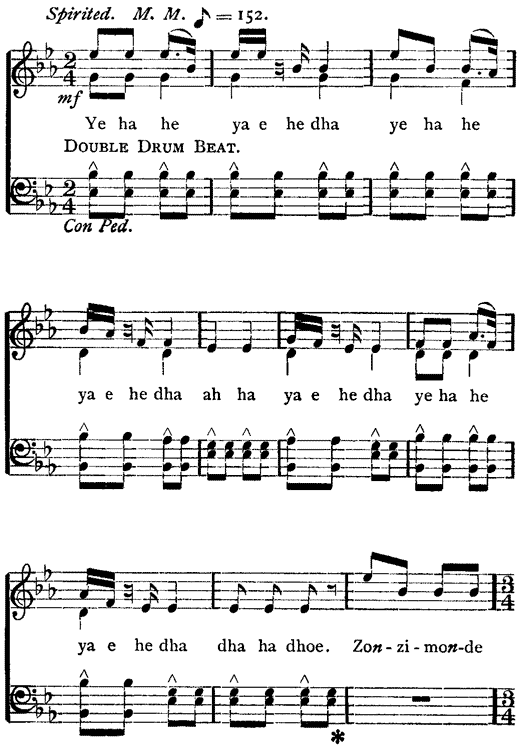
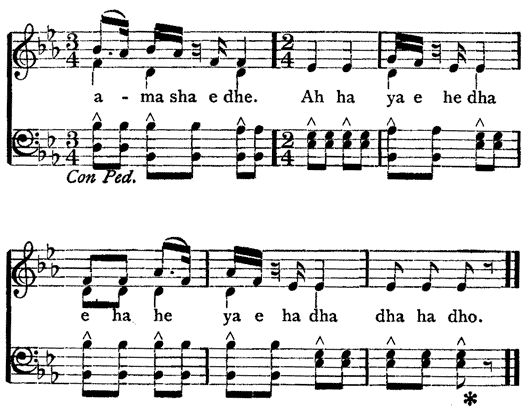
Ye ha he ya e he dha ye ha he ya e he dha ah ha ya e he dha ye ha he ya e he dha dha ha dhoe. Zon-zi-mon-de a-ma sha e dhe. Ah ha ya e he dha e ha he ya e ha dha dha ha dho.
An old Omaha, interested to observe how some of the tribe would conduct themselves in their first battle, made his way toward the scene of conflict. It chanced that just as a Sioux warrior had fallen, pierced by an arrow, and the Omaha men were rushing forward to secure their war honours, this old man was discovered coming up the hill, aided by his bow, which he used as a staff. One of the young warriors called to his companions:—
"Hold! Yonder comes Zon-zi´-mon-de, let us give him the honours."
Then, out of courtesy to the veteran, each young warrior paused and stepped aside, while the old man, all out of breath, hastened to the fallen foe. There he turned and thanked the young men for permitting him, whom age had brought to the edge of the grave, to count yet one more honour as a warrior.[5]
The words of the song give the exclamation of the generous youth: "Zon-zi´-mon-de comes! Stand aside! He comes."