The Battle with the Sand Fleas
Reading edition
The rain had ceased and the sun had swept aside the veil of mist disclosing a glorious panorama of sea and sky. We stepped into our canoe and turned its nose northward.
The sun was setting in a riot of gorgeous colors as we rounded Pinnoch Island and saw the thriving little city of Ketchikan stretching for miles along the waterfront. “Ketch-kaw” the Indians named it, meaning wedged in between two mountains. The harbor was crowded with ships. Great concrete buildings rose against the sky. One by one lights began to flash out from pretty homes crowding hillside and waterfront and were reflected in the waters of Tongass Narrows. As lovely a scene as any famed Venice can boast.
Then the Story Teller broke the long silence.
“It was here that the Thlingets fought and conquered the Tsimpseans. It ended the war that began so long ago that no one can remember. One, two, perhaps three hundred years ago.
“Before that time the Thlingets and the Tsimpseans were brothers. They visited and feasted and danced together. So it happened that two Thlinget princes looked with favor upon a fair Tsimpsean maiden. They quarreled. Their blood relations took up the quarrel. There were angry looks and loud words and much fighting. In one of these fights one of the Thlinget princes was killed.
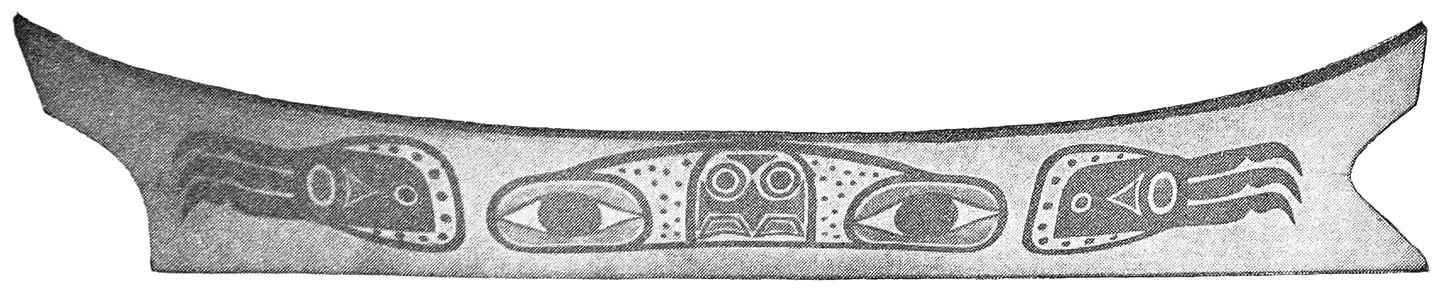
“An Old Indian War Canoe”
“Then the Thlingets hated the Tsimpseans with a fierce hatred because one of their maidens had brought this evil upon them. In those days the Indian believed in an eye for an eye, a life for a life. So they fell upon the Tsimpseans and slew one of the sons of their chief. Then for many, many moons they made war upon each other.
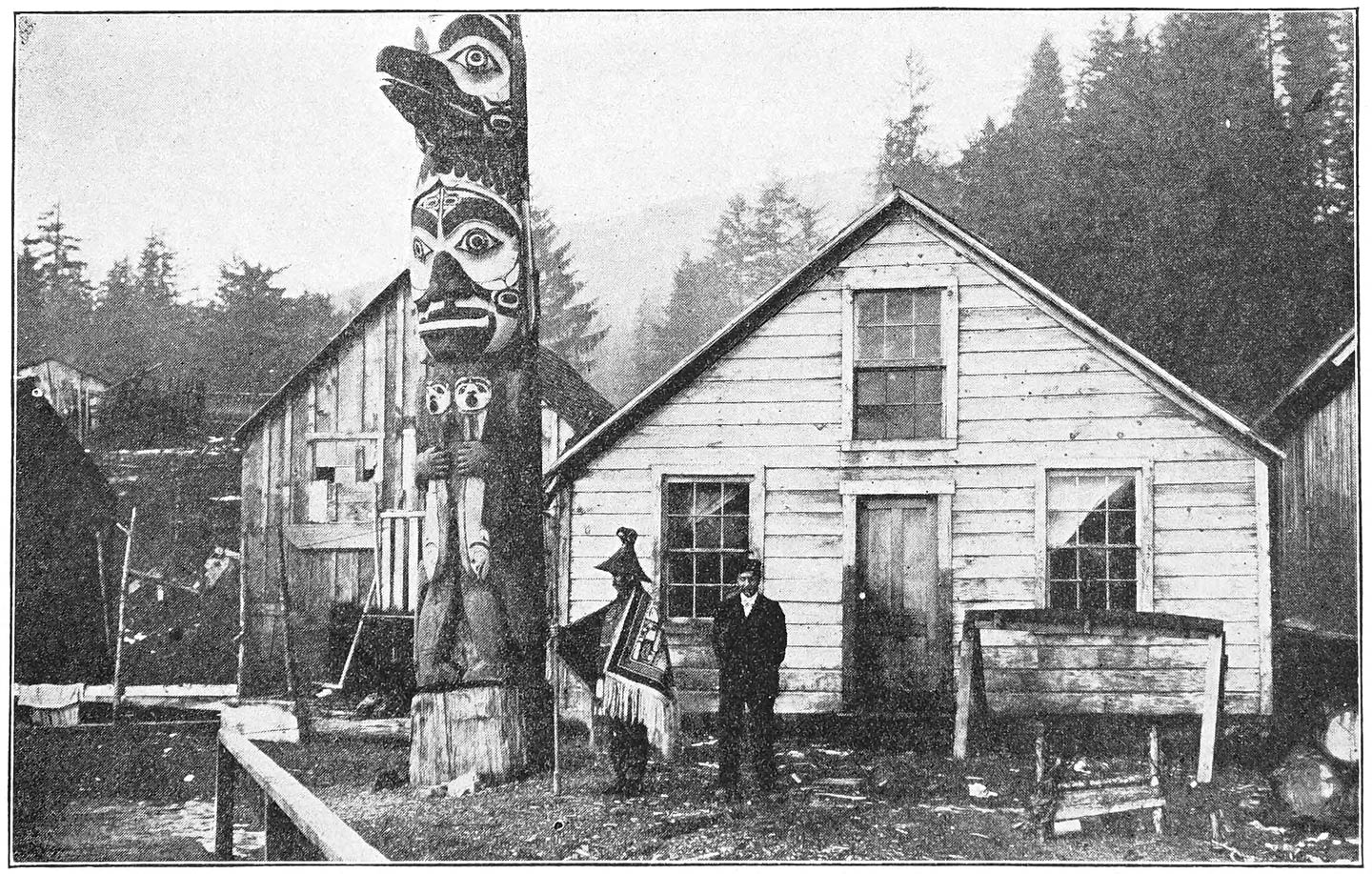
“The Thlingets made a big camp at Ketch-kah. They built three great log forts. One was where Chief Johnson’s lodge now stands.
Courtesy Mrs. F. J. Hunt
“The Thlingets built a fort where Chief Johnson’s lodge now stands”
“The Thlingets called the Tsimpseans Klah-neets (sand fleas) because they would pop up and shoot at them, then disappear in the sand and underbrush, or would steal into their camp and carry off their young men and maidens and make slaves of them. They came noiselessly and were gone, leaving no footprints.
“The Tsimpseans had one small cannon. They had gotten it from the Hudson Bay Company, far to the southward, in exchange for furs. While their enemies slept, they carried the cannon to the top of the hill and fired on the fort. Then a terrible battle was fought. The Thlingets seized their war clubs and fell upon the Tsimpseans with such fury that almost all of them were either killed or taken prisoner. Then the Tsimpsean tribe laid down their war clubs and again lived in peace with the Thlingets.
“But,” said the Story Teller, “my people were still at war with a Thlinget clan that made their camp at Sheet-kah. It started longer, much longer ago than the war with the Tsimpseans. They fought with bows and arrows and with clubs made of bone.
“This was the way the big fight started. Every year my people would take plenty salmon over to Pinnock Island and hang it there to dry for their winter food.
“The Sheet-kah Indians had fine big canoes. They made them of rotten spruce logs, which they hollowed out with sharp stones. Some of them held thirty or forty people. In them they would paddle as far south as Dixon’s Entrance fishing and trading. Once they landed on Pinnock Island and carried off all the salmon they found there.
“That winter was long and cold and there was very little food. The old and many young children died. Then the hearts of my people grew hot with anger. There was a big fight and Chief Nah-goot was killed by Schook-klatch, chief of the Sheet-kah tribe. Then they fight, fight, all the time fight until Captain Cook came. He was the first Pale Face my people had ever seen. Soon the Red Men began trading furs for guns with which to fight each other.
“But at last the great white chief in Washington sent his soldiers to tell the Red Men that they must live in peace with each other. There must be no more fighting.
“Now,” said the Store Teller proudly, “my people live like their white brothers. Our children go to school. We have fine big fishing boats. Our lodges are like the white men’s lodges.
“There,” pointing to where half a mile away a long pier extended far out from the little village of Saxman, “I hope some day to see an Indian village like the white men’s villages, where my people will be able to do all that my white brothers do. Its harbor will be crowded with fishing boats. There shall be canneries and sawmills so our children need not seek work in the villages of the white men. The Indian will no longer be a child. He will be a man.
“But,” the Story Teller ended sadly, “the young look not with the eyes of the old. I dream, but my dreams may not come true.”
[
Contents
]