"A Tale of Love and Heroism" (continued 3)
Reading edition
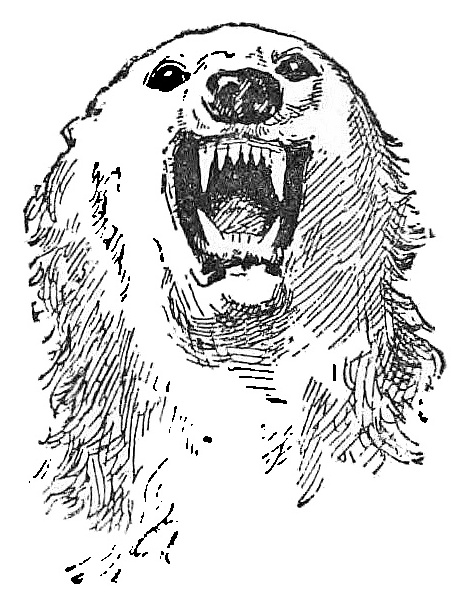
Dr Barrett sprang first though. The monster was within thirty yards of him. He seized boy Bounce’s rifle, and next moment Bruin rolled over the ledge dead at their feet.
“Why didn’t you hit him, you young goose?”
“Cause as ’ow, sir,” said boy Bounce, coolly, “you told me never to do nought ’athout first consulting you.”
“Is it a bear?” said Paddy, rushing to the scene of action.
“Well,” replied the doctor, smiling as he resumed his work, “it is something very like it, Paddy.”
“Sure and it’s meself ought to have killed him, and not that young spalpeen Bounce.”
Boy Bounce smiled and took all the credit, and Paddy at once set about taking Bruin out of his jacket, singing to himself some wild Irish lilt as he did so.
There was one other individual who attached himself to these sleighing expeditions, who had really no business there, namely, the noble deerhound Fingal.
I have no idea what induced him to do so, unless it was to constitute himself captain over the two teams of dogs, and to enjoy good sport among the Arctic foxes, to say nothing of the grand galloping he had.
Fingal used to fly along at the head of the foremost team, keeping well beyond reach, however, of the leader’s fangs and of the driver’s cracking thong. He used to hunt the foxes on his own account all day, and spent his whole night in keeping them off the camp.
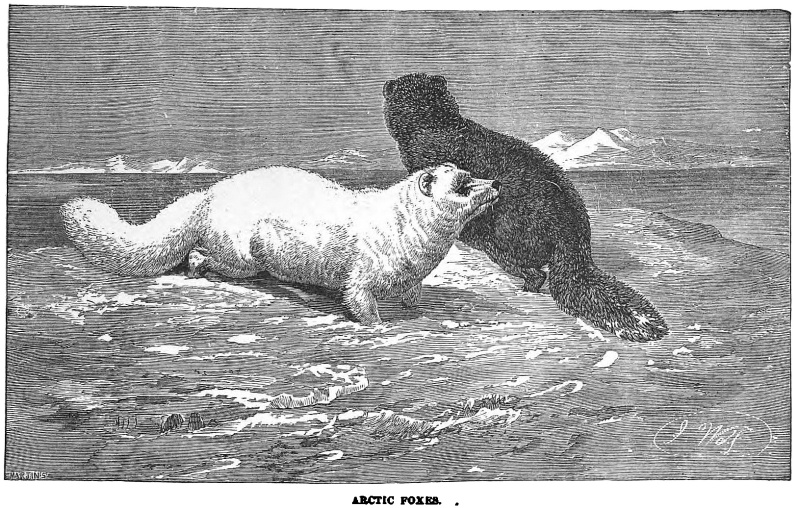
There is no end to the impudence these little animals possess, especially when snow is on the ground. They are then mostly white. I have an idea that, like Scotch hares, they change their colour with the season of the year; at all events, in summer they are of many different hues, and they then keep farther away from the habitations of men.
At night, in snow time, they are singularly annoying. They yelp and yap, and howl and fight, and unless you are very tired indeed, sleep is all but impossible. If you fire at one and wound it, the chances are he will not run off if he could. You march up to club him, and he grins and whines and fawns at you in the most ridiculous manner; in fact, he argues with you. Well, what can you do with a wounded animal who argues with you? You cannot brain him. No, you simply retire, feeling mightily ashamed of yourself for having fired at him.
Wounded monkeys have this same trick, and several other animals I could name.
Camping out by the River Thames in the sweet summer-time, and camping in the shelter of a rock on the snowfields of the far north, are two very different things. The members of Dr Barrett’s sledging parties and the doctor himself slept in the sledges; slept with their bodies in warm flannel-lined bags, with rags over this, and rags right over their heads. Even then it was bitterly, oppressively cold.
The men of the Icebear used to envy Jack and Joe, the Eskimo Indians, who slept on the snow near their dogs with no other covering except the clothes they had worn during the day.
Fingal, poor fellow, never rested by night—if night I dare call it, with the sun ablaze in the sky—he was constantly roaming round the camp doing sentry duty, and keeping off the gangs of foxes. Often a horrid yelling would awaken all hands, and, on looking up, Fingal would be seen shaking a fox as Sarah Jane shakes a mat or a carpet skin.
One evening in May, when the sun was declining, or taking his dip towards the lower part of the northern sky, clouds began to bank rapidly up from the south-west. It had been clear and frosty before this.
It soon grew quite dusk. The clouds were very dense and very black—in great rolling masses that certainly threatened something most unusual.
Dr Barrett gazed with some uneasiness at the gathering storm.
In less than half an hour the sky was entirely obscured, and the wind, which had blown at first as if to place the clouds in position, fell dead. So for a time matters remained, the clouds still in shapeless masses rolling around among each other without any apparent cause. Gradually, however, they lost shape, and the whole firmament merged into one unbroken vault of darkest grey. Then pellets of snow, not bigger than millet seeds, began to fall, faster and faster and faster.
Dr Barrett gave orders for the camp to be made up at once, and supper to be cooked.
The snow-pellets merged into great flakes larger than crown pieces, and it grew darker and darker.
Then there was a thunder-clap that appeared to shake the very earth.
Darker still. What with the gloom of this abnormal night, and the falling snow, the men could hardly see each other’s faces. The thunder was now loud, awful, incessant; the lightning spread all round among the still fast-descending snow. It was lightning of a sort you never see except in Greenland. You are enveloped in the blaze; it is around and above you everywhere—a white, dazzling bath of flame.
Poor Byarnie knelt beside the sledge, and buried his head in his hands. The giant was praying, Paddy crossed himself, and boy Bounce began to cry. Meanwhile the doctor sat on a bundle of bags, stolidly smoking, and Fingal crouched close to his feet; and ever, in the intervals of the thunder-claps and their awful reverberation among the mountains, was heard the melancholy howling of the sledge dogs.
“D’ye think, sorr,” said Paddy O’Connell, touching the doctor gently on the sleeve,—“d’ye think there’s any danger at all, at all?”
“The danger is this, Paddy,” replied the doctor: “the snow is very soft and powdery. We are thirty miles from the ship; and if it comes on to blow, we will never reach her alive.”
“Then, the Lord help me mother and me poor sister Biddy,” said Paddy, piously.
But some time after midnight the thunderstorm retired, growling over the distant hills, and with it went every cloud.
Then oh! to see the beauty of the newly fallen snow, its purity, its whiteness, its stars of many shapes and ever-changing colours of light and radiance.
After two days of a wind that blew steadily from the south, the silence of that great inland sea was suddenly broken.
You might have imagined you were on some great battle-field, there was a constant series of rifle-like reports in all directions, with now and then a louder report, as if a piece of artillery had been discharged. And amid these ominous sounds you could hear, as it were, the shrieks of the wounded and the groans of the dying.
It was the breaking up of the inland sea of ice, and the noise continued for a whole day, and still the soft wind blew from the south.
Chapter Eighteen.
“Summer Comes with one Glad Bound”—Fire!
Spring or early summer is to all a season of hope and joy, but no one who has never lived in the drear cold regions around the Pole in winter could understand or appreciate the glad feeling that is born in the heart when the sun once more ascends his throne and rules triumphant in all the land.
Some reason or other may be ascribed for all religions and forms of worship, even the most heathenish; and I have never been astonished to see a pious Eskimo Indian with his family kneel or throw himself on his face before the god of day, though I have felt sorry for him and for them.
“But yonder comes the powerful king of day, Rejoicing in the east. The lessening cloud, The kindling azure, and the mountains’ brow Illumed with fluid gold, his near approach Betoken glad. He looks in boundless majesty abroad And sheds the shining day, that burnished play, On rocks, and hills, and towers, and wandering streams High-gleaming from afar.”
Summer seemed to come to the rocks and hills around the sea of Dunallan with one glad bound. There were some few days of fog or mist, so dense that it was impossible even to see the point of the jibboom. This fog was, as it were, the curtain of Nature’s great theatre, dropped for a time while the grand transformation scene was being put on the stage behind it.
Then it was withdrawn—lifted, and behold summer on the hills, summer in the glens. Glad streams and cataracts sparkling in the sunshine, the mountain-tops capped in silvery snow, streaks of silver running down their brown, white-flecked sides, but the ground all carpeted with green, which in a few days burst forth into the most charming variety of colours.
The sea itself was scarcely rippled by the gentle breeze that blew steadily from the west; the air was so fresh and balmy that it was a pleasure to breathe it. Everything seemed to feel the touch of the newly come summer, and to rejoice. Flocks of birds of innumerable varieties went wheeling and circling round the ship, or floated on the water; there was music even in their wild glad shrieks.
Many a black head, too, popped up out of the water, some tusked and bearded, some as awful as a nightmare. And seals basked on the sunny side of the rocks, or on the sandy beach; while bears by the dozen and score prowled round, warily watching their chance to spring upon and make prey of these innocents. The bears seemed now to have no fear of man. Nor did they appear anxious to attack any one; they were no longer an-hungered.
The snow awnings were now taken down from the decks, a general spring cleaning was instituted, and, after this, even winter garments were put aside, and the men looked gay and felt happy in consequence. But for all this, the temperature was seldom a degree above 45 degrees; and if ever it reached 50 degrees, the men thought it uncomfortably hot.
Alba, the snow-bird, had pined a great deal during the long, dark winter day, and seldom cared to leave the cabin; but now she went screaming and flying all round the ship as if mad with joy, and hardly could Claude tell her from the other birds of the same genus, only she usually came when called.
Fingal, when not on the war-path, used to lie on the snow-white deck and gasp, with about a quarter of a yard of crimson tongue lolling indolently out of his mouth.
The doctor continued busy as ever, only the sledges were put away, and all expeditions had now to be undertaken on foot.
Very much to Claude’s surprise, they came one day in their wanderings, while a very long way from the ship, on a herd of tiny horned bisons quietly browsing on the sweet mosses in a wild glen.
The strange creatures lifted their heads and sniffed the air as Claude and Paddy O’Connell approached, but it was surprise, not fear, they exhibited.
Claude waited till the doctor and his party came up.
“What are they, in the name of mystery?” asked Claude.
“They are musk oxen, without a doubt,” was the reply; “but I never saw such small ones before. They are dwarfs of their species. Truly this is a land of wonders. There is certainly,” he continued, “no geological reason why these animals should not be here, only—”
“Look here, doctor,” cried Claude, “while you are preaching to Paddy there, I’ll have a shot.”
“By all means, let us have a specimen.”
“And troth,” said Paddy, “we’ll have a specimen for the cook’s coppers, doctor dear, as well as for the good of science.”
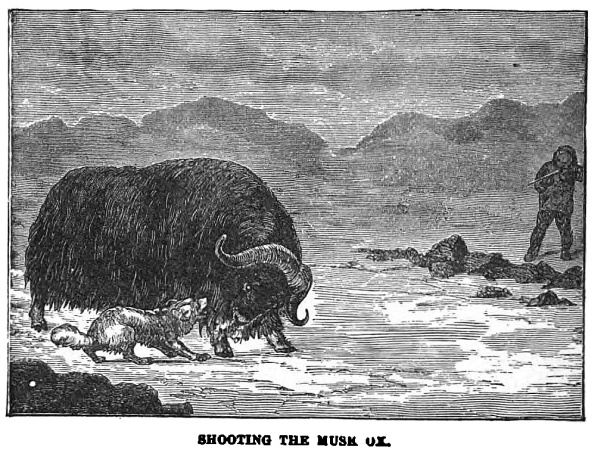
At the very first rifle shot, one of their number bit the dust; but, strange to say, the others fled not. They looked wild and startled, and in dread terror they sniffed at the blood of their dead companion, but they stood still.
Another was shot, and another; then at last there was a wild stampede, not from, but down towards our sportsmen.
Were they charging to take revenge on the murderers of their companions?
Claude thought so. The surgeon knew better.
“Stand aside quickly!” he cried.
Hardly had they rushed a little way up the bank ere the whole herd rolled past.
Paddy had a parting shot, but missed, and looked very foolish.
Fingal could scarcely be restrained from going in pursuit. He thought he could easily pull at least one down, seeing they were but little bigger than Newfoundland dogs.
Deer there were now among the hills in abundance, hares, and a strange kind of rabbit, that even Dr Barrett had never seen before.
On the great lake itself, sport was to be had in abundance. Jack and Joe astonished every one by their marvellous dexterity in harpooning the huge and ferocious bladder-nose seal (Stemmatopus Crisatus), the sea bear (Ursus Marinus), the little Atak, and the walrus himself.
Not from the boats of the Icebear, however, did these wonderful Indians work. No, for they built themselves kayaks, or light canoes, made principally of hide, and so light you could lift one with a single hand or wear it as a hat. In these frail skiffs they would venture for miles out to sea, and they seldom came back without an animal of some kind.
But once Jack came home without Joe.
“Where is Joe?” asked Claude.
“Joe? You asked for my brooder?”
“Yes, your brother,” replied Claude.
“Oh!” said Jack, indifferently, “he toomble up plenty quick. No can turn hims kayak again. P’r’aps he go drown, ha! ha?”
It had never occurred to Jack to go to his brother’s assistance. When taxed with his callousness—
“What for I go?” he replied. “No plenty good. P’r’aps Jack he catchee my kayak, and den we bof on us toomble. No, no, not plenty good enough.”
“Call away the whalers,” bawled Claude.
“Call both away, Mr Lloyd.”
There was a trampling of feet, and a rattling of blocks and tackle, and in two minutes both took the water with a plash.
“A guinea to the first boat that reaches the kayak,” cried Claude.
There was a race on then—a very exciting one, though only to save the life of a poor Eskimo Indian.
The kayak could be distinctly seen from the masthead, with poor deserted Joe clinging to it.
Claude went himself to the crow’s-nest, to guide the boats by means of the long fan used for such purpose by Greenland-going ships.
The poor fellow was at length rescued, very much exhausted.
By the time he had reached the ship, however, what with the warm sunshine and a stimulant the Spectioneer had administered to him, Joe was all right and smiling.
But his brother Jack, as soon as Joe came on board, pointed at him a stern finger of reproof.
“I ’shamed o’ you,” he said. “I ’shamed o’ you proper. You not can turn your kayak, ha! ha! You no true Indian. Suppose one shark snap your two legs off, dat do you plenty mooch good. Bah!”
The summer passed away only too quickly; it passed, but not in vain, for Dr Barrett had done much good for the cause of science; and, reader, science always does or always should bring us nearer to Him who made all things and rules over them by unchangeable laws that He knows are good, whatever we finite beings may dare to imagine.
The summer passed; Claude and all his crew had enjoyed splendid sport. I wish I had space to tell of the adventures they had, some of them wild enough in all conscience. But while enjoying themselves there had been no neglect of duty, with one sad, solitary exception presently to be mentioned.
“I am very glad to say,” remarked Dr Barrett, one evening at dinner, “that I have succeeded in doing about all I believe that our learned friends in England wanted me to do, thanks to your good judgment, Captain Alwyn, in steering us to this wondrous country.”
“And so am I glad also,” replied Claude. He was thinking of home just then. “Let me see,” continued the doctor, musingly, “I have collected quite a museum of specimens of Arctic flora and even fauna. To the lichen world I have, I think, added not a few species hitherto unknown. I have taken observations of every conceivable kind; there is a record of them in my notes. I have, or, pardon me for my egotism, we have discovered coal—that is of little use, perhaps; iron—that exists everywhere; tin—that is more to the purpose; silver and gold, and these are better still. We have also,” he went on, “found the bones of extinct mammals, and the evidences on all sides that at one time the hills around us, or hills like them, were covered with forest and fern, and inhabited by a race of animals that we human beings too often, I think, call inferior. We have, moreover—”
“I beg your pardon, sir,” said the steward. “May I speak to you half a minute?”
The doctor followed him into the steerage.
He soon returned, looking serious and vexed.
“Beast!” he muttered.
“I hope,” said Claude, “there is no one in this ship deserves that title, doctor.”
“Will you come and see for yourself, sir?”
“I will.”
Claude followed the doctor out to the steerage and into the dispensary. There he pointed to an almost empty bottle of brandy.
He said nothing.
“Do you mean me to infer,” said Claude, “that one of my crew has been guilty of a theft so vile?”
The doctor nodded.
“And who?”
“Who but Datchet?”
“Mr Lloyd,” shouted Alwyn, “bring Datchet before me to-morrow morning.”
Datchet was duly punished, Dr Barrett, however, begging mitigation of sentence on the plea that he had left temptation in the man’s way.
Time went on, and everything was got ready for a start. In a few more days the order would be, “Up anchor, and hey for Merrie England!”
All hands were happy. Small wonder at that. It was Friday night. The Icebear would sail on the Monday, the stores having still to be got on board from the house on shore.
Friday night is, in many northern ships, held somewhat en gala, as the day is a salt-fish day, so to-night there was a huge sea-pie cooked for the half-deck officers, and several such for the men forward.
Everything seemed propitious as regards the weather, for though dense fogs had prevailed for a week or two—it was early in August—the sky was now clear and the glass slowly but steadily rising. So the men were right merry. Paddy O’Connell had never appeared to such advantage. The boy Bounce was even allowed to tell a story and sing a London street ballad; while big Byarnie sat in a corner, beaming over with gigantic smiles.
But by ten o’clock sounds were hushed, and all hands in bed fore and aft. There was not now a sound to break the stillness, for the solitary sentry had gone below to smoke by the galley fire.
An hour passed away; then a solitary figure might have been seen creeping aft on hands and knees.
Two hours. The captain is sleeping sound; his hand is over the coverlet. Into this hand a cold wet nose is thrust.
“Go away and sleep, Fingal,” he mutters.
But the dog whines, and finally barks, and then Claude starts up, fully awake now.
See, across the cabin yonder is the reflection of a strange light in the glass!
He springs to the deck and rushes to the door, which is open.
There is fire in the store-closet between his cabin and the wardroom.
Fire in the spirit-store!
Ding, ding, ding, ding, ding, ding, went the bell two strokes to the second.
Ding, ding, ding, ding, and in a minute the whole ship is alive.
Chapter Nineteen.
The Burning of the “Icebear.”
All hands worked steadily, willingly, and well. There was not a sound to be heard, except the roar of the flames, the tramping of feet, an occasional word of command, and the steady clank, clank of the little pumping engine. No noise, no bustle, no confusion on board the burning ship.
The flames had soon gained mastery over the captain’s cabin, and over the wardroom as well, for the fire seemed to spread on both sides.
Claude was walking slowly up and down the deck, ’twixt main and foremast, quietly superintending everything. That he was here, and here only, showed the perfect confidence he had in his men and officers to carry out the terrible duties now imposed upon them.
Smoke and flames were pouring up through the companions aft, and it was evident that that portion of the ship was doomed.
Claude was hoping against hope. Were the cabin and wardroom only destroyed and the fire here checked, the hull and the fore-part of the ship would be but little injured, and the voyage home be, after all, made in safety.
The greatest danger of all rested in the fact that the magazine, containing a very considerable quantity of gunpowder and gun-cotton, lay close to—almost in—the seat of fire, and so quickly had the flames spread that it had been found impossible to remove the stores without the almost certainty of exploding the whole.
So among the first orders given was for a volunteer to carry the end of the hose along the lower deck and flood the magazine.
Boy Bounce was the first to spring forward.
“Can we trust him, Mr Lloyd?”
“Certainly, sir.”
“And I’m so small, you know; I can walk where a big ’un would ’ave to creep, sir.”
The boy seemed a long time gone, but he crawled back at last, and fell senseless at Lloyd’s feet. He was badly burned about the hands and even face, but as soon as he came to himself he went on working with the rest.
Hours flew by, one, two, three; still the fire raged; still the men worked steadily on.
All seemed going well, when suddenly the wind shifted, and almost at the same time the smoke and flames came roaring forward, and one mast caught fire. The crew were driven from the pumps, and for the first time something like a panic spread fore and aft.
It was evident now that the ship could not be saved. All further attempts at pumping were abandoned, and all hands set to work to remove stores.
Unfortunately, two of the boats that hung on davits aft were lost, so that only two remained.
One of these boats was commanded by McDonald, the other by Dr Barrett, Claude and Lloyd determining to remain on board till the bitter end.
How bitter that end was to be no one could have guessed.
All the stores that could, with apparent safety, be got out were landed; the boats were returning to the ship. Claude had calculated that hours must elapse before the vessel blew up, or that she might sink without an explosion.
Orders had just been issued for the men to stand by to embark in the boats with regularity and quietness, when suddenly the after-part of the ship was blown up with fearful violence; masts, spars, deck, rigging, and bulwarks flew skywards, in a fountain of crimson flame.
The sea was covered with the wreckage, and the Icebear began rapidly to sink stern foremost.
“Give way, men,” shouted Dr Barrett. “Give way with a will to the rescue.”
Let the curtain drop over the terrible scene. Suffice it to say that everything that man can do, or heroes accomplish, was done and dared by those in the boats to save their friends and messmates from drowning, and from worse—from being devoured by sharks; but out of all that crew of men, who, only a few short hours before, had been peacefully slumbering, and dreaming, perchance, of home and happiness, only thirty answered to their names that morning in the shore-house.
Some of these, too, were badly wounded, and nearly all exhausted.
Poor Lloyd was among the drowned, so was Warren, the second mate, and both Pipes and Chips had gone to their account.
Big Byarnie had been sent ashore with one of the first boats. He was a giant to work, and did about three men’s duty in unloading. He had taken the sea-birds with him.
Fingal had, dog-like, stayed with his master, and swam all the way to the shore with him after the explosion. Boy Bounce came floating on shore stride-legs on a spar, propelling himself with half an oar, which he had managed to pick up somehow or other.
There was so much life and enthusiasm about Paddy O’Connell, that it is almost needless to say he got ashore.
“Somehow,” said Paddy; but how, he couldn’t remember at all.
A great fire was made in the shore-house, and the men who had been taken out of the water rendered as comfortable as circumstances would permit.
When breakfast had been served and discussed—there was no ceremony now, no distinction between officers and men, those poor mariners in their terrible plight having formed themselves into a little republic—Claude and Dr Barrett went out together.
They walked for a time in silence up and down the beach, Claude hardly daring to cast a glance seawards where the wreckage still was floating.
The doctor was the first to speak.
“This is a sad ending to all our hopes,” he said slowly.
“I cannot as yet realise it,” replied Claude. “My poor men! my poor men!”
There were tears in his eyes as he spoke, tears of which he had no reason to be ashamed.
Dr Barrett pressed his hand.
“I am older than you,” he said; “let me beseech you not to repine. It is almost cheering for me to think that the bitterness of death is past for those dear brave hearts who, remember, Captain Alwyn, died doing their duty nobly and manfully.”
“True, true, Dr Barrett; theirs must be a merciful judgment: but the drunken brute who caused this terrible accident!”
“Stay, sir, stay; he too is in God’s hand. We cannot, dare not, set bounds or limits to His mercy. Let us turn our thoughts to Him, then,” continued the doctor. “We have to submit to whatever is before us. We must pray, ‘Thy will be done on earth as it is in heaven.’”
“Yes,” replied Claude, “but that portion of the beautiful prayer our Saviour taught has always seemed to me more difficult than any other to utter from the heart while in grief or expecting grief.”
“I know it, Captain Claude Alwyn, I know it. There are few kinds of grief in this world I have not tasted the bitterness of. But come,” he went on, “you and I are still the chiefs of this expedition. Let us, even now, bravely face the situation. Let us see how we stand.”
“We are imprisoned in a living grave.”
“Not quite so bad as that, my friend.”
“Well, Dr Barrett, what do you propose?”
“Shortly this. We have still stores on shore here, but we must supplement them Despatch one boat at once; if she returns before the snow falls, well and good. Send her back for a further supply; if the snow falls ere she returns, do not wait, but despatch the sledges across country. As we are about one hundred miles south of the inlet, the sledges will take the short cut, and reach the cave stores in shorter time than the boat can.”
“Good. I will lose no time, and as soon as our poor fellows are buried—”
He paused and glanced seawards. “My dear Captain Alwyn,” said the doctor, “our poor fellows are already buried; that water swarms with sharks.” (Note 1.)
Claude himself went in charge of the boat to visit the Kittywake stores. There would be, he reasoned with himself, about three hundred miles of water to row or sail over. The tide, however, that swept up and down the long creek which joined the ocean to the inland sea, had all the force of a mill-stream. He determined, therefore, to take advantage of that, and on his voyage out to anchor alongside the banks during the flow, and rush onward when the tide was ebbing.
He returned to the camp far sooner than he had expected.
He returned empty.
A bridge of ice and snow had been encountered which, no doubt, extended all the way to the sea.
“And so, even if my poor vessel had not been doomed to destruction, it would have been impossible to get clear this year.” So spoke Claude.
“True, true,” said Dr Barrett, “and now we must depend upon the sledges to bring us supplies from the stores. But,” he added, “it is only right I should tell you what I think, Captain Alwyn—”
“And that is?”
“That they, too, will return empty.”
This melancholy surmise of Dr Barrett turned out far too true.
They waited till the snow fell. Then, in charge of the spectioneer, who had been among the saved, and Mr McDonald, third mate, the sledges set out. As usual, Fingal trotted off with the rest.
Even to those in the sledges, the time seemed long. Their adventures were many, the whole journey a toilsome and perilous one. But the goal was gained at last. There was the signal pole on the cliff top that had been raised to guide the Kittywake towards the creek, but where was the creek itself?
Nowhere to be seen.
It had been frozen over in the winter, and the ravine, at the bottom of which it lay, filled entirely and completely level with snow.
To find or even to guess at the whereabouts of the cave where the stores were buried under such circumstances was quite out of the question. A thousand men could hardly have found and rescued them.
If the time seemed long for those who went on this expedition, it was doubly tedious for those who waited their return.
At last, one evening, about sunset, amid thickly falling snow, Fingal came bounding into camp. Claude knew the sledges could not be far away. All rushed out to meet them. Alas! and alas! for hope seemed to die even in Dr Barrett’s heart at the dire news.
They brought two bears, and these were cut in pieces and stored.
“What is to be done now?” said Claude. “Are we to die like rats in a hole?”
“Not, I think,” was the reply, “without making one last effort to save ourselves. Were it the summer, we could live at all events as long as ammunition lasted, but we have hardly food enough to serve us to spring-time. So I propose that we get ready at once, that we provision the sledges, and make an attempt to reach the semi-Eskimo, semi-Danish settlement of Sturmstadt.”
“It will be a terrible journey.”
“It will, indeed, but both Jack and Joe know the way. I have talked to them. Their people have come on the hunting-path within a hundred miles of this place.”
“For myself, I care not,” said Claude; “but I grieve to think of my poor fellows, perhaps sinking and dying by the way. Would it not be almost better to rough it here through another winter, then, when the snow is gone, to walk the journey? Every day would then be bringing us into a warmer and better climate.”
“No, captain, it would not, and for this one of many reasons. If we take the journey now we can go in almost a straight line, for the creeks and streams will be frozen over in a few days. In summer we know not what détours we might not have to make, what streams or rivers to ford or even swim.”
“I will be guided by your experience,” said Claude.
Early next morning, outside the wooden tent, Paddy O’Connell and boy Bounce were heard talking together loudly and excitedly.
“Is it true what you’re telling me, and sorra a word av a lie in it?”
“Which I walked all the way over, and ran all the way back to see,” was the boy’s reply.
“Och! bladderips!” roared Paddy; “och! the thieving spalpeens! Bad cess to them evermore. Sure if I had them I’d break every bone in their durty bodies. I’d murder every mother’s son or the two o’ them.”
He entered the tent as he spoke.
“I know what you’ve come to say, Paddy,” said Claude: “the Eskimos have taken the sledges and deserted us.”
“True for you, sorr,” said Paddy. “It’s all up wid us now, sorr. Sure I could tear me hair and cry; and it isn’t for meself either, sorr, I’d be after crying, but for me poor mother and Biddy.”
“This is, indeed, terrible news, doctor,” said Claude.
The doctor whistled a few bars of an operatic air thoughtfully before he made reply.
“It may be all for the best, you know. Hope, sir, hope, hope, hope.
“‘Hope is a better companion than fear; Providence, ever benignant and kind, Gives with a smile what you take with a tear. All will be right; Let us look to the light. Morning is ever the daughter of night. Cheerily, cheerily, then, cheer up!’”
Note 1. The Scymnus Borealis. Some of these monsters obtain a length of nearly twenty feet, and at certain seasons of the year the sea in some places swarms with them. They are gregarious, and never fail to appear when men are drowning or seals being killed. They are terribly fierce and voracious.
Chapter Twenty.
Sorrows Never Come Singly.
However cheerful Dr Barrett might try to appear, he was far from feeling easy at heart.
Hopeless he was not. He had seen too much of the world—the wide world, I mean—he had faced too many dangers not to know that there is seldom or never real reason to throw up one’s arms in despair.
But it behoved him to assume an air of cheerfulness, even under the distressing circumstances in which he and his companions were now plunged. The survivors of the unhappy Icebear were all his patients, all his charge and care, and he well knew the depressing effects of despondency, so he determined to do his duty, and keep up their hearts if possible.
“Give the men something to do,” he said to Claude on the same morning the news of the desertion of the Eskimos had been brought to camp by busy boy Bounce.
“I’ll overhaul stores to begin with.”
“Good?” said the doctor. “And during the time yen are working I’ll get on the top of the bench and play the fiddle to them.”
It may seem a menial kind of duty for a surgeon to fiddle to a ship’s crew; nevertheless, duty it was, and the doctor did it.
And the men were pleased; the gloomy shadows left their brows; their eyes grew brighter; they even laughed and joked a little as they worked, and I’m quite sure they got through the task in half the time.
A good dinner followed. The cook, poor fellow, had been drowned, but he found a worthy successor in busy boy Bounce.
Boy Bounce to-day had made some excellent pea-soup. It was a good thing for these unfortunate sailors that this house and camp had been built on shore, and that it contained all the necessaries for cooking, etc, that they were likely to want. After the soup came preserved potatoes and pork, to say nothing of a delightful frizzly relish of young seal’s liver. Then all felt happier and more hopeful.
There would be at least a whole month of daylight yet, though every day would be much shorter than its predecessor. Then light would leave them, and merge into the long, long Polar night.
As long as there was anything like a day, the men were employed fishing and hunting. The bears had not yet left, and sometimes a deer was met with. Why some of these animals should occasionally be left behind the migrating flock is a great puzzle. Are they too delicate for the journey south, or are they left behind for punishment?
The bears that meant remaining were already seeking holes and caves.
The doctor knew their tricks and their manners, and had every likely hole and corner searched, often by torchlight, and several fine specimens were thus unearthed.
The brutes always showed fight, and some fierce hand to hand encounters (if I may so name them) were the consequence.
But the days grew shorter, and, despite all that Dr Barrett could do, a gloom settled down on the minds of the men that nothing seemed able to dispel. Even Paddy O’Connell himself lost heart.
“Och! sure,” he said one day, “it is our graves we are in already, and it’s little use there is in trying to prolong our existence.”
Dr Barrett took him aside.
“Paddy,” he said, “you must help me to keep up the men’s spirits. I depend upon you. I am doing my best. Help me. Will you?”
The tears rushed to the good fellow’s eyes.
“Doctor dear,” he exclaimed, “I’d lay down my life to plaze ye, and it’s the truth I’m telling you.”
“Well, my good honest fellow, there needn’t be any laying down of lives, only just you keep up your heart, and I’ll lay a wager the men will be merry enough, and that is half the battle. I will not conceal from you, Paddy,” continued the doctor, “that there is a hard struggle before us, a struggle perhaps for bare existence, but with God’s help we’ll get through it and conquer.”
“’Deed, then, and well try, sorr.”
“Yes, Paddy; and if the worst comes to the worst, we have but once to die, you know.”
“True for ye, sorr. I never heard of any one dying twice, sorr.”
“No, Paddy. And now you are my assistant—aren’t you?”
He extended his hand as he spoke, and Paddy grasped it with the grip of a vice.
But Paddy did not speak, because there was a big lump in his throat. Only from that moment the doctor and he understood each other.
Another faithful fellow whom the doctor greatly depended on was Giant Byarnie.
So now, virtually, the four heads of the expedition were Claude, the doctor, Paddy, and Byarnie.
They used to hold little meetings by themselves, apart from the others, and talk together of their prospects.
“If everything goes fairly well,” said Dr Barrett one day, “what with rigid economy and no waste, we will manage to weather the winter, be it ever so hard.”
“What say you to bear-steak, Captain Alwyn?”
“Delicious, I’m sure, with hunger as sweet sauce.”
“Well, we can have that in abundance, and we have, or can have, fish all the weary winter. The biscuit is scarce, but we have peas, and—”
“And tobacco, sorr,” put in Paddy.
“Right you are, Paddy. For that we ought to be thankful indeed.—What I lament most,” continued the doctor, “is that our casks of cabbage have gone bad, and that we have saved no lime-juice from the burning ship. However,” he added more cheerfully, “let us keep our minds easy, and hope for the best. How are the birds, Byarnie?”
“In fine wing, sir, the two that are left, for one died, you know, sir. But these are the strongest two, and were Miss Meta’s favourites.”
It was determined to start them both—both to bear the self-same message.
Claude would not willingly have brought a tear to Meta’s eyes to own a throne, but it was agreed between the doctor and him that the best plan was to tell the whole truth, to hide nothing of the terrible extremities to which they were reduced.
And Claude took his advice, and with that message of love which those strong-winged birds bore away south with them, was something like a farewell, a long farewell, and a fear that, on earth, he—Claude—would never meet his love again.
“I think I can face death more bravely now,” said Claude.
“And I too,” was the reply.
It will be seen that even Dr Barrett lacked the complete hope of being able to fight against the fearful odds before them.
The men were set to work at the mines, but they did so with very little heart indeed.
What is the good, they said, of slaving here like coal-heavers, for gold that can never benefit either ourselves or our families?
Faddy came to Claude as spokesman.
Claude himself went personally to the men. He assured them that every nugget of gold they found would be their own; that they were now shipwrecked mariners; that they were to some extent, therefore, free agents, and could, if they chose, throw over allegiance to him, their former captain.
“No, sir,” the men cried, “we will never do that. We have lived together happily and cheerily enough, let us die together.”
“Who talks of dying?” cried Paddy O’Connell. “Sure we’ll never die at all, at all. Is it because the winter is with us, and darkness all around us, that we’d go and cry like a choild that has been sent to bed widout a light? Troth, men, it’s meself that’s ashamed av ye entoirely. Won’t the sun come back and shine down on us wid de blessing o’ Heaven in a few or three months? Then won’t we take our guns under our arms and go marching thro’ the country as bould as Inniskilling Dragoons? And won’t there be such sport and such fun all the way south, as you never had the loikes of before? And sure, won’t we reach the say at last, and go off in some ship or another to England and Oirland? And och! won’t our wives and sweethearts, if we’ve got any, be glad to see us just—the darlints that they thought they’d never see in loife again, because the big whales av Greenland had eaten them up? And sure, won’t me own dear mother, and Biddy my sister, and the pig, the crayture, go wild wid the joy that’ll be on to them when they see their Patrick march in at the door again! Hooch! hurrah! it’s myself that’s as happy as a king wid the thoughts av it all.”
Paddy’s speech had even greater effect in keeping up the men’s spirits than had Claude’s. They resumed their work more cheerfully, and Paddy constantly led them with song or with joke.
Lectures and concerts were resumed in the wooden tent, now their sole abode. But the singing lacked spirit, and the dancing was nil.
They say that sorrows seldom come singly. It appeared even now, in December, that the proverb would hold good in the case of those forlorn mariners. For the winter turned out to be one of awful gloom and darkness.
The aurora, that shone with such radiance the winter before, now showed only occasionally, and that only as a faint white glimmer among the clouds. No moon or stars were ever seen.
Sometimes, for a week at a time, the snow fell and the wind raged with such fearful and bitter force as to preclude the possibility of any one ever putting his head beyond the threshold of the door on pain of instant suffocation.
At such times it taxed all the energies of Claude and the doctor, and even of Paddy himself, to keep the men from sinking into utter despondency.
Even Fingal, and Alba the snow-bird, seemed to partake of a portion of the general gloom. Fingal lying quietly in his corner, dreaming, perhaps, of the bonnie heather hills of Scotland; and Alba, with drooping wings—her head under one—perched over Claude’s couch.
Chapter Twenty One.
A Terrible Time—The Doctor’s Dream—The Wondrous Mirage.
It was the month of mid-winter. Sickness had come at last; the sickness that is born of privation and absence of vegetable food. The younger and more weakly of the men were first to succumb. They lost heart, felt weary, tired, depressed. They refused to work. Even Dr Barrett could not find it in his heart to force them. They grew pale and thin, even to emaciation, and their dilated pupils glittered on their sunken eyeballs.
Their stronger companions tried to cheer them, ay, and many a time went without food themselves to give it to them.
One dropped dead, and was carried away and buried in the ice-hole. “Buried by the light of glaring torches,” buried at sea you may call it,—a sailor’s funeral, but what a sad one!
It was Magnus Jansen, a fair-haired Shetland lad, who had been a great favourite with his messmates, owing to his kind and gentle nature and his ever willingness to oblige.
“We commit his body to the deep,” read Claude, “looking for the resurrection, when the sea shall give up her dead;” and more than one horny hand was raised to brush away a tear, as with deep and sullen plash the body sank into the sea.
Two more died in a week—died apparently of utter despondency and weariness.
“I shall soon see the light,” were the last words of one of these. He just smiled faintly, and passed away.
Three more in a fortnight.
They nearly all seemed to go in the same way, of utter debility and hopelessness.
Byarnie was nurse-in-chief. He was always with them to the last; the great giant kneeling down beside their pallets, and breathing in their dying ears words that it is to be hoped often deprived even death of its victory.
More than one died leaning against Byarnie’s broad breast. I have already said that Byarnie’s big fat face was far from handsome. Ah! but it was so honest; and had you seen him there by the bedsides of those dying sailors, you would have said that his face shone at times with almost a heavenly light.
Another, and still another, was borne slowly away to the ice-hole.
Then it seemed as if Death was for a time satiated, and had claimed victims enough.
For almost the first time this winter, the sky cleared, the stars shone like emeralds through the frosty glow, the moon put in an appearance, casting long shadows across the snowfields, from those who walked out.
There was the aurora, too, a brighter display than any one ever remembered witnessing. Away in the north, and overhead, the ever-changing colours shimmered and danced in a way that was magical, marvellous, and it seemed at times that you had but to put up your hand and touch the broad fringes of light that danced and flickered before your eyes.
The sight of the sky evidently gave the men some heart, some hope.
But after a week the stars and aurora disappeared, and the darkness of a Polar night once more descended on the scene.
With so many ill, with so many dead, it would have been but a mockery now to venture on anything approaching to gaiety or merriment. Even Paddy felt that; and though, like boy Bounce, ever earnest, and energetic, and kind, he went about his work quieter and more subdued than probably he had ever been in his life before.
Instead of lecturing, Dr Barrett used in the evenings now to read books to his people; often books of a religious character, though not of the gloomy kind, but rather those that spoke of a Father’s love, and carried the thoughts away and away to that bright land where there shall be no more sorrow or crying.
One morning in March, Dr Barrett appeared more than usually cheerful.
There were now so many sick that hardly could those in comparative health attend to their wants.
“I’ve had a dream,” the doctor explained. “No,” he added, smiling, “I shall not tell you what it is. You will know by-and-by, for my dream may not come true. Byarnie,” he said, “I’m going mining after breakfast. The morning is still and fine, and there are a lot of stars out. Bring tools and a few men with you.”
“Going mining?” said Claude, in some surprise.
“Yes, mining, captain; but not for gold this time, but for what is ten times more precious—for health. Get ready, Byarnie, and we’ll want torches, as well as a bucket.”
“You excite my curiosity,” said Claude. “May I go along with you?”
“You’ll do me pleasure.”
Straight along the south coast of the inland sea went Dr Barrett, Byarnie following up with his men. For more than half a mile he trudged on without looking either to the right or left. Then he stopped just under a cliff, or rather a rounded braeland.
“Now, men, clear away the snow from the ice close to the edge.”
“I think it was here I saw them in my dream,” he added, turning to Claude.
“I’m all in a fog,” said Claude.
The snow was not very deep, and the ice was soon cleared.
“Now light up your torches, and you other men smash the ice and clear a big hole. No fear of drowning; the tide is well back.”
This was a more difficult task, but it was accomplished at last, all the more easily because there was no water beneath.
“See anything down there?” the doctor asked of a man who had just lifted up a huge piece of ice.
“Only a thickish kind of seaweed, sir.”
“All right,” cried the doctor, quite jubilant now. “Fill this bucket with it.”
This was done, and soon the whole party reached camp again.
“I am to be blamed,” said Dr Barrett, “for not thinking of this marvellous seaweed before. It contains potash in abundance, and while mosses of all kinds are frozen to death on the hillsides, this, you see, survives. Our poor fellows, now almost dead of the scurvy, may yet revive.”
Not only those who were sick, but all hands partook of the esculent weed. The sick revived, those in health grew brighter, calmer, and happier.
“If our food holds out, I think we may now weather the winter,” said Dr Barrett.
“I sincerely trust so,” said Claude, “and that we may all be well to commence the march.”
It seemed, however, that fate had still further affliction in store for them, for one day Byarnie came to the doctor, and very sad he looked.
No less than two casks of meat were found almost putrid, and the store of bears’ flesh had also gone bad.
This was indeed terrible news.
When the third and last cask was opened it was found like the others, unfit even for the food of starving men!
Tinned meat was all they now had to depend upon, and there was very little of that; so they must go on short allowance at once.
The men were far less cheerful after this, and the summer, that but yesterday had appeared so near at hand, was now apparently an illimitable distance away.
Another expedition was made to the caves among the hills, in the endeavour to find another bear.
All in vain.
Hope now sunk in every heart. Even the doctor himself, who had struggled so long, began to feel that the time was not far distant when he too must succumb, must lie down and—die.
It was April, another month, another long, long four weeks—and early summer and sunshine would come and bring back with them the birds—the grebe, the auk, the wild duck and guillemot.
Two more had been added to the list of the dead.
The boy Bounce fell ill.
“We are not going to let the boy die,” said one of the men. “It is food he wants. Let us make a subscription.”
The subscription was made. Everybody gave a morsel of something for the poor boy, and his allowance came to be double instead of half Big Byarnie even gave up his blanket, and just slept a little closer to the fire and hugged Fingal.
Poor boy Bounce lived, and began cooking again, though in this matter, unfortunately, his labour was not now very arduous.
Claude was looking very pallid and worn; he did not speak much, he suffered in silence. The men would have fain had their captain to live better than they did, but he would not hear of such a thing. Besides, he gave away a goodly portion of his meagre allowance to poor Fingal.
For Fingal was ill.
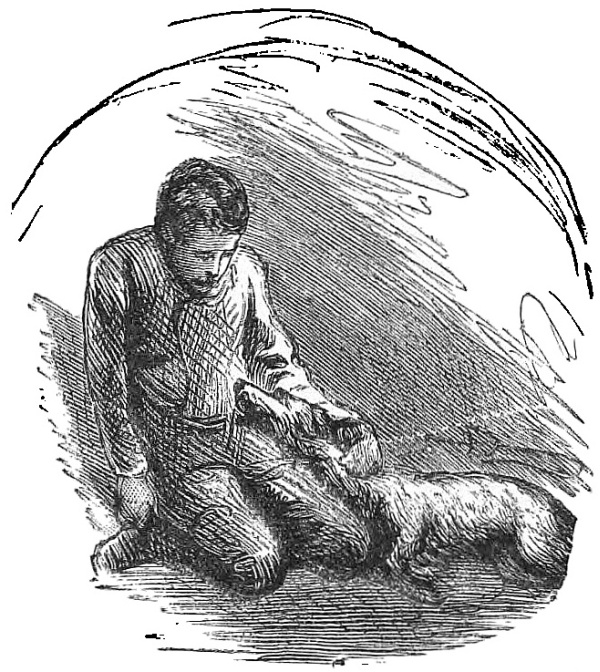
Indeed, Claude knew that Fingal was dying, and the faithful old fellow appeared to know it himself. One day the hound was very much weaker, very much worse, and Claude knew the end was very near. He was sitting by the couch on which the dog lay. Alba, the snow-bird, jealous perhaps of her master’s attentions to Fingal, came and perched upon his shoulder.
Claude took the bird in his hands and slowly rose to his feet.
“For once, Alba,” he said, “I must send you off.” Then he handed her to one of the men. “Take her to the aviary.”
This was all he said. But he went back and knelt by Fingal’s bed.
Why did he put the bird away? Those of my readers who love dogs will understand and appreciate his reasons: there was always a slight rivalry between the bird and the dog, and Claude would have grieved to let Fingal in his last moments feel that aught stood between his master’s heart and his.
As Claude returned, Fingal recognised him. He attempted to rise, tried even to crawl towards him, and in doing so fell. Claude raised him—how light he was!—and replaced him in the softest part of his couch. Then he sat beside his dying favourite with one arm over his shoulder.
Fingal knew he was there. He fell quietly and gently asleep.
It was that sleep from which nor dogs nor men ever awaken.
The time rolled drearily on, and at length the sun rose, and the days got rapidly longer and longer; but starvation had done its work.
Not that more died, but several were down with sheer debility, all were weak and poor, Claude could no longer stand.
Paddy O’Connell held out, so did Byarnie and the doctor, but the latter was quieter far than of yore. “The sooner,” said Claude, one day, “the sooner, doctor, it is all over the better.”
One day from the hill-top, Byarnie saw a sight which suddenly struck him with fear and trembling, and sent him on his knees to pray.
Away in the southern sky, some distance above the horizon, was a wondrous vision.
It faded away at last, and then Byarnie hurried off to the camp, his clothes wet with the sweat of fear, to report the matter to the doctor.
“It is all over with us,” he said, “for I have seen a wonderful vision, even as Ezekiel did in the days of the olden time.”
“Have you been dreaming?” said Dr Barrett.
“I have not even been asleep,” replied Byarnie. “I was there on the mountain-top alone, when suddenly in the sky there appeared before my sight this vision, as of men and sledges and dogs moving rapidly across the sky, among the very clouds.”
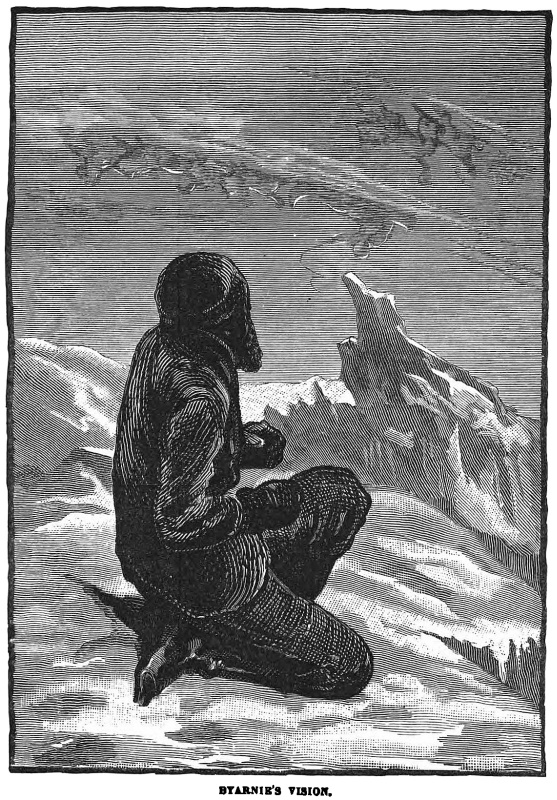
“Were they all head-down?”
“They were all head-down,” said Byarnie, “which makes the awful vision still more wondrous strange.”
“Bless you, Byarnie, for this news,” cried the doctor. “Hurrah! Byarnie, we are saved! we are saved! Be they Indians, be they savages, they are coming, and we are saved. What you saw, my faithful fellow, was a mirage.”
Chapter Twenty Two.
Meta’s Strange Adventures.
We are back once again in Meta’s cottage in Iceland. There is but little change here since the day Claude bade his betrothed a long farewell.
It is evening. Yonder by the fire sits one of Meta’s aunts, working away at her “rock and her reel,” as she seemed always working, spinning, spinning, spinning.
Meta near her, with her zither. She had been playing, but her fingers now lay listlessly on her strings, only now and then some sweet wailing notes and chords were brought out as if the hands were en rapport with her heart.
“And you really say you saw him in your dreams, dear auntie?”
Whirr—whirr—whirr, went the wheel.
“I saw him,” replied the kindly but ancient dame. “I saw him. I can see him now as I saw him in my dream. He is lying on the ground, and his face hardly less pale than the snow.” Whirr—whirr—it—it. “Oh, auntie, don’t frighten me, dear!”
“But kindly men are kneeling by him. They raise him. He revives. The blood returns to his cheeks. He will live!”
“Bless you, auntie, bless you!” Whirr—whirr went the wheel. The snow-flea in his cage twittered fondly. The raven on his log, which he seemed never to leave, stretched himself a leg at a time, then both wings at once. He was very old, that raven, and Poe’s looked not more weird, and—
“His mate long dead, his nestlings flown, The moss had o’er his eyrie grown, While all the scenes his youth had known Were changed and old.”
Meta plays now; she is more happy. Her aunt has given her hope.
But somehow she does not play long; she is easily tired now, so she rises and lays aside the instrument, then stands by the window to watch the snowy mountain peaks changing to pink and to purple in the sun’s parting rays.
Summer has fled from the Norland hills. The songbirds have gone—the martin, and woodlark, and robin; the wild flowers have faded—the blue geraniums, the pink-eyed diapensias, the daisies, and the purple wild thyme; only the green of the creeping saxifrage bedecks the rocks, and hardy sea-pinks and ferns still grow in the glades and by the brook-sides. But autumn winds sigh mournfully through the leafless birch trees and drooping willows, and rustle the withered leaves of the wild myrtle on the braesides.
With a sigh Meta turns away from the window.
Almost at the same time there is a knock at the door, and Guielmyun, brother to Byarnie, and, like himself, a giant, rushed in.
“The bird, the bird?” he cried, “he is—”
But Meta heard no more. Next minute she was standing by the cage.
Panting, ragged, and wretched-looking and dripping wet was the messenger that had flown so far; but oh, bless it! it bore the little quill that contained the missive of sadness and love.
There was no more weariness in Meta’s looks now, but stern, firm resolve.
“I’ll save him if I can,” she said.
“A young lady in the study wants to see me?” said Professor Hodson to his neat-handed waiting-maid. “Bless my heart, what a strange thing!”
But stranger still, five minutes after this the good old professor was sitting opposite this young lady, and had given orders that no one should come near the door till he rang the bell.
“Dear me, my dear, de-ar me!” he was saying; “and you really tell me that a sea-bird carried this message all the way from the icy north? But there, there, I see, it is his own handwriting. And yours is a strange, not to say a sad story. But it will all come right in the end—perhaps, you know.”
“Oh, sir!” cried Meta, “you will make some effort to save him? You will not let him die in those terrible regions of gloom and desolation?”
“Gloom and desolation, dear? Yes, yes, to be sure, you’re quite right; they must be somewhat gloomy and desolate. No morning paper, no morning rolls or hot toast. Well, well, we will see in a day or two what can be done. The Kittywake, too, she has been posted long ago a lost ship and the insurance paid. But even she might turn up, you know. I only say she might. Stranger things have happened.”
Meta took the professor’s soft white hand as she bade him good-bye in the doorway, and touched it reverently with her lips.
“Good-bye, my dear, good night. You’ve got nice lodgings? Yes, I think you said you had. Good night, good night. God bless you.”
The savants are assembled in the largest room in the professor’s house—a room where lectures are often given and wonderful experiments made, but a cosy room for all that, with two great fires burning in it, and a soft crimson light diffused throughout it from the great candelabra.
There is a stranger here to-night—a stranger to us, I mean—a man about fifty, a sailor evidently, from his build and bronze. He is very pleasant in manner and voice; his face is handsome, and his smile strikes you as coming directly from the heart.
They had been dining; the walnuts and wine were now on the table, and conversation was at its best.
“Well, gentlemen, I shall call the young lady, and you shall hear the marvellous tale from her own lips.”
Somewhat abashed at first to find herself in such august company, and in a room more beautiful than anything she could ever have dreamed about, Meta was soon reassured by the professor’s kindly voice. He sat beside her, and held one hand in his.
Then she told her story, as she had told it to Professor Hodson in his study. She hid nothing, kept nothing back, told all the truth, even about her love and betrothal to Claude, talking low but earnestly, as innocently as a child repeating its prayer by its mother’s knee.
There was no more eager listener than Captain Jahnsen, the sailor I have mentioned. As long as she spoke his eyes were riveted on her face, sometimes he even changed colour in his seeming excitement. When she had finished, he stood up.
“Gentlemen,” he said, “I have been all my life a man of action, not of words; and now what I have to say must be said briefly indeed. For the last many years I have been a sailor and adventurer combined. I have dug gold, ploughed the sea, and searched for diamonds; not unsuccessfully, as you are all aware. For years and years previous to that I was a Greenland sailor, not hailing from any British port; not sailing in beautiful barques or full-rigged ships, but in an open boat from Lapland. What made me so? Fate. I once commanded as splendid a little craft as ever sailed the sea. I had on board my wife and my child-daughter. I was wrecked—a sailor’s luck, you say, but mine was a sadder one than falls to the lot of most sailors. My dear wife—ah! gentlemen, the memory of that terrible night almost unmans me even yet—was killed in my arms by a falling spar; my daughter was swept away. Two sailors and I alone were saved by a Lapland walrus boat. We lay-to for hours. No sign of life was visible; again I dropped insensible; I was ill, mad, raving for weeks. Yet calmness and peace came at last. But never more dared I go near that awful coast. To me the very memory of it and of that night has ever been like a nightmare.”
“Where were you wrecked?” asks Professor Hodson.
“On the Icelandic coast, north of Reykjavik.”
Meta has turned suddenly pale, and her eyes fill with tears.
She timidly advances. “Father,” she murmurs.
There is no wild excitement; no melodrama. Captain Jahnsen stoops and kisses his daughter’s brow.
“I’m sure, dear Meta,” he said, “we’ll love each other very much.”
Yet, though lacking melodramatic effect, the scene was touching in the extreme.
Poor Professor Hodson! he was fain to wipe his eyes.
“Dear me, dear me, dear me!” he said, in his quick, sharp way of speaking, “I never thought that I would shed tears again in my life. Dear me, dear me!”
“Now, my child,” said the professor to Meta next morning, “I’m going to ran down to Dunallan Towers, and see her ladyship. No, as you wish me not to, I shall never breathe your name. Good-bye; keep up your heart. I’ll do the best I can.”
Yes, Lady Alwyn was at home, and would see Professor Hodson.
And presently she enters.
Very handsome yet, very stately, very sad withal. She beckons the professor to a seat. “You may not guess what I have come about?”
“Yes, I can,” she says. “You bring no news of my son, but you think of sending a search-party out?”
“That was mooted between my colleagues and me.”
“Professor Hodson, I fear—indeed, I know—I shall never see my son alive or dead again. I live but to mourn for him. I live but to repent the harsh words that drove him from my door—from our door—my boy’s and mine. To see his poor pet dog following him with downcast head; to see even the bird fly away; I— Oh, Professor Hodson!”
Here, woman-like, the poor lady burst into tears, and the tender-hearted professor feels very much inclined to follow suit.
“We may find him yet?”
“Oh! is there a hope, a chance?”
“There is, and we can but try. We have thought of fitting out a yacht.”
“There is his yacht—his own yacht. Take it, and welcome. If not strong enough, do everything for her. And, professor, all the expense must be mine. And I, too, will sail in her in search of my boy.”
“Your ladyship, I—”
“Deny me not. I will not be denied.”
“Your ladyship little knows the danger—”
“Talk not of danger. I’ll be happy every day to think I am braving the dangers my boy has braved before me. Professor Hodson,” she says, after a long pause, during which the savant has been musing on many matters, all of which revolve round Meta—“Professor Hodson, I feel younger, happier since you have come.”
“Your ladyship, then, must not be gainsaid. Well, I will accept the terms you so generously propose. We will at once fit up the Alba. All things promise well. We have in Captain Jahnsen a thorough gentleman, a sailor, and one who knows Greenland well. He has a daughter, too, who has been to sea. Might she not—”
“Oh yes, yes, if she would but come. She would be a companion to me and I to her.”
“Well, well, well. We will consider it all arranged.”
The professor rubs his hands, and laughs a joyous laugh; and the lady, rising, smilingly leads the way to the room where they lunch together.
The Alba is at sea. It is a lovely day in the first week of April. Well off the last of the Shetland Isles is she, and bearing west with a bit of northerly in it. Not steaming, though she has been fitted with engines, and can boast of a funnel elegant and pretty enough for any one to admire.
No, not steaming, for there is a ten-knot beam-wind blowing, and her sails are outfurled to it. White they are, and whiter still they look in the spring sunshine.
The decks are white also, and the very ropes, so neatly coiled thereon, are swirls of snowy-white. Everything about this natty yacht is neat and trim. The capstan is of polished mahogany, the binnacle is fit to be a drawing-room ornament. Whatever ought to be black about her is like polished ebony, and the brasswork shines like burnished gold.
On the deck sit two ladies. One, the elder, leans languidly back in her cane chair; the other—it is Meta—is sitting on a footstool at her knee, reading aloud.
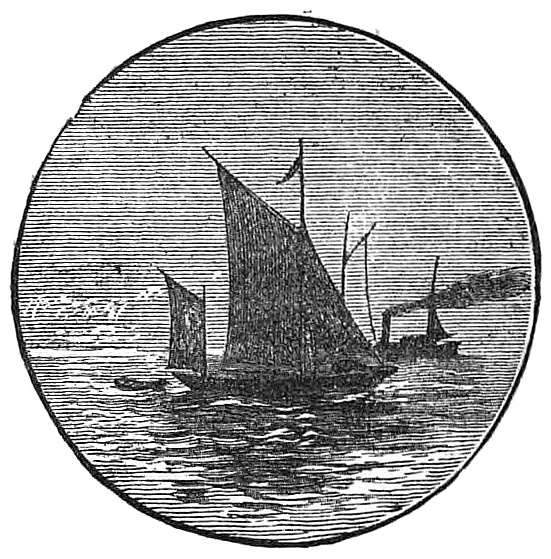
A sailor would say the Alba is a trifle down by the head; only a sailor could notice it. The Alba is heavily fortified with wood and iron around and between the bows. But all water and stores will first be used from the foremost tanks, then she will ride the waves like a sea-bird.
How delightful the breeze! how pleasant the sunshine! and the Alba herself appears to feel the importance of the charge she has on board of her, and is proud in consequence. She nods and curtsies to each passing wave, kisses some, turns coyly away from others, and altogether behaves as if she really were the thing of life the sailors on board half imagine she is.
“So gaily goes the ship, When the wind blows free.”
Chapter Twenty Three.
An Adventurous Voyage—“They’re Coming! They’re Coming!”
From the very day on which Lady Alwyn stepped on board the Alba, and joined the search for her lost son, and for tidings, however meagre, of the good ship Kittywake, a new life seemed to spring up within her. She seemed at once to have lost what she did not hesitate to call her narrow-mindedness.
She began to see that all the world were brothers and sisters, and dependent upon each other, not only for comfort, but for happiness itself. She herself in her pride and exclusiveness had never really known what happiness was before, because she had never been free. Accustomed to exact and to receive homage from almost every one around her, she had been living in a kind of fool’s paradise, imagining that she was not as other people, that because she had, not riches, but birth and high pedigree, she was made of different material than the “plebs,” the common herd, could boast of.
Now the scales seemed falling from her eyes. She could see arightly; she could even notice and learn that the world in general was independent of her, but that she was dependent on the world.
Those hardy seamen, who went merrily about at their work, talking, laughing, often singing, appeared not to know nor care that she, Lady Alwyn, was in existence. If Jack at his duty came on the quarter-deck, and she were in the way, politely but firmly Jack would tell her, “I’ll trouble you to shift for a moment, ma’am.”
Some of the politest of these offered an arm, and the proud Lady Alwyn was surprised at herself for accepting the kindly offered assistance.
She was surprised at herself, too, for positively feeling lost, unless she had some one to talk to, and to find herself often conversing with Captain Jahnsen as if he had been a brother, or with Meta as if she were a sister.
The latter, indeed, became indispensable to Lady Alwyn even before the ship had reached the longitude of Cape Farewell.
Before another fortnight had passed I think she really loved Meta; for Meta had been so unremittingly kind and attentive to her. She had calmed her fears when the winds or seas were raging and the storm roaring through the rigging, and when the poor little yacht was surrounded with floating icebergs so tall and so terrible in their tallness and quiet but awful strength, that the vessel looked beside them like a tiny fly on a crystal épergne.
Meta used to read to her, play to her, sing to her, and tell her tales; but she never told her the tale—she never told her the tale of her love.
One day the book drooped listlessly in Meta’s lap, and there came such a sad far-away look in her eyes, that—they were alone in the cabin—Lady Alwyn took her gently by the hand.
“What are you thinking about, dear child?” said the lady. “You have something on your mind—some grief, some sadness.”
For answer Meta burst into tears.
Had she dared she would have told her ladyship everything now; for Meta could not get over the idea that she was playing a double part, and night and day the thought troubled and vexed her. But dare she tell her? No, she feared her pride too much.
She consoled herself by remembering her vow, that she would never, never marry Claude without his mother’s consent—not unless she joined her hands and blessed them.
But then Claude—might he not even now be lying cold in death? No wonder that Meta wept.
The Alba sailed on and on, or steamed on and on, encountering all the dangers usual to a passage out in these seas.
But every danger was bravely faced by the ladies, every trial was cheerfully met, and but served to bind their hearts closer together in the bonds of friendship.
Then one day, towards the latter end of April, the sun went down in a yellow haze, through which he glared red and angrily. There was ice about everywhere, bergs of every conceivable shape and size, some so big that the Alba took long minutes to steam past them, others with pinnacled top so tall that they caught the sun’s rays long after he had dipped down behind the western waves. There was a look of such unwonted anxiety on good Captain Jahnsen’s face that Meta must go and embrace him, and ask him if there was any danger.
“A little, dear,” he replied. “You’re a sailor’s daughter, you know, so comfort poor Lady Alwyn if it comes on to blow much, and keep up her heart.”
Meta promised she would.
The glass got suddenly hollow at top, and began to sink at an aggravatingly rapid rate.
The night would not be a very long one, but it would be pitchy dark. A heavy swell, too, was coming in from the south, that showed a storm had been raging far out in the broad Atlantic.
Again and again the captain went to the glass, tapping it uneasily. It fell, and fell, and fell.
A bit of sail was got ready, only a morsel to steady her, and the fore-hatches were battened down none too soon.
The storm came on, accompanied by blinding snow. Lady Alwyn could not sleep, though Meta sang and played to her.
Music below, sweet, soft, and plaintive; on deck the roaring, whistling, and howling of the wind through the cordage; orders being almost incessantly given to the man at the wheel, and the ship’s course thus altered a few points every minute. This was to avoid the clashing ice.
Bump, bump, bump, continually against smaller pieces that could not be avoided.
The ship was proceeding very slowly, and the captain was forward transmitting his orders aft through the trumpet, when suddenly there came a terrible crash, and the shouting and screaming after this was so dreadful that Lady Alwyn was fain to put her fingers in her ears.
The ship had been struck, her planks splintered and staved in right abaft the starboard bow.
It was “two watches to the pumps” now, while the mate and a few hands endeavoured to stem the leak by placing blankets overboard against the hole and over it. In vain; the wind was too high, the waves too merciless. With frozen fingers, the mate and his men had to desist.
Short though the night was, it was a terrible one to the ladies below. They had quite prepared to meet death. But oh! death like this is death in a dreadful form.
After what seemed an interminable time, the daylight shimmered in through the dead light on the deck of the ladies’ cabin, and up and down across the glass in the scuttle the green seas could be seen washing and lap—lap—lapping.
By-and-by they heard the captain’s voice in the saloon, and immediately after he sent to tell them that the danger was over, and the storm had blown itself out.
By noon next day the sea had gone so far down that temporary repairs were effected, and in a day or two more, in a calm blue sea, the ship was heeled over, and these repairs made good and substantial.
Then the Alba went on her adventurous voyage—adventurous, I mean, for so small a yacht—and the ladies took heart and came on deck to gaze and wonder at the marvels everywhere visible around them.
Into every creek went the Alba searching for tidings of the lost Kittywake.
In very few of these did they find inhabitants, and when they did, they had no news, or only sadly confusing news to give.
One day Captain Jahnsen came off from a little Yack village with a countenance beaming with hope and joy.
“I think,” he told Lady Alwyn, “I have got news of your son. Bad news partly.”
“Oh!” she cried, “it cannot be bad if he but lives.”
“Some months ago he was alive. I have met two Indians, who frankly confess they basely deserted the party after the ship had been burned, and a dearth of provisions followed. They are willing to be bribed to conduct us to the spot.”
The reader already knows who these Indians were. No time was now lost in getting ready, provisioning, and equipping a sufficient number of strong and ice-worthy sledges.
Captain Jahnsen made every endeavour to persuade Lady Alwyn from joining the toilsome and hazardous expedition, but in vain.
The snows yet lay thick on hill and vale, though the sun had risen for the day—the long Arctic day.
The ice on rivers and creeks was firm and safe, so that the course the sledge party took was a straight one. As they had travelled the road before, Jack and Joe could not now mistake it. Fast and well galloped the dogs, and wonderful was each day’s work that they put behind them; yet to Lady Alwyn’s mind and to Meta’s they could hardly go quickly enough.
The camping out at night, or during the hours that should have been night, was terribly trying to poor Lady Alwyn. How much she must have loved her son, how much she must have repented her false pride, ere she could have exposed herself to hardships such as these.
But the journey is nearly at an end, they have passed unscathed through every danger hitherto, and there is but a short fifty miles between them and the inland sea, when suddenly the sky began to darken over and a snow-wind to moan across the dreary wilderness. For days and days they sheltered in a cave.
How trying to nerves and temper! Would the storm never abate? Would the wind never cease to howl and rave? It did at length, and joyfully the journey was resumed.
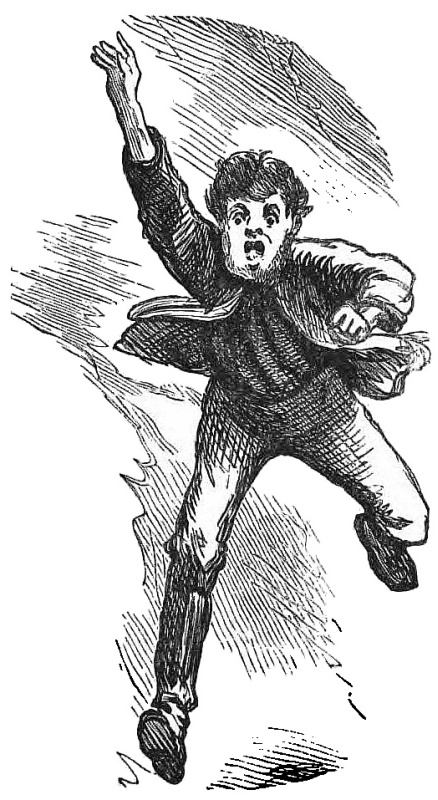
As soon as they were visible, Byarnie, who had been watching on an icy cliff top, must needs take off his jacket to wave it—a cap would not have met the requirements of the situation; then, still waving his jacket aloft and shouting, he rushed down to the camp like a maniac giant.
“They’re coming! they’re coming! they’re coming!” he cried.
Boy Bounce ran out waving his ladle aloft; Dr Barrett himself ran to meet and welcome the expedition; the men rushed to the tent door, the hale supporting those who were maimed and sick, even Claude being among the number.
But Paddy O’Connell—why, nothing less than dancing a jig could satisfy Paddy O’Connell, or keep his feelings of joy in anything like control.
“Bedad!” he told a messmate many months afterwards, “if it hadn’t been for that jig I’d have bursted entoirely, and it’s the truth I’m telling ye, and never a word av a lie in it aither.”
Chapter Twenty Four.
“It is all like a Dream.”
The journey back from the inland sea to the Yack village had been full of adventure and toil, but all happy; and there is hardly anything a person will not do or encounter when buoyed up with hope and joy.
They had stayed for two weeks at the village, that the invalids might recruit their health and strength; and then, with her sails outspread to a favouring breeze, southward she sped, literally on the wings of the wind.
“It is all like a dream,” said Claude, as he sat by Meta’s side on the quarter-deck of the yacht Alba, one beautiful summer’s day just two months after the events related in the last chapter. “All like a dream, Meta.” The vessel was coasting along the western shores of Scotland, many miles off the point of Ardnamurchan.
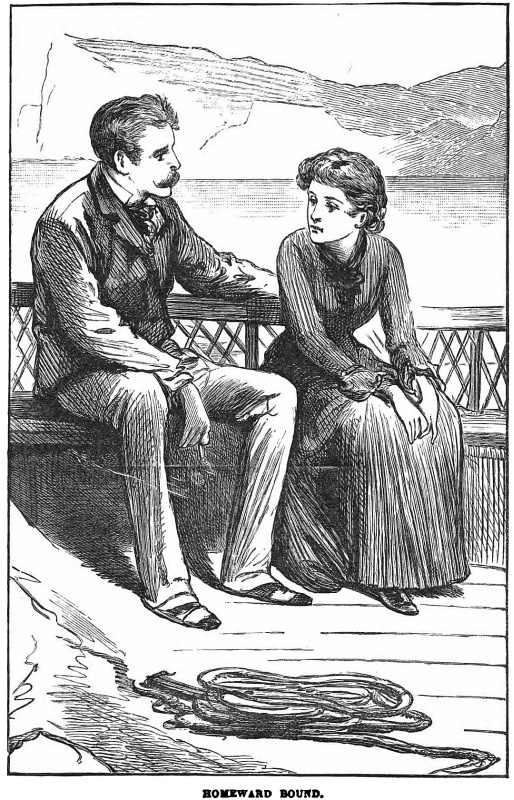
There was hardly a breath of air; just a little swell on, and a gentle ripple on each round heaving wave, with the sunshine weaving threads of brightest silver all through, and making rainbows in the spray and bubbles that floated away astern in the ship’s wake.
The Alba and her happy crew were returning to their native land, and if nothing occurred they would cast anchor by next morning, at the tail of the bank.
“Yes, dear,” replied Meta, “it is all like a dream—a long, long dismal dream.”
“I’m not sorry it all occurred, though, Meta; it has tried your faith and mine as well; and perhaps, you know, if things had not turned out as they have done, my mother would never have consented to our union.”
“Oh, I love your mother so, so much!” exclaimed Meta, enthusiastically. “I loved her before we were a week together in the ship; but then—”
“Then what, dearest?”
“I was not happy, because, you must know, I thought I was deceiving her, that I was playing a double part, that I ought to have told her at once who I was.”
“Do you know, Meta,” said Claude, after a pause, “I do not think I shall ever doubt the goodness of Providence again. Oh! you cannot tell, love,” he continued, “how dark my heart felt, how sad and gloomy, and how full of despair when poor Paddy reported the desertion of Jack and Joe, the Eskimo Indians. And yet, Meta, had they not deserted, your father would not have met them in the Yack village, and the probability is you would not have found us, or found us dead.”
Poor Meta shuddered, and the tears rose to her eyes. Claude hastened to change the subject.
“Do you think, dear,” he said, “you will like our country?”
Meta had not been enough in society to be anything else but candid.
“I’m sure I shall not at first,” she replied; “only—”
She paused.
“I will be with you,” said Claude, beaming.
“Yes. And after a time I dare say I shall get used to—to Scotland; but oh! never to England.”
“We will keep this yacht, Meta.”
“That will be delightful.”
“And when tired of one place, we will go to another. I have a home in the wildest part of the Highlands of Ross; we will live much there. And we will sometimes cruise away north to Norway, and to your dear Icelandic home.”
Meta was too happy to reply.
Claude’s thoughts were also very pleasant, so the lovers relapsed into silence.
There are, to my way of thinking, few events more sad than the breaking up of a ship’s company, on her return after a long voyage.
At sea we have been a little community—nay, more, a family almost. We have learned each other’s ways. We have learned to love our messmates, or at all events to regard them with friendship. We know their peculiarities, their habits, even their weak points and faults. We have been, indeed, more than a community; we have been a little world afloat, knowing as little for the time being of any other people as the inhabitants of one planet do about those of another.
But now with the paying-off of the ship’s crew all is over; from the moment the ship sails into the harbour all is changed, and every tie is ruthlessly snapped asunder.
Everything is now bustle, stir, and excitement. The very ship herself begins to look unkempt and untidy. She seems to become reckless and regardless of her personal appearance—ropes anyhow, rigging awry, dirty foot-prints on a deck that erst was snowy-white, tarnished brass and soiled mahogany. Strangers, too, crowd on board—landsmen with long hats and umbrellas; lands-women who care less for a ship than they do for a barn. You feel the vessel is no longer your home, and you long to get away out of her.
The crew is broken up; and on shore, if you meet some of the seamen you sailed with, you will hardly know them, for Jack himself seems to have degenerated, and your smartest and tidiest sailor on board may, on shore, look a veritable rake or lubber.
No; my ship never looks well in dock. Let me have her leagues and leagues away out on the silent sea; be the water rough or smooth—be it blue, green, grey, or foam-flecked, I can love her then and be quietly, serenely happy.
So the men of the Alba and the survivors of the unfortunate Icebear were scattered far and near, the yacht being left in charge of McDonald and two hands.
Meta and Claude parted for a time—Meta going home to her father’s beautiful villa at R—, on the banks of the romantic Clyde. Byarnie went with his mistress. Dr Barrett became the guest of the Lady of the Towers and of Claude. The boy Bounce was here also. He took up his abode in the kitchen, and settled down to serious eating, by way, perhaps, of making up for what he had lost in the Arctic regions. And Paddy O’Connell went home to “ould Oirland” to visit his mother and his sister Biddy—“and the pig, the crayture.”
My little heroine—the bonnie, winsome, lovesome Meta—had seen many changes even in her short lifetime. And now she is home for a time at her father’s house. Though a very beautiful and tastefully furnished mansion, Captain Jahnsen’s home was by no means a palace, but compared to Meta’s cottage in Iceland, surrounded by wild, bleak, and rugged scenery—scenery nearly as silent as the grave or Greenland—her father’s domains were almost a paradise.
But Meta was one of those girls that, however humble their early surroundings, if transplanted to a higher sphere, grace it Meta, in her Norland home, dressed in hodden grey or simple wincey, was a lady. Meta, arrayed in the costliest and neatest garments a fashionable costumier could devise, and, through her father’s fondness, “bedecked in jewels rare,” was nothing more. She was artless, straightforward, innocent, and candid. What else can you wish for in a lady, young or old?
And by-and-by Meta would be the lady of Dunallan Towers, and Claude’s mother the dowager; and none to see her now could doubt she would fit and fill the proud position gracefully and well.
After a few weeks at home, during which, however, he had made many a little run to Captain Jahnsen’s house, going with all a lover’s joyful ardour, returning with all a lover’s sad, sweet reluctance, our hero ran his vessel down the Clyde.
It mattered but very little to Claude where the beautiful yacht Alba lay while being altered and refitted, so she was moored not far from Captain Jahnsen’s house. Refitted? Yes, because there were tons of iron and wood to come off her bows, and changes were to be made in her saloon and interior generally. She would sail no longer to the icy regions of the far north, but by way of change—and such a change!—to sunny lands beyond the torrid zone.
There was a deal to be done to the interior of the Alba. Fewer hands would be needed now, and therefore a new saloon for the officers, with cabins off it, was built in the fore-part of the ship. It was by no means capacious, this room, but Claude spared no expense in making it both elegant and comfortable.
The after-part of the ship was to contain Claude’s private apartments, and here taste vied with elegance to make a suite of ship-rooms that nothing that is beautiful on board the finest liner could surpass.
What a pleasure it was to Claude, this refitting of what for many months was to be the ocean home of his bonnie bride!
When the last clang of hammer was hushed on board, when every artisan had left the ship, then, and not till then, did Claude invite Captain Jahnsen and his daughter to inspect the Alba.
Is it necessary to say that Meta wondered at and admired everything; asked a great many questions, and felt somewhat like a maiden under the spell of an enchanter?
But honest Captain Jahnsen viewed all in silence. It was certainly the silence of admiration for Claude’s cleverness—nay, almost genius—in the art of turning a yacht into a lady’s boudoir. But, after all, Jahnsen was a very practical sailor, so no doubt he thought, although he said nothing, that he would just as soon sail in a less costly fitted barque.
But then Captain Jansen was not going in the Alba. His sailing days were over, unless, as he said, something wonderful turned up to cause him to go to sea again.
Well, the Alba being completely fitted, it is only necessary to add that as many of Claude’s Arctic messmates as he could find were easily prevailed upon to join the ship.
Among these I need only name boy Bounce, who was rated wardroom steward; Paddy O’Connell, second officer—he was a good sailor, and true, as we already know; giant Byarnie, head steward and general superintendent; and last, but not least, Dr Barrett, surgeon, of course. His duties were bound to be very light, and he was rejoiced to have an opportunity to get that rest in southern climes which his adventures in the Arctic regions rendered a necessity.
It was gay and happy company that sat down to breakfast on that beautiful autumn day on which Claude and Meta were married; and perhaps the happiest, the most calmly, serenely happy face at that festive board was that of the Dowager Lady Alwyn.
And Claude, with his bride, went away to sea.
But one thing is worthy of note in this place. Before bidding his mother good-bye, he took the snow-bird from his shoulder and whispered some words in its ear. I do not for a moment wish any one to believe that the bird knew what was said, but one thing is certain: when Claude placed Alba in his mother’s arms, it nestled there, and it never afterwards left Dunallan Towers.
Seated on a mossy bank, in a wooded ravine, I have been writing this last chapter, dear reader mine, while the Nith goes wimpling through the glen close beneath me.
Summer winds are sighing and whispering among the silver birch trees, and their drooping branches, nodding, kiss the murmuring stream. There is a wealth of wild flowers everywhere—great banks of brambles starred over with pink-white blooms, and great banks of green and feathery breckans, up through which tower the crimson-belled stalks of the beautiful foxglove.
Musing on the story I have just completed, lulled by the river’s lisping song, and mournful croodle of the wild pigeons in the dark spruce thicket, I have almost dropped into dreamland. But I start as a hand is laid on my shoulder. I start and stand up.
No need to be frightened. It is only Janet who confronts me—Janet, with her silvery hair, her mild eyes, and chastened face.
“Janet,” I say, “I have finished my story—your story.”
“The story of our boy,” says Janet, musingly, almost sadly. “And,” she adds, “you have told all about the death of my dear Dowager Lady, and how Claude never cares now to visit Dunallan Towers? Have you told how weeds now grow in the great old garden, and dark, dank nettles where the roses bloomed? How owls usurp the place of the pigeons in the ivied battlements? How on the drear, dark days of autumn the raven flaps—”
“Stay, Janet, stay,” I cry; “no trace of melancholy or gloom must tinge my last pages. Look, Janet, look up. What does yonder sky forebode, evil or good?”
It was the parting rays of the setting sun I pointed to, gleaming red upon a lovely reach of water far down the strath, and lighting up the dark pine trees and the hills that o’ertopped them with a glory not their own. It lighted up old Janet’s face, too, and her locks of silvery-grey, until her face shone—radiant.
“Ah!” she murmured, “that sky bodes a bright to-morrow.”
So, too, shall the sunset of your life and of mine be, dear reader, if our lives are spent in the discharge of duty—be it high, be it low—and if our hearts are ever brightened with a hope that is not of this world, but lies in—the Far Beyond.
The End.
|
Chapter 1
| |
Chapter 2
| |
Chapter 3
| |
Chapter 4
| |
Chapter 5
| |
Chapter 6
| |
Chapter 7
| |
Chapter 8
| |
Chapter 9
| |
Chapter 10
| |
Chapter 11
| |
Chapter 12
| |
Chapter 13
| |
Chapter 14
| |
Chapter 15
| |
Chapter 16
| |
Chapter 17
| |
Chapter 18
| |
Chapter 19
| |
Chapter 20
| |
Chapter 21
| |
Chapter 22
| |
Chapter 23
| |
Chapter 24
|