"A Tale of Love and Heroism" (continued 2)
Reading edition
“Yes, yes, Janet, that is here.”
“Well, sir, it was first Fingal’s going away, trotting so sad-like after his master, and he never once looking back, and then the snow-bird going next. That, I think, nearly broke her heart. But oh, she was proud, sir.”
“She never owned her grief, then?”
“No, sir; but I’ve caught her often in tears, though she tried to hide them. She grew far more active than ever after that. She seemed to hate the very sight of indoors, and, wet day or dry day, she would be always out.”
“Doing good, doubtless?”
“Visiting the sick, sir; ay, and often sitting down sewing in a sick person’s room. The neighbours noticed her grief. They all loved her, they all pitied her. But it was at night, I think, she suffered most. Her room was next to mine, and it is often, often I’ve heard her pacing up and down the floor till nearly morning. On stormy nights, sir, when the wind was roaring round the old turrets, and howling in the trees then she would send for me.
“‘Janet,’ she would say, with her sad, beautiful smile, ‘I cannot sleep to-night. You must read to me.’”
As Janet is now feeling in her pocket for her handkerchief, and tears are choking her utterance, I gently dismiss her, and go on writing.
“Yes, Meta,” replied Claude, “and I often wonder too; but there is one thing that does give me joy, and that is this: she knows I love her and am not really unfilial.”
Claude found Meta much more hopeful next day, and more happy. Sometimes she was almost gay.
“By-the-by, Claude,” she said, “I’ve something to show you. You must promise to believe all I say.”
“Implicitly.”
“And not laugh at me?”
“Never a smile.”
“Well, follow me.”
Claude did.
She led him round to the back of the cottage, and there in a big aviary—evidently the work of Byarnie’s hands—were seven great sea-birds.
“Now you’re going to laugh,” cried Meta, with a warning finger.
“Well, no wonder. Such queer pets, Meta!”
“But they’re not pets, Claude, though I love them. They are all going with you.”
“All going with me! Those funny old things! Ha! ha! ha! Forgive me, darling, I can’t help it.”
“Well, I do forgive you. And when I tell you that this particular seagull makes the best carrier in the world, far before any pigeon, because it can fly ten times as far, and never get lost at sea—”
“I reared those from the shell,” interrupted honest Byarnie, his big face all smiles. “And I’ve reared many such.”
“Byarnie,” said Claude, “you’ll come with me, and look after these birds, eh?”
Byarnie jumped and laughed, clapped his hand upon his leg, and jumped and laughed again, and then went skipping round with all the grace of an infant elephant, till Claude and Meta also laughed to see his uncouth exuberance.
“My brother will come here, and my sister too, and look after the house and farm,” he cried. “He! he! ho! ho! Byarnie’s the happiest man ’tween Reykjavik and Christiansund.”
Day after day went by, but still Claude was at the little capital of Iceland, or with Meta. He was waiting the arrival of the mail: she had broken a shaft or something, and eager and able though he was to get away to the land of the Northern Lights and the sea of ice, he did not begrudge himself the respite.
The mail was sighted and signalled at last, however, and came puffing and blowing in.
Claude had letters from his employers and from many a friend, but none from his mother.
But Janet’s letter must in some measure have made up for this, else he would not have ridden right away out to Meta’s dwelling.
Ah, well, it was their last day together anyhow!
There they were together now whom seas would soon sunder—two warm, loving, hoping hearts. Would they ever meet again?
Chapter Ten.
In Norland Seas.
“I shouldn’t wonder if we get it from out yonder,” said Dr Barrett, pointing away south and by west, the very direction in which the Icebear was steaming.
There was a great billowy heave on the blue sea, blue everywhere, except where the light shadow of some white fleecy cloud made a patch of fleeting grey or grey-green. There was not a breath of wind “to swear by,” as Jack Scott unpoetically put it, so the long rolling swell was as smooth as glass. This swell was meeting them too, and the ship rose and fell on it with a gentle dipping motion; only now and then, when a taller wave than usual dipped in under bows and keel, she gave a quick plunge forward.
Along the horizon ahead was a bank of rock-and-castle clouds, while far away astern the jagged snowcapped peaks of Iceland were just visible above the rolling seas.
Flocks of malleys, shrill-screaming kittywakes, and different kinds of seagulls were tacking and half-tacking round the vessel, afar off, and the dark and ominous-like skua waited his chance to rob the malleys of whatever they might happen to pick up.
“Yes,” the surgeon said; “I think we’ll have it out of yonder.”
“Seems so to me, too,” said Claude. “We are all ready for a blow, Mr Lloyd?”
Mr Lloyd gave one glance forward and smiled.
“Ay, sir,” he replied, “all ready for a buster; and many is the sneezer, sir, I’ve come through in these latitudes, and higher up North too.”
These officers were on the bridge.
This latter was not the great elevated deck you see on passenger steamers right amidships. No, the Icebear’s bridge was but a plank, comparatively speaking. Not more than three feet wide, with a rope railing at one side, and a brass one at the other, with a step-ladder leading up to it from the quarter-deck, for it was between the bulwarks near the mizzen mast.
The glass was going down, and the day was far spent. Already the sun’s rays were beginning to fall aslant the waves.
“Had we started sooner,” remarked the doctor, “we would have been farther off the land ere now.”
“True, my good Dr Barrett, true,” replied Claude; “but could we have done so?”
“It would certainly have been difficult I admit; but if anything short of a hurricane comes along we can face it, and the night is short.”
No, it had not been easy getting away from Reykjavik indeed. It so happens that the good people of that town are exceedingly hospitable, and it is a hospitality that comes straight away from the heart. So there had been a kind of farewell levée on board Claude’s ship, and as there happened to lie in the roadstead a French merchantman and a Danish man-of-war, and the officers from both attended it and talked much, this made matters worse—or better.
But down went the sun, and ugly and angry were his parting gleams. He sank in a coppery haze, which lit up all the sea between. He seemed to squint and to leer at our heroes as much as to say, “You’ll catch it before long; something’s brewing. Good night; I’m off to bed, for bed is the best place.”
Down went the sun and up rose the wind. Twilight is very long in these regions, and before it had quite given place to night, the sea from being rippled got rough. The breeze seemed uncertain at first where to come from, and went puffing about from three to four points of the compass. Then it appeared to say to itself, “First thoughts are best; I’ll follow the swell; I’ll soon blow that down.” So it came roaring out of the north-west. Long before it did blow “a stiffener,” as the mate called it, looking up ahead through the gloaming air, you could have seen mysterious-looking great grey blankets of clouds, drifting fast and furiously towards the south-east. They might have been a few miles high, but soon the stream of clouds was lowered and thickened and darkened, till the horizon was hardly three cables’ length away all round. Then it was night—night with an ever-increasing breeze and a choppy, frothy sea.
The wind did blow the swell pretty flat, but substituted in its place genuine waves, as ragged and jagged as the mountain peaks of Iceland.
And the good ship by-and-by creaked and groaned in every timber, and thick darkness fell, and Claude had to trust to Providence, to steam, and the compass. There were two men at the wheel at midnight, and at that time probably the gale was at its worst, for on heaving the log it was found she was barely making one knot an hour. The seas—whole water—were coming in over the bows by tons, and sweeping right aft like a miniature Niagara; but the hatches had been battened down early in the evening, and the boats secured, so there was little injury done, though the load of water sadly hampered the vessel’s motion: it was not able to get away fast enough.
About two bells in the middle watch the Icebear struck.
Struck? But what or where? I know not; I cannot tell; it was no island, no rock. It may have been the carcase of some floating monster of the deep; or—who knows?—some wretched derelict or a portion of a wreck. It was a mystery. But she struck with a dull thud that quite stopped her way, and for a time made every heart beat with fear for her safety. She must have struck not only on the bows, but gone over something; all along her keel was the quivering grating felt, as if of a substance underneath.
For a while, too, the rudder and screw were hampered and the vessel’s way all but stopped.
As it was she staggered and began to broach to. It was a moment of the greatest danger, but only a moment. Then it was over, and the Icebear was struggling once more with the stormy head wind and raging sea.
By morning light, though the wind still held, it was less furious, and the seas but broke in froth and spray against the descending bows, and went singing aft on each side, their tops twisting and curling in the gale.
Down in the darkened wardroom at breakfast that morning the talk was naturally about the storm. Although Claude retained his own quarters abaft, still he preferred taking all his meals with his officers.
“What was it we struck, do I think?” said the doctor in answer to a question put by Lloyd. “Some unhappy fishing-boat or walrus-hunter on his way to the east shores of Greenland.”
“Heaven forbid!” said Claude, with a slight shudder. “Would we not have heard a scream or yell?”
“Never a scream or yell in that roaring gale,” replied Dr Barrett, coolly. “Bless you, sir, I’ve run them down before. Steward, another cup of coffee, please.”
“You’ve been often to these regions, doctor?”
“I’ve been often everywhere. I’m the veriest old son of a gun of a sea-dog of a doctor.”
“It’s as well no one else said that about you.”
“I wouldn’t mind. My skin is as hard as tortoise-shell. I’ve been married so often, you know.”
“Have you really now?” said the second mate, a merry-eyed little dark man. “Are all your wives dead?”
“What a question!” said Claude.
“Ah! never mind,” quoth the surgeon; “I’ll answer him, if he’ll only cut me another slice of that delicious corn-beef. Mind, it isn’t for a lady, so you may cut it as thick as you please.”
“But about your wives?”
“Oh yes, the wives. I don’t think many of them are dead.”
“Doctor!” cried Claude, “you dreadful man!”
“Well, you see,” said the doctor, tapping the edge of his cup with the spoon as if counting, “I’ve been married just exactly fifty-nine times. My ships, messmates, are my wives.”
“Well, you’ve had many a honeymoon,” said Lloyd.
“Ay,” replied Dr Barrett; “and many more I hope to have.”
An able seaman popped his head in past the door curtain at this moment, and drew it out again.
“Don’t duck your head out and in like an old turtle, man,” cried the doctor; “come right in. Anybody sick?”
“Which I didn’t know, sir, the cap’n was ’ere. Nobody sick, but knew ye liked curios, doctor, sir.”
“Well?”
“Well, beggin’ yer parding, sir, likus the cap’n’s, but there be a bird wot our cook calls a sea-swallow a-perchin’ on the main yard. Shall one of us go up and fetch him? He’s mighty sea-sick I knows, and couldn’t fly to save his life.” (Note 1.)
“Certainly, bring it down.”
The officers went on with breakfast, and had forgotten all about Tom Scott and his sea-swallow, when suddenly the man appeared again, bearing under one arm a beautiful snow-bird.
It escaped almost at once, and fluttering upwards alighted on the compass that depended from the skylight.
All eyes were fixed on it. It did not seem a bit frightened, but looked downwards with one crimson saucy eye at the table.
“It looks like a spirit,” said Lloyd, half afraid, for, like most sailors, he was superstitious.
“It’s a spirit that will bring us luck. They always do,” said the second mate.
“Are you ill, sir?” exclaimed the doctor, addressing the captain.
One might have thought so. His face was pale, mouth a little open, brows lowered, and eyes riveted on the bird.
“Were such a thing possible,” he muttered, “I’d believe that was my snow-bird Alba.”
To the amazement of every one, no sooner were the words uttered, than with one quick glance of recognition, down flew the bird and nestled, as it was wont to do, on its master’s hand, held close up on his breast.
Yes, every one was astonished, but poor McDonald, the third mate, was frightened; and when, after receiving a few caresses, Alba jumped on to the table and began pattering around and saying, “Poor Alba wants his breakfast; Alba wants a sop of food,” McDonald could stand it no longer: he left the table and hurried on deck.
“It’s no canny,” he said to the steward; “it’s no canny, and if I could steal a boat I’d leave the ship and brave the stormy ocean.”
“Lord Alwyn—I mean sir,” said the mate, “a hundred years ago you’d have been burned for a witch.”
“Or a wizard,” remarked the doctor, laughing. “But I am not astonished. The captain has already told me the story of his snow-bird. The wonderful power of sight, scent, and probably hearing in gulls is scarcely yet known to naturalists; and the same may be said about nearly all sea-birds. They either have an instinct that we possess not, or the faculties they possess, in common with other animals, are most marvellously developed. (Note 2.) Just look at that lovely bird now, and listen to its marvellous prattle.”
Pattering round the table went Alba, in a very excited condition, only every now and then flying off to Claude’s breast as if he could hardly believe in his own happiness. He jumbled up his sentences, too, as most talking birds do when excited.
“Alba wants—Alba wants—Alba wants Fingal’s Claude—Fingal’s—Fingal—Claude—Alba wants his breakfast.”
“That’s better, Alba,” said Dr Barrett, lifting the cover from a dish of fish.
Next moment Alba was in the third heaven.
“You’ve made that bird your friend for life, doctor,” said Claude.
Fingal, the deerhound, got up from under the table and laid his great head on his master’s knee.
“Of course I won’t forget you, you silly old Fingal, because Alba has come. I have room in my heart for both.”
Towards sunset that day the weather cleared, the wind having gone round to the nor’-east-and-by-east. The sea too went down with the sun, though it still ran high; a morsel of canvas was got up to steady her, and leaning over to it away she went, cutting merrily through the water as if she had been a veritable living thing. The stars shone that night so brilliantly; it was as though you could have stretched out your hand and touched them, so large, lustrous, and near-like were they. A broad white gleam of auroral light was in the north, above it the sky was of a strange sea-green hue. But a whisper had gone around the ship that a spirit had come on board, and an anxious group was seated round the galley fire to discuss the situation.
“If it’s a spirit,” said Tom Scott at last, “it’s a good one. It has brought us good weather. Hurrah, lads! give us a song somebody.”
The good ship Icebear had no more adventures for nearly a fortnight, by which time she had rounded Cape Farewell and reached the north-eastern ice.
“And now there came both mist and snow, And it grew wondrous cold, And ice, mast-high, came floating by As green as emerald.”
Note 1. Sea-birds are usually unable to fly after they alight. A Cape pigeon, for example, gets giddy and frightened at once when put on deck.
Note 2. The author could adduce very many instances in proof of the good surgeon’s statement.
Chapter Eleven.
Summer on the Greenland Ocean.
There was not an officer nor able seaman on board the good ship Icebear, who had not been in the Arctic regions before.
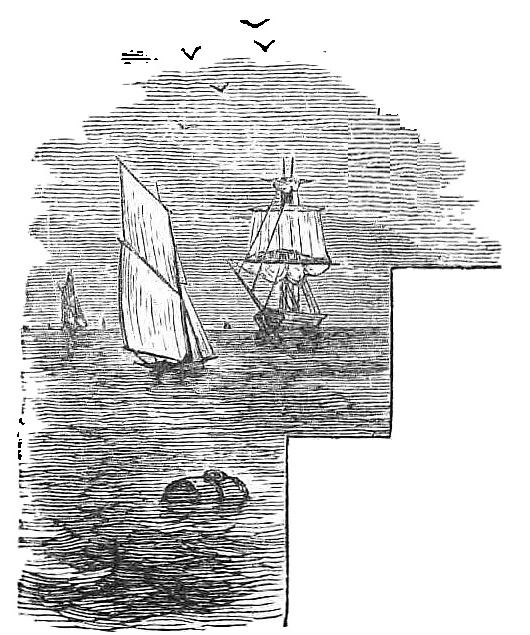
Mostly Englishmen they were, with just a sprinkling of Scotch—“the leaven that leavened the lump,” that is how Rab McDonald, the third officer, expressed it, and it is needless to say that Rab himself was a Scot.
Onward went the Icebear, sometimes in a clear sea, though far into Baffin’s Bay—for this was what is called an exceptional year—but at other times she had literally to plough her way through the heavy ice.
When the weather was fine there was but little danger, unless, indeed, a swell rolled in, playing and toying with the monster pieces as schoolboys would with balls.
But when a breeze sprang up, even if only half a gale, then indeed the scene was changed. Then—
“Through the drifts the snowy clifts Did send a dismal sheen: Nor shapes of man nor beasts they ken— The ice was all between. “The ice was here, the ice was there, The ice was all around; It cracked and growled, and roared and howled, Like noises in a swound.”
During calm weather and in the open water Dr Barrett was busy indeed, taking soundings, deep or otherwise, and dredging for living objects at the sea’s bottom.
Very lovely and interesting indeed was the collection that soon grew up in his cabinet, under his magic spell. What could be in that tangled mass of mud and weed and sand, one would have asked, that was hauled on board, the sea-water dripping and trickling out of the bag?
To Dr Barrett—and to the savants at home—treasures more valuable than gold itself.
And after he had secured a haul, washed them, put them up, perhaps on cards of jet to show their beauties off, the clever surgeon would have handed you his great glass and bade you look. It was like gazing at creatures from fairyland. All shapes and colours, but all so minute that they could not well be seen with the naked eye. Here is a little fairy fish—no bigger is it than this letter ‘f.’ Take that glass, please. Now look. No wonder an expression of amazement steals over your face! It is a perfect fish, yet, strange to say, transparent and colourless—that is, there is no fixed colour any more than there is in the Arctic aurora, but greens dance and crimsons flit and play around it; and, stranger still, with a stronger glass, you can see its internal anatomy, see its heart beat and its pulses move! Could anything be more wonderful? And here are shells that, lying on this morsel of black cardboard, are no bigger than the letters “a,” or “e,” or “c.” Look at these. No wonder you smile with delight; they, too, are faultless in shape and curious in form; they, too, are transparent as glass; they, too, display all the colours of the finest pearl.
Put this one—it is no bigger than a comma to the naked eye—under the microscope in a drop of water. Lo! that drop of water is to it a small ocean, and round and round it crawls, legs all out and its shell high up on its shoulders, and of a bright translucent blue. I could sit here all the livelong night and write, sheet of foolscap after sheet of foolscap should flutter from my desk and fall upon the floor, and yet when the grey dawn of morning crept in through the casement of this red parlour, I should not have told you of one-half the mysterious and beautiful beings that this man of science dredged up from the dark depths of that mysterious sea.
I pause here and listen. There was not a sound in the house when I penned the last sentence, only a mouse nibbling the crumbs that I placed for it in the corner, but now there comes from an adjoining room the voice of some one singing. It is only poor old Janet. She does so every night before retiring; and, old though she be, I know she is very happy—happy with a happiness that can never be taken from her. But to-night the words she sings are so en rapport with my own spirit while writing, that I cannot but give a line or two—
“God moves in a mysterious way, His wonders to perform; He plants His footsteps on the sea, And rides upon the storm.”
As much as it was practicable to do so, the Icebear hugged the western shores of Greenland, but here the ice was heaviest. As the summer advanced, however, the land became bare of snow; it was then that delightful excursions were made inland, up through the long, deep fiords that everywhere indent this coast. I do not like the word “indent,” though I use it; for an indentation means fork-like incision, widest at the mouth—a bay, for example,—but these Arctic fiords are, many of them, narrow at the inlet, then spread out as they go inland.
There are thousands and thousands of them yet unexplored, and which never will be explored as long as the world lasts.
Not altogether for the sake of pleasure were these excursions made, but for the purpose of scientific discovery.
I am sitting here to tell a story, and not to describe scenery, the yachting, the fishing, hunting, and all the pleasures that make a holiday in Greenland north, during the short summer-time, so enthrallingly delightful—a something that once enjoyed can never be forgotten, while the life-blood circulates in our veins.
Claude himself was a lover of nature. In his soul he had all the poetry of a Wordsworth, though there it remained, for he never wrote verses. He could love and admire every tiny flower, every moss or lichen or tender and beautiful saxifrage that clad the rocky uplands. Neither could he classify them.
Dr Barrett both admired and classified. He was ever on the outlook for new species, and I verily believe he dreamed about them by night. So his cabinet, of the rare and lovely specimens found on shore, grew even bigger than did his deep-sea collection.
Cold? No, it was not cold—these regions at this season. Cool sometimes, but never cold.
The Icebear would be cautiously steered up some of those fiords and the anchor let go, in an inland sea or harbour in which all the navies in the world, both mercantile and man-o’-war, could easily have ridden.
While the doctor and his assistants would be prospecting among the hills, leaving the ship in charge of the mate, and, accompanied only by the faithful Fingal and giant Byarnie, Claude would start in a small boat, a kind of elegant dingy, which he had had made on purpose, and go off up the fiords for miles with gun and fishing-rod.
The snow-bird, strange to say, always remained on board. What truth there may be in the statement I do not know, but they say that a snow-bird, or tern, that has once been domesticated by mankind dare not return to its kindred birds under pain of death.
Claude used to enjoy those excursions on the fiords very much. Here is how he generally spent the day: First, Byarnie would pull him slowly about close to the rocks, where the fish were most numerous. A few dozen were speedily caught and thrown in the bottom of the boat. Fingal used to take them in charge, apparently delighting in doing so, for his wise eyes never left them, and if one flopped Fingal held it down with an air of seriousness on his rough hairy face that was highly amusing.
But Claude soon got tired of fishing, and put up the rod. Then he told Byarnie to pull him away out into the centre of the fiord, and let the boat float as she liked in the sweet sunshine. Claude would have a book, perhaps, and very often, when his eyes were riveted on it, it was upside down, which showed where his thoughts were.
Just for fun then he would say to Fingal, “Speak, Fingal.”
Fingal would speak with a vengeance, till every hill and every rock re-echoed his bow-wow-wows. But the sound was sure to bring up a great head or two with goggle eyes out of the water, sea-lions, walruses, or saddle-back or bladder-nose seals, for they are all most inquisitive.
Lying very still sometimes, with the oars in, one single seal would pop his head out of the sun-glazed water and have a look at the boat.
“Sit still, Byarnie; don’t move,” Claude would say.
The seal would come nearer and have another look; then down he would go, tail first, and in three minutes more the sea all around would be black with great heads and sweet, soft, wondering eyes.
“Well,” they would seem to say, “we can’t make it out. Never mind, let us have a romp; the sunshine is so delightful. Hurrah!”
Then a scene of diving, and chasing, and splashing, such as it is impossible to describe, would ensue; it was, in fact, a seals’ ball. If Byarnie would suddenly explode with a loud “Ho! ho! ho!” of merriment, or if Fingal barked, then, hey! presto, every head would sink as if by magic, and in a few minutes the sea would be as smooth as usual, with only the gulls, divers, or grebes floating lazily on it.
Next, Claude would make Byarnie tell him some wild old Norse story—he was full of them—with Sagas, or Vikings, or fairies in it, and then sing. Oh! Byarnie could sing well, but a strange, monotonous kind of lilt it was—very pleasant, nevertheless, for it never once failed to put Claude to sleep. So sure, indeed, was Claude of falling asleep when Byarnie began to sing, that he used to lie down in the stern-sheets with a cushion beneath his head.
Sometimes he awoke with such a happy, happy half-dazed look on his handsome face, and say, “Oh! Byarnie, I’ve had such a pleasant dream!”
Next they would land, and Claude would now read in earnest, while poor Byarnie cooked the dinner in gipsy fashion.
Very often after this Claude would keep his companion talking about Iceland, with Meta always the centre figure, for hours, till, when near sundown, they would probably hear the report of a rifle at some distance off. This was Dr Barrett signalling to his men, and not long after the whaler would come sweeping up, and the boats would return together, often enjoying the fun and frolic of a good race, for Byarnie was a splendid oarsman; his skiff was light, and he, if not a feather, had the strength of three ordinary seamen.
Thus pleasantly passed the summer days on that lonesome Greenland ocean.
Chapter Twelve.
Among Arctic Fiords—A Strange Discovery.
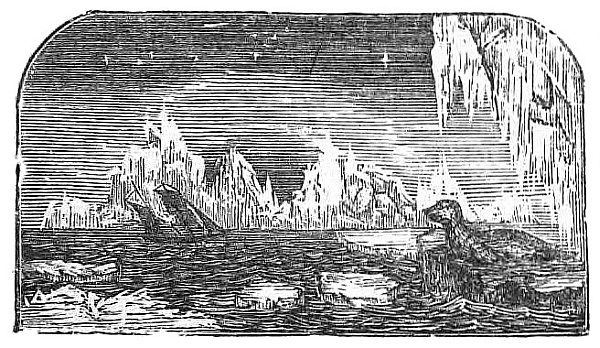
If the reader happens to possess a map of the polar regions, or even a good map of the world, and will take a glance or two at the discovered lands and seas beyond the Arctic circle, he will be struck at once by their nomenclature. It would be interesting to know the why and the wherefore of many of these names, which I do not believe have, in any single instance, been given at random. The origin of some of them is evident enough—“Lady Franklin’s Sound,” for example, or “Hayes’ Inlet,” or “Peabody Bay.”
But I do not wish to be told of the exact reasons that determined these names. Knowing what I do about the Polar regions, I would rather let my imagination have a little play.
A little to the south of Spitzbergen lies Hope Isle, or Sea Horse Island; I happen to know that many walruses, sometimes called sea-horses, frequent the ice or the icy land there; but why called Hope Island? Some ship, perhaps, had been long imprisoned, north of this place, provisions exhausted, and the chances of ever getting clear small indeed; but, behold! the ice opens as if by magic, and by sawing and blasting they struggle as far south as this lone isle, where, though locked up once more in the icy embrace of King Winter, they live in hope, and are eventually rewarded.
Down the east coast of Greenland proper there is a point with an ugly name, “Cape Discord.” Was it mutiny or only mutiny threatened? did men struggle on slippery blood-bespattered decks, or was the discord confined to muttered threats, to black and angry looks and round-robins? (Note 1.)
“Cape Farewell” again—the southernmost point in Greenland. The ship has been wintered in Baffin’s Bay, and the men have undergone cold, misery, and privation; but hurrah! the last land is left behind, the blue open sea is all before them, cheerily sings the wind through the rigging, the sails are full, and the men’s hearts are also so full that if they did not sing they would go mad. So “farewell, old Greenland; our dear wives and sweethearts are waiting us at home in merry England. Farewell, farewell.”
But round that point is Cape Desolation. Look at those bluff, bare crags that overhang the sea, the home of hardly even a wild bird; see afar off the tree-lands covered with snow, leaden clouds athwart the sky, billows dashing in foam against the black rocks, and the cold wind blowing. Ugh! let us leave it. It is pleasant to find a Prince Albert Land and a Victoria Land up in the Arctic ocean, side by side; and a North Lincoln and North Devon, separated only by Jones’s Sound. We have been told that when the North Pole is eventually discovered a Scotchman will be found at the top of it. I should not wonder, for the most northerly land, if my memory serves me aright, is called Grant’s Land, and everybody knows that Grant is the name of a brave old Scottish clan.
Obeying instructions from his employers, Claude worked his ship north and north along the western shores of Greenland, exploring every creek and fiord; the doctor being meanwhile very busy, as we have seen in the last chapter, taking scientific notes and collecting specimens.
In their voyage out, the Icebear had only once spoken the Kittywake. She was a schooner commanded by the ex-skipper of a Dundee whaler, a man who knew the country well, and though but a small craft she was strong, and eminently suited for the work she had to perform, namely, to follow the Icebear with stores. She had received instructions to hug the western land, and, if a flagstaff was seen at the entrance to any creek, there to lay-to until the Icebear came out.
But the Kittywake’s powers of sailing were only of a very limited character, and steam she had none. So, after spoken, she was not seen again for a time.
Very few of these wonderful fiords, as I have already mentioned, are even known. Now, it had occurred to our learned savants at home that it would pay, not in one way, but in two, to explore the largest of them. Untold wealth lies buried in Greenland. Scientific wealth, and the dross called gold, mayhap even diamonds, mayhap precious stones of a kind not yet known to the world. For why? Was not Greenland—that vast country which a single glance at the map tells you is as large in extent, as long and as wide as Africa itself—was it not at one time, ages ago, they argued, an inhabited continent as free from ice as our fair England is at the present day? They believed that the mountains which now shoot their jagged peaks, covered with perpetual snow, up into the blue-green sky were once purple and crimson with gorgeous heath; that green valleys and lovely glens lay below, with placid lakes and rolling rivers, and cascades of sparkling water; that gigantic forest lands covered the greater part of the country, forests in which the bison and wild deer roamed and fed; that, in a word, Greenland was once upon a time—while the torrid zone was but a fiery belt, uncrossable, uninhabitable—a fertile land of beauty, a land of mountain, forest, and stream.
They even went farther. Might not man himself, they said, have dwelt in this beautiful country—primeval man—and might not his remains be found even yet? There is, indeed, no length to which some learned savants will not go, if they once give the reins to their imaginative power.
While not for a moment feeling half so sanguine as his employers, Claude, having undertaken a task, meant to do his duty, his best; and who can do more?
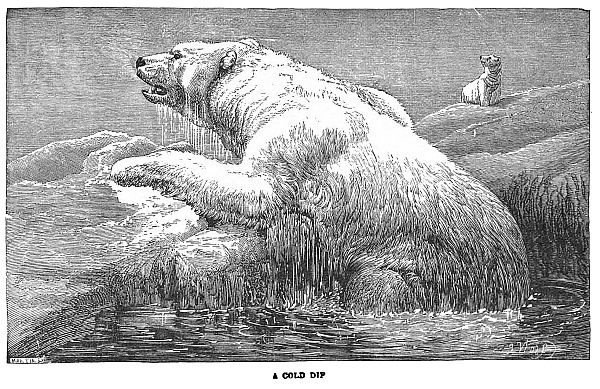
As long as the summer lasted, and before the mists began to rise, Claude continued his explorations. He came at last to a vast wall of solid rock, darkly frowning over the deep. He would have passed along it, never dreaming there could be any opening in there, had he not seen some bears swimming in the water. They disappeared on being followed by a boat, and the officer in charge, on returning, reported having discovered the inlet to a vast fiord. The Icebear was headed for the rock, and found the opening just soon enough to enter with safety.
It was a bright, clear day, with little wind and hardly a cloud in the sky, with every indication that fine weather would continue for a time at least.
All hands were on deck as the Icebear was turned shorewards and headed straight for the rocks. The boat that had gone in pursuit of the bears was ahead, guiding. To go steaming stem on to that adamantine wall seemed courting destruction, but lo! after a progress of a few hundred yards, the cliffs opened up as if by magic, showing a long channel of deep blue water. It got wider inland, but the cliffs were higher; gradually, however, they receded from the water’s edge, and got lower and lower.
The ship was now stopped, and a party sent on shore to climb the highest peak adjoining the sea, and plant thereon the flagstaff that should signal to the Kittywake the whereabouts of her consort.
Slowly on and on steamed the Icebear, two men taking soundings from the chains, lest the water should suddenly shoal, but the beach at each side still continued rocky, though no longer high.
“What do you think of this?” asked Claude of Dr Barrett, who stood near him on the bridge.
“I am rejoiced beyond measure at our discovery,” was the reply. “Why, this would please Professor Hodson, for no slowly descending glaciers ever made this wonderful cutting—it is volcanic entirely. Behold the rocks, Captain Alwyn.”
“You are right, doctor, beyond a doubt.”
“And I should not be surprised now what we came to.”
“Nor I.”
“I wish,” said Mr Lloyd, “I could see things with the eyes you seem to possess, doctor. How delightful it must be to be quite at-home-like with everything you see around you! You are a learned man, doctor.”
“Nay, nay,” cried the surgeon, laughing. “I am but a student—a baby student. Were I to live for ten thousand years I should still be only reading in the first book of Nature.”
“You are modest, at all events,” Claude said; “and I believe that is a sign of genius.”
“One cannot help feeling both modest and humble, Captain Alwyn, when standing face to face with the first facts of science, and knowing that the little knowledge he has acquired is to the vast unknown but as the light of a candle to the noonday sun.”
For days the Icebear followed the course of this estuary. Sometimes it narrowed to a mere deep cutting or canal, anon it would widen out into a broad oblong lake. At length it ended in an inland gulf or sea, some thirty or forty miles square.
In latitude this mysterious sheet of water was fully a degree and a half south of the inlet.
Dr Barrett spent days in dredging, and in roaming over the hills, studying botany and geology.
There were high mountains all around, and it was a strange sight for those on the deck of the Icebear, which was anchored at some little distance from the shore, to witness mighty cataracts tumbling sheer over the very summits of these hills, and coming roaring and foaming down their sides. The men looked upon this as magical, but it is easily explained: there were other hills behind these—much higher ones—that were invisible from the ship’s deck, and it was from these the waters poured down.
As might have been supposed, they found the waters of this inland sea less salt than the ocean itself, though by no means brackish.
“I think, sir,” said Dr Barrett, when he came off one evening, “that we need hardly proceed farther north. We can hardly expect to find another such lake as this.”
“Here, then, we shall winter,” replied Claude.
“Here, I believe, we ought, too. For look what I have dredged up.”
“Coal!”
“It is coal. I found it close in shore, and there is more of it. Depend upon it, we have discovered a country rich in mineral wealth; and, if I am any judge, there is gold in abundance here, too. Look at this. There are specimens for you.”
He handed him a few pieces of rock as he spoke.
“Pretty morsels of stone enough,” said Claude, as he bandied and weighed them in his palm. “Would make nice ornaments for a mantelpiece. But do they really represent anything of value?”
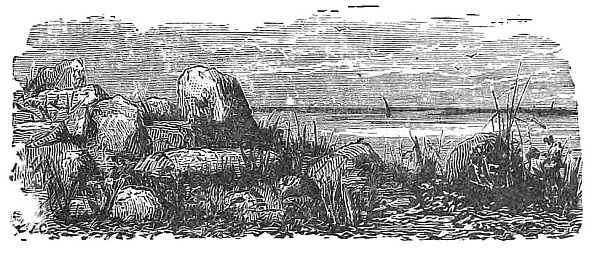
“Well, I will tell you. You see I have numbered all these morsels of stone. Here is Number 1.” (Number 1 was a piece of dark brown stone mingled with patches of the darkest blue, in which little stars sparkled and shone.) “That,” said Dr Barrett, “is carbonate of copper ore. Number 2, you perceive, is black with streaks of green; that also is a copper ore of some value. Number 3—take hold of it, Mr McDonald,” continued the doctor, addressing the third mate. “What would you call it?”
“I should call it a chucky-stone,” was the Scotchman’s reply.
“Yes; well, a rose by any other name would smell as sweet, but that rough red-brown-black-spangled chucky-stone of yours is an argentiferous carbonate of lead. Number 3 is very heavy, and not unlike a piece of blacklead, only it shines more. That would give seventy ounces of solid silver from the ton of ore. Here is Number 4, a piece of quartz mixed with dark grey, and streaked with sea-green. That also is silver ore.”
“And this Number 5,” said McDonald, “looks to me like a bit of very bad coal. Is it worth a doit?”
“It is worth many doits. It will assay three hundred ounces or more of solid silver to the ton. Number 6 looks like a lump of petrified rhubarb root. Number 7 is somewhat similar, but mixed with quartz and a reddish brown material. Both are auriferous; the last will yield 300 pounds from each ton of ore.”
Claude shook Dr Barrett by the hand.
“You have indeed made important discoveries,” he said.
Dr Barrett smiled pleasantly.
“My conscience!” cried McDonald. “We’ll be a’ millionaires thegither, every mither’s son o’ us. Wha could hae thocht it, and a’ own to a wheen chucky-stones that I wadna hae gi’en a button for!”
Note 1. A round-robin is a complaint or request, or even threat to the captain, from the men forward; the names to it being signed in a circle, so that no one can be marked as the instigator, though there must be a ringleader.
Chapter Thirteen.
The Long Dead Arctic Night—The Battle of the Snow-Squalls.
The scene was changed. Summer had fled from the shores and from the braelands around the inland sea, where our travellers have taken up their abode.
“Away hath passed the heather-bell That bloomed so rich on Needpath fell.”
Thus sweetly sang the Scottish bard. But here no heather-bell bloomed to vanish. But the lovely little stonecrops, white or yellow, the crimson ranunculus, the dark-tufted grasses, the wild dwarf poppies, and even the mosses and the hardy shrubs that blossomed for a time in the sloping rays of the sun—all have gone or lie deeply buried under the snow; they will appear no more till June again melts their covering and awakens them to sunshine and life.
Claude and his crew have not been idle. Every preparation is already made to mitigate the rigours of a winter that is even now commenced. Boats had been despatched to the inlet of the creek, to land and bury ship’s stores in a sheltered nook not far from the sea. This was done with all despatch. Captain Watson’s men of the Kittywake working with a will born of the knowledge that, as soon as their labours were over, they would once more embark and bear up for their own dear home in England.
They had the good luck to find a cave large enough to contain all the provisions and ammunition on board the store-ship. There was accordingly no digging to be done, except the quarrying from the hillsides of great stones to build up the entrance to the cave. This done, it but remained for Mr Lloyd, who was in charge of the working party, to take his bearings, in order to easily find the place again, and deliver to Captain Watson his written orders to return south.
Lloyd’s boats towed the Kittywake out to sea, or, rather, steered her, for the tide was running rapidly out. He remained on board the store-ship until the turn of the tide, then there were farewells said, and ringing cheers were re-echoed from the hills and from tall floating icebergs, and, sail being set, away went the Kittywake southward ho! the crew as merry as schoolboys at play.
They were to bear tidings to the savants in London of the successful voyage made by the Icebear, the strange discovery of the inland sea, and the prospects Claude and Dr Barrett entertained of the perfect success of the expedition.
It may be as well to state here, and state it once for all, that the Kittywake was never more heard of, never more seen by mortal eye.
Whether she had sprung a leak in a gale, and foundered; been caught a-back in a squall, and thrown on her beam-ends, never to recover; or been crushed like a nut between some awful bergs, will never be known until—
“The sea gives up its dead.”
Had our heroes known aught of the disaster to the store-ship, it would have cast a gloom over them that nothing could have dispelled.
As it was they had nothing in their hearts but hope—hope that, when the long, dreary winter wore away, having more than accomplished the object of their cruise, the ice would break up, their imprisonment would be over, and, laden with riches and crowned with honour, they would bid farewell to the land of the aurora, and reach England in peace and safety.
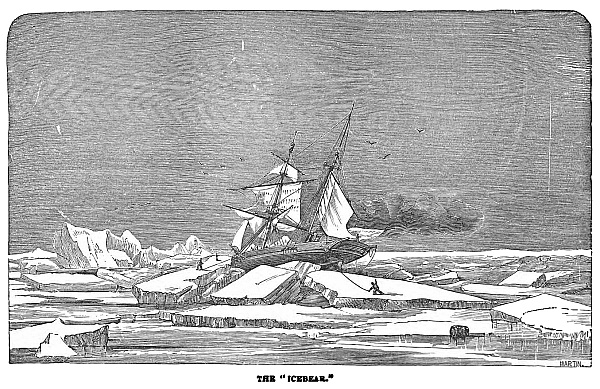
They could, therefore, mark with complacency the ever-shortening days, and the oncoming mists, and mists succeeded by stormy winds, and curling clouds of drifting snow. The sooner winter came the sooner it would be over.
There came a day when these intrepid travellers were to look their last upon the sun for months to come. It was towards the end of October, but not severely frosty. Indeed, the sky was altogether overcast, with the exception of a space on the southern horizon It was here that the sun last showed. Red, large, and angry looking, he but deigned to cast a glance or two across the dreary landscape, then slowly sank to rest, but for two hours after he had gone down, a long stripe of bare, lurid, orange sky remained over the spot. It gradually assumed the appearance of the reflection of some great fire or burning mountain. The clouds above were purple red, mingled with leaden grey, but all this soon faded. There was neither moon nor stars, and the blackness of darkness was over the land. About noon every day for nearly a week there was a kind of twilight. It was even more than this, for when the sky was partially clear there was all the appearance of coming sunrise, the cloudlets grew crimson, and even the tall mountains were tipped with rosy red, and all between the glens were of a strange blue colour.
But even this mid-day twilight ceased at last, then all was night.
All the way north Meta’s gulls had been kept on deck in an aviary built for the purpose, and two had already been despatched with little messages in sealed quills, fastened to their legs. Only one of these reached Iceland. The other probably preferred his freedom.
Claude seldom doubted but that the gulls he sent off would eventually find Meta’s home.
Even before the daylight had entirely gone, and the long dead Arctic night had descended upon the land, the birds and beasts migrated southwards, the malleys, and gulls, and terns, and skuas going first; then the guillemot the eider ducks, grebes, and divers. Next went the bears, the wild oxen, and the foxes; finally even the inland sea itself seemed deserted. The walrus and seal no longer popped their whiskered faces above the water, nor courted the sun’s rays on the rocky shore, and the lonesome unicorn was seen no more ploughing through the waves.
The blackness of desolation and a silence deep as death was over all the scene.
Think not, reader, that the beautiful stars were always shining, or that even when a full moon was in the sky there was somewhat of light and cheerfulness. No, for there were days—ay, and weeks—when neither moon, stars, nor aurora were visible for the dark clouds and whirling drift and snow.
At other times, perhaps, after a fall of silent snow, without as much wind as would serve to move one downy fleck, the clouds would disperse, and the stars would glitter like a million diamonds, when suddenly a murmuring roar would be heard among the mountains, and on looking in that direction from the ship’s deck, or from the huts on shore, a sight would be presented to the wondering gaze of Claude and his crew that my poor feeble pen would struggle in vain to describe. It seemed as if a wind from every point of the compass had marched forth to meet and do battle with each other among the hills, and that each wind was accompanied by a ghostly storm spirit. High as the stars were those whirling sheeted ghosts; if they crossed the moon’s disc they looked unearthly and fearful; but see! they meet in fury, and all is a bewildering chaos. Describe to me the foam of Atlantic billows dashing high in the air after striking a black, bare rock in the sea; describe to me in words the smoky spray of a geyser, and I will try to paint to you the battle of the snow-squalls. But, behold! while we yet look, half awed at the rage of elements among the jagged mountain peaks, the chaotic tempest comes nearer and nearer, other ghosts arise and whirl along on the plains, and a moaning sound as if nature were in pain falls upon the ear. This may be but momentary, and ere you can dive below, the tempest is on the vessel, the war of elements is raging around it. The very masts bend and crack and yield, and high above the roar of the wind is heard wild shrieks and yells and groans, as if demons really danced and fought on every side. These latter sounds are emitted by the ice rubbing against the ship’s hull.
Then, even while one is expecting every moment that some jagged edge of ice will penetrate through the vessel’s timbers—lo! all becomes hushed and silent. You creep on deck as quickly as the drifted snow will permit you, and look around. The stars are all out again, the moon’s rays throwing shadows from the mountain peaks, and all is still. And such a stillness! It is the silence of space—the silence of a dead and buried universe. You can almost fancy the stars are near enough to whisper to; that the flickering aurora borealis will presently emit some sound. If you talk aloud your own voice seems harsh, and you find yourself talking in a strangely subdued tone, as if Nature were asleep—as, indeed, she seems—and you dreaded to wake her. At all times in Greenland, when no wind is blowing, the silence is fearfully impressive; but it is after a snow-squall such as I have endeavoured to depict that it is most so.
“Do you think,” said Claude to Dr Barrett one day—“do you think, doctor, I might venture to send off another seagull?”
“I think,” was the reply, “that the bird will be far more likely to fly southward now—to seek the sun—than it would in summer.”
So a little fond note was attached as usual to a seagull’s thigh.
“Go!” whispered Claude, pressing his lips to the soft, warm head for a moment.
“Go, beautiful and gentle bird, Oh! southwards quickly go; Though moon and stars shine bright above. How sad is all below! “No longer drooping here, confined In this cold prison, dwell; Go, free to sunshine and to wind, Sweet bird, go forth—farewell! “Oh! beautiful and gentle bird, Thy welcome sweet will be. And yonder thou shalt hear the voice Of Love’s fond melody.”
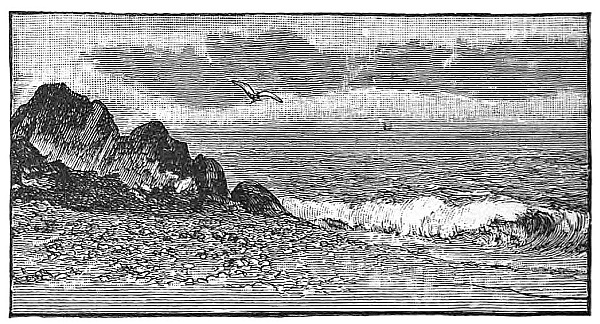
I trust my hero may be forgiven for slightly altering the words of the gentle poet Bowles.
The graceful bird went tacking and tacking for a time around the ship as if he could not quite believe he had obtained his freedom, or were loath to leave his quarters; then, as if memories of a sunnier south had suddenly awakened in his breast, away he darted, and was lost in the darkness.
Chapter Fourteen.
In Winter Quarters—Football among the Snow.
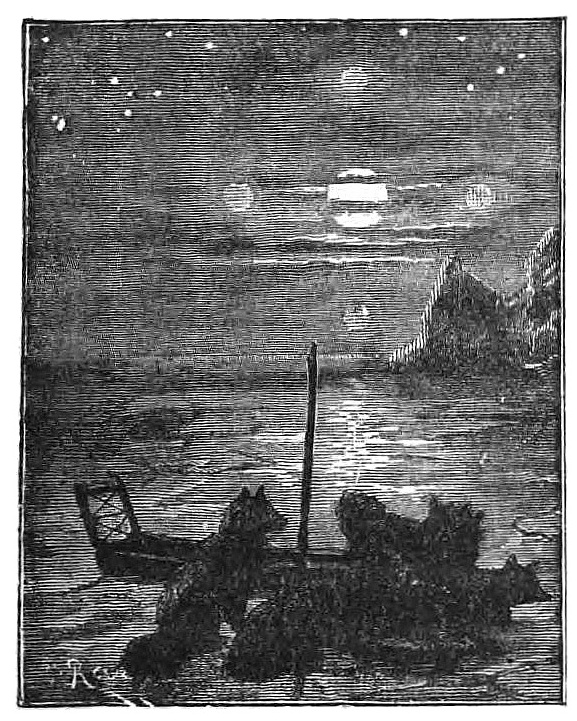
One portion of the cargo of the unfortunate Kittywake—and a very important one it proved to be—was a pack of Yack or Eskimo sledge dogs. Uncouth-looking rascals they are at the best of times, much given to quarrelling and fighting among themselves, and by no means inclined to be over-friendly to mankind.
With them came two native keepers, who professed to, and I dare say did, know something about their uncouth pets, although their rule of the road proved to be a rough one, as far as the dogs were concerned.
Fingal was at first inclined to regard these animals with extreme distrust. He asked Claude, in his own way of speaking, whether he mightn’t begin the fun by charging the pack.
“I am sure, master,” said Fingal, “I would soon make short work with one or two of them.”
“No,” said Claude, holding up a warning finger; “you must never attempt to molest them, Fingal; you will come to love them yet.”
“I don’t believe that,” Fingal seemed to reply.
The dogs were taken on shore at once, and though the Icebear was anchored some little distance from the land, giving her plenty of room to swing round, the row these animals made the first night seemed unearthly. The men could not sleep, and roundly rated the new-comers. Had the noise been a continuous one it would not have been so bad, but it was not so. The deep, deep silence of the Arctic regions would be allowed to remain unbroken for, say, the space of fifteen minutes, then all at once such a chorus of barking, howling, and screaming arose as only the pen of a Dante could describe adequately. This would continue for five minutes, mingled with the cracking of the keepers’ whips and their wild shouting, then gradually the unearthly Babel of sounds would die away, the men and officers on board would give sighs of relief and go to sleep once more, only to be disturbed again in the same fashion ere slumber had well sealed their eyelids.
“Frightful!” said Claude, next morning, at the breakfast-table; “I’ll put a stop to it.”
“You’ll be very clever if you do,” said the surgeon.
“Don’t go meddling near them with a whip, captain,” Lloyd remarked. “Poor Sanderson of ours got drunk one night, and went on shore with a rope’s end to settle, as he thought, a rumpus like what those beggars made last night. He was never seen again.”
“They killed him?”
“Yes, sir, and ate him afterwards, every bone of him. We never found a vestige of him, except the soles of his sea-boots, and we couldn’t bury those in a Christian way, you know, so we were saved the trouble of a funeral.”
“Call the carpenter, steward,” cried Claude. “Carpenter Jones,” he continued, when that worthy appeared, “build comfortable kennels for those dogs half a mile from the spot where our shore quarters are going to stand.”
“Ay, ay, sir.”
“To the lee of a rock, you know.”
“Yes, sir.”
And so the pack was soon disposed of, to the great satisfaction of every one.
By the time, then, that the sun had set for the last time, and the long, icy, Arctic winter had fairly commenced, the Icebear and her gallant crew were fairly settled in their winter quarters, and everybody felt as happy and jolly as possible under the circumstances. Nor was their lot to be despised, after all. Had they not every creature comfort that heart could wish? Had not clever Dr Barrett found coals enough to keep fires burning constantly—fires big enough to roast a whole bear or a small ox, were they so inclined? Had he not also discovered a gold and silver mine? Not that much had yet been taken out of it, to be sure. But it gave them hope. Well, they had never a care, although it must not be supposed they did not often think of home, for ah! the sailor does.
To crown all, was there not a kind Providence above them whose eyes could penetrate the darkness of even this dreary land, and watch over them?
One thing, I believe, that contributed greatly to their happiness was this, everybody seemed determined to do the best he could, not for himself only, but for his shipmates as well.
They had built a house of general entertainment on shore. Also a store for extra provision and other things, in case the ship might be destroyed.
In the storehouse one or other of the Indian keepers always slept as sentry, or rather on guard. Not that there was much fear of an attack on the stores by bears, for most of them had gone south, and the others were curled up asleep in caves and corners among the rocks. But Bruin does not—in my poor judgment and experience—sleep all the winter through. When the weather is milder, even to a few degrees, he awakes, yawns, out-stretches himself, and goes for a turn round in the moonlight and on the snow. He is but the ghost of his former self; like the ghost of a bear revisiting scenes of a former existence. He stalks about, shaking his mighty head, and looking as melancholy as a barn owl.
“How changed is everything!” he appears to soliloquise. “How dead and drear! How hungry I am too. Shouldn’t I like just one pawful out of the back of a fine fat seal now. (Note 1.) Ah! I would eat a whole seal, even the flippers, though there’s not much on those, to be sure. But, mercy on me, how cold it is! Bed’s the best place, after all.” And away he trots.
But Mr Lloyd knew right well from experience what a hungry rascal like this could do even in a single night.
“It isn’t what they eat so much,” he explained to Claude, “as what they destroy. A bear will stave in the head of half a dozen casks of flour, perhaps, before he comes to a barrow of beef. And that doesn’t satisfy him, for he argues that there may be something better in the other casks, and goes clawing away like an evil spirit.”
“Talking about spirits,” put in the second mate, “he is a strict teetotaller; he won’t touch rum.”
“Tins of soupe-en-bouilli, I suppose,” said Claude, “would also defy him.”
“Not if he gets a tooth in one,” replied Warren; “and as for sardines—my conscience! sir, he is fond of them; if once he tastes them he’ll swallow the boxes at a single bite.”
“Boxes and all?” inquired Claude, laughing.
“Well, I never saw the empty boxes left about anywhere.”
“Must be a capital tonic, anyhow!” said Dr Barrett; “but a rather indigestible one.”
There had been wood enough brought on purpose to build huts on shore—simply rough planks. The house of amusement was a famous one. Built with stone as to its chimney, and with wood, filled in with dry moss, as to its walls. There was a capital fireplace, too, in it.
The general routine of the day was somewhat as follows—that is, when there was any kind of bright star, or moonlight, or aurora gleams; though these last were very intermittent, and, like some of our electric lights, would go out without a moment’s warning. There was breakfast at eight; muster to prayers afterwards, on the upper deck, which was almost entirely covered over.
Prayers are seldom more impressive than when repeated away out in the middle of the boundless ocean, but there is even more solemnity in them when heard amid the eternal silence of Greenland wilds. I don’t think there was one poor soul on board the Icebear who would have missed those morning prayers for anything.
Jack-the-Sailor is a rough stick, I must confess, and, as a rule, a very jolly stick. Yet, nevertheless, he has his solemn moments, as well as you, reader, who, maybe, never were afloat on blue water, have.
“I feels some sentences o’ them prayers, that the captain reads, go kind o’ round my heart,” said Chips one day down in the half-deck mess. “That bit, for instance, ‘O God, at whose command the wind blows, and lifts up the waves of the sea and stills the raging thereof.’”
“You hain’t got the words what you might say altogether correct,” said Bos’n Bowman; “but, howsomedever, you’ve got the main thing, and that’s the sense.”
“Well, Pipes,” replied Chips, “you’re more of a scollard than me.”
“And,” put in Spectioneer Wray, “there’s that bit, you know, ‘When we gave up all for lost, our ship, our goods, our lives, Thou didst mercifully look upon us, and wonderfully command a deliverance.’”
“I’ve often found the truth of that,” said Pipes. “So ’as most on us,” said Chips, solemnly. “But,” continued Pipes, “there’s these words: ‘That we may return in safety to enjoy the blessings of the land.’ Don’t they bring old England up before your mind, with her green valleys and flowery fields, and all that kind of thing, eh, maties?”
“Ay, and there’s those as follows,” said Chips, who was a married man and hailed from Rotherhithe, “‘Enjoy the fruits of our labours,’ which means, o’ course, take the missus and the children to Margate for a whole month.”
After prayers, till “pipe for dinner,” there were the various duties of the ship to be carried on, and there was not an officer or man, from Claude himself to little saucy Boy Bounce, who emptied the cook’s ashes, helped to clean the coppers, and attended to the aviary and the wants of Fingal, who did not find something to do. Dinner and smoking done, if the weather permitted, a pleasure party for the shore would be told off.
The doctor and his merry men could do but little exploring now, and his mines lay some distance in the interior among the wild hills, and, from its colour, the ore could not easily be worked by lamplight.
Sometimes for whole weeks the darkness would be intense (Note 2), then the Icebear’s crew had to seek their pleasures indoors or on board the ship. That house on shore was an incalculable boon to these forlorn adventurers. It was devoted, not to games—these could be played on board—but to music, dancing, acting, and to lectures. The musicians were several, and therefore a by no means bad ship’s band was formed. Those, therefore, who could not play could listen; moreover, many of those who could not play, could spin a yarn, dance, or sing.
The lectures were given by good Dr Barrett, whose gentleness and thoughtfulness of the men had rendered him a very great favourite.
These lectures of his, although often on such abstract subjects as chemistry, botany, geology, or astronomy, were always simple and always interesting, and often amusing.
But there were games on the snow-covered ice—frolics we might call them—invented by the men themselves, but none the less exhilarating on that account. The sea about them might be as deep as the hills around were high, but no fear could be entertained of any one falling through—a band of elephants might have frolicked and floundered on it without the least danger.
The snow in some places had been swept off the ice by the wind, leaving it but a few inches deep. These were just the spots for a right roaring game of genuine football. But there was another game, invented by Paddy O’Connell, who was the life and soul of his mess, if not of the whole ship. It was carried on among deep snow, and was very amusing and exciting.
Paddy called it “football.” Well, it was “Irish football,” for the only man in the ship who could kick the thing a yard was gigantic Byarnie. “It was as large as the biggest pumpkin ever you saw, and quite as big as the largest,” so said Paddy. You had to throw it to begin with, and when you got it you had to run with it, and you did not run many yards before you fell with half a dozen on top of you. But the cream of the game lay in the fact that, however much light there might be, before you had played many minutes you could not tell who was your opponent and who not, everybody being as white as the dustiest of millers. When you were struggling for the ball, it was just as likely as not that you were trying to trip up a friend Besides, often when you got it, and could have a fair shy, then, as you could not see well, what with the uncertain light, and what with the powdery snow, you perhaps threw it the wrong way. It was a rare game, and oh! did it not make you hungry!
No wonder that on returning on board you could eat a hot supper with all the appetite of a Highland drover.
“Paddy,” said Dr Barrett once, as he patted him on the back, “you’re a genius!”
“Thrue for you, sorr,” says Paddy, “and it’s just that same me mother towld me. ‘Paddy,’ says she, ‘you’re a born ganious, and there ain’t the likes o’ ye ’twixt Killarney and Cork.’”
Note 1. The shoulder of the seal is the bear’s favourite tit-bit, and I have seldom seen him eat more of Miss Phoca, when sport was good and provisions (seal) plentiful—G.S.
Note 2. There are winters and winters in Greenland. Sometimes for two or even three months together the darkness is deep and depressing, the whole country shrouded in a night that seems never-ending.
Chapter Fifteen.
Paddy’s Adventure with the Bear—Fun on the Ice—The Little Purple Cloud.
Tobogganing? A strange word, is it not? We are indebted to the Americans for it, as we are for many other handy, but hardly elegant, additions to our vocabulary. Those who are fond of hunting for the origins of words, and who cannot live happily unless they find out how this is that, tell us that the sport—and fine fun it is—was first suggested to mankind by the beavers. They say that these busy-brained active animals, by way of keeping their blood-heat up in winter-time, go in a crowd to some snow-clad hill, scurry up to the top of it with their broad flat tails behind them, and go sliding down all in a row, rushing up again as soon as they find themselves at the bottom, and joining the other end of the procession, and that they keep “the pot arboiling” for hours with the highest glee imaginable. Well, perhaps the beavers do, but in one form or other the sport is as old, probably, as the days of Noah.
Canada is perhaps the home of tobogganing, for there the frost is severe and lasts long. Now, the scenery all round the “Sea of Dunallan,” for thus had the waters in which our heroes lay been named by them, was very wild indeed. The hills close beside the beach were high and rounded; beyond these they were higher still, many of them rising into peaks that seemed to have their homes among the stars.
It occurred to Paddy O’Connell, who seemed to be the inventive genius of the crew, and foremost wherever fun was to be had, that a species of tobogganing might be got up from which some “rale diversion” could be had.
So one fine moonlight night, with the stars all shining as well as they could, for the tails and ribbons of brilliant aurora that were hanging in the sky, Paddy went prospecting.
“Shall I come with you, Paddy?” said Byarnie, who was the best of friends with the “Oirlander.”
“Not to-night, me bhoy,” replied Paddy. “It’s after a bit av diversion I’m going, and I think best when I’m all alone by me swate little self.”
“Well, you might take a gun with you,” suggested Byarnie, “for there may be bears about, you know.”
“Bad cess to them. No. There’s never a fear of Paddy.”
Byarnie watched him disappear round the brow of a high knoll, about a quarter of a mile from the Icebear; then went quietly below.
The weather had been fine for weeks, and no snow had fallen. It was just the season when the sun might soon be expected. Already, indeed, there was twilight at noon, so all hearts were gay and hopeful.
Paddy was in search of a hill, and he was very particular as to both its shape, its height, and its condition. At last his prospecting cruise was crowned with success.
“C’dn’t have been better,” said Paddy, talking to himself, half aloud, as he had a habit of doing; “c’dn’t have been better if me own mother had made it.”
The one drawback was that it was fully a mile and a half from the ship; but, after all, that was a small matter. So Paddy started to go back.
It had been tedious work, and hours of it, and, feeling tired, he began to think of his pipe. To think was to act with this son of Green Erin. He stuck his alpenstock in the snow, and forthwith scratched a match and lit up.
“That’s comforting, anyhow,” he said, after a few whiffs. “Now, if I could only find a stone to sit upon. Troth, I might as well look for a stone in the midst av the say, or the big bay of Tralore, as—Hullo! what’s yonder, anyhow?”
Paddy was on the bare brow of a steep hill; but on rounding a hummock and looking back, he found one side of it was dark and free from snow. He returned, and gave the darkness a poke with his stick, and the stick struck—nothing. It was the entrance to a cave.
“I’ll just light a match and have a look,” says Paddy.
The feeble glimmer revealed only a portion of what seemed a great vault.
“I’ll creep in for a moment, out av the cowld,” says Paddy, “and stand in a corner; sure there can’t be any crayture worse than meself in the cave.”
It was an eerisome situation enough, but our gallant Irishman did not mind it a bit.
For fully five minutes he smoked, when he thought, or fancied he thought, he heard a sigh.
“It’s draining I am entoirely; who could be there; at all?”
Presently the sigh—a heavy, long-drawn one—was repeated. There could be no mistake about it this time.
“Ghost of Saint Patrick!” thinks Paddy; “is it in the cave av an evil spirit I am? But never moind, it’s sleeping he is, anyhow. I’ll have a look, and chance it.”
Taking half a dozen hearty puffs to give him courage, Paddy quietly advanced. He had not gone three paces when—behold, curled up at his feet, a gigantic yellow bear!
“Is it there you are, me darlint?” Paddy whispers to himself. “But troth, I just remember it’s toime I was going, so good night, me dear, and bad drames to ye.”
Now Bruin has excellent scent, and Paddy’s tobacco was good and strong, so no wonder he awoke. He rose to his forepaws, opening a great red mouth that would have sheltered a coal-scuttle, and giving vent as he did so to a yawning roar that appeared to shake the very cave.
Paddy threw the almost extinct match into the gulf and fled, with Bruin at his heels.
Byarnie was very fond of Paddy O’Connell, and when his friend stayed so long away, naturally grew anxious, and finally started off to look for him. He would not take a rifle, “because,” he argued, “if Paddy wasn’t afraid, sure I’m not.” But he armed himself with that most deadly weapon, a seal club, and away he strode. On and on went the giant over the snowy hills; but Paddy’s track, that he tried for a time to follow, was as devious as a rabbit’s. When he was just about to give up in despair, who should he see but his friend himself coming round the brow of the hill—it could be nobody else.
But when Paddy disappeared suddenly from view as effectually as if he had sunk into the bowels of the earth, then no wonder big Byarnie rubbed his eyes and stared in astonishment.
Byarnie was superstitious.
“’Twas his ghost,” he thought; “poor Paddy is dead, and that was his spirit!”
And down there on his knees, under the flickering aurora, knelt big Byarnie to pray. While thus devotionally engaged, he was startled by a roar that made him feel as if the earth was going to open and swallow him, and yonder behold poor Paddy running towards him more quickly than he had ever run before, and followed by something large and yellow.
Byarnie spat on his hands, and threw away his cap.
Well, I do not wonder, mind you, at Bruin’s wrath. How would any one like to be wakened from sweet dreamland, and have the fiery end of a lucifer match pitched down his throat?
“Come on, Paddy,” roared Byarnie.
“Sure ain’t I coming as fast as I can?” cried poor innocent Paddy.
As the bear went floundering past, Byarnie struck at him with terrible force.
The steel point of the club entered his neck, but held there, and both Byarnie and Bruin rolled together on the ground, the former undermost, and the blood flew spattering over the snow.
Paddy was back in a moment. He had all his wits about him, and his first act was to free the seal club.
His next act was one which only a brave, merry-hearted Irishman would have thought of. He thrust the alpenstock into Bruin’s mouth as if it had been a horse’s bit, and, mounting the brute’s back, pinned him by seizing the staff close to the side of each jaw.
“I’ve got him,” he cried.
Crack went the alpenstock, and down went Paddy; but Byarnie was up, and in a second he had felled his terrible antagonist.
There lay the dead bear on his side, his tongue lolling out, his dead eyes turned to the sky, and there stood Byarnie and Paddy, both puffing.
“Did you ever see the loikes?” says Paddy.
“No,” Byarnie replied; “but, thank Heaven, you are safe. Let us go home.”
But Paddy carried out his tobogganing scheme all the same.
It was a very simple one, but afforded no end of capital exercise and genuine fun. Carpenter Jones, alias “Chips,” manufactured the tobogganing sledges. Chips said he was glad of the job—anything to keep his hands in. With the help of his assistants he made a score of them in a single day. Very simple they were, in shape somewhat similar to those used by the Canadians, only these seated four abreast, so there was, so Paddy said, four times the fun.
The tobogganing hill was high and round, but not very steep; the top of it was a tableland; at the foot was an enormous bank of drifted snow, and here the fun came in again, as you will presently see.
But let us go with the tobogganing party for just once in a way.
It is eleven o’clock in the forenoon. There is a shimmer of yellowish white light in the east. There is a moon also. Fancy moonlight at mid-day! What with these two lights, the aurora, which has been dancing so merrily for many hours, looks slightly pale, though the colours displayed are more glorious than any pantomimic transformation scene your mind could imagine. Alongside the Icebear are two huge sledges; one is laden with the tobogganing boards and a few merry sailors, the other with men and officers, and such a row there is and such a din! What with the wild shouts of Jack and Joe, the Eskimos; the cracking of whips; the snarling, barking, and yelping of the dogs, the noise is deafening and indescribable.
But they are off at last.
The men have breakfasted well, and, although it is very cold—ten degrees below zero—they are happy, nay, even boisterously merry. Paddy starts a song and all join in the chorus. Claude is there; he knows that Paddy is a favourite, and lets him do pretty much as he pleases. The doctor is there also in case of an accident, and he sings and laughs like the rest, for he is quite a boy, although an old and very learned one.
Mercy on us! how those dogs do fly over the ground to be sure. They are as fleet as the reindeer. Now and then one falls and is dragged a little way, but always manages to scramble up again.
“Hoorup, Hooreeup, Hooree—e?” screams Joe. Crack, crack, crack goes the whip.
Higher and wilder rises Paddy’s song and chorus. Never before were the echoes of the mountains awakened by such boisterous mirth. Even bears asleep in their dens and caves hear and arouse themselves to listen.
“Hoorup, Hooreeup, Hooree—ee—e?”
The sledge goes over a rough bank, and Tom Tatters tumbles out. Boy Bounce waves his cap and laughs at him, but on goes the sledge, over the hills and round the hills and across some frozen streams, and at last straight up the side of the tobogganing hill, and two more men fall out here, and all the rest are thrown on their backs with their heels in the air—what sailors call catching crabs.
“We—e, wee—e, woh—ip!”
The sledge comes to a standstill on the flat top of the mountain, and the dogs stand still also, their tongues lolling out, and panting.
The other sledge is coming up fast and furious, and soon is on the ground.
Then the fun begins.
Four men seat themselves on a tobogganing sledge, and others start them,—with a will too. Down they shoot, the others watching.
The sensation is like that of descending from a balloon with a sense of pleasure substituted for that of danger. The moon and stars are hardly seen by those bold tobogganers. Faster and faster, they can hardly believe they have fairly started till they are at the bottom, and—buried in the wreath of snow.
They are completely buried. Those above for some moments cannot see them at all.
Paddy O’Connell was in the first lot, and he declared that “the dacint burial at the foot av the hill was the best av it entoirely.”
The fun has fairly commenced, and sledge follows sledge down the mountain-side, sometimes three abreast. Even Claude himself and the doctor embark at last, both in the same boat, and find the sensation so delightful that they keep it up.
The dogs have exercise at this game too, for they have to gallop along the plateau to haul the sledges up again.
It is a mad scene and a merry one.
But lo! while the fun is at its fastest, “Look! look!” cried Dr Barrett, pointing skywards; and every eye is turned upwards.
A little purple cloud!
It was twelve o’clock and almost daylight.
What a shout rent the air then!
The sun would rise to-morrow.
Claude and Dr Barrett shook hands, but neither spoke; their hearts were too full. Perhaps both were at that moment breathing a prayer of thankfulness to the kind Father who had hitherto protected them from every danger and from sickness itself.
There were great doings that night in the Icebear and in the Icebear’s snow-house. A supper on board, a concert on shore!
Paddy’s Irish jig was pronounced to be “a caution out and out,” so the men phrased it.
Boy Bounce’s “break-down” almost outstripped it.
Even Byarnie must take the floor to dance all by himself a wild Norse “hoolichan.”
If you can imagine a rhinoceros tripping it on the light fantastic toe, then you see honest Byarnie. If you cannot, then I have only to confess that figures of speech fail me.
The doctor played a selection of airs on his violin, that the engineer, who, like most good engineers, was a Scotchman, declared made him “laugh and greet (cry) by turns.”
Why were those mariners—far away in the desolate regions of the Pole—so happy, so gay?
Because they were hopeful. The purple cloud had done it all. The sun was returning. The long Arctic night had received notice to quit, and in two or three months at most summer would be with them; they would accomplish the object of their adventurous voyage, and bear up for home.
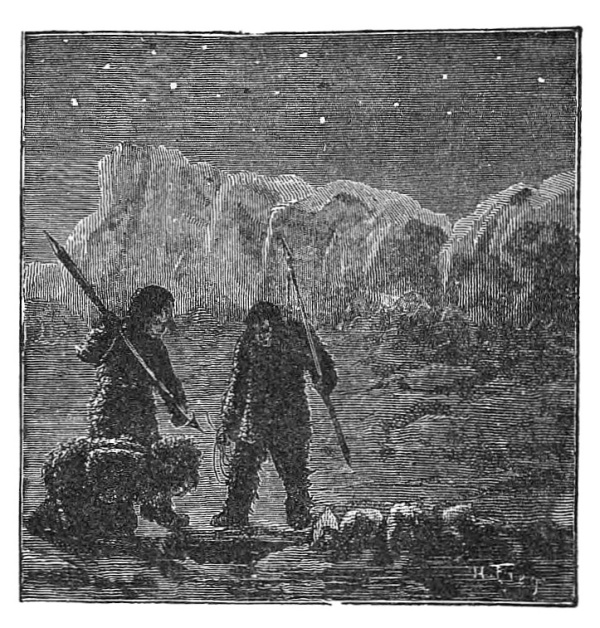
Home! What a charm it has for a sailor’s heart!
Chapter Sixteen.
The Sun’s Return—Hopes and Fears.
Both Claude and the doctor were on a high hill-top next day to watch for the coming of the sun. Nor were they disappointed. About noon the sun duly put in an appearance, looking fiery-fierce and angry through a kind of blue-grey haze that lay along the horizon.
The doctor was ready prepared to take sights, and did so coolly enough, despite the sun’s angry glare—coolly in more ways than one, for as he could only work with bare hands, whenever his fingers came in contact with the brass parts of his instruments they seemed to freeze thereto, and the sensation was that of touching red-hot metal.
I do not know how it was, but after the sun had once more sunk, and twilight had commenced to deepen into night, the scenery of the bleak world around them—the rugged mountains, the rocks and cliffs that looked like bergs of ice, the wide expanse of snow-clad sea, with their vessel lying so cold and comfortless-looking—had a very saddening effect both on Claude and the doctor.
“It is like going back into the grave,” said Claude.
“Well,” the doctor replied, “we must not forget that the sun will—rise again to-morrow and stay a little longer with us, and so on, longer and longer, until he rises not to set again.”
“While we are here?”
“Yes, while we are here. I pray it may be so, for we ought to be out into blue open water by the beginning of August, and homeward bound.”
“Happy thought!” said Claude, after a pause; “I’ll send off another bird.”
“I would certainly do so; and say in your message the sun has come, that all is well and happy; give latitude and longitude exactly.”
“Do you really think these birds ever reach home?”
“Now,” said Dr Barrett, “that is a question that many would ask. Many doubt the capabilities of flight or home instincts of sea-birds. I am as firmly convinced that a seagull, which has been reared in captivity from an egg procured from the parent nest and hatched under a duck or fowl, can be made the best of carriers of messages over sea and land, as I am that the sun we have just seen will rise again to-morrow.”
“It is not that I altogether doubt it,” said Claude; “but you know the story I have confided to you about my love for Meta and my quarrel with my mother—alas! that I should have to give it so harsh a name. Well, although I do not doubt, I sometimes fear.”
“I can fully appreciate your feelings, my dear sir,” was the reply. “Rough old sea-dog though I be, I, too, have had my little romance in life. Yes, let the poor bird fly; it will reach in safety.”
But it may be as well to say at once here that the good doctor was rather sanguine, for of all the six sea-birds that had been, or would be, let fly, only two reached Iceland safely. One of these had been thrown up near Desolation Point; it was that bird which reached home.
“Ought I to communicate the safety of her son to the proud Lady Alwyn?” had been Meta’s thought on receiving the welcome intelligence. She dreaded doing so; she feared to put harder feelings in the lady’s heart against poor Claude than she already possessed. “Besides,” argued Meta, “the Kittywake will soon return and bring her the news that I do not doubt she is pining to hear, if she only loves him half as much as I do.”
The other bird that made its haven in Iceland, though I ought not to anticipate, was one of the last sent up. Of it I shall have more to say anon.
As soon as the day was an hour long, with about an hour of twilight on each side to back it up, Dr Barrett recommenced his explorations in earnest.
The ground all round the inland sea was of adamant; nor pick nor spade could dare on that. But to continue the mine begun the previous summer was far more feasible, for the snow that had filled it had kept out the frost.
Here, then, work was begun. It would keep the men at earnest exercise, at all events, the doctor said, and prevent sickness.
The mine was soon so far advanced as to be a perfect shelter for the workers, even daring the worst of weather.
When little morsels of nuggets of gold and silver came to be found the excitement grew intense. Even the hands who did not strictly belong to the surgeon’s party prayed the captain to permit them to “have a dig,” as they called it, in their spare moments.
And Claude did not refuse.
Rab McDonald, the third officer, was the first to make a lucky find. It was a nugget of pure gold as big as his thumb, and that was by no means a small one.
“Man! look!” he cried exultingly, showing it round to his fellows. “I’ll soon be as rich as Rothschild.”
His face fell somewhat when the doctor quietly told him that all the precious ore found belonged by rights to the company who had sent them out.
A good many more faces fell also, but when Claude explained that he would make such representations as would ensure a goodly percentage of the gold or silver dug out being given to the finders, the enthusiasm was restored, and all hands went to work with a will. For months the gold fever raged among the Icebear’s crew, from February till nearly the end of May, and even sports would have been forgotten in the excitement; but about twice a week Claude ordered all hands to play, if the weather was at all propitious. Then football was resumed, and Paddy’s wild game of tobogganing also, to say nothing of fishing. Fishing? you may repeat, in some surprise. Yes, dear reader. It was done so: a hole was made in the ice, and baited hooks were lowered through. But Jack and Joe despised such cultivated plans of proceeding to business, and, if the truth must be told, they were quite as successful, if not more so, than the British sailors. The tackle these Indians used and their method of using it were of the most primitive description. Each had his own ice-hole, each had a short gut line with a strong strangely shaped bone hook. This was lowered into the water, and if fish even snapped at it—and many did, for the fish are hungry in Greenland during winter—out they came, and they never got back.
The days got longer and longer now, and the weather got sensibly less cold, till lo, and behold! about the middle of April the sun rose one morning and announced his intention of not going to bed again for three months and more to come. At all events, he did not set that night. He only made pretence he would. He went so low on the northern horizon that our heroes fancied he meant disappearing altogether, then he began slowly climbing round again.
Do not imagine, however, that it was all sunshine even now. Far from it. There were terrible gales of wind now, and whirling, drifting snow that seemed to rise as high as the highest mountain peaks.
Some of these hills were evidently extinct volcanoes, but how long ago it might have been since fire and smoke belched from their lofty summits, even Dr Barrett himself would hardly have dared to guess. But working down in their mine one day, about the end of April, the men were startled at hearing a hollow, rumbling sound apparently far down beneath them; it was like the noise of waggon wheels rattling over a rough road, only muffled.
The surgeon and Claude were both in the mine at the time.
“Don’t be alarmed, men,” said the former; “you may safely go on with your work. It is the noise of steam you hear, or rather of water and steam combined. That sound was sent to tell us summer is coming. It is a way the earth has in Greenland.”
“You have heard something similar before?” asked Claude.
“I have, only not in Greenland proper, but in caves among the hills in Spitzbergen.”
Now, giant cataracts began to tumble down from the cliffs of the mountains, and roaring rivers and torrents appeared where rivers had not been suspected before. Water overflowed the inland sea all around the Icebear, making the snow slush, and rendering the passage to and from the shore not only difficult but even dangerous.
And this state of things increased, the sky being meanwhile thickly covered over with dark rolling cumulus, drifting onwards on the wings of a southern breeze. But in a day or two the wind fell flat, the clouds were lifted like a veil from east to west; in half an hour’s time there was not a cloud in the sky, and the sun shone down cold and clear. Strange adjectives to use when speaking of the sun, but none other could express my meaning, for this silver shield of a sun seemed shorn of its rays; you could look at it without pain or inconvenience, just as, raising my eyes, I now gaze upon the flame of the oil lamp by which I am writing.
At eight bells next morning, everybody both fore and aft having breakfasted once, and the boy Bounce twice at least, all hands were on deck waiting orders for the day. Presently the captain and surgeon came up, and took a turn or two up and down the quarter-deck, laughing and talking.
Then came the order, “Hands, lay aft.”
Claude himself addressed them, laughingly. He did not often say much face to face thus to his men.
“Men,” he said, “we’re going to have a forenoon on the ice.”
“Hurrah!” was the shout.
Round the ship, dear reader, and for no one knows how far out seaward, the water had been frozen into one smooth sheet of ice. Who could resist it?
All the skates in the ship were had up, and, although there were hardly enough, those who went without could slide. While the men waited the next order, there was a scream of terror sounded forward. The mate ran towards the fo’c’sle: there lay poor boy Bounce, bleeding; and standing over him, Datchet, the only black sheep in the ship.
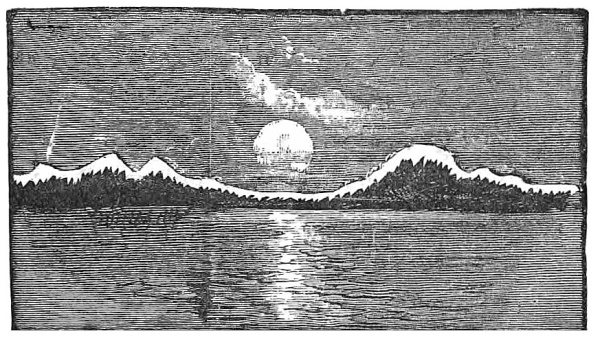
“What do you want with skates, hey?” he was saying.
He had robbed boy Bounce.
When Mr Lloyd ordered Datchet below for the day, the look—nay, scowl—the man gave the mate was not easily forgotten.
But boy Bounce had the skates, his brow was bandaged, and when the order was given, “All hands over the side!” boy Bounce was first to jump, and was the merriest of all the mad and merry crew on that never-to-be-forgotten morning.
Chapter Seventeen.
Wild Sports of the Far North—An Arctic Storm—Breaking up of the Sea of Ice.
It was a matter of no small wonderment to the men of the Icebear why Dr Barrett should now, in a great measure, forsake the mine, where it seemed that wealth could be accumulated, slow though it might be in coming.
But the worthy surgeon “ken’t his ain ken,” as the Scotch say; in other words, he knew what he was about. He was not a gold-digger nor a silver-miner: he was sent out for the purpose of scientific discovery; not to load the Icebear with the spoils of this frozen wilderness, but to spy out the richness of the land.
Was it not possible, he argued with himself, that at some future day an expedition might be sent out, and a company formed to work mines here. It would give him, Dr Barrett, the greatest pleasure to be in charge of it Meanwhile he was very busy indeed.
Dr Barrett’s character and habits were such as might well be imitated by the youth of the rising generation, both male and female. Let me give one or two examples of it.
One. He was never idle unless taking wholesome healthful recreation.
Two. He considered the strict performance of duty as a part and parcel of his religion, and its neglect a grievous and cowardly sin.
Three. He was always ahead of the work he had to perform, and therefore always easy in his mind.
Four. He had method and exactness in carrying on his work.
Five. Having done his duty he trusted all else to that kind Providence who guides and rules everything here below.
Yes, the doctor was busy and kept his men busy.
As long as the snow lay on the ground sledging expeditions were made every day, if it did not blow too high, or if the drifting snow was not blinding.
Very pleasant and delightful, sometimes, were those sledging trips, very dangerous at others. The sledges were large and strong; they had been built specially for the purpose, and were furnished, not only with plenty of provisions, but with all that would be necessary in an extended tour of, say, a week, though three days was generally about the limit the doctor gave himself. He was hardy himself, and cared little for fatigue; he was, in fact, an enthusiast, but he hesitated to expose his men too much. Besides, he had sick patients on board, and an accident might happen at any time.
There was plenty of capital sport to be got in these rambles. The animals that had returned to this country, however, were not yet very numerous. Bears there were, but they could certainly as yet have but little to eat. They growled about among the rocks, and wandered by the side of ice-water swollen streams. Probably they caught fish, perhaps they lived on love; but there they were, lean, long, and hungry looking, their great shaggy coats alone preventing them from having the appearance of downright starvation.
But precisely in the ratio of their hunger was their ferocity. The very sight of a man made them howl with anger.
“Come on!” they seemed to cry. “I won’t run away; I’m not afraid of such as you. Come on, and be eaten up.”
There were two “hands” in the ship who took great delight in these pleasure parties; one was Paddy, the other the boy Bounce, and both constituted themselves Dr Barrett’s special attendants and body-guard. Paddy, of course, carried a rifle; and, after some preliminary training, boy Bounce was permitted to do so likewise. And right proud was the lad to march at his master’s heels with his gun and his shot-belts.
His master was terribly absent-minded.
Boy Bounce used to relate of an evening, to his special friend—on board—the cook, how many times a day he saved his master’s life.
“Blowed if he wouldn’t walk right into the river sometimes!” said boy Bounce, “if I didn’t holler at ’im; or over a cliff, if I didn’t pull ’im back by the coat-tails.”
One fine sunny day the doctor was sitting sketching a pretty snow scene—ice, mountain, glen, and waterfall, and the boy Bounce was lying not far from his feet, facing him.
“Ahem!” began the boy. “I say, sir.”
“Well, well, well?” cried the doctor, impatiently.
“It’s a dee-licious morning—ain’t it, sir?”
The surgeon made no reply, but went on sketching.
“Think the frost’ll hold, sir?”
The doctor looked up now—he knew boy Bounce’s ways.
“What else have you to say, boy, eh? Out with it.”
“Oh, nothing sir, only there’s been a bear a-squatting yonder, and a-lookin’ at ye for the last five minutes, and maybe he’s going to spring.”