Japanese Buddhist Proverbs
Reading edition
As representing that general quality of moral experience which remains almost unaffected by social modifications of any sort, the proverbial sayings of a people must always possess a special psychological interest for thinkers. In this kind of folklore the oral and the written literature of Japan is rich to a degree that would require a large book to exemplify. To the subject as a whole no justice could be done within the limits of a single essay. But for certain classes of proverbs and proverbial phrases something can be done within even a few pages; and sayings related to Buddhism, either by allusion or derivation, form a class which seems to me particularly worthy of study. Accordingly, with the help of a Japanese friend, I have selected and translated the following series of examples,—choosing the more simple and familiar where choice was possible, and placing the originals in alphabetical order to facilitate reference. Of course the selection is imperfectly representative; but it will serve to illustrate certain effects of Buddhist teaching upon popular thought and speech.
1.—Akuji mi ni tomaru. All evil done clings to the body.[1]
2.—Atama soru yori kokoro wo soré. Better to shave the heart than to shave the head.[2]
3.—Au wa wakaré no hajimé. Meeting is only the beginning of separation.[3]
4.—Banji wa yumé. All things[4] are merely dreams.
5.—Bonbu mo satoréba hotoké nari. Even a common man by obtaining knowledge becomes a Buddha.[5]
6.—Bonnō kunō. All lust is grief.[6]
7—Buppō to wara-ya no amé, dété kiké. One must go outside to hear Buddhist doctrine or the sound of rain on a straw roof.[7]
8.—Busshō en yori okoru. Out of karma-relation even the divine nature itself grows.[8]
9.—Enkō ga tsuki wo toran to suru ga gotoshi. Like monkeys trying to snatch the moon’s reflection on water.[9]
10.—En naki shujō wa doshi gatashi. To save folk having no karma-relation would be difficult indeed![10]
11.—Fujō seppō suru hōshi wa, birataké ni umaru. The priest who preaches foul doctrine shall be reborn as a fungus.
12.—Gaki mo ninzu. Even gaki (prêtas) can make a crowd.[11]
13.—Gaki no mé ni midzu miézu. To the eyes of gaki water is viewless.[12]
14.—Goshō wa daiji. The future life is the all-important thing.[13]
15.—Gun-mō no tai-zō wo saguru ga gotoshi. Like a lot of blind men feeling a great elephant.[14]
16.—Gwai-men nyo-Bosatsu; nai shin nyo-Yasha. In outward aspect a Bodhisattva; at innermost heart a demon.[15]
17.—Hana wa né ni kaeru. The flower goes back to its root.[16]
18.—Hibiki no koë ni ozuru ga gotoshi. Even as the echo answers to the voice.[17]
19.—Hito wo tasukéru ga shukhé no yuku. The task of the priest is to save mankind.
20.—Hi wa kiyurédomo tō-shin wa kiyédzu. Though the flame be put out, the wick remains.[18]
21.—Hotoké mo motowa bonbu. Even the Buddha was originally but a common man.
22.—Hotoké ni naru mo shami wo beru. Even to become a Buddha one must first become a novice.
23.—Hotoké no kao mo sando. Even a Buddha’s face,—only three times.[19]
24.—Hotoké tanondé Jigoku é yuku. Praying to Buddha one goes to hell.[20]
25.—Hotoké tsukutté tamashii irédzu. Making a Buddha without putting in the soul.[21]
26.—Ichi-ju no kagé, ichi-ga no nagaré, tashō no en. Even [the experience of] a single shadow or a single flowing of water, is [made by] the karma-relations of a former life.[22]
27.—Ichi-mō shū-mō wo hiku. One blind man leads many blind men.[23]
28.—Ingwa na ko. A karma-child.[24]
29.—Ingwa wa, kuruma no wa. Cause-and-effect is like a wheel.[25]
30.—Innen ga fukai. The karma-relation is deep.[26]
31.—Inochi wa fū-zen no tomoshibi. Life is a lamp-flame before a wind.[27]
32.—Issun no mushi ni mo, gobu no tamashii. Even a worm an inch long has a soul half-an-inch long.[28]
33.—Iwashi[29] no atama mo shinjin kara. Even the head of an iwashi, by virtue of faith, [will have power to save, or heal].
34.—Jigō-jitoku.[30] The fruit of ones own deeds [in a previous state of existence].
35.—Jigoku dé hotoké. Like meeting with a Buddha in hell.[31]
36.—Jigoku Gokuraku wa kokoro ni ari. Hell and Heaven are in the hearts of men.[32]
37.—Jigoku mo sumika. Even Hell itself is a dwelling-place.[33]
38.—Jigoku ni mo shiru bito. Even in hell old acquaintances are welcome.
39.—Kagé no katachi ni shitagau gotoshi. Even as the shadow follows the shape.[34]
40.—Kané wa Amida yori bikaru. Money shines even more brightly than Amida.[35]
41.—Karu-toki no Jizō-gao; nasu-toki no Emma-gao. Borrowing-time, the face of Jizō; repaying-time, the face of Emma.[36]
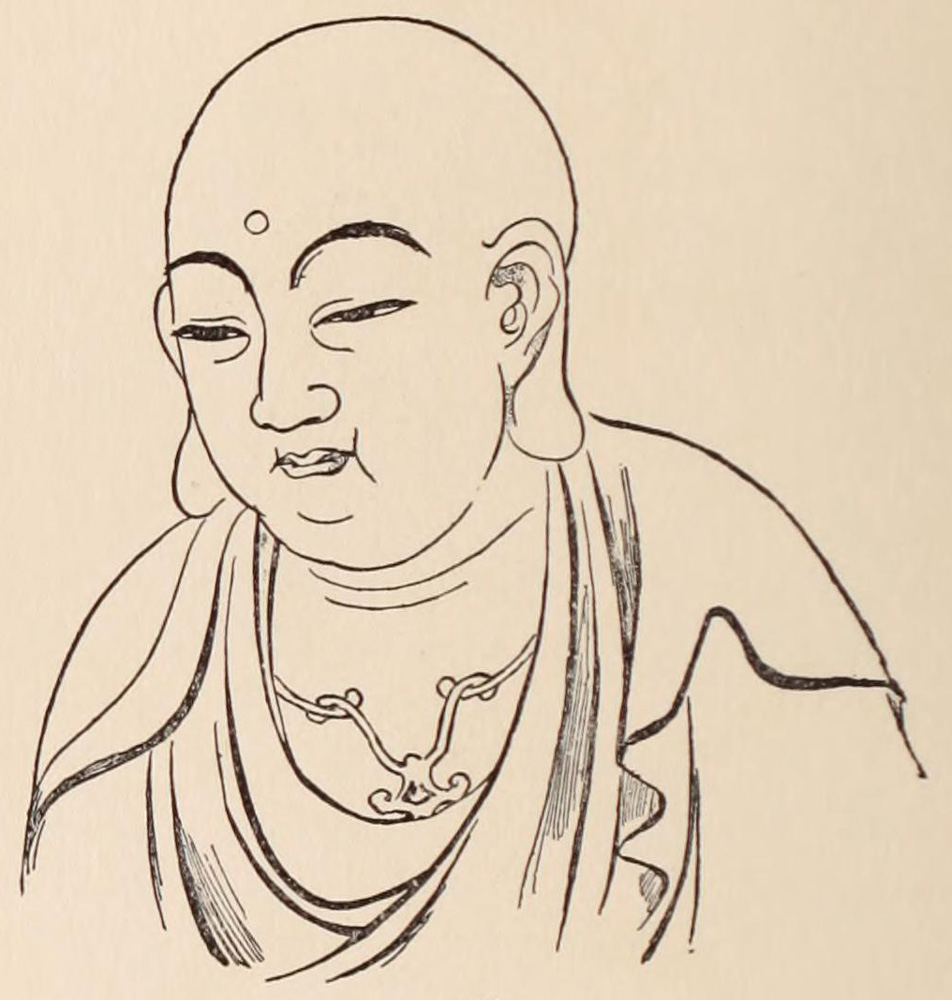
Jizō
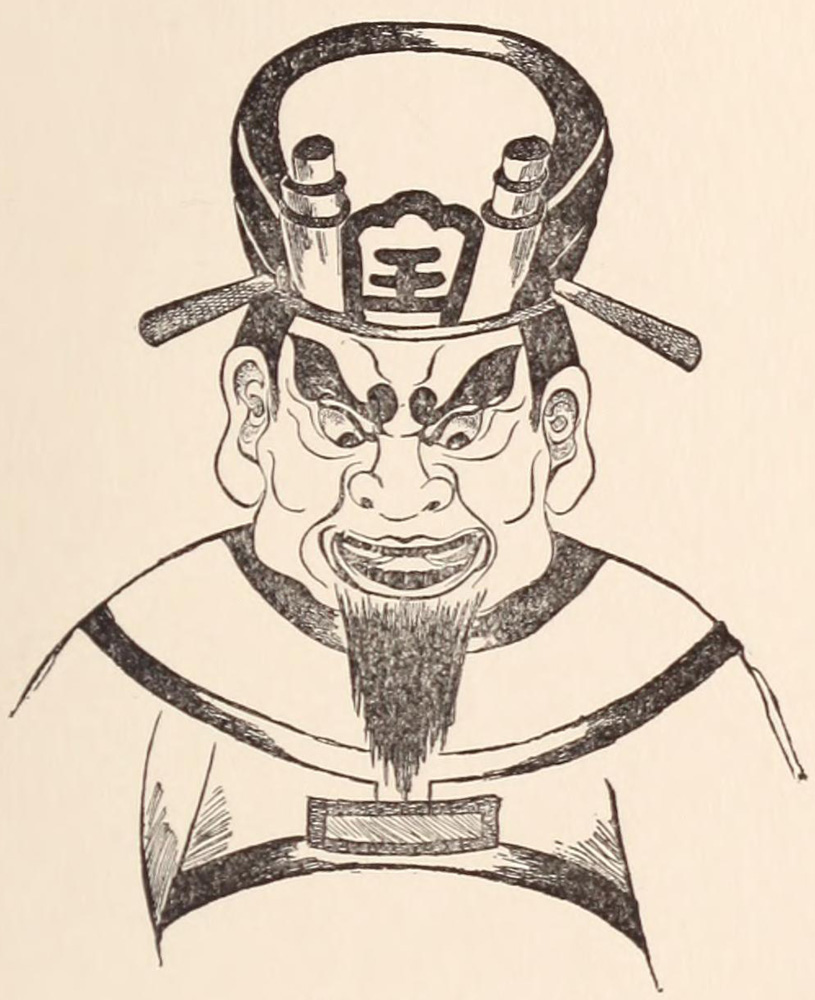
Emma Dai-ō
42.—Kiité Gokuraku, mité Jigoku. Heard of only, it is Paradise; seen, it is Hell.[37]
43.—Kōji mon wo idézu: akuji sen ni wo hashiru. Good actions go not outside of the gate: bad deeds travel a thousand ri.
44.—Kokoro no koma ni tadzuna wo yuru-suna. Never let go the reins of the wild colt of the heart.
45.—Kokoro no oni ga mi wo séméru. The body is tortured only by the demon of the heart.[38]
46.—Kokoro no shi to wa naré; kokoro wo shi to sezaré. Be the teacher of your heart: do not allow your heart to become your teacher.
47.—Kono yo wa kari no yado. This world is only a resting-place.[39]
48.—Kori wo chiribamé; midzu ni égaku. To inlay ice; to paint upon water.[40]
49.—Korokoro to Naku wa yamada no Hototogisu, Chichi nitéya aran, Haha nitéya aran. The bird that cries korokoro in the mountain rice-field I know to be a hototogisu;—yet it may have been my father; it may have been my mother.[41]
50.—Ko wa Sangai no kubikase. A child is a neck-shackle for the Three States of Existence.[42]
51.—Kuchi wa wazawai no kado. The mouth is the front-gate of all misfortune.[43]
52.—Kwahō wa, nété maté. If you wish for good luck, sleep and wait.[44]
53.—Makanu tané wa haënu. Nothing will grow, if the seed be not sown.[45]
54.—Matéba, kanrō no hiyori. If you wait, ambrosial weather will come.[46]
55.—Meidō no michi ni Ō wa nashi. There is no King on the Road of Death.[47]
56.—Mekura hebi ni ojizu. The blind man does not fear the snake.[48]
57.—Mitsuréba, hakuru. Having waxed, wanes.[49]
58.—Mon zen no kozō narawanu kyō wo yomu. The shop-boy in front of the temple-gate repeats the sutra which he never learned.[50]
59.—Mujō no kazé wa, toki erabazu. The Wind of Impermanency does not choose a time.[51]
60.—Neko mo Busshō ari. In even a cat the Buddha-nature exists.[52]
61.—Néta ma ga Gokuraku. The interval of sleep is Paradise.[53]
62.—Nijiu-go Bosatsu mo soré-soré no yaku. Even each of the Twenty-five Bodhisattvas has his own particular duty to perform.
63.—Nin mité, hō toké. [First] see the person, [then] preach the doctrine.[54]
64.—Ninshin ukégataku Buppoō aigatashi. It is not easy to be born among men, and to meet with [the good fortune of hearing the doctrine of] Buddhism.[55]
65.—Oni mo jiu-hachi. Even a devil [is pretty] at eighteen.[56]
66.—Oni mo mi, narétaru ga yoshi. Even a devil, when you become accustomed to the sight of him, may prove a pleasant acquaintance.
67.—Oni ni kanabō. An iron club for a demon.[57]
68.—Oni no nyōbo ni kijin. A devil takes a goblin to wife.[58]
69.—Onna no ké ni wa dai-zō mo tsunagaru. With one hair of a woman you can tether even a great elephant.
70.—Onna wa Sangai ni iyé nashi. Women have no homes of their own in the Three States of Existence.
71.—Oya no ingwa ga ko ni mukuü. The karma of the parents is visited upon the child.[59]
72.—Rakkwa éda ni kaerazu. The fallen blossom never returns to the branch.[60]
73.—Raku wa ku no tané; ku wa raku no tané. Pleasure is the seed of pain; pain is the seed of pleasure.
74.—Rokudō wa, mé no maë. The Six Roads are right before your eyes.[61]
75.—Sangai mu-an. There is no rest within the Three States of Existence.
76.—Sangai ni kaki nashi;—Rokudō ni hotori nashi. There is no fence to the Three States of Existence;—there is no neighborhood to the Six Roads.[62]
77.—Sangé ni wa sannen no tsumi mo hōrobu. One confession effaces the sins of even three years.
78.—San nin yoréba, kugai. Where even three persons come together, there is a world of pain.[63]
79.—San nin yoréba, Monjū no chié. Where three persons come together, there is the wisdom of Monjū.[64]
80.—Shaka ni sekkyō. Preaching to Sâkyamuni.
81.—Shami kara chōrō. To become an abbot one must begin as a novice.
82.—Shindaréba, koso ikitaré. Only by reason of having died does one enter into life.[65]
83.—Shiranu ga, hotoké; minu ga, Gokuraku. Not to know is to be a Buddha; not to see is Paradise.
84.—Shōbo ni kidoku nashi. There is no miracle in true doctrine.[66]
85.—Shō-chié wa Bodai no samatagé. A little wisdom is a stumbling-block on the way to Buddhahood.[67]
86.—Shōshi no kukai hetori nashi. There is no shore to the bitter Sea of Birth and Death.[68]
87.—Sodé no furi-awasé mo tashō no en. Even the touching of sleeves in passing is caused by some relation in a former life.
88.—Sun zen; shaku ma. An inch of virtue; a foot of demon.[69]
89.—Tanoshimi wa hanasimi no motoi. All joy is the source of sorrow.
90.—Tondé hi ni iru natsu no mushi. So the insects of summer fly to the flame.[70]
91.—Tsuchi-botoké no midzu-asobi. Clay-Buddha’s water-playing.[71]
92.—Tsuki ni murakumo, hana ni kazé. Cloud-wrack to the moon; wind to flowers.[72]
93.—Tsuyu no inochi. Human life is like the dew of morning.
94.—U-ki wa, kokoro ni ari. Joy and sorrow exist only in the mind.
95.—Uri no tsuru ni nasubi wa naranu. Egg-plants do not grow upon melon-vines.
96.—Uso mo hōben. Even an untruth may serve as a device.[73]
97.—Waga ya no hotoké tattoshi. My family ancestors were all excellent Buddhas.[74]
98.—Yuki no haté wa, Nehan. The end of snow is Nirvâna.[75]
99.—Zen ni wa zen no mukui; aku ni wa aku no mukui. Goodness [or, virtue] is the return for goodness; evil is the return for evil.[76]
100.—Zensé no yakusoku-goto. Promised [or, destined] from a former birth.[77]