Front matter
Reading edition
IN BEAVER COVE
AND ELSEWHERE
BY
MATT CRIM
New York CHARLES L. WEBSTER & CO. 1892
Copyright, 1892, CHARLES L. WEBSTER & CO. (All rights reserved.)
PRESS OF JENKINS & McCOWAN, NEW YORK.
TO Father and Mother.
CONTENTS.
In Beaver Cove
S'phiry Ann
An "Onfortunit Creetur"
Bet Crow
Silury
'Zeki'l
Was It an Exceptional Case?
An Old-Time Love Story
How the Quarrel Ended
The Crucial Test
The Story of a Lilac Gown
IN BEAVER COVE and ELSEWHERE.
IN BEAVER COVE.
They were having a dance over in Beaver Cove, at the Woods'. All the young people of the settlement were there, and many from adjoining settlements. The main room of the cabin had been almost cleared of its meager furniture, and the pine-plank floor creaked under the tread of shuffling feet, while dust and lamp-smoke made the atmosphere thick and close.
But little did the dancers care for that. Bill Eldridge sat by the hearth, playing his fiddle with tireless energy, while a boy added the thumping of two straws to the much-tried fiddle-strings. A party of shy girls huddled in a corner of the room, and the bashful boys hung about the door, and talked loudly.
"Hey, there! git yer partners!" Bill cried to them tauntingly from time to time.
Armindy Hudgins and Elisha Cole were pre-eminently the leaders in the party. They danced together again and again; they sat on the bench in the dooryard; they walked to the spring for a fresh draught of water. Armindy was the coquette of the settlement. In beauty, in spirit, and in daring, no other girl in Beaver Cove could compare with her. She could plow all day and dance half the night without losing her peachy bloom, and it was generally admitted that she could take her choice of the marriageable young men of the settlement. But she laughed at all of them by turns, until her lovers dwindled down to two—Elisha Cole and Ephraim Hurd. They were both desperately in earnest, and their rivalry had almost broken their lifelong friendship. She favored first one and then the other, but to-night she showed such decided preference for Cole that Hurd felt hatred filling his heart. He did not dance at all, but hung about the door, or walked moodily up and down the yard, savage with jealousy. Armindy cast many mocking glances at him, but seemed to feel no pity for his suffering.
In the middle of the evening, while they were yet fresh, she and Elisha danced the "hoe-down." All the others crowded back against the walls, leaving the middle of the room clear, and she and her partner took their places. They were the best dancers in the settlement, and Beaver Cove could boast of some as good as any in all north Georgia. The music struck up, and the two young people began slowly to shuffle their feet, advancing toward each other, then retreating. They moved at first without enthusiasm, gravely and coolly. The music quickened, and their steps with it. Now together, now separate, up and down the room, face to face, advancing, receding, always in that sliding, shuffling step. The girl's face flushed; her lithe figure, clothed in the most primitively fashioned blue print gown, swayed and curved in a thousand graceful movements; her feet, shod in clumsy brogans, moved so swiftly one could scarcely follow them; her yellow hair slipped from its fastenings and fell about her neck and shoulders; her bosom heaved and palpitated. Panting and breathless, Elisha dropped into a seat, his defeat greeted with jeering laughter by the crowd, while Armindy kept the floor. It was a wild, half-savage dance, and my pen refuses to describe it. Nowhere, except in the mountains of north Georgia, have I ever witnessed such a strange performance.
Armindy would not stop until, half-blind and reeling with exhaustion, she darted toward the door, amid the applause of the crowd. Elisha Cole started up to follow her, but Ephraim Hurd reached her side first, and went out into the yard with her.
"You've nearly killed yourself," he said, half-roughly, half-tenderly.
"No such a thing!" she retorted.
"You're out o' breath now."
"I want some water."
"Better sit down on this bench and rest a minute first," he said, attempting to lead her to a seat placed under an apple-tree; but she broke away from him, running swiftly toward the spring bubbling up from a thicket of laurel just beyond the dooryard fence.
"I ain't no baby, Eph'um Hurd!" she cried, gathering up her hair and winding it about her head again, the breeze fanning her flushed cheeks.
The moon was clear and full over Brandreth's Peak, and Ephraim looked up at it, then down on the girl, softened, etherealized by its magic beams.
"What makes you act so, Armindy?"
She broke a spray of laurel bloom and thrust it through the coil of her hair.
"I don't know what you're talkin' about, Eph'um; but I do know I'm waitin' for you to give me that gourd o' water."
He sighed, stooped, and filled the gourd to the brim, and gave it to her. She drank deeply, then threw the remainder out in a glittering shower, and dropped the gourd into the spring.
"Don't go to the house yet," he pleaded, as she turned away.
"I'm tired."
"An' I—I am—you don't keer anything for 'Lishy, do you? Armindy, do you recollect what you said the last time we went to the singin' at Rock Creek?"
She looked at him from under her lashes, half smiled, then said:
"I don't recollect anything perticular."
"I do," he muttered softly, and stepped across the spring-run to her side. "You said—"
"Oh, don't tell me!—I don't mean anything I say!" she hastily cried.
His face clouded with jealous anger again; he laid his hand on her shoulder.
"You'll—make me do somethin' turrible, Armindy, if you don't mind. I love you; don't—don't—treat me like a dog, flingin' crumbs to me one day, an' whippin' me off the next."
She pushed away his hand, for, with all her coquetries, no man dared take any liberties with her, and stepped beyond his reach.
"I ain't done nuthin' to you, Eph'um Hurd. I—"
"You have!" he cried, stamping his feet; "you've made me love you, tell I don't feel as I could live without you; you let me think that you loved—"
"Law! what's the use o' listenin' to a girl's foolishness? Maybe I love you; an', ag'in, maybe I love 'Lishy Cole an' a dozen others. You're too set on havin' your own way," she exclaimed with a loud laugh.
Somebody called to her from the fence.
"That's 'Lishy, now."
"An' you're goin' to him?" said Ephraim with a pale face.
"Yes, I'm goin' to him. He don't bemean me," with a pretense of being aggrieved, but with mocking laughter in her eyes.
She ran up to the fence, and he heard her talking to Elisha about the flowers in her hair.
The party was over. Ephraim Hurd could scarcely contain the violence of his rage when Armindy refused his company home to accept Elisha Cole's. And how hurt he felt, as well as angry! The slight cut to his soul. He watched them as they went away with a party of the neighbors; he listened to their conversation and loud laughter, until the maddening sound of it was lost in the distance; then he mounted his mule and rode swiftly through the Cove down toward the town on the banks of the Cartecay River, where revenue-officers were stationed. A fierce, irresistible temptation had assailed—had conquered him. If he could not have love, he could have revenge. The revenue-men would be glad to know where Elisha Cole concealed his distillery; they would be better pleased to get Elisha himself. Just a hint, scrawled and unsigned, would be sufficient for them, and no one need know who had furnished the information.
It was morning, full daylight, with mists and clouds afloat in the upper rays of the yet invisible sun, when Ephraim Hurd forded Rock Creek on his way home. The jaded mule dipped his steaming nostrils in the cool, fast-flowing stream, drank thirstily, then, coming out, stopped to crop the high, tender grass growing by the roadside. Ephraim let the rein fall loosely on the faithful creature's neck, while his dull eyes wandered over the landscape. He looked haggard; and the chilly, invigorating air made him shiver, instead of infusing fresh life into him. He dismounted to tighten the girth, then leaned his arm on the saddle, seemingly forgetting to pursue his way home. He was tall, and held himself unusually erect for a mountaineer. He had a rather fine face, with soft, dark beard on lip and chin, and his eyes were a deep, serene blue. He did not look like a coward or a traitor, and yet he secretly felt that he could be justly called so; for repentance had followed quickly upon his rash betrayal of his friend.
The night would have seemed only like a bad dream—a nightmare, had he not gone on that journey to Buckhorn, stealing like a thief through the sleeping town, to slip that line of information under the door of the court-room, where it would be found by the revenue-officers the first thing in the morning. Viewed in the clear, cold light of the morning, when jealousy and savage anger had spent themselves, the deed appeared base to the last degree. He passed his hand over his face with a sense of deepest shame. According to the mountaineer's code of honor, a man could not do a meaner, more contemptible thing, than to betray a comrade to the revenue-men. He would fare better as a thief or a vagabond. No wonder Ephraim Hurd felt like hiding his face from the clear accusing light! no wonder he groaned in anguish of soul! He had lost his own self-respect; he had forfeited all right to the trust of his neighbors.
He raised his eyes and looked slowly around again, and, with his mental faculties all quickened by the trouble he was in, he seemed to realize the preciousness of freedom. A perception of the wild, primeval beauty of the world around thrilled him. He looked up at the cloud floating over the deep blue of the sky, tinged with the rose-light of sunrise; at the fog-wreaths curling around the summits of the higher mountains; at the green depths of the forests; at the winding streams, bordered by laurel and rhododendron, rushing in sparkling cascades or lying in clear, silent pools. All the ineffable loveliness and charm of the new world—the new day, penetrated his soul. The deep solitude, broken only by the murmur of the streams, and the liquid, melancholy notes of the hermit thrush, influenced him as it never had before. Think of leaving it all for the court-room, and the prison! Think of languishing within four close walls through sultry days and restless nights!
Pity for the man he had betrayed melted his heart. At this moment how slight seemed the provocation! Elisha Cole had as much right to Armindy's favor as he could claim.
On the upper side of Rock Creek, just under the great cliff rising boldly toward the clouds, a clump of laurel bushes in full bloom hung over the stream, the opening buds a fine delicate pink, the wide-opened flowers faded to dull white. Ephraim's eyes fell on them, and his face contracted with a keen thrill of pain as he remembered Armindy standing by the spring in the moonlight, and fastening a spray of laurel in her hair. Flushed from the dance, radiant with triumph, she had no thought for him—no kind words. Nevertheless, his heart softened toward her; he writhed as he thought of the sorrow he had laid up for her. He had lost account of time in the midst of his bitter reflections, and a sun-ray, striking across his face, startled him. He sprang into the saddle, and rode out of the highway into the settlement road leading through Beaver Cove.
The Hudgins lived on that road, at the foot of Bush Mountain, in an old log-cabin built in the "double-pen" fashion, with an open entry, and in the rear a rude kitchen. Below the house lay a freshly cleared field, the fence skirting the roadside, and as he drew near, Ephraim heard Armindy singing an old baptismal hymn in a high, clear voice, making abrupt little pauses to say "Gee!" or "Haw!" or "Get up there!" to the ox she was driving before the plow.
Last night she danced the "hoe-down" with spirit and grace, the belle of the party; to-day she plowed in her father's corn-field, barefooted, and clothed in a faded homespun gown, singing for the mere joy of existence—of conscious life. She had on a deep sunbonnet, and coarse woolen gloves covered her hands—strong, supple hands, grasping the plow-handles like a man's.
She reached the end of the row just as Ephraim drew near, and looked over the fence at him with a smile and a blush.
"Good mornin', Eph'um," she cried in a conciliatory tone. "You look as if you had been out all night."
"I have."
"Law! what for? At the 'stillery?" Her voice dropped to a softer key.
"No."
She looked attentively at his sad, haggard face, then took off her bonnet and fanned herself.
"Are you mad at me, Eph'um?"
"No; I ain't mad now, Armindy."
"Then what makes you look so—so strange?"
"I was mad last night."
She turned the cool loam of the freshly opened furrow over her naked feet, a faint smile lurking in the corners of her mouth. He saw it, but did not feel angry.
"Good-by, Armindy," he said gently.
"I didn't mean anythin' last night, Eph'um," she said hastily, sobered again by the gravity of his voice and manner.
"I know how it was."
"I don't believe you do. I—" But he rode away while the defensive little speech remained unfinished on her lips.
She looked after him, slowly replacing the bonnet on her head.
"He is mad, or somethin's happened. I never seed him look like he does this mornin'."
She turned the ox into another furrow, but stepped silently behind the plow. She sang no more that morning.
Beaver Cove was really a long, narrow valley, shut in by ranges of high mountains, the serried peaks sharply outlined against the sky on clear days. The mountain-sides were broken into deep ravines, and here and there, near the base, rose sheltered nooks, in which the mountaineers dwelt, cultivating patches and eking out a primitive livelihood with game and fish. It was in one of these retreats that Ephraim Hurd and his mother lived, with all the length and breadth of the valley lying below them, and the mountains overshadowing them above.
As Ephraim turned from the main settlement road into the wilder trail leading up to his house he met met Elisha Cole driving a yoke of oxen. He was whistling a dance-tune, and hailed Ephraim with a cheerful, friendly air, his whole manner betraying a suppressed exultation. Ephraim noticed it quickly, and clenched his hand on the switch he held—that manner said so plainly, "I have won her; I can afford to be friendly with you now."
"Just gittin' home?" he inquired with a jocular air.
"Yes."
"Oh, ho! Which one o' the Wood girls is it, 'Mandy, or Sary Ann?"
Ephraim flushed, but let the rude joke pass.
"Where are you goin'?"
"To the sawmill for a load o' lumber."
"Goin' to build?"
"Yes; in the fall."
"Thinkin' o' marryin', I s'pose?"
"You've hit it plumb on the head, Eph'um. I am thinkin' o' that very thing," he said, with a loud, joyous laugh.
It grated on the miserable Ephraim. He was full of one thought, which he repeated over and over to himself, "To-morrow he'll be in prison, an' Armindy'll be cryin' her eyes out."
"You'll not be at the 'stillery to-night?" he inquired stammeringly.
"Yes, I will. Man alive, what ails you, Eph'um?"
"Nothin'—nothin'. Hadn't you better go to see Armindy?"
Elisha eyed him suspiciously.
"Me an' Armindy understand one another," he said roughly.
Ephraim rode on, his guilty conscience forbidding any more conversation. He longed to give Elisha a hint of approaching danger—to say carelessly, "I hear the raiders'll be out tonight;" but he knew that he could not without betraying the whole truth.
Breakfast awaited him, and his mother sat in the doorway, smoking, when he arrived at home—a homely woman, yellow as saffron, wrinkled as parchment, and without a tooth in her mouth. Her face lighted up at the sight of her son, and she knocked the ashes from her pipe. He had been a good son, a steady boy, and his absence alarmed her.
"Law! but this is a relief!" she cried as he came in after caring for the mule. "I didn't know you 'lowed to stay out all night."
"I didn't, neither, when I left home."
"I was pestered, thinkin' o' the raiders. Anythin' happened to you?"
"Nothin', mother."
"Are you sick?"
"No."
She watched him silently while he ate sparingly of the breakfast. His dull eyes, his haggard face made her anxious. He had no appetite; he plainly did not care to talk. Her suspicions fell on Armindy Hudgins as the cause of his dejection. She began to question him about the party. She mentioned Armindy and Elisha Cole several times, and each time he betrayed some feeling. She felt resentful toward the girl.
"I s'pose Armindy had things her own way las' night?"
"Purty much."
"I don't, for the life o' me, see why you all should be crazy about that girl. Now 'Mandy or Sary Ann Wood, or Betsey—"
"Ugly as crows, all of 'em."
"Well, they may n't be as purty as pictur's, but they are a sight better than Armindy Hudgins," she retorted, indignantly.
"They certainly ain't smarter, mother."
"No; I s'pose they ain't, for work," said Mrs. Hurd, reluctantly; "but principles count for somethin', Eph'um—you'll 'low that."
"Yes; yes," he cried, and hastily left the table. Who could show less principle than he had?
He went out to work, hoeing and thinning the young corn in a field he had cleared on the mountain-side, but the vigor had gone out of him with hope and courage. The sunlight dazed him, and after a while he stopped and leaned upon his hoe, looking down into the valley, his eyes following the cloud-shadows sweeping silently over the fields, blotting out the silvery gleam of Beaver Creek. It was a day of strange, conflicting thoughts. He had never passed through such an experience in all his simple, primitive life. The impressions of the morning lingered in his memory through the heat of the languid noon and the soft decline of the evening. He had brought upon himself a great question of right and wrong—at least it seemed great to him; so great he could scarcely grapple with it, or settle it with wisdom and justice.
After a supper, partaken almost in silence, he took down his gun and carefully loaded it. Mrs. Hurd watched him until he picked up his hat; then she anxiously inquired:
"Where are you goin', Eph'um?"
"Down to the 'stillery."
"It 'pears to me you'd better take some rest."
"I will, later."
"Well, do be keerful an' keep an eye out for the raiders. I've been so oneasy an' pestered to-day that I feel mighty like somethin's goin' to happen."
He went out, but turned on the doorstep to speak to her:
"If anythin' does happen, mother, you'll be prepared for it."
She sighed, and her wrinkled face quivered with emotion.
"I'm always prepared for the worst, an' expectin' it. To have some sort o' dread on your mind 'pears to me to be a part o' life."
Ephraim shouldered his gun, and disappeared in the darkness. He followed the road for a short distance, then turned out into a trail leading over a ridge. It was not easy walking, but the sure-footedness and agility that are a birthright of the mountaineer made it easy for him.
Out of the deep, clear sky overhead the stars shone softly, but afar in the northwest lay great masses of clouds. Constant flashes of lightning shot over them, and through the profound silence came the dull mutterings of thunder. It was a good time for the raiders to be abroad, and the thought quickened Ephraim's steps. He felt sure they would come before moonrise. On the other side of the ridge he traversed a wilder region of country. Half an hour's rapid walking brought him to a small clearing, surrounded by a low rail-fence. In the centre of the clearing stood a cabin, a stream of ruddy light pouring from its open door. It was where the Coles lived. Two fierce hounds greeted Ephraim's approach with loud, hostile barking, and when he called out to them a young woman appeared at the door with a child on her breast—Elisha Cole's sister-in-law.
"Any o' the men folks at home, Mis' Cole?" Ephraim inquired, leaning over the fence.
"No; John an' his pap have gone over to Fannin County, an' 'Lishy's just started to the 'stillery."
"Oh!—just started, you say?"
"Yes; he ain't been gone five minutes. Won't you come in, Eph'um?"
"Not to-night, Mis' Cole. I 'lowed I'd see 'Lishy before he got off."
With a brief good-night he turned away, following a trail leading down through a ravine. It was a wild, lonely way, and so dark that one could scarcely see an inch ahead. But the pathway presently took an upward turn, and the gray starlight penetrated the sparse underbush. He heard the snapping of twigs ahead of him, and whistled softly. Then the sound of stealthy footsteps fell upon his alert ears. He ran forward a few paces, not daring to speak; then he stumbled over the prostrate body of a man.
"'Lishy," he whispered, peering into the upturned face.
"Is it you, Eph'um?"
"Yes; what's the matter?"
"The raiders they tied me; they're lookin' for Jed Bishop."
It was the work of an instant for Ephraim to get out his knife and to cut the thongs binding Elisha's hands and feet. But the prostrate man had not scrambled up before the revenue-officers were down upon them again. Ephraim snatched his gun, and leaped between Elisha and his foes.
"Get out of the way if you can!" he cried to his friend, and fired blindly at the officers.
Early the next morning, as Armindy sat on the entry steps engaged in sewing some patchwork together before the out-door occupations of the day began, a neighbor rode up and hailed her father.
"Heard about the raid last night?"
"No!" exclaimed Mr. Hudgins, hastening to the fence. "Who'd they get?"
"Nobody but Eph'um Hurd."
Armindy dropped her work, her face growing white, her lower lip caught between her clenched teeth.
"It seems they'd caught 'Lishy Cole, an' was lookin' for Jed Bishop, when Eph'um come up an' set 'Lishy free again. He hadn't more'n done it when up come the raiders, an' 'Lishy says Eph'um fit like old Satan hisself, shootin' at 'em tell 'Lishy cleared out."
"Well, well! that does beat all! He'd better 'a' looked out for hisself."
"That's what I say, an' he with his ma to look after. He wounded one o' the officers, an' it's bound to go hard with him. You needn't look so skeered, Armindy"—raising his voice and looking over at the girl, "'Lishy's safe."
"Oh, yes; 'Lishy's safe. I'm only thinkin' o' what might 'a' happened to him." She laughed loudly, then gathered up her work and rushed into the house.
With slow, uncertain steps a man walked along the settlement road through Beaver Cove. His clothes hung loosely from his slightly stooping shoulders; he leaned on a stick. All about him were the joyful influences of spring. The mountains were clothed in palest green, and every stream could boast its share of laurel and rhododendron abloom along its banks. The man drew in deep breaths of the fine air; his eyes wandered lingeringly over scenes familiar, yet long unvisited. Once he stooped and drank from a clear, shallow stream purling along the road, and, drawing his sleeve across his mouth, muttered softly:
"Ah, that's good. I ain't drunk nothin' like it in more'n four years."
He sat down on a fallen tree rotting on the roadside, to rest a few minutes. A market-wagon, white-covered and drawn by a yoke of sleek oxen, rumbled down the hill. In the driver the wayfarer recognized an old neighbor.
"Howdy, Mr. Davis?"
Davis stared, then leaped from the wagon.
"Why—why—it's Eph'um Hurd, ain't it?"
"What's left o' him," said Ephraim, rising, and shaking hands with his old friend.
"Well, you do look used up an' peaked."
"I've been sick."
"An' your hair is gray."
"It's the prison life done it."
"You've been through a good deal, I take it," in a tone of compassion.
"I don't want to think o' it any more if I can help it!" Ephraim exclaimed. "They didn't treat me so bad, but—oh, I thought it would take the soul out o' me!"
Davis shook his head sympathetically.
Ephraim's face sank on his breast for a moment. There were some questions he longed, yet dreaded, to ask. At last he plucked up courage.
"How—how is mother?"
"Purty well."
"'Lishy Cole is married, is he?"
"Yes; he married more 'n two years ago."
Of course he had expected that answer, but it caused his thin, worn face to twitch and contract with pain. He hastily picked up his stick.
"I—I'd better be gittin' on."
"Your ma's moved down to the Wood place," his neighbor called after him as he started up the road. "The Woods moved to Fannin County last year, you know."
"Is that so?" said Ephraim, but without halting again.
Married! Yes, why should they not marry? It was for that he had saved Elisha Cole. He had known it from the night of the dance, had clearly foreseen it all, that morning he stopped at Rock Creek—facing the awakening world and his own conscience. He had struggled for resignation during his prison life, but never had he been able to think of Armindy sitting by Elisha Cole's fireside—Elisha Cole's wife—without the fiercest pang of jealous anguish.
He sat down again, trembling with exhaustion, and bared his throbbing head to the cool breeze. He looked at his long, thin hands, stroked his face, feeling the hollows in his cheeks and under his eyes. He would never get back his youth and vigor again. It was well no woman loved him except his mother. She would not criticise his changed appearance, or care less for him on account of it.
It was dusk when he reached the old Wood cabin. The shutters had not been drawn over the small, square window in the chimney-corner, and he crept across the yard to look into the room, himself unseen. A low fire burned on the hearth; he could smell the bread baking before it, and the smoke of frying bacon filled the room. Then he saw his mother sitting at the corner of the hearth knitting, while another woman stooped over the fire. Suddenly she stood erect, and he caught his breath sharply, for it was Armindy Hudgins, Elisha Cole's wife, flushed, handsomer than ever. What did it mean? Had they taken his mother to live with them? He writhed at the thought. He leaned forward, for Armindy was speaking:
"Now I'll step to the spring for a pail o' water; then we'll have supper."
"I wish Eph'um was here to eat it with us. Do you think he'll ever come, Armindy?" she said wistfully.
"I know he will," said Armindy, firmly; but a shadow fell upon her face, and Ephraim could see that she looked older, more serious, than in former days. But what a fine, elastic step she had! what supple curves in her figure! His eyes dwelt upon her with admiration, with despair. He loved her as deeply as ever. She stepped out of the room and went away to the spring. He followed her, determined to find out the cause of her presence in his mother's house.
He vividly remembered that other night when they stood at the spring together, and raised his eyes to Brandreth's Peak, but the moon hung low in the west, a pale crescent, Armindy knelt by the spring, dipping up the water, when his shadow came between her and the faint moonlight. She glanced up, then sprang to her feet, half-frightened; the next moment she ran to him and fell weeping on his neck.
"Eph'um! Eph'um! I said you'd come! I've always said you'd come!"
He gathered her to him; then tried to push her away.
"Don't—I—where is 'Lishy?" he stammered.
"I don't know. What do you want to think o' him for, now?" she cried, looking at him with wet eyes, drawing his face down to hers.
"Ain't you 'Lishy's wife?"
She fell back a little.
"Did you think I'd marry him? I loved you, Eph'um—you."
"Is that the reason you 're here with my mother?"
"Yes; I've been with her nearly all the time."
"It was my fault the raiders come out to get 'Lishy, that night."
"I knew it when I heard how you saved him from them. Oh, don't hate me for makin' you suffer so! It seemed like fun then, but I've been paid back for it all."
He felt dazed. Armindy free, Armindy faithful, and loving, and humbly entreating him not to hate her! Life thrilled afresh through him.
"Who did 'Lishy Cole marry?" he inquired at last.
"How you keep thinkin' o' him!"
"I can afford to now."
"He married Sary Ann Wood."
They were standing by the laurel thicket. She saw that his eyes were fixed on the flowers, and turned quickly away to take up the pail of water.
"I ain't danced the hoe-down since that night."
He broke off a spray of the flowers and fastened it in her hair.
S'PHIRY ANN.
The Standneges lived in a little sheltered cove upon the mountain-side, their house only a two-roomed cabin, with an entry separating the rooms, and low, ungainly chimneys at each end. Below it the Cartecay River lay like an amber ribbon in the green, fertile valley; above it towered majestic mountain heights, shrouded in silver mists or veiled in a blue haze. The Standneges were bred-and-born mountaineers, and had drifted into the little cove while Indian camp-fires were still glowing like stars in the valley of the Cartecay, and Indian wigwams dotting the river's banks. The house had a weather-beaten look, and the noble chestnut-oaks shading it had covered the roof with a fine green mold.
The kitchen, a heavy-looking, smoke-blackened structure with a puncheon floor, stood just in the rear of the house, and so situated that from the door one could look through the entry to the front gate and the mountain road beyond.
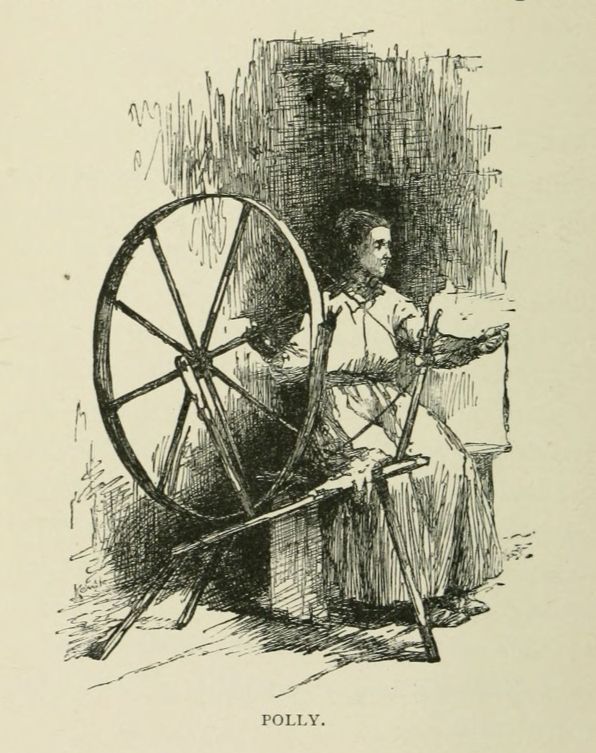
POLLY.
Mrs. Standnege sat in the kitchen door one morning with bottles and bean-bags scattered around her, "sortin'" out seed-beans. She was a woman not much beyond middle age, but lean and yellow, with faded eyes and scant dun-colored hair, time and toil and diet having robbed her of the last remnant of youth, without giving her a lovely old age. She was a good type of the average mountain woman, illiterate but independent, and contented with her scant homespun dress, her house, her beanbags.
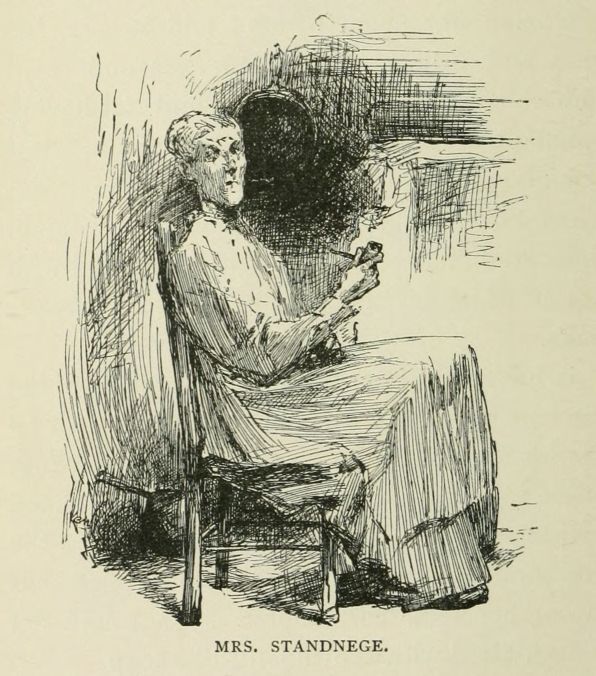
MRS. STANDNEGE.
A heavy old loom occupied one corner of the kitchen, and Polly, the eldest daughter, sat on the high bench before it, industriously weaving, while S'phiry Ann stood by the smoke-stained mantel, watching the pine she had laid on the fire burst into vivid flame. A bundle of clothes lay at her feet, surmounted by a round flat gourd, filled with brown jelly-like soap.
Polly was the eldest and she the youngest of eight children, but the others all lay safely and peacefully in the little neglected burial-ground at the foot of the mountain. She was unlike mother and sister. She had youth, she was supple and fair, her hair dark and abundant, her eyes gray and clear. She had the soft, drawling voice, but also a full share of the sturdy independence, of her race. The circumstances of her christening, Mrs. Standnege was rather fond of relating.
"Yes, S'phiry Ann is er oncommon name," she would say, not without a touch of complacency, "but her pap give it tu her. She was a month old to a day, when that travelin' preacher come through here an' held meetin' fer brother Dan'l on Sunday. He preached mos'ly about them liars droppin' dead at the 'postles' feet, an' Standnege came home all but persessed about it, an' nothin' ed do but he mus' name the baby S'phiry Ann instead er Sary Ann as we had thought. He 'lowed it sarved them onprincipled folks right to die, an' he wanted somethin' ter remin' him o' that sermont. Well, I ain't desputin' but it was right, but I tole Standnege then, an' I say so yit, that ef all the liars in the world war tuk outen it, thar wouldn't be many folks left."
S'phiry Ann had heard of the fate of the Sapphira figuring in sacred history; it had been deeply impressed on her mind in her tenderest years, and might possibly have left a good impression, for she grew up a singularly truthful, upright girl. Just now, as she leaned against the mantel and stared at the fire, her face wore an unwontedly grave expression.
"Folks as set themselves up ter be better'n they ekals air mighty apt tu git tuk down, S'phiry Ann," said her mother, evidently resuming a conversation dropped a short time before.
"But I ain't a-settin' up ter be better'n my ekals, ma," said S'phiry Ann, gently but defensively.
"It 'peared like nothin' else yiste'day when you so p'intedly walked away from Gabe Plummer at meetin', an' it the fust time you had seed him since comin' from yer aunt Thomas over in Boondtown settle*mint*. Thar ain't no call ter treat Gabe so."
"But ain't we hearn he's tuk up with them distillers on the mountains?" said the girl in a low tone, a deep flush overspreading her face.
"Yes, we hev hearn it, but what o' that? Many a gal has tuk jes' sech."
"An' glad to get 'em, too," snapped Polly sharply, stopping to tie up a broken thread.
"Gabe Plummer is er oncommon steddy boy. He's er master hand at en'thing he wants ter do, an'—"
But S'phiry Ann did not linger to hear the full enumeration of her lover's virtues. Hastily balancing the bundle of clothes on her head, she took up the blazing torch, and hurried to the spring, a crystal-clear stream, running out of a ledge of rock, and slipping away through a dark ravine to the river. If she imagined she had escaped all reproaches for her reprehensible conduct the day before, it was a sad mistake. Hardly had the fire been kindled and the rusty iron kettle filled with water when a young man came treading heavily through the laurel thicket above the spring, leaped down the crag, and saluted her.
"Mornin', S'phiry Ann."
"Mornin', Gabe," she said, blushing vividly and busying herself piling unnecessary fuel on the fire.
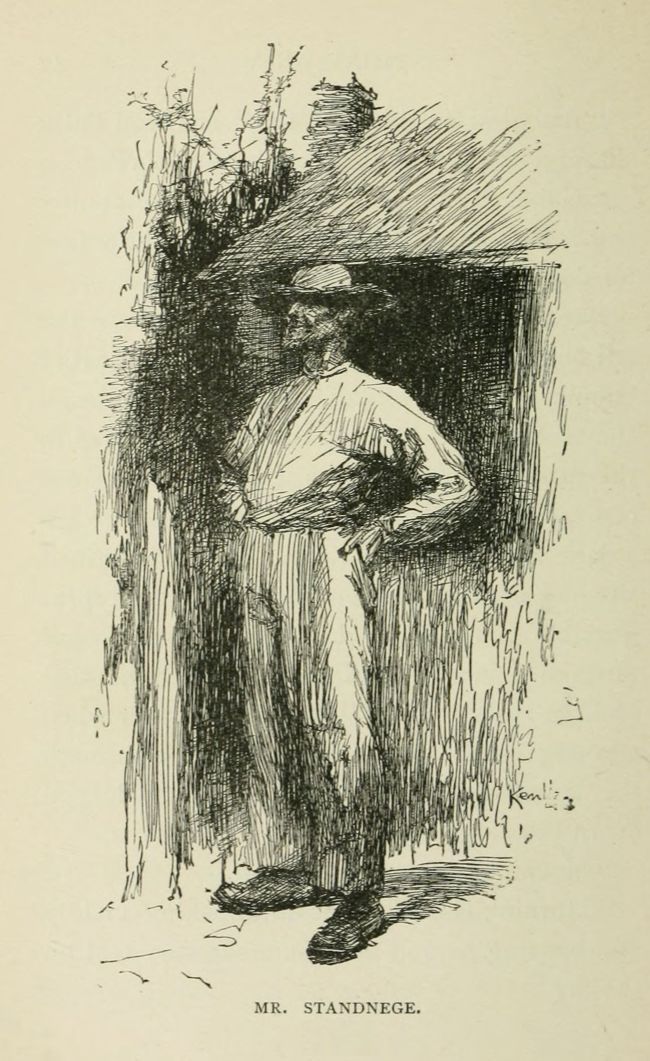
MR. STANDNEGE.
He was a fine specimen of the mountaineer, lithe, well-made, toughened to hardy endurance, with tawny hair falling to his collar, and skin bronzed to a deep brown. He wore no coat, and his shirt was homespun, his nether garments of coarse brown jeans. He carried a gun, and a shot-bag and powder-horn were slung carelessly across his shoulders.
"I knowed you had a way er washin' on Monday, so I jest thought bein' as I was out a-huntin' I'd come roun'," he said, sitting down on the wash-bench, and laying the gun across his lap.
"You air welcome," she said, taking a tin pail and stepping to the spring to fill it.
"I wouldn't 'a' lowed so from yiste'day," darting a reproachful glance at her.
She made no reply.
"What made you do it, S'phiry Ann?" he exclaimed, no longer able to restrain himself. "I ain't desarved no sech; but if it was jes' ter tease me, why—"
She arose with the pail of water.
"No, it wasn't that," she said in a low tone, her eyes downcast, the color flickering uncertainly in her face.
"Then you didn't mean what was said that night a-comin' from the Dillin'ham gatherin'," he cried, turning a little pale. "Mebby it's somebody over in Boondtown settlement," a smoldering spark of jealousy flaming up.
"It's the 'stillery, Gabe," she said, and suddenly put down the pail to unburden her trembling hands. "You hadn't ought ter go inter it."
"But the crap last year made a plum' failure," he replied excusingly, his eyes shifting slightly under the light of hers. She was standing by the spring, against a background of dark green, a slanting sunbeam shifting its gold down through the overhanging pine on her dark, uncovered head, lighting up her earnest face, lending lustrous fire to her eyes. The scant cotton skirt and ill-fitting bodice she wore could not destroy the supple grace of her figure, molded for strength as well as beauty.
"The crap wusn't no excuse, an' if you mus' make whiskey up thar on the sly, I ain't no more tu say, an' I ain't no use fer ye."
"Yer mean it, S'phiry Ann?"
"I mean it, Gabe."
"Then you never keered," he cried with rising passion, "an' that half-way promise ter marry me was jest a lie ter fool me—nothin' but a lie, I'll make it if I please," bringing his down on the bench with a fierce blow.
"An' hide in the caves like a wild creetur, when the raiders air out on mountains?" she scornfully exclaimed.
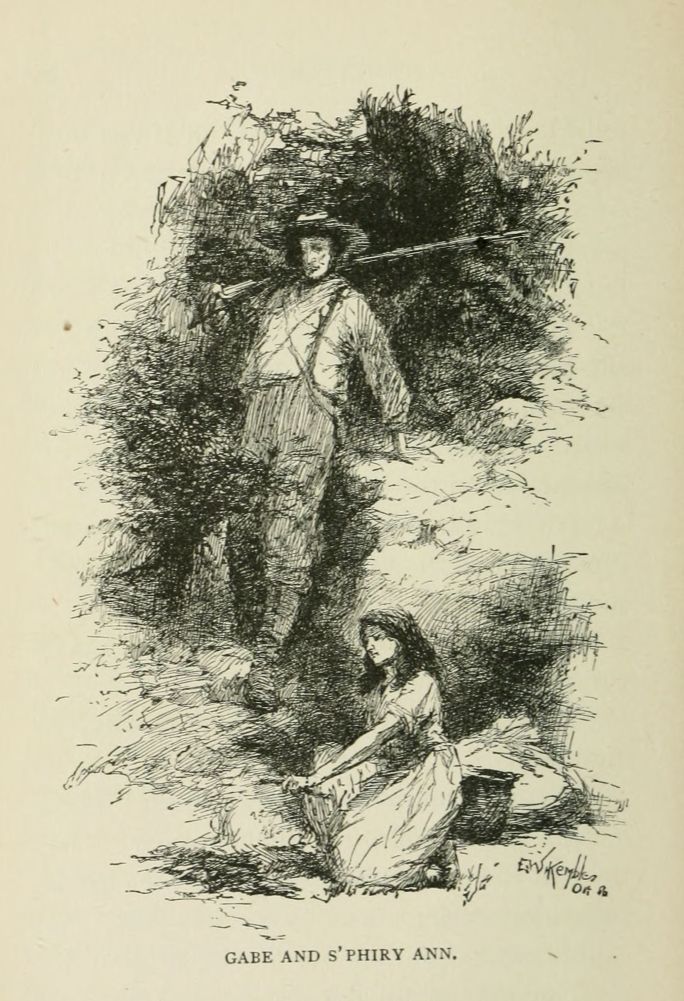
GABE AND S'PHIRY ANN.
His sunburned face flushed a dull red, he writhed under the cruel question.
"They ain't apt ter git me, that's certain," he muttered.
"You don't know that," more gently. "Think o' Al Hendries an' them Fletcher boys. They thought themselves too smart for the officers, but they wasn't. You know how they was caught arter lyin' out for weeks, a-takin' sleet an' rain an' all but starvin', an' tuk ter Atlanty an' put in jail, an' thar they staid a-pinin'. I staid 'long er Al's wife them days, for she was that skeery she hated ter see night come, an' I ain't forgot how she walked the floor a-wringin' her hands, or settin' bent over the fire a-dippin' snuff or a-smokin'—'twas all the comfort she had—an' the chilluns axin' for their pap, an' she not a-knowin' if he'd ever git back. Oh! 'twas turrible lonesome—-plum' heart-breakin' to the poor creetur. Then one day, 'long in the spring, Al crep' in, all broke down an' no 'count. The life gave outen him, an' for a while he sot roun' an' tried ter pick up, but the cold an' the jail had their way, an' he died."
She poured out the brief but tragic story breathlessly, then paused, looked down, and then up again. "Gabe, I sez ter myself then, 'None o' that in your'n, S'phiry Ann, none o' that in your'n.'"
She raised the bucket and threw its contents into a tub.
Gabe Plummer cast fiery glances at her, the spirit and firmness she displayed commanding his admiration, even while they filled him with rage against her. Yes, he knew Al Hendries's story; he distinctly remembered the fury of resentment his fate roused among his comrades, the threats breathed against the law, but he held himself superior to that unfortunate fellow, gifted with keener wits, a more subtile wariness. The stand S'phiry Ann had taken against him roused bitter resentment in his soul, but the fact that he loved her so strongly made him loath to leave her. A happy dream of one day having her in his home, pervading it with the sweetness of her presence, had been his close and faithful companion for years, comforting his lonely winter nights when the wind tore wildly over the mountains, and the rain beat upon his cabin roof, or giving additional glory to languorous summer noons, when the cloud-shadows seemed to lie motionless on the distant heights, and the sluggish river fed moisture to the heated valley.
What right had she to spoil this dream before it had become a reality? He could not trust himself to argue the matter with her then, but abruptly rose to his feet.
"We'll not say any more this mornin', though I do think a-settin' up Al Hendries's wife ag'in me is an onjestice. Me an' some o' the boys air comin' down ter ole man Whitaker's this evenin,' an' bein' agreeable I might step down to see you ag'in."
"Jest as ye please," she quietly replied; then with a tinge of color added, "Ef you'll go back ter the clearin' I'll do jest what I promised, Gabe."
But without saying whether he would or would not, Gabe shouldered his gun and went away.
S'phiry Ann had been very calm and decided throughout the interview, but the moment her lover had disappeared she sank trembling on the bench, her face hidden in her hands.
"Ef it hadn't 'a' be'n for thinkin' o' Al Hendries's wife I never could 'a' stood up ag'in him," she sighed faintly.
A squirrel springing nimbly from a laurel to a slender chesnut-tree paused on a swaying branch to look at her, and a bird fluttered softly in the sweet-gum above her. The sun slipped under a cloud, and when she rose to go about her work, the spring day had grown gray and dull. It sent a shiver through her, as she stared dejectedly at the overshadowed valley. She had little time, though, for idle indulgence—she must be at her washing; and presently when the clouds had drifted away, and the sunshine steeped the earth in its warmth again, her spirits rose, a song burst from her lips—an ancient hymn, old almost as the everlasting mountains around her.
The day waxed to full noon, then waned, and S'phiry Ann spread the clothes on the garden-fence and the grass to dry. There were other duties awaiting her. The geese must be driven up, the cows milked, and water brought from the spring for evening use. Then she would put on her clean cotton gown, and smooth the tangles out of her hair, before Gabe came in. It was all accomplished as she had planned, and at dusk she sat on the rear step of the entry taking a few minutes of well-earned rest. The light streamed out from the kitchen, falling across the clean, bare yard and sending shifting gleams up among the young leaves of the trees. On the kitchen step sat Eph, an orphan boy of twelve or thirteen the Standneges had adopted, whittling a hickory stick for a whistle, and at his side crouched a lean, ugly hound. S'phiry could see her father tilted back in a chair against the loom, talking to Jim Wise, a valley farmer who had come up to salt his cattle on the mountains, while her mother and sister passed back and forth, preparing supper. The voices of the men were raised, and presently she heard Wise say:
"The raiders air out ter-night, so I hearn comin' up the mountain. They air expectin' ter ketch up with things this time, bein' as somebody has been a-tellin',—it 'pears so, anyway."
S'phiry Ann pressed her hands together with a little gasp.
"The boys air got they years open," said Mr. Standnege with a slow smile, his half-shut eyes twinkling.
"But this is er onexpected move, an' they mayn't be a-lookin' fer it," persisted the other man.
"They air always a-ready an' a-lookin'. They ain't ter be tuk nappin'."
But the girl, listening with breathless attention, shivered, not sharing her father's easy confidence. She remembered that Gabe Plummer had said they were coming down to old man Whitaker's, and she knew that they were off guard. They would be caught, she thought, with a cold sensation around her heart; Gabe would be put in jail, and locked up, probably for months, and then come back with all the youth and strength gone from him. Even as these thoughts were passing through her mind, a sound fell on her ears, faint, far away, and yet to her, alert, keenly alive to the approach of danger, terribly significant. It was the steady tramp of iron-shod hoofs upon the road, and it approached from the valley. She sat motionless, but with fierce-beating heart, listening and feeling sure it was the enemy drawing near.
The revenue men had always looked upon the Standneges as peaceful, law-abiding citizens, and though no information had ever been obtained from them, the officers sometimes stopped with them, lounged in the entry, or sat at their board, partakers of their humble fare. Probably they intended stopping for supper. The girl devoutly hoped they would. The steady tramp grew louder, the hound pricked up his long ears, sniffed the air, then dashed around the house with a deep, hostile yelp. The next moment a party of horsemen halted before the gate. Her fears were realized.
The dog barked noisily, the men chaffed each other in a hilarious way, while the horses stamped and breathed loudly, and the quiet place seemed all at once vivified with fresh life. Standnege went out to the gate followed by his guest; Mrs. Standnege and Polly came to the door and peered out, and Eph hurriedly closed his knife and thrust the whistle into his pocket preparatory to following his elders. The officers would not dismount, though hospitably pressed to do so.
"'Light, 'light, an' come in; the wimmen folks air jest a-gettin' supper," said Standnege cordially.
"Business is too urgent. We are bound to capture our men to-night. Why, the whole gang are coming down out of their lair to old man Whitaker's to-night, so we have been informed, and we must be on hand to welcome them."
Eph crossed the yard, but when he would have stepped up to take a short cut through the entry, his hand was caught in another hand so cold it sent a shiver of terror over him.
"My—why, S'phiry Ann!" he sharply exclaimed.
"Hush!" she whispered, drawing him out of the light. "Will you go with me ter ole man Whitaker's, Eph?"
"This time o' night?"
"Yes, now."
"It's more'n a mile."
"We'll take the nigh cut through the woods."
"Dark as all git-out."
"I'm not afeerd; I'll go erlone then," she said with contempt.
"What air you up ter?—Good Lord! S'phiry Ann, do you think that could be done an' they a-ridin'?" suddenly understanding her purpose.
"Nothin' like tryin'," she replied, and glided like a shadow around the corner of the house.
The boy stared for a moment after her.
"Well, I never!" he muttered, and followed on.
They ran through the orchard, an ill-kept, weedy place full of stunted apple-trees, across a freshly plowed field to the dense, black woods beyond. It was a clear night, the sky thickly set with stars, and low in the west a pale new moon hanging between two towering sentinel peaks, but the light could not penetrate to the narrow pathway S'phiry Ann had selected as the nearest route to Whitaker's. The awful solitude, the intense darkness, did not daunt her. She knew the way, her footing was sure, and she ran swiftly as a deer before the hunters, animated by one desire—to get to Whitaker's before the officers. It was a desperate chance. If her father detained them a few minutes longer—but if they hastened on—she caught her breath and quickened her own steps. Eph stumbled pantingly along behind her, divided between admiration at her fleetness and anger that he had been called on to take part in such a mad race.
In speaking of it afterward, he said:
"I never seed a creetur git over more ground in ez short a time sence that hound o' Mis' Beaseley's got pizened. It's a dispensin' er providence her neck wusn't broke, a-rushin' through them gullies an' up them banks, an' it so dark you mought 'a' fell plum' inter the bottomless pit an' not 'a' knowed it."
But S'phiry Ann had no consideration to spare to personal danger, as she broke through the underbrush and climbed stony, precipitous heights. Once an owl flew across her way, its outspread wings almost brushing her face, and with a terrified hoot sought a new hiding-place. The wind swept whisperingly through the forest, and a loosened stone rolled down and fell with a dull, hollow sound into the black depths of the ravine below them. Eph wished they had brought a torch, wished that he had not come, then struck out in a fresh heat, as he heard a mysterious rustling in the bushes behind him.
At last they emerged from the woods opposite Whitaker's, and S'phiry Ann leaned for a moment against the fence, panting, breathless, but exultant. She had won the race.
The house was only one forlorn old room, built of rough hewn logs, with a rickety shed in the rear. A small garden spot and the meager space inclosed with the house comprised all the open ground. Mountains rose darkly above it, and, below, the mountain road wound and twisted in its tortuous course, to the fair, open valley. At the back of the dwelling the ridge shelved abruptly off into a deep ravine, dark the brightest noonday—an abyss of blackness at night.
From the low, wide, front door ruddy light streamed generously, defying the brooding night, playing fantastic tricks with the thickly growing bushes on the roadside. The girl had a good view of the interior, the men lounging around the fire, the vivid flame of pine-knots bringing out the lines in their tanned, weather-beaten faces, flashing into their lowering eyes, and searching out with cruel distinctness all the rough shabbiness of their coarse homespun and jeans.
There were the Whitaker boys, hardy, middle-aged men; Jeff Ward, a little shriveled fellow with long, tangled, gray beard and sharp, watchful eyes; Bill Fletcher, who had bravely survived the trials which had proved the death of his comrade, poor Al Hendries; Jeems Allen, a smooth-faced boy, and Gabe Plummer. He sat somewhat aloof from the others, staring gloomily into the fire, instead of giving attention to the lively story Jeff Ward was telling. At one end of the great hearth, laid of rough unhewn rocks, sat old man Whitaker, at the other, his wife—a gray and withered couple; he tremulous with age, she deaf as a stone.
Nobody seemed to be on the lookout for enemies. The wide-flung door, the brilliant light, the careless group, gave an impression of security.
What had become of the revenue officers? No sound of hoofs struck upon the hard road, or murmur of voices betrayed hostile approach. Eph turned and peered down the road, then clutched excitedly at his companion's arm.
"Good Lord, S'phiry Ann! they're right down there a-hitchin' they horses an' a-gittin' ready ter creep up. I'm er-goin' ter leave here."
S'phiry Ann sprang across the fence, and the next moment stood in the door.
"The raiders! the raiders air a-comin'!" she cried, not loudly, but with startling distinctness; her torn dress, wild, loose hair, and brilliant, excited eyes, giving her a strangely unfamiliar aspect. The warning cry thrilled through the room and brought every man to his feet in an instant.
"Whar? which way?" exclaimed young Jeems Allen, staring first up among the smoke-blackened rafters, then at the solid log wall.
"'Tain't the time fer axin' questions, but fer runnin', boys," said Jeff Ward, making a dash toward the back door, closely followed by his comrades. Gabe Plummer had made a step toward S'phiry Ann, but she vanished as she appeared, and he escaped with his friends into the fastnesses of the woods. There was a shout from the raiders, creeping stealthily around the house, a disordered pursuit, and over the cabin the stillness following a sudden whirlwind seemed to fall.
S'phiry Ann crept cautiously out from the chimney-corner, slipped over the fence, and knelt down in the edge of the bushes, to watch and wait. The officers soon returned with torn clothes, scratched hands and faces, but without a prisoner. They were swearing in no measured terms at being baffled of their prey.
Old man Whitaker and his wife had quietly remained in the house, apparently not greatly moved from their usual placidity. Once the old woman dropped the ball of coarse yarn she was winding, and rose to her feet, but the old man motioned her down again. They were questioned by the officers, but what reliable information could be expected from an imbecile old man and a deaf old woman? The girl could overlook the whole scene from a crack in the fence—the officers stamping about the room, the scattered chairs, the old people with their withered yellow faces, dim eyes, and bent, shrunken forms, and the dancing flames leaping up the wide sooty chimney. Satisfied that the distillers were safe, she softly rose and started across the road. One of the men caught a glimpse of her, the merest shadowy outline, and instantly shouted:
"There goes one of 'em now!"
She heard him—heard the rush of feet over the threshold and the bare yard, and without a backward glance, fled like a wild thing through the woods, home.
One afternoon, a week later, S'phiry Ann drew the wheel out into the middle of the kitchen floor, tightened the band, pulled a strip of yellow corn-husk from a chink in the logs to wrap the spindle, and set herself to finish spinning the "fillin'" for the piece of cloth in the loom. Her mother and sister were out in the garden sowing seeds, Eph was cutting bushes in the new ground, and she could hear the loud, resonant "geehaw" with which her father guided the ox drawing his plow. It was a serenely still day—the heat of mid-summer in its glowing sunshine, with only a fleck of cloud here and there along the horizon, and mountains wrapped in a fine blue haze.
It had been a trying week to S'phiry Ann, but she had no time to mope and brood over her anxieties, no inclination to confide them to her family. She had not shirked daily duties, but went about them silently and without enthusiasm. The revenue officers, disgusted, angered at their disappointment, lingered on the mountains several days, seeking something to lay violent hands on. One still they found and destroyed, but if the earth had opened and swallowed them, their prey could not have disappeared more completely. The law is strong, but it loses its power when carried into the strongholds of the mountains, majestic, clothed in repose, yielding up their secrets only to those bred and born upon them.
S'phiry Ann lifted her eyes to the lofty heights, yearning to know if her lover and his friends had found safe refuge, trembling with terror every time the dog barked or an ox-cart creaked slowly along the road. When the family were made acquainted with her part in that Monday night raid, there were various exclamatory remarks at the inconsistency of her behavior. Mrs. Standnege dropped her pipe, and stared at her in great amazement.
"Well, ef you don't beat all! Last Sunday a-slightin' Gabe Plummer at meetin', an' now mighty nigh a-breakin' yer neck ter git him outen the way o' the raiders."
"Gabe wasn't the only one thar," said the girl in a low tone.
"But it stands ter reason you wouldn't 'a' done it, ef he hadn't 'a' be'n thar. Yer pap may hev ter look out fer a new farm-hand arter all," with a touch of facetious humor, but watching the slow reddening of the girl's throat and face. Standnege came to her aid—
"Let her be, ma, an' work it out in her own mind. Thar ain't no 'countin' fer the doin's o' wimmun folks, no how. They air mighty oncertain creeturs."
"Why, pap!" exclaimed his eldest daughter, a mixture of indignation and reproach in her tone.
"Now, I ain't a-meanin' ter throw off on 'em, an' I don't say as they ain't all steddy enough when they settle down, but a gal in love is the oncertainest creetur that ever lived. Now S'phiry Ann ain't a-lackin' in common sense an' grit, if she does belong to me," he continued, with calm impartiality; "an' ef she wants ter marry Gabe Plummer 'fore craps air laid by, she kin do it."
But it was Monday again, and S'phiry felt that her fortune was still an unsettled thing.
"Ef it hadn't 'a' be'n for thinkin' o' Al Hendries's wife," she said to herself again and again, and the old spinning-wheel flew swiftly beneath strong, young fingers, and the yellow corn-husk on the spindle filled slowly with smooth, even thread. She could look as downcast and troubled as her heart prompted, for no curious eyes were resting on her. Was it true? A shadow suddenly darkened the doorway.
"Howd'y'do, S'phiry Ann?"
The half-twisted thread fell from her fingers, writhed and rolled along the floor, fair sport for the kitten lazily coiled on the hearth, while she turned toward the secretly wished-for, but unexpected, visitor. She trembled, and the color in her face flushed and paled.
"Gabe!" Then quickly, and with a swift searching glance toward the road, "is it safe for you ter be here?"
"Yes, they air gone—an' ter the devil, I hope." He leaned against the wall, jaded, forlorn-looking, the week of hiding out not improving either temper or appearance.
"Take a cheer, an' set down, Gabe," she said, a vibration of tenderest pity in her voice.
"I ain't a-keerin' tu rest jest yit. That was a good turn you done us t'other night. No tellin' where we would be now ef it hadn't 'a' be'n fer that. I don't know how to thank you fer it, S'phiry Ann," he said, with strong emotion in his voice.
"Don't, Gabe!" she stammered, stooping to snatch the tangled thread from the paws of the kitten.
"Would you 'a' done it fer me?"
"'Tain't fair tu be axin' sech questions," she said defensively.
"'Cordin' tu promise you air tu marry me."
"I saud ut ef you 'ud go back tu the clearin'."
"Yes, an' that's jest what I'm a-goin' tu do. I've had a week o' thinkin', an' now I'm willin' tu 'low you kin hev your way. Ain't I b'en tu put my head outen the holler?" he continued in angry disgust; "afeerd tu tech a leaf fer the noise it made? afeerd tu draw my breath? an' I tell ye, I ain't a-hankerin' arter any more sech days, an' I told the boys so, an' I'm a-goin' back tu the clearin' ef every crap fails."
S'phiry Ann stood by the wheel, her face turned from him, silent, motionless. He waited a moment, then strode across the floor, and laid his hand on her shoulder.
"We mus' settle it now, S'phiry, I ain't a-blamin' you now, though I don't say as I didn't, back yander a week ergo, fer standin' tu principle."
"Ef it hadn't 'a' be'n fer thinkin' o' Al Hendries's wife," she said gently.
"I've be'n a-lovin' you er long time, an' it's tu settle what we air a-goin' tu do."
"The clearin' settles it, Gabe," she murmured, and turned her head slowly until her eyes, softly radiant, met his eager, ardent ones.
AN "ONFORTUNIT CREETUR."
Mrs. Upchurch sat in the entry of her house knitting, while down on the step—a rough block of Georgia granite—Mr. Upchurch sat resting and smoking an after-dinner pipe. It was on a summer afternoon, and the hot glare of the sun made a shade gratefully welcome. The house had only the space of an ordinary yard between it and the public country road, but it was on a breezy hill and commanded a fine view of the surrounding country.
Far away, above the green, wooded hills and valleys, rose the North Georgia Mountains, veiled in misty blue. Those mountains were the boundary line of Mrs. Upchurch's world. She had never gone to them; she never dreamed of going beyond them. Still, they were old friends, immovable, unchangeable, upon which she could look when perplexed, sorrowful, or glad. She worked slowly, and often glanced away toward those distant peaks, a very grave meditative light in her eyes.
She was a woman above medium height, and rather dignified in appearance and manner, with a kind, homely face, yellowed and hardened by sun and wind, and with honest, steadfast eyes. She had on a stout, plain cotton dress, and an old brown veil was drawn around her head and tied under her chin. Summer and winter she wore it, to ward off that greatest enemy of her peace—neuralgia.
"He always was an onfortunit creetur," she said abruptly, and with a sigh.
"Who now, Peggy?" inquired Mr. Upchurch in some surprise.
"Why, Ab," and laying her knitting down on her knee, she smoothed it out thoughtfully.
"That brother o' your'n?"
"Yes; I said he always was an onfortunit creetur."
"Yes, onfortunitly lazy," her husband dryly observed.
"He all but died wi' the measles when he was a sucklin' baby not more'n three months old, an' then 'long come the whoopin'-cough on the heels er that, an' liked to 'a' tuk him off. Then you remember ther time he was snake-bit on his big toe, an' how the pizen flew all over him like lightnin', an' he would er died ef we hadn't er happened ter have some dram in the house. Then he tuk cramp once in Punkin Vine Creek, an' would er drownded right on the spot ef Providence hadn't er sent the singin'-school teacher along fer ter fish him out."
The half-forgotten incidents of childhood and youth crowded fresh upon her memory. She leaned forward, resting her elbows on her knees—a favorite attitude with many country women when they are smoking their pipes, dipping snuff, or are lost in deep thought—and thrust a knitting-needle through her hair. But her reminiscences did not impress her husband very deeply. He eyed her kindly, and with a slight touch of pity.
"You hain't seen him sence the war, Peggy. What's got inter you that yer mind keeps er runnin' onter him ter-day?"
"I'm shore I don't know, Sam, but it's er fact. I ain't thought as much erbout him these twenty years an' more as I have ter-day. Mebby Ab's a-comin'."
"Mebby he is, but 'tain't likely at this late day, an' I wouldn't be a-botherin' erbout it, Peggy," said the farmer, shaking the ashes out of his pipe before placing it in his pocket.
"I ain't exactly botherin', Sam, but I dreamed erbout him las' night, an' takin' it all tergether it jes' pesters me er little."
Mr. Upchurch got up slowly from his resting-place, and stepping into the west room, took down his gun from over the door.
"B'lieve I'll go a-huntin', Peggy."
"Well," she answered, absently, still thinking of her brother, and wondering if she would ever see him again.
"He's that onfortunit, he might 'a' wandered off an' er died among strangers, with not er soul ter look arter him, or ter put him erway decently," she murmured in a troubled undertone. "I can't fergit the time he stood between me an' old Miss Whitlock's dog, that run mad when me an' him was little fellers. He was always sorter sickly an' quare, but I knowed then he had grit, for there he stood as calm as could be, an' that dog a-comin' straight fer him, or so it 'peared like, jest er-foamin' at the mouth. I thought shore Ab 'ud be bit plum' through, but the critter passed by without techin' him. Them days is all over, but I ain't fergot that, I orter love him, poor feller!" And she looked away to those blue mountains with eyes grown dim with sudden tears.
It was Saturday afternoon, and therefore a holiday among the farmers. A man must be hard pushed indeed who will not "knock off" Saturday afternoon.
The Upchurch family were thrifty, industrious people, took care of their not too fertile farm, lived honest lives, and kept peace with their neighbors.
"Upchurch is er smart man, ef I do say it," his wife would sometimes proudly remark. "When me an' him married we 'lowed we'd help one ernuther, an' mebby we'd git helped; an' so we did, fer Providence always helps them that helps themselves."
Peggy Upchurch was a good woman, and noted among her neighbors and friends for her readiness to visit the sick and the sorrowful. She was a useful woman in her narrow sphere, a strict member of Ebenezer Baptist Church, and while she did not consider it right "fer wimmin to speak out in meetin'," she did a good deal of missionary work quietly.
She rose and glanced around to see if everything had been put in proper order, then sat down again, with her snuff-box and her knitting on her lap.
The house was a double log-house—that is, two large rooms with a wide, open entry between, and a loft above. In the furnishing of those rooms, the chief consideration seemed to have been beds—high feather beds, with blue and white checked foot-curtains concealing the unpainted pine posts of the bedsteads, and elaborately fringed "double-wove" counterpanes spread over them. Those beds were the pride of Mrs. Upchurch's heart.
"I raised them feathers myself, an' I know they er fresh ernough fer the President ter sleep on."
Doors stood wide open, letting in sunshine and sweet flowers' scents, and George Washington looked down from his rusty frame with a gracious unbending of his dignity.
A few scrubby oaks shaded the clean-swept yard, and a honeysuckle vine had been trained to climb and spread itself over the rough logs of the house. A fine rose-bush bloomed beside the gate, and there were beds of larkspur, pinks, and sweet-williams in the sunnier spots.
It was a home the counterpart of which may be found in almost any portion of Georgia, bare and rather lonely looking, but clean and healthy, and to the householders acceptable as a kingly palace. It appeared a very haven of rest and peace to the tired, dusty tramp toiling up the wide, hot road. His eyes wandered from object to object as though the place was not unfamiliar to him, and a slight quiver of emotion crossed his features when that roving glance fell on Mrs. Upchurch. He carried a small bundle hanging from the end of a knotted hickory stick over his right shoulder, and he walked in a halting, uneven way. He turned from the road and stopped at the gate.
"Good-evenin', ma'am."
"Good-evenin', sir," said Mrs. Upchurch, looking at him with some curiosity.
He opened the gate.
"May I come in an' git er drink er water? Walkin' is pow'ful hot work."
"Ter be shore; jes' walk right in an' take er seat an' rest yerself; you look plum' fagged out," said the hospitable woman, rising and placing a chair out in the entry for him.
He walked across the yard in a footsore and weary way, and dropped feebly down on the edge of the floor, laying his stick and meager bundle beside him. He took off his ragged old hat, and wiped his face on a faded cotton handkerchief. He was a sorry-looking case, shabbily dressed, thin, and stooping, and without the color of blood about his sallow face and hardened hands. His eyes were hollow, and he coughed once or twice a dry hacking cough. So utterly forlorn and friendless did he appear, that deep pity stirred Mrs. Upchurch's heart. He stared hard at her, his face working in an agitated manner. She brought him a gourd of water, and taking it in his trembling hands, he drank slowly from it.
"That's good," he muttered softly.
"Yes, we've got the best well in this country. But won't you take this cheer an' rest? It's better'n the floor," she said compassionately.
"No'm. Is this—where—Sam—Upchurch—lives—that married Peggy Dyer?" he slowly inquired.
"Why, yes; Upchurch bought this place before me an' him was married, an' we've been er-livin' here ever sence," she said, surprised, and striving to recognize him. He had called her name with the ease and familiarity of one well acquainted with it, but not a friend of her youth could she recall who would bear the slightest resemblance to this poor wanderer. Singularly enough, at that moment she had forgotten the brother Ab who had been haunting her memory all day. "You're not er stranger in this settlement, air you?"
"Yes, it 'pears like I am now. You don't seem to know me, Peggy?" he said with a sort of tremble in his voice, his haggard eyes raised to her pleasant, homely face.
She fell to trembling then herself, and her sunburnt face grew pale, for a sudden thought flashed into her mind—a bare possibility, that overcame her. She sat down in her chair, with a searching, eager look at the shabby, stooping figure, and pallid, sickly face.
"I orter know that voice; it 'pears like—" she faltered unsteadily.
"Have you forgot yer brother Ab, Peggy?"
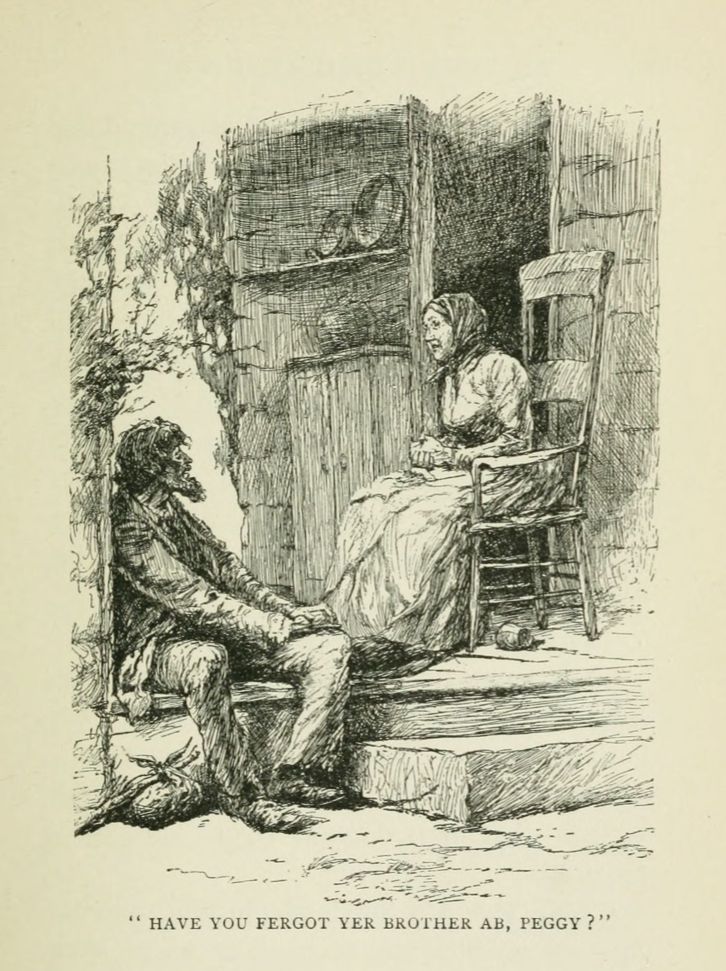
"HAVE YOU FERGOT YER BROTHER AB, PEGGY?"
"Lor', Ab! that ain't possible! it's too good ter be true!" she cried, and then burst into joyful tears.
"Yes, it's me," he said quietly, and wiped his own eyes.
There were no open demonstrations of love. They did not even shake hands.
"Air you glad ter see me, Peggy?" he asked in a sort of sad wonder, but no longer doubtful of his welcome.
"Glad! O Ab, ain't I been a-wantin' ter see you fer nigh on ter twenty years?" she cried, in a voice that might have laid the most subtile doubts at rest. "Come in, brother, and take a cheer, do," wiping her eyes on her knitting, and looking at him tenderly.
"I'm not a-hurtin' here, Peggy. I'm tired enough to rest ennywheres. It's been er hard pull ter git here."
"Praise the Lord that you did git here!" she ejaculated fervently.
She took his hat and stick and bundle and put them away, she brought him more water, and when he declined any further service she drew her chair near him, and sat down.
"You look well an' hearty, Peggy."
"Yes, I ain't got nothin' ter complain erbout; but you—you're dreadful peaked, Ab," she faltered, her heart yearning over him.
He drew his handkerchief across his face again, and coughed that dull, hacking little cough.
"I've been a'mos' dead with my liver. Low-country life didn't agree with me, an' I've been onfortunit, Peggy."
"You always was onfortunit, Ab. Me an' Upchurch have jes' been a-talkin' of the many times you come nigh ter losin' yer life when er boy, let erlone the war an' sence the war. Upchurch is gone a-huntin' now, an' Tempy an' the boys, they er gone over the creek ter town; but as I started ter say, it's cur'us how some folks hev ter live, sorter holdin' on ter life ennyhow. It's er slippery thing at the best, somethin' like er eel that'll slip through yer fingers jest when you're shore you've got it" (ending with a sigh).
"I've had my sheer er bad luck now, shorely," said Dyer wearily.
"Then you must be a-lookin' out for the good," said his sister more cheerfully. The deep dejection, the utter hopelessness of tone and appearance troubled her—took away something from her joy. She grew anxious to see him brighten up, raise his head, and speak with animation. She could not keep her eyes off him. His vagabond appearance, his evident ill health roused all her sisterly love, her womanly compassion. Oh, what a hard life he must have lived to be so changed! He had been a weak and ailing child, and odd, extremely odd, in all his ways. She, being the eldest, had watched over him, and had learned to know him better than any one else did, but she never expected to see him so unkempt, neglected, and broken down.
"Oh, brother, what've you been a-doin' with yourself?" she said abruptly, her eyes filling up again.
"A-roamin' up an' down the world. Lately I've be'n livin' down in southwest Georgia. I married there," he replied.
"Law! you did? Where is your wife?"
"Dead, an' so is my little gal. She was er peart little thing," and he turned his head away, swallowing audibly, as though something choked him. "I wish you could 'a' seed her, Peggy," he continued after a slight pause.
"An' I wish it too, Ab. Can't you tell me erbout her?" she said gently, and with deep sympathy.
"She was the smartest little creetur I ever saw, an' knowed the mos' for her age. She use' ter run an' meet me when I come in, an' the fust thing 'ud be, 'Daddy, I love you; do you love me?' Then she'd put her arms round my neck an' lay her face up close ter mine. Then when she got bigger, she was always a-wantin' ter help me, an' I never axed for better comp'ny than my little Sary Jane. O Lord! if she'd only 'a' lived. It fairly tuk the life outen me to see her—to see her—"
His head dropped on his breast, and again he was silent.
"You er 'bout all the kin I've got, Peggy," he said at last, and there was something in the broken way he uttered the few words that caused her to wipe her eyes again furtively on her knitting.
"You mus' stay with me now, Ab, an' not go wanderin' off enny more. You've be'n keerless erbout your health, I know in reason."
"Mebby I have."
He met his brother-in-law rather shrinkingly at first, but Sam Upchurch gave him such a hearty welcome, he seemed to grow more at ease. About sundown the children returned from their holiday visit to Rockymount, a small town two miles away across Bear Creek. There were four—three sturdy sunburnt boys and one handsome sunburnt girl. She was the eldest, and Mrs. Upchurch presented her to her uncle with motherly pride.
"This is our Tempy, Ab."
He looked at the tall, bright-eyed, rose-faced girl with melancholy surprise. He shook hands with her in an awkward, hesitating way.
"Why, she's grown, Peggy."
"Yes, grown, an' talkin' er gittin' married," said Peggy with a laugh and a sigh.
"Law, now, ma, jes' lis'en at you!" cried Tempy, blushing crimson and retreating to the kitchen.
The young people eyed the new-comer cautiously, and would have little to say to him; but the elders used all their homely arts to entertain him and make him comfortable. After supper, when they had returned from the kitchen to the entry, he grew more communicative. The boys were off in the thickets bird-thrashing, and Tempy sat in the best room with Jeff Morgan, her sweetheart, who lived in an adjoining settlement, and came on Saturday evening, and remained until Monday morning. So the older people were sitting alone in the entry, and Sam Upchurch smoked his pipe, and Peggy dipped snuff, but Dyer declined joining them in using tobacco.
"Had ter quit that years ergo. I have had ups an' downs sence the war. One time I went down inter the piny woods of Alabama an' j'ined the gopher traders, but it wasn't a payin' business, an' I quit it an' sot up ter teachin' school. If you can spell baker you can teach school in them diggin's. Then I tuk it inter my head to settle down an' have er home; but Susan she died, and the little un had ter go too, an' I've jes' be'n knockin' erbout ever sence." His poor thin hands worked nervously, and his head drooped dejectedly again.
How sharply his empty, desolate life contrasted with his sister's busy, useful, happy one! Her husband was beside her; the shouts of her boys floated up from the pine thickets where their torches flashed in and out like the flame of a "Jack-o'-lantern," and occasionally Tempy's full, hearty laugh rang out. The sister thought of it with a sigh, but feeling humbly grateful for her own good fortune. Upchurch, too, vaguely felt the contrast, for he said: "Well, you've got er home here now if you er mind ter take it. Peggy'll be doctorin' you up in no time."
He shook his head with a faint, dry smile.
A screech-owl flew into the yard near the house and began a doleful "shir-r-r-r." The men did not seem to notice it, but Mrs. Upchurch moved uneasily, for neither religion nor common sense could rid her of the superstitious feeling that it meant bad luck. That night her short, simple, but earnest prayers included the poor wanderer, and also an entreaty that no bad luck might come to any of them.
On Sunday morning the wagon was brought around, and all the family came out in their "go-ter-meetin'" clothes.
Ab declined accompanying them, although he had partially recovered from the fatigue of the day before, and he obstinately refused to allow one of the family to remain at home with him, to his sister's distress. She would gladly have remained, for there were still many things she wished to talk over with him, but he would not hear to it.
"I make no pretensions, Peggy, but neither am I goin' ter keep them erway that does," he said more decidedly than she had yet heard him speak.
He was sitting on the fence whittling a stick, and many were the curious glances directed toward the shabby, stooping figure, as the country people passed on their way to Ebenezer.
It was soon known throughout the settlement that Ab Dyer, Peggy Upchurch's brother had come, and the women discovered they owed Peggy a visit, and the men dropped in to see Upchurch, or to borrow some farming tool. Ab did not impress the visitors very favorably. Some regarded him suspiciously, others with more or less contempt.
"He's shore to be crazy," said old Miss Davis confidentially to Sally Gancey.
"You reckon?" in a shocked tone.
"Yes, an' er tramp, too. Won't you take er dip?" producing the little black snuff-box her grandfather had bequeathed to her.
"B'lieve I will. Po' Mis' Upchurch! how she mus' feel!"
"Law, it ain't no new thing. I knowed Ab Dyer when he wasn't much bigger'n er woodpeck, an' he never was right bright. He ain't 'walked fur with Solomon,' I kin tell you," rolling her eyes knowingly.
So the bit of gossip went from house to house, and hints of it reached the Upchurches; but if the poor wanderer ever heard of it, he made no sign. Yet it cut Peggy Upchurch to the heart, and she strove, by additional tenderness and consideration, to make up to him for all he had lost in not gaining the good will of the neighbors.
"I've always noticed that them that's talked erbout is apt ter be better than them that does the talkin'," she said privately to Upchurch.
But once she ventured to gently remonstrate with Ab about the palpable lack of pride in his personal appearance.
"'Tain't no use, Peggy. I wanted ter be somethin' an' I tried, but ever'thing went ag'in' me."
"You mus'n't be mad erbout that, Ab. It was the Almighty's doin's, though I ain't one er them that lays ever'thing ter Providence. Mebby you didn't start right."
"Mebby I didn't," he replied, spiritlessly, and with a fit of coughing. He sat on the door-step in the sunshine, his shoulders bent over, his chin almost touching his knees, as much of a vagabond as the day on which he walked up the road, seeking the last of his kith and kin.
"It pesters me to see you so down in the mouth. I'm all the time a-wantin' ter see you pearten up. Don't that fat light'ood-splinter tea help yer cough?"
"No; but don't you be a-botherin' erbout me, Peggy. 'Tain't no use."
"Ah, that sayin' o' yourn, ''Tain't no use,' has done a sight er harm in this world. Too many folks says it fer their own good," said Mrs. Upchurch solemnly.
"That may be so, but I ain't been no use ter myself nor nobody else."
"Well, I say you have. Don't forgit yer young days an' the time you run between me an' old Miss Whitlock's mad dog. I remember it, an' I'll keep on rememberin' it till I die."
"Lor'! that wasn't nothin'," he said, moving uneasily, a sort of flush passing over his face.
"Yet if you hadn't 'a' done it, I might not 'a' been here now," impressively, and with the feeling that she must ever hold him lovingly and gratefully in her heart, no matter how idle and purposeless his life might be—and one might better have been dead than lazy in that community.
"Mebby if the little un had 'a' lived—" he muttered, but leaving the sentence unfinished, he hastily rose and walked away toward the lot.
He grew rather fond of Tempy, after a cautious, undemonstrative fashion. His eyes would follow her in an absorbed, wistful way, for in her he saw, as it were, a pale vision of his own child grown to womanhood—a pale vision, for no girl could compare with what the reality would have been in his eyes.
Tempy's wedding-day approached, and he astonished her with the gift of ten dollars—all he had.
"Ter help buy yer fixin's," he said, and carefully restored the empty leather purse to his pocket.
The days came and went, and the farmers worked from daylight till dark, but Ab Dyer idled about the house or wandered aimlessly through the woods with a gun. Sometimes he would bring home game, but oftener he would come empty-handed.
"What ails him, Peggy?" Sam Upchurch inquired one evening, after Dyer had gone off to bed. "There ain't nothin' to be got outen him."
"He's give up—that's what ails him, an' it's the worst thing a body could do fer themselves. Ab always was easy to git down in the mouth, an' it 'pears like he ain't a-goin' to git over the loss o' his fambly. Poor fellow! he always was an onfortunit creetur," wiping her eyes on her nightcap and sighing deeply.
The summer drew near its end, and one cloudy morning, late in August, Sam Upchurch pulled out the buggy, harnessed his best horse to it, and invited Ab to go with him over to Rockymount, to buy some things for Tempy's wedding. It had rained torrents the night before, and Bear Creek rushed along turbulent, muddy, and nearly up to the bridge.
"But we'll be all right, if it don't set in to rainin' ag'in," said Upchurch, taking a sweeping glance at the clouds rolling so darkly above them.
"An' ef it does?" Ab dryly inquired.
"Well, I reckon we will, ennyhow; the bridge is new," Sam easily and carelessly replied.
It did rain again, heavy, flooding rains, and they were detained in town until quite late. Indeed, they did not realize how swiftly the day passed, until night was upon them.
"Better lie over in town to-night. Bear Creek ain't er pleasant sight jes' now," said an acquaintance, who also lived beyond the creek. But Sam Upchurch shook his head.
"No, Peggy'll be a-lookin' fer us, an' the bridge is strong. There ain't no danger, ef the water does run over it."
"You don't know that. My old woman'll be a-lookin' fer me, too, but I ain't a-goin' ter risk my life jes' fer that," muttered the other countryman, shrugging his shoulders.
It was dark when the belated travelers reached the creek—not the gray darkness of twilight, but the pitchy blackness of a clouded, stormy night. They could hear the rush and roar of the stream, and the horse trembled and shrank back from it in fear, but, urged on by his master's voice, he ventured in. For many a day Sam Upchurch reproached himself for that rash and foolhardy act, but he had such faith in the strength of the bridge, that he did not think of danger until with a desperate plunge they were floundering in the creek.
"Good God! the bridge is gone!" he groaned, and the next moment felt the buggy swept away from him by the strong current.
"Ab!" he shouted loudly.
"Here I am. Can you swim, Sam?"
"Not much here," he cried hoarsely, realizing that only a bare chance of life remained. A vision of his home rose up before him, and of his wife and children; life never seemed so precious and desirable a thing as when death stared him in the face. He groaned aloud; then he heard Ab's voice close beside him—
"Ketch onter this limb."
It was a willow bough clipping into the water, a slender, flexible thing, not strong enough to bear the weight of both men; but Upchurch did not know that when he clutched so desperately at the frail chance of salvation.
Ab loosened his grasp.
"What's the matter?" cried his brother-in-law in quick alarm, for the poor fellow brushed against him as the strong, swift current carried him away.
"Nothin'! Git home ter Peggy an' the chillun if you can. I'm goin'"—but there his voice died away, was swallowed up in the confusion of noises around them. Upchurch shouted himself hoarse, but no reply came back to him, and chilled and stiffened he drew himself up out of the water, realizing at last that Ab had given up to him the one chance of life that lay between them.
They laid him down within the shadow of Ebenezer Church, along with the other quiet sleepers who rested there, and no one ever again breathed aught against the luckless vagabond; while in one household his memory was gratefully and tenderly cherished. Never did a stormy night come, but they would draw up around the flaming pine-knot fire thinking of him, and Mrs. Upchurch would take one of Tempy's children on her knee, to shield her tearful eyes from observation.
Then again she would sit in the entry on calm, clear summer days, with her knitting and her snuff, just as she sat that day he came up the road, footsore, and weary with his tramp, and, recalling all the trials and failures of his life, she would far away toward those misty blue mountains, softly murmuring:
"Poor Ab! He always was an onfortunit creetur."
BET CROW.
A DIALECT STORY OF GEORGIA LIFE.
Mr. Jesse Crow sat on the front fence with his feet comfortably resting on the lower rail, whittling a stick. Crops had been "laid by," and he felt that he could afford to sit on the fence and engage in the pleasing recreation of whittling. But it was not, on this particular occasion, enjoyed as heartily as usual. It seemed to be a mere mechanical occupation to aid him in solving a knotty problem. He was a small, wiry, mild-eyed man, with a deeply tanned complexion and a good-humored expression. He was a prosperous farmer, and highly respected in the settlement, where he had a good reputation for fair, honest dealing and clear judgment, though often permitting his love of mercy to overrule the rigid laws of justice.
"It ain't no use in bein' hard on enny creetur," he would say mildly. "We ain't all been tried erlike, an' thar mought be extinguishin' sarcums-tances ter jedge by if we could see 'em."
But this morning his brows were drawn together in a perplexed frown, and he stared at the slowly sharpening splinter with abstracted eyes. The steady, even fall of hoofs upon the hard, dry road roused him from his reflections, and glancing up he saw Jim Edwards, his neighbor and crony, approaching on his old gray mare. Mr. Jesse Crow hailed him with hearty delight.
"Won't you 'light an' come in?" he asked hospitably.
"No, reckon not this mornin'. Nancy's in er pow'ful hurry fer some truck, but I don't know as I min' a-jinin' you thar a little while."
He dismounted, threw the bridle over a low projecting limb of the great chestnut-tree standing near the gate, and in a few minutes sat on the fence by the side of his friend.
"You have heard erbout Tom Fannin a-takin' that money from Bill Sanders, down whar they air a-workin' on the new railroad?" he said, fumbling for his knife from mere force of habit, and settling himself for a little gossip.
"Yes," said Mr. Crow, seriously, "an' I don't min' sayin' that I never was more tuk down."
"Well, I thought better o' Tom than that myself, but you know what the scripturs say 'bout Satan allus a-havin' work fer idle hands ter do, an' it's purty well known Tom Fannin's as lazy as his hide kin hold."
"Yes, that's so," assented his companion.
Edwards stole a glance at him, shifted the tobacco around in his mouth, and then—
"How does Bet take it?" he rather diffidently inquired.
"That's what's pesterin' me erbout the matter, Ed'ards," exclaimed Mr. Crow, dropping the last sliver from his whittling, and turning toward his companion. "Bet lows he didn't do it; she knows in reason he didn't, an' ter that point she sticks."
"But, man alive, the money was found in his pocket! It was this way, an' I hearn it from Bill hisself. Him an' Tom has been a-roomin' together since Tom tuk an' started to work down thar, an' Bill one mornin' put twenty dollars in the top er his trunk with nobody seein' it but Tom. At dinner-time it wus gone. The men, black an' white, wus all fer havin' their pockets searched, an' when they come ter Tom's coat a-hangin' on er bush, thar wus the money stacked down in the little pocket. Some er the boys say he turned mighty white, an' 'lowed he didn't know 'twas thar, an' kep' on denyin' it, but the p'int is, how did it come thar then?"
"I've tole Bet that, time an' ag'in, but every time she sez, 'Pa, I know he didn't take it.'"
"How do you know?" says I.
"''Cause he sez so—' as if that kin clar up the matter. Thar ain't no reasonin' with wimmen folks, Ed'ards."
"That's so, Jesse. If you ax 'em why they believe sech an' sech, they'll apt ter say 'jes' 'cause,' an' that's all the sense you kin git outen 'em."
"It ain't my fault Bet's been a-keepin' comp'ny long o' Tom Fannin—it's er puzzlin' thing ter me how she kin like him, knowin' he is lazy an' sorter triflin', but Bet's got er head of her own," with a sudden touch of pride, and fumbling along the rail for another loose splinter.
"She's er likely gal, if I do say it ter you, Jesse Crow, an' I'd 'a' been mighty glad if she'd 'a' tuk a likin' ter Pink. She knows how ter work, an' she ain't afeerd ter put her hand tu it."
"Her ma hain't sp'ilt her, that's a fact," said Mr. Crow, modestly. "Thar she comes now," he continued, raising his head, and glancing across the road.
She had been to the spring, and walked briskly up the path and across the dusty road, her sun-bonnet swinging from one hand, a pail of water poised evenly on her head. Her black hair hung in a thick braid down her back, the sun had tanned her skin to a fine brown, but there was a ruddy glow in her cheeks, and full, firm lips. Her bright, steady eyes were dark gray, and when she smiled two rows of even white teeth were disclosed to view.
"A likely" girl indeed, dressed in a neat, clean cotton gown, its clumsy folds not able to hide the graceful development of her figure. She was Jesse Crow's only child, and he regarded her with a just feeling of pride, and, though it had now taken a perplexing turn, felt secretly pleased at her disposition and ability to have her own way. Edwards nodded to her with a friendly smile.
"Mornin', Bet."
"Mornin' Mr. Ed'ards. How's Mis Ed'ards and the chillun?" she inquired in a pleasant, soft-toned voice, pausing at the gate.
"'Bout as common, Bet."
She looked inquiringly at him. Mr. Edwards cleared his throat.
"Now, Bet, you ain't goin' ter be onreasonable 'bout this Fannin scrape, air ye?"
A sudden flush passed over her face, and she lifted the brimming pail from her head and placed it on the fence.
"Depends on what you mean by that, Mr. Ed'ards, hopin' you'll take no offence a-talkin' so plain."
"I mean you ain't a-goin' ter hold up fer him ag'in everybody else, an' pester yer ma an' pa."
Her lips trembled; she looked at her father.
"Pa knows I ain't a-meanin' ter pester him."
"Yes, honey, we know that," he said, her appealing glance melting his heart to tenderness at once. When had he ever failed to respond to her joy or sorrow?
"Now, that's Pink, an' Sile Jill, an' Bill Sanders, an'—"
"Don't be a-namin' Bill Sanders ter me, Mr. Ed'ards, if yer please," she exclaimed quickly.
"But it ain't fair ter be a-blamin' him fer Tom Fannin's fault, Betsy," shaking his head reprovingly.
"How kin I help it, Mr. Ed'ards, when I feel an' know that in some way or other he's the cause o' it?" she cried, with a passionate tremor in her voice. "It ain't a-hurtin' nobody fer me ter b'lieve in Tom, spite o' everything, an' please don't ax me not to, fer I must; I can't help it."
She opened the gate, and took up the pail of water and went on into the house, and a few minutes later the men heard the steady click-clack of the loom.
All day she sat on the high bench, weaving steadily a stripe of blue and a stripe of brown, counting the threads carefully; but her heart lay heavy in her bosom, and her eyes were grave. She had been deeply shocked at the charge against Tom Fannin, but her faith in his honesty remained unshaken. She understood his faults, his weaknesses, but they only appealed to her womanly tenderness. He was generous, honest, and truthful, and if he was not so good-looking or so prosperous as others—Pink Edwards and Bill Sanders, she loved him. The heart of woman is past finding out. Bet Crow might have had pick and choice among the beaux of the settlement, and instead of favoring the suit of one of her smart, industrious lovers, she chose Tom Fannin, the poorest, least fortunate young man in the county. He had a farm, but it did not prosper, and his stock were neglected and shabby.
"He's shiftless," said his neighbors, and Bet knew it to be true, though too loyal even to acknowledge it to any one but herself.
The shadows were growing long across the yard, and the soft lowing of the cows, wending their way home, could be heard, when a step sounded in the entry, and Tom Fannin himself walked into the room where Bet sat weaving.