Front matter (continued 2)
Reading edition
"Mis' Crow said 'Jest walk right in,'" he said, stopping near the door, holding his hat awkwardly in his hands.
"Tu be shure, Tom," said the girl, feeling his new embarrassment acutely, and longing to put him at his ease and make him understand that story would not change her regard. "Jes' take er cheer."
She did not stop her work, and he drew a chair up near the bench, laid his hat on the floor, and then for the first time looked straightly and frankly at her. His eyes were clear and honest if not handsome. Bet felt his steady look, and flushed, and the hand holding the shuttle trembled slightly.
"You have heard?" he said at last, with a deep, dejected sigh.
"Yes," suddenly facing him and looking into his eyes. They did not waver, though his sunburnt face flushed.
"It wus in my pocket, Bet, but if it's the las' word I'm ever ter say, I don't know how it got thar," he said, solemnly.
"I know'd you didn't do it," she said with generous faith. "Bill Sanders mus' be at the bottom o' it himself."
"I don't know—I don't know nothin' erbout the matter 't all. I can't seem ter understan' why ennybody'd wanter spile my character, I've been shiftless an' lazy, I'll 'low that," humbly, "an' I don't know as you oughter 'a' put up with me, but I never tuk nothin' that didn't berlong ter me, an' never lifted er finger to harm a human creetur."
His voice shook slightly, and he leaned his head upon the weaving bench, his face hidden in a fold of Bet's dress.
She trembled in a passion of tender sympathy; tears filled her eyes, ran down her face, but she would not let a single sob pass her quivering lips. She laid her hand softly on his ruddy hair, and when she could speak without crying, said:
"It'll never make enny difference with me, I don't care what they say."
"But the whole world'll be turnin' ag'in me now, Bet. I've come over to tell you I won't think hard o' yer fer takin' back yer promises," he said with an effort.
"Promises air promises, an' I never make 'em 'thout wantin' ter keep 'em," she said steadily.
He raised his head, he saw the tears on her face, the trembling of her lips, and starting up threw one arm around her, and pressed her head against him.
"God A'mighty bless yer, Bet, honey, for keerin' fer sech a poor creetur as I, when you mought git the best. Ef I don't make somethin' o' myself now arter this, I'll never ax yer to keep yer word," he whispered, passionately pressing his rough cheek against her smooth, warm one.
For a moment the girl did not move, then she gently removed his arm, and sitting upright began to look confusedly for her shuttle, flushing, paling, not daring to meet her lover's eyes.
"Can't nothin' be done to clear up the matter?" she said finally in a low tone.
Fannin shook his head sadly.
"Nothin'; it wus thar, an' I hain't no way o' provin' I didn't put it thar."
That was true, and gossip was rife throughout the settlement, and the members of Cool Spring Church met in solemn conclave to "deal" with the erring young man, who persisted in denying his guilt, thereby adding the sin of a lie to the sin of stealing. He lost his situation on the railroad, he lost his friends, and seemed to sink to the lowest ebb of fortune. But his trials put a new spirit into him, or else called forth a great deal of latent strength, for he met the slights of his associates and neighbors with quiet dignity and went to work energetically on his farm.
"I 'lowed you 'ud be a-huntin' a new home," said one of his neighbors to him, eying him curiously.
"No, I'm goin' ter stay right t' hum," he replied doggedly.
"He's er turrible sinner," said the gossips on learning his determination to remain at his old home.
Those long summer days were wretched ones to Bet Crow. She devised a thousand plans for clearing her lover, but they all came to naught. She firmly believed Bill Sanders had caused the trouble, though why or how she could not determine. He had been one of her most ardent admirers, and betrayed as much anger as disappointment when she refused to "keep cump'ny" with him, but she did not connect that with Tom's disgrace. After that one afternoon visit her lover did not come again to see her, and if they met accidentally at church or elsewhere, they only exchanged the briefest and quietest greeting, but eyes may speak as well as lips, and there were glances eloquent and sweet to both.
Bet did not parade her feelings, and people said she had come to her senses at last, and had sent "that triflin' Tom Fannin erdrift."
One day Bill Sanders stepped boldly up and asked permission to walk home from meeting with her. She curtly refused.
"What's the matter, Bet? It's onjest to treat me in sech er way 'thout er cause," he said in wounded tones.
"You know I can't be a-wantin' enny o' yer comp'ny," she said, and before the righteous anger of her eyes he shrank back abashed.
The summer passed slowly—dewy dawns, languid sunlit noons, and dusky evenings. The corn ripened, and the cotton-fields promised a fair yield. Tom Fannin worked steadily, early and late, as though finding in constant occupation a panacea for his troubles.
"He'll soon git tired o' that; min' what I say," said one prophet, "an' go ter idlin' round ag'in."
But he did not, growing thin and brawny with constant toil. But the change had come too late. The charge of theft could neither be forgiven nor forgotten in that community.
Farmer Crow carefully refrained from mentioning Tom Fannin's name to his daughter since the morning he sat on the fence and talked with Mr. Jim Edwards. But his shrewd, kindly eyes observed the young man's demeanor with approval.
"He's got more grit than we calkerlated on," he mused.
At last he broached the subject to Bet.
"It's a pity Tom Fannin sp'ilt his fortune a-takin' that money; he's a-doin' so mighty well now."
Bet looked reproachfully at him. "How do you know he took it, pa?"
"How do we know he didn't, Bet? Honey, don't be a-deceivin' yerself. I'm mighty proud you have dropped his comp'ny."
"I hain't dropped it, pa. We er jest a-waitin'."
He sighed.
"You air pow'fully sot in yer ways, Bet, fer er young creetur."
"Pa, I mought as well give up livin' as ter give up Tom. You know how 'tis," her eyes traveling to the round, placid face of her mother sitting out in the entry, knitting.
Her father's face softened.
"Well, well, honey, don't do nothin' you'll be sorry fer, that's all I ax. Waitin' is sometimes a mighty tryin' thing."
"But it mus' be better'n not havin' anything ter wait fer," she said, solemnly.
But as time passed monotonously, without bringing any vindication of her lover's name, and hope died slowly and painfully, she learned the bitterness of waiting.
It was "fodder-pullin'" time, and the farmers were out from dawn until evening stripping the yellowing blades from the stalk, tying it, and stacking it in the wide hot fields. The new railroad skirted the western bounds of Mr. Jesse Crow's farm, and through the almost breathless stillness could be heard the ring of hammer and steel from the bridge building over Cool Spring Creek. Some of the strange workmen had a reputation for lawlessness quite shocking to the simple, peaceable country people.
It was about the middle of the afternoon, and Bet Crow was spinning listlessly, while her mother carded the rolls for her. They were not dreaming of any danger, when a man, coatless, hatless, covered with dust, and panting heavily, leaped the fence and ran across the yard. It was Bill Sanders.
"Mis' Crow, for the love of God let me hide in here!" he gasped hoarsely, stumbling over the doorstep, and then staggering into the room.
"Bill Sanders! what on the face o' the yeth!" cried the frightened woman, her fresh-colored face growing pale.
"They air arter me! they mean to kill me!" he panted, crouching under the loom, quivering with exhaustion, wild-eyed with fear.
"Bet, Bet! what does it mean?" exclaimed her mother appealingly.
Bet ran to the door, and shading her eyes with her hand, looked out. Four or five men were running along the road toward the house, searching and cursing fiercely. She had no idea what had happened, but she knew they were workmen from the bridge, and a desperate-looking gang they were to her frightened eyes. For a moment her heart quailed. They might murder her and her mother, as well as Bill Sanders. He was incapable of offering any defense just then, and pity filled her heart. Her eyes flashed; her lips were set in a determined line. They should not get him if she could help it.
"Quick, ma! blow the horn for pa!" she said, then sprang up on a chair and took down her father's shot-gun from over the door, a trusty weapon he loved next to his wife and daughter.
"Don't you come enny nigher till you tell what you want," she said clearly, raising the gun in her none too steady hands as they scrambled over the fence. For a moment they were nonplussed, and stared at her with a mixture of surprise and uncertainty.
"We want the man that's hid in there," said one lowering fellow, fiercely.
"What for?"
"To hang to the nearest tree."
"What's he been a-doin'?"
"Killin' a friend of our'n down on the railroad."
The horror of it almost took her breath, but she maintained her defensive attitude bravely.
"That's er turrible thing," she said, praying that every blast of the horn would bring her father.
"See here, young woman, you'd better get outen that and let us have him. We don't mean no harm to you, but we ain't got time to argue with you."
"I'm plum' sorry for you, but I'm bound ter do what I kin fer the law. We air peaceable folks here, an' like ter be punished 'cordin' ter law. If you'll git the jestice o' the peace an' have Mr. Sanders tuk ter jail, I ain't no objections."
Their wrath was evidently cooling somewhat, and they were forced to a reluctant admiration of her pluck.
If they had known that she was trembling like a leaf, that her arms were feeling nerveless and weak, her eyes dim! She knew that she could not hold out much longer in that threatening attitude. A moment of dead silence fell while the men consulted in whispers, and Bet could hear the deep, hurried breathing of the hidden man, and the horrified moans and ejaculations of her mother with a distinctness absolutely painful to her. But help had come. Her strained eyes wandered despairingly from those dark, angry faces confronting her, and she saw her father and two or three other men coming through the lot.
Matters were at last peaceably adjusted. Mr. Crow argued so mildly and reasonably with the avenging party that they consented—the farmers bearing them company—to take their prisoner and allow the law to deal with him.
"But I'll tell you what, Sanders, you owe your life to that girl. We would 'a' killed you, sure, if she hadn't 'a' stood up in your defense like she did. We didn't want to hurt her," said one of the men grimly, and Sanders groaned heavily. He gave Bet one humbly grateful glance as they led him away.
The whole occurrence occupied but a brief space of time in the bright summer day. The dust settled softly upon the road behind the retreating footsteps of the self-appointed posse and their prisoner, and the crickets shrilling in the grass seemed the only living thing left. Bet sank down on the doorstep, and hid her face in her hands, faint and weak from the strain upon her nerves.
"Drink this, honey, it'll do you good," said her mother, holding a brimming gourd of water to her pale lips, and she drank a little and declared that she felt better.
"Do you s'pose they'll hang him, Bet?" in a fearful whisper.
"I don't know, ma, if he's tuk human life—" she paused with a shudder.
A new sensation had been furnished the settlement, and a far greater one than the mere theft of a little money. The men met to discuss the crime, and the women spoke of it in low, awestruck tones. Then it was discovered that the man had not been killed, but badly wounded and stunned. A quieter spirit prevailed, and when it came out that the stranger had struck the first blow, and that Sanders had only acted on the defensive, the tide of public sympathy turned in his favor.
It does not belong to this story to go into all the details of the trial held at the September term of the county court. It is enough to say the young man was acquitted and walked out of the court-room free, but subdued and quiet. He went direct to Farmer Crow's, and walked into the room where Bet sat with her patchwork. She greeted him with grave kindness, and asked him to sit down, but he declined, preferring to stand. He twisted the flexible willow switch he carried, nervously around in his hands, and swallowed audibly, as though something choked him.
"They'd 'a' tuk my life shure in their first mad fit if it hadn't 'a' been for you, Bet," he said finally, with an effort. "I don't know what to say; I ain't much fer words, but—"
"Please don't say nothin' 'bout it, Bill," she pleaded in great embarrassment. "Folks air a-puttin' what I done up too high. If I helped you it wasn't nothin' more'n duty, seein' as you was plum' tuckered out with runnin'. I'd 'a' done it fer ennybody."
"Don't I know that better'n you, Bet?" he exclaimed bitterly. "Don't I know you can't bear the sight o' me? but I'm a-goin' to show you that I ain't ungrateful fer what you've done fer me."
He passed his hands over his eyes. "Bet, I done somethin' for you that for yer sake I'm now a-goin' ter undo. Next Sunday is meetin' day at Cool Spring, an' I'm a-goin' ter make public acknowledgments o' my temptations, an' the doin's o' Satan in my heart. I've keered for you mighty nigh to the ruination o' my hopes fer a better world. But if God A'mighty kin fergive me, then you kin tu, Bet. Good-evenin'."
He turned to go. She sprang up, scattering her quilt pieces right and left.
"Bill!" she gasped, but he strode hastily out of the room, mounted his horse, and rode away.
The last song had been sung and the congregation at Cool Spring church were about to rise to receive the benediction when Bill Sanders stood up, and clearing his throat, looked around on the people. As he met the curious expectant eyes fixed upon him, he seemed to waver—to flinch from his purpose.
"Now speak out, Brother Sanders," said the pastor encouragingly, and the kindly voice of the old man gave him fresh strength.
"Broth'r'n an' sist'r'n, it becomes my duty ter tell you o' the temptations I've be'n a-fallin' under this year, an' ter ax yer forgiveness an' yer prayers. I've be'n a-wanderin' fur from the right way. I done er turrible thing ter brother Tom Fannin—took away his good name, an' made him a byword an' en example o' evil among you. Fer the sake o' one who it ain't becomin' in me ter name here, an' who ain't ter blame any more'n a innocent child, I 'lowed myself ter hate him—ter wanter cast disfavor 'pon him."
He paused, and a pinfall might have been heard in that church, so intensely quiet, so breathless were the excited people. He looked at Tom Fannin leaning forward eagerly on his seat, then his eyes rested for a moment on Bet Crow's drooping face, and he could almost feel the quick flutter of the pulse in her round soft throat. His eyes sank to the floor; he drew a long breath.
"Broth'r'n, this is er public acknowledgment, an' the solemn, bindin' truth—I put that money in Tom Fannin's pocket with my own hands."
He said no more, but sat down and hid his face in his hands, and a stir and murmur seemed to sweep over the church like a wave. The agitation, excitement, seemed about to break dignified Christian bounds, when Mr. Jesse Crow rose and solemnly said:
"Broth'r'n, we have all heard the public acknowledgments o' Brother Sanders's wrong-doin'. He has tole it 'thout bein' axed, an' o' his own free will an' inclernation. In dealin' with this errin' brother we mus' bear in min' thar air allus extinguishin' sarcumstances surroundin' ever' deed done by weak mortal creeturs, an' a confession o' guilt is er long way to'ards complete repentance."
Well, that public confession was the climax of that year of events in the Cool Spring settlement, if I except the wedding at Mr. Jesse Crow's, later in the season, when house and yard overflowed with guests, and all united in giving a kindly hand and a hearty word to the bridegroom. Bill Sanders was not present. He had gone out West to seek a new home, and let us hope that he was in time as happy as Tom Fannin and his wife, once the belle of Cool Spring settlement—Bet Crow.
SILURY.
STORY OF A MOONSHINER'S DAUGHTER.
Silury Cole threw a fresh pine-knot on the fire and stepped to the door to peer out into the night, listening intently for the first sound of her father's footsteps on the hard mountain road. For two days the revenue officers had been abroad on the mountains, and the hearts of women and children were heavy with terror and dread.
The rich pine kindled, burnt into vivid flame, throwing its light upon the girl from head to foot, on her smooth hair, black as the night, on the profile of her face, denoting unusual character for a girl of fourteen, and on her primitively fashioned gown of blue checked cotton.
The rioting flames, filling the black cavernous depths of the fireplace, lighted up the low room also, throwing grotesque shadows behind the loom and spinning-wheel, lingering round the flaxen heads of the three children asleep on the low trundle bed, glancing over the basket of corn ready to be shelled for the miller, and over the table and simple preparations for supper.
Mrs. Cole sat in the corner at one end of the flat stone hearth, smoking and silently brooding. She was a small, sickly looking woman with sunken eyes and sharp, delicate features. She leaned forward with her chin resting in one hand, staring into the fire. A stick of wood burned apart and fell softly to the coals underneath. She started and glanced at Silury.
"Is he comin', Silury?"
"Not yet, ma."
She refilled her pipe and laid a glowing coal on it, shaking her head slowly.
"An' not likely to till the revenue men have gone away."
"Ah, but don't you know, ma, pa never stays away mor'n two days at a time? Recollect the time he come a-whistlin' with his gun on his shoulder, an' the raiders just down on the mill road," said Silury, and laughed at the remembrance of his daring. "Pa ain't easily scared."
"That's so, an' I remember that he was mighty hungry, too," murmured her mother, a faint smile, for a moment, lighting up her prematurely wrinkled face.
Silury glanced over her shoulder at the oven of potatoes steaming on the hearth, and the frying-pan filled with fresh-cut rashers of bacon ready to place over the fire. Her preparations were all complete. When he came it would take but a few minutes to place a smoking hot supper, such as he loved, before him.
"Are the children covered up?" her mother inquired, glancing toward the bed. "These October nights are gettin' cold."
Silury stepped across the room and tucked the cover around the young sleepers. No wonder her face had such a mature look—she moved with such a womanly air—the cares of the household nearly all fell upon her. She was the pride of her father's heart, her mother depended on her, and the younger children always looked to her to supply their needs. Mrs Cole relapsed into her former attitude, for a few minutes, then suddenly raised her head, a look of fear flashing into her dull eyes. "Silury, it 'pears to me I hear somethin'," she whispered quickly.
The girl hurried back to the door, and leaned out again, her head slightly bent, one hand lifted to her ear in a listening attitude. A gust of wind swept down the black serried peaks, so high above the small cabin, so sharply cut against the starlit sky, hurrying on its erratic course to the valley. The cow munched dry corn husks in a corner of the fence, and Kit, the mule, pawed restlessly at the stable door. But none of those sounds had disturbed Mrs. Cole, roused that fear in her. Far away Silury heard the steady beat of hoofs upon the dry, hard road, as of a horse newly shod, and urged to his utmost speed.
"I 'low it's only somebody ridin' fer the doctor," she said soothingly, but a line, drawn by keenest anxiety, appeared between her dark brows. The sound came upward from the valley, not downward from the mountains. It drew nearer each moment, bringing glad or evil tidings to some lone dweller on the heights, for no one ever traveled over the mountains in that way simply for the pleasure of it. How swift, how steady, fell the iron-shod feet upon the earth! now clear and distinct, as they passed along a ridge, now almost lost as they plunged into a ravine. The big liver-colored hound, lying on the doorstep, stood up, sniffed the air, and howled mournfully.
"It may be the raiders," muttered Mrs. Cole restlessly.
"Or somebody's dead, an' they er comin' fer their folks," said Silury in awed tones.
She could hear the heavy panting of the horse, as, with slackened gait, he came up the hollow below the house, and see an outline of the rider as they turned the lot fence; then, as they crossed the narrow path of light projected from the doorway beyond the low yard fence, she recognized a valley neighbor. He scarcely halted, as he excitedly cried:
"Silury, the raiders got yer pa—took him over in Jimson's Brake, along with Peleg White, an' one o' the Davis boys. They'll pass Buckhorn Springs to-night."
And then he went on his way, to carry the sad news to more remote habitations; and great silence seemed to fall upon the mountain-side. Silury and her mother looked speechlessly at one another, then Mrs. Cole passed a trembling hand confusedly over her face.
"What all did he say, Silury? It 'pears to me my understandin' ain't quite clear to-night."
"He said—" she caught her breath in a sob. "Oh, ma! the raiders have took pa; what shall we do, what shall we do? Poor pa! it will kill him to be put in prison!" in a burst of despairing anguish.
Mrs. Cole crouched lower in her chair.
"I knew it would come. I've been a-feelin' it here for a long time—a long time," one thin hand groping for her heart. "Yes, he'll pine fer his freedom an' the mountings when he's shut up in jail. Oh, I've begged him not to be a moonshiner—not to make whiskey on the sly. They all have to suffer fer it sooner or later." Her wandering, tearful eyes fell on the waiting supper. "How hungry he must be!"
There were no noisy demonstrations, but a grief, pathetic as it was deep. They were mountaineers, patient by nature, and schooled by all the circumstances of life to endure and be strong. The law does not punish the moonshiner alone, but it falls heavily on his wife and children. Silury dried her eyes and touched her mother on the shoulder, speaking in a firmer tone:
"I must go down to Buckhorn Springs to-night, ma."
"Eh?" said the dazed woman.
"I must see pa; I must help him to get away from the raiders."
"You, Silury! How'll you do it?"
"I don't know," her lips trembling again, "but I must do it—I must!"
Mrs. Cole stared at her. She had faith in Silury's courage and ability, but now she caught the girl's hand, fresh terror seizing her.
"Don't you get into trouble, honey. Me an' the children would perish if your pa an' you were both took off."
"Don't you fret, ma; I'll come back to you an' bring pa, too."
"How'll you get to Buckhorn Springs?"
"Ride Kit."
She was already down on her knees before the fire, kindling a torch to take out to the lot with her. She looked up at her mother with brave, tender eyes.
"Now, don't pester yerself any more'n you can help, ma."
Mrs. Cole shook her head with a deep sigh, and instinctively reached for her pipe, but she could only sit and hold it in her hand, unfilled, unlighted, while Silury went away to the lot with the flaring torch and an old saddle thrown on her arm.
Kit was a shabby beast, thin, wiry, and with only one good eye, but he had served the Coles faithfully. He greeted the young girl with a gentle whinny, and she leaned her head against him with another burst of tears. But she quickly wiped them away, and led Kit out to the road. It did not take her long to put bridle and saddle on him, then she ran in, took down her father's rifle from the rack over the front door, and in a few minutes had started on her solitary ride down the mountains. The hound would have followed her, but she ordered him back. "Go back, Bolivar, an' take care o' them that's left behind," and he slunk unwillingly to the doorstep again.
It was a night to live in the child's memory all her life, for with all her fearlessness and hard training she had never before been called upon to traverse the mountain passes alone after darkness had fallen upon them. Solitude and gloom surrounded her. The valley seemed but a formless gulf of darkness, the multitudinous mountains, black sentinels, towering to the stars. Far away in some remote fastness of the mountains a dog barked, and she could hear the prolonged blast of a hunting horn. A star shot downward from the zenith, leaving a trail of fire across the sky, and was lost behind the far-reaching western ranges. A sense of isolation oppressed her. She seemed the only living human creature in all the vast, silent world. On the saddle in front of her she held the trusty rifle, and that gave her a sense of security from beasts of prey. Her father had taught her how to use the gun, and practice had given her an almost unerring aim. But my young readers will acknowledge that it was a trying situation for even a mountain girl, to ride alone through ravines and over declivities, often only a bridle path to guide her. It required a brave heart and a steady nerve.
Buckhorn Springs are on the public highway leading from a market town in North Georgia to Murphy, North Carolina, and traditions of the wonderful medicinal qualities of the water come down, even from the remote days when the Indian set up the poles of his wigwam near the springs, and slaked his thirst in their cool, healing streams, flowing out from under Buckhorn Mountain. The Indian and his wigwam are mere traditions now themselves, and the white man and his covered market wagon have taken their places. It has been the favorite camping-ground of the mountaineers coming from or going to market since the first white settlers boldly penetrated the wilderness beyond. Campers were there the night the revenue officers were to pass with Amaziah Cole, Peleg White, and young Davis. They were on the roadside, their white covered wagon drawn out under the sparse timber, their sleek red oxen lying unyoked near it. A camp-fire of brushwood and pine-knots blazed up in the open space between the timber and the road, throwing strange eerie shadows against the mountain-side, and in the tree-tops above.
A lean, brown-faced wagoner sat on an inverted feed-box whittling a stick, and a woman occupied a rude camp-stool nearer the fire, the light bringing out the stripes in her brown and yellow homespun skirts, and the melancholy lines in her sharp-featured face. A brown woolen veil was tied around her head, and she rubbed snuff with subdued enjoyment. Silury did not go down to the public road. On the mountain-side, above the springs, a ledge of gray rocks jutted out. Dismounting at a level spot in the pathway, Silury tied Kit's bridle to an overhanging bough, then with the gun grasped in her hands, she crept through the underbrush to the rocks. She trembled with excitement, for a daring thought had come to her—a scheme whereby she might deliver her father from his captors. She crouched down behind the rocks, and waited, praying that she might be calm, that her eye might be true, her hand steady when the time came.
Evidently the campers had heard of the raid, and were intending to sit up until the officers passed with the prisoners, for several times, during that lagging hour of suspense Silury spent behind the boulders, the man walked out into the road to listen for sounds of travel.
"I 'low they are comin' at last," he said, closing his knife with a sharp click, and his wife put up her snuff-box and joined him on the roadside.
Silury's heart gave a great thump, thump, against her side. She started into a more erect position, bringing the barrel of her rifle to a level with the rock. The tramping sound of horses' feet could be distinctly heard on the road, and presently the cavalcade rode up, the prisoners in the middle. The officers were feeling comparatively secure. No rescue had ever been attempted at Buckhorn Springs. Friends of prisoners had sometimes ambushed in the wilder country above, but this raid had been unmolested. They had been riding hard, and so they halted for a few minutes at the springs, and some of them dismounted for a drink.
Silury saw her father astride a powerful mule, his hands tied together, but his lower limbs free. He looked haggard and unkempt, his long, black hair falling to his shoulders, his beard tangled. He bore the marks of his sojourn in Jimson's Brake, and of his resistance to arrest.
"Poor pa!"
Did he hear that trembling, pitying whisper? He threw up his head, his black, deep-set eyes flashing an eager glance around. The officer at his side fell back a little to speak to a comrade. It was the girl's chance. She suddenly rose head and shoulders above the rocks, the camp-fire shining on her white face and bare head.
"Look out, pa! look out!" she screamed in shrill, piercing tones, and fired.
He saw her, read her purpose and, as the animal under him staggered and fell, he leaped from its back like a panther, and disappeared in the underbrush.
It was all so quick, so unexpected! Through the curling wreath of smoke from the rifle, Silury's face appeared for a moment to the amazed eyes of the officers; then they realized what had happened, and fearing a stronger attack, put spurs to their horses and hustled their other prisoners away, leaving the dead mule in the road.
The next morning, as the rising sun gilded the mountain tops with gold, the revenue officers rode through the streets of the market town with two prisoners, telling a thrilling story of the moonshiners' ambush at Buckhorn Springs and the escape of Amaziah Cole.
It was about that same time that Silury stood again on the doorstep of home, her face aglow, her eyes radiant, in spite of the sleepless night spent abroad on the mountains. Bolivar crouched against her feet, or licked her hands in his joy at her return, but she scarcely noticed him. She was looking at the unfinished supper, cold on the hearth, the gray, fireless ashes in the deep fireplace, and her mother asleep in her chair.
"Wake up, ma! wake up!" she cried, joyously; "pa is here!"
Mrs. Cole started up and rubbed her eyes as she saw her husband and daughter standing in the doorway. "Did I dream it all?" she murmured helplessly. "I thought the raiders were takin' you to jail, Amaziah."
"So they were, an' I'd be there right now ef—" he stopped, choked with emotion, and his hand stroked Silury's head.
"An' he's never goin' to be a moonshiner again, ma, never! Ain't we glad!" and Silury slipped across the floor to wake the younger children. Her father's proud eyes followed her.
"It's all owin' to you, all owin' to you, Silury."
'ZEKI'L.
He lived alone in a weather-beaten log-cabin built on the roadside at the edge of a rocky, sterile field, with a few stunted peach-trees growing around it, and a wild grape-vine half covering the one slender oak shading the front yard. The house consisted of only one room, with a wide, deep fireplace in the north end, and a wide window to the south. The logs had shrunk apart, leaving airy cracks in the walls, and the front door creaked on one hinge, the other having rusted away.
But 'Zeki'l Morgan's ambition seemed satisfied when he came into possession of the house, the unproductive clearing around it, and the narrow strip of woodland bounding the richer farm beyond. From the cabin door could be seen the broken, picturesque hills marking the course of the Etowah River, with the Blue Ridge Mountains far beyond, and the Long Swamp range rising in the foreground.
Very little of 'Zeki'l's past history was known in Zion Hill settlement. He had walked into Mr. Davy Tanner's store one spring day, a dusty, penniless tramp, his clothes hanging loosely from his stooping shoulders, a small bundle in one hand, a rough walking-stick in the other. Mr. Davy Tanner was a soft-hearted old man, and the forlorn, friendless stranger appealed strangely to his sympathy, in spite of his candid statement that he had just finished a five-years' term in the penitentiary for horse-stealing.
"I tell you this, not because I think it's anything to boast of, but because I don't want to 'pear like I'm deceivin' folks," he said in a dejected, melancholy tone, his face twitching, his eyes cast down. It was a haggard face, bleached to a dull pallor by prison life, every feature worn into deep lines. Evidently he had suffered beyond the punishment of the law, though how far it had eaten into his soul no man would ever learn, for after that simple statement of his crime and his servitude as a convict, he did not again, even remotely, touch upon his past, nor the inner history of his life. No palliative explanations were offered, no attempts made to soften the bare, disgraceful truth.
Mr. Davy Tanner was postmaster as well as merchant, and his store was the general rendezvous for the settlement. The women came to buy snuff, and thread, and such cheap, simple materials as they needed for Sunday clothes; the men to get newspapers and the occasional letters coming for them, besides buying sugar and coffee, and talking over the affairs of the county and of Zion Hill church.
They looked on 'Zeki'l Morgan with distrust and contempt, and held coldly aloof from him. But at last a farmer, sorely in need of help, ventured to hire him, after talking it over with Mr. Davy Tanner.
"I tell you there ain't a mite o' harm in him."
"S'pose he runs away with my horse, Mr. Tanner?"
"I'll stand for him ef he does," said Mr. Davy Tanner, firmly. "I don't know any more th'n you about him, but I'm willin' to trust him."
"That's the way you treat most o' the folks that come about you," said his neighbor, smiling.
"Well, I ain't lost anything by it. It puts a man on his mettle to trust him—gives him self-respect, if there's any good in him."
All the year 'Zeki'l filled a hireling's place, working faithfully; but the next year he bought a steer, a few sticks of furniture, and, renting the cabin and rocky hillside from Mr. Davy Tanner, set up housekeeping, a yellow cur and an old violin his companions. Then he managed to buy the place, and settled down. On one side he had the Biggers place, a fine, rich farm, and on the other Mr. Davy Tanner's store and Zion Hill church. He attended the church regularly, but always sat quietly, unobtrusively in a corner, an alien, a man forever set apart from other men.
As the years passed, openly expressed distrust and prejudice died out, though he was never admitted to the inner life of the settlement. He did not seem to expect it, going his way quietly, and ever maintaining an impenetrable reserve about his own private history. Not even Mr. Davy Tanner could win him from that reticence, much as he desired to learn all about those long years of penal servitude and the life concealed behind them. He seemed to be without any ties of kindred or friendship, for the mail never brought anything to him, not even a newspaper.
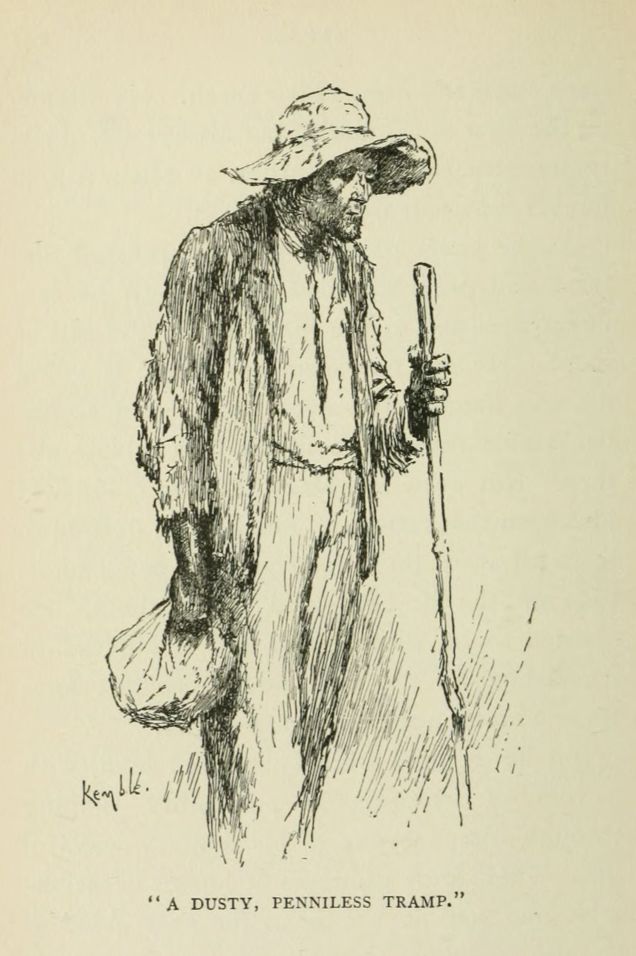
"A DUSTY, PENNILESS TRAMP."
But he seemed a kindly natured man, with a vein of irrepressible sociability running through him, in spite of his solitary ways of life. There were glimpses of humor occasionally, and had it not been for that cloud of shame hanging forbiddingly over him, he would have become a favorite with his neighbors.
Across the road, opposite his house, he set up a small blacksmith shop, and much of his idle time he spent in there, mending broken tools, sharpening dull plows, hammering patiently on the ringing red-hot iron. The smallest, simplest piece of work received the most careful attention, and the farmers recognized and appreciated his conscientiousness.
One summer afternoon, as he was plowing in his cotton-field, a neighbor came along the road and, stopping at the fence, hailed him. He plowed to the end of the row, and halted.
"Good evenin', 'Zeki'l," said the man, mounting to the top of the fence, and sitting with his heels thrust through a crack in the lower rails.
"Howdy you do, Marshall? What's the news down your way?" 'Zeki'l inquired, drawing his shirt-sleeve across his face, and leaning on the plow-handles.
"I don't know as there's much to tell. Billy Hutchins an' Sary Ann McNally run away an' got married last night, an' old Mis' Gillis is mighty nigh dead with the ja'nders. A punkin couldn't look yallerer." He opened his knife, and ran his fingers along the rail in search of a splinter to whittle. "Old man Biggers has sold his place at last."
"Has he?"
"Yes; I met him down at the store, an' he said the trade had been made."
"He's bound to go to Texas."
"Yes; so he 'lows."
"Well, old Georgy is good enough for me," 'Zeki'l remarked, with a pleased glance at his sterile fields.
"An' for me," said Marshall, heartily. "Wanderin' 'round don't make folks rich. Biggers owns the best place in this settlement, an' he'd better stay on it. It won't do to believe all the tales they tell about these new States. I had a brother go to Louisiany before the war. Folks said, 'Don't take anything with you; why, money mighty nigh grows on bushes out there.' His wife took the greatest pride in her feather beds, but what would be the use o' haulin' them beds all the way across the Mississippi, when you could rake up feathers by the bushel anywheres? Well, they went, an' for the whole endurin' time they stayed they had to sleep on moss mattresses, an' my brother 'lowed it was about the meanest stuff to kill he ever struck. If you didn't bile it, an' bury it, an' do the Lord only knows what to it, it would grow an' burst out of the beds when you was sleepin' on 'em." 'Zeki'l's attention did not follow those reminiscent remarks. "Who bought the Biggers place?" he inquired, as soon as Marshall ceased speaking.
"A man he met in Atlanta when he went down the last time, a man from one of the lower counties, an' his name—why, yes, to be sure, it's Morgan, same as yours—'Lijy Morgan. May be you know him?" with a sharp, questioning glance.
But the momentary flush of emotion that the stranger's name had called to 'Zeki'l's face was gone.
"I don't know as I do," he slowly replied, staring at a scrubby cotton-stalk the muzzled ox was making ineffectual attempts to eat.
"I 'lowed may be he might be some kin to you," said Marshall, in a baffled tone.
"I don't know as he is," said 'Zeki'l, still in that slow, dry, non-committal tone, his eyes leaving the cotton-stalk to follow the swift, noiseless flight of a cloud-shadow across a distant hillside. "Morgan isn't an uncommon name, you know."
"That's so," reluctantly admitted Marshall.
"When does Mr. Biggers think o' goin' to Texas?"
"Oh, not until after crops are gathered."
"The other family, isn't to come, then, right away?"
"No; not till fall."
After Marshall had whittled, and gossiped, and gone his way, 'Zeki'l stood a long time with his hands resting on the plow-handles, his brows drawn together in deep thought. Some painful struggle seemed to be going on. The crickets shrilled loudly in the brown sedge bordering a dry ditch, and a vulture sailed majestically round and round above the field, his broad black wings outspread on the quivering air. The cloud-shadows on the river-hills assumed new form, shifted, swept away, and others came in their places, and the vulture had become a mere speck, a floating mote in the upper sunlight, before he turned the patient ox into another furrow, murmuring aloud:
"I didn't go to them, an' if they come to me, I can't help it. I am not to blame; the Almighty knows I'm not to blame;" and his overcast face cleared somewhat.
That night when Mr. Davy Tanner closed his store and went home, he said to his wife:
"'Zeki'l Morgan must be lonesome, or pestered about somethin'. You'd think that old fiddle o' his could talk an' cry too, from the way he's playin'."
The season advanced; crops were gathered, and the shorn fields looked brown and bare. A sere, withering frost touched the forests, and the leaves fell in drifts, while the partridge called to his mate from fence and sedgy covert. A light snowfall lay on the distant mountains when the Biggerses started to the West and the new family of Morgans moved into Zion Hill settlement.
It was the third day after their arrival. 'Zeki'l leaned over the front gate with an armful of corn, feeding two fat pigs, when 'Lijy Morgan passed along the road on his way to Mr. Davy Tanner's store. He was a strong-looking, well-built man, with rugged features and hair partly gray. He looked curiously at the solitary, stooping figure inside the gate, his steps slackened, then he stopped altogether, a grayish pallor overspreading the healthy, ruddy hue of his face.
"'Zeki'l!"
'Zeki'l dropped the corn, and thrust open the gate.
"Howdy you do, 'Lijy?"
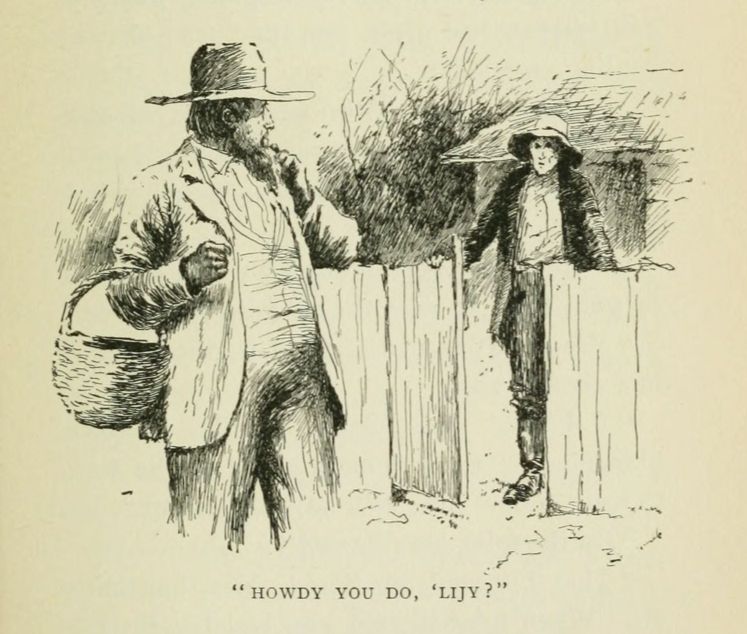
"HOWDY YOU DO, 'LIJY?"
Their hands met in a quick, close grip, then fell apart.
"I like not to have known you, 'Zeki'l, it was so unexpected seein' you here," said 'Lijy, huskily, scanning the worn, deeply lined face before him with glad yet shrinking gaze.
"An' twelve years make a great difference in our looks sometimes, though you are not so much changed," said 'Zeki'l quietly. He had been prepared for the meeting, and years of self-mastery had given him the power of concealing emotion.
"Twelve years? Yes; but it has seemed like twenty to me since—since it all happened. Why didn't you come home, 'Zeki'l, when your time was out?"
"I 'lowed the sight o' me wouldn't be good for you, 'Lijy; an'—an' the old folks were gone."
"Yes; it killed them, 'Zeki'l, it killed them," in a choked voice.
"I know," said 'Zeki'l, hastily, his face blanching; "an' I thought it would be best to make a new start in a new settlement."
"Do the folks here know?"
"That I served my time? Yes; but that's all. When I heard that you had bought the Biggers place I studied hard about movin' away, but I like it here. It's beginnin' to seem like home."
'Lijy stared at the poor cabin, the stunted, naked peach-trees, so cold and dreary-looking in the wintry dusk.
"Is it yours, 'Zeki'l?"
"Yes; it's mine, all mine. Come in and sit awhile with me, an' warm. It's goin' to be a nippin' cold night."
He turned, and 'Lijy silently followed him across the bare yard and into the house. A flickering fire sent its warm glow throughout the room, touching its meagre furnishing with softening grace, but a chill struck to 'Lijy Morgan's heart as he crossed the threshold—a chill of desolation.
"Do you live here alone?"
"Yes; all alone, except Rover and the fiddle."
The cur rose up from the hearth with a wag of his stumpy tail, and gave the visitor a glance of welcome from his mild, friendly eyes.
There were only two chairs in the room, and 'Zeki'l placed the best one before the fire for his guest, then threw on some fresh pieces of wood. Outside the dusky twilight deepened to night, the orange glow fading from the west, and the stars shining brilliantly through the clear atmosphere. The chill wind whistled around the chimney-corners and through the chinks in the log walls.
Between the men a constrained silence fell. The meeting had been painful beyond the open acknowledgment of either. The dog crept to his master's side and thrust his nose into his hand. The touch roused 'Zeki'l. From the jamb he took a cob pipe and a twist of tobacco.
"Will you smoke, 'Lijy?"
"I believe not; but I'll take a chew."
He cut off a liberal mouthful, and then 'Zeki'l filled and lighted his pipe. It seemed to loosen his tongue somewhat.
"Is Marthy Ann well enough?"
"She's tolerable."
"How many children have you?"
"Three; the girls, Cynthy an' Mary—"
"I remember them."
"An' little Zeke."
'Zeki'l's face flushed.
"Named him for me, 'Lijy?"
"Yes; for you. Cynthy's about grown now, an' a likely girl, I can tell you."
His face softened; his eyes grew bright with pride and tenderness as he spoke of his children. 'Zeki'l watched him, noting the change in his countenance, and perhaps feeling some pain and regret that he had missed such pleasure. 'Lijy reached out his hand and laid it on his knee. "'Zeki'l, you must come live with us now. I'll tell these folks we are brothers, an'—"
"I don't know as I would," said 'Zeki'l, gently. "It would only make talk, an' I'm settled here, you know."
His unimpassioned tone had its effect on his brother. He protested, but rather faintly, finally saying:
"Well, if you'd rather not—"
"That's just it. I'd rather not."
They both rose, and 'Lijy groped uncertainly for his hat.
"Your life ain't worth much to you, 'Zeki'l, I know it ain't," with uncontrollable emotion.
"It's worth more 'n you think, 'Lijy, more 'n you think."
He knocked the ashes from his pipe, and cleared his throat as though to speak again, but his brother had reached the door before he called to him.
"'Lijy."
"Well?"
"What became o' 'Lizabeth?"
"She's still livin' with us."
He peered into the bowl of the pipe.
"She's never married?"
"No. She had a fall about ten years ago which left her a cripple, an' she's grayer than I am. You 're not comin' to see us, 'Zeki'l?"
"I reckon not, 'Lijy." And while 'Lijy stumbled through the darkness home—his errand to the store forgotten—'Zeki'l stood before the fire, one arm resting against the black, cobwebby mantel. "Crippled an' gray! O 'Lizabeth, 'Lizabeth!" he groaned, and put his head down on his arm, the twelve years rolling backward upon him.
"Where have you been, 'Lijy?" exclaimed Mrs. Morgan when her husband returned. "We waited an' waited for you, till the supper was spoiled."
"I met a man I used to know," he said, evasively, casting a wistful, troubled glance toward the corner where 'Lizabeth, his wife's sister, sat knitting, a crutch lying at her side.
Cynthia, a rosy, merry-eyed girl, laughed.
"Pa is always meetin' a man he knows."
Mrs. Morgan began hastily removing the covered dishes from the hearth to the table.
"Well, where is the sugar you went over to the store to get?" she demanded with some irritation.
"I forgot it, Marthy. I'll go for it in the mornin'," in a confused, propitiatory tone.
She stared at him.
"I never! Forgot what you went after! You beat all, 'Lijy Morgan; you certainly do beat all."
"The man must 'a' sent your wits wool-gatherin', pa," cried Cynthia, jocosely.
'Lizabeth leaned forward. Her face was long, thin, and pale, and the smooth hair framing it glinted like silver in the firelight; but her dark eyes were wonderfully soft and beautiful, and her mouth had chastened, tender lines about it.
"Are you sick, 'Lijy?" she inquired, in a gentle, subdued voice, a voice with much underlying, patient sweetness in it.
Morgan gave her a grateful look. "N—no; but I don't think I care for any supper," he said slowly. "I'll step out an' see if the stock has all been fed."
When he returned Mrs. Morgan sat by the fire alone. He looked hastily about the room.
"Where is Cynthy?"
"Gone to bed."
"An' 'Lizabeth?"
"She's off, too."
He drew a sigh of relief, and stirred the fire into a brighter blaze.
"Marthy Ann, it was 'Zeki'l I saw this evenin'."
She dropped the coarse garment she was mending.
"'Zeki'l!"
"Hush! Yes; he lives up on the hill between here an' the store;" and then he went on to tell her about their meeting and conversation. Her hard, sharp-featured face softened a little when he came to 'Zeki'l's refusal to live with them or to have their kinship acknowledged.
"I'm glad to see he's got that much consideration. We left the old place because folks couldn't forget how he'd disgraced himself; an' to come right where he is! I never heard of anything like it. Why didn't he leave the State if he wanted to save us more trouble?" wiping tears of vexation from her eyes. "You spent nearly all you had to get him out of prison, an' when he had to go to the penitentiary it killed his pa an' ma, an'—"
"Be silent, woman! you don't know what you are talkin' about!" he said sternly, writhing in his chair like a creature in bodily pain. "God A'mighty forgive me!" He paused, smote his knee with his open palm, and turned his face away.
"Well, if I don't know what I'm talkin' about, I'd like to know the reason!" she cried, with the same angry excitement. "You ain't been like the same man you were before that happened, you know you ain't. I'll never be willin' to claim kin with 'Zeki'l Morgan again, never! Folks may find out for themselves; an' they'll do it soon enough—don't you be pestered—soon enough."
But not a suspicion of the truth seemed to occur to Zion Hill settlement. The Morgans were welcomed with great friendliness, and 'Zeki'l alone failed to visit them. Children sat around his brother's fireside, a wife ministered to him; but he had forfeited all claim to such homely joys. The girls had evidently been informed of his relationship to them, for they looked askance at him as they passed along the road, pity and curiosity in their eyes. Once he came out of the blacksmith shop, and, meeting his sister-in-law in the roadway, stopped her, or she would have passed with averted head.
"You needn't be so careful, Marthy Ann," he said, without the slightest touch of bitterness in his calm tone.
"It is for the children's sake, 'Zeki'l," she said, her sallow face flushing with a feeling akin to shame. "I must think o' them."
He gave her a strange glance, then looked to the ground.
"I know; I thought o' them years ago."
"It's a pity you didn't think before—"
"Yes, so it is; but some deeds aren't to be accounted for, nor recalled either, no matter how deeply we repent."
"We sold out for the children's sake, but, Lord! I'm pestered now more than ever."
"Because I'm here?"
"Well, it ain't reasonable to think we can all go right on livin' here, an' folks not find out you an' 'Lijy are brothers."
"What would you like for me to do, Marthy Ann?"
She hesitated a moment, then drew a little nearer to him.
"Couldn't you go away? You've got nobody but yourself to think about, an' I know in reason 'Lijy would be glad to buy your place," with a careless, half-contemptuous glance at the cabin.
A dull flush passed over his face; his mouth twitched.
"Does 'Lijy want me to go?"
"He ain't said so; but—"
"I'll think about it," he said slowly, turning back to the smithy, where a red-hot tool awaited his hammer.
But thinking about it only seemed to bind his heart more closely than ever to the arid spot he called home. He had looked forward to spending all the remaining years of his broken, ruined life there, far from the world and from those who had known him in the past. Then a great desire had risen within him to remain near 'Lizabeth. He shrank from the thought of meeting her, speaking to her, and felt rather glad that she did not appear at church. A few times in passing he had caught a glimpse of her walking about the yard or garden in the winter sunshine, leaning on her crutch, and the sight had sent him on his way with downcast face. He had just sat down before the fire to smoke one evening when there came a timid knock on the door. It was just between daylight and darkness, and he supposed it to be some neighbor on his way to or from the store who wished to drop in to warm himself and gossip a little.
"Come in," he said hospitably, and, reaching out, drew the other chair nearer the fire.
The latch was slowly lifted, the door swung open, and then he started to his feet, pipe and tobacco falling to the floor, while his face flushed and paled, and his breath came in a sharp sigh. It was 'Lizabeth, her bonnet pushed back, her shawl hanging loosely around her shoulders.
"I've be'n to the store for Marthy Ann, I wanted to go to get out away from the house a little while, and I thought I'd step in for a minute, 'Zeki'l, to see you."
"You are tired; come an' sit down," he said huskily, and led her to the chair.
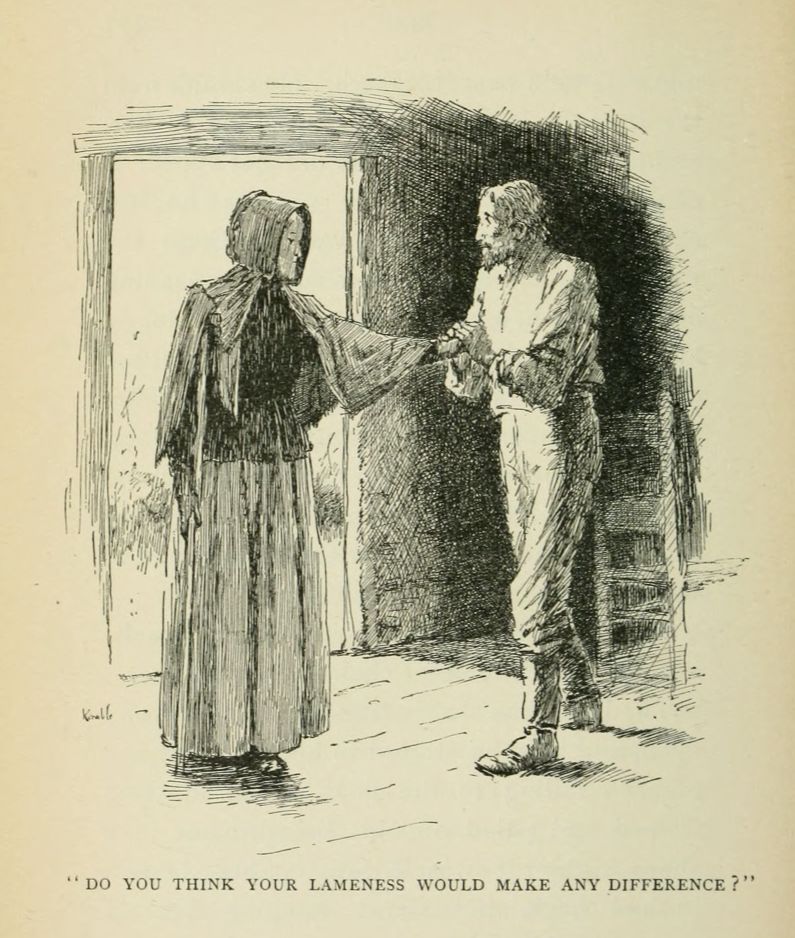
"DO YOU THINK YOUR LAMENESS WOULD MAKE ANY DIFFERENCE?"
What emotion those simple, commonplace words covered! They looked at each other, silently noting the changes time and sorrow had wrought. They had never been openly declared lovers, but words were not needed for them to understand each other, and they knew that they would marry when she had finished her term as teacher in the county school, and he had built a house on the lot of land his father had given him. But that shameful, undenied accusation of horse-stealing, followed swiftly by trial and conviction, had put an end to all hopes, all plans.
"You see I'm a cripple now, 'Zeki'l," she said, to break the silence.
"An' I've grown old," he replied, and their eyes met again in a long, eloquent, steadfast gaze, and they knew that neither age, nor affliction, nor shame, nor separation had wrought any change in their love. It had only grown stronger and deeper. Her thin face flushed, her trembling fingers gathered up a fold of her gown.
"Why don't you come to see us, 'Zeki'l?"
"I can't, 'Lizabeth; I can't. It wouldn't be right. Don't you know I've been longin' to come, an' hungerin' an' hungerin' to see you?" He flung himself on the floor at her feet, his face hidden against her knees. "You don't know all! you don't know all!" The words were wrung from him by an almost uncontrollable desire to tell her the story of his sufferings. She had not turned against him nor forgotten him. It was almost more than he could bear, to read in her eyes her faith and her pardon. He felt the touch of her hand on his bared head, and tears gushed from his eyes.
"Can't you tell me?" she whispered, her face, her eyes, illumined by a pity and tenderness divine in their beauty.
"No, honey; it's somethin' I must bear alone, I must bear alone."
He rose to his feet again, brushing his sleeve across his eyes, and she stood up also, leaning on her crutch, the transient glow of color fading from her face.
"You shouldn't bear it alone if I didn't have this lameness. You—"
"Hush!" he said, and, taking her hand, pressed it against his breast. "Do you think your lameness would make any difference? Wouldn't I love you all the more, take care o' you all the better, for it? It's the disgrace, the shame, standin' between us. I'll never outlive it—get rid of it—an' I'll never ask any woman to share it. I couldn't."
Her physical infirmity held her silent. She would be a care and a burden to him rather than a help. She drew up her shawl.
"The Almighty comfort you, 'Zeki'l."
"An' take care o' you, 'Lizabeth."
He took her hand in a grasp painful in its closeness, then he turned and leaned against the mantel, and she went softly out of the room.
Winter passed. The frost-bound earth sent up faint scents and sounds of spring in fresh-plowed fields and swelling buds. 'Zeki'l wandered about his fields in idleness, striving to make up his mind to go away. It would be best, yet the sacrifice seemed cruel.
"It is more than I can bear," he cried aloud one night, and strained one of the violin-strings until it snapped asunder. He laid the instrument across his knees and leaned his head upon it. The candle burned dimly, and a bat flew in through the open door, circled around the room, at last extinguishing the feeble light with one of its outspread wings. But the unhappy man did not heed the gloom. Why should he care to have a light for his eyes when his soul was in such darkness? He groped his way to the bed, and fell down upon it. Rover came back from a nightly prowl, barked to let his master know of his presence, then lay down on the doorstep.
The sound of music vibrated through the air, and 'Zeki'l remembered that the young people of the settlement were to have a "singing" at his brother's that evening. He raised his head and listened. They were singing hymns, and many of them were associated with recollections of his own youth. A line of Tom Moore's "Come, ye disconsolate," once a special favorite when sorrow seemed far from him, was borne to his ears:
Earth has no sorrow that heaven cannot heal.
He lay down and slept.
At dusk the next evening, as he was heating a piece of iron in the blacksmith shop, a man stopped at the wide-open door.
"Will you give me a night's lodging? I have walked far to-day, and I'm a stranger in this part of the country."
'Zeki'l wheeled, the light from the forge shining across his face. It brought out the stranger's face and form in bold relief also. "Why, it's Zeke Morgan!" he cried, walking into the shop.
"Yes: I thought I recognized your voice, Miller," said 'Zeki'l, slowly, and without much pleasure at the recognition.
They had been in prison together, and 'Zeki'l had left Miller there. He had never felt any liking for the man, and less now than ever, as he looked at his ragged clothing and dissipated face. He had evidently been steadily sinking in vice, and its repulsiveness was impressed upon his outward being. But a certain pity stirred 'Zeki'l's heart. He remembered his own friendlessness when he entered that settlement. Could he show less mercy than had been shown to him?
"Sit down, won't you?" he said kindly, blowing up the coals in the forge to a glowing heat.
"That I will. I'm footsore, and hungry as a bear. I'm in luck to meet with you, comrade," chuckling.
'Zeki'l winced. The man's familiarity grated upon him.
"Where are you goin'?" he inquired.
"Oh, nowhere in particular. I'm jest out."
"Why, I thought your time would be up in two years after I left."
Miller shrugged his shoulders. "Yes; but I made so many attempts to escape that they kept adding extra time to my term."
He sat down while 'Zeki'l finished his work.
"You seem to be getting on pretty well," he continued, his restless eyes scanning the surroundings.
"Only tolerable."
Two or three of the neighbors dropped in, one to leave a broken plow, another to tell a bit of gossip. They stared curiously at 'Zeki'l's disreputable companion, who jocosely informed them that Morgan had once been his chum.
'Zeki'l felt annoyed, and, closing up the shop, invited his guest into the house. They had supper, then sat down and smoked. Miller talked a good deal, and asked many questions about the neighborhood and the store; but at last he fell asleep, huddled up on the bed, and 'Zeki'l lay down on a bench, recollections of his prison life keeping him awake far into the night. When he awoke the next morning his guest was gone. He was glad of it. The man's presence oppressed him—brought a sense of degradation. But what were his feelings when he heard that Mr. Davy Tanner's store had been robbed, the mail-box rifled, letters torn open, and various articles of wearing apparel taken!
He grew so pale, seemed so agitated and confused, that the man who had come up to tell the news stared wonderingly, half-suspiciously at him. He had brought the plow to the shop the evening before, and he now looked around for the stranger.
"Where is your friend?" he inquired.
"He is no friend of mine."
"But he 'lowed that he knew you."
"Yes."
"Where?"
"In prison," said 'Zeki'l, quietly, though he flushed with shame.
"Aha! I lowed so, I jest 'lowed so, last night."
'Zeki'l tingled all over. He had never felt the degradation of being a convict more keenly than at that moment. He suspected Miller of the theft: this man's tone implied that he suspected them both. It showed how slight a hold he had upon the trust of his neighbors if they could so readily believe that he would rob the best friend he had in the settlement. He went into the house, and sat down by the hearth, his head leaned between his hands.
News of the robbery spread, and men left their work to go over to the store—stirred up, pleasantly excited. It was not often that Zion Hill settlement could boast of having anything so important as this robbery take place within its limits, and it must be made the most of.
'Zeki'l held aloof from the store, where he knew a large crowd had collected, but later in the day a small delegation came up to interview him. He read suspicion in every face, indignation in every eye. His quiet, honest life among them had been forgotten; they remembered only that he had been a convict.
"Once a thief, always a thief, I say!" one man cried loudly.
'Zeki'l clenched his hands, but what could he say in self-defense? He made a clear, straight-forward statement of all he knew about Miller, earnestly denying all knowledge of the robbery, but he felt the slight impression it made on their doubting minds. They did not openly accuse him, but they asked many questions, they exchanged knowing glances, and when they went away he felt that he had been tried and condemned. The sheriff had gone in pursuit of Miller, and all day groups of men sat or stood about the store whittling sticks, chewing tobacco, and talking. It was a most enjoyable day to them. It afforded excitement, and gave an opportunity to air opinions—to bring forth old prejudices. There was almost universal condemnation of 'Zeki'l. He had entertained the thief, had given him all the information necessary, and the more bitter ones wagged their heads and said that no doubt he had shared in the spoils. Even Mr. Davy Tanner looked sad and doubtful, though he defended the unfortunate man.
"We've no right ever to accuse a person without evidence o' guilt. We don't know even that this other man had anything to do with it—though circumstances do all p'int that way—let alone 'Zeki'l Morgan. It's best to hold our peace till we find out the truth."
"But it looks mighty suspicious ag'in' 'Zeki'l."
"Because he's been in the penitentiary, an' we think he's got a bad name by it."
"Well, ain't that enough to set honest men ag'in' him?"
"Yes; but it ain't best to always judge a man by his misdeeds in the past, but rather by his good deeds in the present, an' what they promise for the future."
"Why not, when it's accordin' to scriptur'?"
So the talk went on, while 'Zeki'l sat by his fireless hearth or walked aimlessly up and down the yard. At dusk his brother called, looking almost as haggard as he did.
"It's a bad thing, 'Zeki'l."
"Yes," said 'Zeki'l, listlessly.
"They are fools to think you had anything to do with it, plumb fools."
"It's natural they should, 'Lijy."
"I can't stand it, 'Zeki'l! Lord! I can't stand it!"
He fell into a chair and covered his face with his hands.
"Chut, man! what does it matter?" said 'Zeki'l, bracing himself up and forcing a smile. "Don't let 'Lizabeth believe it, that's all I ask."
"She'll never believe it."
"It's all right, then; I'll not care what the rest o' the world thinks."
"But I do," cried 'Lijy, starting up, "an' I'll put an end to it by—"
"You'll not do anything rash, 'Lijy," said 'Zeki'l, firmly, quietly, and laid his hand on the other's shoulder. "Recollect your family."
He looked slight and insignificant by the side of his brother, but his face had a strength and calmness which seemed to give it a power the other lacked. 'Lijy groaned, and turned tremblingly away.
A week passed, but Zion Hill settlement could not go back to its every-day vocations until somebody had been arrested for the robbery. The man Miller seemed to be wary prey, eluding his pursuers with the crafty skill of an old offender. It was a solitary week to 'Zeki'l. He had been completely ostracized by his neighbors. They openly shunned him, and no more work came to his forge. He stood in the empty shop one day, wondering what he should do next, where he should go, when 'Lizabeth walked slowly, quietly in.
He flushed painfully.
"You see I'm idle," he said, pointing to the dead coals in the forge. "They don't think I'm worthy o' doin' their work any longer."
"I wouldn't mind," she said, tenderly, laying her hand on his arm. "They'll see they are mistaken after a while, and be glad enough to come back to you."
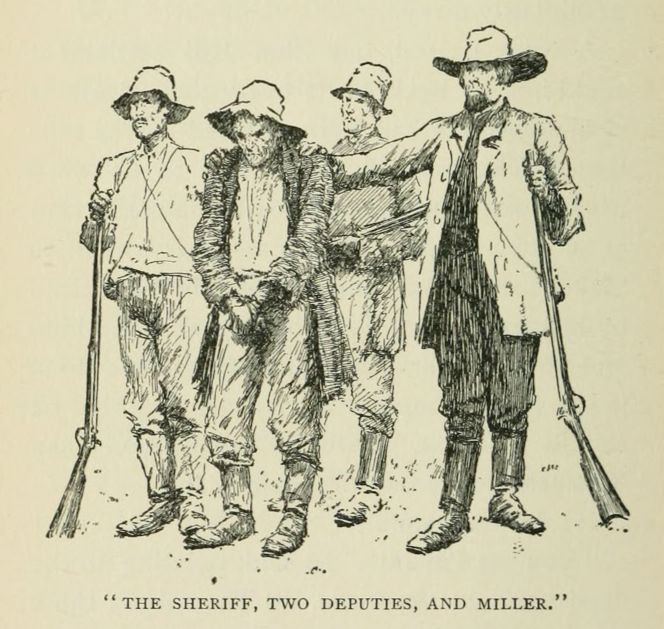
"THE SHERIFF, TWO DEPUTIES, AND MILLER."
"I don't know," with a heavy sigh. "It's the injustice that hurts me, an' the lack o' faith in my honesty. The years I've lived here count for nothin' with them."
"I have faith in you, 'Zeki'l."
He laid his hand over hers.
"If I had you, 'Lizabeth, if I only had you to help me bear it!"
"That's what I've come for, 'Zeki'l. I'm crippled. It may be that I'll turn out to be more of a burden than a comfort to you, but I can't sit down there any longer, knowin' you are here slighted and sufferin' all alone. 'Zeki'l, have pity on me, if you've none on yourself, and let me bear this trouble with you."
He trembled before the future her words conjured up.
"Could you, would you, be willin' to bear my disgrace, share it, be shunned like a plague, have no company, no friend, but me?"
"What are friends to the one we love, or company? I'd give up all the world, 'Zeki'l, willin'ly, willin'ly, for you."
He looked into her deep, earnest eyes, realized the full truth of her words, and drew her closer to him.
"It's a great sacrifice, 'Lizabeth, an' I'm wrong to let you make it; but—the Lord forgive me! I can't hold out alone any longer. My will an' my courage are all broke down. I need help; I need you."
After a momentary silence he dusted a bench, and they sat down to talk over their plans for the future. The shop, black with charcoal and iron dust, was a queer place for such a conversation; but they paid little heed to their surroundings.
"Marthy Ann will never get over your marryin' me," said 'Zeki'l.
"Then she can make the best of it."
The next day was Saturday, and the beginning of the regular monthly "meetin'" at Zion Hill church. Everybody in the settlement who could, attended services that day. The Morgans were all there, even 'Lizabeth, and 'Zeki'l sat in his accustomed place, apparently unmindful of the cold, hostile glances and whispers around him. Through open doors and windows shone golden sunlight, floated spicy odors from the woods surrounding all but the front of the church, which faced the public road; and vagrant bees mingled their lazy hum with the champing of bits and the stamping of iron-shod hoofs in the thickets, where the mules and the horses were tied.
It was a quiet but alert congregation. A kind of expectancy—of suspense—filled the air. No telling what might happen before the day was over. The preacher made the robbery the theme of his discourse, and there were nods and approving looks when he referred to the punishment laid up for those who persisted in doing evil. It was a fitting finale that just before the benediction was pronounced a small cavalcade rode up to the church door—the sheriff, two deputies, and Miller. A thrill ran through the church, a rustle, a whisper, and the preacher cried aloud to the sheriff:
"What do you want, Brother Mangum?"
"'Zeki'l Morgan."
"Here he is! here he is!" cried more than one voice, and men rose to their feet and laid eager hands on the unresisting 'Zeki'l.
"What do you want him for?" cried 'Lijy Morgan, rising from his seat in the deacons' corner. "What's he done?"
"Helped to rob the store."
"We've said so, we've said so, ever since it happened!" a chorus of stern but triumphant voices exclaimed.
"Bring up the witness ag'in' him, the man that says he did it," said 'Lijy, advancing to the open space before the pulpit.
"No man has said out an' out that he helped to do it, but Miller—"
"It's a lie," cried 'Lijy, loud enough to be heard beyond the church door.
'Zeki'l's eyes were fixed anxiously, warningly, on his brother, and once he tried to throw off the hands holding him.
"Prove it, then!" a taunting voice cried out.
"I will," said 'Lijy, though he grew pale, and trembled strangely. "A more honest man than 'Zeki'l Morgan never lived."
"What do you know of him?"
Again 'Zeki'l strove to free himself, but failed.
"'Lijy!" he called imploringly, "'Lijy, 'Lijy, mind what you say!"
'Lijy looked across at him.
"I will mind the truth, 'Zeki'l." He turned to the congregation.
"I come here with good recommendations, brethren; I am a deacon o' the church; you have faith in my integrity, my honor." An approving murmur went up. "If a dozen thieves were to stop at my house there'd be no suspicion against me." He paused, passed his hand over his face, then looked up again. "Years ago there were two brothers in this State who grew up together happy and contented. The elder one was always a little wild, and would get drunk sometimes, even after he'd married and had a family to look after, but the younger was the steadiest, best boy in the settlement. One night the elder brother, in a fit of drunken recklessness, stole a horse from the camp of a Kentucky drover, an' nobody found it out but his brother, who undertook to return the horse, an' was arrested. He took the guilt, he stood the trial, an' went to the penitentiary. He lost his good name, the girl he loved, his home, everything in the world an honest man values. He served his time, an' instead o' comin' home to be a reproach to his cowardly brother, he, when free, went away into a strange settlement to live. An' by an' by his brother moved there too, an' his conscience hurt him more an' more as he saw what a sad, lonesome life the convict lived. He was prosperous, he enjoyed the confidence of his fellow-men, while the other was shunned, and regarded with distrust." Emotion checked his utterance for a moment; then he turned and pointed to 'Zeki'l. "Brethren, look at that man; look without prejudice or suspicion, an' you'll not see guilt in his face nor on his conscience. There never lived a truer hero than 'Zeki'l Morgan. Nobody should know it better than I, for I am the brother whose crime he suffered for."
Then he walked across the floor to 'Zeki'l's side in the midst of the deepest silence which had ever fallen upon a congregation in Zion Hill church.
WAS IT AN EXCEPTIONAL CASE?
The Capelles were Louisianians, of French descent, and before the war lived in New Orleans, occasionally visiting their plantations on Red River. But Anthony Capelle was killed in the battle of Vicksburg, and after the surrender Mrs. Anthony Capelle sold the Red River plantations for about half their value, placed her New Orleans property in the hands of a lawyer, gathered up some of her household stuffs, books, and other things she prized, and with her little daughter Madeline, and one old negro who had spent his life in the service of the Capelles, removed to Marietta, Georgia. Those were days of change and great confusion, and she disappeared from New Orleans and the knowledge of old friends without calling forth comment or question, and she was received into the social life of Marietta in the same way. It was not the time to sit in judgment on one's neighbors—to probe for secret motives or purposes. A common woe made all akin. From a merchant and planter who wished to sell out and go west to recuperate his broken fortunes, Agnese Capelle bought a house and lot on the northeast side of the town, and with her small family settled quietly down. It was a picturesque old house, built after the colonial fashion, and set back from the street in the seclusion of an oak grove. In the early spring the graveled walks were bordered with jonquils and mountain pink, and from April to December the roses bloomed along the garden fence and around the piazza.
The tumult following the war died away. People ceased to go about with a helpless, bewildered look as they learned to adjust themselves to the new conditions of life, and realized that the negro could no longer be regarded as a slave, but as a free citizen, with all the rights and privileges of citizenship. The laws of the country made white and black equal, but there was some bitter triumph in the consciousness that unwritten social laws would hold them forever apart, two distinct races, one degraded by color and past servitude. On the surface of life the agitations and thrills of the strong undercurrents ceased to make much impression; they had sunk too deep. The country at large settled to outward peace, and from politics and social questions attention turned to commerce and manufacture, to the development of rich mineral resources, and to literature. But the years passed quietly enough over the Capelles. They were so strongly fixed in their pride and prejudices against social equality that they pursued their own gentle, even way, untouched by the convulsions and throes of fierce indignation around them. Their servants were treated with kindness and consideration, and when the old man who had clung to them with unbroken faith through slavery and freedom died, they wept over him, and felt that a noble friend had been lost, though also a negro and a servant. And Madeline developed into womanhood, beginning her education at her mother's knee, and finishing it at a college in Virginia.
She was gifted above the average girl in wit and beauty, and possessed not only fascinating, lovely manners, but the tenderest heart and the finest sympathies. She was a girl of ardent temperament, but refined and delicate in all her tastes, and pure in thought and aspiration. She had strong convictions and opinions of her own, read and reflected more than the ordinary Southern girl, and loved music passionately. The simplest strain could make her eyes kindle, her color come and go, in a sort of silent rapture, and the pathos of a negro song moved her heart deeply. In person she was slightly above medium height, and held her head with an imperial grace not at all unsuitable to her youth and her French ancestry. Her hair was burnished brown, with a crisp wave in it, her eyes blue-gray and brilliant. But she lacked the clear, thin, transparent skin usually accompanying such hair and eyes, the blood pulsing through it pink as a rose. Hers was soft as velvet, with an opaque creamy tint, and the faintest suggestion of color, ordinarily. She had scores of friends, and in her own small family circle was looked upon as the most beautiful and lovable girl in the world. In Agnese Capelle's love for this fair daughter there was a passionate protective tenderness, a subtle quality one would have called pity, had not such a thing seemed absurd in connection with Madeline. While not betraying any undue anxiety over her marriage and settlement in life, she studied each suitor that appeared on the scene, and if eligible, gave him a gracious welcome. But Madeline's heart remained in her own possession until she met Roger Everett.
Marietta was just attracting the attention of the Northern invalid and also the Northern capitalist. A few delicate, weak-lunged people had found their way to it, and a company of enterprising men had projected a railroad to pass through the north Georgia mountains, across the Blue Ridge, and into North Carolina and Tennessee. Along the line of this road marble quarries were being opened and gold and talc mines discovered; but Marietta still preserved its provincial ways and appearances, its best houses the old colonial mansions, its churches overgrown with ivy, Cherokee-rose hedges bounding the pastures and gardens on the outskirts of the town, and inclosing the neglected-looking graveyard. Its picturesque hills were overshadowed by Kennesaw Mountain, with the solitary peak of Lost Mountain rising far to the south, and the dim, broken outline of the Blue Ridge range bounding the northern horizon. The hills and the mountains are still there, but the town has caught the spirit of progress sweeping with electrical effect over the South. Handsome modern residences are springing up, hotels and boarding-houses are being opened, and on the northeast side of the town a beautiful national cemetery has been laid out, where the Union soldiers who fell in the battles around Atlanta lie buried. The public square is still the scene of lively traffic in the fall, when the streets are crowded with wagons heavily loaded with cotton, the farmers, white and black, standing around, clothed in jeans and homespun, while the buyers go about thrusting sampling-hooks into the great bales to test the quality of the cotton and to determine its market value. But these brown, tobacco-chewing countrymen jostle the New Yorker, the Bostonian, and, indeed, people from all parts of the Union, seeking health and fortune.
Roger Everett was one of the first New England men to find his way to Marietta, and to invest in the Pickens County Marble Works. He belonged to the Everetts of Massachusetts, a family of strong abolitionists, and possessed his share of the traditional New England reserve and the deeply rooted New England pride. For a year or two he devoted himself almost exclusively to business, making only occasional visits to Marietta; but his circle of acquaintances widened, and, being young and handsome and cultivated, he was at last drawn into the social life of the town, and few parties or picnics were complete without him. He and Madeline met at one of the picnics, danced together once at one of the parties, but their acquaintance really began the day a large party went up the new railroad to the marble works. It fell to Everett to play the part of cicerone, and though Madeline shrieked less and asked fewer questions than the other girls, there was an intelligent comprehension in her eyes when he explained the process of getting out the marble from the quarries, and the machinery used for cutting it into blocks, that made him feel that he was talking directly to her. They lunched on the bank of Long Swamp Creek, with the purple shadows of the mountains falling over them, and mountain laurel in bloom all about them. Then Madeline and the young Northerner strolled away down the stream to look for maidenhair ferns. They talked at first on general topics, and then the girl asked some questions about the North, drawing in her breath with little quivering sighs as he told her of frozen rivers, of snows so deep one could scarcely walk through them, of sleighing and skating.
"And—and is it true what they say about the negroes?" she questioned hesitatingly, curious to hear with her own ears the opinion of one of these rabid abolitionists—at least she had read in the papers that they were rabid.
He smiled, broke off a bit of laurel, pink and fragrant, and offered it to her.
"What do they say, Miss Capelle?"
"That they are equal—that we should recognize them. Oh, I hardly know how to explain it," breaking off with a little laugh, not caring to tread too boldly on delicate ground for fear he should feel wounded.
"We respect them where they deserve it, just as we do all men," he said calmly.
"Regardless of color?"
"Yes. What has the color of a man's skin to do with the question of his worth?"
"Everything, if he is a negro. Could you—I beg your pardon for asking the question—sit at the table with a negro? actually break bread with him as your equal?"
"If he were a gentleman, yes," firmly, his blue eyes meeting hers fearlessly.
"Oh, oh! how could you? I cannot understand it. I am fond of some negroes. I loved Uncle Sam, I like Aunt Dilsey, and I'm sorry for them as a race, but meet them on common ground I could not." And then they drifted away from the dangerous topic.
He walked with her and her mother to the train that evening, and Mrs. Capelle invited him warmly and graciously to call upon them when he came to Marietta again.
"He is interesting," she said to Madeline, with a backward glance through the car window at his tall, slight figure as the train swept them away from the station.
"Do you think so, chérie mama?" indifferently, her eyes looking down upon her lap.
"He is handsome and well-bred."
"Oh, he is a Yankee," maliciously.
"He is a gentleman."
And then they looked at each other and laughed gently, and Madeline held up a little paper-weight of pale pink marble, veined with threads of white, that he had selected and ordered polished for her as a souvenir of the day.
From that day it was a clear case of strong mutual attraction. What though they had been differently trained, and their opinions clashed on some points? They came out of wordy controversies firmer friends than ever. There was never-ending interest in their combats, and the lightest jest or banter held a fascination keen as the brightest wit. He called Madeline a narrow-minded, illiberal provincial, for holding such fierce prejudices against the colored people, and she retorted that the negro had become a sentiment to the North, and that if they, the Yankees, would give some of their attention and pity to the poor white people crowding their large cities, the South would solve its own great problem. Sometimes they parted in anger; but it was short-lived, for love drew them with irresistible force, and if they disagreed on a few questions, how many hopes, thoughts, and desires they had in common! what taste and sympathy!
Mrs. Capelle looked on, sighed, and smiled, but waited in silence for Madeline's confidence. And one evening she came in, knelt at her mother's feet, put her arms around her, and pressed her flushed, tremulous, radiant face against her bosom. Mrs. Capelle flushed and trembled herself, and gathered that proud young head closer to her heart.
"You have promised to marry him," she said in a whisper.
"He asked me again this evening. I could not put him off," Madeline confessed, also in a whisper.
"Coquette! Did you want to put him off?"
"N—no."
"Oh, oh! he is a Yankee."
"I love him."
"He may take you away to his hard, his cold New England."
"We are to live here with you."
"Without consulting me? Fie! what aggressive children!"
"You are glad, mama. Why are you so glad I'm to be married?"
"I am longing to see you safe, my darling," dropping her teasing tone, and speaking with sudden agitation.
"Am I not safe with you?" lifting her head, and looking tenderly into the delicate face above her.
"But I am not strong, sweet, and I may be called suddenly from you some day, and it is not good for girls to be alone. It will be comforting to leave you in such hands. He is noble, he is good, and will love you faithfully. Ah, Madeline, he is strong and firm; he will rule my wilful girl."
"I should not love him if I could rule him," said Madeline, proudly.
Mrs. Capelle laughed and kissed her. "Tell me all about it," she said softly. They talked until the hand of the clock pointed to twelve, and only the barking of a dog or two pierced the silence resting upon the town.
"We have no secrets—no secrets from each other, have we, mama?" said Madeline with a happy laugh.
"No secrets, sweet? No, no; there should be no secrets between mother and child," said the elder woman; but her eyes fell; a paleness swept over her face. It was a swift, subtle change, unnoticed by the girl in the delicious absorption of her thoughts.
That was a winter to live in the memory of those lovers as long as they lived. Every one of the swiftly flying days seemed to have its own special joy, its own sweet experiences. When apart, there were long letters written out of the fullness of their hearts; when together, long talks, or delicious silences in which it seemed enough that they could be together.
And there were letters from his New England home to her, one from his mother, as sweet and gentle as her own mother could have written.
"She must be lovely, Roger," she said to him.
"She is," he replied with proud loyalty. "I am longing for you to see her."
"I shrink from it, for if she should not be pleased with me—"
"She must; she cannot help it, dearest. Ah! you know that you'll charm her," putting his hand under her chin, and turning her face upward to his eyes, its palpitant color, proud, shy eyes, and lovely tremulousness, a tacit confession of his power.
Before she could elude him—for with all her caressing ways and Southern temperament, lending itself so naturally to demonstrativeness, she was very chary of her favors—he drew her into his arms against his heart, and kissed her.
Mrs. Capelle spent those winter days sewing on fine linen, cambric, sheer muslin, and lace, stitching many loving thoughts into the dainty garments intended for Madeline's wardrobe. Imperceptibly, as it were, she had grown very fragile, and the least excitement caused her to palpitate and tremble, with flushed face and hand pressed upon her heart.
She had been a devout Catholic in her youth, and though removed from her church, she still occasionally attended mass in Atlanta, and went to confession. But as the winter passed, her thoughts turned longingly to Father Vincent, her old father confessor, and one day in the early spring she received a letter from him. He would in a short time pass through Marietta on his way to the North. Could he stop for a day with them? It seemed such a direct answer to her secret desire for his counsel that she joyfully hastened to reply, telling him how she needed his advice and his blessing.
She had rejoiced over Madeline's engagement, but as the time set for her marriage drew near, some secret trouble seemed to wear upon her, much to the girl's distress.
"What is it, mama?" she asked, sitting at her feet, and taking her hand and laying it against her cheek.
"What can it be but the loss of you, sweet?" she replied quickly. "You must allow me to be jealous and foolish."
"But you are not going to lose me, dearest mama, and are you sure—I have fancied there must be something else troubling you."
"Indeed you must not think so; I am selfish to—"
"Selfish! You, the best and sweetest woman in the world, selfish! I'll not believe that." Still she did not feel satisfied, and was greatly relieved when Father Vincent came, and she saw her mother brighten and look like her old self. It was about two weeks before the wedding that he came, and was persuaded to stop with them two days instead of one. He was an old man, small, slender, and ascetic looking, with clear, calm eyes, and a sweet voice.
It was the afternoon of his arrival that Madeline went out to make some calls, but after one visit changed her mind, and returned home. She did not at once go to her mother, knowing that she and Father Vincent would probably have much to say to each other, but turned into the parlor, cool, dusky, and deserted, and went to the little alcove, where she had left her embroidery and the last letter from her lover. It was simply a corner of the big room, furnished with a lounge and a small table, and shut in by soft silk curtains. How long she had been there, re-reading that letter, dreaming over her work, she could not tell, when roused by footsteps and voices in the room—her mother and the priest.
"You hinted at some special cause for trouble in your letter," he said, as they sat down in close proximity to those curtains and Madeline's retreat.
"Yes; it concerns Madeline."
"What of her? I thought her future had been settled. Is she not to be married in a short time?"
"Yes; but, Father, she is not my child, and I am growing doubtful of the honor of my course in regard to this marriage."
"Not your child!" exclaimed Father Vincent in surprise, for he thought that he knew all the Capelle secrets.
"No. I would to God that she were!" she said with deep emotion, "for I love her so well that I'd gladly give my life to know that pure, unmixed blood flowed in her veins."
His chair creaked as he drew it a little nearer her; his voice sank to a low key:
"You do not mean—"
"Yes; her mother was a quadroon," in a trembling whisper.
Did he hear that strange gasping sigh, as of a dumb creature struck by a mortal blow, that he so quickly and abruptly exclaimed:
"Where is she now?"
"Out calling. I did not dare speak of this while she was in the house, for fear the very walls would betray the secret. She must never know it, never! It would ruin her life, kill her, my poor, proud child!"
Her voice broke in tears.
"Tell me the whole story," said the priest gently, but with authority.
"Yes, yes; that is what I am longing to do. The secret has become a burden to me: I want to be assured that I have acted rightly about her marriage. You remember my husband's brother, Lawrence Capelle?"
"Well, very well; a handsome young fellow, but rather wild."
"And lovable with it all. He died while my husband and I were in France—we were there three years—and before his death he wrote to Anthony, begging him to look after the welfare of a child, a baby, and giving the history of his attachment to a beautiful quadroon in New Orleans. Her mother had been a slave, but this girl had been born free, received a very good education, and grew up superior to her class. She had loved him with rare faith and tenderness, and died at the birth of the child."
"They were not married, of course?"
"Married? Oh, no; but he had really been quite fond of her, and he dwelt at length upon the beauty and intelligence of the child. We came home very quietly, and before going to our own house, or betraying our presence to even intimate friends, we sought her out, and the moment I took her in my arms, looked into her eyes—Lawrence's own beautiful gray eyes, smiling with innocent fearlessness straight into my own—my heart went out to her in such a gush of love, pity, tenderness, I did not feel that I could ever be parted from her. Father, she was the loveliest, most lovable child I ever saw. We adopted her, we made her our very own, and no one knew that she had not really been born to us abroad. Not even to you, Father, did we confess the truth. The war came then, and Anthony died at Vicksburg; but I could not feel utterly alone, utterly bereft, while I had Madeline. I made plans for her; I said that she should never know that she was not truly my own child. Her training, her education, became the absorbing interest of my life. After the close of the war I thought it best for her sake to leave New Orleans, to seek a new and more obscure home, away from old friends, old ties. If we remained there she might in some way learn the truth. We came here, you and my lawyer alone knowing where to find us. I have brought her up most carefully. She is refined, beautiful, accomplished, and innocent as a young girl should be, but you can see for yourself what she is. I instilled the strongest race prejudices into her mind. I impressed it upon her that the negro is an inferior creature, a servant of servants, to be treated with kindness, but never to be considered an equal; for a morbid fear that her mother's blood would betray itself in some coarse or degraded taste, haunted me. But I am no longer afraid for her. Have I acted with wisdom? Have I done well to lift her up?"