WHEN THIS CRUEL WAR IS OVER.
Reading edition
Dearest love, do you remember, When we last did meet, How you told me that you lov’d me, Kneeling at my feet? Oh! how proud you stood before me, In your suit of blue, When you vow’d to me and country Ever to be true. Weeping, sad and lonely, Hopes and fears how vain! When this cruel war is over, Praying that we meet again! When the summer breeze is sighing, Mournfully along; Or when autumn leaves are falling, Sadly breathes the song. Oft in dreams I see thee lying On the battle plain, Lonely, wounded, even dying, Calling, but in vain. If amid the din of battle Nobly you should fall, Far away from those who love you, None to hear you call— Who would whisper words of comfort Who would soothe your pain? Ah! the many cruel fancies, Ever in my brain. But our country call’d you, darling, Angels cheer your way; While our nation’s sons are fighting, We can only pray. Nobly strike for God and liberty, Let all nations see How we love the starry banner, Emblem of the free. —Charles Carroll Sawyer.
Charles Carroll Sawyer was born in Mystic, Connecticut, in 1833. His father, Captain Joshua Sawyer, was an old-fashioned Yankee sea captain. The family moved to New York when Charles was quite young, and he obtained his education in that city. The poetic instinct was marked in his youth, and at the age of twelve he wrote several sonnets which attracted a good deal of attention among his acquaintances. At the breaking out of the war he began to write war songs, and in a few months was recognized everywhere as one of the most successful musical composers of the day. His most popular songs were Who will Care for Mother Now? Mother would Comfort Me, and the one we have selected—When this Cruel War is Over. Each of these three songs named reached a sale of over a million copies before the close of the war, and were sung in almost every mansion and farmhouse and cabin from the Atlantic to the Pacific throughout all the northern part of the Union, as well as in every camp where soldiers waited for battle.
His song, Mother would Comfort Me, was suggested, as indeed were most of his songs, by a war incident. A soldier in one of the New York regiments had been wounded and was taken prisoner at Gettysburg. He was placed in a Southern hospital, and when the doctor told him that nothing more could be done for him, his dying words were: “Mother would comfort me if she were here.” When Sawyer learned of the incident, he wrote the song, the first verse of which runs as follows:—
“Wounded and sorrowful, far from my home, Sick among strangers, uncared for, unknown; Even the birds that used sweetly to sing Are silent, and swiftly have taken the wing. No one but mother can cheer me to-day, No one for me could so fervently pray; None to console me, no kind friend is near— Mother would comfort me if she were here.”
This song captured the country at once, and spread its author’s fame everywhere.
On another occasion a telegram came to a Brooklyn wife concerning her husband who was killed on the battlefield. The last words of the despatch read: “He was not afraid to die.” Sawyer caught up that note in the telegram, and wrote his splendid song beginning,—
“Like a true and faithful soldier He obeyed our country’s call; Vowing to protect its banner Or in battle proudly fall: Noble, cheerful, brave and fearless, When most needed, ever nigh, Always living as a Christian, ‘He was not afraid to die.’”
Another of his greatest creations found its inspiration in a similar way. During one of the battles, among the many noble men that fell was a young man who had been the only support of an aged and invalid mother for years. Overhearing the doctor tell those who were near him that he could not live, he placed his hands across his forehead, and with a trembling voice said, while burning tears ran down his cheeks: “Who will care for mother, now?” Sawyer took up these words which voiced the generous heart of the dying youth, and made them the title and theme of one of his noblest songs. The first verse is full of pathos,—
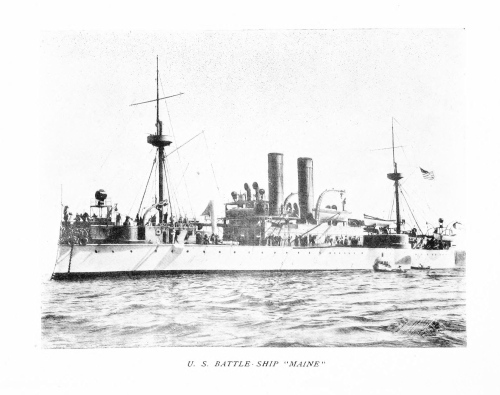
U. S. BATTLE-SHIP “MAINE”
“Why am I so weak and weary, See how faint my heated breath, All around to me seems darkness, Tell me, comrades, is this death? Ah! how well I know your answer; To my fate I meekly bow, If you’ll only tell me truly Who will care for mother now?”
At that time, when every community throughout the North as well as the South had more than one mother whose sole dependence for the future days of weakness and old age was the strong arm of some soldier boy at the front, this song struck a chord that was very tender, and it was sung and whistled and played in street and theater and drawing-room throughout the entire country.
Sawyer’s songs were unique in that they were popular in both armies. They never contained a word of malice, and appealed to the universal human heart. At the close of the war a newspaper published at Milledgeville, Georgia, said of Sawyer’s songs, “His sentiments are fraught with the greatest tenderness, and never one word has he written about the South or the war that could wound the sore chords of a Southern heart.”
The most universally famous of all Sawyer’s songs was When this Cruel War is Over. As the long years of carnage dragged on, the fascination for the glamour and glory of war disappeared, and its horrid cruelty impressed people, North and South, more and more. Loving hearts in the army and at home caught up this song as an appropriate expression of the hunger for peace that was in their souls. A popular Southern song, When upon the Field of Glory, the words of which were written by J. H. Hewitt and the music by H. L. Schreiner, was an answer to this song of Sawyer’s. As it is one of the best of the songs of the Confederacy, it is worth repetition here:—
“When upon the field of glory, ’Mid the battle cry, And the smoke of cannon curling Round the mountain high; Then sweet mem’ries will come o’er me, Painting home and thee, Nerving me to deeds of daring, Struggling to be free. Weep no longer, dearest, Tears are now in vain. When this cruel war is over We may meet again. “Oft I think of joys departed, Oft I think of thee; When night’s sisters throw around me, Their star’d canopy. Dreams so dear come o’er my pillow, Bringing up the past, Oh! how sweet the soldier’s visions! Oh! how short they last! “When I stand a lonely picket, Gazing on the moon, As she walks her starry pathway, In night’s silent noon; I will think that thou art looking On her placid face, Then our tho’ts will meet together, In a heav’nly place. “When the bullet, swiftly flying Thro’ the murky air, Hits its mark, my sorrow’d bosom, Leaving death’s pang there; Then my tho’ts on thee will turn, love, While I prostrate lie. My pale lips shall breathe, ‘God bless thee— For our cause I die!’ Weep then for me, dearest, When I’m free from pain; When this cruel war is over, In heav’n we’ll meet again.”

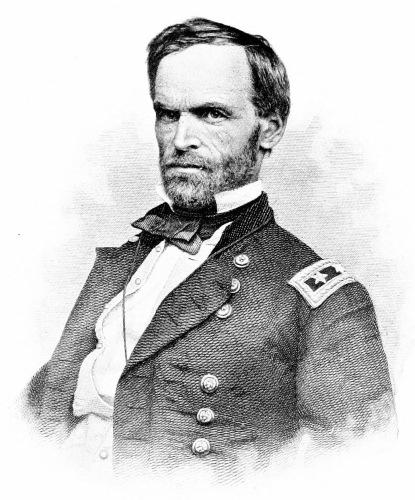
WILLIAM TECUMSEH SHERMAN