JUST BEFORE THE BATTLE, MOTHER.
Reading edition
Just before the battle, mother, I am thinking most of you, While upon the field we’re watching, With the enemy in view— Comrades brave are round me lying, Fill’d with tho’t of home and God; For well they know that on the morrow, Some will sleep beneath the sod. Farewell, mother, you may never Press me to your heart again; But oh, you’ll not forget me, mother, If I’m number’d with the slain. Oh I long to see you, mother, And the loving ones at home, But I’ll never leave our banner Till in honor I can come. Tell the traitors all around you That their cruel words, we know, In ev’ry battle kill our soldiers By the help they give the foe. Hark! I hear the bugles sounding, ’Tis the signal for the fight, Now may God protect us, mother, As he ever does the right. Hear the “Battle Cry of Freedom,” How it swells upon the air, Oh, yes, we’ll rally round the standard, Or we’ll perish nobly there. —George F. Root.
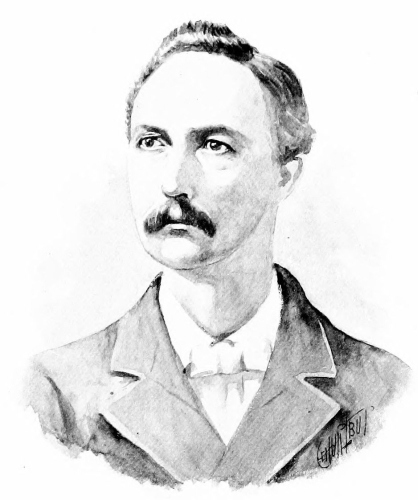
George F. Root was born in Sheffield, Massachusetts, in 1820. He has perhaps written more popular war songs than any other American. His songs have carried his name to the ends of the earth. He was a musician from childhood. He began as a boy by getting hold of every musical instrument he could find and attempting to master it. When about eighteen years of age, he left his father’s farm in the beautiful Housatonic Valley, and went to Boston to obtain instruction in music, which he had already determined to make his life-work. He was very fortunate in finding employment with a Boston teacher named A. B. Johnson, who also took the young countryman into his own home and manifested the warmest interest in his superior musical gifts. It was not long before young Root became a partner in Mr. Johnson’s school. He was ambitious and industrious, and was soon acting as leader for a number of church choirs. There are several churches in Boston to-day which recall as one of the legends of their history that George F. Root used to lead their music. His reputation as a teacher spread so rapidly that he was sought after to give special instruction in other institutions. Later he went to New York and became the principal of the Abbott Institute.
Mr. Root was not satisfied to make anything less than the best out of himself, and so went to Europe in 1850 and spent a year in special work improving his musical talent. About this time he began writing songs, in which he had success from the start. These won him such wide recognition that Mason and Bradbury, the great musical publishers of that day, secured his aid in the making of church music books. He now retired from the field of teaching and devoted himself to composing music and the holding of great musical conventions.
On the breaking out of the war, Dr. Root was in Chicago, and from that Western center of patriotic fire and enthusiasm he sent forth scores of songs that thrilled the heart of the country. While the Battle Cry of Freedom was perhaps his most famous song, there are a number of others that keep, even to this day, close company with it in popularity. The old veterans who still linger on the scene, as well as those who were but boys and girls in those days, well remember the martial enthusiasm that was evoked by his prison song, Tramp, Tramp, Tramp! The mingled pathos and hopefulness of it has been rarely, if ever, surpassed:—
“In the prison cell I sit, Thinking, mother dear, of you, And our bright and happy home so far away, And the tears they fill my eyes, Spite of all that I can do, Tho’ I try to cheer my comrades and be gay. Tramp, tramp, tramp, the boys are marching, Cheer up, comrades, they will come, And beneath the starry flag We will breathe the air again, Of the freeland in our own beloved home. “In the battle front we stood, When their fiercest charge they made, And they swept us off a hundred men or more; But before we reached their lines, They were beaten back dismayed, And we heard the cry of vict’ry o’er and o’er. “So within the prison cell, We are waiting for the day That shall come to open wide the iron door, And the hollow eye grows bright, And the poor heart almost gay, As we think of seeing home and friends once more.”
To appreciate the pathos of that song one needs to hear a company of Grand Army Veterans tell about singing it in Andersonville or Libby Prisons.
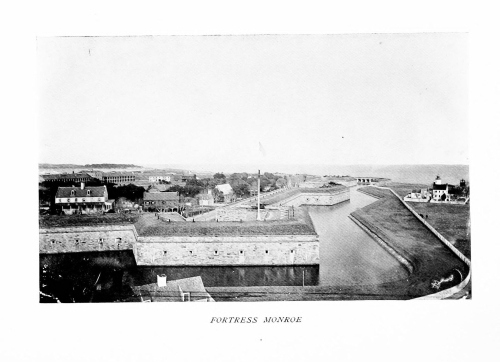
FORTRESS MONROE
Just Before the Battle, Mother appealed to the tender side of those who remained at home, and made it a very popular song not only for public gatherings, but in drawing-rooms, and camps in the twilight of the evening. The sequel to it, Just After the Battle, was equally as popular and retains its popularity though a generation has passed away since it was written. It, too, has the vein of optimism in it which runs through all of Doctor Root’s work. Perhaps that is one of the secrets of his great power over the human heart. While he makes us weep with the tenderness of the sentiment, there is always a rainbow on his cloud, a rainbow with promises of a brighter to-morrow. Just After the Battle has that rainbow in it, in the hope expressed by the singer that he shall still see his mother again in the old home:—
“Still upon the field of battle I am lying, mother dear, With my wounded comrades waiting For the morning to appear. Many sleep to waken never, In this world of strife and death, And many more are faintly calling, With their feeble dying breath. Mother dear, your boy is wounded, And the night is drear with pain, But still I feel that I shall see you, And the dear old home again.
“Oh, the first great charge was fearful, And a thousand brave men fell, Still, amid the dreadful carnage, I was safe from shot and shell. So, amid the fatal shower, I had nearly pass’d the day, When here the dreaded Minie struck me, And I sunk amid the fray. “Oh, the glorious cheer of triumph, When the foeman turn’d and fled, Leaving us the field of battle, Strewn with dying and with dead. Oh, the torture and the anguish, That I could not follow on, But here amid my fallen comrades, I must wait till morning’s dawn.”
CHARLES CARROLL SAWYER