THE PHILADELPHIA MINT.
Reading edition
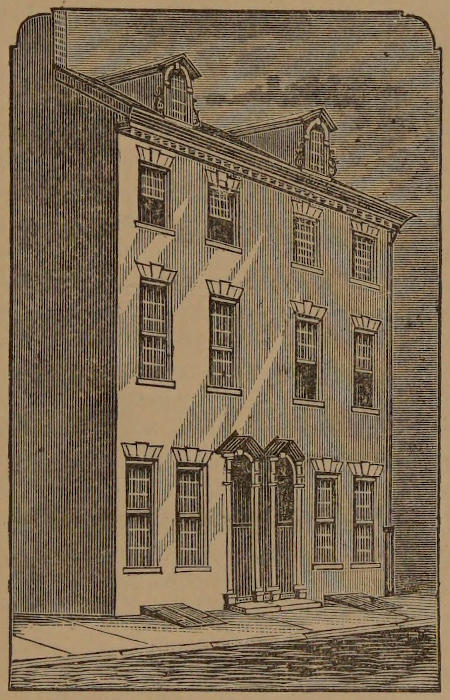
THE FIRST MINT IN THE UNITED STATES, ERECTED IN 1792.
The popular estimation in which the Mint is held in the United States, is, for obvious reasons, more distinctively marked than that entertained for other public institutions. Its position, in a financial point of view, is so important, its use so apparent, and its integrity of management so generally conceded, that it enjoys a pre-eminence and dignity beyond that accorded to general governmental departments. Party mutations usually effect changes in its directorship, with but slight interference, however, with the other officials, as those of attainments, skill, and long experience in the professional branches, required to intelligently perform the various duties assigned, are few in all countries. Those occupying positions are chosen for their proficiency in the various departments, their characters being always above question. The confidence reposed in the officials of the United States Mint has never been violated, as, for nearly a century of its operations, no shadow of suspicion has marred the fair name of any identified with its history.
The need of a mint in the Colonies was keenly felt to be a serious grievance against England for years before the Revolution, and as soon as practicable after the establishment of Independence, the United States Mint was authorized by an Act of Congress—April 2, 1792.
A lot of ground was purchased on Seventh Street near Arch, and appropriations were made for erecting the requisite buildings. An old still-house, which stood on the lot, had first to be removed. In an account book of that time we find an entry on the 31st of July, 1792, of the sale of some old materials of the still-house for seven shillings and sixpence, which “Mr. Rittenhouse directed should be laid out for punch in laying the foundation stone.”[7]
The first building erected in the United States for public use, under the authority of the Federal Government, was a structure for the United States Mint. This was a plain brick edifice, on the east side of Seventh street, near Arch, the corner-stone of which was laid by David Rittenhouse, Director of the Mint, on July 31, 1792. In the following October operations of coining commenced. It was occupied for about forty years. On the 19th of May, 1829, an Act was passed by Congress locating the United States Mint on its present site.
The first coinage of the United States, was silver half-dimes in October, 1792, of which Washington makes mention in his address to Congress, on November 6, 1792, as follows; “There has been a small beginning in the coinage of half-dimes; the want of small coins in circulation, calling the first attention to them.” The first metal purchased for coinage was six pounds of old copper at one shilling and three pence per pound, which was coined and delivered to the Treasurer, in 1793. The first deposit of silver bullion was made on July 18, 1794, by the Bank of Maryland. It consisted of “coins of France,” amounting to $80,715.73½. The first returns of silver coins to the Treasurer, was made on October 15, 1794. The first deposit of gold bullion for coinage, was made by Moses Brown, merchant, of Boston, on February 12, 1795; it was of gold ingots, worth $2,276.72, which was paid for in silver coins.
The first return of gold coinage, was on July 31, 1795, and consisted of 744 half eagles. The first delivery of eagles was in September 22, same year, and consisted of four hundred pieces.
Previous to the coinage of silver dollars, at the Philadelphia Mint, in 1794, the following amusing incidents occurred in Congress, while the emblems and devices proposed for the reverse field of that coin were being discussed.
A member of the House from the South bitterly opposed the choice of the eagle, on the ground of its being the “king of birds,” and hence neither proper nor suitable to represent a nation whose institutions and interests were wholly inimical to monarchical forms of government. Judge Thatcher playfully, in reply, suggested that perhaps a goose might suit the gentleman, as it was a rather humble and republican bird, and would also be serviceable in other respects, as the goslings would answer to place upon the dimes. This answer created considerable merriment, and the irate Southerner, conceiving the humorous rejoinder as an insult, sent a challenge to the Judge, who promptly declined it. The bearer, rather astonished, asked, “Will you be branded as a coward?” “Certainly, if he pleases,” replied Thatcher; “I always was one and he knew it, or he would never have risked a challenge.” The affair occasioned much mirth, and, in due time, former existing cordial relations were restored between the parties; the irritable Southerner concluding there was nothing to be gained in fighting with one who fired nothing but jokes.
EXTRACT FROM THE RULES AND REGULATIONS ADOPTED FOR THE MINT, JANUARY 1, 1825.
The operations of the Mint throughout the year, are to commence at 5 o’clock in the morning, under the superintendence of an officer, and continue until 4 o’clock in the afternoon, except on Saturdays, when the business of the day will close at 2 o’clock, unless on special occasions it may be otherwise directed by an officer. Extra work will be paid for in proportion, on a statement being made of it through the proper officer, at the end of each month. A strict account is to be kept by one of the officers, as they may agree of the absentees from duty, if the absence be voluntary, the full wages for the time will be deducted, if it arise from sickness a deduction will be made at the discretion of the proper officer. A statement of these deductions will be rendered at the end of the month, and the several accounts made out accordingly.
The allowance under the name of drink money is hereafter to be discontinued, and in place of it three dollars extra wages per month will be allowed for the three summer months to those workmen who continue in the Mint through that season. No workman can be permitted to bring spirituous liquors into the Mint. Any workman who shall be found intoxicated within the Mint must be reported to the Director, in order that he may be discharged. No profane or indecent language can be tolerated in the Mint. Smoking within the Mint is inadmissible. The practice is of dangerous tendency; experience proves that this indulgence in public institutions, ends at last in disaster. Visitors may be admitted by permission of an officer, to see the various operations of the Mint on all working days except Saturdays and rainy days; they are to be attended by an officer, or some person designated by him. The new coins must not be given in exchange for others to accommodate visitors, without the consent of the Chief Coiner. Christmas day and the Fourth of July, and no other days, are established holidays at the Mint. The pressmen will carefully lock the several coining presses when the work for the day is finished, and leave the keys in such places as the Chief Coiner shall designate. When light is necessary to be carried from one part of the Mint to the other, the watchman will use a dark lanthorn but not an open candle. He will keep in a proper arm chest securely locked, a musket and bayonet, two pistols and a sword. The arms are to be kept in perfect order and to be inspected by an officer once a month, when the arms are to be discharged and charged anew.
The watchman of the Mint must attend from 6 o’clock in the evening to 5 o’clock in the morning, and until relieved by the permission of an officer, or until the arrival of the door-keeper. He will ring the yard bell precisely every hour by the Mint clock, from 10 o’clock until relieved by the door-keeper, or an officer, or the workmen on working days, and will send the watch dog through the yard immediately after ringing the bell. He will particularly examine the departments of the engine and all the rooms where fire has been on the preceding day, conformably to his secret instructions. For this purpose he will have keys of access to such rooms as he cannot examine without entering them.
If an attempt be made on the Mint he will act conformably to his secret instructions on that subject. In case of fire occurring in or near the Mint, he will ring the Alarm Bell if one has been provided, or sound the alarm with his rattle, and thus as soon as possible bring some one to him who can be dispatched to call an officer, and in other particulars will follow his secret instructions. The secret instructions given him from time to time he must be careful not to disclose. The delicate trust reposed in all persons employed in the Mint, presupposes that their character is free from all suspicion, but the director feels it his duty nevertheless, in order that none may plead ignorance on the subject, to warn them of the danger of violating so high a trust. Such a crime as the embezzlement of any of the coins struck at the Mint, or of any of the metals brought to the Mint for coinage, would be punished under the laws of Pennsylvania, by a fine and penitentiary imprisonment at hard labor. The punishment annexed to this crime by the laws of the United States, enacted for the special protection of deposits made at the Mint, is DEATH. The 19th Section of the Act of Congress, establishing the Mint, passed April 12, 1792, is in the following words: Section 19, and be it further enacted, That if any of the gold or silver coins, which shall be struck or coined at the said Mint, shall be debased or made worse as to the proportion of fine gold or fine silver, therein contained, or shall be of less weight or value than the same ought to be, pursuant to the directions of this act, through the default or with the connivance of any of the officers or persons who shall be employed at said Mint, for the purpose of profit or gain, or otherwise, with a fraudulent intent, and if any of the said officers or persons shall embezzle any of the metal which shall at any time be committed to their charge, for the purpose of being coined, or any of the coins which shall be struck or coined at the said Mint, every such officer or person who shall commit any or either of the said offences, shall be deemed guilty of Felony, and shall suffer death. Printed copies of the Rules here recited are to be kept in convenient places for the inspection of the workmen, but as all may not be capable of reading them, it shall be the duty of the proper officer of the several departments, or such person as he may appoint, to read them in the hearing of the workmen, at least once a year, and especially to read them to every person newly employed in the Mint.
SAMUEL MOORE, Director.
Up to 1836 the work at the Mint was done entirely by hand or horse power. In that year steam was introduced. At different periods during the years 1797, 1798, 1799, 1802, and 1803, the operations of the Mint were suspended on account of the prevalence of yellow fever.
“Bond of Indemnity or Agreement of Operatives to return to the service of the Mint.” Dated August, 1799.
“We, the subscribers, do hereby promise and engage to return to the service of the Mint as soon as the same shall be again opened, after the prevailing fever is over, on the penalty of twenty pounds.”
“As witness our hands this 31st day of August, 1799.
“GEORGE WATT’N,
JOHN COPE,
LEWIS BITTING,
GEO. BOEMING,
JAMES ANDERSON,
JOHN SCHREINER,
JOHN BIRNBAUM,
GEORGE MYERS,
CHARLES BENJ. K——,
GEORGE BAILY,
JOHN MANN,
(In German) JOHANNES ——,
SAML. THOMPSON,
MARTIN SUMMERS.”
The above are the signatures of the parties agreeing, written on old hand-made unruled foolscap paper.
This is part of the Mint records, which has been framed for convenience and protection. It hangs in the Cabinet.
The Mint Established.
The Mint was established by Act of Congress the second of April, 1792, and a few half-dimes were issued towards the close of that year. The general operations of the institution commenced in 1793. The coinage effected from the commencement of the establishment to the end of the year 1800 may be stated in round numbers at $2,534,000; the coinage of the decade ending 1810 amounted to $6,971,000, and within the ten years ending with 1820—$9,328,000. The amount within the ten years ending with 1830 is stated at $18,000,000, and the whole coinage from the commencement of the institution at $37,000,000. On the second of March, 1829, provisions were made by Congress for extending the Mint establishment, the supply of bullion for coinage having increased beyond the capacity of the existing accommodations. The Mint edifice, erected under this provision, stands on a lot purchased for the object at the northwest corner of Chestnut and Juniper streets, fronting 150 feet on Chestnut street and extending 204 feet to Penn Square, (the central and formerly the largest public square in the city). The corner-stone of the new edifice was laid on the fourth of July, 1829; the building is of marble and of the Grecian style of architecture, the roof being covered with copper. It presents on Chestnut street and Penn Square a front of 123 feet, each front being ornamented with a portico of 60 feet, containing six Ionic columns. In the centre of the structure there was formerly a court-yard (now built up) extending 85 by 84 feet, surrounded by a piazza to each story, affording an easy access to all parts of the edifice. Present officers of the Mint: Hon. Daniel M. Fox, Superintendent; William S. Steel, Coiner; Jacob B. Eckfeldt, Assayer; Patterson Du Bois, Assistant Assayer, James C. Booth, Melter and Refiner; N. B. Boyd, Assistant Melter and Refiner; Charles E. Barber, Engraver; George T. Morgan and William H. Key, Assistant Engravers; M. H. Cobb, Cashier; George W. Brown, Doorkeeper.
On July 4, 1829, Samuel Moore, then Director, laid the corner stone of the present building, located at the northwest corner of Chestnut and Juniper streets. It is of white marble, and of the Grecian style of architecture, and was finished, and commenced operations, in 1833. Subsequent to that date necessary changes in the interior arrangements, to accommodate the increase in business, have been introduced at various times, and it was made more secure as a depository for the great amount of bullion contained within its vaults, by having been rendered fire-proof in 1856.
Copy of the Paper laid in the Corner Stone of the Mint, July 4, 1829.
This corner stone of the Mint of the United States of America, laid on the 4th day of July, 1829, being the fifty-third anniversary of our independence, in the presence of the Officers thereof, Members of Congress of the adjacent districts, architect, and artificers employed in the building, and a number of citizens of Philadelphia, in the which with this instrument are deposited specimens of the Coins of our Country struck in the present year. The Mint of the United States commenced operations in the year A. D., 1793, increasing constantly in utility, until its locality and convenience required extension and enlargement, which was ordered by the passage of a bill appropriating $120,000 for the erection of new and convenient buildings, to accommodate its operations, vesting the disbursement in the judgment and taste of the Director and President of the United States. In pursuance of the above bill, passed during the Presidency of John Quincy Adams, arrangements were made and designs adopted; William Strickland appointed architect; John Struthers, marble mason; Daniel Groves, bricklayer; Robert O’Neil, master carpenter, and in the first year of the Presidency of Andrew Jackson, this corner stone was placed in southeast corner of the edifice.
The names of the officers of the Mint of the United States at this time, are as follows:
Doctor Samuel Moore, Director,
Adam Eckfeldt, Coiner,
Joseph Cloud, Melter and Refiner,
Joseph Richardson, Assayer,
Doctor James Rush, Treasurer,
Wm. Kneass, Engraver,
George Ehrenzelder, Clerk.
Mint of the United States, Philadelphia, March 20, 1838.
To Hon. Levi Woodbury, Secretary of the Treasury.
Sir:—I had the honor to receive your letter asking my attention to a resolution of the House of Representatives of the United States, passed March 5, 1838, as follows:
Extract from Resolution of Congress relating to Mint.
“Resolved, That the Secretary of the Treasury report to this House the cost of erecting the principal Mint and its branches, including buildings, fixtures, and apparatus; the salaries and expenses of the different officers; the amount expended in the purchase of bullion; the loss arising from wastage, and all other expenses; and the average length of time it requires to coin at the principal Mint all the bullion with which it can be furnished; and further, what amount of coin has been struck at the several branch mints, since their organization.”
Mint of the United States, Philadelphia.
The cost of the edifice, machinery, and fixtures, was $173,390
Ground, enclosure, paving, etc. 35,840
Total cost of buildings, etc. $209,230
This amount does not include expenditures made under special appropriations for the years 1836 and 1837, for milling and coining by steam power; and for extensive improvements in the assaying, melting, and parting rooms, and machine shops, amounting to $28,270.
It may be proper to mention that the Mint building is on the best street in the city, is of large dimensions, with the whole exterior of marble, and two Ionic porticos; and that the machinery and apparatus are of the best construction. The cost must therefore be considered as very moderate. The new Mint lately erected by the British India Government at Calcutta, cost 24 lacs of rupees, or about $1,138,000.
The Director receives per annum $3,500
Treasurer 2,000
Chief Coiner 2,000
Assayer 2,000
Melter and Refiner 2,000
Engraver 2,000
Second Engraver 1,500
Assistant Assayer 1,300
Treasurer’s Clerk 1,200
Bookkeeper 1,000
Clerk of the weighing room 1,200
Director’s Clerk 700
Total for salaries $20,400
No expenses are allowed, beyond the above sums, to any officer, assistant, or clerk, for the performance of his duties.
As all the gold and silver brought to the Mint is purchased at the nett Mint price, there is no expense, properly so called, incurred on this account.
R. M. PATTERSON, Director of the Mint.
Previous to the passage of the law by the Federal government for regulating the coins of the United States, much perplexity arose from the use of no less than four different currencies or rates, at which one species of coin was recoined, in the different parts of the Union. Thus, in New Hampshire, Massachusetts, Maine, Rhode Island, Connecticut, Vermont, Virginia and Kentucky, the dollar was recoined at six shillings; in New York and North Carolina at eight shillings; in New Jersey, Pennsylvania and Maryland at seven shillings and six pence; in Georgia and South Carolina at four shillings and eight pence. The subject had engaged the attention of the Congress of the old confederation, and the present system of the coins is formed upon the principles laid down in their resolution of 1786, by which the denominations of money of account were required to be dollars (the dollar being the unit), dismes or tenths, cents or hundredths, and mills or thousandths of a dollar. Nothing can be more simple or convenient than this decimal subdivision. The terms are proper because they express the proportions which they are intended to designate. The dollar was wisely chosen, as it corresponded with the Spanish coin, with which we had been long familiar.
Visiting the Mint.
The Mint, on Chestnut street near Broad, is open to the public daily, excepting Sundays and holidays, from 9 to 12 A. M. Visitors are met by the courteous ushers, who attend them through the various departments. It is estimated that over forty thousand persons have visited the institution in the course of a single year. Owing to the immense amount of the precious metals which is always in course of transition, and the watchful care necessary to a correct transaction of business, the public are necessarily excluded from some of the departments. These, however, are of but little interest to the many and are described under their proper heads. The system adopted in the Mint is so precise and the weighing so accurate, that the abstraction of the smallest particle of metal would lead to almost immediate detection.
On entering the rotunda, the offices of the Treasurer and Cashier are to the right and left. Farther in, in the hall, to the rear, on the right, is the room of the Treasurer’s clerks; a part of this was formerly used by the Adams Express Company, who transport to and from the Mint millions of dollars worth of metal, coin, etc.
The Deposit or Weighing-room.
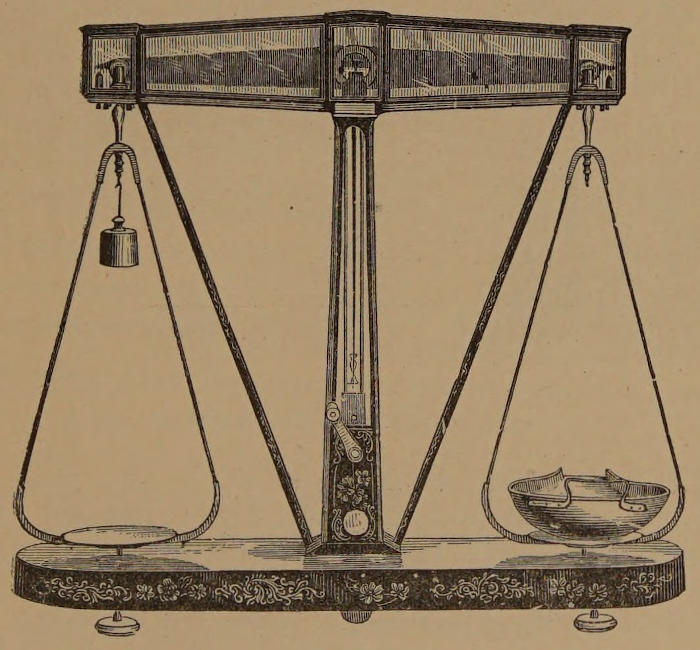
SCALES.
On the left is the Deposit or Weighing-room, where all the gold and silver for coining is received and first weighed. The largest weight used in this room is five hundred ounces, the smallest, is the thousandth part of an ounce. The scales are wonderfully delicate, and are examined and adjusted on alternate days. On the right of this room is one of the twelve vaults in the building. Of solid masonry, several of them are iron-lined, with double doors of the same metal and most complicated and burglar-proof locks.
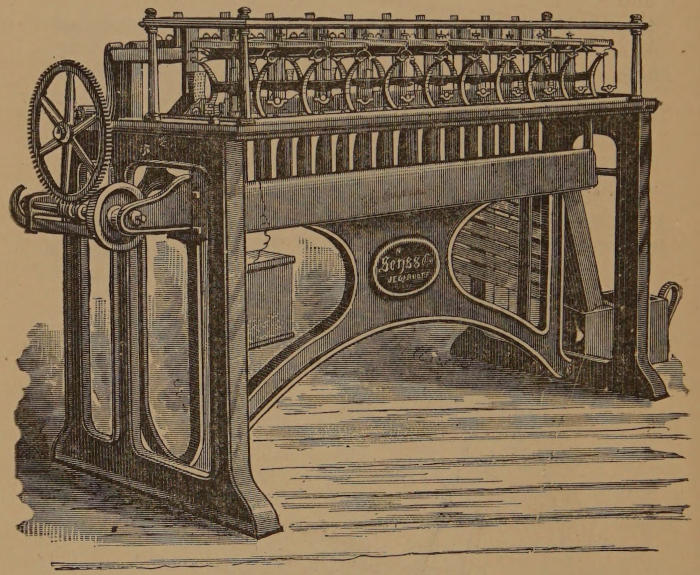
AUTOMATIC WEIGHING SCALES.
It is estimated that about fifteen hundred million dollars worth of gold has been received and weighed in this room; probably nine-tenths of this amount was from California, since its discovery there in the year 1848. Previous to that time the supplies of gold came principally from Virginia, North Carolina, and Georgia. During the past ten years considerable quantities have been received from Nova Scotia, but most of the gold that reaches the Mint, at the present time, comes from California, Montana, Colorado, Idaho, Nevada, Arizona, Oregon, Dakota, Virginia, South Carolina, and New Mexico.
Formerly the silver used by the Mint came principally from Mexico and South America, but since the discovery of the immense veins of that metal in the territories of the United States the supply is furnished from the great West.
The copper used comes principally from the mines of Lake Superior, the finest from Minnesota. The nickel is chiefly from Lancaster County, Pa.
The Deposit Melting Room.
After the metal has been carefully weighed in the presence of the depositor and the proper officials, it is locked in iron boxes and taken to the melting room, where it is opened by two men, each provided with a key to one of the separate locks. There are four furnaces in this room, and the first process of melting takes place here. The gold and silver, being mixed with borax and other fluxing material, is placed in pots, melted and placed in iron moulds, and when cooled is again taken to the deposit room in bars, where it is reweighed, and a small piece cut from each lot by the Assayer. From this the fineness of the whole is ascertained, the value calculated, and the depositor paid. The metal in its rough state is then transferred to the Melter and Refiner.
Office of the Melter and Refiner.
Adjoining the Deposit Melting Room are the Melter and Refiner and assistants. This is the general business office of the head of this department, and is also used for weighing the necessary quantities of the metals used in alloying coin.
The Process of Assay.
The two essential things regarding every piece of metal offered in payment of any dues were, first, the weight or quantity, next, the fineness or purity of the same. The process of weighing even the baser metals used in coining must be conducted by the careful use of accurate scales, with precise notes of the results. In precious metals, gold, silver, and their high grade alloys, a very small variation in the fineness makes a great difference in the value. Nothing is more essential than the accurate determination of the weight of the sample and of the metal obtained from it. It requires keen sight and most delicate adjustment in the hand which manipulates the Lilliputian scales of an Assayer’s table. The smallest weight used in the Mint is found in the Assay Room; it is the thirteen-hundredth part of a grain, and can scarcely be seen with the naked eye, unless on a white ground. The Assay Department is strictly a technical and scientific branch of the service. It has been practically under one regime, for the last fifty years. There have been but three Chief Assayers in that time, the only removals being by death, the only appointments by promotion. Its workmen are all picked men, selected from other parts of the Mint for special fitness and good character.
The Assaying Rooms.
These are on the second floor, in the southwest corner of the building. In one of these are fires, stills, and other appliances used in the delicate and complicated process of assay, by which the specific standard of the fineness and purity of the various metals are established and declared.
Assaying Gold.
The gold is melted down and stirred, by which a complete mixture is effected, so that an assay piece may be taken from any part of the bar after it is cast. The piece taken for this purpose is rolled out for the convenience of cutting. It is then taken to an assay balance (sensible to the ten-thousandth of a half gramme or less), and from it is weighed a half gramme, which is the normal assay weight for gold, being about 7.7 grains troy. This weight is stamped 1000; and all the lesser weights (afterwards brought into requisition) are decimal divisions of this weight, down to one ten-thousandth part.
Silver is next weighed out for the quartation (alloying), and as the assay piece, if standard, should contain 900-thousandths of gold, there must be three times this weight, or 2700-thousandths of silver; and this is the quantity used. The lead used for the cupellation is kept prepared in thin sheets, cut in square pieces, which should each weigh about ten times as much as the gold under assay. The lead is now rolled into the form of a hollow cone; and into this are introduced the assay gold and the quartation silver, when the lead is closed around them and pressed into a ball. The furnace having been properly heated, and the cupels placed in it and brought to the same temperature, the leaden ball, with its contents, is put into a cupel (a small cup made of burned bones, capable of absorbing base metals), the furnace closed, and the operation allowed to proceed, until all agitation is ceased to be observed in the melted metal, and its surface has become bright. This is an indication that the whole of the base metals have been converted into oxides, and absorbed by the cupel.
The cupellation being thus finished, the metal is allowed to cool slowly, and the disc or button which it forms is taken from the cupel. The button is then flattened by a hammer; is annealed by bringing it to a red heat; is laminated by passing it between the rollers; is again annealed; and is rolled loosely into a spiral or coil called a cornet. It is now ready for the process of quartation. This was formerly effected in a glass matrass, and that mode is still used occasionally, when there are few assays. But a great improvement, first introduced into this country by the Assayer in 1867, was the—“platinum apparatus,” invented in England. It consists of a platinum vessel in which to boil the nitric acid, which is to dissolve out the silver, and a small tray containing a set of platinum thimbles with fine slits in the bottom. In these the silver is taken out, by successive supplies of nitric acid, without any decanting as in the case of glass vessels. The cornets are also annealed in the thimbles; in fact there is no shifting from the coiling to the final weighing, which determines the fineness of the original sample by proportionate weights in thousandths. In this process extra care has to be taken in adding the proportions of silver, as the “shaking” of any one cornet, might damage the others.
Assaying Silver.
The process of assaying silver differs from that of gold. To obtain the assay sample, a little of the metals is dipped from the pot and poured quickly into water, producing a granulation, from portions of which that needed for assay is taken. In the case of silver alloyed with copper there is separation, to a greater or less degree, between the two metals in the act of solidification. Thus an ingot or bar, cooled in a mould, or any single piece cut from either, though really 900-thousandths fine on the average, will show such variations, according to the place of cutting, as might exceed the limits allowed by law. But the sudden chill produced by throwing the liquid metal into water, yields a granulation of entirely homogeneous mixture that the same fineness results, whether by assaying a single granule, or part of one, or a number.
From this sample the weight of 1115 thousandths is taken; this is dissolved in a glass bottle with nitric acid. The standard solution of salt is introduced and chloride of silver is the result, which contains of the metallic silver 1000 parts; this is repeated until the addition of the salt water shows but a faint trace of chloride below the upper surface of the liquid. For instance: if three measures of the decimal solution have been used with effect, the result will show that the 1115 parts of the piece contained 1003 of pure silver; and thus the proportion of pure silver in the whole alloyed metal is ascertained. Extensive knowledge and experience are required in such matters as making the bone-ash cupels, fine proof gold and silver, testing acids, and other special examinations and operations. The Assayer must, himself, be familiar with all the operations of minting, as critical questions are naturally carried to him. The rendering of decisions upon counterfeit or suspicious coins has long been a specialty in this department. Once a year the President appoints a scientific commission to examine the coins of the preceding year. There has never yet been a Philadelphia coin found outside of the tolerance of fineness.
The Separating Room.
This department occupies the largest part of the west side of the building, on the second floor. Here the gold and silver used by the Mint in the manufacture of coin and fine bars are separated from each other, or whatever other metals may be mixed with them, and purified. It goes to this room after having been once melted and assayed. In separating and purifying gold, it is always necessary to add to it a certain quantity of pure silver. The whole is then immersed in nitric acid, which dissolves the silver into a liquid which looks like pure water. The acid does not dissolve the gold, but leaves it pure. The silver solution is then drawn off, leaving the gold at the bottom of the tub. It is then gathered up into pans and washed.
The silver in the condition in which it is received from the hands of the depositor, and generally filled with foreign impurities, is melted and then granulated, after which the whole mass is dissolved with nitric acid. The acid dissolves the base metals as well as the silver. The liquid metals are then run into tubs prepared for it, and precipitated, or rendered into a partially hard state, by being mixed with common salt water. After being precipitated it is called “chloride,” and resembles very closely new slacked lime. By putting spelter or zinc on the precipitated chloride, it becomes metallic silver, and only needs washing and melting to make the purest virgin metal. The base metals remain in a liquid state, and being of little value are generally thrown away. The process of refining silver is of two kinds; that of melting it with saltpetre, etc., which was known some thousands of years since, and the modern process of dissolving it in nitric acid, like the method of extracting it from gold in the above described operation.
After the separating process has been completed, the gold or silver is conveyed to the Drying Cellar, where it is put under pressure of some eighty tons, and all the water pressed out. It is then dried with heat, and afterwards conveyed in large cakes to the furnaces.
The Melting Rooms
are on the first floor, in the west side of the building. Here all the metal used in coining is alloyed, melted and poured into narrow moulds. These castings are called ingots; they are about twelve inches long, a half-inch thick, and vary from one to two a half-inches in breadth, according to the coin for which they are used, one end being wedge-shaped to allow its being passed through the rollers. The value of gold ingots is from $600 to $1,400; those of silver, about $60. The fine gold and silver bars used in the arts and for commercial purposes, are also cast in this department.
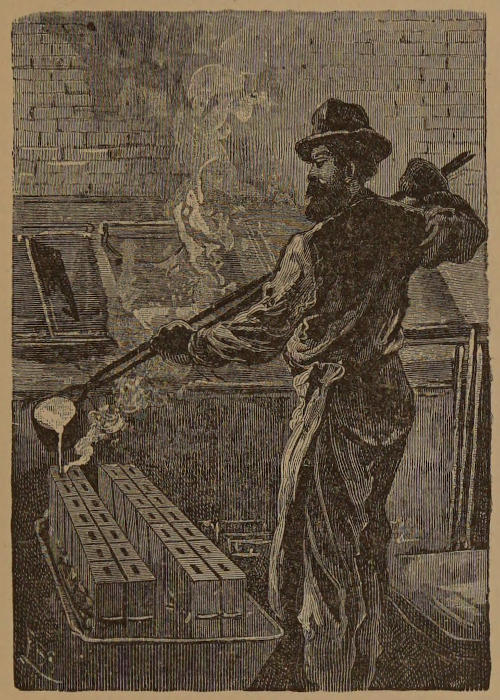
CASTING INGOTS.
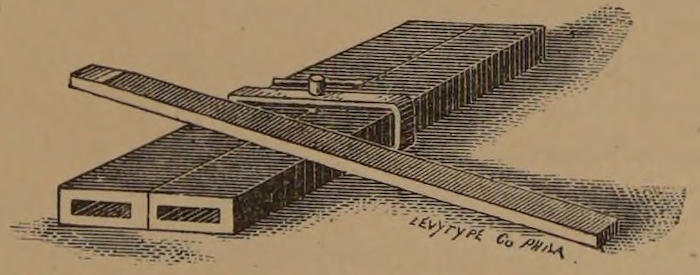
INGOTS.
These are stamped with their weight and value in the deposit room. The floors that cover the melting rooms are made of iron in honey-comb pattern, divided into small sections, so that they can be readily taken up to save the dust; their roughness acting as a scraper, preventing any metallic particles from clinging to the soles of the shoes of those who pass through the department, the sweepings of which, and including the entire building, averages $23,000 per annum, for the last five years.
The copper and nickel melting rooms, wherein all the base metals used are melted and mixed, is on the same side and adjoining to the gold and silver department. Up to the year 1856, the base coin of the United States was exclusively copper. In this year the coinage of what was called the nickel cents was commenced. These pieces, although called nickel, were composed of one-eighth nickel; the balance was copper.
The composition of the five and three cent pieces is one-fourth nickel; the balance copper. The bronze pieces were changed in 1859, and are a mixture of copper, zinc and tin, about equal parts of each of the two last; the former contributing about 95 per cent. There are seven furnaces in this room, each capable of melting five hundred pounds of metal per day. When the metal is heated and sufficiently mixed, it is poured into iron moulds, and when cool, and the rough ends clipped off, is ready to be conveyed to the rolling room.
The Rolling Room.
From the melting rooms through the corridor we reach the rolling room. The upright engine, on the right, of one hundred and sixty horse power, supplies the motive force to the rolling machines, four in number. Those on the left, are massive and substantial in their frame-work, with rollers of steel, polished by service in reducing the ingots to planchets for coining. The first process or rolling is termed breaking down; after that it requires to be passed through the machine until it is reduced to the required thinness—ten times if gold, eight if silver, being annealed in the intervals to prevent breaking. The rollers are adjustable and the space between them can be increased or diminished at pleasure, by the operator. About two hundred ingots are run through per hour on each pair of rollers.
The pressure applied is so intense that half a day’s rolling heats, not only the strips and rollers, but even the huge iron stanchions, weighing several tons, so hot that you can hardly hold your hand on them.
When the rolling is completed the strip is about six feet long, or six times as long as the ingot.
It is impossible to roll perfectly true. At times there will be a lump of hard gold, which will not be quite so much compressed as the rest. If the planchets were cut from this place, it would be heavier and more valuable than one cut from a thinner portion of the strip. It is, therefore, necessary to “draw” the strips, after being softened by annealing.
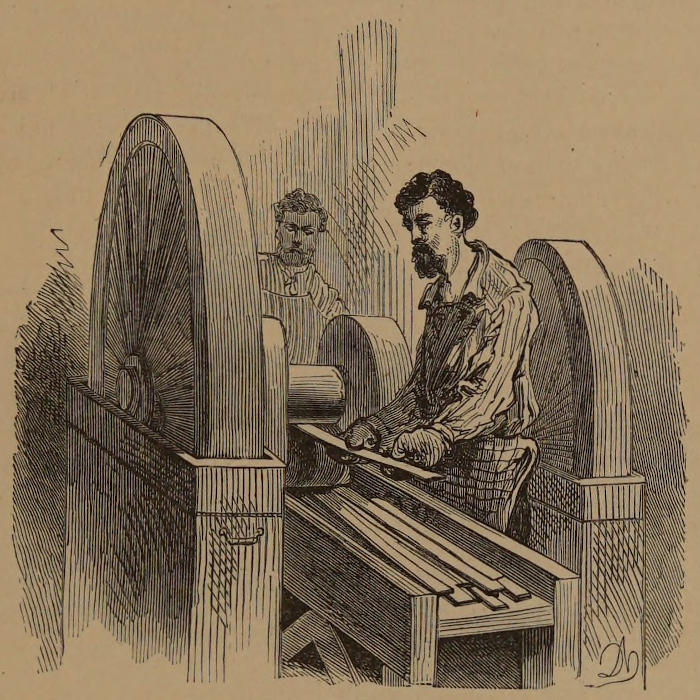
Rolling Machine.
Annealing Furnaces.
These are in the same room, to the right facing the rollers. The gold and strips are placed in copper canisters, and then placed in the furnaces and heated to a red heat; silver strips being laid loosely in the furnace. When they become soft and pliable, they are taken out and allowed to cool slowly.
The Drawing Benches.
These machines resemble long tables, with a bench on either side, at one end of which is an iron box secured to the table. In this are fastened two perpendicular steel cylinders, firmly supported in a bed, to prevent their bending or turning around, and presenting but a small portion of their circumference to the strip. These are exactly at the same distance apart that the thickness of the strip is required to be. One end of the strip is somewhat thinner than the rest, to allow it to pass easily between the cylinders. When through, this end is put between the jaws of a powerful pair of tongs, or pincers, fastened to a little carriage running on the table. The carriage to the further bench is up close to the cylinders, ready to receive a strip, which is inserted edgewise. When the end is between the pincers, the operator touches a foot pedal which closes the pincers firmly on the strip, and pressing another pedal, forces down a strong hook at the left end of the carriage, which catches in a link of the moving chain. This draws the carriage away from the cylinders, and the strip being connected with it has to follow. It is drawn between the cylinders, which operating on the thick part of the strip with greater power than upon the thin, reduces the whole to an equal thickness. When the strip is through, the strain on the tongs instantly ceases, which allows a spring to open them and drop the strip. At the same time another spring raises the hook and disengages the carriage from the chain. A cord fastened to the carriage runs back over the wheel near the head of the table, and then up to a couple of combination weights on the wall beyond, which draw the carriage back to the starting place, ready for another strip.
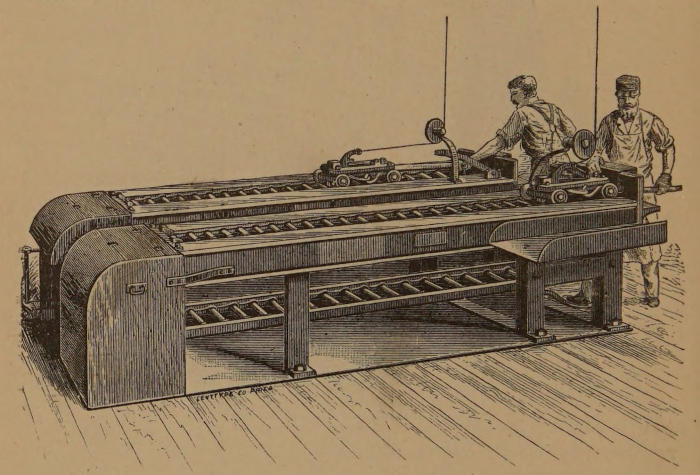
DRAWING BENCH.
The Cutting Machines.
After being thoroughly washed, the strips are consigned to the cutting machines. These are in the rear of the rolling mills, and are several in number, each when in active operation cutting two hundred and twenty-five planchets per minute. The press now used, consists of a vertical steel punch, which works in a round hole or matrix, cut in a solid steel plate. The action of the punch is obtained by an eccentric wheel. For instance, in an ordinary carriage wheel, the axis is in the centre, and the wheel revolves evenly around it. But if the axis is placed, say four inches from the centre, then it would revolve with a kind of hobble. From this peculiar motion its name is derived. Suppose the tire of the wheel is arranged, not to revolve with, but to slip easily around the wheel, and a rod is fastened to one side of the tire which prevents its turning. Now as the wheel revolves and brings the long side nearest the rod, it will push forward the rod, and when the long side of the wheel is away from the rod, it draws the rod with it.
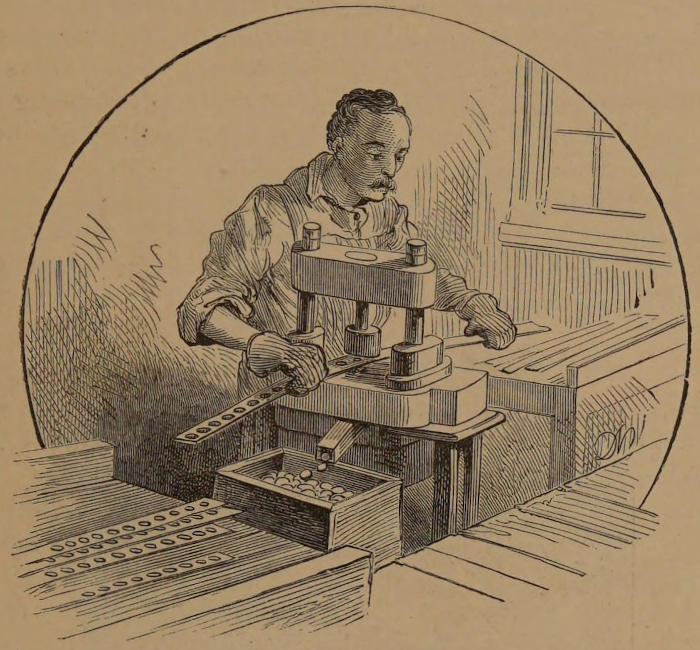
CUTTING MACHINE.
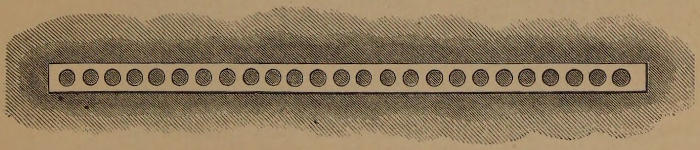
STRIP FROM WHICH PLANCHETS ARE CUT.
The upper shaft, on which are seen the three large wheels, has also fastened to it, over each press, an eccentric wheel. In the first illustration will be seen three upright rods running from near the table to the top. The middle one is connected with a tire around the eccentric wheel, and rises and falls with each revolution. The eccentric power gives great rapidity of motion with but little jerking.
The operator places one end of a strip of metal in the immense jaws of the press, and cuts out a couple of planchets, which are a fraction larger than the coin to be struck. As the strips are of uniform thickness, if these two are of the right weight, all cut from that strip will be the same. They are therefore weighed accurately. If right, or a little heavy, they are allowed to pass, as the extra weight can be filed off. If too light, the whole strip has to be re-melted. As fast as cut the planchets fall into a box below, and the perforated strips are folded into convenient lengths to be re-melted. From a strip worth say eleven hundred dollars, eight hundred dollars of planchets will be cut.
Adjusting Room.
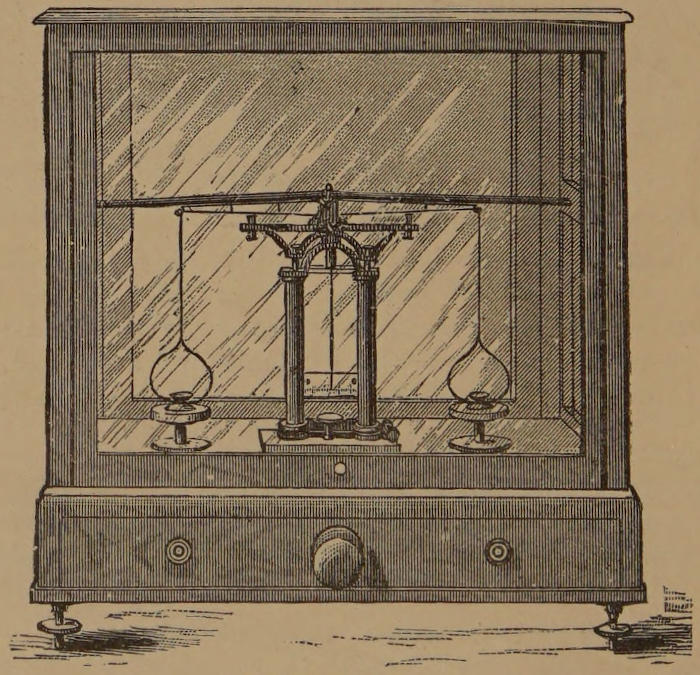
DELICATE SCALES.
The planchets are then removed to the adjusting room, where they are adjusted. This work is performed by ladies. After inspection they are weighed on very accurate scales. If a planchet is too heavy, but near the weight, it is filed off at the edges; if too heavy for filing, it is thrown aside with the light ones, to be re-melted. To adjust coin so accurately requires great delicacy and skill, as a too free use of the file would make it too light. Yet by long practice, so accustomed do the operators become, that they work with apparent unconcern, scarce glancing at either planchets or scales, and guided as it were by unerring touch.
The exceedingly delicate scales were made under the direction of Mr. Peale, who greatly improved on the old ones in use. So precise and sensitive are they that the slightest breath of air affects their accuracy, rendering it necessary to exclude every draft from the room.
Progress in Coining.
The methods of coining money have varied with the progress in mechanic arts, and are but indefinitely traced from the beginning; the primitive mode, being by the casting of the piece in sand, the impression being made with a hammer and punch. In the middle ages the metal was hammered into sheets of the required thickness, cut with shears into shape, and then stamped by hand with the design. The mill and screw, by which greater increase in power, with finer finish was gained, dates back to the Sixteenth Century. This process, with various modifications and improvements, continued in use in the Philadelphia Mint until 1836.
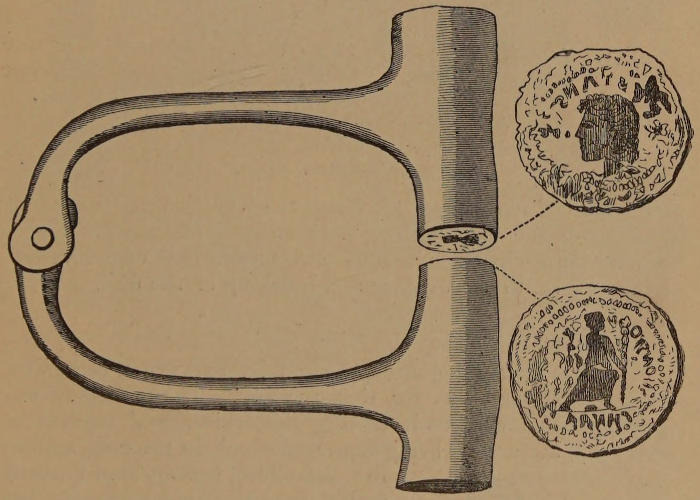
ANCIENT COINING PRESS.
The first steam coining press was invented by M. Thonnelier, of France, in 1833, and was first used in the United States Mint in 1836. It was remodeled and rebuilt in 1858, but in 1874 was superseded by the one now in operation, the very perfection of mechanism, in which the vibration and unsteady bearing of the former press were entirely obviated, and precision attained by the solid stroke with a saving of over seventy-five per cent. in the wearing and breaking of the dies.
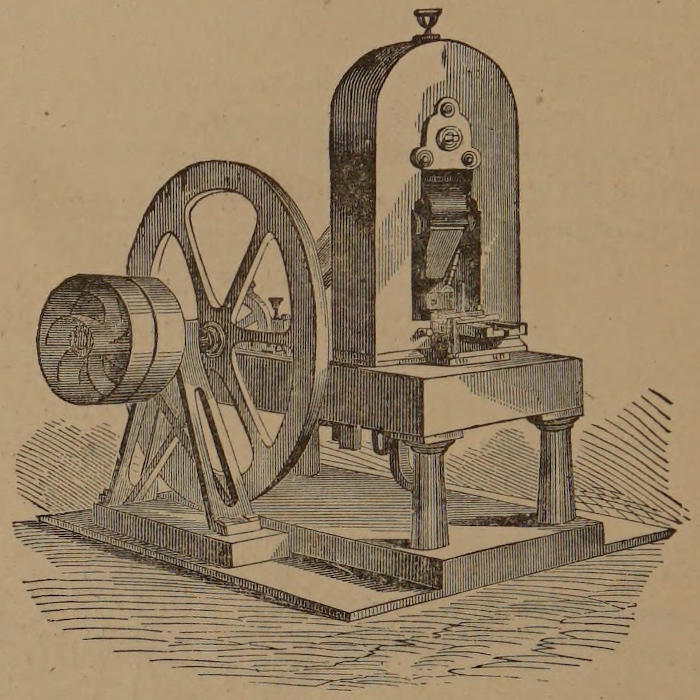
STEAM COINING PRESS.
Dies.
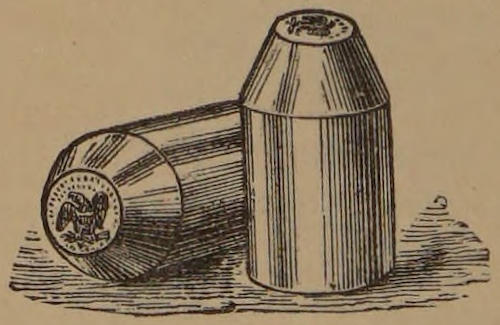
DIES.
The dies for coining are prepared by engravers, especially employed at the Mint for that purpose. The process of engraving them consists in cutting the devices and legends in soft steel, those parts being depressed which, in the coin, appear in relief. This, having been finished and hardened, constitutes an “original die,” which, being the result of a tedious and difficult task, is deemed too precious to be directly employed in striking coins; but it is used for multiplying dies. It is first used to impress another piece of soft steel, which then presents the appearance of a coin, and is called a hub. This hub, being hardened, is used to impress other pieces of steel in like manner which, being like the original die, are hardened and used for striking the coins. A pair of these will, on an average, perform two weeks’ work.
Transfer Lathe.
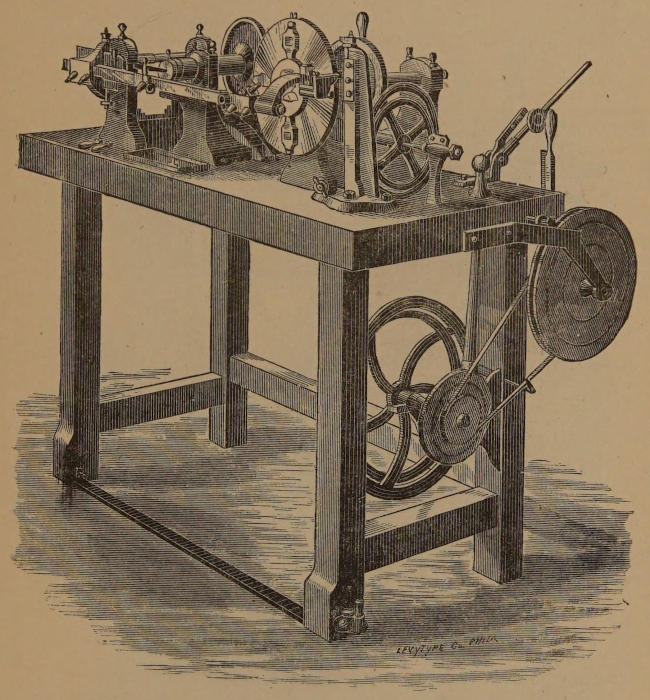
The transfer lathe, a very complicated piece of machinery, is used in making dies, for coins and medals. By it, from a large cast, the design can be transferred and engraved in smaller size, in perfect proportion to the original.
The Coining and Milling Rooms.
This department, the most interesting to the general visitor, occupies the larger portion of the first floor on the east side of the building. The rooms are divided by an iron railing, which separates the visitors, on either side, from the machinery, etc., but allows everything to be seen.
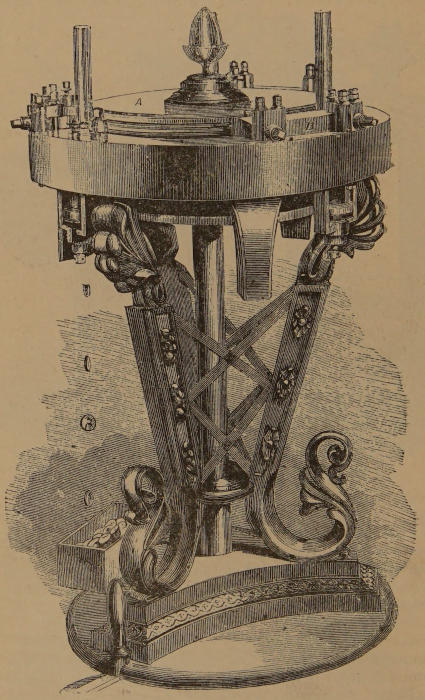
MILLING MACHINE.
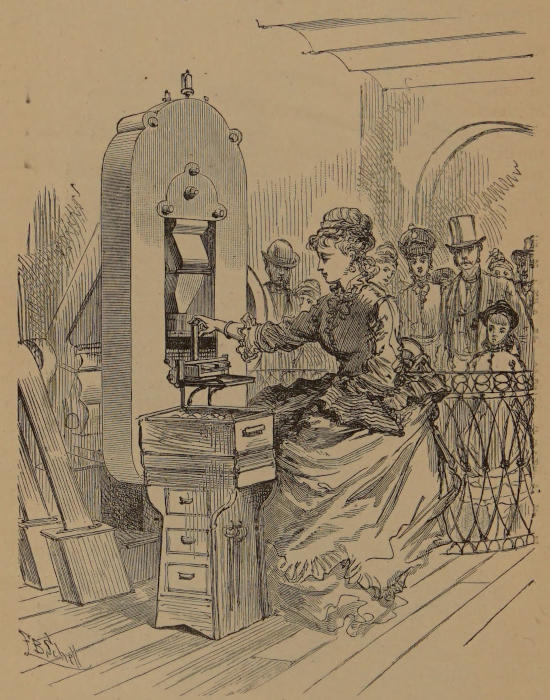
The planchets, after being adjusted, are received here, and, in order to protect the surface of the coin, are passed through the milling-machine. The planchets are fed to this machine through an upright tube, and, as they descend from the lower aperture, they are caught upon the edge of a revolving wheel and carried about a quarter of a revolution, during which the edge is compressed and forced up—the space between the wheel and the rim being a little less than the diameter of the planchet. This apparatus moves so nimbly that five hundred and sixty half-dimes can be milled in a minute; but, for large pieces, the average is about one hundred and twenty. In this room are the milling machines, and the massive, but delicate, coining presses, ten in number. Each of these is capable of coining from eighty to one hundred pieces a minute. Only the largest are used in making coins of large denominations.
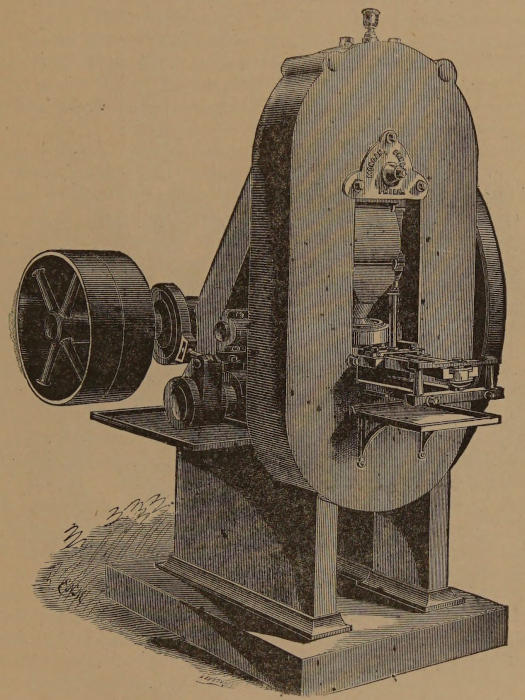
PERFECTED COINING PRESS.
COINING PRESS.
The arch is a solid piece of cast iron, weighing several tons, and unites with its beauty great strength. The table is also of iron, brightly polished and very heavy. In the interior of the arch is a nearly round plate of brass, called a triangle. It is fastened to a lever above by two steel bands, termed stirrups, one of which can be seen to the right of the arch. The stout arm above it, looking so dark in the picture, is also connected with the triangle by a ball-and-socket joint, and it is this arm which forces down the triangle. The arm is connected with the end of the lever above by a joint somewhat like that of the knee. One end of the lever can be seen reaching behind the arch to a crank near the large fly-wheel. When the triangle is raised, the arm and near end of the lever extends outward. When the crank lifts the further end of the lever it draws in the knee and forces down the arm until it is perfectly straight. By that time the crank has revolved and is lowering the lever, which forces out the knee again and raises the arm. As the triangle is fastened to the arm it has to follow all its movements.
Under the triangle, buried in the lower part of the arch, is a steel cup, or, technically, a “die stake.” Into this is fastened the reverse die. The die stake is arranged to rise one-eighth of an inch; when down it rests firmly on the solid foundation of the arch. Over the die stake is a steel collar or plate, in which is a hole large enough to allow a planchet to drop upon the die. In the triangle above, the obverse die is fastened, which moves with the triangle; when the knee is straightened the die fits into the collar and presses down upon the reverse die.
Just in front of the triangle will be seen an upright tube made of brass, and of the size to hold the planchets to be coined. These are placed in this tube. As they reach the bottom they are seized singly by a pair of steel feeders, in motion as similar to that of the finger and thumb as is possible in machinery, and carried over the collar and deposited between the dies, and, while the fingers are expanding and returning for another planchet, the dies close on the one within the collar, and by a rotary motion are made to impress it silently but powerfully. The fingers, as they again close upon a planchet at the mouth of the tube, also seize the coin, and, while conveying a second planchet on to the die, carry the coin off, dropping it into a box provided for that purpose, and the operation is continued ad infinitum. These presses are attended by ladies, and do their work in a perfect manner. The engine that drives the machinery is of one hundred and sixty horse-power.
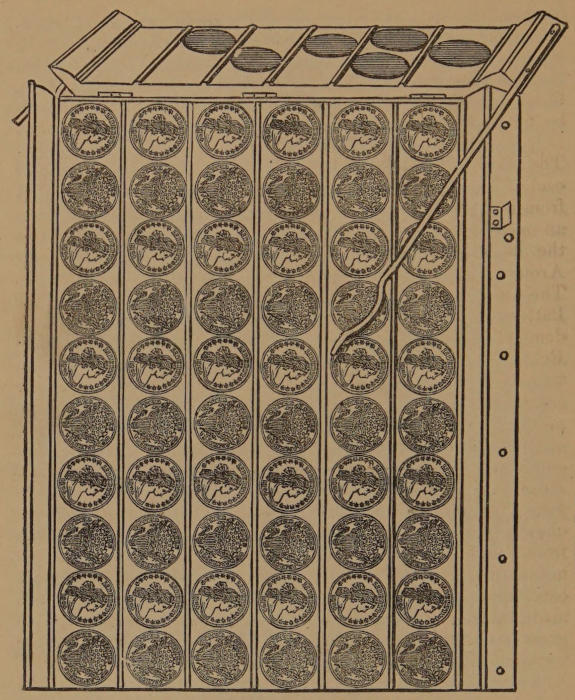
After being stamped the coins are taken to the Coiner’s room, and placed on a long table—the double eagles in piles of ten each. It will be remembered that, in the Adjusting Room, a difference of one-half a grain was made in the weight of some of the double eagles. The light and heavy ones are kept separate in coining, and when delivered to the treasurer, they are mixed together in such proportions as to give him full weight in every delivery. By law the deviation from the standard weight, in delivering to him, must not exceed three pennyweights in one thousand double eagles. The gold coins—as small as quarter eagles being counted and weighed to verify the count—are put up in bags of $5,000 each. The three-dollar pieces are put up in bags of $3,000, and one-dollar pieces in $1,000 bags. The silver pieces, and sometimes small gold, are counted on a very ingenious contrivance called a “counting-board.”
COUNTING BOARD.
By this process twenty-five dollars in five-cent pieces can be counted in less than a minute. The “boards” are a simple flat surface of wood, with copper partitions, the height and size of the coin to be counted, rising from the surface at regular intervals, and running parallel with each other from top to bottom. They somewhat resemble a common household “washing board,” with the grooves running parallel with the sides but much larger. The boards are worked by hand, over a box, and as the pieces are counted they slide into a drawer prepared to receive them. They are then put into bags and are ready for shipment.[8]