DIRECTORS OF THE MINT.
Reading edition
DAVID RITTENHOUSE, First Director of the Mint.
Entering the Cabinet, the portraits of the different Directors attract attention. That of David Rittenhouse is the copy of a painting by Charles Willson Peale. Mr. Rittenhouse was appointed by Washington, April 14, 1792, and remained in charge of the Mint until June, 1795, when his declining health compelled him to resign.
At an early age he indicated mechanical talent of a high order in the construction of a clock, and his studies from that time were principally mathematical. His genius soon attracted attention, and he was appointed by the colonial governor a surveyor, and in that capacity determined the famous Mason and Dixon line. He succeeded Benjamin Franklin as President of the American Philosophical Society. Mr. Barber, late Engraver of the Mint, executed a bronze medal of Dr. Rittenhouse. Possibly, excepting Duvivier’s head of Washington after Houdon, it cannot be surpassed in the Cabinet. The engraver had a very fine subject, and treated it in the highest style of art. On the obverse is “David Rittenhouse,” with date of birth and death. On the reverse, inscription, “He belonged to the whole human race.”—“Wm. Barber.” This beautiful memento is highly prized.
HENRY WILLIAM DESAUSSURE, Second Director of the Mint.
The portrait of Henry William Desaussure, now in the cabinet, was painted by Samuel Du Bois, from a daguerreotype taken from a family picture. This Director was distinguished for his legal ability, as well as his strict integrity. He entered upon his duties with a protest, as he claimed no knowledge of the requirements of the position, having long been a practicing lawyer; but he was reassured by Alex. Hamilton, then Secretary of the Treasury, and proved himself a fine officer for the short term of his service. He was appointed by Washington, July 8, 1795, but resigned in the following October. Washington not only expressed regret at losing so valuable an officer, but consulted him as to the selection of a successor.
ELIAS BOUDINOT, Third Director of the Mint,
was appointed October 28, 1795, and remained in office eleven years. In the summer and autumn of 1797 and the two following years, and also of 1802 and 1803, the Mint was closed on account of the ravages of the yellow fever. Mr. Boudinot resigned in 1805, and devoted the remainder of his life to benevolent and literary pursuits. He died on the 24th of October, 1821, at the advanced age of eighty-two. The fine portrait of this venerable Director seen in the Cabinet was presented by a relative, and is a good copy of a painting by Waldo and Jewett.
ROBERT PATTERSON, LL.D., Fourth Director of the Mint,
was appointed by President Jefferson, January 17, 1806. He was a native of Ireland, distinguished for his acquirements and ability. He held the office of Director for an exceptionally long term of service. His portrait, which hangs in the Cabinet, is a copy of a fine original by Rembrandt Peale.
SAMUEL MOORE, M. D., Fifth Director of the Mint,
was appointed by President James Monroe, July 15, 1824. He was a native of New Jersey, and the son of a distinguished Revolutionary officer. He was one of the first graduates of the Penn University, in 1791, and was afterwards a tutor in that institution. During his directorship the Mint was removed to the present building. His portrait was painted from life by B. Samuel Du Bois, now in the Cabinet.
ROBERT MASKELL PATTERSON, M. D., Sixth Director of the Mint,
son of a former Director, was appointed by President Andrew Jackson, May 26, 1835. His term of office was marked by an entire revolution in the coinage, and the ready acceptance of those improvements which followed so rapidly upon the introduction of steam. Dr. Patterson possessed the advantage of foreign travel; and having become familiar with the discoveries which had been adopted in the French Mint, he inaugurated and perfected them, also introducing improvements, which are still in use, in the machinery of the Mint. His portrait is in the Cabinet.
GEORGE N. ECKERT, M. D., Seventh Director of the Mint,
was appointed by President Fillmore, July 1, 1851. He served nearly two years, and, resigning, was followed by
THOMAS M. PETTIT, Eighth Director of the Mint,
who was appointed by President Pierce, April 4, 1853. He died a few weeks after his appointment. No portrait of him in the Cabinet. He was succeeded by
HON. JAMES ROSS SNOWDEN, LL.D., Ninth Director of the Mint.
Mr. Snowden, who was appointed by President Pierce, June 3, 1853, was formerly a member of the State Legislature, and served two terms as Speaker; was afterwards elected for two terms as State Treasurer. During his official term the building was made fire-proof, the large collection of minerals was added, and nickel was first coined.
Mr. Snowden has placed the numismatic world under many obligations, by directing the publication of two valuable quarto volumes,—one of them a description of the coins in the Cabinet, under the title of “The Mint Manual of Coins of all Nations,” the other “The Medallic Memorials of Washington,” being mainly a description of a special collection made by himself. In the preface to the former work he gives due credit to the literary labors of Mr. George Bull, then Curator, and also to a reprint of the account of the ancient collection, by Mr. Du Bois, who also furnished other valuable material. These books are valuable as authority, and by reason of the national character of the last mentioned.
JAMES POLLOCK, A.M., LL.D., Tenth Director and First Superintendent,
was appointed by Abraham Lincoln in 1861, and was re-appointed by President Grant to succeed Dr. Linderman in 1869 to 1873. Born in Pennsylvania in 1810; graduated at Princeton College, New Jersey, in 1831, and commenced the practice of the law in 1833; he served in Congress three terms; was elected Governor of Pennsylvania in 1854, and in 1860 was a peace delegate to Washington from his State to counsel with representatives from different parts of the Union as to the possibility of amicably adjusting our unhappy national troubles. His portrait, by Winner, hangs in the eastern section of the Cabinet.[19]
HON. HENRY RICHARD LINDERMAN, M. D., DIRECTOR OF THE MINTS AND ASSAY OFFICES OF THE UNITED STATES,
was the eldest son of John Jordan Linderman, M. D., and Rachel Brodhead. He was born in Pike county, Pennsylvania, the 25th of December, 1825. The elder Dr. Linderman was one of the most noted physicians in northeastern Pennsylvania, and practiced medicine for nearly half a century in the valley of the Delaware, in this State, and New Jersey. He was a graduate of the College of Physicians and Surgeons, of New York, where he had studied under the famous Dr. Valentine Mott. Dr. Linderman’s grandfather, Jacob von Linderman, came to this country during the disturbed period of the Austrian War of Succession, during the first half of the last century, and settled in Orange county, where he purchased a tract of land. The property is still in the possession of the family. Jacob von Linderman was the cadet of an ancient and honorable family of Saxony, which had been distinguished for two centuries in the law and medicine, several of his ancestors having been counsellors and physicians to the Elector. He was a descendant of the same family as Margaretta Linderman, the mother of the great Reformer, Martin Luther. Of this paternal stock, Dr. Henry R. Linderman was, by his mother, a nephew of the late Hon. Richard Brodhead, Senator of the United States from Pennsylvania; grandson of Richard Brodhead, one of the Judges of Pike county, and great-grandson of Garrett Brodhead, an officer of the Revolution, and a great-nephew of Luke Brodhead, a Captain in Col. Miles’ Regiment, and of Daniel Brodhead, Colonel of the 8th Pennsylvania Regiment of the Continental Line; the latter was afterwards a Brigadier-General, was one of the original members of the Cincinnati of this State, and Surveyor-General of the Commonwealth when the war closed. His only son Daniel was a First Lieutenant in Colonel Shee’s Battalion, was taken prisoner by the British, and died after two years’ captivity. General Brodhead married Governor Mifflin’s widow, and died in Milford, Pike county, in 1803. The nephew of these three brothers, Charles Wessel Brodhead, of New York, was also in the Revolutionary army, a Captain of Grenadiers. They all descended from Daniel Brodhead, a Captain of King Charles II.’s Grenadiers, who had a command in Nichol’s expedition, which captured New York from the Dutch in 1664. Captain Brodhead was of the family of that name in Yorkshire, which terminated in England so recently as 1840 in the person of Sir Henry T. L. Brodhead, baronet.
Dr. Henry R. Linderman, after receiving an academic education, entered the New York College of Physicians and Surgeons. When barely of age he graduated, returned to Pike county and began practice with his father, and earned a reputation as a skillful and rising physician.
In 1855 his uncle, Richard Brodhead (United States Senator), procured his appointment as chief clerk of the Philadelphia Mint. He held this position until 1864, when he resigned and engaged in business as a banker and broker in Philadelphia. In 1867 he was appointed Director of the Mint by President Johnson. In 1869 he resigned. In 1870 he was a commissioner of the Government to the Pacific coast to investigate the San Francisco and Carson Mints, and to adjust some intricate bullion questions. In 1871 he was a commissioner to Europe, to examine the coinage systems of the Great Powers. In 1872 he was a commissioner, with the late Dr. Robert E. Rogers, of the University of Pennsylvania, for fitting up the Government refinery at the San Francisco Mint. In the same year he wrote an elaborate report on the condition of the gold and silver market of the world. “In this report he called attention to the disadvantages arising from the computation and quotation of exchange with Great Britain on the old and complicated Colonial basis, and from the undervaluation of foreign coins in computing the value of foreign invoices and levying and collecting duties at the United States Custom Houses.” He was the author of the Act of March 9th, 1873, which corrected the defects above referred to. His predictions in this report on the decline in the value of silver as compared to gold were fulfilled to the letter.
He was thoroughly familiar with the practice, science, and finance of the Coinage Department of the Government, and about this time he wrote the Coinage Act of 1873, and secured its passage through Congress. General Grant, then President, considered him as the fittest man to organize the new Bureau, and, though a Democrat, appointed him first Director under the new Act; the Director being at the head of all the Mints and Assay Offices in the United States.
For the remainder of his life until his last illness, which began in the fall of 1878, he worked incessantly. Under his hands the Bureau of the Mints and the entire Coinage and Assay service were shaped in their present form. Much is due to his official subordinates, but his was the master mind, his the skillful and methodical direction, the studious and laborious devotion to the duties and obligations of his high position at the head of the Coinage Department of this great nation, which have given the United States the best coinage system in the world. It was Dr. Linderman who projected the “trade dollar,” solely for commerce, and not intended to enter into circulation here. It was a successful means of finding a market for our great surplus of silver, which Dr. Linderman sought to send to Oriental countries rather than flood our own and depreciate its fickle value. The old silver dollar by the Coinage Act of 1873 was abolished. The codification of all the legislation of Congress since the foundation of the Mint in 1792 was thus accomplished. Other needed legislative enactments were passed by Congress on his recommendations.
In 1877 Dr. Linderman wrote, and Putnam published, “Money and Legal Tender in the United States,” a valuable and interesting contribution to the science of finance, which was favorably received abroad as well as here. The same year his official report presented one of the most exhaustive, profound, and able efforts which has ever emanated from the Government press. The fact that several of his reports were in use as text books of technical information in some of the technical schools (notably that at Harvard University), will serve to show the estimation in which the late Dr. Linderman was held as an authority upon coinage, mining, and finance. When the Japanese established their mint, that government made him the liberal offer of $50,000 to stay in their country one year and organize their mint service.
When M. Henri Cernuschi, the eminent financier and the Director of the French Mint, was in this country in 1878, he said, “Dr. Linderman’s name is as celebrated on the continent of Europe in connection with his opinions on the double standard of metallic currency, as that of Garibaldi in connection with the Italian revolution.”
In 1877 Dr. Linderman was appointed a commissioner, with power to name two others, to investigate abuses in the San Francisco Mint and Custom House. He appointed ex-Governor Low, of California, and Mr. Henry Dodge, and this commission sat as a court of inquiry in San Francisco in 1877. He returned to Washington in the autumn of that year. His report of the commission was duly approved, and all the changes it advised were made by the Government authorities.
In 1853 Dr. Linderman married Miss Emily Davis, a highly accomplished and talented lady, daughter of George H. Davis, one of the pioneer coal operators of the Wyoming and Carbon districts. Dr. Linderman died at his residence in Washington in January, 1879, after a long illness superinduced by his self-sacrificing care and solicitude for public interests. His conscientious and valuable aid and advice in counsel, his conception of public duty, which so entirely guided his conduct in all his official relations connected with our present monetary system, established through his efforts, justly entitle him to be held in grateful remembrance for the benefits he conferred upon his fellow countrymen.[20]
COL. A. LOUDON SNOWDEN, Second Superintendent,
was born in Cumberland County, Pennsylvania, and descends from one of the old families of Pennsylvania.
He was educated at the Jefferson College in Washington, Pennsylvania. On the completion of his collegiate course he studied law, but on May 7, 1857, just before being admitted to the bar, accepted the position of Register, tendered him by his uncle, the late Hon. James Ross Snowden, then Director of the United States Mint.
In 1866, a vacancy having occurred in the office of Coiner of the Mint, he was appointed by the President, and entered upon the duties of this office October 1, 1866.
At the request of President Grant, in 1876, he was induced to accept the Postmastership of Philadelphia.
He assumed the duties of that office January 1, 1877, with much reluctance, but soon manifested as Postmaster the same capacity for thorough discipline and organization which had distinguished him in the Mint. President Hayes, in December, 1878, tendered him the position of Director of all the Mints of the United States, made vacant by the expiration of the commission of Dr. Linderman. After the death of Dr. Linderman the President again sent for him and urged his acceptance of the place, which he was believed to have declined previous to Dr. Linderman’s death from motives of delicacy, having long been the friend of the late Director.
This offer he again declined, as the acceptance of it would necessitate his removal from Philadelphia to Washington.
In the following February the President again made a tender of office. This time it was the superintendency of the Philadelphia Mint, and, as its acceptance of it restored him to a service agreeable to him in every particular, and permitted him to remain among his friends in Philadelphia, he promptly accepted, and assumed control of the Mint on the 1st of March, 1879, and continued in charge of the “Parent Mint” of the United States until June, 1885, when he resigned his commission.
In January, 1873, he was elected vice-president of the Fire Association, one of the oldest and largest fire insurance companies of the United States. In 1868 he was elected its president. In October, 1880, he was elected president of the “United Fire Underwriters of America,” an organization embracing the officers of more than one hundred and fifty of the leading American and foreign companies doing business in the United States, representing a capital of over $118,000,000.
DANIEL M. FOX.
Hon. Daniel M. Fox, the new Superintendent of the United States Mint, was born in this city on the 16th of June, 1819. His ancestors, both on his father’s and mother’s side, are not without fame, many of them having figured more or less conspicuously in the early history of the country. Daniel Miller, his maternal grandfather, took quite a prominent part in the Revolutionary war, being present with Washington at Germantown, Pa., New Brunswick, N. J., the Highlands, N. Y., Valley Forge, Pa., the siege of Yorktown, and witnessed the surrender of Lord Cornwallis at Yorktown. During the campaign in New Jersey he was taken by the British as a spy and brought to Philadelphia, but effected his escape and rejoined the army. At the termination of the war he finally settled with his family in the old Northern Liberties, where Mr. Fox’s grandfather, by the father’s side, John Fox, resided. Here Daniel’s father and mother were born, and here he himself first saw the light, and was reared and educated.
His parents were possessed of very little of this world’s goods, but that did not prevent them from giving their son a liberal education, which he was not backward in taking advantage of. After leaving school the first two years were employed as clerk in a store, after which he turned his attention to conveyancing, as he intended to make that his permanent profession. He devoted the next five years to the close study of all its intricate details in the office of the late Jacob F. Hoeckley, who at that period stood at the head of the profession in this city, and graduating with eminent credit he commenced practice for himself.
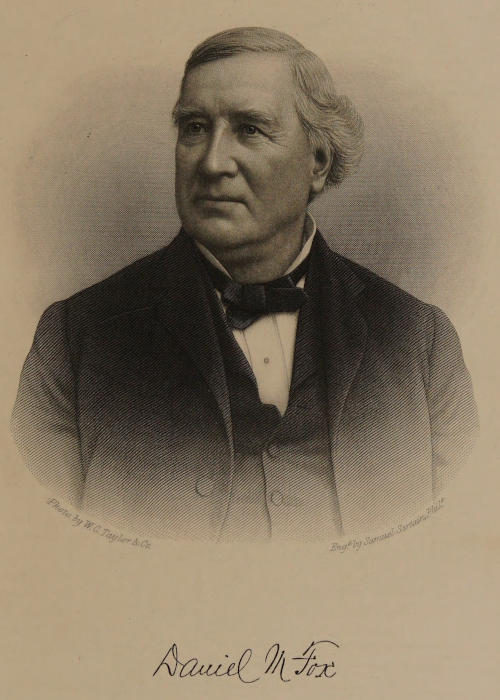
Daniel M. Fox
The profession is one affording many temptations to men who are not well grounded in strict integrity, and sustained in the paths of rectitude and virtue by a conscientious regard for the meum and tuum of a well-ordered business life; but Mr. Fox, looking upon his profession as one of dignity and trust, soon commanded and permanently secured the confidence of the public, by avoiding those speculative ventures which have brought so much disrepute upon it, and by a scrupulous regard for the interests of those who placed their property in his keeping. In consequence, the business entrusted to him has increased to such an extent from year to year that it is said he has more estates in his charge for settlement, as administrator, executor, or trustee, than any other single individual in Philadelphia. His practice constantly increasing as time rolled on, the laws touching real estate operations becoming more complicated year by year, and appreciating the necessity in many cases for court proceedings to secure perfection of title, he submitted himself to a legal examination, and was admitted to the Philadelphia bar in November, 1878.
His Public Career.
His first step in public life was at the age of twenty-one, when he was elected a member of the Board of School Directors of the district in which he then lived, and for many years prior to 1854, when the city was consolidated, and the law in that regard changed, he was President of the Board. For many years he had taken an active interest in the public schools, and was a pioneer in the night-school system for adults. He was chosen two consecutive terms by the City Councils as a Director of Girard College, and also represented the Northern Liberties in the Board of Health, having charge of the sanitary matters and the quarantine regulations of the city, and was quite active and efficient in the abatement of the cholera, which was epidemic here twice during the nine years he served in that Board.
For three years he represented his ward in the Select Council of Philadelphia with credit and ability. In 1861 he retired from Councils, and in the year following was unanimously nominated for the Mayoralty by the Democratic party. The city at that time was strongly Republican, and he was defeated by Hon. Alexander Henry, although he ran largely ahead of his ticket. In 1865 he again received a unanimous nomination for the same office, and ran against Hon. Morton McMichael and with the same result. His personal popularity, however, was in the ascendant, and when he was placed in nomination in 1868 against General Hector Tyndale, he was duly elected.
On January 1, 1869, he was inaugurated, and his first official duty as Mayor was to formally receive on behalf of the city authorities General Grant as President-elect. The reception took place in Independence Hall, in the presence of Councils and a large number of prominent citizens, and was conducted on the part of the new Mayor with ease, grace, and elegance. His municipal administration was marked by many reformatory and sanitary measures, especially in those portions of the city where the impurity of the denizens hazarded the health of more respectable neighborhoods. It was during his official term that the Volunteer Fire Department ceased to exist. It had been his practice during its closing days to attend all conflagrations for the double purpose of holding a moral check on the lawless and to stimulate the police in their duties of keeping the streets clear for the free exercise of those whose business it was to extinguish the flames. The passage by Councils of the ordinance establishing a Paid Fire Department created a profound sensation in the city, arousing the bitter feelings of many of the volunteer firemen, and kindling an intense anxiety on the part of the people generally as to the fate of the bill when it reached the hands of the Mayor. He retained it for a fortnight, unsigned, evidently desiring to soften the feeling engendered by its passage, and also to perfect such arrangements as would be necessary to meet any emergency in carrying the act into effect. The latter being accomplished, he formally approved the ordinance and it became a law. This course was very unpalatable to the riotous element of the volunteers, who manifested their feelings in various ways, such as suspending the effigy of the Mayor in several engine houses, but no other violent demonstrations of any moment occurred, as the steps taken by his officers proved effective and rigorous; these, coupled with the co-operation of many of the discreet firemen, enabled the new “Paid Department” to go into operation without any disturbance whatever, and the city has ever since rejoiced in an efficient system without any of the former accompaniments of noise, riot, and public disturbance.
A startling attempt at assassination occurred during Mayor Fox’s incumbency, in the shooting of United States Revenue Detective James Brooks, in open day, in a Front street store, by some miscreants. The case was at once taken in hand by the Mayor, who by stimulating the police and offering heavy rewards caused the arrest of the parties. Their conviction soon followed. Whenever any question of grave public importance presented itself, it was his practice to invite conferences with the most prominent citizens at his office, as to the best course to be pursued; thus, while showing a true devotion to the public interests, he was enabled to act with great sagacity; he also brought to his support the power of eloquence, which he possesses in an eminent degree; this added much to his popularity. He did not hesitate to use the veto whenever he differed with Councils, and during his term he transmitted to these bodies thirty-two messages of this character, the majority of which were sustained. His official term ended in a most gratifying manner, both chambers of Councils unanimously passing resolutions of thanks for his able and energetic administration of the city’s affairs. This was followed by a grand banquet at the Academy of Music, tendered to him by our most distinguished citizens, irrespective of party. In two successive State conventions he received complimentary votes for the Gubernatorial nominations.
The great International Exposition in commemoration of the centennial anniversary of the birth of our nation was held in this city in 1876. In the preparation for this grand demonstration, in its opening and down to its close, in the autumn of that year, Mr. Fox took a leading part, the incipient step having been taken in the Mayor’s Office during his administration, in a consultation with a committee from the Franklin Institute, who waited upon him for that purpose. As an active and earnest member of the Centennial Board of Finance, which had charge of all the funds for the Exposition, Mr. Fox contributed his time, his means, and his voice greatly to its promotion and final success.
Once more Mr. Fox was called to the discharge of an important public duty. For a number of years a controversy had existed between the general Government and the railroad corporations with reference to the transportation of the United States mails, the former complaining that the service was not satisfactorily rendered, and the latter that they were not adequately compensated.
On the 12th of July, 1876, Congress passed a bill authorizing the President to appoint a Commission of three civilians to investigate the subject and make report upon it. Mr. Fox was one of the appointees, his colleagues being selected from other States. The Commission, in the exercise of its functions, visited every section of the country, embracing a distance of travel of over twenty-eight thousand miles. Sessions were held in all the principal cities, much testimony taken, and when its labors were completed a report of great value was prepared and presented, which went far towards a satisfactory settlement of the controversy.
[From The History of the Philadelphia Police.]
One of the most important occurrences during Mr. Fox’s term as Mayor was the abolition of the old Volunteer Fire Department. The ordinance for the erection of a Paid Fire department was passed December 29, 1870, after a series of hot debates. The old volunteers were a power in politics, but their acts of violence and incendiarism made it imperative in the opinion of a majority of citizens that they should be superseded. The passage of the ordinance caused a sensation because it was not believed that Councils would dare to abolish the volunteers. Feeling ran high. The firemen held meeting after meeting in their engine-houses. All attention was directed towards the Mayor. Would he sign the ordinance and make it a law? He had ten days in which to consider the bill. He was known to favor it; but day after day passed and he took no action. Meanwhile he was not asleep. He had perfected police arrangements whereby the whole force could be called out at once on the outbreak of any violence, and the excitement was so great that the rowdy element and the firemen were expected to sally forth at any moment. There were two or three isolated outrages, but no general riot. The ten days drew towards a close and the excitement became less intense every day. It was with this object in view that the Mayor delayed signing the ordinance. He waited until the last day before putting his signature to the bill. The volunteers had become in a degree reconciled to the measure, and some of them hoped to resume work with engine and hook-and-ladder under the new system.
The old volunteer firemen now hold Mr. Fox in high esteem. At the great fire in Newhall, Borie & Co.’s sugar refinery, which stood at the corner of Race and Crown streets, the lives of a number of the volunteers were endangered through their own stubbornness, and only saved through determined action on the part of the Mayor. The engine-house of the refinery was a single story building facing on Crown street; over it was a projection five or six stories in height containing the hoisting apparatus and other machinery of great weight.
His Watchful Care Saves Many Lives.
About a score of the firemen took up a position on the roof of the engine-house and directed a stream of water against the main building. Unknown to them the flames were rapidly eating their way to the machinery in the projection over them. The Mayor made it a point to attend all important fires, and frequently his vigilance at great conflagrations resulted in the detection of gangs of thieves who operated in the uniform of firemen. On this occasion he observed the danger which threatened the men. It was evident to him that the machinery would soon be reached, and the projection fall. A serious disaster would be the consequence unless the men removed. The Mayor sent the Chief of Police to inform them of their danger, and endeavored to induce them to retire from their perilous position. They angrily declared they would occupy whatever place they pleased, and said the Mayor should mind his own business as he had no authority over them. The Mayor saw that prompt and decisive action was necessary if the lives of the men were not to be sacrificed. He ordered Chief Mulholland to drive the headstrong fellows from the roof by force. All the policemen in the neighborhood of the fire were collected and they charged the volunteers, who were routed with some difficulty and came clamoring around the Mayor, demanding to know by what authority he had interfered with them, execrating and threatening him with personal violence.
“Wait five minutes and I will give you an answer,” said Mr. Fox, quietly.
A moment later the projection with all the heavy machinery fell, crushing the engine-house. The men who a moment before had reviled the Mayor were silent for a moment, then they gathered around him and gave three prolonged and hearty cheers for Daniel M. Fox.
Mr. Fox was the first Mayor who directed the roping off the streets during large conflagrations, thereby keeping away not only the crowds who drawn by idle curiosity went simply to look on but also those persons who may have been attracted for purposes of theft. It aided considerably, too, in giving the Fire Department a clean working space, thus adding to their efficiency, and also avoiding the chance of accidents from falling embers or walls. This plan so wisely begun has been followed with advantage by every successive Mayor.
Mr. Fox’s participation in the philanthropic and benevolent movements of the city has always been unlimited. As President of the Pennsylvania Society for the Protection of Children from Cruelty, Trustee of the Pennsylvania Institution for the Deaf and Dumb, and in his connection with many other charitable works, his constant aim has been the alleviation of the sufferings and the general welfare of his fellow men.
Personally, Mr. Fox is of dignified and distinguished presence, yet in manner affable, courteous, and kind. Always interested in his fellow men, he draws men towards him and impresses them with the sincerity of his nature and the unselfishness of his purpose. Love of justice is one of the strong characteristics of the man, and his life has been singularly free from the petty strifes which disfigure the lives of so many who have had to fight their battle against odds. His selection for the Superintendency of the Mint, being unsought, was a just tribute to his unquestioned integrity and his eminent abilities as a public man. The country is fortunate in his preferment, and his administration of the affairs of the Mint will fitly crown an honored career.
Superintendent Fox has greatly improved the immediate surroundings of the Mint since his entrance upon duty. The areas have been cleared of rubbish, temporary wooden structures demolished, where it is possible to dispense with them, and a systematic policing of the premises has been adopted. But perhaps the most notable of the improvements which Superintendent Fox has made is the removal of the old steam plant from the body of the basement and the creation of a new and much more efficient plant in vaults prepared outside of the walls. This has had the effect to render the atmosphere of the building cool and pure, and at the same time has actually increased the working space nearly forty per cent. Another story has also been added to the adjusting room, with appliances for cooking and toilet, thus increasing the comfort of the ladies employed in that department. The plots on either hand of the entrance on Chestnut street show some happy efforts to please the eye, in a renewal of the sward and landscape gardening in colors. The fine specimens of American cypress in the centre of these plots seem to have borrowed fresh attractions from their new and beautiful setting, and their foliage contrasts pleasingly with the clumps of foliage plants and exotics beneath. Throughout the premises the supervision of a thorough business man is apparent; nothing seems to escape the eyes of the vigilant Superintendent.
COINERS.
Henry Voigt, the first Chief Coiner, was appointed by President Washington, January 29, 1793. He was selected on account of his mechanical knowledge and skill, being a clockmaker by trade. Many of our old families bear witness to the skill of Mr. Voigt in the affection they have for many an “old clock on the stairs,” for the manufacture of which timekeepers he was quite famous. Mr. Voigt held office until removed by death in February, 1814.
Adam Eckfeldt was born in Philadelphia, June 15, 1769. He was trained to mechanical pursuits by his father, who was a large manufacturer of edge-tools and implements. On the establishment of the Mint he was engaged to construct some of the machinery for it. He built the first screw-coining presses. The contrivance for ejecting the piece from the collar, together with some other mechanical appliances, were his invention.
In an old pay-roll of 1795 (see page 12), we find the name of “Adam Eckfeldt, Die Forger and Turner.” His official connection dates from January 1, 1796, when he was appointed Assistant Coiner by Director Boudinot, with the consent of President Washington. Upon the death of Henry Voigt, Mr. Eckfeldt was appointed to succeed him as Chief Coiner, and remained in that position until he resigned, in 1839. He continued to visit the Mint for some years after; and he is yet remembered as a hard worker in the Mint, without compensation. For half a century he was one of the central figures of the Mint service. His mechanical skill, his zeal, energy, and uprightness, brought him many distinctions, both as an officer and a citizen.
In his letter of resignation he warmly recommends the appointment of Franklin Peale, in the following terms: “I feel it my duty, in leaving office, to recommend that my place be filled by Mr. Franklin Peale, the present Melter and Refiner. Our close association as fellow-officers has made me acquainted with his peculiar qualifications, and I therefore know him to be fitted for the situation; and I do not know any other person that is.” He had a high ideal of what a chief coiner should be.
Mr. Eckfeldt died February 6, 1852, in his 83d year.
Franklin Peale was the son of Charles Willson Peale, the eminent artist and founder of Peale’s Museum. Born in the Hall of the American Philosophical Society, October 15, 1795, he was presented to the society by his father, when four months old, as “the first child born in the Philosophical Hall,” and with a request that the society should name him. He was accordingly named after the chief founder and first President of the Society—Franklin.
Young Peale early showed a taste for mechanics, and his father gave him every facility to improve himself in any direction in which nature seemed to lead him. Part of his general education was received at the University of Pennsylvania and part at the Germantown Academy. At the age of seventeen he entered the machine shop of Hodgson & Bro., Delaware. He soon grew to be a skilled mechanic and draughtsman. Some time after he became manager of his father’s Museum. He assisted Baldwin in the construction of the first locomotive built in this country. In 1833 Mr. Peale entered the Mint service, and was sent to Europe by Director Moore to examine into foreign Mint methods. He brought with him valuable apparatus for the Assay Department, together with other important improvements and suggestions. He was appointed Melter and Refiner in 1836 and Chief Coiner in 1839. He introduced the first steam coining press, the milling machine and some other of our more modern forms of Mint machinery.
Mr. Peale’s administration as Chief Coiner may be said to mark an era in the mechanic arts of Minting. Being specially fitted, by natural genius as well as education, for the position which he adorned, his mildness, integrity, gentlemanly bearing and high moral and mental culture constituted him a model officer. His connection with the service lasted until 1854. He died on the 5th of May, 1870.
George K. Childs, appointed December 12, 1854.
Lewis R. Broomall, appointed June 30, 1861.
John G. Butler, appointed November 30, 1863.
A. Loudon Snowden, appointed October 1, 1866.
(For sketch of A. Loudon Snowden, see list of Directors and Superintendents, page 92.)
Colonel O. C. Bosbyshell. On the 4th of May, 1869, Ex-Governor Pollock, then Director of the Mint, appointed Col. Bosbyshell Register of Deposits. His course in the Mint was so satisfactory that, without solicitation, he was made assistant coiner by Col. A. L. Snowden, the then coiner, on the 1st of October, 1872. Upon Col. Snowden’s appointment as Postmaster of Philadelphia, Col. Bosbyshell was appointed Coiner of the Mint by President Grant, on the 15th of December, 1876, and remained in that capacity until January, 1885, when, to the regret of all parties having business relations with him, he tendered his resignation to accept a responsible position in the Controller’s Office, tendered him by his friend, Col. Robert P. Dechert.
William S. Steel was born in the City of Philadelphia, on the 1st of March, 1841. He received a good common school education, and in 1856 entered the office of David Cooper & Co., at Girard’s wharves, remaining engaged in mercantile pursuits till 1861. At 19 years of age he was appointed by Colonel James Ross Snowden, then Director of the United States Mint, First Assistant Weigh Clerk. In this position he served continuously through Colonel J. Ross Snowden, ex-Governor Pollock, and Colonel A. Loudon Snowden’s administrations. In September, 1862, just before the battle of Antietam, Mr. Steele entered the State service, and served with the Thirty-second Regiment, Pennsylvania Volunteers, until discharged by expiration of term. When Colonel A. Loudon Snowden was transferred to the Post Office, January, 1877, Mr. Steele, upon the recommendation of the then Coiner, Colonel O. C. Bosbyshell, became Assistant Coiner, a position he filled in a most acceptable manner, until Colonel Bosbyshell’s retirement in February, 1885, when he was made Coiner.
Harry A. Chester, Assistant Coiner, was born in Philadelphia (Northern Liberties), September 10, 1852, and educated in the North East School, Sixth Section. He was an attachee of the National House of Representatives from 1876 to 1882, clerk in Register of Wills’ Office from January 1, 1883, until May, 1885, when he was appointed by Colonel A. Loudon Snowden as Assistant Weigh Clerk, and promoted by Hon. Daniel M. Fox in October, 1886.
Dr. Henry Leffmann was appointed Chief Coiner at the Philadelphia Mint January 10, 1888, by President Cleveland. Dr. Leffmann was born in Philadelphia September 9, 1847, and was educated in the public schools of Philadelphia, including four years at the Central High School. He devoted three years in practical study in the laboratory of Dr. Charles M. Cresson, and graduated at Jefferson Medical College in 1869, having been for some years assistant to the Professor of Chemistry at the College, and in 1875 was elected Lecturer on Toxicology, which position he held for a number of years. In 1876 he was elected to take charge of the laboratory of the Central High School, and remained in that position for four years. In 1883 he was elected Professor of Chemistry and Metallurgy in the Pennsylvania College of Dental Surgery, a position which he still holds; and he has been for a number of years Professor of Chemistry and Mineralogy in the Wagner Free Institute of Science. Dr. Leffmann has been engaged as chemical expert in patent and criminal cases, notably in the Goerson poisoning case and the chrome-yellow poisoning cases. He is a member of several American and foreign scientific societies, has contributed papers to current scientific literature, and has for the past five years been editor of The Polyclinic, a monthly medical journal. In 1880 he was a candidate for Coroner on the Democratic ticket, but was defeated, and in 1884 was appointed Port Physician for Philadelphia by Governor Pattison, and held that position until October, 1887.
ASSAYERS.
Jacob R. Eckfeldt, Sixth Assayer, was born in Philadelphia, 1846. He entered the Assay Department as Second Weigher, in 1865. By regular promotions he reached the position of Assistant Assayer, in 1872, and upon the death of his superior he was appointed and confirmed as Assayer, December 21, 1881. The position of Assayer is one of great responsibility, and demands not only scientific training but wide and special knowledge and experience upon subjects relating to the history and arts of Coinage. Since the foundation of the Mint there have been but six official heads of this department.
William McIntire was born in Delaware in 1831. He entered the Assay Department of the Mint as an assistant in September, 1853, which position he held, with the exception of a short interim while he was engaged in mercantile business, until October, 1887, when by regular promotion he was appointed Assistant Assayer.
JACOB R. ECKFELDT.
Extract from an Obituary Notice by Mr. Du Bois.
(Read before the American Philosophical Society, Oct. 4th, 1872.)
Jacob R. Eckfeldt, late Assayer of the Mint, was the son of Adam and Margaretta Eckfeldt, and was born in Philadelphia, March —, 1803. He was, therefore, in his seventieth year, at the time of decease, August 9th, 1872.
In the Spring of 1832, Mr. John Richardson, who had been Assayer about one year, and did not find the employment congenial to his tastes, informed Mr. Eckfeldt that he intended to resign, and wished him to prepare to take the place. Mr. E. shrank from this responsibility, and declined. But some of his friends who had influence with President Jackson, presented his name with a strong recommendation and he was appointed without being asked as to his party preferences. This occurred on the 30th of April, 1832. He therefore held the office over forty years.
When he entered upon the work, he had to encounter some embarrassments. The apparatus was old-fashioned, and not calculated for nice results. The silver assay had been well performed, without going to a close figure, for many years; but gold was little known in the country or at the Mint, and it is not surprising that its assay was incorrectly performed. Add to this, there was the coarse and cumbrous nomenclature, brought from the old country, of carats and grains for gold fineness, and so many grains to the pound for silver fineness.
Close upon all this, that is to say, in June, 1834, came the celebrated reduction in the standards of our gold coin, one of the chief measures of the Jackson administration. This changed gold from a curiosity to a currency; bullion and foreign coin flowed to the mint, and accuracy of assay was more than ever needful. Mr. Eckfeldt was equal to the emergency, and resolutely introduced reforms, which, at first, made the older officers stand in doubt.
In those days, about the time the new mint edifice on Chestnut street was finishing, Mr. Peale was sent to London and Paris to observe the methods of assaying and refining, and to procure a new apparatus. We were thus supplied with French beams, weights, and cupel furnaces, and with the appliances of Gay-Lussac’s humid assay, and the printed details of the process. Soon after, Mr. Saxton, famous for his skill in constructing balances and other delicate instruments, returned from a long schooling in that line in London, and was employed in the Mint. Thus furnished, Mr. Eckfeldt felt himself “set up,” and able to compete with the foreign assayers, and if he was ever more precise, it was because he disregarded certain allowances which had become a time-honored custom.
A large importation of fine gold bars from France, known as the French Indemnity, and which came because President Jackson declared he “would submit to nothing that was wrong,” gave a fine opportunity for testing and comparing foreign assays; and it was generally found that these bars were somewhat below the alleged fineness. A still more important discovery, was the fact that British Sovereigns ran below their standard of fineness. This happened when he had been in office less than three years, and the Director was unwilling to set the finding of young Eckfeldt against the experience of Old England. The Assayer being assured and re-assured of the accuracy of his results, Director Moore consented to notify the British Government of their error. The result was a closer scrutiny in the London Mint, and a final acknowledgement that they were wrong. This was no less a triumph for Mr. Eckfeldt, than it was a contribution to exact science, and an honor to the American Government.
It is not surprising, that he felt at first the inconvenience of passing from one form of nomenclature to another, though to a better one. A friend remarks, “I recall conversations with Mr. Eckfeldt, showing how seriously he felt the revolution. He would think in carats, and report in decimals. And I often recur to this as illustrating the kind of difficulties which would arise in case of a decimalising of weights and measures.”
For some years prior to 1842, Mr. Eckfeldt and his Assistant, in addition to their ordinary duties, engaged in the preparation of an original and comprehensive work on the Coins of all Nations; on the Varieties of Gold and Silver Bullion; on Counterfeit Coins, and on other subjects related thereto. This was published in 1842, and has long been regarded as a standard authority. In 1850, they issued a supplementary smaller work, and again in 1852.
As the United States increased in commerce, wealth and population, the Mint of course increased in work. In particular, Mexican dollars came in great quantities for recoinage. Not only were our vaults full, but our entries and corridors were at times crowded with rows of kegs. Every day, for years, we had the constant task of sixteen melts of silver ingots to melt and assay; and it was a great advantage and satisfaction to be supplied with the humid apparatus.
The success of gold mining in our Southern States, and the increasing commerce of New Orleans, gave rise to the establishment of three branch mints at the South, in 1837; and it devolved upon Mr. Eckfeldt to become schoolmaster, and educate the three assayers appointed for those places. The same had to be done again at a later date for other mints and assay offices.
In December, 1848, came the first lot of gold grains from California; and with the opening of the next year the tide set in most powerfully. I shall not here speak of this great turning-point in metallic currency any further than as it affected the mint, or rather the labor which it laid upon Mr. Eckfeldt and his department. As is well known, the lots were numerous, and the aggregate amount was enormous. Instead of making gold assays by dozens, we had to go through with hundreds every day, following the arrival of each steamer. We procured young men as operators in the weigh-room and additional workmen in the laboratory; and in spite all the help we were overworked. Here let me say that the persons who have been educated by Mr. Eckfeldt to this profession have done credit to the selection that was made, not only by skill, diligence, and good character while here, but wherever they are now scattered to other mints and assay offices, or to different pursuits.
The gold pressure continued for about five years, when it was relieved by the creation of a Government assay office in New York, and a branch mint at San Francisco. But directly sequent to this came the change of standard in silver coin, causing an immense recoinage in small pieces. Thus our daily assays continued to count by hundreds. This lasted for some years. When it began to slacken off, a law was passed for calling in the large copper coins and issuing in their stead pieces of copper-nickel alloy of much smaller size.
The analysis of Nickel alloys was not well laid down in the books, and the European or other assays which came with purchased lots showed an incorrect determination. Mr. Eckfeldt was therefore obliged to study out and perfect this assay, which is more tedious and laborious, though of less consequence, than the assay of the precious metals.
But it was his habit to be as scrupulous in minor matters as in major; and after the routine was well settled it went on with the same clockwork regularity as the other branches of assaying. I need not say that this nickel coinage imposed another heavy pressure upon the mint for years.
After this came the substitution of the Bronze alloy; and this called for another process of assay, and brought us a great deal of work.
I thus hastily review this sequence of gold, silver, nickel, and bronze, not only as an interesting part of Mint History, but to show the varied and abundant services of the untiring, energetic Principal Assayer, and the masterly skill with which he met every obligation.
His skill and success as an Assayer and Analyst largely consisted in his power of finding out what was defective or erroneous, and in applying the proper remedy. It often seemed that what was a puzzle to others was to him a matter of quick insight.
In the assays of certain complex alloys, and of low grades of gold and silver, he contrived various methods which are not in print, but which are of great use in the daily manipulations.
And here I may state that he not only introduced great accuracy and precision in the assays, but carried special investigations to a delicacy almost incredible. Thus, much interest was excited by a publication some years ago, both in this country and across the Atlantic, of his experiment upon the brick-clay which underlies our city. Taking two samples from the center of the town and the suburbs he found they contained gold at the rate of nearly 12 grains (say fifty cents) to the ton of clay in its ordinary moisture. Other experiments went to prove the very general diffusion of gold, in infinitesimal proportions.
Some analysts, through want of exactitude, or for the pleasure of making a sensation, may produce very curious results; but Mr. Eckfeldt was conscientious, I may say, nervously scrupulous, about stating anything he was not sure of. Partly for that reason, partly for the very love of work, he was laborious to a fault, all his life long.
United States Mint Officers.
Washington, D. C., James P. Kimball, Director of the Mint $4,500
Philadelphia, Pa., Daniel M. Fox, Superintendent 4,500
Boise City, Idaho, Norman H. Camp 2,000
Carson City, Nevada, James Crawford, Superintendent 3,000
Charlotte, N. C., Calvin J. Cowles, Assayer 1,500
Denver, Colorado, Herman Silver, Assayer 2,500
Helena, Montana, Russell B. Harrison, Assayer 2,500
New Orleans, La., Andrew W. Smyth, Superintendent 3,500
New York, N. Y., Andrew Mason, Superintendent 4,500
San Francisco, Cal., Edw. F. Burton, Superintendent 4,500
St. Louis, Mo., Eliot C. Jewett, Assayer 2,500
WILLIAM E. DU BOIS.
Extract from an obituary notice by Robert Patterson.
(Read before the American Philosophical Society, November 18, 1881.)
William Ewing Du Bois was born at Doylestown, Pennsylvania, December 15, 1810. Through his father, Rev. Uriah Du Bois, he was descended from Louis Du Bois, a French Huguenot of honorable extraction, who emigrated to America in 1660, seeking freedom of religious worship, and, in connection with others of his countrymen, formed the settlement of New Paltz, Ulster County, New York. Through his mother, Martha Patterson, daughter of Professor Robert Patterson, of the University of Pennsylvania, he inherited the Scotch-Irish element which has exerted so marked an influence in the development of our country.
The father of Mr. Du Bois was a Presbyterian clergyman, in charge of churches in and near Doylestown, and was principal of the Union Academy at that place, a classical school then and afterwards of high reputation. He was greatly respected, both as preacher and teacher.
The bright and studious mind of Mr. Du Bois gathered every advantage from his opportunities, and he was well furnished in the classics and mathematics, and in English literature. While yet a boy he developed a freedom and capacity as a writer quite remarkable.
His oldest brother was an eminent member of the bar, and it seemed fitting that Mr. Du Bois should, under his guidance, adopt the law as his profession. He accordingly pursued the usual course, in the meantime aiding to support himself by literary work and conveyancing, and was admitted to practice in September, 1832. But his health failing him on account of a bronchial affection, he accepted an appointment in the Mint at Philadelphia, and thus began the life-work by which his reputation was established.
Mr. Du Bois entered the Mint in September, 1833, and was first employed in the office of the Director, Dr. Moore. In 1835, at the request of the Assayer, Mr. Jacob R. Eckfeldt, he was transferred to a more congenial position in the assay department. Here he continued for the remainder of his life. In 1836 he was appointed Assistant Assayer. In September, 1872, he succeeded Mr. Eckfeldt as Assayer, and remained at the head of the department until his death, July 14, 1881, thus completing nearly forty-eight years of Mint service.
Mr. Du Bois early took rank as an accomplished assayer, and long before his death had reached the head of his profession.
The close intimacy between Mr. Du Bois and Mr. Eckfeldt developed into warm friendship. The tie was made closer by the marriage of Mr. Du Bois, in 1840, to Susanna Eckfeldt, the sister of his chief. I shall have to speak of published works and scientific communications appearing under the names of Eckfeldt and Du Bois. Although it was understood that Mr. Du Bois was the sole literary author, yet no separate claim of authorship was made by either. Whatever of reputation was earned, each was contented that it might be shared by the other, and jealousy never for a moment weakened a union that bound them for life.
In the year 1834 a change took place in the ratio of gold to silver in the standard of U. S. coins, the effect of which was to bring large deposits of gold to the Mint. The coinage previously had been chiefly of silver. The more equal supply of the precious metals gave active employment in the assay of each of them, and was, of course, most valuable as an experience to Mr. Du Bois, who about this time became connected with the assay department.
In 1837, on revision of the Mint laws and standards brought about by Dr. Robert M. Patterson, then Director, a reform was effected in the method of reporting assays, the millesimal system taking the place of the time-honored but cumbrous method of carats and grains. About this time, also, the older plan of assaying silver was abandoned, the humid assay being substituted, and largely worked under the direct supervision of Mr. Du Bois.
About 1838 branch mints were organized in the States of Louisiana, Georgia, and North Carolina. The labors and responsibilities of the Philadelphia assay department were increased by this development, partly from the necessity of instructing assayers for the new branches, and partly in testing the correctness of the assays made there.
In 1848 the great discovery of gold in California was made known. This brought a tremendous pressure on every department of the Mint, and not the least on the assayers. The gold coinage was, in three years, raised from a little over three million dollars to more than sixty-two millions. The assays were often counted by hundreds in a day. But whatever the pressure in the office, accuracy ruled, and the correctness of the assays was never impeached.
In 1853 a change was effected in the law for providing subordinate silver coins. This brought about, for some years succeeding, an unprecedented coinage of that metal, and still further increased the labors of the assay department.
He instituted the Cabinet of coins which now adorns the Mint. This was commenced in 1838. A small annual appropriation was procured from Congress for this purpose, and the work of collection committed entirely to Mr. Du Bois. He brought to it all the enthusiasm which animates most numismatists, sobered, however, by good judgment. His expenditures were always judicious. Some of the best of the specimens were culled from the Mint deposits for the bullion value, merely, of the pieces. After the collection had taken good shape, and been well classified, he wrote and published, in 1846, a description of it, under the title “Pledges of History,” etc. The title thus selected intimated his opinion as to the real value of such collections. He thought that a coin should be prized for its historical teaching, or artistic merit, and discouraged the rage to possess a piece simply because of its rarity. Mr. Du Bois acted as curator of the Cabinet until his death.
Another important labor undertaken by Mr. Du Bois (in connection with Mr. Eckfeldt) was the preparation and publication, in 1842, of a “Manual of the Gold and Silver Coins of all nations, struck within the past century.” This was a work of very great labor, and, from its expense, of some risk also to the authors. It is admirably arranged, the information clear, and it embraced every subject of interest at that date as to coins, bullion, counterfeits, etc. Subsequently, in 1850 and 1851, supplements were published covering later topics, made prominent in consequence of the California gold discoveries.
The writings of Mr. Du Bois were numerous, and continued up to the year of his death. His papers on numismatics were frequent and always attractive, his last appearance in print being in April of this year, in an article on the “Coinage of the Popes.” To the “American Philosophical Society,” of which he was elected a member in 1844, he made various communications on behalf of Mr. Eckfeldt and himself, mostly on topics suggested by experiences in the assay department. Among the most curious was one on “The Natural Dissemination of Gold,” by which we were astonished to learn that this precious metal is found in appreciable quantity in the clays underlying our city.
In 1869 he wrote for the “Bankers’ Magazine,” “Propositions for a Revised System of Weights, and a Restoration of Silver Currency.” The development of his views on these subjects is a model of clear exposition, and the conclusions reached were such as might be expected from a mind aiming to attain practical results rather than to impose visionary theories.
From the beginning he was highly esteemed at the Mint. It was his ambition to acquire a knowledge of every branch of the service, and with his capacity and opportunities this end was attained. He early became the trusted friend and counsellor of his colleagues, and was able to serve them in many ways, perhaps most of all with his ready pen. As time passed, and forty-eight years of experience was given to him, he was recognized by all as the Nestor of the Mint service. And here I pause to draw a lesson, from the example of Mr. Du Bois’s life, as to the value of a properly organized civil service. In the department with which he was connected, political tests were never obtruded, and permanence of tenure followed on merit. On no other basis could his services have been claimed or retained. They would have been transferred to a private sphere, probably to his pecuniary gain, certainly to the public loss. He was very accessible, and ever ready to lend aid from the stores of his knowledge, but in particular did he delight to instruct and bring forward his younger friends.
Mr. Du Bois was able to fulfill his official duties until within a few months of his death. He was fully conscious of his approaching end, preserving his intelligence to the last, and the faith which had comforted him in this life supported him at its close.
The following minute was adopted at a meeting of the officers and employees after his decease:
“The remarkably close conformity of the United States coins to the standard assigned them by law, has been recognized by the highest Mint authorities of the world to be unsurpassed, if quite equalled, in its uniform exactness. The founding of such a reputation and its continuance during the last half-century, are largely due to the joint labors of the late Jacob R. Eckfeldt and William E. Du Bois.”
MELTERS AND REFINERS.
Joseph Cloud, appointed January, 1797; served until January, 1836 (39 years).
Franklin Peale, appointed January 5, 1836.
Jonas R. McClintock, appointed February 19, 1840.
Richard S. McCulloch, appointed in April, 1846; served until April 1, 1849.
James Curtis Booth, Melter and Refiner, was born in Philadelphia in 1810, educated in the same place, and graduated in the University of Pennsylvania 1829. After study and field practice in the Rensselaer School, at Troy, N. Y., in 1831-32, under the late Professor A. Eaton, Mr. Booth studied Practical Chemistry in Germany, in 1833-34-35, in the laboratories of Professors F. Wohler and G. Magnus, and in visiting accessible manufacturing establishments in Germany and England having relation to chemistry. The late Prof. J. F. Frazer and Mr. Booth were the two Assistants on the Geological Survey of Pennsylvania in its first year, 1836. Mr. Booth next had charge of the Geological Survey of Delaware in 1837-38 (being often assisted by Prof. Frazer), and published his report on the survey in 1839-40.
Mr. Booth, observing the great deficiency in the knowledge of Applied Chemistry in his native place, opened a laboratory for teaching the same, by chemical analysis and by operating, in 1836, and the same laboratory has been continued successfully to the present time by Dr. T. H. Garrett and Mr. A. Blair.
With the same object in view, Mr. Booth lectured at the Franklin Institute for nine successive winters, giving three full courses of lectures, each of three winters’ duration (1836-1845).
Prior to 1850 Mr. Booth published the Encyclopædia of Chemistry, being the author of the majority of the articles contained in it, with valuable contributions by Prof. R. S. McCulloch and others. It was a valuable adjunct to the study of chemistry for many years.
The Director and officers of the Mint unsuccessfully solicited the appointment of Mr. Booth as Melter and Refiner of the Mint in 1838-40, but in 1849 Mr. Booth obtained, through his friend, Mr. Meredith, the appointment, over the signature of President Z. Taylor, and has continued in the same position from that date to 1887, a period of more than thirty-six years. He resigned his office at the close of the year 1887.
Dr. David K. Tuttle, of the Carson City Mint, appointed Melter and Refiner January 10, 1888.
Nathaniel B. Boyd, Assistant Melter and Refiner, was born in Philadelphia, January, 1832. Twenty years later, he was graduated with honors at Burlington College. After leaving College he studied law, and was admitted to the Philadelphia Bar in 1854. In 1869 he accepted an appointment in the National Mint, tendered him by Director Pollock. In 1873 he was appointed Assistant Melter and Refiner, a position which he still occupies (1885).
THE MINT ENGRAVERS.
(Extract from Patterson Du Bois’ Biographical Sketch of “Our Mint Engravers.”)
Whatever may be said concerning the peculiar responsibilities of the officers of the Mint, who are occupied with the various operations of turning bullion into coin, it must be conceded that none of them occupies a position so dubious and, in some ways, so unenviable as the Engraver. In the general transactions of the Mint, he is the most retired—the most obscure—of its officers; yet his card is in every one’s pocket.
As to the types of coinage, the standards are as numerous as the eyes that water for them, and there is no piece but may be said to be outside of somebody’s tolerance. No other artist undergoes such an ordeal, for those who do not admire this painting or that statue are not compelled to hug and hoard it, much less to toil for its possession. The engraver who can, from his retired window, see the critical millions clutching for his little relievos, is in some sort a hero ex-officio, and it has been well suggested that we look briefly upon the uneventful lives of this worthy line of officers.
I. Robert Scot received his appointment as the first Engraver of the Mint, November 23, 1793. Information is wanting as to his nativity, but at the time of his appointment he seems to have been turning the down-hill of life. He is remembered as rather under size, and as an honorable and agreeable gentleman.
According to Loubat, Joseph Wright was “appointed first a draughtsman and die-sinker to the United States Mint, and made the dies of a medal, the bust on the obverse of which was considered to be the best medallic profile likeness of Washington.[21] He also made the medal voted by Congress to Major Lee.” Wright died in 1793.
II. William Kneass, second of the line, was born in Lancaster, Pa., September, 1781, and was appointed Engraver January 29, 1824. Mr. Kneass had been chiefly a plate engraver for book-work. There were some changes in the coinage during his term, notably in 1834 and 1838, for gold, and 1836, 1837, 1838, and 1840, for silver. But some of this work was done by Gobrecht as assistant. Kneass appears upon a pattern half dollar of 1838; but the silver dollar of 1836, as well as a pattern half of 1838, were the work of his assistant. Prior to his appointment he had an engraving office on Fourth above Chestnut street, Philadelphia, which was a well-known rendezvous for the leading wits and men of culture, for which Philadelphia was then eminent.
Mr. Kneass died in office, August 27, 1840. A good engraving of him hangs in the Assayer’s Office, inscribed “to his friend Adam Eckfeldt, Chief Coiner,”—who had been chiefly instrumental in securing his appointment.
III. Christian Gobrecht was appointed December 21, 1840, to fill the vacancy made by the death of Kneass. He was born in Hanover, York Co., Pa., December 23, 1785. In 1811 he went to Philadelphia, and became an engraver of bank notes, seals, calico printers’ rolls, bookbinders’ dies, etc. In 1836 he received an appointment as assistant to Mr. Kneass at the Mint, in which capacity he executed some important work. Among other similar performances he was highly commended for his Franklin Institute Medal.
Christian Gobrecht continued in office until his death, July 23, 1844.
IV. James B. Longacre was born August 11, 1794, in Delaware Co., Pa. He served an apprenticeship as a line engraver with George Murray, Philadelphia, and did some high class plate-work before he was free, in 1819. He was one of the originators of the National Portrait Gallery of Distinguished Americans, the first volume of which appeared in 1834. Longacre drew from life and engraved many of the portraits entire.
Like his predecessors, he died in office—January 1, 1869. During his term Mr. Longacre was variously assisted by P. F. Cross, William Barber, Anthony C. Paquet, and William H. Key. Cross was born in Sheffield, England, served several years in the Mint here, and died in 1856. He engraved the obverse of the Ingraham medal. Paquet was born in Hamburg, 1814, emigrated 1848, served as assistant 1857 to 1864, died, 1882. He engraved the medals of Grant, Johnson, Buchanan, Everett, and the Life Saving Medals, with some others. Key is a native of Brooklyn, was appointed an assistant, 1864, and is still in the service. He executed the Kane Expedition and Archbishop Wood Medals. The changes and additions during the Longacre term were numerous and important, both as to alloys and denominations. The pattern pieces also record various experiments in the art of coining.
V. William Barber, fifth Engraver of the Mint, was born in London, May 2, 1807. He learned his profession from his father, John Barber, and was employed on silver-plate work, after his emigration to this country.
He resided in Boston ten years, and was variously employed in his line of work. His skill in this way came to the knowledge of Mr. Longacre, then Engraver of the Mint, and he secured his services as an assistant in 1865.
In January, 1869, upon the death of Mr. Longacre, he was appointed as his successor, and continued in that position for the remainder of his life. His death, which resulted from severe chills, brought on by bathing at the seashore, occurred in Philadelphia, August 31, 1879.
Besides much original work on pattern coins, he also produced over forty medals, public and private. The work on all of them was creditable, but we may specify those of Agassiz, Rittenhouse, and Henry, as very superior specimens of art. Mr. Barber was assisted by Mr. William H. Key, Mr. Charles E. Barber, and Mr. George T. Morgan.
VI. Charles E. Barber, sixth Engraver, is a son of the preceding, and was born in London in 1840. He was appointed an assistant in 1869, and became the official head by promotion in 1880, to fill the vacancy caused by his father’s death. The appointment was not unmerited. One of Mr. Barber’s latest cards to the public is the new five-cent piece—a successful venture in very low relief. But his handiwork is more or less visible in all the principal medals executed since 1869. Since his appointment as Chief Engraver, the work of his department has been enormously increased by the number of medal dies demanded for the War Department and from other Government sources. Mr. Barber’s best work is seen in the medals of Presidents Garfield, Arthur, Indian Peace, Army Marksmanship, and Great Seal. He is particularly happy in “catching a likeness.” The head of Superintendent Snowden is a rare specimen of medallic portraiture.[22]
Messrs. Key and Morgan are the Engraver’s assistants. The former has already received notice; the latter, Mr. George T. Morgan, was born in Birmingham, England, in 1845; he studied at the Art School there, and won a National Scholarship at the South Kensington, where he was a student two years. He is best known to the country by the so-called “Bland dollar,” which is his design and execution.
We have reason to congratulate both the Government and the people that the engraving service is well and judiciously furnished.
BENJAMIN RUSH,
An eminent physician and philanthropist, was born near Philadelphia, December 24, 1745; he graduated from Princeton College in 1760; he afterwards studied medicine in Edinburgh, London, and Paris; returning to this country, he was elected Professor of Chemistry in the Medical College of Philadelphia in 1769. In 1776 he was elected to the Continental Congress, and was one of the signers of the Declaration of Independence in the same year; he was afterwards appointed Surgeon-General of Revolutionary Army, and voted for the adoption of the Constitution of the United States in 1787. Dr. Rush was a popular lecturer, and eminently qualified as a teacher of medicine. When the yellow fever scourged the City, and the public buildings were closed in 1799 and 1800, he was very successful in his treatment of the victims of that epidemic. It is said that he visited and prescribed for one hundred patients in a single day. He was treasurer of the first United States Mint during the last fourteen years of his life. Dr. Rush died in Philadelphia in April, 1813. Among his nine children was Richard Rush, the statesman.
Note.—Dr. Rush was the author of the first pamphlet on temperance published in this country, showing the injurious effects of alcoholic drinks on the human system, and is justly regarded as the father of the temperance movement, the Centennial of which has lately been celebrated throughout the United States, September, 1885.
CASHIER.
Mark H. Cobb, the Cashier of the Mint from 1871 until the present time (1885), was born in Colebrook, Connecticut, in 1828. In 1861, Hon. Simon Cameron, then Secretary of War, appointed him Chief Clerk in the War Department, he having previously been his private secretary. After Mr. Cameron’s resignation as Secretary, Mr. Cobb, at the solicitation of the late Col. John W. Forney, accepted the position of Enrolling Clerk of the United States Senate in 1862. In 1871 he was appointed to the responsible position of Cashier in the United States Mint.
Albion Cox, first assayer of the Mint was appointed April 4, 1794. His commission, signed by Washington, until recently, hung upon the walls of the assay office. But little is known of Mr. Cox, save that he was an Englishman by birth, and a good officer, as appears from the following report to the Secretary of the Treasury made by Director Boudinot, under date, December 3, 1795. He says: “The sudden and unexpected death of the assayer, Mr. Albion Cox, on Fryday last by an apoplectic fit, deprived the Mint of an intelligent officer, essentially necessary to the future progress in the coinage of the precious metals. Until this officer is replaced, the business at the Mint must be confined to striking cents only.”
He therefore held office about a year and eight months.
Joseph Richardson, second assayer, was appointed December 12, 1795. He belonged to an old Quaker family distinguished for ability and character. Mr. Richardson fulfilled the duties of his office with credit and honor. He died in March, 1831. A water color portrait of him, dressed in plain Quaker garb, hangs in the assayers’ room. He held office over thirty-five years.
John Richardson, son of the preceding, was appointed assayer March 31, 1831. Finding the office not congenial with his tastes, and so subjecting him to undue responsibilities, he resigned April, 1832, holding office only a little over a year.
CURATOR.
R. A. McClure, a gentleman skilled in the science of numismatics, was appointed Assistant Curator of the Coin Cabinet in 1868, and, upon the death of the Assayer and Chief Curator in 1881, the responsibilities of the Curatorship fell upon Mr. McClure.