Front matter (continued 3)
Reading edition
Nevertheless, being determined, and trusting, not without reason, in his supply officer, Captain Atcherley, Hamilton started on the 16th, and the Infantry bivouacked eighteen miles from Kroonstadt on the Lindley road--it would perhaps be less misleading to write track. The Cavalry brigade with one corps of Mounted Infantry under Broadwood were pushed ten miles further on, and seized a fine iron bridge, not marked on any map, which spans an important spruit at Kaalfontein. Here trustworthy information was received that a large force of Boers with guns was retreating before Rundle's column (Eighth Division) northwards upon Lindley, and deeming it important to occupy the town before they arrived, Hamilton ordered the Cavalry to hurry on and take possession of the heights to the north of it. It was a double march when ordinary marches were long. The result, however, justified the effort. Broadwood 'surprised'--the word is taken from the Boer accounts--Lindley on the 17th. Scarcely fifty Boers were at hand to defend it. A waggon with 60,000*l.* in specie barely escaped from the clutches of the Cavalry. After a brief skirmish the town surrendered. The British loss was three men wounded. Broadwood then retired as directed by his chief to the commanding hill to the north to bivouac. This hill may for convenience be called 'Lindley Hill' in the subsequent narrative.
The Infantry and baggage also made a long march on the 17th, but as the road was obstructed by several bad spruits or dongas, they were still fourteen miles from Lindley when night closed in. Even then the transport was toiling on the road, and a large part of it did not come in, and then in an exhausted condition, until after midnight. I wonder how many people in England realise what a spruit is, and how it affects military operations. Those who live in highly developed countries, where the surface of the earth has been shaped to our convenience by the patient labour of many years, are accustomed to find the road running serenely forward across the valleys, and they scarcely notice the bridges and culverts over which it passes. All is different in South Africa. The long column of transport trails across the plain. The veldt in front looks smooth and easy going. Presently, however, there is a block. What is the matter? Let us ride forward to see: and so onward to where the single string of waggons merges in a vast crowd of transport, twenty rows abreast, mule carts, Cape carts, ox waggons, ambulances, and artillery, all waiting impatiently, jostling each other, while drivers and conductors swear and squabble. Here is the spruit--a great chasm in the ground, fifty feet deep, a hundred yards from side to side. The banks are precipitous and impassable at all points except where the narrow single track winds steeply and unevenly down. The bottom is a quagmire, and though the engineers are doing their best to level and improve the roadway, it is still a combination of the Earl's Court water chute and the Slough of Despond. One by one, after a hot dispute for precedence, the waggons advance. The brakes must be screwed up to their tightest grip lest the ponderous vehicles rush forward down the slope and overwhelm their oxen. Even with this precaution the descent of each is a crash, a scramble, and a bump. At the bottom like a feather-bed lies the quagmire. Here one waggon in every three sticks. The mules give in after one effort--unworthy hybrids. The oxen strain with greater perseverance. But in the end it is the man who has to do the hauling. Forthwith come fatigue parties of weary men--it has been a long march already to soldiers fully equipped. Drag ropes are affixed, and so with sweat, blood, and stretching sinew, long whips cracking and whistling, white men heaving and natives yelping encouragement, another waggon comes safely through. And there are seven miles of transport!
On the morning of the 18th the Infantry were about to move off, when a patter of rifle shots to the north of the road reminded us of the presence of the enemy. A foraging party of Major Rimington's Guides had ridden up to a farm, which stood in full view of the camp and flew (or was it hoisted afterwards?) a white flag. Arrived there, they were received by a volley from five Boers in hiding near. Conceive the impudence of these people: five Boers, within a mile of eight thousand British and a powerful Cavalry force, fire on a foraging party! Luckily no harm done; Cavalry gallop out angrily; Boers vanish among remoter kopjes. 'But,' said the General, 'what about my convoys?'
So it was arranged that Smith-Dorrien should be left where he was (twelve miles west of Lindley) with his own brigade, one battery, and a corps of Mounted Infantry to help in the expected convoy, and should cut off the corner and rejoin the column at the end of its first march towards Heilbron. Ian Hamilton with the rest of the troops then moved on to Lindley. The march lay through the same class of country hitherto traversed--a pleasant grassy upland which, if not abundantly supplied with water by nature, promised a rich reward to man, should he take the trouble to construct even the simplest irrigation works. Spruits ran in all directions, and only required an ordinary dam, like the bunds the peasants build in India, to jewel each valley with a gleaming vivifying lake. The husbanding of water would repair the scarcity of wood, and the tenth year might see the naked grass clothed and adorned with foliage. But at present the country-side is so sparsely populated that the energies of its inhabitants could not produce much effect upon the landscape. The unamiable characteristic of the Boer, to shun the sight of his neighbour's barn, has scattered the farms so widely that little patches of tillage are only here and there to be seen, and the intervening miles lie neglected, often not more than twenty acres of a six thousand acre property being brought into cultivation, which seems rather a pity.
The fair face of the land under its smiling sky was not unmarked by the footprints of war. In the dry weather the careless habits of the soldiers were the constant cause of grass fires. The half-burnt match, tossed idly aside after a pipe was lighted, or an unguarded spark from a cooking fire, kindled at once an extensive conflagration. The strong winds drove the devouring blaze swiftly forward across the veldt, clouding the landscape by day with dense fumes of smoke and scarring the scene by night with vivid streaks of flame. So frequent were these grass fires that they became a serious nuisance, wasting in an hour many acres of grazing, proclaiming the movement and marking the track of the army, stifling the marching columns with pungent odours, destroying the field telegraph, and only extinguished by the heavy dews of the early morning. But in spite of repeated injunctions in the daily orders, the accidents--for which, indeed, there was every excuse--continued, and the plains of brownish grass were everywhere disfigured with ugly patches of black ashes which, as the fires burnt outwards, would spread and spread, like stains of blood soaking through khaki.
At length the track, which had been winding among the smooth undulations, rounded an unusually steep hillock of kopje character, and we saw before us at the distance of a mile the pretty little town of Lindley. The Cavalry bivouacs covered the nearer slopes of the high hill to the northward. The houses--white walls and blue-grey roofs of iron--were tucked away at the bottom of a regular cup, and partly hidden by the dark green Australian trees. We rode first of all to Broadwood's headquarters, following the ground wire which led thither. Arrived there we learned the news. Boer laagers and Boer patrols had been found scattered about the country to the south-east and north-east. There was occasional firing along the picket line. The town had upon most searching requisition yielded nearly two days' supply, and, most important of all, Piet De Wet, brother of the famous Christian, had sent in a message offering to surrender with such of his men as would follow his example, if he were permitted to return to his farm. Broadwood had at once given the required assurance, and Hamilton on his arrival had wired to Lord Roberts fully endorsing the views of his subordinate, and requesting that the agreement might be confirmed. The answer came back with the utmost despatch, and was to the effect that surrender must be unconditional. De Wet, it was remarked, was excluded from the favourable terms of the Proclamation to the Burghers of the Orange Free State, by the fact that he had commanded part of the Republican forces. He could not therefore be permitted to return to his farm. I need not say with what astonishment this decision was received. The messenger carrying the favourable answer was luckily overtaken before he had passed through our picket line and the official letter was substituted. Piet De Wet, who awaited the reply at a farm-house some ten miles from Lindley, found himself presented with the alternative of continuing the war or going to St. Helena, or perhaps Ceylon; and as events have shown he preferred the former course to our loss in life, honour, and money.
In the afternoon I rode into Lindley to buy various stores in which my waggon was deficient. It is a typical South African town, with a large central market square and four or five broad unpaved streets radiating therefrom. There is a small clean-looking hotel, a substantial gaol, a church and a schoolhouse. But the two largest buildings are the general stores. These places are the depôts whence the farmers for many miles around draw all their necessaries and comforts. Owned and kept by Englishmen or Scotchmen, they are built on the most approved style. Each is divided into five or six large well-stocked departments. The variety of their goods is remarkable. You may buy a piano, a kitchen range, a slouch hat, a bottle of hair wash, or a box of sardines over the same counter. The two stores are the rival Whiteley's of the country-side; and the diverse tastes to which they cater prove at once the number of their customers, and the wealth which even the indolent Boer may win easily from his fertile soil.
Personally I sought potatoes, and after patient inquiry I was directed to a man who had by general repute twelve sacks. He was an Englishman, and delighted to see the British bayonets at last. 'You can't think,' he said, 'how we have looked forward to this day.'
I asked him whether the Dutch had ill-used him during the war.
'No, not really ill-used us; but when we refused to go out and fight they began commandeering our property, horses and carts at first and latterly food and clothing. Besides, it has been dreadful to have to listen to all their lies and, of course, we had to keep our tongues between our teeth.'
It was evident that he hated the Boers among whom his lot had been cast with great earnestness. This instinctive dislike which the British settler so often displays for his Dutch neighbour is a perplexing and not a very hopeful feature of the South African problem. Presently we reached his house (where the potatoes were stored). Above the doorway hung a Union Jack. I said--
'I advise you to take that down.'
'Why?' he asked, full of astonishment.
'The British are going to keep the country, aren't they?'
'This column is not going to stay here for ever.'
'But,' with an anxious look, 'surely they will leave some soldiers behind to protect us, to hold the town.'
I told him I thought it unlikely. Ours was a fighting column. Other troops would come up presently for garrison duty. But there would probably be an interval of at least a week. Little did I foresee the rough fighting which would rage round Lindley for the next three months. He looked very much disconcerted; not altogether without reason.
'It's very hard on us,' he said after a pause. 'What will happen when the Boers come back? They're just over the hill now.'
'That's why I should take the flag down if I were you. If you don't fight, keep your politics till the war is over!' He looked very disappointed, and I think was asking himself how much his enthusiasm had compromised him. After we had settled the potato question to his satisfaction and I had sent the sack away upon my pack pony, he perked up. 'Come and see my garden,' he said, and nothing loth I went. It was not above a hundred yards square, but its contents proclaimed his energy and the possibilities of the soil. He explained how he had dammed a marshy sluit in the side of the hills to the eastward. 'Plenty of water at all seasons: this pipe you see, only a question of piping: as much water as ever I want: twenty gardens: grow anything you like, potatoes mostly, cabbages (they were beauties), tomatoes and onions, a vine of sweet white grapes, a bed of strawberries over there--anything: it only wants water, and there's plenty of that if you take the trouble to get it.'
The signs of industry impressed me. 'How long,' I asked, 'have you been here?'
'Eight years last February,' he replied; 'see those trees?'
He pointed to a long row of leafy trees about twenty feet high, which gave a cool shade and whose green colour pleased the eye after looking at so much brown grass. I nodded.
'I planted those myself when I came: they grow quickly, don't they? Only a question of water, and that is only a question of work.'
Then I left him and returned to the camp with my potatoes and some information thrown in.
The next morning before breakfast-time there was firing in the picket line south of Lindley. The patter of shots sounded across the valley, and upon the opposite slopes the British patrols could be seen galloping about like agitated ants. I was at the moment with General Hamilton. He watched the distant skirmish from his tent door for a little while in silence. Then he said:
'The scouts and the Kaffirs report laagers of the enemy over there, and over there, and over there' (he pointed to the different quarters). 'Now either I must attack them to-day or they will attack me to-morrow. If I attack them to-day, I weary my troops; and if I don't we shall have to fight an awkward rear-guard action to get out of this place to-morrow.'
He did not say at the time which course he meant to follow, but I felt quite sure he would not take his troops back very far to the south or south-east to chastise impalpable laagers. We were running on schedule time and had to make our connections with the main army, to securing whose smooth and undisturbed march all our efforts must be directed. So I was not surprised when the day passed without any movement on our part.
Very early on the 20th the brigades were astir, and as soon as the light was strong Broadwood's Cavalry began to stream away over the northern ridges. The guns and the greater part of the Infantry followed them without delay, so that by seven o'clock the great column of transport was winding round the corner of Lindley Hill on the road to Heilbron. The fact that parties of the enemy had been observed on all sides except the west, made the operation of disentangling the force from Lindley difficult and dangerous. Broadwood's duty was to clear the way in front. Legge's corps of Mounted Infantry guarded the right flank: and Ian Hamilton himself watched the movement of the rear guard, which consisted of the Derbyshire Regiment, Bainbridge's corps of Mounted Infantry and, as a special precaution, the 82nd Field Battery.
The full light of day had no sooner revealed the march of the troops than the watching Boers began to feel and press the picket line: and an intermittent musketry spread gradually along the whole three quarter circle round Lindley. At eight o'clock our troops evacuated the town itself, at nine, the convoy being nearly round Lindley Hill, the pickets commenced to draw in. This was a signal for decided increase in the firing. No sooner were the outposts clear of the town than the Boers in twos and threes galloped into it and began to fire from the houses. All kinds of worthy old gentlemen, moreover, who had received us civilly enough the day before, produced rifles from various hiding-places and shot at us from off their verandahs. Indeed, so quickly did the town revert to the enemy's hands that Somers Somerset, the despatch rider of the 'Times,' was within an ace of being caught. He had arrived late the night before, and having found a comfortable bed at the hotel went to sleep without asking questions. The next thing he remembers is the landlord rushing into his room and crying in great excitement that the Boers were in the town. He scrambled into his clothes and, jumping on his horse galloped through the streets and was not fired at till he was more than a quarter of a mile away. History does not record whether among such disturbing events he retained his presence of mind sufficiently to settle his hotel bill.
The General and his staff had watched the beginnings of the action from the now deserted camping ground, a dirty waste, littered with rubbish and dotted with the melancholy figures of derelict horses and mules. So soon as the retiring pickets drew north of the town, he mounted and made his way to the top of Lindley Hill. From this commanding table-top the whole scene of action, indeed the whole surrounding country, was visible. At our feet beyond the abandoned bivouac lay the houses of Lindley giving forth a regular rattle of musketry. On either side, east and west, rose two prominent kopjes held by companies of Mounted Infantry briskly engaged. The tail of the transport serpent was twisting away into safety round the base of our hill. Far away on the broad expanse of down parties of Dutch horsemen cantered swiftly forward; and along a road beyond the eastern kopje rose a steady trickle of mounted men. They moved in true Boer fashion--little independent groups of four and five, now and then a troop of ten or a dozen, here and there a solitary horseman riding back against the general flow. At no particular moment were more than thirty to be seen on the mile of dusty road. Yet to an experienced eye the movement seemed full of dangerous significance. One became conscious of a growing accumulation of force somewhere among the hills to the eastward. The General, who had served on the Indian frontier, understood rear-guard actions, and his face was grave, as I had not seen it when larger operations were toward; and at this moment the boom of a heavy gun told us that the advanced troops were also engaged. The Boers knew what they wanted. There was an air of decision about their movements which boded no good to rear or right flank guard. Gallopers were sent off, one to warn the right corps of Mounted Infantry, another to bid the main body of the force go dead slow, another to the threatened eastern kopje to learn the state of affairs there. The rear-guard battery was brought up on to the table-top, and came into action. This was, I think, the key of the situation. The battery planted on Lindley Hill, and casting its shells now in one direction, now in another, compelled the assailants to keep their distance, and helped the pickets into safety and new positions further back. It called to mind some famous knight of history or romance holding an angry rabble back beyond the sweep of his long sword, while his comrades made good their retreat. Under this good protection the pickets, having dutifully held their positions until the convoy was well on its road, scampered in, and the battery itself began to think about retiring. But the trickle of Boers along the eastern roadway had not stopped. Seven or eight hundred men must have passed already; and those that now came galloped as if they had some very tangible objective. 'Look out, the right flank!'
But now, the rear guard having disengaged itself from Lindley town, the General's place was with his main body, and we set off to trot and gallop the seven miles that intervened between the head and tail of our force. The firing in front had ceased before we came up. Indeed, the affair had not been of any importance. About seven hundred Boers with three or four guns had obstructed the advance near the Rhenoster River; had even checked the Cavalry screen; Tenth Hussars had two officers wounded; a dozen other casualties in the Brigade; Infantry and guns wanted to clear the way. A Cavalry brigade is not a kopje-smashing machine. 'Never mind, here come the cow-guns. Now we shall see.' Indeed, as soon as the head of the 21st Brigade began to deploy, the five-inch guns and a field battery opened on the enemy, who thereupon fled incontinently across the river, pursued by the fire of the guns and of the Cavalry 'pom-poms.'
We were just congratulating ourselves upon the success of these curious operations--curious because the drill books do not contemplate both sides fighting rear-guard actions at the same time--when half a dozen riderless horses galloped in from somewhere miles away on the right flank. Evidently sharp fighting was proceeding there; the flow of Boers had meant mischief. The peaceful landscape told no tale. No sound of musketry, nor sign of action could be distinguished. Indeed, in this scattered warfare one part of a force may easily be destroyed without the rest even knowing that a shot has been fired. 'Why scatter them?' asks the armchair strategist. 'Because if you don't scatter, and haven't got soldiers who are good enough to act when scattered, you will all get destroyed in a lump together.'
The General sent directions to the rear guard to communicate with the flank guard; kept another corps of Mounted Infantry handy to support either if necessary, and turned his attention to getting his brigades across the Rhenoster River. While this was proceeding the head of Smith-Dorrien's column, which had marched prosperously from their bivouac near Kaalfontein, came into view, and the Army of the Right Flank stood again united, a fact which suggests some consideration of its functions in the general scheme of Lord Roberts's advance.
After Kroonstadt had been captured the republican forces on the railway retreated to the line of the Rhenoster. Half a mile to the north of this river there rises abruptly from the smooth plain a long line of rocky hills, and in this strong position the Boers had determined to make a stubborn stand. Any force advancing along the railway would indeed have found it a difficult and costly business to cross the river and dislodge an enemy so posted. Other low hills trending away to either flank would have made any turning movement an exceedingly extended and probably a useless operation, for the enemy being on the inside of the circle would have been able to confront the attack wherever it might fall. But the Rhenoster River, as the reader will see by a glance at the map, rises considerably south of the point where it intersects the railway; and so soon as Ian Hamilton's force was across it, the Boers holding the kopjes position were in considerable danger of being cut off. The effect of our crossing the Rhenoster between Lindley and Heilbron should therefore be to clear the march of the main army. All fell out as Lord Roberts had expected; although the Boers had made great preparations to defend Rhenoster, had constructed strong entrenchments and made sidings to detrain their heavy guns, they evacuated the whole position without a shot being fired, compelled by the movement of a column forty miles away to their left flank.
All who understood the scope and cohesion of the operations were delighted at the prospect of getting across the Rhenoster River. The General was determined, rear and flank guard actions notwithstanding, to have his army and transport over that night: and two practicable crossings having been found, Infantry, Cavalry, guns and baggage began to push across. The last was now increased by the arrival of Smith-Dorrien, who brought with him a much needed convoy with sufficient supplies to carry us on to Heilbron and a march beyond. It was midnight before all the waggons were across; but though this cruel day of march and sun tore the hearts out of the transport animals, and the flocks of sheep were so weary they could scarcely be driven along, we knew that the exertions had not been made in vain.
Late in the evening came the news from the right flank guard. They had waited, fearing to expose the rear guard to a flank attack. The rear guard had made good its retreat. A gap had sprung up between the two bodies. The vigilant Boers had pounced in and stampeded the horses of one Mounted Infantry company. A sharp, fierce fight followed; rear guard hearing the fusillade swung in to help. Ultimately the Boers were checked sufficiently to enable rear and flank guards to cut inwards together and draw off: but it was by general agreement of participants a very unpleasant affair. The officer commanding the company whose horses were stampeded had particularly interesting experiences. The Boers galloped right in among his men, and a confused scrimmage followed: officer was running towards stampeded horses; on the way he passed a burgher; 'Surrender,' cried the Dutchman. 'No,' retorted the officer--an Irishman--(with suitable emphasis) and ran on, whereupon burgher dismounted and began shooting; had four shots and missed every one. Meanwhile officer reached shelter of a convenient rock, turned in just indignation, fitted his Mauser pistol together and fired back. The burgher, finding his enemy behind cover, and himself in the open--by no means the situation for a patriot--jumped on his horse, and would have galloped away but that the officer managed to hit him in the leg with his pistol, and so he dropped, according to the account of an eye-witness, 'like a shot rook.'
The local advantage, however, rested with the Boers, who hit or captured the greater part of the squadron, including twenty wounded. Concerning these latter, Piet De Wet sent in a flag of truce during the night offering to hand them over if ambulances were sent, and several wounded Boers whom we had taken were given up. This was accordingly done. Our total losses during the 20th were about sixty, some of whom were officers. The Boers admitted a loss of twenty killed and wounded, and it may easily have been more. The army bivouacked on the north bank of the Rhenoster within two marches of the town of Heilbron, upon which it was now designed to move.
CHAPTER XII
CONCERNING A BOER CONVOY
Heilbron: May 22.
Heilbron lies in a deep valley. About it on every side rolls the grassy upland country of the Free State, one smooth grey-green surge beyond another, like the after-swell of a great gale at sea; and here in the trough of the waves, hidden almost entirely from view, is the town itself, white stone houses amid dark trees, all clustering at the foot of a tall church spire. It is a quiet, sleepy little place, with a few good buildings and pretty rose gardens, half-a-dozen large stores, a hotel, and a branch line of its own.
For a few days it had been capital of the Free State. The President, his secretaries, and his councillors arrived one morning from Lindley, bringing the 'seat of government' with them in a Cape cart. For nearly a week Heilbron remained the chief town. Then, as suddenly as it had come, the will-o'-the-wisp dignity departed, and Steyn, secretaries, councillors, and Cape cart, hurried away to the eastward, leaving behind them rumours of advancing hosts--and (to this I can testify) three bottles of excellent champagne. That was on Sunday night. The inhabitants watched and wondered all the next day.
On the Tuesday morning, shortly after the sun had risen, Christian De Wet appeared with sixty waggons, five guns, and a thousand burghers, very weary, having trekked all night from the direction of Kroonstadt, and glad to find a place of rest and refreshment. 'What of the English?' inquired the new-comers, and the Heilbron folk replied that the English were coming, and so was Christmas, and that the country to the southward was all clear for ten miles. Thereat the war-worn commando outspanned their oxen and settled themselves to coffee. Forty minutes later the leading patrols of Broadwood's Brigade began to appear on the hills to the south of the town.
Looked at from any point of view, the British force was a formidable array: Household Cavalry, 12th Lancers and 10th Hussars, with P and Q Batteries Royal Horse Artillery (you must mind your P's and Q's with them), two 'pom-poms,' and two galloping Maxims; and, hurrying up behind them, Light Horse, Mounted Infantry, Nineteenth and Twenty-first Brigades, thirty field-guns, more 'pom-poms,' two great 5-in. ox-drawn siege pieces ('cow guns' as the army calls them), and Ian Hamilton. It was an army formidable to any foe; but to those who now stared upwards from the little town and saw the dark, swift-moving masses on the hills--an avalanche of armed men and destructive engines about to fall on them--terrible beyond words.
'And then,' as the poet observes, 'there was mounting in hot haste,' saddling up of weary ponies, frantic inspanning of hungry oxen cheated of their well-earned rest and feed, cracking of long whips, kicking of frightened Kaffirs; and so pell-mell out of the town and away to the northward hurried the commando of Christian De Wet.
The Cavalry halted on the hills for a while, the General being desirous of obtaining the formal surrender of Heilbron, and so preventing street-fighting or bombardment. An officer--Lieutenant M. Spender-Clay, of the 2nd Life Guards--was despatched with a flag of truce and a trumpeter; message most urgent, answer to be given within twenty minutes, or Heaven knows what would happen; but all these things take time. Flags of truce (prescribe the customs of war) must approach the enemy's picket line at a walk; a mile and a half at a walk--twenty minutes; add twenty for the answer, ten for the return journey, and nearly an hour is gone. So we wait impatiently watching the two solitary figures with a white speck above them draw nearer and nearer to the Boer lines; 'and,' says the brigadier, 'bring two guns up and have the ranges taken.'
There was just a chance that while all were thus intent on the town, the convoy and commando might have escaped unharmed, for it happened that the northern road runs for some distance eastward along the bottom of the valley, concealed from view. But the clouds of dust betrayed them.
'Hullo! what the deuce is that?' cried an officer.
'What?' said everyone else.
'Why, that! Look at the dust. There they go. It's a Boer convoy. Gone away.'
And with this holloa the chase began. Never have I seen anything in war so like a fox hunt. At first the scent was uncertain, and the pace was slow with many checks.
Before us rose a long smooth slope of grass, and along the crest the figures of horsemen could be plainly seen. The tail of the waggon train was just disappearing. But who should say how many rifles lined that ridge? Besides, there were several barbed-wire fences, which, as anyone knows, will spoil the best country.
Broadwood began giving all kinds of orders--Household Cavalry to advance slowly in the centre; 12th Lancers to slip forward on the right, skirting the town, and try to look behind the ridge, and with them a battery of horse guns; 10th Hussars, to make a cast to the left, and the rest of the guns to walk forward steadily.
Slowly at first, and silently besides; but soon the hounds gave tongue. Pop, pop, pop--the advanced squadron--Blues--had found something to fire at, and something that fired back, too; pip-pop, pip-pop came the double reports of the Boer rifles. Bang--the artillery opened on the crest-line with shrapnel, and at the first few shells it was evident that the enemy would not abide the attack. The horsemen vanished over the sky-line.
The leading squadron pushed cautiously forward--every movement at a walk, so far. Infantry brigadiers and others, inclined to impatience, ground their teeth, and thinking there would be no sport that day, went home criticising the master. The leading squadron reached the crest, and we could see them dismount and begin to fire.
We were over the first big fence, and now the scent improved. Beyond the first ridge was another, and behind this, much nearer now, dust clouds high and thick. The General galloped forward himself to the newly-captured position and took a comprehensive view. 'Tell the brigade to come here at once--sharp.'
A galloper shot away to the rear. Behind arose the rattle of trotting batteries. The excitement grew. Already the patrols were skirting the second ridge. The Boer musketry, fitful for a few minutes, died away. They were abandoning their second position. 'Forward, then.' And forward we went accordingly at a healthy trot.
In front of the jingling squadrons two little galloping Maxims darted out, and almost before the ridge was ours they were spluttering angrily at the retreating enemy, so that four burghers, as I saw myself, departed amid a perfect hail of bullets, which peppered the ground on all sides.
But now the whole hunt swung northward towards a line of rather ugly-looking heights. Broadwood looked at them sourly. 'Four guns to watch those hills, in case they bring artillery against us from them.' Scarcely were the words spoken, when there was a flash and a brown blurr on the side of one of the hills, and with a rasping snarl a shell passed overhead and burst among the advancing Cavalry. The four guns were on the target without a moment's delay.
The Boer artillerists managed to fire five shots, and then the place grew too hot for them--indeed, after Natal, I may write, even for them. They had to expose themselves a great deal to remove their gun, and the limber and its six horses showed very plainly on the hillside, so that we all hoped to smash a wheel or kill a horse, and thus capture a real prize. But at the critical moment our 'pom-poms' disgraced themselves. They knew the range, they saw the target. They fired four shots; the aim was not bad. But four shots--four miserable shots! Just pom-pom, pom-pom. That was all. Whereas, if the Boers had had such a chance, they would have rattled through the whole belt, and sent eighteen or twenty shells in a regular shower. So we all saw with pain how a weapon, which is so terrible in the hands of the enemy, may become feeble and ineffective when used on our side by our own gunners.
After the menace of the Boer artillery was removed from our right flank, the advance became still more rapid. Batteries and squadrons were urged into a gallop. Broadwood himself hurried forward. We topped a final rise.
Then at last we viewed the vermin. There, crawling up the opposite slope, clear cut on a white roadway, was a long line of waggons--ox waggons and mule waggons--and behind everything a small cart drawn by two horses. All were struggling with frantic energy to escape from their pursuers. But in vain.
The batteries spun round and unlimbered. Eager gunners ran forward with ammunition, and some with belts for the 'pom-poms.' There was a momentary pause while ranges were taken and sights aligned, and then----! Shell after shell crashed among the convoys. Some exploded on the ground, others, bursting in the air, whipped up the dust all round mules and men. The 'pom-poms,' roused at last from their apathy by this delicious target and some pointed observations of the General, thudded out strings of little bombs. For a few minutes the waggons persevered manfully. Then one by one they came to a standstill. The drivers fled to the nearest shelter, and the animals strayed off the road or stood quiet in stolid ignorance of their danger.
And now at this culminating moment I must, with all apologies to 'Brooksby,' change the metaphor, because the end of the chase was scarcely like a fox hunt. The guns had killed the quarry, and the Cavalry dashed forward to secure it. It was a fine bag--to wit, fifteen laden waggons and seventeen prisoners. Such was the affair of Heilbron, and it was none the less joyous and exciting because, so far as we could learn, no man on either side was killed, and only one trooper and five horses wounded. Then we turned homewards.
On the way back to the town I found, near a fine farmhouse with deep verandahs and a pretty garden, Boer ambulance waggons, two German doctors, and a dozen bearded men. They inquired the issue of the pursuit; how many prisoners had we taken? We replied by other questions. 'How much longer will the war last?'
'It is not a war any more,' said one of the Red Cross men. 'The poor devils haven't got a chance against your numbers.'
'Nevertheless,' interposed another, 'they will fight to the end.'
I looked towards the last speaker. He was evidently of a different class to the rest.
'Are you,' I asked, 'connected with the ambulance?'
'No, I am the military chaplain to the Dutch forces.'
'And you think the Free State will continue to resist?'
'We will go down fighting. What else is there to do? History and Europe will do us justice.'
'It is easy for you to say that, who do not fight; but what of the poor farmers and peasants you have dragged into this war? They do not tell us that they wish to fight. They think they have been made a catspaw for the Transvaal.'
'Ah,' he rejoined, warmly, 'they have no business to say that now. They did not say so before the war. They wanted to fight. It was a solemn pledge. We were bound to help the Transvaalers; what would have happened to us after they were conquered?'
'But, surely you, and men like you, knew the strength of the antagonist you challenged. Why did you urge these simple people to their ruin?'
'We had had enough of English methods here. We knew our independence was threatened. It had to come. We did not deceive them. We told them. I told my flock often that it would not be child's play.'
'Didn't you tell them it was hopeless?'
'It was not hopeless,' he said. 'There were many chances.'
'All gone now.'
'Not quite all. Besides, chances or no chances, we must go down fighting.'
'You preach a strange gospel of peace!'
'And you English,' he rejoined, 'have strange ideas of liberty.'
So we parted, without more words; and I rode on my way into the town. Heilbron had one memory for me, and it was one which was now to be revived. In the hotel--a regular country inn--I found various British subjects who had been assisting the Boer ambulances--possibly with rifles. It is not my purpose to discuss here the propriety of their conduct. They had been placed in situations which do not come to men in quiet times, and for the rest they were mean-spirited creatures.
While the Republican cause seemed triumphant they had worked for the Dutch, had doubtless spoken of 'damned rooineks,' and used other similar phrases; so soon as the Imperial arms predominated they had changed their note; had refused to go on commando in any capacity, proclaimed that Britons never should be slaves, and dared the crumbling organism of Federal government to do its worst.
We talked about the fighting in Natal which they had seen from the other side. The Acton Homes affair cropped up. You will remember that we of the irregular brigade plumed ourselves immensely on this ambuscading of the Boers--the one undoubted score we ever made against them on the Tugela.
'Yes,' purred my renegades, 'you caught the damned Dutchmen fairly then. We were delighted, but of course we dared not show it.' (Pause.) 'That was where De Mentz was killed.'
De Mentz! The name recalled a vivid scene--the old field-cornet lying forward, grey and grim, in a pool of blood and a litter of empty cartridge cases, with his wife's letter clasped firmly in his stiffening fingers. He had 'gone down fighting;' had had no doubts what course to steer. I knew when I saw his face that he had thought the whole thing out. Now they told me that there had been no man in all Heilbron more bitterly intent on the war, and that his letter in the 'Volksstem,' calling on the Afrikanders to drive the English scum from the land, had produced a deep impression.
'Let them,' thus it ran, 'bring 50,000 men, or 80,000 men, or even'--it was a wild possibility--'100,000, yet we will overcome them.' But they brought more than 200,000, so all his calculations were disproved, and he himself was killed with the responsibility on his shoulders of leading his men into an ambush which, with ordinary precautions, might have been avoided. Such are war's revenges. His widow, a very poor woman, lived next door to the hotel, nursing her son who had been shot through the lungs during the same action. Let us hope he will recover, for he had a gallant sire.
CHAPTER XIII
ACTION OF JOHANNESBURG
Johannesburg: June 1.
On the 24th of May, Ian Hamilton's force, marching west from Heilbron, struck the railway and joined Lord Roberts's main column. The long marches, unbroken by a day's rest, the short rations to which the troops had been restricted, and the increasing exhaustion of horses and transport animals seemed to demand a halt. But a more imperious voice cried 'Forward!' and at daylight the travel-stained brigades set forth, boots worn to tatters, gun horses dying at the wheel, and convoys struggling after in vain pursuit--'Forward to the Vaal.'
And now the Army of the Right Flank became the Army of the Left; for Hamilton was directed to move across the railway line and march on the drift of the river near Boschbank. Thus, for the first time it was possible to see the greater part of the invading force at once.
French, indeed, was already at Parys, but the Seventh and Eleventh Divisions, the Lancer brigade, the corps troops, the heavy artillery, and Hamilton's four brigades were all spread about the spacious plain, and made a strange picture; long brown columns of Infantry, black squares of batteries, sprays of Cavalry flung out far to the front and flanks, 30,000 fighting men together, behind them interminable streams of waggons, and, in their midst, like the pillar of cloud that led the hosts of Israel, the war balloon, full blown, on its travelling car.
We crossed the Vaal on the 26th prosperously and peacefully. Broadwood, with his Cavalry, had secured the passage during the previous night, and the Infantry arriving found the opposite slopes in British hands. Moreover, the Engineers, under the indefatigable Boileau, assisted by the strong arms of the Blues and Life Guards, had cut a fine broad road up and down the steep river banks.
Once across we looked again for the halt. Twenty-four hours' rest meant convoys with full rations and forage for the horses. But in the morning there came a swift messenger from the Field-Marshal: main army crossing at Vereeniging, demoralisation of the enemy increasing, only one span of the railway bridge blown up, perhaps Johannesburg within three days--at any rate, 'try,' never mind the strain of nerve and muscle or the scarcity of food.
Forward again. That day Hamilton marched his men eighteen miles--('ten miles,' say the text-books on war, 'is a good march for a division with baggage,' and our force, carrying its own supplies, had ten times the baggage of a European division!)--and succeeded besides in dragging his weary transport with him. By good fortune the Cavalry discovered a little forage--small stacks of curious fluffy grass called manna, and certainly heaven-sent--on which the horses subsisted and did not actually starve. All day the soldiers pressed on, and the sun was low before the bivouac was reached. Nothing untoward disturbed the march, and only a splutter of musketry along the western flank guard relieved its dulness.
At first, after we had crossed the Vaal, the surface of the country was smooth and grassy, like the Orange River Colony, but as the column advanced northwards the ground became broken--at once more dangerous and more picturesque. Dim blue hills rose up on the horizon, the rolling swells of pasture grew sharper and less even, patches of wood or scrub interrupted the level lines of the plain, and polished rocks of conglomerate or auriferous quartz showed through the grass, like the bones beneath the skin of the cavalry horses. We were approaching the Rand.
On the evening of the 27th, Hamilton's advance guard came in touch with French, who, with one Mounted Infantry and two Cavalry brigades, was moving echeloned forward on our left in the same relation to us as were we to the main army.
The information about the enemy was that, encouraged by the defensive promise of the ground, he was holding a strong position either on the Klip Riviersburg, or along the line of the gold mines crowning the main Rand reef. On the 28th, in expectation of an action next day, Hamilton made but a short march. French, on the other hand, pushed on to reconnoitre, and if possible--for the Cavalry were very ambitious--to pierce the lines that lay ahead.
I rode with General Broadwood, whose brigade covered the advance of Hamilton's column. The troops had now entered a region of hills which on every side threatened the march and limited the view.
At nine o'clock we reached a regular pass between two steep rocky ridges. From the summit of one of these ridges a wide landscape was revealed. Northwards across our path lay the black line of the Klip Riviersburg, stretching to the east as far as I could sec, and presenting everywhere formidable positions to the advancing force. To the west these frowning features fell away in more grassy slopes, from among which, its approach obstructed by several rugged underfeatures, rose the long smooth ridge of the Witwatersrand reef. The numerous grass fires which attend the march of an army in dry weather--the results of our carelessness, or, perhaps, of the enemy's design--veiled the whole prospect with smoke, and made the air glitter and deceive like the mirages in the Soudan. But one thing showed with sufficient distinctness to attract and astonish all eyes. The whole crest of the Rand ridge was fringed with factory chimneys. We had marched nearly 500 miles through a country which, though full of promise, seemed to European eyes desolate and wild, and now we turned a corner suddenly, and there before us sprang the evidences of wealth, manufacture, and bustling civilisation. I might have been looking from a distance at Oldham.
The impression was destroyed by the booming of shotted guns, unheard, by God's grace, these many years in peaceful Lancashire. French was at work. The haze and the distance prevented us from watching closely the operations of the Cavalry. The dark patches of British horsemen and the white smoke of the Dutch artillery were the beginning and the end of our observations. But, even so, it was easy to see that French was not making much progress.
As the afternoon wore on the loud reverberations of heavy cannon told that the Boers had disclosed their real position, and we knew that something more substantial than Cavalry would be required to drive them from it. In the evening French's brigades were seen to be retiring across the Klip River, and the night closed in amid the rapid drumming of the Vickers-Maxims covering his movement, bringing with it the certainty of an Infantry action on the morrow.
At twelve o'clock a despatch from the Cavalry division reached Hamilton. French's messenger said that the cavalry were having a hot fight and were confronted by several 40-pounder guns, but the stout-hearted commander himself merely acquainted Hamilton with his orders from headquarters, to march via Florida to Driefontein, and made no allusion to his fortunes nor asked for assistance. Indeed, as we found out later, his operations on the 28th had been practically confined to an artillery duel, in which, though the expenditure of ammunition was very great and the noise alarming, the casualties--one officer and eight men--were fortunately small.
But the Boers, seeing the Cavalry retire at dusk, claimed that they had repulsed the first attack; their confidence in the strength of the Rand position was increased; their resistance on the next day was consequently more stubborn; and the 'Standard and Diggers' News' was enabled to terminate a long career of exaggeration and falsehood by describing one more 'bloody British defeat with appalling slaughter.'
The event of the next day admitted of no such misinterpretation.
The orders from headquarters for the 29th were such as to involve certain fighting should the enemy stand. French, with the Cavalry Division, was to march around Johannesburg to Driefontein; Ian Hamilton was directed on Florida; the main army, under the Field-Marshal, would occupy Germiston and seize the junctions of the Natal, Cape Colony, and Potchefstroom lines. These movements, which the chief had indicated by flags on the map, were now to be executed--so far as possible--by soldiers on the actual field.
The operations of the main army are not my concern in this letter; but it is necessary to state the result, lest the reader fail to grasp the general idea, and, while studying the detail, forget their scale and meaning.
Advancing with great speed and suddenness through Elandsfontein, Lord Roberts surprised the Boers in Germiston, and after a brief skirmish drove them in disorder from the town, which he then occupied. So precipitate was the flight of the enemy, or so rapid the British advance, that nine locomotives and much other rolling stock were captured, and the line from Germiston southward to Vereeniging was found to be undamaged. The importance of these advantages on the success of the operations can scarcely be over-estimated. The problem of supply was at once modified, and though the troops still suffered privations from scarcity of food, the anxieties of their commanders as to the immediate future were removed.
French had camped for the night south of the Klip River, just out of cannon shot of the enemy's position, and at eight o'clock on the morning of the 29th he moved off westward, intending to try to penetrate, or, better still, circumvent, the barrier that lay before him.
Such ground as he had won on the previous day he held with Mounted Infantry, and thus masking the enemy's front he attempted to pierce if he could not turn his right. For these purposes the force at his disposal--three horse batteries, four 'pom-poms,' and about 3,000 mounted men--was inadequate and unsuited. But he knew that Ian Hamilton, with siege guns, field guns, and two Infantry brigades, was close behind him, and on this he reckoned.
Firing began about seven o'clock, when the Boers attacked the Mounted Infantry Corps holding the positions captured on the 28th, and who were practically covering the flank movement of the rest of the Cavalry Division and the march of Hamilton's column. The Mounted Infantry, who were very weak, were gradually compelled to fall back, being at one time enfiladed by two Vickers-Maxims and heavily pressed in front.
But their resistance was sufficiently prolonged to secure the transference of force from right to left. By ten o'clock French had gone far enough west to please him, and passing round the edge of a deep swamp turned the heads of his regiments sharply to their right (north), and moved towards the Rand ridge and its under features.
By the vigorous use of his Horse Artillery he cleared several of the advanced kopjes, and had made nearly two miles progress north of the drainage line of the Klip River, when he was abruptly checked. A squadron sent forward against a low fringe of rocks, clumping up at the end of a long grass glacis, encountered a sudden burst of musketry fire, and returned, pursued by shell, with the information that mounted men could work no further northwards.
Meanwhile Hamilton, who had determined to lay his line of march across the Doornkop ridges (of inglorious memory), and whose Infantry, baggage, and guns were spread all along the flat plain south of the Klip, was drawing near. French halted his brigades and awaited him. The instructions from headquarters defined very carefully the relations which were to be observed between the two Generals. They were to co-operate, yet their commands were entirely separate. Should they attack the same hill at once, French, as a lieutenant-general and long senior to Hamilton, would automatically assume command. But this contingency was not likely to arise from the military situation, and the good feeling and mutual confidence which existed between these two able soldiers, and which had already produced golden results at Elandslaagte, made the possibility of any misunderstanding still more remote.
French was joined by Hamilton at one o'clock, and they discussed the situation together. French explained the difficulty of further direct advance. He must move still more to the west. On the other hand, Hamilton, whose force was eating its last day's rations, could make no longer détour, and must break through there and then--frontal attack, if necessary. So all fitted in happily. The Cavalry division moved to the left to co-operate with the Infantry attack by threatening the Boer right, and, in order that this pressure might be effective, Hamilton lent Broadwood's Brigade and two corps of Mounted Infantry to French for the day. He himself prepared to attack what stood before him with his whole remaining force.
By two o'clock the Cavalry in brown swarms had disappeared to the westward, both Infantry brigades were massed under cover on the approaches of the Rand ridge, and the transport of the army lay accumulated in a vast pool near the passage of the Klip--here only a swamp, but further east a river. The artillery duel of the morning had died away. The firing on the right, where the Mounted Infantry still maintained themselves, was intermittent. The reconnaissance was over. The action was about to begin, and in the interval there was a short, quiet lull--the calm before the storm. The soldiers munched their biscuits silently under the sun blaze. The officers and staff ate a frugal luncheon. Ian Hamilton with his aide-de-camp, the Duke of Marlborough, shared the contents of my wallets. I watched the General closely. He knew better than the sanguine people who declared the Boers had run away already. No one understood better than he what a terrible foe is the rock-sheltered Mauser-armed Dutchman. In spite of its cavalry turning movement, and other embellishments, the impending attack must be practically frontal. Supply did not allow a wider circle: to stop was to starve; and the position before us--half-a-dozen clusters of rock, breaking from the smooth grass upward slopes, except in colour like foam on the crest of waves, natural parapet and glacis combined, and, beyond all, the long bare ridge of the Rand lined with who should say what entrenchments or how many defenders--a prospect which filled all men who knew with the most solemn thoughts.
For my part, having seen the Infantry come reeling back in bloody ruin two or three times from such a place and such a foe, though I risked no repute on the event--scarcely my life--I confess to a beating heart. But the man who bore all the responsibility, and to whom the result meant everything, appeared utterly unmoved. Indeed, I could almost imagine myself the General and the General the Press Correspondent, though perhaps this arrangement would scarcely have worked so well.
At three o'clock precisely the Infantry advanced to the attack. Major-General Bruce-Hamilton directed the left attack with the Twenty-first Brigade, and Colonel Spens the right with the Nineteenth Brigade. The whole division was commanded by General Smith-Dorrien. The lateness of the hour gave scarcely any time for the artillery preparation, and the artillery came into action only a few minutes before the infantry were exposed to fire.
It must be noticed that the combination of the batteries and the support which they afforded to the attack was scarcely so effective as might have been expected from the number of guns available. But the General commanding a mixed force is bound to trust the various specialists under him, at least until experience has shown them to be deficient in energy or ability.
The Infantry advance was developed on the most modern principles. Each brigade occupied a front of more than a mile and three quarters, and the files of the first line of skirmishers were extended no less than thirty paces. Bruce-Hamilton, with the left attack, started a little earlier than the right brigade, and, with the City Imperial Volunteers in the first line, soon had his whole command extended on the open grass.
A few minutes after three, French's guns were heard on the extreme left, and about the same time the firing on the right swelled up again, so that by the half-hour the action was general along the whole front of battle--an extent of a little over six miles.
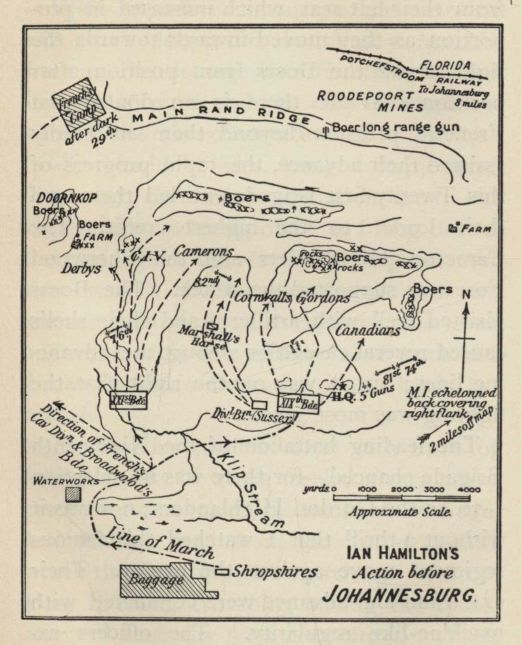
IAN HAMILTON'S ACTION BEFORE JOHANNESBURG
The left attack, pressed with vigour, and directed with skill by General Bruce-Hamilton, led along a low spur, and was designed to be a kind of inside turning movement to assist the right in conformity with the Cavalry action now in full swing. The City Imperial Volunteers moved forward with great dash and spirit, and in spite of a worrying fire from their left rear, which increased in proportion as they moved inwards towards the right, drove the Boers from position after position. While there is no doubt that French's pressure beyond them materially assisted their advance, the rapid progress of this Twenty-first Brigade entitled them and their leader to the highest credit. The Cameron Highlanders and the Sherwood Foresters supported the attack. The Boers resisted well with artillery, and their shells caused several casualties among the advancing lines; but it was on the right that the fighting was most severe.
The leading battalion of the Nineteenth Brigade chanced--for there was no selection--to be the Gordon Highlanders; nor was it without a thrill that I watched this famous regiment move against the enemy. Their extension and advance were conducted with machine-like regularity. The officers explained what was required to the men. They were to advance rapidly until under rifle fire, and then to push on or not as they might be instructed.
With impassive unconcern the veterans of Chitral, Dargai, the Bara Valley, Magersfontein, Paardeburg, and Houtnek walked leisurely forward, and the only comment recorded was the observation of a private: 'Bill, this looks like being a kopje day.' Gradually the whole battalion drew out clear of the covering ridge, and long dotted lines of brown figures filled the plain. At this moment two batteries and the two 5-in. guns opened from the right of the line, and what with the artillery of French and Bruce-Hamilton there was soon a loud cannonade.
The Dutch replied at once with three or four guns, one of which seemed a very heavy piece of ordnance on the main Rand ridge, and another fired from the kopje against which the Gordons were marching. But the Boer riflemen, crouching among the rocks, reserved their fire for a near target. While the troops were thus approaching the enemy's position, the two brigades began unconsciously to draw apart. Colonel Spens' battalions had extended further to the right than either Ian Hamilton or Smith-Dorrien had intended. Bruce-Hamilton, pressing forward on the left, found himself more and more tempted to face the harassing attack on his left rear. Both these tendencies had to be corrected. The Gordons were deflected to their left by an officer, Captain Higginson, who galloped most pluckily into the firing line in spite of a hail of bullets. Bruce-Hamilton was ordered to bear in to his right and disregard the growing pressure behind his left shoulder. Nevertheless a wide gap remained. But by this mischance Ian Hamilton contrived to profit. Smith-Dorrien had already directed the only remaining battalion--the Sussex--to fill up the interval, and the General-in-Chief now thrust a battery forward through the gap, almost flush with the skirmish line of the Infantry on its left and right.
The fire of these guns, combined with the increasing pressure from the turning movements both of Bruce-Hamilton and French, who was now working very far forward in the west, weakened the enemy's position on the kopje which the Gordons were attacking. Yet, when every allowance has been made for skilful direction and bold leading, the honours, equally with the cost of the victory, belong more to the Gordon Highlanders than to all the other troops put together.
The rocks against which they advanced proved in the event to be the very heart of the enemy's position. The grass in front of them was burnt and burning, and against this dark background the khaki figures showed distinctly. The Dutch held their fire until the attack was within 800 yards, and then, louder than the cannonade, the ominous rattle of concentrated rifle fire burst forth. The black slope was spotted as thickly with grey puffs of dust where the bullets struck as with advancing soldiers, and tiny figures falling by the way told of heavy loss. But the advance neither checked nor quickened.
With remorseless stride, undisturbed by peril or enthusiasm, the Gordons swept steadily onward, changed direction half left to avoid, as far as possible, an enfilade fire, changed again to the right to effect a lodgment on the end of the ridge most suitable to attack, and at last rose up together to charge. The black slope twinkled like jet with the unexpected glitter of bayonets. The rugged sky-line bristled with kilted figures, as, in perfect discipline and disdainful silence, those splendid soldiers closed on their foe.
The Boers shrank from the contact. Discharging their magazines furiously, and firing their guns at point-blank range, they fled in confusion to the main ridge, and the issue of the action was no longer undecided.
Still the fight continued. Along the whole Infantry front a tremendous rifle fire blazed. Far away to the left French's artillery pursued the retreating Boers with shells. The advanced batteries of Hamilton's force fired incessantly. The action did not cease with the daylight. The long lines of burning grass cast a strange, baleful glare on the field, and by this light the stubborn adversaries maintained their debate for nearly an hour.
At length, however, the cannonade slackened and ceased, and the rifles soon imitated the merciful example of the guns. The chill and silence of the night succeeded the hot tumult of the day. Regiments assembled and reformed their ranks, ambulances and baggage waggons crowded forward from the rear, the burning veldt was beaten out, and hundreds of cooking fires gleamed with more kindly meaning through the darkness.
The General rode forward, to find the Gordons massed among the rocks they had won. The gallant Burney, who commanded the firing line, was severely wounded. St. John Meyrick was killed. Nine officers and eighty-eight soldiers had fallen in the attack; but those that remained were proud and happy in the knowledge that they had added to the many feats of arms which adorn the annals of the regiment--one that was at least the equal of Elandslaagte or Dargai; and, besides all this, they may have reflected that by their devotion they had carried forward the British cause a long stride to victory, and, better than victory, to honorable peace. Ian Hamilton spoke a few brief words of thanks and praise to them--'the regiment my father commanded and I was born in'--and told them that in a few hours all Scotland would ring with the tale of their deeds. And well Scotland may, for no men of any race could have shown more soldier-like behaviour.
Then we rode back to our bivouac, while the lanterns of searching parties moved hither and thither among the rocks, and voices cried 'Bearer party this way!' 'Are there any more wounded here?' with occasional feeble responses.
Owing to the skilful conduct of the attack, the losses, except among the Gordons, were not severe--in all about 150 killed and wounded. The result of the fight--the action of Johannesburg, as we called it--was the general retreat of all the enemy west of the town under Delarey and Viljoen northwards towards Pretoria, and, in conjunction with the Field-Marshal's movements, the surrender of the whole of the Witwatersrand.
French, continuing his march at dawn to Driefontein, captured one gun and several prisoners. Ian Hamilton entered Florida, and found there and at Maraisburg sufficient stores to enable him to subsist until his convoys arrived.
CHAPTER XIV
THE FALL OF JOHANNESBURG
Johannesburg: June 2.
Morning broke and the army arose ready, if necessary, to renew the fight. But the enemy had fled. The main Rand ridge still stretched across our path. Its defenders had abandoned all their positions under the cover of darkness. Already French's squadrons were climbing the slopes to the eastward and pricking their horses forward to Elandsfontein (North). So Hamilton's force, having but six miles to march to Florida, did not hurry its departure, and we had leisure to examine the scene of yesterday's engagement. Riding by daylight over the ground of the Gordon's attack, we were still more impressed by the difficulties they had overcome. From where I had watched the action the Boers had seemed to be holding a long black kopje, some forty feet high, which rose abruptly from the grass plain. It now turned out that the aspect of steepness was produced by the foreshortening effects of the burnt grass area; that in reality the ground scarcely rose at all, and that what we had thought was the enemy's position was only a stony outcrop separated from the real line of defence by a bare space of about 200 yards.
Looking around I found a Highlander, a broad-shouldered, kind-faced man, with the Frontier ribbon, which means on a Gordon tunic much hard fighting; and judging with reason that he would know something of war, I asked him to explain the ground and its effect.
'Well, you see, sir,' he said, in quick spoken phrases, 'we was regularly tricked. We began to lose men so soon as we got on the burnt grass. Then we made our charge up to this first line of little rocks, thinking the Boers were there. Of course they weren't here at all, but back over there, where you see those big rocks. We were all out of breath, and in no order whatever, so we had to sit tight here and wait.'
'Heavy fire?' I asked. He cocked his head like an expert.
'I've seen heavier; but there was enough. We dropped more than forty men here. 'Tis here poor Mr. ---- was wounded; just behind this stone. You can see the blood here yet, sir--this mud's it.'
I looked as required, and he proceeded:
'We knew we was for it then; it didn't look like getting on, and we couldn't get back--never a man would ha' lived to cross the black ground again with the fire what it was, and no attack to fright them off their aim. There was such a noise of the bullets striking the rocks that the officers couldn't make themselves heard, and such confusion too! But two or three of them managed to get together after a while, and they told us what they wanted done ... and then, of course, it was done all right.'
'What was done? What did you do?'
'Why, go on, sir, and take that other line--the big rocks--soon as we'd got our breath. It had to be done.'
He did not seem the least impressed with his feat of arms. He regarded it as a piece of hard work he had been set to do, and which--this as a matter of course--he had done accordingly. What an intrepid conquering machine to depend on in the hour of need!--machine and much more, for this was a proud and intelligent man, who had thought deeply upon the craft of war, and had learnt many things in a severe school.
I had not ridden a hundred yards further, my mind full of admiration for him and his type, when a melancholy spectacle broke upon the view. Near a clump of rocks eighteen Gordon Highlanders--men as good as the one I had just talked with--lay dead in a row. Their faces were covered with blankets, but their grey stockinged feet--for the boots had been removed--looked very pitiful. There they lay stiff and cold on the surface of the great Banket Reef. I knew how much more precious their lives had been to their countrymen than all the gold mines the lying foreigners say this war was fought to win. And yet, in view of the dead and the ground they lay on, neither I nor the officer who rode with me could control an emotion of illogical anger, and we scowled at the tall chimneys of the Rand.
General Ian Hamilton, General Smith-Dorrien, all their staffs, and everyone who wished to pay a last tribute of respect to brave men, attended the funerals. The veteran regiment stood around the grave, forming three sides of a hollow square--Generals and staff filled the other. The mourning party rested on their arms, reversed; the Chaplain read the Burial Service, the bodies were lowered into the trench, and the pipes began the lament. The wild, barbaric music filled the air, stirring the soldiers, hitherto quite unmoved, with a strange and very apparent force. Sad and mournful was the dirge wailing of battles ended, of friendships broken, and ambitions lost; and yet there were mingled with its sadness many notes of triumph, and through all its mourning rang the cry of hope.
The whole of Hamilton's force had marched by ten o'clock, but even before that hour the advanced guard had passed through Florida and picketed the hills beyond. Florida is the Kew Gardens of Johannesburg. A well-built dam across a broad valley has formed a deep and beautiful lake. Carefully planted woods of Australian pines offer a welcome shade on every side. The black and white pointed chimneys of the mine buildings rise conspicuous above the dark foliage. There is a small but comfortable hotel, called 'The Retreat,' to which on Sundays, in times of peace, the weary speculators whose minds were shattered by the fluctuations of the Exchange were wont to resort for rest or diversion. Everywhere along the reef the signs of industry and commerce were to be seen. Good macadamised roads crossed each other in all directions; flashy advertisements caught the eye. A network of telegraphs and telephones ran overhead. The ground was accurately marked out with little obelisks of stone into 'Deeps' and 'Concessions,' and labelled with all the queer names which fill the market columns of the newspapers. In a word, it seemed--to us dirty, tattered wanderers--that we had dropped out of Africa and War, and come safely back to Peace and Civilisation.
Since the soldiers had eaten their last day's rations, and the only food they had had that morning came from any odds and ends the regiments might have saved, it was imperative to find some supplies. The Field-Marshal had ordered that no troops should enter Johannesburg until he should specially direct; but, finding little to eat in Florida, Hamilton sent his supply officer and a squadron as far as Maraisburg; whence they presently returned with a quantity of tinned rabbit and sardines, and with the news that the Boers were said to be occupying a position near Langlaagte mine.
During the morning we caught a train and some prisoners. The train was returning from Potchefstroom, guarded by six armed burghers, and on rifles being pointed, it stopped obediently and surrendered. The other prisoners were brought in by the Cavalry and Mounted Infantry, who had caught them wandering about without their horses. Among them was Commandant Botha--not Louis or Philip--but Botha of the Zoutspansburg commando, a brave and honest fellow, who had fought all through the war from Talana Hill until the last action; but who was quite content that Fate had decided he should fight no more. Hearing of him under guard, and near headquarters, I went to see him. He displayed no bitterness whatever, and seemed quite prepared to accept the decision of war. He inquired anxiously whether he would be sent to St. Helena, and evinced a childish horror of the sea. While we were chatting, one of the other Boer prisoners, who had been looking hard at us, said, suddenly, in very good English:
'The last time I saw you, you were in my position and I in yours.'
He then went on to tell me that he had been in the commando that destroyed the armoured train. 'I felt very sorry for you that day,' he said.
I remarked that it was much worse to be taken prisoner at the beginning of a war than near the end, as he was.
'Do you think this is the end?' asked the Commandant quickly.
'I should ask you that.'
'No, no--not yet the end. They will fight a little more. Perhaps they will defend Pretoria--perhaps you will have to go to Lydenburg; but it will not be very long now.'
And then, since both he and his companion had been through the Natal campaign, we fell to discussing the various actions. Ian Hamilton came up while we were talking. I had just told the Commandant that we considered the Boers had made a fatal strategic mistake in throwing their main strength into Natal, instead of merely holding the passes, masking Mafeking and Kimberley, and marching south into the colony with every man and gun they could scrape together. He admitted that perhaps that might be so; 'but,' said he, 'our great mistake in Natal was not assaulting Ladysmith--the Platrand position, you know--the day after our victory at Lombard's Kop. We blame Joubert for that. Many of us wanted to go on then. There were no fortifications; the soldiers were demoralised. If once we had taken the Platrand (Cæsar's Camp) you could not have held the town. How many men had you on top of it?'
'Only a picket for the first week,' said the General.
'Ah! I knew we could have done it. What would have happened then?'
'We should have had to turn you out.'
The Commandant smiled a superior smile. The General continued: 'Yes--with the bayonet--at night; or else, as you say, the town could not have been held.'
'Presently,' said Botha, 'you pulled yourselves together, but for three days after Nicholson's Nek there was no fear of bayonets. If we had stormed you then--(then we had all our men and no Buller to think about)--you would not have been able to turn us out.'
Hamilton reflected. 'Perhaps not,' he said, after a pause. 'Why didn't Joubert try it?'
'Too old,' said Botha, with complete disdain; 'you must have young men for fighting.'
That was, so far as I remember, the end of the conversation; but, a fortnight later, I met Botha a free man in the streets of Pretoria. He told me he had been released on parole, so that evidently his frank manliness had not been lost upon the General.
After lunch I became very anxious to go into, and, if possible, through, Johannesburg. An important action had been fought, witnessed by only two or three correspondents; and since the enemy lay between the force and the telegraph wire no news could have been sent home. Hamilton, indeed, had sent off two of Rimington's Guides early in the morning with despatches; but they were to make a wide sweep to the south, and it was not likely, if they got through at all, that they would reach Lord Roberts until late. The shortest, perhaps the safest, road lay through Johannesburg itself. But was the venture worth the risk? While I was revolving the matter in my mind on the verandah of the temporary headquarters, there arrived two cyclists from the direction of the town. I got into conversation with one of them, a Frenchman, Monsieur Lautré by name. He had come from the Langlaagte mine, with which undertaking he was connected. There were no Boers there, according to him. There might or might not be Boers in the town. Could a stranger get through? Certainly, he thought, unless he were stopped and questioned. He undertook there and then to be my guide if I wished to go; and it being of considerable importance to get the telegrams through to London, I decided, after a good many misgivings, to accept his offer. The General, who wanted to send a more detailed account of his action, and to report his arrival at Florida, was glad to avail himself even of this precarious channel. So the matter was immediately settled. Lautré's friend, a most accommodating person, got off his bicycle without demur and placed it at my disposal. I doffed my khaki, and put on a suit of plain clothes which I had in my valise, and exchanged my slouch hat for a soft cap. Lautré put the despatches in his pocket, and we started without more ado.
The tracks were bad, winding up and down hill, and frequently deep in sand; but the machine was a good one, and we made fair progress. Lautré, who knew every inch of the ground, avoided all highways, and led me by devious paths from one mine to another, around huge heaps of tailings, across little private tram lines, through thick copses of fir trees, or between vast sheds of machinery, now silent and idle. In three-quarters of an hour we reached Langlaagte, and here we found one of Rimington's scouts pushing cautiously forward towards the town. We held a brief parley with him, behind a house, for he was armed and in uniform. He was very doubtful of the situation ahead; only knew for certain that the troops had not yet entered Johannesburg. 'But,' said he, 'the Correspondent of the Times passed me more than two hours ago.'
'Riding?' I asked.
'Yes,' he said, 'a horse.'
'Ah,' said my Frenchman, 'that is no good. He will not get through on a horse. They will arrest him.' And then, being quite fired with the adventure: 'Besides, we will beat him, even if, unhappily, he escape the Boers.'
So we hurried on. The road now ran for the most part down hill, and the houses became more numerous. The day was nearly done, and the sun drew close to the horizon, throwing our long shadows on the white track before us. At length we turned into a regular street.
'If they stop us,' said my guide, 'speak French. Les François sont en bonne odeur ici. You speak French, eh?'
I thought my accent might be good enough to deceive a Dutchman, so I said yes; and thereafter our conversation was conducted in French.
We avoided the main thoroughfares, bicycling steadily on through the poorer quarters. Johannesburg stretched about me on every side, silent, almost deserted. Groups of moody-looking people chatted at the street corners, and eyed us suspiciously. All the shops were shut. Most of the houses had their windows boarded up. The night was falling swiftly, and its shades intensified the gloom which seemed to hang over the town, on this the last day of its Republican existence.
Suddenly, as we crossed a side lane, I saw in the street parallel to that we followed, three mounted men with slouch hats, bandoliers, and that peculiar irregular appearance which I have learned to associate with Boers. But to stop or turn back was now fatal. After all, with the enemy at their gates, they had probably concerns of their own to occupy them. We skimmed along unhindered into the central square, and my companion, whose coolness was admirable, pointed me out the post-office and other public buildings, speaking all the time in French. The slope now rose against us so steeply that we dismounted to push our machines. While thus circumstanced I was alarmed to hear the noise of an approaching horse behind me. With an effort I controlled my impulse to look back.
'Encore un Boer,' said Lautré lightly.
I was speechless. The man drew nearer, overtook and pulled his horse into a walk beside us. I could not help--perhaps it was the natural, and, if so, the wise, thing to do--having a look at him. He was a Boer sure enough, and I think he must have been a foreigner. He was armed cap-à-pie.' The horse he rode carried a full campaigning kit on an English military saddle. Wallets, saddle-bags, drinking-cup, holsters--all were there. His rifle was slung across his back, he wore two full bandoliers over his shoulders and a third round his waist--evidently a dangerous customer. I looked at his face and our eyes met. The light was dim, or he might have seen me change colour. He had a pale, almost ghastly visage, peering ill-favoured and cruel from beneath a slouch hat with a large white feather. Then he turned away carelessly. After all, I suppose he thought it natural a poor devil of a townsman should wish to look at so fine a cavalier of fortune. Presently he set spurs to his horse and cantered on. I breathed again freely. Lautré laughed.
'There are plenty of cyclists in Johannesburg,' he said. 'We do not look extraordinary. No one will stop us.'
We now began to approach the south-eastern outskirts of the town. If the original scheme of advance had been carried out, Lord Roberts's leading brigade should be close at hand. Lautré said, 'Shall we inquire?' But I thought it better to wait. As we progressed the streets became still more deserted, and at last we found ourselves quite alone. For more than half a mile I did not see a single person. Then we met a shabby-looking man, and now, no one else being in sight, the night dark, and the man old and feeble, we decided to ask him.
'The English,' he said with a grin, 'why, their sentinels are just at the top of the hill.'
'How far?'
'Five minutes--even less.'
Two hundred yards further on three British soldiers came in sight. They were quite unarmed, and walking casually forward into the town. I stopped them and asked what brigade they belonged to. They replied Maxwell's.
'Where is the picket line?'
'We haven't seen no pickets,' said one of them.
'What are you doing?'
'Looking for something to eat. We've had enough of 'arf rations.'
I said, 'You'll get taken prisoners or shot if you go on into the town.'
'Wot's that, guvnor?' said one of them, deeply interested in this extraordinary possibility.
I repeated, and added that the Boers were still riding about the streets.
'Well, then, I ain't for it,' he said with decision. 'Let's go back and try some of them 'ouses near the camp.'
So we all proceeded together.
I discovered no picket line at the edge of the town. Maxwell must have had one somewhere, but it certainly did not prevent anyone from passing freely; for we were never challenged, and, walking on, soon found ourselves in the middle of a large bivouac. I now became of some use to my companion, for if he knew the roads I knew the army. I soon found some officers of my acquaintance, and from them we learned that Lord Roberts's headquarters were not at Elandsfontein (South), but back at Germiston, nearly seven miles away. It was now pitch dark, and all signs of a road had vanished; but Lautré declared he knew his way, and, in any case, the messages--press and official--had to go through.
We left the camp of Maxwell's Brigade and struck across country in order to cut into the main southern road. A bicycle now became a great incumbrance, as the paths wound through dense fir woods, obstructed by frequent wire fences, ditches, holes, and high grass. Lautré, however, persisted that all was well, and, as it turned out, he was right. After about an hour of this slow progress we reached the railway, and, seeing more camp fires away to the left, turned along it. Half a mile in this direction brought us to another bivouac, which we likewise entered unchallenged. I asked a soldier whose brigade he belonged to, but he did not know, which was painfully stupid of him. A group of officers were gathered round an enormous fire a few yards away, and we went up to them to ask. Chance had led me to General Tucker's mess. I had known the commander of the Seventh Division in India, when he was stationed at Secunderabad, and he welcomed me with his usual breezy courtesy. He had been sent off with his leading brigade late in the afternoon to try to join hands with French, and so complete the circle round Johannesburg; but darkness had curtailed his march. Besides this, no communications having yet come through from the Cavalry, he was uncertain where French was. Naturally he was interested to hear what had passed on the west of the town, and about the stirring action of the previous day. From him I got some whisky and water, and clear directions to the Field-Marshal's headquarters. They were, it appeared, two miles beyond Germiston, a mile and a half west of the road, in a solitary house on a small hill which stood beyond a large tank. And in case these indications might have been of little avail in the dark, he led us a few feet up the slope, and there we saw that, on the blackness of the night, flamed a regular oblong of glittering lights. It was the camp of the Eleventh Division. Somewhere near that were the Chief's headquarters. Thus instructed, we resumed our journey.
Another half-hour of walking brought us, as Lautré had promised, to a good firm road, and the bicycles quickly made amends for their previous uselessness. The air was cold, and we were glad to spin along at a fair ten miles an hour. At this rate twenty minutes brought us into Germiston. Not knowing where I should be likely to find dinner, or a bed, I dismounted opposite the hotel, and, seeing lights and signs of occupation, went inside. Here I found Mr. Lionel James, the principal Correspondent of the Times. I asked him if his subordinate had arrived from Hamilton's force. He said 'No'; and when I told him he had started two hours in front of me, looked much concerned; whereat the Frenchman could not conceal a heartless grimace. I offered to give him some account of the action for his own use (for what is more detestable than a jealous journalist?), but he said that I had had the good luck to come through, and that he would not think of depriving me of my advantage. Alas! the days of newspaper enterprise in war are over. What can one do with a censor, a forty-eight hours' delay, and a fifty-word limit on the wire? Besides, who can compete with Lord Roberts as a special correspondent? None against the interest of his daily messages; very few against their style and simple grace. Never mind. It is all for the best.
We dined hastily and not too well, secured the reversion of half the billiard table, should all other couches fail, and set out again, this time tired and footsore. After two miles of dusty track the camp was reached. I found more officers who knew where Army Headquarters were, and at last, at about half-past ten, we reached the solitary house. We sent the despatches in by an orderly, and after a few minutes Lord Kerry came out and said that the Chief wanted to see the messengers.
Now, for the first time in this war, I found myself face to face with our illustrious leader. The room was small and meanly furnished, and he and his staff, who had just finished dinner, sat round a large table which occupied the greater part of the floor. With him were Sir William Nicholson (who arranges all the transport of the army, a work the credit of which is usually given to Lord Kitchener) and Colonel Neville Chamberlayne, his private secretary, both of them soldiers of the practical Indian school, where you have real fighting, both of them serving once more under their commander of Afghan days. There, too, was Sir Henry Rawlinson, whom I had last seen round Sir George White's table, the night Dundonald broke into Ladysmith; and Sir James Hills-Johnes, who won the Victoria Cross in the Indian Mutiny, and aides-de-camp and others whom I cannot remember.
The Field-Marshal rose from his place, shook hands, and bade us, in most ceremonious fashion, to be seated. He had read half of Hamilton's despatch.
'The first part of this,' he said, 'we knew already. Two guides--Rimington's, I think--got in here about an hour ago. They had a dangerous ride, and were chased a long way, but escaped safely. I am glad to hear Hamilton is at Florida. How did you get through?'
I told him briefly. His eye twinkled. I have never seen a man before with such extraordinary eyes. I remember to have been struck with them on several occasions. The face remains perfectly motionless, but the eyes convey the strongest emotions. Sometimes they blaze with anger, and you see hot yellow fire behind them. Then it is best to speak up straight and clear, and make an end quickly. At others there is a steel grey glitter--quite cold and uncompromising--which has a most sobering effect on anyone who sees it. But now the eyes twinkled brightly with pleasure or amusement or approbation, or, at any rate, something friendly.
'Tell me about the action,' he said.
So I told him all I knew, much as it is set down in these pages, though not nearly at such length; but I don't think the tale lost in the telling. From time to time he asked questions about the Artillery concentration, or the length of front of the Infantry attack, and other technical matters, on which I was luckily well-informed. The fact that the troops had no rations seemed to disturb him very much. He was particularly interested to hear of Hamilton's novel attack 'at thirty paces extension'; of the manner in which the batteries had been rammed almost into the firing line; but most of all he wanted to hear about the Gordons' charge. When I had done he said: 'The Gordons' always do well.' Then he asked what we proposed to do. Lautré said he would go back forthwith; but the Chief said, 'Much better stay here for the night; we will find you beds'; so of course we stayed. He asked me whether I meant to go back next morning. I said that as I had got my messages to the telegraph office I thought, upon the whole, that I would not run any more risks, but wait and see the British occupation of the town. He laughed at this, and said that I was quite right, and would be very ill-advised to be caught again. Then he said that he would send a letter to Hamilton in the morning, bade us all 'good-night,' and retired to his waggon. I, too, found a comfortable bed--the first for a month--and being thoroughly worn out soon fell asleep.
Part of Lord Roberts's letter that he wrote to Ian Hamilton next day was published in the orders of the flanking column. In some way it explains why the private soldier will march further for 'Bobs Bahadur' than for any one else in the world.
'I am delighted at your repeated successes, and grieve beyond measure at your poor fellows being without their proper rations. A trainful shall go to you to-day. I expect to get the notice that Johannesburg surrenders this morning, and we shall then march into the town. I wish your column, which has done so much to gain possession of it, could be with us.
'Tell the Gordons that I am proud to think I have a Highlander as one of the supporters on my coat-of-arms.'
CHAPTER XV
THE CAPTURE OF PRETORIA
Pretoria: June 8.
The Commander-in-Chief had good reasons--how good we little knew--for wishing to push on at once to the enemy's capital, without waiting at Johannesburg. But the fatigue of the troops and the necessities of supply imposed a two days' halt. On the 3rd of June the advance was resumed. The army marched in three columns. The left, thrown forward in echelon, consisted of the Cavalry Division under French; the centre was formed by Ian Hamilton's force; and the right or main column nearest the railway comprised the Seventh and Eleventh Divisions (less one brigade left to hold Johannesburg), Gordon's Cavalry Brigade, and the Corps Troops all under the personal command of the Field-Marshal.
The long forward stride of the 3rd was, except for a small action against French, unchecked or unopposed by the Boers, and all the information which the Intelligence Department could collect seemed to promise a bloodless entry into the capital. So strong was the evidence that at dawn on the 4th of June Hamilton's column was diverted from its prescribed line of march on Elandsfontein[#] and drawn in towards the main army, with orders to bivouac on Pretoria Green, west of the town. French, whom the change of orders did not reach, pursued his wide turning movement, and encountered further opposition in a bad country for cavalry.
[#] Yet another Elandsfontein, situated to the west of Pretoria.
At ten o'clock it was reported that Colonel Henry, with the corps of Mounted Infantry in advance of the main column, was actually in the suburbs of Pretoria without opposition. The force continued to converge, and Ian Hamilton had almost joined Lord Roberts's force when the booming of guns warned us that our anticipations were too sanguine. The army had just crossed a difficult spruit, and Colonel Henry with the Mounted Infantry had obtained a lodgment on the heights beyond. But here they were sharply checked. The Boers, apparently in some force, were holding a wooded ridge and several high hills along the general line of the southern Pretoria forts.