Front matter (continued 2)
Reading edition
The consequences of this ill-timed change of plan were swift. The Boers saw the retrograde movement, and pressed boldly forward, and Kitchener's Horse, finding themselves closely engaged, were unable to move. A sharp and savage little fight followed in the gloom. The Boers crept quite close to the soldiers, and one fierce greybeard was shot through the head eight paces from the British firing line, but not until after he had killed his man. The reports which reached the town, that Kitchener's Horse were 'cut off' on a kopje four miles from the camp, induced General French to send the Gordon Highlanders to their relief. This battalion started at about ten o'clock, and were put on their road to the northward. But in the darkness and the broken ground they lost their way, marched five miles to the south, occupied another hill, and did not rejoin the command until the afternoon of the next day, an absence which, since no inquiries could discover them, caused much anxiety. Kitchener's Horse meanwhile, under Major Fowle, of the 21st Lancers, made a plucky defence, beat off the Boers, and managed at about eleven o'clock to effect their retreat undisturbed. The losses in the affair were twelve or fourteen men killed and wounded, including one officer, who was shot through the head.
Very early the next morning the whole force marched out of the town, and French's operations were this day designed to compel the enemy to retreat from his positions in rear of Thabanchu Mountain, and if possible to surround some part of his force. The information at General French's disposal could not, however, have been very accurate, for in my telegram of the 26th I wrote that 'more than 2,000 Boers' were collected to the north of Thabanchu, and the Press Censor erased this and substituted the words 'small parties.' If this latter view had been correct it is probable that the operations of the following day would have been attended by a greater measure of success.
The plan was clear and vigorous. Gordon's Cavalry Brigade was to move to the right, round the east of Thabanchu Mountain, and force their way into the plains behind it. It was hoped that the Lancers, of which this brigade is entirely composed, would find some opportunity for using their dreaded weapon. Hamilton was to push back the weak Boer right, and open the way for Dickson's Cavalry Brigade to pass through and join hands with Gordon. Rundle, whose infantry were tired from their long march from Dewetsdorp, was to demonstrate against the Boers' centre and hold the town.
The action opened with the re-occupation of Kitchener's Horse Hill by Smith-Dorrien's Infantry Brigade, who advanced in determined style, and by a sweeping movement of Ridley's Mounted Infantry. Both these undertakings, which were directed by Hamilton, prospered. The Boer right, which was very thin, was brushed aside, and the road for the cavalry was opened. At, and not until, nine o'clock, French's leading squadrons began to appear on the plain, and by ten the whole of Dickson's Brigade had passed through the gap and were safely extended in the undulating plains beyond.
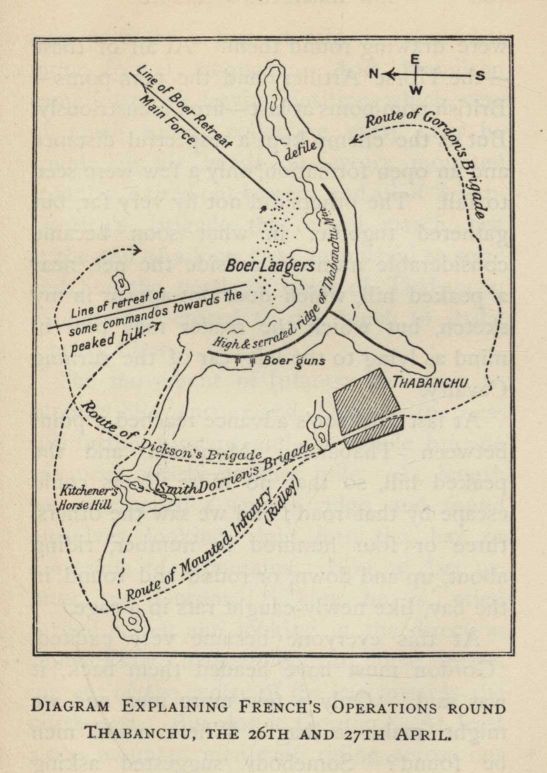
DIAGRAM EXPLAINING FRENCH'S OPERATIONS ROUND THABANCHU, THE 26TH AND 27TH APRIL.
Wishing to see, for the first time, Cavalry and Horse Artillery working in suitable country, I rode down from my post of observation on Kitchener's Horse Hill and trotted and cantered until I caught up the squadrons. It was evident that the left enveloping arm was making good progress. Already we could almost look into the bay behind Thabanchu Mountain. If Gordon were only getting on as well we might join hands with him, and enclasp a goodly catch of prisoners. So the brigade continued to advance from ridge to ridge, and presently Boers began to gallop across the front to escape, as was thought, from the net we were drawing round them. At all of these--the Horse Artillery and the pom-poms--British pom-poms at last--fired industriously. But as the enemy kept a respectful distance and an open formation, only a few were seen to fall. The others did not fly very far, but gathered together in what soon became considerable numbers outside the net, near a peaked hill, which does not appear in my sketch, but which the reader may bear in mind as lying to the left rear of the turning Cavalry.
At last Dickson's advance reached a point between Thabanchu Mountain and the peaked hill, so that no more Boers could escape by that road; and we saw the others, three or four hundred in number, riding about, up and down, or round and round in the bay, like newly-caught rats in a cage.
At this everyone became very excited. 'Gordon must have headed them back,' it was said. 'Only a few more men and we might make a bag.' Where could men be found? Somebody suggested asking Hamilton. The helio twinkled: 'Come and help us make a bag,' it said, in somewhat more formal language. And Hamilton came forthwith, leaving positions which were of much value; collecting every man he could lay his hands on--weary mounted Infantry, a tired-out battery, and all of Smith-Dorrien's Brigade that could march fast at the end of a long day--he hurried to seize and line the northern spurs of Thabanchu Mountain, prepared to risk much to strike a heavy blow.
The movement of Infantry and guns to support him encouraged Dickson to press still further forward, and the whole brigade advanced nearly another mile. At length we overtopped a smooth ridge, and found ourselves looking right into the bay or horseshoe of mountains. Now at last we must see Gordon. 'There he is,' cried several voices, and looking in the direction shown I saw a majestic body of horse streaming out of the centre of the bay towards the north-west. But was it Gordon? At least 4,000 mounted men were riding across our front, hardly two miles away. Surely no brigade was so numerous. Yet such was the precision of the array that I could not believe them Boers.
Boers their numbers, however, proved them to be; and not their numbers alone, for before we had watched this striking spectacle long, two large puffs of smoke leapt from the tail of the hostile column, and two well-aimed shells burst near our Horse Battery. At the same time patrols from the left rear hurried in with the news that the Boers who had already escaped from our imagined 'trap' were advancing in force, with two more guns, to cut us from the rest of the army.
As for Gordon, there was no longer any doubt about his fortunes. Far away to the eastward the horseshoe wall of mountains dipped to a pass, and on the sides of this gateway little puffs of smoke, dirty brown against the darkening sky, showed that Gordon was still knocking with his Artillery at the door, and had never been able to debouch in the plains behind it. Moreover, the dangerous hour of twilight was not long distant. Dickson determined to retreat while time remained, and did so without any unnecessary delay. Whereat the Boers came down on our rear and flank, opening furious fire at long range, and galloping eagerly forward, so that the brigade and its guns, so far from entrapping the enemy, were all but entrapped themselves; indeed, the brigadier's mess cart, the regimental water carts, and several other little things, which, being able only to trot, could not 'conform to the general movement,' were snapped up by the hungry enemy, who now pressed on exulting.
Meanwhile Hamilton had taken some risks in order to promote the expected entrapping. He had now to think of himself. First, the Boer advance must be stopped, and, secondly, the force which had, in the hopes of grasping the Boers, let go its hold on Kitchener's Horse Hill, must be withdrawn within the Thabanchu picket line. The General, however, was equal to both requirements. Judiciously arranging some force of Infantry and guns, he peppered the advancing Boers heavily, so that at 800 yards they wheeled about and scurried to the shelter of adjacent kopjes. This advantage restored the situation. Hamilton remained on the ground till dark, and then, with the whole of Ridley's and Smith-Dorrien's commands, returned safely into Thabanchu.
During the day rifle and artillery fire had been constant; but as the fighting had been conducted at extreme ranges, which neither side showed much anxiety to diminish, the slaughter was small. Indeed, I do not think that a dozen men were stricken in either army. So far as the British were concerned, the result of the day's operations was a qualified success.
The Boers were evidently prepared to retreat from Thabanchu, but they proposed to do so in their own time and at their most excellent discretion, and it was quite evident that we had not succeeded in any way in hindering or preventing them. It was also clear that, far from being 'in small parties,' their strength was nearly 6,000, so that on the whole we might congratulate ourselves on having moved in ignorance and taken no great hurt, The only point about the action difficult to understand was the behaviour of the Boers who had ridden about like caged rats. Why should they do so when they knew that their line of retreat to the north-east was perfectly secure? I can only conclude that this particular commando had arranged to retire northwards towards the peaked hill, and were annoyed at being prevented from joining their comrades at the point where their waggons, and, consequently, their dinners, were awaiting them.
On the evening of this instructive, but unsatisfactory, day, Hamilton received orders from Lord Roberts to march north on Winburg in conformity with the general advance of the army. For this purpose his force was to be largely increased, and the operations which followed require the space of another letter. French remained for some days at Thabanchu, but attempted no further serious operations against the enemy.
Only one other incident of interest occurred in the neighbourhood of Thabanchu. After his relief of Wepener, Brabazon was ordered thither via Dewetsdorp. On the 28th, dusty and tired at the end of a long march, he arrived with his Yeomanry at the foot of a pass among the hills. A Kaffir lounged into the bivouac and asked the General whether he would like to see some pretty shelling, for that there was a fine show at the top of the valley. Brabazon, much interested, mounted his horse forthwith, and, guided by the Kaffir through devious paths, reached a point which afforded an extensive view.
There, in the twilight, lay a British convoy, stoutly defended by a company of the kiddies and a few Yeomanry, and shelled--as the Kaffir had said--with great precision by two Boer guns. The General thereupon gave the Kaffir a 'fiver' to carry a letter through the Boer lines to the commander of the convoy, telling that officer to hold out manfully, and promising that with the dawn Brabazon and the Imperial Yeomanry would come to his aid.
The Kaffir succeeded in his mission. The convoy was encouraged, and, good as his word, with the daylight came the General, at whose approach the Boers fled incontinently, so that Brabazon, the Yeomanry, and the convoy came in safety and triumph into Thabanchu together.
CHAPTER VIII
IAN HAMILTON
London: August 10, 1900.
Ian Standish Monteith Hamilton was born at Corfu in 1853. His father, the late Colonel Christian Monteith Hamilton--then a captain, but who eventually commanded the 92nd Highlanders--was the eldest son of John George Hamilton and of Christina Cameron Monteith, daughter of Henry Monteith of Carstairs, sometime Member of Parliament for Lanarkshire. His mother, the late Maria Corunia Vereker, was daughter of John, third Viscount Gort, by Maria O'Grady, daughter of Viscount Guillamore.[#] The Hamilton family is one of the elder branches of the Scottish Hamiltons, and represents the male line of the Hamiltons of Westport. One of his ancestors on his father's side, a Colonel Hamilton, was for several years an aide-de-camp of the first Duke of Marlborough, and it was therefore something in the nature of a coincidence when Ian Hamilton found the present Duke of Marlborough serving in a similar capacity on his staff. It would not be quite correct to call him a pure Celt, but some notice should be taken by those interested in these questions that his blood is mostly Celtic: both of his grandmothers, Monteith and O'Grady, being of Celtic stock, Scottish and Irish respectively.
[#] Vide Peerage, Gort and Guillamore.
When Ian Hamilton was born his father was serving with a detachment of the 92nd Highlanders at Corfu. His mother died in 1856, and for the next ten years, the father being constantly on duty with the regiment, he and his younger brother, Vereker Hamilton, who was born in 1856, lived with their grandparents at Hapton, in the Holy Loch in Argyllshire. Such a childhood on moor and loch in a fine wild country was likely to develop and brace nerve and muscle, and stir the keen blood inherited from many generations of warlike ancestors. He was educated first at Cheam, and as he grew sufficiently old at Wellington College. Here he was very happy, and although he was not especially noted for industry, his success in the examinations at the end of each term excused any neglect in its course. In 1872 he passed the tests for the army, and, according to the system at that time in force, was offered the choice of going to Sandhurst or living for a year abroad to learn a foreign language thoroughly. The cadet chose the latter, and was sent to Germany. Here he had the good luck to make the close friendship of a most distinguished old man. General Dammers was a Hanoverian who had fought against the Prussians at Langesalze, and who, refusing a very high command under the Prussians, lived at Dresden. Although he himself remained aide-de-camp to the ex-King of Hanover, he became the centre of a group of Hanoverian officers who had entered the Saxon service. He was thus in touch with the latest school of military thought, stimulated to its utmost activity by the lessons of the great war which had lately been concluded. From General Dammers, Ian Hamilton learned the German language, military surveying, something of military history, and something doubtless of strategy and the art of war. The year thus passed very profitably. On his return to England, however, the War Office announced that they had changed their minds and that for the future everybody must go through Sandhurst. Such protests as his father, himself an officer, was entitled to make were overruled by the authorities, and Ian Hamilton embarked upon his military career having lost, through no fault of his own, one year of seniority--a year which Fortune had perhaps even then determined to restore to him manifold.
In 1873 he entered the 12th Foot, and after some months joined his father's old regiment, the 92nd. At first with the 92nd, and after 1881 with the 2nd battalion of the regiment, the Gordon Highlanders, Ian Hamilton followed the drum from garrison to garrison, going through the military routine, and plodding slowly up the first few steps of the long ladder of promotion. From the very first he interested himself in musketry. He became himself a keen and good rifle shot, and not with the military rifle alone. He spent a long leave in Kashmir on the fringe of the snows, and made a remarkable bag. Indeed, some of his heads attained nearly to the record dimensions, and one big single-horned markhor enjoyed the actual supremacy for several months.
Then came the Afghan war. Ian Hamilton, although only an infantry soldier, became aide-de-camp, with Brabazon as Brigade Major, to the unfortunate commander of the British Cavalry Brigade. Early in the campaign he was stricken down with fever, and so avoided being drawn into the controversy which raged for several years in military circles around the actions in the Chardeh valley. It would indeed have been unfortunate if at this early stage in his career he had been led into any antagonism to the great General with whom his fortunes were afterwards so closely associated.
The Boer war of 1881 found Hamilton still a subaltern. He was ordered to South Africa with his regiment, and went full of eager anticipation. The regiment, composed almost entirely of soldiers inured to the hardships and disdainful of the dangers of war, was in the most perfect condition to encounter the enemy, and, as is usual in British expeditions on the outward voyage, they despised him most thoroughly. It was not to be dreamed of that a parcel of ragged Boers should stand against the famous soldiers of Kabul and Kandahar. They discussed beforehand the clasps which would be given upon the medal for the campaign. They were to be Laing's Nek, Relief of Potchefstroom, and Pretoria 1881. No one had then ever heard the name of Majuba Mountain. Yet there was to be the first encounter between Highlanders and Dutchmen.
The dismal story of Majuba is better known than its importance deserves. Had that action been fought in this war it would perhaps have gone down to history as the affair of the 27th of February. Instead, it was accepted as a stricken field, and might, such was the significance that was attached to it, have changed the history of nations. It needs no repetition here save in so far as it is concerned with Ian Hamilton. Majuba Mountain may in general terms be described as a saucer-topped hill. Sir George Colley and his six hundred soldiers, picked from various units (that all might share the glory), sat themselves down to rest and sleep, and dig a well in the bottom of the saucer. One weak picket of Gordon Highlanders was thrust forward over the rim on to the outer slope of the hill to keep an eye on those silent grey patches which marked the Boer laagers far below. Hamilton was the subaltern in command. As the day gradually broke and the light grew stronger, he saw from the very lifting of the curtain the course of the tragedy. Boers awoke, bustled about their encampments; looked up just as Symons' Brigade looked up on the morning of Talana Hill, and saw the sky-line fringes with men. More bustle, long delay, much argument and hesitation below, a little boasting rifle fire from some of the British soldiers: 'Ha, ha! got you this time I think!'--and then, straggle of horsemen riding in tens and twenties towards the foot of the mountain. Hamilton reported accordingly. The action of Majuba Hill had begun. Pause.
There was--so it has been described to me--a long donga that led up the steep slope. Into the lower end of this the Boer horsemen disappeared. Hamilton moved his score of men a little to their right, where they might command this zig-zag approach as much as the broken ground would allow, and reported again to the General or whoever was directing affairs--for Colley, wearied with the tremendous exertion of the night climb, was sleeping--'Enemy advancing to attack.' He also made a few stone shelters. Pause again. Suddenly, quite close, darting forward here and there among the rocks and bushes of the donga--Boers! Fire on them, then. The Gordons' rifles spluttered accordingly, and back came the answer hot and sharp--a close and accurate musketry fire pinning the little party of Regulars to the earth behind their flimsy shelters. No one could show his head to fire. Soldiers would hold a helmet up above the sheltering stone and bring it down with two and three bullets through it. Could half a company fight a battle by itself? What were others doing? Hamilton felt bound to send another report. He left the half company in charge of the sergeant, got up, ran up the slope, and dropped into safety the other side of the saucer-shaped rim. The distance was scarcely forty yards, yet two bullets passed through his kilt in crossing it. Where was the General? A staff officer, ignorant and therefore undisturbed, said that the General was sleeping. 'He knew,' said the staff officer, 'what was going on. No need for a subaltern of Highlanders to concern himself.' Hamilton returned, running the gauntlet again, to his men. The fire grew hotter. The Boers began to creep gradually nearer. Their front attack widened and drew around the contours of the hill. Were all the force asleep? One more warning at any rate they should have. Again he darted across the open space with the swish of bullets around him. Again he found the staff. But this time they were annoyed. It is such a bore when young officers are jumpy and alarmist. 'It's all right,' they said: and so it was within the saucer. The bullets piped overhead as the wind howls outside the well-warmed house. But a sudden change impended.
Hamilton rejoined his men just as the Boers attacked at all points. The little picket of Highlanders, utterly unable to withstand the weight of the enemy's advance, ran back to the rim of the saucer intermingled with the Boers, who fired their rifles furiously at them, even putting the muzzles to the men's heads and so destroying them. In Sir William Butler's book, written almost entirely with the view of exonerating Sir George Colley, it is suggested that his advanced picket fell back in a panic. The truth is that they were swept backward by overwhelming force after they had three times reported to the General the development of a heavy attack. Of the seventeen men under Ian Hamilton in this advanced position twelve were shot dead.
The survivors of the picket with the pursuing Boers reached the rim together, and became visible to the main force. Astounded by this apparition, the troops who were lying down in the saucer rose up together, and, some accoutred, some with their coats off, Highlanders, sailors, and linesmen, ran forward and fired a ragged volley. The Boers immediately lay down and replied, causing heavy loss. A furious musketry fight followed between the Dutch in cover along the rim and the British among the rocks across the centre of the saucer. This was ended by the appearance of other Boers on the high ground at the northern end of the plateau. Without orders or order, exposed to a terrible fire, ignorant of what was required of them, the soldiers wavered. One last chance presented itself. Hamilton rushed up to the General in the impetuosity of youth: 'I hope you'll forgive my presumption, sir, but will you let the Gordon Highlanders charge with the bayonet?'
'No presumption, young gentleman,' replied Colley, with freezing calmness. 'We'll let them charge us, and then we'll give them a volley and a charge.'
On the word the whole scene broke into splinters. The British troops abandoned their positions and fled from the ground. The Boers, standing up along the rim, shot them down mercilessly--sporting rifles, crack shots, eighty yards' range. Hamilton saw a figure scarcely ten yards away aiming at him, raised the rifle he found himself somehow possessed of to reply. Both fired simultaneously. The British officer went down with his wrist smashed to pieces. He rose again: the rear crest was near. The last of the fugitives were streaming over it. One dash for liberty! The fire was murderous. Before the distance was covered his tunic was cut by one bullet, his knee by another, and finally a splinter of rock striking him behind the head brought him down half stunned to the ground--luckily behind the shelter of a small rock.
The firing stopped. The Boers began to occupy the position. Two discovered the wounded man. The younger, being much excited, would have shot him. The elder restrained him. 'Are you officer, you damned Englishman?' said they.
'Yes.'
'Give your sword.'
Now Hamilton's sword had belonged to his father before him. He replied by offering them money instead.
'Money!' they cried; 'give it up at once,' and were about to snatch it away when a person of authority--it is said Joubert himself--arrived. 'Voorwarts,' he said to the burghers, and in spite of their desire to plunder he drove them on. Hamilton thanked him. 'This is a bad day for us.'
'What can you expect,' was the answer characteristic of the Boer--the privileged of God--'from fighting on a Sunday?'
Then they collected the prisoners and helped Hamilton to walk back to the British position. Colley lay dead on the ground. The Boers would not believe it was the General. 'Englishmen are such liars.' Hector Macdonald--grim and sad--hero of the Afghan war, now a prisoner in the enemy's hand, watched the proceedings sullenly. The Boers picked out the surrendered prisoners. They looked at Hamilton. He was covered with blood from head to foot They said: 'You will probably die. You may go.' So he went; staggered, and crawled back to camp, arrived there delirious the next morning. The wrist joint is composed of eight separate bones. The bullet, breaking through, had disarranged them sadly, had even carried one or two away. If he had consented to amputation he would soon have been convalescent. But a soldier must preserve all he can. What with fever and shock he nearly died. For six months he was an invalid. But the hand was saved, so that now the General can hold an envelope between his paralysed and withered fingers, and sometimes hold a cigarette. For all other purposes it is useless, and when he rides it flaps about helplessly--a glorious deformity.
After some months of doubt as to whether he should leave the army and throw himself entirely into the literary pursuits which had always possessed for him a keen attraction, Hamilton decided to remain a soldier.
He next saw service in the Soudan: he was not intended to make this campaign, for the battalion to which he belonged was serving in India, and there has always been much jealousy between the Indian and the Egyptian British officer. But he happened to be coming home on leave, and when the steamer reached Suez it occurred to him to ask himself why he should not go up the Nile with the columns which were being formed. He got out of the ship accordingly and ran across the sands to the train which was standing in the station. Had he not caught it he would have returned to the ship. But he was in time. Next day he arrived in Cairo, and while waiting there for his luggage he applied for employment. It was refused, officers were not allowed to volunteer. The Gordon Highlanders, his only hope, had their full complement of officers. They had no vacancy for him. Hamilton did not, however, give up his idea easily. He resolved to travel as far as Wady Halfa and renew his application there. He journeyed south with Colonel Burnaby, and after a week of train and river-boat arrived at the whitewashed mud huts in the midst of a vast circle of sand which marked the base of the British Expeditionary forces, both desert and river columns.
What followed has happened so often that it is well worth the attention of young officers. Be it always remembered that the regulations of the army are formed to make all people quite alike one uniform pattern and on one level of intelligence--not yet the highest. You do not rise by the regulations, but in spite of them. Therefore in all matters of active service the subaltern must never take 'No' for an answer. He should get to the front at all costs. For every fifty men who will express a desire to go on service in the mess or the club, and will grumble if they are not selected, there is only about one who really means business and will take the trouble and run the risk of going to the front on the chance. The competition is much less keen when you get there. I know something of this myself, and am convinced of its truth.
The subaltern really stands on velvet in the matter. If he succeeds all is well. If he gets rebuked and ordered down, he must try again. What can the authorities do? They cannot very well shoot him. At the worst they can send him back to his regiment, stop his leave for six months, and some choleric old martinet who was a young man once, though he had half forgotten it, will write in some ponderous book in Pall Mall against the offender's name: 'Keen as mustard--takes his own line--to be noted for active service if otherwise qualified.'
Of course everyone was delighted to see Hamilton at Wady Halfa. They appointed him to a vacancy which had meanwhile occurred in the Gordon Highlanders, and gave him a company and a boat in the River Column. Through all the hard campaign that followed he served with credit. The fortunes of the troops who worked their way up the Nile have not been so closely studied as those of the columns which plunged into the desert and fought at Abu Klea and Abu Kru. But it was nevertheless one of the most picturesque enterprises of our military history. The broad boats toiling forward against the current of the river, making perhaps three miles a day, obstructed by frequent cataracts and menaced continually by the enemy, the scouts on the banks, the lines of men on the tow ropes, the red sand of the desert, the hot steel sky, and the fierce sunlight slanting in between rocks of the Nile gorge, are materials from which a fascinating sketch might be painted. Hamilton's boat became somehow the head of the rear column. At length there came a day when they told of expected opposition, dervish encampments, and a certain rocky ridge said to be lined with riflemen. The leading column of boats was hurried forward. By some mischance Hamilton's boat became the rear boat of the leading column. At any rate, his company alone of the Gordon Highlanders fought in the action of Kirbeckan next day. Nothing succeeds like success. Hamilton received the Distinguished Service Order for his services.
After the Nile Expedition of 1885 had reached its sad conclusion, Hamilton returned to India and became an aide-de-camp on the staff of Lord Roberts, who was then commanding the Madras army. The question of musketry training for Infantry was at that time much discussed, and Lord Roberts was determined to do something to improve the shooting of the British army. In his book 'Forty-one Years in India' he tells us how he and his staff formed themselves into a team and had many exciting rifle matches with the regiments in the Madras command. In all this Hamilton's skill with the rifle and the keen interest he had always shown for musketry--his first regimental appointment had been to be Musketry Instructor--stood him in good stead, and when Lord Roberts became Commander-in-Chief in India his aide-de-camp, who had meanwhile served in the Burmah campaign, was made Assistant Adjutant-General for Musketry.
In 1886 he married Jean, daughter of Sir John Muir, Baronet, of Deanston, Perthshire. He had now determined to persevere in the military profession, and devoted himself to it with great assiduity. His literary talents were turned to military subjects. He published a book on musketry in the army entitled 'The Fighting of the Future.' It was strong and well written. The introduction of the magazine rifle has modified many of his conclusions, but at the time the book attracted a great deal of attention. He found time, however, to write on other things, and there are still extant from his pen: 'A Jaunt in a Junk,' an account of a cruise which he made with his brother down the west coast of India; a volume of verses, 'The Ballad of Hadji and the Boar'; and one or two other writings. He preserved and extended his acquaintance with literary men, particularly with Andrew Lang, whom he powerfully impressed, and who inscribed a volume of poems to him in the following compulsive lines:
TO COLONEL IAN HAMILTON
To you, who know the face of war,
You, that for England wander far,
You that have seen the Ghazis fly
From English lads not sworn to die,
You that have lain where, deadly chill,
The mist crept o'er the Shameful Hill,
You that have conquered, mile by mile,
The currents of unfriendly Nile,
And cheered the march, and eased the strain
When Politics made valour vain,
Ian, to you, from banks of Ken,
We send our lays of Englishmen!
After doing much useful work in the Musketry Department he became one of the Assistant Quartermaster-Generals in India. From this office he managed to sally forth to the Chitral Expedition, for his services in which on the lines of communication he was made Commander of the Bath. He next became Deputy Quartermaster-General, and it was evident that if he chose to continue to serve in India he would ultimately become the head of the Department. In 1897 the Great Frontier War broke out. Hamilton was appointed to command one of the brigades of the Tirah Expeditionary Force. He was at the time on leave in England. He returned at speed, assumed command, and led his brigade through the Kohat Pass in the first movement of the general advance. It looked as if his chance in life had come. He had a magnificent force under him. He enjoyed the confidence of the General-in-chief, Sir William Lockhart, and only a few miles away the enemy awaited the advancing army on the heights of Dargai. The next morning his horse shied suddenly. He was thrown to the ground and broke his leg. They carried the brigadier away in a doolie, his brigade passed to another, and the campaign in Tirah was fought without him.
Ian Hamilton took this bitter disappointment with philosophical composure. 'Perhaps,' he said to me one day in Calcutta, 'I should have lost my reputation had I held my command.' But it was easy to see how much he felt the lost opportunity and the enforced inaction. At length his leg was mended--after a fashion. He persuaded a medical board to pass him as sound. The campaign continued. There was, however, no vacancy at the front. For several weeks he waited. Presently Sir Bindon Blood--who was preparing for his invasion of Buner, and who knew Hamilton well--applied for him to command his lines of communication. Obstacles were, however, raised by the Indian War Office, and the proposal fell through. At last, in February, when it seemed certain that a spring campaign must be undertaken against the Afridis, Sir William Lockhart decided to replace General Kempster by some other brigadier, and Ian Hamilton was again sent to the front. The hopes or fears of a further campaign proved unfounded. The Afridis gradually paid their toll of rifles, and their jirgahs made submission. The fighting was practically over. Yet in much skirmishing as occurred while Hamilton's brigade were holding the advanced posts in the Bara valley his care and eagerness attracted attention, and, small as was his share in the campaign, Sir William Lockhart gave him an honourable mention in the despatches.
On the restoration of order along the North-West Frontier Hamilton was offered the temporary position of Quartermaster-General in India. Anxious, however, for home employment, and fully alive to the importance of not becoming too closely identified with any particular military set, he declined this important office and proceeded to England on a year's leave. After some delay he was appointed commandant of the School of Musketry at Hythe, and from this post he was twice withdrawn to command brigades at the Manoeuvres. When Sir George White was sent to Natal in September 1899 Hamilton accompanied him as Assistant Adjutant-General. The War Office are therefore entitled to plume themselves upon his successes, for he is one of the few men originally appointed who have increased their reputation.
Ian Hamilton's part in the Boer war is so well known that it will be unnecessary to do more than refer to it here. He displayed a curious facility for handling troops in close contact with the enemy, and practically from the beginning of the fighting he held the command of a brigade. It was Hamilton whose influence went so far to counteract the astounding optimism of the gallant Penn Symons. It was Hamilton who was to have led the bayonet attack by night on the Boer laagers two days before Talana Hill was fought. It was Hamilton to whom French entrusted the entire disposition of the Infantry and Artillery at Elandslaagte, who arranged the attack, rallied the struggling line, and who led the final charge upon the Boer entrenchment. Again after Lombard's Kop, when the army reeled back in disorder into Ladysmith, it was Hamilton's brigade which, judiciously posted, checked the onset of the victorious enemy. During the defence of Ladysmith Hamilton's section of the defence included Cæsar's Camp and Wagon Hill. He has been censured in the Press for not having fortified these positions on their outer crests, and it was said in the army after the 6th of January that this neglect caused unnecessary loss of life. How far this criticism may be just I do not now propose to examine. The arguments against entrenching the outer crest were that heavy works there would draw the enemy's artillery fire, and that the Imperial Light Horse, who were to have defended this section, said they preferred to avail themselves of the natural cover of rocks and stones. The reader would be well advised to defer judgment until some serious and historical work on the campaign in Natal is published. At present all accounts are based on partial and imperfect evidence, nor do I think that the whole true account of a single action has yet been written.
Whatever the rights of this question may be, it is certain that on the 6th of January Ian Hamilton, by his personal gallantry and military conduct, restored the situation on Wagon Hill. Indeed, the Homeric contest, when the British General and Commandant Prinsloo of the Free State fired at each other at five yards' range, the fierce and bloody struggle around the embrasure of the naval gun, and the victorious charge of the Devons, may afterwards be found to be the most striking scene in the whole war.
After the relief of Ladysmith, Roberts, who knew where to find the men he wanted, sent for Hamilton, much to the disgust of Sir Redvers Buller, who proposed to keep this good officer for the command of one of his own brigades. On reaching Bloemfontein he was entrusted with the organisation of the Mounted Infantry division, a post from which he could conveniently be drawn for any service that might be required. Of the rest some account will be found in these letters.
Ian Hamilton is, as the fine portrait by Sargent, reproduced as the frontispiece of this book, shows him, a man of rather more than middle height, spare, keen eyed, and of commanding aspect. His highly nervous temperament animating what appears a frail body imparts to all his movements a kind of feverish energy. Two qualities of his mind stand forward prominently from the rest. He is a singularly good and rapid judge of character. He takes a very independent view on all subjects, sometimes with a slight bias towards or affection for their radical and democratic aspects, but never or hardly ever influenced by the set of people with whom he lives. To his strong personal charm as a companion, to his temper never ruffled or vexed either by internal irritation or the stir and contrariness of events, his friends and those who have served under him will bear witness. He has a most happy gift of expression, a fine taste in words, and an acute perception of the curious which he has preserved from his literary days. But it is as a whole that we should judge. His mind is built upon a big scale, being broad and strong, capable of thinking in army corps and if necessary in continents, and working always with serene smoothness undisturbed alike by responsibility or danger. Add to all this a long experience in war, high military renown both for courage and conduct, the entire confidence and affection of the future Commander-in-Chief, the luck that has carried him through so many dangers, and the crowning advantage of being comparatively young, and it is evident that here is a man who in the years that are to come will have much to do with the administration of the British Army in times of peace and its direction in the field.
CHAPTER IX
THE ACTION OF HOUTNEK
Winburg: May 8
Ian Hamilton's orders were to march north from Thabanchu on Winburg by the Jacobsrust road, and he was expected, if no opposition was encountered, to reach his destination by the 7th of May. The column with which he started from Thabanchu was composed of Smith-Dorrien's 19th Infantry Brigade, Ridley's Mounted Infantry Brigade, and two batteries of artillery; but at Jacobsrust he would receive a strong reinforcement, consisting of Bruce-Hamilton's 21st Brigade of Infantry, Broadwood's Cavalry Brigade, two batteries of field and one of horse artillery, and two 5-in. guns. This accession would raise his force to a total of 7,500 Infantry, 4,000 mounted men, and thirty-two guns--an imposing command for an officer who had not yet had time to take the badges of a colonel off his shoulders. The first thing, however, was to reach Jacobsrust, and effect the junction with Bruce-Hamilton's force.
The Thabanchu column started at daybreak on the 30th of April, and when it was within three or four miles of Houtnek Poorte the enemy suddenly unmasked field guns and 'pom-poms,' and opened a long range fire with them from the east on the right flank of the marching troops. Colonel Bainbridge, with the 7th Corps of Mounted Infantry, wheeled up to contain this force of the enemy, and at the same time De Lisle--of polo fame--pushed forward boldly at a gallop with the 6th Corps and the New Zealanders, and seized a commanding position about 2,000 yards south of the actual nek. Colonel Legge, meanwhile advancing on the left front, noticed that Thoba Mountain was weakly held by the enemy, and thereupon ordered Kitchener's Horse to attack it, thus anticipating the order which the General was himself about to send. These dispositions, which were made on their own initiative by the various Mounted Infantry officers, enabled a deliberate view of the situation to be taken.
The pass of Houtnek consists of two parallel grassy ridges separated by a smooth shallow valley a little more than a mile across, and devoid of cover. On the east the pass runs up into sharp rocky kopjes, strengthened by successive lines of stone walls trailing away towards the main laagers of the enemy. Both the centre and the left flank of the Boer position refused all opportunity of attack. The Dutch right was scarcely more encouraging. On the west of the pass rose the great mountain of Thoba, an uneven battlefield, better suited to Boers than to British troops. Yet as it was on Hamilton's safer flank, dominated the rest of the enemy's position, could be turned by mounted troops making a very wide detour, and being, moreover, the only way, the General resolved to attack it.
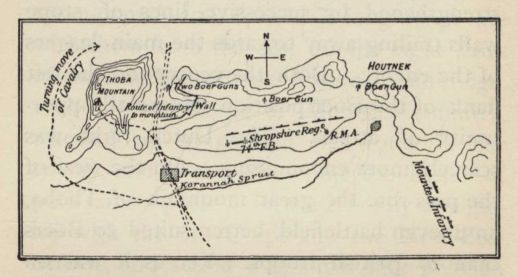
Diagram Explaining the Action of Houtnek
At 9.30 the Infantry began to come up, and at ten o'clock the approaches to the Boer position were strongly occupied. As soon as Kitchener's Horse were seen to have made good their footing on Thoba Mountain, Hamilton ordered General Smith-Dorrien to support them with part of his brigade, which was accordingly done, two companies of the Shropshires, the Gordon Highlanders, and four companies of the Canadians being successively worked up on to the hill under a heavy shell fire from the enemy. This practically disposed of the whole force, which was soon engaged all along the line, the Mounted Infantry holding the enemy off the right and right rear, the Cornwalls guarding the baggage, one-half Smith-Dorrien's Brigade containing the front, and the other half with Kitchener's Horse pushing the flank attack on Thoba Mountain. As soon as the Boers understood the designs of the British on Thoba they made a strong effort to regain and hold that important feature. At first the troops made good progress; but as the enemy received continual reinforcements the resistance became more severe, until, presently, far from gaining ground, they began to lose it. At last, about two o'clock, some one hundred and fifty of the German corps of the Boer force advanced from the northern point of Thoba in four lines across the table top to drive the British off the hill. So regular was their order that it was not until their levelled rifles were seen pointing south that they were recognised as foes, and artillery opened on them. In spite of an accurate shell fire they continued to advance boldly against the highest part of the hill, and, meanwhile, cloaked by a swell of the ground, Captain Towse, of the Gordon Highlanders, with twelve men of his own regiment and ten of Kitchener's Horse, was steadily moving towards them. The scene on the broad stage of the Thoba plateau was intensely dramatic. The whole army were the witnesses.
The two forces, strangely disproportioned, drew near to each other. Neither was visible to the other. The unexpected collision impended. From every point field glasses were turned on the spectacle, and even hardened soldiers held their breath. At last, with suddenness, both parties came face to face at fifty yards' distance. The Germans, who had already made six prisoners, called loudly on Captain Towse and his little band to surrender. What verbal answer was returned is not recorded; but a furious splutter of musketry broke out at once, and in less than a minute the long lines of the enemy recoiled in confusion, and the top of the hill was secured to the British. Among the foreigners wounded in this encounter, was Colonel Maximoff.
Captain Towse, for his conspicuous gallantry, and for the extraordinary results which attended it, has been awarded the Victoria Cross; but, in gaining what is above all things precious to a soldier, he lost what is necessary to a happy life, for in the moment when his military career was assured by a brilliant feat of arms, it was terminated by a bullet which, striking him sideways, blinded him in both eyes. Thus do Misery and Joy walk hand in hand on the field of war.
All this time the rifle and gun fire along the whole front had been continuous, and as the day wore on without the British making good their hold on Thoba Mountain the enemy gathered in a more and more threatening attitude on the right of the column, and by four o'clock at least 1,500 men were collected, with guns and 'pom-poms,' which threw shell into the rear guard and transport. Hamilton, however, was determined to fight the matter out. He therefore directed that all troops should post guards on their front, lie down wherever darkness found them, and prepare to renew the action at daybreak. He then telegraphed to General French for some assistance, the need of more mounted troops being painfully felt.
At dawn on May-day fighting recommenced, and soon after six o'clock parties of the Gordons and Canadians succeeded in gaining possession of the two peaks of Thoba Mountain. Besides this, half a company of the Shropshires, under Colour-sergeant Sconse, managed to seize the nek between them, and though subjected to a severe cross fire, which caused in this small party ten casualties out of forty, maintained themselves stubbornly for four hours. The points which dominate the flat top of the mountain were thus gained.
Meanwhile reinforcements, consisting of the 8th Hussars, a composite Lancer regiment, the East Yorkshire, and a field battery, had arrived from Thabanchu, and the approach of Bruce-Hamilton's force from the direction of Kranz Kraal was also felt. General Ian Hamilton now ordered Colonel Clowes, commanding the Cavalry, to move right round Thoba Mountain and threaten the Boer line of retreat as a preliminary and accompaniment of the main Infantry assault, which had now become inevitable. Clowes's force was strengthened by the addition of a horse battery. The newly-arrived Infantry and the field battery had to be diverted to support the right and right rear, where the pressure was now very strong.
At about eight A.M. General Smith-Dorrien had himself gone up to the top of Thoba Mountain to direct personally the decisive movement when the time should come. A little before one o'clock, the progress of the Cavalry being satisfactory, he determined to settle the matter, so that if successful the force might get its baggage over the pass before dark. He therefore formed a line of Infantry right across the plateau, two companies of the Shropshires in the centre, and one and a half company of the Gordons on either flank. The advance was sounded.
The troops moved forward with alacrity. For a few moments the fire was heavy, but the Boers knew themselves bested, and on the soldiers raising the cheer that precedes the actual assault they rushed to their horses, and the whole of Thoba Mountain was won. The rest of the position now became untenable, and the enemy, to the number of 4,000, promptly evacuated it, galloping swiftly back in the direction of Jacobsrust.
A few troops of the 8th Hussars alone got near enough to charge; half-a-dozen Dutchmen were sabred, and one was shot dead by an officer, Lieutenant Wylam. The Boers who were making the attack on the right retreated at the same time as their comrades, and the transport, no longer molested, passed safely over the pass and parked for the night on the northern side. No trustworthy estimate can be formed of the enemy's loss; but a score of prisoners were taken, and an equal number of bodies were found on the position.
The British casualties were fortunately slight considering the fire and its duration, and did not exceed a hundred officers and men.
The next day the junction between the columns was effected, and Ian Hamilton's force formed, with reference to the main advance, the Army of the Right Flank, and was composed as follows:[#]
Infantry. { 19th Brigade } Smith-Dorrien { 21st Brigade } Bruce-Hamilton Mounted { 1st M. I. } Ridley Infantry. { Brigade } Cavalry. { 2nd Cavalry } Broadwood { Brigade } { 3 Batteries F.A. } Artillery. { 2 Batteries H.A. } Waldron { 2 5-in. Guns. }
[#] For full composition see Appendix.
This force was supported by the Highland Brigade and two 4.7 naval guns, under General Colvile, who was directed to follow the leading column at a distance of ten miles. Hamilton proposed to march forward on the 2nd of May, but an order from headquarters enjoined a halt; nor was it until the afternoon of the 3rd that the force reached Jacobsrust, as it is called by the inhabitants; Isabellasfontein, as our maps record. A little cavalry skirmishing in the neighbourhood of the camp resulted in the death of one Lancer.
On the 4th of May the whole army moved forward again, Lord Roberts passing through Brandfort towards Smaldeel, Hamilton continuing his march on Winburg. This day did not pass without fighting, for scarcely had the troops left camp when a patter of musketry warned the General that his Cavalry had become engaged. Riding forward, he was the witness of a very dashing cavalry exploit. Across the line of advance was drawn up a strong force of the enemy, estimated at 4,000 men and thirteen guns. These, in a good position along a range of wooded bluffs, promised a sufficient task for the troops during the day. But now, suddenly, from the direction of Brandfort, a new army of Boers began to appear, riding swiftly down to join hands with their comrades athwart the road, and fall on the left flank of the column.
The thing was urgent, and perhaps vital. But between the fast converging Boer forces, at the angle where they would meet, ran a long ridge of indefinite extent. General Broadwood at once, without a moment's delay, galloped forward, and with two squadrons of the Guards' Cavalry and two of the 10th Hussars seized it. The Boers were already scrambling up its lower slopes. A sharp fight immediately opened. Kitchener's Horse, hurrying up in support, occupied a further point of the ridge, and the Dutch, after a determined but futile attempt to clear the hill, fell back. The junction of the two Boer columns was prevented. It seems that the whole of their plan for the day was based on this first condition, and in an army where every individual soldier must have the details of any plan explained to him it is not easy to make fresh dispositions on the field.
Indeed, a sort of panic seems to have taken hold of the enemy, for without waiting for the Infantry attack to develop they fled forthwith at great speed, galloping madly across the drift--as the British proprietor of Welcome Farm told me--horsemen and guns, pell-mell, in downright rout, pursued, so swift was their departure, only by the shells of the Horse Artillery.
The losses in this brief affair were not large, and almost entirely among the Cavalry. In those few minutes of firing on the ridge about a dozen troopers had been hit. Lord Airlie was slightly wounded in the arm, and Lieutenant Rose, Royal Horse Guards, was killed. He had bee sent forward to see what lay beyond the further crest of the hill, and found that deadly riflemen lay there waiting for a certain victim. He fell pierced by several bullets, and lived only for half an hour.
This officer was a most zealous soldier. Though possessed of private means which would have enabled him to lead a life of ease and pleasure, he had for several years devoted himself assiduously to the military profession. He went to India as a volunteer during the Tirah Campaign, and served with distinction on Sir Penn Symons' staff--general and aide-de-camp both vanished now, as the foam fades in the wake of a fast ship! From India he hastened to West Africa, and in that vile and pestilential region won a considerable reputation; indeed, he was to have received the Distinguished Service Order for his part in recent operations there had not another war intervened. He arrived at the Cape, scarcely a month ago, full of hope and energy. This is the end; and while it is one which a soldier must be ready to meet, deep sympathy will be felt for the father, from whom the public necessities have now required two gallant sons.
Though the disorderly and demoralised nature of the Boer flight through Welcome Farm was known throughout the British Army, it was not expected that so strong a position as the bluffs behind the Vet River would be yielded without a shot fired. This, nevertheless, proved to be the case, for when, on the morning of the 6th, Hamilton resumed his advance, he found that no force of the enemy stood between him and Winburg.
He therefore sent, shortly after noon, a staff officer, Captain Balfour to wit, under flag of truce, with a letter to the mayor of the town summoning him forthwith to surrender the town and all stores therein, and promising that if this were done he would use every effort to protect private property, and that whatever foodstuffs were required by the troops should be paid for. This message, which was duly heralded by the sound of a trumpet, concluded by saying that unless an acceptance was received within two hours the General would understand that his offer had been declined.
Thus accredited, Captain Balfour made his way into the town and was soon the centre of an anxious and excited crowd of burghers and others who filled the market square. The mayor, the landdrost, and other prominent persons--indeed, all the inhabitants--were eager to avail themselves of the good terms, and a satisfactory settlement was almost arranged when, arriving swiftly from the northeast, Philip Botha and a commando of 500 men, mostly Germans and Hollanders, all very truculent since they were as yet unbeaten, entered the town.
A violent and passionate scene ensued. Botha declared he would never surrender Winburg without a fight. Dissatisfied with the attentions paid him by Captain Balfour, he turned furiously on him and rated him soundly. Several of the Free Staters had asked what would be done to them if they laid down their arms. Balfour had replied that they would be permitted to return to their farms, unless actually captured on the field. This Botha held to be a breach of the laws of war, and he thereupon charged the officer with attempting to suborn his burghers. What had he to say that he should not be made a prisoner? 'I ask favours of no Dutchman,' replied Balfour, sternly.
'Arrest that man!' shouted Botha, in a fury; 'I shall begin shooting soon.' At these shameful words a great commotion arose. The women screamed, the mayor and landdrost rushed forward in the hopes of averting bloodshed. The Boers raised their rifles in menace, and the unarmed British envoy flourished his white flag indignantly.
For several minutes it seemed that an actual scuffle, possibly a tragedy, would occur. But the influence of the townsfolk, who knew that their liberty and property lay in the hands of the Imperial General, and that the great siege guns were even then being dragged into effective range, prevailed, and Philip Botha, followed by his men, galloped furiously from the square towards the north.
That afternoon General Ian Hamilton entered Winburg at the head of his troops. Under a shady tree outside the town the mayor and landdrost tendered their submission and two large silver keys. The Union Jack was hoisted in the market-place amid the cheers of the British section of the inhabitants, and, as each battalion marching through the streets saw the famous emblem of pride and power, bright in the rays of the setting sun, these feeble or interested plaudits were drowned in the loud acclamations of the victorious invaders.
Hamilton was expected to arrive on the 7th, if no opposition was encountered, He had fought nearly every day, and reached the town on the evening of the 5th.
CHAPTER X
THE ARMY OF THE RIGHT FLANK
Kroonstadt: May 16, 1900.
On the same day that Ian Hamilton's force won their fight at Houtnek, to wit, the 1st of May, the advance of the main army towards Pretoria, long expected, long prepared, long delayed, began, and the Eleventh Division marched north from Bloemfontein to join the Seventh, which was entrenched at Karree Siding. On the 3rd both Infantry divisions moved forward along the railway, their left protected by Gordon's Cavalry Brigade and Hutton's Mounted Infantry, and after a sharp cannonade drove the Boers from their positions covering Brandfort and entered the town. The advance was resumed on the 5th, and the enemy were again met with, this time holding the line of the Vet River. Another artillery action ensued, in which the British 5-inch and naval 4.7 guns were very effective, and at the end of which the West Australians and other parts of Hutton's Mounted Infantry force, pushed across the river in gallant style and captured an important kopje. The Dutchmen then retreated, and the Field-Marshal's headquarters on the 6th were fixed in Smaldeel. His losses since leaving Bloemfontein had not amounted to twenty-five men.
Ian Hamilton, in spite of the long marches his troops had made, was impatient to push on from Winburg without delay, and, following the track to Ventersburg, to seize the drifts across the Sand River, twenty miles to the north. The great speed of his last movement had outpaced the Boers, and their convoys were struggling along abreast of, and even behind, the British column, trying vainly to slip across our front, and join the burgher forces accumulating for the defence of Kroonstadt. By marching forthwith--great though the strain might be--the General hoped to secure the bloodless passage of the river, and perhaps cut up some of these same toiling convoys. Accordingly, having collected from the town about three days' stores--Sir Henry Colvile helping him unselfishly with mule waggons--he set his brigades in motion on the afternoon of the 6th, and marched nine miles towards the Sand.
But Lord Roberts had decided to remain at Smaldeel until his temporary bridge over the Vet River was made and the trains running, and he did not choose to run the risk of the Boers concentrating all their forces upon any single division of his army, such as would be incurred if Hamilton pushed forward alone. The principle was indisputable; but, of course, in practice it resolved itself into another instance of balancing drawbacks, for delay gave the enemy time to get his breath, and meant that the Sand River passage would be opposed. Besides, if the Boers had flung all their strength upon Hamilton, we were 7,000 bayonets, 3,000 horse, and nearly forty guns, and would have beat them off with a shocking slaughter. To us it seemed a great pity to wait; but to the Chief, in whose eyes the Army of the Right Flank was but one column of that far-flung line which stretched from Rundle near Senekal, along the front of the main army to Methuen near Boshof, Hunter at Warrenton, and Mahon far away on the fringe of the Kalahari desert, it must have been a very small matter, and certainly not one justifying any loss of cohesion in the general scheme. So I have no doubt that it was right to make us halt on the 7th and 8th.
On the former of these two days of rest Lord Roberts sent for General Hamilton to meet him at a point on the branch railway line mid-way between Winburg and Smaldeel, and they had a long private conference together. On the 9th, the whole army marched forward again towards the Sand River. I rode with the General, who managed somehow to find himself among the cavalry patrols of the right flank guard, and we watched with telescopes three long lines of dust in the eastward, which, under examination, developed into horsemen and waggons marching swiftly north and turning more and more across our front. It was clear that if we had pushed on without halting, all these commandos would have been prevented from reaching Kroonstadt. The General contemplated them hungrily for some time, but they were too far off to attack, bearing in mind the great combination of which we were a part. The flanking patrols, however, exchanged a few shots.
The march was not a long one, and by mid-day we reached the halting-place, a mile south of the river. The headquarters were fixed in a large farm which stood close to the waggon-track we followed.
This farmhouse was certainly the best purely Dutch homestead I have ever seen in the 500 miles I have ridden about the Free State. It was a large square building, with a deep verandah, and a pretty flower-garden in front, and half a dozen barns and stables around it. The construction of a dam across the neighbouring spruit had formed a wide and pleasant pool, in which many good fat ducks and geese were taking refuge from the wandering soldier. At the back, indeed, on all sides but the front of the farm, rose a thick belt of fir-trees. Within the house the ground-floor was divided into three excellent bedrooms, with old-fashioned feather-beds and quaint wooden bedsteads, a prim but spacious parlour, a kitchen, pantry, and storeroom. The parlour deserved the greatest attention. The furniture was dark and massive. The boards of the floor were deeply stained. In the middle was a good carpet upon which an ample oval table stood. The walls were hung with curious prints or coloured plates, and several texts in Dutch. One pair of plates I remember represented the ten stages of man's life and woman's life, and showed both in every period from the cradle to the grave, which latter was not reached until the comfortable age of one hundred. The woman's fortunes were especially prosperous. At birth she sprawled contentedly in a cradle, whilst loving parents bent over her in rapture, and dutiful angels hung attendant in the sky. At ten she scampered after a hoop. At twenty she reclined on the stalwart shoulder of an exemplary lover. At thirty she was engaged in teaching seven children their letters. At forty, she celebrated a silver wedding. At fifty, still young and blooming, she attended the christening of a grandchild. At sixty, it was a great-grandchild. At seventy she enjoyed a golden wedding. At eighty she was smilingly engaged in knitting. Even at ninety she was well preserved, nor could she with reason complain of her lot in life when, at a hundred, the inevitable hour arrived. 'Be fruitful and multiply,' was the meaning of a Dutch text on the opposite wall, and a dozen children black and white (little Kaffirs, the offspring of the servants, playing with the sons and daughters of the house) showed that the spirit of the injunction was observed; and these are things with which the statesman will have to reckon.
The inmates of the farm consisted of the old man, a venerable gentleman of about sixty years, his dame, a few years younger, three grown-up daughters, a rather ill-favoured spinster sister, and seven or eight children or grandchildren of varying ages. There were in all seven sons or grandsons--two were married and had farms of their own; but all, including even one of fourteen, were 'on commando' at the wars, some, perhaps, looking at us and their home from the heights across the river.
The General politely requested shelter for the night, and a bedroom and the parlour were placed at his disposal; not very enthusiastically, indeed, but that was only natural. The staff settled down in the verandah so as not to disturb the family. Ian Hamilton, keenly interested in everything, began at once to ask the old lady questions through an interpreter. She gave her answers with no good grace, and when the General inquired about her youngest fighting son--he of fourteen--her sour face showed signs of emotion, and the conversation ended for the day. On the morrow, however, just before he crossed the river, he had to come back to the telegraph-tent pitched near the farm, and found time to see her again.
'Tell her,' he said to the interpreter, 'that we have won the battle to-day.'
They told her, and she bowed her head with some dignity.
'Tell her that the Dutch will now certainly be beaten in the war.'
No response.
'Perhaps her sons will be taken prisoners.'
No answer.
'Now tell her to write down on a piece of paper the name of the youngest, and give it to my aide-de-camp; and then when he is captured she must write to me or to the Hoofd-General, and we will send him back to her, and not keep him a prisoner.'
She thawed a little at this, and expressed a hope that he had been comfortable while beneath her roof, and then--for the guns were still firing--he had to hurry away. But the aide-de-camp remained behind for the paper.
During the time we spent in this homely place I made a thorough inspection of the farm, especially the parlour, where I found one very curious book. It was a collection of national songs and ballads, compiled, and in part written, by Mr. Reitz. I afterwards succeeded in buying another copy in Ventersburg; indeed, it has been widely disseminated. The first part consists of patriotic Boer poems--the Volkslied, the Battle of Majuba, the Battle of Laings Nek, and other similar themes. The second half of the book is filled with Reitz's translations of English songs and well-known ditties into the taal. John Gilpin, besides being a burgher of credit and renown, was eke a Field-Cornet of famous Bloemfontein. Young Lochinvar had come from out of the Boshof district. The Landdrost's daughter of Winburg found a lover no less faithful than a famous swain of Islington. The pictures were mightily diverting. The old Field-Cornet Gilpin--'Jan Jurgens,' as he called himself now--was shown galloping wildly along, on a pulling Basuto pony, through the straggling streets of, let us say, Ventersburg, his slouch hat crammed over his eyes, his white beard flapping in the wind, while a stately vrouw, four children, and a Kaffir, flung up their hands in mingled wonder and derision.
One piece began:
Engels! Engels! alles Engels! Engels wat jij siet en hoor.
Ins ons skole, in ons kerke, word ons modertaal vermoor.
I cannot read Dutch, but the meaning and object of the book were sufficiently clear without that knowledge.
F. W. Reitz, sometime President of the Free State, now State Secretary of the Transvaal, looked far ahead, and worked hard. This, the foundation-stone of a vernacular literature, was but one act in the long scheme of policy, pursued, year in year out, with tireless energy, and indomitable perseverance, to manufacture a new Dutch nation in South Africa--the policy which, in the end, had brought a conquering army to this quiet farm, and scattered the schemers far and wide. But what a game it must have been to play! Only a little more patience, a little less pride and over-confidence, concessions here, concessions there, anything to gain time, and then, some day--a mighty Dutch Republic, 'the exchange of a wealthier Amsterdam, the schools of a more learned Leyden,' and, above all--no cursed Engels.
I was considering these matters, only suggested here, when messengers and the sound of firing came in from the eastward. The news that small parties of Boers were engaging our right flank guard did not prevent Hamilton riding over to meet the Chief, nor tempt us to quit the cool verandah of the farm; but when, suddenly, at about three o'clock, fifty shots rang out in quick succession, scarcely 500 yards away, every one got up in a hurry, and, snatching pistols and belts, ran out to see what mischance had occurred. The scene that met our eyes was unusual. Down the side of the hill there poured a regular cascade of antelope--certainly not less than 700 or 800 in number--maddened with fear at finding themselves in the midst of the camp, and seeking frantically for a refuge. This spectacle, combined with the hope of venison, was too much for the soldiers, and forthwith a wild and very dangerous fire broke out, which was not stopped until fifteen or twenty antelopes were killed, and one Australian Mounted Infantryman wounded in the stomach. The injury of the latter was at first thought to be serious, and the rumour ran that he was dead; but, luckily, the bullet only cut the skin.
Thus disturbed, I thought it might be worth while to walk up to the outpost line and see what was passing there. When I reached the two guns which were posted on the near ridge, the officers were in consultation. Away across the Sand River, near two little kopjes, was a goodly Boer commando. They had just arrived from the east of our line of march, and having skirted round our pickets had set themselves down to rest and refresh. Spread as they were on the smooth grass, the telescope showed every detail. There were about 150 horsemen, with five ox-waggons and two guns. The horses were grazing, but not off-saddled. The men were lying or sitting on the ground. Evidently they thought themselves out of range. The subaltern commanding the guns was not quite sure that he agreed with them. Some Colonial Mounted Infantry officers standing near were almost indignant that the guns should let such a chance slip. The subaltern was very anxious to fire--'really think I could reach the brutes'; but he was afraid he would get into trouble if he fired his guns at any range greater than artillery custom approves. His range finders said '6,000.' Making allowances for the clear atmosphere, I should have thought it was more. At last he decided to have a shot. 'Sight for 5,600, and let's see how much we fall short.' The gun cocked its nose high in the air and flung its shell accordingly. To our astonishment the projectile passed far over the Boer commando, and burst nearly 500 yards beyond them: to our astonishment and to theirs. The burghers lost no time in changing their position. The men ran to their horses, and, mounting, galloped away in a dispersing cloud. Their guns whipped up and made for the further hills. The ox-waggons sought the shelter of a neighbouring donga. Meanwhile, the artillery subaltern, delighted at the success of his venture, pursued all these objects with his fire, and using both his guns threw at least a dozen shells among them. Material result: one horse killed. This sort of artillery fire is what we call waste of ammunition when we do it to others, and a confounded nuisance when they do it to us. After all, who is there who enjoys being disturbed by shells just as he is settling himself comfortably to rest, after a long march? And who fights the better next day for having to scurry a mile and a half to cover with iron pursuers at his heels? Even as it was an opportunity was lost. We ought to have sneaked up six guns, a dozen if there were a dozen handy, all along the ridge, and let fly with the whole lot, at ranges varying from 5,000 to 6,000 yards with time shrapnel. Then there would have been a material as well as a moral effect. 'Pooh,' says the scientific artillerist, 'you would have used fifty shells, tired your men, and disturbed your horses, to hit a dozen scallawags and stampede 150. That is not the function of artillery.' Nevertheless, function or no function, it is war, and the way to win war. Harass, bait, and worry your enemy until you establish a funk. Once he is more frightened of you than you are of him, all your enterprises will prosper; and if fifty shells can in any way accelerate that happy condition, be sure they are not wasted.
The afternoon passed uneventfully away, though the outposts were gradually drawn into a rifle duel with the Dutch sharpshooters in the scrub across the river. In the evening the General returned from his conference with Lord Roberts, and told us the passage was to be forced on the morrow all along the line. The Army of the Right Flank would cross by the nearest drift in our present front. The Seventh Division inclining to its right would come into line on our left. The Field-Marshal, with the Guards and the rest of Pole-Carew's Division, would strike north along the line of the railway. French, with two Cavalry brigades and Hutton's Mounted Infantry brigade, was to swing around the enemy's right and push hard for Ventersburg siding. Broadwood from our flank, with the Second Cavalry Brigade, and such of the Second Mounted Infantry Brigade as could be spared, was to be thrust through as soon as the Boer front was broken, and try to join hands with French, thus, perhaps, cutting off and encircling the Boer right. The diagram--it is not a map--on page 172 will help to explain the scheme.
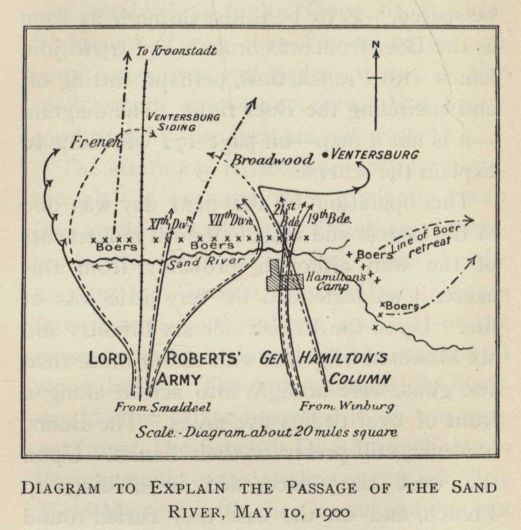
DIAGRAM TO EXPLAIN THE PASSAGE OF THE SAND RIVER, MAY 10, 1900. The dotted lines show what was proposed; the continuous lines show what was done. The crosses indicate the Boers.
The operation of the next day was one of the largest and most extended movements of the war, although, probably from this cause, it was attended by very little loss of life. Upon the British side six Infantry and six Mounted brigades, with rather more than 100 guns, were brought into action along a front of over twenty-five miles. The Boers, however, still preserved their flanks. Upon the west they succeeded in holding up French, and on the east they curled round Hamilton's right and rear so that his action here, which in its early stages resembled that afterwards fought at Diamond Hill, was of a piercing rather than a turning nature. But in thus amazingly extending their scanty forces, which, altogether, did not number more than 9,000 men, with twenty-five guns, the enemy became so weak all along their front that the attacking divisions broke through everywhere, as an iron bar might smash thin ice, with scarcely any shock.
On the evening of the 10th, the British forces, in their extended line, lay spread along the south bank of the river, just out of cannon-shot of the Boer positions on the further side. French, indeed, did not rest content with securing his ford twelve miles to the west of the railway, but pushed his two brigades across before dark. The wisdom of this movement is disputed. On the one hand, it is contended that by crossing he revealed the intention of the Commander-in-Chief, and drew more opposition against himself the next day. On the other, it is urged that he was right to get across unopposed while he could, and that his purpose was equally revealed, no matter which side of the river he stayed. During the night Ian Hamilton, at the other end of the line, seized the drift in his front with a battalion, which promptly entrenched itself. Tucker, who proposed to cross near the same point, despatched the Cheshire regiment for a similar purpose. The single battalion was sufficient; but the importance and wisdom of the movement was proved by the fact that the enemy during the night sent 400 men to occupy the river bank and hold the passage, and found themselves forestalled.
At daybreak the engagement was begun along the whole front. I am only concerned with Ian Hamilton's operations; but, in order that these may be understood, some mention must be made of the other forces. French advanced as soon as it was light, and almost immediately became engaged with a strong force of Boers, who barred his path, and prevented his closing on the railway as intended. A sharp Cavalry action followed, in which the Boers fought with much stubbornness; and the Afrikander Horse, a corps of formidable mercenaries, even came to close quarters with Dickson's brigade, and were charged. French persevered throughout the day, making very little progress towards the railway, but gaining ground gradually to the north. Although his casualties numbered more than a hundred, he was still some distance from Ventersburg siding at nightfall. The centre attack properly awaited the progress of the flanking movements, and was, during the early part of the day, contented with an artillery bombardment, chiefly conducted by its heavy guns. Tucker and Hamilton, however, fell on with much determination, and were soon briskly engaged.
Ian Hamilton began his action at half-past five, with his heavy guns, which shelled the opposite heights leisurely, while the Infantry and Cavalry were moving off. The Boer position before us ran along a line of grassy ridges, with occasional kopjes, which sloped up gradually and reached their summits about a mile from the river. But besides this position, which was the objective of the force, the Boers, who held all the country to the east, began a disquieting attack along our right and right rear, and although the Mounted Infantry, and principally Kitchener's Horse, under Major Fowle, held them at arm's length throughout the day, the firing in this quarter caused the General some concern, and occupied the greater part of his attention.
At six o'clock the Twenty-first Brigade began to cross the river, and Bruce-Hamilton, stretching out to his left, soon developed a wide front. The Boers now opened fire with two or three field-guns and a 'pom-pom,' which latter was quickly silenced by our heavy pieces. At the same time, the Nineteenth Brigade, who were containing the enemy's left, became engaged with their skirmishers in the scrub by the river. The four batteries of Field Artillery also came into action, and were pushed forward across the drift as soon as sufficient space was gained by the Infantry. At a little after seven the head of General Tucker's Division appeared on the plain to our left, and that determined officer thrust his men over the river in most vigorous style. Moreover, seeing Bruce-Hamilton committed to an assault, he swung two of his own batteries round to the eastward, and so rendered us material assistance.
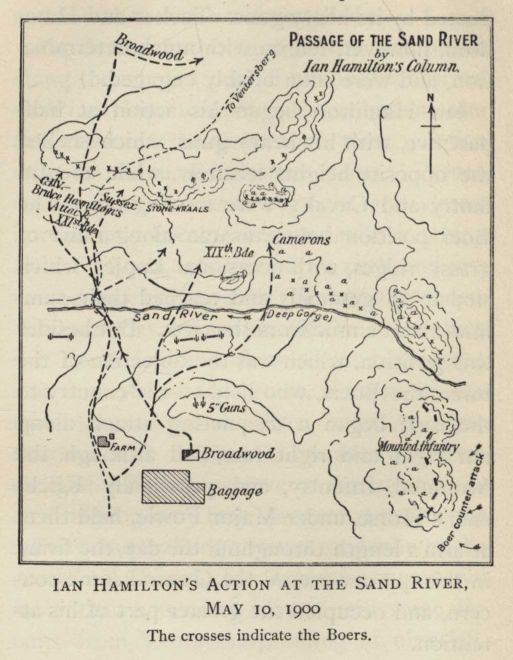
IAN HAMILTON'S ACTION AT THE SAND RIVER, MAY 10, 1900. The crosses indicate the Boers.
Both Smith-Dorrien, who directed the two Infantry brigades, and Ian Hamilton were fully alive to the grave dangers of crowding too many troops on to a narrow front, and the Infantry attack was very sparingly fed with supports, until it became completely extended. This condition was attained about eleven o'clock, when the Camerons were sent across the river to clear the scrub and prolong the line to the right. Bruce-Hamilton now had his deployment completed, and with an admirable simultaneity the whole of the assaulting Infantry rose up and advanced together upon the enemy's position, covered by the heavy fire of twenty-six guns. The panorama was now very extensive. Far away to the left the smoke of lyddite shells, and the curious speck of the war-balloon high in the clear air, showed that the centre was engaged. The whole of the Seventh Division had crossed the Sand, and were now curving to the north-west amid a crackle of fire. Before us the slopes were sprinkled with brown dots moving swiftly upwards. The crest of the ridge was fringed with exploding shells. For a few minutes the Boers fired steadily, and the dust jumped amid the Sussex Regiment and the City Imperial Volunteers. But both Infantry and Artillery attacks were far beyond the capacity of the defence to resist, and by noon the whole of the heights beyond the Sand were in the British possession.
Ian Hamilton had meanwhile ordered baggage and Cavalry to cross. Broadwood was over the enemy's position almost as soon as the Infantry. He proceeded to move in the direction of Ventersburg siding. The enemy, however, had covered themselves with a strong rearguard, and the Cavalry were soon opposed by three guns and a force of riflemen of considerable numbers. Whether Broadwood would have thought it worth while to make here the effort which he afterwards made in the action of Diamond Hill, and order a charge, is uncertain; for at this moment a misunderstanding arose which induced him to change his plans altogether.
The Boer pressure on our right rear had been growing stronger and stronger all the morning, and at length Hamilton, wishing to check the enemy sharply, so as to draw his rearguard over the river after his baggage, told his chief of artillery to find him a battery. Now it happened that only one of the two horse batteries, 'P,' had been able to go with the Cavalry, the other, 'Q,' being too tired to keep up. The chief of artillery therefore proposed to send for the tired battery. Unfortunately, by some mistake, either in giving or taking the order, the orderly was sent for 'P' instead of 'Q.' The man, a sergeant-major, galloped across the river, and, understanding that the matter was urgent, hurried after Broadwood, overtook him just as he was becoming engaged, and demanded the battery. Broadwood, who knew that Hamilton would never deprive him of his guns except for some very urgent reason, sent them at once, abandoned his movement to the north-west, which indeed was now impracticable without artillery, and concluding that the rearguard was seriously involved, turned sharply to the east to assist them. Explanations arrived too late to make it worth while to revert to the original plan, and, perhaps, seeing that French was unable to make Ventersburg siding, it was just as well that Broadwood did not try alone.
Broadwood's latest movement, or the action of the artillery, or the knowledge that the British had successfully forced the passage of the river at all points, induced the Boers who were assailing the rearguard to desist, and the musketry in that quarter gradually died away. Meanwhile, by the exertions of Lieutenant-Colonel Maxse, the baggage had mostly been dragged across the river, and Ian Hamilton made haste to overtake his victorious Infantry, who had already disappeared into the valley beyond the enemy's position. By the time that we reached the top of the high ground, Bruce-Hamilton's leading battalions were nearly a mile further on, and the tail of Broadwood's brigade was vanishing in a high cloud of dust to the eastward. The City Imperial Volunteers, who had lost a few men in the attack, were resting on the hill after their advance, and eating their biscuits. Several dead Boers had been found lying among the rocks, and a burial party was at work digging a grave for these and for four of our own men who had fallen close by. There were also a few prisoners--Transvaalers for the most part--who had surrendered when the troops fixed bayonets. Four miles away to the north-east the trees and houses of Ventersburg rose from a grassy hollow.
The General decided to bivouac in the valley beyond the enemy's position, and to set his pickets upon the hills to the northward. He also sent an officer with a flag of truce into Ventersburg to demand the surrender of the town, and directed Broadwood to detach a regiment and some Mounted Infantry to occupy it, should the enemy comply. In case they should desire to hold the town the 5-inch guns were brought into position on the captured heights.
Hoping to secure some supplies, particularly bottled beer, before everything should be requisitioned by the army, I rode forward after the flag of truce had gone in and waited where I could see what followed. When, about an hour later, a cavalry force began to advance from the direction of Broadwood upon the town, I knew that all was well, and trotted on to join them. My road led me within a few hundred yards of the town, but, luckily for me, I did not enter it alone, and hurried to join the troops. All of a sudden the ominous patter of rifle shots broke the stillness of the evening, and, turning to whence the sound came, I saw a score of Boers standing on the sky-line about a mile away and firing at the advancing Cavalry, or, perhaps, for I was much nearer, at me. The next minute there galloped out of the town about a score of Dutchmen, who fled in the direction of their friends on the western sky-line. Had I ridden straight into the town I should have run into these people's jaws. I lost no time in joining the Cavalry, and entered the streets with the squadron of Blues. It was a miserable little place, not to be compared with Winburg. There were a few good stores and a small hotel, where I found what I sought; but the whole town was very dirty and squalid. Thirty or forty troopers of Roberts's Horse were firing at the fugitive burghers from the edge of the buildings and gardens, while a score of reckless fellows were galloping after them in excited pursuit. The Boers on the hill kept up a brisk fire to help their comrades in, and not a few of the bullets kicked up the dust in the village streets, without in the least disturbing the women and children who crowded together to look at the war, in blissful ignorance of their danger. When some of these people were told that they would perhaps be killed if they came out of their houses while the fighting was going on, they clutched their children and sought shelter with an energy at which, since, after all, nobody was hurt, it was pardonable to laugh.
Night put an end to all skirmishing, and under its cover the Boers retreated--the greater part to Kroonstadt, which, be it remembered, they meant to hold to the death; but a considerable proportion to the east, where they collected with the commandos under Christian de Wet. Broadwood's brigade had captured about a dozen waggons and thirty prisoners. In all there were fifty-two unwounded and seven wounded Boers in our hands at the end of the day. The casualties in Hamilton's force were under fifty. Tucker and Pole-Carew may have lost the same number between them. French, who encountered the most stubborn resistance, had a little over 120. But, in any case, the passage of the Sand River in this long straggling action was cheaply won at a cost of under 250 officers and men.
All our beasts were so exhausted by the labour of dragging the waggons through the steep and rocky drift of the Sand, and by the long pull up the hills on the opposite side, that few of the regiments got their baggage that night, and hence it was impossible to make an early start next morning. But it was known that the Field-Marshal meant to reach Kroonstadt on the next day, and as all the information at our disposal indicated that the Boers were entrenching a strong position along a line of wooded bluffs called the Boschrand, just south of the town, every minute of halt was grudged.
We moved at eleven o'clock, heading direct for Kroonstadt, and persevered for two hours after the sun had set, making in all nearly seventeen miles. The country to our left was flat and open, and as we converged upon the main army we could see, like red clouds with the sunset behind them, the long parallel lines of dust, which marked the marches of the Seventh and Eleventh Divisions; and we knew besides, that, beyond both columns and west of the railroad, French was driving his weary squadrons forward upon another wide swoop. The army drew together in the expectation of a great action. But for all our marching we could never make up the extra distance we had to cover in coming diagonally from the flank, and as darkness fell we realised that the Seventh Division was drawing across our front, and that Pole-Carew with the guard was striding along ahead of us all. That night Lord Roberts slept at America Siding, scarcely six miles from the Boschrand position.
Ian Hamilton marched on again at dawn, transport and convoys struggling along miles behind, and the fine-drawn yet eager Infantry close upon the heels of the Cavalry screen. At times we listened for the sound of guns, for if the enemy stood, the Field-Marshal must come into contact with them by eight o'clock. And when, after nine o'clock, no cannonade was heard, the rumour ran through the army that the Boers had fled without giving battle, the pace slacked off, and the Infantry began to feel the effects of their exertions.
At eleven a message from Lord Roberts reached General Broadwood to say that it did not matter by which road Hamilton's column marched in, as the enemy was not holding his positions. Thereupon I determined, since there was to be no battle, to see the capture of Kroonstadt, and being mounted on a fresh pony I had bought at Winburg, a beautiful and tireless little beast, by an English blood sire out of a Basuto mare, I soon left the Cavalry behind, caught up the rear of Tucker's transport, pushed on four or five miles along the line of march of his division, struck the tail of the Eleventh Division, and finally overtook the head of the Infantry columns about three miles from the town.
Lord Roberts entered Kroonstadt at about mid-day with all his staff. The Eleventh Division, including the Guards' Brigade, marched past him in the market square, and then, passing through the town, went into bivouac on the northern side. The rest of the army halted south of Kroonstadt. Gordon's Cavalry Brigade a mile from the town; the Seventh Division and Ian Hamilton's force three miles away, in a wide valley among the scrub-covered, trench-rimmed hills the Boers had not dared defend. French, whose turning movement had again been obstinately opposed, reached the railway line north of the town too late to intercept any rolling stock. Indeed, Major Hunter Weston, a daring and enterprising engineer, arrived at the bridge he had hoped to blow up only to find that it had been blown up by the enemy.
Thus, by one long spring from Bloemfontein, Kroonstadt, the new capital of the Free State, was captured. It has the reputation of being one of the prettiest places in the Republic, but even when allowances are made for the circumstances under which we saw it, it does not seem that its fame is just. The town looked a little larger than Winburg, though not nearly so clean and well-kept, and the whole place was smothered in reddish dust, and dried up by the sun. The Boers retreated northward along the railway, in spite of all President Steyn's exhortations, which included the public sjambokking of several unwilling burghers, and did not stop except to wreck the permanent way until they reached Rhenoster kopjes. The President, with the members of the Executive Council and the seat of Government--which needs to have a good pair of legs beneath it in times like these--withdrew to Lindley, whither, for various reasons, it soon became desirable to follow them.
CHAPTER XI
LINDLEY
Heilbron: May 22, 1900.
Having arrived thus prosperously at Kroonstadt, Lord Roberts determined to halt until his supplies were replenished and the railway line from Bloemfontein in working order. Moreover, in the expectation of a general action outside the town, he had concentrated all his troops and had drawn the Army of the Right Flank close in to the main force. Before he advanced again towards the enemy's position on the Rhenoster River, he wished to extend his front widely, as he had done in the previous operation. The scheme of advance by converging columns required a pause after each concentration before the movement could be repeated; so that while the Field-Marshal himself remained stationary his energetic Lieutenant was again on the move.
General Ian Hamilton, with the same troops as before and an addition of four 'pom-poms,' started from his camp outside Kroonstadt on the 15th, and after a short march encamped on the eastern side of the town preparatory to moving on Lindley, whither President Steyn had withdrawn. The question of supplies was a very troublesome one, and it was no light matter to thrust out fifty miles into a hostile country with only three and a half days' food and forage in hand. Suppose anything should happen to the convoys which were to follow. Meat in plenty could be found everywhere, but the stores of flour and other farinaceous goods which the farm-houses might contain were insufficient and precarious. Even the benefits of the abundant meat supply were to some extent discounted by the scarcity of wood, for it is not much satisfaction to a soldier to be provided with a leg of mutton if he has no means of cooking. The deficiencies were hardly made good by the arrival of a small convoy, the greater part of which consisted of disinfectants for standing camps, and the rest--so valuable in a grass country--of compressed hay.