"Hunting the Skipper" (continued 8)
Reading edition
“No, Tom. Are you?”
“No, sir. But that’s about how it is, arn’t it?”
“Yes, I believe so, Tom.”
“Then it goes on as I said till their medicine man—sort o’ priest, I suppose—stirs ’em to make another try to get the upper hand. Talks a lot o’ that nonsense to ’em about fetish and Obeah, as they calls it, and shows the poor benighted chaps a bit of hanky panky work with a big snake like that we saw to-night. Makes ’em think the snake’s horrid poisonous, and that it can’t bite him as handles it, because he’s took some stuff or another. Rum game that there was with that sarpent, and—I say, sir, don’t you think we’d better get up now for a bit and just mark time? You see, we can’t walk, for if we do we shall lose ourselves.”
“We might take it in turns, and just keep touch of one another.”
“What, sir? No, thankye. Ketch me trying that way again! We’ve had enough of that. Fust thing, though, let’s see how our wounded’s getting on.”
“Yes, Tom,” said Murray; and they felt for their unfortunate companions in the darkness, with the result that Titely flung out one fist with the accompaniment of an angry growl, and at the first touch of Murray’s fingers, Roberts uttered an angry expostulation, taking all the stiffness out of his brother middy’s joints as the lad started, broke out in a violent perspiration, and caught hold of his wakeful companion, for the pair to stand listening for some sign of the enemy having heard the cry, and beginning to steal silently towards them.
“Cutlasses, Tom,” whispered Murray, with his lips to the big sailor’s ear, and together they unsheathed their weapons and stood back to back, ready to defend themselves.
“Thrust, Tom,” whispered Murray again.
“Ay, ay, sir!” And then the terrible silence of the black darkness was only broken by a faint mutter from one or other of the wounded pair, while the listeners breathed hard in agony, trying the while to suppress the going and coming of the prime necessity of life. Murray pressed the hard hilt of his cutlass against his breast in the faint hope that by so doing he could deaden the heavy throbbing that sounded loudly to his ear, while if any one was approaching at all near he felt certain that he must hear the dull thumps that went on within the breast of the big sailor.
There was another dread, too, which troubled the watch-keepers: at any moment they felt certain the disturbed sleepers might begin talking aloud. But that peril they were spared.
“Don’t hear anything, sir,” whispered Tom, at last. “I made sure we should have brought them down upon us. I say, sir, it seems to me as Natur must have made some mistake.”
“How?” asked Murray.
“Forgot to wind up the sun last night.”
“What do you mean?”
“So as it should rise again.”
“Nonsense!” said Murray, in a voice which sounded to be full of annoyance. “That’s the morning breeze beginning to blow.”
“Well, I don’t care, sir,” grumbled the big sailor; “it ought to have been to-morrow morning before now. Sun must be late. I never knowed such a long night before.”
“It’s coming, Tom, and before long. Isn’t that the warm glow?”
“No,” said the sailor shortly. “As you said, there’s a breeze coming up from somewhere or another, and tidy strong, too.”
“Yes,” said Murray.
“Well, it’s blowing up the embers of the fire that was burning its way through the woods.”
“Think so, Tom?” said Murray, his companion’s words arousing his interest.
“Yes, sir; that’s it. Can’t you see that it looks reddish?”
“So does the sunrise.”
“Yes, sir, that’s true; but all the same I’m sartain that’s the fire brightening up a bit. We haven’t seen no pale dawn yet.”
“If it would only come, Tom!”
“Yes, sir; and what then?”
“We shall be able to find our messmates and bring them to our side.”
“Maybe we shall bring the black and white niggers instead, sir, and it’ll mean a fight, for we’re not going to give up quietly, are we?”
“No, Tom, and I hope that when those two wake up they may be able to fire a shot or two to help us.”
“Hope so, sir. But look yonder: there’s the dawn coming.”
“Yes!” whispered Murray eagerly. “Look; I can just make out the branches of a tree against the sky.”
“That’s right, sir. Now for it; what’s it going to be—enemies or friends?”
“Friends, Tom,” whispered Murray confidently.
There was a pause, during which the pair stood gazing straight before them, striving to pierce the dim dawn which seemed to consist for the most part of a thick mist which lay low upon the surface of the earth, while above the top of the forest all was fairly clear.
Then all at once, very softly, but so clear of utterance that the word seemed to vibrate in the middy’s ear, the big sailor uttered a whisper, as he pressed his firm, strong hand upon the lad’s shoulder.
His word was “Enemies!” and in obedience to the warning, Murray sank down till he lay prone upon the dew-wet earth.
For about fifty yards away there were figures moving, and evidently in the direction of the spot where the two watchers lay.
Chapter Thirty Nine.
On the Strain.
Roberts and Titely lay close by, breathing heavily, but to Murray’s horror it seemed as if, faintly spoken as it was, the big sailor’s warning had reached the sensitive nerves of both the wounded, making them stir uneasily and mutter something unintelligible, while the light of morning, which had before been so sluggish in its approach, seemed now to be coming on by a steady glide, as if the black darkness which had pressed so heavily upon the spirits of two of the party was now being swept away like a cloud.
A terrible dread came over Murray, for he saw in the moving figures death coming upon him in most probably some horribly brutal form, and he could feel his nerves thrill with an icy sensation which had its origin among the roots of his hair and then began to glide down his spine till it reached to and made its exit from his toes; while in spite of what he suffered, he could not help recalling some of the words which had passed between him and his waking companion as he was conscious of fresh movements on the part of Roberts and Titely, and he wished that he could carry out what had been proposed, namely, to sit upon the pair and keep them quiet.
“They’ll let the wretches know where we are,” he thought, and quietly reaching out one leg till he could reach Tom May’s big body, he gave him a steady thrust.
“That will keep him on the qui vive,” he thought to himself; and then the lad started violently, for the big sailor responded with a well-meant but decidedly forcible kick, which Murray took for a warning of impending danger, and raised his head to look, but dropped it again on the instant, throbbing with excitement, for there were the moving figures, clearly seen now, in the shape of a villainous-looking party of about a dozen well-armed men, clothed sailor fashion and graduated in colour from the sun-tanned skin of a white through the swarthiness of the Malay and Mulatto to the black of the East Indian and the intense ebony of the African black.
He gazed in that moment, as he knew for certain, upon a party of the cut-throat ruffians belonging to the crew of one of the slave-trade vessels, and as he subsided, it was with the feeling upon him that his head must have been seen, that in another instant he should be listening to the rush of feet, and would have to make a desperate effort to preserve his life, while all the while he was lying there suffering from a kind of paralysis which held him as if he were passing through the worst phases of a nightmare-like dream.
“Poor old Dick!” he thought, as if in a flash. “We were always quarrelling, and he was horribly jealous of me; but I liked him, and I’d do anything to save him. But he’ll never know, for the brutes will kill him in his sleep. Poor Billy Titely the same. But Tom May must be ready to fight for his life, and he’ll pay out some of the butchers, and I shall help him too, though I haven’t got his strength. Why don’t I spring up before they come?”
It seemed curiously misty and dream-like to him, and he fully realised that something must be wrong, as he seemed to fight hard to answer that question; but so far from replying to the mental query, and springing up to help his brave companion, he could not move, till he was roused into a state of action by the touch of the big sailor’s foot, which did not come in a heavy kick this time, but in steady pressure.
Murray drew a slow, deep breath, and instead of starting up he softly turned his head sidewise till he could peer with one eye through the bushes, and see that the crew of ruffians had turned off to the right and were slowly and cautiously passing away.
So far Murray felt the murderous wretches had not seen them, but as he knew that the slightest movement on the part of the sleepers, or a muttered word, would bring them to their side, he lay quivering and trying involuntarily to press himself deeper into the soft earth for some minutes, clinging to hope, till once more the intensity of the strain was broken by a sharp clear snap which sounded awfully loud, and he started up, resting upon his right elbow, and gazed, not upon the fiercely savage face of one of the enemies, but upon the big, frank, apologetic countenance of Tom May, who was in precisely the same attitude.
“Who’d have thought it?” he whispered. “But they didn’t hear.”
“Oh, Tom,” replied the lad, hardly above his breath, “how you frightened me!”
“Frightened you, sir?” chuckled the big fellow, with his face expanding into a grin. “Why, it frightened me.”
“What was it?” whispered Murray, pressing his left hand upon his throbbing breast.
“This here, sir,” replied the man, holding up a round brass tobacco-box. “Thought I’d take a quid just to put a bit o’ life into me, and as soon as I’d got it I shut up the lid, and it went off like a pistol.”
“But do you feel sure they didn’t hear?”
“Oh, there’s no doubt about that, sir. There they go, and we’re all right so long as none of ’em looks round, and Billy Titely and Mr Roberts don’t sing out anything to bring them back.”
“Oh, don’t speak so loud,” whispered the middy.
“Nay, they can’t hear that, sir,” said the man. “Lucky beggars!”
“What!”
“Lucky beggars, sir. Two on ’em’s saved their lives, and a couple more’s gone off without having any mark upon ’em. For I’m pretty handy with my cutlash, Mr Murray, sir; arn’t I?”
“Handy, Tom? Yes, of course; but what an escape! I felt as if I couldn’t have helped you.”
“Yah! Nonsense, sir! I always feel like that, just as if I couldn’t do anything. It’s nat’ral, I suppose. I was allers that how when I was a boy, when I got fighting. Used to feel like running away, till I was hurt, and then my monkey was up directly and I began to bite. Whatcher talking about, sir? I just see you standing still and one of them ugly beggars sticking his long knife into you. You’d hold still, wouldn’t you? Not much!”
“Oh, I don’t know, Tom.”
“Well, sir, I do,” said the sailor, half closing his eyes as he kept careful watch in the direction the enemy had taken.
“What’s to be done now, Tom?” said Murray, after a pause.
“Eh? What’s to be done, sir? Why, I was waiting for orders. You’re my orficer, sir.”
“Yes, Tom, but this is a terrible position.”
“Oh, I dunno, sir. ’Tarn’t a wreck.”
“No, Tom, but I want your help.”
“Say what I’m to do, sir, and here I am.”
“Yes, I know, but can’t you make a good suggestion?”
“No, sir; I arn’t clever. I want some one to set me going. Seems to me, though, as the best thing we could do would be to—”
“Yes,” said Murray eagerly, for the man had paused.
“Do nothing, sir,” said the man slowly. “We know that gang is on the lookout so as we can’t follow their way.”
“No, Tom, but we might go in the opposite direction.”
“Yes, sir, we might,” replied the man, “but there’s lots more on ’em about, and we may be tumbling out o’ the frying-pan into the fire.”
“Yes, Tom,” said the middy, “and we are pretty well hidden. I propose that we lie here till those two poor fellows wake up. They may be better then and so far able to help us that they may get along with our arms.”
“Yes, sir,” said May quietly, “and I’d stop at that. Besides, Mr Anderson’s looking after us, and perhaps he knows the way back to that rondyvoo of his, for it must be somewheres not very far-off. Don’t you think the first luff may be sending that black See-saw chap to look for us?”
“Yes, very likely, Tom. Capital!”
“Yes, sir; it don’t seem so bad now we come to think of it. See-saw knows all about these parts, sir, and it would be a pity for him to come to find us, and walk into this patch of trees and find as we’d gone.”
“Yes, of course, Tom. Then you think that our wisest plan would be to lie here and wait for a few hours at all events and see what turns up?”
“That’s it exactly, sir.”
“Then that’s what we’ll do, Tom.”
“Thankye, sir.”
“Why do you say that, Tom?”
“Oh, ’cause you said what we’d do.”
“Of course.”
“Yes, sir, but some young gents—Mr Roberts there, for instance—would ha’ thought he knowed best and wouldn’t have listened to a bit of advice. Pst! Don’t you hear some un coming along, making the trees rustle and crackle a bit?”
Murray listened eagerly, before turning to the big sailor again.
“No. Your ears are better than mine, Tom.”
The middy had hardly ceased speaking before there was a heavy burst of coarse laughter, and then several voices came from some little distance away, while as the listeners crouched together and drew their cutlasses, after Tom May had raised the pan of his musket and closed it again, satisfied that the priming was correct, the pair gazed in each other’s eyes, for Roberts started and turned uneasily, waking the wounded sailor, who began to talk aloud and incoherently about manning a boat and getting ashore.
“What’s to be done, Tom?” whispered Murray; and as he spoke he loosened the knot of his neckerchief and slipped it off, to hold it to the big sailor.
“Right, sir. Can’t do better than that.” And taking the silk kerchief, Tom began to crawl close to where the man’s voice was sinking to a low muttering, the poor fellow being perfectly unconscious of the fact that his messmate was leaning over him ready to use the silken tie as a gag and thrust it between his teeth if he went on talking and the enemy drew near.
Fortunately it seemed as if all the mutterings were about to die out, and though coarse mirth was on the increase, and the party of searchers were drawing nearer, it appeared to Murray that the rough means of quieting the wounded man would not be called into service, when all at once, when the peril of being discovered was growing to be more grave, Roberts started as if from pain, and threw out his arms sharply, striking Titely upon the side of the head.
It was not sufficient to cause pain, but the poor fellow’s lips parted to cry out, and he gave forth an inarticulate sound caused by the sudden descent of the rolled-up pad of black silk vigorously planted in its place by the sturdy hand of Tom May.
The next minute there was a violent struggling to add to the gurgling noise, and in spite of the big sailor’s efforts, the gagged one wrenched his head free from the pressure of the hand, and uttered a loud cry of annoyance and pain.
Chapter Forty.
Dealing with the Wounded.
“It’s all over,” thought Murray, and he turned sharply from watching for the approach of the enemy, for the big sailor whispered—
“Don’t get up, sir, till they close in; then make one jump for it and stand back to hit, but take distance and give me plenty of room for a good swing.”
The midshipman did not reply, but crouched down with his time divided between waiting for the enemy’s approach and listening for the next utterance made by Titely or his brother officer.
The attention of the slaver’s men had evidently been attracted by the sounds, for from where Murray crouched down among the thick growth, he saw that two of the party had stopped short to gaze straight away before them, but not in the direction where the fugitives waited to be discovered; and the young officer, when he afterwards thought over the matter, decided that though they must have heard the noise that was made, it was when several of their companions were talking aloud, so that the listeners had not been able to tell with certainty from whence the cry had come. For after a short colloquy, during which Murray could distinctly see that the two men in question were addressing their fellows who surrounded them, there was a little gesticulating, a pointing towards a different portion of the forest, and the gang went off along what proved to be a well-beaten track.
“Hah!” ejaculated Murray, after waiting impatiently for what seemed to be a full quarter of an hour. “I think we’ll make a movement soon, Tom May.”
“Right, sir. Where to? One moment first. You’d better take my musket, sir, because I shall have to carry Mr Roberts. I wish they’d come to their senses so as we could make sure that they don’t let out again as if they wanted to tell the enemy where we are.”
“What’s the matter?” cried Roberts, in a tone which made his brother midshipman start. “Has some one been hurt?”
He was in pain, but seemed to be quite calm and sensible now, as he listened to Murray’s explanation of the position in which they were.
“It’s bad,” he said. “I can hardly understand it, for I’ve been in a regular feverish dream. But tell me, what are you going to do?”
Before Murray could answer, Titely sat up suddenly.
“That you, Tom May?” he said huskily.
“Ay, messmate,” was the reply. “Me it is. What is it?”
“Take the tin, mate, and dip me a drink o’ water.—Why, hullo! Where are we now? Not out in the forest?”
“Out in the forest it is, my lad, and the enemy’s close arter us,” replied the big sailor.
“Enemy?” said the poor fellow, in a wondering tone of voice. “Why, that means—Yes, I remember now. I’m hurt, arn’t I?”
“Yes, messmate; you got just touched by a bullet.”
“To be sure,” said Titely. “Yes, I remember now. Well, somebody’s got to be hurt, of course. Anybody else just touched by a bullet?”
“Mr Roberts.”
“Has he now? Well, orficers leads, and they has the best chance of it. Doctor seen him?”
“No.”
“Course not; he wasn’t with the expedition. Arn’t seen me neither, I s’pose?”
“No,” growled Tom May; “but look here, messmate, you and Mr Roberts atween you nearly give us up to the enemy.”
“Me? I don’t know about Mr Roberts, but you’re not going to make me believe I should try and give you up to the enemy. Is it likely, Mr Murray, sir?”
“No, Titely; it’s the last thing you would do.”
“There, Tommy! Hear that?”
“Oh yes, I hear it plain enough,” growled the big sailor, “but can’t you see that you were off that thick head o’ yourn, and began shouting just when the enemy was close at hand?”
“Was that it, Mr Murray, sir?” cried the man.
“Yes, Titely; but you could not help it. Now be quiet and help us to watch,” said the midshipman, “for the enemy can’t be very far away, and they’re evidently searching for us.”
“Phee-ew!” whistled the man softly. “I do understand now. Very sorry, Mr Murray and Mr Roberts.”
“Pst!” whispered Tom May. “Down flat, everybody. Here they come again;” and as the order was obeyed the sound of breaking twigs and the rustling of tropical leaves was heard; and before long the hiding party began to make out that the slaver’s men were for some reason or another returning in their direction, spread over a pretty wide surface of the thick brake, and apparently so arranged that they were bound to cover the hiding-place of the unfortunate party.
But somehow the difficulties of the search favoured the concealed man-o’-war’s men, who from where they lay saw the thick undergrowth so beaten that the outer leader of the line came within a few yards only of the hiding-place, giving Tom May a clue to the reasons for the enemy’s return in the shape of one of the Seafowl’s muskets, which he held on high as he pressed forward through the trees.
“But how could you tell?” whispered Murray, as soon as their foes had passed. “You can’t be sure, Tom, that it was one of our muskets.”
“Well, no, sir, I can’t be sure, but it seems to me it was one of ours; elsewise why should he be carrying it like he was? P’raps I’m wrong, but there he was, holding it up in a niminy piminy way, as if he felt it was what them half-bred niggers calls a fetish as would help ’em to find the chap as let it fall. Anyhow just harkye there! I’m blest if they arn’t coming again!”
“Yes,” said Murray, after listening. “They are coming back.”
“Well,” said Tom May, “bad luck to ’em! There’s four on us now to give ’em a shot.”
“On’y three, messmate,” said Titely, with a sigh. “I arn’t got no gun. That there one the whitey brown chap carried must be mine.”
There was no time nor chance for further conversation respecting their position. Nothing could be done but lie low crouching beneath the densest part of the undergrowth in the hope of escaping the keen eyes of the slaver’s men; and twice over Murray caught sight of the man who seemed to be the leader, who evidently attached a great deal of importance to the gun he still carried on high, till at last, sick at heart, the middy gave up their position as hopeless, for the savage-looking wretch was leading his men straight for them.
Murray passed the cutlass he carried into his left hand, while he bent over his wounded comrade and stole his right down beside him to grasp that of Roberts.
“In case of the worst,” he whispered, and he felt his brother middy’s fingers close round his own, before he snatched his hand away so as to seize the cutlass, ready to strike at the leader of the final rush, when as the man turned his head and shouted to his followers to come on, he raised the musket to give it a wave in the air, but somehow caught it amongst the twining canes, when his progress was checked, and he fell headlong amongst the dense growth, the piece exploding with a loud concussion, upon which the men uttered a loud yell and dashed away, evidently under the impression that they had been attacked.
The leader staggered to his feet growling like some savage beast, and roared out to his followers to return. His words were unintelligible to the listeners, but their tones suggested plainly enough that he was cursing them fiercely and hurling anathemas and threats at them as to what he would do when he overtook them.
Then, as he found himself left alone, he snatched at the musket again, but without result, for it was fast in the tangle of twining canes, at which he tore and tore again till the tough green growth gave way and he stood up, examining lock and trigger now as if to try and make out whether the weapon was injured, when he roared again to his men and stood listening, but without avail.
If he had only turned upon his heels and taken half-a-dozen steps he must have walked over the hidden party of Englishmen, but the falling and explosion of the weapon and the flight of his men seemed to have completely upset his calculations; and hence it was that Murray, after giving up all hopes of escaping, saw the ruffian stand in the midst of the silence, snapping the flint and pan of the musket to and fro three or four times, begin to try and reload the piece without success, and then shoulder it and start off in search of his followers, now muttering angrily, now shouting to them again and again, without, however, any appearance of success.
Chapter Forty One.
Hunted.
“Think he’s gone now, Mr Murray, sir?” said Tom May in a whisper.
“I’m afraid to hope for it,” replied Murray.
“So’m I, sir,” said the man; “but what a toucher! Just think of his bungling off that old musket and scaring the lot! He may think himself lucky that he didn’t shoot some of ’em.”
“Or hisself,” growled Titely. “That makes me sure it was the one I was handling, for it had been strained a bit so as the hammer was a bit loose. But hadn’t we better get on somewhere else for a bit, sir, ’fore he comes back?”
“I don’t think I would, Frank,” whispered Roberts sadly. “I’m so weak and helpless I don’t know what to do, and we’re just as likely to blunder against the enemy as they are to come upon us. If I could only have some water I wouldn’t care.”
“Just wait for a half-hour or so, sir, and give the beggars a chance to get a bit further away, and then we’ll have a look round and see if we can’t find water, and if we don’t come upon any at once we’ll see what we can do in the way of digging some up with the cutlasses.”
“Oh, I’ll wait,” said Roberts, with a piteous sigh, “but don’t wait too long, or I shall die of thirst.”
It was a guess at the time, but all being perfectly still, and as if the enemy had gone right away, it was determined to make a venture in search of water.
“Shall we go together, Tom?” asked Murray.
“It’s like making half the chance, sir,” replied the man. “I think I’d take one way and me the other.”
“Very well; but let’s go very carefully; and we ought to cut or mark the trees if we could, so as to find our way back.”
“It’s like showing the way we’ve gone, sir,” said the man; “but there, we must run some risks.”
“Whatever you do, Tom,” said the midshipman, “be careful about finding your way back.”
“I’ll do my best, sir,” replied the man.
“Water! For goodness’ sake, water!” moaned Roberts; and those words started the pair off at once, each feeling perfectly despairing of success, in opposite directions, and each with the same precautions, till sick at heart and hopeless after marking his way step by step either by blazing the sides of the trees or cutting the cane in a way that he felt pretty sure of following back, Murray sank down faint and exhausted, to rest for a few minutes before deciding whether he should persevere a little more or return to his unfortunate companion in despair.
“It seems so cowardly to give up,” he said to himself; “but Tom may have succeeded, and even if he has not, it would be better to try in a fresh direction.”
He sat motionless listening for a few minutes in indecision, feeling that if he did not find water or food he would be in as bad a plight as his companion, when he suddenly caught at the nearest tree, drew himself up, and stood trembling. The next minute what had seemed to be an utter wilderness assumed a different form from that which he had observed before. He realised that some form of cultivation had been carried out, and following up the track, he passed on through a narrow, trampled patch, to find himself in an opening where, roughly hacked out of the forest, a clearing had been made, along one side of which ran a grip of water, cleared out for reasons connected with irrigation, and there stretching out before him were a few dozen of banana trees, Indian corn, and what he directly after made out to be the succulent yam plant.
Murray’s despair was a thing of the past, and his spirits rose to a pitch of excitement now, for at the end of the clearing was the roughly-made hut of some negro, which appeared to have been only quite lately forsaken.
He entered the hut cautiously, expecting to find traces of inhabitants, and these were simple and plain in the shape of several cocoanut shells that had been used for food vessels, and close at hand a large dry calabash.
Trembling with excitement, the discoverer seized the latter vessel and one of the nut-shells, to bear them to the side of the grip, where he dipped with the shell and drank with avidity of the perfectly clear-looking water, which proved to be of a deep amber colour, but tasted sweet and refreshing.
He refilled the nut-shell and drank again with a feeling of excited hope running through him. Then filling the calabash, he drew the cutlass he bore, hacked through the fruit-stalk of the ripest banana plant he could find, shouldered it, and with the calabash in his right hand paused for a few moments to look excitedly round, fully expecting to find that he was watched.
But the place was quite forsaken, and, trembling with eager desire now to get back to the two sufferers he had left behind, he muttered to himself, “Saved!” and stepped out, but only for his heart to sink again, for in his excitement he felt that he had not taken sufficient precaution as to his way back.
It was after some minutes and only through forcing himself to step back and stand in the very position where he had first felt, that he was gazing upon the clearing, that he caught his idea of location of the place again, when he started back with the treasures he had found, and further encouraged himself with one of the sweet succulent fruit which with the water gave him invigoration and enabled him to recover his traces and blazings of the trees on his way back.
And now it was that he found how much further he had strayed away than he had thought, and twice over he seemed to have missed his marks entirely, and turned hot and faint.
A fresh draught of the water he bore, however, restored the failing clearness of his intellect, and he found that which he had missed, started afresh, and at last to his intense delight he staggered with his load to where he found Roberts lying asleep, but quite alone.
“Dick!” he cried excitedly, as he looked round in vain, while laying down his burden.
There was no reply.
“Dick! Here, Dick,” he whispered softly, lest he might raise an alarm and bring upon them danger from their lurking foes.
There was no reply, but the poor fellow stared up at him in a half-delirious way.
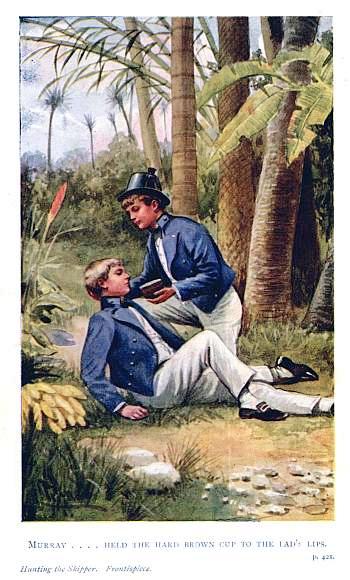
As quietly as he could manage, Murray filled the cocoanut he had brought, raised his brother middy’s head upon his arm, and held the hard, dark-brown cup to the lad’s lips.
There was no response for a few minutes, during which Murray contrived to moisten the parched and cracking membrane as if in vain, and he was about to try in despair to bathe the poor lad’s temples when the lips softened, there was a choking gurgling sound, a gasp or two, and then with strange avidity the midshipman drank and drank, spilling much, but drinking a fair proportion, and as the cup was drained asking in a hoarse, dry voice for more.
Instead of refilling the half nut Murray tore off another banana, hastily skinned it, and placed that in his companion’s hand, watching him eat it, gazing about him the while, and then as he found that the lad was recovering himself, he asked him if he could speak.
“Speak! Yes,” cried the lad. “It is like life.”
“That’s right. Cheer up!”
“Water! More water;” cried Roberts.
“Yes, soon. Eat that first;” and he gave him another of the bananas. “Where’s Titely?”
“Titely? There,” said Roberts, pointing.
“No, he is not there,” said Murray excitedly. “Where has he gone?”
“He was there when I fell asleep.”
“Has Tom May been back?”
“No; I have not seen him. But have you found more water and more fruit?”
“Yes; I have found a plantation and a stream or long pool. But where can Titely be?”
“I don’t know. Can Tom May have fetched him?”
“No; he would have spoken to you.”
“Perhaps he did, but I was half insensible and did not hear. Oh, Frank, old man, you’ve saved my miserable life!”
“Thank heaven, old fellow! If we can only avoid the slavers we may hold out till Mr Anderson or the captain comes to our help. But I must find Titely. Perhaps he has crawled away. There, go on eating while I search round. Go on eating and drinking; only leave enough for Tom May when he comes back, and for Titely when I have found him.”
“You have some too,” said Roberts, who was beginning to recover fast, save that his wound gave him increasing pain.
And now began a search which grew more and more hopeless as hours glided by. There was no trace of the injured sailor, and no sign of Tom May’s return; and at last, when the first signs of the coming brief tropical evening began to show themselves, and with them the desire for more water and fruit, Murray made up his mind to guide his companion to the negro’s hut, after leaving by way of refreshment all the fruit and water that was left, trusting to the fact that upon finding the refreshments Tom May might go further and trace the way they had gone by means of the blazings and other signs he had left upon the canes and trees.
It took some making up of the boy’s mind before he could decide to leave the place where they had hidden themselves for so long; but he felt himself bound to try hard to place his wounded comrade in safety, and where he could supply him amply with food and water; and at last, hesitating no longer, he induced his companion to make an effort to rise, and they started off together, after a final look round, for the idea had forced itself upon Murray that if they did not go at once they would not reach their haven of rest and refreshment before it grew dark.
As it was the task proved to be anxious enough before Murray succeeded in getting his companion within the hut, where he sank down in weariness and pain, but glad enough to drink heartily from a fresh nut cup of the sweet, rather peculiarly coloured water, after which he dropped into a complete state of insensibility, with a half-eaten banana grasped in his hand, while Murray eagerly seized his opportunity to follow his brother middy’s example, drinking with avidity, and for his part eating almost ravenously to master the weakness and hunger from which he suffered.
Satisfied with this, he set himself to watch and think about the two men who were sharing their troubles.
“Tom must have come upon poor Titely somewhere, wandering from our hiding-place,” he thought, “and taken him back after I had gone with Dick, and it is madness to go back to him. I couldn’t do it in the darkness, any more than he could track me out; and yet I don’t know—I ought to try and find him. Perhaps, poor fellow, he has found no food, and may be nearly starved. I think I could find him, even if it is dark. I ought to know the way to him after going over the ground twice. I ought to, and I will—after I’ve had about an hour’s rest. I must have that, and then I’ll start.”
The midshipman sat and thought of the scene when they crouched together, expecting moment by moment to be discovered.
The next minute his mind had wandered away to his search, the fortunate discovery of the old hut and the cultivation carried out by some slave; and then he came to the determination that he would crawl to where Dick Roberts lay sleeping so heavily that his breathing had become a deep snore.
“Poor fellow,” he sighed; “he has suffered badly enough, but I ought to try and put him in an easier position. It is his wound which makes him so uneasy.”
Then he thought he would wait a little longer before waking his comrade and telling him that he was going back to the old hiding-place to say where they were.
Murray had just come to the conclusion that he ought to be content with the rest he had snatched, when there was a faint rustling sound just beyond the doorway where he had seated himself, and like a flash he recalled the scene in the planter’s cottage where Tom May had shrunk from going up into the chamber behind the screen on account of the snakes—poisonous or not. This was a thatched cottage place, up whose angles or sides one of the reptiles that had lurked among the bananas and maize of the plantation could easily have made its way to the roof, ready to descend upon any one sleeping on the floor.
So suggestive was this thought that the midshipman felt startled and drew himself up slightly, feeling that he ought to go to his companion’s assistance.
“Perhaps poisonous,” he thought, “and I may get a bite if I disturb it in the darkness. Perhaps, too, it may be tired out as I am, and drop asleep without molesting either me or Roberts. He’s not sleeping so heavily now,” he thought, “and I ought to be off trying to find poor worn-out and hungry Titely. I wonder how far he has wandered away from where he was left. I ought to have found him, but it wasn’t to be helped. Tom will know now. I wonder how long it will take me to get to where we left the poor fellow? But is that Dick Roberts breathing hard—snoring—or is it one of those snakes creeping about in the maize-leaf thatch? I wonder what I had better do! Of course I can’t leave poor Dick, but it’s a pity that he should make all that noise. It is like trying to betray himself.
“I think I must go and wake the poor fellow. It isn’t fair to leave him, of course. And it isn’t fair to leave poor Tom May lying done up and faint for want of water. It’s rather hard, though, when I’m so done up too;” and then he thought how beautiful it was with the soft yellow moonlight of the tropical night shining through the Indian corn leaves down through the roof of the flimsy hut, on to the floor close by where Dick Roberts was sleeping so heavily.
But no, he was not sleeping so deeply now, for he was not snoring.
And then there was the snake, or snakes, that had been rustling about so heavily. It or they were quite silent now. They had not bitten the midshipman, for of course he would have shrieked out in pain or fear. So perhaps the reptiles had crept right away, and it was quite time that he, Frank Murray, started upon his quest to find Tom May and Bill Titely. He ought in fact to have gone before, but he was so wearied-out that he felt obliged to rest for a few minutes; and now the moon was shining so brightly that it would be much better and easier to make a start through the forest lit-up by the soft yellow rays of the tropic night.
“Yes,” he muttered to himself; “it will be much better. What a beautiful night!”
And then he sat up; and again another moment and he had crawled out of the hut doorway with his eyes widely open from wonder.
“Why, it isn’t the moon, nor night!” he exclaimed, half aloud. “It’s morning, with the sun glowing through the shades of the forest, and I must have been asleep for hours.—Or else,” faltered Murray, after a pause, “I’m off my head with fever, and don’t know what I’m about.”
Chapter Forty Two.
Without a Doctor.
Fever? Brain heat? The poor fellow turned cold with horror, and hurried back, careless of any impending danger that there might be, into the rough hut within whose shades he could dimly make out the figure of his comrade, who appeared to be sleeping heavily, but not well, for he was muttering.
“I say, Dick,” he whispered, “how’s your wound?”
There was no reply.
“Dick,” he continued, “your wound doesn’t hurt much, does it?”
Still there was no reply, and beginning to realise now that his own brain was clear, and that he really had been fast asleep, wearied-out beyond the power of watching by the previous night’s exertions, he sank down upon one knee to lay his hand upon Roberts’s forehead, when, feeling that it was burning, and that at the slightest touch the poor fellow started with pain, he began to master himself.
“What fancies one does get into one’s head at a time like this! Of course I’ve been asleep, and no wonder. I was done up; but, thank heaven, I’m all right and able to think and act, while poor Dick’s feverish and bad with his wound.”
“Asleep, Dick?” he whispered again; and once more he laid his hand upon the poor fellow’s brow, but with no fresh result. His comrade was insensible, and as Murray bent over the mutterer a fresh chill of horror ran through him as he thought of his position.
Suppose he grew worse, and no help came. What should he do? The idea was horrible. Suppose he were to—
He determined not to dwell upon the thought, and drawing a deep breath, he whispered to himself, now full of excitement—
“That’s not the way to do any good,” he said. “It’s only playing the coward and thinking of one’s self. I’m playing with shadows.”
And setting his teeth, the middy sprang to his feet and stole quickly and silently to the doorway to peer out and listen as he gazed at the scene of beauty that opened out before him.
The rough plantation was mingled with wild growth, both of which, the cultivated and the natural, were flourishing luxuriantly. Wondrous creepers tangled themselves in the boughs which sheltered the hut from the morning sunshine, and bell-flowers of exquisite beauty hung in the pure limpid air; and as his eyes roamed here and there in search of danger, a couple of ruby-crested humming birds darted into a patch of sunshine, and chased one another round, sparkling, flashing and quivering in the light, till one of them darted away and seemed to suspend itself in front of one of the most beautiful bells, so as to probe the honied depth of the great blossom like a gigantic bee.
The lad snatched himself from this to gaze in a fresh direction, for all at once there was a prolonged whistle; but at its repetition he knew that it was no human utterance; and when fresh bird-calls came from the verdant tangle beyond the plantation, he felt encouraged by the feeling that even if there were no friends forcing their way towards the wild-looking hut in the forest, no enemy could be near, for the birds that played about were too bold.
The next thought which came to the lad’s eager, busy brain was of Tom May and his intent of the previous night to go in search of him. “But I can’t go now,” he thought, and, satisfied himself now that there was as far as he could make out no immediate danger, he hurried back to the side of Roberts, to try and take in his position and promptly decide upon his actions.
This was soon done.
There was water at hand; rough vessels in which to fetch it; and after a moment’s thought as to whether he should carry his companion out into the light, a smile crossed his lips as he thought of the old legend about carrying the well to the pitcher, and making use of his unsheathed cutlass, a few strokes resulted in his hacking away a portion of the rough leafy thatching and admitting a broad band of light right across his comrade’s reclining figure.
A few touches convinced the amateur surgeon that the injury was too tightly bound, and after removing the covering he set to work and bathed the wound with the soft cool water till the temperature was reduced, re-bound it tenderly, and soon after had the satisfaction of noting that his patient’s irritation and evident pain had grown less, while when he raised his head and applied the freshly-drawn nut-full of water to the poor lad’s lips he drank with avidity, and then sank back with a sigh of relief. The muttering grew less frequent, and he sank into a quiet sleep.
It was Murray’s turn to sigh now that he had achieved thus much; but it was not with relief, for he was dripping with perspiration, the heat was dense within the hut, and a sense of faint weariness stole over him of so strange a nature that it seemed to him that his senses were passing away.
“I am going to be bad now,” he thought, feeling that perhaps in spite of pluck and effort his time had come.
“What will poor Roberts do?” he felt in a queer, strange way, and somehow it never seemed in the midst of the feeble dizzy sensation that he was of any consequence himself.
“How hot!” he muttered feebly, and he made an effort to crawl out of the hut, and then on and on almost unconsciously until he had dragged himself to where a bright ray of light flashed from the glowing surface of the clear amber water and played upon the great, green, glossy leaves of a banana plant, one from whose greeny-yellow bunch of fruit he had plucked the night before.
That all seemed dream-like, but it did not trouble him, for his nature had prompted him to thrust forward his lips till they touched the water just where the ray shot forth glowing light and life as well, for he drank and drank, and as he imbibed the fluid, which looked like fire but tasted like water, the feeling of faintness grew less, his senses began to return, and he drew back to lie over with a sigh and gaze dreamily at the great arum-like leaves of the banana and the huge bunch of green and yellow finger-shaped fruit.
“Finger-like—thumb-like,” he muttered, “just as if it was so many huge hands resting one upon the other.”
Murray sighed at his fancy, closed his eyes for a few moments to dream about the refreshing water, and soon after opened them again to let them gaze up the curve of a tree till it rose higher and higher, perfectly straight now, and ended by resting his vision amidst the great fount of green leaves which started from the crown and curved outwards.
There was a curious clump of fruit there, flowers too, and small and large nuts; huge, semi-triangular and rounded masses of fibre, and he looked at the high-up cluster, realising the while that hanging far above him, where they would fall in front of the hut, was an abundance of good satisfying food in the shape of pulpy nut, milk and cream, as well as sweet water that he might drink; so that the occupant of that humble hut might partake, but which was out of his reach, for the fruit would not fall and he could not climb.
Murray lay thinking, as his senses grew stronger, of how blessed by nature the black who lived in that hut must be, with a home that he could easily construct, and with such ripe fruits ready to his hand with hardly a care in the production; and then somehow the feeling of envy seemed to turn to equally profound pity, as it flashed into his mind that the poor wretch paid for it at the cost of labour, misery, and despair forced upon him by some of the vilest wretches that lived beneath the sun.
“Slavery!” muttered the lad, and again slavery mingled with the thoughts of the horrible sufferings inflicted aboard the slave-ships—sufferings that he and those with him were there to check and sweep away.
As these thoughts flooded the lad’s brain, he at the same time grew clearer and began to think of Tom May and Titely, of where they were, and whether they would come to him and Roberts. He even pictured to himself the former, big, hulking, and strong, coming staggering into sight with his wounded comrade upon his back. Then his thoughts floated away to Mr Anderson and his men. How had they got on? he asked himself. Would the captain soon come with their vessel and by means of a few shots sweep the place clear of the slave-hunting miscreants?
The midshipman’s brain was fast growing clearer still, and all at once he found himself gazing in imagination at the faithful black, shiny of face, and clothed in white. Would he find him and his wounded comrade and guide them back to the boats, or only perhaps to where he hoped Mr Anderson was holding out at Plantation Cottage? And as he thought, strangely enough it seemed to Murray in his faint, dreamy state, he stretched out one hand to separate the great green leaves of the banana near at hand so as to open a way for him to look beyond the great plant through the plantation and see if the blacks were coming.
Then somehow, half unconsciously, the middy’s hand closed upon something soft to the touch and smooth—something that he plucked and peeled and ate, and then plucked and ate again and again, till he began to grow less faint, and refreshed as well as clear of brain, ending by feeling strengthened and ready to crawl back into the hut, half wondering at what had happened, until he fully realised it all and was able to tell himself that he had been thoroughly exhausted and was now refreshed as well as rested and ready to take fresh steps to help his less fortunate comrade.
“Asleep still, Dick, old chap?” he whispered cheerfully.
But there was no reply, and after bathing the poor fellow’s injury again and watching him anxiously by the clear light that struck through the roof, Murray rose to his feet, feeling more and more refreshed and ready to act. He was encouraged, too, by the growing restfulness that came like a soft flood through his senses.
“Well,” he said to himself, “there’s nothing wrong with me now. I was completely done up. It’s of no use to despair, for it is only cowardly. I’m in a bad position, but it might be worse, even as poor old Dick’s is horribly bad, but as soon as I got to work I found that I could make him better. It was a very simple thing to do, and if I could make him better when he was so bad, now he is better I ought to be able to make him better still.”
But first of all he tried to settle thoroughly within himself what it was his prime duty to do.
“Nature says to me, Try and save your own life. But then that seems to be so horribly selfish and unnatural. I am fairly healthy and strong now that I have got over that bit of a fit—bit of a fainting fit, I suppose.”
Here the lad pulled himself up short to think a little more.
“Fainting fit,” he said to himself. “That sounds like being a girl. I don’t know, though: men faint as well as women when they are exhausted by pain or by bleeding. Well, I was exhausted, and now I’m strengthened and mustn’t let myself get so weak again, and what’s more, I mustn’t let poor Dick grow so weak. Oh, if old Reston were only here with his bottles of stuff! But I don’t know; perhaps I can get on without them, for it isn’t as if the poor chap was bad of a fever. Fever there is, of course, but it’s only the fever that comes from a wound, and wounds heal by themselves. So I’m not going to despair.
“I’m sure of one thing,” he continued, after a little more thought, “as I’m so much better I don’t want any doctoring, and it’s my duty to attend to poor old Dick, and I’m going to do it. It’s very horrible to be in such a hole as this, but I know that the first luff won’t rest until he has found every one of his party, and the captain won’t rest till he has found his officer, and—”
Frank Murray’s cogitations were at an end, for just as he had come to the conclusion that matters were far better than he expected, and that all he had to do was to devote himself to his comrade’s recovery, which was already on the way, he started suddenly, for he was conscious of a slight rustling noise somewhere apparently at the back of the hut, a sound as of some animal forcing its way through the dense growth which shut the building in upon three sides.
Murray’s heart began to beat fast as he listened, for the noise was repeated, and though there was caution connected with the movement, the sound was of such a nature that he was not long in doubt as to its cause.
It was, as far as the lad could determine, a man forcing his way through the jungle at the back; and then, just as it came close at hand, so close that the rough walls of the hut seemed to quiver, the sound ceased again, and in the midst of the deep silence which ensued, the lad felt convinced that he was being watched by some one who was peeping through the wall opposite to where he crouched over his sleeping companion; and he waited in agony for some fresh movement, ready to spring up with his cutlass gripped in his hand.
His excitement seemed to grow till he could bear it no longer, and he rose to his feet, and stepped softly to the side of the door, just as there was a louder rustle than ever, and some one bounded out of the thicket right to the front of the doorway, stared into the darkness for a brief moment, and then turned and ran along the edge of the rough plantation, disappearing amongst a clump of maize-stalks. Murray was beginning to breathe freely, in the hope that in the brief glance he had not been seen in the darkness within, when his heart sank once more, for he recalled the hole he had hacked in the thatch—a hole which must have flooded the place with light.
At that moment there was the soft pad of footsteps again, and to his horror, in company with the rustle of the tall corn stalks, the figure of the black, who now seemed to be herculean in build, dashed into sight, armed, as the middy could see, with a heavy machete, and coming rapidly straight for the door of the hut.
Chapter Forty Three.
Nocturnal Visitors.
Desperate, but ready for action in defence of his comrade, Murray gripped his cutlass hard, and in those exciting moments found time, oddly enough, to congratulate himself upon the fact that he was armed with the heavy service weapon in place of the ordinary ornamental dirk that formed part of a midshipman’s equipment. As to his chance, slight, well-built and youthful, he could not help feeling doubtful, pitted as he was about to be against a heavy, work-hardened negro wielding the heavy cutting weapon utilised for laying low the canes; but on the other hand he felt that skill would count somewhat on his side, for in company with the wounded lad he sought to defend he had devoted every opportunity that presented itself to small-arms practice, and was no mean handler of the service sword.
“I can only do my best,” he thought; and in this spirit he stood on guard in the darkness, his eyes flashing, and fresh and active, prepared for everything that might befall him.
And that for the time being proved to be nought, for in those brief moments the black made for the doorway, Murray noting the glistening of the great fellow’s opal eyes, and standing ready to receive him upon his point, when with a sharp swerve to his right, the man sprang at the broad-leaved banana plant which had supplied the lads’ sustenance, and disappeared from his sight, and then there was the sharp hacking sound of a couple of blows being delivered at the fruit stem, before the huge fellow backed into sight again with a banana bunch thrown over his left shoulder.
A minute later the black had plunged in amongst the canes, and Murray, whose heart was still beating hard from excitement, was listening to a repetition of the sounds he had first heard, as the man worked himself round by the back, the imaginary danger passing away and leaving the middy wondering how it could have happened that the black had not caught sight of him, and coming to the conclusion that the poor fellow was so intent upon obtaining the food that he had been driven from by his enemies, that he had eyes for nothing else.
“What a coward I must be!” thought Murray, as he calmed down. “I’m precious glad that there was no one by to see what a fine brave-hearted fellow I am. Poor fellow, why, he must be the black who built this hovel and planted the fruit. Well, of course he’s a slave, and I only hope we may have the opportunity to set him free.”
Murray stood thinking for a few moments, and then in obedience to a sudden thought he made a dash for the spot where the black had plunged in. But all was silent again, and he felt that it would be impossible to follow his trail.
“It’s a pity,” thought the lad, as he went slowly back to the hut doorway. “Here was a friend, if I had only known—one who would have helped me to find the way back to the others—if I could have made him understand what I wanted.”
Upon reaching the side of Roberts he had the satisfaction of finding him sleeping more calmly, and after making up his mind to be on the watch for the black’s next coming, he crouched down by his wounded companion to think again about trying to hunt out Tom May; but he ended by wrinkling up his brow and coming to the conclusion that it would be cruel to forsake his friend in such distress.
“A hundred things might happen,” he mused. “I should as likely as not lose my way and be unable to get back. Poor Dick—I don’t think I care much for him, for he always sets himself against me and is as jealous as can be; but trouble seems to wipe all that away, and I suppose I am pretty fond or I shouldn’t have been ready to fight for him. Yes,” he mused, “he might recover his senses and find himself alone and so weak that he could hardly stir. Why, it would be enough to drive him nearly mad.”
Murray employed himself twice over in the course of that day bathing and dressing his comrade’s wound, and always with good results, for though the lad remained insensible, he sank each time into a more restful slumber, leaving his nurse and surgeon at liberty to watch and plan as to their future.
It was towards evening that he had another scare—one sufficiently real to make him feel that they were again in imminent danger, for though he could not identify a couple of fresh-comers of whose advent he had warning, their fierce aspect, the way in which they were armed, and their action, seemed to show for certain that they belonged to one or other of the slavers’ crews.
Murray heard them approach suddenly, and darting out of the hut, he took refuge in the shelter of the cane plantation, from amidst whose thick growth he saw them step to the front of the hut, which in no wise excited their curiosity; but they stopped short for a few minutes, just long enough for one of them to climb one of the cocoanut trees and hack off a couple of the great husks, to fall with heavy thuds, before the climber slipped to earth again, when both set to work hacking off the husk and cutting away one end of the half-hardened shell.
They were moments of intense excitement for Murray, as he crouched a few yards away, almost afraid to breathe, fully expecting that one or other of the pair might rise from where he had thrown himself down, and entering the hut discover its occupant. But it seemed as if the rough little edifice only represented the hut of a slave in the fresh-comers’ eyes, and having satisfied their thirst with the sweet sub-acid cream, they cast away the shells and sat talking together for a few minutes; and then the crucial moment seemed to have arrived for the discovery, for they suddenly sprang up—so sharply that the lad’s hand flew to his cutlass, and then he had hard work to suppress a cry of relief, as the pair rapidly stalked away.
“It is too risky,” muttered the lad. “I must find some safer hiding-place.”
“So beautiful and yet so horrible,” he thought, as he crouched in amongst the abundant growth, the narrow sunlit openings being visited from time to time by tiny birds whose scale-shaped feathers were dazzling in their hues as precious stones, while they were so fearless that he watched them hang suspended in the air or flit with a low hum to and fro within a few inches of his face. At another time he would be visited by butterflies that were the very perfection of Nature’s painting, while wherever the sun’s rays struck down hottest the jungle was alive with glistening horny-coated beetles whose elytra looked as if they had been fashioned out of golden, ruddy and bronze-tinted metal.
Just when the sun was beginning to sink lower and warning him that it would not be long before he would have the protection of another night, his attention was caught by a fresh rustling noise not far away, and it struck him that this might be the sound made by the returning of the builder of the hut.
So sure did the lad feel of this that he congratulated himself upon the fact that he was well hidden still amongst the foliage around, where he could suddenly start out upon the big black if he should enter the shelter.
But as the faint rustling continued, he awakened to the recollection of the previous night’s alarm, for it now dawned upon him that the movement was not made by a human being, but by one of the reptiles with which he had peopled the thatch.
This was soon plain enough, and whether venomous or not it was enough to startle the watcher, as a serpent some seven or eight feet in length came into sight, travelling through the undergrowth, with its scales ever changing in tint as its folds came more or less into connection with the light that penetrated the leaves.
Murray felt the natural disgust for the lithe creature and dread of the poison fangs of which it might be the bearer, but at the same time he could not help feeling a certain admiration for its wondrous activity, the power with which it intertwined itself among the twigs and in loops and wreaths and coils, while the light played upon the burnished scales in silver greys, chestnuts and ambers, and softly subdued and floating over it as if in a haze of light, played bronze green and softened peacock blues.
For a time the serpent seemed to be making its way towards him, and there were moments when he felt certain that he was its goal, and that two brilliant points of light shot from the two hard jewel-like eyes were marking him down.
Then all at once there was a sharp movement as if a spring had been let loose, and the midshipman felt paralysed for a few moments, before his hand glided to the cutlass and he began to draw it slowly from its sheath ready to make a cut, for, following upon the sharp spring-like movement the serpent had disappeared, the next sound that met his ears being that of the reptile trickling, as it were, through the undergrowth in his direction.
For a few moments he could not stir, and the recollection of what he had read about the fascination displayed by snakes seemed to have a paralysing effect upon him, till his reason suggested that it was the eye that was said to produce the power described, while now the reptile had dropped out of sight amongst the undergrowth. His dread was increased, though, by the fact that the sun was rapidly passing out of sight, according to its way in the tropics, and it began to seem to him that he would be at the mercy of what might probably be a venomous creature approaching slowly amongst the leaves.
All at once there was another quicker and sharper movement, as if something passing amongst the undergrowth very slowly and cautiously had startled the reptile, which made where it was growing dark three or four rapid darts, each more distant, the last being followed by one that developed into a glide, which soon died away, the sound being supplanted by a steady slow rustle that was gradually approaching; and for a certainty the sounds were made by a human being forcing his way through the forest.
“Enemy or friend?” Murray asked himself, and then, freed from the horror of the approaching serpent, he roused himself to try and creep silently back towards the hut.
Chapter Forty Four.
“You Dah?”
Murray’s movements were cautious in the extreme, and as he crept almost inch by inch he grew more confident of his power to do so without being heard, for the movements made by whoever it was that was drawing near were loud enough to cover his own.
To remain away from his companion during the long night was a thing not to be dreamed of, with the possibility of the companionship of reptiles such as he had seen; and the opportunity of creeping back unseen as well as unheard grew more and more promising as the minutes glided by, and he listened now so that he might be in no danger of losing his way. But at the same time there was the risk of this being an enemy.
How he completed his short journey he could hardly tell, for he had to battle with nervous excitement as well as with the darkness that now began to fall rapidly in the deep shades of the forest, and at the last he was attacked by a fresh trouble which was as startling as the first, and showed him beyond doubt that some one was making for the hut. He had more than once nearly convinced himself that he who approached was the huge black, who had startled him with a false alarm of danger; but somehow, when this idea was still hanging in the balance and he felt doubtful of the wisdom of making his presence known to one who might after all prove an enemy, he grasped suddenly at a fresh development, for when at last the movements to which he listened had drawn very near, he felt his heart sink with something approaching dread on his fellow sufferer’s behalf, for certainly now it could not be the huge black he had seen, for two people, evidently well accustomed to thread a way through the forest, were converging upon his hiding-place, and rapidly now.
“If it were only morning!” he said to himself, as, unable to keep down his hard breathing, he covered the last few yards which lay between him and his brother midshipman, and then, cutlass in hand, turned at bay.
The lad’s experience had already been giving him lessons in wood-craft, and so it was that in his last movements he had hardly made a sound; but he had evidently been heard, for the duplex movement amongst the trees ceased at once, and a silence ensued which seemed terrible. So well was it sustained that as the lad crouched there, cutlass in hand, bending over his comrade, upon whose breast he had laid one hand, it seemed to him that his own breathing and that of Roberts was all that could possibly be heard. In fact, there were moments when the lad felt ready to believe that he had been a victim to imagination, and that he had been for some time fancying the presence of a snake. Yes, those were the heavy pulsations of his own breast—of that there could be no doubt; and those others which sounded like the echoes of his own heart were as certainly the result of the beating which kept on heavily in the breast of his wounded companion. It could not be—it was impossible that any one else was near. If there had been pursuers at hand, Murray felt that they must have gone by. And as he leaned forward, staring hard above where his comrade lay insensible, and trying to pierce the darkness, he at last found himself faintly able to make out a little opening which meant feeble light that was almost darkness; and this he now recognised as being the opening he had made with the cutlass by removing a portion of the leafy roof.
“We are alone,” thought Murray, “and this is all half-maddening fancy.”
The effort to retain silence had at last become greater than he could sustain, and even at the risk of bringing down danger upon their heads, Murray felt that he must speak—if only a word or two. If matters should come to the worst he was ready with his cutlass—ready to strike, and his blow would send the enemy, if enemy it was, or even enemies, scuffling rapidly away through the forest. At any rate the lad determined that he could retain silence no longer, and drawing a long, slow, deep breath, he was about to ask who was there in some form or another, and fend off at the same time any blow that might be struck at them, when the silence was broken from close at hand, and in a low deep whisper, with the words—
“Massa—massa! You dah?”
And now, suffering from the strange whirl of excitement which seemed to choke all utterance, Frank Murray felt that it was impossible to reply.
Chapter Forty Five.
A Friend in Need.
“Massa sailor officer, you dah?” came again; and still the midshipman could not respond.
“You dah?” came in an angry whisper. “You no open your mouf, sah?”
“Yes, yes,” whispered Murray, recovering himself. “I could not speak. It is you, Caesar, isn’t it?”
“Caesar. Come. Big black fellow Tullus come along to get plantain; see young sailor officer. Tell Caesar. Where big sailor?”
“Tom May? I have lost him.”
“Not killed, sah, and other young officer?”
“No; he is here, Caesar. Where is Mr Anderson?”
“Gone; had big fight with Huggins’s men.”
“Any one hurt, Caesar?”
“Caesar no don’t know. Nearly get kill. Where Massa young sailor hand, take hold?”
Murray raised his hand, and it was taken directly between those of the black speaker; and the midshipman started, for one of these was bandaged up as if the poor fellow had been wounded.
“Where other young sailor officer?”
“Hurt, and lying down here asleep.”
“Very bad hurt?”
“Yes, my man. Where is Mr Allen?”
“Caesar don’t know yet awhile. Want to find Massa Allen. Very much great deal of fighting, sah. Massa Huggins bring many men out of schooner ship kill much slabe boy. Kill very bad, and poor Caesar can’t find Massa Huggins. Want kill um and save Massa Allen.”
“Who wounded you, Caesar?”
“Massa Huggin, sah. Poor slabe fellow too much afraid. Run away. Caesar t’ink massa sailor officer killed dead.”
“Is your wound very bad?” asked Murray.
“Yes, sah; dreffle bad.”
“Let me examine it.”
“Examine?”
“Yes; let me see how bad it is and tie it up.”
“No time. Caesar tie corn-leaf all about and stop bleed. Caesar don’t mind. What massa sailor officer call himself?”
“Murray—Frank,” was the reply.
“Murray Frank, sah. Murray Frank, sah, come away dreckerly and bring your brudder sailor. Caesar couldn’t find young massa for big long time. Now come?”
“Come where?” asked Murray quickly.
“Caesar don’t know. Want find Massa Anderson lieutenant. Want find big Tom May chap. Massa know where?”
“No, Caesar. Can’t you show me?”
“No, sah! Everybody run all away. Lot people get killed. Caesar glad find Massa young sailor ’gain.”
“So am I, my lad. But now can you find Tom May and Bill Titely?”
“Caesar try, sah. Come along.”
“But I can’t leave my wounded friend here.”
“No, sah. Take um ’long.”
“That’s right; but can you find the way in the darkness?”
“Caesar going try,” said the black confidently; but he did not inspire the midshipman with the same amount of confidence. In fact, the little he felt was a good deal shaken by a great hand darting as it were out of the darkness and seizing him roughly by the shoulder.
“What does that mean?” he cried.
A deep-toned whispering ensued, and it seemed to Murray that the huge black who had so much startled him by his appearance before was eagerly whispering to his recovered friend.
“Big Tullus,” whispered Caesar. “Say Massa Huggin men come along. Murray Frank come along quick.”
“Yes, but I tell you I cannot leave my brother midshipman,” whispered Murray.
“No, sah,” said the black. “Big Tullus take um ’long on back.”
“But you must be careful,” whispered Murray. “He is wounded.”
“Big Tullus fellow take care,” replied the black, and he whispered to his invisible companion, with the result that, in spite of the darkness, Murray made out that poor Roberts, who moaned slightly, was easily lifted up, and the huge black seemed to have no difficulty in throwing the slightly-made wounded lad over his shoulder as if he had been a child.
“Now massa, come quick,” whispered the black.
“But will your black friend keep up with us in the dark?”
“Yes, massa. Caesar knock um head off if don’t. Him Caesar man. Come and tell young massa um find young sailor. Now carry other one. Come along quick, ’fore sailor crew find um and catch um. Now Murray Frank hear?”
“Oh yes, I hear plainly enough,” replied Murray. “Now lead on.”
It was evidently quite time enough, for from somewhere near at hand the voices of some of the overseer’s crew of followers could be heard, as if making for the middle of the clearing where the big black had set up his hut, a spot which was evidently known to Huggins’s people, by the way in which they had come in search of food.
So close were the men that the midshipman seized the big black by the arm and stopped his progress.
“What massa do?” whispered the black.
“Take care! They will hear you,” replied Murray.
“Yes, hear massa if massa talk,” whispered the man warningly. “Massa come along.”
“But do you know the way to Mr Allen’s cottage?”
“Iss—yes, Caesar know the way. Come along,” whispered the man, and seizing the lad by the arm, he thrust him before his companion, who the next minute was making his way through the woodland, with the enemy so close behind that it was plainly evident that they were ignorant of the proximity of the fugitives, who pressed on steadily, with the huge black bearing his burden as lightly as if he were in no way troubled by the weight.
A very real danger, however, now began to show itself, for, becoming uneasy at being swayed about by Catullus, Roberts began to mutter impatiently, though in an incoherent way, with the result that the great black suddenly stopped short and, bending towards Caesar, uttered a few words in a tone full of protest.
“What does he say, Caesar?” whispered Murray.
“Say massa young sailor no talk so much. Bring Massa Huggin men come see what’s all a bobbery and kill um all.”
“I can’t stop him, my lad,” whispered back Murray. “He is insensible from his wound and does not know what he is saying.”
“Caesar tell big slabe boy walk fast and get along a way;” and Murray heard a low whispering follow as he was thrust onward, with the canes and other growth being brushed aside. But, in spite of the extra pressure brought to bear, it became more and more evident that their enemies were keeping up with them and following their movements so exactly that it was hard to believe that they were not aware of their proximity.
Murray whispered words to this effect, but the black only laughed.
“No, no,” he said; “Huggins’s men don’t know we come along here, or run fast and kill Massa Murray Frank, kill Roberts, kill Caesar, and big Tullus. Come along and see if Massa Allen find way back to cottage.”
Chapter Forty Six.
Caesar’s Proposal.
For the most part of that night all thought of sleep had passed away, and a feeling of wonder filled the middy’s brain at the ease with which the black forced his way through the darkness.
“Black as a bat,” thought Murray, “and just like one. It’s wonderful how these fellows can see as they do. It can’t be because they are used to it, for my eyes would never be of any good, I am sure.”
But there it was all the same.
“Come ’long. Massa Huggins man dat way want to find Caesar;” and the black led the way and seemed to put pressure upon his white companion just at the right moment, “steering” him, Murray mentally called it, in and out among tree and cane so that he never came in contact with any obstacle, while the lad’s anxiety about his wounded comrade was always alleviated when a halt was made by the comforting whispered assurance from Caesar after an examination.
“Massa sailor Roberts fas’ ’sleep. No know nothing at all.”
There were times, though, when at one of their many halts Murray’s heart sank very low, for generally when all was silent save for some strange cry of night bird, croak of reptile, or weird whirr of insect that seemed to be magnified in power by the heated misty air, the black’s fingers would tighten upon the lad’s arm with spasmodic suddenness, in company with what seemed to be the piercing humming trumpet of a mosquito. Twice over Murray as he toiled on in the black darkness took it for granted that the black had stopped short to avoid being bitten or stung, but only to find afterwards that the sound came with perfect realism from the black’s lips, being his warning to his big companion to halt while he reconnoitred as to the position of the enemy.
And now a fresh direction would be taken, or more than once it seemed to Murray that they completely retraced their steps; but after a time a feeling of dullness akin to despair came over the lad, and he resigned himself to his fate, satisfying himself that Roberts was being carefully carried, and then plodding on and on, plunging as it seemed to him in a state of torpidity or stupid sleep in which he kept on dreaming about the ship and the boats and going through various adventures at sea.
Then he would start awake with a strange suddenness, feeling as if his conscience had pricked him for his drowsiness and neglect, and he would begin to tremble with anxiety, for he felt that he must have spoken aloud just at a time when they were near their pursuers, and so have betrayed their whereabouts.
Thoroughly wakened then, Murray found that they were motionless with his black companions listening, while Caesar’s fingers were pressing his arm very tightly.
“No speak,” he whispered; and the man’s breath came hot into his ear. “Huggins fellow chap everywhere. No catchee.”
Murray’s brain was closing up again, so it seemed to him, back into a deep sleep, and he remembered afterwards that during the latter part of that night he woke up from time to time when Caesar pinched his arm for him to stop, but directly the journey was continued he dropped asleep again.
Then it seemed to the middy that he must have been asleep an immensely long time, and he started up awake, staring hard at his guide, who had laid one hand over his lips while the other was offering him a ready-opened cocoanut.
“No speak, massa.”
“Why?”
“Huggins man over dah. See sailor officer—see slabe boy—see Caesar—shoot, kill.”
The man pointed over where Roberts lay half hidden by the undergrowth, while beyond him the big black was seated munching away at some half-ripe bananas, and ready to meet his eyes with a pleasant smile.
“It’s morning, then!” whispered Murray, in surprise.
“Yes: to-morrow morning, sah,” said the man, smiling; and it appeared to Murray that he had made a very absurd remark, for it must have been daylight for many hours, the sun being high.
“Whereabout do you think Mr Allen’s cottage is?” he whispered now, as his head seemed to clear.
“Over dah,” was the confident declaration. “Huggins man all round about come to fight.”
“Fight? Who with?”
“Massa officer sailor men.”
“Do you think they have got back to the cottage?”
The black nodded.
“Big very much fight. Sailor kill big lot Huggins man.”
“How do you know that?” said Murray sharply, for it seemed to him now that the last dreamy feeling of exhaustion had passed away.
“Caesar find free dead men. Him tread on two,” was his ready reply, “him” being the big black.
“But not white men!” said the midshipman, with his voice sinking to a whisper that was almost inaudible.
“Huggins man, massa. Bad fellow. Caesar berry glad.”
“Hah!” sighed Murray, and he crept to where Roberts lay apparently sleeping comfortably now.
“Is it far to Mr Allen’s cottage?” asked the lad, after a pause.
“Over dah, sah,” replied the black, pointing.
“Then why not go on at once?”
The black showed his teeth as his face lit-up in a smile.
“Lots Huggins man all about. Wait shoot white man. Wait shoot massa sailor officer. Shoot big slabe boy and Caesar. ’Top here get dark again and Massa Murray Frank crawl up close to cottage ’long o’ Caesar show de way. Massa Murray Frank put hand to mouf so how, like Caesar and say, Ahoy! No shoot, my boy! Friend!”
“Yes, I understand,” said Murray eagerly.
“Dat’s de way,” said the black, laughing with satisfaction; and he placed his hollowed hand to the side of his mouth and cried very softly again: “Ahoy! No shoot, my boy! Friend! British sailor boy shoot more than Huggins man. Shoot drefful bad. Kill friend in a dark. Kill Murray Frank. Kill Roberts officer. Kill big slabe boy, and kill poor ole Caesar; and dat drefful bad job, eh, sah?”
“Yes,” said Murray, responding to the black’s smile most heartily; “that would be a dreadfully bad job, and no mistake.”
“And no mistake, sah,” cried the black, bringing to bear his natural imitative faculty apparently with a feeling of intense enjoyment, and repeating the expression, “And no mistake, sah. Ha, ha, ha, ha! Hallo! ’Top, ’top!” he added, in an excited whisper. “Caesar make too much noise enough and tell Huggins man where we hide umself. Massa Murray Frank eatum Caesar nut. Do um good and makum fight like sailor man.”
“Yes, I’ll eat it soon,” replied Murray. “But you’re right, Caesar; we must wait till it is dark, for fear that my people should shoot us by mistake.”
“Yes, sah; dat be bad job and no mistake,” whispered the black, bringing in the fresh expression again. “What Massa Allen do widout Caesar? Hey?”
“Mr Allen trusts you, then?” said Murray.
“Yes, sah. Massa Allen berry much trust Caesar. Massa Allen tell Caesar he berry sorry he ebber trust Massa Huggin. Wish um nebber come plantation. Caesar see big tear in Massa Allen eye, and make Caesar berry sorry. Make um fink a deal. Massa Huggins kill poor black niggah, sah, lots o’ times. Massa Huggins got bad brudder come sometime with ship schooner full o’ slabes. Flog um and sell um. Make um die sometime. Massa Huggins’ brudder tell um bad sailor man. Talk like dis way;” and the man as he knelt by Murray’s side gave an exact imitation of the keen Yankee skipper. “Say ‘Chuck um overboard,’ sah.” As the black uttered the command he acted it, and added grimly: “‘Chuck um overboard to de shark?’” and added now a horrible bit of pantomime, dashing and waving his arms about to represent the terrible fish gliding over one another in a wild struggle to seize their prey.
“Don’t! Don’t!” whispered Murray, with a look of horror which proved the realism of the black’s word-painting and gesticulation.
“No, massa,” whispered Caesar solemnly. “Um nebber chuck black niggah overboard. But,” he added, with a fierce look that was even ferocious, “Caesar like chuck Massa Huggins overboard. Like see shark fish bite all a pieces and eat um. So—so—so!”
As he uttered the last words with hideous emphasis he brought his imitative faculty once more into action by laying bare his fine white teeth, throwing his head from side to side, and snapping like a savage animal.
“Horrible!” ejaculated Murray.
“Yes, sah; dreffle horrible see shark bite poor half-dead niggah a pieces.”
“But you have never seen this?”
“Yes, massa—long time ago. Caesar brought in schooner ship from Caesar own country. Bring lot of poor niggah all shut up down below. Ship quite full, and ebery night some shut um eyes, and to-morrow morning some won’t open eyes again. Gone dead. Sailor chap come along rope, haul niggah up on deck—haul on deck, and Massa Huggins brudder say: ‘Chuck um o’erboard,’ and chap come and take rope off Caesar and make um open um eye like say: ‘What’s de matter?’ Den Massa Huggins’ brudder say, ‘What’s dat, you lubber? Dat one not dead!’”
“Did you hear that?” said Murray, with his lips apart as he listened in horror to the black’s narrative.
“Yes, sah. Caesar no understand den what um mean, but um say—‘What’s dat, you lubber? Dat one not dead!’ Nebber forget um—nebber! Caesar shut um eye now and see it all again—those niggah chap chuck overboard and shark fish coming up out of water and roll over and over and snap, snap, snap—so. Make Caesar keep eyes open so dat couldn’t go to sleep again for long time. Massa Huggins man come take hold of um by arm and leg and chuck down below. Caesar not dead a bit. Caesar quite ’live now. Go and talk lot o’ time to pore black niggah when Massa Huggins’ brudder bring schooner ship full of niggah. Caesar talk to um, not like um talk to Massa Murray Frank. Talk to um in own way sometime. Sometime poor niggah can’t understand, but berry glad find Caesar sorry for um. Make um happy; laugh again.”
“Poor creatures!” said Murray.
“Yes, massa. Poor creature! Come and talk togedder in de night sometime. Massa Huggins flog um when him find um out, but poor niggah don’t mind dat. Like to talk about de ole country where um come from. Massa Allen find um out too, but um only laugh and say, ‘Poor fellow!’ But Massa Huggin flog um, and some shut eye and nebber open um again. Poor Massa Allen good massa, but won’t do what Caesar say. He berry ill now, and get frighten of Massa Huggins. Tell Caesar one day he wish Massa Huggins die.”
“He told you that!” said Murray, for the black had ceased speaking, and his narrative had so great a fascination for the lad that he wanted to hear more.
“Yes, massa; um say he wish Massa Huggin die so that poor niggah boy be happy again and do um work. Massa Allen say so free time to Caesar, and den Caesar wait till Massa Huggins go out and Caesar go in to Massa Allen in de cottage, where um sit down by de table like dat.” And the black rested his head sidewise upon his elbow and hand. “‘What you want, Caesar, lad?’ he say, and um put um white hand on Caesar black arm. ‘Poor niggah ill and can’t work? Bad time, Caesar, to be sick man.’ ‘Yes, massa,’ I say to um. ‘Berry bad to be sick man.’ ‘Who is it, my lad?’ he say. ‘Caesar, massa,’ I say to um. ‘Caesar berry sick.’ ‘You bad, Caesar!’ him say. ‘Your massa berry sorry, for you de only frien’ I got in de worl’ now, Caesar.’ ‘Yes, massa,’ I say. ‘Caesar know dat.’ ‘What de matter, boy?’ he say. ‘Caesar bad to see massa so berry sick. Caesar ’fraid massa die.’ ‘Ah, dat’s berry good of you, Caesar,’ he say—‘berry good. Then you no want me to give you doctor ’tuff?’ ‘No, massa,’ I said. ‘Nigger know what to do when niggah ill. Shut um mouf up tight free day, and niggah quite well again.’ ‘Ah, Caesar,’ he say, ‘dat do me no good, dat not do for your massa.’ Then I say to um, ‘No, massa, but you let Caesar do massa good and um quite well again and make all de poor niggah happy over again.’ ‘No, no, my boy,’ um say; ‘nebber again.’ ‘Yes, massa,’ I say; ‘you let Caesar try.’ ‘What wiv?’ um say, laughing; and den I say in um whisper like: ‘Fetish, massa.’”
“What!” cried Murray, half indignantly. “You don’t believe in that nonsense, Caesar?”
“Not nonsense, massa.”
“Well, my good fellow,” said Murray, rather coldly, “I’m not going to argue with you now, but some other time, I hope. Now tell me, what did Mr Allen say?”
“Um say, ‘No, my lad, no; I’ll hab none of dat.’”
“Of course; but surely he does not believe in it?”
“Yes, massa; um believe for sure. Massa Allen know what niggah know and bring from own country. But Massa Allen say, ‘Nebber, nebber, Caesar. Your massa done too much bad in dis worl’, and he nebber do no more now.’”
“Well, that’s very good of him, Caesar, but I don’t quite understand what you mean.”
“No, massa? Dat Huggins bad man do bad things to everybody. Make Massa Allen ill and go die. Massa Allen say not fit to live.”
“And quite right too, Caesar.”
“Yes, sah. Massa Allen quite right, and Caesar come one night and bring niggah Obeah and put in bad Massa Huggin rum. Den Massa Huggin drinkum, drinkum, and go drefful bad and nebber flog no more poor niggah. Nebber. Poor niggah dance and sing, and Massa Allen get well.”
“But—what—here—I say, Caesar!” cried Murray, staring hard at the black—“You don’t mean to say that you mean you would poison the wretch!”
“Yes, massa,” said the black, in the most innocent way. “Gib um Obeah snake poison. Gib um manchineel in um rum. Make um curl up and go dead.”
“Oh, that wouldn’t do at all, Caesar,” cried Murray earnestly. “He’s a horribly bad wretch, of course.”
“Yes, massa; ollible bad wretch, and ought to be killed dead; but Massa Allen say no, he won’t do any more wicked thing.”
“And he is quite right, Caesar.”
“No, sah,” said the black, shaking his head. “Not do no wicked thing. Caesar do it, and it not wicked thing. All good.”
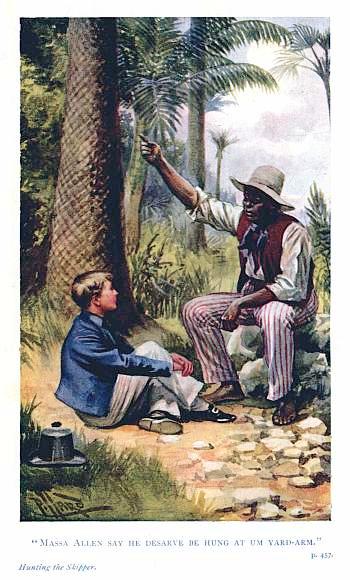
“No, no; it would be murder, Caesar,” cried the middy.
“What murder, massa?”
“Eh? What is murder? Why, to kill innocent people.”
“What innocent people, massa?”
“What are innocent people, my man? Why, those who have done no harm.”
“Massa Huggin not no innocent people, Murray Frank. Massa Huggin bad man; kill poor niggah. Try kill poor Massa Allen, take um plantation.”
“Yes, that’s all very bad,” said Murray thoughtfully.
“Yes, sah; berry bad. What British captain do Massa Huggin?”
“Well, I hardly know, Caesar,” said Murray thoughtfully. “I should say that if he catches him fighting against the king and setting those blackguards of his to murder the poor creatures he has been dealing in—throwing them overboard so as to escape—the captain will have him hung at the yard-arm.”
“Yes, sah,” cried the man, with his eyes flashing. “Dat what Massa Allen tell um. Massa Allen say he desarve be hung at um yard-arm for kill an’ murder poor black niggah, and Massa Huggin laugh and say Massa Allen hang too. Dat right, sah?”
“No, no; that wouldn’t be right, Caesar.”
“Bri’sh captain not kill Massa Allen?”
“Certainly not, my man,” said Murray earnestly. “No, sah. Much a bes’ way for Caesar gib Massa Huggin Obeah.”
“No, no, and that would not do either. Hallo! what do you mean by that?”
The black had suddenly thrown himself down upon his face and dragged the midshipman beside him, a movement instantly imitated by the big slave who was seated among the bushes beside Roberts, who lay motionless as if asleep.