"Hunting the Skipper" (continued 5)
Reading edition
Rustling and splash, for now he awoke plainly enough to the fact that he was sinking ankle deep at every step, and he roused himself fully once more.
“Giving up,” he panted, “just when I had won the day! Hurrah! There’s the river!” And making a tremendous effort he struggled on, for there was the alligator floundering through mud and water now where the growth was getting more open, and at the end of some dozen yards there was light—golden-looking light—coming down from above. Then there was a loud flopping, followed by a heavy splash, and the lad snatched at and seized the boughs that closed him in, and just saved himself from following the reptile he pursued by clinging with hands and legs to a stout cypress, to which he held on as he indistinctly made out the sobbing sound of the wave that the reptile had raised as it plunged into what seemed to be the edge of a swampy lake.
“He won’t come back, will he?” thought Murray, and he obeyed the natural instinct which prompted him to drag himself up amongst the evergreen boughs of the tree, which slowly rocked to and fro with his weight.
But the water beneath him gradually settled down, the cypress in which he clung ceased to bend, as he got his feet settled better to support his weight, where he could look along a dark green verdant tunnel to a spot of golden light where the subdued sunshine fell upon a glistening level of amber-hued water so beautiful that for a time the lad could not withdraw his eyes.
“It’s no river,” he said, “but the edge of a lagoon, and it would be madness to go any farther. Let’s have a rest. Might have been worse off after all, and it’s no use to get despairing and tiring oneself out. I should have liked this adventure if my two lads had been with me, and—and—Yes, that’s it,” he groaned—“if I hadn’t been sent on such a tremendous task! There, it’s of no use to despair. I’ve done my duty, and no matter what happens now I can say that. Who knows what may come next? I mustn’t think I can hang here till it grows dark. I could climb up higher, but this is a swamp, and though I might save myself from alligators and snakes—Ugh!” he shuddered. “This is the sort of place where they live!—I couldn’t escape from fever. There, I must hail now till some one hears me and answers, even if it’s the enemy. But it may be one of my fellows, or if not it’s sure to be one of the slaves, for there must be plenty about here.”
But Frank Murray did not shout for help. Perhaps it was due to exhaustion, that the place seemed to have a strange restful fascination, as he hung there in the thick growth of the cypress, gazing along the soft green tunnel at the little glistening lake, which he now saw was full of living things, for every now and then the surface was stirred by creatures which he made out to be tiny terrapins—water tortoise-like creatures which just thrust out their heads and drew them beneath again. Then water beetles skimmed about, forming glistening geometric figures for a time before they disappeared.
Then the lad shuddered, for from the side of the bright verdure-framed lagoon a snake writhed itself in horizontal waves across the surface and began to climb up the foliage, to glisten as it reached where the light fell strongest and the burnished scales flashed with bronze, silver grey and gold.
“I wonder whether it’s a poisonous snake,” thought Murray; and then he made an effort to awaken himself from the pleasant feeling of restfulness, for he knew that he must exert himself if he intended to find a way back to where he had been separated from his companions—those whom he must urge on to the fulfilment of his task.
“And I have not done what I felt that I must do at all risks,” he said, as he once more made an effort to rouse himself from the drowsy inertia which was holding him in something resembling a trance.
Drawing a deep breath, he took more tightly hold of the cypress boughs, and was about to hail at any risk and with all his might, when he uttered a loud sob of relief, for suddenly from somewhere far away, came, strangely softened and subdued, though prolonged, the words—
“Ahoy-y-y! Seafowls ahoy-y-y!”
Chapter Twenty Five.
With Shot-Holes.
“Ahoy-y-y! Seafowls ahoy-y!” came again after a pause, and though he felt that he ought to have hailed in reply, Frank Murray’s lips remained closed, and he still clung there listening for the hail to come again.
It was not until he heard the hail for the fourth time that the midshipman was able to throw off the nightmare-like feeling, and, drawing a deep breath, shout with all his might—
“Seafowls ahoy!”
Then he held his breath and waited, feeling that his voice could not have been heard, and a feeling of despair began to assail him and the fancy grew that he was sinking back into that horrible sensation of inertia which had mastered him for a time.
But it was fancy, for throwing off the weakness he shouted now joyously and lustily—
“Seafowl ahoy!”
There was silence for a few moments; then came the inspiring sound of some one struggling through the tangled growth and splashing over the mud and water—sounds which were followed by—
“Where away there? Ahoy!”
“Here! Is that you, Tom May?” shouted Murray, and from not far from the foot of the cypress where the lad clung there was a wallowing sound and a splash in the water which sent a wave-like movement across the little lake at the end of the tunnel.
“Tom May it is, sir! Where are you?”
“Up here in this fir-like tree, Tom. Where’s Titely?”
“What, ain’t you got him along o’ you, sir?”
“No! I haven’t seen him since we parted. Haven’t you any notion where he is?”
“Not a haporth, sir. I on’y hope he arn’t gone through.”
“Gone through!” cried Murray, in horror.
“Yes, sir; I hope not, but it’s solid soft everywhere I’ve been. I’ve been most through half-a-dozen times, and twiced over I’ve felt as if some of them there lizardy crorkendillo things had got hold of my toes and tugged at ’em to get me down.”
“Oh, don’t talk about it, Tom,” groaned the midshipman.
“All right, sir; on’y you arksed me.”
“But you have no right to think such a horror as that. He may have got down to the boat.”
“Yes, sir, he may,” said the man, in a low growl, “but I’ve been trying my best, and I couldn’t.”
“Then you haven’t seen the boat-keepers, Tom?”
“Not a squint of ’em, sir, and there’s going to be the wussest row that ever happened aboard ship if we don’t make haste and find them and fetch the first luff help.”
“It’s horrible, I know, Tom, but I’ve tried all I could. What’s to be done?”
“Dunno, sir. But anyhow I’ve found you—leastwise, a’most; and I’m coming to jyne yer. Whereabouts are you, sir? Hail again; it’s rayther puzzling like.”
“It is, Tom—dreadful. But here, where I told you—up in this fir tree—cypress. But mind how you come, for it’s very soft.”
“Soft ain’t the word for it, sir. I’ve been going to make a swim on it over and over again. But it’s reg’lar hugga-my-buff, sir; neither one thing nor t’other. It’s too soft to walk in, and it ain’t soft enough to swim.”
“That’s true, Tom,” said the lad.
“Oh, you’ve found it so, have you, sir? Then look here; you arn’t so heavy as I am, so s’pose you comes to me ’stead o’ me coming to you. What do you say to that?”
“I’ll try, Tom,” cried Murray; and he began to descend, feeling the elastic evergreen begin to sway and vibrate as if before long it would double down with the weight of its load; and this it finally did, leaving the midshipman floundering on the surface of the cane and reed-covered swamp, so that it was only by a vigorous effort that he managed to scuffle along in the direction of the man, who kept on shouting encouragement until he was able to reach out a hand and drag the lad to his side.
“Hah!” panted Murray, with a sigh of relief.
“Hah it is, sir,” said the man. “But beg your pardon, sir; arn’t you a-spoiling your uniform?”
“Don’t talk about it, Tom,” said Murray, breathing hard. “Let’s be thankful that we’ve saved our lives.”
“Saved our lives! But have we, sir? Don’t seem to me that we’re out of the muddle yet. There, look at that!” added the man.
“Look at what?” cried Murray.
“I meant feel that, sir,” said the man, correcting himself, and stamping with one foot. “It felt just as if one of them short four-legged sarpints had laid hold of my leg to pull me down for supper.”
“Surely not, Tom,” said Murray, with a shudder, as he felt attacked by a sense of horrible insecurity.
“All right, sir. Say so if you like; I’m willing. But I’d keep on stamping as long as we’re here in this lovely place. I do hope, though, as they arn’t making a meal of poor old Titely; he do desarve better luck after being speared as he was over yonder across the herring pond.”
“Let’s hail him again.”
“All right, sir. I’ve wanted to do so ever so much more, but I wouldn’t, for it was telling the enemy where we are, and if we do much of that sort of thing we shall be having that pleasant Yankee coming shooting with his men, and we don’t want that.”
“Of course not, Tom, but we must risk it, for the poor fellow may be somewhere within reach waiting for help.”
“Then why don’t he holler, sir?”
“Perhaps he has shouted till he is worn-out, Tom.”
“Then he can’t be within reach, sir, or else we should ha’ heered him, for he’s got a pretty good pipe of his own.”
“Well, hail him, Tom.”
“All right, sir, but ’tween you and me and the starn post your voice would go farther than mine would.”
“Think so, Tom? Very well, then. Seafowl ahoy!”
It was a loud tenor shout that doubtless penetrated the cane jungle farther than would the deep bass of the able-seaman, and after a minute’s listening, Murray hailed again; but somehow the shout did not seem to have any result.
“Let me have a try, sir,” growled the sailor, and upon the middy nodding, the man shouted five times at intervals, listening with his hand to his ear after every hail.
“It’s of no good, Tom,” said Murray bitterly. “Come along, and let’s be doing something.”
“That’s what I was a-thinking, sir, for if we stop here much longer we shall be reg’larly sucked down into the mud. ’Sides which, if my poor mate hears us he won’t come here. He’d on’y hail.”
“And if the enemy hear us they are quite at home here, and they’ll come down upon us and put a stop to our getting across to the boat. What do you mean by that?—What are you chuckling about?”
“You, sir,” said the man. “I was thinking what an orficer you will make some day.”
“Do you mean that for banter, my man?” said Murray angrily.
“Banter, sir? What, chaff? Not me, sir. I meant it. I felt a bit proud of you, sir, for using your head like that.”
“Well, this is no time for paying compliments, Tom. You take the lead.”
“I’ll do what you orders, sir, of course, you being my orficer, but you might tell me which way I oughter lead.”
“I can’t, Tom, my lad. We want to get down to the boat, and hope to pick up Titely on the way. I’ve tried till I grew more and more puzzled than ever; so now you try. You must chance it, my lad.”
“Mean it, sir?”
“Mean it? Of course!” cried Murray; and the man shut his eyes close, knit his brow, and then began to mutter in a low tone, much to the midshipman’s surprise.
“What are you doing, Tom?” he cried at last.
“What you telled me, sir—charnshing of it.”
“Chancing it?”
“Yes, sir; that’s right,” said the man. “Same as we used to when we was little uns playing at Blind Man’s Buff. ‘How many horses has your father got?’ Then the one as had the hankychy tied over his eyes used to answer, ‘Black, white and grey.’ Then the one who arksed about the horses used to say, ‘Turn round three times and ketch who you may.’”
And as soon as the man had repeated these words with his eyes still closely shut he turned round three times and then opened them and stared straight before him.
“This here’s the way, sir; right ahead.”
“What nonsense, Tom!” said the middy sadly. “You’re old enough to know better.”
“Maybe, sir, but you said I was to charnsh it, and that’s what I’m a-doing of; and if I don’t find the way down to the boat it won’t do us no harm as I can see; so come along.”
The man stepped off, keeping as nearly as he could to the line he had marked down, and without turning his head he called back to his young officer—
“Don’t you mind me giving o’ you orders, sir, but you telled me to lead on, and I should like to say, sir, as you’d find it better if instead of walking hard and stiff, sir, like the jollies march up and down the deck, you’d try my way, sir, trot fashion, upon your toes, with a heavy swing and give and take. You’d find that you wouldn’t sink in quite so much, seeing as one foot’s found its way out before t’other’s got time to sink in.”
“I’ll try, Tom,” said the middy quietly; and after following the man for a few dozen yards he whispered, “Yes, I think that’s better, Tom; but I have no faith in your Blind Man’s Buff plan.”
“Give it time, sir; we arn’t half tried it yet.”
“Go on, then,” cried Murray; and the man trotted on as fast as the tangled growth would allow him, pausing from time to time to listen before going on again.
“I’m afraid we must make a change, Tom,” said Murray, at last, when the man drew up suddenly. “Are you, sir?”
“Yes; this seems hopeless.”
“That’s what it all seems, sir, but I don’t like being in too great a hurry to pitch a hidee overboard. There’s nothing like trying, sir, and just as like as not we may be getting nigher and nigher to poor old Titely.”
“I’m afraid—”
Murray did not finish his sentence, but made a spring forward and clapped his hand hard upon his leader’s shoulder.
“What’s wrong, sir?” cried the sailor, turning sharply upon him.
“Hark! Listen!” cried Murray excitedly.
“Oh, Mr Murray, sir,” groaned the man despairingly, “you’ve been and gone and done it now!”
“Nonsense! What do you mean?”
“Pitched me off my bearings, sir. I’ve looked round, and I shall never pick ’em up again.”
“Well, what does that matter?” cried Murray. “Don’t you hear?”
“Hear, sir? Hear what?”
“Oars. I heard them rattling in the rowlocks as plain as possible.”
“Whereabouts, sir?”
“Away there through the canes yonder. Didn’t you?”
“No, sir,” said the man gloomily; “I didn’t hear no oars.”
“I did, quite plainly,” said Murray, leaning forward and straining his ears. “No, it’s stopped now.”
“Yes, sir,” said the man, shaking his head; “it’s stopped now.”
“Well, don’t talk like that, Tom. You look as if you didn’t believe me.”
“Oh, I wouldn’t go for to say as I don’t believe anything you say, sir,” said the sailor; “but all the same it do seem queer.”
“Yes, queer because they’ve stopped rowing to listen. Don’t you see?”
“No, sir,” said the man, shaking his head sadly. “I don’t see nothing, on’y as you’re a bit overdone, sir, in the head, and gets fancying things.”
“Fancy, man!” cried the middy angrily. “It was no fancy, I tell you. Now then, listen.”
Tom May shut one eye and cocked his head on one side in obedience to his young officer’s command; but all was perfectly still.
“It’s very strange,” said Murray.
“Yes, sir; very,” said the sailor, in a tone of voice which made the young officer turn upon him fiercely.
“Oh, you obstinate—”
Murray did not say what, but ceased speaking and stood straining forward.
“Of course you thought you heered oars, sir, because you wanted to hear ’em,” said the sailor; “but it’s a pity you did, sir, because it made me lose my bearings, and I know I shall never—”
“There, then,” cried the middy excitedly. “Now, did I fancy I heard rowing?”
“No, sir; that’s oars, sure enough,” replied the sailor; “and it seems to come from right for’ard there, and not far away.”
“Hail the boat, then,” cried Murray excitedly.
“I dunno as I would, sir,” whispered the man, “because it mightn’t be our boat.”
“What! Oh, we must chance that. Hail away.”
Tom May, who looked exceedingly unwilling, clapped his hand to his cheek and yelled out, “Seafowls ahoy!” just as the regular beat of oars had ceased once more.
But there was no further doubt, for in a dull smothered tone, as if the reply came through so much dense forest, there was the answering hail—
“Ahoy there! Where away?”
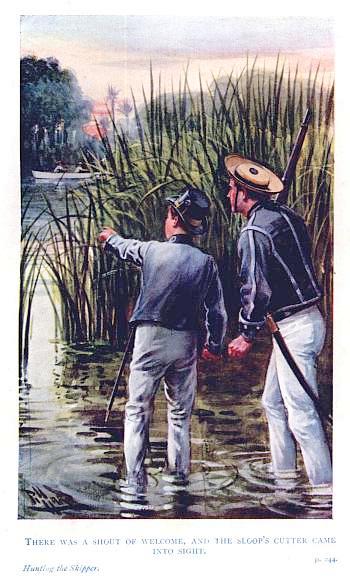
“Ahoy!” shouted Tom May. “That’s the right sort, sir. Come along;” and stepping out, the sailor beat the dense growth to right and left, with his feet sinking deeper in the soft soil, till the cane brake began to open out and the forest grew lighter, the splashing of oars sounding nearer and nearer till there was a shout of welcome and the sloop’s cutter came into sight, gliding towards them till the light vessel’s nose was run into the river bank.
“At last!” cried Murray, as he scrambled over the bows, to sink exhausted into Titely’s arms. “Why, how did you get here, my lad?” said the young officer.
“I d’know, sir. Lost my way, and couldn’t find it nohow.”
“But you managed to find the boat.”
“Nay, sir; not me, sir! I didn’t find her. I did find the side o’ the river, but couldn’t get no furder. I was hanging on to a branch and trying to keep up because I was sinking into the boggy shore, when my two mates here come pulling up stream and picked me up. It was them found me, sir, not me found them.”
“Well, never mind that now,” cried Murray angrily. “What about you two? Your orders were to stay by the boat where we landed.”
“Yes, sir,” said the first boat-keeper, “but they wouldn’t let us, sir.”
“They!” cried Murray. “Whom do you mean by they?”
“Oh, I dunno, sir, who they was, only that it was a big party o’ rough uns with guns and rifles as come up all to wunst as we sat hanging on by the grapnel and line, out in the middle o’ the river, and one on ’em hails us and tells us to pull ashore.”
“Well,” said Murray, “and did you?”
“You go on, messmate,” said the man. “You can spin the yarn better nor I can.”
“Yes, go on,” cried Murray; and the second boat-keeper took up the narrative.
“Well, sir, we just didn’t.”
“Just did not what?” asked Murray.
“Pull ashore, sir. They warn’t our people, and him as hailed us warn’t our officer. ’Sides, we didn’t like the looks of ’em.”
“Well done, my lads,” said the middy; “that was right. But what did you do then?”
“I hystes up the grapnel, sir, and Harry Lang there gets an oar over the side.”
“Well?”
“Well, sir, then a Yankee sort of a chap as seemed to be the head on ’em leans hisself up again’ a bush and rests his gun upon a bough of one of the trees on the bank, and he says to me, he says, as he looks along the barrel, ‘Now, you sir,’ he says, ‘just you run that boat’s nose into this here bank, and tidy quick too, ’fore I draws this here trigger.’
“‘All right, sir,’ I says, and I shoves another oar over the side; and as soon as he sees me do that, quite easy like, he lowers down his gun—rifle, I think it was—and turns his head to say something to the chaps who was with him.
“‘Easy, messmate,’ I says then; ‘get her head straight first,’ making believe as Harry warn’t doing right. The ’Merican chap was just turning round then, but I sees my chance, and I whispers to Harry, ‘Up stream, lad, for all you’re worth.’ ‘Right you are,’ he says, and my word! sir, we did take hold of the water and put our backs into it, ’gainst stream as it was; and as I pulled I was all the time wishing as hard as I could that you’d got hold of the rudder lines so as to steer, sir, and leave us nothing to do but pull while you kept the boat’s head right in the middle of the river. ‘Here, hi, there! What are you doing? Pull ashore, or—’ He steps to the same tree again and rests his gun on the bough and takes aim, while I thinks to myself what a pity it was that we hadn’t turned the boat’s head down stream.”
“You said arterwards, messmate, as that would ha’ been like leaving the first luff and the lads in the lurch,” said the other boat-keeper.
“So I did, messmate; and so it would,” said the narrator.
“But he didn’t fire at you?” cried Murray eagerly.
“Didn’t fire at us, sir?” said the man. “But he just did, while we pulled with all our might.”
“And missed you?”
“He missed me, sir, but he hit the boat. Sent his bullet slap through the bow planks just between wind and water, and the brown juice come trickling in quite fast, but we couldn’t stop to plug it.”
“Hah!” ejaculated Murray, who was breathing hard with excitement. “Oh, do go on a little faster!”
“That we did, sir—pulled faster, for some of the enemy come shouting after us along the side of the stream. You see, they couldn’t come on the far side, ’cause it was all trees, while luckily for us they couldn’t get along much where they were, for it was all boggy, and I see three of them sink in up to their knees and stick fast cussing and swearing. But they warn’t the only ones, for him as we took to be their boss, he let go at ’em orful, sir, and yelped at ’em to follow us up, knowing all the time that they couldn’t do nowt o’ the sort, and him not trying a bit, because he warn’t going to fill his boots.”
“But they kept on firing at you?” cried Murray.
“Fast as ever they could, sir. They kep’ on loading and firing, and Harry and me kep’ on pulling like hooray. You see, the shooting spurred us on a bit, for they kep’ on hitting the boat when they didn’t send the bullets spattering into the trees over our heads, and cut the little twigs and leaves and make them fall upon us.”
“But didn’t they get to the bank higher up?” asked Murray.
“I dunno, sir,” replied the man. “We was too busy to think about that. Precious hot it was too, pulling under boughs as kept all the air away. I don’t want to brag, Mr Murray, sir, but we had a precious nice time on it, pulling, and hearing the beggars shouting and firing till we got well round a bend and out o’ their sight, same as they was out of our sight, when I says to Harry Lang as best thing we could do was to see to damages, and seeing as it warn’t likely that they could get at us for a bit we run the boat’s nose into the far side bank where Harry could get hold of a branch, and then he outs with his Jack knife and whittles a peg to fit into the shot-hole, for the water kep’ on coming in tidy fast.”
“Is that the hole?” said Murray eagerly.
“That’s it, sir, and there’s two more plugged up astarn, ’sides that there chip out o’ the back by the starn sheets.”
“But you neither of you got hurt?”
“No, sir; you see they warn’t very handy with the guns, and we kep’ going pretty fast.”
“But there’s a blood-stain upon your shirt, my lad.”
“Oh, that, sir? It did bleed a little bit, but it was only a scrat—nowt to speak about.”
“Indeed!” said Murray. “Well, it has left off bleeding, but the doctor must see to it when we get back to the Seafowl.”
“Oh yes, sir; that’ll be all right,” said the man, smiling; “and that’s all, I think, ’cept that we baled out the boat till we began to pull on again, for we was obliged to put some distance ’twixt us in case they should find some way up to the bank and begin practice again. Same time, sir, of course we had to think of not getting too far, so as to be handy when our fellows came back and wanted the cutter.”
“Well, but about finding Titely?” said Murray.
“Oh, there’s nothing to say about that, sir, on’y we didn’t quite get it settled whether he found us or we found him. Theer he was, hung up in one of the trees over the river, and glad he was to be took aboard—just as glad as we was to take him, sir, for you see it made another to share the ’sponsibility like of our not being where we ought to be with the boat. After that, sir, I wanted to hang about as close as we could to the enemy, ready to be handy and help our officers and men; but messmet Titely says we must go on pulling up stream in search of you and Tom May, and this must be all, sir, and my throat’s as dry as dust. Think this here water’s good to drink, sir? It looks too much like beer to be quite to my taste.”
“No, my lad; I wouldn’t venture to drink it. Better wait.”
“That’s what I says to Harry Lang, sir.”
“And very wisely too. Now, Tom,” continued Murray, turning to his companion in adversity, “you have said nothing. What do you think of the state of affairs?”
“I think it’s hard, sir—precious hard on a man.”
“But they have done splendidly, Tom.”
“Yes, sir, I s’pose so, for them,” said May sourly; “but I warn’t thinking about them. I mean it comes hard upon a man like me, shut out of a fight like that. Don’t you think we might drop down with the stream now, seeing as we’re tidily strong like?”
“Yes, I do think something of the kind,” replied Murray.
“And give ’em a right down good dressing, sir?”
“No; we have got something else to think of, Tom,” said the middy sternly. “Dressing them down is tempting, but that is not what we want to do. We must get down to the bay as quickly as we can, and without the loss of a man. The fighting must rest till the captain sends up reinforcements.”
Tom May nodded his head.
“Bit disappointing, though, sir.”
“Yes, my lad, but we can wait. Now then, we must drop down a little farther, and then drop the grapnel or hook on to one of the trees of the farther bank.”
“And not make a dash of it, sir?”
“No, my lad; not till it is quite dark.”
Tom May stared.
“According to what your messmates said, the enemy was in pretty strong force. How many of them were there?”
“’Bout twenty, sir,” said Lang.
“And all armed?”
“Yes, sir; they’d all got guns,” said the other.
“Then they will be lying in wait for us,” said Murray decisively. “I only said that we shall be trying to run by them as soon as it is dark.”
“Well, sir, but we could do it,” said May warmly.
“Yes, we could run by them if I risked everything, my lad,” said the middy, “but I can’t afford to lose a man. Besides, they will have been making arrangements to receive us. There is that lugger we saw lying in the mouth of the river; they have plenty of men, I am sure, and they may have brought her up to block our way, for they are bound to try and capture us if they can.”
“Yes, sir; bound to take us if they can,” assented the sailor.
“How long do you think it will be before it is dark?” asked Murray.
“Not half-an-hour, sir,” was the reply.
“And how far are we above the landing-place?” said the middy, speaking in a low tone now and turning to the first boat-keeper.
“Can’t say, sir, for sartain,” replied the man. “What do you say, Harry Lang?”
The man shook his head.
“You see, sir, we put our backs into it when we started to row, and pulled and pulled, thinking of nothing else but getting as far up’ards as we could. Hour’s hard rowing, I should say, in and out, and we got a long ways before we come upon Bill Titely.”
“Then we’ll begin moving as soon as it is quite dark, my lads,” said Murray. “Till then, a careful watch and silence, for there is no knowing whether the enemy may not have a way through the cane brake which will enable them to come upon us by surprise.”
Chapter Twenty Six.
A Fight in the Dark.
It was sooner than they expected that the darkness came on—thick, black, dense darkness, which in spite of its gradual approach seemed strange and full of suggestions of being peopled with enemies ready to draw trigger on the banks and send lightning-like flashes at the occupants of the boat—flashes each of which might be a messenger of death.
The boat was set in motion and glided down stream slowly, with Murray in the bows peering straight before him, trying to pierce the darkness; Tom May right astern with one oar dipped, with which he kept the boat level; while the others sat with oars balanced ready for use in case of attack, and so as to ensure retreat.
In this fashion they floated down, carried along by the gentle current, not a word being spoken, and the midshipman hardly daring to breathe as he listened to the strange nocturnal sounds which came from the banks on either side—weird croakings, pipings, and strange trumpeting notes which sounded like a challenge to the strangers who were daring to penetrate the thick darkness of the night.
More than once there was a sudden motion, a heaving and a rising wave as of some huge fish or reptile which had been disturbed from its slumbers, and from which attack was expected at any moment.
It was a strange ride, with the black water whispering by the boat’s side, while the men as they listened hardly seemed to breathe.
Murray had laid down his plan of action to the men before starting, and that was to plunge oars and back-water with all their might to get out of the sphere of danger, for to press on in the darkness seemed too great a risk to run. But for quite two hours nothing occurred that could be attributed to the agency of man, and the midshipman, who had begun to grow used to the cries, croaks and movements of bird and reptile, felt his spirits begin to rise, his heart to swell with hope of reaching the mouth of the river unmolested, where he felt sure that another boat would be awaiting them, and then and there he would at last be able to perform his long-delayed mission.
“I’ve done wrong,” he said to himself, “and alarmed myself without reason. There have been no enemies waiting for us. They have settled in their own minds that we should not venture to come down the river in the darkness, and we might very well have had the oars out and come quickly.”
He had no sooner thought this than he mentally retracted his notion as being so much folly, feeling as he did that it would have been impossible to steer, and that in all probability they would have been aground—perhaps wedged in amongst the trees or shrubs of the bank.
“I don’t know what to do for the best,” said the lad to himself. “One moment I feel one way; the next something seems to tug at me the other. I wish I could come to a decision that I knew was for the best.”
He had his wish, for he had hardly had the desire when as the boat glided on through the profound darkness it came in contact with something hard with a heavy shock.
For the moment all was excitement. To the men it seemed as if the cutter was rising up to ride over some huge tree-trunk that was floating across the centre of the stream—some obstruction that had been washed out of the bank during a flood and whose roots still clung to the place of its growth.
“Boat-hook,” said Murray, in a low business-like tone. “Steady, lads. Try if you can shove her off.”
Then like a flash the lad grasped the reality of their position, for voices rose from the right bank of the river, to be answered from the left, and as the occupants of the boat came to the same conclusion, that the great trunk against which the boat had struck must have been placed there by their enemies, so many flashes of light streaked the darkness, followed by loud reports, and then came a fierce yell of despair or pain and a loud adjuration full of rage.
“Shove all you know with that boat-hook,” whispered Murray, “and strain all with those oars. Do you hear? Back-water!”
There was no question about the men hearing, for every one was striving his best in a fierce struggle to get free from a tangle of sharp water-washed boughs; but the boat, after running stem on to the floating trunk and making as if to climb over the impediment, had swung round almost parallel; the water pressed heavily all along its side, and then seemed to be engaged in heaving it over, so that when Murray thrust one hand down over to his left he found that the stream was rippling within an inch of the gunwale, and in another few moments would have been over the side.
It was a question of decisive action, and Murray shouted—
“Trim the boat starboard, all!”
That saved them for the moment, but at terrible risk, for it spoke loudly to the enemy of their position, and in rapid succession almost simultaneously three more streaks of light came from the right bank of the river with their reports.
Murray gave vent to a low hissing sound, and then remained silent, striving his utmost the while to thrust the boat away from the strong tree-trunk; but his efforts, like those of his companions, were in vain.
“It’s no good, sir,” whispered Tom May; “we’re a-shoving against one another. Let me lead, sir, and I think I can do it. There’s hard bottom here, sir, and we’re almost aground.—Fire away, you lubbers,” he added, in a whisper; “you can’t hit us in the dark. Now then, Mr Murray, sir, you take an oar along with the lads and wait till I say ‘Pull.’ Then all on you do your best.”
“But what about you?” whispered Murray.
“You leave that to me, sir. I’m big enough and old enough to take care o’ mysen.”
Murray was silent, for it was no time to dispute. Every now and then—as fast as their enemies could reload—there was a shot from the bank, and the bullets whizzed just over the heads of the men. The young officer’s disposition was to ask what the sailor intended to do, but he contained himself, and, feeling for an oar, thrust it over the side and into the rowlock, conscious the while that the others had done the same, but in his case and that of the man in front for the oar-blades to rest upon branches of the submerged tree. He realised, though, that his was the bow oar, and for a few moments that was all he could grasp. Beyond that everything was confusion, and he sat ready to pull, and in spite of himself starting violently at every shot from the shore when the bullet struck the boat or splashed in amongst the branches of the ingeniously contrived dam.
Then the lad felt something like a hysteric sob escape from his breast as the puzzle and confusion from which he suffered gave place to clear mental light, and he grasped the full force of the big sailor’s plan.
The noise of panting and splashing which accompanied what felt like a sudden lightening of the boat was caused by Tom May lowering himself over the side, after laying down the boat-hook with which he had been sounding the depth; and then Murray felt that the brave fellow had begun to wade with the water close up to his arm-pits, forcing the bows of the boat away from the tree-trunk against which it was pressed by the water, and gaining a little.
“That’ll do it,” he said, with a deep grunt.
“Shall I get to the boat-hook, messmate?” whispered Titely.
Bang! came from the bank.
“There’s your answer,” growled Tom May fiercely. “You ’bey orders and stick to your oar. That was precious nigh, though.”
Murray heard every word, and it was to him as if he could see everything that the big sailor did, as with one arm over the cutter’s bows he forced it a little more and a little more away, fighting against the pressure of the water and meaning to get the boat at right angles to the dam and her stem pointing straight up stream before he gave the order to pull.
But it was slow work, for the pressure of the water was so great and the man’s foothold on the bottom so insecure that at last, and just as he was about to call upon the middy and the man who handled the third oar to try and pull, there was a slip and a splash, May’s feet glided over the bottom, and he was swept back, fortunately still clinging to the bows, back to where he had started from—close against the trunk.
“Are you there, Tom?” whispered Murray excitedly, for he feared the worst.
“Here I be sir,” growled the man. “I’m sticking tight enough.”
“Hah!” ejaculated the lad. “If it were only light!”
“Jolly for us it ain’t, sir,” said the man. “Bad if they could see. Hear that?”
That was another shot from the right bank of the river, followed by a couple more, and the bullets splashed up the water not far from their heads.
“Are you going to try again?” whispered Murray.
“Arn’t I, sir! I’m a-going to try till to-morrow mornin’ if I don’t do it afore. Now then, all on yer, I’m going to begin shoving off her bows again, and this time don’t wait, my lads, for any orders from me. Use your own gumption, and all on it at once. It’ll take all my wind to keep me going. You, Mr Murray, you get hold of the water first charnsh and pull, and you t’others back-water; on’y just remember this: a broken oar means done for.—Now here goes.”
Once more Murray felt right through his brain every movement of the big sailor as he began to wade, holding the cutter’s bows nipped between his arm and his broad chest; and as the boat began to move the middy felt among the boughs and twigs with the blade of his oar to such good effect that at the risk of breakage he turned the oar into a lever which slightly helped to move the boat’s head from its position.
“Good!” grunted Tom May softly, and he thrust away steadily a little and a little, while the two who held the stout ash blades on the other side began to back-water.
“Good!” grunted Tom again, and, as if in answer, Bang! Bang! came from the shore, and a couple of splashing sounds rose from the woodwork where the bullets struck.
“All together,” whispered Murray, as he bent forward and got a fresh hold of the boughs, while to his intense satisfaction he felt that the man behind him had got a good grip too, and the boat’s head was thrust farther and farther away.
“Good!” grunted Tom May again, and Murray could not refrain from uttering a low Hurrah! for at his next bending forward his oar cut down into the water so that he got a good hold and pulled with all his might—steadily too.
“Back-water hard!” he panted, and the men whose oars dipped on the other side thrust with all their might.
“Hooray!” came now from the man behind Murray. “I’ve got water!”
“Then pull all you know,” panted Tom May as he gave the boat’s head what he intended to be one last tremendous thrust, “for you’ve got it all your own way now.”
“No, no,” whispered Murray excitedly. “Keep on, Tom!”
“Can’t, sir,” said the man, with a low hiss. “I’m off the bottom. Pull all!” he shouted now, and Murray felt the boat lose its trim, and sank over on his side bending down, knowing full well now that the brave fellow was heaving himself up so as to get over and seize an oar.
But it was dark, black darkness. Every one was pulling his best now in obedience to the cry “Pull all!” There was no regular swing, but plenty of confusion, while a thrill of excitement half intoxicated the men, as they felt that they had mastered the pressure of the stream, and consequently they pulled away madly, conscious as they were that they were moving up stream and leaving the enemies, who were still firing, though with no effect, behind.
“Starn all, you lubbers!” literally roared Tom May. “D’yer want to scrat me right out of the cutter’s bows?”
“Stroke there!” cried Murray to the man who wielded that blade. “Get your oar over astarn and steer. We’re running into the bank.”
There was a quick movement, the boat rocked, and a scraping sound and a splash told that the order had been obeyed.
“I can’t see, sir,” cried the man, who had begun to steer.
“Do your best, my lad. Pull gently, my lads. We must feel our way. What about you, Tom May? Are you all right?”
“Me, sir? I’m no use to steer,” grumbled the man. “Let me come and take stroke oar; the lubbers pretty well scratted my eyes out.”
Bang! Bang! Bang!
Three shots came quickly now in succession, but the flashes were from fully fifty yards back.
“Keep silence, my lads,” whispered Murray. “They’re firing at the splashes of our oars.”
A minute later those scattered irregular splashes became almost as one, and though they were given slowly, the effect was steady and the steersman proved to be doing his part so carefully and well that the flashes from behind became more distant and sounded fainter, and the last seemed to come from round a bend of the river.
Chapter Twenty Seven.
Lost.
“Now, my lads,” said Murray, at last; “speak out; let me know the worst. Who is hurt?”
There was no reply, the men tugging slowly and regularly at the oars.
“Well, speak out,” cried the middy. “Don’t be too modest to let me know. You, Tom May, what about your eyes?”
“Don’t want ’em now, sir,” said the man, in his deep, low growl. “Won’t be daylight yet awhile.”
“I know that,” said Murray testily; “but you said that you were getting them scratched out.”
“Yes, sir, but I just spoke out in time, or else they’d ha’ gone. I’m all right, sir; don’t you worry about me.”
“But I shall worry about you, Tom May,” said the lad, “especially when I make my report. You saved us all when it seemed all over with our chance of escape.”
“Did I, sir?”
“Ay, ay, that he did,” chorussed the men.
“Well, don’t make such a fuss about it, messmets,” grumbled the man. “Mere’s two on ’em got a scrarp from that shooting, sir.”
“Ah!” cried Murray. “Well, the wounds must be seen to as soon as it’s daylight. Can you tie the places up for the present?”
“Ay, ay, sir,” said one of the men. “A hankychy’s been teared up, and there’s nothing bad, sir.”
But though nothing could be seen till daybreak, the young officer, knowing his men as he did, insisted upon making an examination by touch during a short rest in the darkness, with the boat hitched up to an overhanging tree, after which the slow pull was resumed hour after hour, till overhead the stars began to pale, and Murray sat trying to scheme out some sensible course to be carried out in the daylight.
The lad thought and thought, gradually growing more low-spirited, as he was always face to face with the thought that he had made a miserable failure of the task he had attacked in such high spirits. He had hoped to reach the boat-keepers and take them down the river to the Seafowl, and return with the second lieutenant and a strong party of men to the aid of Mr Anderson and his lads, who would probably proceed to rout out the slaving nest. In fact, he had started full of glee to carry out his instructions, but only to be dogged at every step by mischance.
Murray sank down in his seat, the image of despair. He had pulled on for some hours, only to give up faint with hunger, and wearied by his efforts during the night; but all these were as nothing to the trouble that was to come with the rising sun. He would sooner or later have to face the first lieutenant, who would say to him, “I sent you for reinforcements and to make a report to the captain; and what have you done?”
“It is of no use to make excuses,” the lad said to himself; “I have failed.”
He was bending very low now with his elbows resting upon his knees, and the only comfort he could find was in the thought that if Dick Roberts had been sent instead, he could have done no better, when he roused himself with the thought that he must not run any more risks; he must reach the place where the boat had been left the previous day, and he was now face to face with the thought that he might over-run the spot during the dark hours, or, when full daylight came, be in the troublous position of incertitude as to whether they had rowed too far or not far enough.
The daylight at last, and the cane brake alive with the cries of the various strange occupants of its wilds. A light mist was floating overhead, the leaves were drenched with dew, and when the pale mist began to grow opalescent, shot as it were with purple, ruby and gold, everything was so beautiful that the lad’s spirits rose with a bound.
“I did my best,” he said to himself, “and though I shall get a good bullying for not doing more, old Anderson will come round and make me tell everything I have gone through, and then nod his head and say that I could have done no more.”
There was a good deal too in the way of making the subject appear more cheerful, for the men were pulling at their oars easily and looked full of contentment, in spite of a few bruises, blood-smears and bandages, ready, too, to smile at him, when he fully expected to encounter surly glances full of reproach, while as soon as a question arose for discussion they plunged into it full of eagerness and excitement.
The first boat-keeper was thoroughly decisive about the spot where the boat had been left.
“Further on yet, sir,” he declared. “I can recollect going along here yesterday.”
“No, you don’t,” said Tom May surlily. “You don’t know nothing about it, lad.”
“Not know? That I do, messmate! Why, I’m sure on it.”
“On’y a-guessing, sir. Don’t you believe a word he says.”
“Oh, come, mate,” said Lang, the other boatman; “he’s right enough. We ought to know better than you, because we stopped with the boat.”
“Well, that’s why you don’t know, my lad,” said the big sailor. “All you did was to stop and sit cutting sticks or pegs. We others know better because we landed and went with the first luff right inland.”
“What of that?” said Lang. “You didn’t go about the river high-up or low down; so now then!”
“Don’t argue, my lads,” cried Murray sharply. “Pull, and let’s see if Lang and his fellow are right. For my part, I think we must be just about the place where we landed now. Why, yes; there, it’s just beyond that overhanging tree.”
“To be sure, sir,” said Tom May excitedly. “That’s the landing-place.”
“Right you are, mate,” cried the boat-keepers in a breath, “and there’s the sticks we whittled when we cut down that furren sapling to make pegs.”
A very few minutes’ pulling brought the little party to the landing-place from which the start had been made for the plantation, and Murray stood up in the boat, trying to settle in his own mind what the next step ought to be.
It was his greatest crisis of responsibility, and his face puckered up as he glanced at his men and grasped the fact that they were looking to him to lead. They were ready enough to obey his orders, but not to give him the advice which he needed at such a crucial time.
“What can I do?” he asked himself. “It is a horrible task, but I must let Mr Anderson know of my failure. I feel as if I could find my way up to the plantation house now; but I can’t leave the boat here, knowing that the enemy may follow us up the river and attack and capture it. That would be like cutting off Mr Anderson’s retreat. I can’t send one or two of the lads up to the house, for Tom May and Titely proved that they could lose themselves hopelessly, and if I sent the others they don’t know the way at all. There’s only one I feel as if I could trust—myself; and I can’t trust him. Oh, was ever a fellow in such a hole before!”
He stood thinking, and the longer he thought the worse off he seemed to be; and his position grew more painful as he realised the fact that his men were waiting for his orders; and, though they remained silent, they kept on casting glances down stream as if expecting to see the armed party of the enemy in pursuit.
“It’s of no use,” he said to himself; “the more I think the worse the difficulties seem to grow;” and pulling himself together, he turned sharply upon May.
“Look here, my lad,” he said sharply, “you must find your way up to the plantation and tell Mr Anderson how I am fixed. I can’t leave the boat, for I must hold that in case the enemy comes on; and I can’t spare any one to go with you, for three fellows will be small enough force to beat the enemy back.”
“Ay, ay, sir!” said the sailor promptly.
“You can tell Mr Anderson everything, and then he will settle whether he will hold the plantation house or come here and help us to get back to the sloop.”
“Ay, ay, sir! Start?”
“One moment, Tom. You mustn’t lose your way, but try and recollect the track that black fellow led us; and one word more—this is not a time for fighting, but for cunning. Now, off!”
The man stood for a few moments to thrust the ramrod down his piece and make sure that it was well loaded; then throwing it over his shoulder, he sprang ashore as lightly as if neither his rest nor his regular meals had been interfered with, gained the track, which now seemed plain enough, and disappeared.
Chapter Twenty Eight.
“Where’s your Despatch?”
“It’s all right, sir,” cried Roberts. “Our lads coming.”
“Well done!” said the lieutenant, with a sense of relief running through him. “Can you see who it is?”
“Tom May, sir.”
“Only May? Well, he brings a message, I suppose.—Where’s your despatch, man?” he cried, as the big sailor came within hearing.
“Not got none, sir; on’y a message from Mr Murray, sir;” and the man related his experience.
“A regular fight, then?”
“Yes, sir.”
“But no one badly hurt?”
“No, sir.”
“Tut, tut, tut! Whatever has Mr Murray been about to go astray like that? I did think I could trust him! And now it is quite open to his being taken, boat and men, by these scoundrels before I can get down to him?”
“Yes, sir,” replied the messenger. “I don’t think they’ll be long afore they come up the river after him.”
“Then how could he be so absurd as to send you, when either of the others would have done? He ought to have kept you.”
“Thought I was a bit crippled, sir,” said the man.
“But you didn’t say you were much hurt.”
“No, sir; no good to holloa, as I see.”
“What to do?” muttered the lieutenant; and his first thought was to fire the building, his second to gather his men together and make a start.
He paused for a few moments to glance round in the full expectation of seeing a movement among the trees or some sign of their being watched; but the place was perfectly quiet and apparently deserted.
“Well, May,” he said, as he caught the man’s eyes fixed questioningly upon him, “what is it?”
“Thought perhaps you might be going to give orders to fire the place, sir.”
“What for, man?” said the lieutenant, starting at the sailor’s similarity of idea.
“Keeping ’em from holding it, sir.”
“We may want to hold it ourselves, and there seems to be a want of fortification.”
The next minute the big seaman was ordered to the front to act as guide, and being thoroughly now in an enemy’s country every needful precaution was taken—precautions which soon seemed to be highly necessary, for the little party had not proceeded far before, as Roberts with a couple of men brought up the rear, he became aware of the fact that they were being followed by what seemed to be a strong body of men stealing after them through the plantation.
A halt was called, and the rear-guard faced round, with the effect that those who followed could be seen to retire amongst the long lines of sugar-canes and maize, which offered plenty of cover.
The lieutenant impatiently gave the order again to advance, and this was followed by halt after halt; but the enemy seemed to be content with keeping just in touch, no attack being made; but it was evident that whoever was answerable for the tactics was pretty keen and ready, and the lieutenant thoroughly realised the precariousness of his position and the need for care if he intended to reach the boat.
“Nothing better can be done, Mr Roberts,” he said. “We must let them see that we are ready for them. It seems to check them every time.”
“Yes, sir,” replied the middy; “but doesn’t it mean that they are waiting till we reach some other party hidden between here and the river, and that as soon as we get close up they’ll make a dash for us?”
“Very likely, Mr Roberts,” said the lieutenant; “but if it does we must make a dash for them. Anyhow we must not let them think we are afraid.”
“Oh no, sir,” replied the middy excitedly. “But what about me letting my fellows give them a volley to drive them back a little faster?”
“A volley of two, Mr Roberts,” said the lieutenant sarcastically, “and a waste of ammunition that we must husband.”
“Beg pardon, sir; only what I thought,” said the middy.
“Quite right to speak, my lad; but tell me, can you make out what our pursuers are like?”
“Mixed lot, sir. They seem to be sailors and blacks.”
“Humph! Well, we are pretty well surrounded. I don’t like these cowardly-looking tactics, but I must get back to Mr Murray and the boat. We are gaining a knowledge of the country, and when we come again it must be in force. Much farther, May?” said the lieutenant, after pressing on to the front to where the big sailor was trudging steadily on.
“’Bout two hours, sir,” replied the man.
“Two hours? Surely not!”
“Yes, sir; quite that.”
“Are you certain? Surely you have not lost your way?”
“Not this time, sir,” replied the man confidently. “It’s much further than you thought.”
The officer was silent, and always with the signs behind of a party getting ready to close up, the retreat was kept up, till all at once Tom May stopped short, and once more the lieutenant hurried to his side.
“What is it—enemy in front?”
“No, sir. All clear; but that comes from about where the boat lies, sir.”
“Firing?”
The answer came at once in the sound of a distant shot, a faintly heard report which sent a thrill through every man of the party, who needed no incitement to stretch out in a quicker step, one which would have been increased to a trot but for the checking of the officer in command, who kept the sturdy fellows well in hand so that they might come up to their companions with the boat, cool and ready to take action.
But as the pace was increased somewhat, Roberts was made fully aware of the presence of the secretive enemies, who still kept under cover—cover that was fast becoming cane brake and wilderness, as cultivation grew more sparse.
“It means a rush before long,” thought the lad, and he did not fail to utter a few words of warning from time to time as his heart began to beat heavily with excitement, and at the same time he had hard work to control the longing to hurry forward to the help of those who were plainly heard to respond to a steadily-kept-up fire which all felt must come from the enemy.
“We’re getting pretty close now, sir,” said May, in answer to a question from the lieutenant, who was marching by the guide’s side. “Enemy’s got a boat up the river, sir, I’m sartain, and that’s our Mr Murray and the lads keeping ’em in check. Don’t you think it might be double, sir, now?”
“I’d say yes, my man, but we must get in cool and steady.”
“Ay, ay, sir!” replied the big sailor, and he gave a sidelong glance at his officer as he spoke, shifted his musket from his right shoulder to his left, and passed a hand over his streaming face in a way which made Mr Anderson smile.
Another five minutes, during which the fire on both sides was evidently growing hotter, and then with a cheer which was answered from the river, the party of relief dashed forward, and the firing ceased as if by magic, while the lieutenant, as he reached the water’s edge at the head of his men, looked down the slowly gliding water in vain for signs of the enemy, the long curve of the bend to his right being unoccupied, and no trace of a boat in sight.
Chapter Twenty Nine.
Where is the Slaver’s Lugger?
“Murray!” came from the Seafowl’s boat, as Murray gave orders for the men to let it float down from beneath the trees where he had kept it moored with his men, partly screened by the overhanging boughs, while lying down in the bottom firing from behind the bulwark.
“Thankye, sir,” cried the lad excitedly. “We have been longing for you.”
“But the enemy, my lad?”
“Place four men behind the trees there, sir, ready to fire. You’ll see their boat come stealing out from round the bend, sir, directly. We have driven them back for the moment.”
“A boat attacking from below?”
“Yes, sir; a lugger, full of men. We were quiet for some time;” and the lad hurriedly explained to his chief how that the enemy must have cleared away the tree-trunk with which the river had been dammed, and brought up a boat, from which for quite an hour they had been firing, after making one fierce attack, and being met with a steady fire which drove them back.
“Bravo! Well done, my lad!” said the lieutenant warmly.
“But it was quite time you came, sir. We couldn’t have held out much longer.”
“Nonsense!” said the lieutenant, laughing encouragement. “You would never have given up. Why, you had plenty of water.”
“Yes, sir,” said Murray, with a grim smile; “but the cartridges had nearly run out.”
“Ours have not, Murray,” said the lieutenant, for the men whom he had posted according to the middy’s advice just then opened fire upon a boat, which looked at the first glance uncommonly like the dismasted lugger which had been seen lying in the mouth of the little river when the Seafowl first entered the river.
A shot or two came in reply from the enemy before the lugger drew back round the bend, to be followed by the cutter, which came in sight of the enemy at last in time to see that the lugger’s masts had been stepped and her sails hoisted, to be filled out by the breeze, which sent the boat rapidly gliding down stream.
The men looked sharply at their commander, as if fully expecting to receive orders to row with all their might; and Mr Anderson noticed it, for he turned to the two middies, and by way of answering the silent question—
“No,” he said; “we’re all fagged as it is, and no pulling on our part will bring us alongside of a boat that can sail like that. Pull steadily, my lads, and let the stream do the rest. The chances are that the captain has sent a boat up the river to look after us, and that we shall catch the lugger between two fires, if Mr Munday has not been first.”
A good lookout was kept as the cutter dropped down the stream, and at every bend the men were ready to fire, but they searched with eager eyes in vain, and a general feeling of disappointment had attacked the hungry and exhausted party, while the lieutenant’s countenance was over-clouded by a stern look which betokened the bent of his thoughts in connection with the coming meeting with his chief, when a glimpse was seen through the trees at a sharp curve which sent a thrill of excitement through the boat and made Murray spring to his feet.
“What’s that?” cried the lieutenant.
“The lugger, I think, sir,” whispered the middy. “I just caught sight of one of her masts.”
“Hist! Silence!” said the lieutenant. “Dip as quietly as you can, my lads. Two of you there, Titely and Lang, be ready to fire, and drop the steersman if they don’t lower their sails.”
“Ay, ay, sir!” came back, in a whisper, followed by the clicking of musket locks, and the oars dipped into the water with scarcely a sound.
“I can’t make her out, Mr Murray,” whispered the lieutenant. “Are you sure that you were not deceived?”
“Certain, sir,” was the reply.
“I saw her too, sir,” put in Roberts, “but the trees were very thick and there’s a big bend there.”
“Humph! Yes; the stream winds and doubles upon itself like a snake. You, Tom May, you’ve got a voice like a speaking trumpet; be ready to hail them, and if they don’t lower their sail directly, fire, as I said before, at their steersman.”
The minutes which followed were full of excitement, and then a low murmur arose, for one of the men forward turned to draw the attention of the officers in the stern sheets to the head of a mast which was seen for a few moments passing along above the bushes apparently at the edge of the river, and only some five hundred yards from where the cutter was gliding swiftly down.
“We shall do it, my lads,” whispered the lieutenant to the middies.
“But they’ve altered their course, sir,” said Roberts softly. “They’re coming to attack.”
“No, no; that’s only because the stream winds so; or else—yes, that’s it. They’ve caught sight of one of our boats coming up, and, bravo! we shall take the scoundrels, as I expected, between two fires.”
The lieutenant sprang to his feet and clapped his hand to his sword, for a clean white lug sail came fully into sight. But he thrust his sword back into its sheath before dropping into his seat, for Tom May growled out in his siren-like voice—
“Second cutter, sir, and yon’s Mr Munday, sir, in the starn sheets.”
“Then where’s the slaver’s lugger?” cried the first lieutenant, and a voice from the man-o’-war boat which was coming up stream under oars and a couple of lug sails shouted—
“Seafowls ahoy!”
“Bah!” cried Mr Anderson. “Then we must have passed some branch of the river; and I’m sure we kept a sharp lookout. How stupidly blind!”
“Perhaps Mr Munday’s lads passed a branch, sir,” cried Murray eagerly.
“Thank you, Mr Murray,” said the lieutenant, clapping the lad on the shoulder. “I hope you’re right, for I could never have forgiven myself if we had been met by this fresh misfortune.”
Chapter Thirty.
Better Luck Next Time.
“Why, where have you been?” cried the second lieutenant, as the two boats ran alongside. “The captain’s been nearly mad with excitement and anxiety.”
“Oh, don’t ask me,” cried Mr Anderson. “But tell me this, has the stream forked anywhere as you came up?”
“Yes, once: about a mile lower down; but the river was very shallow and insignificant, and I did not think it was worth while to explore there. But why?”
“Shallow—insignificant!” said the lieutenant bitterly. “It was big and important enough to float a large lugger—the one we are pursuing.”
“The one that we saw at the mouth of the river when we entered the bay? I was wondering where that had gone as we came up.”
“No doubt the same,” replied Mr Anderson. “Well, you’ve let the enemy slip, Munday.”
“Nonsense! You don’t mean that, man?”
“There’s no mistake,” said the lieutenant; “and it means this, that you will have to share the captain’s anger and disappointment over my failure.”
“I? But why?”
“For not catching the gang of scoundrels I was driving down before me. Oh, Munday, you ought to have taken that boat!”
“But how was I to know, man?”
“Don’t stop to talk. Run on back and find the lugger if you can, while I keep on down the main stream. We may overtake the wretches after all, and if either of us sees the enemy in the offing of course we must pursue, even if it’s right out to sea.”
“But the captain—the Seafowl? We must report what has happened.”
“I will, of course, in passing. You, if you come up first, need only say that there is a nest of slavers up the river, and that I have had a sharp fight. If the captain has seen the lugger, tell him it is full of a gang of scoundrels who have fired upon us, and that the vessel ought to be sunk.”
“You had better tell him all this yourself, Anderson,” said the second lieutenant, in a whisper that the men could not hear, “and I wouldn’t say a word about my missing the lugger on the way, for he’s in a towering rage, and will only be too glad to drop on to me for what I really could not help.”
“No, I suppose not,” said the first lieutenant good-humouredly; “but you might take your share of his ill-humour.”
“But it is all on account of your being so long away.”
“Well, that was not my fault, man. We’ve had a rough time of it; but be off sharply, and as to the missing business, follow and catch the scoundrels, and I won’t say a word.”
“Oh, I say, Anderson!” protested the second lieutenant.
“Well, there, be off and I’ll see.” The second cutter’s sails were sheeted home, and she glided off without more being said, while at little more than half the rate the first cutter went on under oars, but well helped by the current; and they had not gone far down the winding river before the silence of the cane brake was broken by a dull report which made the two middies half rise from their seats by their leader.
“That means the Seafowl firing at the lugger to heave to, sir,” said Murray.
“May you be right, my lad,” replied Mr Anderson. “Step the masts, my lads, and hoist sail.”
The orders were obeyed, and sometimes catching the light breeze and at others helped by the sturdy pulling at the oars, the cutter sped on, her occupants hearing shots fired from time to time, and reading clearly enough that the occupants of the lugger, if it was she who was being summoned to heave to, had not obeyed, but were racing on and trying to make their escape.
This grew more and more certain as the time glided on, and Roberts went so far as to assert that he could tell the difference between the unshotted and the shotted guns which followed.
Then, to the delight of the two lads, the firing ceased, and as they sat anxious and excited, they compared notes and passed opinions, while the lieutenant sat sombre and silent, looking straight out before him, only uttering an ejaculation of impatience from time to time as the wind dropped in some bend of the river, or filled the sails again upon a fresh tack.
Only once did the lieutenant rouse himself a little, and that was when they came in sight of the place where the river forked and down which the second cutter had long passed. Murray pointed it out, while Roberts exclaimed—
“Of course! I remember that well now; but I had forgotten all about it before.”
“Yes; I can recollect it now,” said the lieutenant bitterly; and he relapsed into silence again, though he was listening to the conversation of the two middies all the same, as he proved before long.
“You may be right or you may be wrong,” said Murray, after a time. “I think you are wrong and haven’t told the difference between the shotted and the unshotted guns; but the firing has quite ceased now, and that means that the lugger has given up, and lowered her sails.”
“Maybe,” said Roberts, “but more likely after holding on so long she has had an unlucky shot and been sunk.”
“Lucky shot,” said Murray grimly.
“Ah, that depends upon which side you take. I believe that our lads have grown pretty savage, and sunk her.”
A low murmur of satisfaction arose from amongst the men who overheard the conversation, and then there was silence again, till the lieutenant suddenly spoke out.
“You’ve only provided for two alternatives, gentlemen,” he said.
“Do you mean about the lugger, sir?” asked Murray.
“Of course. You settled that she had lowered her sails or been sunk.”
“Yes, sir; there is no other way.”
“Indeed, Mr Roberts?” said the lieutenant. “It seems to me that there is another alternative.”
“I don’t understand you, sir,” said the lad.
“Perhaps Mr Murray does,” said the lieutenant sadly. “What do you say, my lad?”
“I’m afraid so, sir, but I hope not,” cried the lad; “but we shall soon know, for the river is opening out fast.”
“Yes, that will soon be proved,” said the first lieutenant; and he relapsed into silence.
“I say,” whispered Roberts, giving his companion a nudge, “what do you mean by your alternatives? The lugger must either have lowered her sails or been sunk.”
“What about the coast here?” replied Murray.
“Well, what about it?”
“Isn’t it all wooded and covered with jungle?”
“Of course: don’t we know it well!”
“Yes, and don’t the slaving people know it well?”
“Of course they must.”
“Then isn’t it possible for them to have held on, sailing all they knew, and made for some other river or creek running into the shore right up perhaps into some lagoon or lake known only to themselves, and where we could not follow, knowing so little as we do of the country?”
“Oh, I say,” cried Roberts, “what a miserable old prophet of ill you are, Frank! You shouldn’t go on like that. Haven’t we been disappointed enough, without coming in for worse things still? You might as well stick to it that the lugger has been sunk.”
“I can’t, old fellow,” said Murray, “for I honestly believe—”
“Oh, bother your honest beliefs!” cried Roberts pettishly. “Be dishonest for once in a way. You might give us a bit of sunshine to freshen us up. Haven’t we got enough to go through yet, with the captain fuming over our failure and being ready to bully us till all’s blue?”
“Can’t help it, old fellow; I must say what I feel. But there, we needn’t talk, for we shall soon know now.”
The lieutenant was of the same opinion, for he suddenly rose from where he was seated, and pressing the sheets on one side as he went forward he made for the bows, where he stood looking out where the mouth of the river became a wide estuary, and then came back to his place in the stern sheets, and as he sat down he pointed past the sails.
“There, gentlemen,” he said; “there lies the Seafowl, in quite a different position; but there is no lugger.”
“No, sir, but there lies the second cutter,” cried Roberts; and he pointed to where their fellow boat was sailing far away and close in shore. “That means she had been chasing the lugger until a lucky shot from the sloop sunk her.”
“No, my lad,” said the officer gravely. “I hold to Mr Murray’s idea—that the second cutter chased the scoundrels till they dodged into one of their lairs, and they have by this time penetrated far up the country, perhaps been able to get round by some back way through some forest labyrinth to where the plantation house is.”
“Well, sir, we know our way better now,” said Murray, “and we must go again. Better luck next time.”
“Thank you, Mr Murray. Better luck next time. Now to hear what the captain has to say!”
Chapter Thirty One.
Mr Allen’s Visit.
The captain had too much to say when the first cutter’s crew went on board and learned that matters had taken place just as had been anticipated, the lugger having suddenly glided out of what had seemed to those on board the sloop to be a patch of dense tropical forest, and then sailed away as if to reach the open sea, paying not the slightest heed to the repeated summonses which she received from the Seafowl.
More stringent commands in the shape of shot would have followed, but for the fact that the second cutter, which had been despatched up the river in search of Mr Anderson’s expedition, suddenly, to the surprise of all on board, glided out of the same patch of forest as the lugger had appeared from some little time before, and upon catching sight of the sails of the craft they had followed, had continued the pursuit as rapidly as the crew could force their boat along.
“The place is a regular maze, Mr Anderson,” said the captain, as he described all that had taken place, “and the scoundrel who commands the lugger—I’ll hang him to the yard-arm, Mr Anderson, whether he’s a Yankee or English born, and the bigwigs of the United States and in Parliament at home may settle among themselves whether I’ve done right or not, for he has got the wrong man to deal with if he thinks he is going to play with me. He played with me, Mr Anderson, and tricked me into the belief that he had surrendered, so that I should not fire upon him, and manoeuvred his lugger so as to keep Mr Munday with the second cutter between us. Bah! I’ll never forgive Mr Munday for letting himself be so out-manoeuvred. He has been as bad as you have, sir.”
“I’m very sorry, sir,” said the first lieutenant meekly.
“And so you ought to be, sir! But, as I was telling you, the scoundrel led the second cutter a pretty dance, Munday following him till from the deck here it seemed that all he had to do was to tell his coxswain to put his boat-hook on board the lugger and bring his prisoners alongside here.”
“Well, sir, and he did not?” asked the chief officer.
“No, sir, he did not!” cried the captain angrily; and then he stopped short for a few moments. “Well,” he continued then, “aren’t you going to ask why he didn’t take the lugger a prize?”
“I was not going to interrupt you, sir, but I should be glad to hear.”
“Very good, then, Mr Anderson, I will tell you. It was because the scoundrel played a regular pantomime trick upon us—yes, sir, a regular pantomime trick. Look yonder,” continued the captain, pointing towards the shore. “What can you see there?”
“The edge of the forest that comes down to the bay nearly all round as far as I can make out, sir.”
“Exactly. Well, somewhere over yonder the lugger suddenly sailed out, and of course we were astonished, for no glass that we have on board shows the slightest sign of an opening, while before we had got over our surprise, all of a sudden the second cutter, which went up the river to follow you, popped out of the same place as the lugger. Now, sir, how do you explain? Could you come out of the mouth of the river where you went in, while the second cutter, which I sent up the river after you, came out at the same spot as the lugger? Explain that, if you please.”
“It is simple enough, sir; the little river forks and forms two mouths. I sailed down one, and Mr Munday after we had met sailed down the other in pursuit of the enemy, and came out as you saw. It is quite simple, sir.”
“Then I must be too dense to understand it, Mr Anderson,” said the captain angrily; “and now look here, sir,” he continued, “you tell me that the river has two mouths?”
“Yes, sir.”
“There’s one, then,” said the captain, pointing to where it could be plainly seen.
“Yes, sir.”
“Then where’s the other, sir?”
“Really, sir,” replied the first lieutenant, glancing round and seeing that the two middies were hearing every word and striving hard to keep their faces straight in spite of an intense desire to laugh—“Really, sir, I cannot point out the exact spot, but I suppose that it is where the lugger and the second cutter came out.”
“You suppose that, sir, do you—suppose it!” roared the captain, thumping the rail with his open hand. “Well, that’s what Mr Munday supposes; but where is it, sir—where is it?”
“I must ask Mr Munday, sir, for I suppose he examined that part of the coast when he came out himself.”
“Suppose—suppose—suppose!” cried the captain. “I’m sick of all this supposition. Mr Munday knows nothing whatever about it. The lugger sailed out, and after a bit the second cutter sailed out and continued the pursuit—for I suppose it was a pursuit?”
“Yes, sir, of course.”
“Don’t say of course, Mr Anderson. I tell you it was all like a pantomime trick. He has thoroughly examined the coast there, and he can find no second mouth.”
“River’s shut it up again, Dick,” whispered Murray.
“He has regularly muddled it, Mr Anderson,” continued the captain—“just as you muddled your part of the expedition; and the fact is that these slaver people have here an intricate what-do-you-call-it?—the same as the classical fellow. Here, you boys, it is not long since you left school: What did they call that puzzle? You, Mr Roberts.”
“I forget, sir,” said the midshipman, upon whom the captain had turned sharply.
“More shame for you, sir! Now, Mr Murray, I hope you have a better memory.”
“Labyrinth, sir,” replied the lad. “Of course—labyrinth! A child could have answered such a simple question;” and the speaker turned to the first lieutenant again, while Murray cocked his eye at Roberts and Roberts made a derisive “face” suggestive of scorn and contempt, and as much as to say, Then if a child could have answered it, why couldn’t you?
“Yes,” continued the captain—“a labyrinth, Mr Anderson, and it is very plain that the slaving scoundrels believe that their place is so confusing and strong that they can set his Majesty’s sloop of war at defiance, and continue to carry on their abominable traffic as they please. But I think not, Mr Anderson—I think not, sir, for we are going to show them that we laugh at all their slippery talk about the island, or whatever it is, belonging to the American Government, and that we are a little too sharp to be deceived over their hiding-places. Only narrow ditches like so much network through swamps. Dreadfully confusing, of course, till you have been through them once, and afterwards as easy to thread as a big packing-needle. I’m disappointed in Mr Munday, I must say, but here is a splendid opportunity for you, you young gentlemen. You are not going to allow yourself to be baffled by a bit of a maze, Mr Murray?”
“No, sir; I hope not,” said the lad. “And you, Mr Roberts?”
“No, sir, now we have been through forest, or cane brake, as Murray calls it.”
“Of course you will not let such trifling obstacles stand in your way,” said the captain, beginning to pace up and down now, and rubbing his hands. “We are going to find out here more than we expect, and after long disappointments make up for the past. Now, Mr Anderson, it is very plain that this Mr er—What do you say the American scoundrel is called?”
“His principal, Allen, addressed him as Huggins,” replied the first lieutenant.
“Huggins! Bah! What a name! It suggests a convict of the worst type. It is a name bad enough, young gentlemen, to condemn any ruffian. Huggins! Why, it literally smells of villainy. But as I was going to say, this Huggins has placed himself completely in our hands by firing upon his Majesty’s forces, and we are now going to give him a thoroughly severe lesson.”
“I hope so, sir,” said the chief officer. “Hope so, Mr Anderson!” cried the captain, turning. “We are going to, and at once. But look here, you tell me that the man’s principal owns quite a handsome country seat up yonder?”
“Yes, sir.”
“And you saw the slaving barracks where they collect the unfortunate wretches which are brought over from the West Coast of Africa?”
“No, sir; we saw nothing of that kind, but the surroundings are thickly wooded as well as highly cultivated, and this must all be done by numbers of slaves.”
“Exactly, and this—what do you say his name is?—Allen?”
“Yes, sir.”
”—lives the life of a wealthy slave-owner there?”
“Boat just slipped out from among the trees, sir!” cried Murray excitedly.
“How dare you interrupt me in that rude—Eh? Yes, of course! A boat, Mr Murray? What do you make her out to be?—Not coming to the attack?”
“No, sir,” replied the middy, giving his fellow a quick glance full of mirth. “Row-boat, sir, pulled by a dozen black fellows—six oars a side. Man holding the ropes in white. Looks to me like—”
“The scoundrel Huggins coming out to surrender?”
“No, sir,” said the lad eagerly. “I can’t quite make out at this distance, but I think it’s like the thin delicate-looking Mr Allen whom Huggins was so insolent to.”
“What!” cried the captain.
“Yes, sir,” said the chief officer, who had had his glass to his eye; “Mr Murray is quite right. This is the head man—proprietor, I suppose—of the plantation.”
“Come to surrender,” said the captain, rubbing his hands, and then taking the glass his chief officer offered to him. “A nice scoundrel!” muttered the captain, as he scanned the boat. “Everything in style, eh, and a black slave to hold a white umbrella over his head for fear the sun should burn his cheeks. Well, things are going to alter a good deal for him. The cowardly dog! This is showing the white feather, and no mistake. Well, Mr Anderson, I did not expect this.”
The captain tucked the telescope under his arm and drawing himself up, marched off, while preparations were made for the coming boat’s reception. The men were at their stations, and a couple of marines took their places at the gangway, while the young officers eagerly scanned the chief occupant of the boat, the doctor, who had just come on deck after seeing to the slight injuries of the first cutter’s men, joining the midshipmen.
“Thank you, Murray,” he said, handing back the glass the lad had offered him. “So this is the diabolical ruffian whose men fired upon his Majesty’s able seamen and officers, is it? Well, he doesn’t look very terrible. I think I could tackle him with a little quinine.”
“Yes, doctor; he looked to me like a thorough invalid,” whispered Murray.
“He is an invalid, my lad. Had fever badly. The fellow’s come for advice.”
“What’s that?” said the captain sharply, for the doctor had made no scruple about giving his opinions aloud.
“I say your slaver or pirate captain looks as if he had come to visit the doctor and not the captain,” replied the gentleman addressed.
“Come to go into irons,” said the captain.
“Not he, sir. He doesn’t want iron; steel is more in his way. Poor fellow! He looks as if you could blow him away.”
“From the mouth of a gun? Well, he deserves it.”
“But surely this is not the ruffian you folks have been talking about—firing upon the boats, and—Ah, here he is!”
For the well-made cutter now came alongside, the slave crew who rowed it and the coxswain being well-armed, and hooking on quite as a matter of course, the latter showing his white teeth, an example followed by the rest of the crew, while the occupant of the stern sheets rose feebly and painfully, gladly snatching at the hands offered to him, by whose aid he climbed the side with difficulty and stood tottering on the deck.
“The captain?” he said to Mr Anderson. “No; I saw you ashore, sir. Thanks,” he added, taking the arm the chief officer extended to him. “I am greatly obliged, sir, for I am very weak.”
“Yes,” said the doctor, stepping forward. “A deck-chair, there. That’s right, Mr Murray; a little more under the awning. Sit down, sir. Mr Roberts, a glass of water, if you please.”
“You are very good, gentlemen,” said the visitor, recovering a little, for he was evidently on the point of fainting. “I am better now. Can I speak to the captain?”
“Yes, sir,” said that gentleman, coming forward frowning, and rather taken aback by the aspect of one he looked upon as a surrendered prisoner. “Now, sir, what have you to say?”
“Only that I wish to express my grief, captain, that the untoward business of the past twenty-four hours or so should have occurred.”
“Very pretty, sir,” said the captain sternly. “You set me at defiance, fire upon his Majesty’s forces, and then presume to come aboard my ship having the insolence to suppose that all you have to do is to offer an apology.”
“No, sir,” said the visitor sadly. “This has all been none of my doing. I think your officers will bear me out when I tell you that it was far from my wish that any resistance should be made to one of the King of England’s ships.”
“Indeed! To one of your king’s ships?”
“Yes; I own myself to be one of his Majesty’s most unworthy subjects.”
“Indeed!” said the captain sharply. “Why, Mr Anderson, I understood you to say that this man claimed to be a subject of the United States Government.”
“No—no!” interrupted the planter. “I can bear this no longer; the end has come. All this trouble, sir, has arisen from my weakness in allowing myself to be subjected to the oppression and led away by the villainy of the man whom I at first engaged to manage my plantation.”
“Look here, my good fellow,” cried the captain sternly, “I do not want to know anything about your overseer, but I take it that you are a slaver. Answer me that—yes or no.”
“Unwillingly, sir, yes.”
“And you confess to having fired upon his Majesty’s forces?”
“No, sir; no.”
“What, sir!” cried the captain. “Do you deny that your servants—your slaves—have done this thing?”
“Sir,” cried the planter bitterly, “for long enough my chief servant has made himself my master. I, the slave, have fought hard against what has been carried out in my name.”
“Indeed?” said the captain sharply. “But qui facit per alium jacit per se. Eh, Mr Murray? You can render that for this gentleman if he requires an interpreter.”
“I need no rendering of the old Latin proverb, sir,” said the planter sadly, “and I know that I am answerable. I am a sick man, sick to death, sir, of the horrible life I have been forced to lead for the past two years, and I come to you ready to render you every assistance I can give in clearing away this plague spot.”
“Indeed,” said the captain, after exchanging looks with Mr Anderson, “but this plague spot is, I understand, a very prosperous one, and you seem to lead rather a lordly life with your state barge and retinue of slaves.”
“I beg that you will not mock me, sir,” said the planter. “I am indeed sincere in what I say, and I offer to do everything possible to enable you and your men to root out this nest of slavery.”
“Exactly,” said the captain; “now that I have found it out and do not want your help. Yours is rather a late repentance. Upon what terms do you propose this?”
“On very easy terms for you, sir,” replied the planter; “only that you will let a broken man die in peace.”
The captain looked at his visitor searchingly, and then turned to the doctor.
“What is your opinion of this gentleman’s state?” he said.
“Most serious,” replied the doctor, after a very brief examination of the visitor.
“Humph!” ejaculated the captain. “And I understand,” he continued, “that you are ready to give me every assistance I need to root out this plague spot, as you term it?”
“Every help I can,” replied the planter.
“Now that I do not need it, eh?”
“I beg your pardon, sir,” said the planter; “you do need it. You have made your way to my house and plantations without help.”
“Yes; my officers soon made their way there,” said the captain.
“And it will be easy to burn and destroy there; but you will not be able to deal with the slave quarters in different parts of the island, nor with the three well-equipped slaving schooners that voyage to and from the West Coast of Africa and carry on their sickening trade with this depot and the other stations.”
“H’m!” ejaculated the captain. “Perhaps not; but I have no doubt that we shall soon find out all I require.”
The planter shook his head sadly.
“No, sir; the task will prove more difficult than you anticipate. Your officer here has some little experience of one of your opponents.”
“Oh! There is more than one to deal with, then?” said Mr Anderson sharply.
“There are two, sir, who act as heads of the traffic—my overseer Huggins, and his twin brother.”
“Ah! I see,” said the chief officer, smiling. “I am of opinion, then, that we have met the brother yonder upon the West Coast.”
“Most likely, sir,” said the planter feebly. “If you have, you have encountered another of the most cunning, scheming scoundrels that ever walked the earth.”
“And these are your friends that I understand you are ready to betray to justice?” said the captain sternly.
“My friends, sir?” said the planter bitterly. “Say, my tyrants, sir—the men who have taken advantage of my weakness to make me a loathsome object in my own sight. Captain,” cried the trembling man, “I must speak as I do to make you fully realise my position. I am by birth an English gentleman. My father was one of those who came out here like many others to settle upon a plantation. In the past, as you know, ideas were lax upon the question of slavery, and I inherited those ideas; but I can answer for my father, that his great idea was to lead a patriarchal life surrounded by his slaves, who in their way were well treated and happy.”
“As slaves?” said Mr Anderson sternly.
“I will not enter into that, sir,” said the planter sadly, “and I grant that the custom became a terrible abuse—a curse which has exacted its punishments. I own fully that I have been a weak man who has allowed himself to be outwitted by a couple of scheming scoundrels, who led me on and on till they had involved me in debt and hopelessly so. In short, of late years my soul has not seemed to be my own, and by degrees I awoke to the fact that I was nominally the head of a horrible traffic, and the stalking-horse behind whose cover these twin brothers carried on their vile schemes, growing rich as merchant princes and establishing at my cost this—what shall I call it?—emporium of flesh and blood—this home of horror.”