Chapter X · THE REVIVAL OF ENGLISH SCHOLARSHIP
Reading edition
Had the Duke of Gloucester confined his patronage to scholars of foreign birth, and taken no part in the intellectual life of England as a whole, he would deserve only a passing mention by those who would trace the development of English thought. His praises, however, were not sung by Italian humanist and French ecclesiastic alone. In England he was the acknowledged leader in the world of letters, the centre round which native scholar and poet alike revolved, and his patronage was extended to all who took an interest in intellectual pursuits. He therefore became the medium of introducing the new ideas from Italy to the English scholars, though it must be admitted that the latter were very slow to accept the message of the new movement. They were reared in an entirely different atmosphere to the Italians, and in most cases showed little or no interest in the new learning. Even Wheathampsted of St. Albans, who seems in some ways to have acted as the Duke’s literary adviser, showed but scant sympathy with the scholarship fostered by his friend and patron. On the whole, it is probable that this Abbot was more a political than a literary friend to Gloucester, and it has been considered significant that he resigned the Abbacy in 1440, just when his friend and supporter was losing his hold on the politics of the country.[1265] Wheathampsted, however, was associated with the Duke in literary matters, and was employed by him to adorn and increase his collection of books, though our authority for this statement seems to suggest that this was only part of his policy of securing his patron’s favour.[1266] He showed a distinct interest in books apart from his relations with Duke Humphrey, himself building a library for his monastery out of his own pocket,[1267] and presenting at least one book to the students at Oxford, probably to the foundation of Gloucester College, which was connected with the House of St. Albans.[1268] From time to time we find gifts of books to Humphrey entered in the accounts of the monastery, one of which alone cost £6, 13s. 4d.,[1269] a fact which may help us to estimate the enormous sums which the Duke must have spent in collecting his great library. On another occasion we hear of the gift of three books to the Duke of Gloucester, one of them being a Cato Glossatus, which we may identify with the Catonem Comentatum presented to Oxford in 1443,[1270] probably an annotated copy of Cato’s famous treatise De Re Rustica. The other two books of this gift were of the Abbot’s own compilation,[1271] probably two parts of his three-volume work, the Granarium de Viris Illustribus, which we also find included in the Oxford gifts.[1272] From his connection with Wheathampsted and his Abbey of St. Albans Humphrey may have imbibed that love of astrology which was so unfortunately shared by his wife, but there is no recorded gift of a work on this subject to him, though Bedford received a treatise of this kind at the hands of these monks, who were famous for the study of the occult sciences.[1273]
JOHN CAPGRAVE
Amongst monkish scholars to be found in the Duke’s following was John Capgrave, a native of Lynn, in Norfolk. He studied at Oxford, Cambridge, and London, and was for a time a tutor in the first-named University, ending his days as a member of the Augustinian community in its monastery at Lynn. He was a prolific writer on theological and historical subjects, and also a composer of English verse, into which he translated a Life of St. Catherine of Alexandria, attributed by some to St. Athanasius.[1274] He is said to have been intimate with Humphrey, who retained him to discuss matters of philosophy when the mood was upon him.[1275] It is interesting to note that Capgrave was one of the first monkish chroniclers to use the vulgar tongue for historical purposes, and his Chronicle of England is one of the most useful contributions to the history of his times still extant. This adoption of English as a medium for the writing of history casts an interesting gleam of light on the position of Duke Humphrey in the Renaissance movement, one of the most important aspects of which was the abolition of ‘Christendom’ as a political term, and the development of the nationalities of Europe, a development which is mirrored by the adoption of the vernacular languages for scholarly purposes.
It was probably at the instance of Humphrey that the Chronicle of England was compiled, as well as the Commentary on Genesis which was dedicated to him. To this book, of which the original copy is preserved in the Library of Oriel College, Oxford, is prefixed a dedication to Duke Humphrey, in which he is described as the extirpator of heresy and the protector of the poor. The author goes on to say that no one was so worthy as Gloucester to receive the gift of such a book, for ‘flourishing in the vigour of a most subtle intellect you give yourself, as is reported, with the greatest earnestness to the study of the works of ancient authors.’ Most especially was the Duke famous for his studies in the Scriptures, and, much in the spirit of the Italian Humanists, Capgrave thanks God that such a prince should devote himself to the pursuit of knowledge, especially in an age when even ecclesiastics abandon the cloister for the field of politics, and without studying themselves, discourage studies in other people.[1276] Had he set out to paint Humphrey in relation to his times, this author could not have drawn the picture more accurately than he has here done. The scholars of the Middle Ages had lost all traces of enthusiasm; their scholarship was in that state of decay which preceded its entire abolition. To such a state of affairs came Humphrey, the first of that long line of laymen who were to usurp the place which the Church could no longer hold in the vanguard of the pursuit of knowledge. The domination of the ecclesiastical mind over the intellectual development of the world was about to pass away; no longer would it be possible for a Gregory the Great to order the destruction of a library of ancient classics, for a poet such as Alcuin of York to declaim against heathen authors, or for any one to cry in the words of Gregory of Tours, ‘Let us shun the lying fables of poets, and forgo the wisdom of sages at enmity with God, lest we incur the doom of endless death by sentence of our Lord.’ Humphrey and Capgrave were both faithful sons of the Church in which they had been born, yet they did not hesitate to denounce the scholarship of the mediæval ecclesiastics which had developed into a science of superstition, and to herald a new era in which knowledge was to be the birthright of all men, a means whereby they might perfect their lives by a realisation of the goodliness of humanity.
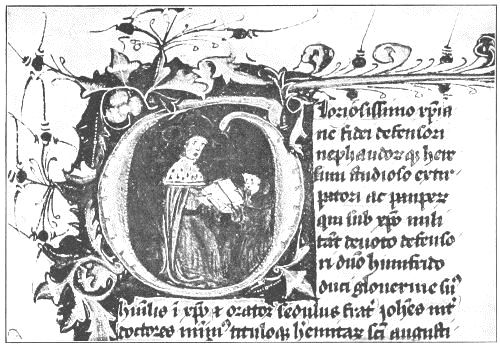
Capgrave presenting his Commentary on Genesis to the Duke of Gloucester.
An equally interesting feature of this dedication is that Capgrave commends this commentary on Genesis to his patron on the ground that in it is to be found the science of judging literature.[1277] The new science of theology was to discard the crutches of tradition, and to take its place side by side with the other interests of the human mind. No longer was it to be a science apart, but rather one branch of a great and growing literature, which had for its object the improvement of man’s state, both mentally and morally. In these words of Capgrave may we not see some indication of that critical faculty, which plays so large a part in the new birth of the mind of man? That Humphrey could be addressed after this manner clearly shows the position that he held among those who aspired to more freedom of thought; it is significant that a theological treatise should be dedicated to him on the ground that in it full play was given to the critical faculty.
It seems likely from the wording of the dedication of this Commentary on Genesis, that Capgrave was not at that time patronised by Humphrey, for he alludes to the Duke’s love of learning as a matter of report and not of personal knowledge. Probably this book and its dedication served as an introduction for its author, even as the Republic of Plato had served for Pier Candido Decembrio, and from the autograph at the end we gather that it was personally presented by Capgrave in the year 1438. We have no other work by Capgrave with a dedication to Gloucester, though four books written by this author, including this same copy of the Commentary on Genesis, were presented to Oxford; yet we know of one which would have been of immense interest had it survived, for it seems an undoubted fact that Capgrave wrote a Vita Humfridi Ducis. In his De Illustribus Henricis he tells us that such a work was in contemplation,[1278] and it was known to exist in the days of Bale and Pits, the last of whom declares that in his time it formed part of the Library of Balliol College, Oxford.[1279]
Among other English authors patronised by Duke Humphrey we must place Nicholas Upton, a Fellow of New College, Oxford, who dedicated his work De Studio Militari to ‘Excellentissimio et illustrissimo Principi meo singulari, Humfrido.’[1280] It is a work of heraldic rather than of military interest, and bears more on the public than on the literary side of Gloucester’s character. Also a host of quite forgotten men, mostly clerics, circled round this famous prince and patron, such as John Homme, Canon of Hereford, and at one time the Duke’s secretary;[1281] Richard Wyot, his Dean of the Chapel;[1282] John Everdon, who successfully petitioned for a Canonry in the Collegiate Church of Hastings;[1283] and one Henry Abingdon, who for services rendered received an annuity of £8 per annum.[1284] All these probably were employed at one time or another in copying books for their master, and all found the reward they sought at the hands of their employer, a fact which leads us to believe that the complaints of Bruni and Candido were based more on cupidity than on justice.
ENGLISH POETS
More a friend than a follower was Thomas Beckington, a man of some political importance, at one time Lord Privy Seal, Private Secretary to Henry VI., and ultimately Bishop of Bath and Wells. He was elected a Fellow of New College, Oxford, in 1408, a position which he held till 1420, about which time he probably became Gloucester’s chancellor, for he is alluded to as such in a letter written by Henry V. to Pope Martin V.[1285] He was a man who leant towards the new learning, led thereto probably by the example of his friend, and we find him in communication with Italian Humanists, such as Flavio Biondo of Forli and Piero del Monte, while at home he was connected with such scholars as Adam Moleyns, Thomas Chandler, and William Grey,[1286] the last of whom was the first great scholar churchman of England whose enthusiasm for the new learning was anything but a passing fancy. It may be that, through Beckington, Humphrey had some connection with these men, though all trace of this has vanished; at least he probably knew Grey, who claimed a distant relationship with the royal House. Lastly, it has also been stated that Reginald Pecock, the famous heretical Bishop of St. Asaph, was patronised by Gloucester, and we are told that he was ‘quiet and safe, and also bold to dispute and to write his mind’ so long as his patron was alive.[1287] Moreover, he is said to have been appointed Master of Whittington College, London, in 1431, through the influence of Duke Humphrey.[1288] The original authorities for these statements cannot be found, but it is significant that Pecock began the propaganda which ended in his disgrace immediately after the death of the man who is said to have been his patron. It may be that the orthodoxy of Humphrey acted as a restraint on the Bishop so long as he lived. However, this cannot be anything but supposition, as there is no real authority on which to base this hypothetical connection.
While speaking of the English writers patronised by the Duke of Gloucester, some mention must be made of a small band of poets—or perhaps it would be more correct to term them writers in verse—who had some relation with Gloucester. The fifteenth century was entirely barren of English literature. After the bright sun of Chaucer had set, a period of darkness arose, unrelieved by the slightest gleam of brilliancy or genius. An unheroic age produced a race of unheroic versifiers, men who slavishly followed in the steps of Chaucer, hailed him as their master in all their works, and exemplified the law that a literature which looks for its ideals to the age that has just passed must be devoid of all originality and of all real power. Interested as he was in the rediscovery of the lost literature of the past, Humphrey did not patronise the poets with the fervour he showed in reading the ancient classics, yet most of the versifiers of the day seem to have had some connection with him. Most famous of these was John Lydgate, who was responsible for about fifteen thousand of the worst lines of poetry that have ever been produced. He acted as a self-appointed poet-laureate, writing a poem to celebrate every important national event. Thus he described the triumphant entry of Henry V. into London after Agincourt; he welcomed the attempts at peace in 1443; Queen Margaret’s advent and the truce she brought with her were celebrated in the same manner.[1289] His output of bad verse is amazing, and, with the exception perhaps of his ‘London Lyckpenny,’ it is totally devoid of interest whether literary or personal. The greater part of his life was spent as an inmate of the great Benedictine monastery at Bury St. Edmunds, and it was probably here that he first met Gloucester. Several of his all too frequent poems were written to celebrate Duke Humphrey. He produced one of these on the occasion of his patron’s first marriage, and entitled it ‘A comendable balade by Lydgate dame John at ye reverence of my lady of Holland and of my lord of Gloucester to fore ye daye of there maryage in the desyrous tyme of their true louynge.’[1290] In another poem he bewailed the sad fate of Jacqueline in a way which was not very complimentary to Humphrey, though this production of his has not survived in a complete state, two whole folios being mercifully missing.[1291] Finally, he lived long enough to write the ‘Epitaphium Ducis Gloucesterie,’ a piece of doggerel which almost surpasses its predecessors.[1292]
JOHN LYDGATE
Apart from these original poems, Lydgate produced one work commissioned by the Duke. This was a verse translation of Boccaccio’s encyclopædic Latin work De casibus Virorum et Feminarum illustrium, though a French translation by Laurent de Premierfait and not the original was used by the English versifier. The title runs, ‘Here beginneth the book callyd I Bochas, descriuyng the falle of Pryncys, pryncessys, and other nobles, translated into Inglish by John Ludgate, monke of the Monastery of Seynt Edmundes Bury, after commaundment of the worthi prynce Hunfrey duk of Gloucestre, beguning at Adam and endyng with Kyng John taken prisoner in France bi Prince Edward.’[1293] Humphrey showed considerable interest in the works of Boccaccio, for he possessed other translations of this master’s writings. To his copy of the Corbaccio we have already alluded, and a French version of the Decameron was presented to him by the Earl of Warwick.[1294] His appreciation of Italian literature was not confined to these items, though it is evident that he had no knowledge of the Italian language. To Oxford he gave a copy of Dante’s works, and a commentary thereon, together with several volumes of Petrarch and Boccaccio, all in Latin, but these may well have contained translations of the Italian compositions of these writers, as well as those originally written in the scholarly language of the time. Italian literature was undoubtedly known in England before Humphrey’s day. Richard of Bury had been the friend of Petrarch, who, together with Dante, was the acknowledged inspiration of Chaucer’s poetry,[1295] and so there is no occasion for surprise at finding that these works formed part of the literary equipment of the Duke of Gloucester.
The translation of Boccaccio’s work must have cost the Duke dear, for in the midst of the translating he received a rhymed communication from Lydgate, urging penury as an excuse for a request for money, and asking him at least to give a moment,
‘To so th’ entent of this litel bille, Whiche whan I wrote my hand felt I quake.’[1296]
There is something peculiarly modern in this appeal, and to judge by the fervent thanks in the text of the work, it was not in vain. A tribute is paid to the munificent patron of the work in the Prologue, which is interesting as evidence of what was the general opinion about Humphrey’s humanism in England. His ability and energy in governing the kingdom occupy two stanzas, and still more space is devoted to his exertions in support of Holy Church, which were so successful,
‘That in this londe no lollard dar abide.’
The greatest stress, however, is laid on the Duke’s literary qualities:
‘He doth excelle In understandyng alle othir off his age, And hath gret joie with clerkes to commune, And no man is more expert off language. Stable in study alwey he doth contune, Settyng a side alle changis of fortune. Duc off Gloucestre men this prynce calle, And notwithstanding his staat and dignite, His corage never doth appalle To studie in bokis off antiquite. Therin he hath so gret felicite Vertuously himselff to ocupie Off vicious slouthe to have the maistrie.’[1297]
Strangely enough, this encomium on the literary character of Gloucester runs on very much the same lines as the praises of the Italian Humanists, and though it may have been written by a grateful poet about a munificent patron, yet there is a certain restraint about it, unusual in Lydgate’s verses, which leads us to believe it is prompted by genuine feeling. It would seem that the book was not dedicated to the Duke, though undertaken at his request, and these lines occur unheralded in the midst of the prologue to the reader.
SOME OTHER POETS
Lydgate was not the only English poet who owned Gloucester as a master, though there is no other mention of poetical work being either composed at his request, or dedicated to him when finished. On the title-page of his Boke of Nurture, John Russell describes himself as ‘Sum tyme seruande with Duke Ufrey of Glowcetur, a prynce fulle Royalle, with whom Uschere in Chambur was I, and Mershalle also in Halle,’ and in the course of the poem, which is interesting as an indication of contemporary manners and customs, we read:
‘Pray for the soule of John Russelle that God do hym mede. Sum tyme seruande with duke umfrey due of Glowcetur in dede,’[1298]
a couplet which gives a clear indication of the poetical qualifications of Gloucester’s usher. George Ashley, who was clerk of the signet to Queen Margaret, and compiled a moral poem for the instruction of her ill-fated son, Prince Edward, was also at one time in Humphrey’s service, at least so we would gather from a statement made by his mistress that at the time of his death the Duke owed him money.[1299]
A closer connection existed between Humphrey and Thomas de Norton, who was his chaplain[1300] and chancellor of his house.[1301] This post was probably one of importance, for he assisted materially in securing the renewal of the St. Albans charter, and was in correspondence with Abbot Wheathampsted on this subject. Norton was a man of more eminence than these other English versifiers, though he was probably but a young man when his master died. A native of Bristol, he became one of the most noted alchemists of his day, and embodied his knowledge in a poem called the ‘Ordinal,’ using this form and the vernacular, in order that he might instruct the unlearned in a science so useful to them,[1302] a reason which bears some affinity to the remarks made by Dante to the Prior of the Convent of Santa Croce when explaining his use of Italian in the Divina Commedia. It was most likely in his primary capacity as a scientist, and not as a poet, that Norton appealed to Humphrey, who died long before this poetical scientific treatise was written.
ENGLISH VERSION OF PALLADIUS
There is still one more versifier to be mentioned in connection with the Duke of Gloucester, though his name has not survived, and perhaps, considering the quality of his verse, he was wise not to betray his identity. Indeed, he is so conscious of his feebleness as a poet that he alludes to it more than once in the prologue which precedes his verse translation of the De Re Rustica of Palladius.[1303] This prologue, which, consists of sixteen stanzas, is not directly addressed to the Duke, nor is there any formal dedication of the poem to him. Nevertheless, frequent mention is made of the writer’s patron, and in a few introductory verses to the second book of the work it is obvious that the translation was undertaken for him.
‘I wul assay hem up to plowe and delue; A lord to plese, how suete is to laboure,’[1304]
writes this rhymester, and there is no doubt as to the identity of this lord, for he tells us plainly,
‘My blissed lord, mene I the duc homfrey.’[1305]
The writer was well acquainted with the life of his ‘blissed lord,’ most especially with his literary leanings, and he devotes nearly two whole stanzas to retailing his benefactions to Oxford, and the nature of the books given to that University.[1306] He also mentions the famous men in the Duke’s following, making special allusion to Wheathampsted, Piero del Monte, Livius, and Antonio di Beccaria, and he further gives us a speaking picture of the extensive field which his master’s studies covered.[1307] He also makes the somewhat startling statement that ‘he taught me meter make,’[1308] which we may well discount as a poetical exaggeration, not to be taken too literally. Doubtless it was at the Duke’s bidding that the translation was undertaken, and the author was probably a member of the foundation of St. Albans. This last supposition is suggested by the placing of Wheathampsted first on the list of Humphrey’s literary friends, and by an allusion in the course of the prologue to the robber Wawe, whose crimes were only of local importance, and would be unknown to us save for the account of them given by the St. Albans chronicler.[1309] The poem must have been written between the years 1439 and 1447, that is, after the first gifts to Oxford, and before the death of the writer’s patron, who was obviously still alive at the time of writing. The literary form of the poem cannot enhance Gloucester’s reputation, but it bears interesting testimony to the important position held by him amongst the scholars of the kingdom.
The list of English poets connected with Duke Humphrey is not brilliant, but this was not his fault. There was no great light in the poetic firmament whom he could patronise in the way his grandfather had patronised Chaucer, though it may seem a strange omission that this dead poet was totally unrepresented as far as we know, in his library, We must qualify our surprise by remembering that we possess no complete list of Gloucester’s books, so that a copy of Chaucer may have been among them, but at least we have sufficient evidence to prove that he did not despise the vernacular languages as did so many of the earlier humanists. True, we can only directly connect three books written in English with his name, and he seems to have found French more natural to his use than the language of his native land, since all the inscriptions in his books are written in that language, but practically all the writers of his age who wrote in English enjoyed his patronage, and we have the evidence of the University of Oxford to prove that he encouraged the production of books in the national language.[1310] Humphrey was not so busy in the rediscovery of the forgotten poets and philosophers of the past, as not to realise that the knowledge he was acquiring was to be the basis of the vernacular literature of the future, that the spirit of the new learning, while it liberated men’s minds from bondage, must also find a means of expression for itself. Though intent on building the foundations, he did not fail to consider the nature of the edifice which should crown his labours.
THE UNIVERSITY OF OXFORD
The historian of Literature is little more than the historian of exploded reputations; the great men with whom we must deal are the great men who no longer loom large on the horizon, and this is doubly true of a patron of literature. Humphrey’s reputation as scholar and patron, though it flourished in his day in countries far distant from England, is now not even a distant memory, save perhaps in that society which frequently in his lifetime expressed the conviction that his fame would be immortal, not so much for his military or political glories, though indeed they were great, as for his constant liberality to its members, and that the University of Oxford would ever be the home of his glory.[1311] In Humphrey, Duke of Gloucester, Oxford found one of her most generous and constant patrons of any age, one who laid the University under an obligation which not all her sons are ready to recognise. Certainly no contemporary of the ‘Good Duke’ could rival his generosity to the ‘clerks of Oxenford,’ though they were not destitute of important patrons. Henry IV. was numbered amongst the benefactors of the early library;[1312] Henry V. took an interest in the welfare of the University, on one occasion making special ordinances to be proclaimed and observed therein,[1313] and at his death bequeathing certain books to the Library.[1314] It is said that he had intended to found a great college there, and though this plan was never carried out, Archbishop Chichele built and endowed his foundation of All Souls in memory of his royal master. Of Henry’s sons, Bedford had the intention of founding lectures in the seven liberal arts and the three philosophies, but it is uncertain whether this project was ever brought to fruition.[1315] Henry VI. was but a churlish friend of the University in spite of the obsequious flattery he received therefrom, and on more than one occasion we find him as a harsh landlord raising the rent of ‘Bedel Hall,’ or cutting down the hard-earned fees of the masters teaching in the arts.[1316] On the other hand, Queen Margaret was the founder of a lectureship in theology,[1317] whilst Cardinal Beaufort, who had neglected his Alma Mater during his life, thought it well to add to his chances of eternal salvation by bequeathing five hundred marks towards the completion of the Divinity School, in return for which he was to be remembered in all the University prayers.[1318]
GLOUCESTER AND OXFORD
Oxford, therefore, was a fashionable subject of interest, though the benefits gained were not in proportion to the giving capacity of the donors. Humphrey was not only a liberal benefactor, but a faithful and trusted friend to the University. We may smile at the servility of the eulogies, and the extravagances of the compliments in the letters addressed to him, and also at the obvious suggestion in these utterances that there was a distinct hope of favours to come, yet with all this we can trace a note of genuine admiration and respect in these flowery effusions. For many years the Duke of Gloucester was the ‘great protector’[1319] of Oxford outside the confines of the University, a power in the land who would stand up for the privileges and rights of Chancellor and Proctors in a way that was far more valuable than many liberal donations at a time when the majesty of the law was a very venal sovereign. In a case of trouble or danger, whether from within or from without, the University would invariably appeal to her good patron, and did not find him wanting. Even when it was a matter of a quarrel with the members of the Benedictine order, of whose monasteries he was acknowledged to be quasi fundator, the University did not hesitate to appeal to the Duke to use his influence with the Chancellor in stopping the proceedings instituted by these monks in the Court of Arches against the usual payment of six shillings and eightpence made by each student to the master whose lectures he attended. At the same time he was besought to bring the presidents of the Benedictine order, namely the Abbots of St. Albans and Abingdon, to reason in this matter.[1320] The appeal was probably successful, for Humphrey’s sense of justice was seldom subordinated to his predilections, and he had already upbraided the Prior of the monks in Oxford for unseemly behaviour towards the scholars of Glastonbury.[1321] At any rate, no further appeal was found necessary, so that it may be presumed that the monks were compelled to yield the point. The incident recalls an interesting aspect of Gloucester’s relations with Oxford, in that he devoted his sympathies to the University as a corporate body, and neglected the separate foundations which made up the whole, even to the extent of having no connection with Gloucester College, the home of these monks of the Benedictine order, and the offshoot of his beloved monastery of St. Albans.
But while Gloucester favoured Oxford, he was not unduly partial, and in one case at least the University had to compromise. A certain friar, William Mussilwyk, had been deprived of his doctor’s robes, and his supporters had been suspended, whereupon Gloucester wrote to remonstrate. The University declared that their patron had been misinformed as to the rights of the case, but after considerable correspondence with him on the subject, a compromise was arranged, and it was agreed that the disgraced friar was to be reinstated if he acknowledged his fault; it was, however, emphatically explained that this course was adopted merely as a personal favour to the Duke, and was in no way a confession of error.[1322]
The University had reason to be grateful to Gloucester, for he had taken it under his special protection, at least so one would gather from the phraseology of a letter written to him in 1430, wherein elaborately worded thanks are given him for his great generosity towards it ever since he had been its protector.[1323] He was not the man to give his protection without his interest, and he wrote to the University in 1431, requesting that certain reforms which he suggested should be carried into effect. An evasive reply explained that at present this could not be done, as so many members of the University were then absent from Oxford, and the time was too short for so important a question to be decided; however, it was hoped that a more definite answer could be sent before Christmas.[1324] Of this promised answer there is no trace, and the event passed into oblivion as one of no importance, save that it might suggest a marked continuity in the history of the University. This is the only record of unsolicited interference in the internal history of Oxford on the part of Humphrey, and it comes somewhat as a surprise that a man who has the reputation of being overbearing and interfering should not have tried to stamp his individuality more clearly on the University of which he was the protector.
Throughout the earlier years of the connection between Humphrey and Oxford it is the latter that invokes aid, not the former who would press his own wishes. Each may occasionally ask the other’s help for a friend,[1325] but the letters addressed by the University to their patron were mainly written in pursuit of some benefit from outside, or in the hope of the pacification of some internal quarrel. At one time the Duke is besought to use his influence in securing for them the books bequeathed by Henry V.;[1326] at another, as protector of the realm, he is asked, together with the King’s Council, to advise as to the treatment of certain defiant heretics, who are preaching ‘uncircumcised and seditious words’;[1327] or again he is appealed to in matters of purely internal concern—the disputes between Town and Gown, or the insubordination of the members of the University themselves. Thus in 1434 the authorities sought aid in enforcing a statute which had been passed in the interests of peace, which was meant to satisfy both the townsmen and the scholars, but the opposition thereto threatened to render it a nullity.[1328] The very next year a claim made by the Bachelors to be called Masters threw the University into a state which bordered on civil war, and caused a total cessation of lectures and all teaching. Urgent letters were written to Gloucester asking his assistance in quieting these disturbances, and Kymer was petitioned to use his influence with the Duke to beg him to grant their supplication.[1329] No sooner was the town reduced to quiet than the scholars of Devon and Cornwall organised a riot, and bearing off the image of St. Peter from a parish church, they placed it in the monastery of St. Frideswide, and desired all other scholars to attend Mass there. An attempt on the part of the University authorities to allay the tumult resulted in armed resistance, in which the law-students took the lead. Oxford, in a state of anarchy, once more appealed to its patron.[1330] We have none of the replies to these various petitions, but from a subsequent letter from the University it would seem that Gloucester had shown sympathy, and had intervened, for peace, though not entirely restored, was then at least in sight.[1331]
Interesting though they are, Gloucester’s relations to the University in his capacity of a great prince have not the importance of his intercourse with her as a man of letters. Noisiness and a tendency to tumult have not always been signs of decay in Oxford, but at this moment they were the outward tokens of inward debility. Poverty, ‘the step-mother of learning,’ was the bane of university life, and we have seen the efforts of some students to escape paying their fees. A large percentage of the letters written by the University had this lack of money as their theme, and it was not greediness for more of the good things of life, but a desire for mere necessaries, that obliged them so to write. The University was as Rachel weeping for her children—so says a letter to the Archbishop of Canterbury in 1438: once she was famous in the world, and students flocked to her from all parts; then she possessed many men learned in the arts and sciences, her schools were not depopulated, nor were her halls empty. Now there was a scarcity both of food and money, and learning was so little rewarded that few came to acquire it; scarcely a thousand scholars and masters remained in the University, doors were locked, the buildings in ruins. Those who still remained had to be content to see ignorant and unlettered men promoted over their heads in the world outside, whilst they were left to starve.[1332]
Oxford had indeed fallen from her high estate, and was experiencing a period of affliction. The scholarship of the Middle Ages was worn out, the gospel of the New World had not yet been preached to her, but when, as in all its troubles, the University turned for help to the Duke of Gloucester, it had taken the first step towards better things. To him its grievances were told, and it was his generosity that resuscitated the lectures on the seven liberal arts and the three philosophies.[1333] Still, there was not sufficient for their continual maintenance. The lectures were carried on for some time, till the expense was more than could be borne, and again an appeal was made to the Duke. It was imperative that they should have a permanent foundation for three more lecturers, and they must have books, and money to buy more. Yet another important corollary to these demands was that more suitable appointments should be made by those in authority in the kingdom, and that a man who had been educated at Oxford should not be at a disadvantage by reason of his superior knowledge.[1334] We have here the grievance in a nutshell. University education was unpopular, no one was ready to provide the means for that education, and the existing means were at present wholly inadequate.
GIFTS OF BOOKS TO OXFORD
Probably the lack of books was the greatest want, for beyond a very few volumes in the chests of the Library named after Bishop Cobham, and some others possessed by masters more wealthy than their fellows, there were no books at all in the University. The students had no access to books, all the teaching had to be done orally, and hence the knowledge acquired was of that purely hereditary type which could not be enlivened by the infusion of new ideas. To a lover and student of books such as Duke Humphrey this defect in the equipment of both teachers and taught must have come home very strongly, and his reply to the appeal, which was made in April 1438, was not tardy. Already his name, together with those of his father and brothers, was written on that tablet in the Oxford Library which recorded the benefactors of that institution,[1335] and in 1435 he had presented both money and books to the University, for which he had received the warmest thanks, and a promise of renewed diligence in study, as recognition that it was his wisdom that had brought about a revival of learning in Oxford.[1336] In answer to the direct appeal he had received in 1438, he forwarded what must have been an important part of his library, in the shape of one hundred and twenty-nine volumes[1337], ‘a more splendid donation than any prince or king had given since the foundation of the University,’ valued as it was at more than £1000.[1338] The letter of thanks spoke in naturally high terms of the Duke’s wisdom and learning, and compared him to Julius Cæsar, who founded a library in Rome, for he, like Gloucester, combined the attributes of a great soldier with those of an enthusiastic scholar.[1339] Not content with their own thanks, these grateful scholars wrote to Parliament, urging its members to thank the Duke, since both they and their relatives had been, or in the future would be, beholden to the University for their education[1340]—a request which, it is hardly a surprise to find, went unheeded. On November 5, 1439, an indenture in receipt of the books was drawn up, and thereon were inscribed the first word or words occurring on the second folio of each volume, so that identification in case of loss might be possible.[1341] This last precaution, which was customary in most libraries of that period, is still of immense value in verifying the authenticity of manuscripts said to have formed part of the donations of Duke Humphrey to Oxford. Two more gifts followed in 1441, the first consisting of seven, the second of nine books, of which we have only the names of the latter preserved.[1342] It is noticeable that on both these occasions the books were conveyed to Oxford by Sir John Kirkby, a soldier who had served under Humphrey in the campaign of 1417. Finally, in 1444, came a gift of one hundred and thirty-four volumes, which were indented for in the usual manner.[1343]
Gifts of books in such numbers were unique in the history of the University, and continued to be so for some time to come. Other donors there were, amongst whom may be numbered Bedford, Wheathampsted, the Duchess of Suffolk, Thomas Knolles, and John Somersett.[1344] These, however, were all either small collections or single books, and even a gift by Henry VI. to the foundation of All Souls only numbered twenty-three volumes.[1345] Throughout, Duke Humphrey had led the way in the patronage of the University. He had befriended it at a time when it sadly needed support, and he now endowed it with a library, which in numbers compared very favourably with any similar collection in England. It was a deed of open-handed generosity, which well deserved all the thanks it provoked, for in all he must have given quite three hundred volumes to the University[1346]—by no means an insignificant collection of books when all had to be copied by hand. They were drawn undoubtedly from his own private library, as there had been no time between the request and the donations to collect for the purpose, and the gift becomes thereby all the more interesting to us, and all the more honourable to the donor. Humphrey cared not for books merely for the sake of collecting them; he valued their teaching, and did his utmost to give them every opportunity of spreading their gospel abroad among the students of the land.
Special arrangements were made by the University for the preservation of these additions to their Library. Already since 1412 there had been a Librarian, who cared for the books collected in the room over the porch of St. Mary’s Church. He was in receipt of a salary of one hundred shillings per annum, besides six shillings and eightpence for every university Mass that he said, and the right to receive robes from every beneficed graduate at the time of his graduation. Only graduates and members of the religious orders who had studied philosophy for eight years were given access to the Library, though certain exceptions, as in the case of sons of members of Parliament, might be made. Oaths must be taken by all readers not to mutilate the books by erasures or blots, an ordinance, let us hope, which was observed more carefully at that time than it is now in modern libraries. The Library was open from nine to eleven and from one to four o’clock, except on Sundays and certain specified days, including the Librarian’s holiday of one month in the long vacation.[1347]
Fresh provisions were drawn up in 1439 in view of the recent additions. All books were to be entered on a list kept in the Library, and their titles were to be clearly marked on the first page with a list of the contents; none were to be alienated or removed from the Library, save for the purpose of rebinding, though the Duke might borrow any volume after having submitted a written request to that effect. The books were to be kept in chests for the use of lecturers and masters, and in the absence of lectures students might have access to them. In case of loss the loser was to pay to the University the sum marked on the book, which was to be in excess of its real value.[1348]
The possession of a useful library did much to restore the old position of the University. From having almost no books—so wrote the authorities to Gloucester—they now had plenty, so that both the Greek and Latin tongue was there studied—that is, both the Greek and Latin authors, for no Greek books were included in the gift. Men from all lands came to study in Oxford now, as they had done before, and the letter concludes with a phrase couched in more intimate terms than had been hitherto customary; ‘we wish you could see the students bending over your books in their greediness and thirst for knowledge.’[1349] So great were the crowds that used these volumes, that the accommodation afforded by the old library was insufficient, and so the University wrote to Gloucester, suggesting that the new Divinity school, then in course of construction, should be used for the purpose. It was in every way suitable for a library, being retired and quiet, and the idea that this new home for his books should be called by his name was submitted to the donor thereof for his approbation.[1350] Herein we may see a polite hint that money as well as books would be acceptable. We have no evidence that the Duke responded to this appeal at the moment and he died before the building was completed by the munificence of Thomas Kempe, Bishop of London, who gave one thousand marks for the purpose. With a conveniently short memory the University alluded to the finished Library as tuam novam librariam when writing to Kempe in 1487.[1351]
LAST RELATIONS WITH OXFORD
This last request of Oxford, though only suggested, did not go unanswered, for Humphrey appeared in the House of Congregation, and publicly promised to give the rest of his Latin books to the University together with £100 towards the new Divinity school, a promise which he renewed just before his death. But this promise was never fulfilled, and in spite of numerous letters to the King, the executors of the Duke’s will and many other influential persons, neither the books nor the money ever found their way to Oxford.[1352] Even as the library bequeathed by Petrarch to Venice in the preceding century never reached its destination, so did Oxford never benefit by the last promise of her friend and patron.
It was with genuine regret that Oxford learned the death of the Duke of Gloucester, and an invocation, inspired by sorrow and fear for the future, appears in their letter-book.[1353] His obsequies were performed with great pomp,[1354] and an ordinance was issued enjoining all graduates to pray for him at the beginning of all sermons preached before the University, at St. Paul’s Cross, and at St. Mary’s Hospital, Bishopsgate.[1355] Every year Mass was said on the anniversary of his death for the repose of his soul, and later of that of his wife Eleanor.[1356]
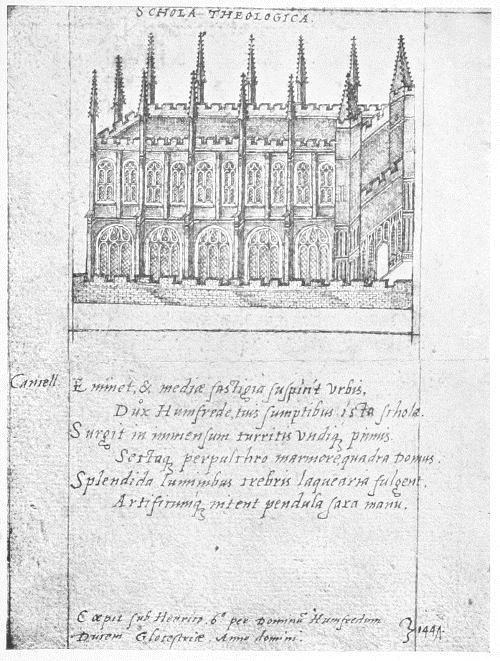
The old Divinity Schools and Duke Humphrey’s Library at Oxford.
The Oxford masters had reason to be grateful to Gloucester, and in the later epistles to him we can trace a growing simplicity and a growing genuineness in their tone—‘unable to repress our feelings, we pray you of your goodness accept our simple gratitude.’[1357] Like the Italian Humanists, they dwelt on that great combination of qualities which made him a great soldier and a great man of letters in one,[1358] and speaking of his books given to them, they cried, ‘Statues, sculpture, and graven brass will not so long preserve the memory of the great, as will the living records of history.’[1359] The prophecy was justified, but later events mitigated the exactitude of its operation. When the ecclesiastical reformers, whom Humphrey had suppressed, won their final triumph in the unlovely days of Edward VI., the tangible evidences of the ‘Good Duke’s’ benefactions to his University were lost. How or exactly when this happened we cannot tell, but of the original manuscripts not one was left in the Library. A fanatical abhorrence of illuminations and rubricated initials, combined with a mediæval disregard of the intellectual side of life, destroyed, scattered and lost, in most cases for ever, these interesting relics of an interesting personality.[1360] The student of the early Renaissance in England has good ground of complaint against the Protestant Commissioners of King Edward VI. Yet in the University which educated him, and which he helped to educate, the memory of Duke Humphrey is not entirely forgotten. For long it treasured a silver-gilt belt known as ‘le Duke Humfrey’s gyrdyll’ as a remembrance of their benefactor,[1361] and to this day every preacher in the University pulpit still recalls to his hearers the bounty of this fifteenth-century prince. The building which was erected to contain his manuscripts, now the central part of the larger room in which the present students ‘studie in bokies off antiquite,’ still bears his name, and beyond that barrier where visitors dare not—or rather should not dare to—tread lies ‘Duke Humphrey’s Library.’ Though Oxford may call her Library by the name of its restorer, Sir Thomas Bodley, yet there is an older tradition which never dies, the tradition of the man who, with all his faults and with all his vices, did not forget his debt of gratitude to his Alma Mater—‘literatissimus princeps, amicissimus noster.’[1362]
GLOUCESTER’S LITERARY TASTES
All that we know of Gloucester’s literary career tends to prove that his patronage of Oxford was only one branch of his scholarly activities. It is evident that he had an extensive collection of books over and above those that he gave to the University, and it is the loss of nearly all knowledge regarding this private library which is our most serious disadvantage when estimating his literary tastes. We have but little evidence of the nature of the books which belonged to the Duke and never reached Oxford, or of the subjects of a less classical bias that he studied; had we even the catalogue of books in his possession that he sent to Candido, we might be able to estimate his position in the literary life of his age more justly, but this also seems to have gone to that bourne from whence no knowledge returns. Apart from the zeal of the reformers and the carelessness of the ignorant, we doubtless owe the loss of many of these books to that discovery which has helped to perpetuate the learning of the past. Humphrey stood on the threshold of the age of printing, that age when the multiplication of printed books cast their written forebears into the lumber-room. A manuscript of which the contents had been printed was then regarded as a cumbrous method of imbibing learning; its historical value was not recognised. Humphrey’s library was not long to remain as a monument to his memory, as the University of Oxford had predicted that it would; it no longer remains to help us to gauge with any hope of exactitude the breadth of his interests, or the nature of his talents. That he loved his books, and took an interest in them for what they contained, is beyond dispute, though in those copies that survive there is no evidence that he wrote in them ‘Moun bien mondain,’ as Leland asserted, and Hearne either copied or confirmed.[1363]
The fact that a large proportion of the books which once belonged to Humphrey, and are still extant, did not form part of the gift to Oxford, leads us to believe that a considerable part of his library must remain unknown to us, even as to the titles of the various volumes. From the Oxford lists, however, it is evident that the scholarship of the Middle Ages had but little interest for him. Theology holds an important place among the gifts to Oxford, but the schoolmen are but scantily represented on the list. Bede, William of Occam, Pietro Damieno, and Albertus Magnus, the master of Thomas Aquinas, are there, but there is no trace of the writings of Aquinas himself, Peter Lombard, Bradwardine, Duns Scotus, and many other famous schoolmen. The early Fathers are well represented, some only by volumes of letters, others by their better-known works, and these last seem to be more the imaginative than the doctrinal theologians of their day. Taken as a whole, the theology of Humphrey’s library betrays a tendency to ignore mediæval doctrinaires, and to turn to the early Fathers, who wrote before Imperial Rome had passed into final decay. Mediæval law shared the fate of mediæval theology, and even more markedly. Hardly any of the numerous treatises on a subject which formed part of the staple food of the mediæval mind appear on Humphrey’s lists; canon law is but sparsely represented, civil law is almost entirely neglected.
Humphrey’s library was fairly well supplied with historical writers. We find the works of Suetonius, the historian of the twelve Cæsars, the Jewish historian Josephus, Tragus Pompeius, and Cassidorus; among later historians Eusebius and Vincent of Beauvais, Bede, and Higden. Among other historical works were a copy of the Flores Historiarum, an Eulogium Historiarum, a volume entitled Tripartita Historia, a Polycronicon, the Granarium of Wheathampsted, and other anonymous chronicles. These were a goodly number of historical books for the times in which Humphrey lived, but more remarkable is the large quantity of medical and astronomical treatises. A long list of books from the pens of doctors ancient and modern belonged to him, beginning with the early Greek writers on medicine, and ending with the compilations of his own physician-in-chief, Gilbert Kymer. Side by side with these stand all the leading authorities on astronomy and astrology, including the works of the chief Arabian philosophers and Roger Bacon’s De Celo et Mundo. No mention is made of Bacon’s Opus Majus, nor are there any traces of any scientific treatises outside those known to the mediæval scholars. The interest evinced by the Duke in medicine is both interesting and unusual; his knowledge of astrology proved one of the most fatal of his accomplishments in the days when his wife was accused of sorcery. A word should be said about the recurrence of several works on agriculture, both in Humphrey’s library and amongst the books he requisitioned Candido to procure for him. Whether this points to a practical interest in agriculture we cannot tell, though the probability is against it, and there seems no reason to believe that the Duke anticipated that other disappointed politician, who forgot grief at the loss of power in the useful, if unheroic, occupation of growing turnips.
Humphrey’s chief distinction as a collector of books lies in the possession of those copies of the ancient classics which he had procured from Italy. Though the Cosmography of Ptolemy, the Politics of Aristotle, and the Lives of Plutarch were absolutely unknown in Western Europe till Palla degli Strozzi had them brought to Italy from Constantinople, yet within a few years of this they were to be found in Latin translations among the Duke of Gloucester’s books. Other classical works there were in that collection. Five more volumes of Aristotle, the Republic, the Meno, and the Phædrus of Plato, all the known works of Cicero, and a volume of that ‘most learned of the Romans,’ Varro; Sallust, the historian of the Cataline conspiracy; grammarians such as Aulus Gellius and Priscian; rhetoricians such as Quintilian; poets such as Ovid and Terence, all stood side by side in this wonderful library. Seneca was represented both by his philosophical and by his dramatic writings, and criticisms on the philosophy of Aristotle might be found from the pen of Averrois or John of Damascus. The Greek language had been relearned in Italy during the Duke’s lifetime, and a step towards bringing it to England was taken in the presentation of a Greek dictionary to Oxford. Finally, Humphrey showed his sympathy with the men of the new learning by possessing five volumes of Boccaccio and seven of Petrarch, and his appreciation of what was best in mediæval thought by the inclusion of a volume of Dante and a commentary thereon amongst his books.[1364]
None can doubt the catholicity of Gloucester’s tastes after a glance at the names of the books which he collected, and we must believe that they genuinely manifested his predilections, and that Leland was clearly in the right in praising his sound judgment in matters literary.[1365] His taste was developed by genuine study. Numerous references to him by contemporaries prove that his patronage of literature was no pose adopted for the sake of the popularity it might bring. Livius declares that he surpassed all other princes of his time in his devoted study of letters both humane and divine;[1366] Basin bears the best testimony,[1367] Capgrave follows suit,[1368] and an unknown hand has left a record of high praise for his love of study on the fly-leaf of an Oxford manuscript.[1369] It is, moreover, obvious that the Duke’s interests were not confined to the volumes presented to Oxford, and it is noteworthy that among the survivals of his library there is a great contrast in subject-matter between the books of the Oxford donation and those which were retained in his own hands. While the Oxford books are strictly classical and scholastic, the others show a wide range of subjects, and give us reason to believe that they must have formed part of a collection of considerable literary interest. This shows at once the wisdom of the Duke in making his selection of works to give away to a great educationary foundation, and his great range of knowledge, which in many cases stepped outside the traditional limits both of the Schoolmen and of the Humanists. Perhaps the most striking fact is the existence of so many French works in Gloucester’s library.[1370] The large majority of these are translations from the Latin, which might at first glance seem to imply that Humphrey was but an indifferent Latin scholar, and preferred to read his books in French. It is undoubtedly true that French was to him the most natural language; he invariably used it in inscribing his name in his books, and he even went so far as to possess a French translation of Livy.[1371] But we must remember that in those days of infrequent and costly manuscripts a collector was only too glad to secure a copy of the author he wanted in whatever language it was written, and moreover a large number of these French books, notably the Livy, were presents from friends, and not private purchases on the part of the Duke. It is, however, interesting to note that whilst he gave a Latin version of the military treatise of Ægidius Romanus to Oxford, he retained in his own hands a French version of the same work.[1372] Undoubtedly, Humphrey read gladly and largely in French, but there is ample evidence that he was also a finished Latin scholar, and deeply versed in the classics. This alone can explain the wealth of classical quotations in letters addressed to him on matters purely personal, when the writer was trying to ingratiate himself with his princely correspondent.[1373] Moreover, his letters to his Italian friends, though doubtless they owe their final shape to a secretary, make constant allusion to classical reading. He was never separated from his copy of the Republic of Plato, and on one occasion at least he borrowed a book from the Oxford Library for his own private use.[1374] On this showing he must have been able to read Latin with ease, and his favourite study was the works of Plato, whose philosophical system was the chief new discovery of the Italian Humanists.[1375]
Earnest though he was in the study of the ancient classics, Gloucester did not allow it to restrict his mental vision. As a practical soldier he was interested in the theory of military operations, and besides his copy of the work of Ægidius Romanus he possessed in his private library a French version of the Epitome Institutionum Rei Militaris of Vegetius.[1376] This treatise, which deals with the organisation of armies, the training of soldiers, and other kindred subjects, was doubtless used by him as a basis for his military theories, and proved a useful handbook on which to found a system more in accord with the circumstances of his day. In general literature, apart from the English poetical works composed for him, Humphrey showed an interest in early French romance by the possession of a copy of the Roman du Renard[1377] and at the same time this shows how his political inclinations affected his literary outlook. The Roman du Renard, unlike its predecessors of the Carlovingian and Arthurian epic cycles, was produced by the growing sense of independence in the French towns. It has a direct bourgeois inspiration, which must have appealed to a man who found his chief supporters among the burgesses of the City of London. Gloucester’s personal tastes may also be traced in his possession of a copy of the resolutions passed at the Council of Basel,[1378] and in the Songe du Vergier, which also formed part of his library.[1379] This last consists of a discussion on the relative spheres of the spiritual and temporal powers, and shows us the learned Duke applying his intellect to the pressing ecclesiastical problems of his day, problems about which he had taken a very definite stand in his public actions. Closely connected with this was his interest in matters theological, his acceptance of Capgrave’s Commentary on the Book of Genesis,[1380] and his possession of numerous tracts by Athanasius,[1381] and of both an English and French version of the Bible.[1382]
Apart from matters purely literary, we have reason to believe that Humphrey’s interests were very wide. He showed considerable artistic taste in the beautifully illuminated manuscripts which formed part of his library, though the books that were written specially for him were not often very elaborately adorned. Like his brother Bedford, he knew how to appreciate this kind of artistic work, and we need but allude to the beautiful edition of the Psalms compiled for him, to the St. Omer Psalter once in his possession, and to his copies of the Decameron and of Livy, to realise how he was able to gratify this taste.[1383] In an age when artistic values were still the monopoly of Italians, the illuminated books in the Duke’s possession, if of no great artistic value, were excellent examples of the decorative work of the period.[1384] In the kindred art of music also Gloucester probably took some interest. We find frequent mention of ‘The minstrels of the Duke of Gloucester,’ who visited Winchester, Reading, Lydd, and many other towns ‘as a courtesy,’ for which they received monetary recognition from the inhabitants.[1385] Possibly these were a band of strolling musicians who enjoyed the patronage of the ‘Good Duke,’ much in the same way as at a later date actors were known as the ‘King’s servants.’ In any case there is a strong presumption that musicians as well as scholars enjoyed the bounty of the Duke of Gloucester.
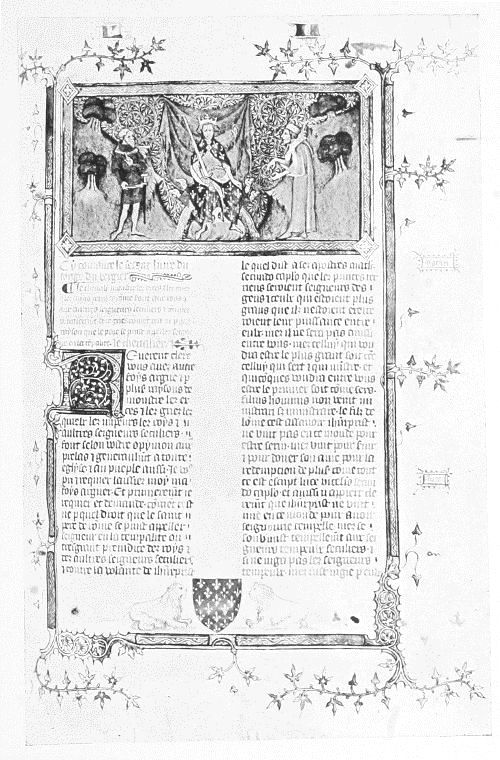
A Page from the Duke of Gloucester’s copy of “Le Songe du Vergier,” once part of the Library of Charles I of France.
GLOUCESTER’S LITERARY POSITION
Just as Humphrey was a great student so was he a great personality in the life of England, the Mæcenas of the new learning, and the friend of all scholars. A considerable portion of his books were presents from various people, and he seems to have been always approachable by any one who could take an interest in any branch of knowledge. Those who gave books to him were drawn from various classes of the community. Men who would earn his patronage presented their work to him as did Capgrave;[1386] his friend Wheathampsted cemented their friendship in the same way.[1387] Frenchmen as well as Englishmen knew of his tastes, and approached him with literary gifts, whether it were the learned Bishop of Bayeux,[1388] or an insignificant Canon of Rouen.[1389] The Duke of Bedford chose a choice treasure from the library of Charles VI. as a gift for his brother,[1390] and the Earl of Warwick, the ‘Father of Courtesy’ and the tutor of the young King Henry VI., offered a French translation of the Decameron as a mark of friendship and esteem for the man under whom he had served.[1391] Men of less mark followed the lead of the princes of the land. Sir Robert Roos, a public servant of some eminence, gave yet another French work to the then Protector of England,[1392] and Sir John Stanley, possibly the Sir John Stanley who was king of the Isle of Man, hastened to add his tribute of homage in the shape of a French Bible.[1393]
It is hard to say whether these gifts were in all cases indications of literary esteem, or merely means towards securing the favour of a powerful prince. At least they show that Humphrey’s interest in all kinds of literature and learning was not assumed as a pose, but was a veritable passion, ministered to by all who desired his friendship. To no other man of his time were such gifts in such profusion given, gifts, moreover, which came not only from the needy scholars who desired his support, but from prince, noble, priest, and humble gentleman alike. There is, too, a remarkable absence of party politics in the literary friendships which these gifts manifest. Bedford not once nor twice was compelled to condemn his brother’s action. Warwick was a member of the Council of Regency which withstood the Protector’s ambitious claims. Sir Robert Roos, though he accompanied Beckington on his embassy to the Court of Armagnac, was prominent in carrying out the peace policy which Humphrey opposed, and in 1445 was intrusted with bringing Henry VI.’s Queen over to England. Sir John Stanley may possibly be the man to whom the Duchess of Gloucester was intrusted when she was confined in Leeds Castle, and when we look further afield we find that Piero del Monte, the friend of Duke Humphrey, did not hesitate to give the papal blessing to the union of Margaret and Henry VI. when they were married by proxy at Tours.
GLOUCESTER’S LITERARY UNDERSTANDING
Humphrey therefore was more than a mere patron of scholars, and more than a mere literary dilettante. He was known to be more devoted to literature of all kinds than to anything else, and the subtle monks of St. Albans knew well how to win his favour by enlarging his library. His powers of criticism and appreciation are, however, hidden from us. Beyond the nature of the books he collected and a few words of formal appreciation of the works of Plato, we have nothing to guide our judgment, for though a patron and a student, he was not himself an author, in spite of statements to the contrary.[1394] There still exists a copy of certain astrological tables entitled Tabulæ Humfridi ducis Gloucestriæ in judiciis artis geomansie, but this was merely a compilation made at his command.[1395] He was content to encourage learning, and to qualify himself for this rôle by study. Thus the Duke of Gloucester devoted a large amount of his superfluous energy to the really great work of encouraging learning in England; yet at first sight it may seem that he laboured in vain. England did not at once adopt the new doctrines that were paving the way to modern methods of study, and it has been thought that Humphrey simply worked in the spirit of the mediæval scholar, and did not in any way appreciate the importance of his actions. England had lagged behind other nations in accepting the doctrines of the Renaissance scholars. Men imbued with the scholastic spirit had journeyed to Italy before the days of Duke Humphrey, but they had not understood the message which the Italians taught them. Richard of Bury had been the friend of Petrarch, but had entirely failed to understand his point of view, and when the future Duke of Gloucester was but five years old, a certain Augustinian monk, known in Italy as Thomas of England, was lecturing in Florence, but was said by Leonardo Bruni to have loved Humanism only so far as an Englishman could understand it.[1396] The Italian scholar therefore had been contemptuous of his English contemporary, but a new era dawns when Humphrey begins to take an interest in Italian scholarship. The Italians who wrote to him showed clearly in their letters that they understood their patron’s interest to be intelligent and quite different to the mediæval conceptions of his predecessors, and in some cases we can see the genuine appreciation of the scholar peeping through the adulation of the retainer. His love for Plato, and his clear understanding of the contrast between his philosophy and that of Aristotle, show how entirely he had thrown off the intellectual fetters of the Middle Ages, and in his selection of books we clearly see that he understood that the progress of the future must be based on an understanding of the past. In Humphrey, too, we see traces of that critical faculty which characterised the new movement. He did not look on the classics as an allegorical commentary on the Scriptures, and as a basis for Christian Theology; he studied them from the literary and philosophical point of view, and refused to accept the system laid down by the mediæval schoolmen. He was the first great Englishman to introduce these new ideas into England, though there were other scholars of the period who understood the new doctrines, if they did not preach them; men like Andrew Holles, who after long study in Italy retired to a country benefice, and did nothing towards spreading the new ideas he had acquired.[1397]
GLOUCESTER’S LITERARY INFLUENCE
Herein lies the importance of Duke Humphrey’s career. He not only understood the meaning of the new doctrines, but he paved the way towards their fuller appreciation by the nation as a whole. As a layman and a man of affairs he was able to take a more comprehensive view of the significance of the new learning than the churchmen who hitherto had held the monopoly of English knowledge, and he laid the foundations on which others were to build. In the first place he taught men that it was to Italy that they should look for direction in their studies. He himself had not visited that country as so many of his contemporaries had done, but he had brought himself into nearer touch with its intellectual life than any other Englishman. The man who was the patron of Leonardo Bruni, the constant correspondent of Pier Candido Decembrio, the friend of Piero del Monte, and the literary acquaintance of Alfonso of Aragon, the man who more than once was picked out by Æneas Sylvius for literary appreciation, was far more in sympathy with Italian aspirations than such a one as Thomas Beaufort, Duke of Exeter, who showed no signs of having been influenced in any way by his sojourn at the University of Padua.
Yet the interest of Humphrey’s Italian sympathies lies not so much in his connection with Italy as in the fact that he never set foot in the country. He did not take himself and his energies to be expended in a selfish pursuit of learning in Italy, like his contemporary Holles, but he helped to bring the intellectual aspirations of the Italians over to England. He not only taught men to study Italian wars, but also led them to bring the results of that study home to their own doors. And he was not without disciples. It is customary to believe that the humanistic aspirations of the ‘Good Duke’ received no echo in the England of his day, but we cannot but think that his example helped to inspire the exertions of that devoted band of scholars which included the princely ecclesiastic, William Grey, poor students such as John Free, Fleming, and Gunthorpe, and the notorious but scholarly John Tiptoft, Earl of Worcester. Indeed there is much to suggest this, and perhaps the most curious of all our evidence centres in the name of Guarino da Verona, the great schoolmaster of Ferrara, who was intrusted with the education of Lionello and Borso d’Este. Every one of this band of English students studied under the direction of this famous scholar. Grey attended his instructions while living in princely state at Ferrara; Free journeyed from his home in Bristol to get the benefit of his teaching; Tiptoft turned aside during his wanderings in Italy to visit him in his adopted home; all at one time or another joined that ever-increasing band of English scholars who flocked to the Ferrarese school in such numbers as to be specially mentioned by Lodovico Carbone in his funeral oration over the dead scholar.[1398] Humphrey’s influence is to be traced here, for it was he who had first pointed to Guarino as the fountain of true learning. When commissioning Zano of Bayeux to buy him books in Italy, he had laid special stress on his desire to possess anything that had been written by this teacher.[1399] By selecting Guarino as the mentor of his intellectual aspirations, he had pointed out the road for future scholars to tread.
All these scholars followed in the steps of the Duke of Gloucester, and had all grown up before he passed from the scene of his activities. They, however, failed to carry out his theories to the full. Though they submitted themselves to the desire for the new learning, they did but little to bring it home to the great mass of Englishmen. They studied, but they did not teach. They had all learnt the earliest lesson of the new ideas under the shadow of the University of Oxford; all were Oxonians, and thus were direct products of Duke Humphrey’s patronage of that home of learning, and they so far followed in his footsteps as to give or bequeath the books they collected either to the University itself, or to some College within it. It was in this way that Gloucester had most conspicuously prepared the high-road to learning. By his gifts of books he had given Oxford students the opportunity of further researches into the human mind, he had thrown open the doors which had hitherto barred the way to Englishmen who desired a knowledge of what the past had thought of life and its component elements. For the first time in England men were able to know something of what the ancients had written. In the book-chests of Oxford lay the seeds of the English Renaissance. The immense importance of access to these books may easily be misunderstood at the present day; it is hard to realise completely the limitations which surrounded the mediæval scholar, but once this is achieved, the presence of these works, which reflected, if they did not very accurately represent, the ideas of classical writers, will be fully appreciated.
By his patronage of Oxford and his gifts of books Humphrey had inspired his immediate successors to carry on his work, and to bring together the materials for future generations to use. His work was crowned when Greek came to be taught in England. He himself had known no Greek, Grey and his friends had known but not imparted it; it remained for William Selling of All Souls at Canterbury, and Thomas Linacre, William Grocyn, and Thomas Latimer at Oxford, to bring this language and the literature which it voiced to the knowledge of educated Englishmen. Linacre, perhaps even more than his fellows, was cast in the mould that Humphrey would have approved. Like Humphrey, he was a man of immensely wide interests, not the dry-as-dust scholar, but the man of the world; like Humphrey, he was a special student of medicine, a science which owed its development in Italy to the discovery of the works of Hippocrates. At the same time he, more than any one else, completed the edifice of which Humphrey had built the foundations. Again we can trace the direct influence of the Duke. This last band of scholars who finally established the new learning in England were, like their predecessors, all Oxonians. The University which Gloucester had started on the way of good things was the parent of the new school of thought, it carried on the work of its great patron. It is to the lasting fame of this indifferent politician that through him the humanities came to be taught in England, that through him Oxford was induced to lead the van in introducing the new culture. We are apt to forget the debt we owe to the work of these early intellectual reformers, and to minimise the influence of the ideas they introduced on every aspect of our lives. Yet reflection will give its due meed of praise to their laborious efforts, and if it goes far enough back, will, like the Bidding Prayer read from the pulpit of the University Church, place Duke Humphrey’s name first on the list of benefactors.
GLOUCESTER’S TITLE TO FAME
It is a relief to turn from the stormy political career of Duke Humphrey to that sphere of his activity where undiluted praise can be given; to forget that public life which was marred by instability and prejudice, and to admire that industry which won him a great reputation both with his contemporaries and with posterity. Yet we must not forget that many of the qualities which led him to court disaster in public life were due to his leanings towards a life of study. The circumstances of his life and the tendencies of his age were against him. A student by nature and a politician by birth, he had too much ambition and too little restraint to choose the better path, and confine his energies to spreading the gospel of the new learning. The man of letters is seldom wise in adopting a life of political activity, and the case of Humphrey was in some ways repeated later in the life of Bacon. Even if we place the Duke of Gloucester amongst the worst types of political criminals—and we have no adequate reason for so doing—we must accord him a position of honour amongst those to whom posterity should be grateful. By those who have laboured under the shadow of his personality in the Library which preserves his name the memory of the ‘Good Duke’ must be cherished as an inspiration. They indeed must catch something of the spirit which enabled Hearne to speak of him as ‘that religious, good and learned prince whose handwriting I us’d, whenever I saw it in the Bodleian Library ... to show a particular sort of respect to, as some little Remains of a truly great Man, one that was both a Scholar himself, and the chiefest Promoter of Learning and Scholars at that time.’[1400]
The first page of the Renaissance in England consists of the life of Humphrey, Duke of Gloucester, and all who value the inspiration to be drawn from the new era in human thought which dates from that great movement, must respect the memory of this great Lancastrian Prince.