POSSIBLE CAUSE-EFFECT RELATIONSHIPS BETWEEN HUMAN USE OF GLACIER BAY AND THE DISPLACEMENT OF HUMPBACK WHALES FROM THE BAY[5]
Reading edition
POSSIBLE CAUSE-EFFECT RELATIONSHIPS BETWEEN HUMAN USE OF GLACIER BAY AND THE DISPLACEMENT OF HUMPBACK WHALES FROM THE BAY[5]
The meeting participants agreed that the observed decrease in the number of whales in Lynn Canal in 1974 and Glacier Bay in 1978 may be attributable to a number or combination of factors. Available evidence suggests human activity was at least one of the causes, or served to trigger otherwise "natural events". In Lynn Canal, humpback whales were known to feed on herring (Clupea harengus pallasi). In 1974, the year a herring fishery began, the number of humpback whales dropped to one (Table 1). Between 1974 and 1978 fishing continued. There was no fishing in 1979.
Use of the Canal by Class 5 vessels (cabin cruisers with high RPM outdrive units) increased by 15-20 percent each year after 1970 (Jurasz and Jurasz, 1979, p. 85). Three humpback whales were seen in Lynn Canal during the 1975-1977 seasons, the number increasing to five in 1978-1979. The relationship between vessel activity, fishing effort, fish take, fish abundance, and the presence and activity of whales in Lynn Canal does not appear to be documented.
In Glacier Bay, increased vessel traffic may be one of the factors responsible for the movement of humpback whales from the Bay in 1978 and 1979. The Juraszs' data, while not evaluated fully, suggest that there has been a general increase in avoidance by humpback whales of Class 1 through 5 vessels over the three year period, 1976-1978.
TABLE 6. Number of visitors and vessels to Glacier Bay National Monument.[a]
YearVisitation IncreasePrivate Vessels Juraszs' Classes 1-2Cruise Ships (incomplete count) Juraszs' Classes 4-8
19651,800
196916,000 789% over 1965 450
197029,700 86% over 1969
1972 33
1978109,500 269% over 1970 584% over 19691231800
1979 123
TABLE 7. Number of vessel sightings per month in each class as seen from the Juraszs' R/V GINJUR. (from Jurasz and Jurasz, 1979)
1977 1978
Vessel ClassJuneJulyAugustTOTAL JuneJulyAugustTOTAL
120221153 1725850
36718691 623164157
4374230109 2912564218
5384517100 276124112
6314017 0291948
764616 84517
872716 2 12317
12 437
TABLE 8. Average vessel sightings per day in each class as seen from the Juraszs' R/V GINJUR. (Modified from Jurasz and Jurasz, 1979)
Vessel Class19771978Percent DecreasePercent Increase
13.903.2018%
35.7413.47 135%
48.3816.87 101%
56.938.19 18%
61.113.99 259%
71.211.38 14%
81.241.185%
Figure 4. COMMERCIAL FISHING VESSEL VISITS TO GLACIER BAY (from Hale and Wright, 1979)
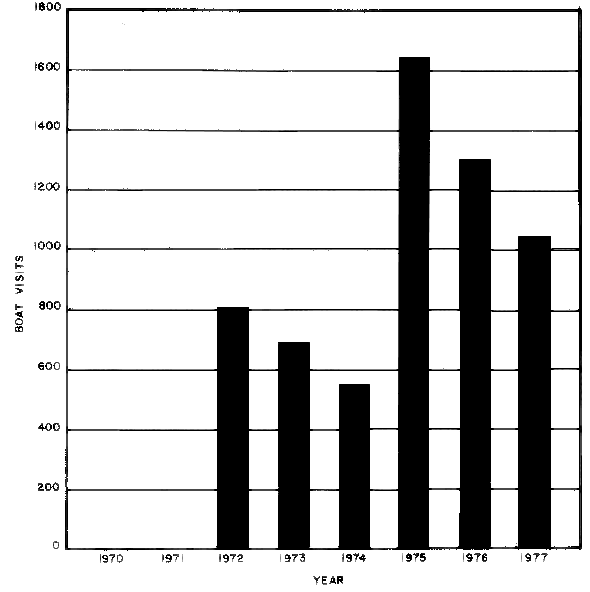
Figure 5. COMMERCIAL FISHING ACTIVITY GLACIER BAY (from Hale and Wright, 1979)
JFMAMJJASOND SALMON KingLLLLMHHHMLLL Red LMMML Coho HHHH Pink LHHHM Chum LHHMM HALIBUT CRAB Tanner King Dungeness Key commercial fishing occurs L Low level M Medium level H High level
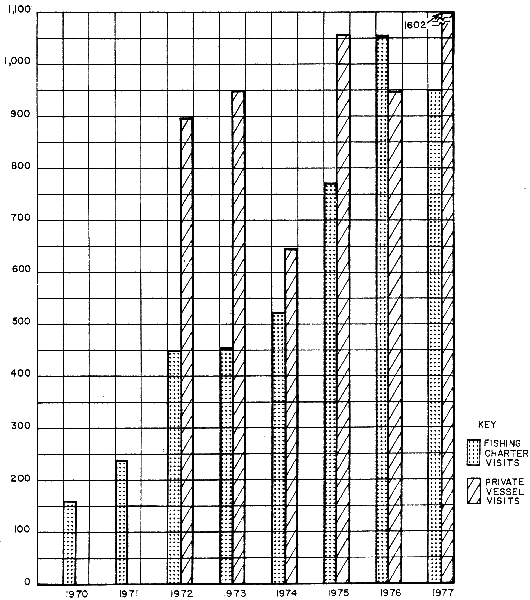
FIGURE 6. FISHING CHARTER BOATS AND PRIVATE BOAT VISITS TO GLACIER BAY 1970-1977 (from Hale and Wright, 1979)
Natural changes in the environment and/or in the behavior of whales have occurred concurrently with increased human/vessel activity in Glacier Bay. Such natural changes include spatial and temporal trends or cycles in the physical (temperature, tides, currents, turbidity, etc.), chemical (salinity, dissolved gases, inorganic/organic substances—nutrients, etc.) or biological (primary productivity, zooplankton, nekton, benthic species, predators, etc.) properties or characteristics of the waters within and outside the Bay. Temporal and/or spatial differences in relative abundance of three different prey species within and outside the Bay may have occurred and been responsible, at least in part, for the movement of humpbacks from Glacier Bay. At this time, data are inadequate to relate the movement of humpback whales from Glacier Bay in 1978 and 1979 to physical, chemical, or biological factors. Meeting participants felt that physical and chemical factors were unlikely to have changed sufficiently between 1976 and 1978 to affect humpback whales, while biological factors, perhaps as a result of physio-chemical changes, could have changed sufficiently to have caused or contributed to the movement.
Human activity may have caused changes in the physical, chemical, or biological environment, effecting humpbacks directly or indirectly. Human and vessel activities may have occurred such that the space (vertical and/or horizontal) available to whales for normal activities was less than that necessary (below some threshold level or value). "Too many" vessels may have transited an area and/or approached whales "too closely" for "too long" a period of time, producing visual, acoustic, tactile, chemical, or other as yet unknown stimuli at levels or values (magnitude, intensity, duration, frequency, interval, etc.) greater than the whales would tolerate. The physical-acoustic environment may have changed as a result of sounds produced by vessels. Vessel sounds may be modified, amplified, intensified, etc., as a result of the geological/topographical features of Glacier Bay (and perhaps Lynn Canal as well). Direct interference with the whales' own sounds may have occurred or "environmental" sound levels may have exceeded certain thresholds. Basic data on the acoustic properties and characteristics of Glacier Bay with and in the absence of vessels are lacking.
Changes in water quality may have occurred through pollution. Data are insufficient to document the past or present levels of pollution, but they were thought by meeting participants to be relatively low.
Changes in the biological environment induced by human activity may be contributory to the movement of whales. Movement from Lynn Canal may have resulted from direct competition for the same resource at the same time, by depletion of the resource below levels sufficient to support humpbacks or as a result of noise or the presence of fishing vessels. Fishing activity or overharvesting (depletion of resource) of other species at other trophic levels may indirectly impact humpbacks through the food web/chains. There are insufficient data to prove or disprove such hypotheses at this time.
In summary, a best interpretation of the available data is that uncontrolled increase of vessel traffic, particularly of erratic charter/pleasure craft, may have adversely altered the behavior of humpback whales in Glacier Bay and thus may be implicated in their departure from the Bay the past two years. The causal mechanism of this adverse reaction to increased vessel traffic remains unknown. The effects of increasing vessel traffic apparently are exacerbated by the narrow physical confines of Glacier Bay. This analysis is not clear-cut, however, and may be confounded, at least in 1979, by possible shifts in the occurrence and availability of preferred prey species of humpback whales.