CHESS.[73] (continued 2)
Reading edition
8.K to B 58.K to R 6
9.K to B 49.K to R 7
10.R to Kt 310.K to R 8
11.K to B 311.K to R 7
12.K to B 212.K to R 8
13.R to R 3, mate.
N.B.—The Rook can only checkmate on an outer row or file of the board.
KING AND TWO BISHOPS AGAINST KING.
Fig. 19. [White to Move and Win.]
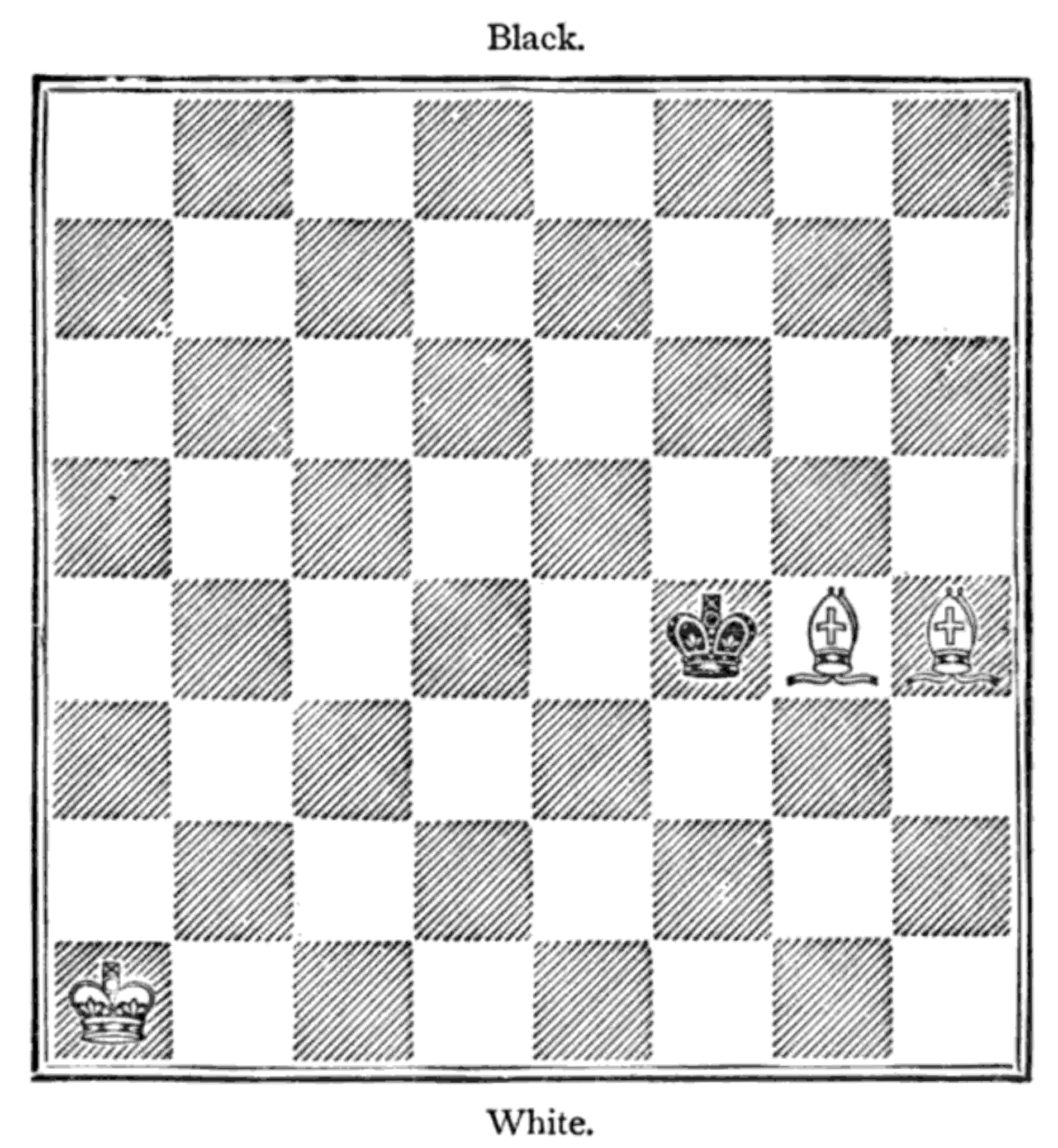
To checkmate with two Bishops is comparatively easy. Fig. 19 illustrates the most unfavourable position for White, and the solution given is the shortest attainable.
WHITE.BLACK.
1.B to Q sq.1.K to K 6
2.K to Kt 22.K to Q 7
3.B to Q B 23.K to K 6
4.K to B 34.K to B 6
5.K to Q 45.K to Kt 5
6.B to K sq.6.K to B 6
7.B to Q 37.K to B 5
8.B to K 48.K to Kt 4
9.K to K 59.K to Kt 5
10.B to K B 210.K to Kt 4
11.B to K B 511.K to R 3
12.K to B 612.K to R 4
13.B to K 613.K to R 3
14.B to Kt 414.K to R 2
15.K to B 715.K to R 3
White must he careful not to stalemate the Black King. For instance, if Black were to play here 15. ... K to R sq., White could not play 16. B to K B 5; but must play 16. B to K 3, K to R 2; 17. B to B 5: ch., K to R sq.; 18. B to Q 4 mate.
16.B to K 3: ch.16.K to R 2
17.B to B 5: ch.17.K to R sq.
18.B to Q 4, checkmate.
KING, BISHOP, AND KNIGHT AGAINST KING.
Fig. 20. [White to Move and Win.]
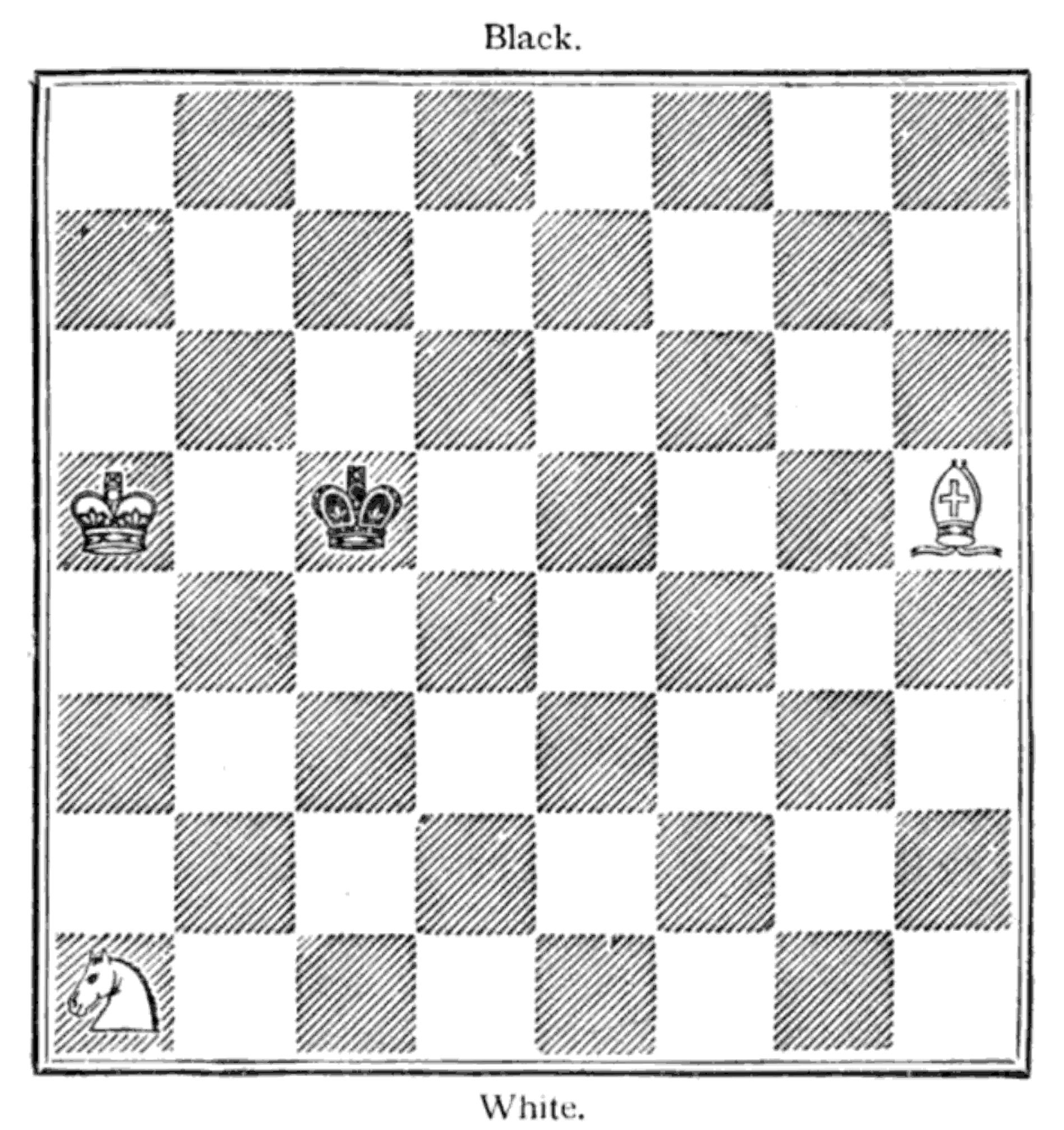
To checkmate with Bishop and Knight is a very difficult process. Checkmate can only be forced if the Black King is driven to one of the Rook squares of the same colour as the Bishop. In the position shown in Fig. 20 the Black King must be driven either to Q R sq., or K R 8. Frequently the Bishop and Knight are separated from the White King; in that case the Black King cannot be prevented from moving to a Rook square of the opposite colour to the Bishop. Then the forces must be brought together to act in concert with the White King; when, by combined action, the Black King can be forced on to a corner square of the same colour as White's Bishop, and checkmated as shown in the appended solution. Mate can be forced in the most unfavourable position (see Fig. 20) in about thirty or thirty-one moves.
WHITE.BLACK.
1.Kt to Kt 3: ch.1.K to B 3
If 1. ... K to B 5; then 2. B to Q sq., K to B 6; 3. K to Kt 5, K to Q 6; 4. K to B 5, K to K 5; 5. B to B 2: ch., K to K 4; 6. Kt to Q 4, K to B 3; 7. K to Q 6, K to B 2; 8. Kt to B 3, K to B 3; 9. Kt to K 5, K to Kt 2; 10. K to K 6, and the King is gradually forced on to the last row.
2.K to Kt 42.K to Q 4
3.B to B 3: ch.3.K to Q 3
4.Kt to Q 44.K to K 4
5.K to B 55.K to B 3
6.K to Q 56.K to B 2
7.Kt to B 57.K to B 3
8.Kt to Q 68.K to Kt 3
9.K to K 59.K to Kt 2
10.B to K 410.K to Kt sq.
11.K to B 611.K to R sq.
The King is now on the Rook square of opposite colour to the Bishop, and must be driven to K R 8, or Q R square, in order to be checkmated.
12.Kt to B 7: ch.12.K to Kt sq.
13.B to B 5...
Purposely losing a move (coup de repos); it is immaterial where the Bishop moves to so long as it remains on the same diagonal, the object being to force Black to move, without altering White's position.
...13.K to B sq.
14.B to R 7...
To prevent the King from returning to Kt sq. if the Kt moves.
...14.K to K sq.
15.Kt to K 515.K to Q sq.
16.B to K 416.K to B 2
17.Kt to B 4...
The Black King is now gradually forced on to the fatal White corner.
...17.K to Q 2
18.K to B 718.K to Q sq.
19.B to B 619.K to B 2
20.B to Kt 5...
Not to R 4, because at Kt 5 the Bishop guards the additional square R 6.
...20.K to Q sq.
21.K to K 621.K to B sq.
22.K to Q 622.K to Q sq.
23.Kt to R 523.K to B sq.
24.B to Q 7: ch.24.K to Kt sq.
If 24. ... K to Q sq., then 25. Kt to B 6, checkmate.
25.K to B 625.K to R 2
26.Kt to B 426.K to R 3
27.K to B 727.K to R 2
28.B to B 828.K to R sq.
29.Kt to R 529.K to R 2
30.Kt to B 6: ch.30.K to R sq.
31.B to Kt 7, checkmate.
END GAME WITH TWO KNIGHTS.
With two Knights alone no mate can be forced, except through incorrect play on the part of the defence. Consequently the remaining with two Knights should be avoided. If the player has the option to change off pieces, he should keep Bishop and Knight rather than two Knights.
General Observations.
A good system for the student is to practise one Opening only, attack and defence alternately, till it is thoroughly well mastered, and so on with every other Opening. The student should not get into the habit of playing with one colour only, or he will find himself at a disadvantage when he cannot have his favourite colour. He must not make a move without carefully weighing the possible replies. If he finds a good move, let him still try to find a better one. When his opponent makes a move, he must try to discover the object of such move, whether it is immediately menacing, or only indirectly so. In the first case, a suitable defence must be found; in the latter case, he may profit by the respite to bring a piece into play.
The first principle is to develop the pieces quickly, and never to commence an attack with insufficient forces. If a player is able to bring more pieces into play than his opponent, it is obvious that he must be stronger. The Opening correctly played is frequently half the battle won.
Avoid useless checks. Avoid useless exchanges. Bear in mind that it is disadvantageous to be left with two Knights only, as mate cannot be given with them. If the player has the better game, he should avoid remaining with a Bishop of different colour from a like piece of his opponent, as Bishops of different colour frequently lead to a draw.
The student should further accustom himself to an elegant style of play—viz., strictly to adhere to the laws of the game; never to take back a move; never to touch a man until he has determined where to move it; and to move his pieces quietly.
Bibliography of Chess.
The literature of chess is very extensive, but many of the best works would be practically useless to a beginner, as too advanced for his capabilities. Any of the works mentioned next below may be studied with advantage by the learner.
Chess[106] (Oval Series). By L. Hoffer. Routledge, 1s.
Common Sense in Chess. By E. Lasker. Bellairs & Co. 2s. 6d. nett.
Chess. By R. F. Green. Bell & Sons. 1s.
The Chess-Player's Mentor. By F. J. Lee and G. H. D. Gossip. Ward & Downey. 1s.
The Chess-Player's Vade Mecum. By G. H. D. Gossip. Ward & Downey. 1s.
The Chess Openings. By I. Gunsberg. Bell & Sons, 1s.
The Chess-Player's Pocket Book. By James Mortimer. Sampson Low & Co. 1s.
Six Practical Chess Openings. Anon. British Chess Company. 6d.
Six Chess Lessons for Junior Players. By S. Tinsley. British Chess Company. 6d.
Fifty Pawn Puzzles. Anon. British Chess Company. 4d.
To more advanced players may be recommended, in addition—
The Chess-Player's Handbook. By Howard Staunton. Bell & Sons. 5s.
The Chess-Player's Companion. By Howard Staunton. Bell & Sons. 5s.
Morphy's Games of Chess. By J. Löwenthal. Bell and Sons. 5s.
Chess Openings, Ancient and Modern. By E. Freeborough and C. E. Ranken. Kegan Paul & Co. 8s.
Chess Endings. By E. Freeborough. Kegan Paul & Co. 7s. 6d.
Select Chess End-Games. By E. Freeborough. Kegan Paul & Co. 1s. 6d. nett.
Chess Studies and End Games. By J. Kling and B. Horwitz. Bell & Sons. 7s. 6d.
Synopsis of the Chess Openings. By William Cook. Simpkin, Marshall & Co. 4s.
The Chess-Player's Manual. By G. H. D. Gossip. Routledge. 7s. 6d.
The Principles of Chess. By James Mason. Horace Cox. 2s. 6d.
The Art of Chess. By James Mason. Horace Cox. 5s. nett.
Chess Openings. By James Mason. Horace Cox. 2s. net.
Chess Masterpieces. By H. E. Bird. Dean & Sons. 3s.
Chess Practice. By H. E. Bird. Sampson Low & Co. 2s. 6d.
Chess Novelties. By H. E. Bird. Warne & Co. 3s. 6d.
Modern Chess Brilliancies. By G. H. D. Gossip. Ward & Downey. 1s.
The Hastings Chess Tournament Book (1895). Edited by Horace Cheshire. Chatto & Windus. 7s. 6d. net.