WRIGHT-MARTIN AIRCRAFT CORPORATION
Reading edition
The Wright-Martin Aircraft Corporation has two shop training departments, one at the Long Island City plant and the other at the plant in New Brunswick, N. J. Both plants are engaged in the manufacture of a high-grade aeroplane engine.
Each training department occupies about 10,000 square feet of floor space in buildings separate from the factories. They are equipped with modern machinery tooled up for production, the machines and equipment being of the same type as that in the factory proper.
The primary purpose of these departments is to train women, also men, for the needs of the factory, upon production work, assembly, inspection, shop clerk work and tool crib tending. It is the aim of the Instruction Department to train the learner to do her work habitually correct, both as to quantity and quality. With this in mind the training rooms are miniature factories equipped with lathes, automatic screw machines, hand screw machines, J. & L. Turret Lathes, hand millers, plain millers, sensitive drills, upright drills, radial drills, plain grinders, internal grinders and bench equipment. Jigs and fixtures and the operation tool equipment necessary for the production work are used on these machines, that those being trained may become entirely familiar with the tools they are required to handle when they go into the shop. The machines and the operation tool equipment were selected after the complete layout of the main operations had been carefully gone over and the operations that women could perform were listed.
Considerable care has been used in selecting the learners and the class of women under training are of good type. A number of these have worked in shops before; others have been in offices. Our experience has been that our most successful women are those who have had to work for their living, either in shops or offices, up to the time they entered our employ. The range of ages preferred varies from 21 to 35. The first few hundred women selected were about 35 years of age, the maturity and judgment going with such an age being of value in stabilizing later conditions when hundreds more, of a more general sort, will be employed. Many of the women are mothers, wives, or relatives of those at the front.
The training is given upon actual factory production in the manufacture of parts that enter into the construction of the motor. Such manufacturing furnishes an excellent medium for instruction in the various branches above mentioned, and holds both the learner and the instructor up to the factory requirements. The standards of the factory are the standards of the training department both as to quantity and quality. Work is routed to the Instruction Department according to the regular shop forms and the finished product is transferred from the Instruction Department in the same manner as work is transferred within the factory, the Instruction Department receiving credit for what it does.
So far, women are being trained at a rate equal to the demands of the factory, which is fast approaching 120 per week, this being the approximate weekly training capacity of the training department. In some branches of work it takes four days to train, in others ten days, the length of time varying according to the time it takes the learner to reach the average hourly production.
Records of production, while under training, are plotted on cross section paper and when the learner has reached the average hourly production she is declared trained in that particular line. In some cases women after two or three days’ training have done 25 per cent. higher than the average hourly production stated for the job. Records of salvage are also kept as a check on such training, and every effort is made to combine a steep production curve and a minimum salvage curve with good training. The salvage records of the learners are remarkably low, some weeks averaging much less than 1 per cent., the highest being less than that in the factory itself.
After the women have been transferred to the factory their progress is kept track of for at least one week, to make sure that they are following the instructions given in the training room. Those who do not make good after training are assigned back to the training room for further instruction, or for such disposition as the chief instructor may see fit.
Regularly, during the week, the learners are given general lectures, talks and instructions on matters that relate to their training, that they may be more generally fitted for the line of work into which they are to be transferred.
The results obtained have been very interesting. The women are very enthusiastic and the foremen are highly pleased. In one branch the foreman advised, when asked how things were going: “You can give me thirty more women right away; they are all right,” In another branch a foreman advised that he would not exchange a good share of the women in his department for an equal number of the best men he had on his floor.
The instruction in each training room is given by four male instructors, with women assistants; the women assistants having been selected from the best of those who have been trained within the department. The men instructors are all first class mechanics, especially capable on production work and teaching.
The instructors are regularly interviewed from time to time, and the work they are doing is carefully reviewed, with the purpose of building them up as efficient instructors.
As a part of the training program at New Brunswick an evening school is conducted for the men in the company’s employ. The instruction work given consists of technical studies related to the mechanical trades, and includes blue-print reading, shop drawing, shop mathematics and clerical work in its different branches. This is used in conjunction with a promotion program, whereby men who are capable are promoted into various openings as they occur, requiring more skill of the same sort they already have.
(Signed) James F. Johnson, Chief Instructor.
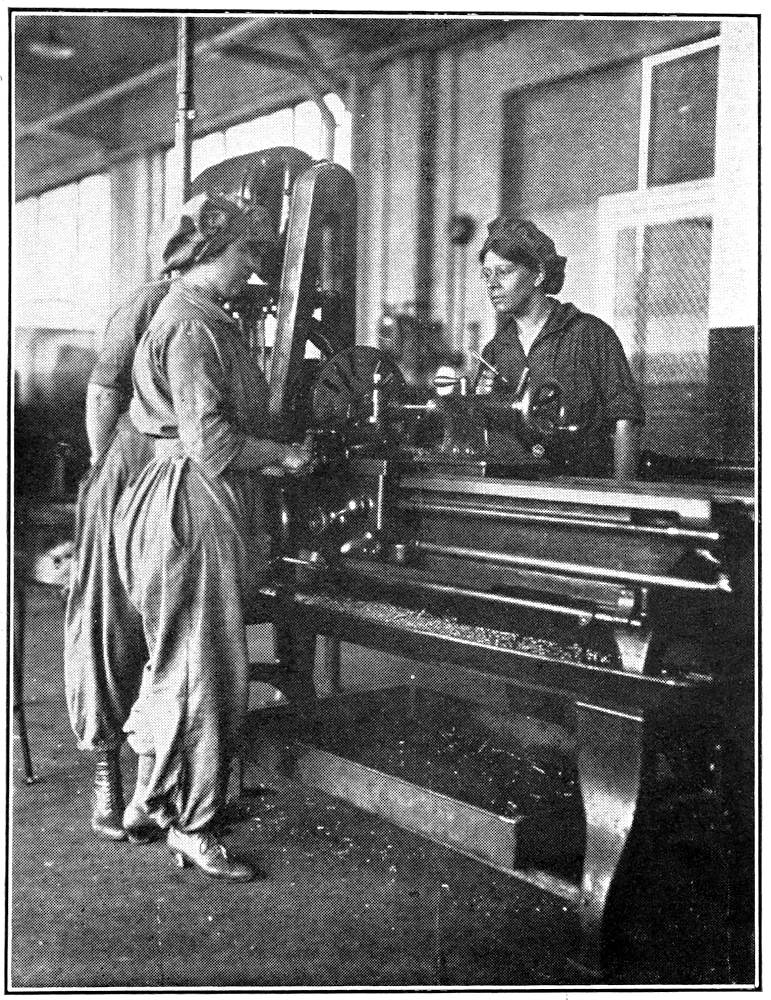
Being trained upon an engine lathe to accuracy of one-thousandth.
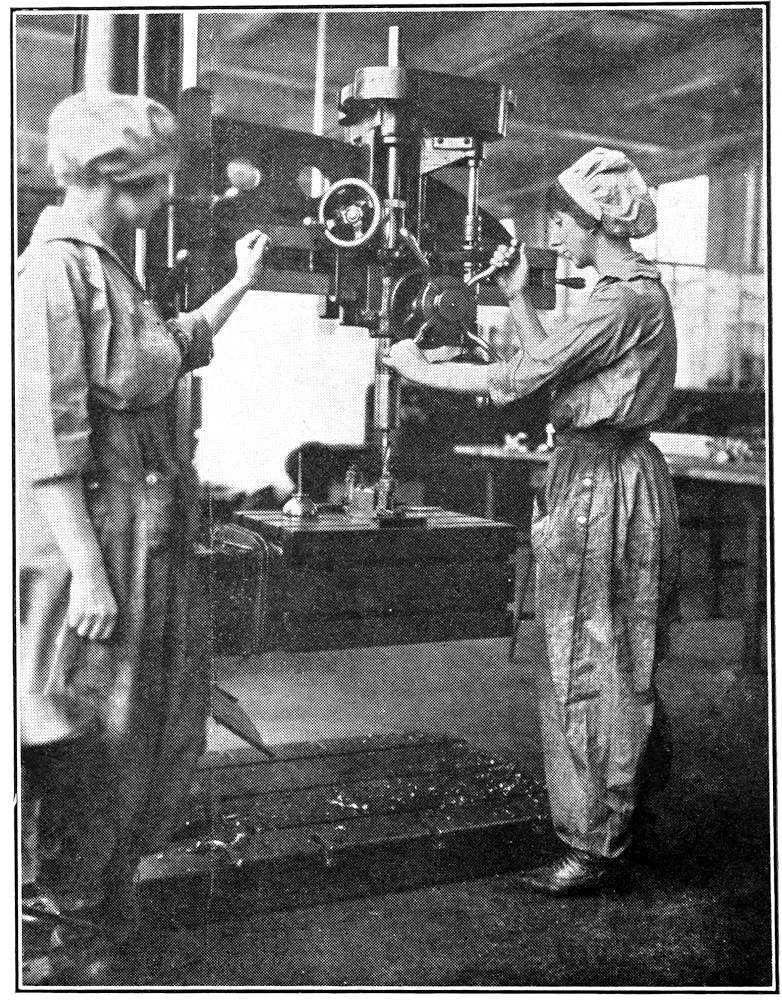
Learning to operate the radial drill presses Wright-Martin Aircraft Corp.
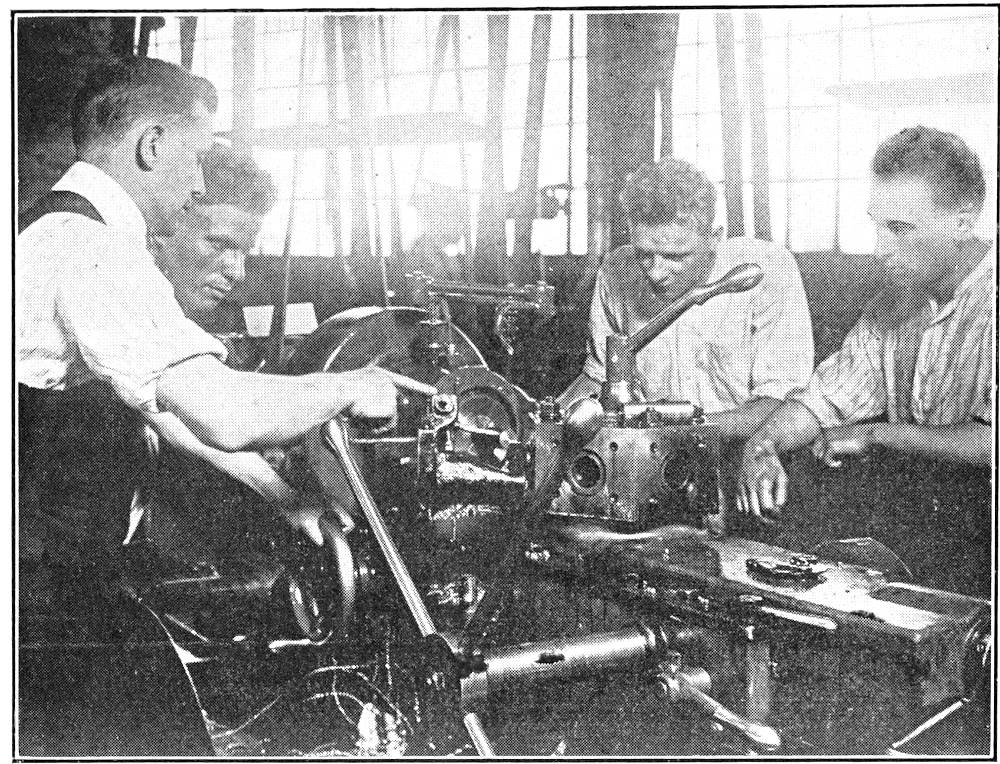
Training on the job in shop. Wright-Martin Aircraft Corp.
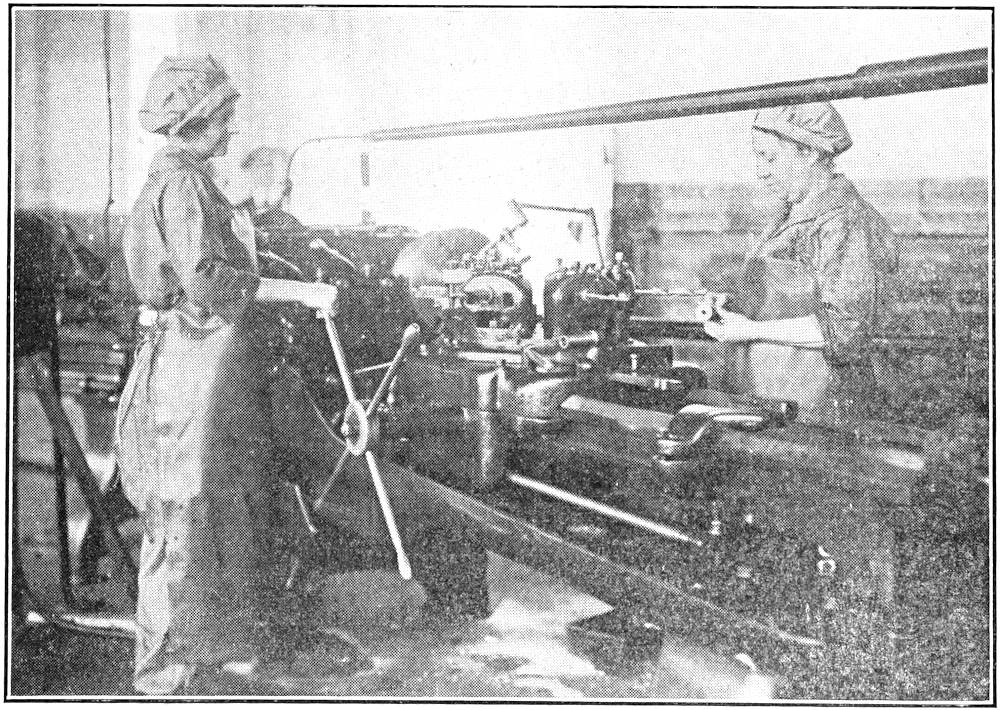
Being trained upon a James & Lamson machine. Wright-Martin Aircraft Corp.