BROWN & SHARPE MANUFACTURING COMPANY
Reading edition
Providence, R. I.
In our own experience, without doubt, much more attention has been given by foremen and fellow-workmen to the supervision of women’s work than has been given to the average male employee in the past, the assumption being that a woman, having less mechanical background and intuition than a man, required more training and more specific instructions. This has been the reason advanced by some foremen in explaining why women were doing better work and had “broken in” more quickly than men, and they have added, “If we had given the same kind of attention to each new man employed, he would have done just as well as the girl”; this is, after all, an admission on the part of the foreman that he had not in the past helped all he could, and an indirect compliment to the girl having much significance. It may be noted, however, that at the time when such comparisons were made the average man who could be secured was of an unsatisfactory and irresponsible class, as so few trained or competent men were available for positions in the industries, while, on the other hand, in hiring girls a selection from a large number of applicants could be made, so that it was possible to obtain a much better average having the qualities to make successful workers.
Experience has shown that there are advantages in having both men and women in the same department, as it tends to hold the same standard of workmanship and speed for women as for men, while it is believed that having a separate department for women may establish a separate and lower standard, the tendency being to make more allowance for women because of sex. The results seem to show that it is not at all necessary that separate standards should be established and that in some lines of work even more can be expected of women than of men because of their nimble fingers and quickness of motion. As to questions of discipline, where the two sexes are employed in the same work-room, little or no difficulty is experienced under capable foremanship.
Actual results have proved that the fears in the minds of some that there would be opposition on the part of foremen and workmen to the employment of women in the shop were ungrounded. A foreman remarked to a visitor: “See that girl working beside the man assembling speed indicators? She is working with him so as to learn all the requirements, and he knows that she is to have his job as soon as she has become sufficiently proficient, but he is helping her in every way possible. Of course, we shall find other work for the man; and often, with the present shortage of help, such a change of work can be in the line of promotion.” This illustrates the spirit which is practically universal throughout the shop, and which has been an important factor in bringing about the success of the plan.
While the money question—the earning power—is uppermost in the minds of the majority, many of the women show also a distinct ambition to equal or excel men in the work they do. Soon after the employment of women was begun in the gear department, a girl who was cutting sprockets on a gear-cutting machine became discouraged and said she was afraid she could not make a success of the job. Her foreman was surprised and said to her, “We have not made any complaint as to your work, have we?” “No,” she said, “but the man who worked on the night job turned out 105 pieces, while the best I could do was only 85 pieces a day.” Her foreman asked if she realized that the man on the night force was working three hours more per day than she was, and after learning this she felt less discouraged with the results she had obtained.
In the gear department where a number of girls have been “broken in” in operating gear-cutting machines, the foreman said that they had taken hold as quickly as the average man, and some of them are doing exceptionally good and intelligent work. This has partly resulted from the girls being thrown as rapidly as possible on their own resources, being taught to set up their machines, working from a blue-print, to measure their work, and do everything that had previously been required of the operator. A criticism has recently been made of some of the departments to the effect that the foremen were giving so much supervision to the women’s work that they were not thrown sufficiently on their own resources, and thus were not trained to be responsible for the work in hand. This again speaks well for the women, as showing that there is a growing appreciation of their ability to do more advanced work than had at first been expected.
In inspection work a field has been found for women in which they are making an exceptionally good showing. The chief inspector was asked whether women were learning to read the micrometer caliper. He replied that they learned to read it and read it accurately, in a very short time, and that the work passing through their hands showed much discrimination as to the points criticised. He pointed to a pile of work rejected by one of the women inspectors and said, “I have just had a man go over this work, and he has found that while the work failed to pass inspection for many reasons, they were all good reasons.” He said further that in inspecting grinding work he was surprised at the quickness with which some of his women inspectors would pick out batches of work identifying them as coming from particular workmen whose work was known to be above the average. In another department, in inspecting measuring tools, a similar condition was noted by the foreman, and he stated that one of the girl inspectors recently told him that she liked to inspect the work of Mr. Blank, because it required so few rejections. “And,” remarked the foreman, “she sized the situation up just right.” He also showed the writer the notes attached to a number of tools which had been held out by the woman inspector for corrections, these criticisms showing much discrimination on her part, and as good a degree of judgment as would have been expected from the experienced inspectors who had previously been doing the work. It is thus found that in the class of inspection work where women are employed the standard is not lowered because of their employment.
Already several women are employed in the toolmaking department. One of these employees, who was operating a lathe turning out tool-steel blanks for bits and reamers, doing her own setting up and measuring, evinced enthusiasm for machine shop work, showing, in reply to questions, that her work was opening up a new field in which she took especial interest and she remarked, “No more housework for me,” with such feeling that it was evident her interests strongly leaned in a mechanical direction. Girls in the toolmaking department are working on universal milling machines, surface grinders, etc., as well as lathes. Some of the younger girls throughout the works are employed as messengers.
(Signed) L. D. Burlingame.
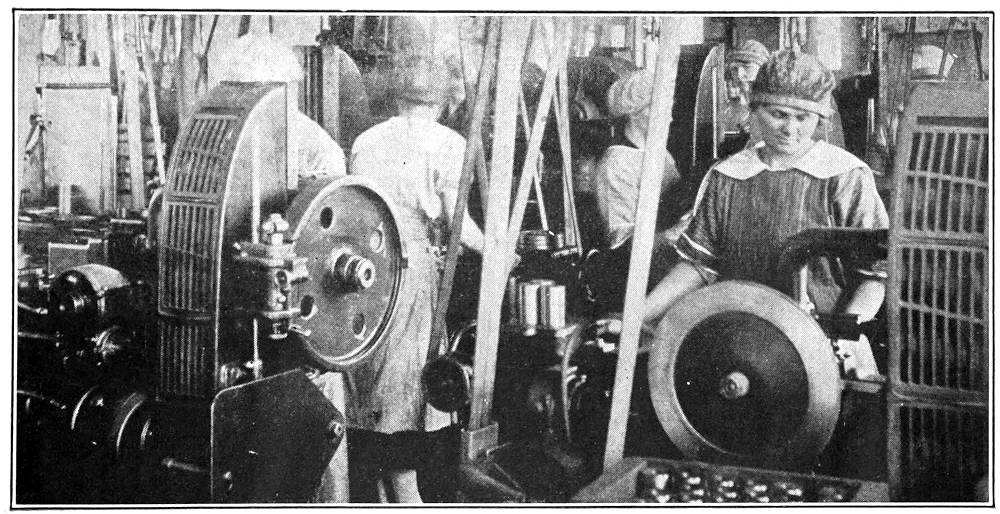
Operating automatic gear-cutting machines. The girls are taught to set up their machines and make all measurements, working from a blue-print. Brown & Sharpe Mfg. Co.
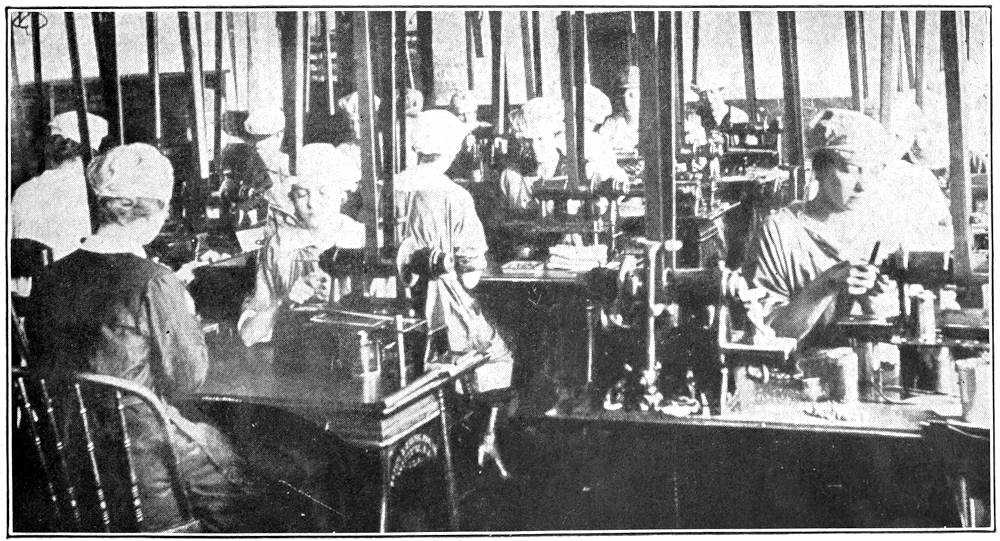
Girls employed on polishing machines. “When they become proficient on polishing, they are given more advanced work at “hand-tooling,” etc., on these machines. Brown & Sharpe Mfg. Co.
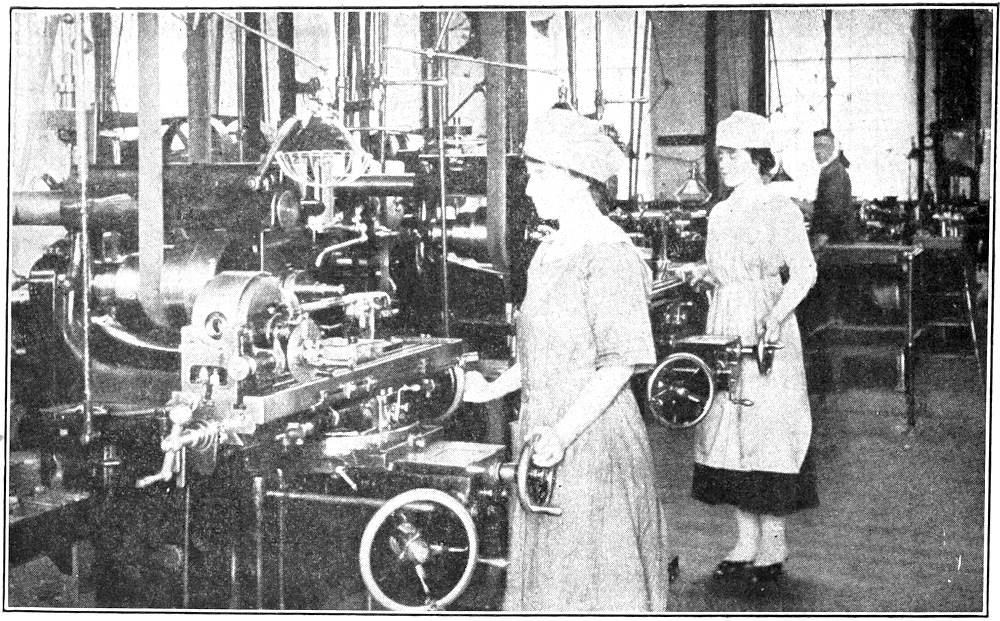
Fluting reamers, etc., on Universal milling machines in the toolmaking department. Brown & Sharpe Mfg. Co.
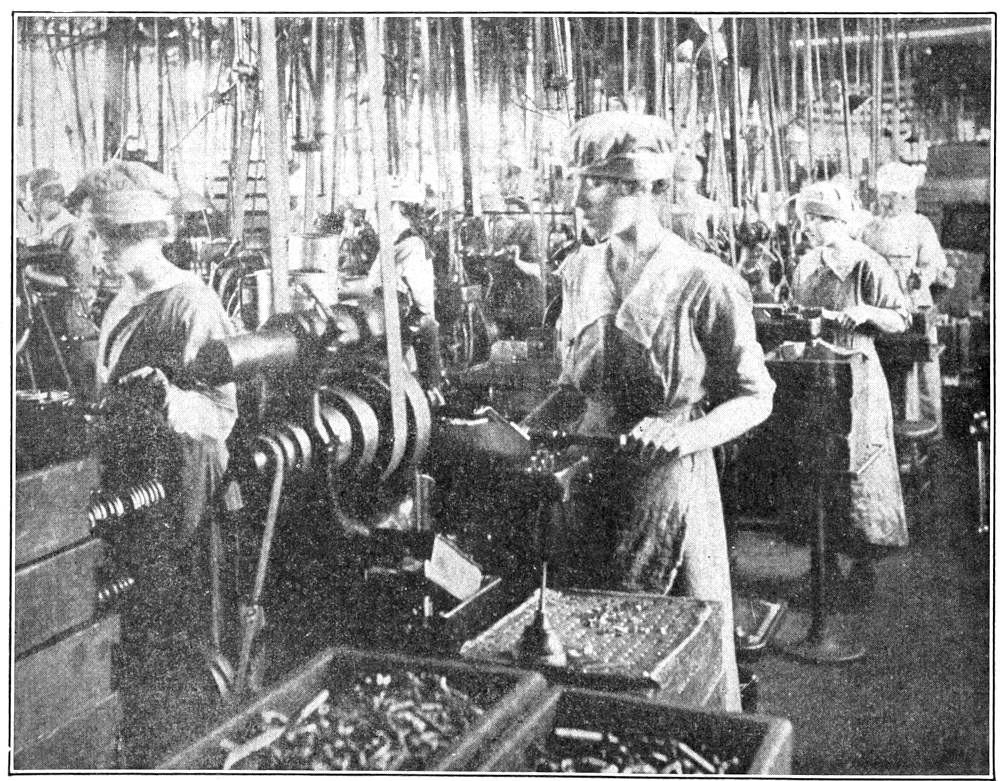
Operating hand milling machines in the production of duplicate parts. Brown & Sharpe Mfg. Co.