THE FLAG OF FORT STANWIX
Reading edition
TRITE but true is the old adage that necessity is the mother of invention. The first flag that flew over an American fort was constructed from an “ammunition shirt, a blue jacket captured from the British, and a woman’s red petticoat.”
The garrison at Fort Stanwix (Fort Schuyler) had no flag; but it had possession of the fort despite the siege of twenty days against it by the British; and it had five British standards taken from the enemy. So it improvised a flag and, with cheers and yells befitting the occasion, ran the British standards upside down upon the flag mast and swung the Stars and Stripes above them. The redcoats looked, and, it is safe to assert, laughed not, as to them the humor of the situation was not appealing. But if they were lacking in the sense of humor, these sons of Old England were not lacking in persistence, and they besieged the fort with steady determination.
Fort Stanwix stood at the head of navigation of the Mohawk River and was an important feature in the plan of General Burgoyne to cut off New England from the southern colonies and thus control the whole country. Embarking upon this expedition, he had instructed his army: “The services required are critical and conspicuous. Difficulty, nor labor, nor life are to be regarded. The army must not retreat.” As he advanced down the Hudson he swept everything before him. Ticonderoga, Mount Defiance, Whitehall, Fort Edward, each in turn fell: and he now anticipated no successful resistance to his forces.
At the beginning of General Burgoyne’s invasion a force of Canadians, Hessians, New York Tories, and Indians commanded by General St. Leger had been sent against Fort Stanwix. The post was held by General Gansevoort with some seven hundred and fifty men. They were ill supplied with ammunition and had few provisions. To Burgoyne defeat seemed here impossible. The siege had, however, been anticipated by the garrison, and the men had determined to hold out to the last extremity.
Word was surreptitiously conveyed to Colonel Willett within the fort that General Herkimer would set out with eight hundred volunteers to reënforce him and that a successful sortie might be made against the besiegers by acting in conjunction with General Herkimer’s forces. This sortie was to be made when a certain signal was given. But the best-laid plans, as we all have doubtless learned by experience, are not always dependable.
St. Leger in this case learned of Herkimer’s advance and sent the savages under his command to intercept and ambuscade him. A terrible hand-to-hand combat ensued in which a hundred and sixty of the colonists were killed and the loss to the Indians was as great. General Herkimer’s horse was shot under him and he himself wounded severely in the leg. Notwithstanding his agony he insisted upon being placed with his back against a tree for support, and therefrom he continued to direct the battle. In the heat of the contest he lighted his pipe and smoked.
The further advance of the Americans to the succor of the fort was prevented, but Colonel Willett, in ignorance of this, made his sally from the fort at the hour appointed. Marvelous to state, the British were taken wholly by surprise and, having no time to form, fled. The Americans took possession of their supplies and their standards, as before mentioned, and retired to the fort.
Failing to shell or starve them out, St. Leger then began efforts to induce a surrender. Two of his American prisoners were compelled to write letters to the commandant at the fort, exaggerating the strength of the enemy and urging, in the name of humanity, a surrender. To this Gansevoort returned no answer. St. Leger then tried another plan.
A white flag appeared before the garrison. Two British officers were blindfolded and admitted to the fort. They were courteously received and, when they were seated, were proffered refreshments. One of the officers then presented the message of General St. Leger, which was in substance a threat, couched in polite language, that if the fort was not surrendered, the Indians would be turned loose upon the country, and not only the men but all the women and children would be tomahawked. Not one should escape. But if the garrison would capitulate, not only would these evils be averted, but none of the garrison should be injured or made prisoners.
Colonel Willett arose. “I consider, Sir,” said he, “the message you bring a degrading one for a British officer to send and by no means reputable for a British officer to carry. I would suffer my body to be filled with splinters and set on fire, and such outrages are not uncommon in your army, before I would deliver this garrison to your mercy. After you get out of it, never expect to enter it again unless you come as a prisoner.”
Provisions were running low, and some uneasiness became manifest in the fort. Colonel Willett, observing this, assured the men, “I will make a sally in the night, if compelled by lack of supplies, and cut our way through the besiegers or die in the attempt.” The siege had now continued more than twenty days, when to the surprise of the garrison it was suddenly raised. This was due, it shortly appeared, to a ruse of General Arnold; Arnold the valiant, Arnold the traitor.
Among the prisoners of Arnold was a young half-witted fellow who was condemned to death. His sorrowing mother never ceased her pleading with General Arnold for her son’s life. Accordingly one day he proposed to her this expedient: That her son, Hon Yost by name, should make his way to Fort Stanwix and in some way so alarm the British that they would raise the siege. Eagerly the old mother promised this should be done and offered herself as hostage for the fulfillment of the mission. To this Arnold would not consent, but retained another son in her place.
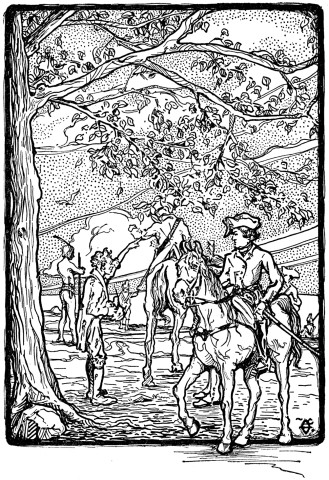
Before starting on his errand, Hon Yost’s clothing was riddled with bullets to indicate escape from the Americans. Reaching the camp of the Indians, he told in a mysterious way of a premeditated attack upon them and aroused their fears. St. Leger heard of his arrival and questioned him. To St. Leger he related a touching story of his capture and miraculous escape from execution, and by signs, words, and gestures made it appear that he was an emissary of Providence to aid in their preservation. Canadians, Hessians, all became uneasy. When he was asked the number of the Americans about to descend upon them, Hon Yost pointed to the leaves of the trees to indicate a legion. In his efforts to terrorize he was ably seconded by a young Indian who had accompanied him. Panic seized the camps. In vain St. Leger strove to allay the frenzy. The result was precipitate flight.
When he was asked the number of the Americans about to descend upon them, Hon Yost pointed to the leaves of the trees to indicate a legion.
It is given by one authority that St. Leger was himself becoming as apprehensive of his red-faced allies as he was of the enemy he was fighting.
The fears he had sought to instill in the minds of the garrison were now returned upon his own head.