OLD GLORY ON THE ISLAND
Reading edition
MEN who have had grave differences and looked at each other coldly and passed with unsmiling faces have, when some calamity threatened, sprang shoulder to shoulder and spent their united strength in defense of a common cause.
Thus in the Spanish-American spurt of war,—serious enough, too serious, alas, in some aspects; but great in some of its beneficent results. In that call, “To Arms!” was laid to rest—forever forgotten—the old enmity between the North and the South, engendered by the Civil Strife.
On the island of Cuba, the trenches of the United States Army were five miles in extent and in shape of a horseshoe. Above the trenches, five curving miles of Stars and Stripes gleamed.
To the United States prisoners, confined in the prison, within sight of these flags, but under the flag of Spain, the waving emblems before their eyes brought daily hope and courage.
In full vision of the men in the trenches fluttered the flag of Spain; above their heads Old Glory flew,—the sheltering Stripes and Stars.
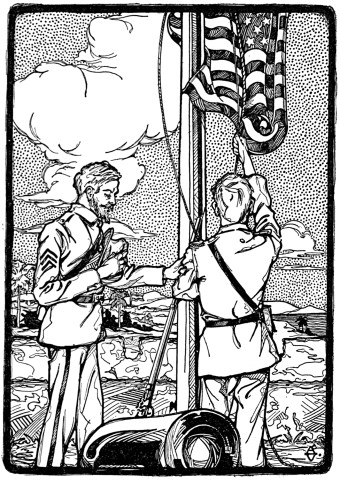
As night came down, and land and shimmering sea was bathed in the white light of the sub-tropics, the strains of the “Star-Spangled Banner” were borne upon the air and fell away softly, as if coming from across the water. Every man uncovered and stood with silent lips, and eyes fixed upon Old Glory until the last echoing note died in the distance, then turned again to duties; but upon his face was stamped the deeper understanding of the meaning of it all—of Flag, and Home, and Country.
Every man uncovered and stood with silent lips, and eyes fixed on Old Glory.
Thus from the shores of a tropic island, fighting together for the flag of the nation, both Blue and Gray gained a new and happier viewpoint; and looking back across the warm and shining waters of the Gulf Stream, each knew that all was good, and said:—
“Lo! from the thunder-strife, And from the blown, white ashes of the dead, We rise to larger life.” “There is a peace amid’st the shock of arms, That satisfies the soul, though all the air Hurtles with horror and with rude alarms.” “That clarion cry, My country! makes men one.”