NORG MYTHS.
Reading edition
The Norgen were a mighty folk in olden time in Tirol. In their span-high bodies resided a power which no child of man, were he ever so stalwart and well-limbed, could resist. But they were also for the most part a peaceable race, and more inclined to assist than to obstruct the industrious inhabitants of the country in their labours; so long as they were treated with respect and deference they seldom interfered with any one. Then they were generally scrupulously honourable, and strict keepers of their word. A service rendered one of them was sure to be repaid a hundredfold. An injury brought a corresponding retribution, and scorn, contempt, or ridicule roused their utmost vengeance; while some there were who entertained a true spirit of mischief, and indulged in wanton tricks which showed their character was not altogether free from malice.
They were most often to be met in lonely paths and unfrequented fastnesses of nature, but a solitary Nörglein could also occasionally stray within the haunts of men, at times asking hospitality at their hands, and at others getting into the bedrooms at night, and teasing the children in their sleep, hence the common proverb—
“Shut the door closely to,
And at other times, again, they would take part in the field and household labours, as if they found it sport. The name of Norg was chiefly appropriated to them in South Tirol; in Vorarlberg the analogous cobbold went by the name of Rutschifenggen. Every locality, every valley, every hamlet, and almost every farm, had its own familiar dwarf whose doings were handed down as household words.
Presently the husband called to know if the pancake was not ready, and the Meierin, running to satisfy him, with both hands engaged in holding the dish of the enormous pancake, caught her feet in the thread, and fell flat on the ground with her face in the dish, while the three Norgs completed her vexation by setting up a loud laugh in chorus.
Suddenly, between the angry gusts of wind, a doleful voice was heard piteously praying for help. One of the party opened the casement, and looked out, but with more of curiosity than interest, and then quickly closing it again, came back into the room with a laugh to describe the ludicrous figure he had seen. It was a little mannikin with a beard big enough for a full-grown man, his clothes drenched with the rain, and slung over his shoulder a tiny bundle tied in a handkerchief, which yet seemed to bow him down with its weight. The description provoked a chorus of laughter, and the wretched little Norg—for it was a Norg—would have been no more thought of but that his wail became more irritating than that of the wind, and at last the master of the house got up and shouted to him to go on, for it was useless to stand droning there, he was not going to open his house at that time of night, or to such a ridiculous object. But though he banged the window to as closely as possible after delivering himself of this speech, the little man’s menacing couplet yet reached his ear—
“The reckoning day
By the time she had dried his clothes and fed him with some warm soup, the worst of the storm had abated, and he was able to go on his way. The maiden offered him shelter for the night, but he declared he must reach home before midnight, and prepared to depart. Before he left he asked her what there was she most desired. “Oh, that my mother be restored to health!” answered Theresa; “I desire nothing more than that!”
The Norg walked to the bedside, and informed himself of the nature of the sick mother’s illness. “Your mother shall be cured,” said the little man; “but you must come to me to-morrow at midnight to the Nörgelspitz;” and as the girl started at the impossibility of the feat, he continued, “You have only to make your way as far as the Wetterkreuz, and there call three times ‘Kruzinegele! Kruzinegele! Kruzinegele!’ and I will be at your side, and take you up the rest of the way.” And he took his departure, singing,—
“Morgen oder Heut
Kommt die Zahlzeit.”
The next night Theresa courageously set out on her way, and climbed as far as the Wetterkreuz—and it was lucky she had to go no farther, for here she sank down quite exhausted. She had not lain there many seconds when she saw a procession of little men just like Kruzinegele, with a litter and torches, who carried her up till they came to a door in the rock, which opened at their approach. This led to a magnificent crystal hall glittering with gold and gems, and on a gold throne sat Kruzinegele himself, with his fair daughter by his side. When the litter was brought to the steps of the throne, he came down courteously, and renewed his thanks for her hospitality, but she could not find a word to say, in her astonishment at seeing him so changed. Meantime he sent his daughter to fetch the herbs which were to cure the poor mother, and gave them to her, telling her how to administer them. “You see,” he added,—
“Morgen oder Heut
Kommt die Zahlzeit;
and your rich neighbour will find it so too.” Then he told the little men to carry her home, and they laid her in the litter, and bore her away; and she remembered nothing more till she found herself comfortably in bed, with the rising sun kissing her cheeks. But the appearance of every thing was as much changed as Kruzinegele himself had been! The walls that used to bulge, and reek with mildew and damp, were straight and smooth; glass casements replaced the ricketty shutters; nice white curtains tempered the sunshine; the scanty and broken furniture was replaced by new. But what she valued above all, in her hand were the herbs which were to make her mother’s healing drink! Their decoction was her first occupation; and by the next day they had restored her mother to health, and joy once more reigned in the cottage, thanks to the Norg!
Of the sleek droves which had started, the envy of all beholders, few beasts lived to return; the prosperity of the once flourishing Hof had fled, and before many years were out its proprietor was obliged to leave it, a ruined man. Theresa had in the meantime married a thrifty peasant, whose industry enabled him to be the purchaser of the abandoned Hof, which he soon stocked to the full extent of former days. Ofttimes a curious grey-bearded little stranger would drop in at night to share their comfortable meal, and before he went away he would always sing his couplet—
“Morgen oder Heut
Kommt die Zahlzeit.”
Such occasional apparitions of the strange visitants excited the curiosity of the inhabitants of the earth to the utmost, and many a weird story was told of frightful injury happening to those who had striven to penetrate their retreat, and for a long period none had any success in the enterprise.
It happened one day, however, that a daring hunter who had been led far from his usual track, and far from the country with which he was familiar, by the pursuit of a gemsbock, found himself at the entrance of a low-arched cavern. As night was about to fall and the sky wore a threatening aspect, he was glad to creep within this shelter till the light of morning should enable him to find his way home once more.
He had not proceeded far within the dim corridor, when he perceived that in proportion as he got farther from the light of day the cave became brighter instead of darker! Eagerly seeking the cause of this phenomenon, he perceived that the walls were all encrusted with gold and precious stones, which emitted constant sparkles of light. He thereby recognized at once that he had reached an approach to one of the resorts of the Mountain-folk, as the Norgs were also called from having their habitation in the hearts of the mountains.
To avoid the fate of those who had ventured within the mysterious precincts, he was about to make good his escape, when he felt something soft under his feet. It proved to be a red hood or cap, dropped there by one of the Mountain-folk, a veritable Tarnkappe which had the property of making the wearer invisible to men, and also enabled him to command admission to any part of the subterranean settlement. He had scarcely placed it on his head when one of the little men of the mountain came running up to look for his lost cap. Fritzl the hunter was much too cunning to give up the advantage of its possession, but with great good humour he told the dwarf he reckoned it too great an advantage to have the opportunity of visiting his beautiful territory to give it up for nothing; but he assured him he should have no reason to regret having given him admission. The dwarf could not choose but obey, and the Jäger enjoyed the singular privilege of surveying all the hidden treasures of the underground world.
Beautiful are the glories of the mountain world as seen by mortal eyes—gorgeous its colours when illumined by the southern sun, but all this is as barren darkness compared with the glories hidden within its stony recesses. Here, the sky overhead was all of diamonds and sapphires and carbuncles, and their light sparkled with tenfold glory and beauty to the light of the sun and moon and stars; the trees were of living gold and silver, and the flowers and fruit of precious stones; the grass all of crystal and emerald; there was no cold or heat, no perplexing change of season, but one perpetual spring spread its balmy air around; lakes there were all of opal and mother-o’-pearl, and gorgeously plumed swans perpetually crossing them served the inhabitants in lieu of boats.
The Jäger’s delight and admiration at all these sights won the sympathy and regard of his guide, and by degrees he grew more communicative, and explained to him the whole economy of their mode of life. He showed him how they were divided into three distinct classes: those wearing red caps, who were gay and good-natured, and filled with goodwill towards mankind also, notwithstanding many wild pranks; those with brown caps, whose mischief was mingled with malice rather than fun, but who yet would suffer themselves to be propitiated; and those with black caps, always gloomy and morose, who boded evil wherever they went. His guide advised him to have nothing to say to these, but with some of the red and brown he was admitted to converse: he found them pleasant and sociable, and ready enough to communicate their ideas. Some asked him questions, too, about various matters which seemed to have puzzled them in their peregrinations on earth, while others, who had never been outside their own habitations, had other inquiries to make—but some there were also who had no curiosity on the subject, but rather contempt; and one thing that amused the Jäger in them was their incapacity to conceive many of the things he had to tell them, and particularly to understand what he could mean when he talked about death.
Chiefly to keep the spiteful freaks of the black-caps in check there was a guard of warrior dwarfs, whose array was shown to our Jäger. Formidable they must have been, for the armour of each was made out of one diamond, and they wore helmets and greaves and shields all of diamonds, and while they were thus impervious to every attack, their swords were of diamond too, and resistless therefore in their thrusts.
The Jäger could not restrain his raptures at their gorgeous show, as the colours of the gems around were reflected in this shining armour.
The dwarf had nothing left to show after this, but then stood and sighed over the glories of the past. “And what were the glories of the past?” inquired the Jäger, with intense interest. The dwarf watched his interlocutor closely, and satisfied himself that his interest was not feigned. Then he paused long, as hesitating whether to unburden himself to a stranger of the sad thoughts which crowded into and oppressed his mind. A few words of sympathy, however, decided him at last
“Yes, we still have some power and some riches left, and some of our ancient strength, but we have lost our kings, the kernel of our strength. It is true, we are able to surprise you with isolated exhibitions of riches and power, but, on the whole, your people has got the better of ours; and since your heroes of old destroyed the last of our royal race, we have been a doomed, disorganized, dwindling race, fast disappearing from our ancient fastnesses.”
“And how happened it that our people got the better of yours? How did our heroes destroy your royal race? I pray you tell me.”
The dwarf led the Jäger into a delicious alcove of the opal rock, whose pure, pale lustre seemed more in accordance with his melancholy mood than the garish brilliancies that had hitherto surrounded them. They laid them down on the bank, and the dwarf thus recounted the story.
THE ROSE-GARDEN OF LAREYN, THE LAST NORG-KING.
The lineage of our kings had endured for countless generations, he said, and had always enjoyed the undeviating homage of our people.
This was Lareyn, the last of his race. Adelgar looked around him with tears, for there was none left to whom he could marry his son, and he had experienced in himself the ill effects of departing from the ancient tradition which forbade him from mingling his race with the race of the governed, and he bewailed his folly.
Lareyn promised his father to attend to his injunctions, and gave orders to prepare a thousand suits of diamond armour for his body-guard, and five hundred suits of silk attire for his pages, who were to bear the gifts with which he meant to captivate the maiden of his choice, and Tarnhauts to cover them all—and, above all, the presents themselves of jewels and priceless goldsmith’s works, at which the Norgen were very expert.
At last the Krystallburg was complete, and the Rosengarten budding ready to burst into a bloom of beauty. To so fair a garden he would have no other fence but a girdle of silk, only he gave it for further defence a law whereby any who should violate that bound should forfeit his left foot and his right hand.
Lareyn looked round, and his heart was content. He felt satisfied now that he had wherewithal to make any daughter of earth forget her own home and her father’s people, how delightful soever might have been the place of her previous sojourn.
Donning his Tarnhaut, he went forth with his followers marshalled behind him, all equally hidden from human sight.
Lareyn had never seen so much beauty and gallantry, and he lingered long with his attendant wights running from one to another, and scanning the attractions of each, as a bee hovers from flower to flower, gathering the honey from their lips. Each maiden was so perfect, that he would have been content with any one of them, but each was so guarded by her cavalier that he saw no way of approaching her; at last, driven to despair, he wandered away under the shade of a lonesome grove.
Lareyn stood absorbed for some time in contemplation of her perfect image. Then, hearing the voices of her companions drawing near, quickly he flung a Tarnhaut over her, so that they trooped by, searching for her, and passed on—seeing her not—to seek her farther. Then he beckoned to the bearers of a litter he had prepared in readiness to approach, into which her sylph-like form was soon laid; and over hill and dale he carried her towards the Rosengarten.
They had got some way before Simild woke. Lareyn rode by her side, watching for her eyes to open, and the moment she gave signs of consciousness he made a sign for the cortége to halt. Quick as thought a refection was laid out on the greensward, while a band of Norg musicians performed the most delicious melody.
Simild, enraptured with the new sights and sounds, gazed around, wondering where she was and what all the little creatures could be who hopped around ministering to her with so much thoughtfulness. Lareyn hastened to soothe her, but fancying that some of the Norgs were wanting in some of their due services to her, he rated them in such a positive tone of command that Simild began to perceive that he was the master of this regiment of ministrants, and hence she inferred that by some mysterious means she had fallen into his power; but what those means could be she was at a loss to conceive.
Lareyn now displayed his presents, and in presenting them poured forth the most enthusiastic praise of her beauty. Simild’s vanity and curiosity were both won; yet the strangeness of the situation, the sudden separation from her friends, her ignorance of what might be going to befall her, roused all her fears, and she continued to repeat in answer to all his protestations of admiration that she could listen to nothing from him till he had restored her to her home.
“This is the one thing, sweet princess, that I cannot do at your bidding,” he replied. “Whatever else you desire me to do shall be instantly executed. And it is hardly possible for you to exhaust my capacity of serving you.”
Then he went on to describe the magnificence and riches of his kingdom, and all the glories over which, as his bride, she would be called to reign, till her curiosity was so deeply excited, and her opposition to his carrying her farther grew so faint, that he lost no time in taking advantage of her mood to pursue the journey.
In the meantime the greatest consternation had fallen on all the friends of Simild. The maidens whose duty it was to wait on her sought her every where, and not finding her they were afraid to appear before her father. The knights and nobles who had been in her company were distracted, feeling the duty upon them to restore her, and not knowing which way to begin. The old Duke Biterolf shut himself up within the palace and wept, objecting to see any one, for his heart was oppressed with sorrow; and he refused to be comforted till his child should be restored to him.
When Hildebrand the Sage saw him come riding yet a long way off, he said to those who stood beside him on the battlements, “See Dietlieb the Styrian, how he rides! His heart is full of indignation. Up, my men, there is work for us; some one has done him a great wrong, and us it behoves to stand by him, and see him righted.”
The counsel was received with joyful acclamation; and loud was the clanging as every one ran to don his chain-armour, for all were glad to be called to deeds of high emprise, and such they deemed were in store for them if Dietrich von Bern was to be their leader.
Ute and her daughters, to whom their courage and mettle was well known, greeted them as they went forth with no sinking hearts, but gave them augury of good success.
As they journeyed along, they came to a broad heath, which they were about to pass over with their train, when up sprang a man of forlorn aspect, who cried after Hildebrand, and asked his aid.
Hildebrand, seeing him in such sorry plight, turned aside out of compassion, to ask what had befallen him. It was no other than the peasant—the widow’s son—whom Lareyn had so deeply wronged, and, seeing the heroes go forth in such brave array, he besought their aid against the oppressor of his mother. Some of them laughed at his wild mien and uncouth gestures, but Hildebrand the Sage took him apart, and lost not a word of his story of how the Norg-king lived in the heart of the mountains, of how he came out with his mighty little men, and ravaged all the face of the country, contrary to all the habits of his former life, and of how it was all because his own labourers were engaged in preparing the most magnificent palace for the reception of a daughter of earth, whom he meant to make his bride.
Hildebrand now felt he knew all, and with the help of the poor countryman, the widow’s son, would be able to conduct the heroes into his retreat, inflict condign punishment, and release the captive princess.
Hildebrand and his companions were received by Theodoric with hearty welcome and hospitable care and cheer. As they sat at table, all the heroes together vied with each other in lauding the prowess of Theodoric, till they had pronounced him the bravest sword of which the whole world could boast.
This was the time for Hildebrand. “No!” he cried, as he upsprang, and by his determined manner arrested the attention of all the wigands. “No, I say! there is one mightier than he; there is one with whom he has never yet ventured to measure his strength——”
“Who? Name him!” shouted Theodoric, rising to his feet, and glaring round him with defiant fury, only kept in check by his regard for Hildebrand.
“I speak of Lareyn, the Dwarf-king, the dweller in the depths of the mountains of Tirol,” replied Hildebrand, in a voice of firm assurance.
“The Dwarf-king!” exclaimed Theodoric, with incredulity and contempt; and he sat down again.
“As long as the Dwarf-king is suffered to live in his mountain stronghold, and to ravage the lands of the peaceful peasants, I call no man who knows of him a hero. But him who overcomes this little one—him I will call a hero indeed, above all others!”
“If your Dwarf-king were so formidable, Meister Hildebrand,” replied Theodoric, “you would have told me of him before now, I ween. How has he raised your wonderment just at this time?”
“Because just at this time his insolence has increased. He has built a palace surpassing all palaces in magnificence, which he calls his Krystallburg, and has surrounded it with a garden of beauty, which he calls his Rosengarten, fenced round only with a silken girdle, but of whomsoever crosses that boundary he forfeits the left foot and the right hand.”
The report of this boast was enough to decide Theodoric, the impetuous sword. “If it is thus he vaunts him,” he cried, “he shall know that there is one will dare brave his decree, and destroy the garden his ferocity guards after the manner you describe.”
Only Wittich the Wigand, his boon companion, who loved to share his rash ventures, and was familiar with his moods, could bestir himself to follow before he was too far gone to be overtaken.
They had pushed on thus many a mile when the blooming Rosengarten itself came in sight, entrancing their senses with its beauty and its odours.
“What was that?” asked Theodoric, who always rode ahead, as some light obstruction made his mount swerve for a moment.
“Why, you have burst the silken girdle of King Lareyn’s Rosengarten!” said Wittich the Wigand; “so now we have incurred the vengeance of the little man.”
“Ah!” said Theodoric, as he gazed around, “let us not harm this pleasant place; sweetly are the flowers disposed, and in the fragrant hours of evening and of morning it must be well to be here: let us destroy naught!”
“Nay!” said honest Wittich, “came we not forth to destroy this devil’s-work, and to reduce the pride of the boasting Norg-king who spares none? Shall we return, and leave our work undone? I have no such mind; nothing will I leave of what we see before us now.”
He dismounted to carry his threat into effect; and Theodoric, not to be behindhand, or to incur suspicion of fearing the Norg-king, dismounted too. Then with one consent they hewed down and rooted up the fair plants, till the whole garden was a wilderness, and they lay them down upon the grass to rest.
As they lay, there appeared before them, coming at full speed, as on swift wings, a knightly form clad in shining armour, so that Wittich cried, “See, Lord Dietrich, who comes to visit us—surely it is St. Michael, leader of the heavenly hosts!”
“I see no St. Michael,” answered Theodoric, sullenly. “It is one of no heavenly build, albeit he bears him so bravely. We may rue that we have loosed our helmets and shields, for methinks he regards us with no loving eye.”
Theodoric would gladly have laughed his little figure to scorn, but when he caught the fire of his eye he was fain to acknowledge he was no puny antagonist in fierce intention, whatever was his height.
Nor did Lareyn spare angry words when he had come up with the knights, and saw what they had done; there was no epithet of scorn in his vocabulary that he did not pour out upon them. He told them their lives were forfeit for the mischief they had wreaked upon his roses, and they could only redeem them by the surrender of their left foot and right hand.
Theodoric was not slow to pay back his vituperation in corresponding measure. He bid him remember what a little, wee mannikin he was; that his was not the right tone in which he ought to talk to princes. Had he ventured to ask a money-compensation, it would have been impertinent enough, but what he had asked was a ludicrous pretention.
“Herr Dietrich!” interposed Wittich, “is it possible you have patience to listen to the insolent railing which this little mite pours out in his folly? Say but the word, and I will punish him once and for all. It needs but to take him and his mount by the leg, with one grasp of my strong hand, and knock their heads against the stone wall, that they may lie as dead as the roses we have already strewn around!”
“God is exhaustless in His wonders!” replied the Bernäre; “for aught we know, He has laid up within this mite’s body all the strength of which he is so forward to boast: or by some magic craft he may have possessed himself of might commensurate with the riches which we can see plainly enough he has at command. If it comes to fighting, we will bear ourselves like men; but take my advice, and be not rash, for very much I doubt if we shall leave these mountains of Tirol alive this day.”
“Now, prince of lineage high! if I knew not your prowess before this day,” cried Wittich, beside himself with indignation, “I had said you were afraid of his sword, which a mouse might wield! Shall a Christian knight shrink before any pagan hound? But a thousand such wights as this could be overmatched by you; and without arms you could smite them down, and hang them all on the trees!”
“Your ideas of your powers are not weak,” interposed King Lareyn; “you talk of one of you being a match for a thousand such as I: come on, and let us see how you will bear you against one ‘tiny antagonist’!”
Wittich’s impatience knew no bounds at the challenge; without exchanging another word with Theodoric he sprang into the saddle, and Lareyn, who had chafed at being spoken of as an unworthy adversary, now drew himself up, proud to find Wittich did not scorn to meet him mounted.
They rode out opposite each other on the greensward with their lances poised, and then dashed the one at the other like two falcons on the wing. Wittich, not at all wanting in the science of handling his lance, made sure to have hit Lareyn, but the spell that surrounded him protected him against the thrust, while his lance struck Wittich’s throat where the helm was braced, and sent him backwards off the saddle on to the ground with great force. As he fell among the clover he vowed that no other lance had ever so offended him, for never before had victory appeared so easy. Hastily he sprang to his feet, to wipe away the shame by seeming indifference; but Lareyn stood before him in the long grass with his sword ready to take the forfeit he demanded, the left foot and the right hand,—and would have taken it, but Theodoric deemed it time to interfere; he said he should have reckoned it a shame on him could it have been said of him that he had stood by while a companion was made to pay so hard a penalty for so small a harm.
“What is a shame to you is no affair of mine,” cried Lareyn in return; “but instead of defending your companion, it behoves you to defend yourself, for, as you had your part in the destruction of the garden, I demand my forfeit equally of you, and your left foot and right hand I must have. Stand on guard then! for I am a match for twelve such as you.”
The words stung Theodoric to the quick. But with what celerity soever he vaulted into the saddle, the moment had sufficed for Lareyn to bind fast Wittich to a tree, and gain his stirrups in time to confront his foe.
“I perceive you are the Bernäre,” he said, “by your shield and helm; and never have I poised lance so gladly against any foe, and never have had such satisfaction in triumph as I shall when I have you bound by the side of your companion, and when the great Dietrich von Bern shall lie in the bonds of the little Norg!”
Hastily Hildebrand reached Theodoric’s ear: “Fight him not in that way,” he said; “he has ever the advantage with the lance, and if he hurled you from the saddle, where would be your princely honour? Never could you again reign in your Hall of Verona. Dismount, and meet him on foot upon the grass, and watch for what further may be suggested to us.”
Theodoric gladly accepted the counsel of the sage, and, standing once more on the ground, called to the Norg to meet him there. Lareyn refused not, but met him with many a valiant thrust, which the wigand parried, and returned too, as best he might, with Hildebrand’s counsel, till the little man complained of the interference, without which, he swore, Dietrich had been bound even as Wittich. But Theodoric bid him not talk, but fight, and with that planted him a blow between the eyes which shut out the light of the sun. Hildebrand, meantime, released Wittich, as it behoved while one fought in his defence. But Lareyn, finding he could gain no signal advantage against the hero, drew his Tarnhaut from his pocket, and, slipping it over his head, became invisible to his antagonist. Now it was a weird running hither and thither, as the deft Norg paid out his cunning blows, and the bold wigand in vain sought him, that he might return them; now his blow fell on the stone wall, and now on a tree, while the Norg’s mocking laughter echoed at each mistake.
“One counsel only I see,” cried good Hildebrand, distressed to see his prince so hard thrust; “call to him to drop his sword, and wrestle with you; so shall you reach him, and at least know where he stands.”
The hero followed the counsel of his master, nor did the Norg refuse. True, Theodoric now could at least feel his unseen foe, but he felt him to his cost, for it was impossible to stand against his strength, nor was it long before the dwarf forced the hero down upon his knees on the grass. Great was the wigand’s distress, for never had antagonist so dealt with him before.
“Dietrich! beloved lord,” cried Hildebrand, “list to my word. One way of safety there is: wrench from him his girdle—his girdle which gives him twelve men’s strength!”
Gladly Theodoric heard the counsel, nor was he long in finding with his hand the girdle; by it he raised King Lareyn from the ground, and dashed him down again, till the girdle burst and fell beneath their feet. Hildebrand quickly caught it up, lest the dwarf should again possess himself of it; but Lareyn gave a cry of despair which might have been heard o’er mountain and forest three days’ journey off! Then, with doleful voice, he said,—
“Dietrich von Bern! if you are the noble sword for which men hold you, you will be now content, and will give me my life; while I will be your tributary, and mighty are the gifts I have to offer you.”
“No!” replied Theodoric; “your haughtiness and pretensions have been too gross. I pardon not such as you so easily; we must have another trial, in which you must yield up your worthless life.”
“I have no power in fighting against such as he now, without my girdle,” mused the Norg; “my only chance of safety lies in getting one of the heroes who is equal to him to fight for my cause in my place. So he made up to Dietlieb the Steieräre, and conjured him, as he was his brother-in-law, to help him in his need—even as he loved his sister’s honour.”
“True!” replied Dietlieb; “since you confess honestly that you have my sister, it is meet that I should be your champion; and I will deliver you or die.” With that he went to Theodoric, and prayed him earnestly four times, by his regard for knightly honour, for woman’s worth, for friendship, and for virtue—four things which, at receiving his sword, every knight bound himself to honour, that he would spare Lareyn. But Theodoric was not to be moved, and each time only swore the harder that he would fight it out to the last; that Lareyn had offended him too deeply, and that he could not be suffered to live. When Dietlieb found the ambassage he had undertaken unsuccessful, and that he would have to own his failure, he grew impatient and wroth, and riding his horse up to Theodoric, he proclaimed in a loud voice,—
“Be it known, Prince Dietrich, highly praised, that I declare King Lareyn, great in power and riches, shall not be bound your prisoner, nor his life taken; that I appear here to answer for him with brotherly service, and that either he shall be let go scot free, or in my person only shall the death-blow be dealt out for him.”
Theodoric, unwilling to enter a feud of life and death with one of his own allies, and yet too proud to refuse the challenge, answered him nothing. But Dietlieb took the Norg and hid him away in safety in the long grass out of Theodoric’s sight, and then returned ready to confront him. Theodoric, finding he was determined in his attack, called for his horse, and bound on his helmet, his shield he took in his hand, and hung his sword to his girdle.
“Think not I spare you more than another, Lord Theodoric, when I have found the cause I ought to defend,” cried Dietlieb, and his flashing eye told that he would fight his fight to the end.
Theodoric still said no word, but his anger was the more desperate.
Thus minded, they rode at each other, and the lance of each hurled the other from his horse upon the grass. Up each sprang again, and drew his trenchant sword; the one struck, and the other pierced, till the grass all around, as high as their spurs, was dyed as red as the roses they had destroyed anon. Then Theodoric dealt such a mighty stroke on Dietlieb’s helmet that the fire flashed again, and he thought, “Now have I conquered him and Lareyn at one blow.” But Dietlieb, recovering from the momentary shock, struck Theodoric’s shield with such force that he dashed it from his grasp; you might have heard the clash a mile off!
“Now then, foolish man!” he cried, in scorn, “do you still hold out for Lareyn?”
Dietlieb sprang to his feet once more with a start which made his armour ring again, and, for an answer, ran at Theodoric, and tried to repeat his stroke; but Theodoric was more difficult to bring down, and answered his attack by striking him on the rim of his shield so forcibly that he loosed the band by which he held it.
Meantime, Hildebrand had been occupied stirring up the other wigands to part the combatants, and at this moment Wittich and Wolfhart came up to Dietlieb and seized him, and with main force dragged him off the field; while Hildebrand reasoned with Theodoric about the merit and friendship of Dietlieb, and the advantage of compromise now that he had done enough to prove his superiority in the fight. Theodoric, who ever gave weight to Hildebrand’s reasoning, agreed to be friends again with Dietlieb, and to leave Lareyn his life and liberty, only exacting homage and tribute of him. To these terms Dietlieb also agreed, and all entered the bonds of good friendship.
Lareyn, who had watched the combat and listened to the treaty of peace from his hiding-place in the long grass, gave in his adhesion, promising to pay tribute of all his wealth.
“And now, good brother-in-law,” he said, addressing Dietlieb, “or brother-in-law that-is-to-be,—for Simild has not yet given her consent to be my wife—let us talk a little about your lovely sister. You are doubtless burning to know how I became possessed of her, and I no less to tell.” Then he told him how he had found her under the linden-tree, and had enveloped her in the Tarnhaut and carried her away unseen by mortal eye; and of how all Norgdom was subject to her, of how he had laid an empire of boundless wealth at her feet, and how, if she preferred reigning on earth, he was able to buy a vast kingdom to endow her with. Then he noticed that the day was declining, and they far from shelter, and bade them all welcome to his underground home, promising them good cheer and merry pastime. Dietlieb, anxious to see his dear sister again, accepted the offer, and the other wigands agreed to follow him. Stern Hildebrand the Sage would have preferred camping in the open air, but Theodoric told him it would be a shame on his name before all heroes if, having been so near the Norg kingdom, of which all had heard, he should have feared to make acquaintance with its economy and government. All the others were of his mind, but Hildebrand reminded Theodoric, that as he whom all were ready to obey had counselled incurring the danger, he made himself responsible for all their lives. “He who gave us prudence will guard our lives and honour,” said the prince; and without further parley they rode on, after Lareyn’s guidance.
On they rode, through thick forest and narrow mountain-path, till, as it grew dark, they came to a golden door in the rock. It opened at Lareyn’s approach, and the moment they had passed within they found themselves surrounded by a light above the light of day from the shining stones that glittered around. Trumpets sounded to herald their entrance. As they advanced through the sparkling trees friendly birds warbled a sweet welcome; and as they neared the hall soft melodies of lutes and harps enchanted their ear. All around them the Norgs disported themselves, ready to render any service the wayfarers might require. Refreshment was all ready, as if they had been expected; and when the wigands had done justice to the spread, they were led each to his apartment to take their rest, which they well needed.
In the morning Lareyn prayed them to stay and enjoy the wonders of his kingdom and taste his hospitality, whereupon new debate arose. Theodoric was disposed to trust him; and Dietlieb desirous to keep friends with him for the sake of his sister; while Wolfhart was ready for any sort of adventure; but Wittich, who had tasted the effects of Lareyn’s guile and strength, used all his persuasion to induce the others to return, and prudent Hildebrand deemed it the wiser part. At last, however, Wolfhart said, scornfully to Wittich, that if he was afraid to stay he could go back; he had no need to spoil their pleasure. After that Wittich said no more, but by his sullen looks he showed he disapproved the venture.
Lareyn, seeing them doubtful, came up, and with much concern bid them have no hesitation or fear, for all they saw was at their service—they had but to command. To which Theodoric made answer that such words were princely indeed, and if his deeds accorded therewith he never would have reason to rue the league he had made with them.
Then with delight Lareyn led them through the riches of his possessions. So much heaped-up gold, so many precious stones, such elaborate handiwork none of Theodoric’s band had ever seen before; and the place rang with their exclamations of wonder.
But all this was nothing to the cunning feats of the Norgs, who, at a sign from Lareyn, displayed their various talents before the astonished eyes of the heroes. Some there were who lifted great stones bigger than themselves, and threw them as far as the eye could reach, then by swiftness attained the goal before the stone they threw! Others rooted up great pine-trees, and broke them across as sticks. Others did feats of tilting and horsemanship, and others danced and leapt till the knights were lost in wonder at their agility and strength.
Lareyn now called his guests in to dine; and all manner of costly dishes were set before them, arranged with greater care and taste than Theodoric was used to in his own palace, while sweet-voiced minstrels sang, and nimble Norgs danced. In the midst of the repast, Simild, summoned by Lareyn, entered the hall, attended by a train of five hundred choicely-robed Norginnen; her own attire a very wonder of art. It was all of silk and down, and set off with ornaments of jewellery beyond compare with any on earth; stones there were of value enough to ransom three kingdoms; and in her coronet one which lighted up the hall with its radiance—meet crown of her own loveliness! At Lareyn’s courteously worded request she gave all the guests a joyful welcome, with a word of praise from her rosy lips for each, for their fame of knightly deeds. But when she saw Dietlieb her joy knew no bounds; they embraced each other with the heartfelt joy of those who have been long and cruelly separated.
“Tell me, sister mine,” said Dietlieb, anxiously turning to account the brief opportunity her embrace gave him of whispering into her ear, “is it of your own will that you are here, in this strange mountain dwelling? is this Lareyn dear to you? and do you desire to dwell with him? Or has his artifice been hateful to you? Say, shall I rid you of his presence?”
“Yes, Simild, sister dear, in Christendom is your place, not here; and since such is your mind, cost what it will, I will set you free from the Norg-king’s power,” was Dietlieb’s answer; and there was no time for more, for Lareyn called them back to the fresh-dressed banquet.
“Come, new allies but trusted friends!” cried the dwarf, “come, and let us be merry, and pledge our troth in the ruby bowl! Lay aside your heavy arms and armour, your sword and shield. Let us be light and free as brothers together.”
As he spoke a whole host of waiting-men appeared, who helped the knights off with their armour, and brought them robes of rich stuffs and costly work. The guests suffered them to do their will, for they were lost in admiration at the choice banquet; at the table, all of ivory inlaid with devices of birds and game so lifelike they seemed to skim across the board; at the vessels of silver and gold and crystal of untiring variety of design; and, above all, at the order and harmony with which all was directed.
At last the tables were drawn away, and at the same time Simild and her maids withdrew; but many an hour more the guests sat while the music and the singing continued to charm them. But lest even this should weary, King Lareyn, as if determined there should be no end to the change of pastimes with which he had undertaken to amuse his guests, sent to fetch a certain conjuror who dwelt in the heart of a high mountain, and whose arts surpassed any thing that had been done before. The magician came at his bidding, and exhibited surprising evidences of his craft, till at last the king said,—
“You are a cunning man, no doubt, but there is one exhibition of your power you have never been able to give me, and I shall think nothing of your art till you can satisfy me. In this country within the mountains, these jewels fixed in vault, wall, and sky, weary one with their perpetual glare. Make them to move as the luminaries of earth, so that we may have calm, peaceful night for repose.”
“True, O king! I have never before been able to accomplish this desire,” replied the magician; “but now I have acquired this art also, and waited for a fitting occasion to make the first display of the same.”
“No occasion can be more fitting than the present,” answered Lareyn, “when by its inauguration you shall celebrate the visit of my honoured guests, and also by its achievement afford them that rest from the glare of day to which they are accustomed in their own nights.”
“I desire but to obey,” replied the magician; and forthwith he threw on to the fire that burnt on a black stone before him, a powder which no sooner touched the flame than a pale blue smoke arose with pleasing scent, and, curling through the hall, presently extinguished the brilliant shining of every countless jewel with which the walls and roof were set.
“Now, if you are master of your art,” continued the king, “let us have light once more.”
The magician, wrapt in his incantation, spoke not, but dropped another powder on the flame, which at once sent up a wreathing fume of rainbow hues, carrying back to every precious stone its lustre.
“Wondrous!” “Brave artist!” “Wondrous show indeed!” were the exclamations which broke spontaneously from every lip.
“Now let it be dark again,” said the king; and the magician quenched the sparkling light as before.
“Now light,” he cried; and so alternated until the sight was no longer new. Now, it was dark, and this time Lareyn called no more for light, nor spoke, and the silence was long; till the heroes grew anxious, and Wittich turned to where Wolfhart had sat, and said, “I like not this: who knows but that while we can see naught the Norgs may fall upon us and destroy us?” But Wolfhart answered not, for a stupor had fallen upon him that the fumes had been gifted to convey; and Wittich, too, felt their influence before he could utter another word; so it was with Hildebrand the Sage no less. Theodoric only had time to answer, “Such treachery were not princely; and if Lareyn means harm to us, he may be sure he will rue this day,” and then sleep fell upon him as on the others.
Dietlieb had already left the hall, thinking under cover of the darkness to find his sister, but being met by a page had been conducted to his apartment, and knew nothing of what had befallen the others.
Lareyn, meanwhile, sought out Simild in anxious mood. “Ever lovely virgin!” he exclaimed, “support me with your prudent counsel in this strait. I have already told you how your people have avenged on me that I have loved you; how they have laid low my silken fence and golden gates, and wasted my choice garden of roses. Good reprisals I had thought to have taken, and had I been left man to man against them I had overcome them all; but Hildebrand the Sage interposed his advice: it was thus the Bernäre had the advantage over me, and had it not been for your brother Dietlieb’s stout defence, he had even taken my life. But in all the other four beside him there is no good, and in one way or another I had found means to rid me of them, but for Dietlieb’s sake, who would be as ready to oppose me in their defence as he opposed Dietrich in mine. So, fair lady mine, say how shall I end this affair?”
“If you would follow my advice,” replied Simild, “be not rash; and, above all, use no treachery; keep to the pact of peace that you have sworn; and be sure the Christian knights will not go back from their plighted word. But in place of the little girdle of twelve-men’s-strength that they took from you, here is a ring of equal power which your seven magicians welded for me: with that you will feel all your old consciousness of strength and dignity. But, by all you hold dear, let the wigands go forth with honour!”
Lareyn was not slow to own that the counsel was good, and spoke as if he would have followed it. But when he put on the ring, and found himself endowed once more with twelve men’s strength, he could not forbear taking his sweet revenge for his yesterday’s defeat and danger.
First, he had sevenfold bolts put on Dietlieb’s door, that he might not be able to come forth and aid his brethren; and then he sent and called for one of the giants, who were always true allies to the dwarfs, and entreated him to carry the heroes to a deep dungeon below the roots of the mountains, where they should be bound, and shut out from the light of day, and never again be able to do him harm.
The feat pleased the giant well; and, having bound a cord round the waist of each of the sleeping heroes, slung the four over his shoulder as if they had been no heavier than sparrows, and carried them to the dungeon below the roots of the mountains, whither Lareyn led the way, now skipping, now dancing, now singing, now laughing in high glee, to think how well he had succeeded in ridding him of his foes—but forgetting all about Simild’s advice, and his promise to her.
It was not till next morning that the heroes woke; and then all was cold and dark around them, and they knew they were no longer in the hall of the banquet, for the iron chains and stanchions, the chill, and must, and damp, and slime, told them they were in a dungeon under earth.
Once more, then, his hands at least were free, and his companions gave him joy; but his feet were still held to the rock by chains of hard steel, the links as thick as a man’s arm. Nevertheless, his indignation was so great that when he beat them with his fists they were obliged to yield, as they had been made of egg-shell; and when he had broken his own chains he set to work and released the others also.
Meantime Simild had grown uneasy at the silence that reigned in the palace; there was no more sound of revel and festivity, and of entertaining guests. She was no more sent for to entertain them, and Lareyn hid himself from her, and avoided her. In dire fear she hunted out the right key of her brother’s apartment, and having covered the glowing carbuncle in her coronet, which lighted up every place, crept along silently till she had reached him.
“Sister mine!” exclaimed Dietlieb, “what does this mean? why am I held fast by seven locks? and why do no tidings of my companions reach me? Oh! had I but my sword and shield, I would release them from the hands of Lareyn, and of how many Norgs soever he may have at his command! or at least I would not survive to bear the shame of living while they are in I know not what plight.”
Endowed with the strength the ring gave him, Dietlieb was able to load himself with the arms and armour of all the four heroes; and at its command a way was made in the rock, through which he passed it in to them. As each piece fell upon the hard floor, the clang re-echoed through the far-off mountains.
Lareyn heard the noise, and knew what had befallen, so he sounded on his horn the note that was known far and wide through all the lands of the Norgs; and at the call three hundred thousand dwarfs appeared swarming over the whole face of the country.
“To me, my men! to me!” cried Lareyn, as they drew near. “Before you stands he who has essayed to release our enemies whom I and the giant had bound under the roots of the mountains. He has given them back their strong armour and their weapons of war, and if they get loose and come among us, great havoc will they make of us, therefore smite him down and destroy him!”
The dwarfs rushed on Dietlieb at the bidding of the king; but Lareyn would not engage him himself, because he had fought for his release. Dietlieb, young and strong, stood planted against a vault of the rock, and as the mannikins approached him, he showered his blows upon them, and sent them sprawling, till the dead and mangled were piled up knee-deep around him.
The heroes heard the sound of the battle in their prison, and they longed to take their part in the fray; but they saw no means of breaking through the rock to reach him, till Hildebrand bethought him that he had yet with him the girdle he had picked up when Theodoric tore it from the Norg-king’s body. This he now handed to the hero.
Theodoric took it, and spoke not for joy, but with its strength tore down the living rock round the opening Dietlieb’s ring had made, and burst his way to stand beside the brave young Steieräre. This done, scorning the girdle’s strength, he cast it back to Hildebrand, trusting in his good sword alone.
“Now, treacherous dwarf, come on!” he cried. “No knightly troth has bound you, but against us, your guests and allies, you have acted as one who has no right to live! Come here, and let me give you the guerdon you have earned!”
Lareyn refused not; and the two fought with fury terrible to behold. And yet Theodoric prevailed not. Then Hildebrand discerned the ring of twelve-men’s-strength on Lareyn’s hand, where it was not before, and knew it was a talisman, so he called to Theodoric, and said,—
“Dietrich, my prince, seize yonder ring upon the Norg-king’s hand! so shall his strength be no more increased by the powers of his magic.”
Theodoric, ever prone to be guided by the advice of the Sage, directed a mighty blow upon the ring, so that the hoop must fain give way; and the dwarf’s power went from him.
“Now all your hosts, and all your arts, and all your gold shall profit you nothing more!” So cried the Bernäre; “but condign penalties you must suffer for your crime. My prisoner you are, nor is there any can deliver you more.”
The Norgs, grieving for their king’s loss, trooped round Theodoric and attacked him on every side; but he swang his good sword Velsungen around, and at every sweep a hundred Norg’s heads fell pattering at his feet. Suddenly a little dwarf came running out from the mountain rock, and seizing Lareyn’s horn, blew on it notes which wandered wild through all the forest-trees.
Five giants lived in the forest, and when they heard those notes they knew the Norgs were in dire distress. With swift strides they came; their helmets flashed like lightning over the tops of the pines; and each brought his sword and pike of trenchant steel. The little dwarf saw his brethren mown down like grass before the scythe, and again sent forth his far-sounding notes of distress. The giants heard it, and marched over hill and dale, till they came before the mountain-side. Again the little dwarf sent out his appeal, and the giants burst their way through the mountain; but albeit they came with such speed, twelve thousand Norgs were meantime lost to King Lareyn by Velsungen’s strokes.
Dietlieb and Hildebrand, Wittich and Wolfhart mowed down their harvest too.
Now they had to prepare for another kind of attack, for in fearful array the five giants came down upon them, brandishing their clubs of steel. But neither could these stand before the swords of the heroes, and each several one laid low his adversary.
When the Norgs saw that their king was bound, and their best fighting-men destroyed, and the giants themselves without breath, they knew they could stand no longer before the wigands, but each turned him and fled for refuge to the mountains.
The heroes then, seeing no more left to slay, went into the banquet-hall, where only Simild stood, for all the Norgs had hidden themselves in fear.
“Welcome, noble brother! and welcome, bold swords all!” cried the maid; “you have delivered us from this treacherous king. Now you will go home to your own land with glory and honour, and take me with you.”
The heroes returned her greeting, and rejoiced in her praise; then they piled up the treasure on to waggons, all they could carry, and in triumph they made their way to earth, and Lareyn with them, bound.
First they directed their steps to Styria, till they came to the spreading linden-tree whence Simild had first been taken; for there sat Duke Biterolf, her father, bewailing his bereavement, and around him trooped her maidens lamenting their companion.
All was restored to joy and gladness now that Simild was at home again. They passed seven days in high festival, the heroes all together; and many a time they had to tell the tale of their bold deeds, and the wonders of the mountain-world. And the minstrels sang to the merits of the conquerors, while the merry bowl passed round and round.
At last Theodoric rose and thanked Biterolf for his hospitality, who thanked him in return right heartily for the help he had lent his son. With that Theodoric took his leave, and along with him went Hildebrand the Sage, and Wittich the Wigand, and the strong Wolfhart, and King Lareyn too, of whom Theodoric made his court-fool in his palace at Verona.
From the fourteenth to the sixteenth, in some few places down to the seventeenth, centuries the mountains of Tirol were in many localities profitably worked in the search after the precious metals; many families were enriched; and the skill of the Tirolese miners passed into a proverb throughout Europe. When the veins lying near the surface had been worked out, the difficulty of bringing the machinery required for deeper workings into use, in a country whose soil has nowhere three square miles of plain, rendered the further pursuit so expensive that it was in great measure abandoned, though some iron and copper is still got out. There are many old shafts entirely deserted, and their long and intricate passages into the bowels of the earth not only afford curious places of excursion to the tourist, but are replete with fantastic memories of their earlier destination.
I have given you my way of accounting for the cessation of the mining-works. The people have another explanation. They say that the Bergmännlein, or little men of the mountains—the dwarfs who were the presiding guardians of these mineral treasures—were so disgusted with the avarice with which the people seized upon their stores, that they refused to lend them their help any more, and that without their guidance the miners were no longer able to carry on their search aright, and the gnomes took themselves off to other countries.
One of these little men of the mountains, however, there was in the Röhrerbüchle who loved his ancient house too well to go forth to seek another; he still lingered about the mile-long clefts and passages which once had been rich with ore, and often the peasants heard him bewailing, and singing melancholy ditties, over his lonely fate. They even thought he came out sometimes to watch them sadly in their companionship of labour, and peeped through their windows at them in their cosy cottages, while it was cold and dark where he stood without: and many there were who took an interest in the Nickel of the Röhrerbüchel.
“I have been over to Oberndorf for a day’s work,” said orphan Aennerl, “and as I came back I thought I would turn aside this way, and see how you were getting on; and then we can go home together.”
“So we will,” answered Jössl; “but we’re both tired, and the sun isn’t gone yet—let’s sit down and have a bit of talk before we go.”
Orphan Aennerl was nothing loath; and they sat and talked of the events of the day, and their companions, and their work, and the weather, and the prospects of the morrow. But both seemed to feel there was something else to be said, and they sat on, as not knowing how to begin.
“Is this not happiness, Aennerl?—what can we want more in this world? True, we work hard all day, but is not our toil repaid when we sit together thus, while the warm evening sun shines round us, and the blue heaven above and the green fields below smile on us, and we are together? Aennerl, shall we not be always happy together?”
They were the very words that orphan Aennerl had so often longed to hear her Jössl say. Something like them she had repeated to herself again and again, and wondered if the happy day would ever come when she should hear them from his own lips. Had he said them to her any day of her whole life before, how warmly would she have responded to them!
To-day, however, it was different. The rich peasant’s wife for whom the poor orphan worked had been harsh to her that day, and for the first time envious thoughts had found entrance into her mind, and discontent at her lowly lot.
So, instead of assenting warmly, she only said,—
The good, hard-working, thrifty, God-fearing Jössl looked aghast to hear his Aennerl speak so. Beyond his day’s wage honestly worked for, and the feather in his Trutzhut bravely contended for, and his beloved Aennerl wooed with tenderness and constancy—he had not a thought or a wish in the wide world. Hitherto her views had been the counterpart of his; now, for the first time, he perceived there was something had come between them, and he felt disappointed and estranged.
“If that’s your view, Aennerl girl, it isn’t the Goigner Jössl that will be able to make you happy,” replied the youth at length, coldly; “your best chance would be with the Nickel of the Röhrerbüchel,” he added, almost bitterly, as one who would say, Your case is desperate; you have no chance at all.
“What was that?” said Aennerl, suddenly starting. “Who can be working so late? Don’t you hear a pick go ‘click, clack’? Who can it be?”
“No one is working at this hour,” replied Jössl, in no mood to be pleased at the interruption. But as he spoke the bells of the villages around toned forth the Ave-Maria. Both folded their hands devoutly for the evening prayer; and in the still silence that ensued he could not deny that he heard the sound of the pick vigorously at work, and that, as it seemed, under the ground directly beneath their feet.
“It is the Bergmännlein—it must be the Bergmännlein himself!” exclaimed Aennerl, with excitement.
“Nonsense! what silly tales are you thinking of?” replied Jössl, inwardly reproaching himself for the light words he had just spoken suggesting the invocation of a superstition with which his honest, devout nature felt no sympathy; and, without letting the excited girl exert herself to catch the strange sounds further, he led her home.
Aennerl’s curiosity was roused, however, and was not to be so easily laid to rest.
The next evening Jössl’s work lay in a different direction, but no sooner had the hour of the evening rest arrived than he started on the road to Oberndorf, to see if he could meet his Aennerl coming home. But there was no Aennerl on the path; and he turned homewards with a heavy heart, fearing lest he had offended her, and that she was shunning him.
But Aennerl, whom the desire of being rich had overcome with all the force of a new passion, had been more absorbed on that last memorable evening by the idea of having heard the Bergmännlein at work amid the riches of the mines than with—what would have been so terrible a grief at any other time—having offended her faithful Jössl. Accordingly, on the next evening, instead of being on the look-out for Jössl to walk home with her, her one thought had been to find out the same place on the bank where they had sat—not with loving affection to recall the happy words she had heard there, but to listen for the sound of the Bergmännl’s axe, and perhaps follow it out; and then—and then—who could tell what might befall? Perhaps she might be able to obtain some chips of those vast wealth-stores unperceived; perhaps the Bergmännl’s heart might be opened to her—who could say but, in some mode or other, it might be the way to fortune?
But Jössl heard the holy sound as he was retracing his steps mournfully from his fruitless search after her, having missed her by but a minute’s interval. He heard it as he was passing a little old, old wayside chapel, which you may yet see, with a lordly pine-tree overshadowing it, and which records the melancholy fate of some Knappen who perished in the underground workings. Jössl, who has no fear on the steep mountain-side, and loves to hang dangerously between earth and sky when he is out after the chamois, shudders when he thinks of those long, dark, mysterious passages where the miners worked underground, and, as he kneels on the stone step of that wayside memorial, obedient to the village-bell, involuntarily applies his prayer to all those who have to penetrate those strange recesses: “Be with them; help them now and in the hour of death. Amen.” If you had told him his Aennerl was included in that prayer he would not have believed you then.
Meantime Aennerl had found her way to the opening of the old mine. It has a lateral shaft through which you may walk some distance—a very long way it seemed to Aennerl, now breathless and trembling, but the nearing sounds of the Bergmännl’s tool kept up her courage, and determined her not to give in till she had attained the goal.
On she went, groping her way with fear and trembling, and expecting every moment to come upon some terrible sight. But, far from this, in proportion as she got deeper into the intricate passages of the Röhrerbüchel, the way, instead of getting darker, grew lighter and lighter. A pale, clear, rosy light played on the sides of the working, which, now that she looked at them close, she found to her astonishment were not made of rough, yellow clay, as she had thought hitherto, but of pure, sparkling gold, and encrusted with gems!
It was no longer fear that palsied her, it was a fascination of delight at finding herself in the midst of those riches she coveted, but the near approach of which brought back misgivings of the danger of their possession of which she had so often heard, though without ever previously feeling an application to herself in the warning.
Her curiosity far too strongly stimulated to yield to the counsel of her conscience to turn and flee the temptation, she walked stealthily on and on, till the faint, rosy light grew into a red, radiant glow, which, as she reached its focus, quite dazzled her senses.
She now found herself in a broad and lofty clearing, into which the long narrow passage she had so long been timorously pursuing ran, and in the sides of which she saw the openings of many other similar ramifications. The walls, which arched it in overhead and closed it from the daylight, were of gold and silver curiously intermixed, burnished resplendently, and their brilliance so overcame her that it was some minutes before she could recover her sight to examine more particularly the details of this magnificent abode.
The dwarf was much too busily and too noisily engaged to notice Aennerl’s footsteps, so she had plenty of leisure to examine him. He was a little awkward-shaped fellow, nearly as broad as he was long, with brawny muscular arms which enabled him to wield his pick with tremendous effect. He seemed, however, to be wielding it merely for exercise or sport, for there did not appear to be any particular advantage to be gained from his work, which only consisted in chipping up a huge block of gold, and there were heaps on heaps of such chips already lying about. Though his muscles displayed so much strength, however, his face gave you the idea of a miserable, worn-out old man; his cheeks were wrinkled and furrowed and bronzed; and the matted hair of his head and beard was snowy white. As he worked he sang, in dull, low, unmelodious chant, to which his pick beat time,—
“The weary Bergmännl, old and grey,
Sits alone in a cleft of the earth for aye,
With never a friend to say, ‘Good day.’
For a thousand years, and ten thousand more,
He has guarded earth’s precious silver store,
Keeping count of her treasures of golden ore
The only light of the Bergmännlein
But never a friend to say, ‘Good day,’
As he sits in a cleft of the earth for aye,
Has the lonely Bergmännl, old and grey!”
He had poured out his ditty many times over while Aennerl stood gazing at the strange and gorgeous scene. The ugly, misshapen, miserable old man seemed altogether out of place amid the glories of the wonderful treasure-house; and the glittering treasures themselves in turn seemed misplaced in this remote subterranean retreat. Aennerl was quite puzzled how to make it all out. It was the Nickel of the Röhrerbüchel who was before her, she had no doubt of that, for he was exactly what the tradition of the people had always described him, and she had heard his ungainly form described before she could speak; so familiar he seemed, indeed, from those many descriptions, that it took away great part of the fear natural to finding herself in so novel a situation.
At last the dwarf suddenly stopped his labour, and, as if in very weariness, flung the tool he had been using far from him, so that it fell upon a heap of gold chips near which Aennerl was standing, scattering them in all directions. One of the sharp bits of ore hit her rudely on the chin, and, anxious as she was to escape observation, she could not suppress a little cry of pain.
Old and withered and haggard as he seemed, the Cobbold’s eye glittered with a light only second to that of the Karfunkelstein itself at the sound of a maiden’s voice, and quickly he turned to seize her. Aennerl turned and fled, but the Nickel, throwing his leathern apron over the shining stone on his breast, plunged the whole place in darkness, and Aennerl soon lost her footing among the unevennesses of the way and lay helpless on the ground. Her pursuer, to whom every winding had been as familiar as the way to his pocket these thousand years, was by her side in a trice, still singing, as he came along,—
“But never a friend to say, ‘Good day,’
As he sits in a cleft of the earth for aye,
Has the lonely Bergmännl, old and grey!”
The self-pitying words, and the melancholy tone in which they were uttered, changed most of Aennerl’s alarm into compassion; and when the dwarf uncovered the carbuncle again, and the bright, warm red light played once more around them, and showed up the masses of gold after which she had so longed, she began to feel almost at home, so that when the dwarf asked her who she was and what had brought her there, she answered him quite naturally, and told him all her story.
“To tell you the truth,” said the Cobbold, when she had finished, “I am pretty well tired of having all this to myself. I was very angry at one time, it is true, with the way in which your fellows went to work destroying and carrying every thing away, and leaving nothing for those that are to come after, and I was determined to put a stop to it. I am not here to look after one generation, or two, or three, but for the whole lot of you in all the ages of the world, and I must keep things in some order. But now they have given this place up and left me alone, I confess I feel not a little sorry. I used to like to listen to their busy noises, and their songs, and the tramp of their feet. So, if you’ve a mind to make up for it, and come and sit with me for a bit now and then, and sing to me some of the lively songs you have in your world up there, I don’t say I won’t give you a lapful of gold now and then.”
A lapful of gold! what peasant girl would mind sitting for a bit now and then, and singing to a poor lonely old fellow, to be rewarded with a lapful of gold? Certainly not Aennerl! Too delighted to speak, she only beamed assent with her dark, flashing eyes, and clapped her hands and laughed for joy.
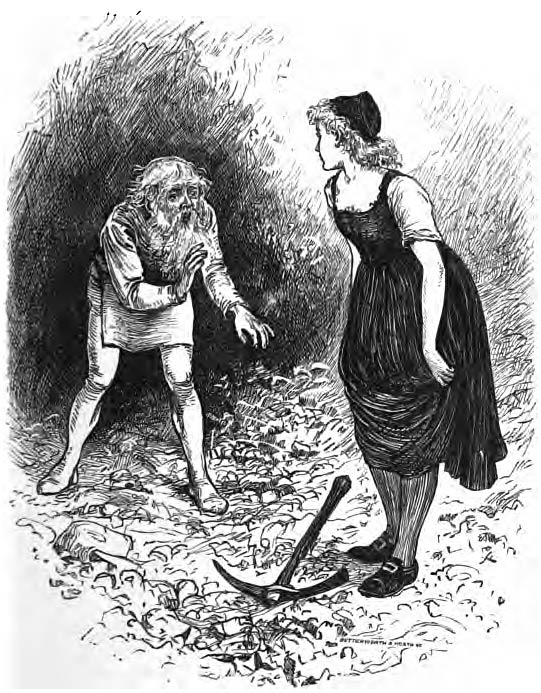
The Nickel of the Röhrerbüchele.—Page 84.
“It’s many a day since these walls have echoed a sound like that,” said the dwarf, with deep feeling, and as Aennerl’s smile rested on him, it seemed to wipe away some of the rough dark wrinkles that furrowed his cheeks and relax the tension of his knit brows. “And yet there’s more worth in those echoes than in all the metallic riches which resound to them! Yes, my lass, only come and see the poor old Bergmännl sometimes, and cheer him a bit, and you shall have what you will of his.”
With that he led her gently back into the great vault where she had first seen him working, and, stirring up a heap with his foot, said,—
“There, lass, there’s the Bergmännl’s store; take what you will—it is not the Bergmännl that would say nay to a comely wench like you. Why, if I were younger, and a better-looking fellow, it would not be my lapfuls of gold I should offer you, it would be the whole lot of it—and myself to boot! No, no, I shouldn’t let you go from me again: such a pretty bird does not come on to the snare to be let fly again, I promise you! But I’m old and grey, and my hoary beard is no match for your dainty cheeks. But take what you will, take what you will—only come and cheer up the poor old Bergmännl a bit sometimes.”
Aennerl had not wanted to be told twice. Already she had filled her large pouch and her apron and her kerchief with all the alacrity of greed. So much occupied was she with stowing away the greatest possible amount of the spoil, that she scarcely remembered to thank the Bergmännl, who, however, found pleasure enough in observing the rapturous gestures her good fortune elicited.
“You’ll come again?” said the Cobbold, as he saw her turn to go when she had settled her burden in such a way that its weight should least impede her walking.
“Oh, yes, never fear, I’ll come again! When shall I come?”
“Oh, when you will! Let’s see, to-day’s Saturday, isn’t it? Well, next Saturday, if you like.”
“Till next Saturday, then, good-bye!” said Aennerl, panting only to turn her gold to account; and so full was she of calculation of what she would do with it, that she never noticed the poor old dwarf was coming behind her to light her, and singing, as he went,—
“The weary Bergmännl, old and grey,
Sits alone in a cleft of the earth for aye,
With never a friend to say, ‘Good day.’
For a thousand years, and ten thousand more,
He has guarded earth’s precious silver store,
Keeping count of her treasures of golden ore
By the light of the bright Karfunkelstein,
The only light of the Bergmännlein.
But never a friend to say, ‘Good day,’
As he sits in a cleft of the earth for aye,
Has the lonely Bergmännl, old and grey!”
Aennerl had no time for pity; she was wholly absorbed in the calculation of the grand things she could now buy, the fine dresses she would be able to wear, and in rehearsing the harsh speeches of command with which she would let fling at the girls whom she would take into her service, and who yesterday were the companions-in-labour of orphan Aennerl.
The village was all wrapt in silence and sleep as Aennerl got back with her treasure.
Aennerl already reckoned it as hers, and in the meantime kept an eye open for any chances of good stock that might come into the market.
It was the Langer Peterl; and a goodly burden he bore, indeed—a burden which was sure to gather round him all the people of Reith, or any other place through which he might pass.
“Show you the best, indeed!” said the Langer Peterl, scarcely slackening his pace, and not removing the pipe from his mouth; for hitherto he had only known the orphan Aennerl by her not being one of his customers. “Show you the best, indeed, that what you can’t buy you may amuse yourself with a sight of! And when you’ve soiled it all with your greasy fingers, who’ll buy it, d’you suppose? A likely matter, indeed! Show you the best! ha! ha! ha! you don’t come over me like that, though you have got a pair of dark eyes which look through into a fellow’s marrow!”
“Nonsense, Peterl!” replied Aennerl, too delighted with the thought of the finery in prospect even to resent the taunt; “I don’t want to look at it merely—not I, I can tell you! I want to buy it—buy it all up—and pay you your own price! Here, look here, does this please you?” and she showed him a store of gold such as in all his travels he had never seen before.
“Oh, if that’s your game,” said the long Peter, with an entirely changed manner, “pick and choose, my lady, pick and choose! Here are silks and satins and laces, of which I’ve sold the dittos to real ladies and countesses; there are——”
“Oh, show me the dittos of what real ladies and countesses have bought!” exclaimed Aennerl, with a scream of delight; and the pedlar, who was not much more scrupulous than others of his craft, made haste to display his gaudiest wares, taking care not to own that it was seldom enough his pack was lightened by the purchases of a “real lady.” To have heard him you would have thought his dealings were only with the highest of the land.
But it needed only to say, “This is what my lady the Countess of Langtaufers wears,” “This is what my lady the Baronin Schroffenstein bought of me,” for Aennerl to buy it at the highest price the Long Peter’s easy conscience could let him extort; and, indeed, had he not felt a certain commercial necessity for reserving something to keep up his connexion with his ordinary customers on the rest of his line of route, orphan Aennerl would have bought up all that was offered her under these pretences, and without stopping to consider whether the materials or colours were well assorted, or whether such titles as those with which the pedlar dazzled her understanding existed at all!
The next day was a village festival in Reith. And the quiet people of Reith thought the orphan Aennerl had gone fairly mad when they saw at church the extravagant figure she cut in her newly-acquired finery; for, in her hurry to display it, she had in one way and another piled her whole stock of purchases on her person at once. A showy skirt embroidered with large flowers of many colours, and trimmed with deep lace, was looped up with bright blue ribbons and rosettes over a petticoat of violet satin, beneath which another of a brilliant green was to be seen. Beneath this again, you might have descried a pair of scarlet stockings; and on her shining shoes a pair of many-coloured rosettes and shoe-buckles. The black tight-fitting bodice of the local costume was replaced by a kind of scarlet hussar’s jacket trimmed with fur, fastened at the throat and waist with brooches which must have been originally designed for a stage-queen. From her ears dangled earrings of Brobdignagian dimensions; and on her head was a hat and feathers as unlike the little hat worn by all in Reith as one piece of head-gear could well be to another.
Of course, it did not befit a lady so decked to take the lowly seat which had served the orphan Aennerl; before the Divine office began she had seated herself in the most conspicuous place in the church, so that no one lost the benefit of the exhibition; and it may well be believed that the congregation had no sooner poured out of the sacred building than the appearance of the orphan Aennerl was the one theme of a general and noisy conversation.
For some it was a source of envy; for some, of ridicule; for some unsophisticated minds, of simple admiration. But the wiser heads kept silence, or said, in tones of sympathy, “The orphan Aennerl isn’t the girl the Goigner Jössl took her for.”
Jössl had been to church in his own village of Goign, and had therefore been spared the sight, as well as the comments it had elicited. But as he came towards Reith to take his Aennerl for the holiday walk, he noticed many strange bits of hinting in the greetings he received, which puzzled him so, that, instead of going straight on to Aennerl, he sat down on the churchyard wall, pondering what it could all mean. “I wish you joy of your orphan Aennerl!” one had said. “Goigner Jössl, Goigner Jössl, take my advice, and shun the threshold of orphan Aennerl!” were the words of another, and he was an old man and a sage friend too. “Beware, Goigner Jössl, beware!” seemed written on every face he had met—what could it all mean? He wandered forward uncertain, and then back again, then on again, till he could bear it no longer, and he determined to go down to the Wirthshaus beim Stangl, and ask his mates to their face what they all meant.
Before he came in sight of the door, however, he changed his resolution. Through the open window he heard noisy talk, and noisiest of all was the voice of the Langer Peterl. Honest Jössl had an invincible antipathy to the wheedling, the gossip, the bluster, and the evil tongue of the Langer Peterl, and he never trusted himself to join his company, for he knew a meeting with him always led to words.
Determining to wait till he was gone, he walked about outside, and as there is always a train of waggons waiting at the Wirthshaus am Stangl while the wayworn carters refresh themselves, he could easily remain unperceived.
Thus, however, he became unintentionally the hearer of all he desired to know—much more than he desired, I should say.
“I tell you, she,—Aennerl would have bought my whole pack if I’d have let her!” vociferated the Langer Peterl; “and I might have saved myself all further tramping, but that I wouldn’t disappoint my pretty Ursal, and Trausl, and Moidl, and Marie,” he added, in a tone of righteousness.
“Buy it, man! you don’t mean buy it! She got it out of you one way or another, but you don’t mean she bought it, in the sense of paying for it?”
“Yes, I do. I say, she paid for it in pure gold!”
“No, that won’t do!” said other voices; “where could she get gold from?”
“Oh, that’s not my affair,” replied the pedlar, “where she got it from! It wouldn’t do for a poor pedlar to ask where his customers get their money from—ha! ha! ha! I’m not such a fool as that! I know the girl couldn’t have it rightfully, as well as you do, but it wouldn’t do for me to refuse all the money I suspect is not honestly come by—ha! ha! I should then drive a sorry trade indeed!”
Jössl’s first impulse had been to fly at the Langer Peterl, and, as he would have expressed it, thrust the lie down his throat; but then, he reflected; where had the girl got the money from? what could he say? To dispute it without having means of disproving it was only opening wider the sore; and while he stood dejected and uncertain the conversation went on more animated than before.
“I agree with you!” cried, between two whiffs of smoke, an idle Bursch, on whom since the death of the Wilder Jürgl that nickname had descended by common consent. “What right have we to be prying into our neighbour’s business? If the girl’s got money, why should any one say she hasn’t a right to it? She’s an uncommon fine girl, I say, and looks a long way better than she did before in her beggarly rags; and a girl that can afford to dress like that is not to be despised, I say.”
That the speaker had only received the cognomen of Wild after the Wilder Jürgl was only in that he was younger; he had earned the right to it in a tenfold degree. None of the steady lads of either Goign or Reith or Elmau, or any other place in the neighbourhood, would make a friend of him, and that is why he now sat apart from the others smoking in a corner.
“Very well played, Wilder Karl! but I see your game. You think because the girl’s got money she’s a good chance for you. You think her flaunting way will estrange steady Goigner Jössl, and then you think you may step in between them—and a sorry figure she’d cut two days after you’d had the handling of her! She wouldn’t have much finery left then, I’ll warrant! The Langer Peterl there would have it all back at half-price, and that half-price would all be in the pocket of our honest Wirth am Stangl. But it’s in vain; whatever she is, she’ll be true to the Goigner Jössl, I’ll warrant—and as for you, she wouldn’t look at you!”
“That you won’t,” said the Wirth, coming to Friedl’s rescue, who was but a young boy, and had felt rather dismayed at the proposed wager, “for I’m not sure, till all this is cleared up, that I should admit her to the dance. But the difficulty will not arise, for Aennerl herself told my daughter Moidl that now she could wear a lady’s clothes it would be impossible for her to come any more to the village dance.”
But Wilder Karl, furious at the disappointing news of the Wirth, and maddened by the invective of the Kleiner Friedl, rushed at the boy head-over-heels, bent on mischief.
But Wilder Karl, though a bully and a braggart, inspired no respect, because no feather adorned his hat, and that showed he was no champion of any manly pursuit. So the whole room was on the side of Kleiner Friedl; and the bully having been turned out, and the subject of conversation pretty well exhausted, the Goigner Jössl turned slowly home.
Now I don’t say that he was right here. He was an excellent young man, endowed in an especial degree with Tirolese virtues. His parents had never had a moment’s uneasiness about him; no one in the whole village was more regular or devout at church; in the field none more hard-working or trustworthy; at the village games and dances none acquitted himself better; and had a note of danger to his country sounded in his time I am sure he would have been foremost to take his place among its living ramparts, and that none would have borne out the old tradition of steadfastness more manfully than he.
But of course he had his faults too. And one of his faults was the fault of many good people,—the fault of expecting to find every one as good as themselves, of being harsh and unforgiving, of sulking and pining instead of having an open explanation.
Now, mind you, I think it would have been much better if Jössl had, after hearing the conversation I have just narrated, gone straight on to Aennerl’s, and had it all out with her, had heard from her own lips the truth of the matter about which all Reith and Goign were talking, and judged her out of her own mouth, giving her, if he could not approve her conduct, advice by which she might mend it in the future.
But this was not his way. He had thought his Aennerl a model, almost a divinity. He had always treated her as such, talked to her as such, loved her as such. It was clear now, however, that in some way or other she had done wrong. Instead of getting to the bottom of it, and trying to set it straight, he gave himself up to his disappointment and went home and sulked, and refused to be comforted.
Aennerl, meantime, knew nothing of all this. She had had a great desire to be a lady and no longer a servant; and having plenty of money, and plenty of fine clothes, she thought this made her a lady, and had no idea but that every one acknowledged the fact. I don’t think she exactly wished that all the village should be envious of her, but at all events she wished that she should enjoy all the prerogatives of ladyhood, and this, she imagined, was one. Then she had no parents to teach her better, and Jössl, who might have been her teacher, had forsaken her.
But it was all too new and too exciting for her to feel any misgivings yet. She amused herself with turning over all her fine things, and fancied herself very happy.
In another day or two the Hof of good neighbour Bartl was put up for sale, and another visit to the Bergmännlein enabled her to become the purchaser. She thus became the most important proprietor in Reith; but she was so little used to importance that she did not at all perceive that the people treated her very differently from the former proprietor of the Hof.
Before him every hat was doffed with alacritous esteem due to his age and worth. But poor Aennerl hardly received so much as the old greeting, which in the days of companionship in poverty had always been the token of good fellowship with her, as with every one.
It was long before any suspicion that she was mistrusted reached the mind of Aennerl. In the meantime she enjoyed her new condition to the full. Weekly visits to the Röhrerbüchel enabled her to purchase every thing she desired; and when the villagers held back from her, she ascribed their diffidence to the awe they felt for her wealth.
In time, however, the novelty began to wear off. She grew tired at last of giving orders to her farm-servants, and watching her sleek cattle, and counting her stores of grain. That Jössl had not been to see her, she never ascribed to any thing but his respect for her altered condition; and she felt that she could not demean herself by being united to a lad who worked for day-wages.
Still grandeur began to tire, and her isolation made her proud, and angry, and cross; and then people shunned her still more, and upon that she grew more vexed and angry. But, worse than this, she got even so used to her riches that she quite forgot all about the Nickel to whom she owed them. Her farm was so well stocked that it produced more than her wildest fancies required; she had no need to go back to the Röhrerbüchel to ask for more gold, and she had grown too selfish to visit it out of compassion to the dwarf.
The Bergmännlein upon this grew disappointed; but his disappointment was of a different kind from Jössl’s. He was not content to sit apart and sulk; he was determined to have his revenge.
One bleak October night, when the wind was rolling fiercely down from the mountains, there was a sudden and fearful cry of “Fire!” in the village of Reith. The alarm-bells repeated the cry aloud and afar. The good people rose in haste, and ran into the lane with that ready proffer of mutual help which distinguishes the mountain-folk.
The whole sky was illumined, the fierce wind rolled the flames and the smoke hither and thither. It was Aennerl’s Hof which was the scene of the devastation. The fire licked up the trees, and the farm, and the rooftree before their eyes. So swift and unnatural was the conflagration that the people were paralyzed in their endeavour to help. One ran for ladders, another for buckets; but before any help could be obtained the whole homestead was but one vast bonfire. Then, madly rushing to the top of the high pointed roof, might be seen the figure of Aennerl clothed only in her white night-dress, and shrieking fearfully, “Save me! save me!” Every moment the roof threatened to fall in, and the agonized beholders watched her and sent up loud prayers, but were powerless to save.