NORG MYTHS. (continued 2)
Reading edition
Suddenly, on the road from Goign a figure was seen hasting along. It was the Goigner Jössl. Would he be in time? The crowd was silent now, even their prayers were said in silence, for every one gasped for breath, and the voice failed. A trunk of an old branchless tree yet bent over the burning ruins. Jössl had climbed that trunk and was making a ladder of his body by which to rescue Aennerl all frantic from the roof. Will he reach her? Will his arm be long enough? Will he fall into the flame? Will he be overpowered by the smoke? See! he holds on bravely. The smoke rolls above his head, the flames dart out their fierce fangs beneath him! He holds on bravely still. He calls to Aennerl. She is fascinated with terror, and hears him not. “Aennerl! Aennerl!” once more, and his voice reached her, and with it a sting of reproach for her scornful conduct drives her to hide her face from his in shame.
On the edge of the crowd, apart, stands a little misshapen old man with grey, matted hair and beard, whom no one knows, but who has watched every phase of the catastrophe with thrilling emotion.
It was he who first raised the cry that they had fallen into the flames; and the people sickened as they heard it, for he spoke it in joy, and not in anguish. In the gladness of the deliverance they have forgotten the old man, but now he shouted once more, as he dashed his hood over his head in a tone of disappointed fury, “I did it! and I will have my revenge yet!”
“No; let there be peace,” said Jössl, who had deposited Aennerl in safe hands, and now came forth to deal one more stroke for her; “let there be peace, old man, and let bygones be bygones.”
“Never!” said the Cobbold; “I have said I will have my revenge, and I will have it!”
“But,” argued Jössl, “have you not had your revenge? All you gave her you have had taken away—she is as she was before: can you not leave her so?”
“No!” thundered the dwarf; “I will have the life of her before I’ve done.”
“Never!” in his turn shouted Jössl; and he placed himself in front of the elf.
“Oh, don’t be afraid,” replied the dwarf, with a cold sneer, “I’m not going after her. I’ve only to wait a bit, and she’ll come after me.”
Jössl was inclined to let him go, but remembering the instability of woman, he thought it better to make an end of the tempter there and then.
“Will you promise me, that if I let you return to your hole in peace, you will do her no harm should she visit you there again?”
“I promise you that I will serve her to the most frightful of deaths—that’s what I promise you!” retorted the enraged gnome.
“Then your blood be on your own head!” said Jössl, and, with his large hunting-knife drawn in his hand, he placed himself in a menacing attitude before the now alarmed dwarf.
Jössl was a determined, powerful youth, not to be trifled with. The gnome trusted to the strength of his muscles, and fled with all his speed; but Jössl, who was a cunning runner too, maintained his place close behind him. The dwarf, finding himself so hotly followed, began to lose his head, and no longer felt so clearly as at first the direction he had to take to reach the Röhrerbüchel. Jössl continued to drive him before him, puzzling him on the zigzags of the path till he had completely lost the instinct of his way of safety. Then, forcing him on as before to the edge of the precipice, he closed upon him where there was no escape.
Yes, one escape there was—it was in the floods of the Brandenburger Ache, which roared and boiled away some hundred feet below! Rather than fall ignominiously by the hand of a child of man, the gnome dashed himself, with a fierce shout, down the abyss. And that was the last that was ever seen of the Nickel of the Röhrerbüchel.
Aennerl was now poorer than ever in this world’s goods, but she was rich in one deep and wholesome lesson—that it is not glittering wealth which brings true happiness. The smiles of honest friends, and the love of a true heart, and the testimony of an approving conscience are not to be bartered away for all the gold in all the mines of the earth.
Wilder Karl laughed with his two or three boon companions, and said, with a burst of contempt, “I’ve no doubt that fool of a Goigner Jössl will marry the orphan Aennerl now that she hasn’t a penny to bless herself with!”
And the Wilder Karl judged right. Aennerl scarcely dared hope that he could love her still, and she went forth humbly to her work day by day, neither looking to the right hand nor the left, accepting all the hardships and humiliations of her lot as a worthy punishment of her folly and vanity.
But one evening as she came home from her toil, the Goigner Jössl came behind her, and he said softly in her ear, “Do you love me still, Aennerl?”
“Love you still, Jössl!” cried the girl; “you have thrice given me life—first when I was a poor, heartbroken orphan, and you made me feel there was still some one to live for in the world; and then a second time, in that dreadful fire, when hell seemed to have risen up out of the earth to punish me before the time; and now again this third time, when I began to think my folly had sickened you for good and all! Don’t ask me that, Jössl, for you must know I love you more than my life! If I dared, there is one question I should ask you, Can you still love me? but I have no right to ask that.”
“I must answer you in your own words, Aennerl,” replied Jössl: “you must know that I love you more than my life!”
“You must, you must—you have shown it!” exclaimed Aennerl. They had reached the bank near the Röhrerbüchel where we first saw them; the rosy light of the sunset, and the scent of the wild flowers, was around them just as on that night.
They walked on together; as they reached the memorial of the dead miners the village bells rang the Ave. And as they knelt down, how heartfelt was Jössl’s gratitude that the prayer he had uttered at that spot once before had been so mercifully answered, and his Aennerl restored to him for ever!
THE WILDER JÄGER AND THE BARONESS.
There was a rich and powerful baron who owned a broad patrimony in South Tirol, Baron di Valle. He was not only one of the richest and most powerful, he was also one of the happiest, for he had the prettiest and most sensible woman of Tirol for his bride. The brief days were all too short for the pleasure they found in each other’s society, and they were scarcely ever apart the whole day through.
Once, however, the Baron went on a hunting party through a part of the country which was too rough for the Baroness to follow him. The day was splendid, the scent good, and the Baron full of enthusiasm for his favourite sport; but what egged him on more than all these, was the sight of a strange bold hunter who bestrode a gigantic mount, and who dashed through brake and briar, and over hill and rock, as if no obstacle could arrest him. Baron di Valle, who thought he was the boldest hunter of the whole country-side, was quite mad to see himself outdone; nor could he suffer this to be. Determined to outstrip his rival, he spurred his horse on, so that he might but pass him somewhere; but the Wilder Jäger, for it was he, always kept on ahead, and though the brave Baron kept close to his heels, he was never able to pass him by.
They had long outstripped all the rest. But all this time the Baron had taken no note of whither he went; now he found himself in the midst of a thick forest of tall fir-trees, with their lower branches cut off because they were planted so thick and close together that there was no room between them, and their tops were intergrown so that they formed one compact mass, excluding the very air and the light of day. The Wild Hunter stopped his mad career before this barrier, and then, turning, pretended for the first time to be aware of the Baron’s presence.
“What do you want here?” he exclaimed, fiercely, his rolling eyes glaring like fire. “How dare you invade my domain!” and with that he blew a mighty blast on his hunting-horn, at sound of which a whole troop of wild huntsmen, habited like himself, and with similar fiery eyes, appeared suddenly, surrounding the Baron.
“Stand back!” cried the Baron, in a commanding tone, as the wild huntsmen dismounted and prepared to seize him.
“No one commands here but I,” said the Wilder Jäger. And then he added, addressing his men, “Seize him, and carry him off!”
“Hold!” said the Count, but speaking more humbly than before, for he saw he must yield something to the necessity of the case; “I suppose there is some ransom upon which you will let me off? I have wronged you in nothing, and meant no offence. I admired your brave riding, and I thought what one brave man might do, another might.”
“Since you take that tone,” said the Wilder Jäger, “I will do what I can for you. I will let you ransom yourself at one price. You must know, that it is not you that I want at all; I only lured you here as a means of getting hold of the Baroness, and had you been uppish and violent, I should have kept you in chains for the rest of your life, while I married her. But as you know how to keep a civil tongue in your head, I will show you that I can appreciate courtesy. So now I give you permission to return, to be yourself the bearer to your wife of my conditions.
“Tell her, then, that I have won her for my own, and she belongs irrevocably to me; it is useless that she attempt to escape, for you see that my people are countless, and violence is of no avail against me. But I am a good sort of fellow, and as I love her, I don’t want to do any thing to alarm her, so long as she shows no foolish resistance.”
“But the ransom? You spoke of a ransom just now,” interposed the Baron, hastily; “what, about that?”
“All in good time,” replied the Wilder Jäger—“give a fellow time to speak. The only mode of ransom is this—let the Baroness guess my name. I give her three guesses of three words each, and an interval of a month. But if she doesn’t succeed, remember, she is mine! this day month I appear and claim her. If, in the meantime, she thinks she has made the guess, and wants to satisfy herself as to its correctness”—and he laughed a ghastly laugh of scorn, as if to impress the Baron with the hopelessness of the idea—“she has only to come to the ilex grove on the border of this forest which marks the frontier between your territory and mine. If she stands there, beside the centre tree, and blows this horn—see what a pretty little gold horn it is, that I have had studded with diamonds and rubies—just fit for her pretty little fingers!” he added, with a grin of scorn—“at sound of her voice I shall be with her on the instant.”
The Baron was not one to have tolerated such talk from any human being soever, but he felt the necessity of vanquishing his temper this time—a more difficult matter ordinarily than vanquishing a foe—for a dearer life than his own was at stake; and if he could not altogether save the Baroness from the power of the Wilder Jäger, he could take counsel with her as to the means of finding out the hidden name, and at least spend with her the last days that he could call her his.
Accordingly he took the horn, and stuck it in his belt without a word. And indeed no word would have availed him, for the whole troop of the wild huntsmen had vanished as it came, and he was left alone.
There was no difficulty in finding his way back by the path by which he had come, for it was plainly marked by the havoc of the surrounding vegetation the wild chase had cost. And though he now put spurs to his steed that he might reach home without losing an hour more than he could help of the companionship of his beloved wife, he now for the first time apprehended how swiftly he had come, for, riding the utmost of mortal speed, it took him three days to get back to the ilex grove which marked the boundary of his own territory. Hence it was still half a day’s journey to reach his castle. But while he was yet a great way off his loving wife came out to meet him, full of joy at his approach, for since the rest of the hunt had come home without him she had done nothing but watch from the highest turret of the castle, that she might catch the first sight of him returning; her thirsty eyes had not been slow to discern his figure as he hastened home.
Great was her amazement, however, to find that, instead of returning her greeting with his wonted delight, he turned his head away, as if he dared not look at her, and wept. She rode beside him all the way home, but he still kept silence, for he could not bear to render her sorrowful with the message of which he was the bearer. But he could conceal nothing from her loving solicitude, and soon he had told her all.
Being a woman of prudent counsel and strong trust in God, she was much less cast down, however, than he had expected. Though bewildered at first, and seeing no way out of the difficulty, she yet declared she was sure some way of escape would be opened to her, it only remained to consider where they should find it. And never a word of angry recrimination did she utter to remind him that it was his mad vanity had brought them to this plight.
The Baron felt the full force of this forbearance, for he did nothing but reproach himself with his folly. But the fresh proof of her amiability only occasioned another pang at the thought of the approaching separation.
Still no good counsel came to mind, and the Baroness herself began almost to lose heart. The Baron had abandoned the hunt and all his sports, and sat gloomily in the ancient seat of his ancestors. The Baroness sat among the flowers of her oriel window, her embroidery in her hand; but her mind was far away over the tops of the dark green trees, looking for some bright thought to bring deliverance to her from above. Every morning and evening they knelt together in the chapel of the castle, and prayed that a spirit of prudence and counsel might be given them.
Ten days had passed, and no good thought had come. The Baron reclined gloomily in the ancient seat of his ancestors, and the lady sat among the flowers of the oriel window gazing over the tops of the high dark fir-trees, full of hope that some wise counsel would be given her. Suddenly she rose and clapped her hands, and her ringing laugh brought the Baron bounding to her side.
“I have found it, Heinrich!” she exclaimed; “I am sure I have found the name! Doesn’t the Wilder Jäger live among the tall fir-trees?”
“Yes; among the tall fir-trees is his dwelling.”
“And didn’t he speak of three names?”
“Yes; he said your guess must include three names.”
“Then I have it, Heinrich! What more natural than that he should be called from the names of the trees which form his palace? As I was gazing over the tops of the high dark trees the words came into my mind, ‘Tree, Fir, Pine’—those will be the three words. Come, and let us go out to the ilex grove, and be free to belong to each other as of old!”
She was so lively that the Baron caught some spark of her hopefulness, but he was too far sunk in despondency to enter into her joy all at once. Nevertheless, it was not a moment when, if ever, he would have thwarted her, so he ordered the horses to be saddled, for it was still early morning. And they rode together to the ilex grove which was the boundary of the Wilder Jäger’s domain; the Baroness striving every minute by some sprightly speech to distract the Baron, and the Baron utterly incapable of rousing himself from his gloomy fears.
The Baroness was the first to reach the grove; in fact, she had ridden on a good way in advance, that she might have it out with the Wilder Jäger before her husband came, so that she might greet him on his arrival with the news that she was free.
Merrily she sounded the jewelled horn, and before its sound had died away the Wilder Jäger was at her side. He no longer looked dusty, wild, and fierce, as during the Baron’s mad chase. He seemed a man of noble presence, carefully dressed in a green hunting-suit, with a powerful bow in his hand, and a beautiful boy to hold his arrows. In his belt was a jewelled hunting-knife of exquisite workmanship, and to a cord across his shoulder hung a golden horn of similar pattern to that he had sent the Baroness, and, moreover, as a further act of gallantry, he wore a scarf of red and white, the favourite colours of the Baroness. A jewelled cap shaded the sun from his brow, which a red and white plume gracefully crested.
The Baroness looked astonished to find she had nothing more formidable to meet, and felt that had she not already been the wife of the Baron di Valle, she would not have found it so great a calamity to be obliged to marry the Wilder Jäger.
The Wilder Jäger was not slow to perceive that the impression he had produced was good, and bowing towards her with courtly mien, paid her a respectful salutation, and immediately added,—
“Your eyes are so clever, fair Baroness, that I very much fear you are going to pronounce my name, and rob me of the happiness I had so nearly bought! Spare me, therefore, lovely lady—say not the word! but come with me into the shady pine-forest, where you shall have every thing heart can desire—the noblest palace, the widest domain, and unlimited command; retainers without number, pleasures without alloy, and every wish gratified without condition!”
He approached her as he spoke. His eyes sparkled no longer with the angry fury which had thrilled the Baron, but with a mild fire of tenderness and devotion. Nothing more attractive and winning than his whole appearance and manner could be conceived, and for a moment the Baroness had almost forgotten the less accomplished—but, oh! more sincere—passion of her Heinrich.
It was only for a moment. The weakness passed, she instantly drew herself up with dignity, and stepped back against the friendly ilex.
“It was not to hear such words I came,” she said, “but to pronounce those which are to free me from ever having to listen to such protestations again——”
“Oh, say them not! say them not!” said the Wilder Jäger, throwing himself at her feet. “Any thing but that! Name any wish by fulfilling which I can win your favour; name any difficult task by accomplishing which I can prove myself worthy of your love——”
“My love,” said the Baroness, striving to speak coldly, “is another’s already; you see, there is none to be won from me. But interrupt me no more. I have guessed your name, to discover which was to be the price of my freedom. It is——”
The Wilder Jäger clasped her feet in despair, entreating her not to pronounce it, but she went on, with a clear, confident voice, to utter the words,—
“Tree! Fir! Pine!”
The Wilder Jäger looked up as if he did not quite understand what she meant.
“Now, let go your hold, and let me pass, for I am free!” she said, resolutely.
“‘Free,’ say you?” said the handsome Cobbold, with astonishment. “Free? did you mean you thought that was my unknown name?”
“Yes,” replied the lady, in a voice of conviction.
“Oh, dear, it is nothing like it!” he answered, with glee, and yet not without a delicate regard for her disappointment. “No, that is not it; nor is it likely you should ever arrive at it. So days of happiness are before us yet.” He had no need to kneel to her longer, but it was joy to him to be at her feet.
“Dare not to speak so before me!” replied the Baroness, trying to tear herself away. “I know of no happiness, except with Heinrich; and I am persuaded that, though I have failed this time, it will yet be given to me to find the word which shall restore me to him completely.”
The Baron arrived as she finished speaking; and though he saw by the sorrowful look which now had possession of her bright face, and the triumphant mien of the Cobbold, that she had failed, and that she was still under the Wilder Jäger’s spell, he was so incensed to find him in such an attitude that he drew his sword, and would have closed with him then and there, but the Wilder Jäger blew one note upon his horn, and in an instant he was surrounded, as before, by his myrmidons, who unarmed him and held him bound upon the ground, while the Cobbold himself approached to seize the hand of the Baroness. A fiery fury took possession of him, and sparks darted from his eyes which fell smouldering among the twigs of fir. Powerless to defend his wife by force, the Baron once more mastered his anger, and reminded his adversary courteously of his promise to leave them at peace for the interval of a month.
“I am always ready to answer you in whatever tone you elect to adopt,” said the Wilder Jäger, rising, and leaving the side of the Baroness. “You see, it is useless to attempt force against me; but when you behave with due consideration, so will I.” At a sign from him the sprites loosed the Baron’s bonds, gave him back his sword, and held his stirrup with the most respectful care, while he mounted his horse.
“Depart, then, unharmed,” said the Wilder Jäger, “since you set so much store on prolonging your suspense. I should say, it was wiser to make the best of a bad bargain and submit to your fate at once, with grace. However, I have given my word and won’t go back from it. I restrain my power over you till the full end of the month; and, what is more, I not only give the lady three guesses, but as many as she likes. For,” he added, with a cynical leer, “she is as little likely to guess it in thirty as in three; while every time that she chooses to essay the thing, it gives me the happiness of seeing her.” And he turned away with a peal of wild laughter which made the lady shudder.
The sprites vanished as they had come; and the Baron and his wife rode sadly home, without the courage to exchange a word.
If the Baroness had for a moment been won by the comely presence and devoted admiration of the Wilder Jäger, she had now seen enough reason to fear his treacherous humour, and to dread her impending fate as much as at the first.
They spent the rest of the evening in prayers and tears in the chapel of the castle, and the next evening, and the next; and the days flowed by as before, but more sadly, and with even less of hope. The Baroness scarcely now dared raise her eyes so high as the tops of the tall dark trees; they fell abroad over the beautiful landscape stretched out beneath them, and the good gifts of God cropping up out of the ground; and she thought how beautiful was that nature to which she must so soon say adieu!
Thus ten days passed without a gleam of expectation. Suddenly she rose and clapped her hands; and her silvery laugh brought her husband bounding to her side.
“I have it this time, Heinrich!” she said.
And the Baron listened anxiously, but trusted himself never to speak.
“Said you not that the Wilder Jäger’s domain was entirely among the tall dark trees?”
“So it seemed to me it was,” responded her husband.
“But I certainly discerned through the forest patches of ripe golden grain. Saw you them not too?”
“The first time I rode too fast to notice them, but I do think on this last journey I saw such here and there by the wayside.”
“No doubt,” continued the lady, “it is hence he takes his name; these small patches of golden grain are more worth than all the vast forests. Order the horses, for I have guessed his name! It came to my mind just now, as I looked over the harvest-fields stretched out yonder.
“Wheat, Oats, Maize—that will be his name!”
The Baron knew her counsel had often proved right when he least expected, and even disputed it, and though he was now too desponding to expect success, he was likewise least inclined to dispute her word. So he ordered the horses round, for it was yet early morning, and they rode to the ilex grove.
The Baroness, whose hope seemed to rise as she got nearer the goal of the journey, was full of spirit and cheerfulness, and, finding it impossible to work up the Baron to the same expectation as herself, rode on to accomplish her work ere he arrived.
One note of the jewelled horn brought the Wilder Jäger to her presence.
As she had failed before, he had less fear of her success this time, and he was proportionately less subservient and submissive.
“So you think you are come to give me my dismissal, beautiful Baroness? But you have no reason to repulse me so—be assured I mean it well with you; and though there is no limit to my power over you, I shall never treat you otherwise than with honour,” he said, with a little scornful laugh which suited his fine features exactly, and made him look handsomer than before. And as he spoke so, his haughty tone, not unmixed with warmth and admiration, thrilled her with the notion that, after all, if it were not for her troth plighted to the Baron, it would not be so very dreadful to owe obedience to one who knew how to command so gracefully.
But it was only for a moment. The weakness passed, she drew herself up with dignity, and, retreating against the support of the friendly ilex, said,—
“Silence! and remember your promise to leave me at peace till the fatal month is out. I cannot listen to you. And now for your name——”
The Cobbold bowed, with a half-mocking, half-respectful inclination, as if forcing himself to listen out of courtesy, but secure that she would not guess right.
“Wheat! Oats! Maize!” said the Baroness, with a positive air.
The Cobbold stared comically, as if doubting whether she was in earnest; and at last, as if to relieve her out of politeness, he replied,—
“Oh, dear no, that’s not at all like it!”
The Baroness hung her head in despair; then, drawing herself up again, she said,—
“How do I know you are not deceiving me? You say this is not your name, and I have to believe you—but suppose I maintain that it is it?”
“You are not fair, beautiful Baroness,” replied the Wilder Jäger, with a charming dignity. “I have never deceived you, nor ever would I deceive so noble a lady! what I have promised, I have kept; but in this case I have no means of deceiving you—great as is my power, that is one thing beyond it. Could a mortal, indeed, discover and pronounce my name in my presence, I could not stand before him an instant. But this it is not given to mortals to know, and that is why I proposed this difficulty to you. Should I have paid you so bad a compliment,” he added, with his cynical laugh, “as to render it possible that I should lose so great a prize?”
The Baron rode up while he was saying this, and shrank dumb with despair at the cruel words and the positive tone in which they were uttered.
Without condescending to exchange a word with the Cobbold this time, he lifted his wife on to her palfrey and rode away with her in silence.
It was now all over. His despondency even gained the Baroness, and she ceased to rack her brain with the hope of finding the inconceivable name. Her eye not only dared not raise itself to the tall dark trees—it had not even power to range over the landscape. With her head sunk upon her breast, she sat silently among her flowers in her oriel window, nor cared even to look at them. Only in the morning and the evening they knelt together in the chapel of the castle, and prayed that the calamity might pass away yet.
The days went by, and now the last but one had come; and the Baroness trembled, for her imagination pictured the Cobbold coming to carry her away. But her courage did not forsake her even now, and she proposed to go out into the forest to meet her fate, as more noble than waiting for it to overtake her.
The Baron, too dispirited to discuss any matter, and indifferent to every thing, now that all he cared for was to be taken from him, gave a listless consent. The next morning, having prayed and wept together in the castle chapel, they set out on their mournful pilgrimage, the young wife led as a lamb to the sacrifice.
The flowers bloomed beneath their feet, and the sun shone warm overhead, the birds sang blithe and gay—all nature was bright and fresh; but with heavy hearts they passed through the midst, nor found a thought but for their own great sorrow. As they came to the borders of the forest, however, the Baroness discerned the cry as of one in distress. Forgetting for the moment her own agony, her compassionate heart was at once moved, and she begged her husband to turn aside with her, and find out the poor wretch who pleaded so piteously. In a little time they had followed up the sound, and they found one of the Wilder Jäger’s men tied in front of a lately lighted fire. In a few minutes more the heaped-up wood would have been all in flames, and then the luckless wight must have been slowly roasted! At a word from the Baroness, the Baron cut his bonds; and then they inquired what was the occasion of his punishment. “Oh, it don’t want much to get a punishment out of the Wilder Jäger!” was the answer.
“Is he so very severe, then?” asked the Baroness, her cheek blanching with fear.
“At times, yes; it depends how the fancy takes him—if he is out of humour he spares no one. If he were not so violent and arbitrary, I would do you a good turn for that you have done me; but I dare not, his anger is too fearful.”
The more he descanted on the Wilder Jäger’s barbarity, the more the Baroness prayed that he would tell her the word that would save her; but he dared not, and all her instance was in vain. “And yet there might be a means,” he said, for he was desirous of doing a service to his deliverers.
“Oh, speak! tell us what we can do—no matter what it is, we will do it!” answered both at once.
“Well, if you happen to overhear it, I shan’t have told you, and yet it will serve your turn just as well;” and with that he walked on close in front of them, singing carelessly as he went.
“How are we to ‘overhear’ it, Heinrich?” said the Baroness, after a bit.
“He seems to have forgotten us,” replied the Baron, in despair. “I have been expecting him every minute to turn round and give us a hint of how he meant to help us; but it is just like every one you do a favour to—when they have got what they want, they forget all about you.”
They walked on in silence; and the fellow kept on close in front of them, singing as before, and always the same verse.
At last the Baroness got wearied with hearing the same thing over and over again, and she began repeating the words over to herself, mechanically. She could not make them out at all at first, for he had a rough, abrupt articulation, but by dint of perseverance in an occupation which served as a distraction to her agony, she at last made it out, word by word:—
“The Wild Huntsman’s betrothed (though he is not tamed)
To a lady fair
Driven to despair.
If she only knew he’s Burzinigala named!”
“‘Burzinigala named!’ exclaimed the Baroness, with the ringing laugh of former days, and clapping her hands merrily.
“I have it all right this time, you may depend, Heinrich!” and she laughed again.
The Baron was too delighted for words—he embraced his wife in his joy; and they walked on with a very different mien from what they wore before. The first joy over, they turned to thank their helper; but he had already disappeared, climbing over the tops of the trees to get out of sight of the Wilder Jäger’s eye for as long as might be.
There was no more lingering now, they hasted on, anxious only to proclaim their triumph.
The ilex grove was soon reached, and the jewelled horn quickly produced the Wilder Jäger.
To-day he was habited with greater care even than on the former occasions, and there was also still more assurance in his manner, and still more forwardness to flatter.
“Well, lady fair,” he said, with a mocking air, “do you deem you have guessed my name this time?”
“Really, it is so difficult,” replied the lady, “that how can you think I can hope to succeed? Besides, why should I wish to do what would deprive me of so charming a companion?”
The Wilder Jäger in his turn was perturbed. Nothing could have made him happier than to hear such words from her lips, could he have deemed them sincere; but there was an irony in her tone and a playfulness in her countenance which showed that her heart was not in her words. Yet he felt convinced she could not discover his name; and so he knew not what to think, and scarcely what to say. And the Baroness, delighting in his confusion, continued teasing him, like a cat with a mouse.
After a good deal of this bantering, in which the Wilder Jäger got quite bewildered, the Baroness rose majestically.
“Have we not had enough talking?” she said, with emphasis; “when are you going to take me home—Sir Burzinigala?”
It would be impossible to describe the effect of this word. He rose from the earth with one bound. The beauty, the calmness, the commanding air, which had at one time charmed the Baroness, had all fled. Wild, savage, and furious as he had first appeared and tenfold more, he now showed; and the sparks flew from his eyes on all around. Through the thick tops of the trees he passed, they hardly knew how; and soon the only trace of him left was that of the sparks that smouldered on the dry heath.
It only remained for the Baron and Baroness to return home, locked in each other’s arms. And they continued loving each other more than ever before to the end of their days.
THE GRAVE PRINCE AND THE BENEFICENT CAT.
There once was a king in Tirol who had three sons. The eldest was grave and thoughtful beyond his years; but he seldom spoke to any one, took no pleasure in pastimes, and lived apart from those of his age. The other two were clever and merry, always forward at any game, or at any piece of fun, and passed all their time in merry-making and enjoyment.
Now though the eldest son was, by his character, more adapted to make a wise and prudent sovereign, yet the two younger brothers, by their lively, engaging manner, had made themselves much more popular in the country; they were also the favourites of their father, but the eldest was the darling of his mother.
The king was old and stricken in years, and would gladly have given up the cares of government, and passed his declining years in peace, but he could not make up his mind to which of the brothers he should delegate his authority. The queen was persuaded of the excellent capacity of her eldest son; but the two younger were always saying he was half mad, and not fit to govern, and as they had the people on their side, he greatly feared lest the kingdom should be involved in civil war, so he always put off making any arrangement.
One day, however, an ancient counsellor observed to him, that if he really feared that there would be a dispute about the succession, it was much better to have it decided now while he was alive to act as umpire, than that it should befall when they would be left to wrangle with no one to make peace between them.
The king found the counsel good, and decided to retire from the government, and to proclaim his eldest son king in his stead. When the two younger sons, however, heard what he intended to do, they came to him and urged their old charge, that their elder brother was not fit to govern, and entreated the king to halve the kingdom between them. But the king, anxious as he was to gratify them, yet feared to displease the queen by committing so great an injustice against her eldest son; and thus they were no further advanced than before.
Then the old counsellor who had offered his advice before spoke again, and suggested that some task should be set for the three, and that whoever succeeded in that should be king beyond dispute.
The three sons all swore to abide by this decision; and the king found the counsel good. But now the difficulty arose, what should he set them to do? for they had insisted so much on the weak intellect of the eldest, that the queen feared lest, after all, he should fail in the trial, and her care for him be defeated. She knew he had never practised himself in feats of strength, or in the pursuit of arms, so it was useless proposing such as these for the test, but she persuaded him to set them something much simpler.
So, having called an assembly of all the people, he proclaimed aloud that the three brothers should travel for a year and a day, and whichever of them should bring him back the finest drinking-horn, he should be the king—the three sons swearing to abide by his award.
The two younger brothers set out with a great retinue; and, as they did not apprehend much difficulty in surpassing their brother in whatever they might undertake, they spent the greater part of the year allowed them in amusing themselves, secure in bringing back the best, whatever they might bring.
The eldest set out alone through the forest. In his lonely wanderings he had often observed a strangely beautiful castle on a far-off mountain, concerning which he could find no record in any of his books, nor could he learn that any one living knew any thing about it. He now resolved to make his way thither, persuaded that if he was to find something surpassing the work of human hands, it was like to be in this enchanted castle.
Though it was so high-placed, the way was much easier than he thought, and he was not more than five months getting there; so that he had ample time for exploring its precincts, and yet get back within the appointed date. He had, indeed, to traverse dark forests and steep rocky paths, but when he got near the castle all these difficulties ceased. Here there were only easy slopes of greensward, diapered by sparkling flowers; broad-leaved trees throwing delicious shade; and rills that meandered with a pleasant music. Delicious bowers and arcades of foliage of sweet-scented plants invited to repose; and every where luscious fruits hung temptingly within reach. Birds sang on every branch with a soft, dreamy melody which soothed, and disturbed not the lightest slumber.
The prince thought it would have been delightful to pass the remainder of his days there, but he remembered that it was an important mission with which he was entrusted, and he passed on.
A broad flight of marble steps led from these amenities up to the palace, and every now and then a thousand little jets were turned on, to pour their tiny floods over them, and cool them for the tread of those who entered.
And yet no one was near, no one to enjoy all this magnificence! The prince entered the hall, but no one came to meet him; he passed through the long corridors—all were deserted; he entered one apartment after another—still no one. At last he came to one charming boudoir all hung with pink satin, and lace, and beautiful flowers. On a pink satin sofa covered with lace sat a large Cat with soft grey fur, and soft grey eyes—the first living thing he had met!
As he entered, the Cat rose to meet him, walking on her hind-paws, and, holding out her right front-paw in the most gracious manner, asked him, in a sweet, clear voice, if there was any thing she could do for him. Then, as if the effort was too great, she let herself down on all fours, and rubbed her soft grey head against his boots.
Finding her so friendly, he was going to take her up in his arms: this she would not allow, however, but sprang with an agile bound on to a ledge above his head. “And now tell me,” said she, “what is it you want me to do for you?”
“Really, Lady Purrer, you are so kind, you confuse me! But, to tell you the truth, I fear—”
“You fear that a poor puss can’t be of any use,” interposed the Cat, smartly, “and that your requirements are much above her feeble comprehension. But never mind, tell me all the same; there is little fear but that I can help you, and if I can’t, the telling me will do you no harm.”
“Quite the contrary,” replied the prince, “it will be a great pleasure to have only your sympathy, for I am in great distress.” Her voice was so sweet and kind, that he quite forgot it was only a Cat he was talking to.
“Poor prince!” said the Cat, soothingly; “tell me all about it, then. But stop, I’ll tell you first what I think. I’m sure you are not appreciated at home. I saw it in your look when you first came in. You don’t look bright and enterprising, as you ought to look. You look as if you lived too much alone. Oh, you would be twice as handsome if you only looked a little more lively and energetic—” and then she stopped short, and sneezed a great many times, as if she feared she had said what was not quite proper, and some other sound would efface that of her words.
“There is a great deal of truth in what you say,” replied the prince; “they don’t care much about me at home—at least my mother does, but my father and brothers don’t. And I do live too much alone—but it’s not my fault: it’s a bad way of mine, and I don’t know how to get out of it.”
“You want some one to pet you, and spoil you, and make you very happy; and then you would be pleased to go into the society of others, because then you could say to yourself, I’ll show them that there’s some one understands me and makes a fuss about me—” and she stopped short, as before.
“But who should care to spoil and pet me?” cried the prince, despondingly, and too much interested in her words to see any reason why she should be confused at what she had said.
“Why, a nice little wife, to be sure!” replied the Cat.
“A wife!” exclaimed the prince; “oh yes, my father’s grey-bearded counsellors will find me some damsel whom it is necessary I should marry for the peace of the kingdom; and to her I shall be tied, and, be she an idiot or a shrew, I shall have no voice in the matter.”
“But do you mean to say,” retorted the Cat, in a more excited voice, “that if you found a nice little princess—I don’t say any one they could with justice object to, but a real princess—who cared very much for you, and made you very happy, very happy indeed, so that you determined to marry her, that you wouldn’t be man enough to say to your father and all his counsellors, ‘Here is the princess I mean to make my wife; I feel Heaven intended her for me. I am sure she will be the joy of my people, as she is mine, and no other shall share my throne’?”
“Wouldn’t I,” exclaimed the prince, with energy, starting to his feet, and placing his hand instinctively on his sword, his eye flashing and the colour mounting in his cheek.
“Ah! if you always looked like that! Now, you are handsome indeed!” exclaimed the Cat, enthusiastically, and purred away. “But,” she added, immediately after, “all this time you haven’t told me what it was you came for.”
“Ah!” said the prince, despondingly, at finding himself thus recalled to the prosaic realities of his melancholy life from that brief dream of happiness. “No; because you have been talking to me of more interesting things” (the Cat purred audibly); and then he told her what it was had really brought him there.
“You see, your mother understands your character better than all the rest,” said the Cat. “She knew you could be trusted to prove your superiority over your brothers, though the others hope you may fail. However, fail you won’t this time, for I can give you a drinking-horn which neither your brothers nor any one else on earth can match!”
With that she sprang lightly on to the soft carpet, and ran out of the room, beckoning to him to follow her. She led him through a long suite of rooms till they came to a large dining-hall all panelled with oak and filled with dark carved-oak furniture. In the centre of one end of this hall, high up in the panelling, was an inlaid safe or tabernacle curiously wrought. Puss gave one of her agile springs on to the top of this cabinet, and, having opened its folding-doors gently with her paw, disclosed to view a drinking-horn such as the prince had never seen. It was a white semi-transparent horn, but close-grained, like ivory, and all finely carved with designs of curious invention; the dresses of the figures were all made of precious stones cunningly let in, and they sparkled with a vivid lustre, like so many lamps. Then it had a rim, stand, and handle of massive gold exquisitely chased, and adorned with rows of pearls and diamonds.
“Kind Lady Purrer,” exclaimed the prince, “you are right, there is no doubt of my success! But how can I ever sufficiently thank you for what you have done for me? for I owe all to you.”
“And a little to your own discernment too,” said the Cat, archly. “And now, always look as much alive and as bright as you do now, and you will see people will think better of you.”
“But when shall I see you again, most sweet counsellor? May I come back and see you again?” pleaded the prince, and he tried to stroke her sleek fur as she rubbed her soft grey head, purring, against his boots. The stroking, however, she would by no means allow, but springing again on to the top of the cabinet, she said,—
“Oh, yes; it will not be long before you will have to come back to me, I know. But go, now; you have spent more time here than you think, and you have only just enough left to get back within the year.”
The prince turned to obey her; and the Cat jumped down, and ran by his side, purring. When he got out into the grounds again, she followed him, climbing from tree to tree; and when he came to the boundary-wall she ran all along on the coping. But here at last they had to part, to her great regret, and for many a lonely mile he still heard her low and plaintive mew.
It was true, he must have spent more time in her pleasant company than he had thought, for when he reached home he found the day of trial had arrived; the streets were deserted, and all the people gathered in the palace to see the drinking-horns his brothers had brought, and talking loudly of their magnificence. He passed through their midst without being recognized, for the people knew him so little; and thus he heard them speak of his younger brothers:—
“What bright faces they have! and what a merry laugh! it does the heart good to hear them,” said one.
“I wonder how the kingdom will be divided, and which half will be to which of them,” said another.
“For my part, I don’t care to the lot of which I fall, for both are excellent good fellows,” replied a third.
And thus they had clearly settled in their own mind that his brothers had carried the day, and they didn’t even trouble themselves to think what he would bring, or whether he would come back at all. It was the same thing all the way along. The words were varied, but the same idea prevailed every where, that the younger brothers had made good their claim; there was no question at all of the eldest. The prince’s face was growing moody again; but just then one good woman, wiping the soap-suds from her hands as she turned from her washing at the river to join the throng, exclaimed, as she heard some neighbours talking thus, “Hoity toity! it’s all very well with you and your laughing princes—a grave one for me, say I! Laughing may lead a man to throw away his money, but it won’t teach him to feed the poor, or govern a kingdom. Wait till the Grave Prince comes back! I’ll warrant he’ll bring the bravest drinking-horn!”
A chorus of mocking laughter greeted her defence of him.
“He bring the bravest drinking-horn!” said one.
“Don’t believe he knows what a drinking-horn is for—or drink either!” said another.
“No; his brothers understand that best, at all events. I like a man who can drink his glass.”
“And I like one who doesn’t drink it, whether he can or not; but keeps his head clear for his business,” said the good wife who had defended him before.
And as there were a good many who were too fond of the bottle in the crowd, the laugh raised at him was turned against them.
He had one defender, then, in all that mass of people, but all the rest judged him incapable, and without trial! He was too disheartened, to make his way into the great hall where the success of his brothers was being proclaimed, but instead trod sadly and secretly up to his mother’s chamber.
The queen was too distressed at the absence of her favourite son to take part in the jocular scene below, and was seated, full of anxiety, at her window, watching.
“What do you here, my son?” she exclaimed, when he entered; “you have but one short half-hour more, and the time will be expired. The sun is already gone down, and the time once past, whatever you have brought, it will avail you not! Haste, my son, to the council-hall!”
“It is useless, mother; all are against me!” cried the prince; and he laid the beautiful flagon on the table, and sank upon a chair.
In the mean time it had grown dark, but the queen, impelled by her curiosity to know what success her son had had, pulled off the wrapper that enclosed the drinking-horn, and instantly the apartment was brilliantly lighted by the light of the precious stones with which it was studded!
“My son, this is a priceless work! This is worth a kingdom! Nothing your brothers can have brought can compare with this—haste, then, my son!” and she led him along.
It was dark in the council-hall too; but when the queen had dragged her son up to the throne where the king sat, she uncovered the flagon, and the sparkling stones sent their radiance into every part.
Then there was one shout of praise. The drinking-horns of the younger brothers, which had anon been so highly extolled, were no more thought of, and every one owned that the Grave Prince had won the trial.
The king declared it was too late for any more business that night, the proclamation of the new sovereign would be made the next morning; and in the meantime they all retired to rest, the Grave Prince with some new sensations of satisfaction and hope, and the queen assured of the triumph of her son.
But in the silent night, when all were wrapt in slumber, and the king could not sleep for the anxiety and perplexity which beset him as to his successor, the two young brothers came to him and complained that they had been circumvented. The Grave Prince had always shown himself so gloomy and unenergetic, it was impossible they could conceive he was going to distinguish himself, so they had taken no trouble to beat him; but if their father would but allow another trial, they would undertake he should not have the advantage of them again.
So the next day, instead of proclaiming the new sovereign, the king announced that he had determined there should be a fresh trial of skill; and whichever of the princes should bring him the best hunting-whip, that day year, should have the crown.
The princes set off next day on their travels once more, the eldest son of course directing his towards the castle of the Beneficent Cat.
This time he had not to traverse a file of deserted halls before meeting her; she sat looking out for him on the coping of the wall where he had left her mewing so piteously when he last parted from her.
“I told you it would not be long before you would have to come back to me,” she said, as he approached. “What can I do for you this time?”
“My brothers are discontented at being beaten with your beautiful beaker,” replied the prince, gallantly, “and they have demanded another trial: this time my father sends us in quest of a hunting-whip.”
“A hunting-whip?” echoed the Cat; “that is lucky, for I can suit you with one neither they nor any one else on this earth can surpass!” and she frisked merrily along the path before him till they came to the stables; then she took him into a room where all manner of saddles, and horse-gear, and hunting-horns were stored. But on a high ledge, at the very top of the room, was a dusty hunting-whip of the most unpretending appearance. With one of her bold springs she reached the ledge, and jumped down again with this whip in her mouth.
“It is not much to look at, I own,” she said, as she observed the perplexed look with which the prince surveyed the present; “but its excellent qualities are its recommendation. You have but to crack this whip, and your horse will take any thing you put him at, be it a river half a mile wide, or a tree fifty feet high. There are plenty of horses in the stable, saddle any of them you like, and make experience of it for yourself.”
The prince did as she bid him; and at sound of the enchanted whip his mount leapt with equal ease over hills and valleys.
“This is a whip indeed!” exclaimed the prince, his face flushed with the unwonted exercise, and his heart beating high at the idea of being the bearer of such a prize.
“Ah, that’s how I like to see you!” said the friendly puss; “I like to see you like that. Now you are handsome indeed!” and she scampered away, as if coyly ashamed of what she had said.
It was not long before she returned; and then she invited the prince into the next room, where an elegant dinner was laid out, of which the Cat did the honours very demurely. A high divan was arranged at the top of the table, on which she reclined, and ate and lapped alternately out of the plates ready before her, while invisible attendants served the viands and filled the glasses.
When they had finished their meal, they went out to repose in the flowery bowers; and when the heat of the day was past, the Beneficent Cat reminded her guest that he must be thinking of going home, if he would not that his brothers should supplant him.
“Must I go so soon, sweet Lady Purrer?” replied the prince. “I know not how to part from you; it seems I should be happy if I were always with you. I have never felt so happy any where before!”
“You are very gallant, prince,” responded the Cat, “and you have no idea how well it becomes you to look as you do now; but the affairs of your kingdom must be your first thought. You must first secure your succession—and then we must look out for the nice little wife we talked of last time.”
“Ah,” sighed the Grave Prince, “don’t talk of that—that is not for me! No one beautiful enough for me to care about will ever care for me!”
“Not if you look desponding and gloomy, like that,” replied the Cat. “Do you know, you look quite like another being when you look so gloomy; and yet you can be so handsome when you look bright and hopeful! But now,” she proceeded, laying her soft paw on his arm to arrest the futile justification which rose to his lips, “before you go, I have something very important to tell you. You will now go back, and with the hunting-whip I have given you, you are safe to win the trial which is to establish your right to the kingdom. But there will be yet another trial exacted of you, and you will have to come back again to me. What you are to do then, I must tell you now, for it requires great prudence and courage, and one principal thing is, that you don’t say a word to me all the time. Can you promise that?”
“Well, that is hard indeed,” said the prince; “but still, if you command it, I think I can promise to obey, for the sake of pleasing you.”
“Then the next thing is harder. Do you think you can do whatever I command?”
“Oh yes, I am sure I can promise that!” replied the prince, warmly.
“Mind, whatever I command, then—however hard, or however dreadful it may be?”
“Yes, any thing—however hard, or however dreadful!”
“But will you swear it?”
“I see you doubt my courage,” said the prince, half offended. “You take me for a fool, like the rest. But no wonder; I know I look like a fool!”
“Now don’t look gloomy again! you were so handsome just now when you said so firmly you would do ‘any thing.’ Will you gratify me by swearing?”
“You doubt my courage.”
“No; I don’t doubt your courage. But I know how terrible a thing I have to command you; and I know how many others have failed before you. Now will you not swear, but to please me?”
“Yes; I swear,” said the prince, energetically, “to do whatever it may be that you tell me to do.”
“Now, remember, you have undertaken it solemnly. This is what you must do. When you come in, you will find me sitting on the kitchen stove; you must then seize me by my two hind-paws, and dash me upon the hearthstone till there is nothing left of me in your hands, but the fur!”
“Oh dear! I can never do that!” exclaimed the prince, in great embarrassment.
“But you have sworn to do whatever I told you!” replied the Cat.
“Well, but I thought you were going to order me to do something rational, something noble and manly, requiring courage and strength—not a horrible act like this.”
“If it is the thing that has to be done, it does not matter what it is. Besides, it does require courage, great courage; and that is why I would not tell you first what it was, because others have failed when they knew what it was.”
“And you expect me to have less feeling and affection for you than they?”
“No; but I expect more sense and judgment of you. I expect you to understand and believe that if I say it has to be done, it is really for the best, and that you will trust to me that it is right. And I expect that you will respect your promise, which was made without limit or exception. But now, go; you have no time to lose, if you want to reach home with the hunting-whip in time for the trial.”
He rose to leave; and she followed him down the path, purring by his side. And after she had taken leave of him at the boundary-wall, he heard her mewing sad adieus as he went on for many a weary mile.
When the prince reached the council-hall, he found, as before, that his brothers were there first, and that every one seemed to have decided that they had won the day—in fact no one showed any curiosity to know what he would bring. As he had beaten them by his lustrous jewels before, they had fancied he would bring something of the same sort again; so, to conquer him on his own ground, they had sought out and found two handles of hunting-whips mounted with jewels as sparkling as those of his drinking-horn. When they saw him come in with the shabby old whip the Beneficent Cat had given him, they laughed outright in his face; and the king, in a fit of indignation, ordered him to leave the hall for venturing to insult him by bringing such a present. Some laughed him to scorn, and some abused him; but no one would listen to a word he had to say. At last the tumult was so great that it reached the queen’s ears; and when she had learnt what was the matter, she insisted that he should have a hearing allowed him. When silence had been proclaimed the Grave Prince said,—
“It is true, my whip is not so splendid as that of my brothers, but jewels are out of place on a hunting-whip, it seems to me; the handle is wanted to be smooth, so that the hand may take a firm grip of it, rather than to be covered with those points and unevennesses. The merit of my whip is not in the handle, it is in the lash, which has such excellent qualities, that you have but to crack it, and your horse will immediately take you over any obstruction there may be in your way—be it a house or a mountain, or what you will. If you will allow me, I will give you proof of its powers.”
Then they all adjourned to the terrace in front of the council-hall, where was a fine avenue of lofty cypresses; and the queen ordered a horse to be brought round from the stables. The people had never seen the prince on horseback before; and when they saw him looking so gallant, and noble, and determined, they could not forbear cheering him, till his younger brothers began to fear that his real worth would soon be found out, and their malice exposed.
Then the prince cracked his whip—and away went the horse over the tops of the high trees, seeming to scrape the clouds as he passed. All the people were lost in admiration, no one had ever seen such a sight before; and while they were wondering whether it was possible he could have reached the ground in safety from such a height, there was a murmur in the air, and they saw him coming back again over the tree-tops. With no more apparent effort than if he had merely taken a hedge, he came softly to the ground; and then, kneeling gracefully before his father on one knee, without a word of boasting or reproach, he laid the clever whip at his feet.
The king raised him up, and said, aloud to the people, none could deny that it was this whip that had won the trial, but that as it was now late, he must leave the ceremony of proclaiming his successor till the morrow.
All went home for the night, and the old king also went to bed; but he could not sleep for anxiety, thinking of the anger and dissatisfaction of his younger sons. And presently, in the silent hour, they came to him, and said that he must allow them another trial; that it was impossible they could conceive he meant them to bring him a fantastical whip of that sort, or of course they would have brought one which could do much better things. They thought it was the beauty of the workmanship they had to look to, and so they had provided for nothing else. They urged their suit so persistently, that the king, who was now very old and weak, agreed to let them have their way.
Accordingly, next morning he had it proclaimed that the three princes were to make one trial more; and that whichever brought back the most beautiful and virtuous princess for his wife should have the crown.
The three princes set out again early the next morning; the two younger ones providing themselves with jewels and riches, and many precious things for presents; the eldest taking nothing, but walking off alone towards the enchanted castle with a heavy heart. “It is all up with me now,” he said to himself, “after all! Why couldn’t my father have been satisfied when I had beaten them twice? Now I have to kill the Beneficent Cat—the only being that ever assisted me; and then I shall have no one to help me at all! They will come back with two beautiful princesses, and I shall come back looking like a fool, because no princess will ever come with me—and they will take my kingdom, and laugh at me into the bargain! If it was not for my mother, I would never come back at all; but it would break her heart if I stayed away, and she is the only one of them who understands me and cares for me.”
As he got nearer the castle, he grew more and more sad. “Why did she make me swear? If it hadn’t been for that, I could still have escaped doing it; but now I cannot break my oath;” and he trudged on.
The gardens looked more lovely than ever. The scent of the flowers seemed sweeter, and the melody of the birds more soothing. All was full of harmony—and he who had never harmed a fly must cruelly use the soft and beautiful Cat who had so befriended him!
He passed through the apartments where puss had purred round him so happily—the dining-room where they had had their pleasant repast together—the boudoir where she had given him such wise counsel.
At last he came to the kitchen; and there, sure enough, was the Cat cosily curled round, her soft grey head buried in her long grey fur.
An energy and daring he had never known before seemed suddenly to possess him. He took care not to speak, for she had particularly recommended silence; but, approaching her on tiptoe, seized her rapidly by her hind-paws before she had time to wake from her pleasant slumber, and dashed her several times upon the hearth, scarcely knowing what he did in his horror, till he perceived that he had nothing left in his hand but the soft, limp, grey fur.
He sank upon the ground in tears, and commenced laying it out tenderly before him, when he was woken from his reverie by a mellow ringing laugh, which made him look up—and there before him stood the most beautiful, fairy-like princess that ever was seen on this earth!
“Well done, kind prince! you have nobly kept your word. And see what I have gained thereby—instead of that grey fur, I now have a form which will perhaps make me meet to fulfil the condition your father has imposed on you for obtaining your throne!”
Her voice, and the glance of her soft eyes, seemed quite familiar to him—it was the voice which had first inspired him with hope and enterprise, and the mild light which had beamed on him when he said he could be happy to be always near her in her bower. How much more now, when she appeared in such matchless guise!
He remained kneeling at her feet, and asked her if it was indeed true that she could love him and be with him always as his wife.
“Nay,” she replied, raising him up; “it is I who ought to be astonished. I have nothing to refuse, for I owe you all; and as, but for you, I should still be nothing but a poor grey Cat, I belong to you, and am absolutely yours. It is I who have to be astonished, and to ask you if it is possible you who have known me as a Cat can really love me and regard me as worthy to be indeed your wife.”
“You are mocking me again, I see,” he replied; “but you do not really think me so insensible as not to appreciate your beauty, and the prudence and generosity of which you have given me such abundant proof? No; if you will come with me, I have no fear but that I shall win the trial this time beyond all possibility of demanding another.” He spoke warmly, and his face beamed with joy. The princess was leaning on his arm, and looked up in his face as he spoke.
“Ah, now you do look!—No, I suppose I mustn’t say it now I have no longer my cat-disguise to hide my blushes,” she said, archly; and they passed on into the reception-hall.
The attendants were no longer invisible. Together with their mistress they had received their forms and original life; and the corridors and apartments were filled with her people bustling to serve her. A banquet was prepared in the dining-hall; and when they had partaken of it, and had regaled themselves in the bower with happy talk, the princess reminded the prince—now no longer grave—that it was time for them to be going back to his father. A great train of carriages and horses were brought round, with mounted guards and running-footmen, and all the retinue which became a noble princess.
The princess was carried in a litter by six men in embroidered liveries, and her ladies with her; and the prince rode on horseback, close by her side.
This time, though it was near the close of the last day, his brothers had not appeared when he reached the council-hall. The king and the queen received the Beneficent Princess with smiles and admiration, and all the people praised her beauty; and the queen said,—
“There is no fear, my son, that your brothers can demand another trial this time.”
Before she had done speaking, a messenger was hastily ushered into the hall, covered with dust and stains of travel. He came from the two younger princes, and had a sorrowful tale to tell.
They had striven to obtain the hands of the princesses of the neighbouring kingdom; but the king was a prudent sovereign, and discerned their envious, selfish character. When they found he repulsed their advances, they had endeavoured to carry off the princesses by force; but the king had surprised them in the midst of their design, and had had them shut up as midnight robbers.
The old king was in great distress when he heard the news, for his sons had manifestly been taken in the midst of wrong-doing, and he could not defend their acts nor avenge their shame. But the eldest son took on himself the mission of pacifying the neighbouring sovereign and delivering his brothers. Having accomplished which, they were fain to acknowledge that he was not only victor in the trials, but their deliverer also; and they swore to maintain peace with him, and obey him as his faithful subjects.
So the old king proclaimed the Grave Prince for his successor, and married him to the Beneficent Princess, amid great rejoicing of all the people; and the queen had the happiness of seeing her eldest son acknowledged as the most prudent prince, and the ruler of the people, and gifted with a beautiful and devoted wife.
KLEIN-ELSE.
The Passeier-Thal, which at the beginning of the present century sent Hofer and his famous band of peasant heroes to the defence of the fatherland, was in ancient times often involved in the wrangles between its rulers and those of Bavaria. The men of the Passeier-Thal were no less heroes then than now, but there were heroes in Bavaria too, so that the success was as often on one side as the other.
But inasmuch as his adversary was reckless and determined, and much better provided with men and means, he succeeded in laying his plans so well at last, that he eluded all the vigilance of the baron’s scattered handful of look-out men, and, bursting in upon his domain by surprise, carried all his defences, laid waste every thing before him, and marched upon the castle itself.
The bold baron swore he would not remain to be killed like a reptile in its hole, but sallied out with the few retainers who remained to him, to sell his life and his possessions as dearly as he might. With desperate courage he dealt the deadliest blows around which had been paid out that day. But it was all in vain. Overcome by superior numbers, he was brought back but a few hours later in piteous plight, mortally wounded.
Klein-Else bent over her father with despairing cries; and her tears fell as fast as the blood from the deep wounds she tried in vain to staunch.
“Leave the bandage, Klein-Else, it boots not,” said the baron, in tones so slow and faint that she could only catch his words by putting her ear to his lips; and, as she did so, his cold breath filled her with horror.
“It boots not to staunch the blood, Klein-Else; my life is spent. But as you have ever obeyed me, listen now to my word. The enemy is at the door; you have but time to escape falling into his hands. Take this key—it opens a gate of which no one knows the secret. Count the tenth buttress in the wall, and where the ivy grows thickest, there, behind it, feel for the lock and open it. Then creep beneath; and, once on the other side, replace the branches, that no one may see they have been disturbed. You will see before you three paths: one leads down into the smiling plain, where you might think to find refuge in the houses of our people; but another destiny is for you. The second leads upwards to the thick pine forest, where you might think to lie concealed till our friends have time to come and rout out this vile usurper; but another destiny is for you. Take the path straight before you, that winds round the mountain; though it is open and exposed to view, fear not, for it leads to—to——”
And here his voice failed, so that she could no more make out what he said; and though he continued to exert himself to complete his directions, it was vain that she attempted to distinguish them. His power of articulation was gone.
Klein-Else threw herself on his cold body, and clung to it with all her might. But he who had been her guide and guardian, her will, till now, was powerless and stark; and for all her beseeching he could not answer.
The chaplain came and raised her up, and they carried the body to the sanctuary; but Klein-Else, paralyzed with sadness and despair, stood and gazed after it as though she knew not where she was.
Suddenly wild shouts broke on her ear, and the sound of many feet, and the tumult of the servants and men-at-arms bidding her fly, for the enemy had come.
“Fly, for the enemy is here!” The words recalled her father’s counsel, and mechanically she clasped the key, his last legacy. Scarcely taking time to change her embroidered garments for a peasant’s attire, she crept along under the wall, counting ten buttresses, with a beating heart. After the tenth, she put her hand through the thick ivy, and felt, as her father had foretold, the iron bosses of the lock. It required all her strength to turn the key; but this accomplished, there was safety and rest behind the ivy’s faithful veil.
It was but just in time; the rough soldiers were close behind.
“Ha! who went there?” she heard a hoarse voice say, as she noiselessly closed the door. “Saw you not the ivy move? Press through and see who passed.”
“It was but a frightened hare—I saw it run,” said another, with a less terrible voice.
“Nothing taller ever passed that branch,” said another; and the speakers passed out of hearing.
There lay the three paths: the one straight on before—but so open, so exposed, any one who happened to be passing for miles round might have seen and pursued her, while either of the others offered instant cover and security. Klein-Else was sorely tempted to try one of them.
“If I had heard all his instructions,” she reasoned, “it would have been different: I would then have done all he told me, whithersoever it might have led; but now I know not what he meant. I may go a little way along this path—and then what shall I do? Maybe, I shall fall into a greater danger than that from which he would have saved me!”
And she turned to seek the shelter of the friendly cottages in the valley beneath. But the words seemed to live in the air around her,—
“Another destiny is for you!”
Trembling and confused, she would have plunged into the hiding-place of the pine-forest above; but the wind that moaned through their lofty branches seemed charged with the words,—
“Another destiny is for you!”
She was thus impelled forward into the open path; and, creeping close to the mountain-side, she now pursued her way along it. It was with no small relief that she noticed the sun was nearly sinking behind the opposite heights, so that soon she might hope to be safe from the gaze of men.
And yet, as darkness fell around, it became but the source of other fears. And the sense of her loneliness and abandonment took away her courage to proceed any farther.
She leant against the rock for support, and her tears fell fast and warm upon its stony side—piteously enough, you might have thought, to move and melt it.
And so it was! for see! the hard rock yielded and made way before the noble form of a knight in armour, who said, with compassionate voice,—
“Maiden, wherefore these tears?”
“Because my father is dead, and his enemies have taken his castle, and I have no shelter and nothing to eat!” sobbed Klein-Else.
“If that is all,” answered the noble knight, “it is easily made straight.” And with that he turned to the rock, and said,—
“Open, hoary rock!”
And the hoary rock opened, and disclosed a treasure of every imaginable kind of riches stored around—jewels and coin, and shining armour, and dazzling dresses.
“All this is yours, Klein-Else,” said the knight; “you have but to take what you will, when you will. It will never grow less. You have only to say, ‘Open, hoary rock!’ and these treasures will always appear at your bidding. Dispose of them as you like; only make a good use of them, for on that depends all your future happiness. I will come and see you again in seven years, and I shall see what use you have made of my gift; but you must remember my name, or woe will be to you.” So he whispered his name in her ear, and disappeared.
Klein-Else was so dazzled and startled that she hardly knew what to think, or whether what had happened was a dream or reality. To make sure, she said to the rock, “Open, hoary rock!” and the rock opened at her bidding as quickly as at the knight’s, and disclosed its glittering treasure. But it was still hard to decide all at once what to take of it; and knowing that it was in a secure store-house, and that it was dangerous to burden herself with much riches when travelling alone in the dark night, she only took a few pieces of money—enough to pay for food and lodging—and passed on with a lightened heart. The rock closed up as she went farther—but she took a note of the spot, so that she might be sure to know it again; and then made for the lights which appeared with friendly radiance at no great distance through the trees which now fringed the road, repeating the name of the knight to herself, as she went along, that she might never forget it.
Klein-Else hasted on, but was rather dismayed to find that the lights were the lights of a great castle where her money would be of no use. She could not ask for a lodging and supper for money there, and there was no other habitation near. So she put by her money again, and, with the humility befitting her wayworn aspect and lowly attire, begged the great man’s servants to give her some poor employment by which she might earn a place among them.
“What can a little, dirty, ragged girl like you do?” said the cook, who was just occupied in fixing the spit through a young chamois that looked so succulent and tender, one as hungry as Klein-Else might have eaten it as it was.
“I can do whatever you please to tell me,” answered Klein-Else, timidly.
“A proper answer,” replied the cook. “Let’s see if you can watch the poultry-house, then. You must be up by daybreak and go late to bed, and lie in the straw over the poultry-loft, and keep half awake all night to scare away the foxes, if any come; and if one smallest chicken is lost, woe betide you! you will be whipped and sent away. Here is a piece of dry bread for your supper. Now go, and don’t stand idling about.”
Klein-Else was so hungry that she gladly took the piece of dry black bread, and went to try to sleep on the straw in the poultry-loft. She had to get up at daybreak, when the cock crew; and she had to keep her eye on the brood all day; and late at night she had a piece of dry black bread for supper, and was sent to sleep in the straw of the poultry-loft. Her only pastime was to recall the memory of her treasure in the rock, and repeat over and over again the knight’s name, that she might be sure never to forget it.
So she sat and counted the hens and chickens, and repeated the knight’s name, and ate her dry black bread, and slept in the straw in the poultry-loft.
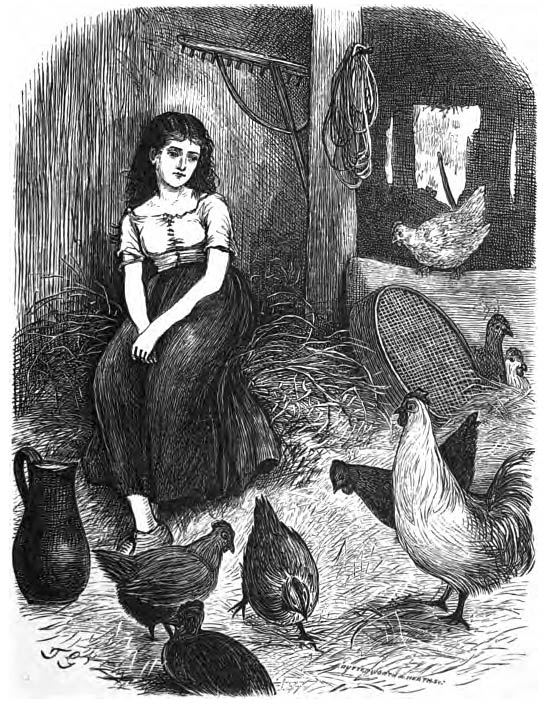
Klein-Else, the Hennenpfösl.—Page 166.
At last Sunday came, and the glad church bells rang merrily, flinging their joyous notes all abroad; and the servants of the castle put on their best clothes to go to church. But how could Klein-Else be seen among them, all in their snow-white linen and bright-coloured ribbons—Klein-Else, the Hennenpfösl, with her poor rags?
“Now, at last, I can use my treasury,” she said to herself; “I can at least get some of the pretty clothes that hang there, and go to church.” So she washed herself in the mountain-torrent, and braided her dishevelled hair in massive golden braids, and crept round to the rock, and bid it open, saying,—
“Open, hoary rock!”
Of all the treasures it instantly disclosed, she saw none but one beautiful garment all woven out of sunbeams and glittering with jewels of morning dew. Having put this on, and once more looking like a baron’s daughter, she made haste to reach the church.
The holy office had already begun, and the church was crowded right out into the porch. But when the people saw such a dazzling sight, they all made way for the lady in the shining apparel, none dreaming of Klein-Else. Now the only part of the church where there was any room was at the baron’s bench. For he was a young lord, and had neither mother, sister, nor wife; and all the places reserved for his family were vacant. Klein-Else, moving on till she could find where to kneel, had thus to come and kneel by him.
The young baron was as much dazzled at the sight as Klein-Else herself had been at the treasures in the rock, and at every pause in the service he could do nothing but fix his gaze on her. As soon as it was over, however, Klein-Else glided out softly, and hasting back to the rock, hung the sunbeam-dress up again; and once more assuming her rags, hid herself in the poultry-loft, almost frightened at what she had done.
All the next week she had new subjects of thought. She felt sure the young baron had looked at her and admired her; and wasn’t it more meet that she, a baron’s daughter, should be kneeling by the side of the young baron than sleeping in the poultry-loft, a mere Hennenpfösl? Ah, if that came true—if the young baron married her; then she would have some one to tell her good fortune to—some one to defend her treasure. Then she could make the good use of it the knight had manifestly intended. She could wipe away the tears of all those who went without shelter, as she had once; every desolate orphan who had none to defend her; every poor Hennenpfösl, the drudge of the menials. “How strange,” she said to herself, “there should be people blessed with friends, and riches, and enjoyments, who live full of their own happiness, and who have no thought for the forsaken and the outcast! She would never be like them, not she! her happiness should be in making others happy.”
But, in the meantime, was she sure the baron had looked at her otherwise than out of curiosity? Was he really interested in her? and if he was, would he continue to care for her when he found she was only a Hennenpfösl? She must put him to the test; and she sat and thought how to arrange this. This was subject enough for thought; and this week was at an end only too soon.
The next Sunday came; and when the church bells rang, Klein-Else ran to her rock, took out of her store this time a garment woven out of moonbeams, and having arranged her luxuriant hair in massive tresses, once more proceeded to the church. But with all the haste she had made, she could not arrive before the holy office had begun, and the church was once more full. The people fell back again, in awe of her shining garments, and made way for her to kneel beside the baron, who could scarcely suppress a gesture of delight at beholding her once again. Nor did his joy escape Klein-Else’s observation; and many a blushing glance they exchanged.
“What a noble cavalier!” thought Klein-Else; “and just such a one as my father always told me my husband should be.”
“What a lovely maiden!” mused the young baron; “where can she have sprung from? Is she of earth or heaven?”
All that last week, while Klein-Else was thinking of him, he had been thinking still more of her; and had ordered his waiting-men to surround her as she came out of church, and beg her to come to him at the castle. But Klein-Else had no idea of suffering herself to be so easy a prize; so she fled so fast the baron’s men could hardly approach her. And when at last she found they were gaining upon her, and that her fleet step availed her not, she threw down the pieces of money which she took the first night from the rock; and while they stopped to pick them up, pursued her way unperceived, and let the rock close on her till they had lost the trace. Then, assuming her poor rags once more, she returned silently to her poultry-loft.
Her thoughts had food enough now; but it was less with the poor orphans she was to console, than with the young baron, and how to test his love, that they were occupied.
Next Sunday she chose a garment blue like the sky, and all sparkling, as with living stars. She presented herself at the church, and found herself again placed beside the young baron. At the end of the service she went out quickly, as before, only this time he contrived, as she rose to leave, to seize her hand, and slip a gold ring on her finger. Nevertheless, Klein-Else slipped out through the midst of the congregation, and though the serving-men had had stringent orders to follow her, she had prudently provided herself with gold pieces enough to disperse the whole lot of them while she escaped.
The young baron sat alone in his castle, as he had sat this fortnight past, taking no notice of any one, but as if his whole soul was wrapt up in the fair apparition, and he was in despair, since her hiding-place could not be traced. He sat nursing his grief, and could neither be distracted from it, nor comforted. His friends sent for the most famous physicians of the country to attend him, but none of them could do any thing for his case; and daily he grew paler and gloomier, and none could help him. At last the Gräfin Jaufenstein, his aunt, came and insisted that some amusement must be found to divert him; but the young baron refused every proposal, till at last she begged him to give a great banquet, to which every one from far and near should be invited, every kind of game and every kind of costly diet should be afforded, and nothing spared to make it the most magnificent banquet ever given. To the great surprise and delight of all, he consented to this; but it was because it occurred to him that inviting the whole country, the chances were that the beautiful maiden of his choice, who yet hid herself so persistently from him, might once more mysteriously appear before him too: so he gave his aunt the Countess Jaufenstein free leave to give what orders she liked, and go to what expense she liked, only providing that she should have the invitations publicly published, so that there might be every chance of their reaching the ears of the mysterious maiden.
At last the day of the banquet came, and there was a running hither and thither in the baron’s castle, with the preparations, such as can be better imagined than described. The guests swarmed in the halls, and the servants in the kitchen; and Klein-Else, creeping up from her poultry-loft, could hardly make her way up to the fire where the cook was preparing all manner of deliciously scented dishes.
“I don’t know what ails the things!” cried the cook; “these pancakes are the only thing the baron will eat, and, as fate will have it, I cannot turn one of them to-night! Three and thirty years I have made pancakes in this castle, and never did I fail before to-night—to-night, when it is most important of all!” and she poured another into the pan. But as she did so, with a hand trembling with anxiety, the oil ran over the side of the pan, and the great heat of the stove set it on fire, so that a great flame curled over the pancake—and there was nothing left of it but a black, misshapen mass.
“Oh, dear! oh, dear! what shall I do?” cried the cook; “there is not one of the whole lot fit to send up, and if this dish is not the best, I had just as lief I had prepared no dish at all!”
“May I have a try, friend cook?” said Klein-Else, coaxingly.
“You, indeed!” screamed the cook, indignation and envy added to her former despair; “and a little, dirty, ragged, misbegotten starveling—a vagabond—a Hennenpfösl like you, who never saw a kitchen, or a stove, or a frying-pan, or any thing else! to suppose that you can turn a pancake, when I, who have turned pancakes in this castle for three and thirty years, have failed! A likely matter indeed! What is the world coming to? Begone, with your impudence, and mind your hens! Ah! now I think of it, I believe it is you that have bewitched the eggs, and that’s why the pancakes won’t turn! Begone, I say, out of my kitchen, and out of the poultry-house too—I’ll have no more of your tricks with my eggs!” and she turned, with a menacing gesture at Klein-Else, to try her luck once more.