Transcriber's Notes: (continued 5)
Lucy Crane translation
"There is the culprit in the tree!"
And the dog and the cat looking up caught sight of the wolf, who came down, quite ashamed of his timidity, and made peace with the dog once more.

Once on a time a king was hunting in a great wood, and he pursued a wild animal so eagerly that none of his people could follow him. When evening came he stood still, and looking round him he found that he had lost his way; and seeking a path, he found none. Then all at once he saw an old woman with a nodding head coming up to him; and it was a witch.
"My good woman," said he, "can you show me the way out of the wood?"
"Oh yes, my lord king," answered she, "certainly I can; but I must make a condition, and if you do not fulfil it, you will never get out of the wood again, but die there of hunger."
"What is the condition?" asked the king.
"I have a daughter," said the old woman, "who is as fair as any in the world, and if you will take her for your bride, and make her queen, I will show you the way out of the wood."
The king consented, because of the difficulty he was in, and the old woman led him into her little house, and there her daughter was sitting by the fire.
She received the king just as if she had been expecting him, and though he saw that she was very beautiful, she did not please him, and he could not look at her without an inward shudder. Nevertheless, he took the maiden before him on his horse, and the old woman showed him the way, and soon he was in his royal castle again, where the wedding was held.
The king had been married before, and his first wife had left seven children, six boys and one girl, whom he loved better than all the world, and as he was afraid the step-mother might not behave well to them, and perhaps would do them some mischief, he took them to a lonely castle standing in the middle of a wood. There they remained hidden, for the road to it was so hard to find that the king himself could not have found it, had it not been for a clew of yarn, possessing wonderful properties, that a wise woman had given him; when he threw it down before him, it unrolled itself and showed him the way. And the king went so often to see his dear children, that the queen was displeased at his absence; and she became curious and wanted to know what he went out into the wood for so often alone. She bribed his servants with much money, and they showed her the secret, and told her of the clew of yarn, which alone could point out the way; then she gave herself no rest until she had found out where the king kept the clew, and then she made some little white silk shirts, and sewed a charm in each, as she had learned witchcraft of her mother. And once when the king had ridden to the hunt, she took the little shirts and went into the wood, and the clew of yarn showed her the way. The children seeing some one in the distance, thought it was their dear father coming to see them, and came jumping for joy to meet him. Then the wicked queen threw over each one of the little shirts, and as soon as the shirts touched their bodies, they were changed into swans, and flew away through the wood. So the queen went home very pleased to think she had got rid of her step-children; but the maiden had not run out with her brothers, and so the queen knew nothing about her. The next day the king went to see his children, but he found nobody but his daughter.
"Where are thy brothers?" asked the king.
"Ah, dear father," answered she, "they are gone away and have left me behind," and then she told him how she had seen from her window her brothers in the guise of swans fly away through the wood, and she showed him the feathers which they had let fall in the courtyard, and which she had picked up. The king was grieved, but he never dreamt that it was the queen who had done this wicked deed, and as he feared lest the maiden also should be stolen away from him, he wished to take her away with him. But she was afraid of the step-mother, and begged the king to let her remain one more night in the castle in the wood.
Then she said to herself,
"I must stay here no longer, but go and seek for my brothers."
And when the night came, she fled away and went straight into the wood. She went on all that night and the next day, until she could go no longer for weariness. At last she saw a rude hut, and she went in and found a room with six little beds in it; she did not dare to lie down in one, but she crept under one and lay on the hard boards and wished for night. When it was near the time of sun-setting she heard a rustling sound, and saw six swans come flying in at the window. They alighted on the ground, and blew at one another until they had blown all their feathers off, and then they stripped off their swan-skin as if it had been a shirt. And the maiden looked at them and knew them for her brothers, and was very glad, and crept from under the bed. The brothers were not less glad when their sister appeared, but their joy did not last long.
"You must not stay here," said they to her; "this is a robbers' haunt, and if they were to come and find you here, they would kill you."
"And cannot you defend me?" asked the little sister.
"No," answered they, "for we can only get rid of our swan-skins and keep our human shape every evening for a quarter of an hour, but after that we must be changed again into swans."
Their sister wept at hearing this, and said,
"Can nothing be done to set you free?"
"Oh no," answered they, "the work would be too hard for you. For six whole years you would be obliged never to speak or laugh, and make during that time six little shirts out of aster-flowers. If you were to let fall a single word before the work was ended, all would be of no good."
And just as the brothers had finished telling her this, the quarter of an hour came to an end, and they changed into swans and flew out of the window.
But the maiden made up her mind to set her brothers free, even though it should cost her her life. She left the hut, and going into the middle of the wood, she climbed a tree, and there passed the night. The next morning she set to work and gathered asters and began sewing them together: as for speaking, there was no one to speak to, and as for laughing, she had no mind to it; so she sat on and looked at nothing but her work. When she had been going on like this for a long time, it happened that the king of that country went a-hunting in the wood, and some of his huntsmen came up to the tree in which the maiden sat. They called out to her, saying, "Who art thou?" But she gave no answer. "Come down," cried they; "we will do thee no harm." But she only shook her head. And when they tormented her further with questions she threw down to them her gold necklace, hoping they would be content with that. But they would not leave off, so she threw down to them her girdle, and when that was no good, her garters, and one after another everything she had on and could possibly spare, until she had nothing left but her smock. But all was no good, the huntsmen would not be put off any longer, and they climbed the tree, carried the maiden off, and brought her to the king. The king asked, "Who art thou? What wert thou doing in the tree?" But she answered nothing. He spoke to her in all the languages he knew, but she remained dumb: but, being very beautiful, the king inclined to her, and he felt a great love rise up in his heart towards her; and casting his mantle round her, he put her before him on his horse and brought her to his castle. Then he caused rich clothing to be put upon her, and her beauty shone as bright as the morning, but no word would she utter. He seated her by his side at table, and her modesty and gentle mien so pleased him, that he said,
"This maiden I choose for wife, and no other in all the world," and accordingly after a few days they were married.
But the king had a wicked mother, who was displeased with the marriage, and spoke ill of the young queen.
"Who knows where the maid can have come from?" said she, "and not able to speak a word! She is not worthy of a king!"
After a year had passed, and the queen brought her first child into the world, the old woman carried it away, and marked the queen's mouth with blood as she lay sleeping. Then she went to the king and declared that his wife was an eater of human flesh. The king would not believe such a thing, and ordered that no one should do her any harm. And the queen went on quietly sewing the shirts and caring for nothing else. The next time that a fine boy was born, the wicked step-mother used the same deceit, but the king would give no credence to her words, for he said,
"She is too tender and good to do any such thing, and if she were only not dumb, and could justify herself, then her innocence would be as clear as day."
When for the third time the old woman stole away the new-born child and accused the queen, who was unable to say a word in her defence, the king could do no other but give her up to justice, and she was sentenced to suffer death by fire.
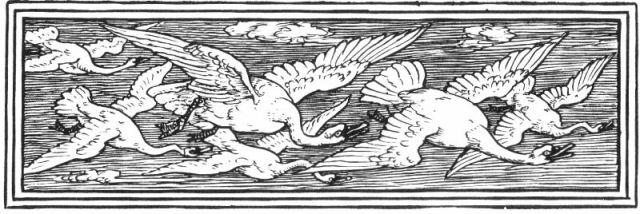
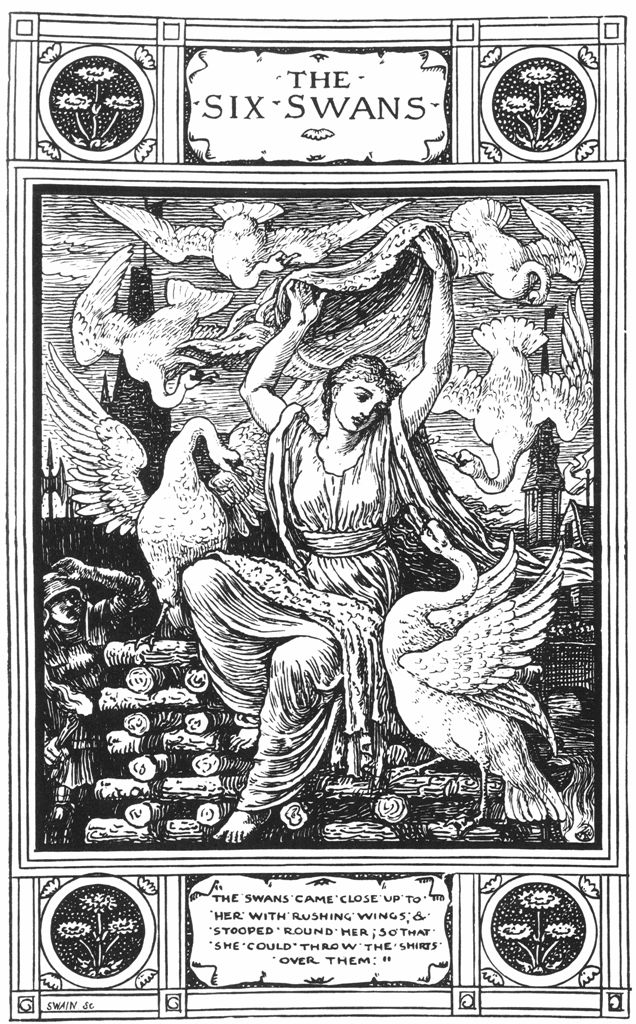
The day on which her sentence was to be carried out was the very last one of the sixth year of the years during which she had neither spoken nor laughed, to free her dear brothers from the evil spell. The six shirts were ready, all except one which wanted the left sleeve. And when she was led to the pile of wood, she carried the six shirts on her arm, and when she mounted the pile and the fire was about to be kindled, all at once she cried out aloud, for there were six swans coming flying through the air; and she saw that her deliverance was near, and her heart beat for joy. The swans came close up to her with rushing wings, and stooped round her, so that she could throw the shirts over them; and when that had been done the swan-skins fell off them, and her brothers stood before her in their own bodies quite safe and sound; but as one shirt wanted the left sleeve, so the youngest brother had a swan's wing instead of a left arm. They embraced and kissed each other, and the queen went up to the king, who looked on full of astonishment, and began to speak to him and to say,
"Dearest husband, now I may dare to speak and tell you that I am innocent, and have been falsely accused," and she related to him the treachery of the step-mother, who had taken away the three children and hidden them. And she was reconciled to the king with great joy, and the wicked step-mother was bound to the stake on the pile of wood and burnt to ashes.
And the king and queen lived many years with their six brothers in peace and joy.

In times past there lived a king and queen, who said to each other every day of their lives, "Would that we had a child!" and yet they had none. But it happened once that when the queen was bathing, there came a frog out of the water, and he squatted on the ground, and said to her,
"Thy wish shall be fulfilled; before a year has gone by, thou shalt bring a daughter into the world."
And as the frog foretold, so it happened; and the queen bore a daughter so beautiful that the king could not contain himself for joy, and he ordained a great feast. Not only did he bid to it his relations, friends, and acquaintances, but also the wise women, that they might be kind and favourable to the child. There were thirteen of them in his kingdom, but as he had only provided twelve golden plates for them to eat from, one of them had to be left out. However, the feast was celebrated with all splendour; and as it drew to an end, the wise women stood forward to present to the child their wonderful gifts: one bestowed virtue, one beauty, a third riches, and so on, whatever there is in the world to wish for. And when eleven of them had said their say, in came the uninvited thirteenth, burning to revenge herself, and without greeting or respect, she cried with a loud voice,
"In the fifteenth year of her age the princess shall prick herself with a spindle and shall fall down dead."
And without speaking one more word she turned away and left the hall. Every one was terrified at her saying, when the twelfth came forward, for she had not yet bestowed her gift, and though she could not do away with the evil prophecy, yet she could soften it, so she said,
"The princess shall not die, but fall into a deep sleep for a hundred years."
Now the king, being desirous of saving his child even from this misfortune, gave commandment that all the spindles in his kingdom should be burnt up.
The maiden grew up, adorned with all the gifts of the wise women; and she was so lovely, modest, sweet, and kind and clever, that no one who saw her could help loving her.
It happened one day, she being already fifteen years old, that the king and queen rode abroad, and the maiden was left behind alone in the castle. She wandered about into all the nooks and corners, and into all the chambers and parlours, as the fancy took her, till at last she came to an old tower. She climbed the narrow winding stair which led to a little door, with a rusty key sticking out of the lock; she turned the key, and the door opened, and there in the little room sat an old woman with a spindle, diligently spinning her flax.
"Good day, mother," said the princess, "what are you doing?"
"I am spinning," answered the old woman, nodding her head.
"What thing is that that twists round so briskly?" asked the maiden, and taking the spindle into her hand she began to spin; but no sooner had she touched it than the evil prophecy was fulfilled, and she pricked her finger with it. In that very moment she fell back upon the bed that stood there, and lay in a deep sleep. And this sleep fell upon the whole castle; the king and queen, who had returned and were in the great hall, fell fast asleep, and with them the whole court. The horses in their stalls, the dogs in the yard, the pigeons on the roof, the flies on the wall, the very fire that flickered on the hearth, became still, and slept like the rest; and the meat on the spit ceased roasting, and the cook, who was going to pull the scullion's hair for some mistake he had made, let him go, and went to sleep. And the wind ceased, and not a leaf fell from the trees about the castle.
Then round about that place there grew a hedge of thorns thicker every year, until at last the whole castle was hidden from view, and nothing of it could be seen but the vane on the roof. And a rumour went abroad in all that country of the beautiful sleeping Rosamond, for so was the princess called; and from time to time many kings' sons came and tried to force their way through the hedge; but it was impossible for them to do so, for the thorns held fast together like strong hands, and the young men were caught by them, and not being able to get free, there died a lamentable death.
Many a long year afterwards there came a king's son into that country, and heard an old man tell how there should be a castle standing behind the hedge of thorns, and that there a beautiful enchanted princess named Rosamond had slept for a hundred years, and with her the king and queen, and the whole court. The old man had been told by his grandfather that many king's sons had sought to pass the thorn-hedge, but had been caught and pierced by the thorns, and had died a miserable death. Then said the young man, "Nevertheless, I do not fear to try; I shall win through and see the lovely Rosamond." The good old man tried to dissuade him, but he would not listen to his words.
For now the hundred years were at an end, and the day had come when Rosamond should be awakened. When the prince drew near the hedge of thorns, it was changed into a hedge of beautiful large flowers, which parted and bent aside to let him pass, and then closed behind him in a thick hedge. When he reached the castle-yard, he saw the horses and brindled hunting-dogs lying asleep, and on the roof the pigeons were sitting with their heads under their wings. And when he came indoors, the flies on the wall were asleep, the cook in the kitchen had his hand uplifted to strike the scullion, and the kitchen-maid had the black fowl on her lap ready to pluck. Then he mounted higher, and saw in the hall the whole court lying asleep, and above them, on their thrones, slept the king and the queen. And still he went farther, and all was so quiet that he could hear his own breathing; and at last he came to the tower, and went up the winding stair, and opened the door of the little room where Rosamond lay. And when he saw her looking so lovely in her sleep, he could not turn away his eyes; and presently he stooped and kissed her, and she awaked, and opened her eyes, and looked very kindly on him. And she rose, and they went forth together, and the king and the queen and whole court waked up, and gazed on each other with great eyes of wonderment. And the horses in the yard got up and shook themselves, the hounds sprang up and wagged their tails, the pigeons on the roof drew their heads from under their wings, looked round, and flew into the field, the flies on the wall crept on a little farther, the kitchen fire leapt up and blazed, and cooked the meat, the joint on the spit began to roast, the cook gave the scullion such a box on the ear that he roared out, and the maid went on plucking the fowl.
Then the wedding of the Prince and Rosamond was held with all splendour, and they lived very happily together until their lives' end.

A king had a daughter who was beautiful beyond measure, but so proud and overbearing that none of her suitors were good enough for her; she not only refused one after the other, but made a laughing-stock of them. Once the king appointed a great feast, and bade all the marriageable men to it from far and near. And they were all put in rows, according to their rank and station; first came the kings, then the princes, the dukes, the earls, the barons, and lastly the noblemen. The princess was led in front of the rows, but she had a mocking epithet for each. One was too fat, "What a tub!" said she. Another too tall, "Long and lean is ill to be seen," said she. A third too short, "Fat and short, not fit to court," said she. A fourth was too pale, "A regular death's-head;" a fifth too red-faced, "A game-cock," she called him. The sixth was not well-made enough, "Green wood ill dried!" cried she. So every one had something against him, and she made especially merry over a good king who was very tall, and whose chin had grown a little peaked.
"Only look," cried she, laughing, "he has a chin like a thrush's beak."
And from that time they called him King Thrushbeard. But the old king, when he saw that his daughter mocked every one, and scorned all the assembled suitors, swore in his anger that she should have the first beggar that came to the door for a husband.
A few days afterwards came a travelling ballad-singer, and sang under the window in hopes of a small alms. When the king heard of it, he said that he must come in. And so the ballad-singer entered in his dirty tattered garments, and sang before the king and his daughter; when he had done, he asked for a small reward. But the king said,
"Thy song has so well pleased me, that I will give thee my daughter to wife."
The princess was horrified; but the king said,
"I took an oath to give you to the first beggar that came, and so it must be done."
There was no remedy. The priest was fetched, and she had to be married to the ballad-singer out of hand. When all was done, the king said,
"Now, as you are a beggar-wife, you can stay no longer in my castle, so off with you and your husband."
The beggar-man led her away, and she was obliged to go forth with him on foot. On the way they came to a great wood, and she asked,
"Oh, whose is this forest, so thick and so fine?"
He answered,
"It is King Thrushbeard's, and might have been thine."
And she cried,
"Oh, I was a silly young thing, I'm afeared, Would I had taken that good King Thrushbeard!"
Then they passed through a meadow, and she asked,
"Oh, whose is this meadow, so green and so fine?"
He answered,
"It is King Thrushbeard's, and might have been thine."
And she cried,
"I was a silly young thing, I'm afeared, Would I had taken that good King Thrushbeard!"
Then they passed through a great town, and she asked,
"Whose is this city, so great and so fine?"
He answered,
"Oh, it is King Thrushbeard's, and might have been thine."
And she cried,
"I was a silly young thing, I'm afeared, Would I had taken that good King Thrushbeard!"
Then said the beggar-man,
"It does not please me to hear you always wishing for another husband; am I not good enough for you?"
At last they came to a very small house, and she said,
"Oh dear me! what poor little house do I see? And whose, I would know, may the wretched hole be?"
The man answered,
"That is my house and thine, where we must live together."
She had to stoop before she could go in at the door.
"Where are the servants?" asked the king's daughter.
"What servants?" answered the beggar-man, "what you want to have done you must do yourself. Make a fire quick, and put on water, and cook me some food; I am very tired."
But the king's daughter understood nothing about fire-making and cooking, and the beggar-man had to lend a hand himself in order to manage it at all. And when they had eaten their poor fare, they went to bed; but the man called up his wife very early in the morning, in order to clean the house. For a few days they lived in this indifferent manner, until they came to the end of their store.
"Wife," said the man, "this will not do, stopping here and earning nothing; you must make baskets."
So he went out and cut willows, and brought them home; and she began to weave them, but the hard twigs wounded her tender hands.
"I see this will not do," said the man, "you had better try spinning."
So she sat her down and tried to spin, but the harsh thread cut her soft fingers, so that the blood flowed.
"Look now!" said the man, "you are no good at any sort of work; I made a bad bargain when I took you. I must see what I can do to make a trade of pots and earthen vessels; you can sit in the market and offer them for sale."
"Oh dear!" thought she, "suppose while I am selling in the market people belonging to my father's kingdom should see me, how they would mock at me!"
But there was no help for it; she had to submit, or else die of hunger.
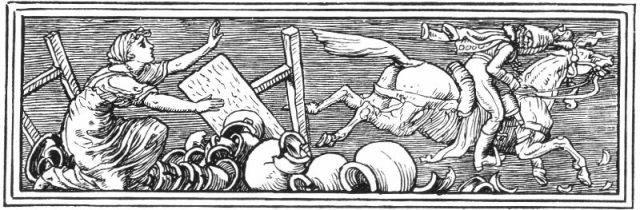
The first day all went well; the people bought her wares eagerly, because she was so beautiful, and gave her whatever she asked, and some of them gave her the money and left the pots after all behind them. And they lived on these earnings as long as they lasted; and then the man bought a number of new pots. So she seated herself in a corner of the market, and stood the wares before her for sale. All at once a drunken horse-soldier came plunging by, and rode straight into the midst of her pots, breaking them into a thousand pieces. She could do nothing for weeping.
"Oh dear, what will become of me," cried she; "what will my husband say?" and she hastened home and told him her misfortune.
"Who ever heard of such a thing as sitting in the corner of the market with earthenware pots!" said the man; "now leave off crying; I see you are not fit for any regular work. I have been asking at your father's castle if they want a kitchen-maid, and they say they don't mind taking you; at any rate you will get your victuals free."
And the king's daughter became a kitchen-maid, to be at the cook's beck and call, and to do the hardest work. In each of her pockets she fastened a little pot, and brought home in them whatever was left, and upon that she and her husband were fed. It happened one day, when the wedding of the eldest prince was celebrated, the poor woman went upstairs, and stood by the parlour door to see what was going on. And when the place was lighted up, and the company arrived, each person handsomer than the one before, and all was brilliancy and splendour, she thought on her own fate with a sad heart, and bewailed her former pride and haughtiness which had brought her so low, and plunged her in so great poverty. And as the rich and delicate dishes smelling so good were carried to and fro every now and then, the servants would throw her a few fragments, which she put in her pockets, intending to take home. And then the prince himself passed in clothed in silk and velvet, with a gold chain round his neck. And when he saw the beautiful woman standing in the doorway, he seized her hand and urged her to dance with him, but she refused, all trembling, for she saw it was King Thrushbeard, who had come to court her, whom she had turned away with mocking. It was of no use her resisting, he drew her into the room; and all at once the band to which her pockets were fastened broke, and the pots fell out, and the soup ran about, and the fragments were scattered all round. And when the people saw that, there was great laughter and mocking, and she felt so ashamed, that she wished herself a thousand fathoms underground. She rushed to the door to fly from the place, when a man caught her just on the steps, and when she looked at him, it was King Thrushbeard again. He said to her in a kind tone,
"Do not be afraid, I and the beggar-man with whom you lived in the wretched little hut are one. For love of you I disguised myself, and it was I who broke your pots in the guise of a horse-soldier. I did all that to bring down your proud heart, and to punish your haughtiness, which caused you to mock at me." Then she wept bitterly, and said,
"I have done great wrong, and am not worthy to be your wife."
But he said,
"Take courage, the evil days are gone over; now let us keep our wedding-day."
Then came the ladies-in-waiting and put on her splendid clothing; and her father came, and the whole court, and wished her joy on her marriage with King Thrushbeard; and then the merry-making began in good earnest. I cannot help wishing that you and I could have been there too.

It was the middle of winter, and the snow-flakes were falling like feathers from the sky, and a queen sat at her window working, and her embroidery-frame was of ebony. And as she worked, gazing at times out on the snow, she pricked her finger, and there fell from it three drops of blood on the snow. And when she saw how bright and red it looked, she said to herself, "Oh that I had a child as white as snow, as red as blood, and as black as the wood of the embroidery frame!"
Not very long after she had a daughter, with a skin as white as snow, lips as red as blood, and hair as black as ebony, and she was named Snow-white. And when she was born the queen died.
After a year had gone by the king took another wife, a beautiful woman, but proud and overbearing, and she could not bear to be surpassed in beauty by any one. She had a magic looking-glass, and she used to stand before it, and look in it, and say,
"Looking-glass upon the wall, Who is fairest of us all?"
And the looking-glass would answer,
"You are fairest of them all."
And she was contented, for she knew that the looking-glass spoke the truth.
Now, Snow-white was growing prettier and prettier, and when she was seven years old she was as beautiful as day, far more so than the queen herself. So one day when the queen went to her mirror and said,
"Looking-glass upon the wall, Who is fairest of us all?"
It answered,
"Queen, you are full fair, 'tis true, But Snow-white fairer is than you."
This gave the queen a great shock, and she became yellow and green with envy, and from that hour her heart turned against Snow-white, and she hated her. And envy and pride like ill weeds grew in her heart higher every day, until she had no peace day or night. At last she sent for a huntsman, and said,
"Take the child out into the woods, so that I may set eyes on her no more. You must put her to death, and bring me her heart for a token."
The huntsman consented, and led her away; but when he drew his cutlass to pierce Snow-white's innocent heart, she began to weep, and to say,
"Oh, dear huntsman, do not take my life; I will go away into the wild wood, and never come home again."
And as she was so lovely the huntsman had pity on her, and said,
"Away with you then, poor child;" for he thought the wild animals would be sure to devour her, and it was as if a stone had been rolled away from his heart when he spared to put her to death. Just at that moment a young wild boar came running by, so he caught and killed it, and taking out its heart, he brought it to the queen for a token. And it was salted and cooked, and the wicked woman ate it up, thinking that there was an end of Snow-white.
Now, when the poor child found herself quite alone in the wild woods, she felt full of terror, even of the very leaves on the trees, and she did not know what to do for fright. Then she began to run over the sharp stones and through the thorn bushes, and the wild beasts after her, but they did her no harm. She ran as long as her feet would carry her; and when the evening drew near she came to a little house, and she went inside to rest. Everything there was very small, but as pretty and clean as possible. There stood the little table ready laid, and covered with a white cloth, and seven little plates, and seven knives and forks, and drinking-cups. By the wall stood seven little beds, side by side, covered with clean white quilts. Snow-white, being very hungry and thirsty, ate from each plate a little porridge and bread, and drank out of each little cup a drop of wine, so as not to finish up one portion alone. After that she felt so tired that she lay down on one of the beds, but it did not seem to suit her; one was too long, another too short, but at last the seventh was quite right; and so she lay down upon it, committed herself to heaven, and fell asleep.
When it was quite dark, the masters of the house came home. They were seven dwarfs, whose occupation was to dig underground among the mountains. When they had lighted their seven candles, and it was quite light in the little house, they saw that some one must have been in, as everything was not in the same order in which they left it. The first said,
"Who has been sitting in my little chair?"
The second said,
"Who has been eating from my little plate?"
The third said,
"Who has been taking my little loaf?"
The fourth said,
"Who has been tasting my porridge?"
The fifth said,
"Who has been using my little fork?"
The sixth said,
"Who has been cutting with my little knife?"
The seventh said,
"Who has been drinking from my little cup?"
Then the first one, looking round, saw a hollow in his bed, and cried,
"Who has been lying on my bed?"
And the others came running, and cried,
"Some one has been on our beds too!"
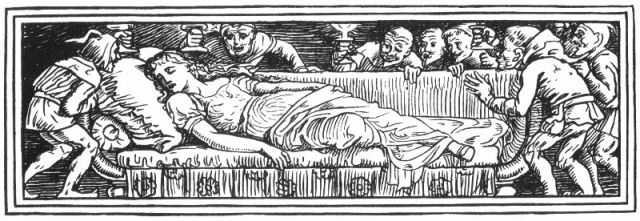
But when the seventh looked at his bed, he saw little Snow-white lying there asleep. Then he told the others, who came running up, crying out in their astonishment, and holding up their seven little candles to throw a light upon Snow-white.
"O goodness! O gracious!" cried they, "what beautiful child is this?" and were so full of joy to see her that they did not wake her, but let her sleep on. And the seventh dwarf slept with his comrades, an hour at a time with each, until the night had passed.
When it was morning, and Snow-white awoke and saw the seven dwarfs, she was very frightened; but they seemed quite friendly, and asked her what her name was, and she told them; and then they asked how she came to be in their house. And she related to them how her step-mother had wished her to be put to death, and how the huntsman had spared her life, and how she had run the whole day long, until at last she had found their little house. Then the dwarfs said,
"If you will keep our house for us, and cook, and wash, and make the beds, and sew and knit, and keep everything tidy and clean, you may stay with us, and you shall lack nothing."
"With all my heart," said Snow-white; and so she stayed, and kept the house in good order. In the morning the dwarfs went to the mountain to dig for gold; in the evening they came home, and their supper had to be ready for them. All the day long the maiden was left alone, and the good little dwarfs warned her, saying,
"Beware of your step-mother, she will soon know you are here. Let no one into the house."
Now the queen, having eaten Snow-white's heart, as she supposed, felt quite sure that now she was the first and fairest, and so she came to her mirror, and said,
"Looking-glass upon the wall, Who is fairest of us all?"
And the glass answered,
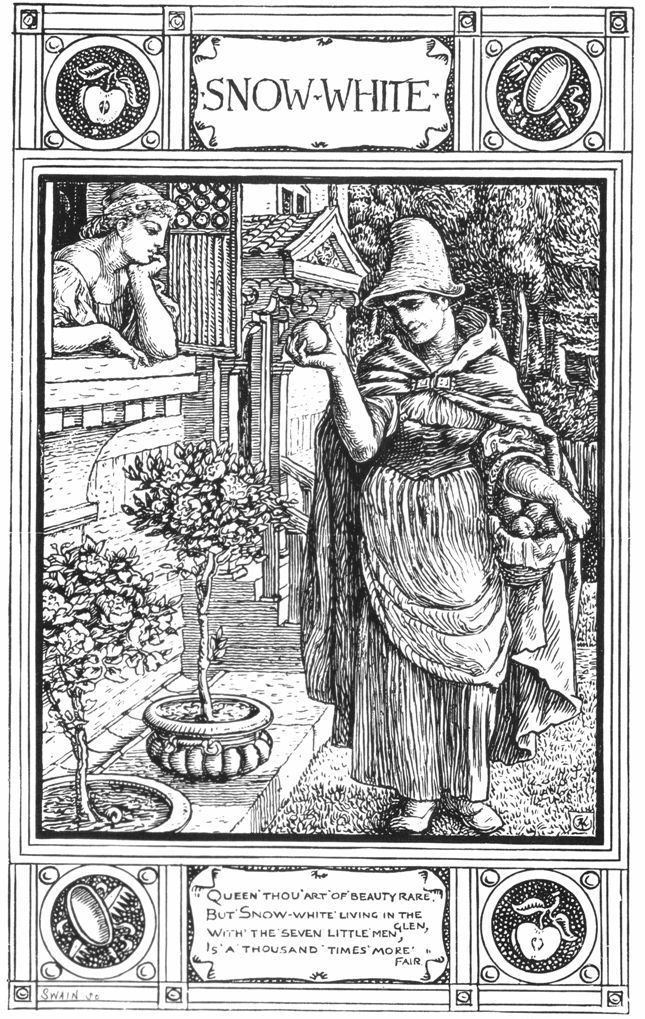
"Queen, thou art of beauty rare, But Snow-white living in the glen With the seven little men Is a thousand times more fair."
Then she was very angry, for the glass always spoke the truth, and she knew that the huntsman must have deceived her, and that Snow-white must still be living. And she thought and thought how she could manage to make an end of her, for as long as she was not the fairest in the land, envy left her no rest. At last she thought of a plan; she painted her face and dressed herself like an old pedlar woman, so that no one would have known her. In this disguise she went across the seven mountains, until she came to the house of the seven little dwarfs, and she knocked at the door and cried,
"Fine wares to sell! fine wares to sell!"
Snow-white peeped out of the window and cried,
"Good-day, good woman, what have you to sell?"
"Good wares, fine wares," answered she, "laces of all colours;" and she held up a piece that was woven of variegated silk.
"I need not be afraid of letting in this good woman," thought Snow-white, and she unbarred the door and bought the pretty lace.
"What a figure you are, child!" said the old woman, "come and let me lace you properly for once."
Snow-white, suspecting nothing, stood up before her, and let her lace her with the new lace; but the old woman laced so quick and tight that it took Snow-white's breath away, and she fell down as dead.
"Now you have done with being the fairest," said the old woman as she hastened away.
Not long after that, towards evening, the seven dwarfs came home, and were terrified to see their dear Snow-white lying on the ground, without life or motion; they raised her up, and when they saw how tightly she was laced they cut the lace in two; then she began to draw breath, and little by little she returned to life. When the dwarfs heard what had happened they said,
"The old pedlar woman was no other than the wicked queen; you must beware of letting any one in when we are not here!"
And when the wicked woman got home she went to her glass and said,
"Looking-glass against the wall, Who is fairest of us all?"
And it answered as before,
"Queen, thou art of beauty rare, But Snow-white living in the glen With the seven little men Is a thousand times more fair."
When she heard that she was so struck with surprise that all the blood left her heart, for she knew that Snow-white must still be living.
"But now," said she, "I will think of something that will be her ruin." And by witchcraft she made a poisoned comb. Then she dressed herself up to look like another different sort of old woman. So she went across the seven mountains and came to the house of the seven dwarfs, and knocked at the door and cried,
"Good wares to sell! good wares to sell!"
Snow-white looked out and said,
"Go away, I must not let anybody in."
"But you are not forbidden to look," said the old woman, taking out the poisoned comb and holding it up. It pleased the poor child so much that she was tempted to open the door; and when the bargain was made the old woman said,
"Now, for once your hair shall be properly combed."
Poor Snow-white, thinking no harm, let the old woman do as she would, but no sooner was the comb put in her hair than the poison began to work, and the poor girl fell down senseless.
"Now, you paragon of beauty," said the wicked woman, "this is the end of you," and went off. By good luck it was now near evening, and the seven little dwarfs came home. When they saw Snow-white lying on the ground as dead, they thought directly that it was the step-mother's doing, and looked about, found the poisoned comb, and no sooner had they drawn it out of her hair than Snow-white came to herself, and related all that had passed. Then they warned her once more to be on her guard, and never again to let any one in at the door.
And the queen went home and stood before the looking-glass and said,
"Looking-glass against the wall, Who is fairest of us all?"
And the looking-glass answered as before,
"Queen, thou art of beauty rare, But Snow-white living in the glen With the seven little men Is a thousand times more fair."
When she heard the looking-glass speak thus she trembled and shook with anger.
"Snow-white shall die," cried she, "though it should cost me my own life!" And then she went to a secret lonely chamber, where no one was likely to come, and there she made a poisonous apple. It was beautiful to look upon, being white with red cheeks, so that any one who should see it must long for it, but whoever ate even a little bit of it must die. When the apple was ready she painted her face and clothed herself like a peasant woman, and went across the seven mountains to where the seven dwarfs lived. And when she knocked at the door Snow-white put her head out of the window and said,
"I dare not let anybody in; the seven dwarfs told me not."
"All right," answered the woman; "I can easily get rid of my apples elsewhere. There, I will give you one."
"No," answered Snow-white, "I dare not take anything."
"Are you afraid of poison?" said the woman, "look here, I will cut the apple in two pieces; you shall have the red side, I will have the white one."
For the apple was so cunningly made, that all the poison was in the rosy half of it. Snow-white longed for the beautiful apple, and as she saw the peasant woman eating a piece of it she could no longer refrain, but stretched out her hand and took the poisoned half. But no sooner had she taken a morsel of it into her mouth than she fell to the earth as dead. And the queen, casting on her a terrible glance, laughed aloud and cried,
"As white as snow, as red as blood, as black as ebony! this time the dwarfs will not be able to bring you to life again."
And when she went home and asked the looking-glass,
"Looking-glass against the wall, Who is fairest of us all?"
at last it answered,
"You are the fairest now of all."
Then her envious heart had peace, as much as an envious heart can have.
The dwarfs, when they came home in the evening, found Snow-white lying on the ground, and there came no breath out of her mouth, and she was dead. They lifted her up, sought if anything poisonous was to be found, cut her laces, combed her hair, washed her with water and wine, but all was of no avail, the poor child was dead, and remained dead. Then they laid her on a bier, and sat all seven of them round it, and wept and lamented three whole days. And then they would have buried her, but that she looked still as if she were living, with her beautiful blooming cheeks. So they said,
"We cannot hide her away in the black ground." And they had made a coffin of clear glass, so as to be looked into from all sides, and they laid her in it, and wrote in golden letters upon it her name, and that she was a king's daughter. Then they set the coffin out upon the mountain, and one of them always remained by it to watch. And the birds came too, and mourned for Snow-white, first an owl, then a raven, and lastly, a dove.
Now, for a long while Snow-white lay in the coffin and never changed, but looked as if she were asleep, for she was still as white as snow, as red as blood, and her hair was as black as ebony. It happened, however, that one day a king's son rode through the wood and up to the dwarfs' house, which was near it. He saw on the mountain the coffin, and beautiful Snow-white within it, and he read what was written in golden letters upon it. Then he said to the dwarfs,
"Let me have the coffin, and I will give you whatever you like to ask for it."
But the dwarfs told him that they could not part with it for all the gold in the world. But he said,
"I beseech you to give it me, for I cannot live without looking upon Snow-white; if you consent I will bring you to great honour, and care for you as if you were my brethren."
When he so spoke the good little dwarfs had pity upon him and gave him the coffin, and the king's son called his servants and bid them carry it away on their shoulders. Now it happened that as they were going along they stumbled over a bush, and with the shaking the bit of poisoned apple flew out of her throat. It was not long before she opened her eyes, threw up the cover of the coffin, and sat up, alive and well.
"Oh dear! where am I?" cried she. The king's son answered, full of joy, "You are near me," and, relating all that had happened, he said,
"I would rather have you than anything in the world; come with me to my father's castle and you shall be my bride."
And Snow-white was kind, and went with him, and their wedding was held with pomp and great splendour.
But Snow-white's wicked step-mother was also bidden to the feast, and when she had dressed herself in beautiful clothes she went to her looking-glass and said,
"Looking-glass upon the wall, Who is fairest of us all?"
The looking-glass answered,
"O Queen, although you are of beauty rare, The young bride is a thousand times more fair."
Then she railed and cursed, and was beside herself with disappointment and anger. First she thought she would not go to the wedding; but then she felt she should have no peace until she went and saw the bride. And when she saw her she knew her for Snow-white, and could not stir from the place for anger and terror. For they had ready red-hot iron shoes, in which she had to dance until she fell down dead.

Once there were three brothers, and they grew poorer and poorer, until at last their need was so great that they had nothing left to bite or to break. Then they said, "This will not do; we had better go out into the world and seek our fortune."
So they set out, and went some distance through many green fields, but they met with no good fortune. One day they came to a great wood, in the midst of which was a hill, and when they came near to it, they saw that it was all of silver. Then said the eldest,
"Now here is good fortune enough for me, and I desire no better."
And he took of the silver as much as he could carry, turned round, and went back home. But the other two said,
"We must have something better than mere silver," and they would not touch it, but went on farther. After they had gone on a few days longer, they came to a hill that was all of gold. The second brother stood still and considered, and was uncertain.
"What shall I do?" said he; "shall I take of the gold enough to last me my life, or shall I go farther?"
At last, coming to a conclusion, he filled his pockets as full as they would hold, bid good-bye to his brother, and went home. But the third brother said to himself,
"Silver and gold do not tempt me; I will not gainsay fortune, who has better things in store for me."
So he went on, and when he had journeyed for three days, he came to a wood still greater than the former ones, so that there was no end to it; and in it he found nothing to eat or to drink, so that he was nearly starving. He got up into a high tree, so as to see how far the wood reached, but as far as his eyes could see, there was nothing but the tops of the trees. And as he got down from the tree, hunger pressed him sore, and he thought,
"Oh that for once I could have a good meal!"
And when he reached the ground he saw to his surprise a table beneath the tree richly spread with food, and that smoked before him.
"This time at least," said he, "I have my wish," and without stopping to ask who had brought the meal there, and who had cooked it, he came close to the table and ate with relish, until his hunger was appeased. When he had finished, he thought,
"It would be a pity to leave such a good table-cloth behind in the wood," so he folded it up neatly and pocketed it. Then he walked on, and in the evening, when hunger again seized him, he thought he would put the table-cloth to the proof, and he brought it out and said,
"Now I desire that thou shouldst be spread with a good meal," and no sooner were the words out of his mouth, than there stood on it as many dishes of delicious food as there was room for.
"Now that I see," said he, "what sort of a cook thou art, I hold thee dearer than the mountains of silver and of gold," for he perceived that it was a wishing-cloth. Still he was not satisfied to settle down at home with only a wishing-cloth, so he determined to wander farther through the world and seek his fortune. One evening, in a lonely wood, he came upon a begrimed charcoal-burner at his furnace, who had put some potatoes to roast for his supper.
"Good evening, my black fellow," said he, "how do you get on in this lonely spot?"
"One day is like another," answered the charcoal-burner: "every evening I have potatoes; have you a mind to be my guest?"
"Many thanks," answered the traveller, "I will not deprive you; you did not expect a guest; but if you do not object, you shall be the one to be invited."
"How can that be managed?" said the charcoal-burner; "I see that you have nothing with you, and if you were to walk two hours in any direction, you would meet with no one to give you anything."
"For all that," answered he, "there shall be a feast so good, that you have never tasted the like."
Then he took out the table-cloth from his knapsack, and spreading it on the ground, said,
"Cloth, be covered," and immediately there appeared boiled and roast meat, quite hot, as if it had just come from the kitchen. The charcoal-burner stared, but did not stay to be asked twice, and fell to, filling his black mouth with ever bigger and bigger pieces. When they had finished eating, the charcoal-burner smiled, and said,
"Look here, I approve of your table-cloth; it would not be a bad thing for me to have here in the wood, where the cooking is not first-rate. I will strike a bargain with you. There hangs a soldier's knapsack in the corner, which looks old and unsightly, but it has wonderful qualities; as I have no further occasion for it, I will give it to you in exchange for the table-cloth."
"First, I must know what these wonderful qualities are," returned the other.
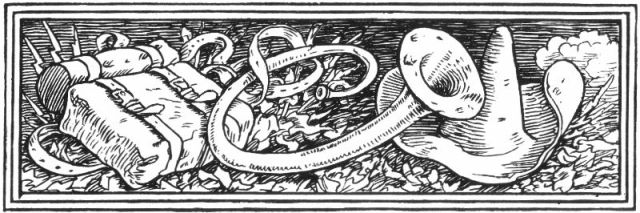
"I will tell you," answered the charcoal-burner; "if you strike it with your hand, there will appear a corporal and six men with swords and muskets, and whatever you wish to have done, that will they do."
"Well, for my part," said the other, "I am quite willing to make the exchange." And he gave the table-cloth to the charcoal-burner, took down the knapsack from its hook, slung it over his shoulder, and took his leave. Before he had gone far he began to want to make a trial of his wonderful knapsack, so he struck it a blow. At once seven soldiers appeared before him, and the corporal said,
"What does my lord and master please to want?"
"March in haste to the charcoal-burner and demand my wishing-cloth back," said the man. They wheeled round to the left, and were not long before they had accomplished his desire, and taken away, without wasting many words, the wishing-cloth from the charcoal-burner. Having dismissed them, he wandered on, expecting still more wonderful luck. About sunset he fell in with another charcoal-burner, who was getting his supper ready at the fire.
"Will you join me?" said this black fellow; "potatoes and salt, without butter; sit down to it with me."
"No," answered he, "this time you shall be my guest." And he spread out his table-cloth, and it was directly covered with the most delicious victuals. So they ate and drank together and were merry. After the meal was over the charcoal-burner said,
"Over there, on the bench, lies an old worn-out hat, which has wonderful properties: if you put it on and draw it well over your head it is as if a dozen field-pieces went off, one after the other, shooting everything down, so that no one can stand against them. This hat is of no use to me, and I will give it to you in exchange for the table-cloth."
"All right," answered the other, taking the hat and carrying it off, and leaving the table-cloth behind him. Before he had gone far he struck upon the knapsack, and summoned his soldiers to fetch back the table-cloth again.
"First one thing, and then another," thought he, "just as if my luck were never to end." And so it seemed, for at the end of another day's journey he came up to another charcoal-burner, who was roasting his potatoes just like the others. He invited him to eat with him off his wishing-cloth, to which the charcoal-burner took such a fancy, that he gave him for it a horn, which had different properties still from the hat. If a man blew on it down fell all walls and fortresses, and finally towns and villages in heaps. So the man gave the table-cloth in exchange for it to the charcoal-burner, afterwards sending his men to fetch it back, so that at last he had in his possession knapsack, hat, and horn, all at one time.
"Now," said he, "I am a made man, and it is time to go home again and see how my brothers are faring."
When he reached home he found that his brothers had built themselves a fine house with their silver and gold, and lived in clover. He went to see them, but because he wore a half-worn-out coat, a shabby hat, and the old knapsack on his back, they would not recognise him as their brother. They mocked him and said,
"It is of no use your giving yourself out to be our brother; he who scorned silver and gold, seeking for better fortune, will return in great splendour, as a mighty king, not as a beggar-man." And they drove him from their door. Then he flew into a great rage, and struck upon his knapsack until a hundred and fifty men stood before him, rank and file. He ordered them to surround his brothers' house, and that two of them should take hazel-rods, and should beat the brothers until they knew who he was. And there arose a terrible noise; the people ran together and wished to rescue the brothers in their extremity, but they could do nothing against the soldiers. It happened at last that the king of the country heard of it, and he was indignant, and sent a captain with his troops to drive the disturber of the peace out of the town: but the man with his knapsack soon assembled a greater company, who beat back the captain and his people, sending them off with bleeding noses. Then the king said,
"This vagabond fellow must be put down," and he sent the next day a larger company against him, but they could do nothing: for he assembled more men than ever, and in order to bring them more quickly, he pulled his hat twice lower over his brows; then the heavy guns came into play, and the king's people were beaten and put to flight.
"Now," said he, "I shall not make peace until the king gives me his daughter to wife, and lets me rule the whole kingdom in his name."
This he caused to be told to the king, who said to his daughter,
"This is a hard nut to crack; there is no choice but for me to do as he asks; if I wish to have peace and keep the crown on my head, I must give in to him."
So the wedding took place, but the king's daughter was angry that the bridegroom should be a common man, who wore a shabby hat, and carried an old knapsack. She wished very much to get rid of him, and thought day and night how to manage it. Then it struck her that perhaps all his wonder-working power lay in the knapsack, and she pretended to be very fond of him, and when she had brought him into a good humour she said,—"Pray lay aside that ugly knapsack; it misbecomes you so much that I feel ashamed of you."
"My dear child," answered he, "this knapsack is my greatest treasure; so long as I keep it I need not fear anything in the whole world," and then he showed her with what wonderful qualities it was endowed. Then she fell on his neck as if she would have kissed him, but, by a clever trick, she slipped the knapsack over his shoulder and ran away with it. As soon as she was alone she struck upon it and summoned the soldiers, and bade them seize her husband and bring him to the king's palace. They obeyed, and the false woman had many more to follow behind, so as to be ready to drive him out of the country. He would have been quite done for if he had not still kept the hat. As soon as he could get his hands free he pulled it twice forward on his head; and then the cannon began to thunder and beat all down, till at last the king's daughter had to come and to beg pardon. And as she so movingly prayed and promised to behave better, he raised her up and made peace with her. Then she grew very kind to him, and seemed to love him very much, and he grew so deluded, that one day he confided to her that even if he were deprived of his knapsack nothing could be done against him as long as he should keep the old hat. And when she knew the secret she waited until he had gone to sleep; then she carried off the hat, and had him driven out into the streets. Still the horn remained to him, and in great wrath he blew a great blast upon it, and down came walls and fortresses, towns and villages, and buried the king and his daughter among their ruins. If he had not set down the horn when he did, and if he had blown a little longer, all the houses would have tumbled down, and there would not have been left one stone upon another. After this no one dared to withstand him, and he made himself king over the whole country.

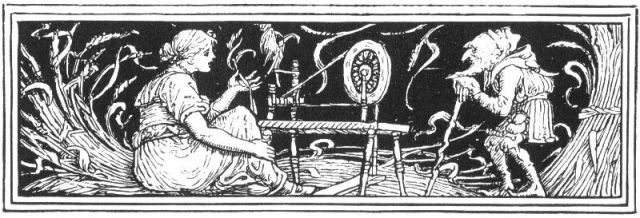

There was once a miller who was poor, but he had one beautiful daughter. It happened one day that he came to speak with the king, and, to give himself consequence, he told him that he had a daughter who could spin gold out of straw. The king said to the miller,
"That is an art that pleases me well; if thy daughter is as clever as you say, bring her to my castle to-morrow, that I may put her to the proof."
When the girl was brought to him, he led her into a room that was quite full of straw, and gave her a wheel and spindle, and said,
"Now set to work, and if by the early morning thou hast not spun this straw to gold thou shalt die." And he shut the door himself, and left her there alone.
And so the poor miller's daughter was left there sitting, and could not think what to do for her life; she had no notion how to set to work to spin gold from straw, and her distress grew so great that she began to weep. Then all at once the door opened, and in came a little man, who said,
"Good evening, miller's daughter; why are you crying?"
"Oh!" answered the girl, "I have got to spin gold out of straw, and I don't understand the business."
Then the little man said,
"What will you give me if I spin it for you?"
"My necklace," said the girl.
The little man took the necklace, seated himself before the wheel, and whirr, whirr, whirr! three times round and the bobbin was full; then he took up another, and whirr, whirr, whirr! three times round, and that was full; and so he went on till the morning, when all the straw had been spun, and all the bobbins were full of gold. At sunrise came the king, and when he saw the gold he was astonished and very much rejoiced, for he was very avaricious. He had the miller's daughter taken into another room filled with straw, much bigger than the last, and told her that as she valued her life she must spin it all in one night. The girl did not know what to do, so she began to cry, and then the door opened, and the little man appeared and said,
"What will you give me if I spin all this straw into gold?"
"The ring from my finger," answered the girl.
So the little man took the ring, and began again to send the wheel whirring round, and by the next morning all the straw was spun into glistening gold. The king was rejoiced beyond measure at the sight, but as he could never have enough of gold, he had the miller's daughter taken into a still larger room full of straw, and said,
"This, too, must be spun in one night, and if you accomplish it you shall be my wife." For he thought, "Although she is but a miller's daughter, I am not likely to find any one richer in the whole world."
As soon as the girl was left alone, the little man appeared for the third time and said,
"What will you give me if I spin the straw for you this time?"
"I have nothing left to give," answered the girl.
"Then you must promise me the first child you have after you are queen," said the little man.
"But who knows whether that will happen?" thought the girl; but as she did not know what else to do in her necessity, she promised the little man what he desired, upon which he began to spin, until all the straw was gold. And when in the morning the king came and found all done according to his wish, he caused the wedding to be held at once, and the miller's pretty daughter became a queen.
In a year's time she brought a fine child into the world, and thought no more of the little man; but one day he came suddenly into her room, and said,
"Now give me what you promised me."
The queen was terrified greatly, and offered the little man all the riches of the kingdom if he would only leave the child; but the little man said,
"No, I would rather have something living than all the treasures of the world."
Then the queen began to lament and to weep, so that the little man had pity upon her.
"I will give you three days," said he, "and if at the end of that time you cannot tell my name, you must give up the child to me."
Then the queen spent the whole night in thinking over all the names that she had ever heard, and sent a messenger through the land to ask far and wide for all the names that could be found. And when the little man came next day, (beginning with Caspar, Melchior, Balthazar) she repeated all she knew, and went through the whole list, but after each the little man said,
"That is not my name."
The second day the queen sent to inquire of all the neighbours what the servants were called, and told the little man all the most unusual and singular names, saying,
"Perhaps you are called Roast-ribs, or Sheepshanks, or Spindleshanks?" But he answered nothing but
"That is not my name."
The third day the messenger came back again, and said,
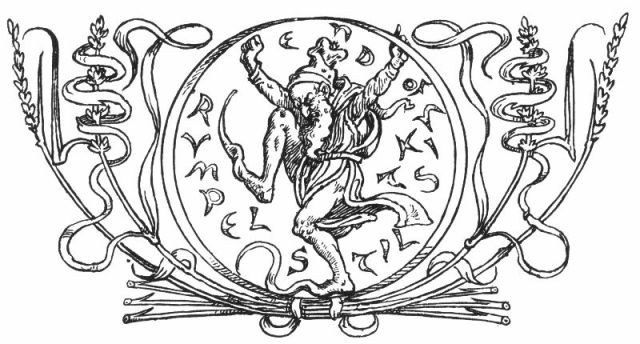
"I have not been able to find one single new name; but as I passed through the woods I came to a high hill, and near it was a little house, and before the house burned a fire, and round the fire danced a comical little man, and he hopped on one leg and cried,
"To-day do I bake, to-morrow I brew, The day after that the queen's child comes in; And oh! I am glad that nobody knew That the name I am called is Rumpelstiltskin!"
You cannot think how pleased the queen was to hear that name, and soon afterwards, when the little man walked in and said, "Now, Mrs. Queen, what is my name?" she said at first,
"Are you called Jack?"
"No," answered he.
"Are you called Harry?" she asked again.
"No," answered he. And then she said,
"Then perhaps your name is Rumpelstiltskin!"
"The devil told you that! the devil told you that!" cried the little man, and in his anger he stamped with his right foot so hard that it went into the ground above his knee; then he seized his left foot with both his hands in such a fury that he split in two, and there was an end of him.


There was once a woman who was a witch, and she had two daughters, one ugly and wicked, whom she loved the best, because she was her very own daughter, and one pretty and good, whom she hated because she was her step-daughter. One day the step-daughter put on a pretty apron, which the other daughter liked so much that she became envious, and said to her mother that she must and should have the apron.
"Be content, my child," said the old woman, "thou shalt have it. Thy step-sister has long deserved death, and to-night, while she is asleep, I shall come and cut off her head. Take care to lie at the farthest side of the bed, and push her to the outside."
And it would have been all over with the poor girl, if she had not been standing in a corner near and heard it all. She did not dare to go outside the door the whole day long, and when bed-time came the other one got into bed first, so as to lie on the farthest side; but when she had gone to sleep, the step-daughter pushed her towards the outside, and took the inside place next the wall. In the night the old woman came sneaking; in her right hand she held an axe, and with her left she felt for the one who was lying outside, and then she heaved up the axe with both hands, and hewed the head off her only daughter.
When she had gone away, the other girl got up and went to her sweetheart's, who was called Roland, and knocked at his door. When he came to her, she said,
"Listen, dear Roland, we must flee away in all haste; my step-mother meant to put me to death, but she has killed her only child instead. When the day breaks, and she sees what she has done, we are lost."
"But I advise you," said Roland, "to bring away her magic wand with you; otherwise we cannot escape her when she comes after to overtake us." So the maiden fetched the magic wand, and she took up the head of her step-sister and let drop three drops of blood on the ground,—one by the bed, one in the kitchen, and one on the steps. Then she hastened back to her sweetheart.
When the old witch got up in the morning, she called out to her daughter, to give her the apron, but no daughter came. Then she cried out, "Where art thou?"
"Here, at the steps, sweeping!" answered one of the drops of blood.
The old woman went out, but she saw nobody at the steps, and cried again, "Where art thou?"
"Here in the kitchen warming myself," cried the second drop of blood.
So she went into the kitchen and found no one. Then she cried again, "Where art thou?"
"Oh, here in bed fast asleep!" cried the third drop of blood.
Then the mother went into the room, and up to the bed, and there lay her only child, whose head she had cut off herself. The witch fell into a great fury, rushed to the window, for from it she could see far and wide, and she caught sight of her step-daughter, hastening away with her dear Roland.
"It will be no good to you," cried she, "if you get ever so far away, you cannot escape me." Then she put on her boots, which took her an hour's walk at every stride, and it was not long before she had overtaken them. But the maiden, when she saw the old woman striding up, changed, by means of the magic wand, her dear Roland into a lake, and herself into a duck swimming upon it. The witch stood on the bank and threw in crumbs of bread, and took great pains to decoy the duck towards her, but the duck would not be decoyed, and the old woman was obliged to go back in the evening disappointed. Then the maiden and her dear Roland took again their natural shapes, and travelled on the whole night through until daybreak. Then the maiden changed herself into a beautiful flower, standing in the middle of a hedge of thorns, and her dear Roland into a fiddle-player. It was not long before the witch came striding up, and she said to the musician,
"Dear musician, will you be so kind as to reach that pretty flower for me?"
"Oh yes," said he, "I will strike up a tune to it."
Then as she crept quickly up to the hedge to break off the flower, for she knew well who it was, he began to play, and whether she liked it or not, she was obliged to dance, for there was magic in the tune. The faster he played the higher she had to jump, and the thorns tore her clothes, and scratched and wounded her, and he did not cease playing until she was spent, and lay dead.
So now they were saved, and Roland said,
"I will go to my father and prepare for the wedding."
"And I will stay here," said the maiden, "and wait for you, and so that no one should know me, I will change myself into a red milestone." So away went Roland, and the maiden in the likeness of a stone waited in the field for her beloved.
But when Roland went home he fell into the snares of another maiden, who wrought so, that he forgot his first love.
And the poor girl waited a long time, but at last, seeing that he did not come, she was filled with despair, and changed herself into a flower, thinking "Perhaps some one in passing will put his foot upon me and crush me."
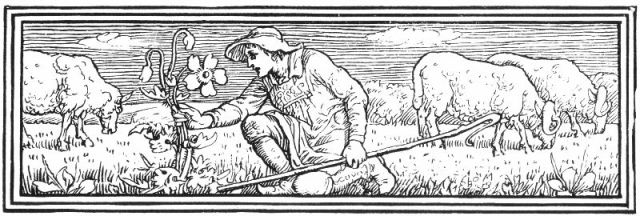
But it happened that a shepherd, tending his flock, saw the flower, and as it was so beautiful, he gathered it, took it home with him, and put it in his chest. From that time everything went wonderfully well in the shepherd's house. When he got up in the morning, all the work was already done; the room was swept, the tables and benches rubbed, fire kindled on the hearth, and water ready drawn; and when he came home in the middle of the day, the table was laid, and a good meal spread upon it. He could not understand how it was done, for he never saw anybody in his house, and it was too little for anybody to hide in. The good serving pleased him well; but in the end he became uneasy, and went to a wise woman to take counsel of her. The wise woman said,
"There is magic in it: get up early some morning, and if you hear something moving in the room, be it what it may, throw a white cloth over it, and the charm will be broken."
The shepherd did as she told him, and the next morning at daybreak he saw the chest open, and the flower come out. Then he jumped up quickly and threw a white cloth over it. So the spell was broken, and a lovely maiden stood before him; and she told him that she had been the flower, and had until now cared for his household matters. She told him all that had happened to her, and she pleased him so much that he asked her to marry him, but she answered "No," because she still remained true to her dear Roland, though he had forsaken her; but she promised not to leave the shepherd, but to go on taking care of his house.
Now the time came when Roland's wedding was to be held; and there was an old custom in that country that all the girls should be present, and should sing in honour of the bride and bridegroom. The faithful maiden, when she knew this, was so sorrowful that she felt as if her heart would break; and she would not go, until the others came and fetched her. And when her turn came to sing she slipped behind, so that she stood alone, and so began to sing: and as soon as her song reached Roland's ear he sprang up and cried,
"I know that voice! that is the right bride, and no other will I have." And everything that he had forgotten, and that had been swept out of his mind, came suddenly home to him in his heart. And the faithful maiden was married to her dear Roland; her sorrow came to an end and her joy began.

In times gone by there was a king who had at the back of his castle a beautiful pleasure-garden, in which stood a tree that bore golden apples. As the apples ripened they were counted, but one morning one was missing. Then the king was angry, and he ordered that watch should be kept about the tree every night. Now the king had three sons, and he sent the eldest to spend the whole night in the garden; so he watched till midnight, and then he could keep off sleep no longer, and in the morning another apple was missing. The second son had to watch the following night; but it fared no better, for when twelve o'clock had struck he went to sleep, and in the morning another apple was missing. Now came the turn of the third son to watch, and he was ready to do so; but the king had less trust in him, and believed he would acquit himself still worse than his brothers, but in the end he consented to let him try. So the young man lay down under the tree to watch, and resolved that sleep should not be master. When it struck twelve something came rushing through the air, and he saw in the moonlight a bird flying towards him, whose feathers glittered like gold. The bird perched upon the tree, and had already pecked off an apple, when the young man let fly an arrow at it. The bird flew away, but the arrow had struck its plumage, and one of its golden feathers fell to the ground: the young man picked it up, and taking it next morning to the king, told him what had happened in the night. The king called his council together, and all declared that such a feather was worth more than the whole kingdom.
"Since the feather is so valuable," said the king, "one is not enough for me; I must and will have the whole bird."
So the eldest son set off, and relying on his own cleverness he thought he should soon find the golden bird. When he had gone some distance he saw a fox sitting at the edge of a wood, and he pointed his gun at him. The fox cried out,
"Do not shoot me, and I will give you good counsel. You are on your way to find the golden bird, and this evening you will come to a village, in which two taverns stand facing each other. One will be brightly lighted up, and there will be plenty of merriment going on inside; do not mind about that, but go into the other one, although it will look to you very uninviting."
"How can a silly beast give one any rational advice?" thought the king's son, and let fly at the fox, but missed him, and he stretched out his tail and ran quick into the wood. Then the young man went on his way, and towards evening he came to the village, and there stood the two taverns; in one singing and dancing was going on, the other looked quite dull and wretched. "I should be a fool," said he, "to go into that dismal place, while there is anything so good close by." So he went into the merry inn, and there lived in clover, quite forgetting the bird and his father, and all good counsel.
As time went on, and the eldest son never came home, the second son set out to seek the golden bird. He met with the fox, just as the eldest did, and received good advice from him without attending to it. And when he came to the two taverns, his brother was standing and calling to him at the window of one of them, out of which came sounds of merriment; so he could not resist, but went in and revelled to his heart's content.
And then, as time went on, the youngest son wished to go forth, and to try his luck, but his father would not consent.
"It would be useless," said he; "he is much less likely to find the bird than his brothers, and if any misfortune were to happen to him he would not know how to help himself; his wits are none of the best."
But at last, as there was no peace to be had, he let him go. By the side of the wood sat the fox, begged him to spare his life, and gave him good counsel. The young man was kind, and said,
"Be easy, little fox, I will do you no harm."
"You shall not repent of it," answered the fox, "and that you may get there all the sooner, get up and sit on my tail."
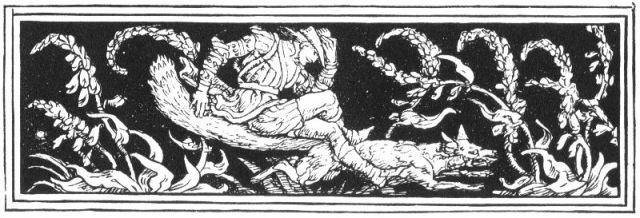
And no sooner had he done so than the fox began to run, and off they went over stock and stone, so that the wind whistled in their hair. When they reached the village the young man got down, and, following the fox's advice, went into the mean-looking tavern, without hesitating, and there he passed a quiet night. The next morning, when he went out into the field, the fox, who was sitting there already, said,
"I will tell you further what you have to do. Go straight on until you come to a castle, before which a great band of soldiers lie, but do not trouble yourself about them, for they will be all asleep and snoring; pass through them and forward into the castle, and go through all the rooms, until you come to one where there is a golden bird hanging in a wooden cage. Near at hand will stand empty a golden cage of state, but you must beware of taking the bird out of his ugly cage and putting him into the fine one; if you do so you will come to harm."
After he had finished saying this the fox stretched out his tail again, and the king's son sat him down upon it; then away they went over stock and stone, so that the wind whistled through their hair. And when the king's son reached the castle he found everything as the fox had said: and he at last entered the room where the golden bird was hanging in a wooden cage, while a golden one was standing by; the three golden apples too were in the room. Then, thinking it foolish to let the beautiful bird stay in that mean and ugly cage, he opened the door of it, took hold of it, and put it in the golden one. In the same moment the bird uttered a piercing cry. The soldiers awaked, rushed in, seized the king's son and put him in prison. The next morning he was brought before a judge, and, as he confessed everything, condemned to death. But the king said he would spare his life on one condition, that he should bring him the golden horse whose paces were swifter than the wind, and that then he should also receive the golden bird as a reward.
So the king's son set off to find the golden horse, but he sighed, and was very sad, for how should it be accomplished? And then he saw his old friend the fox sitting by the roadside.
"Now, you see," said the fox, "all this has happened, because you would not listen to me. But be of good courage, I will bring you through, and will tell you how you are to get the golden horse. You must go straight on until you come to a castle, where the horse stands in his stable; before the stable-door the grooms will be lying, but they will all be asleep and snoring; and you can go and quietly lead out the horse. But one thing you must mind—take care to put upon him the plain saddle of wood and leather, and not the golden one, which will hang close by; otherwise it will go badly with you."
Then the fox stretched out his tail, and the king's son seated himself upon it, and away they went over stock and stone until the wind whistled through their hair. And everything happened just as the fox had said, and he came to the stall where the golden horse was: and as he was about to put on him the plain saddle, he thought to himself,
"Such a beautiful animal would be disgraced were I not to put on him the good saddle, which becomes him so well." However, no sooner did the horse feel the golden saddle touch him than he began to neigh. And the grooms all awoke, seized the king's son and threw him into prison. The next morning he was delivered up to justice and condemned to death, but the king promised him his life, and also to bestow upon him the golden horse, if he could convey thither the beautiful princess of the golden castle.
With a heavy heart the king's son set out, but by great good luck he soon met with the faithful fox.
"I ought now to leave you to your own ill-luck," said the fox, "but I am sorry for you, and will once more help you in your need. Your way lies straight up to the golden castle: you will arrive there in the evening, and at night, when all is quiet, the beautiful princess goes to the bath. And as she is entering the bathing-house, go up to her and give her a kiss, then she will follow you, and you can lead her away; but do not suffer her first to go and take leave of her parents, or it will go ill with you."
Then the fox stretched out his tail; the king's son seated himself upon it, and away they went over stock and stone, so that the wind whistled through their hair. And when he came to the golden castle, all was as the fox had said. He waited until midnight, when all lay in deep sleep, and then as the beautiful princess went to the bathing-house he went up to her and gave her a kiss, and she willingly promised to go with him, but she begged him earnestly, and with tears, that he would let her first go and take leave of her parents. At first he denied her prayer, but as she wept so much the more, and fell at his feet, he gave in at last. And no sooner had the princess reached her father's bedside than he, and all who were in the castle, waked up, and the young man was seized and thrown into prison.
The next morning the king said to him,
"Thy life is forfeit, but thou shalt find grace if thou canst level that mountain that lies before my windows, and over which I am not able to see: and if this is done within eight days thou shalt have my daughter for a reward."
So the king's son set to work, and dug and shovelled away without ceasing, but when, on the seventh day, he saw how little he had accomplished, and that all his work was as nothing, he fell into great sadness, and gave up all hope. But on the evening of the seventh day the fox appeared, and said,
"You do not deserve that I should help you, but go now and lie down to sleep, and I will do the work for you."
The next morning when he awoke, and looked out of the window, the mountain had disappeared. The young man hastened full of joy to the king, and told him that his behest was fulfilled, and, whether the king liked it or not, he had to keep to his word, and let his daughter go.
So they both went away together, and it was not long before the faithful fox came up to them.
"Well, you have got the best first," said he; "but you must know the golden horse belongs to the princess of the golden castle."
"But how shall I get it?" asked the young man.
"I am going to tell you," answered the fox. "First, go to the king who sent you to the golden castle, and take to him the beautiful princess. There will then be very great rejoicing; he will willingly give you the golden horse, and they will lead him out to you; then mount him without delay, and stretch out your hand to each of them to take leave, and last of all to the princess, and when you have her by the hand swing her up on the horse behind you, and off you go! nobody will be able to overtake you, for that horse goes swifter than the wind."
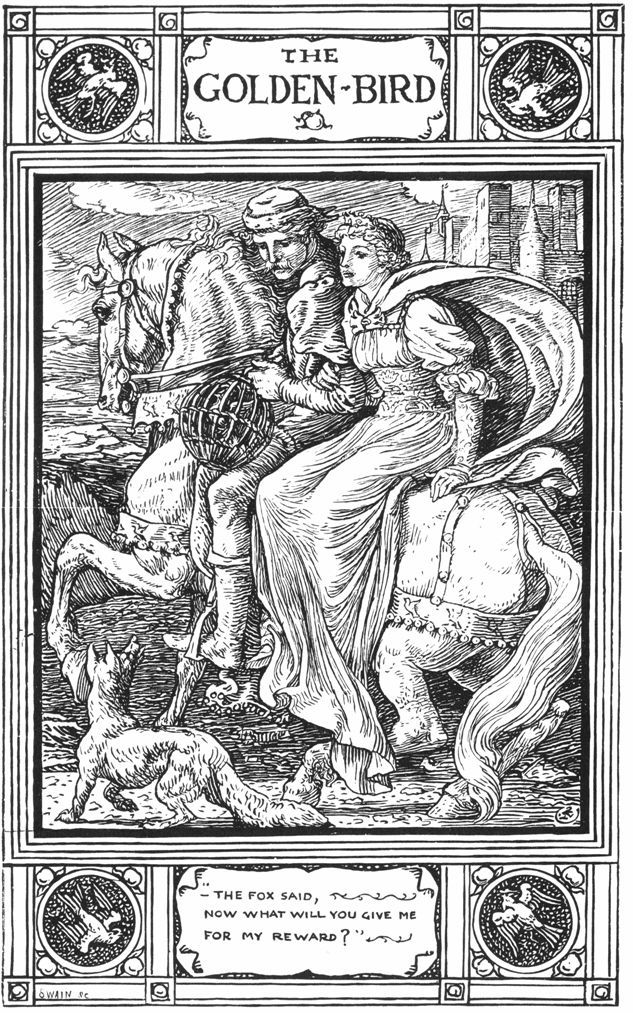
And so it was all happily done, and the king's son carried off the beautiful princess on the golden horse. The fox did not stay behind, and he said to the young man,
"Now, I will help you to get the golden bird. When you draw near the castle where the bird is, let the lady alight, and I will take her under my care; then you must ride the golden horse into the castle-yard, and there will be great rejoicing to see it, and they will bring out to you the golden bird; as soon as you have the cage in your hand, you must start off back to us, and then you shall carry the lady away."
The plan was successfully carried out; and when the young man returned with the treasure, the fox said,
"Now, what will you give me for my reward?"
"What would you like?" asked the young man.
"When we are passing through the wood, I desire that you should slay me, and cut my head and feet off."
"That were a strange sign of gratitude," said the king's son, "and I could not possibly do such a thing."
Then said the fox,
"If you will not do it, I must leave you; but before I go let me give you some good advice. Beware of two things: buy no gallows-meat, and sit at no brook-side." With that the fox ran off into the wood.
The young man thought to himself, "That is a wonderful animal, with most singular ideas. How should any one buy gallows-meat? and I am sure I have no particular fancy for sitting by a brook-side."
So he rode on with the beautiful princess, and their way led them through the village where his two brothers had stayed. There they heard great outcry and noise, and when he asked what it was all about, they told him that two people were going to be hanged. And when he drew near he saw that it was his two brothers, who had done all sorts of evil tricks, and had wasted all their goods. He asked if there were no means of setting them free.
"Oh yes! if you will buy them off," answered the people; "but why should you spend your money in redeeming such worthless men?"
But he persisted in doing so; and when they were let go they all went on their journey together.
After a while they came to the wood where the fox had met them first, and there it seemed so cool and sheltered from the sun's burning rays that the two brothers said,
"Let us rest here for a little by the brook, and eat and drink to refresh ourselves."
The young man consented, quite forgetting the fox's warning, and he seated himself by the brook-side, suspecting no evil. But the two brothers thrust him backwards into the brook, seized the princess, the horse, and the bird, and went home to their father.
"Is not this the golden bird that we bring?" said they; "and we have also the golden horse, and the princess of the golden castle."
Then there was great rejoicing in the royal castle, but the horse did not feed, the bird did not chirp, and the princess sat still and wept.
The youngest brother, however, had not perished. The brook was, by good fortune, dry, and he fell on soft moss without receiving any hurt, but he could not get up again. But in his need the faithful fox was not lacking; he came up running, and reproached him for having forgotten his advice.
"But I cannot forsake you all the same," said he; "I will help you back again into daylight." So he told the young man to grasp his tail, and hold on to it fast, and so he drew him up again.
"Still you are not quite out of all danger," said the fox; "your brothers, not being certain of your death, have surrounded the wood with sentinels, who are to put you to death if you let yourself be seen."
A poor beggar-man was sitting by the path, and the young man changed clothes with him, and went clad in that wise into the king's courtyard. Nobody knew him, but the bird began to chirp, and the horse began to feed, and the beautiful princess ceased weeping.
"What does this mean?" said the king, astonished.
The princess answered,
"I cannot tell, except that I was sad, and now I am joyful; it is to me as if my rightful bridegroom had returned."
Then she told him all that happened, although the two brothers had threatened to put her to death if she let out anything. The king then ordered every person who was in the castle to be brought before him, and with the rest came the young man like a beggar in his wretched garments; but the princess knew him, and greeted him well, falling on his neck and kissing him. The wicked brothers were seized and put to death, and the youngest brother was married to the princess, and succeeded to the inheritance of his father.
But what became of the poor fox? Long afterwards the king's son was going through the wood, and the fox met him and said,