Transcriber's Notes: (continued 3)
Lucy Crane translation
"If you come back without it, you shall be put under the waves again and again until you are drowned."
Every one pitied the handsome young man, but they went, and left him alone by the sea. As he was standing on the shore and thinking of what he should do, there came three fishes swimming by, none other than those he had set free. The middle one had a mussel in his mouth, and he laid it on the strand at the young man's feet; and when he took it up and opened it there was the gold ring inside! Full of joy he carried it to the King, and expected the promised reward; but the King's daughter, proud of her high birth, despised him, and set him another task to perform. She went out into the garden, and strewed about over the grass ten sacks full of millet seed.
"By the time the sun rises in the morning you must have picked up all these," she said, "and not a grain must be wanting."
The young man sat down in the garden and considered how it was possible to do this task, but he could contrive nothing, and stayed there, feeling very sorrowful, and expecting to be led to death at break of day. But when the first beams of the sun fell on the garden he saw that the ten sacks were all filled, standing one by the other, and not even a grain was missing. The ant-king had arrived in the night with his thousands of ants, and the grateful creatures had picked up all the millet seed, and filled the sacks with great industry. The King's daughter came herself into the garden and saw with astonishment that the young man had performed all that had been given him to do. But she could not let her proud heart melt, but said,
"Although he has completed the two tasks, he shall not be my bridegroom unless he brings me an apple from the tree of life."
The young man did not know where the tree of life was to be found, but he set out and went on and on, as long as his legs could carry him, but he had no hope of finding it. When he had gone through three kingdoms he came one evening to a wood, and seated himself under a tree to go to sleep; but he heard a rustling in the boughs, and a golden apple fell into his hand. Immediately three ravens flew towards him, perched on his knee, and said,
"We are the three young ravens that you delivered from starving; when we grew big, and heard that you were seeking the golden apple, we flew over the sea to the end of the earth, where the tree of life stands, and we fetched the apple."
Full of joy the young man set off on his way home, and brought the golden apple to the King's beautiful daughter, who was without any further excuse.
So they divided the apple of life, and ate it together; and their hearts were filled with love, and they lived in undisturbed happiness to a great age.

There lived in a certain village a poor old woman who had collected a mess of beans, and was going to cook them. So she made a fire on her hearth, and, in order to make it burn better, she put in a handful of straw. When the beans began to bubble in the pot, one of them fell out and lay, never noticed, near a straw which was already there; soon a red-hot coal jumped out of the fire and joined the pair. The straw began first, and said,
"Dear friends, how do you come here?" The coal answered,
"I jumped out of the fire by great good luck, or I should certainly have met with my death. I should have been burned to ashes." The bean said,
"I too have come out of it with a whole skin, but if the old woman had kept me in the pot I should have been cooked into a soft mass like my comrades."
"Nor should I have met with a better fate," said the straw; "the old woman has turned my brothers into fire and smoke, sixty of them she took up at once and deprived of life. Very luckily I managed to slip through her fingers."
"What had we better do now?" said the coal.
"I think," answered the bean, "that as we have been so lucky as to escape with our lives, we will join in good fellowship together, and, lest any more bad fortune should happen to us here, we will go abroad into foreign lands."
The proposal pleased the two others, and forthwith they started on their travels. Soon they came to a little brook, and as there was no stepping-stone, and no bridge, they could not tell how they were to get to the other side. The straw was struck with a good idea, and said,
"I will lay myself across, so that you can go over me as if I were a bridge!"
So the straw stretched himself from one bank to the other, and the coal, who was of an ardent nature, quickly trotted up to go over the new-made bridge. When, however, she reached the middle, and heard the water rushing past beneath her, she was struck with terror, and stopped, and could get no farther. So the straw began to get burnt, broke in two pieces, and fell in the brook, and the coal slipped down, hissing as she touched the water, and gave up the ghost. The bean, who had prudently remained behind on the bank, could not help laughing at the sight, and not being able to contain herself, went on laughing so excessively that she burst. And now would she certainly have been undone for ever, if a tailor on his travels had not by good luck stopped to rest himself by the brook. As he had a compassionate heart, he took out needle and thread and stitched her together again. The bean thanked him in the most elegant manner, but as he had sewn her up with black stitches, all beans since then have a black seam.

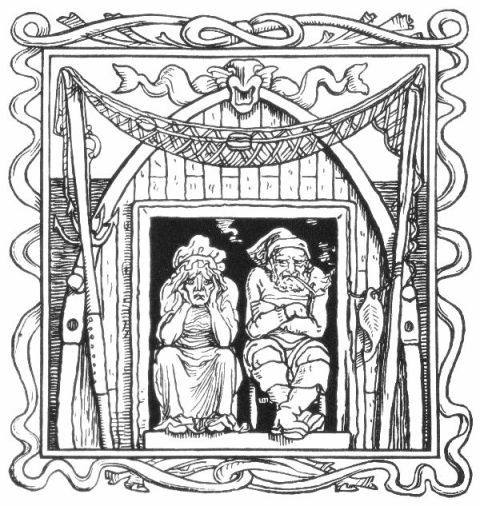
There was once a fisherman and his wife who lived together in a hovel by the sea-shore, and the fisherman went out every day with his hook and line to catch fish, and he angled and angled.
One day he was sitting with his rod and looking into the clear water, and he sat and sat.
At last down went the line to the bottom of the water, and when he drew it up he found a great flounder on the hook. And the flounder said to him,
"Fisherman, listen to me; let me go, I am not a real fish but an enchanted prince. What good shall I be to you if you land me? I shall not taste well; so put me back into the water again, and let me swim away."
"Well," said the fisherman, "no need of so many words about the matter, as you can speak I had much rather let you swim away."
Then he put him back into the clear water, and the flounder sank to the bottom, leaving a long streak of blood behind him. Then the fisherman got up and went home to his wife in their hovel.
"Well, husband," said the wife, "have you caught nothing to-day?"
"No," said the man—"that is, I did catch a flounder, but as he said he was an enchanted prince, I let him go again."
"Then, did you wish for nothing?" said the wife.
"No," said the man; "what should I wish for?"
"Oh dear!" said the wife; "and it is so dreadful always to live in this evil-smelling hovel; you might as well have wished for a little cottage; go again and call him; tell him we want a little cottage, I daresay he will give it us; go, and be quick."
And when he went back, the sea was green and yellow, and not nearly so clear. So he stood and said,
"O man, O man!—if man you be, Or flounder, flounder, in the sea— Such a tiresome wife I've got, For she wants what I do not."
Then the flounder came swimming up, and said,
"Now then, what does she want?"
"Oh," said the man, "you know when I caught you my wife says I ought to have wished for something. She does not want to live any longer in the hovel, and would rather have a cottage.
"Go home with you," said the flounder, "she has it already."
So the man went home, and found, instead of the hovel, a little cottage, and his wife was sitting on a bench before the door. And she took him by the hand, and said to him,
"Come in and see if this is not a great improvement."
So they went in, and there was a little house-place and a beautiful little bedroom, a kitchen and larder, with all sorts of furniture, and iron and brass ware of the very best. And at the back was a little yard with fowls and ducks, and a little garden full of green vegetables and fruit.
"Look," said the wife, "is not that nice?"
"Yes," said the man, "if this can only last we shall be very well contented."
"We will see about that," said the wife. And after a meal they went to bed.
So all went well for a week or fortnight, when the wife said,
"Look here, husband, the cottage is really too confined, and the yard and garden are so small; I think the flounder had better get us a larger house; I should like very much to live in a large stone castle; so go to your fish and he will send us a castle."
"O my dear wife," said the man, "the cottage is good enough; what do we want a castle for?"
"We want one," said the wife; "go along with you; the flounder can give us one."
"Now, wife," said the man, "the flounder gave us the cottage; I do not like to go to him again, he may be angry."
"Go along," said the wife, "he might just as well give us it as not; do as I say!"
The man felt very reluctant and unwilling; and he said to himself,
"It is not the right thing to do;" nevertheless he went.
So when he came to the seaside, the water was purple and dark blue and grey and thick, and not green and yellow as before. And he stood and said,
"O man, O man!—if man you be, Or flounder, flounder, in the sea— Such a tiresome wife I've got, For she wants what I do not."
"Now then, what does she want?" said the flounder.
"Oh," said the man, half frightened, "she wants to live in a large stone castle."
"Go home with you, she is already standing before the door," said the flounder.
Then the man went home, as he supposed, but when he got there, there stood in the place of the cottage a great castle of stone, and his wife was standing on the steps, about to go in; so she took him by the hand, and said,
"Let us enter."
With that he went in with her, and in the castle was a great hall with a marble pavement, and there were a great many servants, who led them through large doors, and the passages were decked with tapestry, and the rooms with golden chairs and tables, and crystal chandeliers hanging from the ceiling; and all the rooms had carpets. And the tables were covered with eatables and the best wine for any one who wanted them. And at the back of the house was a great stable-yard for horses and cattle, and carriages of the finest; besides, there was a splendid large garden, with the most beautiful flowers and fine fruit trees, and a pleasance full half a mile long, with deer and oxen and sheep, and everything that heart could wish for.
"There!" said the wife, "is not this beautiful?"
"Oh yes," said the man, "if it will only last we can live in this fine castle and be very well contented."
"We will see about that," said the wife, "in the meanwhile we will sleep upon it." With that they went to bed.
The next morning the wife was awake first, just at the break of day, and she looked out and saw from her bed the beautiful country lying all round. The man took no notice of it, so she poked him in the side with her elbow, and said,
"Husband, get up and just look out of the window. Look, just think if we could be king over all this country. Just go to your fish and tell him we should like to be king."
"Now, wife," said the man, "what should we be kings for? I don't want to be king."
"Well," said the wife, "if you don't want to be king, I will be king."
"Now, wife," said the man, "what do you want to be king for? I could not ask him such a thing."
"Why not?" said the wife, "you must go directly all the same; I must be king."
So the man went, very much put out that his wife should want to be king.
"It is not the right thing to do—not at all the right thing," thought the man. He did not at all want to go, and yet he went all the same.
And when he came to the sea the water was quite dark grey, and rushed far inland, and had an ill smell. And he stood and said,
"O man, O man!—if man you be, Or flounder, flounder, in the sea— Such a tiresome wife I've got, For she wants what I do not."
"Now then, what does she want?" said the fish.
"Oh dear!" said the man, "she wants to be king."
"Go home with you, she is so already," said the fish.
So the man went back, and as he came to the palace he saw it was very much larger, and had great towers and splendid gateways; the herald stood before the door, and a number of soldiers with kettle-drums and trumpets.
And when he came inside everything was of marble and gold, and there were many curtains with great golden tassels. Then he went through the doors of the saloon to where the great throne-room was, and there was his wife sitting upon a throne of gold and diamonds, and she had a great golden crown on, and the sceptre in her hand was of pure gold and jewels, and on each side stood six pages in a row, each one a head shorter than the other. So the man went up to her and said,
"Well, wife, so now you are king!"
"Yes," said the wife, "now I am king."
So then he stood and looked at her, and when he had gazed at her for some time he said,
"Well, wife, this is fine for you to be king! now there is nothing more to wish for."
"O husband!" said the wife, seeming quite restless, "I am tired of this already. Go to your fish and tell him that now I am king I must be emperor."
"Now, wife," said the man, "what do you want to be emperor for?"
"Husband," said she, "go and tell the fish I want to be emperor."
"Oh dear!" said the man, "he could not do it—I cannot ask him such a thing. There is but one emperor at a time; the fish can't possibly make any one emperor—indeed he can't."
"Now, look here," said the wife, "I am king, and you are only my husband, so will you go at once? Go along! for if he was able to make me king he is able to make me emperor; and I will and must be emperor, so go along!"
So he was obliged to go; and as he went he felt very uncomfortable about it, and he thought to himself,
"It is not at all the right thing to do; to want to be emperor is really going too far; the flounder will soon be beginning to get tired of this."
With that he came to the sea, and the water was quite black and thick, and the foam flew, and the wind blew, and the man was terrified. But he stood and said,
"O man, O man!—if man you be, Or flounder, flounder, in the sea— Such a tiresome wife I've got, For she wants what I do not."
"What is it now?" said the fish.
"Oh dear!" said the man, "my wife wants to be emperor."
"Go home with you," said the fish, "she is emperor already."
So the man went home, and found the castle adorned with polished marble and alabaster figures, and golden gates. The troops were being marshalled before the door, and they were blowing trumpets and beating drums and cymbals; and when he entered he saw barons and earls and dukes waiting about like servants; and the doors were of bright gold. And he saw his wife sitting upon a throne made of one entire piece of gold, and it was about two miles high; and she had a great golden crown on, which was about three yards high, set with brilliants and carbuncles; and in one hand she held the sceptre, and in the other the globe; and on both sides of her stood pages in two rows, all arranged according to their size, from the most enormous giant of two miles high to the tiniest dwarf of the size of my little finger; and before her stood earls and dukes in crowds. So the man went up to her and said,
"Well, wife, so now you are emperor."
"Yes," said she, "now I am emperor."
Then he went and sat down and had a good look at her, and then he said,
"Well now, wife, there is nothing left to be, now you are emperor."
"What are you talking about, husband?" said she; "I am emperor, and next I will be pope! so go and tell the fish so."
"Oh dear!" said the man, "what is it that you don't want? You can never become pope; there is but one pope in Christendom, and the fish can't possibly do it."
"Husband," said she, "no more words about it; I must and will be pope; so go along to the fish."
"Now, wife," said the man, "how can I ask him such a thing? it is too bad—it is asking a little too much; and, besides, he could not do it."
"What rubbish!" said the wife; "if he could make me emperor he can make me pope. Go along and ask him; I am emperor, and you are only my husband, so go you must."
So he went, feeling very frightened, and he shivered and shook, and his knees trembled; and there arose a great wind, and the clouds flew by, and it grew very dark, and the sea rose mountains high, and the ships were tossed about, and the sky was partly blue in the middle, but at the sides very dark and red, as in a great tempest. And he felt very desponding, and stood trembling and said,
"O man, O man!—if man you be, Or flounder, flounder, in the sea— Such a tiresome wife I've got, For she wants what I do not."
"Well, what now?" said the fish.
"Oh dear!" said the man, "she wants to be pope."
"Go home with you, she is pope already," said the fish.
So he went home, and he found himself before a great church, with palaces all round. He had to make his way through a crowd of people; and when he got inside he found the place lighted up with thousands and thousands of lights; and his wife was clothed in a golden garment, and sat upon a very high throne, and had three golden crowns on, all in the greatest priestly pomp; and on both sides of her there stood two rows of lights of all sizes—from the size of the longest tower to the smallest rushlight, and all the emperors and kings were kneeling before her and kissing her foot.
"Well, wife," said the man, and sat and stared at her, "so you are pope."
"Yes," said she, "now I am pope!"
And he went on gazing at her till he felt dazzled, as if he were sitting in the sun. And after a little time he said,
"Well, now, wife, what is there left to be, now you are pope?"
And she sat up very stiff and straight, and said nothing.
And he said again, "Well, wife, I hope you are contented at last with being pope; you can be nothing more."
"We will see about that," said the wife. With that they both went to bed; but she was as far as ever from being contented, and she could not get to sleep for thinking of what she should like to be next.
The husband, however, slept as fast as a top after his busy day; but the wife tossed and turned from side to side the whole night through, thinking all the while what she could be next, but nothing would occur to her; and when she saw the red dawn she slipped off the bed, and sat before the window to see the sun rise, and as it came up she said,
"Ah, I have it! what if I should make the sun and moon to rise—husband!" she cried, and stuck her elbow in his ribs, "wake up, and go to your fish, and tell him I want power over the sun and moon."
The man was so fast asleep that when he started up he fell out of bed. Then he shook himself together, and opened his eyes and said,
"Oh,—wife, what did you say?"
"Husband," said she, "if I cannot get the power of making the sun and moon rise when I want them, I shall never have another quiet hour. Go to the fish and tell him so."
"O wife!" said the man, and fell on his knees to her, "the fish can really not do that for you. I grant you he could make you emperor and pope; do be contented with that, I beg of you."
And she became wild with impatience, and screamed out,
"I can wait no longer, go at once!"
And so off he went as well as he could for fright. And a dreadful storm arose, so that he could hardly keep his feet; and the houses and trees were blown down, and the mountains trembled, and rocks fell in the sea; the sky was quite black, and it thundered and lightened; and the waves, crowned with foam, ran mountains high. So he cried out, without being able to hear his own words,
"O man, O man!—if man you be, Or flounder, flounder, in the sea— Such a tiresome wife I've got, For she wants what I do not."
"Well, what now?" said the flounder.
"Oh dear!" said the man, "she wants to order about the sun and moon."
"Go home with you!" said the flounder, "you will find her in the old hovel."
And there they are sitting to this very day.

One summer morning a little tailor was sitting on his board near the window, and working cheerfully with all his might, when an old woman came down the street crying,
"Good jelly to sell! good jelly to sell!"
The cry sounded pleasant in the little tailor's ears, so he put his head out of the window, and called out,
"Here, my good woman—come here, if you want a customer."
So the poor woman climbed the steps with her heavy basket, and was obliged to unpack and display all her pots to the tailor. He looked at every one of them, and lifting all the lids, applied his nose to each, and said at last,
"The jelly seems pretty good; you may weigh me out four half ounces, or I don't mind having a quarter of a pound."
The woman, who had expected to find a good customer, gave him what he asked for, but went off angry and grumbling.
"This jelly is the very thing for me," cried the little tailor; "it will give me strength and cunning;" and he took down the bread from the cupboard, cut a whole round of the loaf, and spread the jelly on it, laid it near him, and went on stitching more gallantly than ever. All the while the scent of the sweet jelly was spreading throughout the room, where there were quantities of flies, who were attracted by it and flew to partake.
"Now then, who asked you to come?" said the tailor, and drove the unbidden guests away. But the flies, not understanding his language, were not to be got rid of like that, and returned in larger numbers than before. Then the tailor, not being able to stand it any longer, took from his chimney-corner a ragged cloth, and saying,
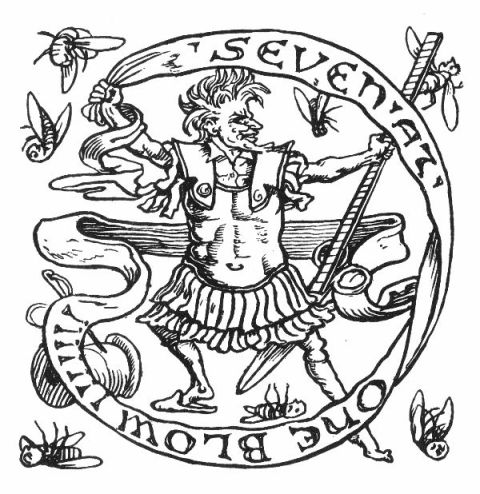
"Now, I'll let you have it!" beat it among them unmercifully. When he ceased, and counted the slain, he found seven lying dead before him.
"This is indeed somewhat," he said, wondering at his own gallantry; "the whole town shall know this."
So he hastened to cut out a belt, and he stitched it, and put on it in large capitals "Seven at one blow!"
"—The town, did I say!" said the little tailor; "the whole world shall know it!" And his heart quivered with joy, like a lamb's tail.
The tailor fastened the belt round him, and began to think of going out into the world, for his workshop seemed too small for his worship. So he looked about in all the house for something that it would be useful to take with him, but he found nothing but an old cheese, which he put in his pocket. Outside the door he noticed that a bird had got caught in the bushes, so he took that and put it in his pocket with the cheese. Then he set out gallantly on his way, and as he was light and active he felt no fatigue. The way led over a mountain, and when he reached the topmost peak he saw a terrible giant sitting there, and looking about him at his ease. The tailor went bravely up to him, called out to him, and said,
"Comrade, good day! there you sit looking over the wide world! I am on the way thither to seek my fortune: have you a fancy to go with me?"
The giant looked at the tailor contemptuously, and said,
"You little rascal! you miserable fellow!"
"That may be!" answered the little tailor, and undoing his coat he showed the giant his belt; "you can read there whether I am a man or not!"
The giant read: "Seven at one blow!" and thinking it meant men that the tailor had killed, felt at once more respect for the little fellow. But as he wanted to prove him, he took up a stone and squeezed it so hard that water came out of it.
"Now you can do that," said the giant,—"that is, if you have the strength for it."
"That's not much," said the little tailor, "I call that play," and he put his hand in his pocket and took out the cheese and squeezed it, so that the whey ran out of it.
"Well," said he, "what do you think of that?"
The giant did not know what to say to it, for he could not have believed it of the little man. Then the giant took up a stone and threw it so high that it was nearly out of sight.
"Now, little fellow, suppose you do that!"
"Well thrown," said the tailor; "but the stone fell back to earth again,—I will throw you one that will never come back." So he felt in his pocket, took out the bird, and threw it into the air. And the bird, when it found itself at liberty, took wing, flew off, and returned no more.
"What do you think of that, comrade?" asked the tailor.
"There is no doubt that you can throw," said the giant; "but we will see if you can carry."
He led the little tailor to a mighty oak-tree which had been felled, and was lying on the ground, and said,
"Now, if you are strong enough, help me to carry this tree out of the wood."
"Willingly," answered the little man; "you take the trunk on your shoulders, I will take the branches with all their foliage, that is much the most difficult."
So the giant took the trunk on his shoulders, and the tailor seated himself on a branch, and the giant, who could not see what he was doing, had the whole tree to carry, and the little man on it as well. And the little man was very cheerful and merry, and whistled the tune: "There were three tailors riding by," as if carrying the tree was mere child's play. The giant, when he had struggled on under his heavy load a part of the way, was tired out, and cried,
"Look here, I must let go the tree!"
The tailor jumped off quickly, and taking hold of the tree with both arms, as if he were carrying it, said to the giant,
"You see you can't carry the tree though you are such a big fellow!"
They went on together a little farther, and presently they came to a cherry-tree, and the giant took hold of the topmost branches, where the ripest fruit hung, and pulling them downwards, gave them to the tailor to hold, bidding him eat. But the little tailor was much too weak to hold the tree, and as the giant let go, the tree sprang back, and the tailor was caught up into the air. And when he dropped down again without any damage, the giant said to him,
"How is this? haven't you strength enough to hold such a weak sprig as that?"
"It is not strength that is lacking," answered the little tailor; "how should it to one who has slain seven at one blow! I just jumped over the tree because the hunters are shooting down there in the bushes. You jump it too, if you can."
The giant made the attempt, and not being able to vault the tree, he remained hanging in the branches, so that once more the little tailor got the better of him. Then said the giant,
"As you are such a gallant fellow, suppose you come with me to our den, and stay the night."
The tailor was quite willing, and he followed him. When they reached the den there sat some other giants by the fire, and each had a roasted sheep in his hand, and was eating it. The little tailor looked round and thought,
"There is more elbow-room here than in my workshop."
And the giant showed him a bed, and told him he had better lie down upon it and go to sleep. The bed was, however, too big for the tailor, so he did not stay in it, but crept into a corner to sleep. As soon as it was midnight the giant got up, took a great staff of iron and beat the bed through with one stroke, and supposed he had made an end of that grasshopper of a tailor. Very early in the morning the giants went into the wood and forgot all about the little tailor, and when they saw him coming after them alive and merry, they were terribly frightened, and, thinking he was going to kill them, they ran away in all haste.
So the little tailor marched on, always following his nose. And after he had gone a great way he entered the courtyard belonging to a King's palace, and there he felt so overpowered with fatigue that he lay down and fell asleep. In the meanwhile came various people, who looked at him very curiously, and read on his belt, "Seven at one blow!"
"Oh!" said they, "why should this great lord come here in time of peace? what a mighty champion he must be."
Then they went and told the King about him, and they thought that if war should break out what a worthy and useful man he would be, and that he ought not to be allowed to depart at any price. The King then summoned his council, and sent one of his courtiers to the little tailor to beg him, so soon as he should wake up, to consent to serve in the King's army. So the messenger stood and waited at the sleeper's side until his limbs began to stretch, and his eyes to open, and then he carried his answer back. And the answer was,
"That was the reason for which I came," said the little tailor, "I am ready to enter the King's service."
So he was received into it very honourably, and a separate dwelling set apart for him.
But the rest of the soldiers were very much set against the little tailor, and they wished him a thousand miles away.
"What shall be done about it?" they said among themselves; "if we pick a quarrel and fight with him then seven of us will fall at each blow. That will be of no good to us."
So they came to a resolution, and went all together to the King to ask for their discharge.
"We never intended," said they, "to serve with a man who kills seven at a blow."
The King felt sorry to lose all his faithful servants because of one man, and he wished that he had never seen him, and would willingly get rid of him if he might. But he did not dare to dismiss the little tailor for fear he should kill all the King's people, and place himself upon the throne. He thought a long while about it, and at last made up his mind what to do. He sent for the little tailor, and told him that as he was so great a warrior he had a proposal to make to him. He told him that in a wood in his dominions dwelt two giants, who did great damage by robbery, murder, and fire, and that no man durst go near them for fear of his life. But that if the tailor should overcome and slay both these giants the King would give him his only daughter in marriage, and half his kingdom as dowry, and that a hundred horsemen should go with him to give him assistance.
"That would be something for a man like me!" thought the little tailor, "a beautiful princess and half a kingdom are not to be had every day," and he said to the King,
"Oh yes, I can soon overcome the giants, and yet have no need of the hundred horsemen; he who can kill seven at one blow has no need to be afraid of two."
So the little tailor set out, and the hunched horsemen followed him. When he came to the border of the wood he said to his escort,
"Stay here while I go to attack the giants."
Then he sprang into the wood, and looked about him right and left. After a while he caught sight of the two giants; they were lying down under a tree asleep, and snoring so that all the branches shook. The little tailor, all alive, filled both his pockets with stones and climbed up into the tree, and made his way to an overhanging bough, so that he could seat himself just above the sleepers; and from there he let one stone after another fall on the chest of one of the giants. For a long time the giant was quite unaware of this, but at last he waked up and pushed his comrade, and said,
"What are you hitting me for?"
"You are dreaming," said the other, "I am not touching you." And they composed themselves again to sleep, and the tailor let fall a stone on the other giant.
"What can that be?" cried he, "what are you casting at me?"
"I am casting nothing at you," answered the first, grumbling.
They disputed about it for a while, but as they were tired, they gave it up at last, and their eyes closed once more. Then the little tailor began his game anew, picked out a heavier stone and threw it down with force upon the first giant's chest.
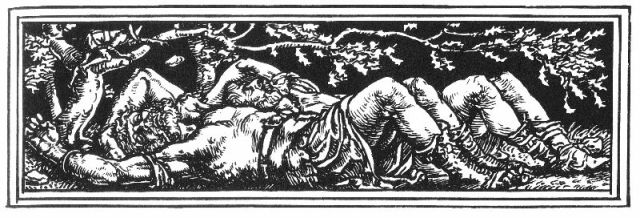
"This is too much!" cried he, and sprang up like a madman and struck his companion such a blow that the tree shook above them. The other paid him back with ready coin, and they fought with such fury that they tore up trees by their roots to use for weapons against each other, so that at last they both of them lay dead upon the ground. And now the little tailor got down.
"Another piece of luck!" said he,—"that the tree I was sitting in did not get torn up too, or else I should have had to jump like a squirrel from one tree to another."
Then he drew his sword and gave each of the giants a few hacks in the breast, and went back to the horsemen and said,
"The deed is done, I have made an end of both of them: but it went hard with me, in the struggle they rooted up trees to defend themselves, but it was of no use, they had to do with a man who can kill seven at one blow."
"Then are you not wounded?" asked the horsemen.
"Nothing of the sort!" answered the tailor, "I have not turned a hair."
The horsemen still would not believe it, and rode into the wood to see, and there they found the giants wallowing in their blood, and all about them lying the uprooted trees.
The little tailor then claimed the promised boon, but the King repented him of his offer, and he sought again how to rid himself of the hero.
"Before you can possess my daughter and the half of my kingdom," said he to the tailor, "you must perform another heroic act. In the wood lives a unicorn who does great damage; you must secure him."
"A unicorn does not strike more terror into me than two giants. Seven at one blow!—that is my way," was the tailor's answer.
So, taking a rope and an axe with him, he went out into the wood, and told those who were ordered to attend him to wait outside. He had not far to seek, the unicorn soon came out and sprang at him, as if he would make an end of him without delay. "Softly, softly," said he, "most haste, worst speed," and remained standing until the animal came quite near, then he slipped quietly behind a tree. The unicorn ran with all his might against the tree and stuck his horn so deep into the trunk that he could not get it out again, and so was taken.
"Now I have you," said the tailor, coming out from behind the tree, and, putting the rope round the unicorn's neck, he took the axe, set free the horn, and when all his party were assembled he led forth the animal and brought it to the King.
The King did not yet wish to give him the promised reward, and set him a third task to do. Before the wedding could take place the tailor was to secure a wild boar which had done a great deal of damage in the wood.
The huntsmen were to accompany him.
"All right," said the tailor, "this is child's play."
But he did not take the huntsmen into the wood, and they were all the better pleased, for the wild boar had many a time before received them in such a way that they had no fancy to disturb him. When the boar caught sight of the tailor he ran at him with foaming mouth and gleaming tusks to bear him to the ground, but the nimble hero rushed into a chapel which chanced to be near, and jumped quickly out of a window on the other side. The boar ran after him, and when he got inside the door shut after him, and there he was imprisoned, for the creature was too big and unwieldy to jump out of the window too. Then the little tailor called the huntsmen that they might see the prisoner with their own eyes; and then he betook himself to the king, who now, whether he liked it or not, was obliged to fulfil his promise, and give him his daughter and the half of his kingdom. But if he had known that the great warrior was only a little tailor he would have taken it still more to heart. So the wedding was celebrated with great splendour and little joy, and the tailor was made into a king.
One night the young queen heard her husband talking in his sleep and saying,
"Now boy, make me that waistcoat and patch me those breeches, or I will lay my yard measure about your shoulders!"
And so, as she perceived of what low birth her husband was, she went to her father the next morning and told him all, and begged him to set her free from a man who was nothing better than a tailor. The king bade her be comforted, saying,
"To-night leave your bedroom door open, my guard shall stand outside, and when he is asleep they shall come in and bind him and carry him off to a ship, and he shall be sent to the other side of the world."
So the wife felt consoled, but the king's water-bearer, who had been listening all the while, went to the little tailor and disclosed to him the whole plan.
"I shall put a stop to all this," said he.
At night he lay down as usual in bed, and when his wife thought that he was asleep, she got up, opened the door and lay down again. The little tailor, who only made believe to be asleep, began to murmur plainly,
"Now, boy, make me that waistcoat and patch me those breeches, or I will lay my yard measure about your shoulders! I have slain seven at one blow, killed two giants, caught a unicorn, and taken a wild boar, and shall I be afraid of those who are standing outside my room door?"
And when they heard the tailor say this, a great fear seized them; they fled away as if they had been wild hares, and none of them would venture to attack him.
And so the little tailor all his lifetime remained a king.

There was once a rich man whose wife lay sick, and when she felt her end drawing near she called to her only daughter to come near her bed, and said,
"Dear child, be pious and good, and God will always take care of you, and I will look down upon you from heaven, and will be with you."
And then she closed her eyes and expired. The maiden went every day to her mother's grave and wept, and was always pious and good. When the winter came the snow covered the grave with a white covering, and when the sun came in the early spring and melted it away, the man took to himself another wife.
The new wife brought two daughters home with her, and they were beautiful and fair in appearance, but at heart were black and ugly. And then began very evil times for the poor step-daughter.
"Is the stupid creature to sit in the same room with us?" said they; "those who eat food must earn it. Out upon her for a kitchen-maid!"
They took away her pretty dresses, and put on her an old gray kirtle, and gave her wooden shoes to wear.
"Just look now at the proud princess, how she is decked out!" cried they laughing, and then they sent her into the kitchen. There she was obliged to do heavy work from morning to night, get up early in the morning, draw water, make the fires, cook, and wash. Besides that, the sisters did their utmost to torment her,—mocking her, and strewing peas and lentils among the ashes, and setting her to pick them up. In the evenings, when she was quite tired out with her hard day's work, she had no bed to lie on, but was obliged to rest on the hearth among the cinders. And as she always looked dusty and dirty, they named her Aschenputtel.
It happened one day that the father went to the fair, and he asked his two step-daughters what he should bring back for them.
"Fine clothes!" said one.
"Pearls and jewels!" said the other.
"But what will you have, Aschenputtel?" said he.
"The first twig, father, that strikes against your hat on the way home; that is what I should like you to bring me."
So he bought for the two step-daughters fine clothes, pearls, and jewels, and on his way back, as he rode through a green lane, a hazel-twig struck against his hat; and he broke it off and carried it home with him. And when he reached home he gave to the step-daughters what they had wished for, and to Aschenputtel he gave the hazel-twig. She thanked him, and went to her mother's grave, and planted this twig there, weeping so bitterly that the tears fell upon it and watered it, and it flourished and became a fine tree. Aschenputtel went to see it three times a day, and wept and prayed, and each time a white bird rose up from the tree, and if she uttered any wish the bird brought her whatever she had wished for.
Now if came to pass that the king ordained a festival that should last for three days, and to which all the beautiful young women of that country were bidden, so that the king's son might choose a bride from among them. When the two step-daughters heard that they too were bidden to appear, they felt very pleased, and they called Aschenputtel, and said,
"Comb our hair, brush our shoes, and make our buckles fast, we are going to the wedding feast at the king's castle."
Aschenputtel, when she heard this, could not help crying, for she too would have liked to go to the dance, and she begged her step-mother to allow her.
"What, you Aschenputtel!" said she, "in all your dust and dirt, you want to go to the festival! you that have no dress and no shoes! you want to dance!"
But as she persisted in asking, at last the step-mother said,
"I have strewed a dish-full of lentils in the ashes, and if you can pick them all up again in two hours you may go with us."
Then the maiden went to the back-door that led into the garden, and called out,
"O gentle doves, O turtle-doves, And all the birds that be, The lentils that in ashes lie Come and pick up for me! The good must be put in the dish, The bad you may eat if you wish."
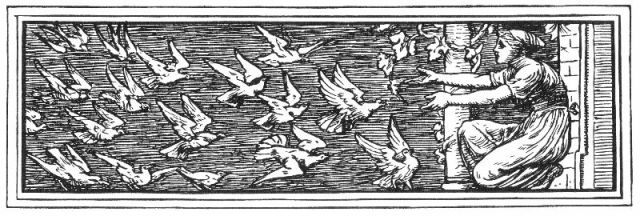
Then there came to the kitchen-window two white doves, and after them some turtle-doves, and at last a crowd of all the birds under heaven, chirping and fluttering, and they alighted among the ashes; and the doves nodded with their heads, and began to pick, peck, pick, peck, and then all the others began to pick, peck, pick, peck, and put all the good grains into the dish. Before an hour was over all was done, and they flew away. Then the maiden brought the dish to her step-mother, feeling joyful, and thinking that now she should go to the feast; but the step-mother said,
"No, Aschenputtel, you have no proper clothes, and you do not know how to dance, and you would be laughed at!"
And when Aschenputtel cried for disappointment, she added,
"If you can pick two dishes full of lentils out of the ashes, nice and clean, you shall go with us," thinking to herself, "for that is not possible." When she had strewed two dishes full of lentils among the ashes the maiden went through the back-door into the garden, and cried,
"O gentle doves, O turtle-doves, And all the birds that be, The lentils that in ashes lie Come and pick up for me! The good must be put in the dish, The bad you may eat if you wish."
So there came to the kitchen-window two white doves, and then some turtle-doves, and at last a crowd of all the other birds under heaven, chirping and fluttering, and they alighted among the ashes, and the doves nodded with their heads and began to pick, peck, pick, peck, and then all the others began to pick, peck, pick, peck, and put all the good grains into the dish. And before half-an-hour was over it was all done, and they flew away. Then the maiden took the dishes to the step-mother, feeling joyful, and thinking that now she should go with them to the feast; but she said "All this is of no good to you; you cannot come with us, for you have no proper clothes, and cannot dance; you would put us to shame."
Then she turned her back on poor Aschenputtel, and made haste to set out with her two proud daughters.
And as there was no one left in the house, Aschenputtel went to her mother's grave, under the hazel bush, and cried,
"Little tree, little tree, shake over me, That silver and gold may come down and cover me."
Then the bird threw down a dress of gold and silver, and a pair of slippers embroidered with silk and silver. And in all haste she put on the dress and went to the festival. But her step-mother and sisters did not know her, and thought she must be a foreign princess, she looked so beautiful in her golden dress. Of Aschenputtel they never thought at all, and supposed that she was sitting at home, and picking the lentils out of the ashes. The King's son came to meet her, and took her by the hand and danced with her, and he refused to stand up with any one else, so that he might not be obliged to let go her hand; and when any one came to claim it he answered,
"She is my partner."
And when the evening came she wanted to go home, but the prince said he would go with her to take care of her, for he wanted to see where the beautiful maiden lived. But she escaped him, and jumped up into the pigeon-house. Then the prince waited until the father came, and told him the strange maiden had jumped into the pigeon-house. The father thought to himself,
"It cannot surely be Aschenputtel," and called for axes and hatchets, and had the pigeon-house cut down, but there was no one in it. And when they entered the house there sat Aschenputtel in her dirty clothes among the cinders, and a little oil-lamp burnt dimly in the chimney; for Aschenputtel had been very quick, and had jumped out of the pigeon-house again, and had run to the hazel bush; and there she had taken off her beautiful dress and had laid it on the grave, and the bird had carried it away again, and then she had put on her little gray kirtle again, and had sat down in the kitchen among the cinders.
The next day, when the festival began anew, and the parents and step-sisters had gone to it, Aschenputtel went to the hazel bush and cried,
"Little tree, little tree, shake over me, That silver and gold may come down and cover me."
Then the bird cast down a still more splendid dress than on the day before. And when she appeared in it among the guests every one was astonished at her beauty. The prince had been waiting until she came, and he took her hand and danced with her alone. And when any one else came to invite her he said,
"She is my partner."
And when the evening came she wanted to go home, and the prince followed her, for he wanted to see to what house she belonged; but she broke away from him, and ran into the garden at the back of the house. There stood a fine large tree, bearing splendid pears; she leapt as lightly as a squirrel among the branches, and the prince did not know what had become of her. So he waited until the father came, and then he told him that the strange maiden had rushed from him, and that he thought she had gone up into the pear-tree. The father thought to himself,
"It cannot surely be Aschenputtel," and called for an axe, and felled the tree, but there was no one in it. And when they went into the kitchen there sat Aschenputtel among the cinders, as usual, for she had got down the other side of the tree, and had taken back her beautiful clothes to the bird on the hazel bush, and had put on her old gray kirtle again.
On the third day, when the parents and the step-children had set off, Aschenputtel went again to her mother's grave, and said to the tree,
"Little tree, little tree, shake over me, That silver and gold may come down and cover me."
Then the bird cast down a dress, the like of which had never been seen for splendour and brilliancy, and slippers that were of gold.
And when she appeared in this dress at the feast nobody knew what to say for wonderment. The prince danced with her alone, and if any one else asked her he answered,
"She is my partner."
And when it was evening Aschenputtel wanted to go home, and the prince was about to go with her, when she ran past him so quickly that he could not follow her. But he had laid a plan, and had caused all the steps to be spread with pitch, so that as she rushed down them the left shoe of the maiden remained sticking in it. The prince picked it up, and saw that it was of gold, and very small and slender. The next morning he went to the father and told him that none should be his bride save the one whose foot the golden shoe should fit. Then the two sisters were very glad, because they had pretty feet. The eldest went to her room to try on the shoe, and her mother stood by. But she could not get her great toe into it, for the shoe was too small; then her mother handed her a knife, and said,
"Cut the toe off, for when you are queen you will never have to go on foot." So the girl cut her toe off, squeezed her foot into the shoe, concealed the pain, and went down to the prince. Then he took her with him on his horse as his bride, and rode off. They had to pass by the grave, and there sat the two pigeons on the hazel bush, and cried,
"There they go, there they go! There is blood on her shoe; The shoe is too small, —Not the right bride at all!"
Then the prince looked at her shoe, and saw the blood flowing. And he turned his horse round and took the false bride home again, saying she was not the right one, and that the other sister must try on the shoe. So she went into her room to do so, and got her toes comfortably in, but her heel was too large. Then her mother handed her the knife, saying, "Cut a piece off your heel; when you are queen you will never have to go on foot."
So the girl cut a piece off her heel, and thrust her foot into the shoe, concealed the pain, and went down to the prince, who took his bride before him on his horse and rode off. When they passed by the hazel bush the two pigeons sat there and cried,
"There they go, there they go! There is blood on her shoe; The shoe is too small, —Not the right bride at all!"
Then the prince looked at her foot, and saw how the blood was flowing from the shoe, and staining the white stocking. And he turned his horse round and brought the false bride home again.
"This is not the right one," said he, "have you no other daughter?"
"No," said the man, "only my dead wife left behind her a little stunted Aschenputtel; it is impossible that she can be the bride." But the King's son ordered her to be sent for, but the mother said,
"Oh no! she is much too dirty, I could not let her be seen."
But he would have her fetched, and so Aschenputtel had to appear.
First she washed her face and hands quite clean, and went in and curtseyed to the prince, who held out to her the golden shoe. Then she sat down on a stool, drew her foot out of the heavy wooden shoe, and slipped it into the golden one, which fitted it perfectly. And when she stood up, and the prince looked in her face, he knew again the beautiful maiden that had danced with him, and he cried,
"This is the right bride!"
The step-mother and the two sisters were thunderstruck, and grew pale with anger; but he put Aschenputtel before him on his horse and rode off. And as they passed the hazel bush, the two white pigeons cried,
"There they go, there they go! No blood on her shoe; The shoe's not too small, The right bride is she after all."
And when they had thus cried, they came flying after and perched on Aschenputtel's shoulders, one on the right, the other on the left, and so remained.
And when her wedding with the prince was appointed to be held the false sisters came, hoping to curry favour, and to take part in the festivities. So as the bridal procession went to the church, the eldest walked on the right side and the younger on the left, and the pigeons picked out an eye of each of them. And as they returned the elder was on the left side and the younger on the right, and the pigeons picked out the other eye of each of them. And so they were condemned to go blind for the rest of their days because of their wickedness and falsehood.
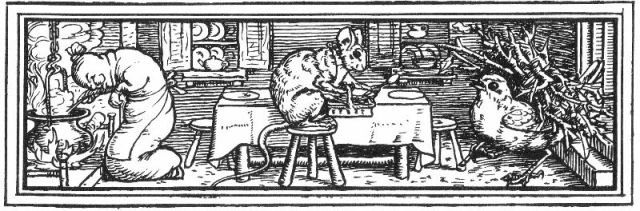

Once on a time, a mouse and a bird and a sausage lived and kept house together in perfect peace among themselves, and in great prosperity. It was the bird's business to fly to the forest every day and bring back wood. The mouse had to draw the water, make the fire, and set the table; and the sausage had to do the cooking. Nobody is content in this world: much will have more! One day the bird met another bird on the way, and told him of his excellent condition in life. But the other bird called him a poor simpleton to do so much work, while the two others led easy lives at home.
When the mouse had made up her fire and drawn water, she went to rest in her little room until it was time to lay the cloth. The sausage stayed by the saucepans, looked to it that the victuals were well cooked, and just before dinner-time he stirred the broth or the stew three or four times well round himself, so as to enrich and season and flavour it. Then the bird used to come home and lay down his load, and they sat down to table, and after a good meal they would go to bed and sleep their fill till the next morning. It really was a most satisfactory life.
But the bird came to the resolution next day never again to fetch wood: he had, he said, been their slave long enough, now they must change about and make a new arrangement So in spite of all the mouse and the sausage could say, the bird was determined to have his own way. So they drew lots to settle it, and it fell so that the sausage was to fetch wood, the mouse was to cook, and the bird was to draw water.
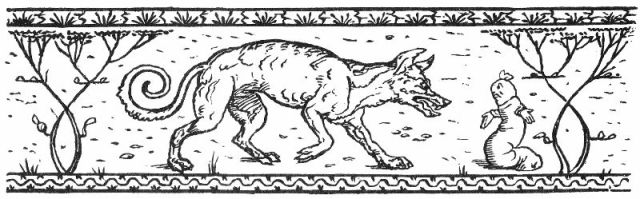
Now see what happened. The sausage went away after wood, the bird made up the fire, and the mouse put on the pot, and they waited until the sausage should come home, bringing the wood for the next day. But the sausage was absent so long, that they thought something must have happened to him, and the bird went part of the way to see if he could see anything of him. Not far off he met with a dog on the road, who, looking upon the sausage as lawful prey, had picked him up, and made an end of him. The bird then lodged a complaint against the dog as an open and flagrant robber, but it was all no good, as the dog declared that he had found forged letters upon the sausage, so that he deserved to lose his life.
The bird then very sadly took up the wood and carried it home himself, and related to the mouse all he had seen and heard. They were both very troubled, but determined to look on the bright side of things, and still to remain together. And so the bird laid the cloth, and the mouse prepared the food, and finally got into the pot, as the sausage used to do, to stir and flavour the broth, but then she had to part with fur and skin, and lastly with life!
And when the bird came to dish up the dinner, there was no cook to be seen; and he turned over the heap of wood, and looked and looked, but the cook never appeared again. By accident the wood caught fire, and the bird hastened to fetch water to put it out, but he let fall the bucket in the well, and himself after it, and as he could not get out again, he was obliged to be drowned.

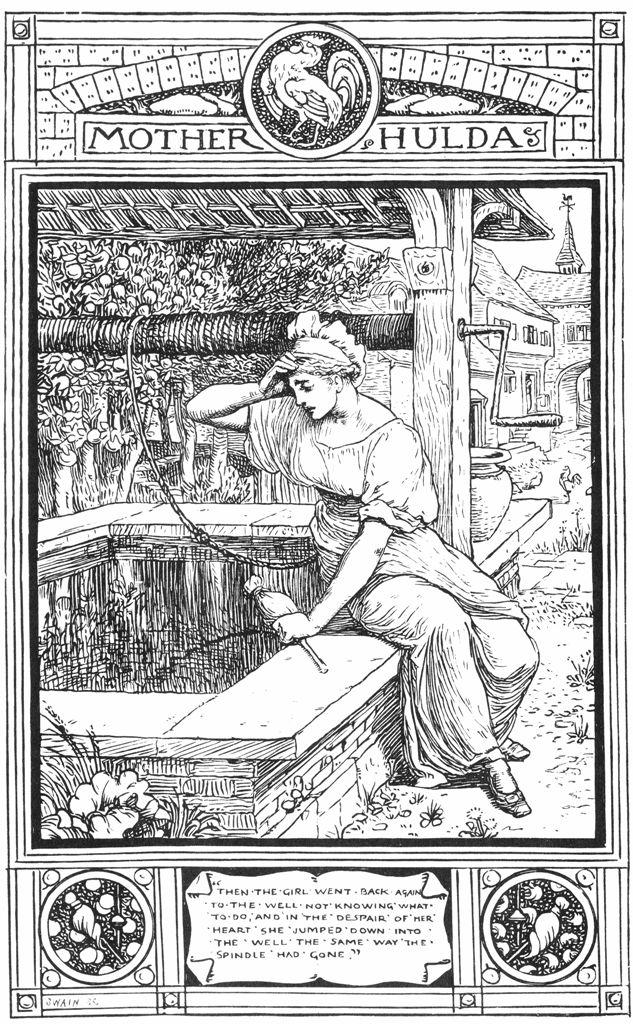
A widow had two daughters; one was pretty and industrious, the other was ugly and lazy. And as the ugly one was her own daughter, she loved her much the best, and the pretty one was made to do all the work, and be the drudge of the house. Every day the poor girl had to sit by a well on the high road and spin until her fingers bled. Now it happened once that as the spindle was bloody, she dipped it into the well to wash it; but it slipped out of her hand and fell in. Then she began to cry, and ran to her step-mother, and told her of her misfortune; and her step-mother scolded her without mercy, and said in her rage,
"As you have let the spindle fall in, you must go and fetch it out again!"
Then the girl went back again to the well, not knowing what to do, and in the despair of her heart she jumped down into the well the same way the spindle had gone. After that she knew nothing; and when she came to herself she was in a beautiful meadow, and the sun was shining on the flowers that grew round her. And she walked on through the meadow until she came to a baker's oven that was full of bread; and the bread called out to her,
"Oh, take me out, take me out, or I shall burn; I am baked enough already!"
Then she drew near, and with the baker's peel she took out all the loaves one after the other. And she went farther on till she came to a tree weighed down with apples, and it called out to her,
"Oh, shake me, shake me, we apples are all of us ripe!"
Then she shook the tree until the apples fell like rain, and she shook until there were no more to fall; and when she had gathered them together in a heap, she went on farther. At last she came to a little house, and an old woman was peeping out of it, but she had such great teeth that the girl was terrified and about to run away, only the old woman called her back.
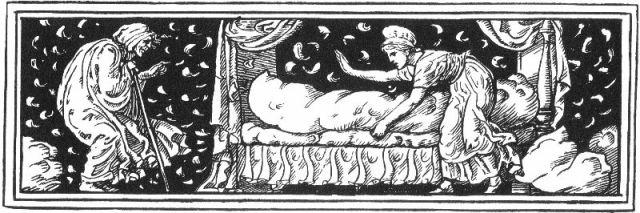
"What are you afraid of, my dear child? Come and live with me, and if you do the house-work well and orderly, things shall go well with you. You must take great pains to make my bed well, and shake it up thoroughly, so that the feathers fly about, and then in the world it snows, for I am Mother Hulda."[A]
As the old woman spoke so kindly, the girl took courage, consented, and went to her work. She did everything to the old woman's satisfaction, and shook the bed with such a will that the feathers flew about like snow-flakes: and so she led a good life, had never a cross word, but boiled and roast meat every day. When she had lived a long time with Mother Hulda, she began to feel sad, not knowing herself what ailed her; at last she began to think she must be home-sick; and although she was a thousand times better off than at home where she was, yet she had a great longing to go home. At last she said to her mistress,
"I am home-sick, and although I am very well off here, I cannot stay any longer; I must go back to my own home."
Mother Hulda answered,
"It pleases me well that you should wish to go home, and, as you have served me faithfully, I will undertake to send you there!"
She took her by the hand and led her to a large door standing open, and as she was passing through it there fell upon her a heavy shower of gold, and the gold hung all about her, so that she was covered with it.
"All this is yours, because you have been so industrious," said Mother Hulda; and, besides that, she returned to her her spindle, the very same that she had dropped in the well. And then the door was shut again, and the girl found herself back again in the world, not far from her mother's house; and as she passed through the yard the cock stood on the top of the well and cried,
"Cock-a-doodle doo! Our golden girl has come home too!"
Then she went in to her mother, and as she had returned covered with gold she was well received.
So the girl related all her history, and what had happened to her, and when the mother heard how she came to have such great riches she began to wish that her ugly and idle daughter might have the same good fortune. So she sent her to sit by the well and spin; and in order to make her spindle bloody she put her hand into the thorn hedge. Then she threw the spindle into the well, and jumped in herself. She found herself, like her sister, in the beautiful meadow, and followed the same path, and when she came to the baker's oven, the bread cried out,
"Oh, take me out, take me out, or I shall burn; I am quite done already!"
But the lazy-bones answered,
"I have no desire to black my hands," and went on farther. Soon she came to the apple-tree, who called out,
"Oh, shake me, shake me, we apples are all of us ripe!"
But she answered,
"That is all very fine; suppose one of you should fall on my head," and went on farther. When she came to Mother Hulda's house she did not feel afraid, as she knew beforehand of her great teeth, and entered into her service at once. The first day she put her hand well to the work, and was industrious, and did everything Mother Hulda bade her, because of the gold she expected; but the second day she began to be idle, and the third day still more so, so that she would not get up in the morning. Neither did she make Mother Hulda's bed as it ought to have been made, and did not shake it for the feathers to fly about. So that Mother Hulda soon grew tired of her, and gave her warning, at which the lazy thing was well pleased, and thought that now the shower of gold was coming; so Mother Hulda led her to the door, and as she stood in the doorway, instead of the shower of gold a great kettle full of pitch was emptied over her.
"That is the reward for your service," said Mother Hulda, and shut the door. So the lazy girl came home all covered with pitch, and the cock on the top of the well seeing her, cried,
"Cock-a-doodle doo! Our dirty girl has come home too!"
And the pitch remained sticking to her fast, and never, as long as she lived, could it be got off.
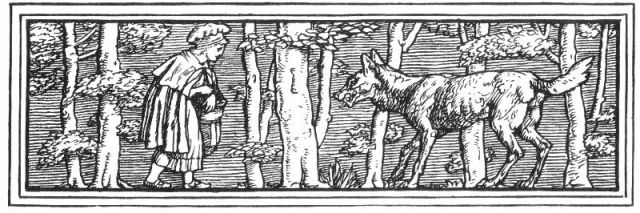


There was once a sweet little maid, much beloved by everybody, but most of all by her grandmother, who never knew how to make enough of her. Once she sent her a little cap of red velvet, and as it was very becoming to her, and she never wore anything else, people called her Little Red-cap. One day her mother said to her,
"Come, Little Red-cap, here are some cakes and a flask of wine for you to take to grandmother; she is weak and ill, and they will do her good. Make haste and start before it grows hot, and walk properly and nicely, and don't run, or you might fall and break the flask of wine, and there would be none left for grandmother. And when you go into her room, don't forget to say, Good morning, instead of staring about you."
"I will be sure to take care," said Little Red-cap to her mother, and gave her hand upon it. Now the grandmother lived away in the wood, half-an-hour's walk from the village; and when Little Red-cap had reached the wood, she met the wolf; but as she did not know what a bad sort of animal he was, she did not feel frightened.
"Good day, Little Red-cap," said he.
"Thank you kindly, Wolf," answered she.
"Where are you going so early, Little Red-cap?"
"To my grandmother's."
"What are you carrying under your apron?"
"Cakes and wine; we baked yesterday; and my grandmother is very weak and ill, so they will do her good, and strengthen her."
"Where does your grandmother live, Little Red-cap?"
"A quarter of an hour's walk from here; her house stands beneath the three oak trees, and you may know it by the hazel bushes," said Little Red-cap. The wolf thought to himself,
"That tender young thing would be a delicious morsel, and would taste better than the old one; I must manage somehow to get both of them."
Then he walked by Little Red-cap a little while, and said,
"Little Red-cap, just look at the pretty flowers that are growing all round you, and I don't think you are listening to the song of the birds; you are posting along just as if you were going to school, and it is so delightful out here in the wood."
Little Red-cap glanced round her, and when she saw the sunbeams darting here and there through the trees, and lovely flowers everywhere, she thought to herself,
"If I were to take a fresh nosegay to my grandmother she would be very pleased, and it is so early in the day that I shall reach her in plenty of time;" and so she ran about in the wood, looking for flowers. And as she picked one she saw a still prettier one a little farther off, and so she went farther and farther into the wood. But the wolf went straight to the grandmother's house and knocked at the door.
"Who is there?" cried the grandmother.
"Little Red-cap," he answered, "and I have brought you some cake and wine. Please open the door."
"Lift the latch," cried the grandmother; "I am too feeble to get up."
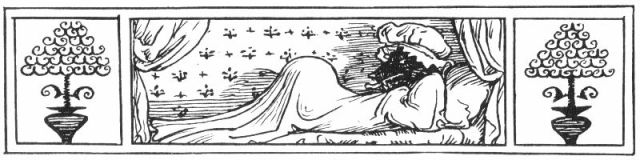
So the wolf lifted the latch, and the door flew open, and he fell on the grandmother and ate her up without saying one word. Then he drew on her clothes, put on her cap, lay down in her bed, and drew the curtains.
Little Red-cap was all this time running about among the flowers, and when she had gathered as many as she could hold, she remembered her grandmother, and set off to go to her. She was surprised to find the door standing open, and when she came inside she felt very strange, and thought to herself,
"Oh dear, how uncomfortable I feel, and I was so glad this morning to go to my grandmother!"
And when she said, "Good morning," there was no answer. Then she went up to the bed and drew back the curtains; there lay the grandmother with her cap pulled over her eyes, so that she looked very odd.
"O grandmother, what large ears you have got!"
"The better to hear with."
"O grandmother, what great eyes you have got!"
"The better to see with."
"O grandmother, what large hands you have got!"
"The better to take hold of you with."
"But, grandmother, what a terrible large mouth you have got!"
"The better to devour you!" And no sooner had the wolf said it than he made one bound from the bed, and swallowed up poor Little Red-cap.
Then the wolf, having satisfied his hunger, lay down again in the bed, went to sleep, and began to snore loudly. The huntsman heard him as he was passing by the house, and thought,
"How the old woman snores—I had better see if there is anything the matter with her."
Then he went into the room, and walked up to the bed, and saw the wolf lying there.
"At last I find you, you old sinner!" said he; "I have been looking for you a long time." And he made up his mind that the wolf had swallowed the grandmother whole, and that she might yet be saved. So he did not fire, but took a pair of shears and began to slit up the wolf's body. When he made a few snips Little Red-cap appeared, and after a few more snips she jumped out and cried, "Oh dear, how frightened I have been! it is so dark inside the wolf." And then out came the old grandmother, still living and breathing. But Little Red-cap went and quickly fetched some large stones, with which she filled the wolf's body, so that when he waked up, and was going to rush away, the stones were so heavy that he sank down and fell dead.
They were all three very pleased. The huntsman took off the wolf's skin, and carried it home. The grandmother ate the cakes, and drank the wine, and held up her head again, and Little Red-cap said to herself that she would never more stray about in the wood alone, but would mind what her mother told her.
It must also be related how a few days afterwards, when Little Red-cap was again taking cakes to her grandmother, another wolf spoke to her, and wanted to tempt her to leave the path; but she was on her guard, and went straight on her way, and told her grandmother how that the wolf had met her, and wished her good-day, but had looked so wicked about the eyes that she thought if it had not been on the high road he would have devoured her.
"Come," said the grandmother, "we will shut the door, so that he may not get in."
Soon after came the wolf knocking at the door, and calling out, "Open the door, grandmother, I am Little Red-cap, bringing you cakes." But they remained still, and did not open the door. After that the wolf slunk by the house, and got at last upon thereof to wait until Little Red-cap should return home in the evening; then he meant to spring down upon her, and devour her in the darkness. But the grandmother discovered his plot. Now there stood before the house a great stone trough, and the grandmother said to the child, "Little Red-cap, I was boiling sausages yesterday, so take the bucket, and carry away the water they were boiled in, and pour it into the trough."
And Little Red-cap did so until the great trough was quite full. When the smell of the sausages reached the nose of the wolf he snuffed it up, and looked round, and stretched out his neck so far that he lost his balance and began to slip, and he slipped down off the roof straight into the great trough, and was drowned. Then Little Red-cap went cheerfully home, and came to no harm.

There was once an ass whose master had made him carry sacks to the mill for many a long year, but whose strength began at last to fail, so that each day as it came found him less capable of work. Then his master began to think of turning him out, but the ass, guessing that something was in the wind that boded him no good, ran away, taking the road to Bremen; for there he thought he might get an engagement as town musician. When he had gone a little way he found a hound lying by the side of the road panting, as if he had run a long way.
"Now, Holdfast, what are you so out of breath about?" said the ass.
"Oh dear!" said the dog, "now I am old, I get weaker every day, and can do no good in the hunt, so, as my master was going to have me killed, I have made my escape; but now, how am I to gain a living?"
"I will tell you what," said the ass, "I am going to Bremen to become town musician. You may as well go with me, and take up music too. I can play the lute, and you can beat the drum."
And the dog consented, and they walked on together. It was not long before they came to a cat sitting in the road, looking as dismal as three wet days.
"Now then, what is the matter with you, old shaver?" said the ass.
"I should like to know who would be cheerful when his neck is in danger?" answered the cat. "Now that I am old my teeth are getting blunt, and I would rather sit by the oven and purr than run about after mice, and my mistress wanted to drown me; so I took myself off; but good advice is scarce, and I do not know what is to become of me."
"Go with us to Bremen," said the ass, "and become town musician. You understand serenading."
The cat thought well of the idea, and went with them accordingly. After that the three travellers passed by a yard, and a cock was perched on the gate crowing with all his might.
"Your cries are enough to pierce bone and marrow," said the ass; "what is the matter?"
"I have foretold good weather for Lady-day, so that all the shirts may be washed and dried; and now on Sunday morning company is coming, and the mistress has told the cook that I must be made into soup, and this evening my neck is to be wrung, so that I am crowing with all my might while I can."
"You had much better go with us, Chanticleer," said the ass. "We are going to Bremen. At any rate that will be better than dying. You have a powerful voice, and when we are all performing together it will have a very good effect."
So the cock consented, and they went on all four together.
But Bremen was too far off to be reached in one day, and towards evening they came to a wood, where they determined to pass the night. The ass and the dog lay down under a large tree; the cat got up among the branches, and the cock flew up to the top, as that was the safest place for him. Before he went to sleep he looked all round him to the four points of the compass, and perceived in the distance a little light shining, and he called out to his companions that there must be a house not far off, as he could see a light, so the ass said,
"We had better get up and go there, for these are uncomfortable quarters." The dog began to fancy a few bones, not quite bare, would do him good. And they all set off in the direction of the light, and it grew larger and brighter, until at last it led them to a robber's house, all lighted up. The ass, being the biggest, went up to the window, and looked in.
"Well, what do you see?" asked the dog.
"What do I see?" answered the ass; "here is a table set out with splendid eatables and drinkables, and robbers sitting at it and making themselves very comfortable."
"That would just suit us," said the cock.
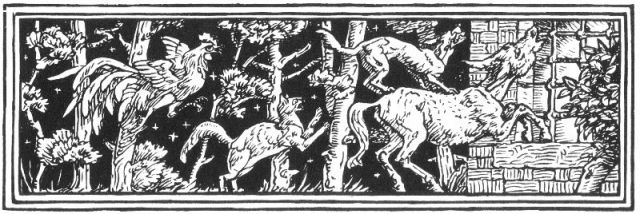
"Yes, indeed, I wish we were there," said the ass. Then they consulted together how it should be managed so as to get the robbers out of the house, and at last they hit on a plan. The ass was to place his forefeet on the window-sill, the dog was to get on the ass's back, the cat on the top of the dog, and lastly the cock was to fly up and perch on the cat's head. When that was done, at a given signal they all began to perform their music. The ass brayed, the dog barked, the cat mewed, and the cock crowed; then they burst through into the room, breaking all the panes of glass. The robbers fled at the dreadful sound; they thought it was some goblin, and fled to the wood in the utmost terror. Then the four companions sat down to table, made free with the remains of the meal, and feasted as if they had been hungry for a month. And when they had finished they put out the lights, and each sought out a sleeping-place to suit his nature and habits. The ass laid himself down outside on the dunghill, the dog behind the door, the cat on the hearth by the warm ashes, and the cock settled himself in the cockloft, and as they were all tired with their long journey they soon fell fast asleep.
When midnight drew near, and the robbers from afar saw that no light was burning, and that everything appeared quiet, their captain said to them that he thought that they had run away without reason, telling one of them to go and reconnoitre. So one of them went, and found everything quite quiet; he went into the kitchen to strike a light, and taking the glowing fiery eyes of the cat for burning coals, he held a match to them in order to kindle it. But the cat, not seeing the joke, flew into his face, spitting and scratching. Then he cried out in terror, and ran to get out at the back door, but the dog, who was lying there, ran at him and bit his leg; and as he was rushing through the yard by the dunghill the ass struck out and gave him a great kick with his hindfoot; and the cock, who had been wakened with the noise, and felt quite brisk, cried out, "Cock-a-doodle-doo!"
Then the robber got back as well as he could to his captain, and said, "Oh dear! in that house there is a grewsome witch, and I felt her breath and her long nails in my face; and by the door there stands a man who stabbed me in the leg with a knife; and in the yard there lies a black spectre, who beat me with his wooden club; and above, upon the roof, there sits the justice, who cried, 'Bring that rogue here!' And so I ran away from the place as fast as I could."
From that time forward the robbers never ventured to that house, and the four Bremen town musicians found themselves so well off where they were, that there they stayed. And the person who last related this tale is still living, as you see.

One day, Hans's mother said,
"Where are you going, Hans?"
Hans answered,
"To Grethel's, mother."
"Manage well, Hans."
"All right! Good-bye, mother."
"Good-bye, Hans."
Then Hans came to Grethel's.
"Good morning, Grethel."
"Good morning, Hans. What have you brought me to-day?"
"I have brought nothing, but I want something."
So Grethel gave Hans a needle; and then he said,
"Good-bye, Grethel," and she said, "Good-bye, Hans."
Hans carried the needle away with him, and stuck it in a hay-cart that was going along, and he followed it home.
"Good evening, mother."
"Good evening, Hans. Where have you been?"
"To Grethel's, mother."
"What did you take her?"
"I took nothing, but I brought away something."
"What did Grethel give you?"
"A needle, mother."
"What did you do with it, Hans?"
"Stuck it in the hay-cart."
"That was very stupid of you, Hans. You should have stuck it in your sleeve."
"All right, mother! I'll do better next time."
When next time came, Hans's mother said,
"Where are you going, Hans?"
"To Grethel's, mother."
"Manage well, Hans."
"All right! Good-bye, mother."
"Good-bye, Hans."
Then Hans came to Grethel.
"Good morning, Grethel."
"Good morning, Hans. What have you brought me to-day?"
"I've brought nothing, but I want something."
So Grethel gave Hans a knife, and then he said, "Good-bye, Grethel," and she said, "Good-bye, Hans."
Hans took the knife away with him, and stuck it in his sleeve, and went home.
"Good evening, mother."
"Good evening, Hans. Where have you been?"
"To Grethel's."
"What did you take her?"
"I took nothing, but I brought away something."
"What did Grethel give you, Hans?"
"A knife, mother."
"What did you do with it, Hans?"
"Stuck it in my sleeve, mother."
"That was very stupid of you, Hans. You should have put it in your pocket."
"All right, mother! I'll do better next time."
When next time came, Hans's mother said,
"Where to, Hans?"
"To Grethel's, mother."
"Manage well, Hans."
"All right! Good-bye, mother."
"Good-bye, Hans."
So Hans came to Grethel's. "Good morning, Grethel."
"Good morning, Hans. What have you brought me to-day?"
"I've brought nothing, but I want to take away something."
So Grethel gave Hans a young goat; then he said,
"Good-bye, Grethel," and she said, "Good-bye, Hans."
So Hans carried off the goat, and tied its legs together, and put it in his pocket, and by the time he got home it was suffocated.
"Good evening, mother."
"Good evening, Hans. Where have you been?"
"To Grethel's, mother."
"What did you take her, Hans?"
"I took nothing, but I brought away something."
"What did Grethel give you, Hans?"
"A goat, mother."
"What did you do with it, Hans?"
"Put it in my pocket, mother."
"That was very stupid of you, Hans. You should have tied a cord round its neck, and led it home."
"All right, mother! I'll do better next time."
Then when next time came,
"Where to, Hans?"
"To Grethel's, mother."
"Manage well, Hans."
"All right! Good-bye, mother."
"Good-bye, Hans."
Then Hans came to Grethel's.
"Good morning, Grethel."
"Good morning, Hans. What have you brought me to-day?"
"I've brought nothing, but I want to take away something."
So Grethel gave Hans a piece of bacon. Then he said, "Good-bye, Grethel."
She said, "Good-bye, Hans."
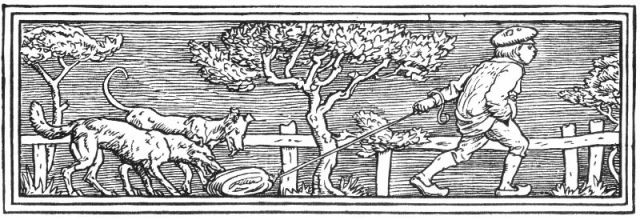
Hans took the bacon, and tied a string round it, and dragged it after him on his way home, and the dogs came and ate it up, so that when he got home he had the string in his hand, and nothing at the other end of it.
"Good evening, mother."
"Good evening, Hans. Where have you been?"
"To Grethel's, mother."
"What did you take her, Hans?"
"I took her nothing, but I brought away something."
"What did Grethel give you, Hans?"
"A piece of bacon, mother."
"What did you do with it, Hans?"
"I tied a piece of string to it, and led it home, but the dogs ate it, mother."
"That was very stupid of you, Hans. You ought to have carried it on your head."
"All right! I'll do better next time, mother."
When next time came,
"Where to, Hans?"
"To Grethel's, mother."
"Manage well, Hans."
"All right! Good-bye, mother."
"Good-bye, Hans."
Then Hans came to Grethel's.
"Good morning, Grethel."
"Good morning, Hans. What have you brought me?"
"I have brought nothing, but I want to take away something."
So Grethel gave Hans a calf.
"Good-bye, Grethel."
"Good-bye, Hans."
Hans took the calf, and set it on his head, and carried it home, and the calf scratched his face.
"Good evening, mother."
"Good evening, Hans. Where have you been?"
"To Grethel's, mother."
"What did you take her?"
"I took nothing, but I brought away something."
"What did Grethel give you, Hans?"
"A calf, mother."
"What did you do with the calf, Hans?"
"I carried it home on my head, but it scratched my face."
"That was very stupid of you, Hans. You ought to have led home the calf, and tied it to the manger."
"All right! I'll do better next time, mother."
When next time came,
"Where to, Hans?"
"To Grethel's, mother."
"Manage well, Hans."
"All right, mother! Good-bye."
"Good-bye, Hans."
Then Hans came to Grethel's.
"Good morning, Grethel."
"Good morning, Hans. What have you brought me to-day?"
"I have brought nothing, but I want to take away something."
Then Grethel said to Hans,
"You shall take away me."
Then Hans took Grethel, and tied a rope round her neck, and led her home, and fastened her up to the manger, and went to his mother.
"Good evening, mother."
"Good evening, Hans. Where have you been?"
"To Grethel's, mother."
"What did you take her, Hans?"
"Nothing, mother."
"What did Grethel give you, Hans?"
"Nothing but herself, mother."
"Where have you left Grethel, Hans?"
"I led her home with a rope, and tied her up to the manger to eat hay, mother."
"That was very stupid of you, Hans. You should have cast sheep's eyes at her."
"All right, mother! I'll do better next time."
Then Hans went into the stable, and taking all the eyes out of the sheep, he threw them in Grethel's face. Then Grethel was angry, and getting loose, she ran away and became the bride of another.

There was once a man who had a daughter who was called "Clever Else," and when she was grown up, her father said she must be married, and her mother said,
"Yes, if we could only find some one that she would consent to have."
At last one came from a distance, and his name was Hans, and when he proposed to her, he made it a condition that Clever Else should be very careful as well.
"Oh," said the father, "she does not want for brains."
"No, indeed," said the mother, "she can see the wind coming up the street and hear the flies cough."
"Well," said Hans, "if she does not turn out to be careful too, I will not have her."
Now when they were all seated at table, and had well eaten, the mother said,
"Else, go into the cellar and draw some beer."
Then Clever Else took down the jug from the hook in the wall, and as she was on her way to the cellar she rattled the lid up and down so as to pass away the time. When she got there, she took a stool and stood it in front of the cask, so that she need not stoop and make her back ache with needless trouble. Then she put the jug under the tap and turned it, and while the beer was running, in order that her eyes should not be idle, she glanced hither and thither, and finally caught sight of a pickaxe that the workmen had left sticking in the ceiling just above her head. Then Clever Else began to cry, for she thought,
"If I marry Hans, and we have a child, and it grows big, and we send it into the cellar to draw beer, that pickaxe might fall on his head and kill him."
So there she sat and cried with all her might, lamenting the anticipated misfortune. All the while they were waiting upstairs for something to drink, and they waited in vain. At last the mistress said to the maid,
"Go down to the cellar and see why Else does not come."
So the maid went, and found her sitting in front of the cask crying with all her might.
"What are you crying for?" said the maid.
"Oh dear me," answered she, "how can I help crying? if I marry Hans, and we have a child, and it grows big, and we send it here to draw beer, perhaps the pickaxe may fall on its head and kill it."
"Our Else is clever indeed!" said the maid, and directly sat down to bewail the anticipated misfortune. After a while, when the people upstairs found that the maid did not return, and they were becoming more and more thirsty, the master said to the boy,
"You go down into the cellar, and see what Else and the maid are doing."
The boy did so, and there he found both Clever Else and the maid sitting crying together. Then he asked what was the matter.