PREFACE. (continued 3)
Reading edition
It was very late at night, and I returned with him to the hotel, where he had taken the girls, to see that they were all right, and while going there he told me that he had been delayed twenty-four hours at some junction between Indianapolis and Detroit, so that he had only reached Detroit that afternoon, and Miss Williams not wishing by any accident to meet my wife had gone to Buffalo to visit some theatrical friends, taking Howard with her. I did not think strange of this, for I knew Howard had known and liked Miss Williams the year before, when she was in my office in Chicago. The next day I engaged permanent board for both myself and wife, and also for the children, in two separate portions of the city, as I expected to remain there for some time, and enlisting Hatch’s services, we proceeded to look for a house that, if possible, could be bought in exchange for Chicago property, and by so doing save money.
If this could not be accomplished, then a house that should be rented for a few months, until such a trade could be made. A small house was found so favorably located, with school advantages for the children, that I thought it best to pay the small deposit required, five dollars, to hold it for a few days.
On Sunday morning Mrs. Pitezel came to Detroit, and I did not think it wise to tell her positively that she was to settle there until I should have heard again from both St. Louis and Chicago. During the interval, I had her board at a hotel; nor did I think it wise to tell her the other children were in the city, until I knew that no further move was to be made, lest she not understanding the danger of arrest—if such danger I should find still existing—she would be unwilling to go elsewhere, unless she supposed the children and her husband, or both, had already gone.
I had brought with me a package of papers from Chicago, which I did not care to carry in my own trunks, and it was arranged to conceal them in the house lately rented in Detroit. I took them there in company with Hatch, and proceeded to place them above the ceiling of the upper story, when he suggested that in case of fire they would be lost, and volunteered to prepare a place next day in the basement for their safe-keeping. And this he did by first buying a new shovel, and then making a small excavation in the earth, not using this shovel, as it afterward appeared, but another found in the basement.
Upon the morning of October 17th I received startling intelligence from both St. Louis and Chicago, and, upon holding a consultation, it was with reluctance that we decided to leave Detroit and go either to Canada or Europe; for I felt that any move, without regard to expenses, was better than to have Mrs. Pitezel arrested and myself as well. This day was a very busy one. Before Mrs. Pitezel left St. Louis I had bought a large trunk, which I loaned to her to carry part of her personal effects to her new house. When it was decided to make a move into other lands, I arranged with Hatch that, while I was busy about other matters, he should take the trunk to his room and repack it, and exclude a multitude of worthless articles, after having told Mrs. Pitezel that this was to be done.
It also became necessary to go to a city called Ypsilanti upon that same day to get a package of valuable papers I had ordered forwarded to me there, and, being so busy about other matters, I requested Hatch to make the trip for me. He hesitated considerably about doing it, saying he must see to repacking this trunk. I told him that I could better take the time to do this than to go to Ypsilanti. He replied that I could not well take it to his room, as I was not known to the people of whom he rented. I told him I would arrange it otherwise, and he then started for Ypsilanti.
At about one o’clock I found an expressman, and accompanying him to a feed store near by bought a flour barrel with the address of a party in Hartford, Conn., upon one end of it. We then drove to Mrs. Pitezel’s hotel and had the trunk taken to the depot. There, upon the platform, I took such worthless articles as Mrs. Pitezel had placed in a separate part of the trunk and put them in the barrel, and leaving the trunk at the depot had the expressman take the barrel to either the United States or American Express Company’s office, and ship it to Hartford, Conn. At about 2 p. m. I went to a livery stable on —— street, and hiring a horse and buggy drove to the house that had been rented and took the two girls with me for a drive. I entered the house and procured the papers I had previously left there. I also left a note instructing Hatch to the effect that if he came there from Ypsilanti with the other papers, not to bury them. I then drove to Hatch’s room and left a small note, and this accounts for the note being later found in the house where I directed the authorities to search.
Earlier in the same day Hatch and I visited several large stores, and at one obtained a $500 and two $200 bills, which, together with other small bills, making in all $1,000, which sum he took to Miss Williams to pay upon what was due her on the Fort Worth transaction. Before leaving Detroit, Hatch brought to the depot the new shovel wrapped in a paper, and wished to put it in the trunk, but upon my remarking that it seemed more useless than things I had just taken out to make more room, he said he had paid for it and did not care to throw it away.
The next morning my wife and I left Detroit for Toronto at 10 o’clock. Mrs. Pitezel and the two children started two hours later. The next morning Hatch took the two girls, Alice and Nellie, to the train and they made the journey to the same city alone twenty-four hours later, and over the same road I had come, while Hatch came to Toronto by the way of Buffalo, where he stopped to see Miss Williams.
I reached Toronto early Thursday evening, October 18th, and went at once to the Walker House. After taking dinner, I went to the station and met Mrs. Pitezel, taking her to a hotel near by, and returned to the Walker House for the night. Next morning we breakfasted at about 8.30. I visited Mrs. Pitezel at her hotel about a half hour, and then with my wife visited several fur stores, purchasing a fur cape and returned with her to the Walker House for the mid-day meal. Immediately thereafter we went for a long country drive, and did not return until about 6 p. m. I ate dinner and then, as upon the preceding evening, went to the station. This time I met the two girls, Alice and Nellie, with whom Hatch had started from Detroit that morning, as stated.
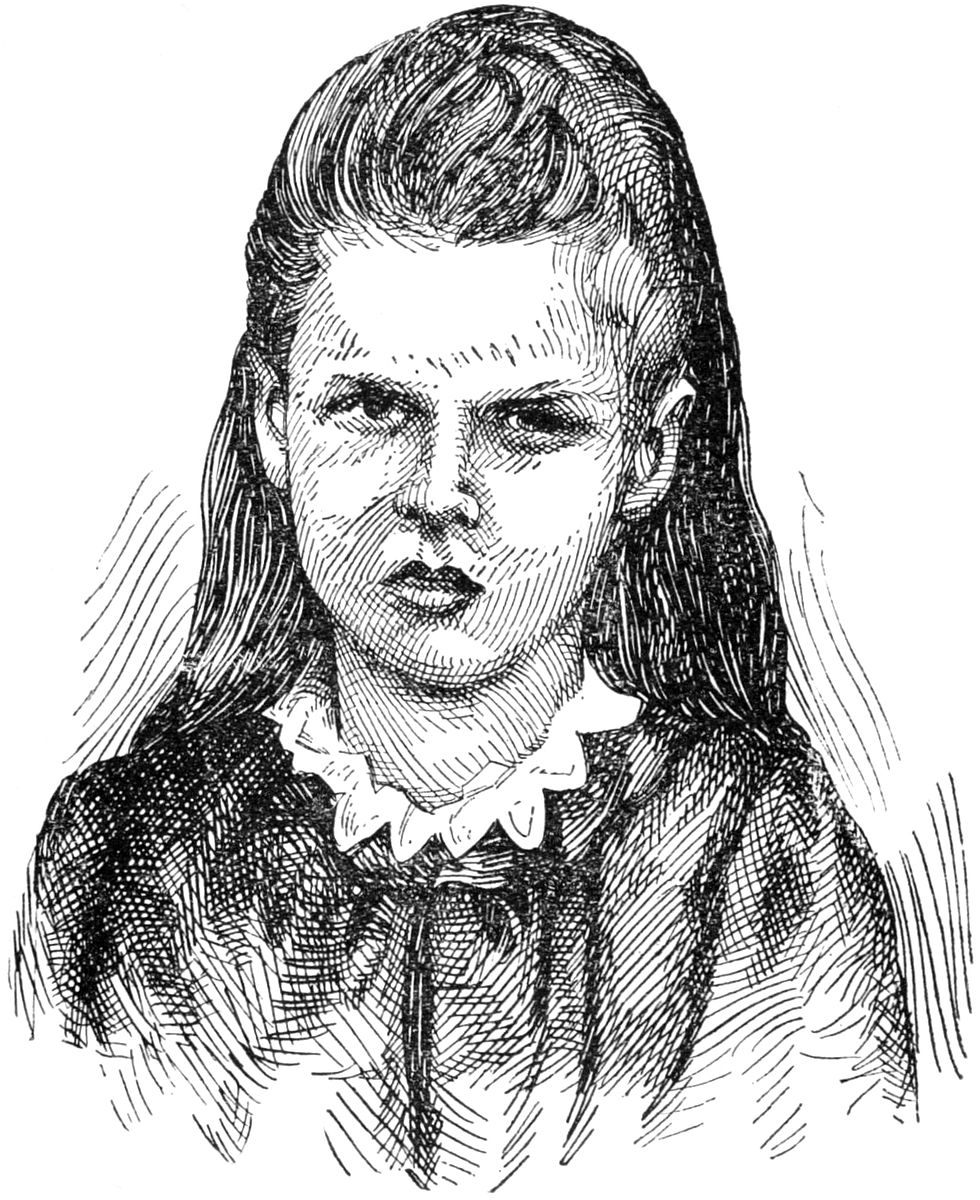
NELLIE PITEZEL
Upon their arrival I placed them in an omnibus running to the Albion Hotel, in care of the runner for that house, and returning to the Walker House had hardly time to prepare for the theatre, which I attended that evening with my wife. The next morning, after eating a late breakfast,[7] my first occupation upon this day was to go to the Hotel Albion and visit the children. I found them in their room, greatly interested in watching the immense open market across the street. I remained with them until almost, if not quite, 10 a. m. I then went to the post-office, making a few calls at some haberdashers on the way. I reached the post-office not later than 10.30, when I met Hatch, in accordance with an arrangement made before leaving Detroit. He had visited Miss Williams at Buffalo, upon the trip to Toronto; and, in answer to my inquiry, stated that the boy Howard was well, and that he had wanted to come to Toronto with him, but he had thought it best for him to wait and accompany Miss Williams if she came.
He then left me, as he stated, to find for himself a private room, agreeing to meet me at the same place at 2 p. m.
Now, in this short time between 10.30 a. m. and 2 p. m., it appears from the testimony recently taken in Toronto at an inquest, that a visit was made to a real estate agent then in a distant part of the city; a call was made upon the owner of the house at Vincent street of sufficient length to arrange for renting the property, and to enter into a detailed description of the family supposed to be the future tenants, and become well acquainted with the owner; then to take possession of the house, to call upon a neighbor and make their acquaintance as well, and, presumably, to eat a lunch at some restaurant, and buy a small amount of furniture for the house just hired. Add to this the almost certain probability that the lessee had visited other houses as well, it being hardly possible that he could have found a house at once so well adapted to the purpose as this seems to have been, and there is little time left for other work before 2 p. m. of the same day.
My movements during these same hours were as follows: Leaving Hatch at the post-office, I went to Mrs. Pitezel’s hotel, fully one mile away, stopping upon my way at the telegraph office for fully fifteen minutes, while a search was instituted in a different part of the building for undelivered telegrams. After making a short call at the hotel, I returned to the Walker House, went again to the fur store where our purchase of the day previous had been made (one of two stores located very near each other about two blocks west of the post-office and north of K street). Here fully one-half hour was taken up in the work done there, which included the purchase of two storm garments. We then went to King street, made several calls at furnishing stores and one large dry goods store, and then, after spending some time in selecting a good pocket compass, returned to the Walker House for lunch; to do which, and to write two letters, certainly occupied fully an hour, probably more.
I then went again to the Albion Hotel, stopping to buy the children some fruit and toys upon the way. At the appointed hour, I went to meet Hatch at the post-office. He was late in keeping his appointment, and I made several purchases in that neighborhood, and I think at this time selected the material and was measured for a suit of clothes at a custom tailor shop, upon the west side of Young street, near junction of the street leading to the post-office.
Upon meeting Hatch, I told him I was to be absent from the city on Sunday, and asked if he could see to the children while I was away, and if they wished to go for a street car ride, he would accompany them. This he agreed to do, and after making some further plans with him for the following week, I went to the Hotel Albion again and told the children of the arrangement made for their ride, then went to the furnishing store on King street kept by a man named Dickson, I think.
When I found the grade of goods I had been in search of, and after purchasing some, I returned to the Walker House with hardly time left to be shaved and go to Mrs. Pitezel’s hotel, to let her know I was to be out of the city the next day, and to catch the 4 or 4.30 train for Niagara Falls.
At this time my wife’s trunk and the large trunk from Detroit, were both at the Toronto Depot, and I asked that they be checked to Niagara. I remarked to the baggage agent that I had no need to take the large one, save to avoid storage. He asked how long I desired to leave it there, and I replied that was uncertain, but perhaps a week. He asked for a half dollar and said that there are no further charges if it was taken away in a week’s time. The trunk never left the Toronto Depot during my stay there. Sunday, October 21st, was passed by us at the Falls, returning to Toronto by the way of Hamilton in the early evening, at which time I went to the Palmer House.
During Monday I was busy about the city, returning to my hotel often during the day. Part of the time I was with Hatch searching for a suitable location in which he and Miss Williams could open a respectable massage establishment, if they all settled there, which was the real object of the Toronto trip, as I have reason to believe.
During the day he asked me if I would not spend Tuesday night with him in and about the city. I gave him to understand that I might do so. Tuesday morning we met, as had become our custom, at the post-office between 10 and 11 o’clock.
I received additional and disquieting messages from the West, and by noon-time we had made up our minds that the conditions favorable to the business we had hoped to find did not exist in Toronto, and had decided to go to England instead. Hatch particularly favored this plan, as they had had a prosperous business there during the foregoing year, and he at once wrote Miss Williams to that effect, and for her to meet the two girls at Niagara at as early a day as possible, which she was to appoint by letter.
She was to take the three children to London, while Mrs. Pitezel took the others there a little later on, or as soon as we could become settled again.
When Hatch again urged me to stay with him during the night, I finally told him that since my terrible experience of the year before, which the indirect results of my loose living had been Nannie Williams’ death, and more particularly since my marriage, I had endeavored to live a clean life, and thought best not to deviate in this instance. I returned to the Palmer House not later than 4.30 p. m. Later, in thinking the matter over, I thought, inasmuch as he had helped me so much during the preceding weeks, it seemed like ill-treatment towards him, and decided that if he brought the matter up next day I would spend a part of the evening with him.
Acting upon this decision, I told my wife next morning, Wednesday, that I might not return until late, but later in the day I reconsidered my former plan and returned to the Palmer House at about 2.30 p. m., and my wife being absent and the room locked at the time, I threw some flowers I had just bought into the room through the open transom, my wife finding them upon her return a short time later.
During the day I had been buying a quantity of small articles to send to my relatives in New Hampshire, and had gotten them together temporarily at the furnishing store previously mentioned. At noon-time I had eaten lunch with the children and in the afternoon Hatch had taken them for a drive. In the evening I accompanied my wife to the theatre, enjoying myself far more than the case would be had I been going about the city together with Hatch and a guilty conscience.
On Thursday, October 24th, the day when it is reasonable to suppose the two girls were killed, I was busy about the city during the forenoon. The girls came to the post-office at about 10.30, and either went with Hatch for a drive or a streetcar ride, they having been in Hatch’s care more than with me while in Toronto, for the reason that their hotel was so distant it encroached upon my time to ride to visit both them and Mrs. Pitezel and do what work I wished. That morning we heard that Miss Williams would meet the girls at Niagara upon the arrival of the afternoon train. They ate lunch with me between 1 and 2 o’clock, Hatch being elsewhere at the time. The girls returned to their hotel afterwards for a few minutes to change part of their attire for some that was warmer, which I had bought for them in anticipation of their sea voyage. Later they joined me again and I bought them a number of presents. I also bought Miss Williams a small brooch, which I gave to Alice, together with a note, which she was to deliver personally to Miss Williams.
My object in sending it in this way was that Hatch knew of our former relations, and I had avoided sending by him as he then claimed she was his wife. About half an hour before train time, which I think was 4.30 p. m., we were upon Young street. I sent the girls to a restaurant or bakery near by to get some lunch prepared to take with them upon the train, instructing them to then come to a large store which I pointed out to them, where I would await their arrival. I then entered this store and bought some small articles for the children, having in my hands at the time some underwear I had previously purchased to send to Howard, the boy, when I heard a familiar voice, and turning, saw Mrs. Pitezel and the other two children.
I quote from her recent statement, made in Toronto, as to what took place between us then, and state that it could only have been on this day, for while there I asked her if she could get ready to leave Toronto that evening:—
“I am convinced that my two children were right here in Toronto while I was here,” said Mrs. Pitezel. “One day while I was shopping in a large store here, I suddenly saw Holmes. He said you wait here a little while until I return. I believe my children were right there in that store at the time, and Holmes took them out some other way so I should not see them.”
As a matter of fact, they were at the bakery before spoken of, and I can only wish now that they had been with me, and met their mother, though at the time I should have considered it an unfortunate circumstance for the same reasons that obtained in Detroit.
I at once left the store and took the children to the depot, where Hatch met me with some bundles of goods he had bought. I took the children to the ladies’ waiting room and giving Alice $400, directed her to go into the private waiting room and fasten it securely within her dress, and later give it to Miss Williams. I also gave each of the girls a small amount of spending money. I wrote a telegram, directing it to myself at the hotel opposite the Palmer House, for Alice to send me early next morning from Niagara, if anything happened to prevent Miss Williams meeting them as had been agreed upon.
I also gave them explicit directions as to where to stay, and told them that I would surely go to them at once if any trouble arose. I then asked if they were afraid to go alone. Alice answered, “Oh, no; I wish you or Mr. Hatch were going along, though.” The train came so quickly that I had little time to bid them good-bye, and therefore got upon the train and accompanied them perhaps a mile to a station where the train slowed up; Hatch going still farther, at his suggestion, to see that the conductor took their tickets and agreed to transfer them at Hamilton to the right train.
I sat in the seat with Nellie during this time, Alice being in the seat in front. They spoke of their prospective voyage, gave me messages for their mother and the baby, and asked how long it would be before we all came to London. I told them to help Miss Williams all they could, and especially cautioned Nellie about quarreling with Howard, which she was apt to do when they were together, finally telling them that upon my arrival there the three who had not quarreled would receive a present of considerable value.
My opportunity to leave the train having now arrived, I hastily bade them good-bye, and started to leave the car. Little Nellie followed me to the door, and said, “Don’t forget about baby,” and reaching up kissed me good-bye, and ran back to the seat again. With all truthfulness, I most earnestly state that under the circumstances, and at this time, about 4.30 p. m., Thursday, October 25th, I last saw these children.
I immediately returned to the Palmer House, telling my wife we should leave the city next morning, and said to her that if she had any more purchases to make, she should attend to it at once, as certain of the stores closed early. For the next hour I was busy collecting my various purchases about the city, and taking them to the depot to place in the large trunk, and at not later than 6.30 Hatch was again at the depot, and stated that the conductor had taken the children in charge before he left the train. He then left me, agreeing to meet me early next morning at the hotel to learn if the children arrived all right. I then returned at once to the Palmer House and ate dinner.
Without delay I went to Mrs. Pitezel’s hotel, and assisted her in packing her trunk and having it taken to the train before 8 o’clock, the larger trunk going upon the same train; but Mrs. Pitezel and Dessie remarked to me later that they saw that trunk upon their arrival at Prescott early next morning, and a day later the Custom’s officer at Ogdensburg, during his inspection, came across the shovel Hatch had insisted in placing in it at Detroit, remarking that he did not know but that it was dutiable on account of being new.
If this trunk had been at the Vincent street house there would have been no necessity of one’s going to the neighbors to borrow a spade with which to conceal the evidence of the terrible crime committed there. I returned to the Palmer House before Mrs. Pitezel had started—not later than 8.15 p. m.—and during the evening aided my wife in her preparations for the next day’s journey; and only left the hotel before taking the train next morning at 8 o’clock, for about two minutes, to step across the street and ascertain if the girls had met Miss Williams, as was reasonable to suppose as no telegram was there. Hatch was waiting for me at the hotel, and said he should wait one or two days in Toronto to get his mail and to buy some dutiable goods to take across the border.
I did no smuggling while upon this trip, nor was I even absent from my hotel any evening or night, save when accompanied by my wife to some place of amusement; nor did I ever leave my hotel before 8.30 a. m., save upon this last morning.
Thus it will be seen that this is not an unimportant statement, for according to a witness named Rodgers, if his testimony at the inquest at Toronto is correctly reported, he saw the two children at 1 p. m., Thursday, and that early next morning a spade that had been previously borrowed had been returned to him.
In an informal talk upon this subject, Mr. Rodgers has several times stated that this occurred quite early before working hours.
The hackneyed expression that “a spade is a spade” may be true, but I feel that it but poorly expresses the full value and significance of this particular article. Again, Mr. Rodgers states that “Some time—in one published account some days later—the keys were left with me; I fully believe that the children met their death and were buried during the night, Thursday, October 25th; the spade returned before 8 o’clock—for Hatch was at that time at the hotel—that during the day their clothes were slowly burned”—and this, while I was journeying towards Prescott, Canada, a railroad trip of about eight hours, and where I registered at the Imperial Hotel not later than 4.30 p. m. that day.
It may be asked how at this late date I can fully remember what occurred upon one certain Saturday, nearly a year previous to the writing of these pages, to distinguish it from the preceding day or any other day that is less important? Upon first hearing of the children’s death, I was no more in a position to be positive in regard to this particular day than any other, until after thinking of the matter for hours and days together, as I believe only a man can force himself to think when he feels that perhaps his life depends upon such exertion, I arranged the facts in my mind in something like the following order:—
Being first sure, from some written memoranda, that I arrived in Toronto upon Thursday, October 18th, upon the next day, which was Friday, I was sure that no purchases had been made, save the fur garment referred to, because this took up the entire morning, and our ride occurred the same day, which fact was firmly impressed upon my mind by remembering that the livery conveyance came to the Walker House. This could not have occurred on any other day, as next afternoon we were going to Niagara, and at all later dates we were at the Palmer House. I also remember that the second purchases at the fur store, that of the storm coats, were made upon the day following our previous purchase; this being further strengthened and impressed upon my mind by remembering that upon my return from Niagara the day following these purchases, a delay had occurred of several hours at Hamilton. The weather being such as to require it, I went to the baggage car, and after considerable conversation with the baggage man, was allowed to open our trunk for this garment.
This date brought to my mind that the compass had been used while at Niagara, showing that that, too, was bought upon the day previous. This in its turn made me think that the purchase of the compass had occurred while passing from one furnishing store to another, looking for the special grade of underwear I wished, and which was bought later in the day, showing me clearly that at least a dozen other calls had been made at different other establishments for a like purpose, and which must of necessity have occurred prior to the purchase which ended my search.
My suit of clothes was promised to be delivered to me upon the following Tuesday, if possible, and upon Wednesday at the latest, and I was required to call once in the meantime to have them fitted. If instead of Saturday I had been measured Monday, and told to call the next day to be fitted, they could not have been promised to me upon Tuesday, and so on in regard to the other visits made after this day, until I became so thoroughly convinced that I have not yet verified them by tracing the several stores, not knowing their names; but I fully believe that the order books and delivery slips of at least three responsible establishments will show that I must have been transacting business in their stores at the very hours when it had been sworn I was in remote parts of the city paying friendly visits to the owner and neighbor of the Vincent street house.
From there the remainder of my journey was by private conveyance, hired for that purpose, and through a blinding snow storm. My pen cannot adequately portray the meeting with my aged parents, nor, were it possible, would I allow it to do so for publication. Suffice it to say that I came to them as one from the dead, they for years having considered me as such, until I had written them a few days before.
That after embracing them, as I looked into their dear faces once more, my eyes grew dim with the tears kindly sent to shut out for the moment the signs of added years I knew my uncalled-for silence of the past seven years had done much to unnecessarily increase.
For the next two days I tried to feel that I was a boy again, and when I could go away by myself for a few minutes, I would wander from room to room, taking up or passing my hands lovingly over each familiar object, opening each cupboard and drawer with the same freedom I would have used twenty years before.
Here I found some letters written to my mother when I was a boy, and later as a young man; then as a physician, giving her careful directions regarding her health; then the letter written the day before my supposed death, all bearing evidence of the many times she had sorrowfully read them. There also I found toys that years before had seemed so precious to me, and old garments carefully laid away, principally those which I had worn, and which I felt sure mother had purposely caused to be placed separately, thinking me dead, for if such had been the case it would have been the first death in our family.
And, moreover, I had always been looked upon by the others as “mother’s boy.” When I went to the room where, times without number, I had been given such faithful teachings, and prayed with so earnestly, and had I been the earnest Christian my mother had then entreated me to become, I could have prayed for guidance beside the same dear old chair in which she had so often sat with me. I could not stay here, I felt it was too sacred a place to be entered now, and with tears in my eyes, that come again as I write, I reluctantly closed the door and went away.
Later, I visited what had been my own room, finding it much as I had left it twenty years before. Many of my old school books were here, but my most precious though worthless possessions I had carefully placed elsewhere; and now I took them, dust laden, from their places of concealment. First, a complicated contrivance that when finished was to have solved the problem of perpetual motion, then a piece of a wind-mill so arranged as to make a noise when in operation sufficient to scare the crows from the corn field; going further I came to some small boxes containing almost everything from a tooth, the first I remember of having extracted, to a small bunch of very tenderly-worded notes and a picture of my little twelve-year-old sweetheart. These experiences were repeated next day when I drove to the old farm my grandfather had owned during his life-time. Here mother had lived as a child, a girl, and a young woman, and accompanying me she no doubt saw many things as dear to her. I, too, had lived here for a time, and could not leave the place until I had found my “marks” denoting my height at various times—the first of which was less than three feet. I also explored the yards and barns. Here many changes had taken place; even my initials that had been deeply cut in one of the large elm trees that grow so slowly had become obliterated. This touched me deeply, seeming so much in keeping with what had in reality occurred to the name itself; and feeling that I must find one unchanging remembrance, I went to a huge boulder upon a hill near by, having to cross the brook with much difficulty that in earlier years had offered no impediment to the progress of my unclad feet.
Reaching the rock I raised my voice, uttering the same words I had used as a child, and listened for the echoing answer. It did not come; it, too, was dead, owing, no doubt, to the woods upon the surrounding hills having disappeared meantime. Returning I found my brother had come in answer to my request that he should visit me. He was accompanied by several sturdy boys whom I had never seen, and in whose faces I could see my brother and myself of years ago; but when, in conversation, they spoke to and of their father as “Arthur,” his given name, I could but wonder if he thought of what would have been our portion had we ever addressed our parents in like manner. The day before I came away father told me of what disposition he had made, when he thought me dead, of the portion of his property that would have belonged to me if I had lived, and told me that he would rearrange it. This I begged him not to do, and a good occasion having thus been brought about, I had him bring from his trunk of private papers the several promissory notes that he had guaranteed for me years previous, and later had paid, and after adding the interest, I insisted upon his taking the money so represented. The next day, after a leave-taking nearly as pathetic and hard to bear as my meeting had been, I left them. I have seen neither of them since, nor do I ever expect to do so. Each prison mail delivery I receive with trembling hands, expecting it to be an announcement of their death, caused by this great sorrow and shame so cruelly forced upon them.
The morning following my return to Burlington I visited the post-office and received my mail. It had been handed to me and I had stepped to a small desk to open some of it when, glancing toward the delivery window, I saw what seemed to me to be the entire office force staring with all wonder at me. I knew instantly that I was in danger, and this was made more sure to me by the manner in which they at once sought to dispel this feeling by dispersing from the window. I at once resumed my reading, for I felt that it would be hazardous to have them know I was aware of their acts. As soon as I could do so safely I went to Mrs. Pitezel’s house and told her I had been hastily called to Boston and New York; that she should remain in Burlington until I should return or send for her prior to her going to the children. At this time (when I knew that momentarily there was a possibility of officers coming to the house for me) she reminded me that the supply of coal was nearly exhausted and, not wishing to go upon the street to order more, I accompanied her to the basement and, after removing some of the decayed boards from the floor of the coal bin, I shoveled together a considerable quantity of coal that had accumulated there. It was this circumstance that later, when she was suffering so acutely in Toronto, she distorted into the statement that she believed I was then preparing to take her life. The dispatches I had received in my Burlington mail left no doubt in my mind that detectives were following my movements, although I could not determine then how they had undermined my apparently safe plans. Later I found that, by making absolutely erroneous statements to the Post-Office Department at Washington, they had been given the right to examine all of a certain line of mail matter, thus accomplishing their purpose.
Having made these arrangements with Mrs. Pitezel, I left Burlington Tuesday morning, November 13th, and reached Boston the same evening at the Adams House. The next day I secured some rooms in a quiet street for my wife and myself, and proceeded at once to arrange for Mrs. Pitezel’s departure for Europe. But that evening while writing some letters at the Parker House, a careless shadower, in his earnestness to learn their address, allowed me to know that I was being watched. As in Burlington, I tried not to have it known that I had observed it, but from that moment I knew I was in their hands. After leaving the hotel and entering several crowded stores to ascertain the number and vigilance of my followers, I adopted the only feasible plan I considered was left open to me. I wrote Mrs. Pitezel a letter, asking her to meet me upon a certain day at Lowell, Mass., intending to see her and instruct her as to taking the trip alone. After throwing off my followers, I sent this letter to Burlington by express, including tickets and full directions for their journey. I then returned to my rooms, intending to tell my wife of my threatened trouble and the causes that had led up to it. I could not do it.
We had been married less than a year, and during that time I had endeavored to shield her from all annoying influences, and to cause her such great unhappiness now, until I absolutely knew it was upon me, was impossible. The next day I was continually shadowed, and finally returned to my room, and while my wife was absent made a small opening in the now famous trunk.[8]
I then went to a relative, living in a suburb, intending to ask him to aid me in making my escape, by means of the trunk, if absolutely necessary. Here again my courage failed me, when I had visited him, lest it should involve him in some difficulty, and I returned to my room resolved to meet whatever was in store for me.
Saturday p. m., November 17th, I left the house intending to send two letters, if possible. I had proceeded hardly a block when I was surrounded by four greatly excited men, two of whom said, “We want you, you are under arrest, and it will be useless for you to try to escape, as there are four of us.” I said, “I shall make no effort to escape.” We were near the police headquarters, where I was at once taken into Inspector Watts’ private office. I knew that no time would be lost in sending to my room to search my belongings, and I therefore asked that my wife be called to me, preferring to tell her myself of what was in store for her. The request was granted, and in a few minutes she was ushered into the room.
Of this scene I also cannot write. No one was present save Inspector Watts, and I can never forget or fail to appreciate his efforts to make it as easy for her—for us both, for that matter—as was possible. Before she had left me I told her what had brought about my arrest and also my right name. Only true-hearted, loving wives, who have been made to suffer in the same way, can know what the blow meant to her. They also alone can understand her feelings expressed to me in a letter months afterwards, from which, sacred though it is to me, I quote these words, “Our idols once shattered, though cherishing the broken fragments as best we may, can never be the same.” After she had returned to our rooms I had a long conversation with Inspector Watts, a representative of the Insurance Company and a Pinkerton detective. I found I had been arrested upon the charge of stealing horses in Texas; that I was to be held upon this charge until requisition and other papers could be obtained from Pennsylvania in order to have me tried in that State upon the charge of conspiring to defraud the Insurance Company in Philadelphia. I at once waived the necessity of requisition papers, and told them I was ready to go with them.
I was then closely questioned regarding the whereabouts of the Pitezel family, and knowing that Mrs. Pitezel would in a few days be in Lowell with no one to plan and care for her, and fearing lest she should see an account of my arrest and become alarmed thereby, I thought it best to tell them where she was, asking them to meet her upon her arrival. They thought it best to go to Burlington, and it was there arranged that they should escort her to Boston, but it was agreed not to place her under arrest. I told them that Pitezel and the other children were in the South, not wishing to deviate from Mrs. Pitezel’s understanding of his condition until I could see her. In my interview with Mr. Perry, the company’s representative, it was agreed that in consideration of my aiding them in clearing up the case, that I could depend upon the company’s influence and aid in selecting a suitable location for a home for my wife in Philadelphia. That my name, then only known to a few persons, should be withheld, allowing me to appear before the public as H. H. Holmes, thus shielding my relatives from disgrace. That I should, upon reaching Philadelphia, see and talk with Mrs. Pitezel, and plan for her future, and that my wife should visit me upon my arrival there. No one of these promises was kept save to obtain a boarding place for my wife, and that principally that they could use their best endeavors to so prejudice her against me that she would not care to visit me.
Upon the following Monday evening I started for Philadelphia in company with Detective Crawford, being chained to him, in fact. Upon this trip my wife came into the car in which I was traveling to visit me for a few minutes, and while there saw Mrs. Pitezel and her two children for the first time in her life—they being then in the same car. Nor had she even known of the existence of such a family until my arrest in Boston. She had known of Pitezel in Fort Worth as a man working for me by the name of Lyman.
Upon reaching Philadelphia I was placed in a darkened cell in the City Hall, and here, figuratively speaking, the thumb-screws were applied. I was not allowed to see or hear from my wife, save that she was seriously ill. Mrs. Pitezel and the two children I knew were in the same place of confinement, but only by hearing their voices or the cries of the child, as I was not allowed to speak to them. After a time I was taken to the photograph department and weighed and measured, a process which has been too often described for publication to be of interest, save to say that so scientifically is it done that a person once placed under the ban in this way has little chance of ever escaping recognition. Later my photograph was also taken with what must have been a magical camera, judging from the thousand and one different reproductions from time to time appearing in print. Returning to my cell, Superintendent Linden visited me and advised me to see no attorney, and wishing to retain his good-will, if possible, I for a time gave heed to this. He also urged me strongly to tell him Pitezel’s exact location. Upon Friday, October 23d, I was committed to prison upon the conspiracy charge, but before I went I made a detailed statement of our attorney’s connection with the case, for I had found that he had been the cause of my trouble, and was then standing back, as he had said he should do, relying upon his reputation as a member of an influential firm of lawyers, to escape trouble himself. What followed during the next weary months of my life I feel that I can best express by copying from my prison diary, kept during this time, which now lies before me. I give such portions as relate more particularly to my case, stating first, however, that during all my life I had always been active and had taken much out-of-door exercise, and that on this account, together with worrying about my wife’s safety, and financial affairs, it seemed for a time after my imprisonment commenced that I should die from the effect thereof.
MOYAMENSING PRISON DIARY.
Saturday Evening, November 24, 1894.—A week ago to-day I was placed under arrest in Boston, and after a preliminary hearing was brought here to Philadelphia, where I was confined at City Hall police headquarters. Yester-day p. m. I was placed in a crowded conveyance filled with a filthy lot of humanity, and after what seemed to me an endless drive reached the county prison, located at Tenth and Reed streets, which is known as Moyamensing. I was assigned to a thoroughly clean, whitewashed room, about 9 x 14 feet in size, lighted by one very narrow grated window. The entrance to the room is closed by a small latticed iron door, beyond which is still another solid door of wood, which, when closed, excludes nearly all sound, and thus renders the room practically a place of solitary confinement. A register furnishes furnace heat, and one sixteen candle power electric burner gives light during a part of the evening, it being turned off promptly at 9 p. m. The superintendent of the prison came to my door for a few moments this morning, and spoke to me of some of the prison rules and regulations. My attorney, Mr. Shoemaker, also called on me, also assured me that my wife should see me on Monday, and that she was no longer seriously ill, to hear which makes my heavy load seem lighter. I have now had three meals served to me since coming here, and can judge something of what my food will be if I have to stay here any length of time. For breakfast a plentiful supply of plain coffee and a quantity of coarse white bread; at the noon hour a small pail well filled with soup, thickened with barley and a few beans, and containing a large piece of beef; at 5 p. m. I was agreeably surprised at receiving a liberal quantity of cocoa, made, I judge, from cocoa shells—a most healthful drink for one in such close confinement. This was accompanied by another piece of bread, which completed the day’s rations. One thing is certain, even if not a great variety, the quantity is sufficient, and is cleanly cooked and served.
Sunday, November 25, 1894.—A long, still day, doubly hard to bear, inasmuch as since my marriage it has, owing to our long talks, reading and driving, grown to be a day of delight to me. At 3 p. m. the outer door to my room was opened about four inches in order to admit the sound of the religious services held at that hour and lasting until 4 o’clock, which consists principally of singing, some of which is quite good.
November 26, 1894.—My wife came to see me at 9.30 this morning. I had not been allowed to see her since my arrival in Philadelphia, and it required all the courage I could command to go to her under such humiliating circumstances. Our meeting took place in the presence of one of the prison officials. She has suffered, and though she tried heroically to keep me from seeing it, it was of no avail; and in a few minutes to again bid her good-bye and know she was going out into the world with so heavy a load to bear, caused me more suffering than any death struggles can ever do. Each day until I know she is safe from harm and annoyance will be a living death to me. I am promised that for the present she shall visit me two times a week, each week, not to exceed fifteen minutes in duration. If she can bear the humiliation of coming here it will be a Godsend to me, but I shall not urge her to do so against her will.
Tuesday, November 27, 1894.—My attorney called to see me to-day. He only is allowed to visit my room and converse with me alone. Our time was principally occupied in planning to furnish bail for Mrs. Pitezel, who must be set at liberty at all hazards. I am threatened with arrest upon the charge of murder, if I give bail myself, which is only another form of saying that I must stay here until it is their pleasure to call my case for trial; for if charged with murder, bail would not be accepted. Had letters sent to Miss Williams. The other two children are here in Philadelphia, and I am assured are well cared for. Was agreeably surprised to-day to find that unsentenced prisoners are allowed to receive eatables, at their own expense, from outside the prison, and I shall make arrangements to have this brought about. I also can have all newspapers and periodicals I wish. Money here in the prison, aside from these uses, is absolutely without value.
November 30, 1894.—My wife came, looking brighter and stronger. This time a seat was given her outside my door, though a keeper was present during the entire interview. I can see only too plainly what an effort it is for her to come into this terrible place, for she sees more of the prison in passing in and out than I do myself, and to one of her sensitive nature it is a most trying experience. Was instructed to-day that, after I have completed several important business letters I am writing, I must restrict all of my correspondence to one letter a week. All mail is inspected in the prison office. I think my weight is twenty pounds less than at time of my arrest; but I am getting more used to my unnatural surroundings and to my bed of straw, and am sleeping better. The great humiliation of feeling that I am a prisoner is killing me far more than any other discomforts I have to endure. I notice quite a difference, however, between my wooden stool and a comfortable office or rocking-chair, but still feel that I have much to be thankful for, as thus far I have been allowed to wear my own clothing and to keep my watch and other small belongings. The escape from wearing the convict garb I greatly appreciate.
December 3, 1894.—I have commenced to write a careful and truthful account of all matters pertaining to my case, including the fact that Pitezel is dead and that the children are with Miss Williams, and as soon as I have completed it I shall ask my attorney to place it in the hands of the authorities that they may verify what I have written.
I feel that I could very easily have carried out the statements I made relative to his being alive and the substitution of a body if there was anything to be gained by it, but Mrs. Pitezel, at all events, should know of it before the children return, lest the question arise as to where he was, and give occasion for the prosecution to feel that other motives than this had caused me to conceal the true state of affairs.
December 25, 1894—Christmas. I shall receive no presents, and caused only a few flowers to be sent to ——, as I feel that any reminder of a year ago to-day would make it harder for her to bear. Nor will I trust myself to write at length to-night. I did not have a dinner sent in to-day. To-morrow will also be another sad anniversary, and a day hard to bear.
January 1, 1895.—The New Year. I have been busy nearly all day in prison formulating a methodical plan for my daily life while in prison, to which I shall hereafter rigidly adhere, for the terrible solitude of these dark winter days will otherwise soon break me down. I shall rise at 6.30, and after taking my usual sponge bath shall clean my room and arrange it for the day. My meal hours shall be 7.30 a. m., 12, and 5 and 9 p. m. I shall eat no more meat of any kind while I am so closely confined. Until 10 a. m. all the time not otherwise disposed of shall be devoted to exercise and reading the morning papers. From 10 to 12 and 2 to 4, six days in the week, I shall confine myself to my old medical works and other college studies, including stenography, French and German, the balance of my day shall be taken up with reading the periodicals and library books with which —— keeps me well supplied. I shall retire at 9 p. m. and shall as soon as possible force myself into the habit of sleeping throughout the entire night. Received a most kind and tender letter from my wife, filled with encouraging words. But each day seems to make it harder to bear.
January 9th.—We have abandoned for the time being all hopes of procuring Mrs. Pitezel her liberty. The insurance company, misconstruing our motives, are determined to keep her under their control. Efforts are being made to keep me from making satisfactory settlements of my business matters, as well as trying to induce my wife to abandon me. Came across these two lines in my reading to-day:—
“I only know the sky has lost its blue, The days are weary and the night is drear.”
They so thoroughly described my own condition that I cannot refrain from copying them to-night.
January 25th.—Had a long, quiet talk with my wife at City Hall to-day, where I had been taken to be interviewed by the authorities. I feel better and stronger to-night than for many days. Caused advertisement to be sent to Miss Williams, and also sent out a large number of business letters, there being no restriction against doing so while there.
In February Mr. Shoemaker started West and South to settle up my business matters for me; I expect him to be absent fully two weeks. Owing to the interference of the insurance company, property that I would have refused $50,000 for three months ago, some of which I would not have sold at all, will have to be sacrificed, so that not more than one-half that sum will be realized for it.
March 1st.—Commenced to-day to arrange for my trial. Mr. S. P. Rotan is to act with Mr. Shoemaker as associate counsel. Thus far I have devoted but little time to this work, but shall now give my 10 to 12 study hour to it each day.
March 11th.—Read Trilby, and was much pleased with parts of it. My wife also brought me some very nice flowers, speaking so strongly to me of our former life that I have had to put them from my sight.
March 23d.—The days are fast lengthening; the sun shone into my room for a few minutes to-day for the first time since I came here.
May 16th.—My birthday. Am 34 years old. I wonder if, as in former years, mother will write me. Was at the City Hall and pleaded with the Assistant District Attorney again that my present case be abandoned and that I be at once tried upon the charge of killing Pitezel, as I feel that I cannot too soon have this matter settled, inasmuch as they so boldly accuse me of it. This they flatly refused to do, saying I only wished to avoid serving a sentence upon the minor charge. Then the only satisfaction I could obtain when I urged that the conspiracy charge be tried at once in order that Mrs. Pitezel may be set at liberty was, “Don’t you worry yourself about Mrs. Pitezel; we will care for her and will also give you all you want to do before we are through with you.” Have retained Mr. R. O. Moon as special counsel.
May 21st.—My case was called in Court to-day, and I entered a formal plea of “not guilty.” The trial was postponed until a later date. On Monday, May 27th, my case was called for trial. I went to the City Hall, where the Court was held, in the same kind of conveyance that had brought me here over six months before, and was conducted by two officers into the Court room, and placed in a small enclosure in the centre of the room. After a little delay, the Court was called to order, Judge Hare presiding. Little time was lost in securing a jury, as those first called, almost without exception, appeared to be both intelligent and honest. After administering the oaths, the District Attorney arose and addressed the Court. Theretofore I had not looked upon my case as serious, for after I had placed before the authorities my written statement, some months earlier, stating that Pitezel was actually dead, some of the prosecution and the insurance company had openly stated that they believed it to be true, and knowing myself that his death had actually occurred, it left little, save the charge of conspiracy, to be disposed of; but when the prosecution drew into the case matters altogether foreign to the conspiracy charges, I felt that it could not help but influence the jury. The authorities had also brought Mrs. Pitezel into Court, and had seated her in a prominent portion of the room, and later, while giving his testimony, one of the witnesses led the Court to understand that with a knife I had proceeded, in a cold-blooded manner, to mutilate the body of Pitezel at the time of examination for the purpose of identification. I saw that the prosecution were determined to magnify and dilate each point that could be turned in their favor.
During the afternoon session I learned that a subpœna had been issued requiring my wife to appear in Court, contrary to a distinct arrangement that I had previously made with the insurance company that she should not be used as a witness or annoyed in regard to the case, and I felt that I would rather serve a longer term of imprisonment than thus humiliate her. At the close of the Court for the day I learned that the prosecution were prepared to place upon the witness stand the doctors before referred to, who had seen the body at Callowhill street, both of whom would swear the body found there could not have been Pitezel, a matter I could not disprove, and that evening, after considering all the proceedings of the day, I resolved to ask my counsel to allow me to change my plea, relying upon them to show the Court when I should, at a later date, be brought before the Judge to be sentenced, that while there had existed an agreement to perpetrate a fraud under certain circumstances, there was no active conspiracy at the time when Pitezel’s death had occurred, and that the death being genuine, the insurance company had not been defrauded. This, together with the fact that I should save at least a week’s valuable time to the Court by ending my trial as I did, I hoped would cause the Judge to reduce my sentence to one-half the fullest extent, thus allowing me to go to Texas in October, 1895, which would be in season to attend to my business matters there before they would seriously suffer from the delay. Before leaving the Court the Judge stated that I should be allowed the six months I had already been in prison, which I could not but appreciate, as it was wholly discretionary with him. Later during the day I was called before the District Attorney, in his private office, and there made a statement as to the probable whereabouts of the children, telling them as truthfully as I knew all the facts I could think of that would aid them in the search, and later gave them the cipher I had formerly used in communicating with Miss Williams. I then returned to my prison room at Moyamensing.
Upon the 18th of June I was taken to the Court House as a witness in the case against Howe; but a long continuance being taken, I was not called upon to testify. Shortly thereafter one of my attorneys, after careful preparation, went to London, and did considerable hard work for me in endeavoring to locate the missing children by searching for the old addresses given me by Hatch; and the assertion made by the Assistant District Attorney that I had deceived my counsel and sent him upon a search I knew to be useless, is simply one of many statements he has made both to me and for publication that are painful evidence of the want of discernment and good judgment one had a right to expect from the occupant of so important a position.
Later in June Detective Guyer called on me, and, in a long conversation with him, I made a most honest endeavor to place him in possession of all the facts I could think of that would be instrumental in facilitating the proposed search, which I looked upon and welcomed as one of corroboration of the same statements I had previously made, feeling that upon his following my movements from place to place, and finding that I had not misled him in any way, he would return more free to believe other statements that were not so easily verified; and I do not think I need to state to any intelligent reader that had I known of the death and burial of the little ones in the Toronto cellar, and wished to conceal the same, I should have avoided all mention of other houses where furniture had been brought and, in one instance, an excavation made, and I feel that if Mr. Guyer were called upon for a truthful statement, he could not fail to say that but for my aid, freely given him at this time, together with detailed statements and drawings previously made relating to those places where I had forgotten the exact location, his search would have been a failure, inasmuch as he would have had no incentive to prosecute a similar investigation in Toronto.
On the morning of the 16th of July, my newspaper was delivered to me at about 8.30 a. m., and I had hardly opened it before I saw in large headlines the announcement of the finding of the children in Toronto. For the moment it seemed so impossible, that I was inclined to think it one of the frequent newspaper excitements that had attended the earlier part of the case, but, in attempting to quickly gain some accurate comprehension of what was stated in the article, I became convinced that at least certain bodies had been found there, and upon comparing the date when the house was hired I knew it to be the same as when the children had been in Toronto; and thus being forced to realize the awfulness of what had probably happened, I gave up trying to read the article, and saw instead the two little faces as they had looked when I hurriedly left them—felt the innocent child’s kiss so timidly given and heard again their earnest words of farewell, and I realized that I had received another burden to carry to my grave with me, equal, if not worse, than the horrors of Nannie Williams’ death.
I think at this time I should have lost my senses utterly had I not been hurriedly called to prepare to be taken to the District Attorney’s office. I went there securely handcuffed and accompanied by two officers for further safety, and not until these extra precautions were taken did I realize the new and terrible change that had occurred affecting the entire aspect of my case. Upon reaching the City Hall the Assistant District Attorney met me. I was in no condition to bear his accusations, nor disposed to answer many of his questions. I felt it right that he should know that I had already seen the morning papers, and upon his demanding that I tell him where the body of the boy could be found, I answered, that in the light of the Toronto development, I had reason to think he would be found buried in or about the house that had been hired in Detroit. He then accused me of killing him in Detroit and destroying his body by burning it in a furnace that was in the cellar. This I denied, and moreover felt sure and told him that the body could not have been destroyed there in that way by any one else, as I had been in the house upon two occasions and knew that if human remains had been cremated there even at a considerably earlier date the odor would have been noticeable. I did not see the District Attorney at this interview and was very soon taken to the prison again.
For the next forty-eight hours I reasoned and thought, studying minutely each step of our journey from the time Hatch had joined us; but what seemed utterly incomprehensible to me then, and even now, was how any sane man would take such awful chances, even if he had no other scruples to restrain him, yet I well knew it could have been no one else that committed the crime, for in that event the non-arrival of the children would have been known to us. I knew also that the small sum of $400, that was given to the girls just previous to their death, could have been no incentive for the commission of the act, and was forced to look further for the motive. I could only think that it had been done at Miss Williams’ suggestion and in furtherance of her threat of the previous year, which, owing to friendliness at a later date, I had believed wholly abandoned, probably also intending to give color to a theory (if later for her safety such had to be advanced) that I, and not she, had killed her sister, pointing to these disappearances that had occurred at a time when I was known to have had the children in my charge as corroborative of the same, though I felt sure that her hellish wish for vengeance for the imagined desertion of the previous year was much the more potent of the two motives.
Finally I commenced at the time I had first asked them to come here, and following carefully each step and conversation we had held, I became certain that when Hatch had first met me in Cincinnati he could have had no matured plans. Then going over our route I could see no change until after reaching Indiana. He had gone away for a few days to Chicago, as he then said, but, as I now believe, to Detroit, to consult with Miss Williams, as it occurred directly after he had first known I was liable to be arrested. He then commenced taking more interest in the children, taking them about with him and buying them presents. It was at this time, also, that he took a private room, saying that inasmuch as I was liable to be watched, it was unsafe for any of us to be at a hotel. It was then that he had his beard removed from his chin[9] in the barber shop at the Indianapolis depot, each act being a trifle in itself, yet taken together showed to me that then was when the change had commenced. Following still further, I had at first wished to go to Chicago alone, thinking it safer to do so than to be accompanied by the children. I had asked him to take them all to Detroit with him, to which he replied that if this was done it would keep him from looking about for a house there for Mrs. Pitezel, which we were anxious to obtain as quickly as possible; that he could take the boy with him easily, for he could accompany him about the city in his search. This, together with the girls’ desire to go to Chicago, led me to carry out the arrangement in this way. Then came our arrival in Detroit, two days later, when Hatch stated that the boy had gone with Miss Williams to Buffalo, and that he had been delayed twenty-four hours en route to Detroit at some junction where a wreck had occurred, thus accounting for his having made no search for a house.
Then of another circumstance, which ordinarily I should not have considered more than a coincidence. While in Cincinnati, Alice and the boy had disputed as to which should wear an old watch that had belonged to their father. Alice advancing her claim of superior years, Howard, that he was the boy of the family, accompanied by the remembrance that his father had promised it to him when he grew older. I settled the matter by taking the watch in charge and buying each of them a small nickel open-faced watch and chain. This left little Nellie with a broken heart, and as soon as I noticed her trouble, I told her that before our journey was ended I would also buy one for her, or something else equally pleasing to her, if she preferred. The day after our arrival in Detroit she came to me much elated, saying Mr. Hatch had bought her a watch. Upon looking at it, it proved to be of the same make and design as the one Alice had, and I now believe it was the same watch I had given Howard some days before. Then in Detroit occurred the buying of the spade and his insisting upon taking it to Toronto, giving the weak excuse that he had paid for it and did not wish to throw it away, when he could have sold it at a second-hand store much easier than to have taken it so far to the depot to place it in the trunk. Then, the letter from Miss Williams, asking that I pay the $1,000 due upon the Fort Worth property then, instead of later, as she wished to use a part of it; it seeming hardly probable, if this had been the real reason of requiring the money at that time, that so much trouble would have been taken in trying to convert the money I gave into a $1,000 bill.
The only other circumstance I could then think of was his almost querulous objection to my buying a jacket in Detroit for one of the girls, and later heavier clothing in Toronto, he saying that Miss Williams could better understand their needs, and his efforts to borrow $500 from me in Burlington, and also that Alice had told me in Toronto that Mr. Hatch had given her a letter or a postal card to write for him, as he had no writing materials at his room. I asked her what it was about, and she answered, as near as I can remember, that it was to a Mr. Cooke about a house that he did not need longer and about a sale of furniture or that it had been sold. If I thought sufficiently of the matter at the time, I supposed it referred to the Detroit house, as this was the only one I had reason to think he had engaged, and I think it will be later found that at Logansport or Peru, or some other junction town in Indiana, a house was hired upon October 10th or 11th, while I was in Chicago, and the body of the boy shipped from the hotel in Indianapolis in accordance with the report that a large trunk was that day shipped to an unknown destination, and the remains buried similarly to the Toronto case, and that this was the true cause of his delay in reaching Detroit.
Some days later I told the authorities that such was my belief, giving them my reasons for thinking so, and for my pains I was severely taken to task for having previously stated that I thought he would be found in or about the Detroit house. From this I have been characterized by them as a supreme falsifier.
With the one exception of the statements made at the time of my arrest, and adhered to until I knew Mrs. Pitezel could be no longer saved from worriment by so doing, I know of no material misstatements made, save that the children were in England, which I most honestly believed to be true.
The next day I saw an account in the papers of my wife’s coming here in answer to a telegram from the District Attorney’s office. This said to me far more than was printed in the paper. I knew she must have been intimidated to have come at this time and in answer to a summons from them. My fears were confirmed a few days later when I learned from a trusted source that such was the case, and that the threat had been made that if she made any effort to see or communicate with me she would be arrested and held as a witness. (It will here be remembered that our prison interviews were invariably held in the presence of a keeper.) And upon the other hand if she remained away from me and aided them, all her expenses would be paid by the prosecution or the insurance company.
I knew that the latter would have no weight with her, but I feared that the threats they made would cause her to worry until she became ill, and I therefore felt justified in resorting to almost any means to see her and try and quiet her fears. With this in view I wrote the District Attorney that if I could have an interview with him, my wife being present, I would endeavor to make it plain to him where they could expect to find the remains of the boy. This interview was promptly accorded me and, upon being taken into his private office, I met my wife, and it needed but one glance to know what she had been and was then suffering, which caused a feeling of almost uncontrollable anger to take possession of me, both towards the authorities for unjustly causing her hard lot to be made worse, and towards myself that for the sake of business gains I had ever allowed myself to enter into the petty transactions that had been the cause of all her troubles. My first inquiry, as could naturally be expected, was as to her physical condition and if she was in comfortable quarters and free from actual restraint. I also told her that until the world at large ceased to look upon me as a murderer I should not in the presence of others greet her as was my usual custom. If at this time my wife shrank from me as though in fear, as was given out from the District Attorney’s office for publication, I, in my blindness, did not see it, and in the days and nights that followed until I again heard of her welfare almost my only source of comfort was the remembrance of the few kind words she had said, and, what was even more to me, that she had worn both her engagement and her wedding rings, and as many of the gifts I had presented to her during our happier days as she could without exciting undue notice, choosing those that would convey to me from their associations the kind thoughts she knew she would have no opportunity to say in words.
This was particularly plain to me, inasmuch as it was wholly contrary to her usual custom to appear thus attired at that early hour of the day, and in so public a place, and until she tells me that such is not the case I shall hold to the belief that she is yet loyal to me. There were present at this meeting, beside the District Attorney, Mr. Shoemaker and Supt. Linden, and for a part of the time Mr. Fouse and the Assistant District Attorney. I endeavored to state to them, in as few words as possible, the circumstances of Hatch’s delay of twenty-four hours, and the letters sent from either Detroit or Toronto about a house. They at once branded my statements concerning Hatch as untrue, and said that he was a mythical person, asking me to name any one who had ever seen him. In reply I said, “I do not consider that you have any more grounds for doubting the fact that he was at these places than to doubt that Mrs. Pitezel or these children were there, because they did not happen to meet. However, you need not rely upon my statements.”
Last November or December Mr. Perry, a representative of the insurance company, came to the prison, in company with another witness, to question me about some other matters pertaining to the case, and while there said to me, “Who was the man you met at the Burlington depot you seemed so surprised to see, and immediately went to the telegraph office and took up a message you had previously written?”
I told him it was a man named Hatch, a friend of Miss Williams, who was not connected with my case in any important way. I also stated in further answer to the District Attorney’s question that I felt sure that the barber in the Indianapolis depot would remember his coming there with me, it being so unusual an occurrence for me to be accompanied by any one; that the proprietor or clerk of the small hotel where he had taken the children upon their arrival in Detroit would remember him, and probably the woman where they boarded during most of their stay in that city, as he accompanied them to the train the day following my departure for Toronto. That Mrs. Pitezel will remember his calling at her house at Burlington, and upon her going to the door he made some trivial excuse and went away, having expected to meet me there. And that my wife will remember my leaving her upon the steamboat landing at B. for a moment to step across to the depot to speak to him, and upon two subsequent occasions while in that city of recognizing him upon the street, she remarking upon my knowing any one there, and parties who have lately testified that they knew of my visiting Miss Williams in New York in 1888, and later in Denver, will know that it was Hatch and not myself, as I never was in Denver until January, 1894, and never saw Miss Williams prior to January, 1893.
“Call him Hatch, Jones, or Smith, if you will, but you have known for months that there was such a person at certain places during the trip with whom I communicated, and with whom I was seen, and whose existence you cannot now ignore.”
I then tried to explain to them that for want of time alone, even if I were the bloodthirsty villain they were inclined to make me appear, I could not be guilty of the Toronto murders, and begged them to allow me to go there before by any chance evidence that could now be obtained should become unavailable to me. To this the District Attorney replied, “I shall not do it; I shall try you here.” What more could be said? If a man as broad-minded as I knew the District Attorney to be, both from common report and from my own observation, would not consider so important a statement, what could I expect from others having a less thorough knowledge of the case? I was much disappointed, both at not being allowed to go there, and at the harsh and unjust way he looked upon the matter, and the feeling was increased a few minutes later when I asked to be allowed to provide for my wife’s support while here, by having him tell me that he did not consider it any part of my business at the present time to either know of or care for her welfare; and some weeks later by his refusing to allow my relatives and business agent to visit me at the prison, and by a number of trivial matters like withholding my newspaper and intercepting and keeping letters that, after reading, he could see did not pertain to, and could not influence my case in any way, saying that if I were given hardships enough and kept long enough away from others, I would confess these crimes. Feeling it was useless to prolong the interview, and noticing that my wife was suffering intensely, I brought it to a close as quickly as possible. I bade her good-bye and was again handcuffed and taken to prison.
During the previous days the part of the Toronto matters that had seemed the most unaccountable to me was how Hatch could have returned to the depot so soon after I had left both him and the children upon the train, and what excuse he could have given to them to forego their journey. This information my interview had supplied. In questioning me, Superintendent Linden had said, “Who was that light young man standing upon the corner of the street near the house where the children were killed, that you spoke with at some length and then went away to hire an expressman?” I hesitated in my answer to him, and finally told him that I had not met any one there, but if he knew that such a meeting had taken place it was of the most vital importance to my case. There had instantly come into my mind when he had asked this question a remembrance of two years previous, but owing to their scoffs at the possibility of Hatch’s existence, I felt it wise to refrain from speaking of it to him until I could hear from those by whom I could prove the statement I would have liked to have made at the time.
One day in the spring of ‘93, soon after Miss Williams’ trunks, containing her theatrical costumes, had been brought to our rooms in the block in Chicago, returning from the city one afternoon, I met upon the stairway leading to my office a jauntily dressed young man, whom, as I passed, I asked to cease smoking his cigarette within the building, and a few minutes later was being saucily laughed at in my office by Miss Williams. So clever had the deception been, both in clothing and change in facial expression by aid of her color box, that upon her wishing to do so, I allowed her to accompany me upon a trip to Aurora, Ill., and later to St. Joseph, Mich., costumed in this manner. That both of these trips, made under these circumstances, actually occurred, I am able to prove by competent and disinterested persons, and I feel sure that Miss Williams was in Toronto, probably meeting the children at Hamilton, and returning with them, and keeping one with her while the other was killed; and next day, while I must necessarily have been hundreds of miles away, inasmuch as I registered at Prescott at 4 p. m., she, if any one, met Hatch near this house, disguised in this manner. On August 15th, Mr. Cops, a Fort Worth attorney, obtained permission of the District Attorney to interview me, and, after questioning me for a time, said he would like to tell me his theory of how I had killed my Chicago victims, which was that while they were in my office I had in some way induced them to step inside the vault and then caused their death by suffocation. He said, “Why, Holmes, it is the plainest case I ever heard of, even the footprints of one of them are to be seen upon the door, where in their desperation they had tried to make their escape.”
I asked him when he believed the last of these deaths had occurred there. He replied, “Probably in July, 1893. In fact, if you could show me that Minnie Williams was alive after that date, I would be much inclined to believe that she was alive now and that she killed her sister, as you say, for, if alive, only that could have been a sufficient motive to induce her to conceal her whereabouts for so long from her Texas friends.” I said, “Will you grant me that I am not guilty of taking life there since I left Chicago about January 1, 1894, for Texas.” He replied, “Yes, I think that would be safe from the evidence I have gathered in Chicago.” I said, “In August, 1893, a fire occurred in the building, causing the destruction of many valuable letters and papers, and upon the building being repaired I bought this vault, in October or November, 1893, from a safe and vault company whose offices were one block west of La Salle street, between Madison and Adams, in Chicago. The purchase was made in the name of the Campbell-Yates Company, and in December, 1893, it was put in place and plastered by a workman named Kriss.
“A very few days thereafter I left Chicago and have never been in the rooms since. There was never any other vault in the building, save one upon the first floor that for years had been under the entire control of tenants occupying the drug and jewelry store in which it is located. I cannot give you the name or exact address of this company, but it is plainly printed upon the door of the vault, and upon your return to Chicago, if you care to do so, you can satisfy yourself of the truthfulness of my statement regarding it.” He said, “Until I can do this I cannot believe it to be true, but if I do find that such is the case I shall be inclined to return to Fort Worth and abandon my case, and upon the strength of what you have told me, I will say to you that I have lately learned that there has been found at Fort Worth among mail that was sent to you after you left that city, a London letter from Miss Williams, but being so sure in my own mind that she died nearly a year previous to that time, I have supposed it to be a clever forgery sent there by you to mislead those who found it.” I told him that Miss Williams had sent me three letters there which were forwarded by Mr. John L. Judd, my Denver agent, 1609 Lawrence street, that city, to whom he could write to or visit to corroborate my statement. That two of these letters I had received and had supposed the other had been sent to the Dead Letter Office and destroyed; that if he would take the letter to Mr. —— and others in Fort Worth, who knew her writing, they would at once tell him it was not a forgery. A few days later I heard of the explosion and fire at the block in Chicago, and felt, as has lately been the case whenever I hear of any loss of life, strange disappearances or other misdemeanors not easily accounted for, throughout the United States—anywhere in the world in fact—almost thankful that the strong doors of my prison room make it impossible for such acts to now be ascribed to me.
OTHER DISAPPEARANCES.
A Miss Van Tassand to the best of my knowledge I never saw. Certain it is that I hired no fruit store in Chicago, nor did I have a person of that name in my employ at any time.
A Mrs. Lee, said to have disappeared some time in 1893, I do not know of ever having seen.
Cora Quinlin is said by the newspapers to be alive. No insurance of any kind was ever caused to be placed upon the life of this child by me nor did I know that such had been placed by others.
A Miss Cigrand was sent to me by the National Typewriter Exchange in Chicago in May, 1892. She worked faithfully in my interests until November, 1892, when, much against my wishes, she left my employ to be married, as I understood at the time. Some days after going away she returned for her mail, and at this time gave me one of her wedding cards, and also two or three others for tenants in the building who were not then in their rooms; and in response to inquiries lately made I have learned that at least five persons in and about Lafayette, Ind., received such cards, the post mark and her handwriting upon the envelope in which they were enclosed showing that she must have sent them herself after leaving my employ. While working for me she had also acted as the secretary of the Campbell-Yates Co., a corporation in which I was interested; and in 1893 certain papers relating to the business of this company that had been overlooked required her signature, and after considerable delay she came to the office in November, which was about one year after she left my employ. She accompanied me to lunch at Thompson’s restaurant, where I had eaten regularly for years, and where during the previous year she had often eaten with me. Here the man known as Henry, who for a long time has been head usher in this establishment and knew us both well, remarked to her, as he gave us our seats, “It is a long time since you were here.” She replied, “About one year.” A few days later she met me elsewhere in Chicago, at which time Arthur S. Kirk, a member of the well-known soap manufacturers, Kirk & Co., and two employees were present, and upon my recalling to Mr. Kirk’s memory certain business transactions I had with him at about this time, he, as well as his employees, will remember the circumstances, and be able to fix the exact date and give an accurate description of Miss Cigrand.
Before leaving Chicago, she expressed a desire to re-enter my employ, stating that unless more kindly treated she should not longer live with her husband, but should either return to office work or re-enter the convent, where she had been educated, or some other similar institution.
She also told me that she had written her people, but should not visit them until she could give them financial aid, as she had been in the habit of doing before her marriage, and I think she will let me know her location and present name before I am made to suffer for her disappearance.
Miss Mary and Miss Kate Dunkee are both acknowledged by the Philadelphia authorities to be alive. Charles Cole is also known to be alive.
The Redman family, the child or its abductress, I never saw, and know nothing of the case save from the accounts published at the time.
Robert Latimer, a former janitor, a Mr. Brummager, once in my employ as a stenographer, also a Miss Mary Horacamp, from Hamilton, Canada, are alive, as shown by letters recently received from friends or relatives of each.
Miss Anna Betz, formerly of Englewood, Ill., whose death I have been so persistently charged with during the past year, the claims being made that it had been caused by a criminal operation performed by me at the instigation of ——, of Chicago, for which I received a release of the sum of $2,500 that I owed him, I was but little acquainted with, and if her death was occasioned in such a manner I certainly am not the cause of it, and checks given upon my order by F. W. Devoe & Co., of New York, will show when and how my indebtedness to Mr. —— was canceled.
The same charge concerning a domestic named Lizzie is untrue, although I have no means of verifying it save that it has been proven that she was alive and in Chicago some months after I left that city, early in 1894.
PHOTOGRAPHIC IDENTIFICATIONS.
In 1883 there were conducted within my knowledge a series of experiments illustrative of the unreliability of photographic identifications, and other similar experiments have often been made. These consisted in calling upon ten students who had witnessed two skillful sign writers executing some work upon a street window to later identify them from photographs. An open album was first handed to the student who was told to choose which one of two pictures before him was the party in question, they all made a prompt decision as to one or the other being the person they had seen, the fact being that neither of the pictures were of these men. To another group of ten that had also seen the painters under like circumstances was given a frame containing forty photographs, they being instructed that the picture of one of the men they had seen was among the number. Only one chose the right picture, and none looked for or found more than one, although without their knowledge pictures of both were plainly before them in the group. The result of the entire number of experiments was that over 95 per cent. failed in their efforts at identification. In my own case by means of pictures, a man in Milwaukee is or was ready to make oath that I was in that city, accompanied by the two children, at a time when the Philadelphia authorities know we were elsewhere. A woman in Chicago is equally positive that I was several days at her boarding house with Miss Williams and the two children, at a time when the authorities know I was in Cincinnati, Ohio. In the same manner two Detroit parties are ready to swear that Miss Williams was in that city, accompanied by a man answering my description of Hatch, at a time when I know he was with me in Indianapolis. In all these instances, and in the Toronto identifications, I believe that the parties have been honest in the statements made, but it must be remembered that they have been led to understand that no other decision was possible. A good example of the methods employed was furnished some months ago when at police headquarters here. I was taken before some twenty or thirty people by a detective who, when near enough for them to hear, said, “Mr. Holmes, these people are witnesses in the case for which you are to be tried here, and I wish to see if they can identify you.”