PREFACE. (continued 2)
Reading edition
The next day she seemed as pleasant as usual, and planned her own future course, which consisted in opening a massage establishment in a London hotel, Hatch to help her in conducting the enterprise.
About the middle of February I sent to her, from Fort Worth, $1,750, which, when deducted from my previous indebtedness due her, left me still considerably in her debt. This was secured by the Wilmette property, the title to which it was agreed she should hold until all was paid. I left Miss Williams in Detroit, apparently well pleased with her business arrangements, and at least passably satisfied that the many other matters between us had been settled.
Early in January, 1894, I sent Pitezel to Fort Worth, instructing him to sell the real estate there which previously had been conveyed to Benton T. Lyman, whom Pitezel was to personate, it not being safe for him to act in his own name on account of his recent trouble in Terre Haute, Ind. He did not succeed in readily finding a purchaser, and later in the same month, having been married in the meantime, I joined him there to aid him in his work. I had given Pitezel careful instructions as to his conduct while away, but I found upon reaching Fort Worth that he had not been governed by them. My first duty was to remove him from the boarding place he had chosen to one in a more respectable quarter, but the mischief had already been accomplished, and he was known by that time throughout the town as a liberal, free and easy drinking man, who, it was understood, had considerable property.
A party owning property adjoining that which we wished to sell had need of a portion of ours, but would not buy, depending upon renting it at a very small figure, as he had been doing heretofore. In order to force him to buy I directed Pitezel to withdraw his offer, and remain wholly away from him, quietly survey our lot, and proceed to excavate a portion of it, having it understood that he was about to erect a large building, covering all of the ground. Our neighbor was fully as crafty as ourselves, and not until we had caused elaborate drawings to be prepared by an architect, and some foundation laid encroaching upon the portion he needed, did he conclude to buy, and at a figure about twice what it was worth. With a portion of this money, the old encumbrance of $1,700, that had existed against the property, was paid. Then having had some tempting offers from prospective tenants, a larger loan was made and the building later nearly completed.
While the building was in progress there came to us a forlorn looking object, begging for work, and out of charity we gave him some light labor to do. He grew stronger as soon as he procured food. Later he confided to me that he had recently been released from serving a ten-year term in a Southern prison.
I had at first called him “Mascot,” which name clung to him thereafter, though I think his real name was Caldwell.
Early in March Pitezel came to me one morning to say that the day before while drunk he had been induced by some of the disreputable associates he had formed at his former boarding place to marry a woman of doubtful character, an adventuress some said, and that as soon as he became sober had come to me. He threatened to shoot both the woman and himself. I had him watched carefully for a few days, until I had reasoned him out of this idea. A little later I sent him home to his family in Chicago. He had in the meantime lived with this woman, and they were known as Mr. and Mrs. Lyman.
Upon reaching Chicago he did some work there, and in St. Louis where he afterwards went. He finally met me about May 1st, at Denver, where I had gone to prepare papers with which to secure a loan of $16,000 upon this Fort Worth building. I needing his signature to the papers, inasmuch as the property was (and still is) in his fictitious name, Lyman, upon meeting him in Denver, I wished to proceed at once to the Court House to have the necessary papers acknowledged, but he told me he had, while away, devised a plan whereby he could not only gain $10,000, but at the same time forever do away with any fear of prosecution or trouble in consequence of his marriage in Fort Worth—a matter which had perpetually worried him.
I had times without number listened to his visionary schemes for obtaining vast wealth upon a day’s notice, usually in connection with some new patent, until such matters had become a joke between us.
So I said to him, “Well, Col. Sellers, what is it now?” He replied that it was one of my own inventions, and if I would go to the hotel with him, he would tell me of it. He seemed so much in earnest that I, although in a great hurry, went with him.
His plan was this (I should say here that several years before, while making a Southern lumber trip with him, he had taken up some of the tedious hours of the journey in telling me of his wild gold-mining experiences, and, in reciprocation, I had told him something of my medical experience, including a part of the frustrated insurance scheme): He wished to hire an office in one of the highest buildings in Denver, having it understood that he was to use it as a wholesale book agent’s office; that he should buy an awning to protect the room from the sun, and while placing it in position upon the outside of the window it should appear that he had fallen into the area way below, wishing me to have shipped to him from Chicago, or elsewhere, a body which he could use to aid in the fraud.
I do not think we talked of the matter to exceed fifteen minutes. He was accustomed to accept my judgment upon matters of importance without much hesitancy. I proceeded to give him several reasons why his plan was not a feasible one, principal among which was the fact that at the present time insurance companies are too well equipped and too much upon the alert not to detect this kind of fraud, nearly all of them having a corps of private detectives. Among other reasons I gave him was one he very well knew, that theretofore, when I had thought it wise to indulge in business transactions that were not strictly legitimate, I had always insisted upon two conditions being carried out:—
First, that such proceedings should be outside the regular beaten track followed by ordinary disreputable schemers, for in consequence thereof those engaged in them were closely watched. Second, that all such acts should stop short of anything that was punishable by either a large fine or imprisonment.
There was another reason I had for not entering into this fraud at that time, if no others had existed, I did not tell him of it, namely, that during the previous years he had been worth to me much more than $10,000 per year, and I could not afford to have him place himself in such a position as would necessarily be the case if this were carried out where I could not further use him. His idea in regard to this had been to go to South America and later have his family join him there.
Having dismissed the matter, I went on with my real estate work, and as soon as the papers were executed, returned to Fort Worth, Pitezel going back to St. Louis to attend to some work there.
Upon reaching Fort Worth, I found that some to whom money was owing had filed mechanics’ and furnishers’ liens against the property, and this so alarmed the party who was to have made the large loan that he withdrew from his agreement, and this resulted in a large number of the other creditors becoming alarmed, some two or three proposing to cause my arrest for having obtained the material for the building under false pretenses of payment.
I had never been arrested, and I had the same horror of it that I would of being shot. Especially terrible seemed the methods prevalent in the South, where I had seen, from time to time, convicts chained together, with hardly any clothing, and if I could believe the reports our “Mascot” had given us, with less food and more inhuman treatment than was accorded the slaves of that region forty years ago.
I therefore raised what money I could, paying all of it, save $200, to the poorer laborers who had worked for me, and immediately left the city, intending to secure the loan in St. Louis or Chicago.
From time to time, during my residence in Fort Worth, I had bought from different parties six good horses, paying for them, it is true, for the most part with notes guaranteed by Lyman as the owner of the real estate there. I make no claim that these notes have been paid, but I do claim that the transactions were lawful, that no mortgage or other encumbrance existed against any of the horses, but they were, however, subject to attachment by any parties whom I was owing, and to avoid this I instructed “Mascot” to take them to Denison, Texas, and ship them from there to St. Louis.
Upon reaching Denison he shipped five of the horses, but failed to accompany them himself, or to send $300 worth of other material, including much of my clothing, one carriage, a watch I had loaned him, and $80 cash given him to pay the freight upon the stock; nor did I hear from him again until July, 1895, when, as an inmate of an Arkansas prison, he was willing in exchange for his liberty to tell of matters of which he could not have known even had they existed.
After reaching St. Louis, I immediately tried to negotiate the loan I had failed to secure in the South. Pitezel was feeling much annoyed at my failure there, for he had expected a rather more liberal payment therefrom than he had received during the few preceding months, owing to the fact that while he had been in Texas it had been necessary, in order to appear that he was the owner there, that he should carry the bank account in his name, and before he had known it, during his drunkenness, he had been robbed little by little of nearly $1,000. Therefore, when I told him that we should be short of money for some time longer, he again advocated the insurance scheme, saying that it could be carried out in the Southern Lumber Co.
He felt sure, and finally, against my better judgment, I told him we would take a trip to the region he had spoken of, partly upon lumber business and partly to look over the ground in connection with the insurance work. He was as pleased as a child, and all his morose feelings vanished at once. We first went down the Mississippi River to visit a lumber tract that had been offered to me the year before upon very easy terms, hoping to buy it, using some Chicago securities as payment, and by selling at once to raise the money we so much needed at Fort Worth. We found upon reaching our destination that this tract had been sold. We then went East to the Tombigbee River in search of another similar tract, and here Pitezel wished to have it appear that while he was traveling upon horseback through the extensive swamps he had met his death accidentally, or had been killed for what money he was supposed to have carried. He was known in that locality under his own name, having transacted a number of legitimate lumber deals there the year before. After wandering with Pitezel for several days through those swamps, being eaten by fleas and terrified by snakes, he walking ahead, as he said, to drive them away, but, as I later found, to escape their anger by passing out of their reach, leaving them for me to contend with, I flatly refused to go farther with the scheme, but told him instead that I would interest some of the planters in a canning factory.
With the machinery which I was able to furnish from Chicago I felt sure that, before sixty days, we could realize $15,000 in cash and lumber therefrom. He would not hear to it, however, and opposed me more strongly than I had ever known him to do previously. He told me that at that time he was liable to arrest in Kansas, in Terre Haute, Ind., and Fort Worth, Texas, and that since his domestic trouble some years before in Chicago he had cared less than ever, and he had been determined ever since he left Texas, where he had drank more heavily than before (which also worried him), that he would leave the country, and now, if he could not do so, he would, upon my refusal to go on, go through with his scheme alone. His words were, “I can furnish a body, and, the way I feel now, I do not care how quickly I do it.” Seeing how downhearted he was I complained no more, but talked with him of other things, and finally told him that I would next day go to Mobile, and if I could procure a suitable body there, would return with it. If not, I should go direct from Mobile to St. Louis, where he must join me, and, after doing some work there, we would go to Chicago and organize a company among certain lumber firms we knew, and return South later and make what money we could by exchanging this stock and machinery for the canning factory into lumber and other products. I therefore left him, as he supposed, to go to Mobile. This I did not do, and have never been in that city in my life. I returned at once to St. Louis and, after a little delay, wrote to Pitezel that it had been impossible to obtain what I needed South and for him to join me at once. Nearly two weeks’ delay occurred before he came. His wife had been receiving letters from him that he was sick during this time.
Later, after his death, I learned that upon receiving my letter that I could not do any more in the insurance matter he had made an effort to take his life at the hotel of Henry Rodgers, at Perkinsville, Ala., and for days, as a result of this ineffectual attempt, he was sick there, as he was later at the Gilmer House, at Columbus, Miss. As soon as I reached St. Louis I found that all efforts towards securing a loan there were useless, and being nearly out of money, owing to my having paid out so much before leaving Fort Worth, I had to look sharply about for some immediate source of revenue. I finally bought and took possession of a drug store in that city, paying for it with notes secured by a chattel mortgage and some other securities. Owing to the negligence of the firm of whom I bought, this mortgage was not recorded, and upon Pitezel reaching the city I sold to him all my right, title and interest (this being the wording of the bill of sale) in the store, which he immediately mortgaged for a considerable sum.
For this transaction I was arrested and confined in the St. Louis jail for several days until, although I perhaps could, by a legal fight, have shown that I had a right to sell the store under these circumstances, it became clear to me that it was safer to settle the matter, which was done.
My arrest occurred on a Saturday evening, and from then until Monday morning I was confined in the receiving portion of the jail, below the level of the street, and these few hours of my first imprisonment were far more trying to me than my subsequent experiences of like nature have been.
Here, all through that long, hot Sunday, all classes of prisoners, both male and female, were brought together, and allowed to indulge in the most filthy and obscene talk.
And at the open windows, opening directly upon the sidewalk, all day and far into the night, a crowd was standing, more than half of whom were tiny children, eagerly drinking in each word that was said. The next morning I had handcuffs placed upon my wrists, and was taken into Court and later into the jail proper, where better discipline was enforced. Here I was consigned to a very small iron cage (I know no better name for it), one of about three hundred, ranged tier above tier around a large area in which all, or nearly all, the prisoners are allowed to exercise together during certain hours of the day. Here were to be seen many noted criminals, who were soon pointed out to me as “This is so and so, who is to be hung upon such a date.” (About thirty murderers, one of whom was the prison barber, who if you paid him ten cents, would shave you with a very dull razor, while if you paid him more he would use a sharp one; and as I sat in his chair, I could not help thinking that which ever one he used was plenty sharp enough for him to commit one more murder with, if he chose, and I therefore directed him to use his sharpest razor at a price above his own figure, very much as I would have held out a tempting piece of meat to a vicious dog which I feared was about to bite me.)
Or, “That is the notorious forger or confidence man,” as the case might be. Among others was one, a noted train robber then serving an eighteen years’ sentence, and who a short time previously had become more notorious by a nearly successful attempt at escape from the prison. He is a young man, whom, to meet upon the street, one would suppose to be a bright mechanic or a farmer. He is very intelligent, and I took much interest in talking with him. He told me of the case that had resulted in his arrest; of his subsequent trial, and remarked that Blank & Blank in St. Louis were his attorneys; to which I replied that but for the fact of the senior members of the firm being absent on a vacation they would have been my attorneys as well, I having first sent for them, and finding this to be the case had employed Judge Harvey instead.
He afterwards asked me if, upon leaving the prison, I could not contribute $300, which, together with some other money he could obtain, would give him his liberty by bribing one of the keepers, making a claim that he had successfully done so before. My answer was, that at the present time I had less ready money than had been the case for years previously, owing to my having invested so much in the South. I told him if I could arrange to aid him later I would do so, but I made no engagement with him to furnish me with an attorney for the insurance work as has been claimed, for I was already acquainted with the firm.
The balance of my short stay in this prison was taken up by my reading “Les Misérables,” a peculiarly interesting volume to me under the circumstances, and I judge it was to all prisoners who cared for reading, as was evidenced by the condition of the book itself, which I obtained from the prison library. I was also entertained by watching a huge negro being prepared to meet his death by hanging, by having alternately administered to him spiritual consolation from his confessors, large quantities of cigars to smoke, food to eat and liquor or beer to drink. A so-called death watch was kept also, but not so stringent but that he was allowed to go alone to the front of the compartments occupied by his favorite companions, and talk at some length with them.
Next morning, upon looking from my latticed window across into the court yard, I saw him meet his death upon the gallows in the presence of a large and morbidly curious crowd of people. If I had been in need of any warning to deter me from almost immediately placing myself in a similar position, I know of no stronger one that I could have received than to witness this man’s death struggles, to see the crowd making light of it, and almost before he was dead quarreling to possess small portions of the rope which sent his soul hence, and, I think, of his clothes. Gruesome relics they were, indeed.
Upon the day I was liberated from this place of confinement, I visited first my own attorney and later Blank & Blank, in the same street, at which time the following conversation took place. Entering the office, and having explained who I was, I said:—
“I have called on you to perhaps make some arrangements that will aid in securing the liberty of your client,” to which one of the firm to whom I spoke, replied, “I guess you have made a mistake in the office; I know nothing in regard to the matter.” I said, “I am sure I have made no mistake in the office, and furthermore, have seen either you or your brother talking to him at the prison. However, my visit to you was to aid your client, and of no immediate value to me, and I have no desire to force the recognition of your client upon you, and will therefore bid you good day.” Upon my withdrawing to the door, he followed me, and said, “Wait a moment; I will go down to the prison and see what my client means; you come here again, shortly.”
I replied that I should be in Judge Harvey’s office, and upon his return he could call there if he wished to talk further with me. I would then accompany him to his office. He did call for me, and upon reaching his private office was willing and ready to talk. Our conversation resulted in my placing in his hands for collection nearly $500 worth of good accounts, authorizing him to apply $300 of the proceeds to the robber’s use. I also gave him my Chicago address, in case he wished to write me.
As I was leaving his office he said, “My client wished me to ask you, if he succeeds in gaining his liberty, if you will aid him in a certain piece of bank work he wishes to do.” I replied that it was wholly out of my line, and I should be of no more service to him in such work than a dead man; moreover, my recent imprisonment had shown me the necessity of being even more careful to avoid laying myself liable to arrest in the future, but that I would furnish the chloroform and nitroglycerine he needed upon my arrival in Chicago, and have it placed in a safe place with a suit of clothes and other articles we had planned during our interview, and possibly might aid him later in disposing of certain bonds and stocks he expected to gain possession of; but that there would be ample time to plan for that after he had gained his liberty, for which I would watch the papers closely.
Upon this I left his office, and started for Chicago the same evening, where I had previously sent Pitezel to commence arrangements among the lumber men whom he knew for the formation of the stock company before mentioned. I reached Chicago August 1, 1894, and upon calling upon my attorney there and also my agent, both assured me that it was dangerous for me to stay in Chicago, as there were then Fort Worth parties there looking for me, and forming an alliance with some persons whom I was owing to cause my arrest, and thereby force me to procure the money due them.
My attorney instructed me to go elsewhere if I thought sufficient money could be made to satisfy these debts and organize my company, and upon my asking him where I should go, he told me that either New York or New Jersey were favorable States in which to organize companies to do business elsewhere. Having other business in New York I decided to go there, though under a different name, lest the granting of a charter to a company of which I was an officer should, by being published, be noticed by the Fort Worth parties.
I suggested to Pitezel that he should finish some patents, one of which I wished to use in this company, and it was later decided that he should go with me to New York to act as one of the incorporators and to work upon his patents in some small shop he was to hire for the purpose. Before leaving Chicago he reminded me that his insurance premium would be due before our return, and wished me to give him the money to pay it before he went away, remarking that he still thought I would be glad to fall back upon this plan of getting money after my company had failed me. I told him that, owing to the stringency of our money matters, I had allowed my own insurance to lapse and wished he would do the same. He was not willing to do this, advancing, besides the reason already given, that while it was safe for me to allow my insurance to lapse, as I had other things with which to protect those dependent upon me in case of my death, he had little or nothing. He also knew that I had collected a considerable sum of money since coming to Chicago, and could, if necessary, give him what was needed. I finally settled the matter to his satisfaction in the following manner: Upon the day his insurance expired I was to give him sufficient money to take out a three months’ accident policy for $5,000; it was supposed he at that time carried $1,000 of the same kind of insurance, and I agreed to be personally responsible to his family to the extent of $4,000 in case he died, this aggregating the sum of $10,000. He was satisfied with this, it being agreed that at the end of three months, when our money matters were in a more flourishing condition, his regular insurance should be renewed. During our trip to New York, in my talk with him, not having had much opportunity to plan and hold genial conversation together since he left Fort Worth months before, I noticed that he was not as pleasant as usual, was more inclined to sit by himself and smoke and think and frown and worry. I spoke to him of it, and asked him if he had encountered any new trouble at home, to which he answered that he had not.
We reached New York about August 5th, I think. I went to the Astor House and he secured a boarding place near Thirty-third street. I at once commenced to look about for some small space in a shop where he could carry on his work.
Up to this time, since I had sent Miss Williams the various sums aggregating $1,500 from Texas, during the preceding winter, I had received only two letters from her, both forwarded to me from New York through a friend in Denver, who had acted as my agent in the matter. About the time I left Fort Worth, I had written her asking that she send me $600. I found this amount awaiting me at New York in Bank of England notes, which I later converted into United States currency at Drexel & Co., in Philadelphia and in New York.
For the first few days of my stay in New York, I was busy visiting several large machinery stores and in doing some other work pertaining to my company’s business of years before. Upon the morning of the 9th of August, Pitezel reminded me that his insurance expired that day, and requested that I aid him in placing his temporary insurance.
I had been waiting for him to make this announcement. He had a very valuable, undeveloped patent, nearly finished, a machine for testing eggs, which I wished to use at once. I therefore said to him, suppose I pay you $500 cash for your share of the new patent (I by previous contract already owned one-half of it), then you can use the money as you choose, both for insurance and other matters. He answered that he ought not to take less than a $1,000. I finally gave him $600 for it, and upon his asking me which he should do, retain his old insurance or take out the new, I at once advised him to retain the old, for two reasons: First, it would help my old friend again. Second, if he took the third insurance, long before the expiration of that time his money would have been blown away, and I should feel obliged to give him more.
He then said, “I will go and telegraph to the company in Chicago, and see if they will keep my insurance in force until the money can reach them.” I said, wire them the money instead. This was apparently a new idea to him, for after understanding it he not only wired them what was due, but also a small amount to St. Louis to his wife. I, as usual, cautioned him to be careful of the rest of the money, and make it last as long as he could. Besides this I had done all I could to cheer him up, and get him out of the morbid condition he had been in, and he voluntarily promised that for the following thirty days he would not drink liquor.
He told me afterwards that so hard did he try to keep his promise after I left him in New York that he went to the post-office there, and sent by registered letter to B. F. Perry[1] in Philadelphia, nearly all the money he had, so as to place himself beyond temptation for the first hard days of his struggle. At this time I had come to Philadelphia to meet my wife, to do some business with the Link Belt Engineering Company, with some stationers and with the Pennsylvania Railroad, all of whom were using a patent in which I was interested. Upon reaching Philadelphia I found that this and other work would detain me some time, and not knowing of Pitezel’s precaution already taken, and fearing lest he should become drunk in New York, I wrote to him to come here. This he did, and, deciding to make our headquarters here, I hired some rooms for my wife and myself.
He immediately commenced to look about for a part of a shop in which to do his work. My wife was taken seriously ill about this time, and continued so during the remainder of our stay in Philadelphia. I was not able to be away from the house more than a few hours at a time, and therefore did not see as much of Pitezel as I otherwise should. About the middle of August he told me he had hired an entire house at 1316 Callowhill street, it being but little more expensive than a shop. That he had met another patent man who had promised to pay a part of the rent, remarking at the same time that when I got ready to help him in what he wished to do, he would buy out the other man’s business or move elsewhere, and if I perfected my company and went South to unload it, he, if he could make any money in his patent exchange, would have his family come to Philadelphia for the winter, as under the name of Perry he did not fear trouble.
I did not have anything to do with the leasing of the house, nor was I in it to exceed four times prior to the day before his death.
Upon Saturday, September 1st, I called on him to execute some patent papers to send to Washington, and at this time he certainly was doing a good business. During the time I was there no less than twenty customers called, some of them being agents he was supplying with certain washing and cleaning compounds that he manufactured. He had also surrounded himself with a great number of models of patents he was trying to sell for other parties on commission. So busy was he, that after waiting patiently for a long time, I told him I would go to my house and would return next day to execute the work he wished to do. Just before leaving he asked me to lend him $30 or $35, saying he wished to use it to pay his rent that was then due and to place some advertisements in the next day’s papers, explaining to me that all his money was in two large bills, which he did not wish to change until necessary, as, if once broken, he feared he would spend them faster.
I laughingly said to him, “Ben, you are sure they are not spent already?” He answered, “Oh, no! I have them placed away safely upstairs; I can go up and get them if you want me to;” and then started as if to do so. I gave him the money, saying that I did not require him to verify his statement.
That evening he came to my place of residence at about 8.30. I noticed at once that he had been drinking, and spoke to him of it, though not in anger, as it had always been my custom to wait until he became sober before chiding him. He told me that he had received word that one of his children was sick, and it might become necessary for him to go home. I asked him which child it was, and also told him he had better telegraph and instruct his wife to wire him if she thought it was necessary for him to go. He then spoke of leaving his business, and asked me what he should do about it if the man he was expecting to take an interest with him did not come on at once. I told him I thought it best for him to select the most trustworthy of his agents to leave in the office for a few days, reminding him that I had to go to St. Louis upon some legal business early in the week, and therefore could not aid him. I then bade him good night, telling him I had to go to the market near by before it should be closed. He said he would go with me. He waited at the market while I made my purchases, and returned with me almost without speaking. I then again said “good night.”
He said, “Can’t you come out again? I want to see you.” I told him as my wife was not well, I could not very well be absent longer, attributing his unusual request to his having been drinking; I also reminded him that I was to see him early the next day. He said in reply, “Then come out a moment now, and I will go home.” I did so, and he said, “You will have to let me have some money in case I have to go to St. Louis.” I said, “that will hardly be necessary; use what you have, and if the child dies or other unforeseen expense arises, I shall be in St. Louis during the week, and can then see to it.” He replied, “Well, I will have to tell you; I have not got any money save what you gave me to-day, and I have used part of that for liquor instead of paying my rent with it.” I said, “Ben, this makes over $1,600 you have wasted in debauchery and drink within the last seven months while your family have needed it. I am done. I told you in Fort Worth if it occurred again I should settle our business affairs, and thereafter you would have to care for yourself. I don’t want to talk with you to-night, but to-morrow I will go to your house, and I want to settle up not only the patent work, as we had intended, but all our other affairs, and in the future if I can spare any money it will be given to your family instead of to you, but I will go to see them upon my arrival in St. Louis, and will, if the child is dangerously sick, send you money to go home with.”
He said they had no money then to live on. I said, “If I find this to be so, I will give them some. It will not be the first time I have done so, and far in excess of what would have come to them had you been working elsewhere. For your own part, you will have to keep sober here in Philadelphia in order to make a living, which I know you can do if you try.” He was crying at the time. He then asked me if I would not help him to carry out the insurance work, having it appear he had been robbed there in the Callowhill street house. I replied, that inasmuch as he was persisting in drinking, it would not be a month after it was carried out before he told some one of it. He said, “You are in earnest; you will not help me anymore; I can do nothing alone.”
I replied, “I am in earnest, and will talk it all over with you to-morrow, and plan as best we can for the family,” and again bade him good night, and as he reluctantly started away I asked him to promise me not to drink again that evening, and to go at once to his home and to bed.
He promised to do this after first going again to the telegraph office to see if there were any messages for him. He then left me, and that is the last time I ever saw him alive.
I wish to say, however, that while I thought it wise and for his advantage for him to suppose he had got to care for himself in the future, I had no intention of abandoning him, if for no other reason than that he was too valuable a man, even with his failings taken into consideration, for me to dispense with. I should have gone through a form of settlement with him next day, and upon my return from St. Louis, if I found him sober, have gone on as before.
The next morning I went to the Callowhill street house, reaching there about 11 o’clock, entering with a key he had given me some weeks before to use if I came there in his absence. I found no one in the front portion of the house, and passed back into the kitchen; finding that also deserted, I went to the stairway and called him by name; receiving no answer, I went up the stairs so that I could look into the room where he slept.
He was not there, and I was much worried, thinking that, instead of coming home as he had promised, he had gone about the city and perhaps had been arrested. Upon returning to the kitchen, however, I noticed that there were evidences of a fire having recently been built in the stove, and, therefore, did not think more of the matter, concluding that he had gone to the post-office or telegraph office.
I then left the house, but before doing so I placed a chair in a narrow passageway at the end of a counter, to denote to him, if he returned before I did, that I had been there. I went to the Mercantile Library and read the foreign papers for about an hour, went to a place on Eleventh street where I had a box for my private mail, and then, buying a Philadelphia Sunday paper, I returned to the Callowhill street house, entering as before.
The chair was as I had left it. I sat down for a few minutes to read, then went into the kitchen and rekindled the fire, so that he could prepare us a light lunch as soon as he returned, while I was making up the necessary papers.
The fire soon making the lower rooms uncomfortably warm, I went up stairs and lay down upon his bed and resumed the reading of the paper. While there I noticed an unusual odor and finally got up. Upon going into the adjoining room I found perhaps two dozen small bottles containing a certain cleaning fluid upon the mantel, some of which were uncorked. This fluid contained some chloroform, ammonia and benzine among other ingredients, all being of a volatile nature.
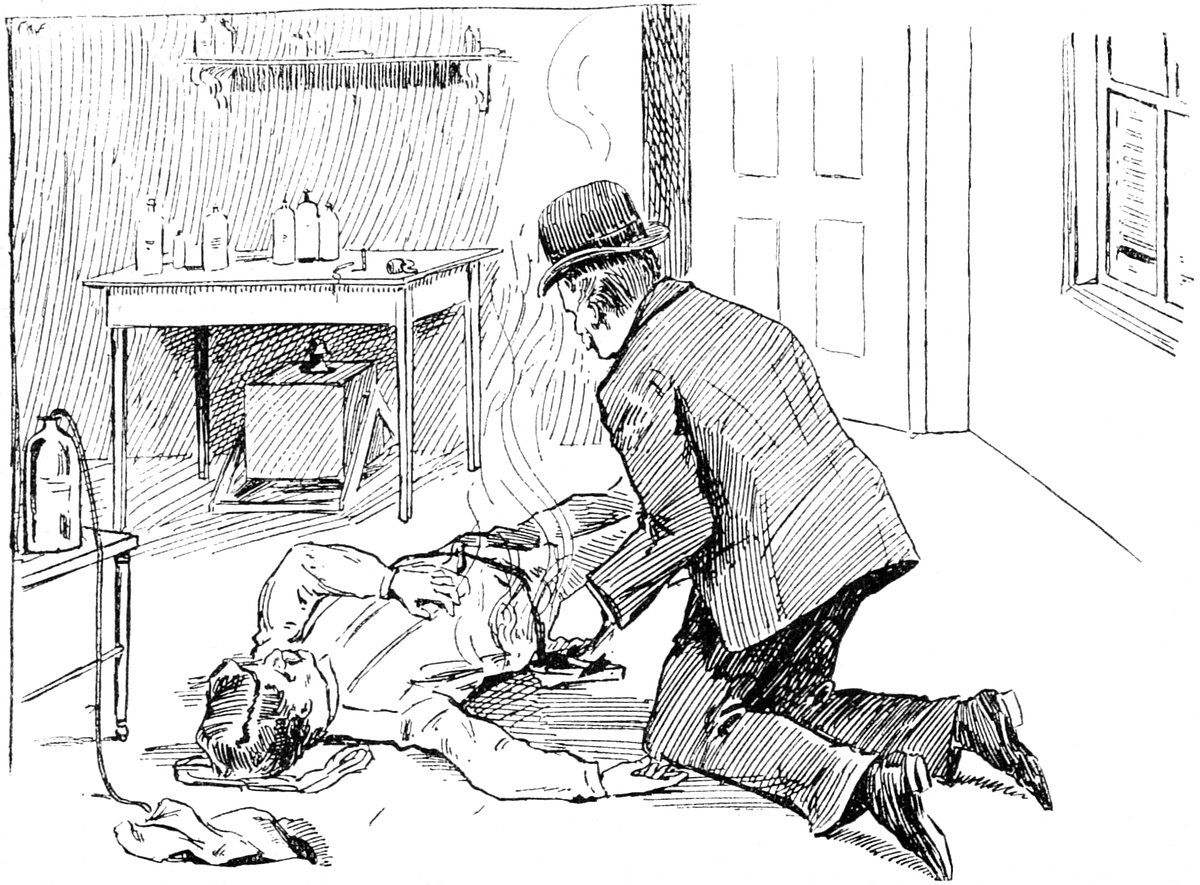
HOLMES BURNING PITEZEL’S CLOTHING IN CALLOWHILL STREET HOUSE.
I don’t know how long I stayed there, nor what time it was when I finally thought it best to go home, and I then went down stairs to his desk to write him a note. There among the paper I found a note written in a cipher we sometimes used, which read, “Get letter in bottle in cupboard,” or words to that effect. (This note being one that no one could read without my aid, I carried it in the small watch pocket of my pantaloons, until in Toronto, having a new suit of clothing made, from which my tailor had omitted such a pocket, I placed the note in a tin box of papers that later was taken by the authorities. The note is now, or should be, in their hands.)
I went to the kitchen cupboard, which was the only one I had noticed in the house, and there I found a whiskey flask, within which I could see some paper.
To get at it I quickly broke the bottle, and upon opening the letter I read, “I am going to kill myself, if I can do it. You will find me up stairs. I am worth more dead than alive.” I did not wait to finish the letter at that time, but went hurriedly up stairs. The only place on the second floor I had not had occasion to visit that morning was a small room under the stairway, and looking into it I found it empty.
I then ran up this stairway to the third story, a portion of the house I had never before been in.
It consisted of two low, small rooms, each having one small window. The door to one of these rooms was open. I instinctively turned to the room that was closed. Thrusting open the door and stepping within, I saw Pitezel lying upon the floor. I rushed to him, but before I had remained longer than to remove a large towel that was wrapped around his head, and not having time to find if he were alive, I was forced, owing to the overpowering odor of chloroform, together with the shock of coming upon him so suddenly and in such a condition, to leave the room, falling upon my knees and crawling a portion of the way until I finally reached the window in the adjoining room, which I opened, and in a few minutes had recovered myself sufficiently to return to the room where Pitezel lay, but again was forced to leave before I could make a satisfactory examination.
This time I had opened the window in this room as well, and presently was able to ascertain that he was dead. I then went to the hallway and sat down upon the stairs. I do not know how long I sat there, nor what I thought in the meantime. I had not yet wholly recovered from the effects of the chloroform, and was dazed. This was not due to having come suddenly upon a dead body, for my medical experience of years before had rendered me accustomed to disagreeable sights and scenes—but the man had been to me far more than an ordinary employee; one whom, although most of our tastes were dissimilar, I had always liked and had had fewer disagreements with than would likely have been the case had he been my own brother. And to come upon him thus had unmanned me.
I know the thought never came to me while sitting there that it might be dangerous for my own safety, the street door being then unlocked. After a time I returned to the room and made a careful examination.
He lay upon his back, his lower limbs fully extended, one arm folded upon his chest, the other thrown out at his side.
His head was slightly raised by means of a coarse colored blanket, closely folded. He was fully dressed, except his coat and vest which hung on a chair beside him. The pockets of his trousers were turned inside out, and in the waistband was a letter within an envelope addressed “C. A. P.”[2]
If asked to express an absolutely true opinion as to how long he had been dead, I should say not more than six hours.
Upon the chair was a large gallon bottle laying upon its side, so arranged that it would nearly empty itself, it being held in position upon one side by a hammer and upon the other by a small block of wood; from the bottle, and connected thereto by a perforated cork in which an ordinary quill toothpick had been inserted, there trailed a long piece of small rubber tubing, terminating at its free end in the towel I had removed upon first entering the room. This tube was constricted midway by a piece of cord tied about it, so that the flow of liquid would be slow.
Owing to the time that had elapsed after his death all the chloroform that could escape from the bottle, in the position in which it lay, had passed through the tube, filling his mouth and, as I later learned from the Coroner’s physician, his stomach as well; this one fact alone being sufficient to prove to any scientific person, or physician at least, that any one having a medical training would not, if obliged to use chloroform for such a purpose, carry it to such an extent if he wished it to appear later that the man died as the result of inhaling the vaporous fumes of chloroform and benzine, that had exploded in a bottle held in the victim’s hands.
The excess of the liquid had then run out upon the floor and on the blanket underneath his head. The only other articles in the room besides those already enumerated were some small pocket belongings, a knife, memoranda book, match box, containing some of our patent stamps, and perhaps twenty small coins; all these were placed on the chair beside the bottle. Upon the window-sill was a small handful of tacks with which he had fastened some newspapers upon the sash in lieu of a curtain.
By this time, owing to the excoriating effect of the chloroform his face had become somewhat discolored, and I went to the rooms below and procured a wet towel, and after covering the face with it I started down the stairs fully intending to call in some of the neighbors. Then came the thought that, instead of filling the house with a crowd of curious people, it would be better to go direct to the Coroner.
I know this thought was in my mind as I passed down the stairway, for I distinctly remember wondering in what part of the city the Coroner’s office was located, whether at the City Hall or elsewhere, and if it would be open on Sunday.
Reaching the kitchen I picked up the letter which, in my haste, I had let fall before going up stairs in search of him. The substance of the letter, beside that already given, was that he had tried to take his life in Mississippi during the previous June, and now with his drinking habit growing so much stronger day by day, he could not hope to make a living without my aid. He wished me to so arrange his body in one of two ways that it would appear that his death had been either accidental or that he had been attacked by burglars and killed, giving the details of how I was to carry out either course:—
First, that his family should not at present know of his death;[3] second, that the children should never know he had committed suicide (this he also repeated in the letter left for his wife); that the insurance money should be used to place the Fort Worth building in an earning condition, and that I should exchange some Chicago property we owned for some house in a city with good school advantages; that none of the money should be so placed that relatives could borrow it away from his wife. He spoke of our close connection for years, and that he could depend upon my aiding him now and in the future, ending his directions with the words:—
“Do enough with me so there won’t be any slip-up on the insurance; I shan’t feel it.” The letter was poorly written, and it took me some minutes to decipher it, and upon finishing it, I sat down for a time and re-read parts of it. This gave me time to consider my own position, and as soon as it came into my mind, but before I had decided to carry out his instructions, I went into the front office and locked the street door.
The thought that troubled me most at that time was, that under no conditions, whether the insurance part was carried out or not, was I the one to discover his dead body. I was here in Philadelphia under an assumed name. A few years earlier I had stopped at some hotels and met people under the name of Holmes. Some years before that I had done business here under still another name, and at another time, earlier yet, I had visited relatives here under my true name.
And now at this time, to be called as a witness before a Coroner’s jury, would almost certainly cause me to be identified by some one; and if under the name of Holmes, it was more than likely to be seen in the papers by some Fort Worth people, and would probably result in my arrest upon the charges there, and my arrest at this time I was satisfied would mean death to my wife.
Again, I had an engagement in St. Louis for the following Thursday morning, to fail to keep which would result in the loss of a considerable sum of money, and also prove a source of great annoyance to my attorney, who was personally responsible for my appearance there. Besides this, Pitezel was dead; nothing I could do here would aid him, while in St. Louis I could be of the utmost benefit to his family, by forestalling the announcement of his death reaching them through the newspapers, by seeing them personally, and also caring for the child that was sick, if need be. This portion of the matter was settled in my mind at once, then came the question whether I should do anything to aid in the deception of the insurance matter or simply remove the letter he had written to his wife, lest it contain matters that should not be made public and go away. One of his plans I did not entertain for a moment, the one involving striking him upon the head severely enough to crush his skull. Had my own life depended upon it, I could not have forced myself to strike his dead body even had I been sure there was no suicide clause in his insurance policy. I should have preferred to have told his family at once of his death, contrary to his wishes, in preference to doing anything to mislead the authorities, involving, as it necessarily must, some mutilation of the body.
I had never seen the policy, but from my friend the insurance agent’s statement that it was similar to mine, I judged it contained such a clause. Nor did I know whether or not the suicide clause was inoperative in Pennsylvania as it is in many other States. (All these things I most certainly should have found out previously if I had been intending to immediately carry out the fraud.) After considerable deliberation, I went to the room in the second story that he had partially prepared, uncorked the small bottles I had previously found there, and also found the pipe he had filled with tobacco, the top of which was slightly burned as though he had just lighted it before his accident occurred.
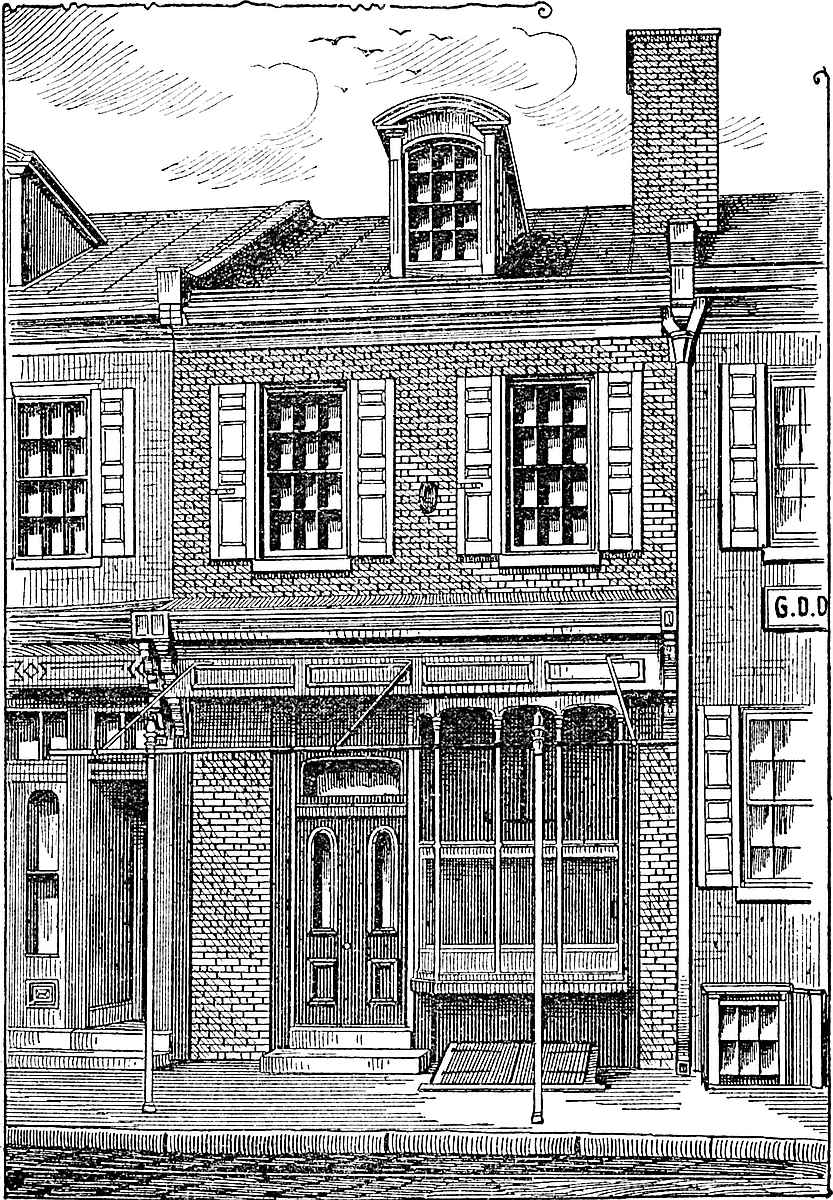
Callowhill St. House where B. F. Pitezel’s Body was Found.
He did this part of the work previous to his death, knowing that I did not smoke or knew little of filling pipes intelligently enough to deceive any one. Having placed the room in the condition necessary (breaking the large bottle, placing pipe upon the floor, etc.), I moved his body as carefully as possible to this second-story room. I found that the chloroform had given the side of the face and neck and part of the chest quite the appearance of having been burned, and this made my task the easier, although it seemed terrible enough in any event.
At last I forced myself to burn the clothing upon one side of the body, smothering the flames when they reached the flesh, and in this way produced partially successful results; then hastily gathering together several small articles that I wished to take away with me, I placed the room somewhat in order, and after going again to the room where he lay to see him, as I then supposed for the last time, I at once left the house, disguising myself to some extent by wearing one of his hats, for I had been fully alive to the necessity of care after I had first had time to think of the matter. Among the things taken from the house was a bottle of chloroform, which he had previously bought in Philadelphia, and prepared to send to Chicago to be placed with the clothing and other things for Hedgpeth’s use.
In going out of the house I was careful to leave the door both unlocked and open, in order to call attention to the condition of affairs within as soon as possible. Upon reaching the more pure air of the street I was seized with a feeling of nausea and dizziness, resulting probably as an after-effect of the chloroform-laden air within.
I knew my general appearance must have been that of an intoxicated person. To become relieved of this feeling somewhat if possible, I decided to walk a portion of the distance to my residence, and while doing so decided that it was best, my wife being well enough, to leave Philadelphia at once, thinking that Pitezel had no doubt spoken of me to some of his newly-made friends, and perhaps told them where I lived. I, therefore, went to the Broad Street Station and ascertained that a train would leave in half an hour (so I know now that I left the Callowhill street house, at about 3.45 o’clock, as the train referred to was the regular 4.30 Western train); I found that another train left for the West at 10.25 p. m.; and although my wife was not able to do so, I took her as carefully as I could to this train and left at that hour.
I have often since that day tried to analyze the feelings which I had at the time of Pitezel’s death. I felt it to be a terrible matter, and certainly could not have deplored it more had he been a relative, but I did not then, nor have I since felt the great horror concerning it that I experienced at the time of Nannie Williams’ death in Chicago, which was wholly unprovoked and for which I felt that I was the indirect cause; while in this case, his death occurred as the result of his own premeditation, in consequence of his having allowed himself to slowly drift into pernicious habits for which he was more than any one else to blame. Upon reaching Indianapolis, I was occupied until Wednesday noon, September 5th, in arranging comfortable quarters for my wife, at which time I started for St. Louis, reaching that city about 7 p. m., having bought upon the train a St. Louis Globe-Democrat, giving in a Philadelphia dispatch an account of the finding of Pitezel’s (Perry’s) body in the Callowhill street house upon the previous day.
After a short delay I went at once to Mrs. Pitezel’s place of residence, about an hour’s ride from the centre of the city, hoping to be in time to tell them of the matter myself. Upon reaching the house, however, I found all in a state of commotion.
The neighbors were there, a physician had been summoned, and it was some time before I could obtain a suitable opportunity to talk with Mrs. Pitezel. I found her in a very nervous and over-wrought condition, and I thought it best to palliate her fears for a time, and, therefore, said to her, “Perhaps Ben is not dead. There may be a mistake in the person, as I saw him alive last week.”
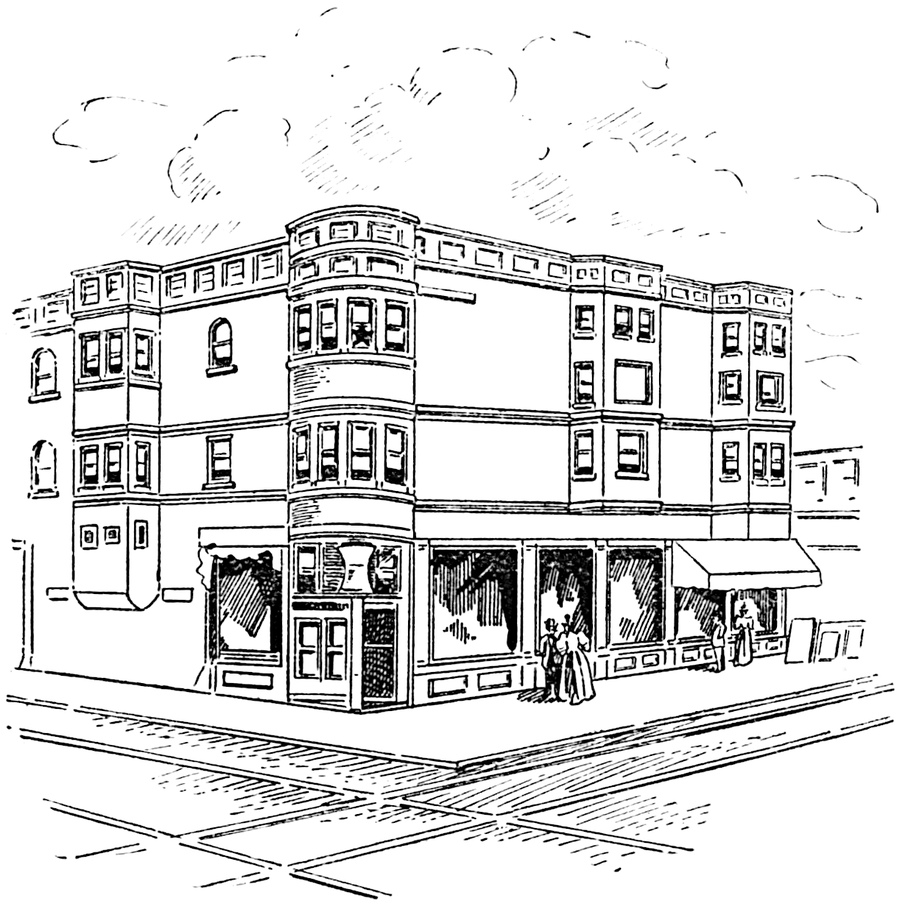
HOLMES’ “CASTLE” CHICAGO.
To which she answered, “Oh, no! I am sure it is he, for I have been writing to him under that name and at that address.” Just at this moment Dessie, the oldest daughter, called me to one side and said, “Do you think papa is really dead?” I replied that I feared so, but that her mother should not be told until we were certain of it. She said, “I don’t think he is. Last spring, when I was sick and he was leaving me, he told me that if I ever heard that he was dead not to believe it, as some work he was going to do might require him to have people think so for a time.” I asked her if he had told her mother of this, and she said, “No; her father had told her not to tell any one.” As soon as a favorable opportunity occurred, I said to Mrs. Pitezel, “Did Ben ever say anything to you about not worrying if you heard of his death?” She replied, “Yes;” and, after stopping a moment, added, “If he has gone and done that without letting us know, leaving us to worry ourselves to death, I could almost wish he was dead. Is it the insurance matter?” “I guess it is,” I replied, in such a tone that she would think that I knew it to be so. She then asked if he would get the money all right, and I told her that it would be paid to her, if anyone. She asked, “Where is Ben now?” I replied that it was his plan to go South at once. She said, “Well, I do not want him writing to me; all his letters for me must go to you; and the children need not know but that he is really dead, for they would certainly tell of it; they are young, and will soon get over the worry.” I asked if the insurance policy was there in the house, and she said, “I do not know; I will see; he ought to have given it to you if he was going through with it so soon; it may be in Chicago among some things stored in a warehouse there.”
I did not allow her to look for it at that time, as she was too ill yet from her shock to do so, but instructed her to look for it next morning, and if well enough, to bring all the papers she had to my attorney’s office. Some question then arose as to whether she could find this office, and she remembered that at the time of my arrest her husband had called there and had brought home one of their cards, which she said was still among some of his papers, and with this she could find her way.[4]
At about 9 o’clock, the family being more quiet at the time, I returned to the hotel for the night, and I feel sure that Mrs. Pitezel at the time of this visit, which was the first confidential talk I had ever had with her, had no previous knowledge of an intention to perpetrate a fraud upon this company other than a vague idea that under certain conditions and at a more remote time it might have been carried out, which was the exact condition of affairs as they had existed upon the day of Pitezel’s death.
She is not a woman of extraordinary gifts, and any simulation on her part at this time would not have deceived me. The next morning I went to Judge Harvey’s office and found that owing to his absence my case had been postponed. I left word there for Mrs. Pitezel, if she called during the day, to wait for me, and I went to the offices of another attorney and spoke of the insurance claim and told him if it was promptly paid I could use some of that money. He said insurance companies are slow and it will probably be some time before it is settled. He asked how large an amount it was, and upon my stating it was $10,000, he said, “You will need an attorney in fixing the papers; can’t I do it for you?” I replied that I was about to consult Judge Harvey. He said, “Let me have it; I have just settled a fire insurance loss and had first-rate success, besides you are really my client, as we sent you to Judge Harvey because my partner was away at the time.” After returning to Judge Harvey’s office and not finding him there, I saw him again and told him that the claim was a false one, that the man was, in reality, not dead. He made a number of inquiries as to the details of the fraud and finally said, “Well, if you have any one to attend to it here it had better be me, for neither Judge Harvey or my partner would dare to take hold of it. I do not belong to this firm, although I have an office here with them. You will notice my letter-heads appear with my own name alone; still I can avail myself of their judgment in important cases, and on account of this supposed death occurring under a fictitious name, you will find you need help.”
I then explained that Mrs. Pitezel was to come into the city that morning, if she was able, with the papers, and he remarked, “Well, she must not know that I have any knowledge that the claim is not a legitimate one.”
It was then arranged that he should write some letters to the company’s office in Chicago, to ascertain if Pitezel had, in reality, paid the premium as he had stated, there being no receipts showing this had been done, and also to write to the authorities in Philadelphia.
I asked him in regard to his fee, and he stated that it would depend upon how much work had to be done, but that being a young attorney he would make it a reasonable sum. Later, in going out of the building, I met Mrs. Pitezel and explained to her that this lawyer would take care of the case for her, and that she should not have him know that she was aware of his knowing the true state of the case. In other words, she, while in his presence, was to appear and speak as though it were a genuine loss.
So, at this stage of the case, I knew Pitezel was dead; Mrs. Pitezel and the attorney each supposed him to be alive, but, by a separate agreement each had voluntarily made with me, both were to deceive each other in this respect, making a most unique case of conspiracy, if conspiracy it was.
I was not present during all of the attorney’s first interview with Mrs. Pitezel, but she authorized him to write the necessary letters, and I told her that he had made satisfactory arrangements with me in regard to his fee, which I would be responsible to him for.
I then gave Mrs. Pitezel some money for her immediate wants and left the city, intending to return again in ten days, at which time my case was to be called in Court. Before going away I told the attorney he could address me at Indianapolis at any time. About five days thereafter I received a letter from him, stating that he had received an answer to his letter of inquiry sent to the Philadelphia authorities, in which they stated that the man referred to was only known to them under the name of Perry, and would be buried as that person unless some one identified him at once as Pitezel. He also stated that Mrs. Pitezel instructed him to ask me to return to St. Louis and aid her if I could do so.
This I did at once, and upon meeting him he told me it would be necessary for some one to go to Philadelphia at once, and wished me to furnish the money for him and one of the family to make the trip. I told him that until the first of the following month I could not well do this, but suggested a person with whom Pitezel had formerly dealt that I thought would advance the necessary sum, if it was agreed that it should be returned to him with interest as soon as the insurance was collected. The attorney later negotiated such a loan, receiving $300.
At this time I saw Mrs. Pitezel, and she not being strong enough to take the trip, it was decided that the daughter, Alice, should go. This choice of the children being principally due to arrangements previously made by Pitezel, that if Miss Williams came to this country, and returned to her old occupation as a teacher, that Alice should live with her for a year to go to school. I had received a letter from Miss Williams that she had decided to do this, and at the time of Pitezel’s death had asked her to come to settle in Cincinnati, thinking thus she would break away from her old life, making it safer for me to be also where she could help in regard to some Texas papers, which I had found must at any hazard, be duplicated. Therefore, a few days later, when Alice left St. Louis, it was with the full understanding that she was to stay East with Miss Williams, or go with her to Cincinnati, if all located there.
At the time I was about to leave, having made these arrangements, I received a letter that had been forwarded to me from Chicago, asking for my assistance in identifying Pitezel, it being known to the Chicago office that he had been in my employ. To intelligently answer this letter, I went to the attorney’s office, at which time I first closely examined the insurance policy. I then wrote to the company as accurate a description as I could give of him.
At this time the attorney said, “Why don’t you go to Philadelphia, also?”
I replied that it would be an unnecessary expense, and I wished to go to Cincinnati at that time to arrange for a house for the family. He said, “I had better wait until the money was paid,” and I replied that the family would have to have a house whether the money was paid or not. Finally it was decided I should go to Philadelphia via Cincinnati, which I did, writing to the company from the latter place that I had business calling me toward Philadelphia, and I would call upon them in a few days, and if possible aid them in identifying the body. Later in the same day I met Alice en route. The next day, early in the afternoon, I called upon the Insurance Company in Philadelphia.
I was introduced, after a little delay, to Colonel Bosbyshell, one of the officers. He talked with me for some time regarding the case, and finally, having asked me a good many questions as to Pitezel’s general appearance, said, “Well, I think that it is either a case of mistaken identity or a fraud. The man found here, and who has been buried under the name of B. F. Perry, was a man who weighed forty pounds more than Mr. Pitezel, both according to your judgment and according to his application for insurance; and moreover, this man had red hair while Pitezel’s was black. An attorney and some of Mr. Pitezel’s relations are expected here at any time, and I wish you could stay and aid us in clearing up the matter.”
He then left the office, and in a few minutes returned with some money, which he tendered me, saying they would be glad to have me stay at their expense. I replied that I would not take the money, but having other work to attend to, I would call from day to day, and if I was put to much expense or loss of time, I would ask them to pay me, otherwise no charge would be made, explaining further that Pitezel was indebted to me, and if the claim was a genuine one I would be willing to devote some time to it in order that I could collect my money, which I had no doubt his wife would pay.
That afternoon I saw our attorney, he and Alice having arrived in the interim. I told him of my interview, and he at once said, “We shan’t collect a dollar. They have either substituted a body for the one you used, or your choice was so poor it had not deceived them.” He was in favor of abandoning the case and returning to St. Louis.

ALICE PITEZEL.
Finally it was decided that he should see the company the next day, but he insisted, as he said, for his own safety, that if we met at the company’s office he should not have it appear he had ever seen me before. The next day, about half an hour after I called at the insurance office, the president of the company, who I had met the day before, and our attorney entered the room where I was seated, and the following conversation took place:—
Mr. ——, the president, then introduced me to our attorney, saying:—
“This is Mr. Holmes, of Chicago, who carries insurance in our company, and who formerly was well acquainted with Mr. Pitezel.”
Upon our shaking hands, he said, “I am glad to know you, sir.”
After some general conversation, I said, “The officers of the company inform me that you have certain letters and other papers in Mr. Pitezel’s handwriting, and I think, if agreeable to you, I can identify them if belonging to him.”
Our attorney then turned to the president, saying, “Who is this man? Before I show any papers or have anything more to do with one who is apparently an outsider, I wish to know more about him.”
The president then said in a conciliatory manner, “Oh! I think you can depend upon Mr. Holmes acting independently and for the interest of all in the case. He is a man formerly in business in Chicago, and for whom Mr. Pitezel worked for a long time, and if any one is able to give an accurate description of him, Mr. Holmes should be able to do so.”
“My inquiry was a precautionary one,” said our attorney, “I am willing under those circumstances that Mr. Holmes should examine the papers and aid us if he can.”
During that afternoon our attorney entered into an agreement in writing with the company, stipulating, that in order to establish his claim, certain marks of identification should be found upon the body, which it had been arranged to have disinterred the next day. Among those marks should appear a large wart, or mole, upon the back of the neck, jet black hair, a cowlick upon the forehead, a peculiarly decayed condition of the teeth, a bruised thumb nail and a scar upon one of the lower extremities.
That evening, quite late, our attorney came to me freshly terrified, and again ready to abandon the case. He had met a man named Smith, who, in conversation with him, had stated that while in Pitezel’s place of business he had seen a man come in and hold some conversation with him, who he had understood was a friend then living in the city. Smith had stated that the friend had not come forward at the time of his death and he thought it strange, and also remarked that if he ever saw the man again he would know him.
Mr. Smith was to be at the Coroner’s office next day, and was also to be present at the time the body was viewed. I told him that from what I remembered of the man Smith, I did not think he was a very close observer or overburdened with general intelligence, and I would take the chances of his recognizing me, rather than give up the case at that stage of it. Next morning we all met at the Coroner’s office. My judgment had been correct in regard to Smith. He noticed me only as he would have done any stranger, and upon being introduced to him, and being in his company and holding a general conversation with him, I met with the same result.
It was decided at the meeting at the Coroner’s office that later in the day those interested should go to the cemetery where the body would be exhumed for identification. This was done, there being in the party the president and two others, representing the insurance company, a physician and a Deputy Coroner representing the city; our attorney, Alice Pitezel and myself, besides Mr. Smith before referred to.
Upon reaching the cemetery we were told that the body had already been placed in a small house and was ready to be seen.
I felt, that there being two other physicians present, it was not necessary for me to take part in the identification, unless called upon to do so; and had, upon first arriving together with Mr. Perry, taken the daughter to a distant quarter of the enclosure. The physician made the examination of the body, which lay in a well-lighted room; and, after taking abundant time for this purpose, came out of the building and announced that all marks of identification were wanting. After some further conversation, the president said to our attorney that they were satisfied before they came there that such would be the case, and a general movement was made preparatory to leaving the place.
The attorney asked me what I thought should be done, and upon my answering him, he told the president that he would like to have me examine the body as well. I asked the doctor if he would object, and he said “No,” but that I would not find it a pleasant task.
I entered the building, and hardly had passed the door before I was positive that the doctor had been mistaken in the color of the hair. Upon a close examination, all the marks were easily found: the wart upon the neck, equal in diameter to that of a lead pencil, and projecting fully a quarter of an inch from the surface; the cowlick, the bruised nail, the teeth decayed exactly as had been described; and lastly, the scar an inch and a half in length upon the foot.
I could do no less than call the doctor in, and one by one he grudgingly admitted their presence; and that there should be no further question as to the identity of the man, I asked him to remove the wart for microscopical examination, some of the hair, the nail and the scar. He said he had no implement with him that he cared to use for this purpose. I had only a very small lancet, but I removed the necessary portions, and later turned them over to the Coroner’s representative.
I then endeavored to have a decision reached at once in order to save the necessity of the daughter seeing the body, feeling it to be cruel to have her do so, and if possible to prevent it. The president would not agree to this, but it was finally arranged that she should see only the teeth. All other portions of the body were therefore excluded from view, and I led the child into the building.
It was a terribly hard thing that I had to do, for she was but a delicate child of perhaps fourteen or fifteen years, yet she was courageous and very willing to do what she could.
Upon reaching the body she said, “Yes, those are papa’s teeth, I am sure of it.” I at once led her away, but I found the impression left upon her tender mind would remain as long as she lived, and have always felt it to have been a wholly unnecessary requirement upon the part of the company.
Without regard to what the reasons were, the doctor’s report was destined to cost me dearly, as will later be seen in this history. This ended the examination at the grave-yard, and we all returned to the city.
Even at that time the officers of the company would not express themselves as willing to allow the claim, but later in the day they reluctantly admitted that they were satisfied with the identification. Upon reaching the Coroner’s office again, the Coroner very kindly offered to take my testimony the next morning, which was Sunday, in order that I could leave the city without further loss of time. After making this arrangement, I went to the insurance company’s office where I was reweighed, remeasured and in other ways readjusted my own insurance, and later went to an undertaker’s office, and made every arrangement to have the body properly buried in a good locality, well satisfied to be able to perform this final act for my friend.
The next day at 4.30 p. m., having previously gone to the Coroner’s office, I left Philadelphia, taking Alice Pitezel with me. I had not heard from Miss Williams as I felt sure I should do, informing me of her expected arrival in New York, and thus not hearing, I addressed her there, asking both she and Hatch to come to Cincinnati as soon as they conveniently could, stating my reasons for asking them to do so.
Alice did not like to return to St. Louis on account of having told every one she knew before leaving that she was going away for the winter, although she would have been very glad to have seen her mother; and upon reaching Indianapolis I told her she could choose between returning to St. Louis or remaining there for the few intervening days while I went to St. Louis and returned with some of the rest of the family upon our way to Cincinnati, it having previously been arranged with Mrs. Pitezel that this move should be made at once to save commencing another month in St. Louis, where she was paying rent.
Alice having decided to remain in Indianapolis, I took her to Stubbin’s Hotel and left her there in charge of those whom I had become acquainted with during my previous stay in that city. The next day I received a telegram from the attorney, stating that the company had paid him the insurance, after deducting several hundred dollars for expenses, which, I think, was wholly unjust towards Mrs. Pitezel, the whole amount, if any, being due her.
I then returned to St. Louis, where, owing to my absence, my own case had again been postponed, and I therefore decided to return to Cincinnati.
Taking the two children, Nellie and Howard, I started for that city via Indianapolis, telegraphing to the hotel to have some one accompany Alice to the train in the morning to join us. This was done, and at about 8 a. m. we reached the Cincinnati station where Hatch met us. It was the first I had seen of him since early in December of the previous year.
Miss Williams had remained in New York, being unwilling to go to Cincinnati where she had previously played, and therefore was known to some people.
Being in haste to commence my work among the real estate men, I gave the children into Hatch’s charge, and he took them to a small hotel near the station. But not liking the surroundings, I returned to the Hotel Bristol. I spent a very busy day, but was not successful in finding property to exchange for Chicago property, and at last I thought it safer to rent a house for a time, and then, by advertising my property, find something more suitable for the children’s wants. I therefore hired a house, paying one month’s rent and six months’ water tax. I also made arrangements for its being comfortably furnished.
Miss Williams not having come, I looked around for some trustworthy person to care for the children until their mother could reach them. Mrs. Pitezel having a desire to visit her parents before going elsewhere, did so.
Not finding such a person as I wished, and not liking to leave the children without proper attention, I decided to take them with me to Indianapolis, where I expected to be engaged in some real estate work for the following two weeks. This I did, Hatch accompanying us, and then going on to Chicago from whence he returned in a few days.
We reached Indianapolis about October 1st; the children stayed one day at English’s Hotel, and then I engaged permanent board for them at the Circle House, my wife and myself being at another hotel near by, so that I could visit the children each day and know they were properly cared for. This form of life was new to the children, and they thoroughly enjoyed it, going about the city either by themselves, Hatch’s or my own company.
I shortly afterwards returned to St. Louis, and, upon entering the attorney’s office, he said, “Well, I am glad you have come; my partner had been wishing that you would return.” I said, “Why?” He replied, “Because he wants to get this matter settled up and get our fee out of it. You know how close work it was to get the company to believe the claim was straight, and something may occur to make them change their minds. But, I said, “Why has he to be considered, even in that event?” He replied, “Because, in a case as big as this, he will have to be considered; besides, if it had not been for his letter of introduction to Superintendent Linden in Philadelphia, the money would not have been paid.” I then told him that I had not yet seen Mrs. Pitezel, but we would arrange the settlement when I did so, and I would have her come in and sign the necessary papers later. “Well,” said he, “what do you think we should receive?” I said, “I have no idea; you must set your price, not I.”
He then said, “Well, usually in these insurance cases the attorneys get fifty per cent. of the claim. I have asked three disinterested lawyers about it, and they say I ought to have that much, they not knowing it as a fraudulent claim, which makes it all the worse.”
My answer was, “Well, if it comes to taking $5,000, which, from your own statement to me, is more money than you ever before earned in your life, you will have the opportunity to keep the balance as well.” After some further conversation, he offered to choose an attorney if I would choose one, and leave the fee to their decision, and with this understanding I went away to return the next morning. When I returned he met me with the announcement that his partner would not agree to his proposition. I then said, “I wish to see him if he is the principal.” At that time I had never been introduced to him. He left his office in a few minutes and returned and conducted me into his partner’s private office. He was seated at his desk, apparently much too busy to leave his work for so small a matter as the settlement of a $5,000 fee.
Finally he turned upon me and, in an over-bearing, bull-dozing manner, said, “What is all this trouble about? Don’t you expect to pay your attorney after you have hired him?” I was angry at his insolent manner, and at once told him that I would have no words with him. If they wished to receive $500 for their services (reminding him that had it not been for my presence in Philadelphia they would not have collected the claim, as he had shown so very little tact in treating with the company—so much so that they had been twice upon the point of ordering him from their offices) then that amount could be deducted, but no more.
He then said, “I will allow no man to come into my office and dictate to me in regard to a fee after the work has been done for him, and as for $500 it is an insult to offer it.” I then reminded him that I was not making it as an offer to him, one of the most prominent lawyers of St. Louis, but to his partner, a recent law graduate, to whom a $500 fee would be a large one, inasmuch as his expenses upon the trip had been elaborately provided for.
He said, “Well, we will take $3,000 for this work and nothing less.” I replied, “It cannot be paid.”
He said, “Then there is no further use for us to discuss the matter.” Turning to his partner, he then said, “Go to the bank and get a New York draft for what you have left; I am going to return the money.” I said, “Very well, sir, nothing could be more to my advantage than this, and upon Mrs. Pitezel receiving the money direct from the company I shall tender to you your fee of $500.”
He replied, “You will never have a chance to do this; when the money is sent back I shall at the same time write a letter to my old friend, Captain Linden of the Philadelphia Police Department, stating that since my return we have found out that the claim is crooked and cannot handle such money, and that we think it our duty to aid him by placing him in immediate possession of all the facts pertaining to the matter; moreover, you are wanted in Fort Worth, Texas, and I shall at once cause your arrest before you can leave the city.”
I replied, “You could only cause me trouble in regard to the insurance matter at the cost of your partner’s disgrace.” He said, “It is not so; it would be the word of our firm, which is well known throughout the country, against your single statement, and you a man that has already been under arrest once and will be again inside of an hour.” This so angered me that I said, “You can send back the money, you can arrest me, but you cannot intimidate or browbeat me. I will spend ten years in the penitentiary before giving in to you now.”
Upon this I left the office. Mrs. Pitezel was seated in the outer room, having come in in the meantime. I asked her to come at once to Judge Harvey’s office, and upon her hesitating to do so, when he asked her to remain a moment, I told her to make no settlement that involved a greater reduction than $500 from the amount the company had paid. Upon my doing this I left the office, and waited a long time for Mrs. Pitezel; and when she met me she was in tears and said that they would not let her leave the office until she allowed them to deduct $2,500 from the insurance money, and that she had also signed a long typewritten agreement of some kind. She then had the remainder of the money, about $6,000, with her, the lawyers having previously paid some bills upon her giving them a written order to do so.
Some days previous to this I had made arrangements that the amount of money to be used at Fort Worth should be paid at a bank at St. Louis in exchange for a note her husband had executed while there.[5] Mrs. Pitezel went to the bank and lifted this note, and of the balance gave me $225 for my expenses, as she supposed. As a matter of fact, the $5,000 thus paid upon the note came to me, I having months before had to satisfy the claim by the use of other property. That afternoon, some time later, I left St. Louis, intending to return to Cincinnati and complete the arrangements there for the home of the Pitezel family. Before leaving St. Louis, however, I arranged that Mrs. Pitezel and the two other children should go to Galva, Ill., upon their intended visit to Mrs. Pitezel’s mother, and also made private arrangements to be informed of any movements that should be made by the attorneys detrimental to my interests.
Upon my returning to Indianapolis I found that both the children were apparently enjoying themselves. Hatch had received a letter from Miss Williams (to whom he claimed he was married) asking that we both meet her in Detroit. This meeting was delayed, as I had some more real estate work to do in Indianapolis which had been neglected, owing to the insurance work. While attending to this work I received word that the attorneys were intending to make trouble for me, and almost at the same time word came from Chicago that some Fort Worth detectives were again there, and had heard of my being in Cincinnati, Indianapolis and St. Louis.
After consulting with Hatch, who was very much worried lest if I were arrested it would implicate him as being with me, and perhaps Miss Williams as well, we concluded that we should go away at once. Finally I decided to abandon the Cincinnati house, and have the Pitezel family locate elsewhere, as the attorneys knew of my former trips to that city. I therefore wrote Mrs. Pitezel at Galva, advising her to change her plans and go to Detroit.
Up to this time, all that I had done for Mrs. Pitezel she had been aware of, but I did not now think it prudent that she should know of the probability of trouble arising from the insurance company. I preferred having her locate in some large city at that time, and explain to her afterwards about her husband’s death as he had requested me to do, and also of the necessity of remaining quiet until I could ascertain if any real danger existed.
Quite early upon the morning of October 10th, I went to the children’s hotel, and found them eating their breakfast. I told them we were going away that day, and went with them to their rooms and instructed them to divide their belongings into three separate packages, they having previously been contained in a very old trunk, which was not in a condition to be taken further. There was left in this trunk some old clothing, among which was a suit of heavy clothes which had belonged to Pitezel.
I then asked the children whether they would go with me to Chicago, and then to Detroit, or go with Hatch. Howard Pitezel chose to go with Hatch, while the girls desired to go to Chicago, hoping, while there, to have time to visit some of their former acquaintances. Having some purchases to make before leaving, I therefore, after telling the girls at what time to meet me at the station, left the hotel, having instructed Howard not to leave until Hatch should come, in order that he could direct him to come to the station before my train left. I met Hatch and Howard later upon the street. This was the last time I ever saw the boy Howard, at which time he was both well and contented. The first few days after his leaving home he had been homesick.
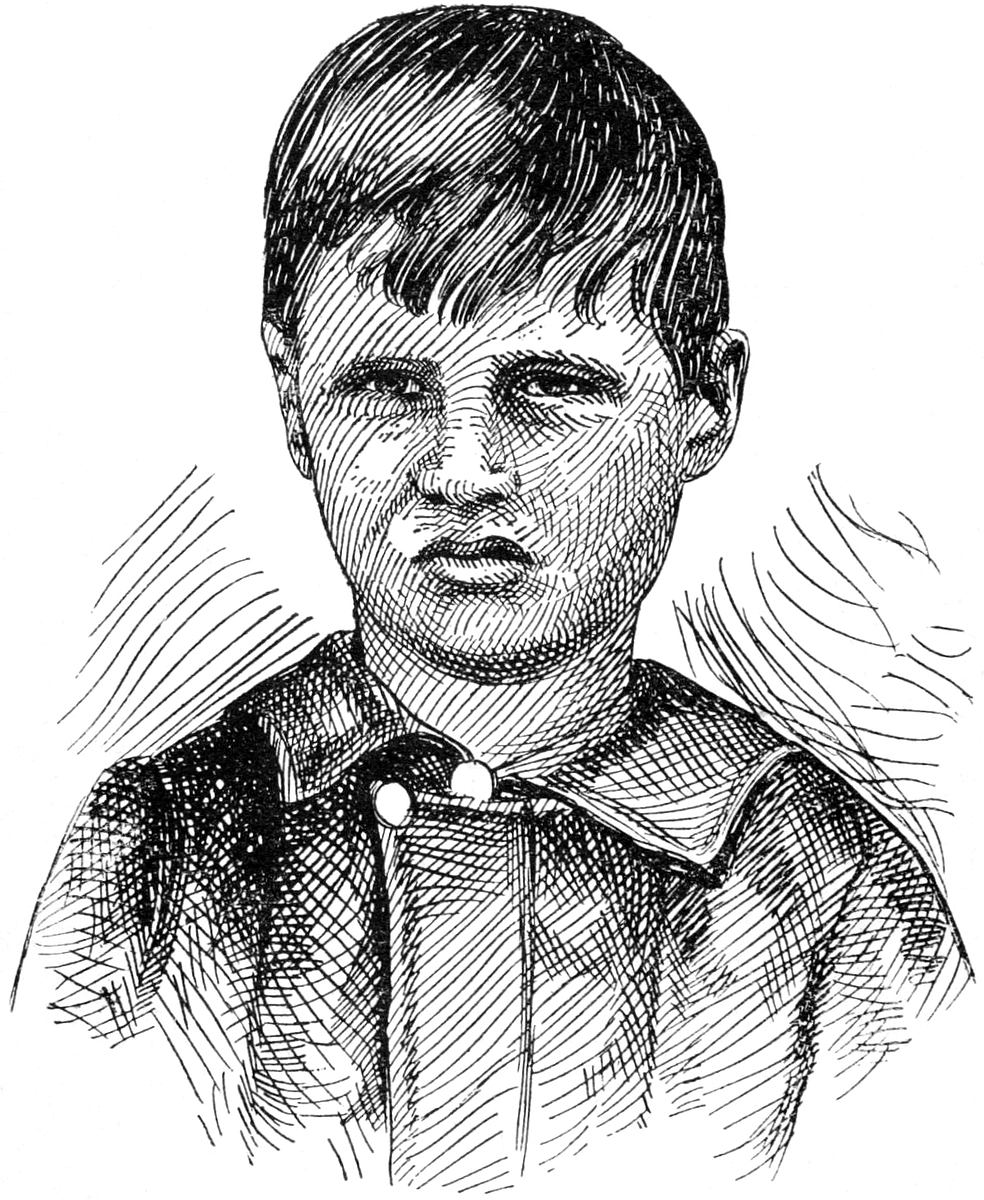
HOWARD PITEZEL.
While I was in the barber shop at the station upon this same morning, I asked Hatch to go to the hotel and have the nearly empty trunk taken to the station and have it checked to any destination he might choose, there being nothing of value in it, and it not being desirable to have it left at the hotel. Upon reaching Chicago, I took the two girls to a hotel, as I had business in a distant part of the city. I stayed during the one night I remained there at a new hotel upon the west side of North Clark street, less than a block north of the Lincoln avenue car junction.[6]
Not deeming it prudent, owing to the late news I had heard at Indianapolis, to go to my attorney’s office, I had both him and my agent meet me elsewhere, and arranging my work as quickly as possible, I left Chicago upon Friday, October 12th, going directly to Detroit, taking the girls with me. During the latter part of this trip my wife was upon the same train, she having left Indiana that morning in response to a request from me to do so.
Anticipating this, I had made arrangements with Hatch before leaving Indianapolis to be at the Detroit Station to take charge of the children. Upon our reaching Detroit I at once took my wife to a hotel about one mile from the station, and as I was leaving the train I saw Hatch helping the girls from the car in which they had traveled. About a half hour later Hatch met me at the Western Union telegraph office in response to a note I had given to Alice for him.