Volume 1 — THE HAGUE.
Helen Zimmern translation
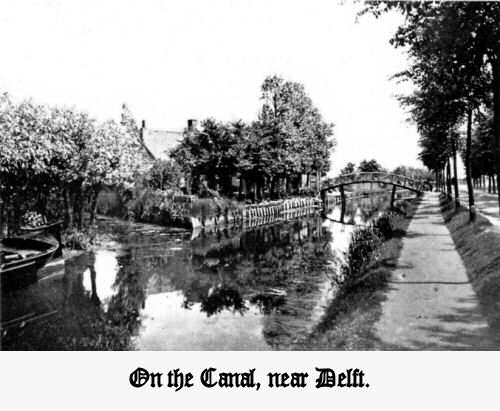
THE boat that was to carry me to the Hague was moored near a bridge, in a little basin formed by the canal which leads from Delft to the Hague, and shaded by trees on the bank like a garden lake.
The boats that carry passengers from town to town are called in Dutch trekschuiten. The trekschuit is the traditional boat, as emblematic of Holland as is the gondola of Venice. Esquiros defined it as "the genius of ancient Holland floating on the waters;" and, in fact, any one who has not travelled in a trekschuit is not acquainted with Dutch life under its most original and poetic aspect.
It is a large boat, almost entirely covered with a cabin shaped like a stage-coach and divided into two compartments—the division near the prow being for second-class passengers, and that near the poop for first-class. An iron pole with a ring at the end is fastened to the prow, through which a long rope is passed; this is tied at one end near the rudder and at the other end is fastened a tow-horse, which is ridden by a boatman. The windows of the cabin have white curtains; the walls and doors are painted. In the compartment for first-class passengers there are cushioned seats, a little table with books, a cupboard, a mirror; everything is neat and bright. In putting down my valise I allowed some ashes from my cigar to fall under the table; a minute later, when I returned, these had disappeared.
I was the only passenger, and did not have to wait long; the boatman made a sign, the tow-boy mounted his horse, and the trekschuit began to glide gently down the canal.
It was about an hour past noon and the sun was shining brightly, but the boat passed along in the shade. The canal is bordered by two rows of linden trees, elms, willows, and high hedges on either side, which hide the country. It seemed as though we were sailing across a forest. At every curve we saw green enclosed views in the distance, with windmills here and there on the bank. The water was covered with a carpet of aquatic plants, and in some parts strewn with white flowers, with iris, water-lilies, and the water-lentil. The high green hedge bordering the canal was broken here and there, allowing a glimpse, as if through a window, of the far-off horizon of the champaign; then the walls would close again in an instant.
Every now and then we encountered a bridge. It was pleasant to see the rapidity with which the man on horseback and another man, who was always on guard, handled the cords to let the trekschuit pass, and how the two conductors made room for each other when two trekschuiten met, the one passing his rope under that of the other without speaking a word, without greeting each other even with a smile, as if gravity and silence were obligatory. All along the way the only sound to be heard was the whirring of the arms of the windmills.
We met barges laden with vegetables, peat, stones, and barrels, and drawn with a long tow-rope by men, who were sometimes aided by large dogs with cords round their necks. Some were towed by a man, a woman, and a boy, one behind the other, with the rope tied to a sort of girth made of leather or linen. All three would be leaning forward so far that it was hard to understand how they managed to keep their feet, even with the help of the rope. Other boats were towed by old women alone. On many, a woman with a child at her breast would be seen at the rudder; other children were grouped around, and one might see a cat sitting on a sack, a dog, a hen, pots of flowers, and bird-cages. On some women sat knitting stockings and rocking the cradle at the same time; on others they were cooking; sometimes all the members of the family, excepting the one who was towing, were eating in a group. The look of peace that beams from the faces of those people and the tranquil appearance of those aquatic houses, of those animals which in a certain measure have become amphibious, the serenity of that floating life, the air of security and freedom of those wandering and solitary families,—these are not to be described. Thus in Holland live thousands of families who have no other houses but their boats. A man marries, and the wedded couple buy a boat, make it their home, and carry merchandise from one market to another. Their children are born on the canals; they are bred and grow up on the water; the barge holds their house-hold goods, their small savings, their domestic memories, their affections, their past, and all their present happiness and hopes for the future. They work, save, and after many years buy a larger boat, and sell their old house to a poorer family or give it to their eldest son, who from some other boat takes a wife, at whom he has glanced for the first time in an encounter on the canal. Thus from barge to barge, from canal to canal, life passes silently and peacefully, like the wandering boat which shelters it and the slow water that accompanies it.
For some time I saw only small peasants' houses on the banks; then I began to see villas, pavilions, and cottages half hidden among the trees, and in the shadiest corners fair-haired ladies dressed in white, seated book in hand, or some fat gentleman enveloped in a cloud of smoke with the contented air of a wealthy merchant. All of these little villas are painted rose-color or azure; they have varnished tile roofs, terraces supported by columns, little yards in front or around them, with tidy flower-beds and neatly-kept paths; miniature gardens, clean, closely trimmed, and well tended. Some houses stand on the brink of the canal with their foundations in the water, allowing one to see the flowers, the vases, and the thousand shining trifles in the rooms. Nearly all have an inscription on the door which is the aphorism of domestic happiness, the formula of the philosophy of the master, as—"Contentment is Riches;" "Pleasure and Repose;" "Friendship and Society;" "My Desires are Satisfied;" "Without Weariness;" "Tranquil and Content;" "Here we Enjoy the Pleasures of Horticulture." Now and then a fine black-and-white cow, lying on the bank on a level with the water, would raise her head quietly and look toward the boat. We met flocks of ducks, which paddled off to let us pass. Here and there, to the right and left, there were little canals almost covered by two high hedges, with branches intertwining overhead which formed a green archway, under which the little boats of the peasants darted and disappeared in the shadows. From time to time, in the midst of all this verdure, a group of houses would suddenly come into view, a neat many-colored little village, with its looking-glasses and its tulips at the windows, and without a sign of life. This profound silence would be broken by a merry chime from an unseen steeple. It was a pastoral paradise, a landscape of idyllic beauty breathing freshness and mystery—a Chinese Arcadia, with quaint corners, little surprises, and innocent artifices of prettiness, all which seemed like so many low voices of invisible beings murmuring, "We are content."
At a certain point the canal divides into two branches, of which one hides itself amongst the trees and leads to Leyden, and the other turns to the left and leads to the Hague. After we passed this point the trekschuit began to stop, first at a house, then at a garden-gate, to receive parcels, letters, and verbal messages to be carried to the Hague.
An old gentleman came on board from a villa and took a seat near me. He spoke French, and we entered into conversation. He had been in Italy, knew some words of Italian, and had read "I Promessi Sposi." He asked me for particulars in regard to the death of Alessandro Manzoni. After ten minutes I adored him. He gave me an account of the trekschuit. To appreciate the poetry of this national boat it is necessary to take long journeys in company with some Dutch people. Then they all live just as if they were at home; the women work, the men smoke on the roof; they dine all together, and after dinner they loiter about on the deck to see the sun set; the conversation grows very intimate, and the company becomes a family. Night comes on. The trekschuit passes like a shadow through villages steeped in silence, glides along the canals bathed in the silver light of the moon, hides itself in the thickets, reappears in the open country, grazes the lonely houses from which beams the light of the peasant's lamp, and meets the boats of fishermen, which dart past like phantoms. In that profound peace, lulled by the slow and equal motion of the boat, men and women fall asleep side by side, and the boat leaves nothing in its wake save the confused murmur of the water and the sound of the sleepers' breathing.
As we went on our way gardens and villas became more frequent. My travelling companion showed me a distant steeple, and pointed out the village of Ryswick, where in 1697 was signed the celebrated treaty of peace between France, England, Spain, Germany, and Holland. The castle of the Prince of Orange, where the treaty was signed, is no longer standing. An obelisk has been erected on its site.
Suddenly the trekschuit emerged from the trees, and I saw before me an extended plain, a large woodland, and a city crowned with towers and windmills.
It was the Hague.
The boatman asked me to pay my fare, and received the money in a leather bag. The driver urged on the horse, and in a few minutes we were in town. After a quarter of an hour I found myself in a spotless room in the Hôtel du Maréchal de Turenne. Who knows? It may have been the very room in which the celebrated Marshal slept as a young man when he was in the service of the house of Orange.
The Hague—in Dutch 'SGravenhage or 'SHage—the political capital, the Washington of Holland, whose New York is Amsterdam—is a city that is partly Dutch and partly French. It has wide streets without canals, vast wooded squares, grand houses, splendid hotels, and a population composed in great part of wealthy citizens, nobles, public officers, men of letters, and artists; in a word, a much more refined populace than that of any of the other cities of Holland.
What most impressed me in my first walk round the city were the new quarters where dwells the flower of the moneyed aristocracy. In no other city, not even in the Faubourg St. Germain in Paris, had I ever felt myself such a poor devil as in those streets. They are wide and straight, with small palaces on either side: these are artistic in design and harmonious in coloring, with large windows without blinds, through which one can see the carpets, vases of flowers, and the sumptuous furniture of the rooms on the ground floor. All the doors were closed, and not a shop was to be seen, not an advertisement on the walls, not a stain nor a straw could be found, if one had a hundred eyes. When I passed through the streets there was a profound silence. Now and then an aristocratic carriage rolled past me almost noiselessly over the brick pavement, or I saw some stiff lackey standing at a door, or the fair head of some lady behind a curtain. As I walked close to the windows, I could see out of the corner of my eye my shabby travelling-clothes reflected clearly in the large panes of glass, and I repented not having brought my gloves, and felt a certain sense of humiliation because I was not at least a knight by birth. It seemed to me that now and then I could hear soft voices saying, "Who is that beggar?"
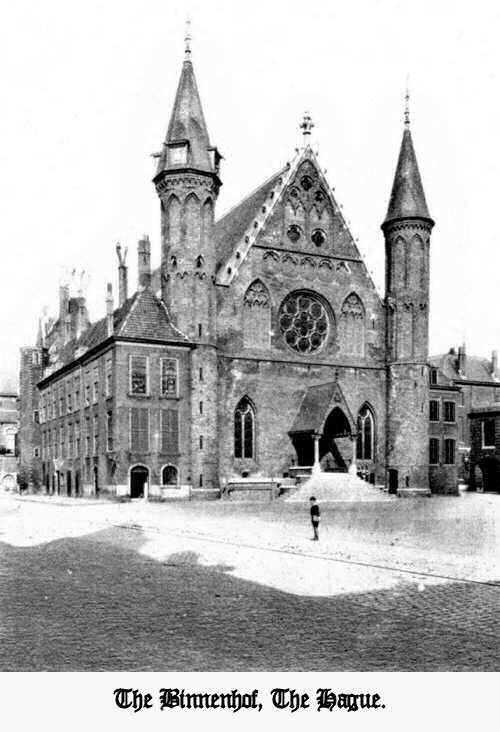
The most noteworthy part of the old town is the Binnenhof, a group of old buildings in different styles of architecture, which overlook two wide squares on two sides and a large pool on the third side. In the midst of this group of palaces, towers, and monumental doors, of a gloomy mediæval appearance, is a spacious courtyard which may be entered by three bridges and three doors. In one of those buildings the Stadtholders lived. It is now the Second Chamber of the States General; opposite to it are located the First Chamber, the rooms of the Ministry, and the other offices of public administration. The Minister of the Interior has his office in a little, low, black, gloomy tower which leans slightly toward the water of the pool.
The Binnenhof, the Buitenhof (a square extending to the west), and the Plaats (another square on the other side of the pool, which is reached by passing under an old door that once formed part of a prison) were the scenes of the most bloody events in the history of Holland.
In the Binnenhof the venerable Van Olden Barneveldt was beheaded. He was the second founder of the republic, the most illustrious victim of the long struggle between the patrician burghers and the Stadtholders, between the republican and monarchical principles, which so terribly afflicted Holland. The scaffold was erected in front of the building where sat the States General. Opposite was the tower from which, they say, Maurice of Orange, unseen, assisted at the execution of his enemy. In the prison between the two squares was tortured Cornelius de Witt, who was unjustly accused of plotting against the life of the Prince of Orange. The furious populace dragged Cornelius and John de Witt, the Grand Pensionary, into the Plaats all wounded and bleeding, and there they were spit upon, kicked, and slaughtered with pike and pistol, and afterward their corpses were mutilated and defiled. In the same square Adelaide de Poelgeest, the mistress of Albert, Count of Holland, was stabbed on the 22d of September in the year 1392, and the stone on which she expired is still shown.
These sad memories and those heavy low doors, that irregular group of dark buildings, which at night, when the moon lights up the stagnant pool, have the appearance of an enormous inaccessible castle standing in the midst of the joyous and cultured city,—arouse a feeling of awful sadness. At night the courtyard is lighted only by an occasional lamp; the few people who pass through it quicken their pace as if they are afraid. There is no sound of steps to be heard, no lighted windows to be seen; one enters it with a vague restlessness, and leaves it almost with pleasure.
With the exception of the Binnenhof, the Hague has no important monuments ancient or modern. There are several mediocre statues of the Princes of Orange, a vast, naked cathedral, and a royal palace of modest proportions. On many of the public buildings storks are carved, the stork being the heraldic animal of the city. Many of these birds walk about freely in the fish-market—they are kept at the expense of the municipality, like the bears of Berne and the eagles of Geneva.
The greatest ornament of the Hague is its forest, which is one of the wonders of Holland and one of the most magnificent parks in the world.
It is composed of alders, oaks, and the largest beech trees to be found in Europe. It is more than a French league in circumference, and is situated to the east of the city, only a few steps from the last houses. It is a really delightful oasis in the midst of the depressing Dutch plains. When one has entered the wood and passed beyond the fringe of pavilions, little Swiss cottages, and summer houses dotted about among the first trees, one seems to have lost one's self in a lonely interminable forest. The trees are as thick as a canebrake, the avenues are lost in the dusk; there are lakes and canals almost hidden by the verdure of the banks; rustic bridges, the crossways of unfrequented bridle-paths, shady recesses; and over all a cool, refreshing shade in which one seems to breathe the air of virginal nature and to be far removed from the turmoil of the world.
They say that this wood, like that of the town of Haarlem, is the remnant of an immense forest which in olden times covered almost the whole of the coast of Holland, and the Dutch respect it as a monument of their national history. Indeed, in the history of Holland there are many references to it, proving that at all times it was preserved with a most jealous care. Even the Spanish generals respected this national worship and shielded the sacred wood from the hands of the soldiers. On more than one occasion of serious financial distress, when the government was disposed to decree the destruction of the forest for the purpose of selling the wood, the citizens exorcised the danger by a voluntary offering. This beloved forest is connected with a thousand memories—records of terrible hurricanes, of the amours of princes, of celebrated fêtes, of romantic adventures. Some of the trees bear the names of kings and emperors, others of German electors; one beech tree is said to have been planted by the grand pensionary and poet Jacob Catz, three others by the Countess of Holland, Jacqueline of Bavaria, and they still point out the place where she used to rest after her walks. Voltaire also left a record of some sort of gallant adventure which he had with the daughter of a hair-dresser.
In the centre of the forest, where the underbrush seems determined to conquer everything and springs up, piling itself into heaps, climbing the trees, creeping across the paths, extending over the water, restraining one's steps and hiding the view on every side, as if it wished to conceal the shrine of some forgotten sylvan divinity,—at this spot is hidden a small royal palace, called the House-in-the-Wood, a sort of Casa del Labrador of the Villa Aranjuez. It was erected in 1647 by Princess Amalia of Solms, in honor of her husband, Frederick Henry, the Stadtholder.
When I went to visit this palace, while my eyes were busy searching for the visitors' door, I saw a lady with a noble and benevolent face come out and get into her carriage. I took her for some English traveller who had brought her visit to a close. As the carriage passed near me, I raised my hat; the lady bowed her head and disappeared.
A moment later one of the ladies in waiting at the palace told me that this "traveller" was no one less than Her Majesty the Queen of Holland.
I felt my blood flow faster. The word queen, independently of the person to whom it referred, has always had this effect on me, although I cannot explain the reason of it. Perhaps because it reminds me of certain bright, confused visions of my youth. The romantic imagination of a boy of fifteen is sometimes content to tread the ground, and sometimes it climbs with eager audacity to a giddy height. It dreams of supernatural beauty, of intoxicating perfumes, of consuming love, and imagines that all these are comprised in the mysterious and inaccessible creatures that fortune has placed at the summit of the social scale. And among the thousand strange, foolish, and impossible fancies that enter his mind he dreams of scaling towering walls in the dark with youthful agility, of passing formidable gates and deep ditches, of opening mysterious doors, threading interminable corridors amidst people overcome with sleep, of stepping silently through immense saloons, of ascending aërial staircases, mounting the stones of a tower at the risk of his life, reaching an immense height over the tall trees of moonlit gardens, and at last of arriving, fainting and bleeding, beneath a balcony, and hearing a superhuman voice speak in accents of deep pity, of answering with equal tenderness, of bursting into tears and invoking God, of leaning his forehead on the marble and covering with desperate kisses a foot flashing with gems, of abandoning his face in the perfumed silks, and of feeling his reason flee and life desert him in an embrace more than human.
In this palace, called the House-in-the-Wood, besides other remarkable things, is an octagonal room, the walls of which from floor to ceiling are covered with paintings by the most celebrated artists of the school of Rubens, among which is a huge allegorical painting by Jordaens which represents the apotheosis of Frederick Henry. There is a room filled with valuable presents from the Emperor of Japan, the Viceroy of Egypt, and the East India Company; and an elegant little room decorated with designs in chiaroscuro, which even when closely examined are taken for bas-reliefs. These are the work of Jacob de Wit, a painter who at the beginning of the last century won great fame in this art of delusion. The other rooms are small, and handsome without display; they are full of the treasures of a refined taste, as becomes the great and modest house of Orange.
The custom of allowing strangers to enter the palace the moment after the queen came out seemed strange to me, but it did not surprise me when I learned of other customs and other popular traits, and in a word the character of the royal family of Holland.
In Holland the sovereign is considered as a stadtholder rather than as a king. He has in him, as a certain Spanish republican said of the Duke of Aosta, the least quantity possible in a king. The sentiment of the Dutch nation toward their royal family is not so much a feeling of devotion to the family of the monarch as affection for the house of Orange, which has shared its triumphs and taken part in its misfortunes—which has lived its life for three centuries. At bottom, the country is republican, and its monarchy is a sort of crowned presidency void of regal pomp. The king makes speeches at the banquets and at the public festivals as the ministers do with us, and he enjoys the fame of an orator because his speeches are extemporary: his voice is very powerful, and his eloquence has a martial ring, which arouses great enthusiasm among the people. The crown prince, William of Orange, studied at the University of Leyden, passed the public examinations, and took his degree as a lawyer; Prince Alexander, the second son, is now studying at the same university. He is a member of the Students' Club, and invites his professors and fellow-students to dinner. At the Hague, Prince William enters the cafés, converses with his neighbors, and walks about the streets with his young gentlemen friends. In the wood the queen will seat herself on a bench beside any poor old woman, nor can one say she does this, like other princes, to acquire popularity; for that the house of Orange can neither gain nor lose, since there is not in the nation (although it is republican by nature and tradition) the least sign of a faction that desires a republic or even pronounces its name. On the other hand, the people, who love and venerate their king, who at the festivals celebrated in his honor will remove the horses and themselves draw his carriage, who insist on every one wearing an orange-colored cockade in homage to the name of Orange,—in ordinary times do not occupy themselves at all about his affairs and family. At the Hague I had some trouble to learn what grade the crown prince holds in the army. One of the first librarians in the town, to whom I put my question, was astonished at my curiosity, which to him seemed childish, and he told me that probably I could not have found a hundred people in the Hague who would have been able to answer my question.
The seat of the court is at the Hague, but the king passes a large part of the summer in one of his castles in Gelderland, and every year spends some days in Amsterdam. The people say there is a law which obliges the king to spend ten days during the year at Amsterdam, and the municipality of that town are obliged to pay his expenses during those ten days. After midnight of the tenth day even a match that he may strike to light his cigar is at his own expense.
On returning from the royal villa at the Hague I found the wood enlivened by the Sunday promenade—music, carriages, a crowd of ladies, restaurants full of people, and swarms of children everywhere.
Then for the first time I saw the fair sex of Holland. Beauty is a rare flower in Holland, as in all other countries; notwithstanding, in a walk of a hundred steps in the wood at the Hague I saw many more beautiful women than I had seen in all the pictures in the Dutch galleries. These ladies do not possess the statuesque beauty of the Romans, the splendid color of the English, nor the vivacity of the Andalusians; but there is about them a refinement, a delightful innocence and grace, a tranquil beauty, a pleasing countenance; they have, as a French writer has rightly said, the attraction of the valerian flower which ornaments their gardens. They are plump, and tall rather than short, they have regular features, and smooth brilliant complexions of a beautiful white and delicate pink—colors which seem to have been suffused by the breath of an angel; they have high cheek-bones; their eyes are light blue, sometimes very light, and sometimes of a glassy appearance, which gives them a vague, wandering look. It is said that their teeth are not good, but this I could not confirm, as they seldom laugh. They walk more heavily than the French and not so stiffly as the English; they dress in the Parisian mode, and the ladies at the Hague display better taste than those at Amsterdam, although they do not dress so richly: they all display their masses of fair hair with considerable pride.
I was astonished to see girls who appeared to be fully grown, who in our country would have had the airs and attire of women, still dressed like children, with short skirts and white pantalettes. In Holland, where life is easy and impatience an unknown experience, the girls are in no hurry to leave off the ways and appearance of childhood, and, on the other hand, they seem naturally to enter at a comparatively late age that period of life when, as Alessandro Manzoni says in his ever-admirable way, it seems as though a mysterious power enters the soul, which soothes, adorns, and invigorates all its inclinations and thoughts. Here a girl very rarely marries before her twentieth year. I need not speak of the children of the Deccan, who, it is said, are married at eight years of age, but in Holland the Italian and Spanish girls, who marry at fourteen or fifteen, are regarded as unaccountable persons. There, girls of fifteen years are going to school with their hair down their backs, and nobody thinks of looking at them. I heard a young man of the Hague spoken of with horror by his friends because he was enamoured of a maiden of this age, for to their minds she was considered as an infant.
Another thing one notices instantly in every Dutch city, excepting Amsterdam, is the absence of that lower stratum of society known as the demi-monde. There is nothing in dress or manner to indicate the existence of such a class. "Beware," said some freethinking Dutchmen to me; "you are in a Protestant country, and there is a great deal of hypocrisy." This may be true, but the sore that can be hidden cannot be very large. Equivocal society does not exist among the Hollanders; there is no shadow of it in their life nor any hint of it in their literature; the very language rebels against translating any of those numberless expressions which constitute the dubious, flashy, easy speech of that class of society in the countries where it is found. On the other hand, neither fathers nor mothers close their eyes to the conduct of their unmarried sons, even if they be grown men; family discipline makes no exception of long beards; and this strict discipline is aided by their phlegmatic nature, their habits of economy, and their respect for public opinion.
It would be a presumption more ridiculous than impertinent to speak of the character and life of Dutch women with an air of experience, when I have been only a few months in Holland; so I must content myself with letting my Dutch friends speak for themselves.
Many writers have treated Dutch women discourteously. One calls them apathetic housekeepers; another, who shall be nameless, carried impertinence so far as to say that, like the men, they are in the habit of choosing their lovers from among the servant class, and that their aspirations are necessarily low. But these are judgments dictated by the rage of some rejected suitors. Daniel Stern (Comtesse d'Agoult), who as a woman speaks with particular authority on this subject, says the women of Holland are noble, loyal, active, and chaste. A few authors venture to doubt their much-talked-of calmness in affection. "They are still waters," wrote Esquiros, and all know what is said of still waters. Heine said they were frozen volcanoes, and that when they thaw—But, of all the opinions I have read, the most remarkable seems to me that of Saint Evremont—namely, that Dutch women are not lively enough to disturb the repose of the men, that some of them are certainly amiable, and that prudence or the coldness of their nature stands them in stead of virtue.
One day, in a group of young men at the Hague, I quoted this opinion of Saint Evremont, and bluntly demanded: "Is it true?" They smiled, looked at each other, and one answered, "It is:" another, "I think so;" and a third, "It may be." In short, they all admitted its truth. On another occasion I collected evidence proving that matters stand just as they were at the time of the French writer. A group of people were discussing an odd character. "Yet," said one, "that little man who seems so quiet in his manner is a great ladies' man." "Does he disturb the repose of families?" I asked. They all began to laugh, and one answered: "What! Disturb the repose of families in Holland? It would be one of the twelve labors of Hercules."—"We Hollanders," a friend once said to me, "do not take the ladies by storm; we cannot do so, because we have no school of this art. Nothing is so false in Holland as the famous definition, matrimony is like a besieged fortress; those who are outside wish to enter, while those who are inside wish they were out. Here those who are inside are very happy, and those who are outside do not think of entering." Another said to me, "The Dutch woman does not marry the man; she espouses matrimony." This, which is true of the Hague, an elegant city to which there comes a great influx of French civilization, is even truer of the other towns, where the ancient customs have been more strictly adhered to. Yet gallant travellers write that the Hollanders are a sleepy people, and that their domestic happiness is "un bonheur un peu gros." The woman who seldom goes out, who dances little and laughs less, who occupies herself only with her children, her husband, and her flowers, who reads her books on theology, and surveys the street with the looking-glass, so that she need not show herself at the window, how much more poetical is she than—But pardon me, Andalusia! I was about to say something rather hard on you.
Hitherto, some readers may think that I have been pretending to know the Dutch language. I hasten to say that I do not know it, and to excuse my ignorance. A people like the Dutch, serious and taciturn, richer in hidden qualities than in brilliant showy ones—a people who are, if I may so express myself, self-contained rather than superficial, who do much and talk little, who do not pass for more than they are worth—may be studied without a knowledge of their language. On the other hand, the French language is generally known in Holland. In the large cities there is scarcely an educated person who does not speak French correctly, scarcely a shopman who cannot make himself understood in good or bad French, and there is scarcely a boy who is not acquainted with ten or twenty words which suffice to help a stranger out of a dilemma. This diffusion of a language so different from that of the country is the more to be admired when one reflects that it is not the only foreign language generally spoken in Holland. English and German are almost as widely known as French. The study of these three languages is obligatory in the secondary schools. Cultured people, like those who in Italy think it a necessity to know French, in Holland generally read English, German, and French with equal facility. The Dutch have an especial talent for learning languages, and an incredible courage in speaking them. We Italians before we attempt to speak a foreign language require to know enough about it to avoid making great mistakes; we blush when we do make them; we avoid the opportunities of speaking until we are sure of speaking well enough to be complimented, and in this way we continue to lengthen the period of our philological novitiate. In Holland one often meets people who speak French with great effort, with a vocabulary of perhaps a hundred words and twenty sentences; but notwithstanding they talk, hold long conversations, and do not seem to be at all worried about what one may think of their blunders and their audacity. Waiters, porters, and boys, when asked if they know French, answer with the greatest assurance, "Oui" or "Un peu," and they try in a thousand ways to make themselves understood, laughing themselves sometimes at the eccentric contortion of their speech, and ending every answer with "S'il vous plait" or a "Pardon, monsieur;" which are often said so prettily and yet are so out of place that they make one laugh even against one's will. It is considered such a common thing to know French that when any one is obliged to answer that he doesn't speak French, he hesitates, ashamed, and if he is interrogated in the street he will pretend to be busy and hurry on.
As for the Dutch language, it is a mystery to those who do not know German, and even when one knows German and can read Dutch books with a little study, one cannot understand Dutch when it is spoken. If I were asked to say what impression it makes on those who do not understand it, I should say that it seems like German spoken by people with a hair in their throats. This effect is produced by the frequent repetition of a guttural aspirate which is like the sound of the Spanish jota. Even the Dutch themselves do not consider their language euphonious. I was often asked, playfully, "What impression does it make on you?" as if they understood that the impression could not be altogether agreeable. Yet some one has written a book proving that Adam and Eve spoke Dutch in the Garden of Eden. But, although the Dutch speak so many foreign languages, they hold to their own, and grow indignant when any ignorant stranger shows that he believes Dutch to be a German dialect, this being, in truth, a theory held by many who only know the language by name. It is almost superfluous to repeat the history of the language.
The first inhabitants of the country spoke Teutonic in its different dialects. These dialects were blended and formed the ancient speech of the Netherlands, which in the Middle Ages, like the other European languages, passed through the different Germanic, Norman, and French phases, and ended in the present Dutch language, in which there is still a foundation of the primitive idiom and the evidence of a slight Latin influence. Certainly, there is a striking similarity between Dutch and German, and, above all, there are a number of root-words common to the two; but there is, however, a great difference in the grammar, that of the Dutch being much simpler in construction, and the pronunciation also is very different. This very likeness is the reason that the Dutch generally do not speak German so well as they speak English or French; perhaps the difficulty may be caused by the ambiguity of words, or because it costs them so little effort to understand the language and to speak it for their own use that they stop there, as we often do with French, which we speak at ten years of age and have forgotten at forty.
Now it is time to go and visit the art gallery, which is the greatest ornament of the Hague.
On entering we find ourselves at once before the most celebrated of all painted animals, Paul Potter's "Bull"—that immortal bull which, as has been said, was honored at the Louvre, when the mania arose of classifying these pictures in a sort of hierarchy of celebrity, by being placed near the "Transfiguration" of Raphael, the "St Peter the Martyr" of Titian, and the "Communion of St. Jerome" by Domenichino; that bull for which England would pay a million francs, and Holland would not sell for double that sum; the bull on which more pages have been written than the strokes of the artist on the canvas, and about which critics still write and dispute as if it were a real living creation of a new animal instead of a picture.
The subject of the picture is very simple—a life-size bull, standing with his head turned toward the spectator, a cow lying on the ground, some sheep, a shepherd, and a distant landscape.
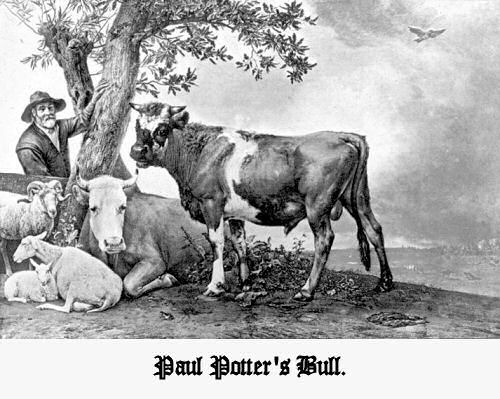
The supreme merit of this bull may be expressed in one word: it is alive. The serious wondering eye, which gives the impression of vigorous vitality and savage pride, is painted with such truth that at the first sight one feels inclined to dodge to the right or left, as one does in a country road when one meets such animals. His moist black nostrils seem to be smoking, and to be drawing in the air with a prolonged breath. His hide is painted with all its folds and wrinkles; one can see where the animal has rubbed himself against the trees and the ground; the hairs look as though they are stuck on the canvas. The other animals are equally fine: the head of the cow, the fleece of the sheep, the flies, the grass, the leaves and fibres of the plants, the moss,—everything is rendered with extraordinary fidelity. Although the infinite care the artist must have taken is apparent, the fatigue and patience of the copy do not appear; it seems almost an inspired, impetuous work, in which the painter, impelled by a thirst for truth, has not felt a moment of hesitation or weariness. Infinite criticisms were made on this "incredible stroke of audacity by a young man of twenty-four." The large size of the canvas was censured, the commonplace nature of the subject, the poverty of the light effects, for the light is equally diffused and everything is placed in relief without the contrast of shadow,—the stiffness of the legs of the bull, the crude coloring of the plants and animals in the background; the mediocrity of the shepherd's figure. But, for all this, Paul Potter's bull was crowned with glory as one of the noblest examples of art, and Europe considers it as the greatest work of the prince of animal-painters. An illustrious critic very rightly said that "Paul Potter with his bull has written the true idyl of Holland."
Herein is the great merit of the Dutch animal-painters, and of Potter above all, that they have not only depicted animals, but have revealed, and told in the poetry of color, the delicate, attentive, almost maternal love with which this Dutch agricultural people cherish their cattle. Potter's animals interpret the poetry of rural life. By them he has expressed the silence and the peace of the meadows, the pleasure of solitude, the sweetness of repose, and the satisfaction of patient toil. One might almost say that he had succeeded in making himself understood by them, and that they must have put themselves in positions to be copied. He has given them the variety and attractiveness of human beings. The sadness, the quiet content which follows the satisfaction of physical needs, the sensations of health and strength, of love and gratitude toward mankind, all the glimmerings of intelligence and the stirrings of affection, all the variety of nature—all these he has understood and expressed with loving fidelity, and he has further succeeded in communicating to us the feelings by which he was animated. As we look at his pictures a strange primitive instinct of a rural life is gradually roused in us—an innocent desire to milk, to shear, to drive these gentle patient animals that delight the eye and heart. In this art Paul Potter is unsurpassed. Berghem is more refined, but Potter is more natural; Van de Velde is more graceful, but Potter is more vigorous; Du Jardin is more amiable, but Potter is more profound.
And to think that the architect who afterward became his father-in-law would not at first give him his daughter, because he was only a painter of animals! and if we may believe tradition his celebrated bull served as a sign to a butcher's shop and sold for twelve hundred and sixty francs.
Another masterpiece in the Hague Gallery is a small painting by Gerard Dou, the painter of the celebrated "Dropsical Woman," which hangs in the Louvre between pictures by Raphael and Murillo. He is one of the greatest painters of the home-life of the Dutch, and the most patient of the patient artists of his country. The picture simply represents a woman seated near a window, with a cradle by her side; but in this humble scene there is such a sweet and holy air of domestic peace, a repose so profound, a love so harmonious, that the most obstinate bachelor on earth could not look on it without feeling an irresistible desire to be the one for whom the wife is waiting in that quiet, clean room, or at least to enter it secretly for a moment, even though he remain hidden in the shadow, if so he might breathe the perfume of the innocent happiness of this sanctuary. This picture, like all the works of Dou, is painted with that wonderful finish which he carries almost to excess, which was certainly carried to excess by Slingelandt, who worked three years continuously in painting the Meerman family. This style afterward degenerated into that smooth, affected, painful mannerism where the figures are like ivory, the skies enamel, and the fields velvet, of which Van der Werff is the best known representative. Among other things to be seen in this picture by Dou is a broom-handle, the size of a pen-holder, on which they say the artist worked assiduously for three days. This does not seem strange when we reflect that every minute filament, the grain, the knots, spots, dents, and finger-marks are all reproduced. Anecdotes of his superhuman patience are recounted which are scarcely credible. It is said he was five days in copying the hand of a Madam Spirings whose portrait he painted. Who knows how long he was painting her head? The unhappy creatures who wished to be painted by him were driven to madness. It is believed that he ground his colors himself, and made his own brushes, and that he kept everything hermetically closed, so that no particle of dust could reach his work. When he entered his studio he opened the door slowly, sat down with great deliberation, and then remained motionless until the least sign of agitation produced by the exercise had ceased. Then he began to paint, using concave glasses to reduce the objects in size. This continual effort ended by injuring his sight, so that he was obliged to work with spectacles. Nevertheless, his coloring never became weakened or less vigorous, and his pictures are equally strong whether one looks at them near by or far off. They have been very justly compared to natural scenes reduced in photographs. Dou was one of the many disciples of Rembrandt who divided the inheritance of his genius. From his master he learned finish and the art of imitating light, especially the effects of candle-light and of lamps. Indeed, as we shall see in the Amsterdam Gallery, he equalled Rembrandt in these respects. He possessed the rare merit among the painters of his school in that he took no pleasure in painting ugliness and trivial subjects.
In the gallery at the Hague home-life is represented by Dou, by Adriaen van Ostade, by Steen, and by Van Mieris the elder.
Van Ostade—called the Rembrandt of home-life, because he imitated the great master in his powerful effects of chiaroscuro, of delicate shading, of transparency in shadows, of rich coloring—is represented by two small pictures which depict the inside and outside of a rustic house. Both are full of poetry, notwithstanding the triviality of the subjects which he has chosen in common with other painters of his school. But he has this peculiarity, that the remarkably ugly girls in his pictures are taken from his own family, which, according to tradition, was a group of little monstrosities, whom he held up to the ridicule of the world. Thus nearly all the Dutch painters chose to paint the least handsome of the women whom they saw, as if they had agreed to throw discredit on the feminine type of their country. Rembrandt's "Susanna," to cite a subject which of all others required beauty, is an ugly Dutch servant, and the women painted by Steen, Brouwer, and others are not worth mentioning. And yet, as we have seen, models of noble and gracious beauty were not wanting among them.
There are three fine paintings by Frans van Mieris the elder, the first disciple of Dou, and as finished and minute a painter as his master. He together with Metsu and Terburg, two artists eminent for finish and coloring, belonged to that group of painters of home-life who chose their subjects from the higher classes of society. One of these canvases portrays the artist with his wife.
Among other paintings, Steen is represented by his favorite subject, a doctor feeling the pulse of a lovesick girl in the presence of her duenna. It is an admirable study of expression, of piquant, roguish smiles. The doctor's face seems to say, "I think I understand;" the invalid's, "Something more than your prescriptions are needed;" the duenna's, "I know what she wants." Other pictures of home-life by Schaleken, Tilborch, Netscher, William van Mieris represent kitchens, shops, dinners, and the families of the artists.
Landscape and marine painting are represented by beautiful gems from the hands of Ruysdael, Berghem, Van de Velde, Van der Neer, Bakhuisen, and Everdingen. There are also a large number of works by Philips Wouverman, the painter of horses and battle-pieces.
There are two pictures by Van Huysum, the great flower-painter, who was born at a time when Holland was possessed with a mad love of flowers and cultivated the most beautiful flowers in Europe. He celebrated this passion with his brush and created it afresh in his pictures. No one else has so marvellously rendered the infinite shades, the freshness, the transparency, the softness, the grace, the modesty, the languor, the thousand hidden beauties, all the appearances of the noble and delicate life of the pearl of vegetation, of the darling of nature, the flower. The Hollanders brought to him all the miracles of their gardens that he might copy them; kings asked him for flowers; his pictures were sold for sums that in those days were fabulous. Jealous of his wife and his art, he worked alone, unseen by his fellow-artists, lest they should discover the secret of his coloring. Thus he lived and died, glorious and melancholy, in the midst of petals and fragrance.
But the greatest work in the gallery is the celebrated "Lesson in Anatomy" by Rembrandt.
This picture was inspired by a feeling of gratitude to Doctor Tulp, Professor of Anatomy at Amsterdam, who protected Rembrandt in his youth. Rembrandt portrays Tulp and his pupils grouped round a table on which is stretched a naked corpse, whose arm has been dissected by the anatomist's knife. The professor, who wears his hat, stands pointing out the muscles of the arm with his scissors, and explaining them to his pupils. Some of the scholars are seated, others stand, others lean over the body. The light coming from left to right illuminates their faces and a part of the dead man, leaving their garments, the table, and the walls of the room in obscurity. The figures are life-size.
It is difficult to describe the effect produced by this picture. The first sensation is a feeling of horror and disgust of the corpse. Its forehead is in shadow, its open eyes are turned upward, its mouth half shut as if in amazement; the chest is swollen, its legs and feet are rigid, the flesh is livid and looks as if it would be cold to the touch. In great contrast to this stiffened corpse are the living attitudes of the students, the youthful faces, the bright eyes, intent and full of thought, revealing, in different degrees, eagerness to learn, the joy of comprehension, curiosity, astonishment, the effort of the intellect, the activity of the mind. The face of the master is calm, his eye is serene, and his lips seem smiling with the satisfaction of intimate knowledge of his subject. The whole group is surrounded by an air of gravity, mystery, and scientific solemnity which imposes reverence and silence. The contrast between the light and shade is as marvellous as that between death and life. Everything is painted with infinite pains; it is possible to count the little folds of the ruff, the wrinkles in the face, the hairs of the beard. It is said that the foreshortening of the corpse is incorrect, and that in some places the finish degenerates into hardness, but universal approval places the "Lesson in Anatomy" among the greatest works of art in the world.
Rembrandt was only twenty-six years old when he painted this picture, which consequently has the mark of his early work. The impetuosity, audacity, and unequalled assurance of his genius, which shine forth in his maturer works, are not yet seen, but his immense power of painting light, his marvellous chiaroscuro, his fascinating magic of contrast, the most original features of his genius, are all to be found here.
However little we may know about art, and however much we may have resolved not to sin by excess of enthusiasm, when we come face to face with Rembrandt van Rijn, we cannot help opening the flood-gates of language, as the Spanish say. Rembrandt exerts an especial fascination. Fra Angelico is a saint, Michelangelo is a giant, Raphael is an angel, Titian a prince, Rembrandt is a spectre. What else can this miller's son be called? Born in a windmill, he arose unexpectedly without a master, without example, without any instruction from the schools, to become a universal painter, who depicted life in every aspect, who painted figures, landscapes, sea-pieces, animals, saints, patriarchs, heroes, monks, riches and poverty, deformity, decrepitude, the ghetto, taverns, hospitals, and death; who in short, reviewed heaven and earth, and enveloped everything in a light so mysterious that it seems to have issued from his brain. His work is at the same time grand and minute. He is at once an idealist and a realist, a painter and an engraver, who transforms everything and conceals nothing—who changes men into phantoms, the most ordinary scenes of life into mysterious apparitions; I had almost said who changes this world into another that does not seem to be and yet is the same. Whence has he drawn that undefinable light, those flashes of electric rays, those reflections of unknown stars that like an enigma fill us with wonder? What did this dreamer, this visionary, see in the dark? What is the secret that tormented his soul? What did this painter of the air mean to tell us in this eternal conflict of light and shadow? It is said that the contrasts of light and shade corresponded in him to moods of thought. And truly it seems that as Schiller, before beginning a work, felt within himself an indistinct harmony of sounds which were a prelude to his inspiration, so also Rembrandt, when about to paint a picture, beheld a vision of rays and shadows which had some meaning to him before he animated them with his figures. In his paintings there is a life, a dramatic action, quite distinct from that of human figures. Flashes of brilliant light break across a sombre surface like cries of joy; the frightened darkness flies away, leaving here and there a melancholy twilight, trembling reflections that seem to be lamenting, profound obscurity gloomy and threatening, flashes of dancing sunlight, ambiguous shadows, shadows uncertain and transparent, questionings and sighs, words of a supernatural language like music heard but not understood, which remains in the memory like a dream. Into this atmosphere he plunged his figures, some of them enveloped by the garish light of a theatrical apotheosis, others veiled like ghosts, others revealed by a single ray of light darting across their faces. Whether they be clothed with pomp or in rags, they all are alike strange and fantastic. The outlines are not clear; the figures are loaded with powerful colors, and are painted with such bold strokes of the brush that they stand out in sculpturesque relief, while over all is an expression of impetuosity and of inspiration, that proud, capricious, profound imprint of genius that knows neither restraint nor fear.
After all, every one likes to give his opinion: but who knows, if Rembrandt could read all the pages that have been written to explain the secret meanings of his art, whether he would not burst out laughing? Such is the fate of men of genius: every one holds that he has understood them better than his neighbor, and restores them in his own way. They are like a beautiful theme given by God which men distort into a thousand different meanings—a canvas upon which the imagination of man paints and embroiders after its own manner.
I left the Hague Gallery with one desire ungratified: I had not found in it any picture by Jerom Bosch, a painter born at Bois-le-Duc in the fifteenth century. This madcap of mischief, this scarecrow of bigots, this artistic sorcerer, had made my flesh creep first in the gallery at Madrid with a work representing a horrible army of living skeletons scattered about an immense space, in conflict with a motley crowd of desperate and confused men and women, whom they were dragging into an abyss where Death awaited them. Only from the diseased imagination of a man alarmed by the terrors of damnation could such an extravagant conception have issued. When you look at it, however long it may be since you were afraid of phantoms, you feel a confused reawakening dread. Such were the subjects of all his pictures—the tortures of the accursed, spectres, fiery chasms, dragons, uncanny birds, loathsome monsters, diabolical kitchens, sinister landscapes. One of these frightful pictures was found in the cell where Philip II. died; others are scattered throughout Spain and Italy. Who was this chimerical painter? How did he live? What strange mania tormented him? No one knows; he passed over the earth wrapped in a cloud, and disappeared like an infernal vision.
On the first floor of the museum there is a "Royal Cabinet of Curiosities," which contains some very precious historical relics, besides a great number of different objects from China, Japan, and the Dutch colonies. Amongst other things there is the sword of that Ruyter who began life as a rope-maker at Vlissingen, and became the greatest admiral of Holland; Admiral Tromp's cuirass perforated by bullets; a chair from the prison of the venerated Barneveldt; a box containing a lock of hair from the head of that Van Speyk who in 1831, on the Schelde, blew up his vessel to preserve the honor of the Dutch flag. Here, too, is the complete suit of clothes worn by William the Silent when he was assassinated at Delft—the blood-stained shirt, the jacket made of buffalo skin pierced by bullets, the wide trousers, the large felt hat; and in the same glass case are also preserved the bullets and pistols of the assassin and the original copy of his death-warrant.
This modest, almost rough dress, that was worn at the zenith of his power and glory by William, the head of the Republic of the Netherlands, is a noble testimony to the patriarchal simplicity of Dutch manners. There is perhaps no other modern nation, equally prosperous, that has been less given to vanity and pomp. It is related that when the Earl of Leicester, who was commissioned by Queen Elizabeth, arrived in Holland, and when Spinola came to sue for peace in the name of the King of Spain, their magnificence was considered almost infamous. It is further said that the Spanish ambassadors who came to the Hague in 1608 to negotiate the famous truce saw some deputies of the Dutch States seated in a field, meanly clad and breakfasting on a little bread and cheese which they had carried in their saddle-bags. The Grand Pensionary, John De Witt, the adversary of Louis XIV., kept only one servant. Admiral Ruyter lived at Amsterdam in the house of a poor man and swept out his own bedroom.
Another very curious object in the museum is a cabinet which opens in front like a book-case, representing in all its most minute details the inside of a luxurious Amsterdam house at the beginning of the eighteenth century. The Czar, Peter the Great, during his stay in Amsterdam, commissioned a rich citizen of that town to make for him this toy house, in order that he might take it back to Russia as a souvenir of Holland. The rich citizen, whose name was Brandt, executed the order like an honest Dutchman, slowly and well. The best cabinet-makers in Holland made the furniture, the cleverest silversmiths the plate, the most accurate printers printed the tiny books, the finest miniature-painters painted the pictures; the linen was prepared in Flanders, the hangings were made at Utrecht. After twenty-five years of work all the rooms were ready. In the nuptial chamber everything was prepared for the confinement of the young mistress; in the dining-room stood a microscopic tea service on a table which was the size of a crown; the picture-gallery, which was seen through a magnifying glass, was complete; in the kitchen was everything needful to prepare a savory dinner for a group of Liliputians; there was a library, and a cabinet of Chinese objects, bird-cages full of birds, prayer-books, carpets, linen for a whole family trimmed with lace and fine embroidery: there were lacking only a married couple, a lady's maid, and a cook rather smaller than ordinary marionettes. But there was one drawback: the house cost a hundred and twenty thousand francs, and the Czar, who as all know, was an economical man, refused it, and Brandt, to shame the imperial avarice, presented it to the Museum of the Hague.
In the streets of the Hague, from the first day, I had met women dressed in such a peculiar manner that I had followed them to observe every particular of their costume. At first sight I thought that they must belong to some religious order or that they were hermits, pilgrims, or women of some nomadic tribes which were passing through Holland. They wore immense straw hats lined with flowered calico, short chocolate-colored monk's cloaks made of serge and lined with red cloth; their petticoats were also of serge, short and puffed out as though they wore crinolines; they wore black stockings and white wooden shoes. In the morning they might be seen going to market bearing on their heads baskets full of fish or driving carts drawn by dogs. They usually went alone or in pairs, without any men. They walked in a peculiar manner, taking long strides, with a certain air of despondency, like those who are accustomed to walking on the sand; there was a sadness in their expression and appearance which harmonized with the monastic austerity of their attire.
I asked a Dutchman who they were, and the only answer he gave me was, "Go to Scheveningen."
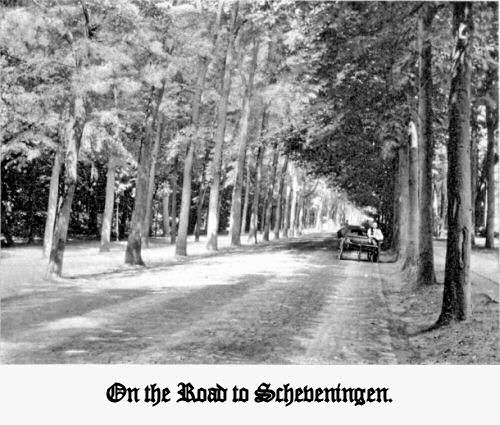
Scheveningen is a village two miles from the Hague, and connected with it by a straight road bordered along its whole length by several rows of beautiful elms, which form a perfect shade. On either side of the road, beyond the elms, there are small villas, pavilions, and cottages with roofs that look like the kiosks of the gardens, and with façades of a thousand fantastic shapes, all bearing the usual inscriptions inviting to repose and pleasure. This road is the favorite promenade of the citizens of the Hague on Sunday evenings, but on the other days of the week it is almost always deserted. One meets only a few women from Scheveningen, and now and then a carriage or the coaches that come and go between the town and the village. As one walks along it seems as though the road must lead to some royal palace surrounded by a large garden or a wide park. The luxuriant vegetation, the shadow and silence, call to mind the forests of Andalusia and Granada. One no longer remembers Scheveningen and forgets that he is in Holland.
When the end of the road is reached the change of scene is so sudden that it seems unreal. The vegetation, the shade, the likeness to Granada,—all have disappeared, and one stands in the midst of dunes, sand, and desert; one feels the salt wind blow and hears its dull confused sound. From the summit of one of the dunes one may see the North Sea.
One who has seen only the Mediterranean is impressed by a new and profound feeling at sight of that sea and shore. The beach is formed of very fine, light-colored sand, over which the outermost edges of the waves flow up and down like a carpet which is being continually folded and unfolded. This sandy sea-shore extends to the foot of the first dunes, which are steep, broken, corroded mounds deformed by the eternal beating of the waves. Such is the Dutch coast from the mouth of the Meuse to the Helder. There are no mollusks, no star-fish, no shells or crabs; there is not a single bush or blade of grass. Nothing is seen but sand, waste, and solitude.
The sea is no less mournful than the coast. It corresponds closely to one's ideas of the North Sea, formed by reading about the superstitious terrors of the ancients, who believed it to be driven by eternal winds and peopled by gigantic monsters. Near the shore its color is yellowish, farther out a pale green, and still farther out a dreary blue. The horizon is usually veiled by the mist, which often descends even to the shore and hides all the waters with its thick curtain, which is raised to show only the waves that come to die on the sand and some shadowy fisherman's boat close to land. The sky is almost always gray, overcast with great clouds which throw dense changeable shadows on the waters: in places these are as black as night, and bring to mind images of tempests and horrible shipwrecks; in other parts the sky is lighted up by patches and wavy streaks of bright light, which seem like motionless lightning or an illumination from mysterious stars. The ceaseless waves gnaw the shore in wild fury, with a prolonged roar which seems like a cry of defiance or the wailing of an infinite crowd. Sea, sky, and earth regard each other gloomily, as though they were three implacable enemies. As one contemplates this scene some great convulsion of nature seems imminent.
The village of Scheveningen is situated on the dunes, which ward off the sea, and hide it so entirely that from the shore nothing is to be seen but the cone-shaped church-steeple rising like an obelisk in the midst of the sand. The village is divided into two parts, one of which is composed of elegant houses representing every kind of Dutch shapes and colors, and built for the use of strangers, with "to let" posted on them in various languages. The other part, in which the natives live, consists of black cottages, little streets, and retreats which foreigners never think of entering.
The population of Scheveningen, which numbers only a few thousands, is almost entirely composed of fishermen, the greater number of whom are very poor. The village is still one of the principal stations of the herring fishery, where are cured those celebrated fish to which Holland owes her riches and power. But the profits of this industry go to the captains of the fishing vessels, and the men of Scheveningen, who are employed as sailors, hardly earn a livelihood. On the beach, in front of the village, many of those wide staunch boats with a single mast and a large square sail may always be seen ranged in line on the sand one beside the other, like the Greek galleys on the coast of Troy: thus they are safe from the gusts of wind. The flotilla, accompanied by a steam sloop, starts early in June, directing its course toward the Scottish coast. The first herrings taken are at once sent to Holland, and conveyed in a cart ornamented with flags to the king, who in exchange for this present gives five hundred florins. These boats make catches of other fish as well, which are in part sold at auction on the sea-shore, and in part are given to the Scheveningen fishermen, who send their wives to sell them at the Hague market.
Scheveningen, like all the other villages of the coast, Katwijk, Vlaardingen, Maassluis, is a village that has lost its former prosperity in consequence of the decline of the herring fishery, owing, as every one knows, to the competition of England and the disastrous wars. But poverty, instead of weakening the character of this small population, beyond doubt the most original and poetical in Holland, has strengthened it. The inhabitants of Scheveningen in appearance, character, and habits seem like a foreign tribe in comparison with the people of their own country. They dwell but two miles from a large city, and yet preserve the manners of a primitive people that has always lived in isolation. As they were centuries ago, so are they now. No one leaves their village, and no one who is not a native ever enters it: they intermarry, they speak a language of their own, they all dress in the same style and in the same colors, as did their fathers' fathers. At the time of the fishing only the women and children remain in the village; the men all go to sea. They carry their Bibles with them on their departure. On board they neither drink nor swear nor laugh. When the stormy seas toss their little boats on the crests of the waves, they close all the apertures and await death with resignation. At the same moment their wives are singing psalms, shut in their cottages rocked by the wind and beaten by the rain. Those little dwellings, which have witnessed so many mortal griefs, which have heard the sobs of so many widows, which have seen the sacred joys of happy return and the disconsolate departure of many husbands, with their cleanliness, their white curtains, with the clothes and shirts of the sailors hanging at the windows,—tell of the free and dignified poverty of their inmates. No vagabonds nor fallen women come out of these homes; no inhabitant of Scheveningen has ever deserted the sea, and none of her daughters has ever refused the hand of a sailor. Both men and women show by their carriage and the expression of their faces a serious dignity that commands respect. They greet you without bending their heads, and look you in the face as much as to say, "We have no need of any one."
In this little village there are two schools, and it is a curious sight to see a swarm of fair-haired children with slates under their arms and pencils in their hands disperse at certain hours among these poverty-stricken streets.
Scheveningen is not only a village famous for the originality of its inhabitants which all foreigners visit and all artists paint. There are, besides, two great bathing establishments, where English, Russians, Germans, and Danes meet in the summer. The flower of the Northern aristocracy, princes and ministers, indeed half the Almanach de Gotha, come here; then there are balls, fantastic illuminations, and fireworks on the sea. The two establishments are placed on the dunes, and at all hours of the day certain carriages which look like gypsy caravans, drawn by strong horses, are driven from the shore into the sea, where they turn round. Whereupon ladies step out from them and bathe in the water, letting their fair hair blow about in the wind. At night the band plays, the visitors walk out, and the beach is enlivened by an elegant, festive, ever-changing crowd, in which every language is heard and the beauty of every country is represented. A few steps distant from this gayety the misanthrope can find solitude and seclusion on the dunes, where the music faintly strikes his ear like a far-off echo, and the houses of the fishermen show him their lights, directing his thoughts to domestic life and peace.
The first time I went to Scheveningen I took a walk on those dunes which have been so often painted by artists, the only heights on the immense Dutch plain that intercept the view—rebellious children of the sea, whose progress they oppose, being at the same time the prisoners and the guardsmen of Holland. There are three tiers of these dunes, forming a triple bulwark against the ocean: the outer is the most barren, the centre the highest, and the inner the most cultivated. The medium height of these mountains of sand is not greater than fifteen metres, and all together they do not extend into the land for more than a French league. But as there are no higher elevations near or remote, they produce the false impression of a vast mountainous region. The eye sees valleys, gorges, precipices, views that appear distant and are close at hand—the tops of neighboring dunes on which we imagine a man ought to appear as large as a child, and on which instead he seems a giant. Viewed from a height, this region looks like a yellow sea, tempestuous yet motionless. The dreariness of this desert is increased by a wild vegetation, which seems like the mourning of the dead and abandoned nature—thin, fragile grass, flowers with almost transparent petals, juniper, sweet-broom, rosemary, through which every now and then skips a rabbit. Neither house, tree, nor human being is to be seen for miles. Now and then ravens, curlews, and sea-gulls fly past. Their cries and the rustling of the shrubs in the wind are the only sounds that break the silence of the solitude. When the sky is black the dead color of the earth assumes a sinister hue, like the fantastic light in which objects appear when seen through colored glass. It is then, when standing alone in the midst of the dunes, that one feels a sense almost of fear, as if one were in an unknown country hopelessly separated from any inhabited land, and one looks anxiously at the misty horizon for the shadow of a building to reassure him.
In the whole of my walk I met but one or two peasants. The Dutch peasants usually speak to the people they meet on the road—a rare thing in a Northern country. Some pull off their caps at the side with a curious gesture, as if they did it for a joke. Usually they say "Good-morning" or "Good-evening" without looking at the person they are greeting. If they meet two people, they say, "Good-evening to you both," or if more than two, "Good-evening to you all." On a pathway in the middle of the first dunes I saw several of those poor fishermen who spend the whole day up to their waists in water, picking up the shells that are used to make a peculiar cement or to spread over garden-paths instead of sand. It must cost them at least half an hour of hard labor to take off the enormous leather boots that they wear to go into the sea; this would give an excuse to an Italian sailor for swearing by all the saints. But these men, on the contrary, perform the task with a composure that makes one sleepy, without giving way to any movement of impatience, nor would they raise their heads until they had finished even if a cannon were to be fired off.
On the dunes, near a stone obelisk recording the return of William of Orange from England after the fall of the French dominion, I saw for the first time one of those sunsets which awaken in us Italians a feeling of wonder no less than that awakened in people from the North by the sunsets at Naples and Rome. The sun, because of the refraction of light by the mists which always fill the air in Holland, is greatly magnified, and diffuses through the clouds and on the sea a veiled and tremulous splendor like the reflection of a great fire. It seemed as if another sun had unexpectedly appeared on the horizon, and was setting, never again to show itself on earth. A child might well have believed the words of a poet who said, "In Holland the sun dies," and the most cold-blooded man must have allowed a farewell to escape his lips.
As I have spoken of my walk to Scheveningen, I will mention two other pleasant excursions that I made from the Hague last winter.
The first was to the village of Naaldwijk, and from this village to the sea-coast, where they were opening the new Rotterdam canal. At Naaldwijk, thanks to the politeness of an inspector of schools who was with me, I gratified my desire to see an elementary school, and I will state at once that my great expectations were more than realized. The house, built expressly for the school, was a separate building one story in height. We first went into a little vestibule, where there were a number of wooden shoes, which the inspector told me belonged to the pupils, who place them there on their entrance into school and put them on again when they go out. In school the boys wear only stockings which are very thick, consequently their feet do not suffer from cold, especially as the rooms are as hot as if they were a minister's cabinet. On our entrance the pupils stood up and the master advanced toward the inspector. Even that poor village master spoke French, and so we were able to enter into conversation. There were in the school about forty pupils, both boys and girls, who sat on opposite sides of the room; all were fair and fat, with plump, good-natured faces; they had the precocious air of little men and women, which I could not observe without laughing. The building was divided into five rooms, each separated from the other by a large glass partition, which enclosed all the space like a wall, so that if a master were absent from one class the teacher of the next class could overlook the pupils of his colleague without leaving his post. All the rooms are large and have high windows which reach from the floor to the ceiling, so that it is almost as light inside as it is outside. The benches, walls, floors, windows, and stoves were as clean as if they had been in a ball-room. Having a lively recollection of certain unpleasant places in the schools I attended as a boy, I asked to see the closets, and found them such as few of the best hotels can boast. Afterward on the school-room walls I saw a great many things that I remember to have wished for when I sat at the desks, such as small pictures of landscapes or figures, to which the master referred in his stories and instruction, so that they should be stamped the better on the memory; representations of common objects and animals; geographical maps purposely made with large names and painted in bright colors; proverbs, grammatical rules, and precepts very plainly printed. Only one thing seemed to me lacking—personal cleanliness.
I will not repeat what many have written and some Dutchmen affirm, that in Holland cleanliness of the skin is generally neglected—that the women are dirty, and that the legs of the tables are cleaner than those of the citizens. But it is certain the cleanliness of inanimate objects is infinitely greater than personal cleanliness, and the deficiency in the last respect is made more apparent by excellence in the first. In an Italian school perhaps those boys might have seemed clean, but, comparing them with the marvellous purity of their surroundings, and reflecting that they were the children of the very women who take half a day to wash the doors and shutters, they seemed to me, and in fact were, rather dirty. In some schools in Switzerland there are lavatories where the boys are obliged to wash upon entering and leaving the school. I should have been pleased to see such lavatories in the Dutch schools too; then all would have been perfect.
I said "that poor master," but I found out afterward that he had a salary of more than two thousand two hundred francs and an apartment in a nice house in the village. In Holland the masters of elementary schools—the principals, that is, for there are assistant masters—never receive less than eight hundred francs a year. This the minimum that the commune can legally give. No commune keeps to this sum, and some masters have the same salaries as our university professors. It is true that it costs more to live in Holland than in Italy, but it is also true that the salaries which seem large to us are there considered small, and yet they propose to increase them. It must also be considered that, owing to the difference of national character, the Dutch masters are not obliged to expend as much of their breath, their patience, and good-humor as are our Italian masters, which is a consideration if it be true that health counts for something.
From Naaldwijk we went toward the coast. On the road my courteous companion explained to me clearly the point which the question of instruction has reached in Holland. In Latin countries persons when questioned by a stranger answer him with a view toward airing their knowledge and showing their conversational powers. In Holland they try rather to make you understand the subject, and if you do not comprehend directly, they impress it upon you until it is fixed in your mind as clearly and as well as it is in their own.
The question of instruction, in Holland as in most countries, is a religious question, which in its turn is the most serious, indeed the only great, question that now agitates the country.
Of the three and a half millions of inhabitants in Holland, a third, as I have remarked, are Catholics, about a hundred thousand are Jews, and the rest are Protestants. The Catholics, who chiefly inhabit the southern provinces of Limbourg and Brabant, are not divided politically as they are in other countries, but form one solid clerical legion,—Papists, Ultramontanists, the most faithful legion of Rome, as the Dutch themselves say—who buy the very straw that the pontiff is supposed to sleep on, and who thunder Italy from the pulpit and the press. This Catholic party, which would have no great strength of itself, gains a certain advantage from the fact that the Protestants are divided into a great many religious sects. There are orthodox Calvinists; Protestants who believe in the revelation, but do not accept certain doctrines of the Church; others who deny the divinity of Christ, without, however, separating themselves from the Protestant Church; others, again, who believe in God, but do not believe in any Church; others—and amongst these are many of the cleverest men—who openly profess atheism. In consequence of this state of things, the Catholic party has a natural ally in the Calvinists, who as fervent believers and inflexible conservers of the religion of their fathers, are much less widely separated from the Catholics than from a large party of those of their own co-religionists. These form, in a certain sense, the clerical wing of Protestantism. Hence in the Netherlands there are Catholics and Calvinists on one side, and on the other a liberal party, while between the two there hovers a vacillating legion that does not allow either side to gain an absolute supremacy. The chief point of contention between the extreme sections is the question of primary instruction, and this reduces itself, on the part of the Catholics and Calvinists, to insistence that so-called mixed schools, in which no special religious instruction is given (so that Catholics and Protestants of all doctrines may support them), shall be superseded by others in which dogmatic instruction is to be given, and that these shall be also supported by the commune under the direction of the state. It is easy to foresee the grave consequences that such a division in the popular educational system would produce—the germs of discord and religious animosity that would be sown, the trouble that would in time arise from separating young people into groups professing different faiths. Up to the present time the principle of mixed schools has prevailed, but the victories of the Liberals have been costly. The Catholics and the Calvinists successively obtained various concessions, and are prepared to obtain yet others. The Catholic party is, in a word, more powerful than the Calvinist party: the one, united and aggressive, gains ground day by day, and it is not unlikely that it will succeed in gaining a victory which, though not lasting, will provoke a violent reaction in the country. Things have come to such a pass that in that very Holland which fought for eighty years against Catholic despotism there are now serious reasons to fear the outbreak of a religious war.
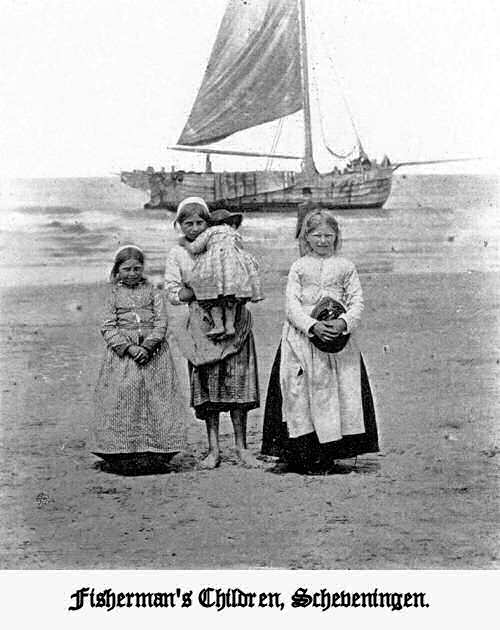
Notwithstanding this state of things, which to the present time has prevented the institution of obligatory instruction demanded by the Liberals, and keeps a great number of Catholic children away from the schools, the education of the lower classes in Holland is in a condition that any European state might envy. In proportion, Holland contains less people who do not know their alphabet than does Prussia. "Of all Europe," as a Dutch writer has said with just pride, although he judges his country severely on other points, "Holland is the land where all such knowledge as is indispensable to civilized man is most widely diffused." I was once greatly surprised, on asking a Dutchman if there were any women-servants who could not read, to hear myself answered, "Well, yes. I remember twenty years ago that my mother had a servant who did not know her alphabet, and we thought it a very strange thing." It is a great satisfaction to a stranger who does not know the language to be sure that if he shows a name on his guide-book to the first street-urchin he meets, the boy will understand it and will try to direct him by gestures.
Talking of Catholics and Calvinists, we arrived at the dunes, and, although we were near the coast, we could not see the ocean. "Holland is a strange country," I said to my friend, "in which everything plays at hide and seek. The façades hide the roofs, the trees hide the houses, the city hides the ships, the banks hide the canals, the mist hides the fields, the dunes hide the sea." "And some day," answered my friend, "the sea will hide everything and all will be ended."
We crossed the downs and advanced toward the coast, where the preparatory works for the opening of the Rotterdam Canal were in progress.
Two dykes, one more than a thousand two hundred meters in length, the other more than two thousand meters long, separated from each other by the space of a kilometer, project into the sea at right angles to the coast. These two dykes, which are built to protect vessels entering the canal, are formed by several rows of enormous palisades made of huge blocks of granite, of fagots, stones, and earth; they are as wide as ten men drawn up in a line. The ocean, which continually washes against them, and at high tide overflows them in many parts, has covered everything,—stones, beams, and fagots, with a stratum of shells as black as ebony, which from a distance seems like a velvet coverlet, giving to these two gigantic bulwarks a severe and magnificent appearance, as if they were a warlike banner unfolded by Holland to celebrate her victory over the waves. At that moment the tide was coming in, and the battle round the extreme end of the dykes was at its height. With what rage did the livid waves avenge themselves for the scorn of those two huge horns of granite that Holland has plunged into the bosom of her enemy! The palisades and the rock foundations were lashed, gnawed, and buffeted on every side; disdainful waters dashed over them and spat upon them with a drizzling rain that hid them like a cloud of dust; then again the waves would flow back like furious writhing serpents. Even the sections far from the struggle were sprinkled by unexpected showers of spray, the advance guard of that endless army, and meanwhile the water kept rising and advancing, forcing the foremost workmen to retire step by step.
On the longest dyke, not very far from shore, they were planting some piles. Workmen with great labor were raising blocks of granite by means of derricks, and others, in groups of ten or fifteen, were removing old beams to make room for new ones. It was glorious to see the fury of the waves lashing the sides of the dyke, and the impassive calm of the workmen, who seemed almost to despise the sea. It crossed my mind that they must be saying in their hearts, as the sailor said to the monster of the Comprachicos in Victor Hugo's romance: "Roar on, old fellow!" A wind which chilled us to the bone blew the long, fair curls of the good Dutchmen into their eyes, and every now and then threw the spray at their feet or on their clothes—vain provocations to which they did not deign to reply even by a frown.
I saw a pile driven into the dyke. It was the trunk of a great tree pointed at one end and supported by two parallel beams, between which a steam-engine drove an enormous iron hammer up and down. The pile had to be driven through several very thick strata of fagots and stones; yet at every blow from the heavy hammer it sunk into the ground, breaking, tearing, and splintering, while it entered the dyke more than a hand's length, as if it were merely a mud hole. Nevertheless, what with adjusting and driving the pile, the operation lasted almost an hour. I thought of the thousands that had been driven, of the thousands still to be driven, of the interminable dykes that defend Holland, of the infinite number that have been overturned and rebuilt and for the first time my mind conceived the grandeur of the undertaking, and a feeling of dismay crept over me as I stood motionless and speechless.
Meanwhile, the waters had risen almost to the level of the dyke, with a sound of panting and breathlessness like tired-out voices that seemed to murmur secrets of distant seas and unknown shores; the wind blew colder, it was growing dark, and I felt a restless desire to withdraw from those front bastions into the interior of the fortress. I pulled the coat-tail of my companion, who had been standing for an hour on a boulder, and we returned to the shore and drank a glass of delicious Schiedam at one of those shops which are called in Dutch "Come and ask," where they sell wines, salt meats, cigars, shoes, butter, clothes, biscuits—in fact, a little of everything. Then we started on the road back to the Hague.
My next excursion was the most adventurous that I made in Holland. A very dear friend of mine who lived at the Hague invited me to go and dine with him at the house of one of his relatives who had shown a courteous desire to make my acquaintance. I asked where his relative lived; and he answered, "Far from the Hague." I asked in what direction, but he would not tell me; he told me to meet him at the railway-station the next day, and left me. On the next morning we met at the station: my friend bought tickets for Leyden. When we arrived at Leyden we alighted, but, instead of entering the town, we took a road across country. I besought my companion to reveal the secret to me. He answered that he could not do so, and as I knew that when a Dutchman does not mean to tell you anything, no power on earth will make him do it, I resigned myself. It was a disagreeable day in February; there was no snow, but a strong cold wind was blowing which soon made our faces purple. As it was Sunday, the country was deserted. We went on and on, passing windmills, canals, meadows, houses half hidden by trees, with very high roofs of stubble mixed with moss. Finally we arrived at a village. The Dutch villages are closed by a palisade: we passed through the gate, but not a living soul was to be seen; the doors were shut, the window curtains were drawn, and not a voice, nor a footstep, nor a breath was heard. We crossed the village, and paused in front of a church which was all covered with ivy like a summer-house; looking through an aperture in the door, we saw a Protestant clergyman with a white cravat preaching to some peasants whose faces were striped with gold, green, and purple, the reflection of the stained-glass windows. We passed through a clean street paved with bricks, and saw stakes put for the storks' nests, posts planted by the peasants for the cows to rub against, fences painted sky blue, small houses with many-colored tiles forming letters and words, ponds full of boats, bridges, kiosks for unknown uses, little churches with great gilded cocks on the top of their steeples; and not a living soul near or far: still we went on. The sky cleared a little, then darkened again; here the sunshine gleamed on a canal, there it made a house sparkle or gilded a distant steeple. Then again it hid itself, reappeared, and so on with a thousand coquetries, while on the horizon there appeared oblique lines denoting rain. We began to meet countrywomen with circles of gold round their heads, on which veils were fastened, the whole surmounted by hats; these were trimmed with bunches of flowers and wide fluttering ribbons. We also met some country carriages of the antique Louis XV. style, with a gilded box ornamented with carved work and mirrors, peasants with thick black clothes and large wooden shoes, children with stockings of every color in the rainbow. We arrived at another village, which was clean, shining, and brightly colored, with its streets paved with bricks and its windows adorned with curtains and flowers. Here we took a carriage and went on our way. A fine icy rain which penetrated to our bones began to fall as soon as we started. Muffled up in the wet frozen covers, we reached the bank of a large canal. A man came out of a cottage, led the horse on to a barge, and landed us safe and sound on the opposite bank. The carriage turned down a wide street, and we found ourselves on the bed of the ancient Sea of Haarlem. Our horse trotted along where the fish once swam through the water; our coachman smoked where at one time the smoke of naval battles had rolled; we saw glimpses of canals, of villages, of cultivated fields, of a new world of which only thirty years ago there had not been a trace. After we had driven about a mile the rain stopped, and it began to snow as I had never seen it snow before: it was a real whirlwind of heavy, thick snow, which the strong wind blew into our faces. We unfolded the waterproof covering, opened our umbrellas, tucked ourselves in, and bundled ourselves up, but the wind broke through all our defences and the snow sifted over us, enveloping us in white and covering our heads and feet with ice. After a long turn we left the lake; the snow ceased, we arrived at another village of toy houses, where we left our carriage and proceeded on foot. We went on and on, seeing bridges, windmills, closed cottages, lonely streets, wide meadows, but no human beings. We crossed another branch of the Rhine, and arrived at another village barricaded and silent; we continued on our way, occasionally seeing some face looking at us from behind the windows. We then left the village and found ourselves opposite the dunes. The sky looked threatening, and I became alarmed.
"Where are we going?" I demanded of my friend.
"Where fortune takes us," he replied.
We proceeded through the dunes, along narrow, winding, sandy roads, seeing no sign of habitation anywhere; we went up hill and down dale; the wind drove the sand into our faces; at every step our feet sank in it, and the country grew more and more desolate, gloomy, and foreboding.