Volume 1 — THE HAGUE. (continued 2)
Helen Zimmern translation
"But who is your relative?" I said to my companion. "Where does he live? what is his business? There is some witchcraft about this; he cannot be a man like other men: tell me where you are leading me."
My friend did not answer: he stopped and stared in front of him. I stared too, and far away saw something that looked like a house, alone in the midst of the desert, almost hidden by a rise in the ground. We hastened on; the house seemed to appear and disappear like a shadow. Round about we saw stakes which looked like gibbets. My friend tried to persuade me that they were only stakes for storks' nests. We were about a hundred feet away from the house. Along a wall we saw a wooden pipe which seemed bathed in blood, but my friend assured me it was only red paint. It was a little house enclosed by a paling; the doors and windows were shut.
"Don't go in," I said. "There is yet time. There is something uncanny in that house; take care what you are doing. Look up; I have never seen such a black sky."
My friend did not hear me; he pressed on courageously, and I followed. Instead of going toward the door, he took a short cut. Behind us we heard a ferocious barking of dogs. We broke into a run, crossed a thicket of underbrush, jumped over a low wall, and knocked at a little door.
"There is yet time!" I exclaimed.
"It is too late," answered my friend.
The door opened, but nobody was to be seen. We mounted a winding staircase and entered a room. Oh pleasant surprise! The hermit, the sorcerer, was a merry, courteous young man, and the diabolical house was a villa full of comfort and warmth, sparkling with light, the dwelling of a sybarite—a real fairy palace to which our host retired some months in the year to study and to make experiments on the fertilization of the dunes. How delightful it was to look at the cold desert without through a window draped with curtains and decorated with flower-pots! We went into the dining-room and sat down at a table glittering with silver and glass, in the midst of which, surrounded by gilded and blazoned bottles, was a hot dinner fit for a prince. The snow was beating against the windows, the sea was moaning, the wind blew furiously round the house, which seemed like a ship in a terrible storm. We drank to the fertilization of the dunes, to the victors of Achen, to the prosperity of the colonies, to the memory of Nino Bixio, to the elves. Nevertheless, I was still a little uneasy. Our host when he needed the servant touched a hidden spring; to tell the coachman to get the carriage ready he spoke some words into a hole in the wall; and these tricks did not please me.
"Tell me," I said, "tell me that this house really exists; promise me that it is not all a joke and that it will not disappear, leaving nothing but a hole in the ground and a smell of sulphur in the air. Assure me that you say your prayers every evening."
I cannot describe the laughter, the merriment, the absurd speeches that succeeded each other until the middle of the night, accompanied by the clinking of glasses and the roaring of the tempest. At last the moment of departure arrived: we went down and were rolled away in a roomy carriage which dashed rapidly across the desert. The ground was covered with snow, the dunes were outlined in white on the dark sky, the carriage glided noiselessly in the midst of strange indistinct forms, which succeeded each other rapidly in the light of the lantern and seemed to melt into each other. In that vast solitude a dead silence reigned which robbed us of speech. After a time we began to see dwellings and arrived at a village. We crossed two or three deserted streets, with snow-covered houses on either side, with a few lighted windows showing human shadows. At last we came to a railway-station, and reached the Hague in a few minutes, although we had been deluded to think we had taken a long journey and crossed an imaginary country. Must I tell the truth? If I were asked to swear at the moment I am writing that the house in the midst of the dunes was a reality, I should request ten minutes for reflection. It is true that the master was polite enough to come and bid me good-bye at the station the day I left the Hague, and that when I saw him clearly by daylight he did not seem to have anything strange about him; but we all know the various forms, the simulations, the thousand arts which a certain gentleman and his servants assume.
At last I saw a Dutch winter, not as I had hoped to see it on leaving Italy, for it was very mild; but still Holland was presented to me as we are in the habit of picturing it to ourselves in the south of Europe.
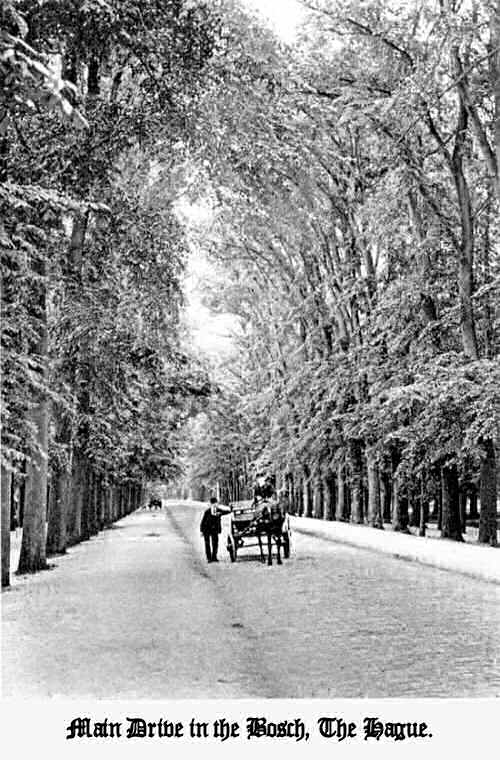
Early in the morning the first thing that attracts the eye in the silent white streets is the print of innumerable wooden shoes left in the snow by the boys on their way to school, and so large are the wooden shoes that they look like the tracks of elephants. These footsteps generally go in a straight line, showing that the boys take the shortest cut to school, and, like steady, zealous Dutchmen, do not play and lose time on the road. One can see long rows of children wrapped up in large scarfs, with their heads half hidden between their shoulders—little bundles arm in arm, walking two by two, or three by three, or pressed together in groups like a bunch of asparagus, out of which peep only the tips of their noses and the ends of books. When the boys have disappeared the streets are deserted for a short time, for the Dutch do not rise early, especially in the winter. One can walk some distance without meeting any one or hearing any sound. The snow seems whiter surrounding those rose-colored houses, which have all their projections outlined with a pure white line, and the wooden heads outside of the shops wear white cotton wigs; the chains of the railings look like ermine; everything presents a strange appearance. When it freezes and the sun shines, the façades seem covered with silver sparks, the ice heaped upon the banks of the canals shines with all the colors of the rainbow, and the trees glitter with thousands of little pearls, like the plants in the enchanted gardens of the Arabian Nights. It is then that it is beautiful to walk in the forest at the Hague at sunset, treading on the hardened snow, which crackles under one's feet like powdered marble, in the avenues of large, white, leafless beech trees, which look like one gigantic crystallization, and cast blue and violet shadows, dotted with myriads of points which glisten like diamonds in the paths dyed pink by the setting sun. But nothing compares with the sight of the Dutch country seen from the top of a steeple at morning after a heavy fall of snow. Beneath the gray and lowering sky one looks over that vast white plain, from which, roads, houses, and canals have disappeared, and nothing is seen but elevations and depressions, which, like the folds of a sheet, give a vague idea of the forms of hidden houses. The boundless white is unstained save by the clouds of smoke that rise almost timidly from the distant dwellings, as if to assure the spectator that beneath the desert of snow human hearts are still beating.
It is impossible to speak of the winter in Holland without mentioning what constitutes the originality and the attraction of winter life in that country—the skating.
Skating in Holland is not only a recreation; it is the ordinary means of transportation. To cite a well-known example, all know the value of it to the Dutch in the memorable defence of Haarlem. When there is a hard frost the canals are transformed into streets, and sabots tipped with iron take the place of boats. The peasants skate to market, the workmen to their work, the small tradespeople to their business; entire families skate from the country to the town with their bags and baskets on their shoulders or drive in sledges. Skating to them is as habitual and easy as walking, and they skim along so rapidly that one can scarcely follow them with the eye. In past years bets were commonly made between the best Dutch skaters that they would skate down the canals on either side of the railway as fast as the train could go; and usually the skaters not only kept abreast of the engine, but even beat it. There are people who skate from the Hague to Amsterdam and back again on the same day; university students leave Utrecht in the morning, dine at Amsterdam, and return home before the evening; and a bet has been made and won several times of going from Amsterdam to Leyden in little more than an hour. Persons who have been drawn by sticks held by skaters have told me that the speed with which they skim over the ice is enough to turn one giddy; but this rapidity is not the only remarkable thing about it: another point very much to be admired is the security with which they traverse great distances. Peasants will go from one town to another at night. Young men go from Rotterdam to Gouda, where they buy very long clay pipes, and return to Rotterdam carrying them unbroken in their hands. Sometimes as one is walking along a canal one sees a figure flit by like an arrow, to disappear immediately in the distance. It is a peasant-girl carrying milk to a house in the city.
There are sledges of every size and shape, some pushed by skaters, others drawn by horses, others propelled by means of two iron-tipped sticks which are worked by the person seated in the sledge. One sees carts and carriages taken off of their wheels and mounted on two boards, on which they glide with the same rapidity as the other sleds. On holiday occasions the boats from Scheveningen have been seen to glide over the snow through the streets of the Hague. Sometimes ships in full sail are seen skimming over the ice of the large rivers, going so fast that the faces of the few who dare to make this experiment are terribly cut by the wind.
The most beautiful fêtes in Holland are given on the ice. When the Meuse is frozen, Rotterdam becomes a place of reunions and amusements. The snow is brushed away until the ice is made as clean as a crystal floor; restaurants, coffee-houses, pavilions, and benches for spectators are set up, and at night all is illuminated. During the day a swarm of skaters of every age, sex, and class crowds the river. In other towns, especially in Friesland, which is the classical land of the art, there are clubs of men-and women-skaters who institute public races for prizes. Stakes and flags are set up all along the canals, railings and stands are raised; immense crowds come from the villages and the country-side. Bands play; the élite of the town are present. The skaters present themselves dressed in a peculiar costume, the women wearing pantaloons. There are races for men and races for women; then both men and women race together. The names of the winners are enrolled in the annals of the art and remain famous for many years.
In Holland there are two different schools of skating, the so-called Dutch school and the Frieslander school, each of which uses a peculiar kind of skate. The Frieslander school, which is the older, aims only at speed; the Dutch school cultivates grace as well. The Frieslanders are stiff in their motions; they throw their bodies forward, and hold themselves very straight, looking as though they were starched, and keeping their eyes fixed on the goal. The Dutch skate with a zigzag movement, swaying from left to right and from right to left with an undulating motion of the body. The Frieslander is an arrow, the Dutchman a rocket.
The women prefer the Dutch school. The ladies of Rotterdam, Amsterdam, and the Hague are, in fact, the most fascinating skaters in the Netherlands. They begin to skate as children, continue as girls and wives, reaching the height of beauty and the summit of art at the same time, while their skates strike out sparks from the ice which kindle many fires. It is only on the ice that Dutch women appear light-heeled. Some attain a marvellous perfection. Those who have seen them say that it is impossible to imagine the grace of movement, the bows, the glides, the thousand pretty delicate arts that are displayed. They fly and return like swallows and butterflies, and in this exercise they grow animated and their placid beauty is transformed. But all are not so skilled: many dare not show themselves in public, for those who would be considered prodigies with us are scarcely noticed there, to such perfection has the art been carried. The men, too, perform all kinds of tricks and feats, some writing words of love and fantastic figures in their twirls, others making rapid pirouettes, then gliding backward on one leg for a long distance; others twist about, making numbers of dizzy turns in a small space, sometimes bending down, then leaning to one side, then skating upright or crouching like india-rubber figures moved by a secret spring.
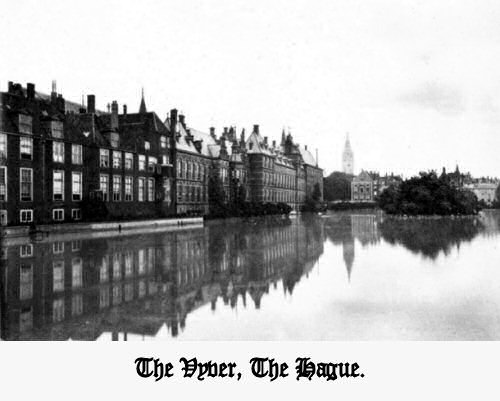
The first day that the canals and small docks are covered with ice strong enough to bear the skaters is a day of rejoicing in the Dutch towns. Skaters who have made the experiment at break of day spread the news abroad; the papers announce it; groups of boys about the streets burst into shouts of delight; men and women-servants ask permission to go out with the determined air of people who have decided to rebel if refused; old ladies forget their age and ailments and hurry off to the canal to emulate their friends and daughters. At the Hague the basin, which is in the middle of the city, near to the Binnenhof, is invaded by a mingling crowd of people, who interlace, knock against each other, and form a confused giddy mass. The flower of the aristocracy skates on a pond in the middle of the wood, and there in the snow may be seen a winding and whirling maze of officers, ladies, deputies, students, old men, and boys, among whom the crown prince is sometimes to be seen. Thousands of spectators crowd around the scene, music enlivens the festival, and the enormous disk of the Dutch sun at sunset sends its dazzling salutation through the gigantic beech trees.
When the snow is packed hard the turn of the sleigh comes. Every family has a sleigh, and at the hour the world goes out walking they appear by hundreds. They fly past in long rows two or three abreast. Some are shaped like shells, others like swans, dragons, boats, or chariots. All are gilded and painted in various colors; the horses which draw them are covered with handsome furs and magnificent trappings, their heads ornamented with plumes and tassels, and their harness studded with glittering buttons. In the sleighs sit ladies clothed in sable, beaver, and blue fox. The horses toss their heads, enveloped in a cloud of steam which rises from them, while their manes are covered with ice-drops. The sleighs dart along, the snow flying about them like silver foam. The splendid uncurbed procession passes and disappears like a silent whirlwind over a field of lilies and jessamine. At night, when the torches are lit, thousands of small flames follow each other and flit about the silent town, casting lurid flashes of light on the ice and snow, the whole scene appearing to the imagination like a great diabolical battle over which the spectre of Philip II. presides from the top of the Binnenhof Tower.
But, alas! everything changes, even the winter, and with it the art of skating and the use of sleighs. For many years the severe winters of Holland have been followed by such mild ones that not only the large rivers, but even the small canals in the towns, do not freeze. In consequence the skaters who have been so long out of practice do not risk giving public exhibitions when the occasion presents itself; and so, little by little, their number becomes smaller, and the women especially are forgetting the art. Last winter they hardly skated at all, and this winter (1873) there has not been a race, and not even a sleigh has been seen. Let us hope that this deplorable state of affairs will not last, and that winter will return to caress Holland with its icy bear's paw, and that the fine art of skating will once more arise with its mantle of snow and its crown of icicles. Let me announce meanwhile the publication of a work called "Skating," upon which a Dutch legislator has been employed for many years—a work that will be the history, the epic, and code of this art, from which all European skaters, male and female, will be able to draw instruction and inspiration.
While I remained at the Hague I frequented the principal club in the town, composed of more than two thousand members. It is located in a palace near the Binnenhof, and there it was that I made my observations upon the Dutch character.
The library, the dining-room, and the card-room, the large drawing-room for conversation, and the reading-room were as full as they could be from four o'clock in the afternoon until midnight. Here one met artists, professors, merchants, deputies, clerks, and officers. The greater number come to drink a small glass of gin before dinner, and return later to take another comforting sip of their favorite liquor. Nearly all converse, and yet one hears only a light murmur, so that if one's eyes were shut one would say that about half of the actual number was present. One can go round the rooms many times without seeing a gesture of excitement or hearing a loud voice: at a distance of ten steps from the groups one would not know that any one was speaking, except by the movement of his lips. One sees many corpulent gentlemen with broad, clean-shaven faces and bearded throats, who talk without raising their eyes from the table or lifting their hands from their glasses. It is very rare to see among these heavy faces a lively, piquant physiognomy like that of Erasmus, which many consider the true Dutch type, though I am not of their opinion.
The friend who opened the door of the club to me presented me to several of its habitués. The difference between the Dutch and the Italian character is especially evident in introductions. On one occasion I noticed that the person to whom I was introduced scarcely bowed his head, and then remained silent some moments. I thought my reverend face had not pleased him, and felt an echo of cordial dislike in my heart. In a little while the person who had introduced me went away, leaving me tête-à-tête with my enemy. "Now," thought I, "I will burst before I will speak, a word to him." But my neighbor, after some minutes of silence, said to me with the greatest gravity, "I hope, if you have no other engagement to-day, you will do me the honor of dining with me." I fell from the clouds. We then dined together, and my Amphytrion placidly filled the table with bottles of Bordeaux and champagne, and did not let me depart until I had promised to dine with him again. Others, when I would ask information about various things, would hardly answer me, as if they were trying to show me that I was troublesome, so that I would say to myself, "How contemptible they are!" But the next day they would send me all the details neatly and clearly written out, and minute in a higher degree than I desired. One evening I asked a gentleman to point out to me something in that ocean of figures that goes by the name of Guide to European Railways. For some moments he did not answer, and I felt mortified. Then he took the book, put on his spectacles, turned over the leaves, read, took notes; added and subtracted for half an hour, and when he had finished he gave me the written answer, putting his spectacles back into their case without speaking a word.
Many of those with whom I passed the evening used to go home at ten o'clock to work, and to return to the club at half-past eleven, after which they would remain until one o'clock. When they had said, "I must go," there was no possibility of changing their minds. As the clock struck ten they left the door; at half-past eleven they stepped over the threshold. It is not surprising that with this chronometrical precision they find time to do so many things, without doing anything in haste; even those who do not depend on their studies for their livelihood have read entire libraries. There is no English, German, or French book, however unimportant, with which they are unacquainted. French literature especially they have at their fingers' ends. And what is said of literature can be said with more reason of politics. Holland is one of the European countries in which the greatest number of foreign papers are to be found, particularly those that deal principally with national affairs. The country is small and peaceful, and the news of the day is soon exhausted; consequently it frequently happens that after ten minutes the conversation has passed beyond the Rhine and deals with Europe. I remember the astonishment with which I heard the fall of the ministry of Scialoia and other Italian matters discussed as if they were domestic affairs.
One of my first cares was to sound the religious sentiment of the people, and here I found, to my surprise, great confusion. As a learned Dutchman most justly wrote a short time ago, "Ideas subversive of every religious dogma have made much way in this land." It is quite a mistake, however, to believe that where faith decreases indifference enters. Such men as appeared to Pascal monstrous creatures—men who live without giving any thought to religion, of whom there are numbers in our country—do not exist in Holland. The religious question, which in Italy is merely a question, in Holland is a battle in which all brandish their arms. In every class of society, men and women, young and old, occupy themselves with theology and read or listen to the disputes of the doctors, besides devouring a prodigious number of polemical writings on religion. This tendency of the country is shown even in Parliament, where the deputies often confute their opponents with biblical quotations read in Hebrew, or translated and commentated, the discussion degenerating into very disquisitions on theology. All these conflicts, however, take place in the mind rather than in the heart; they are devoid of passion, and one proof of this is that Holland, which of all the countries in Europe is divided into most sects, is also the country in which these sects live in the greatest harmony and where there is the greatest degree of tolerance. If this were not the case, the Catholic party would not have made such strides as it has made, protected from the first by the Liberals against the only intolerant party in the country, the orthodox Calvinists.
I did not make the acquaintance of any Calvinists, and I was sorry on that account. I never believed all that is recounted of their extreme rigour; for example, that there are among them certain ladies who hide the legs of the tables with covers, for fear that they might suggest to the minds of visitors the legs of the mistress of the house. But there is no doubt that they live with extreme austerity. Many of them never enter a theatre, a ball-room, or a concert-hall. There are families who on the Sabbath content themselves with eating a little cold meat, so that the cook may rest on that day. Every morning in many houses the master reads from the Bible in the presence of the family and servants, and they all pray together. But, nevertheless, this sect of orthodox Calvinists, whose followers are almost all amongst the aristocracy and the peasantry, does not exert a great influence in the country. This is proved by the fact that in Parliament the Calvinists are inferior in numbers to the Catholic party and can do nothing without them.
I have mentioned the theatre. At the Hague, as in the other large Dutch cities, there are no large theatres nor great performances. They generally produce German operas sung by foreign singers, and French comedies and operettas. Concerts are the great attraction. In this Holland is faithful to its traditions, for, as is well known, Dutch musicians were sought after in all the Christian courts as early as the sixteenth century. It has also been said that the Dutch have great ability in singing in chorus. In fact, the pleasure of singing together must be great if it is in proportion to the aversion they have to singing alone, for I do not ever remember hearing any one sing a tune at any hour or in any part of a Dutch town, excepting street urchins, who were singing in derision at drunken men, and drunkards are seldom seen excepting on public holidays.
I have spoken of the French operettas and comedies. At the Hague not only the plays are French, but public life as well. Rotterdam has an English imprint, Amsterdam is German, and the Hague Parisian. So it may truthfully be said that the citizens of the large Dutch towns unite and temper the good qualities and the defects of the three great neighboring nations. At the Hague in many families of the best society they speak French altogether; in others they affect French expressions, as is done in some of the northern towns of Italy. Addresses on letters are generally written in French, and there is a small branch of society, as is frequently the case in small countries, that professes a certain contempt for the national language, literature, and art, and courts an adopted country beyond the Meuse and the Rhine. The sympathies, however, are divided. The elegant class inclines toward France, the learned class toward Germany, and the mercantile class toward England. The zeal for France grew cold after the Commune. Against Germany a secret animosity has arisen, generated by the fear that in her acquisitive tastes she might turn toward Holland. This feeling still ferments, though it is tempered by community of interest against clerical Catholicism.
When it is said that the Hague is partly a French city, it must be understood that this relates to its appearance only; at bottom the Dutch characteristics predominate. Although it is a rich, elegant, and gay city, it is not a city of riot and dissipation, full of duels and scandals. The life is more varied and lively than that found in other Dutch towns, but not less peaceful. The duels that take place in the Hague in ten years may be counted on the five fingers of one's hand, and the aggressor in the few that take place is usually an officer. Notwithstanding, to show how powerful in Holland is this "ferocious prejudice that honor dwells on the point of the sword," I recall a discussion between several Dutchmen which was raised by a question of mine. When I asked whether public opinion in Holland was hostile to duels, they answered all together, "Exceedingly hostile." But when I wanted to know whether a young man in good society who did not accept a challenge would be universally praised, and would still be treated and respected as before—whether, in short, he would be supported by public opinion so that he would not repent his conduct—then they all began discussing. Some weakly answered, "Yes;" others resolutely, "No." But the general opinion was on the negative side. Hence I concluded that although there are few duels in Holland, this does not arise, as I thought, from a universal and absolute contempt for the "ferocious prejudice," but rather from the rarity of the cases in which two citizens allow themselves to be carried by passion to the point of having recourse to arms; which is a result of nature rather than of education. In public controversies and private discussions, however violent, personal insults are very rare, and in parliamentary battles, which are sometimes very vigorous, the deputies are often exceedingly impertinent, but they always speak calmly and without clamor. But this impertinence consists in the fact rather than in the word, and wounds in silence.
In the conversations at the club I was astonished at first to note that no one spoke for the pleasure of speaking. When any one opened his mouth it was to ask a question or to tell a piece of news or to make an observation. That art of making a period of every idea, a story of every fact, a question of every trifle, in which Italians, French, and Spaniards are masters, is here totally unknown. Dutch conversation is not an exchange of sounds, but a commerce of facts, and nobody makes the least effort to appear learned, eloquent, or witty. In all the time I was at the Hague I remember hearing only one witticism, and that from a deputy, who speaking to me of the alliance of the ancient Batavians with the Romans, said, "We have always been the friends of constituted authority." Yet the Dutch language lends itself to puns: in proof of this there is the incident of a pretty foreign lady who asked a young boatman of the trekschuit for a cushion, and not pronouncing the word well, instead of cushion said kiss, which in Dutch sounds almost the same; and she scarcely had time to explain the mistake, for the boatman had already wiped his mouth with the back of his hand. I had read that the Dutch are avaricious and selfish, and that they have a habit of boring people with long accounts of their ailments, but as I studied the Dutch character I came to see that these charges are untrue. On the contrary, they laugh at the Germans for their complaining disposition. To sustain the charge of avarice somebody has brought forward the very incredible statement that during a naval battle with the English the officers of the Dutch fleet boarded the vessels of the enemy, who had used all their ammunition, sold them balls and powder at exorbitant prices, after which they continued the battle. But to contradict this accusation there is the fact of their comfortable life, of their rich houses, of the large sums of money spent in books and pictures, and still more of the widespread works of charity, in which the Dutch people certainly stand first in Europe. These philanthropic works are not official nor do they receive any impulse from the government; they are spontaneous and voluntary, and are carried on by large and powerful societies that have founded innumerable institutes—schools, prizes, libraries, popular reunions—helping and anticipating the government in the duty of public instruction,—whose branches extend from the large cities to the humblest villages, embracing every religious sect, every age, every profession, and every need; in short, a beneficence which does not leave in Holland a poor person without a roof or a workman without work. All writers who have studied Holland agree in saying that there probably is not another state in Europe where, in proportion to the population, a larger amount is given in charity by the wealthy classes to those who are in want.
It must not, however, be imagined that the Dutch people have no defects. They certainly have them, if one may consider as defects the lack of those qualities which ought to be the splendor and nobility of their virtues. In their firmness we might find some obstinacy, in their honesty a certain sordidness; we might hold that their coldness shows the absence of that spontaneity of feeling without which it seems impossible that there can be affection, generosity, and true greatness of soul. But the better one knows them, the more one hesitates to pronounce these judgments, and the more one feels for them a growing respect and sympathy on leaving Holland. Voltaire was able to speak the famous words: "Adieu, canaux, canards, canaille;" but when he had to judge Holland seriously, he remembered that he had not found in its capital "an idle person, a poor, dissipated, or insolent man," and that he had everywhere seen "industry and modesty." Louis Napoleon proclaimed that in no other European country is there found so much innate good sense, justice, and reason as there is in Holland; Descartes gave the Hollanders the greatest praise a philosopher can give to a people when he said that in no country does one enjoy greater liberty than in Holland; Charles V. pronounced upon them the highest eulogy possible to a sovereign when he said that they were "excellent subjects, but the worst of slaves." An Englishman wrote that the Dutch inspire an esteem that never becomes affection. Perhaps he did not esteem them highly enough.
I do not conceal the fact that one of my reasons for liking them was the discovery that Italy is much better known in Holland than I should have dared to hope. Not only did our revolution find a favorable echo there, as was natural in a independent nation free and hostile to the pope, but the Italian leaders and the events of recent times are as familiarly known as those of France and Germany. The best newspapers have Italian correspondents and furnish the public with the minutest details of our affairs. In many places portraits of our most illustrious citizens are seen. Acquaintance with our literature is no less extended than knowledge of our politics. Putting aside the fact that the Italian language was sung in the halls of the ancient counts of Holland, that in the golden age of Dutch literature it was greatly honored by men of letters, and that several of the most illustrious poets of that period wrote Italian verses or imitated our pastoral poetry,—the Italian language is considerably studied nowadays, and one frequently meets those who speak it, and it is common to see our books on ladies' tables. The "Divina Commedia," which came into vogue especially after 1830, has been twice translated into rhymed triplets. One version is the work of a certain Hacke van Mijnden, who devoted all his life to the study of Dante. "Gerusalemme Liberata" has been translated in verse by a Protestant clergyman called Ten Kate, and there was another version, unpublished and now lost, by Maria Tesseeschade, the great poetess of the seventeenth century, the intimate friend of the great Dutch poet Vondel, who advised and helped her in the translation. Of the "Pastor Fido" there are at least five translations by different hands. Of "Aminta" there are several translations, and, to make a leap, at least four of "Mie Prigioni," besides a very fine translation of the "Promessi Sposi," a novel that few Dutch people have not read either in their own language, in French, or in Italian. To cite another interesting fact, there is a poem entitled "Florence," written for the last centenary of Dante by one of the best Dutch poets of our day.
It is now in place to say something about Dutch literature.
Holland presents a singular disproportion between the expansive force of its political, scientific, and commercial life and that of its literary life. While the work of the Dutch in every other field extends beyond the frontier of the land, its literature is confined within its own borders. It is especially strange that, although Holland possesses a most abundant literature, it has not, as other little states, produced one book that has become European, unless we class among literary works the writings of Spinoza, the only great philosopher of his country, or consider as Dutch literature the forgotten Latin treatises of Erasmus of Rotterdam. Yet if there be a country which by its nature and history suggests subjects to inspire the mind to the production of such poetical works as appeal to the imagination of all nations, that country is Holland. The marvellous transformations of the land, the terrible inundations, the fabulous maritime expeditions,—these ought to have given birth to a poem powerful and original even when stripped of its native form. Why did not this occur? The nature of the Dutch genius may be adduced as a reason, which, aiming at utility in everything, wished to turn literature also to a practical end. Another tendency, the opposite of this, though, perhaps derived from it, is that of soaring high above human nature to avoid treading on the ground with the mass; a weariness of genius which gave to judgment the ascendency over the imagination; an innate love of all that was precise and finished, which resulted in a prolixity in which grand ideas were diluted; the spirit of the religious sects, which enchained within a narrow circle talents created to survey a vast horizon. But neither these nor other reasons can keep one from wondering that there should not be one writer of Dutch literature who worthily represents to the world the greatness of his country—a name to be placed between Rembrandt and Spinoza.
However, it would be a mistake to overlook at least the three principal figures of Dutch literature, two of whom belong to the seventeenth and one to the nineteenth century—three original poets who differ widely from each other, but represent in themselves Dutch poetry in its entirety: Vondel, Catz, and Bilderdijk.
Vondel, the greatest poet Holland has produced, was born in 1587 at Cologne, where his father, a hatmaker, had taken refuge, having fled from Antwerp to escape from the Spanish persecutions. While still a child the future poet returned to his country on a barrow, together with his father and mother, who followed him on foot, praying and reciting verses from the Bible. His studies began at Amsterdam. At fifteen years of age he was already renowned as a poet, but his celebrated works date from 1620. At the age of thirty he knew only his own language, but later he learned French and Latin, and applied himself with ardor to the study of the classics; at fifty he gave himself up to Greek. His first tragedy (for he was chiefly a dramatist), entitled "The Destruction of Jerusalem," was not very successful. The second, "Palamades," in which was delineated the piteous and terrible tale of Olden Barneveldt, a victim of Maurice of Orange, caused a criminal action to be brought against the author. He fled, and remained in concealment until the unexpectedly mild sentence was given which condemned him to a fine of three hundred florins. In 1627 he travelled in Denmark and Sweden, where he was received with great honors by Gustavus Adolphus. Eleven years later he opened the theatre at Amsterdam with a drama on a national theme, "Gilbert of Amstel," which is still performed once a year in his memory. The last years of his life were very unhappy. His dissipated son reduced him to poverty, and the poor old man, tired of study and broken down with sorrow, was obliged to beg for a miserable employment at the city pawnbroker's. A few years before his death he embraced the Catholic faith, and, seized with fresh inspiration, composed the tragedy of "The Virgin" and one of his best poems entitled "The Mysteries of the Altar." He died at a great age, and was buried in a church at Amsterdam, where a century afterward a monument was erected in his honor. Besides tragedies he wrote martial songs to his country, to illustrious Dutch sailors, and to Prince Frederick Henry. But his chief glory was the drama. An admirer of Greek tragedy, he preserved the unities, the chorus, the supernatural, substituting Providence for Destiny, and demons and angels (the good and evil spirits of Christianity) for the angry and propitious gods. He drew nearly all his subjects from the Bible. His finest work is the tragedy of "Lucifer," which, notwithstanding the almost insuperable difficulties of stage setting, was represented twice at the theatre in Amsterdam, after which it was interdicted by the Protestant clergy. The subject of the drama is the rebellion of Lucifer, and the characters are the good and bad angels. In this as in his other plays there abound fantastic descriptions full of splendid imagery, passages of powerful eloquence, fine choruses, vigorous thought, solemn phrases, rich and sonorous verse, while here and there are gleams and flashes of genius. On the other hand, his work is pervaded by a mysticism which is sometimes obscure and austere, by a discord between Christian ideas and pagan forms. The lyrical element predominates over the dramatic, good taste is often offended, and, above all, the thought and feeling, though aiming at the sublime, rise too high above this earth, and elude the comprehension of the human heart and mind. Nevertheless, historical precedence, originality, ardent patriotism, and a noble and patient life have made Vondel a great and venerated name in his country, where he is regarded as the personification of national genius, and is placed in the enthusiasm of affection next to the first poets of other lands.
Vondel is the greatest, Jacob Catz is the truest, personification of Dutch genius. He is not only the most popular poet of his nation, but his popularity is such that it may be affirmed that there is no other writer of any land, not excluding even Cervantes in Spain and Manzoni in Italy, who is more generally known and more constantly read, while at the same time there is perhaps no other poet in the world whose popularity is more necessarily limited to the boundaries of his own country. Jacob Catz was born in 1577 of a noble family in Brouwershaven, a town of Zealand. He studied law, became pensionary of Middelburg, went as ambassador to England, was Grand Pensionary of Holland, and, while he performed the duties of these offices with zeal and rectitude, he devotedly cultivated poetry. In the evening, after he had transacted affairs of state with the deputies of the provinces, he would retire to his home to write verses. At seventy-five years of age he asked to be released from further service, and when the stadtholder told him with appreciative words that his request had been granted, he fell on his knees in the presence of the Assembly of the States and thanked God, who had always protected him during the course of his long and exacting political life. A few days later he retired to one of his villas, where he enjoyed a peaceful and honorable old age, studying and writing up to the year 1660, when he died, in the eighty-first year of his life, mourned by all Holland. His poems fill several large volumes, and consist of fables, madrigals, stories from history and mythology, abounding in descriptions, quotations, sentences, and precepts. His work is pervaded with goodness, honesty, and sweetness, and he writes with frank simplicity and delicate humor. His volume is the book of national wisdom, the second Bible of the Dutch nation—a manual which teaches how to live honestly and in peace. He has a word for all—for boys as well as old men, for merchants as well as princes, for mistresses as well as for maids, for the rich as well as for the poor. He teaches how to spend, to save, to do housework, to govern a family, and to educate children. He is at the same time a friend, a father, a spiritual director, a master, an economist, a doctor, and a lawyer. He loves modest nature, the gardens, the meadows; he adores his wife, does his work, and is satisfied with himself and with other people, and would like every one to be as contented as he is. His poems are to be found beside the Bible in every Dutch house. There is not a peasant's cottage where the head of the family does not read some of his verses every evening. In days of sadness and doubt all look for comfort and find it in their old poet. He is the intimate fireside friend, the faithful companion of the invalid; his is the first book over which the faces of affianced lovers bend; his verses are the first that children lisp and the last that grand-sires repeat. No poet is so loved as he. Every Dutchman smiles when he hears his name spoken, and no foreigner who has been in Holland can help naming it with a feeling of sympathy and respect.
The last of the three, Bilderdijk, was born in 1756 and died in 1831: his was one of the most marvellous intellects that have ever appeared in this world. He was a poet, historian, philologist, astronomer, chemist, doctor, theologian, antiquary, jurisconsult, designer, engraver—a restless, unsettled, capricious man, whose life was nothing but an investigation, a transformation, a perpetual battle with his vast genius. As a young man, when he was already famous as a poet, he abandoned the Muse and entered politics; he emigrated with the stadtholder to England, and gave lessons in London to earn a livelihood. He tired of England and went to Germany; bored by German romanticism, he returned to Holland, where Louis Bonaparte overwhelmed him with favors. When Louis left the throne, Napoleon the Great deprived the favorite of his pension, and he was reduced to poverty. Finally he obtained a small pension from the government, and continued studying, writing, and struggling to the last day of his life. His works embrace more than thirty volumes of science, art, and literature. He tried every style, and succeeded in all excepting the dramatic. He enlarged historical criticism by writing one of the finest national histories his country possesses. He wrote a poem, "The Primitive World," an abstruse, gloomy composition which is very much admired in Holland. He dealt with every possible question, confounding luminous truths with the strangest paradoxes. He even raised the national literature, which had fallen into decadence, and left a phalanx of chosen disciples who followed in his steps in politics, art, and philosophy. Holland regards him not only with enthusiasm, but with fanaticism, and there is no doubt that after Vondel he is the greatest poet of his country. But he was possessed by a religious frenzy, a blind hatred of new ideas, which caused him to make poetry an instrument of sects: he introduces theology into everything, and consequently he could not attain to that free serene region beyond which genius cannot obtain enduring victories and universal fame.
Round these three poets, who represent the three vices of Dutch literature—of losing themselves in the clouds, of creeping on the ground, of entangling themselves in the meshes of mysticism—are grouped a number of epic, comic, satiric, and lyric poets, most of whom flourished in the seventeenth and a few in the eighteenth century. Many of them are renowned in Holland, but none possesses sufficient originality to attract the attention of the passing stranger.
The present condition deserves a rapid glance. Criticism by stripping from Dutch history the veil of poetry with which the patriotism of writers had clothed it, has placed it on the wider and more productive plain of justice. Philological studies are held in high honor in Holland, and almost all the sciences are represented by men of European fame. These are facts of which no scholar is ignorant, and a bare mention of them is sufficient.
In pure literature the most flourishing style is the novel. Holland has had its national novelist, its Walter Scott, in Van Lennep, who died a few years ago, a writer of historical romances which were received with enthusiasm by all classes of society. He was an effective painter of customs, a learned, witty writer, and a master of the art of dialogue and description, but, unfortunately, often prolix. He used old artifices, adopted forced solutions, and often was not sufficiently reticent. In his last book, "The Adventures of Nicoletta Zevenster," while admirably describing Dutch society at the beginning of this century, he had the unheard-of audacity to describe an improper house at the Hague. All Holland was in an uproar. His book was discussed, criticised, condemned, praised to the skies, and the battle still continues. Other historical novels were written by a certain Schimmel, a worthy rival of Van Lennep, and by a Madame Rosboon Toussaint, an accomplished author of deep study and real talent. Nevertheless, historical romance may be considered dead even in Holland. The modern novels of social life and the story meet with better fortune. Most prominent in this field is Beets, a Protestant clergyman and a poet, the author of a celebrated book entitled "The Dark Chamber." Koetsweldt is another of this class, and there are also some young men of great gifts who have been prevented from rising to any height by haste, the demon that persecutes the literature of to-day.
Holland has still another kind of romance which is its own. It might be called Indian romance, since it describes the habits and life of the people of the colonies. Of late years several novels have been published in this style, which have been received in the country with great applause and have been translated into several languages. Among these is the "Beau Monde of Batavia," by Professor Ten Brink, a learned, and brilliant writer, of whom I should like to be able to speak at length to attest in some degree my gratitude and admiration. But apropos of Indian romances, it is pleasant to notice how in Holland at every step one hears and sees something that reminds one of the colonies, as if a ray of the Indian sun penetrated the Dutch winter and colored the life. The ships which bring a breath of wind from those distant lands to the home ports, the birds, the flowers, the countless objects, like sounds mingled with faint music, call up in the mind images of another nature and another race. In the cities of Holland, among the thousands of white faces, one often meets men whose visages are bronzed by the sun, who have been born or have lived for many years in the colonies—merchants who speak with unusual vivacity of dark women, bananas, palm forests, and of lakes shaded by vines and orchids; young men who are bold enough to risk their lives amid the savages of the islands of Borneo and Sumatra; men of science and men of letters; officers who speak of the tribes which worship fish, of ambassadors who carry the heads of the vanquished dangling from their girdles, of bull and tiger fights, of the frenzy of opium-eaters, of the multitudes baptized with pomp, of a thousand strange and wonderful incidents which produce a singular effect when related by the phlegmatic people of this peaceful country.
Poetry, after it lost Da Costa, a disciple of Bilderdijk, a religious poet and enthusiast, and Genestet, a satirical poet who died very young, had few champions in the last generation, and these are now silent or sing with enfeebled voice. The stage is in a worse condition. The untrained, ranting Dutch actors usually appear only in French or German dramas, comedies which are badly translated, and the best society does not go to see them. Writers of great talent, like Hofdijk, Schimmel, and Van Lennep, wrote comedies which were admirable in many ways, but they never became popular enough to hold the stage. Tragedy is in no better condition than comedy and the drama.
From what I have said it would appear that there is not at present any great literary movement in Holland; but on the contrary, there is great literary activity. The number of books published is incredible, and it is marvellous with what avidity they are read. Every town, every religious sect, every society, has its review or newspaper. Besides this, there is a multitude of foreign books: English novels are in the hands of all; French works of eight, ten, and twenty volumes are translated into the national language. This is the more remarkable in a country where all cultivated people can read the originals, and it proves how customary it is not only to read, but to buy, although books are a great deal more expensive in Holland than elsewhere. But this superabundance of publications and this thirst for reading are precisely those elements which are injuring literature. Writers, in order to satisfy the impatient curiosity of the public, write in too great haste, and the mania for foreign literature smothers and corrupts the national genius. Nevertheless, Dutch literature has still a just claim to the esteem of the country: it has declined, but has not become perverted; it has preserved its innocence and freshness; what is lacking in imagination, originality, and brilliancy is compensated by wisdom, by the severe respect for good manners and good taste, by loving solicitude for the poorer classes, by the effective energy with which it advances charity and civil education. The literatures of other lands are great plants adorned with fragrant flowers; Dutch literature is a little tree laden with fruit.
On the morning when I left the Hague, after my second visit to the city, some of my good friends accompanied me to the railway-station. It was raining. When we were in the waiting-room, before the train started, I thanked my kind hosts for the courteous reception they had given me, and, knowing that perhaps I should never see them again, I could not help expressing my gratitude in sad and affectionate words, to which they listened in silence. Only one interrupted me by advising me to guard against the damp.
"I hope at least some of you will come to Italy," I continued, "if only to give me the opportunity of showing my gratitude. Do promise me this, so that I may feel a little consoled at my departure. I will not leave if some one does not say he will come to Italy."
They looked into each other's faces, and one answered laconically, "Perhaps." Another advised me not to change French gold in the shops. At that moment the last bell rang.
"Well, then, good-bye," I said in an agitated voice, pressing their hands. "Farewell: I shall never forget the glorious days passed at the Hague; I shall always recall your names as the dearest remembrance of my journey. Think of me sometimes."
"Good-bye," they all answered in the same tone, as if they were expecting to see me the next day. I leaped into the railway-carriage stricken at heart, and looked out of the window until the train started, and saw them all standing there, motionless, silent with impassive faces, their eyes fixed on mine. I waved a last farewell, and they responded with a slight bend of the head, and then disappeared from my sight for ever. Whenever I think of them I see them just as they were when I left them, in the same attitude, with their serious faces and fixed eyes, and the affection that I feel for them has in it something of austerity and sadness like their native sky on the day when I last beheld them.