HOGARTH ILLUSTRATED. (continued 2)
Reading edition
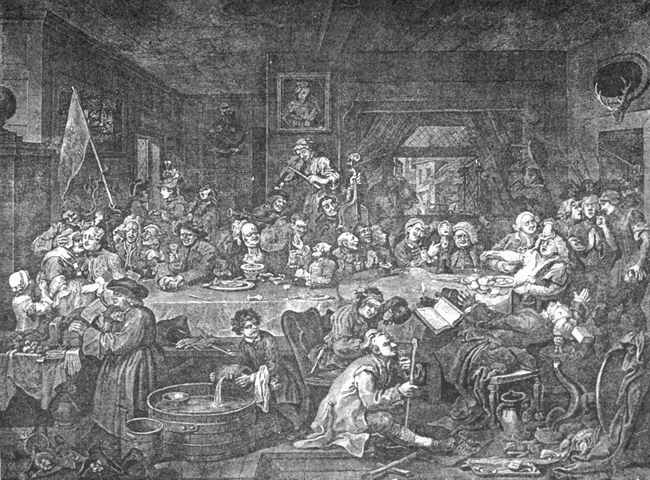
THE ELECTION, PLATE I. THE ENTERTAINMENT.
The first act of this popular farce is very properly a dinner, which in all public transactions ought to precede every other business.[58] The scene is laid in a country town, at an inn, which in these piping times of peace is kept open for the friends of the Court candidate. All the party, except the divine and the mayor, have ended their repast; but episcopal dignity, or prætorian distinction, gives a right to more indulgence than is allowed to the unhallowed multitude.
The highly polished and accomplished gentleman[59] who aspires to the honour of a seat in the British senate demands our first notice. He has what an Hibernian would call a face of much promise. His dress, air, and grace proclaim that he has travelled. Pope has described him exactly as if he had sat for the picture:
"He saunter'd Europe round, And gathered every vice on Christian ground, Saw every court, heard every king declare His royal sense of operas, or the fair.— See now half-cured, and perfectly well-bred, With nothing but a solo in his head, As much estate, and principle, and wit, As Jansen, Fleetwood, Cibber, shall think fit; Stol'n from a duel, follow'd by a nun, And if a Borough choose him,—not undone," etc.
At this time of general equality and universal levelling, when knight and vassal, esquire and mechanic, are of equal rank, our paragon of politeness is lending an attentive ear to a disgusting old beldam, who from her rotundity may be a descendant of Sir John Falstaff's. In her hand, which is behind him, she holds a letter directed to Sir Commodity Taxem; this we may naturally suppose contains either a request of a favour or an offer of a service, in the sure and certain hope of a return to it. Be that as it may, the gallant knight shows her every attention, and has stretched his long arm half round her ample waist:
"Thus the bold eagle leaves his azure way, And takes the carrion carcase for his prey; There dips his beak—but when the banquet's done, Replumes his wings, and rises to the sun."
While a little girl dazzled with the splendour of his brilliant ring attempts to make it a prize, a fellow who stands upon a chair behind him, with all that easy familiarity which the time warrants, strikes the Baronet's head against that of the old woman, and shakes the ashes out of his tobacco-pipe upon his powdered hair. This is election wit.
The next group form a trio, and are made up by a grinning cobbler, a dirty-faced barber, and a mawkish gentleman, whose hand the son of St. Crispin grasps with an energy that almost cracks the bones. The barber, equally friendly, pinches his arm, and resting one hand upon his shoulder blows the hot fumes from a short tobacco-pipe into his eye. This also is election wit.
A pyramidical group behind is composed of an officer, a drunken counsellor, and a pleasing young woman, over whose head the maudlin advocate, flourishing a bumper of wine, roars out an obscene toast. This is the third and most finished specimen of election wit. At a table a little beneath, stewing "the last lov'd remnant of the forest haunch," sits an oily divine,[60] holding his canonical periwig in his right hand, and wiping his forehead with the left. Behind him is a Scotch bagpiper, who, at the same time that he is pressing out his harsh and unmusical tones, enjoys the royal luxury of scratching.[61] A female player on the violin,[62] and a most consequential performer on the bass viol, when aided by the Caledonian pipe, must form a most melodious concert.
A fourth votary of St. Cecilia holds his musical instrument under his arm, ceasing all dulcet sounds, while he drinks a glass of Burgundy with a gentleman who seems much gratified at seeing a chin of more extravagant length than his own. Adjoining are two country fellows delighted beyond measure at a person[63] making the representation of a face by wrapping a napkin round his hand, and singing, "An old woman clothed in grey," etc. This face, ingeniously designed with charcoal blots for eyes and mouth, bears a strong resemblance to the poor gouty old fellow on his left hand, whose violent contortions lead us to suspect that he feels some disagreeable internal emotion. Behind, is a fellow pouring the contents of a vessel through a window amongst a crowd made up of the opposite party, in return for a shower of stones they are hurling into the room. To annoy and repel these troublesome assailants, a man at the opposite corner throws out a three-legged stool. At the upper end of the table sits a gentleman in a tye-wig, whom we presume to be the Right Worshipful Mr. Mayor. He has ate oysters until his breath is stopped, and is now under the hands of a barber-surgeon. This village Sangrado attempts to breathe a vein; "But ah! the purple tide no more will flow."
Notwithstanding this suspension of vital powers, our absolute monarch of his own corporation, true to the cause, and actuated by his ruling passion, even in death, grasps a fork, on which he has impaled an oyster. Immediately behind him an electioneering agent offers a bribe to a puritanic tailor; but this conscientious wielder of the needle, lifting up his eyes with horror, refuses the money, maugre the terrific threats of his amiable wife, who, while she raises her right fist in a menacing style, rests her left hand on the head of their barefooted boy.
On an opposite chair is an unfortunate man of the law, who, intent on casting up the sure and doubtful votes, is, like the mighty Goliah, struck in the forehead with a stone, and falls prostrate to the floor. "Where be his quirks and quiddits now?"
A champion of the same party, generally called a bludgeon-man,[64] having met with a similar accident in the cause of his country, is taken in hand by a patriotic butcher, who, assuming the office of surgeon, pours gin into the wound. A little boy filling a mashing-tub with punch,[65] and a trading Quaker reading a promissory note, conclude the catalogue. This note is from the candidate to Mr. Abel Squat for fifty pounds, payable six months after date, and probably offered in payment for ribands, gloves, etc., which are to be presented to the electors' wives and daughters. With this note honest Abel is much dissatisfied; and by the manner one hand is laid upon his little bale of goods, it does not seem probable that he will part with them for paper security.
Coming in at the door we see a band of assailants from the opposite party, determined to attack the enemy in their entrenchments; most of them flourish their cudgels, but one of the heroes brandishes a sword. The stag's horns over the door may perhaps be intended to convey some allusion to the trembling Puritan. A party, whom their enemies at that time distinguished by the name of Jacobites, to show their respect for Revolution principles, have mangled the portrait of King William the Third. The escutcheon with the Elector's arms, A CHEVRON SABLE BETWEEN THREE GUINEAS OR, with the crest of a gaping mouth, and motto "Speak and Have," is very applicable to a parliamentary canvas. The landscape over the candidate's head may, it has been observed, be intended as a representation of the town where this business is transacting. On the flag, which is entwined with laurels, is inscribed "Liberty and Loyalty," which cabalistic words, like the Abracadabra, are a sort of charm to the eyes of your Englishman. On another flag, which lies upon the ground, is written, "Give us our Eleven Days."[66] In the tobacco tray is a paper of Kirton's best,[67] and a slip from the Act against Bribery and Corruption is torn to light pipes with. A lobster appears to be creeping towards a mutton chop, which lies unheeded in a corner. A procession in the street are following an effigy,[68] on the breast of which is inscribed, "No Jews." The mottoes on their flags are equally curious: "Liberty and Property, and no Excise;" and, "Marry and Multiply, in spite of the devil."
An inscription on the butcher's cockade is infinitely more classical and elegant: "Pro Patriæ" has a chance of general admiration, because it is not generally understood.
As to the characters of the dramatis personæ. The face and air of the Baronet are perfectly of Lord Chesterfield's school; a fellow scattering ashes on his head, and the cobbler at the table, are marked with mischief. The fat old woman is of Mother Cole's family; and the divine has the corpulence and consequence of a bishop. He must "lard the lean earth as he walks along." The two country fellows looking with delighted eyes at Mr. Parnell, and an old man tortured by the gout, are admirably discriminated. The barber-surgeon and his brother butcher have so much sang froid, and display so little feeling for their suffering patients, that we naturally infer each of them is in great practice.
Hogarth was fond of making experiments; and it has been said, that when engraving this plate he determined to attempt what no artist had ever performed, i.e. to finish the plate without taking a single proof during the process. The consequence was such as might be expected; he made some mistakes that it was scarcely possible to rectify, and on discovering the errors, violently exclaimed that he was ruined. On his passion subsiding, a brother engraver assisted him to correct the faults occasioned by trying to perform an impossibility. It is, however, the highest finished print he ever engraved.
In the first state of the plate were some lemons and oranges lying on a paper by the side of the tub; but Hogarth being informed that vitriol and cream of tartar are the usual acids in election punch, erased them from the copper.
PLATE II.
CANVASSING FOR VOTES.
"Although bare merit might in Rome appear The strongest plea for favour,—'tis not here; We form our judgment in another way, And he will best succeed who best can pay."
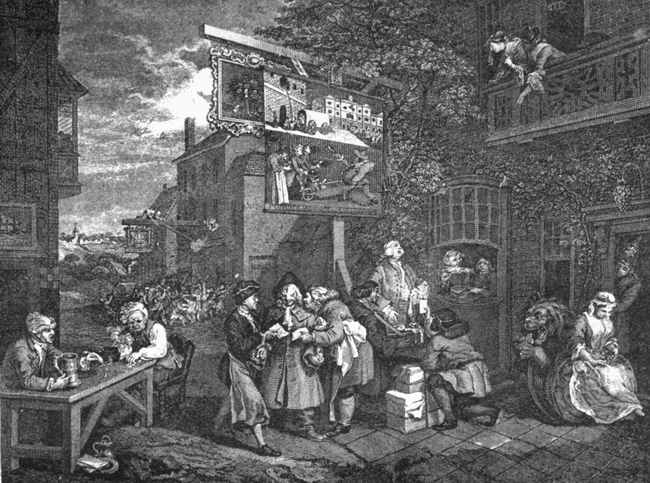
THE ELECTION, PLATE II. CANVASSING FOR VOTES.
The centre group in this print represents a rustic freeholder between two innkeepers, each of whom, as agents for their respective parties, are dropping money into his hands. From the arch and significant cast of his eye, we see that though interest induces him to take all that either of them will give, conscience obliges him to vote for the best paymaster.[69] One of the candidates, considering how necessary it is to conciliate the favour of the fair, is purchasing trinkets from a Jew pedlar for two ladies, who express their virtuous wishes in a balcony. Though neither of them have votes, their interest may be very extensive. By the direction upon a letter which a porter, in the hope of a more liberal gratuity, delivers with a bended knee, we perceive that this gentleman is of the numerous and ancient family of the party tools, who have flourished in this island ever since the Revolution. A packet on the ground consists of printed bills to be dispersed among the electors, intimating that Punch's theatre is opened,[70] the company of the worthy electors humbly[71] and earnestly requested, etc. etc. In election business, eating is a leading article; of this, two hungry countrymen in the Royal Oak larder seem perfectly sensible. One of them is voraciously devouring a fowl, and the other slashing away a round of beef. Seated upon an old stern of a ship, which is placed as a kind of national trophy at the inn door, and represents the British lion swallowing the lily of France, is the buxom landlady (at this time a very important personage), counting the money she has received for her interest in the borough; a grenadier watches her with that kind of eagerness which seems to intimate a desire of dividing the spoil. Settling the nation while they drink their ale, a barber and a cobbler are engaged in a dispute upon politics at the door of the Portobello[72] alehouse. The former seems describing, with pieces of broken tobacco-pipes, the great exploits of Admiral Vernon with six ships only. In the progress of this voluble harangue he has advanced something contrary to the cobbler's creed, and Crispin, being no great orator, offers to back his opinion by a wager. This the eloquent flourisher of a razor is either unwilling or unable to answer, and the self-important mender of bad soles triumphantly sweeps his cash from the table to his pocket. A fellow mounted on a cross-beam at the end of the Crown signpost deserves particular notice. Eagerly exercising his hand-saw, he strains every nerve to cut through the beam, totally negligent of his own situation, and forgetting that when the Crown drops—he must fall. To accelerate this operation, and bring the business to a more speedy crisis, two zealous coadjutors are exerting all their strength in pulling at a rope which is tied round the beam. This is one of the neatest pieces of allegory that Hogarth has delineated.
The crowd beneath are a fair representation of what we had occasion to notice before—the majesty of the people. Delighting in devastation, and blind to its consequences, they with one voice "cry havoc, and let slip the dogs of war." The landlord, enraged at this wanton attack upon his castle, opens his window and discharges a blunderbuss amongst the assailants. Painted on the upper part of a show-cloth, and hung before the sign of the Royal Oak,[73] is a view of the Treasury, out of which a stream of gold is poured into a bag, which, when filled, will be hoisted into a large waggon now loading with guineas to defray the expense of the approaching elections. Next to this is a view of that solid specimen of Mr. Ware's taste and talents in architecture, the Horse Guards. To the cupola of this ponderous pile the artist has, with very little exaggeration, given the form of a beer barrel. In the centre arch the builder forgot proportion and neglected utility, so that the state coach could not pass through until the ground was lowered. To satirize this violation of the laws of Palladio, and inattention to the dictates of common sense, Hogarth has represented the royal carriage on the point of entering the arch, and the king's body-coachman without a head.[74] Beneath is delineated that ancient favourite of a puppet-show, the facetious Mr. Punch, with a barrow full of guineas, which, with a wooden ladle, he tosses up and scatters in the air, to the great delight of two sylvan freeholders who attempt to catch them in their hats. One of these simple swains,[75] having had his head broken with the gold, endeavours to guard his caput from future mishaps. An old woman standing behind them with a magic wand, I suppose to be Mrs. Punch. Underneath is a very applicable inscription, "Punch, a candidate for Guzzledown." A view in the background, between the Crown and Portobello, of a cottage embosomed in a wood, and a village in the distance, is highly picturesque. The tree, which spreads its foliage before the walls of the Royal Oak, has one withered bough; and enveloped by the luxuriant branches of a vine, hangs a wooden bunch of grapes.
The characters are admirable. Nothing can be superior to the haughty and oracular self-importance of the cobbler; the barber has all his professional volubility; and the leer of the countryman lets you into his whole soul. It is evidently directed to mine host of the Oak,[76] who, added to his superior weight of metal, has a superior weight of body, and a much more persuasive aspect. The Jew has the true countenance of his tribe. Of his customer, we may say in the language of Shylock,
"How like a fawning publican he looks!"
PLATE III.
THE POLLING.
"Time was,—our freeholders, a stout rustic band, Inhal'd the fresh breeze as they till'd their own land; Their hearts beam'd with honour, their faces with health, Their toil gave them strength, and their diligence wealth. But these sons of misery, disfranchis'd by fate, Resemble a group at an hospital gate, All huddled together in one little clan, To display the calamities common to man. Yet deaf, blind, or lame, we must trust to their choice; Sans ears, eyes, or hands,—each may have a good voice. And—gasping for breath,—it deserves special note, The expiring Elector is deem'd a dead vote."—E.
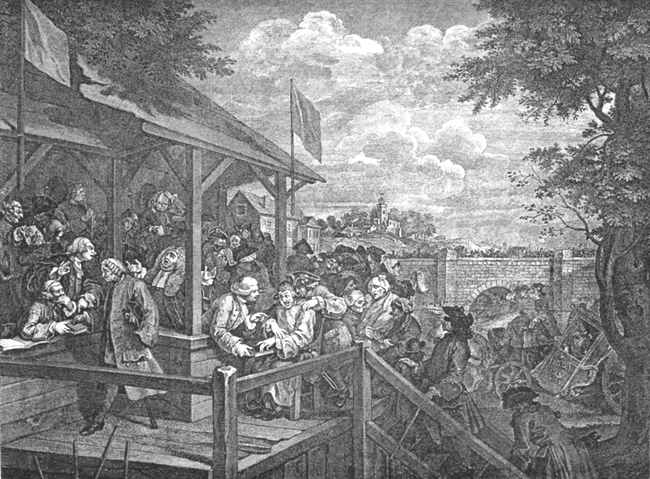
THE ELECTION, PLATE III. THE POLLING.
With the glorious ambition of serving their country, added to an eagerness of displaying their own importance, the maimed, the lame, the blind, the deaf, and the sick, hasten to the hustings to give their independent votes.[77] The contending candidates, seated at the back of the booth, anticipate the event. One of them, coolly resting upon his cane in a state of stupid satisfaction, appears to be as happy as his nature will admit, in the certainty of success. Very different are the feelings of his opponent, who, rubbing his head with every mark of apprehensive agitation, contemplates the state of the poll, and shudders at the heavy expense of a contest in which he is likely to be the loser. Such are the cares of a candidate.
"A man, when once he's safely chose, May laugh at all his furious foes, Nor think of former evil: Yet good has its attendant ill, A seat is no bad thing,—but still, A contest is the Devil."
The first person that tenders his oath to the swearing clerk is an old soldier, and probably a brave one, for he has lost a leg, an arm, and a hand, in the service of his country. They were severed by the sword of an enemy, but the trunk and heart remain entire, and are entitled to more respect than is paid them by the brawling advocate, who, with that loud and overbearing loquacity for which Billingsgate and the bar are so deservedly eminent, puts in a protest against his vote. The objection is not founded upon this heroic remnant of war having forfeited his franchise by any improper conduct, but upon the letter, the black letter of the law, "which," says our quibbling counsellor, "ordains, 'that the person who makes an affidavit shall lay his right hand upon the book.' Now, this man having had his right hand severed from his arm, and, as he informs us, left it in Flanders, cannot comply with the letter of the law, and therefore is not competent to make an affidavit; that being once admitted, which I do contend must be admitted, he cannot be deemed competent to vote." "That," replies another gentleman of the black robe, "I most pointedly deny; for though this valiant veteran, who is an half-pay officer, has lost much of his blood and three of his limbs in the service of his king, and defence of his fellow-subjects, yet the sword which deprived him of his hand has not deprived him of his birthright. God forbid it should! It might as well be argued and asserted, that this gentleman is excluded from the rites of matrimony because he cannot pledge his hand. Thanks to our religion and our constitution, neither law nor gospel holds such language, and it is beneath me to waste any more words in the confutation of it. I will only add,—and I do insist upon my opinion being confirmed by every statute upon the case,—that the law must and will consider this substitute for a hand to be as good as the hand itself; and his laying that upon the book is all which the law ought to require,—all the law can require,—all the law does require."
Leaving these two bright luminaries of their profession to throw dust, and render that obscure which without their explanation would have been perfectly clear, let us attend to the son of Solomon, who is fastened in his chair and brought to give his voice for a fit person to represent him in Parliament. This is evidently a deaf idiot, but he is attended by a man in fetters,[78] very capable of prompting him, who is at this moment roaring in his ear the name of the gentleman for whom he is to vote. Behind him are two fellows carrying a man wrapped in a blanket, apparently in so languid a state, that he cannot be supposed to feel much interest in the concerns of a world he is on the point of leaving.[79] The catalogue of this motley group of electors is concluded by a blind man and a cripple, who are slowly and cautiously ascending the steps that lead to the hustings. In the group an artist is drawing a profile of one of the candidates, and in both air and character this Sayers of his day has given a very striking resemblance of his original. The constable, fatigued by double duty, is at peace with all mankind—a deep sleep is upon him. Many of the crowd are attentively listening to the soft sounds of a female siren, warbling forth a brown paper libel on one of the candidates in that universal language which those that cannot read may yet understand,—the hero of this satire being delineated as suspended to a gibbet on the top of the ballad.
In the sinister corner is a view of Britannia's chariot oversetting, while the coachman and footman are playing at cards on the box. Here is one of the few instances where Hogarth has mounted into the cloudy heights of allegory; and here, as Mr. Walpole justly observes, he is not happy: it is a dark and dangerous region, in which almost every aeronaut of the arts has lost himself, and confused his earth-born admirers. On a bridge in the background is a carriage, with colours flying, and a cavalcade composed of worthy and independent freeholders advancing to give their suffrages with all possible éclat.
The village in the distance has a pretty effect. Of the church we may fairly say, as Charles the Second did of that at Harrow on the Hill, "It is the visible church."
Part of this plate was engraved by Morrilon le Cave, who was a scholar of Picart's. In the year 1733, he engraved from Hogarth's design a small print of Captain Coram, etc., as the headpiece to a power of attorney for the Governors of the Foundling Hospital: he also engraved a head of Doctor Pococke, which is the frontispiece to Twell's edition of the Doctor's works.
PLATE IV.
CHAIRING THE MEMBER.
When Philip's warlike and victorious son A kingdom conquer'd or a battle won, His legions bow'd the head, and bent the knee, And cried, exulting,—Lo, a Deity! Bore him triumphant in a glittering car, While thundering plaudits rent the echoing air. So,—the Election being finish'd, His borough gain'd, his coin diminish'd, Our Knight in mock heroic state Is now exalted,—but not great. Beyond all doubt the people's choice, Ah!—could he check the people's voice? For some exclaim,—A venal knave! And others,—A time-serving slave! While this roars out,—A party tool! That, sneering cries,—A party fool! These are hard words, and grating tones; But what are words to broken bones? And broken bones he'll soon bewail, For there's no fence against a flail. Oh hapless wight!—ah, luckless fray, Down drops this pageant of the day. Thus, he most raised above his fellows, By one rude blast from Fortune's bellows, Falls, like a tempest-riven tower, From pomp, pride, circumstance, and power.—E.
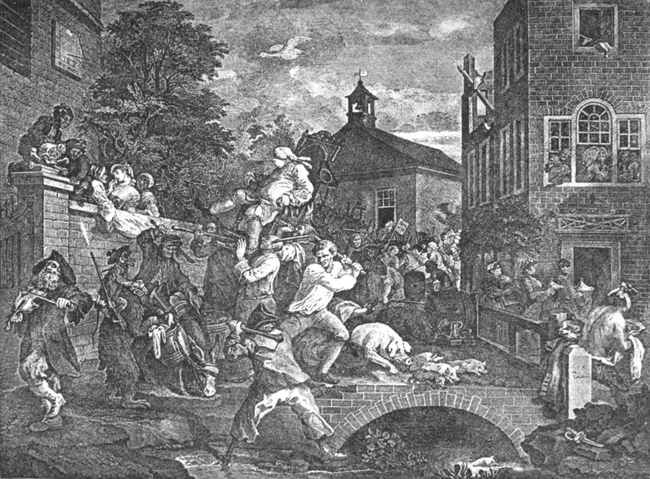
THE ELECTION, PLATE IV. CHAIRING THE MEMBERS.
The polling being concluded, the books cast up, and the returning-officer having declared our candidate[80] duly elected, he is now exhibited in triumph. Seated in an arm-chair, and exalted upon the shoulders of four tried supporters of the constitution, he is borne through the principal streets, which are promiscuously crowded with enemies as well as friends. In this aerostatic voyage there seems to be some danger of a wreck; for a thresher having received an insult from a sailor, in the act of revenging it flourishes his flail in as extensive an orbit as if he were in his own barn. The end of this destructive instrument coming in contact with the skull of a bearer of our new-made member, the fellow's head rings with the blow, his eyes swim, his limbs refuse their office, and at this inauspicious moment the effects of the stroke, like an electric shock, extend to the exalted senator. He trembles in every joint; the hat flies from his head—and—without the intervention of Juno or Minerva, he must fall from the seat of honour to the bed of stone. Terrified at his impending danger, a nervous lady, who with her attendants is in the churchyard, falls back in a swoon. Regardless of her distress, two little chimney-sweepers upon the gate-post are placing a pair of gingerbread spectacles on a death's head. Their sportive tricks are likely to be interrupted by a monkey beneath, who, arrayed en militaire, is mounted upon a bear's back. The firelock slung over this little animal's shoulder, in a fray between the bear and a biped, is accidentally discharged in a direction that, if loaded, must carry leaden death to one of the gibing soot merchants above.[81]
The venerable musician, delighted with his own harmony, neither takes a part nor feels an interest in the business of the day. Let not his neutrality be attributed to a wrong cause; nor be it supposed that, in a country where every good citizen must espouse some party,[82] this ancient personage would remain an indifferent spectator were he not totally blind. At an opposite corner a naked soldier is taking a few refreshing grains of best Virginia, and preparing to dress himself after the performance of a pugilistic duet. On the other side of the rails a half-starved French cook, a half-bred English cook, and a half-roasted woman cook, are carrying three covers for the lawyers' table. Near them is a cooper inspecting a vessel that had been reported leaky, and must speedily be filled with home-brewed ale for the gratification of the populace. Two fellows are forcing their way through the crowd in the background with a barrel of the same liquor. Coming out of a street behind them, a procession of triumphant electors hail the other successful candidate, whose shadow appears on the wall of the court-house. In Mr. Attorney's[83] first floor are a group of the defeated party glorying in their security, and highly delighted with the confusion below. One of these, distinguished by a riband, is said to be intended for the late Duke of Newcastle, who was eminently active on these occasions. A poor old lady is unfortunately thrown down by a litter of pigs, which, followed by their mamma, rush through the crowd with as much impetuosity as if the whole herd were possessed. One of this agreeable party has leaped, not into the ocean, but the brook, and the whole family are on the point of following its example.
Hogarth had surely some antipathy to tailors; in the background he has introduced one of these knights of the needle disciplined by his wife for having quitted the shop-board to look at the gentlemen. In Le Brun's "Battle of the Granicus," an eagle is represented as hovering over the plumed helmet of Alexander; this thought is very happily parodied in a goose,[84] flying immediately over the tye-wig of our exalted candidate.
Mr. Nichols, in his Anecdotes of Hogarth, very shrewdly observes that "the ruined house adjoining to the attorney's is a stroke of satire that should not be overlooked, because," adds the same writer, "it intimates that nothing can thrive in the neighbourhood of such vermin."[85] In this inference I most sincerely join, but am afraid that in the present instance we cannot establish our data. The house is not in ruins from the inhabitant having been unable to keep it in repair, neither has it been torn by the teeth of time; for it is apparently the wreck of a modern edifice, which has been thus destroyed by a riotous mob, because it belonged to one of the opposite party.
An inscription on the sun-dial, when joined to the mortuary representation on the church gate-post, has been supposed to imply a pun hardly worthy of Hogarth, but which yet I am inclined to suspect he intended. "We must,"[86] on the sun-dial, say some of his illustrators, means—We must die all (dial).
All the incidents in this very whimsical plate are naturally and yet skilfully combined: the whole is in the highest degree laughable, and every figure stamped with its proper character. The apprehensive terror of the unwieldy member, the Herculean strength of the exasperated thresher, and the energetic attitude of the maimed sailor, deserve peculiar praise.
Previous to the publication of this series, Mr. Hogarth's satire was generally aimed at the follies and vices of individuals. He has here ventured to dip his pencil in the ocean of politics, and delineated the corrupt and venal conduct of our electors in the choice of their representatives. That these four plates display a picture in any degree applicable to the present times must not be asserted, because it might, by the help of innuendo, be construed into a libel on the present upright and independent House of Commons: but from the floating memorials of some little transactions that took place some thirty or forty years ago, there is reason to think that the people of Great Britain were so far from being influenced by a reverence for public virtue, that they began to suspect it had no existence. Their faith in violent professions of the amor patriæ had been staggered by several recent instances of political depravity. They had a few years before seen a William Pulteney, the champion of patriots, the idol of the people, the dread of ministers, desert from the party of which he was a leader, quit the cause for which he had been the most violent advocate, and accept a peerage. This, and some similar circumstances, gave an example and an apology for universal venality.
How different was the spirit which actuated the Earl of Bath, from that independent dignity, that patriotic ardour, that holy enthusiasm, which has emblazoned the name of Andrew Marvel[87] with a saint-like glory! Let his name be consecrated by the reverence and the gratitude of every Englishman, and may we live to see a band of senators who will emulate his virtues! Could we have faith in speeches, many which we have heard and read are of much promise; let us hope that the day of performance is at hand.
THE MARCH TO FINCHLEY.
"Now I behold the chiefs in the pride of their former deeds; their souls are kindled at the battles of old, and the actions of other times. Their eyes are like flames of fire, and roll in search of the foes of the land. Their mighty hands are on their swords, and lightning pours from their sides of steel. They came like streams from the mountains; each rushed roaring from his hill. Bright are the chiefs of battle in the arms of their fathers."[88]—Fingal, Book I. p. 7.
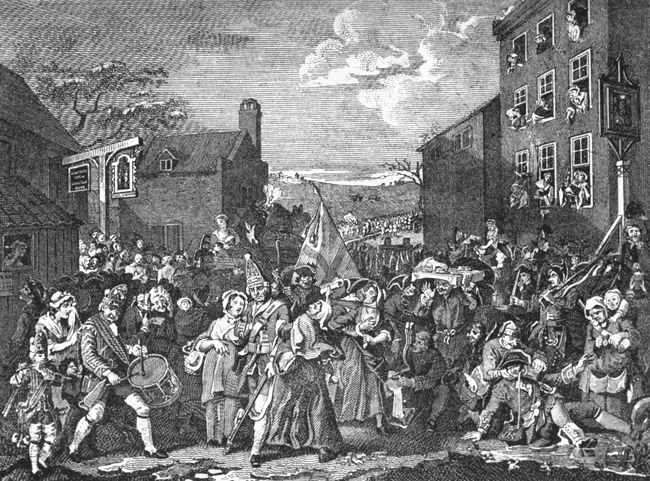
THE MARCH TO FINCHLEY.
That so admirable a representation of the manners of England should be dedicated to the King of Prussia,[89] is one of those odd circumstances which must surprise a man who is not acquainted with the history of the plate. Before publication it was inscribed to his late Majesty, and the picture taken to St. James's, in the hope of royal approbation. George the Second was an honest man and a soldier, but not a judge of either a work of humour or a work of art. The corporal or sergeant he considered as employed in a way which dignified their nature, and gave them a title to the name and rank of gentlemen. The painter or engraver, however exquisite their skill, however elevated their conceptions, were on the King's scale mere mechanics.
When told that Hogarth had painted a picture of the Guards on their march to Finchley, and meant to dedicate a print engraved from it to the King of Great Britain, his Majesty probably expected to see an allegorical representation of an army of heroes devoting their lives to the service of their country; and their sovereign, habited like "the mailed Mars," seated upon a cloud, where he might,
"With a commanding voice, Cry havoc, and let slip the dogs of war."
If such was his expectation, we may readily conceive his disappointment on viewing this delineation. His first question was addressed to a nobleman-in-waiting: "Pray, who is this Hogarth?" "A painter, my liege." "I hate bainting; and boetry too! neither the one nor the other ever did any good! Does the fellow mean to laugh at my Guards?" "The picture, an please your Majesty, must undoubtedly be considered as a burlesque." "What! a bainter burlesque a soldier? he deserves to be picketed for his insolence! Take his trumpery out of my sight."
The print was returned to the artist, who, completely mortified at such a reception of what he very properly considered as his first work, immediately altered the inscription, inserting, instead of the King of England, the King of Prussia (as an encourager of the arts).
Though the fine arts were never much encouraged in Prussia, the painter received a handsome acknowledgment for his dedication, and afterwards circulated proposals for publishing his print by subscription. Thus was it announced in the General Advertiser of April 14, 1750:—"Mr. Hogarth is publishing by subscription a print, representing 'The March to Finchley' in the year 1746; engraved on a copperplate 22 inches by 17: the price, 7s. 6d.
"Subscriptions are taken in at the Golden Head, in Leicester Fields, till the 30th of this instant, and no longer, to the end that the engraving may not be retarded.
"Note.—Each print will be half a guinea after the subscription is over.
"In the subscription-book are the particulars of a proposal, whereby each subscriber of three shillings over and above the said seven shillings and sixpence for the print will, in consideration thereof, be entitled to a chance of having the original picture, which shall be delivered to the winning subscriber as soon as the engraving is finished."
General Advertiser, May 1, 1750.—"Yesterday Mr. Hogarth's subscription was closed: eighteen hundred and forty-three chances being subscribed for, Mr. Hogarth gave the remaining hundred and sixty-seven chances to the Foundling Hospital, and the same night delivered the picture to the Governors."
By the fortunate number being among those presented to a charity which he so much wished to serve, the artist was highly gratified. In a private house it would have been in a degree secluded from the public, and by the lapse of time have been transferred to those who could not appreciate its merit, and from either negligence or ignorance, might have been destroyed by damp walls, or effaced from the canvas by picture-cleaners. Here, it was likely to remain a permanent and honourable testimony of his talents and liberality. Notwithstanding all this, Hogarth soon after waited upon the treasurer of the hospital, and acquainted him, that if the trustees thought proper, they were at liberty to dispose of the picture by auction. His motives for giving this permission it is not easy to assign. They might have their origin in his desire to enrich a foundation which had his warmest wishes, or a natural though ill-judged ambition to have his greatest work in the possession of some one who had a collection of the old masters, with whom he in no degree dreaded a competition. Whether his mind was actuated by these or other causes is not important; certain it is that his opinion changed—he requested the trustees would not dispose of it, and never afterwards consented to the measure he himself had originally proposed. The late Duke of Ancaster's father wished to become a purchaser, and once offered the trustees three hundred pounds for it. I have been told that a much larger sum was since proffered by another gentleman.
The scene is laid before the Adam and Eve, in Tottenham Court Road, and entitled, "A Representation of the March of the Guards towards Scotland in the year 1745."
A handsome young grenadier has been denominated the principal figure, but may with more propriety be called the principal figure of the principal group. His countenance exhibits a strong contest between affection and duty; for the manner in which his Irish helpmate clings to his arm, and at the same time with threatening aspect lifts up her right hand grasping the Remembrancer,[90] proves to a moral certainty that to her he has made a matrimonial vow; while the tender, entreating distress of the poor girl at his right hand, seems to intimate that, though she possesses his heart, she can make no claim except to his gratitude and affection, both of which her present situation seems to demand. Her face forms a strong contrast to that of the fury who is on the other side; for while one is marked with grief and tender regret, the other has all the savage ferocity of an unchained tiger: she is an accomplished masculine tramp, perfectly qualified to follow a regiment, and would be as ready to plunder those that are slaughtered as to scold those who escape: being by no means of the class described by Dr. Johnson when, speaking of superfluous epithets, he says, "they are like the valets and washerwomen that follow an army, who add to the number without increasing the force." The papers of which these two claimants are the vendors determine their principles. The mild-tempered, soft-featured gentlewoman with a cross upon a cloak, is evidently a hawker of the Jacobites' Journal, Remembrancer, and London Evening Post, papers remarkable for their inflammatory tendency; while a portrait of the gallant Duke of Cumberland, and the now popular ballad of God save the King, hang upon the basket of her rival.
An old woman immediately behind, with a pipe in her mouth and a child on her back, appears to have grown rather ancient in the service; but notwithstanding her load and her poverty, puffs away care, and carries a cheerful countenance.
Near the child's head a meagre Frenchman is whispering an old fellow, whom Mr. Thornton in his description of the plate calls an Independent; but as in the original painting part of a plaid appears under his greatcoat, the artist most probably intended it for an old Highlander in disguise. Rouquet, who perhaps had his explanation from Hogarth, describes it as follows:—
"A droite du principal group paroit une figure de François, qu'on a voulu représenter comme un homme de quelque importance, afin de lui donner plus de ridicule; il parle à un homme dont la nation est indiquée par l'étoffe de sa veste, qui est celui dont s'habillent les habitans des montagnes d'Ecosse: le François semble communiquer à l'Ecossois des lettres qu'il vient de recevoir, et qui ont rapport à l'évenement qui donne lieu à cette marche. Les Anglois ne se réjouissent jamais bien sans qu'il en coute quelque chose aux François: leur théatre, leur conversation, leurs tableaux, et sur tout ceux de notre peintre, portent toujours cette glorieuse marque de l'amour de la patrie: les Romans même sont ornés de traits amusans sur cet ancien sujet; l'excellent auteur de Tom Jones, a voulu aussi lâcher les siens. Mais le prétendu mépris pour les François dont le peuple de ce pais-ci fait profession, s'explique selon moi d'une façon fort équivoque. Le mépris suppose l'oubli; mais un objet dont on médit perpétuellement occupé: la satire constitue une attention qui me feroit soupçonner qu'on fait aux François l'honneur de les haïr un peu."
A drummer, sick of the remonstrances of his wife and child, each of whom made a forcible seizure of his person, actuated by a spirit similar to that of our third Richard, beats a thundering tattoo upon his own warlike instrument; and aided by the ear-piercing fife[91] at his right hand, drowns the noise of the tell-tale woman who thus endeavours to check his ardour and impede his march. A war-worn soldier contemplating a quack-doctor's bill, and a woman peeping out of a pent-house above, end the group at the left corner.
Under a sign of the Adam and Eve a crowd are gathered round two combatants, who appear to be adepts in the noble science of boxing.
"Amid the circle now each champion stands, And poises high in air his iron hands; Hurling defiance; now they fiercely close— Their crackling jaws re-echo to the blows."
A man, who from his dress seems to be of a rank superior to the crowd, inflamed with a love of glory, enters with great spirit into the business now going on, and tries to inspire the combatants with a noble contempt of bruises and broken bones. This is said to be a portrait of Lord Albemarle Bertie, who is again exhibited in "The Cockpit." The scene being laid in the background, the figures are diminutive; but every countenance is marked with interest, and no one more than a little fellow[92] of meagre frame but undaunted spirit, who with clenched fists and agitated face deals blow for blow with the combatants. Somerville, in his Rural Games, has well described the passions which agitate the audience in a similar scene at a country wake:
"Each swain his wish, each trembling nymph conceals Her secret dread; while every panting breast Alternate fears and hopes depress or raise. Thus, long in dubious scale the contest hung," etc.
With a humour peculiar to himself, the painter has exhibited a figure shrinking under the weight of a heavy burden, who, preferring the gratification of curiosity to rest, is a spectator, and in this uneasy state waits the issue of the combat.
Upon the sign-board of the Adam and Eve is inserted, "Tottenham Court Nursery," allusive to a booth for bruising in the place, as well as a nursery for plants, and the group of figures beneath.
A carriage laden with camp equipage, consisting of drums, halberds, tent-poles, and hoop petticoats, is passing through the turnpike gate. Upon this, two old female campaigners are puffing their pipes, and holding a conversation in fire and smoke. These grotesque personages are well contrasted by an elegant and singularly delicate figure upon the same carriage, suckling her child; which, it has been said, proves that the painter is as successful in portraying the graceful as the humorous. This very beautiful figure is, however, almost a direct copy from Guido's "Madonna." To show that a little boy at her feet is of an heroic stock, the artist has represented him blowing a small trumpet. The sergeant on the ground beneath seems exerting the authority with which his post vests him in calling his men to order: he has a true roast-beef countenance, and is haughty enough for a general.
The foreground in the centre is occupied by a group of figures, which tell their own story in a manner that perhaps no other artist of any age could have equalled. While an officer is kissing a milk-maid, an arch soldier, taking advantage of her neglected pails, fills his hat with milk: this is observed by a little chimney-sweeper, who, with a grin upon his face, entreats that he may have a share in the plunder, and fill his cap. Another soldier pointing out the jest to a fellow who is selling pies, the pastry-cook, gratified by the mischief, forgets the luscious cakes in the tray on his head, and the military Mercury seems likely to convey them all to his own pocket. The faces of this group are in a most singular degree descriptive of their situations, and consonant to their mischievous employments.
An old soldier, divested of one spatterdash, near losing the other, and felled to the ground by all-potent gin, is now calling for more; his uncivil comrade, supporting him with one hand, endeavours to pour water into his mouth with the other; this the veteran toper rejects with disdain, and lifts up a hand to his wife, who is bearer of the arms and the bottle, and being well acquainted with his taste, fills another quartern.
A child with emaciated face extends its little arms, and wishes for a taste of that poisonous potion it is probably accustomed to swallow: "And here" (says Mr. Thornton in the Student), "not to dwell wholly upon the beauties of this print, I must mention an error discovered by a professed connoisseur in painting. 'Can there,' says this excellent judge, 'be a greater absurdity than introducing a couple of chickens so near such a crowd; and not only so, but see their direction is to objects it is natural for them to shun.—Is this knowledge of nature? Absurd to the last degree!' And here, with an air of triumph, ended our judicious critic. How great was his surprise, when it was pointed out that the said chickens were in pursuit of the hen, which appears to have a resting-place in a sailor's pocket!"
An honest tar, throwing up his hat, is crying "God save our noble King, God save the King:" immediately before him an image of drunken loyalty vows de—de—destruction on the heads of the rebels.
A humane soldier perceiving a fellow heavy laden with a barrel of gin, and stopped by the crowd, bores a hole in the head of his cask, and kindly draws off a part of his burden. Near him is a figure of what may, in the army, be called a fine fellow.[93] As I suppose the painter designed him without character, I shall only observe that he is a very pretty gentleman; and happily the contemplation of his own dear person guards him from the attempts of the wicked woman on his right hand.[94]
The invention of a new term must be pardoned—I shall include the whole King's Head in the word Cattery; the principal figure is a noted fat Covent Garden lady,[95] who, with pious eyes cast up to heaven, prays for the army's success, and the safe return of many of her babes of grace. An officer having placed a letter on the end of his pike, presents it to one of the beauties in the first floor; but the fair enamorata, evidently disgusted at the recollection of some part of his former conduct, flutters her fan and rejects it with disdain. Above her, a charitable girl of an inferior order is throwing a piece of coin to a cripple, while another kindly administers a glass of comfort to her companion as a sure relief against reflection. The rest of the windows are crowded with similar characters, and upon the house-top is a Cat coterie, a fair emblem of the company in the apartments beneath.
The substance of the preceding remarks are, in this as in the first edition, taken from the Student, vol. ii. p. 162, and were made by the late Bonnell Thornton. In the Old Woman's Magazine, Doctor Hill has given an explanation which places it in a point of view somewhat different; I have therefore subjoined the greatest part of it.
To the Editor.
"Sir,—As you desire my sentiments on Mr. Hogarth's picture, I shall begin with pointing out what is most defective. Its first and greatest fault, then, is its being new, and having too great a resemblance to the objects it represents: if this appears a paradox, you ought to take particular care of confessing it. This picture has yet too much of that lustre,—that despicable freshness which we discover in nature, and which is never seen in the celebrated cabinets of the curious. Time has not yet obscured it with that venerable smoke, that sacred cloud which will one day conceal it from the profane eyes of the vulgar, that its beauties may only be seen by those who are initiated in the mysteries of art. These are its most remarkable faults: and I am next going to give you an idea of the subject, which is the march of some companies of the foot guards to their rendezvous at Finchley Common, when sent against the Scottish rebels, who were advancing on that side.
"Mr. Hogarth, who lets no opportunity escape him of observing the picturesque scenes which numerous assemblies frequently furnish, has not failed to represent them on the spot where he has drawn the scene of his picture.
"The painter is remarkable for a particular sagacity in seizing a thousand little circumstances which escape the observation of the greatest part of the spectators, and it is a collection of a number of those circumstances which has composed, enriched, and diversified his work.
"The scene is placed at Tottenham Court, where, in a distant view, is seen a file of soldiers marching in tolerable order up the hill. Discipline is less observed in the principal design; but if you complain of this, I must ingeniously inform you, that order and subordination belong only to slaves; for what everywhere else is called licentiousness, assumes here the venerable name of liberty.
"A young grenadier, of a good mien, makes the principal figure in the first group; he is accompanied, or rather seized and beset, by two women, one of whom is a ballad-singer, and the other a news-hawker: they are both with child, and claim this hero as the father, and except this circumstance they have nothing in common; for their figures, their humours, their characters, appear extremely different: they are even of opposite parties, for the one disposes of works in favour of the Government, and the other against it.
"On the left hand of this group is an officer embracing a milk-woman; but her greatest misfortune is, not her being hugged by a young cavalier, but in having one of her milk-pails seized by a wag, who pours her milk into a hat, while he is pretending to defend her. Near them is a pieman, who is mightily rejoiced at this roguery; while a soldier, who is fleering in his face, slily steals the pies he carries on his head. The humour of this group is greatly heightened by a chimney-sweeper's boy, who comes laughing to receive some of the milk into his hat, which he carries in his hand.
"On the right hand of the principal group is a Frenchman, who, to give him a more ridiculous appearance, is represented as a man of some importance. He is speaking to a very odd person, to whom he seems communicating the contents of some letters relative to the event which is the cause of this march.
"Behind the Frenchman just mentioned is seen an old sutler, who carries her child at her back, and is smoking a short pipe. In the front, at a small distance, is a drummer, who by the noise of his drum seems to endeavour to stun all thoughts of the fate of his family, who seek in vain to soften him by taking a tender leave.
"One of the young pipers whom the Duke of Cumberland has introduced into several regiments, joins his noise to that of the drum, and by the agreeable appearance of his little person, is a contrast to the rudeness of the objects who are near him, etc. etc."
To the dramatic effect of the picture, the late Mr. Arthur Murphy, whose acknowledged judgment give weight to his praise, bears the following honourable testimony in the Gray's Inn Journal, vol. i. No. 20:—
"The era may arrive, when, through the instability of the English language, the style of Joseph Andrews and Tom Jones shall be obliterated, when the characters shall be unintelligible, and the humour lose its relish; but the many personages which the manner-painting hand of Hogarth has called forth into mimic life will not fade so soon from the canvas, and that admirable picturesque comedy, 'The March to Finchley,' will perhaps divert posterity as long as the Foundling Hospital shall do honour to the British nation."
THE INVASION; OR, FRANCE AND ENGLAND.

In the two following designs Mr. Hogarth has displayed that partiality for his own country, and contempt for France, which formed a strong trait in his character. He neither forgot nor forgave the insults he suffered at Calais, though he did not recollect that this treatment originated in his own ill-humour, which threw a sombre shade over every object that presented itself. Having early imbibed the vulgar prejudice that one Englishman was a match for four Frenchmen,[96] he thought it would be doing his country a service to prove the position. How far it is either useful or political to depreciate the power or degrade the character of that people with whom we are to contend, is a question which does not come within the plan of this work. In some cases it may create confidence, but in others leads to the indulgence of that negligent security by which armies have been slaughtered, provinces depopulated, and kingdoms changed their rulers.
These two glaring contrasts were designed at a time when there was a rumour of an invasion from France. The sober politician treated this idle report with contempt; but by the credulous it was believed, and the timid trembled when they heard it. To dispel this phantom of the day was one motive for Hogarth's publication of these prints. They are not addressed to the philosopher or the legislator, but to the soldier and the sailor. They are not designed for the contemplation of the informed and travelled man, who considers himself as a citizen of the world; but for the true-born and true-bred Briton, that believes this to be the only country where man can enjoy happiness, and thinks an Englishman is the boast of the universe, the glory of creation, and the paragon of nature!
PLATE I.
FRANCE.
"With lantern jaws, and croaking gut, See how the half-starv'd Frenchmen strut, And call us English dogs! But soon we'll teach these bragging foes, That beef and beer give heavier blows Than soup and roasted frogs. "The priests, inflam'd with righteous hopes, Prepare their axes, wheels, and ropes, To bend the stiff-neck'd sinner; But should they sink in coming over, Old Nick may fish 'twixt France and Dover, And catch a glorious dinner."
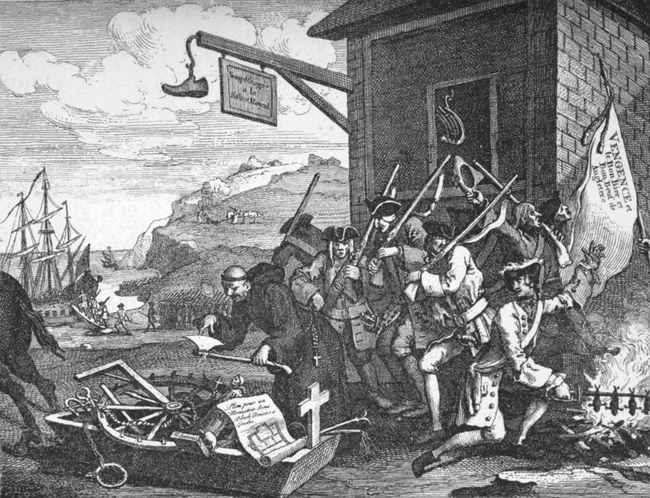
FRANCE PLATE I.
The scenes of all Mr. Hogarth's prints, except "The Gate of Calais" and that now under consideration, are laid in England. In this, having quitted his own country, he seems to think himself out of the reach of the critics, and in delineating a Frenchman, at liberty to depart from nature, and sport in the fairy regions of caricature. Were these Gallic soldiers naked, each of them would appear like a forked radish, with a head fantastically carved upon it with a knife. So forlorn! that to any thick sight he would be invisible! To see this miserable woe-begone refuse of the army, who look like a group detached from the main body and put on the sick-list, embarking to conquer a neighbouring kingdom, is ridiculous enough, and at the time of publication must have had great effect. The artist seemed sensible that it was necessary to account for the unsubstantial appearance of these shadows of men, and has hinted at their want of solid food, in the bare bones of beef hung up in the window, the inscription on the alehouse sign, "Soup maigre à la sabot Royal," and the spider-like officer roasting four frogs which he has impaled upon his sword. Such light and airy diet is whimsically opposed by the motto on the standard, which two of the most valorous of this ghastly troop are hailing with grim delight and loud exultation. It is indeed an attractive motto, and well calculated to inspire this famishing company with courage: "Vengeance, avec le bon bier, et bon beuf d'Angleterre." However meagre the military, the church militant is in no danger of starving. The portly friar is neither emaciated by fasting, nor weakened by penance. Anticipating the glory of extirpating heresy, he is feeling the sharp edge of an axe to be employed in the decollation of the enemies to the true faith, which if any one doubt, he shall die the death. A sledge is laden with whips, wheels, ropes, chains, gibbets, and other inquisitorial engines of torture, which are admirably calculated for the propagation of a religion that was established in meekness and mercy, and inculcates universal charity and forbearance. On the same sledge is an image of St. Anthony, very properly accompanied by his pig, and the plan of a monastery to be built at Blackfriars.
In the background are a troop of soldiers so averse to this English expedition, that their sergeant is obliged to goad them forward with his halberd. To intimate that agriculture suffers by the invasion having engaged the masculine inhabitants, two women ploughing a sterile promontory in the distance complete this catalogue of wretchedness, misery, and famine.
PLATE II
ENGLAND.
"See John the Soldier, Jack the Tar, With sword and pistol arm'd for war, Should Mounseer dare come here; The hungry slaves have smelt our food, They long to taste our flesh and blood, Old England's beef and beer! "Britons, to arms! and let 'em come; Be you but Britons still, strike home, And lion-like attack 'em, No power can stand the deadly stroke That's given from hands and hearts of oak, With liberty to back 'em."
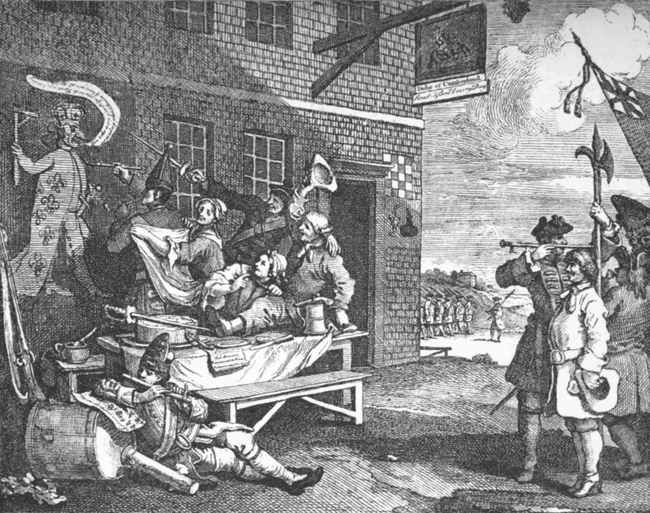
ENGLAND PLATE II.
From the unpropitious regions of France, our scene changes to the fertile fields of England.
"England! bound in with the triumphant sea, Whose rocky shores beat back the envious siege Of wat'ry Neptune."
Instead of the forlorn and famished party who were represented in the last plate, we here see a company of well-fed and high-spirited Britons, marked with all the hardihood of ancient times, and eager to defend their country.
In the first group, a young peasant who aspires to a niche in the Temple of Fame, preferring the service of Mars to that of Ceres, and the dignified appellation of soldier to the plebeian name of farmer, offers to enlist. Standing with his back against the halberd to ascertain his height, and finding he is rather under the mark,[97] he endeavours to reach it by rising on tiptoe. This artifice, to which he is impelled by towering ambition, the sergeant seems disposed to connive at—and the sergeant is a hero, and a great man in his way; "your hero always must be tall, you know."
To evince that the polite arts were then in a flourishing state, and cultivated by more than the immediate professors, a gentleman artist, who to common eyes must pass for a grenadier, is making a caricature of le Grand Monarque. The sovereign of France was in that day as general a subject for copper satire as Mr. Fox is in this. I have seen engravings, where his Gallic Majesty made one of the party, that were not a degree better than the grenadier's drawing, where, to render the meaning obvious, and supply the want of character, or story, every figure had a label hanging to its mouth. That given to this king of shreds and patches is worthy the speaker, and worthy observation: "You take a my fine ships: you be de pirate; you be de teef: me send my grand armies, and hang you all."
The action is suited to the word, for with his left hand this most Christian potentate grasps his sword, and in his right poises a gibbet. The figure and motto united, produce a roar of approbation from the soldier and sailor, who are criticising the work. It is so natural, that the Helen and Briseis of the camp contemplate the performance with apparent delight; and while one of them with her apron measures the breadth of this Herculean painter's shoulders, the other, to show that the performance has some point, places her forefinger against the prongs of a fork. The little fifer, playing that animated and inspiring tune "God save the King," is an old acquaintance: we recollect him in "The March to Finchley." In the background is a sergeant teaching a company of young recruits their manual exercise.
This military meeting is held at the sign of the gallant Duke of Cumberland, who is mounted upon a prancing charger,
"As if an angel dropt down from the clouds, To turn and wield a fiery Pegasus, And witch the world with noble horsemanship."[98]
Underneath is inscribed, "Roast and boiled every day;" which, with the beef and beverage upon the table, forms a fine contrast to the soup maigre, bare bones, and roasted frogs, in the last print. The bottle painted on the wall, foaming with liquor which, impatient of imprisonment, has burst its cerements, must be an irresistible invitation to a thirsty traveller. The soldier's sword laid upon the round of beef, and the sailor's pistol on the vessel containing the ale, intimate that these great bulwarks of our island are as tenacious of their beef and beer as of their religion and liberty.
These two plates were published in 1756; but in the London Chronicle for October 20, 1759, is the following advertisement:—
"This day are re-published, price 1s. each, Two prints designed and etched by William Hogarth: one representing the preparations on the French coast for an intended invasion; the other, a view of the preparations making in England to oppose the wicked designs of our enemies; proper to be stuck up in public places, both in town and country, at this juncture."[99]
The verses which are inserted under each print, and subjoined to this account, are, it must be acknowledged, coarse enough. They were, however, written by David Garrick, who, had he thought the subject worthy of his muse, could, I believe, have produced more elegant stanzas.
THE COCKPIT.
"It is worth your while to come to England, were it only to see an election and a cock-match. There is a celestial spirit of anarchy and confusion in these two scenes that words cannot paint, and of which no countryman of yours can form even an idea."—Sherlock's Letters to a friend at Paris.
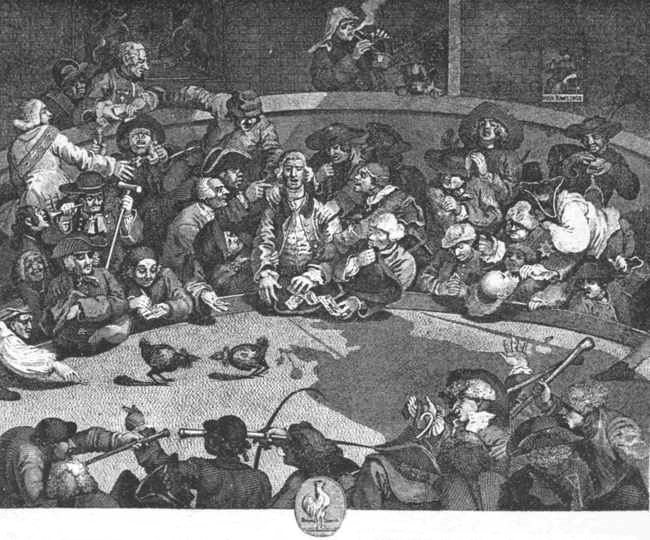
THE COCKPIT.

Mr. Sherlock is perfectly right in his assertion, that neither of these scenes can be described by words; but where the writer must have failed, the artist has succeeded, and the Parisian who has never visited England may, from Mr. Hogarth's Prints, form a tolerably correct idea of the anarchy of an election, and the confusion of a cockpit. To the right learned and laborious successors of Master Thomas Hearne, it would be matter of curious speculation, and worthy of deep research, to inquire which of these "popular sportes was fyrste practysed in fair Englonde." To their grave and useful investigations I leave the decision of this knotty point. The earliest information of this gentile and royal game which my reading supplies, I find in a treatise, published in 1674, and entitled The Complete Gamester, containing instructions how to play at Billiards, Trucks, Bowls, Chess, etc. "To which is added, The Artes and Mysteries of Riding, Racing, Archery, and Cock Fighting. Printed by A. M. for R. Cutler, and to be sold by Henry Brome, at the Gun, at the west end of St. Paul's." To this curious little vade mecum there is a frontispiece divided into five compartments. One of them represents a cockpit, in the centre of which two of the feathered tribe, not unlike ducks, are fighting. The pit is surrounded by a company of crop-eared figures in round hats, with faces as demure and sanctified as are to be seen at a Quakers' meeting. Before many of these most sedate personages are heaps of gold, and (alluding to the print) the following sublime verses:—
"After these three, the cockpit claims a name; A sport gentile, and call'd a royal game. Now see the gallants crowd about the pit, And most are stock'd with money more than wit; Else sure they would not, with so great a stir, Lay ten to one on a cock's faithless spur."
To the respect which our ancestors had for this kingly amusement, the author beareth ample testimony in his 38th chapter, some extracts from which I venture to insert, with the hope that they will be both pleasant and profitable to the lovers of this very refined and humane divertisement:—
"It is a sport or pastime so full of delight and pleasure, that I know not any game in that respect is to be preferred before it; and since the fighting cock hath gained so great an estimation among the gentry, in respect to this noble recreation, I shall here propose it before all the other games of which I have afore succinctly discoursed. That, therefore, I may methodically give instructions to such as are unlearned, and add more knowledge to such who have already gained a competent proficiency in this pleasing art, I shall, as briefly as I can, give you information how you shall choose, breed, and diet the fighting cock, with what choice secrets are thereunto belonging, in order thus:—
"In the election[100] of a fighting cock, there are four things principally to be considered; and they are: shape, colour, courage, and a sharp heel.
"Observe the crowing of your chickens; if you find them crow too soon, that is, before six months old, or unseasonably, and that their crowing is clear and loud, fit them as soon as you can for the pot or spit, for they are infallible signs of cowardice and falsehood: on the contrary, the true and perfect cock is long before he obtaineth his voice, and when he hath got it, observeth his hours with the best judgment."
After much more which I have not room to insert, the author addeth, "To conclude, make your choice of such a one that is of shape strong, of colour good, of valour true, and of heel sharp and ready."
Leaving the book to the study of those whom it may concern, let us now attend to the plate.
The scene is probably laid at Newmarket;[101] and in this motley group of peers, pickpockets, butchers, jockeys, ratcatchers, gentlemen,—gamblers of every denomination,—Lord Albemarle Bertie,[102] being the principal figure, is entitled to precedence. In a former print[103] we saw him an attendant at a boxing match; and here he is president of a most respectable society assembled at a cockpit. What rendered his Lordship's passion for amusements of this nature very singular, was his being totally blind. In this place he is beset by seven steady friends, five of whom at the same instant offer to bet with him on the event of the battle. One of them, a lineal descendant of Filch, taking advantage of his blindness and negligence, endeavours to convey a bank note, deposited in our dignified gambler's hat, to his own pocket. Of this ungentleman-like attempt his Lordship is apprised by a ragged postboy and an honest butcher: but so much engaged in the pronunciation of those important words, "Done! done! done! done!" and the arrangement of his bets, that he cannot attend to their hints; and it seems more than probable that the stock will be transferred and the note negotiated in a few seconds.
A very curious group surround the old nobleman, who is adorned with a riband, a star, and a pair of spectacles. The whole weight of an overgrown carpenter being laid upon his shoulder, forces our illustrious personage upon a man beneath; who being thus driven downward, falls upon a fourth; and the fourth, by the accumulated pressure of this ponderous trio—composed of the upper and lower house—loses his balance, and tumbling against the edge of the partition, his head is broke, and his wig, shook from the seat of reason, falls into the cockpit.
A man adjoining enters into the spirit of the battle—his whole soul is engaged. From his distorted countenance and clasped hands, we see that he feels every stroke given to his favourite bird in his heart's core, ay, in his heart of hearts! A person at the old Peer's left hand is likely to be a loser. Ill-humour, vexation, and disappointment are painted in his countenance. The chimney-sweeper above is the very quintessence of affectation. He has all the airs and graces of a boarding-school miss. There are those who remember the man, and declare that his character is not heightened in the portrait. The sanctified Quaker adjoining, and the fellow beneath, who, by the way, is a very similar figure to Captain Stab in "The Rake's Progress," are finely contrasted.
A French marquis, on the other side, astonished at this being called amusement, is exclaiming Sauvages! sauvages! sauvages! Engrossed by the scene, and opening his snuff-box rather carelessly, its contents fall into the eyes of a man below, who, sneezing and swearing alternately, imprecates bitter curses on this devil's dust, that extorts from his inflamed eyes "a sea of melting pearls, which some call tears."
Adjoining is an old cripple with a trumpet at his ear, and in this trumpet a person in a bag-wig roars in a manner that cannot much gratify the auricular nerves of his companions; but as for the object to whom the voice is directed, he seems totally insensible to sounds, and if judgment can be formed from appearances, might very composedly stand close to the clock of St. Paul's Cathedral when it was striking twelve.
The figure with a cock peeping out of a bag is said to be intended for Jackson, a jockey. The gravity of this experienced veteran, and the cool sedateness of a man registering the wagers, are well opposed by the grinning woman behind, and the heated impetuosity of a fellow, stripped to his shirt, throwing his coin upon the cockpit, and offering to back Ginger against Pye for a guinea.
On the lower side, where there is only one tier of figures, a sort of an apothecary, and a jockey, are stretching out their arms and striking together the handles of their whips in token of a bet. An hiccuping votary of Bacchus, displaying a half-emptied purse, is not likely to possess it long; for an adroit professor of legerdemain has taken aim with an hooked stick, and by one slight jerk will convey it to his own pocket. The profession of a gentlemen in a round wig is determined by a gibbet chalked upon his coat. An enraged barber, who lifts up his stick in the corner, has probably been refused payment of a wager by the man at whom he is striking.
A cloud-capt philosopher at the top of the print, coolly smoking his pipe, unmoved by this crash of matter and wreck of property, must not be overlooked: neither should his dog be neglected; for the dog, gravely resting his fore-paws upon the partition,[104] and contemplating the company, seems more interested in the event of the battle than his master.
Like the tremendous Gog and terrific Magog of Guildhall, stand the two cock-feeders; a foot of each of these consequential purveyors is seen at the two extremities of the pit.
As to the birds whose attractive powers have drawn this admiring throng together, they deserved earlier notice—
"Each hero burns to conquer or to die, What mighty hearts in little bosoms lie!"
Having disposed of the substances, let us now attend to the shadow on the cockpit, and this it seems is the reflection of a man drawn up to the ceiling in a basket, and there suspended[105] as a punishment for having betted more money than he can pay. Though suspended, he is not reclaimed; though exposed, not abashed; for in this degrading situation he offers to stake his watch against money in another wager on his favourite champion.
The decorations of this curious theatre are, a portrait of Nan Rawlins,[106] and the King's arms.
In the margin at the bottom of the print is an oval, with a fighting cock, inscribed "Royal sport," and underneath it is written, "Pit ticket."
Of the characteristic distinctions in this heterogeneous assembly, it is not easy to speak with sufficient praise. The chimney-sweeper's absurd affectation sets the similar airs of the Frenchman in a most ridiculous point of view. The old fellow with a trumpet at his ear has a degree of deafness that I never before saw delineated; he might have lived in the same apartment with Xantippe, or slept comfortably in Alexander the coppersmith's first floor. As to the nobleman in the centre, in the language of the turf, he is a mere pigeon; and the Peer, with a star and garter, in the language of Cambridge, we must class as—a mere quiz. The man sneezing, you absolutely hear; and the fellow stealing a bank note has all the outward and visible marks of a perfect and accomplished pickpocket; Mercury himself could not do that business in a more masterly style.
I hope it will not be thought irrelevant to my subject if I here name a man whose periods have polished the English language, and given to poesy a harmony before unknown.
To Alexander Pope, Hogarth had an early dislike. Pope was the friend of Lord Burlington,—Lord Burlington was the patron of Kent, and Kent was the rival of Sir James Thornhill, who was the father-in-law of William Hogarth. In two of his miscellaneous prints, our mellifluous poet is exhibited in very degrading situations. In one[107] he is represented as whitewashing the gate of Burlington House, and in the violence of his operation bespattering the carriage of his Grace of Chandos, etc.; and in the other, picking John Gay's[108] pocket.
Had the artist been acquainted with a circumstance mentioned by Mr. Tyers in his Rhapsody, our British Horace would very probably have had a place in this group. Tyers tells us that "Pope, while living with his father at Chiswick, before he went to Binfield, took great delight in cock-fighting, and laid out all his schoolboy money, and little perhaps it was, in buying fighting cocks. From this passion, but surely not the play of a child, his mother had the dexterity to wean him."
Admitting the fact, for which I have no other authority than the pamphlet above quoted, it does not tell in favour of that delicate and tender humanity which this elegant poet so much affected. On his conduct to Lady Mary Wortley Montagu, Lord Bolingbroke, Mr. Addison, and Mr. Broome, I will make no comment; but his bitter satire on the Duke of Chandos,[109] while it exalts his poetical powers, dishonours his moral character. The animation, energy, and elegance of the stanzas would atone for almost anything—but ingratitude!
Lord Orrery observes: "If we may judge of Mr. Pope from his works, his chief aim was to be esteemed a man of virtue." When actions can be clearly ascertained, it is not necessary to seek the mind's construction in the writings; and I regret being compelled to believe that some of Mr. Pope's actions, at the same time that they prove him to be querulous and petulant, lead us to suspect that he was also envious, malignant, and cruel. How far this will tend to confirm the assertion, that when a boy he was an amateur[110] of this royal sport,[111] I do not pretend to decide: but were a child in whom I had any interest cursed with such a propensity, my first object would be to correct it; if that were impracticable, and he retained a fondness for the cockpit, and the still more detestable amusement of Shrove Tuesday,[112] I should hardly dare to flatter myself that he could become a merciful man. The subject has carried me further than I intended. I will, however, take the freedom of proposing one query to the consideration of the clergy, should any of that sacred order do me the honour of perusing this volume. Might it not have a tendency to check that barbarous spirit, which has more frequently its source in an early acquired habit arising from the prevalence of example than in natural depravity, if every divine in Great Britain were to preach at least one sermon every twelve months on our universal insensibility to the sufferings of the brute creation?[113]
CREDULITY, SUPERSTITION, AND FANATICISM.
A MEDLEY.
"Believe not every spirit, but try the spirits whether they are of God; because many false prophets are gone out into the world."—1 John IV. 1.
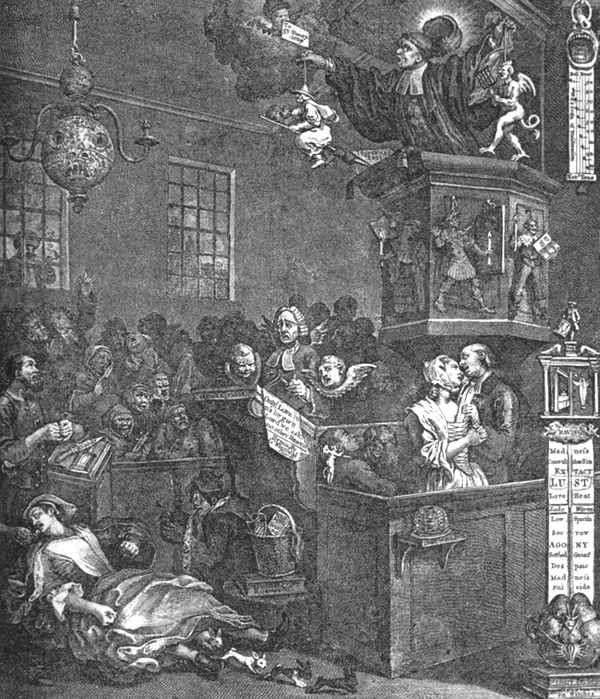
CREDULITY SUPERSTITION AND FANATICISM.

Whoever reads history with a view of tracing the progress of the human mind,—which, by the way, is the great object that renders history useful,—whoever reads history with that regard, must be astonished and shocked at the slow progress of philosophy, and the universal prevalence of credulity, superstition, and fanaticism. If antiquity would give a claim to reverence, this destructive band have a date prior to Christianity; their united power shed baneful influence on the earliest ages.
In the pagan temples there was a kind of incantation for conjuring down deities, to whom were assigned niches according to their different degrees of rank. The histories of Greece and Rome (for the sake of human nature, I wish that the parallel did not reach modern times) display an innumerable host of all ages, sexes, descriptions, and characters, enlisted under the banner of the priesthood, together with a select corps de reserve of augurs and soothsayers, who, by inspecting the entrails of beasts, foretold future events, and from the flight of birds the defeat of armies. Succeeding ages beheld their heathen temples solemnly consecrated; and being thus metamorphosed into Christian churches, the sculptures representing Jupiter, Minerva, Venus, and Diana, by virtue of a new baptism, became saints.[114]
Here also were a legion of arrogant priests, who insolently dictated the terms of salvation, fixed a standard for universal belief, and introduced their own inventions as divine precepts; who forced monarchs to pay tribute by ecclesiastical privilege, assumed the dominion of empires by divine right, and claimed three-fourths of the known world as heirs-at-law to St. Peter. To secure their acquisitions, they entrenched themselves behind ramparts raised on the credulity and folly of mankind. He who attempted to scale these hallowed mounds was deemed guilty of sacrilege; he who questioned the catholic infallibility was an atheist; and whosoever doubted the divine mission of a priest—an infidel.[115]
Finding the multitude were so well inclined to believe that whatever they could not comprehend was supernatural, they construed each phenomenon of nature into a portentous menace from Heaven. An eclipse became the omen of a revolution; an inundation the prognostic of a defeat; and an hurricane foretold the fall of every power that made any opposition to papal authority. By arts like these, the people were brought into a mental vassalage; and the powerful Baron having previously enslaved their persons, they readily gave the care of their souls to the confessor. To him they applied as the proper interpreter of every difficult case; and fraught with a full portion of credulity, each individual considered every cloud that passed over the sun, and every raven that expanded its ebon wing, as bearing some particular direction to himself. Hence arose the doctrine of demonology; and apparitions, witches, dreams, and divinations, formed a creed of superstition. On this was built that notable system, properly enough called "The Philosophy of the Distaff." This mythology of weak minds has been carried through every age and country by oral tradition and unfounded record.
Our earliest histories abound in augury and prediction; the most fabulous tales had credence, not only with the unlearned and ignorant, but with the educated and sagacious. The grave Duke de Sully seriously narrates those which had relation to Henry the Fourth.
It is recorded by Victorius Sirri, that Louis the Thirteenth was from his infancy surnamed Just,—"because he was born under the sign of the Balance!"
Even sorcery was made a leading branch of religion; and one of a priest's duties was to exorcise ghosts by talking Latin, which was considered as a never-failing antidote for a troublesome spirit, and invariably concluded by the ghost being laid in the Red Sea.
Some of these glaring errors have been obliterated, but absurdities of equal magnitude have supplied their place; and modern credulities are nearly as destructive to the interests of society as ancient superstitions.
Though this nation, as well as others, was at an early period enveloped by ignorance, superstition, and their consequent accompaniments, we had some right to expect the clouds would have been dispelled by the Reformation; but credulity kept its ground, and at a still later period—when we had a most learned and sedate monarch, and a most sententious and grave Parliament—an Act was passed for the punishment of witchcraft! By this sagacious union of royal and national wisdom, if a woman lived to a greater age than her neighbour, she was tried, proved guilty of commercing with a familiar in the shape of a tabby cat, and eased of all her sufferings by the ordeal of fire or water.
It is not many years since a fanatic in one of our colonies took a fancy to accuse a neighbour of witchcraft: the crime was clearly proved, and the poor culprit suffered according to law. In credulity and superstition there is something epidemical. The contagion spread; and this being found a summary process for removing a competitor in trade, or revenging an insult, informations for sorcery became frequent. Their sessions-house was crowded with witches, as is that at the Old Bailey with pickpockets. It however brought fees, and so far was well: but these sapient legislators at length discovered that the province was likely to be depopulated; and what affected them still more, their own fraternity were liable to the consequences. A man, who had been cheated by his lawyer, made an affidavit that said lawyer was a wizard. This was too much: the court had a special meeting, and unanimously determined that they would not receive any more informations against wizards. The bye-law had the effect of a charm, and sorcery was no more!
Lord Bacon somewhere remarks that superstition is worse than atheism. It takes from religion every attraction, every comfort; and the place of humble hope and patient resignation is supplied by melancholy, despair, and madness!
To the best minds, credulity is the source of much misery. Our first Charles, who, with all his errors as a king, had the manners and mind of a gentleman, was so much under its influence, that he never enjoyed a day's happiness after consulting the Sortes Virgilianæ.[116]
In our age—an age in many respects enlightened by the beams of philosophy—the effects resulting from credulity, superstition, and fanaticism are dreadful; but while the evils are contemplated with horror, the system is too ridiculous for sober reasoning. It induces the infatuated votary to believe that being in the pale of a particular church will ensure his salvation. The ignorant are confounded with metaphysical subtleties which the wisest cannot comprehend; and by combining different texts of holy writ, we are insulted with conclusions contrary to common sense.[117]
To check this inundation of absurdity, which deemed carnal reason profane, and was not to be combated by argument, Mr. Hogarth engraved this print; it contains what must ever operate as a complete refutation of those who, because they were his opponents in politics, have impudently asserted that he lost his talents in the decline of life: for though the delineation was made in his sixty-fourth year, in satire, wit, and imagination, it is superior to any of his preceding works.
The text "I speak as a fool" is a type of the preacher, whose strength of lungs is a convenient substitute for strength of argument. He is literally a Boanerges; his tones rend the region, and the thunder of his eloquence has cracked the sounding-board. His right hand poises a witch astride upon a broom-stick, and in his left he suspends an emissary of Satan: this embryotic demon wields a gridiron as a terror to the ungodly, and at the witch's breast is an incubus in the shape of a cat.[118] Considering action as the first requisite of an orator, our ecclesiastical juggler throws his whole frame into convulsions: he shakes as the lofty cedar in a storm. Like Milton's devil,
"With head, hands, wings, or feet, he works his way, And swims, or sinks, or wades, or creeps, or flies."
By these violent agitations his gown flies open, and discovers that this Proteus of the pulpit is arrayed in a Harlequin's jacket; and his wig falling off, displays the shaven crown of a Jesuit. But the loss of a periwig is not attended to, his denunciations are redoubled, his fulminations hurled indiscriminately around; he scatters about firebrands; and darts, pointed with destruction, and barbed with death, pierce the hearts of his terrified hearers. Wrought up to the highest pitch of seraphic fervour, fevered by the heat of his own ecstasies,—the whole man is inspired,—and mounted upon the clouds of mystery, he soars through the dark regions of superstition, settles in the third heaven, and breathes empyreal air.
The train is fired,—the contagion spreads, the cup of delusion is filled to the brim, and each of his infatuated auditors intoxicated with the fumes of enthusiastic madness.
"Broken each link of reason's chain, Witchcraft and magic hold their reign; Terror and comfortless despair, And fond credulity is there. Circling all nature's vast profound, Imagination takes her round, Starting at spectres,—painting fairies, Fancy, with all her wild vagaries, Dances on enchanted ground. Now with wings sublime she flies Where planets roll in azure skies; Now o'er clouds where tempests low'r, To where the rushing waters pour: Thence through the vasty void descends, Where Chaos warring atoms blends, To darksome caves of deepest hell, Where sullen ghosts and torturing demons dwell."
With a postboy's cap upon his head, to denote that he is a special messenger from above, a little cherubimic Mercury flies through the clouds, and bears in his mouth an express directed to Saint Money Trapp.
Immediately beneath the pulpit are two lambs of the flock in an ecstasy. The young man with a round head of hair is probably a lay preacher; for though he has not a sable coat, he has a black collar. Piously entreating a young maiden, who meets his advances with an holy zeal, he puts the waxen model of a female saint down her bosom.
In the same pew are two fellows very differently affected: one of them, with a despairing countenance, sheds iron tears; the other, like the wet sea-boy on the mast, sleeps through the terrors of the storm, though a malignant imp of darkness, envying his serenity, endeavours to awake him by a whisper,[119] that he also may share such curses as would serve for a supplement to St. Ernulphus.[120]
Between two duck-winged cherubs, who are studying the laughing and crying gamut, is the harpy clerk. This crook-mouthed echo of absurdity, and associate in villany, has the true physiognomy of a Tartuffe: every feature is charged with hypocrisy.
The congregation,[121] many of whom have been imported from Liffey's verdant banks, bear their parts in this enchanting serenade; and the bull roar of the preacher, combined with a chorus of sighs, groans, and shrieks, must produce a symphony that might vie with the Irish howl or Indian war-whoop.
Among the crowd we discover a youthful convert under the guidance of his spiritual confessor,[122] who, pointing to Brimstone Ocean, unfolds a tale which terrifies his disciple to a degree that
"Must harrow up his soul; freeze his young blood; Make his two eyes like stars start from their spheres; His knotty and combined locks to part, And each particular hair to stand on end, Like quills upon the fretful porcupine."
The sanguinary Jew, while he leans upon an altar, on which lies a knife inscribed "bloody," sacrifices to his revenge an unfortunate insect which he caught carelessly wandering on the environs of his head.
Beneath is Mrs. Tofts, of Godalming, well known in the annals of credulity; in the violence of her paroxysm, she breaks a dram glass with her teeth.[123]
Next to Mrs. Tofts is a possessed shoeblack, coolly clearing his stomach of a quantity of hob-nails and iron staples.[124] In his hand he holds a quart bottle, in which the model of a spirit is closely cribbed—confin'd; but the imprisoned sprite forcing the cork, mounts into the regions of air with a lighted taper in its hand.[125] The book on which our sable professor of necromancy has deposited his basket, is King James's Demonology;[126] this, with Whitfield's Journal, which lies among the implements of his art, covertly intimate the sources where he had sought and found inspiration.
The ridicule is wound up by a Turk, whom we see through a window smoking his tube of Trinidado; lifting up his eyes with astonishment at the scene, he breathes a grateful ejaculation, and thanks his Maker that he was early initiated in the divine truths of the Koran, is out of the pale of this church, and has his name engraven on the tablets of Mahomet.
As all the decorations which are displayed in this temple of credulity, superstition, and fanaticism are suitable to the congregation, the carved figures on the pulpit are worthy of the preacher. We are in the first compartment presented with the apparition which warned Sir George Villiers of the Duke of Buckingham's danger from the knife of Felton;[127] in the second, with Julius Cæsar's ghost reproaching Brutus; and in the third, with the ghost of Mrs. Veale, which appeared to Mrs. Bargrave,[128]—because a very large impression of Drelincourt upon Death lay in the bookseller's warehouse, and would not move without a marvellous relation of an apparition.
Beneath is a figure of the Tedworth drummer, who so wickedly disturbed the family of Mr. Mompesson;[129] and in the frame below, a representation of Fanny, the phantom of Cock Lane, with her hammer in her right hand. These two notable memorials of credulity are placed as a kind of headpiece to a mental thermometer, which ascertains the different degrees of heat in the blood of an enthusiast. When the liquid ascends, it rises from lukewarm to love-heat,—ecstasy! convulsion fits,—madness,—and terminates in raving, which is properly obscured by clouds, and above the ken of human comprehension. In its falling state, the progress of religious depression is most accurately marked. From low spirits it sinks to sorrow, agony, settled grief, despair, madness,—suicide! The whole rests on Wesley's Sermons, and Glanville On Witches.[130]
On the preacher's left hand, suspended to a ring inserted in a human nostril, hangs the scale of vociferation. A natural tone is at the bottom, but the speaker's tone is described by the distended mouth above the scale, crying Blood! blood! blood! and inscribed "Bull roar."
To the hook of the chandelier hangs a small sphere, on which is engraven, "Desarts of new Purgatory." On the globe, out of which spring the branches for candles, is written, "A globe of hell, as newly drawn by R——ne" (Romaine). It is so formed as to give the caricature of a human face, and baptized "Horrid Zone." Round one of the eyes is inscribed "The Bottomless Pit;" round the other, "Molten-lead Lake." On one cheek is "Brimstone Ocean;" on the other, "Parts Unknown;" and round the mouth, "Eternal Damnation Gulf." Horribly profane as are these mottoes, they are mere copies of Tabernacle phraseology. In the same class comes the hymn, which is placed before the clerk:
"Only love to us be given; Lord, we ask no other heaven."[131]
The poor's box is a mouse-trap, which very fairly intimates that whatever money is deposited will be secured for the faithful collectors. It may be further meant to insinuate, that whosoever is caught in this necromantic snare will be in the state of Sterne's starling, and cannot get out, for it is planted with pointed steel, and tears in pieces those who attempt an escape.
THE TIMES.
PLATE I.
"The gods of old were logs of wood, And worship was to puppets paid: In antic dress the puppet stood, And priests and people bow'd the head."
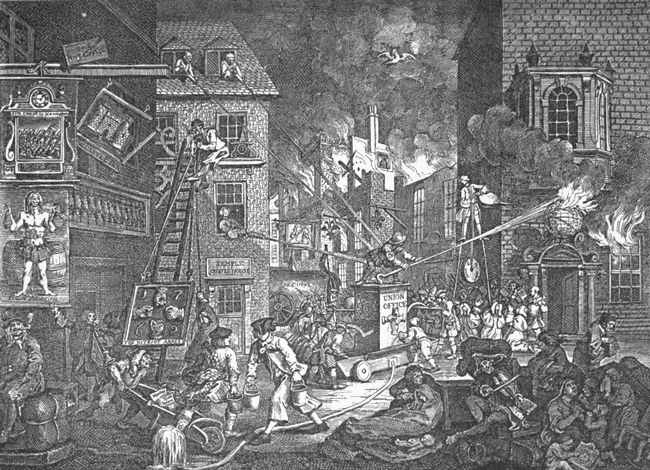
THE TIMES. PLATE I.

There are three things of which your Englishman deems himself the best of all possible judges: the art of stirring a fire, religion, and politics. His infallibility in the first no one will presume to question, except his wife; and with her he will dispute as long as disputing is good. The mysteries of the second he understands better than the Archbishop of Canterbury. As to the intricacies of the third, which thinking men are apt to consider in some degree hidden from those who are not admitted into the arcana, he can unravel them with more ease, and point out with more precision what steps ought to be taken, than can the Prime Minister, with all the aggregate wisdom of the Cabinet.
So many of his Majesty's good subjects being thus gifted with an intuitive knowledge of state affairs, it is no wonder that Britain holds so high a rank among the nations; for each act of government is stated and debated, not only in the two Houses of Parliament, but in every tavern, coffeehouse, and porter-house in the metropolis.
To these eloquent leaders of the numerous clubs, we may add a myriad of political writers, who are all but inspired. Without studying either Machiavel, Locke, or Sidney, they pour forth a torrent of lucubrations on the floating subjects of the hour; that hour past, their letters, replies, remarks, and rejoinders are heard of no more.
In the hope of giving their puny offspring a longer life, some of these learned Thebans, or their booksellers, called in the aid of artists, to adorn their labours with taking frontispieces. These graphic ornaments were in general about as lively as the pamphlets they decorated; and it was found that the united efforts of author, printer, painter, engraver, and publisher, could not ensure immortality. Notwithstanding this general failure in their intended operation, they had one very awkward effect. A sort of political influenza was communicated to our engravers, and they also became deep statesmen and profound politicians. While part of this band sharpened their burins, and defaced much good copper in caricaturing the members of administration, their opponents were equally industrious, and equally pointed, in taking off the honourable gentlemen on the other side of the house.
The buzzing of these insects of a day was little attended to: their dulness preserved them from laughter, their weakness protected them from resentment; they excited no passion except contempt.
Very different was the public expectation when it was found that Hogarth intended to publish a series of political prints. From his former productions they knew his powers, and considered him as able to throw any party into ridicule. That which he was expected to attack dreaded the strength of his aquafortis, which they apprehended would have the effect of a caustic, not only on his copper, but on the objects of his satire.
Previous to the publication of "The Times," Mr. Wilkes, who was then at Aylesbury, was informed that the print was political, and that Lord Temple, Mr. Pitt, Mr. Churchill, and himself, were the leading characters held up to ridicule. Under the impression which this intelligence conveyed, he sent Mr. Hogarth a remonstrance, stating the ungenerous tendency of such a proceeding; which would be more glaringly unfriendly, as the two last-mentioned gentlemen and the artist had always lived upon terms of strict intimacy. This produced a reply, in which Hogarth asserted that neither Mr. Wilkes nor Mr. Churchill were introduced, but Lord Temple and Mr. Pitt were, and the print should be published in a few days. To this it was answered, that Mr. Wilkes would hardly deem it worth while to notice any reflections on himself; but if his friends were attacked, it would wound him in the most sensible part, and, well as he was able, he should revenge their cause. This was a direct declaration of war: the black flag was hoisted on both sides, and never did two angry men of their abilities throw mud with less dexterity.