HOGARTH'S WORKS: WITH LIFE AND ANECDOTAL DESCRIPTIONS OF HIS PICTURES. —◆— FIRST SERIES.
Reading edition
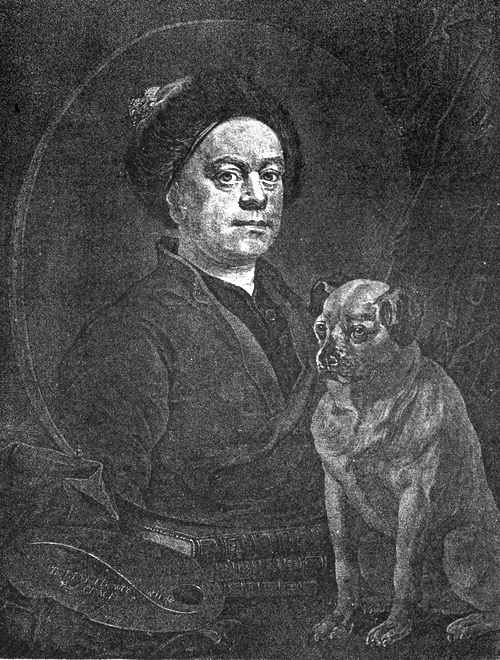
WILLIAM HOGARTH & HIS DOG TRUMP.
HOGARTH'S WORKS:
WITH
LIFE AND ANECDOTAL DESCRIPTIONS OF HIS PICTURES.
BY
JOHN IRELAND and JOHN NICHOLS, F.S.A.
THE WHOLE OF THE PLATES REDUCED IN EXACT FAC-SIMILE OF THE ORIGINALS.
First Series.
London
CHATTO AND WINDUS, PUBLISHERS.
(SUCCESSORS TO JOHN CAMDEN HOTTEN.)
LIST OF PLATES
DESCRIBED IN THE FIRST SERIES.

PAGE
Portrait of William Hogarth, with his dog Trump,Frontispiece
Full-length Portrait of William Hogarth, by Himself, Engaged in Painting the Comic Muse,18
The Battle of the Pictures,44
Analysis of Beauty—
Plate I.,60
Plate II.,64
Sigismunda,76
Time Smoking a Picture,80
The Harlot's Progress—
Plate I. At the Bell Inn, in Wood Street—Mary Hackabout and the Procuress,102
Plate II. The Jew's Mistress quarrelling with her Keeper,106
Plate III. The Lodging in Drury Lane—Visit of the Constables,110
Plate IV. Mary Hackabout beating Hemp in Bridewell,112
Plate V. The Harlot's Death—Quacks Disputing,114
Plate VI. The Funeral,118
The Rake's Progress—
Plate I. Tom Rakewell taking possession of the rich Miser's effects,124
Plate II. The young Squire's Levee,128
Plate III. The Night House,132
Plate IV. The Spendthrift arrested for Debt—Released by his forsaken Sweetheart,136
Plate V. Marylebone Church—Rakewell married to a Shrew,140
Plate VI. The Fire at the Gambling Hell,144
Plate VII. The Fleet Prison,148
Plate VIII. The Madhouse—The Faithful Friend,154
Southwark Fair,162
A Midnight Modern Conversation,184
The Sleeping Congregation,192
The Distressed Poet,200
The Enraged Musician,206
The Four Times of the Day—
Morning. Miss Bridget Alworthy on her way to Church,216
Noon. A Motley Congregation leaving Service,222
Evening. The Shrew and her Husband going home—By the New River at Islington,226
Night. The Drunken Freemason taken care of by the Waiter at the Rummer Tavern,230
Strolling Actresses Dressing in a Barn,240
Mr. Garrick in the Character of Richard the Third,255
Industry and Idleness—
Plate I. The Fellow-apprentices, Thomas Goodchild and Thomas Idle, at their Looms,270
Plate II. The Industrious Apprentice performing the duty of a Christian,272
Plate III. The Idle Apprentice at play in the Churchyard during Divine Service,274
Plate IV. The Industrious Apprentice a favourite, and trusted by his Master,276
Plate V. The Idle Apprentice turned away and sent to sea,278
Plate VI. The Industrious Apprentice out of his time, and married to his Master's Daughter,280
Plate VII. The Idle Apprentice returned from sea, and in a Garret with a Common Prostitute,282
Plate VIII. The Industrious Apprentice grown rich, and Sheriff of London,284
Plate IX. The Idle Apprentice betrayed by a Prostitute, and taken in a Night-cellar with his Accomplice,286
Plate X. The Industrious Apprentice Alderman of London—The Idle one brought before him and impeached by his Accomplice,288
Plate XI. The Idle Apprentice Executed at Tyburn,290
Plate XII. The Industrious Apprentice Lord Mayor of London,292
Roast Beef at the Gate of Calais,298
The Country Inn Yard—Preparing to Start the Coach,306
PREFACE TO THE NEW EDITION.

It is a singular fact, that, notwithstanding the enormous popularity enjoyed by Hogarth in the minds of English people, no perfectly popular edition has been hitherto brought before the public. Were a foreigner to ask an ordinary Briton who was the most thoroughly national painter in the roll of English artists, the answer would be undoubtedly William Hogarth; but the chances are that our countryman would not have at command a tangible proof that his statement was correct. Such editions as have hitherto appeared have been either expensive or unsatisfactory,—even the handsome and costly volume by Nichols is far from complete. To supply the want, the present issue has been projected. The illustrative text of Ireland—undoubtedly the best in existence—has been given in full, and is supplemented by addenda from the works of Nichols. The three volumes form certainly the most complete gallery of Hogarth's drawings yet given to the public. The rapid progress of science has provided means by which the pictures have been reduced from their original size to the compact form of this page; while, at the same time, the most perfect truthfulness has been preserved.
Hogarth is essentially English—brave, straight-forward, manly; never pandering to fashion or fancy. When he had to deal with sin and misery, he met them full in the face, bating no whit of their repulsiveness; and in all his works, wherever a moral is to be drawn, it is a noble and a healthy one. In his merry moods he is irresistibly comic; when he stands forward as a censor of morals, he is terrible in his truth; when he creates a character, it is always human and complete,—a true reflex of the age in which he lived. Times may change, and costumes, but humanity remains much the same. Take any series of the splendid list, and the people who crowd the canvas live and move amongst us with different names and other attire. Such suggestive cognomens as Mary Hackabout are not in use; nor do procuresses haunt such localities as Wood Street in pursuit of their vile calling. The course of fashion, as of empire, has taken its way westward; but the whole story of the Harlot's Progress is as fresh and as applicable to a season in 1873 as it was a hundred and forty years before. Have we not Tom Rakewells in scores among us; and had Hogarth been living now, would he not have interpolated another picture of the degradation attained by the spendthrift when he enters the employment of the moneylender as a decoy to poor flies such as he was himself at the beginning of the chapter? The function of the satirist is still needed, and there is no danger of the works of William Hogarth proving to be out of date. Probably no artist ever told stories so well; certainly no one ever acquired such a reputation, and there is no reason why his splendid monuments should be found only in the libraries of the wealthy. Every one should know something of him besides his moral lessons, since, of all the moral lessons he ever taught, his life formed the most pointed. Fearlessness and honesty were his watchwords from his early career of art, after being released from the silversmith's apprenticeship in 1720 until the day of his death in 1764, when he retired from mundane existence full of years and honours. As Ireland declares him to have asserted, his drawings were meant for the crowd rather than for the critics; and with that intention his book was commenced, the original design being to comprise in one volume "a moral and analytical description of seventy-eight prints;" but as the work advanced, such an amount of anecdote and illustrative comment suggested itself, that he was compelled to adopt the three-volume form which is here followed, with the further addition to which we have alluded, of such a full description and reproduction as the original compiler, from accident or design, omitted. These will be found in the third volume, and include many of the most important and meritorious works of the great artist. It has been found advisable to change the ornamental and sometimes indistinct lettering of the original plates, and to adopt a consistent and uniform style of titles. At the same time the elaborate catalogue compiled by Ireland is preserved, since it is still highly valuable as a chronological list of every effort of Hogarth's hand, although it would be folly to attempt a reproduction of every variation it contains. The system pursued by Ireland and Nichols is followed, and the Publishers venture to congratulate themselves on submitting to the notice of the artistic and literary world, as well as to the public generally, the best and cheapest edition of Hogarth's complete works ever brought forward.

INTRODUCTION.

Mr. Hogarth frequently asserted that no man was so ill qualified to form a true judgment of pictures as the professed connoisseur; whose taste being originally formed upon imitations, and confined to the manners of Masters, had seldom any reference to Nature. Under this conviction, his subjects were selected for the crowd rather than the critic;[1] and explained in that universal language common to the world, rather than in the lingua technica of the arts, which is sacred to the scientific. Without presuming to support his hypothesis, I have endeavoured to follow his example.
My original design was to have comprised in one volume a moral and analytical description of seventy-eight prints; but as the work advanced, such variety of anecdote and long train of et cetera clung to the narrative, that these limits were found too narrow. With the explanation of fifteen additional plates, the letterpress has expanded to near seven hundred pages.
Where the artist has been made a victim to poetical or political prejudice, without meaning to be his panegyrist, I have endeavoured to rescue his memory from unmerited obloquy. Where his works have been misconceived or misrepresented, I have attempted the true reading. In my essay at an illustration of the prints, with a description of what I conceive the comic and moral tendency of each, there is the best information I could procure concerning the relative circumstances, occasionally interspersed with such desultory conversation as frequently occurred in turning over a volume of his prints. Though the notes may not always have an immediate relation to the engravings, I hope they will seldom be found wholly unconnected with the subjects.
Such mottoes as were engraven on the plates are inserted; but where a print has been published without any inscription, I have either selected or written one. Errors in either parody or verse with the signature E, being written by the editor, are submitted to that tribunal from whose candour he hopes pardon for every mistake or inaccuracy which may be found in these volumes.