HOGARTH ILLUSTRATED.
Reading edition

THE HARLOT'S PROGRESS.
PLATE I.
"The snares are set, the plot is laid, Ruin awaits thee, hapless maid! Seduction sly assails thine ear, And gloating, foul desire is near; Baneful and blighting are their smiles, Destruction waits upon their wiles: Alas! thy guardian angel sleeps, Vice clasps her hands, and virtue weeps."—E.
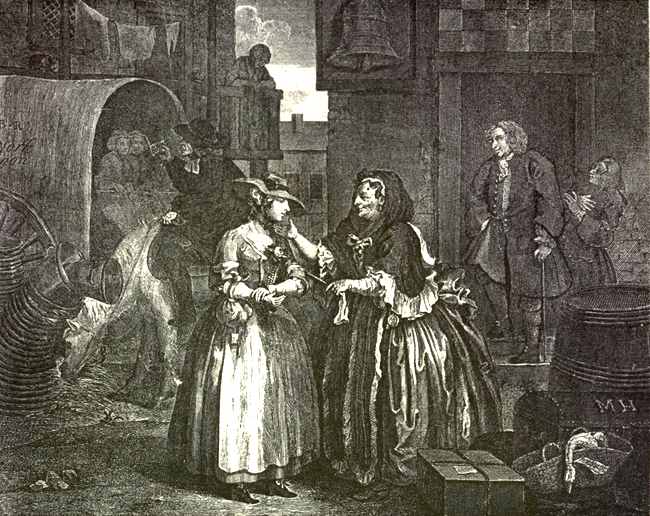
THE HARLOT'S PROGRESS, PLATE I.

The general aim of historical painters has been to emblazon some signal exploit of an exalted and distinguished character. To go through a series of actions, and conduct their hero from the cradle to the grave, to give a history upon canvas, and tell a story with the pencil, few of them attempted. Mr. Hogarth saw with the intuitive eye of genius, that one path to the temple of Fame was yet untrodden: he took Nature for his guide, and gained the summit. He was the painter of nature; for he gave not merely the ground-plan of the countenance, but marked the features with every impulse of the mind. He may be denominated the biographical dramatist of domestic life. Leaving those heroic monarchs who have blazed through their day with the destructive brilliancy of a comet to their adulatory historians, he, like Lillo, has taken his scenes from humble life, and rendered them a source of entertainment, instruction, and morality.
This series of prints gives the history of a Prostitute. The story commences with her arrival in London, where, initiated in the school of profligacy, she experiences the miseries consequent to her situation, and dies in the morning of life. Her variety of wretchedness forms such a picture of the way in which vice rewards her votaries, as ought to warn the young and inexperienced from entering this path of infamy. The first scene of this domestic tragedy is laid at the Bell Inn, in Wood Street, and the heroine may possibly be daughter to the poor old clergyman who is reading the direction of a letter close to the York waggon, from which vehicle she has just alighted. In attire, neat, plain, unadorned; in demeanour, artless, modest, diffident; in the bloom of youth, and more distinguished by native innocence than elegant symmetry; her conscious blush and downcast eyes attract the attention of a female fiend who panders to the vices of the opulent and libidinous. Coming out of the door of the inn we discover two men, one of whom is eagerly gloating on the devoted victim. This is a portrait, and said to be a strong resemblance of Colonel Francis Chartres,[45] whose epitaph was written by Doctor Arbuthnot: in that epitaph his character is most emphatically described.[46]
The old procuress, immediately after the girl's alighting from the waggon, addresses her with the familiarity of a friend rather than the reserve of one who is to be her mistress.
Had her father been versed in even the first rudiments of physiognomy, he would have prevented her engaging with one of so decided an aspect; for this also is the portrait of a woman infamous in her day:[47] but he, good, easy man, unsuspicious as Fielding's Parson Adams, is wholly engrossed in the contemplation of a superscription to a letter addressed to the bishop of the diocese. So important an object prevents his attending to his daughter, or regarding the devastation occasioned by his gaunt and hungry Rozinante having snatched at the straw that packs up some earthenware, and produced
"The wreck of flower-pots, and the crash of pans!"
From the inn she is taken to the house of the procuress, divested of her home-spun garb, dressed in the gayest style of the day, and the tender native hue of her complexion encrusted with paint and disguised by patches. She is then introduced to Colonel Chartres, and by artful flattery and liberal promises becomes intoxicated with the dreams of imaginary greatness. A short time convinces her of how light a breath these promises were composed. Deserted by her keeper, and terrified by threats of an immediate arrest for the pompous paraphernalia of prostitution, after being a short time protected by one of the tribe of Levi, she is reduced to the hard necessity of wandering the streets for that precarious subsistence which flows from the drunken rake or profligate debauchee. Here her situation is truly pitiable! Chilled by nipping frost and midnight dew, the repentant tear trickling on her heaving bosom, she endeavours to drown reflection in draughts of destructive poison. This, added to the contagious company of women of her own description, vitiates her mind, eradicates the native seeds of virtue, destroys that elegant and fascinating simplicity which gives additional charms to beauty, and leaves in its place art, affectation, and impudence.
Neither the painter of a sublime picture nor the writer of an heroic poem should introduce any trivial circumstances that are likely to draw the attention from the principal figures. Such compositions should form one great whole: minute detail will inevitably weaken their effect. But in little stories which record the domestic incidents of familiar life, these accessory accompaniments, though trifling in themselves, acquire a consequence from their situation; they add to the interest, and realize the scene. In this, as in almost all that were delineated by Mr. Hogarth, we see a close regard paid to things as they then were; by which means his prints become a sort of historical record of the manners of the age.
The balcony, with linen hanging to dry; the York waggon, which intimates the county that gave birth to our young adventurer; parcels lying on the ground, and a goose, directed To my lofen coosin in Tems Stret London, prove the peculiar attention he paid to the minutiæ. The initials M. H. on one of the trunks give us the name of the heroine of this drama,—Hackabout was a character then well known, and infamous for her licentiousness and debauchery.[48]
Of elegant beauty Mr. Hogarth had not much idea; but he has marked his heroine with natural simplicity. To the old procuress he has given her physiognomical distinction, and to the Colonel his appropriate stamp.[49]
PLATE II.
"Ah! why so vain, though blooming in thy spring; Thou shining, frail, adorn'd, but wretched thing! Old age will come; disease may come before, And twenty prove as fatal as threescore!"
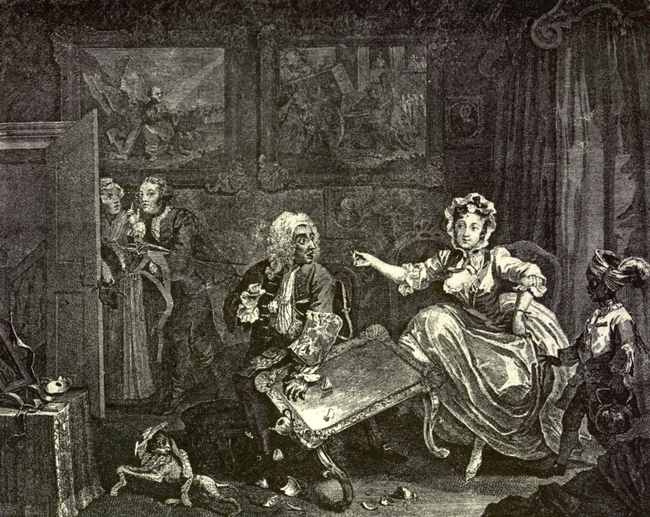
THE HARLOT'S PROGRESS, PLATE II.
Entered into the path of infamy, the next scene exhibits our young heroine the mistress of a rich Jew, attended by a black boy,[50] and surrounded with the pompous parade of tasteless profusion. Her mind being now as depraved as her person is decorated, she keeps up the spirit of her character by extravagance and inconstancy. An example of the first is exhibited in the monkey being suffered to drag her rich head-dress round the room, and of the second in the retiring gallant. The Hebrew is represented at breakfast with his mistress; but having come earlier than was expected, the favourite has not departed. To secure his retreat, is an exercise for the invention of both mistress and maid. This is accomplished by the lady finding a pretence for quarrelling with the Jew, kicking down the tea-table, and scalding his legs, which, added to the noise of the china, so far engrosses his attention, that the paramour, assisted by the servant, escapes discovery.
The subjects of two pictures with which the room is decorated are, David dancing before the ark, and Jonah seated under a gourd.[51] They are placed there, not merely as circumstances which belong to Jewish story, but as a piece of covert ridicule on the old masters, who generally painted from the ideas of others, and repeated the same tale ad infinitum. On the toilet-table we discover a mask, which well enough intimates where she had passed part of the preceding night, and that masquerades, then a very fashionable amusement, were much frequented by women of this description; a sufficient reason for their being avoided by those of an opposite character.
Under the protection of this disciple of Moses she could not remain long. Riches were his only attraction, and though profusely lavished on this unworthy object, her attachment was not to be obtained, nor could her constancy be secured; repeated acts of infidelity are punished by dismission; and her next situation shows that, like most of the sisterhood, she had lived without apprehension of the sunshine of life being darkened by the passing cloud, and made no provision for the hour of adversity.
In this print the characters are marked with a master's hand. The insolent air of the harlot, the astonishment of the Jew,[52] eagerly grasping at the falling table, the start of the black boy, the cautious trip of the ungartered and barefooted retreating gallant, and the sudden spring of the scalded monkey, are admirably expressed. To represent an object in its descent has been said to be impossible: the attempt has seldom succeeded; but in this print, the tea equipage really appears falling to the floor.[53]
PLATE III.
"Reproach, scorn, infamy, and hate, On all thy future steps shall wait; Thy form be loathed by every eye, And every foot thy presence fly."
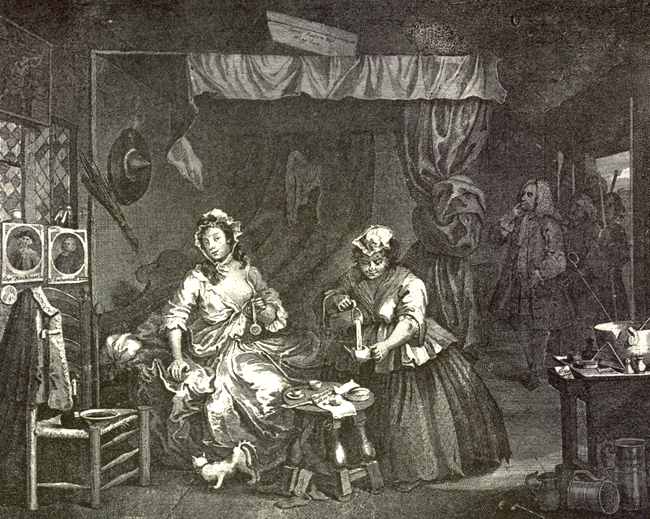
THE HARLOT'S PROGRESS, PLATE III.
We here see this child of misfortune fallen from her high estate! Her magnificent apartment is quitted for a dreary lodging in the purlieus of Drury Lane: she is at breakfast, and every object exhibits marks of the most wretched penury; her silver tea-kettle is changed for a tin-pot, and her highly-decorated toilet gives place to an old leaf-table, strewed with the relics of the last night's revel, and ornamented with a broken looking-glass. Around the room are scattered tobacco-pipes, gin measures, and pewter pots,—emblems of the habits of life into which she is initiated, and the company which she now keeps: this is further intimated by the wig-box of James Dalton, a notorious street-robber, who was afterwards executed. In her hand she displays a watch, which might be either presented to her, or stolen from her last night's gallant. By the nostrums which ornament the broken window, we see that poverty is not her only evil. The dreary and comfortless appearance of every object in this wretched receptacle, the bit of butter on a piece of paper,[54] the candle in a bottle, the basin upon a chair, the punch-bowl and comb upon the table, and the tobacco-pipes, etc. strewed upon the unswept floor, give an admirable picture of the style in which this pride of Drury Lane ate her matin meal. The pictures which ornament the room are, Abraham offering up Isaac, and a portrait of the Virgin Mary; Dr. Sacheverell[55] and Macheath the highwayman are companion prints. There is some whimsicality in placing the two ladies under a canopy,[56] formed by the unnailed valance of the bed, and characteristically crowned by the wig-box of a highwayman.
A magistrate,[57] cautiously entering the room with his attendant constables, commits her to an house of correction, where our legislators wisely suppose, that being confined to the improving conversation of her associates in vice, must have a powerful tendency towards the reformation of her manners!
PLATE IV.
"With pallid cheek and haggard eye, And loud laments, and heartfelt sigh, Unpitied, hopeless of relief, She drinks the bitter cup of grief. In vain the sigh, in vain the tear, Compassion never enters here; But justice clanks her iron chain, And calls forth shame, remorse, and pain."—E.
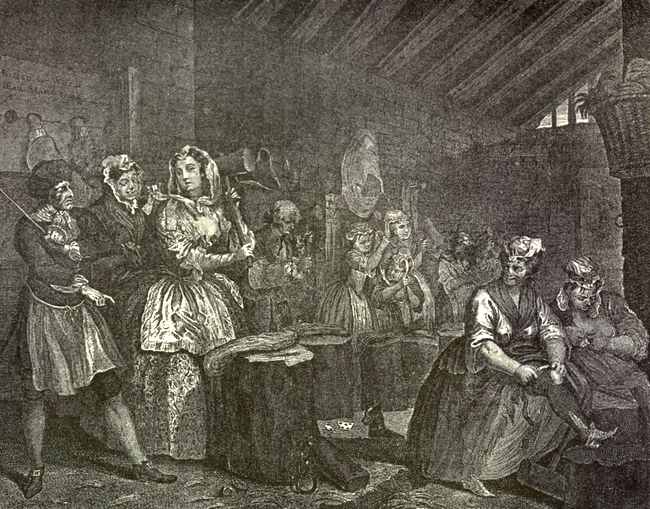
THE HARLOT'S PROGRESS, PLATE IV.
The situation in which the last plate exhibited our wretched female was sufficiently degrading, but in this her misery is greatly aggravated. We now see her suffering the chastisement due to her follies; reduced to the wretched alternative of beating hemp, or receiving the correction of a savage taskmaster.[58] Exposed to the derision of all around, even her own servant, who is well acquainted with the rules of the place, appears little disposed to show any return of gratitude for recent obligations, though even her shoes, which she displays while tying up her garter, seem by their gaudy outside to have been a present from her mistress. The civil discipline of the stern keeper has all the severity of the old school.[59] With the true spirit of tyranny, he sentences those who will not labour to the whipping post, to a kind of picketing suspension by the wrists, or having a heavy log fastened to their leg. With the last of these punishments he at this moment threatens the heroine of our story; nor is it likely that his obduracy can be softened except by a well-applied fee. How dreadful, how mortifying the situation! These accumulated evils might perhaps produce a momentary remorse, but a return to the path of virtue is not so easy as a departure from it. The Magdalen hospital has been since instituted, and the wandering female sometimes finds it an asylum from wretchedness, and a refuge from the reproaches of the world.
To show that neither the dread nor endurance of the severest punishment will deter from the perpetration of crimes, a one-eyed female, close to the keeper, is picking a pocket. The torn card may probably be dropped by the well-dressed gamester, who has exchanged the dice-box for the mallet, and whose laced hat is hung up as a companion trophy to the hoop-petticoat.
One of the girls appears scarcely in her teens. To the disgrace of our police, these unfortunate little wanderers are still suffered to take their nocturnal rambles in the most public streets of the metropolis. What heart so void of sensibility as not to heave a pitying sigh at their deplorable situation? Vice is not confined to colour, for a black woman is ludicrously exhibited as suffering the penalty of those frailties which are imagined peculiar to the fair.
The figure chalked as dangling upon the wall, with a pipe in his mouth, is intended as a caricatured portrait of Sir John Gonson, and probably the production of some wou'd-be artist whom the magistrate had committed to Bridewell as a proper academy for the pursuit of his studies. The inscription upon the pillory, BETTER TO WORK THAN STAND THUS, and that on the whipping-post, near the laced gambler, THE REWARD OF IDLENESS, are judiciously introduced.
In this print the composition is tolerably good: the figures in the background, though properly subordinate, sufficiently marked; the lassitude of the principal character well contrasted by the austerity of the rigid overseer. There is a fine climax of female debasement, from the gaudy heroine of our drama to her maid, and from thence to the still lower object who is represented as destroying[60] one of the plagues of Egypt.
PLATE V.
"With keen remorse, deep sighs, and trembling fears, Repentant groans, and unavailing tears, This child of misery resigns her breath, And sinks, despondent, in the arms of death."—E.
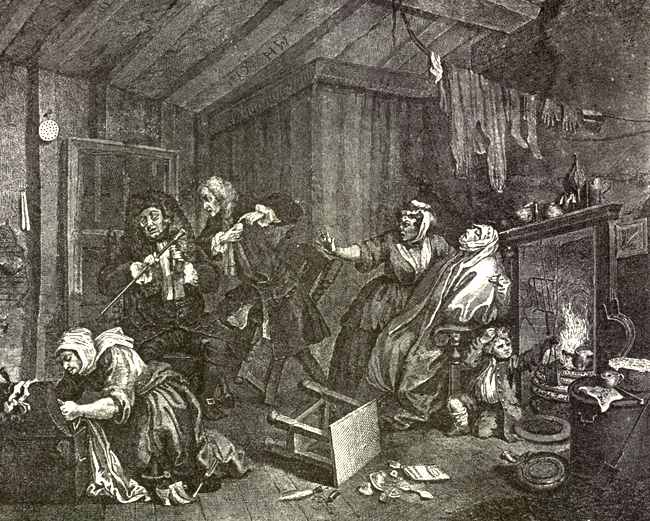
THE HARLOT'S PROGRESS, PLATE V.
Released from Bridewell, we now see this victim to her own indiscretion breathe her last sad sigh, and expire in all the extremity of penury and wretchedness. The two quacks, whose injudicious treatment has probably accelerated her death, are vociferously supporting the infallibility of their respective medicines, and each charging the other with having poisoned her.[61] While the maid-servant is entreating them to cease quarrelling, and assist her dying mistress, the nurse plunders her trunk of the few poor remains of former grandeur. Her little boy turning a scanty remnant of meat hung to roast by a string; the linen hanging to dry; the coals deposited in a corner; the candles, bellows, and gridiron hung upon nails; the furniture of the room, and indeed every accompaniment, exhibit a dreary display of poverty and wretchedness. Over the candles hangs a cake of Jew's bread, once perhaps the property of her Levitical lover, and now used as a fly-trap. The initials of her name, M. H., are smoked upon the ceiling as a kind of memento mori to the next inhabitant. On the floor lies a paper inscribed ANODYNE NECKLACE, at that time deemed a sort of CHARM against the disorders incident to children;[62] and near the fire, a tobacco-pipe and paper of pills.
A picture of general, and, at this awful moment, indecent confusion, is admirably represented. The noise of two enraged quacks disputing in bad English, the harsh vulgar scream of the maid-servant, the table falling, and the pot boiling over, must produce a combination of sounds dreadful and dissonant to the ear. In this pitiable situation, without a friend to close her dying eyes or soften her sufferings by a tributary tear,—forlorn, destitute, and deserted,—the heroine of this eventful history expires; her premature death brought on by a licentious life, seven years of which had been devoted to debauchery and dissipation, and attended by consequent infamy, misery, and disease. The whole story affords a valuable lesson to the young and inexperienced, and proves this great, this important truth, that A DEVIATION FROM VIRTUE IS A DEPARTURE FROM HAPPINESS.
The emaciated appearance of the dying figure, the boy's thoughtless inattention, and the rapacious, unfeeling eagerness of the old nurse, are naturally and forcibly delineated.
The figures are well grouped; the curtain gives depth, and forms a good background to the doctor's head; the light is judiciously distributed, and each accompaniment highly appropriate.
PLATE VI.
"No friend's complaint, no kind domestic tear, Pleas'd thy pale ghost, or grac'd thy mournful bier: By harlots' hands thy dying eyes were clos'd; By harlots' hands thy decent limbs compos'd; By harlots' hands thy humble grave adorn'd; By harlots honoured, and by harlots mourn'd."
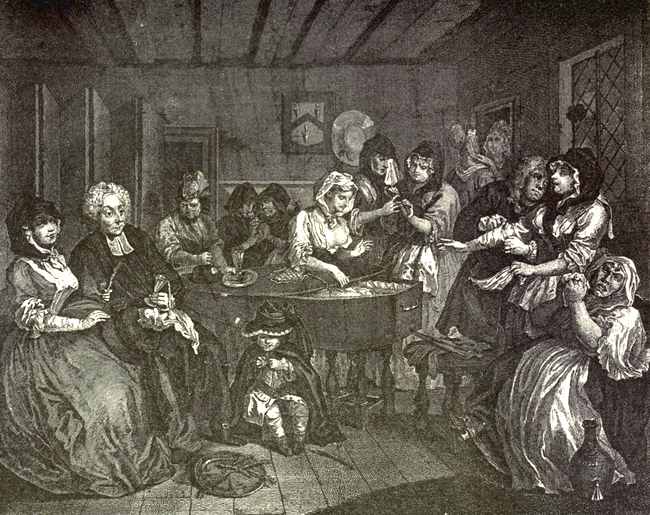
THE HARLOT'S PROGRESS, PLATE VI.
The adventures of our heroine are now concluded. She is no longer an actor in her own tragedy; and there are those who have considered this print as a farce at the end of it: but surely such was not the author's intention.
The ingenious writer of Tristram Shandy begins the life of his hero before he is born; the picturesque biographer of Mary Hackabout has found an opportunity to convey admonition, and enforce his moral, after her death. A wish usually prevails, even among those who are most humbled by their own indiscretion, that some respect should be paid to their remains; that their eyes should be closed by the tender hand of a surviving friend, and the tear of sympathy and regret shed upon the sod which covers their grave; that those who loved them living should attend their last sad obsequies, and a sacred character read over them the awful service which our religion ordains with the solemnity it demands. The memory of this votary of prostitution meets with no such marks of social attention or pious respect. The preparations for her funeral are as licentious as the progress of her life, and the contagion of her example seems to reach all who surround her coffin. One of them is engaged in the double trade of seduction and thievery; a second is contemplating her own face in a mirror. The female who is gazing at the corpse displays some marks of concern, and feels a momentary compunction at viewing the melancholy scene before her: but if any other part of the company are in a degree affected, it is a mere maudlin sorrow, kept up by glasses of strong liquor. The depraved priest does not seem likely to feel for the dead that hope expressed in our liturgy.[63] The appearance and employment of almost every one present at this mockery of woe, is such as must raise disgust in the breast of any female who has the least tincture of delicacy, and excite a wish that such an exhibition may not be displayed at her own funeral.
In this plate there are some local customs which mark the manners of the times when it was engraved, but are now generally disused, except in some of the provinces very distant from the capital; sprigs of rosemary were then given to each of the mourners: to appear at a funeral without one, was as great an indecorum as to be without a white handkerchief. This custom might probably originate at a time when the plague depopulated the metropolis, and rosemary was deemed an antidote against contagion. It must be acknowledged that there are also in this print some things which, though they gave the artist an opportunity of displaying his humour, are violations of propriety and custom: such is her child, but a few removes from infancy, being habited as chief mourner, to attend his parent to the grave; rings presented, and an escutcheon hung up in a garret at the funeral of a needy prostitute.[64] The whole may be intended as a burlesque upon ostentatious and expensive funerals, which were then more customary than they are now. Mr. Pope has well ridiculed the same folly:
"When Hopkins dies, a thousand lights attend The wretch who, living, saved a candle's end."
The figures have much characteristic discrimination: the woman looking into the coffin has more beauty than we generally see in the works of this artist. The undertaker's gloating stare, his companion's leer, the internal satisfaction of the parson and his next neighbour, are contrasted by the Irish howl of the woman at the opposite side, and evince Mr. Hogarth's thorough knowledge of the operation of the passions upon the features. The composition forms a good shape, has a proper depth, and the light is well managed.
Sir James Thornhill's opinion of this series may be inferred from the following circumstance. Mr. Hogarth had without consent married his daughter: Sir James, considering him as an obscure artist, was much displeased with the connection. To give him a better opinion of his son-in-law, a common friend one morning privately conveyed the six pictures of the "Harlot's Progress" into his drawing-room. The veteran painter eagerly inquired who was the artist; and being told, cried out, "Very well! Very well indeed! The man who can paint such pictures as these, can maintain a wife without a portion." This was the remark of the moment; but he afterwards considered the union of his daughter with a man of such abilities an honour to his family, was reconciled, and generous.
When the publication was advertised, such was the expectation of the town, that above twelve hundred names were entered in the subscription book. When the prints appeared, they were beheld with astonishment. A subject so novel in the idea, so marked with genius in the execution, excited the most eager attention of the public. At a time when England was coldly inattentive to everything which related to the arts, so desirous were all ranks of people of seeing how this little domestic story was delineated, that there were eight piratical imitations,—besides two copies in a smaller size than the original, published, by permission of the author, for Thomas Bakewell. The whole series were copied on fan-mounts, representing the six plates, three on one side, and three on the other. It was transferred from the copper to the stage, in the form of a pantomime, by Theophilus Cibber; and again represented in a ballad opera, entitled, The Jew Decoyed, or the Harlot's Progress.
A Joseph Gay, and several other wretched rhymers, published what they called poetical illustrations of Mr. Hogarth's six plates: but these effusions of dulness do not deserve enumeration; nor would they deserve mention, but as collateral proofs of the great estimation in which these prints were held, when their popularity could force the sale of such miserable productions. Happily they are now consigned to those two high priests of the temple of oblivion, the trunkmaker and the pastrycook.
The six original pictures were sold on the 25th of January 1744-5, and produced eighty-eight pounds four shillings. Mr. Beckford, a late Lord Mayor of London, was, I believe, the purchaser. At a fire which burnt down his house at Fonthill, Wiltshire, in the year 1755, five of them were consumed.
When a messenger brought him intelligence of this unfortunate event, he said nothing, but took out his pocket-book, and wrote down a number of figures, which he seemed inspecting with the cool precision of a true disciple of Cocker, when a friend who was present, expressing some surprise at his being so collected after so heavy a loss, asked him what was the subject of his meditation? to which he answered, with the most philosophical indifference, "I am calculating how much it will cost me to rebuild my house."
THE RAKE'S PROGRESS.
PLATE I.
"Oh, vanity of age untoward! Ever spleeny, ever froward! Why these bolts and massy chains, Squint suspicions, jealous pains? Why, thy toilsome journey o'er, Lay'st thou up an useless store? Hope along with Time is flown; Nor canst thou reap the field thou'st sown. Had'st thou a son? In time be wise; He views thy toil with other eyes. Needs must thy kind paternal care, Lock'd in thy chests, be buried there? Whence, then, shall flow that friendly ease, That social converse, heartfelt peace, Familiar duty without dread, Instruction from example bred, Which youthful minds with freedom mend, And with the father mix the friend. Uncircumscrib'd by prudent rules, Or precepts of expensive schools; Abus'd at home, abroad despis'd, Unbred, unletter'd, unadvis'd; The headstrong course of life begun, What comfort from thy darling son?" —Hoadley.[65]
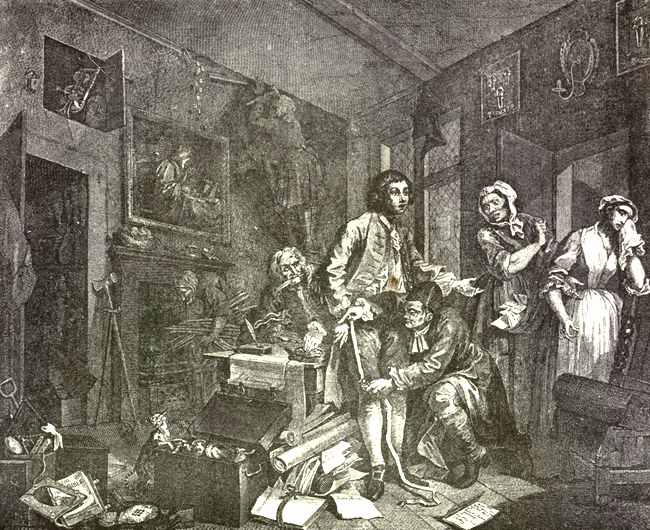
THE RAKE'S PROGRESS, PLATE I.

In the last series of prints Mr. Hogarth delineated, with a master's hand, the miseries attendant upon a female's deviation from virtue. In this he presents to us the picture of a young man, thoughtless, extravagant, and licentious; and, in colours equally impressive, paints the destructive consequences of his conduct. The first print most forcibly contrasts two opposite passions,—the unthinking negligence of youth, and the sordid avaricious rapacity of age. It brings into one point of view what Mr. Pope so exquisitely describes in his Epistle to Lord Bathurst:
"Who sees pale Mammon pine amidst his store, Sees but a backward steward for the poor; This year a reservoir, to keep and spare; The next a fountain, spouting through his heir."
It represents a young man taking possession of a rich miser's effects, and is crowded with the monuments of departed avarice. Everything, valuable or not valuable, has been hoarded. A chest of old plate, an old coat, a worn-out boot, and the caul of a periwig, are preserved with equal care. The thread-bare garments are hung up; the rusty spur put into a closet; and even a spectacle-frame, without glasses, is thought worthy of preservation. The contents of his armoury are curious, and valuable as the lumbering furniture of his room: they consist of two swords, which may be considered as trophies of his youthful prowess, or protectors of his cankered pelf. The crutch and walking-stick, those unequal supporters of his feeble frame, now lean unheeded against the wall. His fur cap and greatcoat seem to have been winter substitutes for fire, as the grate in which a withered Sibyl is laying wood has no marks of even a remaining cinder. The remnant of candle in a save-all, the Jack taken down as an useless piece of furniture, and, with the spit, hoisted into a high cupboard, give strong indications of the manner in which this votary of Mammon existed, for such a being could scarcely be said to live. The gaunt appearance of an half-starved cat proves not only the rigid abstinence practised by this wretched slave to his wealth, but that in his miserable mansion
"No mouse e'er lurk'd, no rat e'er sought for food."
The iron-bound chests, the hidden gold falling from the breaking cornice, and indeed every article that is displayed in this dreary tomb of buried wealth, give additional marks of a suspicious and sordid disposition. The picture of a miser counting his gold; the escutcheons, those gloomy ornaments of departed wretchedness, with the armorial bearings of avarice, three vices hard screwed, are adjuncts highly appropriate to the place; the motto, BEWARE, inscribed under the arms, is a well-directed caution, and ought to be seriously considered by those who feel a propensity to this meanest of passions. An old shoe, soled with the cover of a Bible, and the little memorandum, May 5th, 1721, put off my bad shilling, are strong proofs that extreme avarice destroys all reverence for religion, and eradicates every principle of honesty.
The introduction to this history is well delineated, and the principal figure marked with that easy, unmeaning vacancy of face which speaks him formed by nature for a DUPE. Ignorant of the value of money, and negligent in his nature, he leaves his bag of untold gold in the reach of an old and greedy pettifogging attorney,[66] who is making an inventory of bonds, mortgages, indentures, etc. This man, with the rapacity so natural to his profession, seizes the first opportunity of plundering his employer. Hogarth had a few years before been engaged in a lawsuit, which gave him some experience of the PRACTICE of those pests of society.
The figure of the young woman with a wedding-ring is not alluring, neither is her face attractive; but her being pregnant, and accompanied by her mother with an apron full of letters, gives her a claim to our pity, as it clearly intimates that this is meant as a visit to entreat the promised hand of her seducer; but he violates every former protestation, refuses her marriage, and attempts by a bribe to get a release from the obligation. Her mother violently reproaches him for his conduct, and invokes the curses of offended Heaven upon his falsehood.
In this print the drawing and disposition of the figures are tolerably good, the light is properly distributed, and the perspective accurately represented; but the whole wants mass. To display the hoards, it was necessary to open the boxes and doors; and though an exhibition of the heterogeneous collection heaped together by this wretched defrauder of himself most forcibly describes the disposition of the man, it hurts the repose of the picture. Breaking the background into so many parts, destroys that breadth which ought to be considered as a leading excellence.
PLATE II.
"Prosperity (with harlot's smiles, Most pleasing when she most beguiles), How soon, sweet foe, can all thy train Of false, gay, frantic, loud, and vain, Enter the unprovided mind, And memory in fetters bind? Load faith and love with golden chain, And sprinkle Lethe o'er the brain! Pleasure, on her silver throne, Smiling comes, nor comes alone; Venus comes with her along, And smooth Lyæus, ever young; And in their train, to fill the press, Come apish Dance, and swoln Excess, Mechanic Honour, vicious Taste, And Fashion in her changing vest." —Hoadley.
THE RAKE'S PROGRESS, PLATE II.
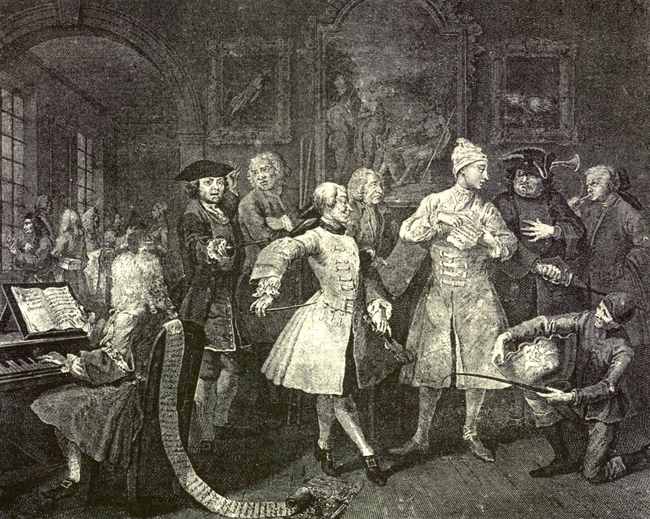
The sordid avarice of the wretched miser is in this print contrasted by the giddy profusion of his prodigal heir. The old man pined in the midst of plenty, starved while surrounded by abundance, and refused himself enjoyment of the absolute necessaries of life from an apprehension of future poverty.
"Not so his son; he mark'd this oversight, And quite mistook reverse of wrong for right."
Three years have elapsed, and our giddy spendthrift, throwing of the awkwardness of a rustic, assumes the character and apes the manners of a modern fine gentleman. To qualify himself for performing the part, he is attended by a French tailor, a milliner, a Parisian dancing-master,[67] a Gallic fencing-master,[68] an English prize-fighter,[69] and a teacher of music.[70] Besides this crowd of masters of arts, he has at his levee a blower of the French horn, an improver of gardens,[71] a bravo,[72] a jockey,[73] and a poet! the latter having written a panegyric in honour of this exalted character, already anticipates approbation and reward. Surrounded by such a multitude of attentive friends and warm admirers, the dissolution of his fortune is inevitable; it must melt like snow beneath the solar beam.
How exactly does Bramston describe the character in his Man of Taste:
"Without Italian, and without an ear, To Bononcini's music I adhere. To boon companions I my time would give, With players, pimps, and parasites I'd live; I would with jockeys from Newmarket dine, And to rough riders give my choicest wine. My evenings all I would with sharpers spend, And make the thief-taker my bosom friend; In Figg the prize-fighter by day delight, And sup with Colley Cibber every night."
On the back of the musician's chair hangs a list of presents which Farinelli, an Italian singer, received the day after his performance of a favourite character at the Opera House. Among others, a gold snuff-box, chased with the story of Orpheus charming the brutes, from T. Rakewell, Esq.
Another memento of musical extravagance is the frontispiece to a poem lying on the floor, and dedicated to Esquire Rakewell, in which the ladies of Great Britain are represented as sacrificing their hearts to this idol of sound, and crying out with great earnestness, One God, one Farinelli! This intimates the violent rage of the fashionable world for that most frivolous of all amusements, the Italian Opera. The taste which our prodigal has imbibed for the turf is pointed out by the jockey presenting a silver punch-bowl, which one of his horses is supposed to have won; his passion for another royal amusement, by the portraits of two fighting-cocks, hung up as the ornaments of his saloon. A picture which he has placed between them bears a whimsical allusion; it is the "Judgment of Paris."[74] The figures in the background consist of such persons as are general attendants in the ante-chamber of a dissipated man of fashion. The whole is a high-wrought satire on those men of rank and fortune whose follies render them a prey to the artful and rapacious.
Of the expression in this print we cannot speak more highly than it deserves. Every character is marked with its proper and discriminative stamp. It has been said by a very judicious critic,[75] from whom it is not easy to differ without being wrong, that the hero of this history, in the first plate of the series, is unmeaning; and in the second, ungraceful. The fact is admitted; but, for so delineating him, the author is entitled to our praise rather than our censure. Rakewell's whole conduct proves he was a fool, and at that time he had not learned how to perform an artificial character; he therefore looks as he is, unmeaning and uninformed. But in the second plate he is ungraceful—granted. The ill-educated son of so avaricious a father could not have been introduced into very good company; and though, by the different teachers who surround him, it evidently appears that he wishes to assume the character of a gentleman, his internal feelings tell him he has not attained it. Under that consciousness, he is properly and naturally represented as ungraceful and embarrassed in his new situation.
The light, it must be acknowledged, is very ill distributed, and the figures most inartificially grouped. To infer from hence, with Mr. Gilpin, that the artist was at a loss how to group them, is not quite fair: his others compositions prove that he was not ignorant of the art, but in many of them he has been inattentive to it. In this he may have introduced in his print figures which were not inserted in the sketch, merely because they were appropriate to his story. The expression of the actors in his drama was always his leading object; composition he considered as secondary, and was little solicitous about their situation on the stage.
PLATE III.
"O vanity of youthful blood, So by misuse to poison good! Woman, framed for social love, Fairest gift of powers above, Source of every household blessing; All charms in innocence possessing: But, turn'd to vice, all plagues above; Foe to thy being, foe to love! Guest divine, to outward viewing; Ablest minister of ruin! And thou, no less of gift divine, Sweet poison of misused wine! With freedom led to every part, And secret chamber of the heart, Dost thou thy friendly host betray, And show thy riotous gang the way To enter in, with covert treason, O'erthrow the drowsy guard of reason, To ransack the abandoned place, And revel there with wild excess?"
THE RAKE'S PROGRESS, PLATE III.
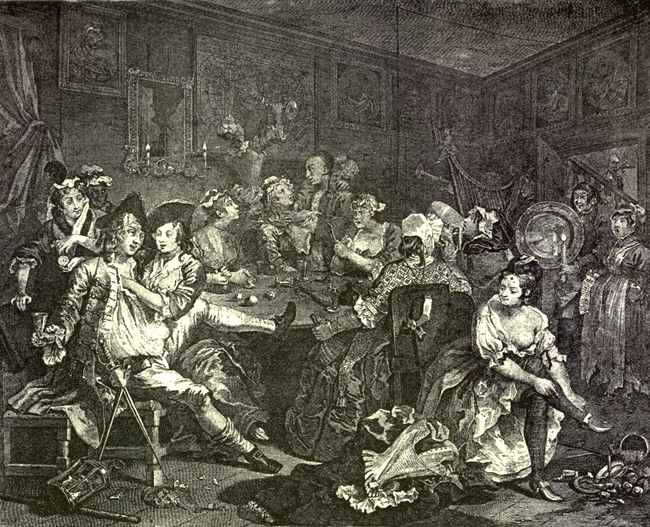
This plate exhibits our licentious prodigal engaged in one of his midnight festivities: forgetful of the past, and negligent of the future, he riots in the present. Having poured his libation to Bacchus, he concludes the evening orgies in a sacrifice at the Cyprian shrine; and, surrounded by the votaries of Venus, joins in the unhallowed mysteries of the place. The companions of his revelry are marked with that easy, unblushing effrontery which belongs to the servants of all work in the isle of Paphos;—for the maids of honour, they are not sufficiently elevated.
He may be supposed, in the phrase of the day, to have beat the rounds, overset a constable, and conquered a watchman, whose staff and lanthorn he has brought into the room as trophies of his prowess. In this situation he is robbed of his watch by the girl whose hand is in his bosom; and, with that adroitness peculiar to an old practitioner, she conveys her acquisition to an accomplice, who stands behind the chair.
Two of the ladies are quarrelling; and one of them delicately spouts wine in the face of her opponent, who is preparing to revenge the affront with a knife, which, in a posture of threatening defiance, she grasps in her hand. A third, enraged at being neglected, holds a lighted candle to a map of the globe, determined to set the world on fire though she perish in the conflagration! A fourth is undressing. The fellow bringing in a pewter dish,[76] as part of the apparatus of this elegant and attic entertainment, a blind harper,[77] a trumpeter, and a ragged ballad-singer roaring out an obscene song, completes this motley group.
This design may be a very exact representation of what were then the nocturnal amusements of a brothel;—so different are the manners of the year 1805 from those of 1734, that I much question whether a similar exhibition is now to be seen in any tavern of the metropolis. That we are less licentious than our predecessors, I dare not affirm; but we are certainly more delicate in the pursuit of our pleasures.
The room is furnished with a set of Roman emperors,—they are not placed in their proper order; for in the mad revelry of the evening this family of frenzy have decollated all of them except Nero; and his manners had too great a similarity to their own to admit of his suffering so degrading an insult: their reverence for virtue induced them to spare his head. In the frame of a Cæsar they have placed the portrait of Pontac, an eminent cook, whose great talents being turned to heightening sensual rather than mental enjoyments, he has a much better chance of a votive offering from this company than would either Vespasian or Trajan.
The shattered mirror, broken wine-glasses, fractured chair and cane; the mangled fowl, with a fork stuck in its breast, thrown into a corner, and indeed every accompaniment, shows that this has been a night of riot without enjoyment, mischief without wit, and waste without gratification.
With respect to the drawing of the figures in this curious female coterie, Hogarth evidently intended several of them for beauties; and of vulgar, uneducated, prostituted beauty, he had a good idea. The hero of our tale displays all that careless jollity which copious draughts of maddening wine are calculated to inspire; he laughs the world away, and bids it pass. The poor dupe without his periwig, in the background, forms a good contrast of character: he is maudlin drunk, and sadly sick. To keep up the spirit of unity throughout the society, and not leave the poor African girl entirely neglected, she is making signs to her friend the porter, who perceives, and slightly returns, her love-inspiring glance. This print is rather crowded,—the subject demanded it should be so; some of the figures thrown into shade might have helped the general effect, but would have injured the characteristic expression.
PLATE IV.
"O vanity of youthful blood, So by misuse to poison good! Reason awakes, and views unbarr'd The sacred gates he wish'd to guard; Approaching, see the harpy Law, And Poverty, with icy paw, Ready to seize the poor remains That vice has left of all his gains. Cold penitence, lame after-thought, With fear, despair, and horror fraught, Call back his guilty pleasures dead, Whom he hath wrong'd, and whom betray'd."
THE RAKE'S PROGRESS, PLATE IV.
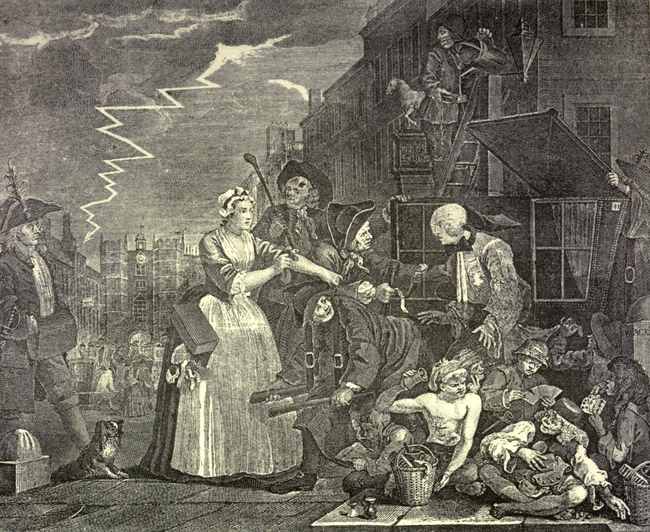
The career of dissipation is here stopped. Dressed in the first style of the ton, and getting out of a sedan chair, with the hope of shining in the circle, and perhaps forwarding a former application for a place or a pension, he is arrested! To intimate that being plundered is the certain consequence of such an event, and to show how closely one misfortune treads upon the heels of another, a boy is at the same moment picking his pocket.
The unfortunate girl whom he basely deserted is now a milliner, and naturally enough attends in the crowd to mark the fashions of the day. Seeing his distress, with all the eager tenderness of unabated love, she flies to his relief. Possessed of a small sum of money, the hard earnings of unremitted industry, she generously offers her purse for the liberation of her worthless favourite. This releases the captive beau, and displays a strong instance of female affection, which, being once planted in the bosom, is rarely eradicated by the coldest neglect or harshest cruelty.
The high-born, haughty Welshman, with an enormous leek, and a countenance keen and lofty as his native mountains, establishes the chronology, and fixes the day to be the first of March; which, being sacred to the titular saint of Wales, was observed at court.[78]
The background exhibits a view of St James's Palace, and White's Chocolate House, then the rendezvous of the first gamesters in London. At this fountainhead of dissipation the artist has aimed a flash of lightning; and to show the contagion of example, and how much this ruinous vice prevails even in the lowest ranks of society, he has in one corner of the print represented an assembly composed of shoe-blacks, chimney-sweepers, etc.,[79] who, aping the vices of their superiors, are engaged at cards, dice, cups and balls, and pricking in the belt. To intimate how eagerly these minor gamblers enter into the spirit of what they are engaged in, one of them is naked, and having staked and lost his clothes, is now throwing for his stock in trade, a basket, brushes, and blacking. The little smutty smoking politician is reading the Farthing Post; his attention is exquisitely marked; his whole soul is engaged; and, regardless of the confusion which reigns around, he contemplates
"The fate of empires, and the fall of kings."
A chimney-sweeper peeping at the postboy's cards, and informing his adversary that he has two honours, by holding up two fingers, is a fine stroke of humour; as the inscription Black's, being on a post[80] close to where this congress of the privileged orders are assembled, is an excellent antithesis when contrasted to White's, on the opposite side.
The grouping is good, the perspective agreeable, and the expression admirable. The trembling terror of the beau, agitated to the very soul, is well contrasted by the hard unfeeling insolence of two bailiffs; and that, again, opposed by the tender solicitude of the poor girl. The gunpowder mark of a star on the side of the naked shoe-black, who is putting his last stake on the hazard of a die, is another well-pointed piece of satire on the conduct of those high-born gamesters, who at the opposite house, with a dignified disregard for the future fate of themselves or their families, put their last acre on the same issue. The boy with a pipe and little pewter measure and glass by his side, shows that smoking and drinking drams was not peculiar to adults, but sometimes practised by young gentlemen before their attainment of what the law calls years of discretion.
PLATE V.
"New to the school of hard mishap, Driven from the ease of fortune's lap, What schemes will nature not embrace T' avoid less shame of drear distress? Gold can the charms of youth bestow, And mask deformity with show: Gold can avert the sting of shame, In Winter's arms create a flame: Can couple youth with hoary age, And make antipathies engage."
THE RAKE'S PROGRESS, PLATE V.
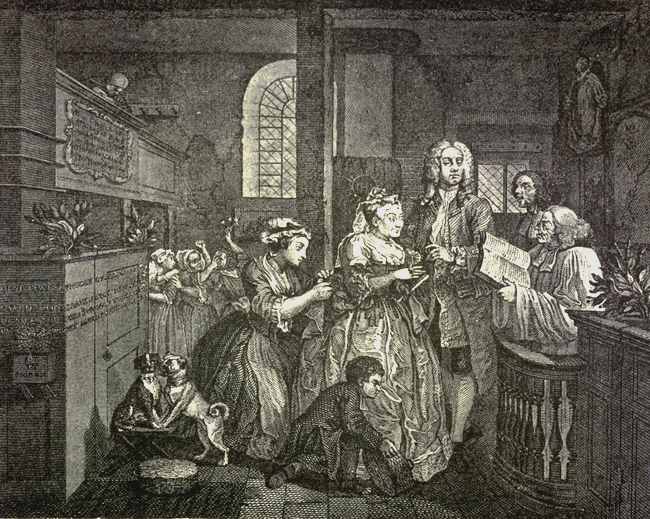
To be thus degraded by the rude enforcement of the law, and relieved from an exigence by one whom he had injured, would have wounded, humbled, I had almost said reclaimed, any man who had either feeling or elevation of mind; but, to mark the progression of vice, we here see this depraved, lost character, hypocritically violating every natural feeling of the soul to recruit his exhausted finances, and marrying an old and withered Sibyl, at the sight of whom nature must recoil.
The ceremony passes in Marybone Church, which was then considered at such a distance from London, as to become the usual resort of those who wished to be privately married.[81] That such was the view of this prostituted young man, may be fairly inferred from a glance at the object of his choice. Her charms are heightened by the affectation of an amorous leer, which she directs to her youthful husband, in grateful return for a similar compliment which she supposed paid to herself. This gives her face much meaning, but meaning of such a sort, that an observer being asked, "How dreadful must be this creature's hatred?" would naturally reply, "How hateful must be her love!"
In his demeanour we discover an attempt to appear at the altar with becoming decorum: but internal perturbation darts through assumed tranquillity; for though he is plighting his troth to the old woman, his eyes are fixed on the young girl who kneels behind her.[82]
The parson and clerk seem made for each other: a sleepy, stupid solemnity marks every muscle of the divine, and the nasal droning of the lay brother is most happily expressed. Accompanied by her child and mother, the unfortunate victim of his seduction is here again introduced, endeavouring to enter the church and forbid the banns. The opposition made by an old pew-opener, with her bunch of keys, gave the artist a good opportunity for indulging his taste in the burlesque, and he has not neglected it.
A dog[83] paying his addresses to a one-eyed quadruped of his own species, is a happy parody of the unnatural union going on in the church.
The Commandments are broken:[84] a crack runs near the tenth, which says, "Thou shalt not covet thy neighbour's wife;" a prohibition in the present case hardly necessary. The Creed is destroyed by the damps of the church; and so little attention has been paid to the poor's box, that—it is covered with a cobweb!!! These three high-wrought strokes of satirical humour were perhaps never equalled by an exertion of the pencil; excelled they cannot be.
On one of the pew-doors is the following curious specimen of churchyard poetry and mortuary orthography:—
These : pewes : vnscrud : and tane : in : svnder In : stone : thers : grauen : what : is : vnder To : wit : a valt : for : burial : there : is Which : Edward : Forset : made : for : him : and : his.[85]
A glory over the bride's head is whimsical.
The bay and holly, which decorate the pews, give a date to the period, and determine this preposterous union of January with June to have taken place about the time of Christmas,
"When Winter linger'd in her icy veins."
Addison would have classed her among the evergreens of the sex.
It has been observed, that "the church is too small, and that the wooden post, which seems to have no use, divides the picture very disagreeably."[86] This cannot be denied: but it appears to be meant as an accurate representation of the place, and the artist delineated what he saw.
The grouping is good, and the principal figure has the air of a gentleman. The light is well distributed, and the scene most characteristically represented.
PLATE VI.
"Gold, thou bright son of Phœbus, source Of universal intercourse; Of weeping Virtue soft redress: And blessing those who live to bless: Ye oft behold this sacred trust, The tool of avaricious lust; No longer bond of human kind, But bane of every virtuous mind. What chaos such misuse attends, Friendship stoops to prey on friends; Health, that gives relish to delight, Is wasted with the wasting night; Doubt and mistrust is thrown on Heaven, And all its power to chance is given. Sad purchase of repentant tears, Of needless quarrels, endless fears, Of hopes of moments, pangs of years! Sad purchase of a tortur'd mind, To an imprison'd body join'd."
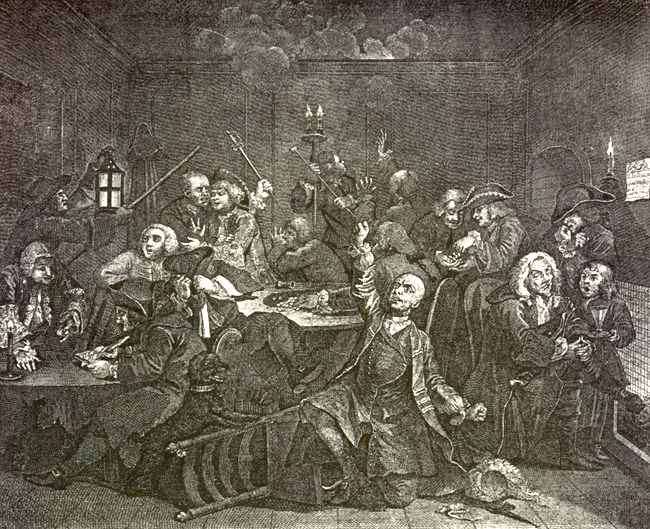
THE RAKE'S PROGRESS, PLATE VI.
Though now, from the infatuated folly of his antiquated wife, in possession of a fortune, he is still the slave of that baneful vice which, while it enslaves the mind, poisons the enjoyments, and sweeps away the possessions of its deluded votaries. Destructive as the earthquake which convulses nature, it overwhelms the pride of the forest, and engulfs the labours of the architect.
Newmarket and the cock-pit were the scenes of his early amusements; to crown the whole, he is now exhibited at a gaming-table, where all is lost! His countenance distorted with agony, and his soul agitated almost to madness, he imprecates vengeance upon his own head.
"In heartfelt bitter anguish he appears, And from the bloodshot ball gush purpled tears! He beats his brow, with rage and horror fraught; His brow half bursts with agony of thought!"
That he should be deprived of all he possessed in such a society as surround him, is not to be wondered at. One of the most conspicuous characters appears, by the pistols in his pocket, to be a highwayman: from the profound stupor of his countenance, we are certain he also is a losing gamester; and so absorbed in reflection, that neither the boy who brings him a glass of water, nor the watchman's cry of Fire! can arouse him from his reverie. Another of the party is marked for one of those well-dressed Continental adventurers, who, being unable to live in their own country, annually pour into this, and with no other requisites than a quick eye, an adroit hand, and an undaunted forehead, are admitted into what is absurdly enough called good company.
At the table a person in mourning grasps his hat, and hides his face in the agony of repentance,[87] not having, as we infer from his weepers, received that legacy of which he is now plundered more than a little month. On the opposite side is another on whom fortune has severely frowned, biting his nails in the anguish of his soul. The fifth completes the climax; he is frantic, and with a drawn sword endeavours to destroy a pauvre miserable whom he supposes to have cheated him, but is prevented by the interposition of one of those staggering votaries of Bacchus who are to be found in every company where there is good wine; and gaming, like the rod of Moses, so far swallows up every other passion, that the actors, engrossed by greater objects, willingly leave their wine to the audience.
In the background are two collusive associates eagerly dividing the profits of the evening.
A nobleman in the corner is giving his note to an usurer.[88] The lean and hungry appearance of this cent. per cent. worshipper of the golden calf is well contrasted by the sleek contented vacancy of so well-employed a legislator of this great empire. Seated at the table, a portly gentleman,[89] of whom we see very little, is coolly sweeping off his winnings.
So engrossed is every one present by his own situation, that the flames which surround them are disregarded,[90] and the vehement cries of a watchman entering the room are necessary to rouse their attention to what is generally deemed the first law of nature, self-preservation.[91]
The grouping of the figures in this print is masterly; but the light, being reflected from various sources, overbalances the shadow, and fatigues the eye. The perspective, though formal, is natural.
PLATE VII.
"Happy the man whose constant thought (Though in the school of hardship taught) Can send remembrance back to fetch Treasures from life's earliest stretch; Who, self-approving, can review Scenes of past virtues, which shine through The gloom of age, and cast a ray To gild the evening of his day! Not so the guilty wretch confin'd: No pleasures meet his conscious mind; No blessings brought from early youth, But broken faith, and wrested truth; Talents idle and unus'd, And every trust of Heaven abus'd, In seas of sad reflection lost, From horrors still to horrors toss'd, Reason the vessel leaves to steer, And gives the helm to mad Despair."
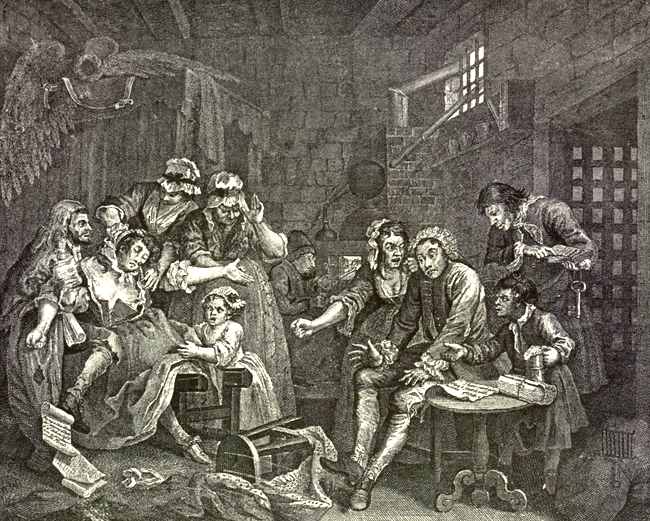
THE RAKE'S PROGRESS, PLATE VII.
It is pithily and profitably observed by Mr. Hugh Latimer, or some other venerable writer of his day, that "the direct path from a gaming-house is unto a prisonne, for the menne who doe neeste themselves in these pestiferous hauntes, being either fooles or cheates, be punished: if fooles, by their own undoing; if cheates, by the biting lash of the beadle, and the durance of their vile bodies."
In the plate before us this remark is verified. Our improvident spendthrift is now lodged in that dreary receptacle of human misery—a prison. His countenance exhibits a picture of despair; the forlorn state of his mind is displayed in every limb, and his exhausted finances by the turnkey's demand of prison fees not being answered, and the boy refusing to leave a tankard of porter unless he is paid for it.
We learn by a letter upon the table, that a play which he sent for the manager's inspection "will not doe;"[92] and we see by the enraged countenance of his wife, that she is violently reproaching him for having deceived and ruined her. To crown this catalogue of human tortures, the poor girl whom he deserted is come with her child,—perhaps to comfort him, to alleviate his sorrows, to soothe his sufferings: but the agonizing view is too much for her agitated frame; shocked at the prospect of that misery which she cannot remove, every object swims before her eyes, a film covers the sight, the blood forsakes her cheeks, her lips assume a pallid hue, and she sinks to the floor of the prison in temporary death. What a heart-rending prospect for him by whom this is occasioned! Should he in the anguish of his soul inquire, "Who is it that hath caused this?" that inward monitor, which to him must be a perpetual torment, would reply in the words that Nathan said unto David, "Thou art the man!" Such an accumulation of woe must shake reason from her throne. The thin partitions which divide judgment from distraction are thrown down, the fine fibres of the brain are overstrained, and in the place of godlike apprehension,
"Chaos and anarchy assume the sway."
That balm of a wounded mind,—the recollection of connubial love, parental joys, and all the nameless tender sympathies which calm the troubled soul,—in his blank and blotted memory find no place. Remorse and self-abhorrence rankle in his bosom! his groans, heaved from the heart, pierce the air! he is chained! rages! gnashes his teeth, and tears his quivering flesh! At this dreadful crisis he sees, or seems to see,
"A fiend, in evil moments ever nigh, Death in her hand, and frenzy in her eye! Her eye all red, and sunk! A robe she wore, With life's calamities embroidered o'er. From me (she cries), pale wretch, thy comfort claim, Born of Despair, and Suicide my name."
He attempts to take away that life which is become hateful to him; is prevented, and removed to a cell more dreadful than even a prison:
"Where Misery and Madness hold their court."
But let us for a moment return to the present scene. The wretched, squalid inmate who is assisting the fainting female, bears every mark of being naturalized to the place: out of his pocket hangs a scroll, on which is inscribed, "A scheme to pay the national debt, by J. L., now a prisoner in the Fleet." So attentive was this poor gentleman to the debts of the nation, that he totally forgot his own. The cries of the child, and the good-natured attentions of the two women, heighten the interest, and realize the scene. Over the group are a large pair of wings, with which some emulator of Dedalus intended to escape from his confinement; but finding them inadequate to the execution of his project, has placed them upon the tester of his bed. They would not exalt him to the regions of air, but they o'er-canopy him on earth. A chemist in the background, happy in his views, watching the moment of projection, is not to be disturbed from his dream by anything less than the fall of the roof or the bursting of his retort; and if his dream affords him felicity, why should he be awakened? The bed and gridiron, those poor remnants of our miserable spendthrift's wrecked property, are brought here as necessary in his degraded situation; on one he must try to repose his wearied frame, on the other he is to dress his scanty meal.
The grated gate, secured with tenfold bars of iron, reminds us of Milton's
"Infernal doors, that on their hinges grate Harsh thunder!"
The principal figure is wonderfully delineated. Every muscle is marked, every nerve is unstrung; we see into his very soul. The poor prisoner who is assisting the fainting woman is ill drawn; the group of which she is the principal figure is unskilfully contrived: it forms a round heavy mass. The opposite group, though better, is not pleasing.
PLATE VIII.
"Madness! thou chaos of the brain, What art? that pleasure giv'st and pain, Tyranny of fancy's reign! Mechanic fancy! that can build Vast labyrinths and mazes wild, With rule disjointed, shapeless measure, Fill'd with horror, fill'd with pleasure! Shapes of horror, that would even Cast doubt of mercy upon Heaven; Shapes of pleasure, that but seen, Would split the shaking sides of Spleen. O vanity of age! here see The stamp of Heaven effac'd by thee! The headstrong course of youth thus run, What comfort from this darling son? His rattling chains with terror hear, Behold death grappling with despair! See him by thee to ruin sold, And curse thyself, and curse thy gold!"
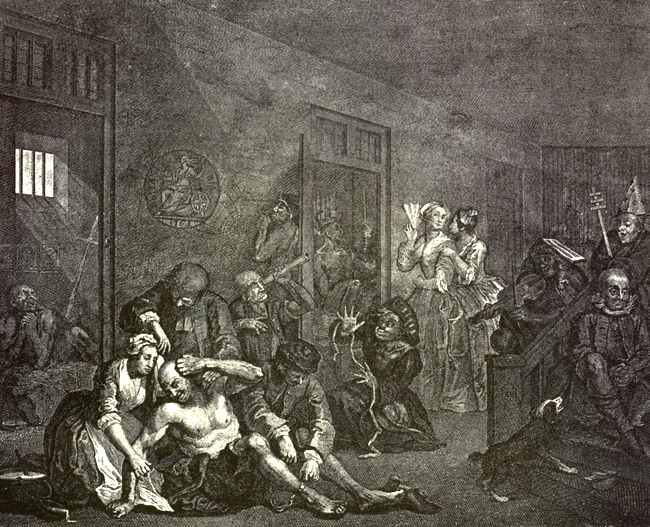
THE RAKE'S PROGRESS, PLATE VIII.
"Last scene of all,—which ends this strange eventful history!"
But in this scene, dreary and horrid as are its accompaniments, he is attended by the faithful and kind-hearted female whom he so basely betrayed. In the first plate we see him refuse her his promised hand. In the fourth she releases him from the harpy fangs of a bailiff; she is present at his marriage. In the hope of relieving his distress, she follows him to a prison. Wishing to soothe his misery and alleviate his woe, she here attends him in a madhouse! What a return for deceit and desertion!
The Reverend Mr. Gilpin, in his elucidation of these eight prints, asserts that "this thought is rather unnatural, and the moral certainly culpable."[93] With the utmost deference for his critical abilities, I must entertain a different opinion. We have had many similar examples of female attachment. If it be culpable to forgive those which have despitefully used us, to free those which are in bonds, to visit those which are in prison, and to comfort those which are in affliction, what meaning have the divine precepts of our holy religion?
The female mind is naturally credulous, affectionate, and—in its attachments—ardent. If, in her peculiar situation, her assiduities must be deemed in any degree culpable, let us remember that this is but a frail vessel of refined clay. When the awful record of her errors is unrolled, may that sigh which was breathed for the misery of a fellow-mortal waft away the scroll, and the tears which flowed for the calamities of others float the memorial down the stream of oblivion!
On the errors of women, let us look with the allowance and humanity of men. Enchanting woman! thou balm of life! soother of sorrow! solace of the soul! how dost thou lessen the load of human misery, and lead the wretched into the valley of delight! Without thee, how heavily would man drag through a dreary world; but if the white hand of a fascinating female be twined round his arm, how joyous, how lightly doth he trip along the path!
That warm and tender friend, who in the most trying situations retains her enthusiastic fondness, and in every change of fortune preserves unabated love, ought to be embraced as the first bension of heaven, the completion of earthly happiness! Let man but draw such a prize in the lottery of life, and glide down the stream of existence with such a partner, and neither the cold averted eye of a summer friend, nor the frowns of an adverse fortune, should ever produce a pang or excite a murmur. But enough,—let not the chaste feelings of blushing innocence be wounded by this rhapsody, or for a moment suppose that the episode, or effusion, or e'en whatever she pleases, is intended as a vindication of female folly; in good truth it is not. The writer would not wish it delivered to the cold-fingered portress of Diana's temple, but it may be laid upon that altar which is sacred to Friendship, to Hymen, to Love.—There we will leave it, and return to the plate before us.
A gentleman[94] from whom I have once or twice reluctantly presumed to differ, says that "the drawing of the principal figure is a more accurate piece of anatomy than we commonly find in the works of this master." The observation is perfectly just, but the inaccuracies of Mr. Hogarth did not arise from inability, but from inattention. He says further, that "the expression of the principal figure is rather unmeaning." The late and ever to be lamented Mr. Mortimer, whose wonderful abilities as an artist were only equalled by his amiable and kind-hearted virtues as a man,—the late Mr. Mortimer, of whom I can never think without a sigh of regard and regret, thought very differently. He was once requested to delineate several of the passions, as they are personified by Mr. Gray. One of the subjects proposed was,—
"Moody madness, laughing wild, amid severest woe."
The instant this line was read to him, he opened a portfolio, took out the eighth plate of the "Rake's Progress," and pointing to the principal figure, exclaimed, "Sir, if I had never seen this print, I should say it was not possible to paint these contending passions in the same countenance. Having seen this, which exactly displays Mr. Gray's idea, I dare not attempt it. I could only make a correct copy; for the alteration of a single line would be a departure from the character."
The reclining figure, with a cross leaning near him, is in a high degree terrific.[95]
"With horror wild, 'Tis Devotion's ruin'd child, Sunk in the emphasis of grief; Nor can he feel, nor dares he ask relief."
In the cell are the portraits of three saints, whose systems were built on the necessity of propagating the religion of mercy by the sword and the wheel.
Near him are two astronomers, one with a paper rolled up to imitate a telescope, gazing at the roof, in the idea that it is
"The spacious canopy of heaven, fretted with golden fires."
The other, delineating the firing off a bomb and a ship moored at a distance, is an immediate ridicule of Whiston's project for the discovery of the longitude,—an object which at this time engaged the attention of the philosophical world, and in the fruitless search after which many a feeble head hath become mad, north—north-west!
The opposite group form a whimsical trio. A mad musician, a counterfeit presentment of St. Peter, and a poor gentleman, with his hands clasped together, that appears by the inscription of "Charming Betty Careless," which he has chalked upon a board, to be
"Craz'd with care, and cross'd by hopeless love."
He is absorbed in thought, and his whole soul so engrossed by the charms of his Dulcinea, that neither the discordant sounds of the fiddler, whose trembling strings
"Grate harshly on the nerve auricular,"
nor the roar of the pope, who is furiously denouncing destruction on all heretics, nor the ear-piercing noise of a barking cur, can awake him from his reverie.
A crazy tailor and a mimic monarch complete this congregation of calamity.
Two women, impelled by a most unaccountable curiosity, are walking in the background. Devoid of that delicacy which gives beauty new attractions, they forget that an eagerness to witness woe which they cannot alleviate, gives strong indication of an hardened and unfeeling heart.
The halfpenny stuck against a wall, and dated 1763, was inserted by Mr. Hogarth the year before his death, and is designed to intimate that Britannia was then mad. This is one of the few instances wherein he has called in the aid of allegory, but his allegory was always seasoned with wit.
Of the expression I have already spoken. The disposition of the figures is good. That group in which the usurper of St. Peter's chair is the principal object, is well contrived. There is great simplicity and breadth in the background, and the light and perspective are judicious.
"Protract not, curious ears, the mournful tale; But o'er the hapless group low drop Compassion's veil."
The eight prints of the "Rake's Progress," with "Southwark Fair," were advertised in the London Daily Post to be delivered June 25th, 1735, with an apology for the publication being deferred, which Mr. Hogarth states to have been occasioned by his waiting until the royal assent was given to an Act intended to secure all new invented prints from being copied, etc.
This series are in every respect superior to those which preceded them, but were not honoured with an equal attention by the public.
From what did this arise? Were the town more interested in the story of an harlot than in the adventures of a rake, or had this new mode of engraving history lost its novelty?
On this occasion was published an octavo pamphlet, entitled, "The Rake's Progress, or the Humours of Drury Lane, a Poem in eight Cantos, in Hudibrastic verse; being the Rambles of a modern Oxonian: which is a complete Key to the eight Prints lately published by the celebrated Mr. Hogarth. Printed for John Chetwood, and sold at Inigo Jones' Head, against Exeter Change, Strand, 1735." This is a most contemptible and indecent performance. In some of the copies are inserted eight prints; but they are only the designs of Hogarth mutilated, and perhaps were originally engraved for the decoration of some other work.
There is reason to believe that the artist once intended to have introduced the ceremony of a marriage contract, instead of the levee, as an unfinished painting of the scene is still preserved. In this sketch he appears to have thought of taking the same ground with Mr. Pope:
"What brought Sir Visto's ill-got wealth to waste? Some demon whisper'd, 'Visto, have a taste.'"
For our Rake is there turned connoisseur; and among a number of articles which prove him a man of virtu, is a canvas containing the representation of a human foot.[96]
In the year 1745 the eight pictures were sold by auction, at Mr. Hogarth's in Leicester Fields, and produced twenty-two guineas each; total, one hundred and eighty-four pounds, sixteen shillings. They are now, I believe, in the possession of Mr. Beckford of Fonthill, in Wiltshire.
SOUTHWARK FAIR.
"The crowded scene will please us then, And the busy hum of men; The Thespian throng, and champions bold, Their jubilee of triumph hold: With store of wenches, whose bright eyes Rain influence, and judge the prize Of hat or shirt,—while all contend To catch her glance whom all commend. Come, Sport, that wrinkled Care derides; And Laughter, holding both his sides; And puppet-show, and quaint device, And Troy in flames, and rattling dice: And Comedy, with wreathed smiles; And Music, that dull care beguiles; Here let the droning bagpipe be, And there the cheerful fiddle see. Nor be our joys to earth confin'd,— But, light as air, swift as the wind, Let Cadman cut the liquid sky, And on the rope Violante fly. Our trumpet's loud clangour Excites not to arms; No shrill notes of anger, No horrid alarms, The double, double, double beat Of the thundering drum, Tells—the actors are come; Let us follow, nor think of retreat. I'll to the well-trod stage anon, If Settle's[97] 'cumber'd sock be on; Or heavy Howard,[98] Folly's child, In native nonsense soareth wild. These joys if Southwark Fair can give, In Southwark Fair a week I'll live."
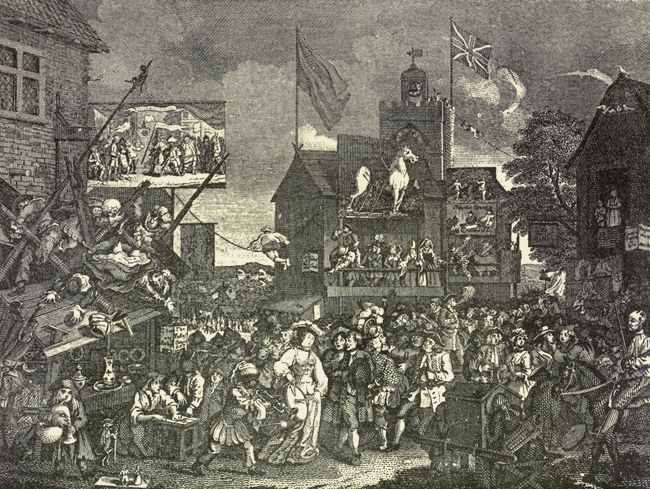
SOUTHWARK FAIR.

At a time when martial hardihood was the only accomplishment likely to confer distinction, when war was thought to be the most honourable pursuit, and agriculture deemed the only necessary employment, there was little social intercourse, and so few retail dealers, that men had no very easy means of procuring those articles which they occasionally wanted. To remove this inconvenience, it was found necessary to establish some general mart, where they might be supplied. Fairs were therefore instituted, as a proper medium between the buyer and seller, and were at first considered as merely places of trade.[99] They were generally held on saints' days. Some of them continued open many weeks, and had peculiar privileges to encourage the attendance of those who had goods upon sale. The pedlar travelled from city to city, or from town to town, with his moveable warehouse, and furnished his customers with what served them until his periodical return.
As men grew more polished their wants increased, their intercourse became more general, and the importance of commerce was better understood. The merchant deposited his goods in a warehouse, and the trader opened a shop. Fairs, deserted by men of business, gradually changed their nature, and, instead of being crowded by the active and the industrious, were the haunts of the idle and the dissolute.[100] Such were they at the time of this delineation, which was made about the year 1733, and may be considered as a true picture of the holiday amusements of that period. At the head of these we must place what were than called stage-plays,—a most favourite diversion of your Englishman ever since the time
"When sweetest Shakspeare, Fancy's child, Warbled his native woodnotes wild."
In these humble representations some of our greatest actors made their first appearance; and not a few of them, even after they had attained high eminence, ranted, strutted, and bellowed through all the days the fairs were kept open, to their own emolument, and the heartfelt pleasure of the Wapping beaux and the black-eyed beauties of Saltpetre Bank.
The play now enacting appears to be the Fall of Bajazet,[101]—and it is performed to the life; for the unsure scaffolding, not being built to bear the terror-working stamps of the furious Turk, tumbles to the ground. The tyrant's turban is shaken from his head, the truncheon is dropped from his hand, and with the moralizing Tamerlane he joins the general crash, and threatens destruction to the china jars and bowls which are beneath. Not only the heroes and heroine of the drama, but both band and musical instruments are involved in the ruin. The band, it is true, consists of—a solitary fiddler; and the instruments are—a violin and a salt-box. The monkey and the merry-andrew seem the only two animals likely to evade injury in this universal wreck. Corporeal dexterity at such a time is more useful than mental acquirements.
The Amazonian, with a hat, feather, and drum, is a beauty of Mr. Hogarth's school, belongs to a company of comedians, and is beating up for an audience. The gaping astonishment of two rustics who are looking at her is inimitably described. One of them, awe-struck by her figure, has pulled off his hat in reverence of her charms; the other "wonders with a foolish face of praise."
A buskined hero, arrayed perhaps for an Alexander, has his career of glory stopped by a sheriff's officer, who pays no respect
"To Macedonia's madman, or the Swede."
The hero puts his hand to his sword, but the bailiffs follower secures his other arm, and aims a bludgeon at his head.
A younger branch of the family of the Simples, with a whip in one hand and the other hooked on a young girl's arm, is so lost in gaping astonishment at the variety of objects around him, that he neglects his pockets, which an adroit candidate for Tyburn is clearing of their contents. While one fellow kisses a girl,[102] another endeavours to decoy her two companions. A prize-fighter, furrowed with scars, makes his triumphal entry on a blind horse, and, calling up a face of terror, and grasping his sword, hurls a proud defiance to all who dare appear as his competitors.
A juggler, in a senatorial wig, displays magic wonders with the cups and balls; and above him is a fellow with a pair of artificial legs extended on a board: one of these legs a man beneath is either attempting to break, or using as a lever to give a summerset to a tumbler, who kneels upon the other. A hat displayed on the end of a pole is the prize of the best wrestler on the green; and a holland chemise will reward the fair racer swiftest of foot.
A quack doctor, in laced hat, long periwig, and embroidered coat, mounted upon a stage and attended by his merry-andrew, dispenses his infallible medicines. To attract the notice of a gaping crowd, this iron-throated descendant of Paracelsus eats fire.
That ancient puppet-show joke of Mr. Punch's horse picking the pocket of the chequered fool of the farce, is exhibited in a balcony, on one side of which is a bout at cudgels by puppets all alive!
Under a show-cloth, which announces "The Siege of Troy[103] is here," are a company rehearsing some part of the play. By a sun upon the breast of the figure in a mitre, we know him to be the high-priest of Apollo, the venerable Chryses. While one arm of this sage of many sorrows is twined round the pole which supports the wooden horse, the other is stretched out in moving supplication, entreating the hearers to
"Relieve a wretched parent's pain, And give Chryseïs to his arms again."
Chryseïs, however, is perfectly satisfied with her situation. Seated in all the pride of conscious beauty close to the haughty Atrides, and glorying in his protection, she prefers the lover to the parent. The inexorable chief nods his plumed crest, grasps his truncheon, and "looks with threatening brow on all around."
"No tears subdue him, no entreaties move, He dares avenging Phœbus, son of Jove."
A little fellow with long hair, playing upon the bagpipes,[104] is attended by a dancing dog, dressed en militaire, and with his foot dances his Fantoccini figures. His Madame Catharina does not excite the attention she merits: the woman with a dice-box has superior attractions; and a country fellow, in a coat which seems to have been the Sunday habiliment of his forefathers for many generations, is trying his fortune, though earnestly dissuaded by his more prudent son from putting his pence in so perilous a situation. The woman, with that energetic eloquence which marks the orators of Billingsgate, rates the boy for daring to doubt her honesty. On the other side, a Savoyard music-grinder, with her galante show, is attended by a dwarf drummer, and collecting pence from the little people who prefer a wonderful and surprising prospect of every court in Europe to a pennyworth of gingerbread. In the distance, a set of figures have been engaged at quarter-staff, then a favourite amusement; and the conqueror, waving his flag of victory, is hoisted upon the shoulders of another man; and thus triumphantly exalted, the air echoes with loud and reiterated acclamations in honour of his prowess.
Having despatched the herd[105] of characters who people the scene on earth, I reserved to a class by themselves those who are buoyant in the air. The figure vaulting on a rope was designed for Signora Violante, who signalized herself in the reign of George I. She was followed by some inferior performers; but the science of rope-dancing and riding has now arrived at its acme, and is rising into such estimation with the public, that Dr. Johnson's prophecy may, at a future day, be wholly fulfilled in our royal theatres. In part it has been already verified:
"Perhaps where Lear has rav'd and Hamlet died, On flying cars new sorcerers may ride; Perhaps (for who can guess th' effects of chance?) Here Hunt may box, or Mahomet may dance."
The man descending from a steeple represents one Cadman, who, in the memory of some persons now living, performed the same feat at St. Martin's in the Fields, from the steeple of which he descended into the Mews. In an experiment of the like nature at Shrewsbury, the rope breaking, he was dashed to pieces.
A show-cloth over the Fall of Bajazet is almost a direct copy from a very coarse etching made by John Laguerre, son of Louis Laguerre, whom Pope has immortalized for his sprawling saints. On the upper part of the print is inscribed, "The Stage Mutiny." It alludes to some disputes between the managers of Drury Lane and such of the actors as were spirited up to rebellion by Theophilus Cibber, and seceded to the Haymarket in 1733. As this made much noise in its day, it may not be unentertaining to narrate some of the circumstances which occasioned it.
The patent for Drury Lane being renewed, Mr. Booth, who found his health decline, began to think it was time to dispose of his share and interest in the theatre. The purchaser was John Highmore, Esq., a gentleman who had unhappily contracted an attachment to the stage, from having one night performed the part of Lothario for a wager.[106] He gave Booth £2500 for half his share in the property, and his whole right in the management. Mr. Wilkes had previously appointed Ellis his deputy; and Colley Cibber, extremely displeased that two strangers should be thus empowered to interfere, authorized his son to act for him in everything that concerned his share in the management. The first season ended with some profit to the new patentees; but Mr. Highmore being disgusted by the impertinence of young Cibber, determined to exonerate himself from his interference, and, for the sum of three thousand guineas, purchased the elder Cibber's right in the theatre. Two years had hardly passed before the principal actors, encouraged by Theophilus Cibber, determined to revolt from the patentee; and as the little theatre in the Haymarket was then unoccupied, agreed to rent it from the proprietor, and opened their campaign with the comedy of Love for Love, at which they were attended by an elegant and crowded audience. The patentees, though weakened by this desertion, began to act at the usual time. To supply the place of those who had left their service, they had recourse to such actors as could be procured from the itinerant companies. With all the help they could obtain, their performances were inferior to those exhibited at the Haymarket, and losses came so heavy upon Mr. Highmore, that he was under the necessity of giving up the contest, and sold the whole property to Mr. Charles Fleetwood for about half the sum he had originally paid for it.'
Upon this circumstance is built the print from which the show-cloth was copied; it probably announces the performance of a farce entitled "The Stage Mutineers, a tragi-comic farcical ballad opera, acted at Covent Garden in 1733;" which is a burlesque on the whole contest. Theophilus Cibber, who was the leader of the malcontents, is in this farce characterized by the name of Ancient Pistol, all his speeches being in that high-flown mock-heroic style with which Shakspeare has marked that boasting coward. The scene is supposed to be in the playhouse, and the time, during a rehearsal.
In 1740, a pamphlet was published for J. Mechell, at the King's Arms, Fleet Street, entitled, "An Apology for the Life of T—— C——, Comedian; being a proper sequel to the Apology for the Life of Mr. Colley Cibber; with an historical view of the stage to the present year. Supposed to be written by himself, in the style and manner of the poet-laureate:" but in reality the work of Harry Fielding. The following passage, relative to this subject, occurs in page 16, etc:—"In that year, when the stage fell into great commotions, and the Drury Lane company, asserting the glorious cause of liberty and property, made a stand against the oppressions of the patentees;—in that memorable year, when the theatric dominions fell in labour of a revolution, under the conduct of myself; that revolt gave occasion to several pieces of wit and satirical flirts at the conductor of the enterprise. I was attacked, as my father had been before me, in the public papers and journals; and the burlesque character of Pistol was attributed to me as a real one. Out came a print of Jack Laguerre's, representing, in most vile designing, this expedition of ours, under the name of 'The Stage Mutiny;' in which, gentle reader, your humble servant, in the Pistol character, was the principal figure. This I laughed at, knowing it only a proper embellishment for one of those necessary structures to which persons out of necessity repair." Again, p. 88: "At the fair of Bartholomew we gained some recruits; but, besides those advantages over the enemy, I myself went there in person, and publicly exposed myself. This was done to fling defiance in the patentees' teeth; for, on the booth where I exhibited, I hung out 'The Stage Mutiny,' with Pistol at the head of his troop; our standard bearing the motto, 'We eat.'" Whether this account which Cibber is made to give of his own conduct is entirely jocular, or contains a mixture of truth and falsehood, cannot now be ascertained. Hogarth may have transferred a circumstance from Bartholomew to Southwark Fair; or Fielding, by design, may have misrepresented it, alluding at the same time to Hogarth's print.
To return to the show-cloth. The figure seated in the corner, with his head bound with laurel, is intended to represented old Cibber, then poet-laureate. With a bag of money upon his knee, he rejoices in the sum he has realized, and laughs at those who are enduring the storm. Under his feet is inscribed "Quiet and snug." The tall, thin figure, stooping, is meant for Mr. Highmore. He holds in his hand a scroll, on which is written, "It cost 6000 pounds." He is again characterized in the figure of a monkey astride the sign-iron of the Rose Tavern, with a label, on which is written, "I am a gentleman."[107]—The man in his shirt, with a paint-pot and brushes at his feet, who takes up the cudgels for the new patentees, is John Ellis the painter. He was the pupil of Sir James Thornhill, deputy-manager for Mr. Wilkes, and principal scene painter to the theatre. By the favour of the Duke of Montagu and Sir Robert Walpole, he was appointed to be great master of the wardrobe, and keeper of the lions in the Tower. He was much happier in attending a pugilistic exhibition at Broughton's academy than in the exercise of his profession. His figure appears muscular, but hardly leads one to suppose, what is yet certainly a fact, that Rysbrack—when he produced what Mr. Walpole very emphatically calls that exquisite summary of his skill, knowledge, and judgment, the "Hercules," now in Mr. Hoare's temple at Stourhead—modelled the legs of the god from those of Ellis.—The figure in the background, with a tremendous plume of feathers, and a flowing periwig, grasping his truncheon in a style of defiance, may be Mills, in the character of Bajazet. On the flag which is borne between Mr. Highmore and Ellis, is inscribed, "We'll starve them out." On that borne in the rear of the seceders, on the opposite side, is written, "We eat." The figure near it is probably intended to represent Johnson, in Sir Hugh Evans; as that with a truncheon in his hand, who stands next him, may be intended for Bardolph; but who the performer was, I am not well enough versed in dramatic history to determine: it would probably be known at that time, by the ends of two cudgels, which rise in parallel lines immediately behind his head, and may perhaps intimate that this gentleman, as well as Theophilus Cibber, was under some obligations to his wife for giving him a title he was not born with.—The Sir John Falstaff was certainly intended for Harper,[108] who was eminent in that character; as Pistol, with the inscription, "Pistol's alive," was indisputably meant for the younger Cibber. The masculine gentlewoman, waving a flag on which is inscribed "Liberty and Property," is, I think, clearly intended as a portraiture of the notorious Mistress Doll Tearsheet; but who was the actress that personated this fair friend of the fat knight, I really do not know.[109]
The show-cloth underneath, with the tall figure and two spectators, is a representation of Maximilian, a giant from Upper Saxony. That with the wooden horse is explained by the inscription above it, "The Siege of Troy is here." Mr. Victor, in an eulogium upon Boheme the actor, says that "his first appearance was at a booth in Southwark Fair, which in those days lasted two weeks, and was much frequented by persons of all ranks and both sexes. He acted the part of Menelaus, in the best droll I ever saw, called The Siege of Troy."
The Adam and Eve upon another show-cloth may probably allude to the representation of somewhat compiled from an old mystery called The Creation.[110]
The old puppet-show joke of Punch wheeling his wife into the jaws of destruction, which is underneath, is well known. By the paper lantern, dwarf drummer, and little figure at a temporary door, it appears that the royal waxwork and whole Court of France are at the Royal Oak.
It is a little remarkable, that in this almost endless variety of holiday amusements there should be no exhibition of wild beasts[111] or wonderful quadrupeds. A roaring lion, raging tiger, and fierce cat a-mountain, would have had a large audience; and a learned pig or an overgrown Lincolnshire ox might have made the proprietors' fortunes at that time, as they have done at this.
The amusements of the fair at this period continued a fortnight,[112] and were unquestionably attended with much loss of time, and productive of some habits of dissipation among the lower ranks of people who attended them. A visit to a family in the vicinity must have been a delightful entertainment, and the pleasure much heightened if the lady of the mansion happened to be fond of dumb creatures. A whistle, drum, and trumpet, in the possession of three little masters, with a barking lap-dog, screaming parrot, and canary bird in full song, must form a concert of such heavenly harmony, as
"Would bring an angel down!"
For those who delight in pointing out examples of Hogarth's bad spelling, this print affords a fine field. The name of Cibber is spelt with only one b. In the Fall of Bajazet, the z appears to have been originally an s. "We'l starve them out." The e final in waxworke, these syllable dissectors may perhaps deign to acknowledge was then customary.
In my enumeration of some of the actors who appear on the show-cloth, etc., I may sometimes be wrong: let it be received as conjecture founded on the best information I could obtain; and let it be remembered, that to procure positive information of circumstances which happened near fifty years ago is not easy. The memoranda to be found in magazines, and other perishable prints of the day, are not always to be depended upon. Even now these authentic documents sometimes lead those who implicitly believe them into error.[113]
A MIDNIGHT MODERN CONVERSATION.
"Think not to find one meant resemblance there; We lash the vices, but the persons spare. Prints should be priz'd, as authors should be read, Who sharply smile prevailing Folly dead. So Rabelais laught, and so Cervantes thought; So Nature dictated what Art has taught."
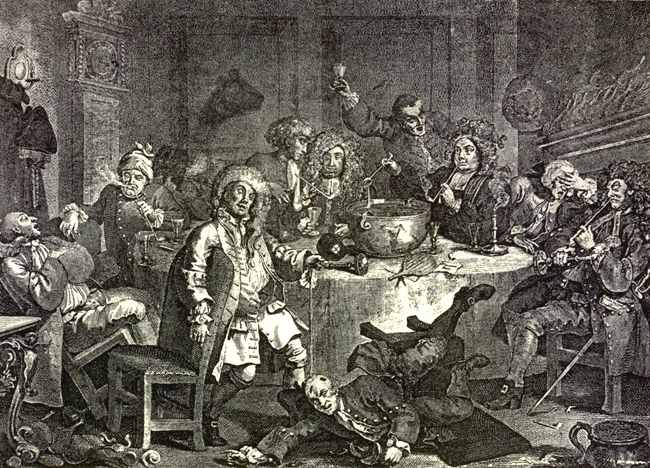
MIDNIGHT MODERN CONVERSATION.

Notwithstanding this inscription, which was engraved on the plate some time after its publication, it is very certain that most of these figures were intended for individual portraits; but Mr. Hogarth, not wishing to be considered as a personal satirist, and fearful of making enemies among his contemporaries, would never acknowledge who were the characters. Some of them the world might perhaps mistake; for though the author was faithful in delineating whatever he intended to portray, complete intoxication so far caricatures the countenance, that, according to the old though trite proverb, "the man is not himself." His portrait, though given with the utmost fidelity, will scarcely be known by his most intimate friends, unless they have previously seen him in this degrading disguise. Hence it becomes difficult to identify men whom the painter did not choose to point out at the time; and sixty years having elapsed, it becomes impossible,—for all who composed the group, with the artist by whom it was delineated,
"Shake hands with dust, and call the worm their kinsman."
Mrs. Piozzi told me that the divine with a corkscrew,[114] occasionally used as a tobacco-stopper, hanging upon his little finger, was the portrait of Parson Ford, Dr. Johnson's uncle; though upon the authority of Sir John Hawkins, of anecdotish memory, it has been generally supposed to be intended for Orator Henley.[115] As I have been told that both these worthies were distinguished by that clerical rubicundity of face with which it is marked, the reader may decree the honour of a sitting to which he pleases. We may say of either one or the other:
"No loftier theme his thought pursues, Than punch, good company, and dues. Easy, and careless what may fall, He hears, assents, and fills to all; Proving it plainly by his face, That cassocks are no signs of grace."[116]
The roaring Bacchanalian who stands next him, waving his glass in the air, has pulled off his wig, and in the zeal of his friendship crowns the divine's head. He is evidently drinking destruction to fanatics and success to Mother Church, or a mitre to the jolly parson whom he addresses.
The lawyer who sits near him is a portrait of one Kettleby, a vociferous bar-orator, who, though an utter barrister, chose to distinguish himself by wearing an enormous full-bottom wig, in which he is here represented. He was further remarkable for a diabolical squint and a Satanic smile. In the Causidicade are a number of lines dedicated to the honour of this amiable person. They begin with—
"Up Kettleby starts with a horrible stare."
A poor maudlin miserable who is addressing him, when sober, must be a fool; but, in this state, it would puzzle Lavater to assign him a proper class. He seems endeavouring to demonstrate to the lawyer that in a poi—poi—point of law he has been most cruelly cheated, and lost a cau—cau—cause that he ought to have got,—and all this was owing to his attorney being an infernal villain. This may very probably be true; for the poor man's tears show that, like the person relieved by the good Samaritan, he has been among thieves. The barrister grins horribly at his misfortunes, and tells him he is properly punished for not employing a gentleman.
Next to him sits a gentleman in a black periwig. He politely turns his back to the company, that he may have the pleasure of smoking a sociable pipe.
The justice, "in fair round belly, with good capon lin'd,"—the justice, having hung up his hat, wig, and cloak, puts on his nightcap, and with a goblet of superior capacity before him, sits in solemn cogitation. Meditating severe punishments on the dissolute peasant who tipples ale or viler liquors, he resolves for the future to act with magisterial harshness, that he may convince his neighbours of his zeal for the law, and detestation of drunkenness. His left elbow supported by the table and his right by a chair, with a pipe in one hand and a stopper in the other, he puffs out the bland vapour with the dignity of an alderman, and fancies himself as great as Jupiter seated upon the summit of Mount Olympus, enveloped by the thick cloud which his own breath has created.
With folded arms and open mouth another leans back in his chair.[117] His wig is dropped from his head, and he is asleep: but though speechless, he is sonorous; for you clearly perceive that where nasal sounds are the music, he is qualified to be leader of the band.
The fallen hero, who with his chair and goblet has tumbled to the floor, by the cockade in his hat we suppose to be an officer. His forehead is marked, perhaps with honourable scars. To wash his wounds and cool his head, the staggering apothecary bathes it with brandy.
A gentleman in the corner, who, from having the Craftsman and London Evening in his pocket, we determine to be a politician, very unluckily mistakes his ruffle for the bowl of his pipe, and sets fire to it.
The person in a bag-wig and solitaire, with his hand upon his head,[118] would not now pass for a fine gentleman, but in the year 1735 was a complete beau. Unaccustomed to such joyous company, he appears to have drank rather more than agrees with him.
The company consists of eleven,[119] and on the chimney-piece, floor, and table, are three-and-twenty empty flasks. These, added to a bottle which the apothecary holds in his hand, prove that this select society have not lost a moment. The overflowing bowl, full goblets, and charged glasses, prove that they think "'tis too early to part," though the dial points to four in the morning!
"What have we with day to do? Sons of Care, Sons of Care, 'twas made for you."
The clock, like the company, is irregular; for the minute finger and hour hand do not agree. Over the chimney-piece is a picture, of which we can discover enough to guess that it has once been a landscape; but, like the understandings of the gentlemen present, is so obscured by smoke and vapour as to appear a mere chaos, without one clear and distinct form. The fumes of punch, the smoke of pipes, and effluvia of candles sunk into the sockets, must render the air delightfully balmy, and produce ambrosial fragrance.
The different degrees of drunkenness are well discriminated, and its effects admirably described. The poor simpleton who is weeping out his woes to honest lawyer Kettleby, it makes mawkish; the beau it makes sick; and the politician it stupifies. One is excited to roaring, and another lulled to sleep. It half closes the eyes of justice, renders the footing of physic unsure, and lays prostrate the glory of his country and the pride of war.