Chapter XXVII
Reading edition
THE UNION ENSIGNS OF THE BRITISH EMPIRE.
A further evolution in the Union flag has come step after step, by which the distinguishing emblems of the colonies have become part, first of the Union Jack, afterwards of the Union ensigns, and then through the red ensign to unite home and colony in one Imperial Union ensign.
In the century of the expansion of Raleigh's "trade command," the governors of the English colonies, principally of those in America, began giving commissions to their local colonial ships, authorizing them to engage in the various free and ready methods by which that trade was being obtained from foreign sources. Some inconvenience seems to have resulted from this practice, as the colonial ships carrying the two-crossed Jack were making prizes and taking trade under the flag which the Old Country merchant ships were directed not to use. Objection was made by the ships sailing from the home ports, and under William III. the matter was taken up.
PLATE IX.
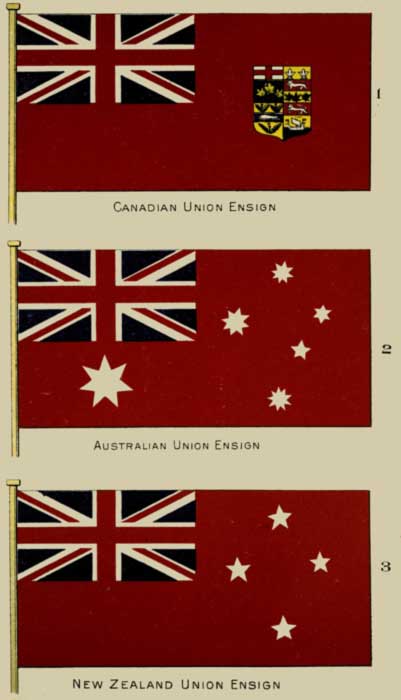
1 Canadian Union Ensign
2 Australian Union Ensign
3 New Zealand Union Ensign
The English Lords Justices in Council considered the question and reported:
"At the Council Chamber, Whitehall, the 31st day of July, 1701.
"Present—Their Excellencies the Lords Justices in Council.
"Upon reading this day at the Board a report from the Lords Commissioners of the Admiralty in the words following, viz.:
"Their Excellencies the Lords Justices having been pleased to refer to us a Report of the Lords Commissioners of Trade, upon a Memorial from this Board, representing the Inconveniences that do attend Merchant ships wearing the King's Colours, in and among the Plantations abroad, under Colour of the Commissions given them by His Majesty's Governours of the said Plantations. We do most humbly report to their Excellencies that we do agree with the said Lords Commissioners for Trade that all such ships to whom the aforesaid Governours shall, by the Authority Lodged in them, grant Commissions, ought to wear colours that may distinguish them from private ships, as is done by those employed by the Officers of the Navy, Ordnance Victualling, and others, and therefore do humbly propose that all the said Governours may be directed to oblige the Commanders of such Merchant ships, to which they grant Commissions, to wear no other Jack than that hereafter mentioned, namely, that worne by His Majesty's ships with the Distinction of a White Escutcheon in the middle thereof, and that said mark of Distinction may extend itself to one-half of the depth of the Jack, and one-third part of the Fly thereof, according to the sample hereunto annexed.
"Pembroke. "Haversham. "D. Mitchell."
Directions were accordingly so issued, and of the instructions transmitted to the governors of the colonies in America originals are extant of those sent to Massachusetts, in 1701, and New York, in 1709. Fig. 56 is from an actual tracing from the drawing of the flag on the margin of the instructions sent to the Governor at Boston.[186] It will be noted that the white escutcheon on the Jack is perfectly plain and without any special distinctive emblem, such as those worn on the escutcheons on the ordnance and other departmental flags.
The white escutcheon of the home departmental flags was thus extended to the Union Jacks used in the colonies, and formed the new and first "colonial flag" (Pl. III., fig. 3).
The Governors, High Commissioners or Administrators of British colonies and dependencies were afterwards authorized to place upon this white escutcheon on the Union Jack the arms or emblem of the colony in which they served. In this way it has come that the arms of Canada, the southern cross constellation of Victoria, the red cross and British lion of New South Wales, the black swan of Western Australia (67), and the other special distinctive emblems in each of the British colonies are now displayed upon the centre of the Union Jacks which form the Governor's flag in each.
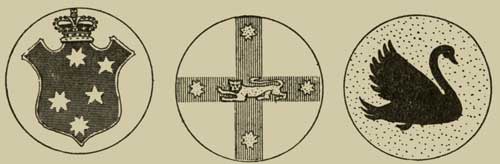
67. Australian Emblems.
Victoria.New South Wales.Western Australia.
In 1865, when Colonial Navies were first established, the vessels of war maintained by the local governments in Australia were authorized to use the blue ensign, with the seal or badge of the colony in the centre of the fly,[187] and thus the escutcheon being transferred from the centre of the Jack to the centre of the "fly," was given another position, and the local stories of the Australian colonies, which established these fleets, became embodied in the British blue ensign.[188]
A similar privilege, although they are not commissioned as vessels of war, was afterwards extended to the "fishery protection" cruisers of Canada, so that these and all other vessels which are owned by the Government of the Dominion carry the blue ensign with the arms of Canada in the centre of the fly.
Authority was also given to all these vessels owned and commissioned by the colonial governments to fly a blue pennant of the same shape as that of the British navy (Fig. 22, page 108), with the white ground and red cross of St. George at the head, but having the fly blue instead of red.[189]
By such successive steps the Imperial idea became attached to one of the ensigns of the British navy.
From the plain white escutcheon in the centre of the colonial Union Jack, 1701, to the special emblem in the fly of the colonial blue ensign, 1865, was a long way, but other steps were yet to be taken.
The vessels owned by the governments of the colonies had thus been given their special British Union flags, but provision had not been made for those owned by private citizens. The plain red ensign has, by authority of Queen Anne, become the national right of all British subjects on all lands as well as on all seas. As the colonies developed in native energy so their merchant shipping increased, and in recognition of this advance, and in order that their ports of origin might be made known, all colonial-owned merchant vessels were accorded, in 1889,[190] the right of wearing, together with the red ensign, an additional flag on which might be shown the distinguishing badge or insignia of their colony, similarly as under James I. direction had been given to raise the separate national Jack of England or of Scotland at the same time as the King's Union Jack. In order to prevent the possibility of mistakes in identification, it was further directed that any flags of this character were to be made in such a way as not to resemble any of the existing flags of the Royal Navy.
In some of the Australian colonies local flags of excellent design had been devised, but these additional flags of entirely separate design were not all that could be desired, for while the special local flag might give expression to the local patriotism represented, there might come with it also an idea of separation, and it did not succeed in expressing the dominant and prevailing sentiment of allegiance to "One Empire, One Flag."
It fell to the lot of the statesmen of Canada, who do not seem to be behindhand in developing new and imperial ideas, to suggest (1890) another step in the history of the ensign.
The merchant shipping of Canada stands fifth in rank in merchant shipping among the nations of the world.[191]
The government ships were authorized to use the blue ensign with the Dominion arms as their distinguishing flag, but as no distinctive flag had been adopted for Canada, her merchant marine used the same plain red ensign as worn by the merchant marine of Great Britain, and Canadian merchant ships were unable to be recognized amidst those of the Mother Country.
In 1892, to meet this requirement, the Lords Commissioners of the Admiralty, on the suggestion of the Canadian Department of Marine, issued a warrant permitting the badge of the arms of Canada to be inserted in the flag of the red ensign as well as in the blue, and this new combined red ensign was by this empowered to be used on board vessels registered in the Dominion of Canada.[192]
Thus was formed the union ensign of Canada. This Canadian ensign (Pl. IX., fig. 1) is the British red ensign, having the Union Jack in the upper corner and the arms of Canada in the fly.[193]
This restriction to its being used only afloat has, like the ancient restriction of the Union Jack, been modified by usage and authorized by permission. Yet it is also to be remembered that the right of the red ensign had been conferred by Queen Anne upon all British citizens whether at sea or on land in all British Dominions, and is rightfully to be raised by all Canadians. The "Dominion Ensign" is the red ensign of the Empire with the insignia of Canada on the broad red of the fly, and, being accorded to Canadians as an evidence of the ownership of their ships, has passed onward to be an evidence of their country over their own homes. As they have the right to use the plain red ensign everywhere, so now they may use its daughter, the Canadian ensign, and although there was at first a restriction as to its use at sea, this has been merged in the more widely extended and general usage on land.
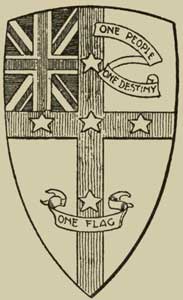
68. Australian Federation Badge.
The raising of this ensign does not, any more than the raising elsewhere of a red ensign in addition to the single Union Jack, suggest any idea of separation; on the contrary it was designed by the Canadian statesmen to avoid any such idea which, perhaps, might be attached to an entirely different flag. The presence of the Union Jack in the upper corner declares inviolate fidelity to King and Empire, while the Canadian emblem on its folds gives a recognition of native home. When an Englishman raises his St. George, the Scotsman his St. Andrew, or the Irish the St. Patrick or their crown and harp on a blue ground, it is not taken as a sign of separation, but only as a recognition and reminiscence of their old homes and ancestry; so, too, with the Canadian in his special ensign, with its Canadian emblem. All raise both their native and the Union Empire flags in united fervour.
The federation badge with the stars of the Southern Constellation, worn during the plebiscite of 1899 in Australia (68), suggested that the union of the Parliaments of the colonies on that continent might be followed by the creation of a Union ensign for the new Commonwealth of Australia.
The union came in 1901, and following on the line of the Canadian ensign, the Australian ensign was created. This is the British red ensign with the Union Jack in the upper corner, under this Jack a six-pointed star signifying the six Provinces or States of the Australian union, and in the fly the five stars of the constellation of the Southern Cross,[194] the leading constellation of the Southern Hemisphere.
By a subsequent enactment another point was added to the star, making a star of seven points,[195] one for each of the States, New South Wales, Victoria, Queensland, South Australia, Western Australia, Tasmania, and one for the Territories of Papua and Norfolk Island; but the rest of the ensign remained the same as previously.
Thus was formed the Australian ensign (Pl. IX., fig. 2).
The Union Ensign of the Dominion of New Zealand contains in the same way the Union Jack in the upper corner, and a southern constellation of four stars in the middle of the red fly (Pl. IX., fig. 3).
As the separated colonies of South Africa are now joining together in a union Parliament under the Union Jack, we may expect another Union Ensign to be added to the galaxy of these loyal union and native ensigns.
Like the expansion of the British Constitution to patriot governments beyond the seas, so has come the extension, step by step, of the old union flag to the newly-created Dominions. As the spirit of that constitution has been adapted to the local circumstances in each, so the red ensign with its Union Jack, which is the embodiment of the power and glory of the British nation, has been emblazoned with the local fervour of each young and growing people, who, ardently loving their new land, yet stand unconquerably in union with the Motherland, and rejoice at seeing their own emblem set upon the mother flag. Each such flag tells us its grand story in a way that a national flag ought to do; for the red ensign of the homeland, with the sign of the colony added to its folds in these far-off lands, signals to the beholder that it is an Imperial Union Ensign of the British Empire.
These are the union ensigns of the self-governing Dominions of the outer Empire, which have been adopted in succession in each, as a Union Parliament for their Dominion has been created, to embrace the several Provinces or States of their continent, and endowed with powers from the Union Parliament of the Parent Realm.
As in the sixteenth century the forces of the Percys raised the cross of St. George in their ensign (Pl. III., fig. 1), to show that of whatever district they might be they were all Englishmen, so the younger nations of the Britains over the seas raise the Union Jack in the upper corner of their Dominion Union Ensigns to tell that their bearers are all Britons, sons and daughters of the Family, loyal to the British Crown.
When the Canadian sees the union crosses displayed on his Canadian ensign, or the distant brother colonist on that of his colony, it speaks to each, not only as his own native flag, but yet more as his sign of brotherhood in an empire wider than his own home, broader than the continent on which he lives, for it is the visible evidence of his citizenship in the Empire of Great and Greater Britain.
The fervid eloquence of Daniel Webster, in 1834, described that empire as "a power dotted over the surface of the whole globe with her possessions and military posts, whose morning drum-beat, following the sun and keeping company with the hours, circles the earth with one continuous and unbroken strain of the martial airs of England."[196]
If this heart-rousing testimony of the majesty of the empire, of which the dominions and colonies form a part, had been given by one of ourselves, it might have been tinged with the suspicion of self-glorious boasting; but springing from the lips of so distinguished a citizen of the United States, its fervid utterance is the candid acknowledgment of a nation wider than his own, whose grandeur compelled his admiration.
If over half a century ago this ascription was true, how much more so is it in these later days when the ideal of the "morning drum-beat" has been transmuted into actual fact in the "continuous and unbroken strain" of the "Diamond Anthem" of the rejoicings at the Jubilee of Queen Victoria,[197] when, commencing at Suva at 4 p.m. on that Sunday afternoon, the National Anthem was taken up in the assemblies in almost every place in the outer British Dominions as the sun came over them in succession around the world, until it had come back again to Fiji on the following day.
Those "possessions" which fired the statesman's imagination have marvellously increased; that "power" has expanded beyond his utmost dreams. Since that time no nation, not even his own, has progressed like has the British nation. Canada, then lost to view in a solitude of far-off forests or of pathless plains, has arisen like a young lion, and carrying the Union Jack in continuous line of government from the Atlantic to the Pacific, has gripped the American continent from sea to sea. Australasia and New Zealand have risen beneath the southern star, India in itself has become an empire, and Africa, youngest born of all the lion's brood, is welding fast another continent beneath the imperial sway.
These are the nations of the Union Jack, the galaxy of parliaments of free men, which have arisen round the centre isles and the throne of Her who, with Her statesmen,
"Knew the seasons when to take Occasion by the hand and make The bounds of freedom wider yet."
In this Nation of nations, brothers join hands with their brothers around the world, and raise aloft the Union Jack of itself, and in their ensigns as the glad emblem of their united allegiance, a union for which the Britains beyond the seas have proved their faith, and ever stand in foremost rank ready and willing to defend.
There is something marvellous in the world-wide influence of this three-crossed flag of the parent nation, whose sons have followed its ideals through all the centuries. Sometimes they have made mistakes, or blundered into difficulties, but undaunted, masterful and confident, have profited by the hard-won experience, and progressing with the march of time, find at the beginning of this twentieth century that they "have builded better than they knew."
Thus, when in the opening month of 1890 Britain stood alone, as said a Canadian statesman,[198] in "splendid isolation," there was heard coming, not only from Canada, but from every daughter nation around the seas, the same brave refrain which had been sung by a Canadian poet in 1861, when the sanctity of the flag had been violated in the stirring times of the "Trent affair":
"When recent danger threatened near, We nerved our hearts to play our part, Not making boast, nor feeling fear; But as the news of insult spread, Were none to dally or to lag; For all the grand old Island spirit Which Britain's chivalrous sons inherit Was roused, and as one heart, one hand, We rallied round our flag."
And yet again in 1899, when brother Britons in Africa were suffering injustice, when our British colonies were being invaded and the Union Jack attacked by a mistaken foe, the Empire arose, and the bold refrain passed into chivalrous action.
In ships that ploughed furrows around the world the sons of the Empire came—colonists, yeomen and imperial forces—"in one united armament blent," to give their glad devotion in life or death for Queen and Union Ensign on the South African hills and veldt.
Such, then, is the story, such is the meaning of our Union Jack; the emblem of combined constitutional government, the proclaimer of British liberty, the Union sign of British rule, the signal of the Realm of "Great Britain and Ireland and of all the Britains beyond the seas."[199]
Mindful of its story, happy in their lot, facing the World, its sons and their sons' sons stand up to their Union Colours and encircle the earth with their glad anthem,
"Send him victorious, Happy and glorious, Long to reign over us, God save the King." "Qu'il soit victorieux, Et que son peuple heureux, Le comble de ses vœux: Vive le roi."
APPENDICES.