Front matter
Reading edition
HISTORY OF ...
THE AUSTRALIAN
BUSHRANGERS..
BY
GEORGE E. BOXALL
Author of "The Anglo-Saxon, a Study in Evolution," etc., etc.
LONDON: T. FISHER UNWIN ADELPHI TERRACE, MCMVIII
FIRST EDITION, September, 1899. SECOND EDITION, May, 1902. THIRD EDITION, May, 1908.
PREFACE.
In this story of the bushrangers I do not pretend to have included the names of all those who have at various times been called bushrangers in Australia. That, as will be seen from what I have said in the earlier chapters, would be not merely impossible but useless. I believe, however, that I have collected some particulars about all those who succeeded in winning even a local notoriety, and I have also endeavoured to supply such personal characteristics of the leaders in the movement as may throw some light on the causes which induced them to "take to the bush." My principal object, however, has been to make the picture as complete as possible, so that the magnitude of the social evil which the Australians set themselves to cure may be realised; and it is generally believed in Australia that this cure has been so complete that bushranging will never again become epidemic.
The story is a terrible one. Some of the incidents related are no doubt revolting, but it is necessary that even these should be told to show how civilised man may be degraded by unjust and oppressive laws. We are all creatures of the educational influences to which we are subjected in our youth, and therefore it is unfair to blame the earlier bushrangers; because they were the products of the civilisation of their day, and were not themselves responsible. But sensational as the story is, its tendency is rather to depress than to exhilarate the reader, for the story is a sad one, in that it shows a deplorable waste of what under happier conditions might have been useful lives. As a rule I have adhered very closely to the newspaper reports of the time, but to make the story (which naturally tends to be scrappy and disconnected) as homogeneous and continuous as possible, I have followed one gang to the close of its career, and then returned to take up the history of another gang. I have paid special attention to the geography of the country, and the reader who possesses a fairly good map of each of the colonies should have no difficulty in following the movements of each of the gangs, and may thus obtain an idea of the extent of the area over which it operated.
Hitherto the histories of Australia have passed very lightly over the bushrangers, but there can be no doubt that they exercised some influence, and not always for evil, for to their influence is due some of the sturdy Republicanism of the modern Australians. The publication of this story may perhaps assist the future historian in tracing the growth of public opinion in Australia, and will therefore not be without its use. It is in this hope that I submit it to the public.
G.E.B.
AUTHORITIES QUOTED.
Reports of the Select Committees of the House of Commons on Transportation, Sessions 1837 and 1838: Chapters I., II., III., IV.
Report of the Special Commission of Enquiry into the state of the Colony of New South Wales. By John Thomas Bigge, 1822 and 1823: Chapters I., II., IV.
Despatches of Governors Macquarie, Bourke, Sorell, Arthur, Franklin, Denison, Latrobe, &c., to the Colonial Office: Chapters I., II., III., IV., XII.
History of Van Diemen's Land, from 1820 to 1835. Anonymous. Chapters I., II.
History of Bendigo. By George Mackay. Chapter XII.
The Last of the Tasmanians. By James Bonwick, F.R.G.S. Chapter II.
The Spectator. Chapter IX.
Hobart Town Gazette. Chapters I., II., III.
Hobart Town Courier and Murray's Review. Chapters I., II., VI., X., XI., XV.
Colonial Times. Chapters X., XI., XV.
Cornwall Chronicle. Chapters I., II., III., VI., IX., X., XI.
Launceston Advertiser. Chapters I., II., VI., IX., X.
Launceston Examiner. Chapters VI., IX., XI.
Sydney Gazette. Chapters I., IV., VI., VII.
Sydney Monitor. Chapters I., IV.
Sydney Australian. Chapters I., IV.
Sydney Morning Herald. Chapters V., VI., VII., VIII., IX., XV., XVI., XVII., XVIII., XIX., XX., XXI., XXII., XXIII., XXIV., XXVIII.
Melbourne Argus. Chapters IV., XIII., XIV., XV., XXI., XXV., XXVIII., XXIX., XXX., XXXI.
Port Phillip Herald. Chapters VI., VII., VIII.
Geelong Advertiser. Chapters XII., XIII., XIV., XV.
Melbourne Herald. Chapters XII., XIV., XV.
Melbourne Age. Chapters XXIX., XXX., XXXI.
South Australian Register. Chapters VIII., XXIV.
Brisbane Courier. Chapter XXVII.
New Zealand Herald. Chapter XXVI.
The quotations from numerous provincial papers acknowledged in the text have been taken at second hand, principally from the metropolitan papers of the colony referred to, and which are included in this list.
CONTENTS.
Chapter I.—Characteristics of the Convicts sent to Australia; Bushranging; Origin and Meaning of the Term; The Cat and the Double Cat; Condition of the Prisoners; Some Terrible Revelations; The Desperation of Despair; Some Flogging Stories; The Bushranging Act and its Abuses; Some Opinions of the Magistrates; Savage Treatment of Criminals Continued to the Present Time; Brutality not Cured by Brutal Punishment; When Bushranging First Began 1
Chapter II.—Van Diemen's Land; The First Bushranger; Mike Howe, the King of the Ranges; The Raid on the Blacks; The Black War; Musquito; Outrages by the Blacks; Brutal Treatment of the Blacks by Bushrangers; A War of Reprisals; Gigantic Scheme to Capture the Blacks; A Cordon Drawn Round the Disaffected District; Details of the Scheme; Its Failure; Only Two Blacks Captured; Estimated Cost; Fate of the Blacks 17
Chapter III.—Pierce the Cannibal; A Terrible Journey; A Shocking Confession; Escapes from the Western Hell; The Ruffian Jefferies; Brady the Bushranger; Escapes from Macquarie Harbour; Sticks up the Town of Sorell; The Governor's Proclamation; Brady Laughs at it; The Fight with Captain Balfour; Betrayed by a Comrade; Captured by John Batman; Sympathy at his Trial; End of the Epoch 33
Chapter IV.—Bushranging in New South Wales; Manufacturing Bushrangers; Employing Bushrangers; The First Bank Robbery in Australia; Major Mudie and his Assigned Servants; Terrible Hollow; Murder of Dr. Wardell; The Story of Jack the Rammer; Hall, Mayne and Others 48
Chapter V.—John Lynch; Murder of Kearns Landregan; Lynch's Trial and Sentence; His Terrible Confession; Murder of the Frazers, Father and Son; Murder and Cremation of the Mulligans; His Appeals to Almighty God 60
Chapter VI.—Jackey Jackey, the Gentleman Bushranger; His Dispute with Paddy Curran; Some Legends About Him; Jackey Jackey Always Well Dressed and Mounted; His Capture at Bungendore; His Escape at Bargo Brush; Jackey Jackey visits Sydney; His Capture by Miss Gray; Paddy Curran's Fight with the Police; Recaptured and Hung; John Wright Threatens to Make a Clean Sweep 71
Chapter VII.—The Jewboy Gang; "Come and Shoot the Bushrangers;" Constable Refuses to Leave his Work to Hunt Bushrangers; Saved by his Wife; Robberies in Maitland; Bushrangers in High Hats; The Bullock-driver Captures the Bushrangers; An Attempt to Reach the Dutch Settlements; Mr. E.D. Day Captures the Gang; Assigned Servants' Attempt at Bushranging; Some Other Gangs 82
Chapter VIII.—Bushranging in South Australia; The Robbers Captured in Melbourne; A Remarkable Raid in Port Phillip; Going Out for a Fight with the Bushrangers; A Bloody Battle; Cashan and McIntyre; The Fight with the Mail Passengers; Cashan Escapes from the Lock-up; Is Recaptured; McIntyre Caught at Gammon Plains 95
Chapter IX.—Bushrangers and Pirates; Capture of H.M. Brig Cyprus by Bushrangers; A Piratical Voyage; Stealing the Schooners Edward and Waterwitch; Mutiny of Prisoners on H.M. Brig Governor Phillip at Norfolk Island; The Trial of the Mutineers at Sydney; How Captain Boyle Recaptured the Vessel 103
Chapter X.—Van Diemen's Land Again; A Hunt for Bushrangers in the Mountains; Some Brutal Attacks; "Stand!" "No, thanks, I'm very Comfortable Sitting;" A Degrading Exhibition; A Determined Judge; Cash, Kavanagh, and Jones, an Enterprising Firm; The Art of Politeness as Exhibited by Bushrangers; A Bushranger Hunt in the Streets of Hobart Town; The Capture of Cash; Break Up of the Gang; a Doubtful Mercy 111
Chapter XI.—Norfolk Island; Its Founding as a Penal Station; The Terrible Discipline in Norfolk Island; An Attempt to Ameliorate it; Its Failure; The Rigorous Treatment Restored; The Consequent Riot; Jackey Jackey's Revenge; An Unparalleled Tale of Ferocity; The Soldiers Overawe the Rioters; Thirteen Condemned to the Gallows; Jackey Jackey's Remarkable Letter; The End of Several Notorious Bushrangers 124
Chapter XII.—The Third Epoch of Bushranging; The Gold Digging Era; Influx of Convicts from Van Diemen's Land; Passing of the Criminals' Influx Prevention Act; Attitude of the Diggers Towards the Bushrangers and other Thieves; The Nelson Gold Robbery; Some Pitiful Stories; A Rapid Raid; Insecurity of the Melbourne Streets 134
Chapter XIII.—Captain Melville Takes to the Road; He Ties and Robs Eighteen Men; He Goes to Geelong for a Spree and Boasts of his Exploits; His Sensational Capture; Sent to the Hulks; Murder of Corporal Owens; Melville Removed from the Hulk Success to the Gaol; Murder of Mr. John Price, and Mutiny of the Convicts; Melville Attacks Mr. Wintle; Death of the Noted Bushranger 148
Chapter XIV.—Murder of a Bullock-driver; Sticking Up in the Melbourne Streets; Stealing £100,000 in Bank Notes; Want of Efficient Police Protection; Murders and Robberies at Ballarat, Bendigo, Mount Alexander, and other Diggings; The Robbery of the McIvor Gold Escort; A Bushranger Intimidated by a Bottle of Brandy; Robbery of the Bank of Victoria at Ballarat; Capture of Garrett in London; Prevalence of Horse Stealing; The Doctor's "Creamy" 158
Chapter XV.—An Escape from Norfolk Island; Stealing a Government Boat; The Convicts of New South Wales; A Terrible Indictment; Thomas Willmore; Murder of Philip Alger; Murder of Malachi Daly; Fight Between Two Bushrangers; Hunting Down Willmore; His Capture While Asleep; The Last of the Van Diemen's Land Bushrangers; Wilson and Dido; Some Minor Offenders; An Unfounded Charge; A Change of Name to Rid the Island of Evil Associations 173
Chapter XVI.—The New Bushranging Era; Fallacy of the Belief that Highwaymen Rob the Rich to Enrich the Poor; The Cattle Duffers and Horse Planters; The Riot at Lambing Flat; Frank Gardiner, the Butcher; Charged with Obtaining Beasts "On the Cross," He Abandons His Butcher's Shop; Efforts to Establish a Reign of Terror in the District; A Letter from Gardiner; The Great Escort Robbery 188
Chapter XVII.—Johnny Gilbert; His First Appearance in Australia; Miscellaneous Bushranging Exploits; Mr. Robert Lowe Makes a Stand; Mr. Inspector Norton Captured by the Bushrangers; A Plucky Black Boy; "Mine Know it, Patsy Daly Like it, Brudder;" A Brave Boy; O'Meally Shoots Mr. Barnes; A Bootless Bushranger; Capture of John Foley; Something about the Foley Family; Ben Hall 205
Chapter XVIII.—Racers as Mounts for the Bushrangers; The Shooting of Lowry; The Bushrangers Visit Bathurst; They Hold the Town of Canowindra for Three Days; Burke Shot by Mr. Keightley; Female Bushrangers; Death of O'Meally at Goimbla; A Newspaper Man and His Wife Stuck up; Lively Times During the Christmas Holidays 218
Chapter XIX.—A Heavy Sessions at Goulburn; Ben Hall Hard Pushed; An Amateur Mail Robber; Discovery of Frank Gardiner; His Trial and Sentence; The Old Man; A Brush with the Police; The Chinkies Show Fight; Messrs. Hall & Co. Take a Lease of the Main Southern Road; Capture of Mount and Dunleavy; Johnny Dunn; A Desperate Duel and Death of Sergeant Parry; A Country Ball and Its Sequel 232
Chapter XX.—Meeting the Gold Escort; Murder of Constable Nelson; A Brush with the Police; Attempt to Stick up the Araluen Escort; Death of Constable Kelly, and Pluck of Constable Burns; Sir Frederick Pottinger Resigns; Death of Ben Hall; A Sketch of His Life; Death of Johnny Gilbert; Record of Johnny Dunn and the Gang; Capture and Trial of Dunn; His Execution; Fate of the Chief Members of the Gang 246
Chapter XXI.—Bloodthirsty Morgan; Morgan's Opinion of the Police; Murder of Sergeant McGinnerty; Murder at the Round Hill Station; A Pseudo Morgan; Morgan Threatens to Brand All Hands; He Shoots Sergeant Smyth; Challenged to Visit Victoria; He Accepts the Challenge; His Death at Peechelba 258
Chapter XXII.—The Brothers Clarke; The Raid at Nerigundah; Deaths of William Fletcher and Constable O'Grady; Murder of Four Special Constables at Jinden; Annie Clarke at Goulburn; Capture of Thomas and John Clarke; A Terrible Record; A Plucky Woman; An Attempt to Escape Custody; "Shoot Away I Can't Stop You"; Some Daring Robberies; Murder and Cremation of the Brothers Pohlmann; Blue Cap 269
Chapter XXIII.—Bushranging in the Northern District of New South Wales; Captain Thunderbolt Robs the Tollbar; A Chinaman Bushranger; A Long Chase; A Fight with the Police; "Next, Please"; The Bushranger Rutherford; Captain Thunderbolt and the German Band; Desperate Duel between Captain Thunderbolt and Constable Walker; Thunderbolt's Death 287
Chapter XXIV.—Bushranging in the Wild Paroo; A Raid into South Australia; A Relic of the Bushranging Era; Agitation for the Release of Gardiner; Official Reports as to Twenty-four Bushrangers Still in Gaol; The Cases of Gardiner and William Brookman; Gardiner and the other Bushrangers Released; Gardiner leaves the Country 304
Chapter XXV.—Bushranging in Victoria; Robert Bourke; Harry Power; He Escapes from Pentridge Gaol and Sticks up the Mail; An Amateur Bushranger; The Police Hunt Power Down and Capture Him Asleep; A Peacock as "Watch Dog;" The Power Procession at Beechworth; The Trial of Power; His Sentence; Engaged to Lecture on Board the Success; His Death 315
Chapter XXVI.—Bushranging in New Zealand; Alleged Fears of the Escort being Robbed; The First Bushranger; Henry Beresford Garrett; The Maungapatau Murders; Arrest of Sullivan, Kelly, Burgess, and Levy in Nelson; Sullivan's Confession; The Discovery of the Bodies; Sullivan's Release 326
Chapter XXVII.—Bushranging in Queensland; Some Bushrangers from Over the Southern Border; A Bogus Ben Hall; The Wild Scotchman; Queensland's Only Bushranger; A Man of Many Aliases; He Goes to Fight a Duel with Sir Frederick Pottinger; He Escapes from the Steamer; Recaptured and Tried 335
Chapter XXVIII.—Captain Moonlite; The "Reverend Gentleman" Robs the Bank and Nearly Makes His Escape; He Breaks Out of Ballarat Gaol; He Becomes a Reformed Character; He Sticks up the Wantabadgery Station; A Desperate Battle with the Police; His Young Companions in Crime; Sentenced to Death; The Wild Horse Hunters Turn Bushrangers; An Abortive Attempt to Rob a Bank 341
Chapter XXIX.—The Kelly Gang; Horse-Stealing a Great Industry of the District; Faking the Brands; Assault on Constable Fitzpatrick; The Bush Telegraphs; Murder of Sergeant Kennedy and Constables Scanlan and Lonergan; Sticking Up of the Faithfull Creek Station; Robbery of the National Bank at Euroa; A Big Haul 353
Chapter XXX.—The Kellys Stick op the Town of Jerilderie; Robbery of the Bank of New South Wales; A Symposium in the Royal Hotel; A Three-days' Spree; "Hurrah for the Good Old Times of Morgan and Ben Hall"; The Robbers take a Rest for a Year; The Kelly Sympathisers Again; The Kellys Reappear; Murder of Aaron Sherritt 365
Chapter XXXI.—Fight between the Police and the Bushrangers at Glenrowan; The Railway Torn Up; Attempt to Wreck the Police Train; The Glenrowan Inn Besieged; Ned Kelly in Armour; His Capture; The Burning of the Inn; Death of Dan Kelly, Steve Hart, and Joe Byrnes; Trial and Conviction of Ned Kelly; His Death; The Kelly Show; Decrease of Crime in the Colonies 377
Index 386
CHAPTER I.
Introductory; Characteristics of the Convicts Sent to Australia; Bushranging: Origin and Meaning of the Term; The Cat and the Double Cat; Condition of the Prisoners: Some Terrible Revelations; The Desperation of Despair; Some Flogging Stories; The Bushranging Act and Its Abuses; Opinions of the Magistrates; Savage Treatment of Criminals Continued to the Present Time; Brutality not Cured by Brutal Punishment; Where Bushranging First Began.
The species of brigandage known in Australia as bushranging was, without doubt, evolved, more or less directly, from the convict system established as the basis of the earlier settlements in the island continent. The first bushrangers were simply men who took to the bush to escape work and enjoy freedom of action. Under the harsh laws of the Georgian era the greater criminals were hung, and not transported, and the convicts sent to "Botany Bay," in the eighteenth and the earlier years of the nineteenth centuries, were generally men to whom the trammels of the civilisation of their day were irksome. Many of them were political agitators, industrial rioters, and machine-breakers. The others were poachers and similarly comparatively mild offenders against the laws, who, under the present laws of Great Britain, would be sufficiently punished with a few months' imprisonment. Many of these men, when they were removed to a new land where the social conditions did not press so heavily on them, became honest and reputable citizens, and, perhaps, but for the harsh treatment they were subjected to, numbers of others who were driven to continue their fight against authority, might also have lived quiet and useful lives. This subject is a very delicate one, and it is not my intention to pursue it further here; but if it could be fully treated without giving offence to numbers of worthy and, in some cases, justly honoured residents of Australia, some very valuable lessons might be learned from the histories of some of those families whose founders could not live in England without offending against the laws, but who could and did earn the respect of their fellow colonists in Australia who were not "sent out."
The student of history in Australia is reminded, perhaps more forcibly than his fellow in England, that the humanitarian spirit, now so distinguishing a trait in the Anglo-Saxon character, is of very recent growth. Under the operation of this new force the criminal law of England was rapidly softened and ameliorated, and with every advance in this direction the character of the convicts sent out to Australia steadily deteriorated, if I may so describe the process. With every alteration in the law a fresh class of criminal was transported, and these with few exceptions would, a few months before, have been hung. At first, pickpockets, then sheep and horse-stealers, forgers and others, who had previously only escaped the gallows in rare instances, when they could find some influential friend to take sufficient interest in them to plead their cause, were now transported as a matter of course. This process continued until transportation ceased, and as the last batch of prisoners sent out was presumably the worst, having been guilty of more heinous crimes than their predecessors, we are too apt to judge the earlier convicts harshly from our knowledge of the later ones. The general effect was that while, with the amelioration of the laws, crime steadily decreased in England, it just as steadily increased in Australia, and no doubt the worst criminals were transported to Van Diemen's Land after transportation had ceased to New South Wales in 1842. The laws of England previously to the great changes made during the past sixty years seem to me to have operated, whether designedly or not, to clear the country of the disaffected and the discontented, rather than the criminal. How far the introduction of large numbers of this class into the country may have paved the way for modern advances in liberal government in Australia, is a question which it might be profitable to study; but it only relates to the bushrangers so far as it enables us to account for the large number of men who "took to the bush."
The earlier bushrangers seem to have been idle and dissolute, rather than criminal, characters. They watched for an opportunity to escape into a patch of scrub whenever the eye of the sentry in charge of them was turned away, and the nature of the country was so favourable to this method of evasion that it constituted a continuous challenge to them to run away, and, almost incredible as it may appear now, numbers of men started northward or westward in hopes of reaching the Dutch or English settlements at Batavia, Singapore, Hong Kong, or some other place in that direction. It must be remembered that the majority of the working classes at the beginning of the century could not read and had no knowledge of geography. They had heard sailors speak of these settlements and had no idea that hundreds of miles of sea flowed between them and Australia. How many of these poor ignorant men lost their lives in the attempt to achieve the impossible cannot be said, but some terrible stories of cannibalism have been related in connection with this phase of bushranging. The majority of the "runaways," however, had no such definite ideas as these, erroneous as they may have been. They hoped to be able to live in freedom in the bush and to subsist on fruits, roots, or other native growths. Some few joined a tribe of blacks and stayed longer or shorter times with them; others simply wandered about until hunger drove them back; while very many remained at large until they were captured, and these lived by stealing from farmers and other settlers any articles which could be eaten or sold. When one of these early bushrangers grew tired of his freedom he gave himself up at the nearest police station and received fifty lashes. The penalty for a second offence was twelve months in a chain gang.
There was no adequate system of classifying the convicts. It was the custom in advertising runaways to give the name of the man and that of the ship in which he was transported. Then followed the personal description, and that was all. It was admitted to be inconvenient, but no attempt appears to have been made to improve it. Besides this, for administration purposes, convicts were divided into three classes according to their sentences. Thus there were men who had been transported for "seven" years, for "fourteen" years, or for "life." They were also classified as "young," "middle-aged," and "old," and usually the crime for which they had been transported was specified, but such a description gave no indication of the character of the man. Finally they were divided into "town thieves," "rural labourers," and "gentlemen." This was a step in the right direction, but it was too vague to be of much use. The educated convicts were all classified as "gentlemen" whether they came from the towns or the rural districts.[1] It is worthy of note that the proportion of skilled labourers, or tradesmen as they are called, was very small. Very few men who had been apprenticed to a trade were among the convicts sent to Australia at any time.
There were no regulations as to hours of work, and the severe taskmaster might work his assigned servants as many hours as he pleased. It was generally understood that Sunday was to be a holiday, or day of rest, but excuses were readily found for making the convicts work on this day, and this was a fruitful source of discontent. Very frequently men absconded on Saturday night, remained in the bush on Sunday, and returned on Monday to take the customary fifty lashes and resume work.
If flogging is efficacious in preventing crime, it should have made the convict colonies the most virtuous places on earth, for the "cat" was in almost continuous use in New South Wales and in Van Diemen's Land. The "cat" generally used was the ordinary military or naval cat; but "the cat used at Macquarie Harbour was a larger and heavier instrument than that used generally for the punishment of soldiers or sailors. It was called the thief's cat, or double cat-o'-nine-tails. It had only the usual number of tails, but each of these was a double twist of whipcord, and each tail had nine knots. It was a very formidable instrument indeed."[2] How far the influence of this barbarous instrument of torture tended to make the prisoners at Macquarie Harbour the most reckless and ferocious of the convicts of Australia it is unnecessary to enquire, but there can be no doubt that its influence was for evil and not for good. It is with the ordinary "cat," with which England in these barbarous times flogged her defenders as ferociously as she did her prisoners, that we have to deal; and, frightful as the tortures were which were inflicted on the convicts, we have positive evidence that their lot was looked upon with envy by the soldiers who guarded them. Several soldiers in New South Wales deliberately committed crime so that they might be convicted, in the hope that, by good conduct, they might earn some of the indulgences open to convicts. The fact is that any prisoner who contrived, by obsequiousness or in any other way, to make friends with an official, had his way made easy for him, while the independent, whether industrious or not, were ruthlessly persecuted until, in many cases, they were finally forced to the gallows.
"The prisoners of all classes in Government are fed with the coarsest food; governed with the most rigid discipline; subjected to the stern, and frequently capricious and tyrannical will of an overseer; for the slightest offence (sometimes for none at all—the victim of false accusation) brought before a magistrate, whom the Government has armed with the tremendous powers of a summary jurisdiction, and either flogged, or sentenced to solitary confinement, or retransported to an iron gang, where he must work in heavy irons, or to a penal settlement, where he will be ruled with a rod of iron. If assigned to a private individual he becomes a creature of chance. He may fall into the hands of a kind indulgent master, who will reward his fidelity with suitable acknowledgments; but, in ninety-nine cases out of a hundred, he will find his employer suspicious, or whimsical, or a blockhead, not knowing good conduct from bad, or a despot, who treats him like a slave, cursing and abusing, and getting him flogged for no reasonable cause. He may be harassed to the very death—he may be worked like a horse, and fed like a chameleon. The master, though not invested by law with uncontrolled power, has yet great authority, which may be abused in a thousand ways precluding redress. Even his legal power is sufficiently formidable. A single act of disobedience is a sufficient ground of complaint before the magistrate, and is always severely dealt with. But, besides the master's power, the prisoners are in some measure under a dominion to the free population at large; any man can give him in charge without ceremony. If seen drunk, if seen tippling in the public-house, if met after hours in the street, if unable to pay his trifling debt, if impertinent—the free man has nothing more to do than to send him to the watch-house, and get him punished. The poor prisoner is at the mercy of all men."[3] This appears to be a fair and unexaggerated statement of the conditions, and therefore it is little cause for wonder that the general tone of morality in the colony was low. Mr. J.T. Bigge says that "every opportunity was seized for cheating. When the convicts attended at the store to draw their weekly rations, supplies were frequently drawn for men not at work there. False lists of men employed in the various gangs were made out."[4] In fact, the Government of the Colony was a military despotism under which corruption was rampant, so that the authorities themselves set an example of immorality which the convicts were not slow to follow. "The police made a considerable revenue by blackmailing convicts who were in business."[5] Those who could pay were allowed to continue to enjoy a freedom to which they were not legally entitled, while those who would not, or could not, be blackmailed, to satisfy the exorbitant demands of the so-called custodians of the peace, speedily "got into trouble," and were prosecuted. It was said that if a man could escape from a country district and go to Sydney he might, if he could afford to dress well, pass as a free man without attracting attention. A blacksmith named Brady, assigned to Major James Mudie, of Castle Forbes, eluded the police in this way for nearly two years. He was recognised by a fellow convict, some time before he was captured, but this man "let him go for £5." Such cases, however, were exceptions to the general rule. The majority of runaways went into the bush and not into the town, and the Sydney and Hobart Town Gazettes in early times contain numerous proclamations by the various governors calling upon all well disposed persons to assist the military in capturing runaways. Some of the issues of these Gazettes contain columns of the names and descriptions of persons variously styled "absconders," "absentees," "bolters," or "bushrangers." In these the term "bushranger" appears most frequently in New South Wales, while "bolter" was the more popular in Van Diemen's Land. The first bushrangers, therefore, were men who "took to the bush" to escape work, and therefore it was quite possible for a man to be a bushranger without committing any depredations on his more prosperous fellows.
But laziness was not the sole cause of bushranging in early times. A more powerful impulse perhaps was discontent, love of change. "One of the most common indications of the misery of convicts under existing circumstances is a passionate desire for change of place; and when serving considerate masters they are sometimes indulged in this by being transferred (though always as a sort of punishment) to their disadvantage. In other cases, however, the desire becomes so strong that they will steal, or commit some equal offence, expressly to be condemned to a road gang or penal settlement."[6] In fact the monotony of their lives became insupportable, even in those cases where they were not cruelly treated. Captain Maconochie cites cases of men who have so acted within a few months of their being entitled to a ticket-of-leave, and who have thus forfeited their chances of freedom in the near future. In some cases this was due to the "inhuman treatment" of the master. In one case a valuable servant—a blacksmith—whose time had nearly expired, was goaded into running away so that he might be condemned to a further term of service before obtaining his ticket-of-leave, and this was not an isolated case.
"Generally," said Dr. J.D. Lang, "the condition of the assigned servant in New South Wales is superior to that of the farm labourer of England. He is better clothed, better fed, and as comfortably lodged. He is under personal restraint, not being allowed to leave his master's property without a pass, but he has many comforts and means of amusement which render his situation by no means irksome or severe."[7] But it was just this restraint which the persons with whom we are now dealing found intolerable. They had not the patience, the long-suffering resignation of the English farm labourer. Many of them had been English farm labourers and had found the conditions in which they lived intolerable, and when they realised that they had not very much improved these conditions by being sent to Australia, they rebelled again. "The experience furnished by the penal settlements," said Judge Forbes, "has proved that transportation is capable of being carried to an extreme of suffering such as to render death desirable, and to induce many prisoners to seek it under its most appalling aspects.... I have known cases in which it appeared that men had committed crimes at Norfolk Island, for the mere purpose of being sent to Sydney to be tried, and the cause of their desiring to be so sent was to avoid the state of endurance in which they were placed in Norfolk Island." ... Several cases occurred in which "men at Norfolk Island cut the heads of their fellow-prisoners with the hoe while at work, with the certainty of being detected, and the certainty of being executed. They did this without malice, and when charged said it was better to be hung than to live in such a hell."[8] Sir Richard Bourke said: "Capital crimes have been committed in that penal settlement from a desperate determination to stake the chance of capital conviction and punishment in Sydney against the chances of escape which the passage might afford to the accused and to the witnesses summoned to attend the trial."[9] The early bushrangers of Australia ranged therefore from the comparatively innocent wanderer in the bush, to such desperadoes as these, while the crimes they committed varied from petty theft to burglary, bank robbery, robbery on the high road, and murder. The modern idea of a bushranger is a bold highwayman, and no doubt many of the bushrangers come up to this ideal, but the story of the bushrangers would not be complete if it took no note of the others.
The settlement on Norfolk Island was established with the view of sending all the reconvicted prisoners there. It was the penal settlement of a penal settlement. It was abandoned for a time, after the founding of a similar settlement on the banks of the Derwent river in Van Diemen's Land, but was re-established as a place of punishment in connection with that colony, and many of the most notorious of the bushrangers ended their days there, as we shall see later. It was in the convict settlements in those islands that the greatest brutalities were perpetrated on the prisoners, and Norfolk Island, Macquarie Harbour, and Port Arthur were each known as "The Hell" among the "old hands," as the convicts were called after transportation had been abolished. It was in these settlements that the more violent and refractory of the convicts were gradually collected, and the history of these places tends to prove that brutality cannot be cured by brutal means. Flogging which was an every-day occurrence had no reformatory effect. The early bushrangers thought nothing of it. It certainly did not deter them from absconding whenever they thought fit. When an absconder tired of wandering about the bush, he returned to the settlement to take his flogging "like a man." In the stories told by the old hands, the absconder or offender in some other way was represented as walking jauntily up to the triangles, throwing off his jumper, placing himself in position for tying, and then, when he had been secured, telling the flagellator to do his "d—— est," and, if the descriptions of the manner in which the floggers performed their task which have come down to us are true, the punishment was a terrible one. It is said that there were two floggers in Sydney who were regarded as artists in their profession. These men performed together, the one being right-handed and the other left. They prided themselves on being able to flog a man without breaking the skin, and consequently there was no blood spilled. But the back of the flogged man is described as having been puffed up like "blown veal." The swelling "shook like jelly," and the effects were felt for a much longer period than when the back was cut and scored as it generally was, for we are told that the ground, in the Barrack Square in Sydney, all round where the triangles stood, was saturated with human blood, and the flogging places elsewhere must have been in the same condition. But to return. When the man had received his dose and was cast loose, he would throw his jumper across his shoulders and walk away with a grin—or with some such remarks as "Well, is that all you can do?—— you!" and afterwards boast that "the—— couldn't get a whimper" out of him. I have heard a story of a man who was flogged. The flagellator kept hitting him low down across the loins. The prisoner turned his head round once and said fiercely: "Hit higher, blast you!" The flogger took no notice, and the prisoner made no other sign until he was untied. Then he knocked the flogger down with his fist, and was immediately seized up for another "dose."
"I can assure you, from personal observation, that it is not uncommon to see a poor wretch working on the roads, or labouring in the fields, with his coarse shirt sticking to the green and tainted flesh of his lacerated back, and that, too, for the most venial offence.... I have it from unquestionable authority, that it frequently occurs in the summer season that the eggs of the blue-fly become inserted and hatched in the wounds of the punished offender, from which they are occasionally extracted by some humane companion."[10]
The blow-fly in Australia, although frequently called "blue-bottle," is not blue. It deposits its young alive in the form of maggots, and great care has always to be taken to prevent sores on man or beast from being "blown." It is very common for flannel shirts, which have become greasy from perspiration, to be blown on the backs of workmen, and the maggots thus deposited will attack and irritate any scratch or sore they can find if not removed quickly.
The convict, so far from having been ashamed of being flogged, boasted of it. But nothing pleased them better than the relations of stories about the flogging of "freemen," as those settlers who had gone to the colonies neither as convicts nor officials were called. One story, which may or may not be true, has been told as having occurred in every convict district in Australia. It was to the effect that a master one day gave a letter to an assigned servant and told him to take it to the nearest gaol. The servant, surmising that the letter was somewhat to the following effect:—"Dear Sir,—Please give the bearer fifty for absconding (or what not), and oblige, yours truly, &c.," told a plausible tale to the first freeman he met and induced him to deliver the letter. The point of the story generally lay in the ingenuity with which the convict induced the freeman to deliver the letter for him, but the astonishment of the freeman when he was seized up to the triangles in spite of his struggles and protestations, and given the "fifty," was a perpetual source of joy and hilarity to the convicts who heard the story. There is nothing inherently improbable in this story. It is quite probable that the incident may have occurred more than once. Although freemen were legally exempt from flogging, unless under sentence of a qualified Court, many authentic instances of freemen having been flogged have been told. Here is one. "A store-keeper in Hobart Town had offended his neighbours, and one of them, in revenge, posted a written placard libelling the offender. The placard was affixed to a big gum stump at the corner of Collins and Elizabeth Streets. Just as the complainant was putting this bill on the stump the man libelled in it passed and called the attention of the Military Commandant, who was near at hand at the time, to it. A sort of informal drum-head Court Martial was held on the spot, and the libeller was found guilty and sentenced to receive three hundred lashes, which were administered at once, in spite of the protests of the victim that he was a freeman and was therefore entitled to a judicial trial. When two hundred lashes had been administered, a cry of 'Ship ho' was raised, and the last hundred was got rid of as quickly as possible, the Commandant, the flagellator, the spectators, and others all rushing away to the wharf to hear the news from Europe."[11] If the law could be thus set at defiance by a military official in the case of a free immigrant holding a good position, what chance of justice could there be for a convict? A story illustrating the reckless manner in which prisoners were flogged is told by the Launceston Advertiser. "A prisoner was found guilty of absconding, and sentenced to receive fifty lashes, when some circumstances were disclosed which proved that the prisoner was innocent, but had lost his pass. 'Never mind,' said the Launceston magistrate, 'the warrant is signed, let him be punished now; I will forgive him the next time he's brought up.'" The tyranny of the officials was boundless. One Government rule was that all convicts should take off their hats to officers and officials whenever they passed. In January, 1839, a party of convicts was building some steps at Woolloomooloo Bay, on Sir Maurice O'Connell's estate. Several of them were rolling a heavy stone down to be placed in position when an officer passed along and the convicts immediately rose up and took their hats off. The stone rolled quickly down the steep embankment, struck the overseer and knocked him down, almost breaking his leg. Captain O'Connell gave orders that the men should not salute anybody in future while at work. A few days later Colonel Wilson, Chief Police Magistrate of Sydney, passed, accompanied by his daughter. The convicts continued at work without noticing him. "Take off your hats," cried the Colonel. Several of the men did so, but Joseph Todd, who was carrying a heavy load, took no notice. "Take off your hat, you scoundrel," said the Colonel. Todd said he had been ordered not to. The Colonel shouted "I'll have your back skinned for you, you rascal," called the sergeant of police who acted as guard, and gave Todd in charge. Captain O'Connell appeared to defend his man and said Colonel Wilson was trespassing and had no right to interfere with assigned servants on their master's estate. Sergeant Goodwin deposed that the path was a common one and people frequented it to get to the bathing place. Sergeant Mather said that Todd had struggled when arrested. The Bench held that Todd being an assigned servant had been guilty of disorderly conduct in resisting the police. Had he been a freeman he would have been justified in resisting arrest without a warrant; but, being a prisoner, his conduct had been highly disorderly, and he was, therefore, sentenced to receive fifty lashes. A week later Todd was again arrested for being out after hours, and was sentenced to receive thirty lashes. The paper in reporting this charged Colonel Wilson with tyrannical conduct, and says that he went to see Todd flogged.[12]
I am not relating the worst cases in order to "make out a case" for the bushrangers, but simply facts to illustrate the life in the colonies at the time, and thus account for the large number of men who "took to the bush," and the special Acts passed to prevent this breach of the law were as tyrannical as the acts of the officials or the masters which went so far to create it. The "Bushranging Act" (11 George IV., No. 10) authorised the military or civil police to arrest any person on the mere suspicion that he or she was illegally at large, and the onus of proof was thrown on the suspected party. This Act was a fruitful source of complaint. No one was safe except well known officials, and it is said that the Act was extensively used for purposes of extortion and black mail. A young woman was arrested by an ex-constable and charged with being illegally at large. It was in vain that she protested that she was "free" and did not require a pass. He insisted on taking her to the lock-up. Fortunately, while walking along the street she met some one who knew her and who threatened the ex-policeman with prosecution if he did not release her. The fellow did so and was not prosecuted. Probably had an enquiry been held it would have been found that he was acting in collusion with the police. Even the officials were not always safe. Mr. Jacques, the Government auctioneer, had been to a dinner party. Being near the Custom House he decided to walk to the wharf from whence the steamer, which ran to Balmain, started and go home in her. Not having walked to the wharf from that point before, he found it necessary to apply to a constable for information as to which turning he should take, and was immediately arrested as a convict illegally at large. In spite of his protests he was conveyed to the nearest police station. The sergeant in charge refused to believe his story, and thought that the presence of a well-dressed man in that quarter was suspicious. Mr. Jacques was therefore detained till morning, when he was recognised by the magistrate and discharged. In 1834 a circular letter was addressed by the Governor to the various police-magistrates in New South Wales, enquiring whether, in their opinion, the Act should be reaffirmed or not, and the replies were by a large majority in favour of its being continued, while others merely suggested that it might be amended in various ways to prevent the abuses which had grown up under its operation. Judge Burton was almost alone in his condemnation of the Bushranging Act, which, he said, was repugnant to the laws of England. "England and the United States of America," he said, "are the only two countries in the world where passports are not compulsory," and he deprecated the introduction of the passport system into Australia. It was held that the conditions existing in the colony made such an act necessary, and it was therefore re-enacted without amendment.[13] It is worthy of note, as illustrating Colonial Office procedure of that day, that it was the paid officials, and not the public, who were consulted in this matter.
The facts being as I have stated, the wonder is not that large numbers of prisoners "took to the bush" but that all did not do so, and the more we study the early history of the convict settlements the less we feel inclined to blame the early bushrangers, however savage or atrocious their actions were. But we have not yet quite escaped from barbarism. In spite of the positive evidence that flogging brutalises and does not reform it is still continued. We also continue to hang criminals, although there is no proof that it deters crime or effects any good whatever. I do not belong to any society for the abolition of capital punishment. I may admit that perhaps there may be men whose death is desirable or expedient; but, if it is so, if there are men unfit to live or whose death might add to the happiness or security of the majority, then I think that we might extend to our fellow creatures, however ferocious or abandoned they may be, the mercy which we show to savage or superfluous dogs and cease from torturing them in their last moments. Hanging has had a sufficiently lengthy trial in Australia if it has not in England. Old residents in Sydney or in Hobart Town or in any other locality where penal settlements have existed can point out numbers of places where the gallows has been erected, and in some cases trees are still standing where numbers of men have struggled away their last few moments of life. This, however, is not the place to enlarge upon this subject, but the story I have to tell shows a lamentable waste of life, and many even of the more notorious of the bushrangers have exhibited qualities which might under happier conditions have fitted them for useful work. This is specially true of the earlier bushrangers who were the victims generally of unjust laws. Of the later ones, the native-born bushrangers, it is impossible to speak in the same terms. They were not driven to crime by want or oppression, but they were the vicious products of a vicious past. Their crimes were due to vicious environment and education, but they are gone now and, if we may draw some lessons of utility for the future, even their lives may not have been altogether wasted.
From the evidence I have adduced it will be seen that the early bushrangers were very numerous. "In one case it became known," said Mr. James Macarthur, "that a gang of about sixty convicts, employed in the Government gangs in Liverpool, intended to break out on a certain night and take to the bush. It was considered advisable to allow them to break out, proper precautions having been made to capture them. It was the intention to attack our farming stations at Camden. We armed twelve of the best-conducted of our convict servants, but the absconders found that their design had been discovered and did not attempt to put it in force."[14] Thus the bushrangers did not always go out singly, or in twos or threes. Mr. J.T. Bigge says: "At Windsor, and in the adjoining districts, the offence termed bushranging, or absconding in the woods, and living upon plunder and the robbing of orchards, are most prevalent.... At Emu Plains, or the district of Evan, gambling, absence from work, insolence to overseers, neglect of work, and stealing, are the most common offences.... As the population of New South Wales has, until lately, been virtually limited to the occupation of a small tract of land that lies between the Blue Mountains and the sea, and as few temptations to plunder existed in the tracts contiguous to these boundaries, excepting those that are afforded by the wild cattle in the cow-pastures, the offence of bushranging, or continued absence in the woods, has not of late been common. Instances have occurred of the departure of convicts for the purpose of traversing the country with a view to escape, of the escape of some from Newcastle, sent thither for punishment, and their wandering and temporary existence in the vicinity of Windsor; and latterly, a few instances of escape from the road parties in the districts of Liverpool and Bathurst; but there has been no systematic or continued efforts of desperate convicts to defy the attempts of the local Government in New South Wales, or to subsist by plunder, such as have existed until a very late period in Van Diemen's Land."[15]
It is in Van Diemen's Land, therefore, that our story of the more serious phases of bushranging first begins.
FOOTNOTES:
CHAPTER II.
Van Diemen's Land; The First Bushranger; Mike Howe, the King of the Ranges; The Raid on the Blacks; The Black War; Musquito; Outrages by the Blacks; Brutal Treatment of Blacks by Bushrangers; A War of Reprisals; Gigantic Scheme to Capture the Blacks; A Cordon Drawn Round the Disaffected District; Details of the Scheme; Its Failure; Only Two Blacks Captured; Estimated Cost; Fate of the Blacks.
The first settlement in Van Diemen's Land was founded in 1803, when a penal establishment, to which the more refractory of the prisoners in Sydney might be despatched, was founded on the banks of the River Derwent. Subsequently other penal stations were opened, and of these we shall hear later. The island continued to be the chief penal establishment of New South Wales until 1825, when it was erected into an independent colony. The first shipment of convicts, direct from England to Van Diemen's Land, took place in 1823, and from that date, until transportation to the island finally ceased, in 1853, 64,306 convicts were sent to that colony from the British Isles. The number sent previously from New South Wales was not large, nevertheless it included the majority of the most turbulent of the convicts and relieved the mother colony of their charge and control. The island was in fact "nothing but a jail on a large scale."[16] The early conditions in the colony appear to have been favourable to bushranging. In 1805 there was such a dearth of food stuffs, owing to the non-arrival of store ships from Sydney, that a famine appeared to be imminent and, to relieve the store, the Lieutenant Governor ordered the liberation of the convicts and sent them into the woods to catch kangaroo and other wild animals for food. When the stores arrived and food became plentiful, the attempts to recall the convicts were only partially successful. Many had learned how to subsist in the bush and disregarded the proclamations issued by the Lieutenant Governor ordering them to return to work. At first the bushrangers or bolters were similar to those of New South Wales and contented themselves with petty thefts. The first proclamation in which reference is made to "a gang of bushrangers" was published in the Hobart Town Gazette by Lieutenant Governor Davey and dated September 10th, 1810. It offered rewards and indulgences to convicts for the capture of any members of a gang which, under the leadership of a convict named Whitehead, had been committing depredations on the property of settlers and farmers in the vicinity of Hobart Town.
Whitehead, therefore, was the first to organise a gang which combined highway robbery with burglary and petty larceny. Bushrangers were not at that time specialists. From time to time other proclamations were issued in which this gang was mentioned, but it was not until May 14th, 1813, that a special proclamation was published, calling upon the "bolters" to surrender. Those who neglected to obey this order were to be proclaimed "outlaws" on December 1st.
Very few particulars are published about this gang in the newspapers, and the proclamations rarely specify the facts in connection with the robberies committed. The newspapers of the time seldom mention the names of the bushrangers, and appear to have been quite as averse to mentioning the Christian names as the modern English papers are those of professional cricketers. Thus Whitehead is referred to as "the convict Whitehead," or the "notorious bushranger Whitehead," and so on. He is debited, however, with one horrible crime. The gang captured a half-crazy fellow named John Hopkins, and accused him of trying to betray them. As a punishment for this offence a pair of moccassins, roughly made of bullock hide, was fitted on to his feet, and in these were placed a number of the great red ants, commonly known in Australia as "bull-dog" or "soldier" ants (myrmecia gulosa). These ants are an inch and a quarter long, and of most ferocious appearance. They are the dread of the colonists. They sting quite as severely as a bee or a hornet. But a bee stings only once, while a soldier ant will continue to sting until removed. It is always ready to fight, and never lets go when it has taken hold; hence its popular names. The horrible barbarity of such a punishment can be best appreciated, perhaps, by those who have inadvertently stood on a "soldier's" bed or nest. The victim is said to have died in agony.
Whitehead was shot by a party of soldiers in October, 1814, and Michael Howe, commonly called the "First of the Australian Bushrangers," was elected captain of the gang in his stead. Mike Howe, as he was usually called, was transported from England for highway robbery, and soon after his arrival at Sydney "got into trouble," and was again transported to Van Diemen's Land, where his violence caused him to be repeatedly flogged and otherwise punished. He made his escape and joined Whitehead's gang, and soon, by his superior education, gained an ascendency over his comrades. His previous experiences as a footpad in England no doubt tended to fit him for the leadership of the gang, and he is still regarded as one of the most notable of the revolters against law and order in the colonies. One of his earlier achievements was to organise a raid on a tribe of blacks for the purpose of providing himself and his comrades with wives. This is said to have been the first act in the tragedy which closed with the complete annihilation of the blacks of the island. The savages, of course, resisted, and many of them were shot, and the women were forced away to the bushrangers' camp. In revenge, the blacks attacked, not the bushrangers' camp, but the houses of settlers who had no connection with the bushrangers, and fights between the settlers and the blacks became frequent. Some of the black women seem to have become reconciled to the change, and Howe's "wife," Black Mary, is associated with him in most of the stories told of him. It is said that it was her knowledge of the bush which enabled him to escape so frequently from the military bands sent out to capture him.
Howe addressed a letter "From the Bushrangers to the Hon. T. Davey, Lieutenant Governor of Van Diemen's Land," in which he protested against the charge, made against himself and his mates in the proclamations, of having been guilty of "horrid and detestable crimes." He asserted that he had never committed murder and had only used violence when it was necessary to avoid capture. The letter was conveyed to Hobart Town by an American whaler named Richard Westlick, who had an interview with his Excellency, and was sent back with a verbal message that the Governor "did not wish to take the life of any man," but merely to preserve order. If, therefore, Howe, or any of his comrades, would surrender no charges should be made against them for their acts while "in the bush." No notice was taken of this generous offer, and the depredations continued. Later on Mike Howe addressed a letter "From the Governor of the Ranges to the Governor of the Town," and sent it to Lieutenant Governor Sorell, who had succeeded Colonel Davey. In this the bushranger offered to give himself up on condition that he received a free pardon. He demanded that some recognised official should be sent to meet him at an appointed spot, so that they might "confer as gentleman to gentleman." The fact that this insolent offer was accepted affords incontrovertible evidence of the power of the bushrangers, and shows the anxiety of the Governor to put a stop to the robberies which harassed the industrious settlers and made the roads of the colony unsafe. Captain Nairne, of the 46th Regiment, was sent out to meet the bushranger, and the result of their conference "as gentlemen" was that Howe accompanied the Captain back to Hobart Town. On his arrival there he was informed that the Lieutenant Governor had no power to grant pardons, but that he would write to Governor Macquarie in Sydney and urge him to grant a pardon without delay. Howe agreed to wait in Hobart Town. He was liberated on parole, and soon became very popular in the city. Then a rumour began to spread to the effect that Howe had committed no less than four murders, not reckoning the blacks he had killed, and that, therefore, the Governor declined to grant him a pardon. As soon as Howe heard this rumour he, without waiting for its confirmation, broke his parole and returned to the bush. A proclamation was immediately issued declaring him an outlaw, and offering one hundred pounds reward for his capture, dead or alive. Smaller rewards were offered for other members of his gang, whose names were known.
The estimates of the strength of his gang vary extremely from time to time. Sometimes he is said to have a hundred or more followers, while frequently he is represented as acting alone or in company with only one or two others. The facts appear to be that many men, who merely "bolted" into the bush as a relief to the monotony of their lives, became bushrangers; and, when hard pressed, or when they tired of that pursuit, returned to the town, gave themselves up, and were punished as ordinary bolters. One day, not very long after his escape from Hobart Town, Howe was surprised while asleep by two ticket-of-leave men named Watts and Drew. They captured and tied him. Howe fought like a lion and contrived to break the rope with which he was tied. He snatched a knife and stabbed Watts. He then seized Watts' gun and shot Drew dead. Watts ran away, while Howe was employed in re-loading the gun, and managed to secrete himself in the scrub for a time. When the way was clear he crawled to a farm and gave information. He was cared for as well as circumstances permitted, but he died from loss of blood before a doctor could be brought to him. Howe was followed by the military, but escaped.
Several skirmishes took place between Howe and his gang and the soldiers, and more than one of his accomplices were shot, but the chief always contrived to get away. At length a kangaroo hunter named Warburton led William Pugh, a soldier commonly known as "Big Bill," and a seaman named John Worrall, to where Howe was camped under a gum tree. A terrific fight took place, Howe's brains being beaten out before it was over.
In his review of this period, Mr. J.T. Bigge said: "The excesses of the bushrangers in the neighbourhood of Port Dalrymple, and likewise near Hobart Town, had attained their utmost height and most sanguinary character at the latter end of the year 1813. They had been joined by two persons who had held subordinate stations in the commisariat department, named Peter Mills and George Williams, and continued a system of violent depredations upon the homes and property of individuals of every description. So great was the intimidation produced by their combined efforts, that the inhabitants of several districts abandoned their dwellings and removed for safety to the towns.... Colonel Davey issued a proclamation offering rewards for the apprehension of a party of nine, and with the advice of Mr. Ellis Bent another proclamation calling upon them to surrender before December 1st.... The effect of this was the reverse of what was intended. It increased the crimes and audacity of the bushrangers during the six months that it allowed for their return; they profited by the pardon by making a temporary surrender, and then resumed their habits of plunder.... Hector McDonald, the leader, was shot by two convicts sent in pursuit of a gang of four. Another was shot by a soldier of the 48th regiment, and the other three were captured and on conviction flogged and transported."[17]
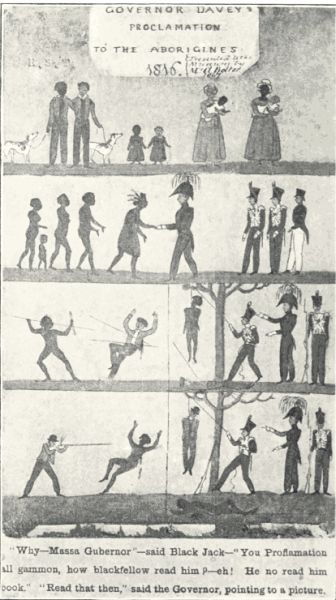
For the time, bushranging in Van Diemen's Land was said to have been put down, but "the Guerilla War" between the whites and the blacks, inaugurated by the bushrangers, continued. Mr. Gilbert Robertson was appointed conciliator, with a view to arranging terms of peace, but he was not very successful. Several proclamations were issued assuring the blacks that if they would come in and make peace the Government would endeavour to protect them against their enemies the bushrangers; but, as was pointed out at the time, issuing proclamations to savages who could not read was absurd. Then a pictorial proclamation was issued. In one portion the governor was shown shaking hands with a blackfellow; in others blacks and whites were exhibited mingling together in friendship. In the two bottom compartments a white man was shown being hung for having shot a black, while a blackfellow was being hung for having speared a white man. Copies of this pictorial proclamation were posted on trees and other places where the blacks might see it. Lieutenant Governor Arthur in fact, on his arrival in the colony, tried by every means in his power to appeal to the blacks and whites alike. He endeavoured to restrain the settlers from attacking and driving the blacks away from their farms whenever they appeared, as had become the custom, but some new outrage by the bushrangers gave a new impulse to the feud, and the settlers were compelled to fight in self-defence. In one of his despatches to the Colonial Secretary Governor Arthur said: "It is not a matter of surprise that the injuries real or supposed, inflicted on the blacks, have been avenged upon the whites whenever an occasion presents itself; and I regret to say that the natives led on by a Sydney black, and by two aborigines of this island, men partially civilised (a circumstance which augurs ill for any endeavour to instruct these abject beings), have committed many murders upon the shepherds and herdsmen in remote settlements.... I have long indulged the expectation that kindness and forbearance would have brought about something like a reconciliation, but the repeated murders which have been committed have so greatly inflamed the passions of the settlers, that petitions and complaints have been presented from every part of the colony, and the feeling of resentment now runs so high that further forbearance would be totally indefensible."[18]
The Sydney black here mentioned was known as Musquito. He was transported to Van Diemen's Land for the murder of a black gin (presumably his wife, which is no crime according to native law) in 1823, and having been employed on a cattle station in New South Wales, was appointed stock-keeper. Later, he was employed as a tracker, and aided the soldiers in capturing some of the bushrangers. For this he was so persecuted by his fellow convicts that life became a burden to him. He appealed to the authorities for protection; but, as this was not accorded to him, he became a bushranger himself. "Perhaps taken collectively the sable natives of this colony are the most peaceable creatures in the universe. Certainly so taken they have never committed any acts of cruelty, or even resisted the whites, unless when insufferably goaded by provocation. The only tribe who have done any mischief were corrupted by Musquito, a Sydney black, who, with much perverted cunning, taught them a portion of his own villainy, and incited them after a time to join in his delinquencies."[19]
Knowing, as we do, the general character of the Australian blacks, it seems strange that one of them should prove himself so much superior to the Van Diemen's Land blacks as Musquito is represented to have done. But however that may be, there can be no doubt as to his skill in organisation. Some of his attacks on settlers were so skilfully planned and carried out, that many persons believed that the blacks had been led by a white man. After about two years of bushranging, Musquito and Black Jack, the two leaders, were captured. Musquito was charged with the murder of William Holyoak, and Mr. Gilbert Robertson appeared in his defence. Mr. Robertson urged that the murders committed by Musquito were in self defence. Had he been protected by the Government, as he should have been after the services he had rendered, he would never have taken to the bush. He related many instances to show the skill of the black, and among others, said that he had seen him "cut the head off a flying pigeon with a crooked stick."[20] This seems to indicate that however intimately Mr. Robertson might be acquainted with the Van Diemen's Land blacks he had no acquaintance with the boomerang. In spite of the conciliator's efforts Musquito was convicted and sentenced to death. When the sentence had been pronounced Musquito said, "Hanging no—— good for blackfellow." Mr. Bisdee asked him "Why not as good for blackfellow as for whitefellow?" "Oh," exclaimed Musquito, "Very good for whitefellow. He used to it." Black Jack was convicted of the murder of Patrick Macartney. The only English known by Black Jack was of the "old hands oaths brand." The two blacks were hung in Hobart Town, but "The Black War" continued.
"The deadly antipathy which was excited between the aborigines and the bushrangers of Van Diemen's Land provoked a series of outrages which would have terminated in the utter extinction of the whole race, if the local Government had not interposed to remove the last remnant of them from the island; an act of real mercy, though of apparent severity."[21] Before proceeding to describe this attempt to save the remnant of the race we may perhaps give a list of the "Atrocities committed by the blacks." It is not a very long one, taking into consideration the time occupied in the war. In March, 1820, forty-nine natives attacked Mr. Broadribb's house. They were divided into several parties which came up from different points simultaneously. One man was speared in the thigh before the blacks were repulsed. They all went away together and stripped Mr. Thomson's house of everything portable. They then proceeded to Mr. E. Denovan's and robbed his place. On April 1st John Raynor was speared and dreadfully beaten at Spring Bay. On May 18th a party of blacks attacked two men employed by Mr. Lord. One was dangerously speared and the other beaten. The hut was stripped. On June 1st Mr. Sherwin's hut, at Weasel Plain, was plundered, and on the 15th, Den Hut, at Lake River, was stripped bare, and Mary Daniels and her two children murdered. On August 7th, S. Stockman's hut, at Green Ponds, was plundered. On the 9th, some muskets, powder, and shot were stolen from the huts of Mr. Sharland, a Government surveyor. On the same day the Government hut, between Borthwick and Blue Ash, was robbed, several horses stolen from Mr. Wood and Mr. Pitcairn, and a man wounded at Mr. Purvis's. This party consisted of about forty blacks. They were met by Mr. Howell's party, and the blacks were driven off after a fight. A woman living near was wounded with a spear. On the 23rd, the huts of Mr. J. Connell and Mr. Robertson were attacked, and the latter plundered; Mr. Sutherland's shepherds were robbed of their arms and one of them wounded; some arms were taken from Mr. Taylor's hut. The next day James Hooper was killed, and his hut plundered. The huts of Lieutenants Bell and Watts were attacked, but the blacks were repulsed. On September 8th Captain Clark's shepherd was attacked, but contrived to escape. On the 13th one man was killed and another wounded on the banks of the Tamar River. On the 14th a man working at the Government lime kilns at Bothwell was attacked, but escaped. On the 18th a private of the 63rd Regiment was speared and two other soldiers wounded. One of the savages was killed. On the 27th Francis Booker was killed with spears, and on the next day three men at Major Gray's hut were wounded. On the same day two men were killed at Mr. G. Scott's place and their bodies thrown into the river. A third man was wounded, but escaped into the bush. The house was stripped of everything. This robbery was so systematically carried through that it was believed that the blacks had been led by white men. A hut on the opposite side of the road was also stripped. On October 16th the settlement at Sorell was attacked, one man being killed and another severely wounded. Four houses were stripped. On the 18th Captain Stewart's shepherd was killed and a settler, Mr. Gilders, was also speared and died. On the 19th, Messrs. Gatehouse and Gordon's house was attacked, but the blacks were repulsed. They were also driven away from Mr. Gaugel's place, but not before he was severely wounded. On November 19th two huts were robbed on the Ouse River. Captain Wight's shepherd was killed and dreadfully mangled. His body was found later. On the 27th a hut on the Esk River was stripped bare. On February 3rd, 1821, an attack was made on Mr. Burrell's house on the Tamar River. Mr. Wallace was severely wounded in several places, and a child was also wounded by a spear. L. Knight's hut was plundered, three horses belonging to Mr. Sutherland were killed and three others were wounded. His hut at North Esk was also plundered. Mrs. McCaskell was killed near Westbury, and her hut plundered of everything. An attack made on Mr. Stewart's house was repulsed. On March 8th, two sawyers were wounded, and two huts near New Norfolk were plundered. On the 12th, Mrs. Cunningham and her child were severely wounded, and her hut at East Arm plundered. Mr. Lawrence's servant was wounded, and three men were wounded on Norfolk Plains. On April 5th, T. Ralton was killed with a spear while splitting wood. On the 16th, Mr. Fitzgerald was sitting at the door of his hut reading, when a blackfellow sneaked up and drove a spear through him, after which his cottage was plundered. On the 17th, another attack was made on Fitzgerald's house. On May 10th, the Government store at Patrick Plains was burned down. Mr. Kemp's establishment at Lake Sorell was attacked by a large mob of blacks. Two men were killed, one wounded, the buildings were burned down and the firearms carried away. On June 6th, several huts were attacked at Hunter's Hill. Mrs. Triffet was speared and her house plundered, the huts of Messrs. Marnetti, Bell, and Clark were robbed, and Mrs. N. Long was killed. On September 5th, Thomas Smith was killed at Tapsley, and his hut plundered; John Higginson was killed and his hut robbed, and a sawyer's hut was plundered. On the 7th, Mr. B.B. Thomas and his overseer, Mr. Parker, were murdered near Port Sorell, while endeavouring to carry out the conciliatory policy of the Government. Mr. Stocker's hut was attacked, a man named Cupid killed, and a child wounded. On the 27th, Mr. Dawson's hut on Bushy Plains was attacked, and a man severely beaten. On the 23rd, Mr. Dawson's man Hughes was again beaten with waddies and nearly killed. On October 13th, the natives, armed with muskets, attacked and robbed the house of Constable Reid, and afterwards that of Mr. Amos Junior.[22]
This report covers only a portion of the time during which the war lasted, but it sufficiently indicates the character of the war. When the blacks attacked the cottages, or huts as they are called in Australia, of shepherds, sawyers, splitters, and other workers, they were frequently successful, but were generally repulsed when they attacked the residences or houses of the employers. The manner in which the blacks fought struck terror into the hearts of the settlers. No one was safe. At any time, day or night, a party of blacks might sneak up and, with wild yells, spear men, women, and children, old or young, without warning. Their patience in tracking was indomitable. If they could not effect a surprise they withdrew and waited. No doubt, as the advocates of the cause of the blacks said, the number of whites killed was much smaller than the number of blacks slaughtered by bushrangers in their lust and by settlers and soldiers in defence. But it can be readily understood that the position of the settlers was intolerable. Every attempt to drive the blacks away from the settled districts only provoked fresh reprisals, while every attempt at conciliation failed until at length it became evident that the blacks must be either captured or killed. It was therefore with a view to saving the blacks that Lieutenant Governor Arthur urged the necessity of capturing and removing them from Van Diemen's Land to one of the Islands in Bass's Straits. In his despatches to Governor Bourke and to the Colonial Office, he said that it was utterly impossible to restrain the colonists, so great was their rage at the murders of peaceful citizens, and especially of women and children, while all his attempts at conciliation had failed in consequence of the continual outrages committed on the blacks by the bushrangers. Mr. Gilbert Robertson said: "One day a settler was riding across his grounds looking for cattle. He jumped his horse over a log, and while doing so caught the sparkle of a pair of eyes gleaming from the shadow of the log. He pulled up, wheeled his horse round and dismounted, thinking he had found a kangaroo, but on pulling some brush away saw a poor cowering black trying to hide himself, but there was no mercy in the heart of the settler. He cocked his gun and shot the black in cold blood."[23] The story is a very pathetic one, but perhaps the settler had had reason to know that "the poor cowering black" was sneaking up to the settlement to murder any unsuspecting man, woman, or child he might come across. Hiding behind logs, crawling through brush, was the ordinary method of fighting employed by the Van Diemen's Land aborigines, and had he not been on the war path he would not have resorted to this secret manner of travelling but would have stood out boldly. The blacks are not cowards, and are not afraid of showing themselves, as a rule, after their first superstitious fear of the white man passes away. This being the general experience of bushmen, the settler may have been justified in killing the black. He may have been simply treating him according to the blackfellow's own rule in war time. But although we may acquit the settler of blame by such reasoning, the existence of such conditions as to necessitate such a war is not the less deplorable. The whites all carried arms when travelling, and even while working about their homes. Shepherds and other workmen went in pairs. There was no safety anywhere outside the cleared lands round the larger towns. Reviewing the whole situation from our present standpoint, it is difficult to say what other measures could have been adopted than those tried by the Government. The authorities were apparently incapable of controlling the bushrangers, nor could they prevent convicts from running away, and these outlaws appear to have always considered the blacks as fair game. Mr. Robertson tells us that a convict known as "Carrots" boasted shortly before his death that, "having killed a native in his attempt to carry off the black's wife, he cut off the dead man's head and obliged the woman to go with him carrying it suspended round her neck."[24] Is it any wonder that even such "passive and inoffensive creatures" as the Van Diemen's Land blacks are said to have been, should have been aroused to fury by such methods? But although the Government had no control over the convicts in the bush, and such outrages as this were not known of until long after they had occurred, it can scarcely be said that even Governor Arthur, in spite of his earnest desire to protect the blacks, was altogether blameless. The whole policy of the Government in relation to the blacks was weak and vacillating. Governor Arthur promised a native, known as Teague, a boat on condition that he should assist in the capture of some bushrangers. The black performed his share of the work, but he never got his boat, and is said to have fretted himself to death in consequence. The Sydney black, Musquito, was forced "into the bush" by the failure of the Government to protect him against the persecution due to the manner in which he had been employed in the service of that Government. In September, 1826, two blacks were hung in Hobart Town "to impress the others." Nothing could be more absurd than this, and it was far more barbarous a method of reprisal than the shooting of a "poor cowering black." But the Government was not even consistent in its savagery. At the trial of Eumarrah Mr. Robertson pleaded that the black was justified in resisting the invaders of his country in any and every way; and, on his undertaking to remove Eumarrah to Flinders Island, where he had collected about thirty-eight blacks under the charge of missionaries, the plea was accepted and the prisoner was handed over to him. By this time, however, the war had become so vindictive that even the authorities in London recognised that the blacks must be captured or annihilated, and consequently permission was granted to Governor Arthur to put in practice the most extraordinary project perhaps ever attempted.
In April, 1828, a proclamation was issued which, after describing the state of tension which existed between whites and blacks, exhorted all well-disposed persons to assist the Government in attempting to establish peace and order. The proclamation went on to explain that a cordon was to be drawn round the disturbed area and that this was to be gradually contracted until the natives were either captured or driven across the narrow isthmus which connects Tasman's peninsula with the main portion of the island. "But I do, nevertheless, hereby strictly order, enjoin, and command, that the actual use of arms be in no case resorted to, by firing against any of the natives, or otherwise, if they can by other measures be captured."
The force employed in this gigantic scheme is said to have been about two thousand two hundred men, of whom five hundred and fifty were soldiers belonging to the 63rd, the 57th, and the 17th regiments. The whole force was divided into parties of about ten each, and one of these was appointed a leader. On October 7th, a chain of posts was established from St. Patrick's Head along the rivers St. Paul, South Esk, Macquarie, and Meander, under the command of Major Douglas, of the 63rd regiment. A similar chain of posts was formed from the Derwent River along the River Dee to the Lakes, under Captain Wentworth, of the 63rd regiment. A third party, under Captain Donaldson, of the 57th regiment, was stationed in the rear to capture any blacks who might escape through the front line. Captain Moriarty, R.N., in charge of a party, was appointed to scour between the lines and to drive the natives forward or capture them. Mr. Gilbert Robertson and other friends of the blacks acted with this group of parties with the object of persuading such natives as they might meet to surrender quietly. For about three weeks the posts were advanced slowly, and frequent reports were circulated that the beaters had seen parties of blacks and that they were going in the desired direction. On the 25th Mr. Walpole reported that he had come on a camp of blacks and saw them lighting their fires and cooking as if nothing unusual was going on. He watched all night, and just before daybreak crept up slowly and found five blacks asleep. He seized one and held him after a desperate struggle, during which the black bit him severely on the arm. A boy of about fifteen was captured by another settler who was with Mr. Walpole, and these two were handed over to the authorities and conveyed to the nearest police station to be kept until the remainder were captured. On the 26th Lieutenant Ovens saw a black with a firestick apparently trying to sneak through the lines. He ran forward and the black retreated into the bush. Several other blacks were turned back from other points in the line. These also carried firesticks. On the 27th the cordon had been drawn so close that the escape of the blacks within the line was considered impossible, but as no reports had been made for some time of any blacks having been seen, some discontent was manifested by the hunters. On the 31st an order was issued from the camp at Sorrell rivulet to close in, and hopes were expressed that no blacks would be permitted to escape in the final rush. The following day the lines closed in, and no blacks escaped. There was none there to escape. They had slipped through the lines as soon as they became aware that they were being hunted, and the man and boy caught by Mr. Walpole's party were the only blacks captured. A proclamation was published next day, in which the Governor thanked the settlers for their services, and regretted that their efforts had not been more successful. In a despatch sent to the Colonial Secretary, Governor Arthur said, "I regret to report that the measures which I had the honour to lay before you terminated without the capture of either of the native tribes,"[25] and that was all that was said about it officially. It has been estimated that the scheme cost the colony some £35,000, but no particulars were published, and therefore all estimates of cost are mere guesses.
From a humanitarian point of view it is to be regretted that it did not succeed, but the fact that it could be attempted proves how little was known of the blacks by the authorities. The fact that the blacks, who were said to be endeavouring to escape through the lines, held firesticks in their hands proves that they were then unaware of the intention of the whites, and they were probably outside the lines very shortly after it had been thus intimated to them that they were being hunted. But it is doubtful whether the race could have been preserved if they had been removed in large numbers from Van Diemen's Land. Mr. Gilbert Robertson and his successor, Mr. G.A. Robinson, succeeded in removing about 130 blacks to Flinders Island, where, although they were under the care of missionaries, they gradually died off. It was not recognised in those days that compelling the blacks to wear clothes induces skin diseases which soon prove fatal. The only way to preserve the Australian blacks is to leave them alone, and the knowledge of this fact came too late to save the Tasmanians.
FOOTNOTES:
CHAPTER III.
Pierce the Cannibal; A Terrible Journey; A Shocking Confession; Escapes from "the Western Hell"; The Ruffian Jefferies; Brady the Bushranger; Escapes from Macquarie Harbour; Sticks up the Town of Sorell; The Governor's Proclamation; Brady Laughs at it; The Fight with Colonel Balfour; Betrayed by a Comrade; Captured by John Batman; Sympathy at his Trial; End of the Epoch.
In a despatch to the Colonial Secretary in 1822, Lieutenant Governor Arthur said that bushranging had been "totally suppressed in Van Diemen's Land during the past three years," or since the breaking up of Howe's gang. But the happy conditions suggested by this report were not destined to last. There was still a number of runaways or bolters in the bush, but bushranging had by this time come to mean the commission of more serious crimes than petty larceny, and it was in this sense that the Governor made use of the term. We have, however, not yet arrived at the time when others, besides highwaymen, can be excluded. The next illustration is, perhaps, the most terrible of all the events connected with bushranging, although it concerns only the bushrangers themselves. On September 20th, 1822, Alexander Pierce, Bob Greenhill, Mathew Travers, Thomas Bodenham, Bill Cornelius or Kenelly, James Brown, John Mathers, and Alexander Dalton made their escape from the recently-founded penal station at Macquarie Harbour. According to Pierce's confession it appears that they "made it up for to take a boat" and proceed to Hobart Town. Greenhill being at work at the mines, "we had to call for him, he being a good navigator." Greenhill smashed up the miners' chests with an axe, and took all their provisions. "We then put out all the fires with buckets of water, so that the miners could not signal our escape; but, when we were a quarter of a mile out we saw fires all along the beach, so we could not have put them all out. We thought a boat would be despatched after us, so we went a little further and then landed. We knew it was no use trying to go by water, so we broke up the boat. We then proceeded to the side of the mountain right opposite the settlement. We were afraid that Dr. Spence or the Commandant would see us with the spy glass, the settlement being so plain to us. So we agreed to lie down until the sun went round. When the sun was behind the hill we went to the top, kindled a fire, and camped all night. Next morning we started again, and walked all day. Little Brown, who came back, and died in the hospital, was the worst walker of all. He was always behind, and kept cooeying. So we said we would leave him behind if he did not keep up. We kept off Gordon River for fear the soldiers might be after us. We travelled from daylight till dark night over very rough country for eight days. We were very weak for want of provisions. Our tinder got wet and we were very cold and hungry. Bill Cornelius said 'I'm so hungry I could eat a piece of a man.' The next morning there were four of us for a feast. Bob Greenhill said he had 'seen the like done before and it eat much like pork.' Mathers spoke out and said it would be murder; and perhaps then we could not eat it. 'I'll warrant you,' said Greenhill, 'I'll eat the first bit; but, you must all lend a hand, so that we'll all be equal in the crime.' We consulted about who should fall, and Greenhill said, 'Dalton, he volunteered to be a flogger. We will kill him.' We made a bit of a breakwind with boughs, and about three in the morning Dalton was asleep. Then Greenhill struck him on the head with an axe and he never spoke after. Greenhill called Travers, and he cut Dalton's throat to bleed him. Then we dragged him away a bit and cut him up. Travers and Greenhill put his heart and liver on the fire and ate them before they were right warm. The others refused to eat any that night, but the next morning it was cut up and divided and we all got our share. We started a little after sunrise. One man was appointed each day to walk ahead and make a road. He carried nothing but a tomahawk. The others carried the things. This morning Cornelius and Brown said they would go ahead together and carry the pots. We had not gone far when the leaders were missing. We went back to look for them, but could see no signs of them. We said, 'They will go back and hang us all,' but we thought they would not find the way, so we went on. We walked for four days through bad country, till we came to a big river. We thought it was the Gordon. We stopped a day and two nights looking for a place to cross. We felled trees, but the stream was too strong and carried them away. Travers and Bodenham couldn't swim, but at last we got over and cut a pole thirty or forty feet long and reached it across, where there was a rock jutting out into the river, and pulled them across. We got up the hill with great difficulty, it was so steep. The ground was very barren on the other side, and covered with scrub. We were very weak and hungry. A consultation was held as to who should be the next victim. Bodenham did not know anything about it, and it was resolved to kill him. Me and Mathers went to gather wood, Travers saying, 'You'll hear it directly.' About two minutes after Mathers said, 'He's done; Greenhill hit him with the axe and Travers cut his throat.' Greenhill took Bodenham's shoes and put them on, for his own were very bad. We ate only the heart and liver that night. Next day we camped and dried the meat. We travelled on for three days, and saw many emus and kangaroos, but could not catch them. Mathers and me went away together, and Mathers said, 'Let us go on by ourselves. You see what kind of a cove Greenhill is. He'd kill his own father before he'd fast for a day.' We travelled on for two days more. We boiled a piece of the meat, and it made Mathers so sick that he began to vomit. Greenhill started up and hit him on the forehead with the axe. Although he was cut, he was still stronger than Greenhill. He called out, 'Pierce, will you see me murdered?' and rushed at Greenhill. He took the axe from him and threw it to me. We walked on till night, and then Travers and Greenhill collared Mathers and got him down. They gave him half an hour to pray. When the half-hour was up Mathers handed the prayer-book to me and Greenhill killed him. When crossing the second tier of mountains Travers got his foot stung by an insect and it swelled up. On the other side we got to a big river and camped for two nights. Me and Greenhill swam across and cut a long wattle, and pulled Travers over as he could not swim. Here the country got better and we travelled well for two days. Then Travers' foot got black, and he said he couldn't go any further. He asked us to leave him to die in peace. When we were a little way away, Greenhill said: 'Pierce, it's no use for to be detained any longer; let's serve him like the rest.' I replied, 'I'll have no hand in it.' When we went back Travers was lying on his back asleep. It was about two o'clock in the day. Greenhill lifted the axe and hit him on the head, and then cut his throat. We crossed the third tier of mountains and got into fine country, the grass being very long. Greenhill began to fret, and said he would never reach a post. I watched Greenhill for two nights and thought that he eyed me more than usual. He always carried the axe and kept it under his head when lying down. At length, just before daybreak, Greenhill dozed off to sleep, and I snatched the axe and killed him with a blow. I took a thigh and one arm and travelled on four more days until the last was eaten. I then walked for two days with nothing to eat I took off my belt meaning to hang myself, but took another turn and travelled on till I came to a fire with some pieces of kangaroo and opossum lying beside it. I ate as much as I could and carried the rest away. Some days later I came to a marsh. I saw a duck with ten young ones. I jumped into the water and the duck flew off, while the little ones dived. Two of them came up close to my legs and I caught one in each hand. Next day I saw a large mountain, and thought it was Table Mountain. Then I came to a big river and travelled down it for two days. I came on a flock of sheep belonging to Tom Triffet, at the falls, and caught a lamb. While I was eating it the shepherd came up and said he would tell. I threatened to shoot him. Then he got friendly and took me to the hut, and fed me for three days. Then he told me that the master was coming up and I'd have to go. I went to another hut and stayed three weeks. Then I fell in with Davis and Cheetham and they said I could join them. They had 126 newly-marked sheep and said they were going to select some more. I shepherded the mob while they were away. They continued robbing the stations until the soldiers came. The soldiers captured the gang except Bill Davis, who snatched up his gun and ran away, Corporal Kelly followed and called on him to stop. As he kept on Kelly fired and missed, when Davis turned round and said, 'I've got you now.' Kelly cried out 'Murder,' and the other soldiers ran forward and fired. Davis was wounded in the arm and gave in."
The confession may here be very much abridged, as the account he gives of his acts is very rambling. About 250 sheep, a gold watch, two silver watches, and a number of other articles were found at the camp. Several of the gang were hung and the others sentenced to long terms of penal servitude. Pierce denied having taken any active share in the robberies, and as he was merely found in charge of the stolen, or as he euphoniously calls them "the selected," sheep, he was sent back to Macquarie Harbour to be dealt with as a bolter. On November 16th, 1823, Pierce again absconded from Macquarie Harbour in company with Thomas Cox. On the 21st, as the schooner Waterloo was sailing down the harbour, a man was observed standing on the shore and signalling with smoke from a fire. These signals had also been observed from the settlement, and a boat was despatched from there. The boat sent by Mr. Lucas from the schooner reached the place at the same time that the boat from the settlement arrived. On landing it was found that Alexander Pierce had made the fire, and he was immediately arrested by Lieutenant Cuthertson. Pierce said that he had killed Cox and eaten part of the body. He volunteered to show where the remainder was. On going to the place it was found that all the fleshy parts had been cut away, leaving the bones and viscera. It is impossible that Pierce could have committed this murder through want of food. He had only been away from the settlement for a few days, and some flour, a piece of pork, some bread, and a few fish, which Pierce and Cox had stolen from a party of hunters, were found at the camp. Before his trial Pierce said that he had been so horror-struck at the crime he had committed that, when he signalled, he did not know what he was about. After his conviction, however, he said that man's flesh was delicious; far better than fish or pork; and his craving for it had led him to induce Cox to abscond so that he might kill and eat him. He was wearing the clothes of the murdered man when he was captured. Although he made no secret of his cannibalism after his conviction, but boasted about it, he is believed to have very much toned down his share in the murders perpetrated during that terrible journey across the Western Tiers. Possibly Greenhill may have been the moving spirit in these atrocities, but we have the fact that Pierce was the sole survivor, and he gives but a very brief account of the last struggle between himself and Greenhill. We can conceive something of it. Pierce was the larger and stronger man, but Greenhill was active though small, and moreover he carried the axe. The two men probably pretended to be actuated by friendly feelings towards each other; each one endeavouring to put the other off his guard; but each knew that the other was only watching for an opportunity to slay him. For two days they walked side by side at a safe distance apart; each afraid to let the other get behind him, or near enough to spring upon him; and each was also afraid to allow the other to get out of sight because of the certainty that he would merely dog him through the scrub until an opportunity to strike occurred. For two nights they sat facing each other, a short distance apart, each afraid to go to sleep or to allow the other to go out of sight. If one rose up the other started to his feet immediately. Every slight movement of one caused the other to be on the alert. The tension must have been fearful. At length, when the second night was drawing to a close, Greenhill could bear up no longer. He dozed, and Pierce sprang on him at once. That is something like the tradition handed down among the "old hands," who knew nothing of Pierce's confession, but who had heard the tale from companions of the cannibal himself. There was a time when it was frequently told round the camp fire in rough, coarse language, plentifully intermingled with profanity, but the old hands have died out and it is heard no longer. Pierce, the cannibal, has been almost forgotten, and yet the story has its moral. It affords us an example of the terrible depths of degradation to which men can be reduced by brutal treatment, and it is not good that the story of Alexander Pierce should be forgotten as long as any remains of the old prison discipline which produced such men continues to exist, either in Australia or in any other civilised country.