Chapter XXIII
Reading edition
NOR STORIED URN, NOR MOUNTING SHAFT.
GLORY NOT ALL SPECTACULAR—BRAVE FORCES BEHIND THE LINES—325TH FIELD SIGNAL BATTALION—COMPOSED OF YOUNG NEGROES—SEE REAL FIGHTING—SUFFER CASUALTIES—AN EXCITING INCIDENT—COLORED SIGNAL BATTALION A SUCCESS—RALPH TYLER'S STORIES—BURIAL OF NEGRO SOLDIER AT SEA—MORE INCIDENTS OF NEGRO VALOR—A WORD FROM CHARLES M. SCHWAB.
Out of the glamor and spectacular settings of combat comes most of the glory of war. The raids, the forays, the charges; the pitting of cold steel against cold steel, the hand to hand encounters in trenches, the steadfast manning of machine guns and field pieces against deadly assault, these and kindred phases of battle are what find themselves into print. Because they lend themselves so readily to the word painter or to the artist's brush, these lurid features are played to the almost complete exclusion of others, only slightly less important.
There are brave forces behind the lines, sometimes in front of the lines, about which little is written or pictured. Of these the most efficient and indispensable is the Signal Corps. While this branch of the service was not obliged to occupy front line trenches; make raids for prisoners, or march in battle formation into big engagements, it must not be supposed that it did not have a very dangerous duty to perform.
One of the colored units that made good most decisively was the 325th Field Signal Battalion of the 92nd Division. The men of this battalion had to string the wires for telegraphic and telephonic connections at times when the enemy guns were trained upon them. Therefore, in many respects, their duty took them into situations fully as dangerous as those of the combatant units.
This battalion was composed entirely of young Negroes excepting the Lieutenant Colonel, Major and two or three white line officers. With few exceptions, they were all college or high school boys, quite a number of them experts in radio or electric engineering. Those who were not experts when the battalion was formed, became so through the training which they received.
Major Spencer, who was responsible for the formation of the battalion, the only Negro signal unit in the American Army, was firm in the belief that Negroes could make good, and he remained with it long enough to see his belief become a realization.
After arriving at Brest, June 19, 1918, the battalion proceeded to Vitrey, and from that town began a four-day hike to Bourbonne les Baines. From that point it proceeded after a few days to Visey, where the boys got their first taste of what was to be, later, their daily duties. Here the radio (wireless telegraphy) company received its quota of the latest type of French instruments, a battery plant was established and a full supply of wire and other equipment issued to Companies B and C. Here, too, the Infantry Signal platoons of the battalion joined the outfit and shared in the training.
A courage test and their first introduction into real fighting in addition to stringing wires and sending and receiving radio messages, came on the afternoon of September 27th. A party including the Colonel, Lieutenant Herbert, the latter a Negro, and some French liaison officers, advanced beyond the battalion post and soon found themselves outside the lines and directly in front of a German machine gun nest.
The colonel divided his men into small groups and advanced on the enemy's position. The sortie resulted in the Signal boys capturing eight prisoners and two machine guns, but it cost the loss of Corporal Charles E. Boykin, who did not return. Two days later during a general advance, Sergeant Henry E. Moody was mortally wounded while at his post. Boykin was killed outright, while Sergeant Moody died in the hospital, these being the first two of the Signal Battalion to make the supreme sacrifice.
On the 10th of October the 92nd Division, having taken over the Marbache sector and relieved the 167th French Division, the 325th Field Signal Battalion took over all existing lines of communication. In the days following they installed new lines and made connections between the various units of the division. This was no small duty, when it is remembered that an army sector extends over a wide area of many square miles, including in it from 50 to 100 cities and towns.
The Marbache sector was an active front and time and time again the boys went ahead repairing lines and establishing new communications under shell fire, with no heed to personal danger—inspired only by that ideal of the Signal Corps man—get communication through at any cost, but get it through.
On the morning of November 10th, when the Second Army launched its attack on the famous Hindenburg line before Metz, the 92nd Division held the line of Vandieres—St. Michel, Xon and Norry. The engagement lasted for twenty-eight hours continuously, during which time the Signal Corps functioned splendidly and as one man, keeping up communications, installing new lines and repairing those shelled out.
One of the most exciting incidents was that participated in by the First Platoon of the Signal Battalion on the first day of the Metz battle. Shortly after the lighter artillery barrage was lifted, the big guns of the enemy began shelling Pont a Mousson. The first shells hit on the edge of the city and then they began peppering the Signal Battalion's station.
Sergeant Rufus B. Atwood of the First Platoon was seated in the cellar near the switchboard; Private Edgar White was operating the switchboard, and Private Clark the buzzerphone. Several officers and men were standing in the "dugout" cellar. Suddenly a shell struck the top, passed through the ceiling and wall and exploded, making havoc of the cellar.
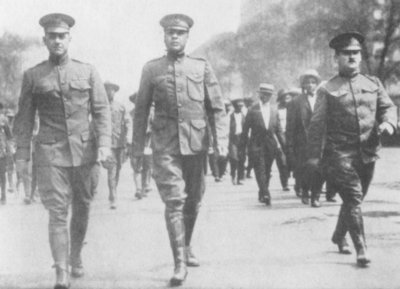
OFFICERS OF THE 15TH NEW YORK (369TH INFANTRY), MARCHING IN PARADE PRIOR TO THE WAR. LEFT TO RIGHT—COL. WM. HAYWARD, BERT WILLIAMS. FAMOUS COMEDIAN AND DR. G. McSWEENEY.
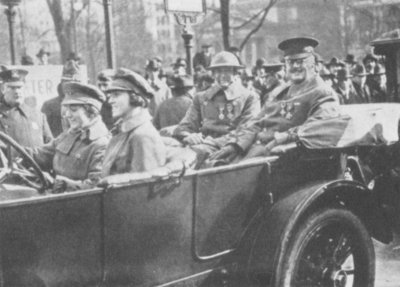
AFTER THE WAR. ONE OF THE NUMBER OF AUTOMOBILES BEARING WOUNDED OFFICERS AND SOLDIERS OF THE 15TH NEW YORK (369TH INFANTRY). MAJOR DAVID L. 'ESPERANCE (WITH HELMET) AND MAJOR LORRILARD SPENCER.
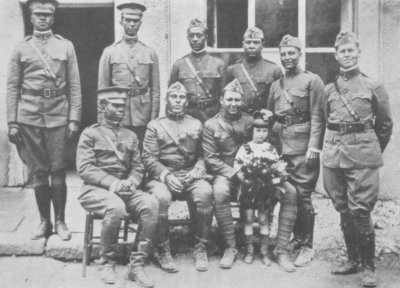
A REPRESENTATIVE GROUP OF NEGRO OFFICERS OF "MOSS'S BUFFALOES" (167TH INFANTRY). THE LITTLE LADY WITH THE BOUQUET IS ONE OF THEIR FRENCH ACQUAINTANCES.
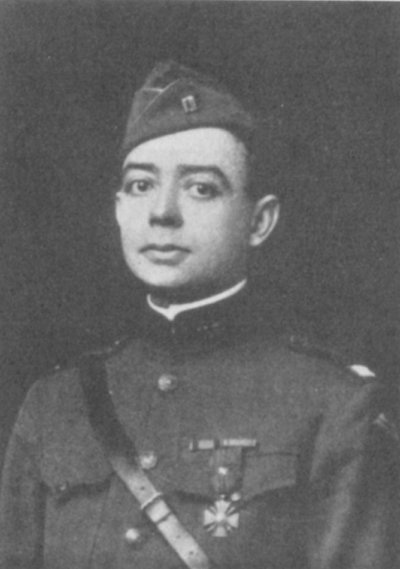
CAPTAIN JOHN H. PATTON, REGIMENTAL ADJUTANT, 8TH ILLINOIS INFANTRY. FROM JUNE 26, 1916, TO SEPTEMBER 11, 1918. COMMANDING 2ND BATTALION, 370TH INFANTRY, FROM SEPTEMBER 11, 1918, TO DECEMBER 25, 1918. SAINT MIHIEL SECTOR FROM JUNE 21, 1918, TO JULY 3, 1918. ARGONNE FOREST FROM JULY 6, 1916, TO AUGUST 15, 1918. BATTLES FOR MONT DES SIGNES, FROM SEPTEMBER 16 TO 30, 1918. OISE-AISNE OFFENSIVE, FROM SEPTEMBER 30, 1918. TO NOVEMBER 11, 1918. AWARDED THE FRENCH CROIX DE GUERRE FOR MERITORIOUS SERVICE COVERING PERIOD FROM SEPTEMBER 11 TO NOVEMBER 11, 1918.
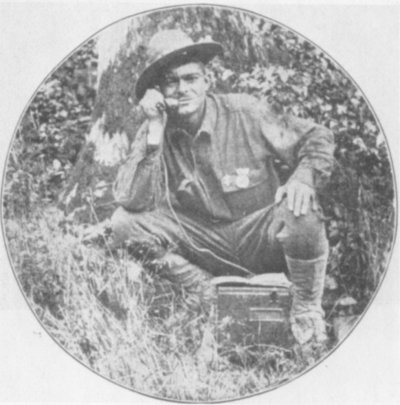
EMIL LAURENT, NEGRO CORPORAL OF 8TH ILLINOIS (370TH INFANTRY), A CROIX DE GUERRE WINNER, ENGAGED IN FIELD TELEPHONE SERVICE IN A FRENCH WOOD.
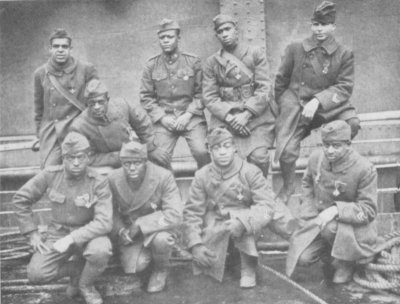
GROUP OF "HELL FIGHTERS' (369TH INFANTRY) WITH THEIR JEWELRY (CROIX DE GUERRE). FRONT ROW, LEFT TO RIGHT, "EAGLE EYE" EDWARD WILLIAMS, "LAMP LIGHT" HERB TAYLOR, LEON TRAINOR, "KID HAWK" RALPH HAWKINS, BACK ROW, LEFT TO RIGHT, SERGT. M.D. PRIMUS, SERGT. DANIEL STORMS, "KID WONEY" JOE WILLIAMS, "KID BUCK" ALFRED HANLY AND CORP. T.W. TAYLOR.
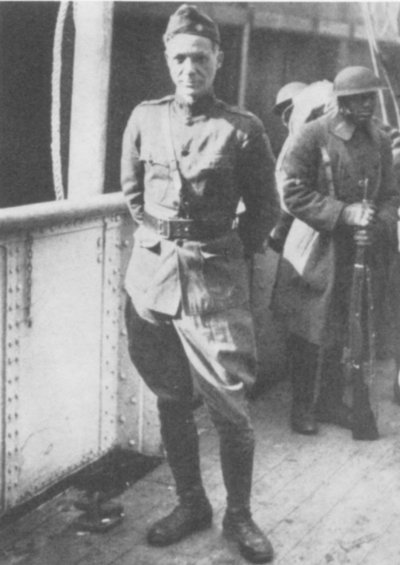
DR. JOSEPH H. WARD ON TRANSPORT FRANCE. THE ONLY NEGRO ATTAINING THE RANK OF MAJOR IN THE MEDICAL CORPS OF THE AMERICAN EXPEDITIONARY FORCES.
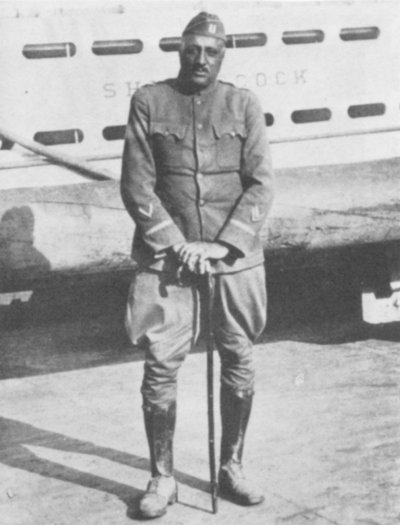
CAPTAIN NAPOLEON B. MARSHALL, FAMOUS HARVARD ATHLETE, WHO HELPED ORGANIZE 15TH NEW YORK AND WAS ONE OF ITS ORIGINAL NEGRO OFFICERS. HE WAS SERIOUSLY WOUNDED AT METZ.
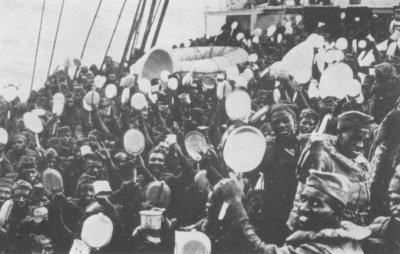
BRAVE NEGROES HOMEWARD BOUND FROM WAR. FIRST CALL FOR DINNER.
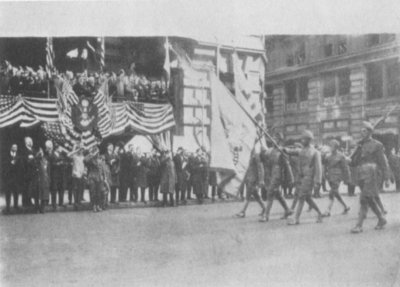
"MOSS'S BUFFALOES" (367TH INFANTRY), REVIEWED BY GOVERNOR WHITMAN AFTER FLAG PRESENTATION IN FRONT OF UNION LEAGUE CLUB, NEW YORK.
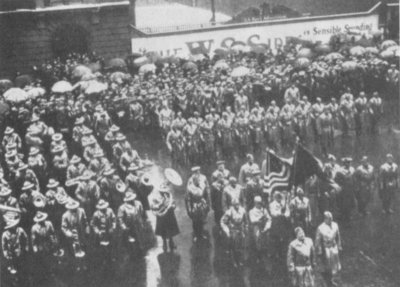
THE "BUFFALOES" (367TH INFANTRY), RETURNING TO NEW YORK AFTER VALIANT SERVICE IN FRANCE. THEIR COLORS STILL FLYING.
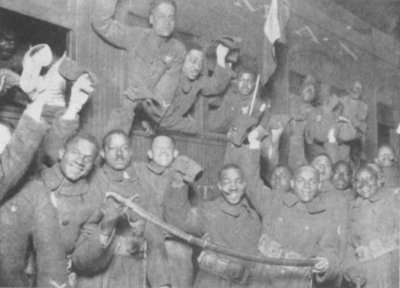
SOLDIERS WHO DISTINGUISHED THEMSELVES AT THE FORTRESS OF METZ. GROUP BELONGING TO 365TH INFANTRY ARRIVING AT CHICAGO STATION.
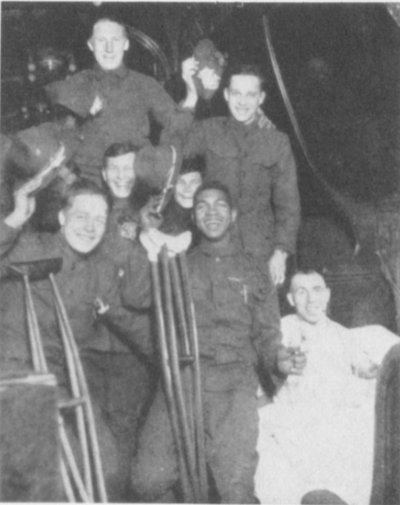
HOMEWARD BOUND IN A PULLMAN CAR. NO "JIM CROWING THERE." THE NEGRO BEARS ON HIS SHOULDER THE CITATION CORD AND EMBLEM DENOTING VALOROUS SERVICE.
Lieutenant Walker, who arrived just at this time, took hold of matters with admirable coolness and presence of mind. Sergeant Atwood tried out the switchboard and found all lines broken. He also found on trying it the buzzerphone out. Lieutenant Walker gave orders to Private White to stay on the switchboard and Corporal Adolphus Johnson to stay on the buzzerphone. The twelve-cord monocord board was nailed up by White and then began the connecting up of the lines from outside to the monocord board. All this time the shelling by the Germans was fierce and deadly. Shells struck all around the boys and one struck a nearby ammunition dump, causing the explosion of thousands of rounds of ammunition, which created a terrific shock and extinguished all the lights.
But still the men worked on and would not leave the dangerous post, a veritable target for the enemy's big guns, until the lieutenant of the Military Police arrived and ordered them out.
The 325th Field Signal Battalion was a great success. What the boys did not learn about radio, telephonic and telegraphic work would be of little advantage to anyone. It will be of great advantage to many of them in the way of making a living in times of peace.
By the time the armistice stopped the fighting the different units of the 92nd Division had taken many prisoners and gained many objectives. They finally retired to the vicinity of Pont a Mousson, where time was spent salvaging material and cleaning equipment, while the men, knowing there was to be no more fighting, anxiously awaited the time until they were ordered to an embarkation point and thence home.
The trip home in February, 1919, was about as perilous to some of them as the war had been. It was a period of unusually rough weather. The north Atlantic, never very smooth during the winter months, put on some extra touches for the returning Negro soldiers. An experience common to many on several different transports has been described by Mechanic Charles E. Bryan of Battery B, 351st Artillery upon his return to his home, 5658 Frankstown Avenue, Pittsburgh, Pa. Asked about his impressions of the war, he said that which impressed him the most was the storm at sea on the way home.
"That storm beat the war all hollow," he said. "Me and my buddies were messing when the ship turned about eighteen somersaults, and we all pitched on the floor, spilling soup and beans and things all over the ship.
"The lights went out and somehow the automatic bell which means 'abandon ship' was rung by accident. We didn't know it was an accident, and from the way the ship pitched we thought she was on her way down to look up one Mr. Davy Jones. So we made a break for the decks, and believe me, some of those lads who had come through battles and all sorts of dangers were about to take a dive over the side if our officers had not started explaining in time."
Stories of varying degrees of interest, some thrilling, some humorous and some pathetic to the last degree, have been brought back.
Ralph Tyler, the Negro newspaper man, who was sent to France as the official representative of the Afro-American press by the Committee on Public Information, has written many of the incidents, and told others from the rostrum. He has told how the small insignificant, crowded freight cars in which the soldiers traveled looked like Pullman parlor coaches to the Negro soldiers.
"To many of our people back in the 'States,'" wrote Mr. Tyler from France, "who saw our boys embark on fine American railroad coaches and Pullman sleepers to cover the first lap of their hoped-for pilgrimage to Berlin, the coaches they must ride in over here would arouse a mild protest. I stood at Vierzon, one of France's many quaint old towns recently, and saw a long train of freight cars roll in, en route to some point further distant. In these cars with but a limited number of boxes to sit upon, and just the floors to stand upon, were crowded some 1,000 of our own colored soldiers from the States. But a jollier crowd never rode through American cities in Pullman sleepers and diners than those 1,000 colored troopers. They accepted passage on these rude box freight cars cheerfully, for they knew they were now in war, and palace cars, downy coaches and the usual American railroad conveniences were neither available nor desirable. "The point I wish to convey to the people back home is that did they but know how cheerfully, even eagerly our boys over here accept war time conveniences, they would not worry quite so much about how the boys are faring. They are being wholesomely and plenteously fed; they are warmly clothed, they are cheerful and uncomplaining as they know this is war and for that reason know exactly what they must expect. To the soldier who must at times sleep with but the canopy of heaven as a covering, and the earth as a mattress, a box freight car that shields him from the rain and wind is a real luxury, and he accepts it as such. "There need not be any worry back home as to the maintenance of our colored soldiers over here. They receive the same substantial fare the white soldier receives, and the white soldier travels from point to point in the same box freight cars as afford means of passage for colored soldiers. In short, when it comes to maintenance and equipment, and consideration for the comfort of the American soldier, to use a trite saying, 'the folks are as good as the people.' There is absolutely no discrimination, and the cheerfulness of those 1,000 boys whose freight cars became, in imagination, Pullman palace cars, was the proof to me that the colored boys in the ranks are getting a fifty-fifty break." "Two more stories have come to me," continues Mr. Tyler, "to prove that our colored soldiers preserve and radiate their humor even where shells and shrapnel fly thickest. A colored soldier slightly wounded in the Argonne fighting—and let me assure you there was 'some' fighting there—sat down beside the road to wait for a chance to ride to the field hospital. A comrade hastening forward to his place in the line, and anxious for the latest news of the progressing battle, asked the wounded brother if he had been in the fight; did he know all about it, and how were things going at the front. 'I sure does know all about it,' the wounded man replied. 'Well, what's happened to them?' quickly asked the trooper on his way to the front. 'Well, it was this way,' replied the wounded one, 'I was climbin' over some barbed wire tryin' to get to those d—n Boches, and they shot me; that's what I know about it.' "A company water cart was following the advancing troops when a German shell burst in the ditch almost beside the cart. The horse on the shell side was killed, and the driver was wounded in the head. While the blood from his wound ran freely down his face, the driver took one look at the wreckage, then started stumbling back along the road. A white lieutenant who had seen it all stopped the driver of the cart and said: "The dressing station is—" "Before he could finish his sentence, the wounded driver, with the blood flowing in rivulets down his face, said: 'Dressing station hell; I'm looking for another horse to hitch to that cart and take the place of the one the shell put out of commission.' "That was a bit of nerve, grim humor and evidence of fidelity to duty. A mere wound in the head could not stop that driver from keeping up with the troops with a needed supply of water."
Dr. Thomas Jesse Jones, who went to France under the auspices of the Y.M.C.A., sent back the following account of the burial of a Negro soldier at sea:
"A colored soldier was buried at sea today. The flags on all the ships of the fleet have been at half-mast all day. It mattered not that the soldier came from a lowly cabin. It mattered not that his skin was black. He was a soldier in the army of the United States, and was on his way to fight for Democracy and Civilization. "The announcement of his death was signalled to every commander and every ship prepared to do honor to the colored soldier. As the sun was setting the guard of honor, including all the officers from commander down, came to attention. The body of the Negro trooper wrapped in the American flag, was tenderly carried to the stern of the ship. The chaplain read the solemn burial service. The engines of the fleet were checked. The troop ship was stopped for the only time in the long trip from America to Europe. The bugle sounded Taps and the body of the American soldier was committed to the great ocean and to God. "The comradeship of the solemn occasion was the comradeship of real Democracy. There was neither black nor white, North nor South, rich nor poor. All united in rendering honor to the Negro soldier who died in the service of humanity."
First Lieutenant George S. Robb of the 369th Infantry was cited for "conspicuous gallantry and intrepidity above and beyond the call of duty" in action with the enemy near Sechault, September 29 and 30, 1918.
While leading his platoon in the assault at Sechault, Lieutenant Robb was severely wounded by machine gun fire, but rather than go to the rear for proper treatment, he remained with his platoon until ordered to the dressing station by his commanding officer. Returning within forty-five minutes, he remained on duty throughout the entire night, inspecting his lines and establishing outposts. Early the next morning he was again wounded, once again displaying remarkable devotion to duty by remaining in command of his platoon.
Later the same day a bursting shell added two more wounds, the same shell killing the captain and two other officers of his company. He then assumed command of the company and organized its position in the trenches. Displaying wonderful courage and tenacity at the critical times, he was the only officer of his battalion who advanced beyond the town and, by clearing machine gun and sniping posts, contributed largely to the aid of his battalion in holding its objective. His example of bravery and fortitude and his eagerness to continue with his mission despite the several wounds, set before the enlisted men of his command a most wonderful standard of morale and self-sacrifice. Lieutenant Robb lived at 308 S. 12th Street, Salina, Kansas.
Second Lieutenant Harry C. Sessions, Company I, 372nd Infantry, was cited for extraordinary heroism in action near Bussy Farm, September 29, 1918.
Although he was on duty in the rear, Lieutenant Sessions joined his battalion and was directed by his battalion commander to locate openings through the enemy's wire and attack positions. He hastened to the front and cut a large opening through the wire in the face of terrific machine gun fire. Just as his task was completed, he was so severely wounded that he had to be carried from the field. His gallant act cleared the way for the rush that captured enemy positions.
In August, 1918, back in the Champagne, a German raiding party captured a lieutenant and four privates belonging to the 369th Infantry, and was carrying them off when a lone Negro, Sergeant William Butler, a former elevator operator, made his presence known from a shell hole. He communicated with the lieutenant without the knowledge of the Germans and motioned to him to flee. The Lieutenant signalled to the four privates to make a run from the Germans. As they started Butler yelled, "Look out, you Bush Germans! Here we come," and he let go with his pistol. He killed one Boche officer and four privates, and his own men made good their escape. Later the German officer who had been in charge of this raiding party was captured and his written report was obtained. In it he said that he had been obliged to let his prisoners go because he was attacked by an "overwhelming number of blutlustige schwartzemaenner." The overwhelming number consisted of Elevator Operator Bill Butler alone.
September 30th the 3rd Battalion, of the 370th Infantry, composed of down-state Illinois boys from Springfield, Peoria, Danville and Metropolis, achieved a notable victory at Ferme de la Riviere. This battalion, under the brilliant leadership of Lieutenant Colonel Otis B. Duncan, made an advance of one kilometer against enemy machine gun nests and succeeded in silencing them, thereby allowing the line to advance. This battalion of the Illinois down-state boys succeeded in doing what, after three similar attempts by their French comrades in arms, had proven futile. During this engagement many were killed and wounded and many officers and men were cited and given decorations.
Company C, of the 370th, under the command of Captain James H. Smith, a Chicago letter-carrier, signally distinguished itself by storming and taking the town of Baume and capturing three pieces of field artillery. For this the whole company was cited and the captain was decorated with the Croix de Guerre and Palm.
Lieutenant Colonel Duncan, who has been attached to the office of State Superintendent of Public Instruction of Illinois for over twenty years, is one of the greatest heroes the Negroes of America have produced. He returned as the ranking colored officer in the American Expeditionary Forces. Instead of being merely an assistant Colonel, he was actively in command of one of the hardest fighting battalions in the regiment. He has been pronounced a man of native ability, an able tactician and of natural military genius.
Sergt. Norman Henry, 5127 Dearborn St., Chicago, attached to the 3d Machine Gun Company, 370th Infantry, won the Croix de Guerre and Distinguished Service Cross. It was in the Soissons sector September 30 in the first rush on the Hindenburg line.
All of the officers and men fell under a heavy machine gun barrage except two squads of which Sergeant Henry was left in command. They took two German dugouts and were cut off from their own line without food. They held the Germans off with one machine gun for three days. Often the gun became jammed, but they would take it apart and fix it before the enemy could get to them.
Lieut. Samuel S. Gordon, 3934 Indiana Avenue, Chicago, of the 370th Infantry, exposed himself to open machine gun fire for six hours and effected the rescue of two platoons which had been cut off by the barrage.
Company H had been badly cut up in a sudden burst of machine gun fire. Lieutenant Gordon with some men were rushed up to relieve what was left of the company, and while reconnoitering were cut off by the same fire. A stream of water four feet deep lay between them and their trenches. By standing in the stream, Lieutenant Gordon let the men crawl to the edge of the bank, where he lifted them across without their having to stand up and become targets.
Corporal Emile Laurent, 5302 So. Dearborn Street, Chicago, a member of the 370th Infantry, had a busy time dodging machine gun bullets one night near Soissons. Volunteering as a wire cutter, he crawled out with his lieutenant's automatic in one hand and the wire clippers in the other. Half a dozen machine guns were opened upon him as he sneaked along the terrain. "Never touched me," he would yell every time a chunk of steel parted his hair. He was out for three hours and cut a broad line through the charged wire. Then he crawled back without a mark on him.
Private Leroy Davis of the same regiment, won a decoration at the Aillette Canal for bringing a comrade back under machine gun fire. When he got back to his own lines he would not trust him with the ambulance outfit, but carried him three miles to the emergency dressing station and then he ran back to the canal to get even. This little stunt saved his comrade's life.
Praise for the American soldier comes from Charles M. Schwab, the eminent steel manufacturer, who was chosen by President Wilson to head the Emergency Fleet Cororation, and rendered such conspicuous service in that position. Returning in February, 1919, from a trip to Europe, Mr. Schwab said in an interview:
"I have come back with ten times the good opinion I had of our soldiers for the work they did. Everywhere I went I found that the American soldiers had left a good impression behind and there was nothing but the greatest praise for them. "During the present voyage I have been among the colored troops on board and talked with them and learned what American soldiering has done for them. They are better men than they were when they went away."