MADELEY. (continued 5)
Reading edition
For some years the proceeds of the charity were given away to the poor—blankets were bought and distributed; but for over forty years, prior to the last distribution in 1879, it had been accumulating, excepting that on the first and second visitations of the cholera, it was made use of for the purpose of alleviating the distress then existing; and it had been thought advisable to permit its accumulation for the purpose of forming a reserve fund on which to fall back in times of urgent distress, whether arising from contagious disease or depression of trade.
The charge of £18 per annum upon the old poor-house was transferred to the new, and is still paid to the trustees; and to the sum accumulated has been added the £750 which the old workhouse sold for, and it was out of the interest of the whole that the last distribution of the funds of the charity took place in 1879, when blankets to the value of £70 or thereabouts were given away.
The union of parishes was formed in 1836, and Wm. Anstice, Esq. was chosen chairman. He held office for fifteen years, and was succeeded by G. Pritchard, Esq. who held it for eleven years. At his death W. Layton Lowndes, Esq. was elected, and held the office for seventeen years. John Arthur Anstice, Esq., who succeeded Mr. Lowndes on his retirement in April 25th, 1879, now discharges the duties of the office.
A building erected and designed for the poor of one parish was scarcely likely to be suited to the wants of a number of parishes, like Barrow, Benthall, Broseley, Buildwas, Dawley, Linley, Little Wenlock, Madeley, Posenhall, Stirchley, and Willey, which formed the new Union; and although additions were made from time to time the building was evidently inadequate for the accommodation of the number of paupers, tramps, &c., who sought aid or refuge within its walls. It was some time however after the subject was broached before anything was decided. Some Guardians advocated the further enlargement of the old building, whilst others were for a new one entirely; but these even differed among themselves, some being in favour of a new building on the old site, whilst others advocated another site and a new plan altogether. The Poor Law Commissioners at Somerset House accelerated the issue by threatening to close the old building, as unfit for the uses to which it was put; the result being that a site was purchased and the present extensive and well arranged suite of rooms, wards, &c., with their various conveniences, were erected. The original loan of £6,000 obtained in 1870 towards the purchase of the site and the erection of the building was to be paid back by instalments out of the rates levied in the several parishes of the Union, according to the proportions of the rating. The loan altogether has been £10,000, and, with interest, the cost of the erection may be said to have been £13,800; but a further sum of £600 is required for the erection of tramp wards. The building stands upon 7¾ acres, which was purchased at a cost of £1,700; and six acres, previously very rough ground, is under cultivation, and made productive, and in part highly ornamental, by the judicious labour of the inmates of the house. Altogether the grounds and building have a pleasing rather than that forbidding appearance such institutions sometimes have. The building consists of a front range, with central entrance, with master’s sitting room, board room, and clerk’s offices, on the right; whilst on the left are the visitor’s rooms, and one for the porter, with male and female receiving wards, bath room &c.
Inside the quadrangle we get central offices of various kinds, cooking and dining rooms, pantry, clothing room, master and matron’s offices. On the right are the laundry, the washhouse, work rooms, able bodied women’s rooms, children’s room, old infirm women’s room, and three small apartments for married couples. There is also a dormitory on the ground floor for old and infirm women; and over the whole of the offices and rooms mentioned are bedrooms. On the left are similar arrangements to those we have mentioned for the men, but with workshops for carpenters and tailors. On the east is the infirmary, a detached building, with male and female apartments, nurses, &c.; and below this a fever hospital. The whole building is capable of giving accommodation to 225 inmates; but at the time we write 88 are the total number, notwithstanding the very depressed state of trade; and 90, we learn, is about the average.
We visited many of the rooms, that in describing the building we may be able to give our own impressions of the appearance of the inmates. The bedrooms were tenantless, but clean, well lighted and airy; we could not say however what they would be from the breath of so many sleeping in them at night time. Many of the old people we saw in the day rooms were very old, and a large number imbecile, several having been recently brought here from Bicton Heath Asylum. And although this was the case with the women there seemed something about the internal domestic arrangements, which, in giving them employment, seemed to create interest. There was a cheerful alacrity among the female workers, in washing, ironing, mending, making, and scrubbing, and a readiness in replying to questions put by the matron which seemed to speak favourably of the way in which she discharges her duties amongst them. In the “day-rooms” of the men too, although we saw feebleness and age, we saw little of that torpid inanimateness, helplessness, and hopeless looking withered faces one is apt to look for in workhouses. Some were dim-eyed with age, but others were reading books, and more would read no doubt if they had something to read which was interesting. And why should they not have? Here were old men 75, 80, and “going of 85,” sitting round a good cheerful fire in a snug room to whom a few illustrated books or newspapers, which everybody could spare, would be a godsend. If all cannot read some can, and they would be pleased to amuse or interest their fellows. We suggested as much to Mrs. Hayes, the matron, who approved of the suggestion of these and of a few prints hung up in the bedrooms, as well as the day and school rooms; as also did the Rev. H. Wayne, one of the Guardians, who wished we had been in time to make the suggestion to the board. We mention it here that it may be acted upon by others, if the board, or to the master, to whom all such books, prints, or papers should be submitted, approve. Age and infirmity require as much commiseration as childhood, and in very many respects the same means will comfort and solace the aged and impotent as the young child. We ought at any rate to try to make old age endurable. If we do not do this we but add to the weight of old age already bent down with infirmities, and—
‘We furnish feathers for the wing of death.’
One thoughtful lady had, we found, kindly furnished the school-room with some really good prints and drawings. On sunny and suitable days Mr. Hayes employs the men in the grounds, and by the growth of vegetables contributes to the maintenance of the establishment, of which we might say much more if space permitted.
The amount administered in out-door relief at present is a little over that of in-door maintenance, which for the half year ending Michaelmas, 1878, was £544 11s. 2¼d
We have already mentioned Master and Matron: Clerk to the Board Mr. H. Boycott; Chaplain Rev. G. Wintour. Relieving officers Mr. W. Morris and Mr. W. T. Jones.
THE CHOLERA.
If some memorable occurrences in local history may be termed ‘red lettered,’ the fearful visitations of this epidemic in 1832 and 1848 may be said to have been black, and very black lettered events indeed. The steady march of this dire disease from Asia over the continent of Europe towards our shores in 1831 created the utmost alarm of approaching danger, and led to precautionary measures being taken. Medical science however was at fault; contradictory advice was given; orders in council were issued and withdrawn; and people were at their wits’ end what steps to take. A rigid system of quarantine was at first enforced; and when the enemy did arrive it was ordered that each infected district or house was to be isolated and shut up within itself, and the inhabitants cut off from communication with other parts of the country; and ‘all articles of food or other necessaries were to be placed in front of the house, and received by the inhabitants after the person delivering them had retired.’ It was in fact the exploit over again of the gallant gentleman who proposed, as Milton says, to ‘pound up the crows by shutting his park gate.’ Clinging to the belief that the disease was imported and spread by contagion, few really remedial measures founded on the hypothesis of the low sanitary condition of the population—as bad drainage, ill-ventilated and overcrowded dwellings, offensive sewers, unwholesome water, and the thousand other kindred abominations which afflict the poor, were suggested. But feelings and sympathies were naturally with the patient and against the unchristian edict which said to him—‘Thou art sick, and we visit thee not; thou art in prison, and we come not unto thee’. Gradually too it dawned upon the minds of the authorities—as the result of observation and experience—that it was not so much from direct communication that persons were affected, as from bad sanitary conditions;—for persons were not consecutively affected who lived in the same house or slept in the same bed with the sick; and that children even suckled by mothers labouring under the disease escaped. On Wednesday, the 21st of March, 1832, there was a general fast for deliverance from the plague, as it was called, but it was pretty much the same as Æsop’s case of the carter who prayed Jupiter to get his cart wheel out of the rut; and the answer vouchsafed by Providence was similar—‘put your own shoulder to the wheel’, do what you can first to make the people clean and wholesome. We have no statistics or recorded facts to fall back upon, but so far as our knowledge and experience serves us we should say that the first victims in this neighbourhood were among men and women who led irregular lives, and who lived in dirty ill-ventilated homes, and in the decks and cabins of barges going long voyages, in which men slept and ate their meals; and persons on the banks of the Severn, who drank the polluted water of the river. A case occurred at Coalport, on the 21st of July, 1832, on board a barge on the Severn, which belonged to owner Jones; and it was thought prudent to sink the vessel to destroy the contagion. A man named Richard Evans also was taken with the cholera on board a Shrewsbury barge, and was removed to the “Big House,” as it was called, at the Calcutts, which had been hired and set apart by Mr. George Pritchard and others for the reception of victims. On the 23rd, Thomas Oakes, son of John Oakes, died on board Dillon Lloyd’s vessel, and during that month and the next the plague continued its ravages by the Severn. From an old diary we learn that a man named Goosetree, his wife, and three children, were seized on the 14th of August at the Coalport Manufactory, and died the same day; as also did a Mrs. Baugh and her mother.
The more ignorant of the people were suspicious of the doctors; Mr. Thursfield on the 23rd of July visited a house at Coalford, and offered a draught to a woman whom he suspected of shewing symptoms of the disease, but was beaten off by her daughter Kitty, who said her mother wanted food and not medicine. The doctor does not appear to have been popular judging from doggrel lines in circulation at the time—
‘The cholera morbus is begun And Dr. Thursfield is the mon To carry the cholera morbus on.’
A man named William Titley, whilst drinking, dancing, and singing this to a public house company, was taken with the disease, and died next day. William Fletcher, a carpenter, whilst employed in making the coffin intended for Titley, was seized, and died next day, and was buried in the coffin he had made for another. A few days after, on the 14th of September, Israel Weager, a barge block-maker, who wore dirty and greasy clothes, who was grimy and dirty also in his person, and worked in a wretched shed by the Robin Hood public house, was another taken about the same time who died. During the remainder of the same month, and those of October, November, and December, the cholera continued to find victims. Men drank hard to ward off the disease and sowed the seeds which brought it on. Men and women were taken ill, died, and were buried the same day; and some were probably buried before they were dead. One man, a well known cock-fighter at Broseley, was attacked with the disease, and so stupefied by brandy that he was supposed to be dead. He was taken to the cholera ground adjoining Jackfield church on the hill, and the rattle of the soil upon the coffin which accompanied the words “ashes to ashes” &c., roused him from his stupor, when the bystanders hearing a noise lifted the lid and the old cocker came forth. [253] We believe his name was William Roberts, judging from the diary before mentioned, and that the event occurred on the 14th of September; and that on the 1st of October his wife and two children died of the plague, and were buried the same day. At many places it was much worse than it was here. At Bilston, for instance, it raged so fiercely that forty-five victims died in one day; and not less than twenty for several days running; and their neighbours at Birmingham presented a waggon load of coffins, as being the most acceptable present they could make. It was bad enough here; church bells were tolling, hearses and cholera carts were in motion often, and at untimely hours, early and late, by torch light, or accompanied by the feeble light of a lantern; and a melancholy sadness settled upon all. Many journeys were made by the “cholera cart from the Workhouse” to Madeley church-yard, with just sufficient of the inmates of the house to convey the corpse to the hole dug for it. It must not be supposed however that the victims to this terrible plague were confined to the lower classes, many of the well-to-do were stricken and died: the sister of the present Lord Forester, we are informed by the diary referred to, died on the 23rd of July of cholera in London. At last the evil spent itself and subsided; it was a fearful curse, but it had the effect of convincing us that something more than fasts and well-seasoned sermons were needed to prevent or remove the epidemic: and so much was done by public attention being called to the effects bad sanitary conditions had on the physical causes of sickness and mortality, by Dr. Southwood Smith in 1838, and by evidence by Mr. Slaney, M.P., for Shrewsbury, who obtained a select committee to enquire into the circumstances affecting the health of the inhabitants of large towns, with a view to improved sanitary regulations for their benefit, in 1840, that the knowledge gained enabled medical men successfully to grapple with the epidemic when it again threatened to spread itself over the country in 1848.
THE SEVERN.
The Severn at present is of little service to the parishioners of Madeley, either as a source of food or a means of transit, compared with what it was in former times. Yet washing as it does the whole of the western side of the parish, from Marnwood brook to the brook which separates Madeley and Sutton parishes, it deserves notice. There was a time when it supplied a considerable portion of food to those living upon its banks; and when, whilst other parts of the country, less favoured, were labouring under the disadvantages of land conveyance, over roads scarcely passable, and by machines but imperfectly constructed, its navigation conferred superior privileges; both by the importation of hay, corn, groceries &c., and the exportation of mines and metals produced along the valley through which it runs. The river, inconsiderable in its origin, is indebted for its navigable importance to physical peculiarities of country that constitute its basins. An extensive water-shed of hills, whose azure tops court the clouds, brings down a large amount of rain to swell the volume of its stream. From its source to its estuary in the Bristol Channel it gathers as it rolls from rivers and brooks, which, after irrigating rich pasture lands along their banks, pour their waters into its channel. The Teme, augmented by the Clun, the Ony, the Corve, the Avon, and the Wye, having each performed similar pilgrimages through flower-dotted fields, also pay tribute of their waters. Here weaving its way through a carpet of the richest green it visits sheep-downs, cattle-pastures, orchards, hop-plantations, and hay-producing fields, as it sweeps along, conferring benefit upon the soil, increasing the fertility of fields, aiding in the development of mines, linking important wealth producing districts, bringing materials for manufacturing purposes together, and transporting their products to the sea.
This formerly more than now, so that Agriculture, and commerce felt its quickening influence and bore witness to its sway. Feeders, which capital with talismanic touch opened up by cuttings on the plain, aqueducts or embankments across the vale, tunnels, locks, and other contrivances among the hills to overcome inequalities of surface ran miles through inland districts to collect its traffic. The Shropshire, the Shrewsbury, and the Ellesmere Canals, united the Severn, the Mersey, and the Dee, and the rival ports, Liverpool and Bristol. Shrewsbury, Coalbrookdale, Coalport, Bridgnorth, Bewdley, Stourport, Worcester, and Gloucester, were centres from which its traffic flowed; iron crude and malleable, brick and tile, earthenware and pipes, were sent, the former in large quantities from wharfs at Coalbrookdale, and from others between Ironbridge and Coalport. The Shropshire trade was carried on by means of vessels from 40 to 78 and 80 tons burthen, drawing from three to four feet, which went down with the stream, and were drawn back by horses, or men or both. In consequence of the rapidity of the current over the fords not more than 20, 30, or 40 tons were usually carried up the river. About 20 voyages in the year were usually made by regular traders, but vessels carrying iron made more. The time occupied for full cargoes to get down to Gloucester was about 24 hours.
In 1756, there were at Madeley-Wood, 21 owners of vessels of 39 vessels. But many more than these came to the Meadow, and Coalport wharves. Hulbert, writing about half a century ago says: “standing upon Coalport bridge I have counted seventy barges standing at Coalport Wharf, some laden and others loading with coal and iron.” Madeley-Wood supplied fire-clay and fire-bricks for many years to the porcelain and other works at Worcester. Originally, when Fuller speaks of coals being exported by barges, and when during the Civil Wars the Parliamentary forces planted a garrison at Benthall to prevent the barges carrying coal down the river, vessels were drawn against the stream by strings of men linked to ropes by loops or bows, who were called bow-haulers. It was slavish work; and Richard Reynolds was so struck with the hardship and unfitness of the practice that he exerted himself to obtain an Act of Parliament for the construction of a road by the side of the river, now called the towing path, by which horses were substituted. Sometimes, when a favourable wind blew against the stream, vessels with all sails set would make good progress without further assistance; and it was a pleasing sight to see these and the larger ones, the trows, sailing along the valley. Had means been taken to improve the channel of the Severn, this noble river, navigable for 180 miles, may have been in a much more flourishing condition than at present.
Like opposing interests for and against improvements in the channel, between which the battle of locks and weirs was fought, two opposing forces have been striving for mastery in the tideway of the channel. One contending for an estuary, the other for a delta. Draining a district six thousand square miles in extent, having a fall of two hundred and twenty feet in its descent from its source on Plynlymmon, (1,500 feet above the sea line), to its tideway in the Bristol Channel, and being fed by boisterous brooks and precipitous streams that cut their way through shales and clays and sand-rocks, it is not surprising that the Severn should bring down a vast amount of silt to raise its bed. To correct these irregularities along a portion of the river, improvements, projected by Sir William Cubitt, some years since, were completed at very considerable outlay, after an expenditure of £70,000 before the sanction of Parliament could be obtained. Above Stourport, where these improvements terminate, the river is still in a state of nature. Except some pedling attempts by means of earth, loose stones, or sinking some dilapidated boats along the side, nothing has been done to improve the channel. The scouring action of the stream constantly undermines the banks. These give way after every flood, and come down to choke the river, or to change the channel, and every newly-formed shoal sends the stream at right angles to its bed to make fresh attempts upon its banks. Fords that served our painted ancestors to make incursions beyond their boundaries, bends almost amounting to circles around which they paddled their canoes, impede navigation still. Attempts to overcome these natural obstacles to its navigation were made as early as 1784, when Mr. Jessop proposed to render the river navigable for vessels drawing four feet at all seasons of the year from Worcester to Coalbrookdale. He proposed to obtain a sufficient depth for that purpose at all seasons of the year by the erection of 13 or 14 weirs between those places; he also recommended that that depth should be obtained below Diglis by dredging and correcting the natural channel of the river, and the Stafford and Worcester Canal Company, joined by the iron manufacturers of Shropshire, applied in the year 1786 to parliament for powers to carry out Mr. Jessop’s recommendations, so far as they related to the portion of the river described in the title of the bill, as from Meadow-wharf, Coalbrookdale, to the deep water at Diglis, below the city of Worcester. The bill was lost owing to the objections on the part of the public to the erection of locks and weirs, and owing to the dislike of the carriers to pay toll at all seasons of the year. As it is, there are often three, four, and five months when barges cannot navigate the river with a freight equal to defray the expenses of working them; indeed, instances have occurred in which in only two months of the twelve the river could be advantageously worked. Besides the additional wear and tear, more strength is required to work the vessel, and it takes treble the time to convey 15 tons at low water as it does four times that weight at other times.
To improvements that affect only a portion of the river, and that the lower portion, the Shropshire traders very naturally took objection. They saw that for any benefit to be derived from navigating the lower portion of the Severn they would be taxed, without being able themselves to participate in it, and at a meeting of iron and coal masters, Severn carriers, and others, held at the Tontine Inn, Ironbridge, on the 2nd of December, 1836, for the purpose of taking into consideration the propriety of opposing the project of the Worcester Severn Navigation Company, for the introduction of locks and weirs upon the river, Richard Darby, Esq., in the chair, it was resolved,
“That having attentively considered the plan proposed by the Worcester Severn Navigation Company, for effecting alterations in the channel of that river, it is of opinion that, whilst the execution of that plan affords no stable prospect of extensive advantage to the public at large, its effects upon a variety, of important local interests, and particularly upon the trading community of this neighbourhood, will be in the highest degree injurious. That the introduction of these works, even if Shropshire vessels were permitted to pass them free of any impost, would be injurious to the traders of this county, but that the exaction from that body of a toll or tonage for such passage would inflict on them a burden of the most unjust and oppressive character. That a petition or petitions in opposition be accordingly at the proper stage presented, and supported by evidence, according to the course of Parliamentary proceeding, and that every exertion be used to obtain the support of members of both houses to the prayer of such petitions.”
The following gentlemen were appointed a committee:—Mr. Botfield, Mr. Mountford, Mr. John Horton, Mr. Richard Darby, Mr. Abraham Darby, Mr. Alfred Darby, Mr. Anstice, Mr. Hombersley, Mr. Rose, Mr. William Pugh, Mr. William James, Mr. Dickinson, Mr. George Pritchard, Mr. John Owen, Mr. Samuel Roden, Mr. John Burton, Mr. John Anstice, Mr. Francis Yates, Mr. John Dyer Doughty, Mr. Edward Edwards, Mr. Samuel Smith, Mr. George Chune. The agitation proved so far successful that a clause was inserted in the bill exempting the Shropshire traders coming down with full cargoes from toll. This exemption was subject to the qualification that if in descending the river they took in, or in ascending it they took out any goods whatever within the improved portions of the river, their whole cargoes should be subject to toll. This concession cost the Shropshire interest a long and expensive opposition before a committee of the House of Commons. At subsequent periods the Shropshire iron and coal masters and Severn traders have had similar battles to fight in order to maintain the exemption clause. The commissioners appointed by the act of 1842, who, in 1847, sought powers to erect the weir at Tewkesbury, claimed the repeal of the qualified exemption from toll granted to the Shropshire trade, on the ground that the system of dredging below Worcester had been ineffectual in maintaining an uniform depth of six feet of water. This was complained of as an act of injustice and bad faith on their part towards the Shropshire interest. The slight assistance which, in certain states of the river, they derived from the diminished force of the stream in ascending, was more than neutralised by the loss of aid on their downward voyage and by the detention of the locks. Again the Shropshire traders, through the indefatigable exertions of W. R. Anstice, Esq., were successful in maintaining the free navigation of the river, so far as they were concerned, and subject to conditions above stated.
Traffic upon the Severn, it as been said, costs less than on any other river in the kingdom; and at the present time, notwithstanding the facilities railways afford, the river is preferred for some kind of goods, as for the fine castings of Coalbrookdale, such as grates, which are still carried cheaper and better by means of barges, than by any other.
THE SEVERN AS A SOURCE OF FOOD.
So much importance has been attached to the Severn as the means both of supplying food and innocent recreation, that many Acts of parliament have at various times been passed for its protection. One sets forth that:
“The King our Sovereign lord James, &c., &c. Having certain knowledge that in his stream and river of Severn and in other rivers, streams, creeks, brooks, waters and ditches thereinto running or descending, the spawn and brood of trout, salmon and salmon-effs and other fish is yearly greatly destroyed by the inordinate and unlawful taking of the same by the common fishers useing and occupying unsized and unlawful nets and other engines,” &c., &c.
We have already said in our “History of Broseley” that—
The earlier acts of parliament were designed with a view to discourage rod-and-line fishing, anglers, who, according to Holinshead ranked third among the rogues and vagabonds, being subject to a fine of £5; and although recent legislation has been intended to encourage this harmless amusement, and to increase the growth of fish, the best efforts of both legislators and conservators have been frustrated hitherto by the Navigation Company, whose locks and weirs turn back the most prolific breeding fish seeking their spawning grounds. The first of these were erected in 1842; and four more have since been added. By the 158th and 159th sections of the Severn Navigation Act the Company were to construct fish passes; and although attempts have been made at various times to do this, no efficient means have been adopted. Not only salmon decreased since their erection but shad, flounders, and lampreys, never now visit this portion of the river. Formerly Owners of barges and their men, when they were unemployed, could spend their time profitably in fishing, and could half keep their families with what they caught.
Of the one hundred and fifteen tons of salmon taken in the Severn in 1877, 16,000 fish were supposed to have been taken in the lower or tidal portion of the river, and 1.800 in the upper or non tidal portions; but the latter proportion was larger that year than usual. Salmon in the Severn have been still further reduced by the too common practice of taking samlets, on their downward course to the sea, and we are glad to find that more stringent measures are being taken by the conservators and the water-bailiffs to prevent this. Amateur fishermen, gentlemen of intelligence, have not only contributed to this by their own acts but by encouraging others to do likewise under the pretence or excuse that they were not the young of salmon. It is a well ascertained fact, however, not only that they are young salmon, but that when grown to a proper size they come up the river they go down. We heard the Duke of Sutherland say, in his grounds at Dunrobin, where he rears hundreds of thousands of young salmon to turn into the Brora and other rivers, that he had marked their fins and found that they invariably came up the same river they go down, and the author of “Book of the Salmon,” says:—
“Take a salmon bred in the Shin, (one of the duke’s salmon rivers) in Sutherland, and set it at liberty in the Tweed, at Berwick, and it will not ascend the Tweed, but will if not slain in transitu, return to its native river, the Shin, traversing hundreds of miles of ocean to do so. Is this wonderful! No more wonderful than,—
“The swallow twittering from its straw-built shed,”
migrating, on the first appearance of winter from these shores, to the warm atmosphere, yielding insect food, of Africa, and returning to its natal locality in the spring, to live and give life in the temperate summer of a temperate zone.”
It is owing to this unconquerable instinct we are indebted for the few salmon we get in the upper Severn. At the spawning season they make their appearance in the estuary, and, so long as they meet with no insurmountable obstruction to their progress, will traverse miles for the deposition of their ova. Slight obstacles in the way will not deter them, and it is only after repeated failures they give up; they swim through rapids, leap from seven to ten feet high, and push on to their destination through powerful floods of descending water; and it is only at insurmountable barriers to their progress that they fall a prey to the rapacity of poachers, who have been known at one time to have taken cart loads with spears.
Since the above was in type Mr. Frank Buckland and Mr. S. Walpole, as Inspectors of Salmon fisheries, have issued their report, wherein we learn that the Severn is much polluted in its upper waters by refuse from mines, and in the middle and lower waters by the refuse from manufactories and town sewage; and that out of the 290 miles of spawning ground which the Severn possesses, only 75 are accessible to the fish. Mr. Willis Bund, the chairman of the Severn Board, supplied Mr. Buckland with the following figures as to the value of the Severn salmon fisheries. The figures show the value of the fish caught:
1869 £8,006
1870 13,000
1871 11,200
1872 8,000
1873 10,000
1874 10,500
1875 10,590
1876 14,560
1877 12,880
1878 8,978
As regards the future prospects of the Severn, Mr. Buckland confesses he does not feel quite happy, but adds that the exact cause of the non-increase of the produce of the river during recent years may possibly depend upon the peculiar conditions of the river between the first navigation weir and the sea. The fish having such a long estuary to traverse before they can get beyond the tidal nets are often unable to pass the lower weirs, and being obliged to fall back with the tide, run a second chance of being caught by the nets. The fish taken in the Severn are usually very large. For the last five years the average has been over 14 lbs. each; last year a great many varying between 30 and 40 lbs. were captured, and some even exceeding the latter weight. The largest recorded, weighing 50 lb., was taken in a draft net on the 18th March, 1878, by Mr. Browning, of Longney, Gloucestershire. The fish spawn in the Severn as early as, if not earlier than, in any other river. During the past year, 1878, Mr. Buckland says fishing was not prosperous, and he gives the number of salmon taken as 12,450, and the weight as 86 tons, against the 16,000 fish, weighing 115 tons, given on a former page, as being the take in 1877. Mr. Buckland adds that the Severn is the largest salmon river in England, and he enumerates the weirs which greatly obstruct the lower part of the river.
Shad were formerly taken in considerable numbers at the fords, by bargemen chiefly, who caught more than they could consume, and sold them to others; and in a commercial point of view, in this portion of the river, they were even more important than salmon. They were caught at night, generally by moonlight, by men who stood at the fords, watching for them as they ascended the river. Their approach was marked by a phosphorescent light, or “loom” in the water. They were difficult to catch in the daytime, as they would either go over or under the net, and fix themselves with their heads in the bed of the river, tail upwards. When in proper condition they were well flavoured fish, and attained a large size, sometimes two and three feet in length.
The flounder was another fine fish, and was as abundant as any in the Severn, affording good sport to “bottom fishers,” with rod and line. Since the locks and weirs were made they have, like the shad, ceased altogether. Lampreys too, which formerly were considered even of more importance than salmon, and which also were caught in this part of the Severn, are fish which have altogether ceased to visit us since the erection of the first weir in 1842.
Again, the rich and oily flesh of the eel formed the staple diet of dwellers along the river banks; and even the well-to-do, whose roomy chimney corners were hung with salted swine flesh, and on whose tables fresh meat appeared only at intervals, esteemed eels a luxury. Eels, like shad, were migratory, and before locks and weirs were placed upon the river myriads of minute eels in spring made their way from the brackish waters of the estuary of the Severn, keeping close to the shore. They formed a dark dense mass, like a sunken rope, and were called Elvers, a word said to be of Saxon origin, and a corruption, it is supposed, of Eelfare, meaning to travel, as in wayfare, thoroughfare, and seafaring. In this state they were caught, bushels of them, and sold at a small sum, whilst the remainder were used for manure or pig-wash. Vast numbers of these eels, when left to their instinct, found their way into the upper Severn and its tributaries.
An Act of the 30th of Charles II. for the preservation of fishing in the river Severn, imposed a penalty on all persons taking elvers; an Act of George III., but repealed so much of the former, as related to the penalty on persons taking elvers for their own use only, and not for sale; whilst the Salmon Act of 1861, repealed the 30th of Charles II. altogether; and left no law to prevent the destruction of young eels, which was carried on in Gloucestershire in what was called the elver season on a large scale.
The Severn Board of conservators, under the powers granted by Mr. Mundella’s Fresh Water Fishing Act, (41 and 42 Vic. Cap. 39) passed a resolution in March, 1879, making it the duty of eel fishermen to pay a sum of ten shillings for an annual license to use their lines. Considerable opposition was offered to this on the part of the Ironbridge and other fishermen; a memorial was drawn up and signed at a meeting of these and others from Bridgnorth and Shrewsbury, and a deputation appointed to present it to the Severn Board of Conservators at their meeting at Shrewsbury.
Mr. Yale who presented the memorial said: One complaint was in regard to the license put upon the rod-and-line. It was only 1s., it was true, and that was not much, but it involved a principle which they thought might be carried further at some future day, and to a very oppressive extent. The greatest grievance, however, was the imposition of licenses upon the use of night lines. He did not believe that the scarcity of fish was owing to the anglers or to the netters, for it was a matter of experience that when men were allowed to go and catch as many as they thought proper there were plenty of fish, but it was not so now. He used to think it a very bad day if he could not catch 20 lbs. of fish, and now, perhaps he would not take 10 ozs. That was not caused by the rod-and-line, or by the use of nets, upon which it is now sought to place these restrictions. He believed, as Mr. George had told him the other day, that the scarcity of fish was owing to the pollutions, and not to the taking of fish.
Samuel Sandals, made a statement to the effect that he worked all the hours he could at his usual work and spent the rest in fishing, and he thought it very hard to put a license upon the night lines. As to the trout taken with night lines, it was very rare indeed that they could take a trout in that way, except in the spring when the water was muddy: he believed the ducks destroyed “a sight” of the spawn on the fords.
Mr. Watton said he did not for a moment dispute what the last speaker had said with respect to his not catching trout on night lines. There might possibly be some very good local reasons for his non-success, but, speaking from his own observation, he knew well enough that the night lines were the destruction of the trout. They were laid zig-zag fashion for a great distance down the river, and swept every trout off the fords at night, and they were most destructive engines.
Mr. H. Shaw said he quite agreed with what Mr. Watton had said, and he could bring evidence to prove that an immense quantity of trout was taken upon night lines, and a very large number of small fish were destroyed in baiting the lines. To take these baits stones were rooted up and the young salmon were frequently disturbed and got devoured by large fish. No less than 3,000 or 4,000 bait were caught each day in and around Shrewsbury to supply the night lines, and that must be a very serious drawback to the stock of fish in the river.
The Chairman said it seemed to him that the gentlemen who had attended the meeting of the Board objected to the principle of issuing licenses, and if it was so, so far as he understood the matter, that Board could do nothing.
Petitions were also presented to the Home Secretary; one from the fishermen themselves and another from the inhabitants. Of course these were from fishermen’s point of view. Those who are anxious that fish in the river should be increased, who think the protective provisions of the Act favour such increase, and who follow fishing more by way of sport and pastime, take very different views; they naturally look upon professional fishermen, men who lay night lines, and fish as a means of obtaining a livelihood, as enemies of legitimate sport. The object of protection is a laudable one, namely, that the means of innocent recreation, and the food of the people, may be increased; and eels are, there is no question, a more important article of food, so far as the people on the banks of the Severn are concerned, than Salmon, and that ten times over. Salmon can never be multiplied so as to come within the reach of the people generally. Eels, on the contrary, are an article of food with the poor, the middle classes, and the rich themselves. Moreover, they will bear comparison with any well-flavoured fish the Severn produces.
It is chiefly for eel fishing, by means of night lines, but sometimes also for fly-fishing for trout and other fish, that the coracle, that ancient British vessel, is still retained on the Severn. The men go down with the stream to lay their lines, and then carry their coracles over their heads and shoulders; so that looking at them from behind they look like huge beetles walking along the road.
Of fish unaffected by the obstructions enumerated may be mentioned the river’s pride—
“The crimson spotted trout And beauty of the stream.”
But it must be sought for higher up or lower down the river, generally at the fords, and the embouchers of streams which come down to join the Severn, as Cound and Linley brooks. In deeper parts of the river too, near these places, good sized chub are found. But the chub is not much esteemed, although a fine fish, and, according to Izaak Walton, “proves excellent meat.” It grows to a large size, and may be caught in holes near Sweyney, where the bushes overhang such holes. Pike too are found here, but are more common about Buildwas and Cressage.
That handsome fish the roach, known by the dusky bluish green on head and back, with lighter shades on sides, its silvery white belly, and dorsal and caudal fins tinged with red, is also to be caught.
Dace, grayling, and perch, are met with, the latter congregating in holes of the river, or seen herding together hunting its prey. As Drayton says of—
“The dainty gudgeon, loche, the minnow, and the bleak, Since they are little, I little need but speak.”
The former makes up for its small size by the daintiness of “meat.” Its favourite haunts are the swift flowing portions of the river, with pebbly and sandy bottoms. It is a ground feeder, greedy, and rushes at once to seek its prey, if you stir up the bed of the river. The bleak is about the size of the gudgeon, and is a quick biter.
From the peculiarities of its watershed the Severn is subject to sudden and unlooked for
FLOODS.
To quote from our “History of Broseley”:—
In modern times these can to some extent be guarded against, as the news of any sudden extraordinary rise in the upper basin may be communicated to those living lower down. Formerly this could not be done; a flood would then travel faster than a letter, and coming down upon the villagers suddenly, perhaps in the night time, people would find the enemy had entered their households unawares. It was no unusual thing to see haystacks, cattle, timber, furniture, and, in one instance, we have heard old people tell of a child in a cradle, floating down the stream. Many of these floods are matters of tradition; others being associated with special events have been recorded. Shakespeare has commemorated one called “Buckingham’s Flood,” in his Richard III., thus:—
“The news I have to tell your majesty Is,—that, by sudden floods and fall of waters Buckingham’s army is dispersed and scatter’d And he himself wandered away alone, No man knows whither.”
Proclaimed a traitor, and forsaken by his army, he concealed himself in the woods on the banks of the Severn and was betrayed and taken in Banister’s Coppice, near Belswardine.
The newspapers of 1785 record a sudden rise in the Severn and its disastrous results. It appears that on the 17th of December, 1794, the season was so mild that fruit-trees were in blossom, whilst early in January, 1795, so much ice filled the Severn after a rapid thaw as to do great damage. The river rose at Coalbrookdale 25¼ inches higher than it did in November, 1770. The rise in the night was so rapid that a number of the inhabitants were obliged to fly from their tenements, leaving their goods at the mercy of the floods. The publicans were great sufferers, the barrels being floated and the bungs giving way. In the Swan and White Hart, Ironbridge, the water was several feet deep. Two houses were washed away below the bridge, but the bridge itself stood the pressure, although Buildwas bridge blew up, the river having risen above the keystone in the centre of the main arch. Crowds visited the locality to see the flood and the ruins it had made.
On the Coalbrookdale Warehouse, and on a house by the side of the brook, the height of these floods are to be seen recorded. At Worcester, a little above the bridge, a brass plate has the following inscription:—“On the 12th February, 1795, the Flood rose to the lower edge of this plate.” The lower edge measures just three feet from the pavement level. Another plate at the archway opposite the Cathedral bears the following:—“On the 18th November, 1770, the Flood rose to the lower edge of this Brass Plate, being ten inches higher than the Flood which happened on December 23rd, 1672.” This measures seven feet from the ground immediately underneath.
There are three other marks which have been cut out the stonework on the wall adjacent to the archway referred to, which are as follows:—
“Feb. 8th, 1852. Nov. 15th, 1852. Aug. 5th, 1839.”
The one in February measures from the ground six feet two inches; November, 1852, eight feet two inches; and the one August 5th, 1839, six feet two inches.
COALBROOKDALE.
As an important part of the parish of Madeley, still more as a locality famous on account of its fine castings and other productions, Coalbrookdale is deserving of a much further notice than has incidentally been given on previous pages in speaking of the Darbys and Reynoldses. There are few people perhaps in the kingdom who have not heard or who do not know something of Coalbrookdale; and there are none, probably, who pass through it by rail who do not peer through the windows of the carriage to catch a passing glimpse of its more prominent features. These may be readily grouped, for the benefit of those who have not seen them, but who may read this book, as follows. In the trough of the valley lie the works, stretching along in the direction of the stream, formerly of more importance to the operations carried on in the various workshops than it is at present. Upon the slope of the hill on the south-eastern side the Church, the palatial looking Literary and Scientific Institute, built for the benefit of the workmen, meet the eye, and the more humble looking Methodist chapel. On both sides are goodly looking houses and villa-like residences, where dwell the men of directing minds; whilst here and there are thin sprinklings of workmen’s cottages—few in number compared with the hands employed. A few strips of grass land intervene, whilst above are wooded ridges with pleasant walks, and to the west some curiously rounded knolls, between which the Wellington and Craven Arms branch railway runs, sending down a siding for the accommodation of the works.
These are the chief features which strike the eye, and which would come out into prominence in photographic views taken to shew what Coalbrookdale now is. The buildings are comparatively of modern construction, but quaint half-timbered houses, rejoicing in the whitewash livery of former times, suggest a phase of Coalbrookdale history much anterior to that other buildings indicate. It is not difficult indeed to depict the earlier stages of the progress the little valley has passed through from its first primitive aspect to the present; there are, for instance, in some of its many windings green nooks and pleasant corners where nature yet reigns, and where lovers of a quiet ramble may feast their eyes and indulge their imaginations, undisturbed by the hammering, and whirl of wheels, lower down. Such a spot is that to which the visitor is led by following the stream above the pool, crossed by a footbridge. To the left of the path is Dale House, Sunnyside, the Friends Meeting House, and the road to Little Wenlock. Little is seen of the brook on the right of the path, but its presence on the margin of the slope is made known beneath over-hanging bushes by prattlings over stones, and a waterfall from some ledges of rock. Following it higher up it is found to be partially fed by droppings from rocks dyed by mineral colours of varying hue, and to present curious petrifactions, rarely permitted however to attain any great proportions. The place is variously called La Mole and Lum Hole, and speculations have been indulged in as to each derivation. The former would, of course, suggest a French origin. Lum is Welsh, and signifies a point, as in Pumlummon, now ordinarily called Plinlimmon, or the hill with five points. It is quite certain that the valley here terminates in a point, but whether this has anything to do with it or not we cannot say. All we say of it is that it is a quiet little sylvan retreat, with wooded heights, green slopes, and precipitous yellow rocks, at the foot of which the stream is treasured up and forms a glassy lakelet. But this stream, in which six centuries since “Lovekin” the fisherman set his baited lines, long ago was made to do other service than that of soothing the listening ear, or paying tribute of its trout to the abbot of Wenlock. The choice of the situation for manufacturing operations was no doubt due to woods like these, which supplied the needed fuel; but much more to the motive power furnished by the stream, for turning the great wheels required to produce the blast, and work the ponderous hammers which shaped the metal.
Brave and strong as these Dale men were, their muscles were too weak for the work demanded. As Vulcan found he needed stronger journeymen than those of flesh and blood to forge the thunderbolts of Jove, so an imperative necessity, a growing demand, led men here to seek a more compelling force to blow their leathern bellows, to lift their huge forge hammers, than animal force could supply. Woods were no longer estimated by pannage yielded for swine, but by the fuel supplied for reducing the stubborn ore to pigs of another kind. Brooks were pounded up, streams were turned back upon themselves, and their treasured waters husbanded as a capital of force to be disposed of as occasion required. Dryads now fled the woods and Naiads the streams,—as beams and shafts and cranks were reared or creaked beneath the labours they performed.
The presence of coal and iron ore could not have been inducements for the first ironworkers to settle here; neither tradition nor facts warrant the supposition that either were ever found in the valley. The first syllable of the name is deceptive, and the probability is that it was neither Coal nor Cole-brook originally, although coal appears to have been brought here for use more than five centuries ago from places just outside. Wood fuel seems to have been growing scarce as far back as the first quarter of the fourteenth century, judging from an application on the part of a Walter de Caldbrook to the Prior of Wenlock, to whom the manor belonged, for a license to have a man to dig coals in “Le Brockholes” for one year. It is not unlikely that this Walter de Caldbrook had a forge or smithy in the Dale; a situation chosen on account of the stream, which served to furnish him with motive power for his machinery. This seems all the more probable from the fact that distinct mention of such smithy is made in Henry the Eighth’s time, and that it is called “Smithy Place,” and “Caldbrooke Smithy,” [277] in the deed or grant by which the manor was conveyed by the King to Robert Brook, signed at Westminster and dated July 23, 1544. (See page 59). The fact too that this smithy was still called Caldbrook Smithy strengthens the suppositious, both as to the name and as to the fact that the Caldbrookes used the Brockholes coal for their smithy in the Dale. For smith’s work coal has always been preferred to wood; but the word smithy did not then strictly mean what it now does; that is a smith’s shop; but a place where iron was made in blooms. Thus the “Smithies,” near Willey, at present so called, was a place where there were small iron-making forges, as heaps of slag there now testify; which forges were blown with leathern bellows, by means of water power, a man having to tread them to increase the pressure.
Again, the word “Place,” which is a Saxon term for locality, situation, or a particular portion of space, itself indicates an establishment on a scale greater than a modern smithy. The words in the deed are “Smithy Place and New House.” And again, “the rights and privileges attached to the whole of the place and buildings that go under the name of The Smithy Place, and Newhouse, called Caldbrooke Smithy, with its privileges” &c. This Newhouse long ago, no doubt, had become an old house. At any rate we know of no house answering to this description at present, unless it is the half-timbered house near the Lower Forge; and if so this house must be about 100 years older than the one which has the date upon it at the forge higher up, shewing it to have been built a century later, or in 1642: and both forges no doubt were then in existence. The latter would be about the period when the flame of Civil War was bursting forth in various parts of the kingdom, and when Richard Baxter, whose old house still stands at Eaton Constantine, was witnessing the battle of Edgehill and others. This old house is such a fair specimen of the half-timbered structures of two centuries and a half or three centuries ago that we add a representation.
There are a number of square iron plates at the Lower Forge supposed to have been hearth-plates, with the following dates and initials:—
I. H. 1602. T. K. W. 1609. I. E. R. 1627.
T. A. 1653. I. A. 1654. B. S. 1693.
T. E. 1706.
The one with the date 1609 has a head cast upon it, and the ‘W’ was for the surname of one of the early proprietors or partners named Wolfe, a member of the same family that gave shelter to King Charles at Madeley: and ‘B’ may have signified Brooke, the family who resided at the Court House, Madeley, and to whom the manor belonged at that time. There is too a beam with the date 1658, being a bearer in an old blast furnace, which is known to have been renewed by Abraham Darby in 1777. This is supposed to have been brought from Leighton, where there was a furnace in blast in 1707. Thus for long periods, during deadly feuds and troubled times, absorbed in the simple arts of industry, these men appear to have toiled on. During the Civil Wars, when Cromwell and his Ironsides were preparing for the pages of history one of its most striking passages, they worked their bloomeries, taking no part, save that a clerk in the Shropshire Ironworks was found to bear to the Protector news of the successes of his troops.
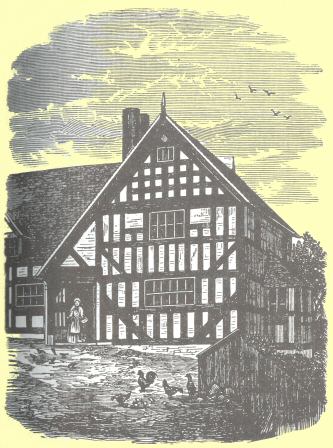
It may therefore be supposed that when the first Abraham Darby came to the Dale he found works already in existence. Mr. Smiles says “he took the lease of a little furnace which had existed at the place for over a century”; and, fortunately, since his time, the commencement of the 18th century, (1709), records of the proceedings have been carefully kept, so that there is little difficulty in tracing the progress of the art, or in giving prominence to important points which may serve to mark such progress. On page 60 are enumerated some of these discoveries, one being the successful use of coal in iron-making, another the adaptability of iron in bridge making, and a third to railroads. To these three starting points in the history of the iron trade was added that of the discovery of puddling by means of pit coal, by the Craneges; a discovery which preceded that of Henry Cort by seventeen years. It will be seen also from what has been already stated, that whilst Richard Reynolds laid down the first iron rails his son William and the Coalbrookdale Co. as early as 1800 were engaged upon locomotives to run on railways.
These stages in the history of the works down to the commencement of the present century have been enumerated thus:—
“Abraham Darby. 1707. Letters patent for a new way of casting iron pots, and other iron ware, in sand only, without loam or clay.”
“Ditto. 1712. First successfully superseded the use of charcoal by that of coke in the blast furnace.”
“Abraham Darby (son of above). 1737. First used coal instead of charcoal for converting pig iron into bar iron at the forge.”
“Ditto. 1760–63. First laid down rails of cast iron, with carriages having axles with fixed wheels.”
“Abraham Darby (the third). The first iron bridge erected over the Severn in 1777.”
“Richard Reynolds. Letters patent to Thomas and George Cranage, for a method of puddling, 1766.”
William, son of Richard Reynolds, invented a locomotive, upon the plans for which the Coalbrookdale Company were engaged in 1800. This was a locomotive for railroads, as we have shewn on page 179. We have also on a previous page spoken of Mr. W. Reynolds as a chemist, a fact which is borne out by an original letter of James Watt to his friend William Reynolds, a copy of which, being too long to insert here, will be given on a subsequent page. Facts like these, recorded in various publications, added to the intrinsic merits of the high class productions of the works, naturally served to give to the establishment in the Dale a very high position in the trade. To these too were to be added the high integrity of the proprietors and managers of the works, a guarantee of which was to be found in the fact that they were Quakers. In our “History of Broseley” page 219, we have shewn that the Friends had established themselves there as early as 1673; that a Meeting house was erected there in 1692; and that the Darbys, the Roses, the Reynoldses, the Fords, the Hortons and others were buried there, prior to the Meeting house at Sunnyside being built. The fact of a man being a Quaker was a tolerable guarantee of his being a fair dealer; and the utterance of the name of Darby or Reynolds was sufficient to command respect.
Speaking of these works at an early stage, Mr. Smiles in his “Industrial Biography” says:—
“By the exertions and enterprise of the Darbys, the Coalbrookdale Works had become greatly enlarged, giving remunerative employment to a large and increasing population. The firm had extended their operations far beyond the boundaries of the Dale: they had established foundries at London, Bristol, and Liverpool, and agencies at Newcastle and Truro for the disposal of steam-engines and other iron machinery used in the deep mines of those districts. Watt had not yet perfected his steam-engine; but there was considerable demand for pumping-engines of Newcomen’s construction, many of which were made at the Coalbrookdale Works.”
One of these engines having the date 1747 was seen at Bilston in 1812. Castings for Watt’s engines also were made here; but the first use to which the steam-engine itself was put was the undignified one of pumping the water which had once gone over the water-wheel back, that it may go over it a second time.
It is not our intention to give a detailed description of the present productions of the Coalbrookdale Works; modern castings like those of the Albert Edward bridge, and those high art ornamental ones of a lighter kind with which the public are familiar by means of various international exhibitions, afford sufficient evidence that the firm occupy a position not unworthy of their ancient renown.
It will be seen from what has been said that the religious no less than the inventive element seems to have distinguished these men, who, so far as we have gone were Quakers; but the brothers Cranege, who anticipated Cort in the discovery of puddling were Wesleyans. Little seems to be known of these men or of their families; but Dr. Edward Cranage, of the Old Hall, Wellington is, we believe, of the same family. Another descendant of the family writes us to say that—
“George Cranage, one of the patentees, and Thomas his brother, the other, both married daughters of John Ward, of Eye Manor Farm, near Leighton; the writer’s grandfather on his mother’s side. Thomas and his wife died without issue, but George Cranage who married Ann Ward, left two sons and five daughters; William, the elder of the sons, was manager or in some such position at Coalbrookdale, and was concerned in the construction of the Iron Bridge. From a small manuscript volume of religious verses and paraphrases into verse of the Psalms composed by him, and now in my possession, he appears to have had some taste for literature. I have his copy of Coke and Moore’s life of Wesley, and Paradise Lost, the latter containing his autograph. He was, I have heard, a Wesleyan of the true type; worshipping at his chapel regularly, but always communicating at Madeley Parish Church on Sacrament Sundays. He lived in the house where Mr. Moses now lives, opposite the church, which house, we believe was built for him. He died in 1823, one son having died previously. The following notice appeared in a Shrewsbury paper of his death:
“Suddenly, at Coalbrookdale, aged 63, Mr. Wm. Cranage, a man whose truly benevolent nature and friendly disposition secured him the respect and esteem of all who knew him, and whose loss as a member of society will be much felt by his neighbours. In him the poor man recognised a friend, the world an honest man, and the church a steady and useful member.”
John the younger, and only other son of George, died in infancy, while the five daughters all married in Bridgnorth or the neighbourhood.
Whilst upon the subject of old workmen at the Dale it may be well here to introduce a notice of the Luccucks, some of whom were Quakers, but two of whom, Benjamin and Thomas, became clergymen of the church of England. Benjamin was apprenticed at Coalport, where he painted a set of china, which whilst breakfasting with an English prelate he was surprised to see produced at table. When a lad he was of a daring disposition. He would lie down, for instance, between the rails of the Incline Plane and allow the carriage and a boat with five tons of iron in it to pass over him, notwithstanding the risk run of being caught and drawn over the rollers by the hook dangling at the end of the carriage. The mother of Mr. W. G. Norris, the present manager, and one of the proprietors, was a Luccock; and other members of the same family are still employed in the works. The grandfather of the former was apprenticed to the first Abraham Darby soon after he came to the Dale. A copy of the indenture or agreement between the parties may not be without interest at the present day. It commences thus:
“Abraham Darby and Thomas Luccuck, concluded and made this 13 day of June, 1714, between Abraham Darby, of the city of Bristol, Smith, in behalf of himself and rest of his co-partners in the ironworks of Coalbrookdale, in the County of Salop, on the one part; and Thomas Luccuck, of the parish of Norfield, in the County of Worcester, who agrees to serve in the art and mystery of making or casting of iron pots and kettles, &c.”
It then proceeds to state that
“Abraham Darby promises to pay the said Thomas Luccuck the sum of 6s. per week during the said term of the year. Thomas Luccuck also covenants not to divulge or make known the mystery of the art of moulding in sand, tools, or utensils, belonging to the said works; and that if he divulges he will agree to pay the sum of £5 for every pot or kettle made by another, &c., through him.”
The mystery alluded to, and which it was deemed then so important not to divulge, was an improvement introduced by one of the Thomases, an ancestor of the Bristol merchants of that name, which consisted in the substitution of green sand for the more expensive and laborious method of using clay and loam in the manufacture of cast pots. By this means, not only was the article cheapened, and the number multiplied, but a more suitable and economical form was obtained; the old one being now rarely seen, except in museums, or as an antiquated heir-loom in some remote cottage. One of the old pots with a neat border has the date 1717. These domestic utensils appear to have formed the staple manufacture at the time that the first Abraham Darby removed here from Bristol, in the year 1709.
One member of this old family of Dale workmen lived to the extraordinary age of 103; and an allusion to the venerable patriarch may serve to introduce at this stage of our history a notice of two local circumstances: the extreme age of an old Coalbrookdale workman of the above name, and the “Great Land Flood” of the Dale. An account of the latter appeared in the Philosophical Transactions of the time; but we prefer following the example of Southey who on an occasion we remember makes use of an old man’s memory to set forth his views of certain changes which had taken place; but at the same time with such toning down as becometh the thoughts of more sober age. Every village has incidents and events associated with it, which some old inhabitant is usually privileged to expound.
Beyond the venerable grey-beards and wrinkled grand-dames there is the village sage—vested with the dignity of a last appeal, and whose version of matters local is deemed truthful as the current coin. Age as a rule commands respect; and the wider the span that measures intervening space between the present and the past the greater the esteem. Coalbrookdale within our recollection boasted, not an octogenarian merely, or one whose claim to the honour was weakened by that of half-a-dozen others—but one, the “oldest inhabitant,” by being a quarter of a century in advance of the whole of the Coalbrookdale elders. He not only lived to celebrate the centenary of his natal day but—like a tree blanched by the storms of ages yet putting forth its leaves afresh—as showing the stamina that still remained—cut, at a still riper age his second set of wisdom teeth. Envy never sought to dim the lustre of his fame. At local festivals, when, unfettered for the day, the members of a club with flags and band met in gay summer time, he was brought to crown the presidential chair. Old Adam—such was his name—a name truly suggestive of the past and well fitted for a village sage—old Adam Luccock was widely known. He was a specimen of archæology in himself—the solitary link of a patriarchal chain that had fallen one by one—he the only one remaining. And old Adam’s cottage—perched upon a rock beneath the Rotunda, quaint, ancient, and impressed by the storms of passing time,—odorous from a narrow strip of garden sheltered by a grey limestone pile, catching the last lingering rays of the setting sun as it mantled with deep shadow the Dale below, and flooded with mellow light the uplands of the river’s western bank—was a counterpart of himself. Like the little vine that girdled its frail and wattled walls—tapping with wiry fingers at the diamond leaded window-panes—old Adam clung to the place long after his friends began to fear the two would disappear together. White as were these white-washed walls, Adam’s locks were whiter, and the accessories of dress and minor details of person and of place were in perfect keeping. A curious net-work of wrinkled smiles accompanied the delivery of one of the old man’s homilies; and amusing enough were the landmarks which memory set up for giving to each event its place in point of time. Of red-lettered ever-to-be-remembered occurrences in the village the more prominent were the phenomena of the land-slip at the Birches, and the land-flood at the Dale. We still see the old man drawing slowly from his mouth a long pipe, still more slowly letting out a wreath of fragrant smoke, as speaking of the latter he would say:—
“I remember well; it was autumn, the berries were ripe on the hedge, and fruits were mellow in the field; we had a funeral that day at Madeley, it was on the 6th of September, 1801. The air was close. A thin steamy vapour swam along the valley, and a dense, fog-looking cloud hung in the sky. The mist spread, and drops like ripe fruit when you shake a tree came down suddenly. The leaves on every tree trembled, we could hear them quake; and the cattle hung down their heads to their fetlocks. The wind blew by fits and starts in different directions, and waves of cold air succeeded warm. Dull rushing sounds, sharp crackling thunderclaps were heard, and streams of fire could be seen—like molten iron at casting time—running in and out among the clouds. Up the valley, driving dust and sticks and stones, came on a roaring wind with pelting rain. Another current moved in a different direction; they met where the black cloud stood, and striking it both sides at once, it dropped like a sponge filled with water, but large as the Wrekin. In a moment houses and fields and woods were flooded by a deluge, and a rushing torrent from the hills came driving everything before it with a roar louder than the great blast or the splash of the great wheel. Lightnings flashed, thunders roared, and before the echo of one peal died you heard another—as if it were the crack of doom. Down came the brooks, the louder where they met, snapping trees, carrying bridges, stones, and stacks of wood. Houses were inundated in an instant, gardens were swept away, and women and children were carried from windows through the boiling flood. Fiercer came the rush and higher swelled the stream, forcing the dam of the great pool; timber snapped like glass, stones were tossed like corks, and driven against buildings that in turn gave way. Steam then came hissing up from the furnace as the water neared and sought entrance to the works. The elements met; it was a battle for a time; the water driven with great force from behind was soon brought into contact with the liquid iron, and then came the climax! Thunders from below answered to those above; water converted into gas caused one loud terrific explosion that burst the strongest bars, shattered the stoutest walls, drove back the furious flood, and filled the air with heated cinders and red-hot scoria. The horrid lurid light and heat and noise were dreadful. Many said ‘The day of God’s wrath is come;’ ‘Let us fly to the rocks and to the hills.’”
After a pause, and re-lighting his pipe, he added:
“I think I forgot to say it was Sunday, and that the Darbys were at meeting; the Meeting-house was in Tea-kettle-row, it was before the neat little chapel at Sunnyside was built. It was a silent meeting,—outside among the elements there was noise enough—I mean among the members there had been no speaking, and if there had they may have heard plain enough what was going on outside. Well, when the furnace blew up they broke up and came down to see what was the matter. They never appear in a hurry, Quakers don’t, and did not then, though thousands of pounds of their property were going to rack every minute. ‘Is any one hurt?’ that was the first question by Miss Darby; she is now Mrs Rathbone. She was an angel of a woman; indeed, every one of the Miss Darbys have been. ‘Is there any one hurt, Adam;’ she said. I said ‘no, ma’am, there’s nobody hurt, but the furnace, and blowing mill, the pool dam, and the buildings are all gone.’ ‘Oh, I am so thankful,’ she said; ‘never mind the building, so no one’s hurt’; and they all looked as pleased—if you’ll believe—as if they had found a new vein of coal in the Dawley Field, instead of having lost an estate at Coalbrookdale.”
Old age sat as fittingly on Adam as glory upon the sun, or as autumnal bloom upon the mellow fruit ripened by the summer’s heat. Nature, in the old man, had completed her work, religion had not left him without its blessings; and, while lingering or waiting, rather, upon the verge of another world, he liked to live again the active past, and to amuse himself by talking of scenes with which he had been associated. He had none of the garrulous tendencies of age; and when once upon his favourite topic, he was all smiles immediately.
“We used,” he said, “to bring the mine for the Dale on pack-horses; and Horsehay being one of the halting places, was, as I believe, called Horsehay in consequence. We used, also, to take minerals on horse-back all the way to Leighton, where there was plenty of wood and charcoal, and water to blow the bellows. Strings of horses, the first having a bell to tell of their coming, used to go; they called them ‘Crickers’—and a very pretty sight it was to see them winding through upland, wood, and meadow, the little bells tinkling as they went.”
“Aye, aye, sir,” said our ancient friend, “Pedlars and pack-horses were the means of locomotion and the medium of news in my day; and if we travelled, it was in the four-wheeled covered waggon, over roads with three or four feet ruts. Lord, sir, I remember, in good old George the Third’s time, when turnpike gates were first put up, there was a great outcry against them. Before that, roads went just where they liked, and there was a blacksmith’s shop at every corner to repair the damage done in bumping over the large stones. Why, sir, in this ere Dale, I can remember when there was no road through it but the tram-road. The road then was over rocks and along the brow of the hill—a bridle road only. There never was such a thing as a one-horse cart seen in the Dale till just before the road was made to Wellington; and then, as I can remember, the road was so narrow that every carter carried a mattock to stock the road wider, in order to pass, if he met another.”
The old man described the construction of those primitive forerunners of that iron network which now spreads its meshes over the entire kingdom, one of which, much worn on the one side by the flange of the wheels is before us. It has a square hole at the end, for the purpose of being pegged to the sleeper. Down the steep banks that enclose the Dale inclined planes were laid with rails of plain oblong pieces of wood, six feet in length, eight inches in width, and four inches in depth, and down these, by means of ropes, waggons by their superior gravity brought up the empty ones to be refilled with minerals which were conveyed for the use of the works. The speed was regulated by a brake made to press, not as now upon the barrel at the top, but upon the wheels of the descending waggons. The man thus regulating their speed, was the jigger, and the hill leading from Coalbrookdale to Wellington, where one of these inclines was situate, became “The Jigger’s Bank.” (Sometimes called the Jig-house Bank, because, of a house there.) In addition to this railway for the purpose of supplying the furnaces, there was another, by which the furnaces at the top were connected with the foundry at the centre; and rails, first of wood, and then of iron, continued for many years to be used, facilitating the transport of heavy materials from place to place.
On the last occasion on which we saw him we were sent by a good old aunt, a Quaker lady who loaded us with presents for the old man, when he had gone to live in “Charity Row,” as it was called. Speaking upon matters connected with the history of the Dale—more particularly in reference to the Darbys and Reynoldses—the old man would grow eloquent; and the effect of a little present—a basket of strawberries or a packet of tobacco—had a wonderful effect in stimulating memory. Nothing was “open sesame,” however, like a drop of “Barnaby Spruce’s old Beer.” [292] Say you had sent for half-a-gallon of Spruce’s best October brewing, and he grew loquacious at once.
“Remember him,” speaking of Richard Reynolds, he would say, arching his eye-brows, and growing animated, as recollections of the past came tripping upon the heels of each other. “I knew him well; all the poor knew him; the robins and the sparrows knew him, for he would carry crumbs a hundred miles in his pockets ‘for his robins.’ He made a vast fortune, and then everybody knew him; books, and tracts, and newspapers all talked about him. He was a Quaker—not a thin, withered, crotchety disciple of George Fox, but a full-fed Quaker, fair and ruddy, with eyes of blue that gave back the bright azure of the sky and lighted up a fine and manly face. I see him now—his light hair flowing in curls beneath his broad brimmed hat upon his shoulders. He yielded to every man his own, not only as concerned money, but in demands upon his respect. I have known him when in a fit of temper he thought he had spoken harshly or slightingly to any one, follow him home and apologise for his warmth. He loved everybody and was beloved by everybody in return. There’s my neighbour, she will tell you how when she was a child he would run into their shop in a morning, put half-a-crown into her hand, saying, ‘There, thee be a good child all day.’ He could not do with the colliers, though; he built schools for their children, but the mothers would not let them go unless he would pay them so much a day for allowing them to attend. They were curious schoolmasters in my day. Old John Share made nails and kept a school in the Dale; he was one of the most learned about these parts for a schoolmaster, but he never would believe that the earth turned round, because, as he said, the Wrekin was always in the same place. Then, there was old Carter, the chairmaker, of Madeley Wood; he always spelt bacon with a ‘k,’ and I remember him giving Charles Clayton a souce on the side of the head that sent him reeling, because he insisted upon it that it should be bacon. The Wrekin, sir, was always an object of admiration to Mr. Reynolds. He had an arbour made from which he could see the sun going down behind it (he used to revel in a good sunset), and with no companion but his pipe was often used to watch it. Every year he treated his clerks and most of the members of the Society of Friends to the Wrekin. Benthall Edge was another favourite resort, and he would revel at such times in the scene.”
“I could tell you many more anecdotes (the old man continued) of the Quakers; I mean the Darbys. They all liked a joke right well; and as for kindness, it seemed as if they thought it a favour to be allowed to assist you. They allow me a weekly pension, have done for years, and pay a woman to wait upon me. They are people that never like to be done, however.”
“You knew old Solomon, the Sexton. Well he once went to the haunted house, as they call it, for an Easter offering. The servants were ordered to attend him, and he sat for some time and eat and drank, and smoked his pipe—but not a word was said about Easter dues. He knocked the ashes out of his third pipe, and feeling muddled a bit about the head thought it time to be moving. At last Mr. Darby entered the room, and Solomon made bold to ask for the Easter offering. ‘Friend,’ said Mr. Darby, throwing up the sash, and assuming a determined attitude, ‘thou hast had a meat-offering and a drink-offering; thou hast even had a burnt offering—as I judge from the fumes of this room, and unless thou choosest to go about thy business, thou shalt have an heave-offering.’ As Solomon had no wish to be pitched head-foremost out of the window, you may imagine (said the old man) that he quickly disappeared.”
The old village sage, whose venerable form and long white locks rise before us like some vision of the past—is gone; he died, as his friends assert, at the advanced age of 107, or, as his headstone more modestly states (and modesty is not a fault common with posthumous records) at the age of 103. He died January 27, 1831, and his gravestone may be seen near the southwest door of Madeley Church, under the wall; but as the inscription is near to the grave, being below those of the Parkers, and that of Samuel Luckock, it will, we fear, be soon obliterated by the damp acting on the stone.
Among other servants of the Darbys who succeeded each other and held important positions in the works were the Fords. Richard married Miss Darby, daughter of Abraham, and was manager of the works in 1747. He also was a Quaker; and to him really is due the credit ascribed to Mr. Darby, of the successful use of coal in iron smelting. In the Philosophical Transactions for 1747, for instance, the year Mr. Ford was manager, it is stated that—
“Several attempts have been made to run iron-ore with pit-coal: he (the Rev. Mr. Mason, Woodwardian Professor at Cambridge) thinks it has not succeeded anywhere, as we have had no account of its being practised; but Mr. Ford, of Coalbrookdale in Shropshire, from iron-ore and coal, both got in the same dale, makes iron brittle or tough as he pleases, there being cannon thus cast so soft as to bear turning like wrought-iron.”
A son or grandson of this Richard Ford was foreman and manager in the engine department of the works, which flourished greatly till he resigned his office, nearly half a century since. The late John Cox Ford was a son, and A. J. Ford, recently of Madeley, a grandson.
Of later members of the Darby family we may speak in part from personal knowledge. Like their ancestors, they were members of the Society of Friends, although not by any means the straitest of the sect. Whilst adhering to the grand cardinal doctrine of the Inner Light, they indulged their own ideas of the extent to which the strict discipline of the body should control their tastes. They were birth-members, but lax in their opinions, and did not live by strict Quaker rule. On one occasion, when a disciple of the old school got up as was his wont to deliver himself in meeting, one of the younger and more lax of the members rose and said, “Friend N—y, it would be more agreeable to this meeting if thou wouldst sit down.”
Francis Darby, of the White House, had great taste, loved high art, and filled his rooms with costly paintings, which he felt a pride in shewing to his friends. Others indulged a forbidden love of music and luxury, contrary to the faith and discipline of their fathers, without otherwise breaking through bounds or committing faults to justify the advocates of the truest code of Quaker rule to disown them.
Richard Darby, like his brother Francis, did not adhere to the Quaker style of dress, either in the cut of his coat or the shape of his hat, the latter being usually a white one of the most approved fashion. He was a popular public man; one whose services were sought, and whose sympathies were readily enlisted in public movements of the day, such as the emancipation of the slaves, and others relating to questions of civil and religious progress. His name was well known through the length and breadth of the borough, and we have seen small farmers and labourers around the Clee Hills brighten up at the mention of his name. William Henry and Charles Darby, the sons of Richard, are proprietors of the Brymbo iron works, and their sister, Miss Rebecca Darby, who resides at the house her father lived in, is the only one of the name now living in the Dale.
The late Abraham and Alfred Darby, sons of Edmund, and cousins of Francis and Richard, were young when their father died. We have elsewhere said that they became managers of the extensive and important works of Coalbrookdale, Horsehay, Lighmnoor, and the Castle, at critical periods of their history, and when, to maintain their existence, it was essential to do battle with lax discipline, old customs, and deep-rooted prejudices. They found men resting on their oars, trusting to the prestige of a fame won by a former generation, and standing still while others around them were advancing. They determined to prove themselves worthy of their predecessors by advancing to the front of the foremost in the rise. Surrounding themselves by energetic agents, intelligent operatives, and introducing new modes of manufacture, they succeeded. With clear views of political economy, they zealously aided in battering down barriers to a free exchange of the world’s productions, which misconceived interest had erected. Penetrated with a lofty sense of duty, and comprehending their positions rightly, they pursued the even tenor of their way, sowing seed and scattering blessings which refreshed and brightened the scenes of their labours. They worked harmoniously together, in their studies, in the laboratory, in their works, and at their books, making themselves acquainted with every detail and minutiæ of their great undertakings. Order and regularity everywhere were observable, others under them being embued with the spirit of their employers. The church on the hill side, and its sweet and silvery bells as their music floats along the valley and over the wooded boundaries of the Dale, tell of their large-hearted benevolence and open handed munificence, and that of their sister, Miss Mary Darby, and their mother, Mrs. Lucy Darby.
Abraham, the elder, married his cousin, Miss Darby, daughter of Francis Darby, on the 8th of August, 1839, on which occasion a kindly demonstration was made, and 1,000 work-people dined at his expense. He removed from the Dale to Stoke Court, near Slough; and afterwards to South Wales, to be near the extensive works of Ebbw Vale, which he, and some of his partners, purchased for the sum of £360,000. He died, was brought to the Dale and buried in the cemetery of the church which he chiefly had built and endowed, amid deep demonstrations of feeling on the part of thousands of spectators.
Alfred, the younger brother, married Miss Christy, sister to the well-known collector of pre-historic relics of man in an uncivilized state, with which he stored his mansion at Westminster, and afterwards bequeathed to the British Museum. Alfred died in the golden meridian of age and usefulness, and his loss was deeply felt by all who knew him. He left issue, and his son Alfred, of Ness, to which place his mother removed from Stanley Hall, is a magistrate, and is now old enough to discharge the duties of a country gentleman.
Of other partners in the works we may mention Mr. Henry Dickinson, who married a sister of Abraham and Alfred Darby, for some years chairman of the Shropshire Banking Company, and who in a most distinguished and disinterested way lent (but on such terms as amounted to a gift) the princely sum of £100,000 at a critical period of its existence, to save it from falling, and numbers dependent upon it from ruin. But for extending our remarks too far, we might say something of men like Mr. Thomas Graham, a former cashier in the works, of Mr. William Norris, who succeeded him in that office; men useful in their day and generation, being foremost in good works and words, as many now living will remember. For the same reason we refrain from speaking of the late Mr. C. Crookes, formerly the enterprising manager of these works; and of the gentleman who has succeeded him, and is himself a proprietor of these extensive works, and in the commission of the peace for the borough. For similar reasons, but much more because of the difficulty of rightly discriminating and equally awarding a just meed of praise where so much is due, we find ourselves prevented from speaking of many trustworthy and clever men now engaged in various departments of these important works, whose names occur to our minds, but whose merits we commend not less heartily to some future local historian, for whose labours the present work will, we flatter ourselves, smooth the way.
It would be unpardonable not to say something here of the means of education and mental culture provided by the proprietors of the Coalbrookdale works for their workpeople. Before the present system of national education was established, and whilst hostile sects and parties were indulging in bitter feuds [300] as to the kind of education to be given, this Company under the direction of Abraham and Alfred Darby in the most noble and generous way came forward and at great cost erected roomy and capacious Schools here and at Horsehay, with every convenience and appliance possible to further education.
We purpose speaking of education, with respect to the schools, in connection with others at Madeley, Ironbridge, and Madeley Wood; and will only add here a word or two on the subject of other and more advanced institutions provided for the use of the men and inhabitants generally of the Dale. First and foremost amongst them comes, of course, the Literary and Scientific Institute, with its library, its reading room, its school of art, its high class lectures and entertainments, so judiciously arranged and carried on under the management of Mr. E. L. Squire, Hon. Secretary, and Mr. Isaac Dunbar, the librarian. The School of Art too, of which Mr. Squires is also Hon. Secretary, and Mr. Gibbons master, is admirably adapted for developing and furthering a taste for drawing and decoration, so essential among artizans engaged in the more ornamental and decorative portions of the company’s productions. Nor are the benefits of this admirable institution limited either to the works or to the Dale: the day classes are attended by ladies of the neighbourhood, desirous of pursuing an æsthetic course of study, and who, following the examples of ladies whose works merit such high approval in the Art Galleries of London and Paris, have really achieved great success in painting birds, flowers, and figures, in enamel colours, on plaques, tazzas, &c., both for use and for drawing room decoration.
Nor must we omit, whilst on the subject of this institution, to mention the splendid collection of British and foreign birds lent by Mrs. Alfred Darby, which have adorned the lecture room for so many years; or the very fine collection of coal-measure fossils, which the late Dean Buckland pronounced in his time the finest private collection of the kind in England, and so liberally given by the late John Anstice, Esq.
Recently a “British Workman” has been added to other institutions, at the room formerly occupied as a British School, under the patronage of Mrs. Norris, who is ever active in promoting similar works, and the present incumbent, the Rev. H. S. Wood, who, it is only justice to say, spares no pains to make himself useful to the inhabitants of the Dale.
COALBROOKDALE BRICK, TILE, AND TERRA COTTA WORKS.
Under the management of Mr. John Fox the clay-works of the Coalbrookdale Company have become so expanded and improved, that they now form an important department of the Company’s undertakings, and are at the present juncture, no doubt, among the more profitable of their industries. Since sanitary science has so successfully called public attention to the importance of the use of good bricks impervious to damp, the productions from these excellent coal-measure clays have been more in demand. Clays, as commonly understood, mean earth of sufficient ductility to allow of being kneaded into some useful shape or form, and rank as raw materials. Some are soft, others are indurated, or hard and rocky; but all have in one sense been prepared by certain poundings, grindings, washings, and mixings, carried on by Nature on a larger scale than that on which they are now still further fitted for use. They differ in quality, in degree of fineness, and in colour, and show certain relationships by which it is clear that they are descended from sand, just as sands are descended from a hardy race of pebbles, which in turn bear close relationship to rocks, from which undoubtedly they have been derived. Surface clays used for making inferior bricks and tiles, whose earthy odour gives evidence of alumina, are generally derived from red sandstone rocks, ground down into mud by the machinery of waves or streams whilst our deeper coal-measures clunches, and clays were originally the sediment thrown by rivers at their embouchures into inland lakes or seas, and are usually much more free from lime, iron, grit, and other foreign substances and impurities.