MADELEY. (continued 4)
Reading edition
“The Coalbrookdale engine is, I believe, the first locomotive engine on record, intended to be used on a railroad. The boiler of it is now to be seen in use as a water tank, at the Lloyds’ Crawstone Pit, and the fire-tube and a few other portions of it are now in the yard at the Madeley Wood Works. I never heard how it came to be disused and broken up.”
Shortly before William Reynolds’s decease, he had had a large pleasure boat built, which was intended to be propelled by steam, and the cylinders of the engines intended for it, beautifully executed by the late James Glazebrook of Ironbridge, are now at the Madeley Wood Offices, but the engines were not finished at his (W. Reynolds’s) death, in 1804, and I never saw any drawing or model of them. The boat lay within my recollection, moored in the river Severn, just above Mr. Brodie’s Boring Mill, at the Calcutts, in a state of much disrepair, and I believe, ultimately fell to pieces or was carried away by a flood.
William Reynolds had a very complete private Laboratory at his residence, at Bank House, which was lighted with gas. William Murdock had, however, as early as 1794, applied gas to the lighting of his own house, in Cornwall, and in 1798, a portion of the Soho Works were lit with gas of his making.—In 1803, the whole of the Works were thus lighted, and from that time its use gradually extended.
Mr. Miller, of Darswinton, had a steam pleasure boat at work in 1788, and in 1801, the “Charlotte Dundas” steam boat was built at Glasgow by Symmington, and this is the first authentic case of steam-boat navigation on record.
The Clay Industries of the district.
The very excellent coal-measure clays found on both banks of the Severn, and turned to such good account by the Coalbrookdale Co., by Mr. Legge at the Woodlands, by neighbours too on the opposite bank of the Severn, as well as the celebrity attained by the Coalport works, renders it necessary that we should take a somewhat comprehensive view of the subject. Bricks and tiles and pottery of various kinds appear to have been made from a very early period, but the manufacture of Salopian porcelain dates from the latter end of the last century. The sites of the old pot works were at the outcrops of the coal-measure clays; and it was the advantages the fire-clays and accompanying coals afforded which led to the manufacture of porcelain. The former were situate at Benthall and Jackfield, where advantage is still taken of them, flourishing works being still carried on in places where these very excellent materials are readily procurable; and before noticing the introduction and very successful manufacture of the former at Caughley and Coalport, it may be desirable to devote a few pages to a description of the old pot-works, at Haybrook, the Pitchyard, and at Jackfield.
The art of moulding a plastic substance like clay is, of course, as old as the world, and on the banks of the Severn, as shewn by specimens ascribed to early British and Roman periods, it must not only have existed but been carried to some perfection there. These clays are said to have been used by the Romans, as evinced by the red and grey pottery and tiles discovered at Uriconinum. Jacquemart, in his “History of Ceramic Art,” says that Jackfield is the most ancient site of pottery in Shropshire. And it is added that from a period so early as 1453, the valley of the Severn was famous for ornamental tiles, many specimens bearing that date having been found in Cathedrals and Churches. We have no reliable authority however for fixing the date at which the art was first practised in Shropshire, but it appears tolerably clear that the articles made were of the simplest kind, being almost uniformly domestic: those in daily use, such as milk-pans, dishes, tea-pots, jugs, and mugs. The latter were substitutes for the drinking horns, which later improvements in the plastic and ceramic arts have driven out of use. We have an ancient specimen of one made at the Pitchyard, and a drawing of another made at Haybrook, well potted, and elegant in shape. The latter is the best manipulated, and probably it was from this circumstance that the latter work was called “The Mug-House.”
In evidence adduced sometime since in an Election Scrutiny at Bewdley, a public-house referred to was called the “Mughouse,” which house is situated on the Severn, at a point where the bargemen, who formerly drew the vessels up the river instead of horses, were in the habit of stopping to get mugs of ale. “Tots” were made out of the same kind of clay, but smaller, and were used when the men drank in company; hence a person who had drank too much was supposed to have been with a convivial party, and was said to have been “totty,” a word often found in old works. Tots had no handles, and some of the old drinking cups, more particularly those of glass of Anglo Saxon make, were rounded at the bottom that they should not stand upright, and that a man may empty them at a draught,—the custom continuing till later times gave rise to our modern name of tumbler. The small tots had no handles; the mug had a “stouk,” as it is called, consisting of a single piece of clay, flattened and bent over into a loop. The ware was similar to the famous “Rockingham ware” made on the estate of Earl Fitzwilliam, near Wentworth.
The discovery of a salt glaze took place in 1690, and the manufacture of that kind of ware must have commenced here soon after, as traces of works of the kind are abundant. This method consisted in throwing salt into the kiln when the ware had attained a great heat, holes being left in the clay boxes that contained it in order that the fumes may enter and vitrify the surface. Evidences of the manufacture of these old mugs and tots, together with milk-pans and washing-pans, having been made at an early period, are numerous; and the old seggars in which they were burnt often form walls of the oldest cottages in Benthall and Broseley Wood.
A considerable number of old jars, mugs, and other articles, have from time to time been found in places and under circumstances sufficient to indicate great antiquity; as in mounds overgrown with trees, and in old pits which for time immemorial have not been worked. One large earthern jar, with “George Weld,” in light clay, was found in an old drain at Willey, and is now in the possession of Lord Forester. Mr. John Thursfield, who lived at Benthall hall, was at one time proprietor of these works.
Three quarters of a century ago these works were carried on by a Messrs. Bell & Lloyd; afterwards by Mr. John Lloyd, one of the best and most truly pious men we ever knew, who some time before his death transferred them to a nephew, Mr. E. Bathurst. His son succeeded him, and after a time sold them to the present proprietor, Mr. Allen, who to the ordinary red and yellow ware, which finds a ready sale in North and South Wales, has added articles of use and ornament in other ways, including forcing pots, garden vases, and various terra cotta articles.
Of the Pitchyard works we know little, only that they stood where the late Mr. E. Southorn carried on his Pipe Works, and where we remember them in ruins more than fifty years ago; but the numerous seggars, now found in cottage garden walls, shew that they must have been continued for some considerable time.
But, besides the manufacture of bricks, tiles, and pottery, these clays have been raised to a trade within the past few years in this district which is every day increasing, and which is capable of much further expansion: we refer now to the important department of encaustic or inlaid tiles and mosaics. The art of producing tiles of this description is only recently revived in this country, and is one which in point of antiquity is not to be compared with its sister branches. The first attempt, so far as we are aware, to revive the art in Shropshire, was at Jackfield; but the first designs were crude, quaint, and spiritless, and altogether wanting in those nicer distinctions and qualities which, not being perceived by the mind of the producer, could not be wrought by the hand. In this as in many other branches of fictile art insight into the principles as well as eyesight is required, and the mistake—as in many other instances—was committed of attempting something which, with the expenditure of thought and time, might catch the uneducated eye—the object being to produce quantity rather than quality. But the call made upon the art by the enlightened demands of the age soon gave a wonderful impetus to the improvement, and men of educated artistic taste—like the Mintons and the Maws—soon called to their aid the assistance of the greatest genius and the highest designing talent at command; at the same time that they directed their efforts to definite points in which utility might be made the instrument of beauty, and by which originality and intelligible design might be made to rise out of the most common-place wants. But although the modern manufacture of geometric and encaustic tiles is recent, it already far surpasses the ancients in variety and arrangement, in geometric patterns, and in beauty of design in encaustics as well as in mechanical finish; although it may be doubted whether the same breadth of general effect is studied as in many ancient examples. Mintons, of Stoke, Maw and Co., of Benthall, Hargraves and Craven, of Jackfield, and Mr. Bathurst, of Broseley, have each produced beautiful encaustic tiles for pavements—both for ecclesiastical and domestic use; and there is yet a large field for development of the use of similar tiles to colour and enrich the details of our street architecture, as well as in that of more elaborate and important structures.
The Coalbrookdale Co., have recently manufactured some admirable terra-cotta entablatures, with historical subjects for costly buildings in the metropolis. The erection of the Literary and Scientific Institution also, of different coloured clays shews their adaptation to works of great architectural beauty.
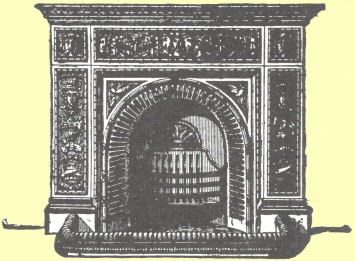
Maw and Co’s Tesselated, Mosaic, and Majolica Works.
It was the excellency of the Broseley and Benthall clays, above referred to, which attracted the Messrs. Maw to the spot and led them to remove from Worcester, to where they had been in the habit, first of all, of having them conveyed by barges on the river, to the present site of their works, fashioned out of the old Benthall Iron Works, carried on a century ago by Mr. Harries, then owner of the Benthall estate. Notwithstanding the additions made by them, the trade has so wonderfully developed itself that after building upon or in some way occupying every inch of ground, they are cramped for room, and are on the look out for more commodious premises. In addition to those classical and other adjuncts of architectural comfort and embellishment, embracing encaustic tiles—the reproduction of an art limited in mediæval times to church decoration, but now having a much more extended application, and the manufacture of tesseræ, used in the construction of geometrical mosaic pavements, similar in character to those found in the mediæval buildings of Italy, also moresque mosaics, like those occurring in Roman remains in this country and on the continent, they now manufacture a superior majolica, and faience of great purity, in both of which departments they have recently received first class medals at the Philadelphia exhibition. The accompanying engraving will convey an idea of the adaptation of faience to articles of domestic utility.
Jackfield Pottery and Porcelain.
Older even than the Haybrook Mug House are the Pot Works of Jackfield, which, according to the parish register of Stoke-upon-Trent, quoted by Mr. Jewitt and Mr. Chaffers, supplied a race of potters to that great centre of early pot-making in the year 1560. Excavations made too, soma years ago, brought to light on a spot near which the present works of Craven, Dunnill & Co., now stand, an oven, or kiln, with unbaked ware, which appeared to have been buried by a land-slip; and in an old pit, which it was said had not been opened for two centuries, a brown mug was discovered, which had upon it the date 1634. If Jackfield supplied early potters for Stoke, Stoke sent pot masters to Jackfield. One of these was Mr. Richard Thursfield, an ancestor of Greville T. Thursfield M.D., who took these works and carried them on in 1713. He was succeeded by his son John, of whom we have spoken as afterwards living at Benthall and carrying on works there. The late Richard Thursfield, Esq., had in his possession some good examples of Jackfield ware. Among them was a handsome jug, gilt, having on it, we believe, the name of one of the family.
In 1772, or soon after, Mr. Simpson carried on the works; and he appears to have further improved the manufacture, for in addition to the “black decanters,” as his mugs were called, he made various articles of superior quality, which prior to the breaking out of the war with America found a ready sale there. The old mill turned by the waters of the Severn, where he ground his materials, has just been taken down.
Mr. Blakeway afterwards carried on the works, and was joined by Mr. John Rose, upon leaving Caughley, and, after carrying them on a short time by himself, he removed them, as he did the Caughley Works, to Coalport, on the opposite bank of the river.
The site of the old pottery was on the ground which is now occupied by the Jackfield Encaustic Tile Works, the clays of which are specially adapted for geometrical and encaustic tiles; and such tiles have been made here for a number of years; but since the old works came into the possession of the present firm of Messrs. Craven Dunnill and Co., great changes have taken place. The firm took a lease of about four acres of ground, and adjoining the old works built a large and commodious manufactory, which has been in operation for nearly two years. They have since taken down all the buildings of the old works, and have erected on their site and joining up to the new works, large warehouses, show room, offices, and entrance lodge. The plan of the works is very complete, so as in every way to economise in the process of manufacture, and they are now among the most complete works of the kind.
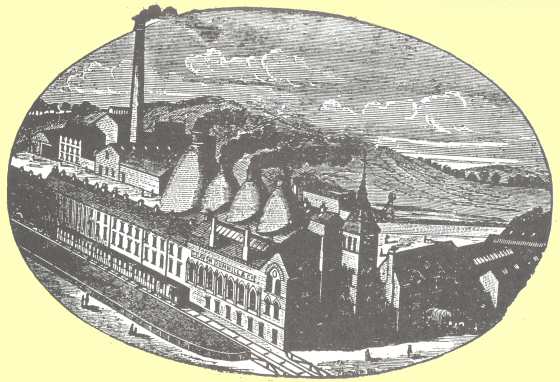
As shewn in the accompanying engraving, the buildings consist of four blocks, one detached and the others connected, each block accommodating a separate branch of the manufacture.
In the detached block the raw materials are reduced to a state ready for the workman.
The second block contains the damping places, where the clays are kept in a certain degree of moisture; pressers’ shops for the various colours of geometrical tiles, and the encaustic tile makers’ shops, with their stoves.
The next block provides for the drying and firing of the goods and decorating shops.
On the first floor are workshops employed for painting, printing and enamelling, or other decorative purposes.
The fourth block provides for the sorting and stocking of goods and for packing them for despatch; also the offices and showroom.
Near to the detached block first described a small gas-works has been erected, which supplies the whole of the buildings.
Coalport Porcelain Works.
The first works at Coalport were we believe founded and carried on by William Reynolds, Thomas Rose, Robert Horton, and Robert Anstice; the former William Reynolds, being then Lord of the Manor. The buildings, or a good portion occupied by them are still standing.
Mr. Thomas Rose, and Mr. John Rose, were sons of a respectable farmer living at Sweeney. The latter was a clerk under Mr. Turner, at Caughley, and left him to take the Jackfield works about the year, it is said, 1780. Having carried them on for a few years, in conjunction with Mr. Blakeway, during which time he greatly improved the quality of the article manufactured there, he established the present Coalport works on the side of the canal, then recently opened, and opposite to those of Reynolds, Horton, Thomas Rose, and Robert Anstice. On Mr. Turner retiring from the Caughley works in 1799, Mr. Rose and the new company he had formed purchased them, and by means of increased capital shortly afterwards removed both plant and materials from Caughley and Jackfield to the more advantageous position they now occupy, on the banks of the canal and the Severn. Even the buildings were pulled down and the bricks and timber removed to the opposite side of the Severn, where they were used in constructing the cottages now standing opposite to the present Coalport Works.
A staff of excellent work-people had been obtained from Caughley and Jackfield works combined, but an accident occurred on the night of the 23rd of October in that year by the capsizing of the ferry, as the work-people were crossing the Severn, by which twenty-eight were drowned, some among them being the best hands employed at the works. It was a dark night, the boat was crowded, and the man at the helm, not having been accustomed to put the boat over allowed the vessel to swing round in the channel where, with a strong tide running, it was drawn under by the rope which went from the mast to a rock in the bed of the river. Some managed to scramble out on the Broseley side of the stream; but the following were lost, notwithstanding the efforts of those who rushed to the river side on hearing the despairing cries raised to save them. Jane Burns, Sarah Burns, Ann Burns, Mary Burgess, Elizabeth Fletcher, Mary Fletcher, Elizabeth Beard, Jane Boden, Elizabeth Ward, Sarah Bagnall, Sophia Banks, Mary Miles, Elizabeth Evans, Catherine Lowe, Jane Leigh, Charles Walker, George Lynn, James Farnworth, George Sheat, John Chell, Robert Lowe, William Beard, John Jones, Benjamin Gosnall, Benjamin Wyld, Richard Mountford, Joseph Poole.
The event, as may be expected, created a great sensation at the time, and was thus commemorated by Mr. Dyas, one of the Coalport workmen.
Alas! Alas! the fated night Of cold October twenty third, In seventeen hundred ninety-nine; What cries, what lamentation heard, The hour nine, when from yon pile, Where fair porcelain takes her form, Where energy with genius joins, To robe her in those matchless charms, A wearied band of artists rose, Males and females, old and young, Their toil suspend, to seek repose, Their homes to gain, they bent along. Sabrina’s stream was near to pass, And she her frowning waves upraised, Her mist condensed to darksome haze Which mocked the light; no star appeared. Yon boat, which o’er her bosom rides, Enveloped in the heavy gloom, Convulsive stretch’d along her sides, To snatch the victims to their doom. Soon e’er on board their faltering feet A monster fell who grasped the helm, Hove from the shore the distressed crew, And so the dreadful overwhelm, Swift horror’s wings o’er spread the tides, They sink! they rise! they shriek! they cling! Again they sink; alarm soon flies, Along their shores dread clamours rise, But Oh, the bleakest night preventing Every means to save their breath, Helpless, hopeless, life despairing Twenty-eight sunk down in death. Alas small time for Heaven’s implorings, Quick sealed their everlasting state, Or, in misery, or in glory. The last tribunal will relate, Here fold, O muse thy feeble wings, Hope where thou canst, but not decide, Dare not approach those hidden things, With mercy, justice, these abide. Return with sympathetic breath, See yon distracted mother stands, Three daughters lost, to heaven she lifts Her streaming eyes and wringing hands, Hark! from those dells how deep the wailings, Fathers, Mothers, join their moans, Widows, orphans, friends and lovers, Swell the air with poignant groans; Recluse in grief, those worthy masters Silent drop the mournful tear. Distress pervades surrounding hamlets, Sorrow weeps to every ear, Sleepless sighings hail the morning, Morning brings no soothing ray.
The author of these verses, Mr. Dyas, was a very clever carver on stone and on wood. He engraved the blocks for a work printed by Mr. Edmonds at Madeley, entitled “Alexander’s Expedition down the Hydaspes and the Indus to the Indian Ocean.” He was the author too of an invention world-wide in its benefits, that of the printers’ roller; an invention second only to the art of printing itself, and infinitely superior to thousands of others out of which vast fortunes have been made.
In 1804 the company consisted of Cuthbert Johnson, William Clarke, John Wootton, and John Rose. In 1811 it was John Rose, William Clarke and Charles Maddison. In 1820 they bought the famous Swansea works and entered into an agreement with Messrs. Billingsley and Walker to make a superior kind of porcelain made by them, first at Nantgarw in Glamorganshire, and afterwards at the Cambrian Pottery, Swansea, in the same county. This was a pure soft paste porcelain, superior to any at present produced in the kingdom, and second only to the famous pate tendre of Sevres at the very best period of its manufacture. This china was first made in 1813 by Billingsley, who went from Derby to Worcester, and from there to South Wales. He was an artist, and understood the manufacture in all its branches. He produced a fret body, by mixing the materials, firing them in order to blend them together, then reducing the vitrified substance into clay—a process which was carried on at Old Sevres during the reign of Louis XV.—and thereby produced an article fine in texture, beautifully transparent, and of a delicate waxy hue, very superior to the dingy blue tinge given to much of the best china of that day. Connoisseurs were at once attracted by it, and Mr. Mortlock went down and entered into an engagement to purchase all that Billingsley and his son-in-law could make. Mr. John Rose finding he had lost a customer, whilst orders he was wont to receive were going to South Wales, went over, bought the plant, moulds, and everything, and entered into an agreement with Walker and Billingsley for a period of seven years to make the same quality of china at Coalport. The process however was an expensive one, from the difficulty of working the clay, which wanted plasticity, and also from the loss in the burning, as being a soft body it was apt to melt or warp, and to go out of shape, if it had a little too much fire in the biscuit kiln. About that time, too, Mr. Ryan discovered a very pure felspar in the Middleton, one of the Briedden hills, the true Kaolin, to which the Chinese were indebted for the quality of their egg-shell and other first class china. The fret body was therefore abandoned, the pate tendre for a pate dure, as the French say, and by adding pure felspar to the Cornish stone and clay which contains a large percentage, a good transparent body was obtained at a less cost than by using a fret body. About this time also the Society of Arts offered a prize to any one who should find a substitute for lead in the glaze, the deleterious effects of which told upon the dippers, and produced paralysis; and Mr. Rose by applying felspar to the glaze succeeded in obtaining it. He was awarded the Gold Medal of the Society; and from that time following, for some years, a badge was either attached to the ware or engraved upon it as follows:—“Coalport Felspar Porcelain, J. Rose & Co: the Gold Medal awarded May 30, 1820; Patronised by the Society of Arts.” The Devonports and other manufacturers competed for the prize.
The felspar porcelain however never equalled the original Nantgarw fret body ware for purity and transparency, a white plate of which would at the present time fetch a couple of guineas. It cannot be said that any new element was introduced by using felspar, because the kaolin, contained in Cornish stone and day, as discovered by Cookworthy in 1768, had been, and was now used at Plymouth, Derby, Worcester, Caughley, and Coalport; and by a judicious admixture of this and a free use of bone (phosphate of lime) a good serviceable china was produced. The former gave mellowness, and the latter whiteness, which approached in a degree the qualities of old and Oriental china. In fact Mr. Rose, who had the sole management of the works, spared neither pains nor expense in raising the character of the productions of the Coalport Works, which were now by far the largest porcelain works in the kingdom, if not in the world. Like Minton, he was a man of wonderful energy, being strong in body, having a clear head, a cool judgment, and gifted with remarkable perseverance.
The works were now in a state of prosperity; warehouses were opened in Manchester, London, Sheffield, and Shrewsbury, and a large trade was being done with dealers all over the kingdom. There was plenty of employment, and a good understanding generally prevailed between masters and their work people. Both before and after the strike there were at Coalport, as at other works of the kind elsewhere, an intelligent class of men, among potters and painters, as well as in other departments. Painters, especially, had good opportunities for mental culture and obtaining information. Numbers worked together in a room, one sometimes reading for the benefit of the others, daily papers were taken, discussions were often raised, and in politics the sharp features of party were as defined as in the House of Commons itself. The rooms were nicely warmed, and a woman appointed to sweep up, to bring coals, to keep the tables clean, to wash up dishes, peel potatoes, and fetch water for those who, not living near, brought their meals with them. It is not surprising, therefore, that men, having such advantages, should sometimes rise to higher situations. Some became linguists, some schoolmasters, engineers, and contractors; one, breakfasting with a bishop, whose daughter he afterwards married, saw upon the table, some time since, a service painted by himself when a workman at Coalport. Some were singular characters: old Jocky Hill kept his hunter; John Crowther, a very amiable fellow, exceedingly good natured, and always ready to do a favour to any one who asked him, lived quite a recluse, studying algebra and mechanics. He has suggested many improvements in locomotives, steam paddles, breaks, &c., &c., and had the honour of submitting to the Government the plan of terminating annuities, by which money at that time was raised to carry on the war, and by which we have been saved the burden—so far—of a permanent debt; also of making other suggestions, which have been likewise adopted. He also invented a most ingenious almanack applicable to all time.
Coalport men were usually great politicians; Hunt, Hethrington, Richard Carlile, Sir Francis Burdett, and Cobbett, had their disciples and admirers; and such was the eagerness to get the Register, with its familiar gridiron on the cover, that a man has been despatched to Birmingham for it from one of the rooms, his shopmates undertaking to do his work for him whilst he was away.
The works themselves are ill designed and badly constructed, the greater portion of them having been put up at the latter end of the past and beginning of the present centuries, whilst other portions were added from time to time, with no regard to ventilation or other requirements of health. Consequently there are the most curious ins and outs, dropsical looking roofs, bulging walls, and drooping floors, which have to be propped underneath, to support half a century’s accumulations of china, accumulations amounting to hundreds and hundreds of tons in weight. In entering some of these unhealthy ateliers and passages strangers have to look well to their craniums. Some work-rooms have very stifling atmospheres, charged with clay or flint; the biscuit room notably so. We have said that a good understanding prevailed generally between masters and workmen. There was one notable exception, the great “strike” as it was called, which occurred somewhere in November, 1833; a memorable event in the history of the works, so much so that in speaking of occurrences it is usual to the present time to ask in case of doubt if it happened before or subsequent to the strike. The men had their “Pitcher,” a well conducted sick society; and a “Travelling Society,” for assisting those in search of employment, with branches in all centres of the trade. Trades unions, however, were just then coming to the front. The Combination Laws had been repealed eleven years previously; otherwise, such was the temper of the Shropshire magistrates, and the feeling generally in relation to the trades unions, that had they existed on the statute book not a few would have had to have experienced the penal consequences of their acts. With the men who still adhered to the masters the works continued to be carried on to a limited extent; after much suffering and privation some of the hands returned, whilst some obtained employment elsewhere. The course taken by Mr. John Rose, in resisting the men was warmly approved of by his neighbours, who subscribed for a handsome silver cup, which is now in the possession of Mr. Charles Pugh, who married Miss Martha Rose, daughter of Mr. Thomas, and niece of Mr. John Rose. It is a large and massive piece of plate. A vine stem entwines around the foot and forms the handles, a vine border with grapes also forms a border round the rim of the cover. On one side is the following inscription:
Presented to John Rose Esqr., of Coalport China Manufactory, By his Friends and Neighbours March 3rd 1834.
On the reverse side is the following:
Tribute of respect to his Public and Private Character and to the uncompromising firmness with which he has recently resisted the demands of an illegal conspiracy.
We have lived to see trades unions legalized, and trade combinations adopted by masters as well as men.
Mr. Walker had invented a maroon colour dip for grounds, which was used with much success. A good deal was done too about this time in imitation of the Sevres style of decoration, and thousands of pounds were spent in endeavouring to make the famous torquoise of the French; but a pale imitation, called celest, only was obtained; some years afterwards however a much better colour was produced, first by Mr. Harvey, secondly by Mr. Bagshaw, thirdly by Mr. Hancock.
In 1839 the late William Pugh became one of the firm, it then being John Rose, Charles Maddison, and William Pugh. In 1841 it was Charles Maddison, William Pugh, Thomas Rose, and William Frederick Rose. In 1843 William Pugh, and William F. Rose were the proprietors. In 1845 the Messrs. Daniell received the command of the Queen to prepare a dessert service as a present by herself to the Emperor Nicholas, and it was manufactured at the works. It was a magnificent service of bleu de roi, and had the various orders of the Russian Empire enamelled, in compartments, with the order of St. Nicholas, and the Russian and Polish eagles in the centre. In 1850 the famous Rose-du-Barry was discovered. The attempt to do so had been suggested by the Messrs. Daniell, in 1849; and after repeated experiments by Mr. George Hancock, who is still the colour-maker at the works, it was produced. This colour, so named after Mdme du Barry, one of the mistresses of Louis XV, had been formerly made at the Sevres Works, but the art had been lost, and its reproduction created a demand for very rich dessert services and ornaments of the colour. Very costly services of it were produced for the Messrs. Daniell, Mortlock, Phillips, Goode, and other London dealers, which attracted considerable attention at the Exhibition of 1851. One splendid dessert service of it was purchased by Lord Ashburton; others also, after special models and designs, of this colour were subsequently produced for the head of the State, for the Emperor of the French, and for noblemen like the duke of Northumberland, the Marquis of Lansdowne and others.
The following are the remarks of the Jurors on that occasion:—Rose J., and Co., Coalbrook Dale, Shropshire (47, p. 727), have exhibited porcelain services and other articles, which have attracted special attention of the Jury. A dessert service of a rose ground is in particular remarkable, not only as being the nearest approach we have seen to the famous colour which it is designed to imitate, but for the excellence of the flower-painting, gilding, and other decorations, and the hardness and transparency of glaze. The same observation applies to other porcelain articles exhibited by this firm. The Jury have awarded to Messrs. Rose and Co. a Prize Medal. The company also attained medals at the French Exhibition in 1855, and at that of London in 1862.
A good deal has been done of late years in the Sevres style of decoration on vases, the moulds of which came direct from Sevres manufactory. It is a pleasing incident, and one worth mentioning, that some years ago Mr. W. F. Rose in company with Mr. Daniell visited Paris, and of course went to Sevres. Mr. Daniell was at once taken round the works, but Mr. Rose feeling some delicacy remained outside. Mr. Daniell mentioned the delicacy of his friend, and the manager at once sent for him in, and shewed him the greatest respect. He told him he might send his best artists to copy any thing he saw, or employ theirs to do so: and sometime after he sent over the moulds themselves to Coalport.
In 1862 Mr. Pugh became sole proprietor of the works, and continued so to his death, in June 1875. Mr. Charles Pugh, brother of the deceased, and Mr. Edmund Ratcliff, brother-in-law, were left executors; and for an adjustment of claims by them and others the estate was thrown into Chancery and a receiver and manager, Mr. Gelson was appointed. The stock which is immense and had been accumulating for half a century is being brought into the market. Hundreds of dozens of one pattern, “India tree,” for example, which had remained out of sight for forty years, are being brought to light. In some instances a hundred dozen or so of saucers, (printed,) are found stowed away, without cups to match; whilst scores of piles of plates and dishes, sixteen or eighteen feet high, may be seen (white) in others, which had been sorted and put on one side from some defect or other. It speaks well for the quality of the china that the biscuit and glazed are both sound and good. In some cases the floors are literally giving way from the immense weight of stock they have to sustain. In one place a quantity of old Caughley China was discovered; whilst in another were found a number of Caughley copper plates engraved by the late Herbert Minton’s father.
It may excite surprise that so large a stock should have been allowed to accumulate, but much was the result of a wish to keep the men employed. The fact of a number of copper plates being found with his name on, confirms what we have previously said about Thomas Minton, who founded the important commercial house bearing his name and that of his son at Stoke, having been employed as an engraver at Caughley. M. Digby Wyatt, also, in his paper read before the Society of Arts and reported in the Society’s Journal, May 28th, 1858, on the influence exercised on ceramic art by the late Herbert Minton, says:—“Mr. Thomas Minton was a native of Shropshire, and he was brought up at the Caughley works, near Broseley, as an engraver. He then went to town and worked for Spode, at his London House of business.” In 1788 he went to Stoke, bought land, and built the house and works which have since become so celebrated. Up to 1798 however he only made earthenware which was printed and ornamented in blue, similar to that at Caughley.
Mr. Wyatt, in the paper just quoted, speaking of John Rose and of the late Herbert Minton admitted that in the excellent, rapid, and cheap production of porcelain for Mr. Minton to have stood still for a moment would have been to have lost his lead in the trade. And Mr. Daniell, in the discussion which followed, said:—
“With reference to Mr. Minton’s predecessors in this branch of art, he might remind the society of one whose name was upon their records as the recipient of the society’s gold medal for china and porcelain manufactures long before Mr. Herbert Minton’s time. He referred to John Rose, of Coalport, who made more china in his day than all those who were mentioned in the paper.”
It will be seen from what we have written that Thomas Turner, of Caughley, and J. Rose, of Coalport, were the creators, so to speak, of new industries which drew around them large populations and gave employment to thousands who otherwise might have sought for it in vain, or have found it under less advantageous circumstances. It will be seen also that not only were they benefactors contributing materially to the common stock of national prosperity themselves, but that their energies and abilities inspired others who in turn became industrial organisers, and through various channels carried on the work of progress.
MADELEY CHINA WORKS.
Excepting to the trade, and to some of the old inhabitants, it is not generally known that Martin Randall established China Works at Madeley, and made porcelain similar to that of Nantgarw and little if at all inferior to old Sevres porcelain. He and his brother Edward were Caughley men; he left there to go to Derby. He afterwards went to Pinxton, and thence with Mr. Robins, a Pinxton man, to London, where they entered into partnership and carried on business. They were supplied with Nantgarw white china by Mr. Mortlock, till Mr. Rose cut off the supply from the Welsh Works, by engaging Billingsley and Walker to make it for himself alone at the Coalport Works. They still continued to carry on business at Islington, where they erected buildings suitable, and fired the ware in box kilns with charcoal.
About this time the demand was great with connoisseurs among the aristocracy for old Sevres china; and the London dealers, finding that it was not obtainable in sufficient quantities to meet the demand for highly decorated specimens, hit upon the expedient of employing agents in Paris to buy up Sevres china in white for the purpose of having it painted in London, as Nantgarw had been, and selling it to their customers as the bona fide productions of Sevres. Slightly painted patterns too were procured, and the colours got off with fluoric acid, and rich and expensive paintings, grounds, and gilding substituted.
About the year 1826 they dissolved partnership and Mr. Randall came to Madeley, where he occupied a house in Park Lane, now the residence of the Wesleyan minister. He then took more commodious premises at the lower end of Madeley, where he erected enamelling, biscuit, and other kilns, and made and finished his own ware. Thomas Wheeler, William Roberts, and F. Brewer, were his potters; Philip Ballard, Robert Grey, and the present writer, were painters there, and Enos Raby was ground layer. John Fox of Coalbrookdale, William Dorsett, of Madeley, also were with Mr. Randall for a short time. Not having had experience in the making of china, great mistakes were committed, and heavy losses sustained. We have known a biscuit kiln fired till tea-pots and cups and saucers were melted into a mass before a trial was drawn, crow bars being necessary to remove them; in some instances they assumed the most fantastic forms. At other times the ware would be short fired in the biscuit kiln and would take up so much glaze that on coming out of the glaze kiln it would fly off in splinters. These wastrels were buried, broken up, or thrown into the canal, to be out of sight.
Mr. Randall however, as the result of repeated and persevering experiments, succeeded in producing a fret body with a rich glaze which bore so close a resemblance to old Sevres china that connoisseurs and famous judges failed to distinguish them. He refused however, from conscientious motives, to put the Sevres mark, the initials of Louis Louis, crossed at the bottom, which was done with less hesitation at Coalport with much more feeble imitations. When introduced on one occasion to a London dealer, of the name of Frost, who had a shop in the Strand, as Mr. Martin Randall’s nephew, the dealer in old china observed that the old Quaker made the best imitation of Sevres that ever was made, but added, “he never could be got to put the double L on it, and we cannot sell it as Sevres.” We remarked that he was “too conscientious to do so,” upon which he replied, “O, d—n conscience; there is no conscience in business.”
Mr. Randall had less hesitation however in putting the Sevres mark on what was known to be Sevres; and he did very much for Mortlock, Jarman, and Baldock, who had agents in Paris, attending all sales where old Sevres was to be sold, in redecorating it in the most elaborate and costly manner. The less scrupulous London agents however did not hesitate to pass it off as being really the work throughout of Sevres artists. Indeed they have been known to have boxes of china going up from Madeley, sent on to Dover, to be redirected as coming from France, inviting connoisseurs to come and witness them being unpacked on their arrival, as they represented, from Paris. A little entertainment would be got up, and supposing themselves to be the first whose eyes looked on the rich goods after they left the French capital, where it would be represented, perhaps, that they had been bought of the Duc-de—or of Madame some one, after having been in the possession of royalty, they would buy freely.
Sevres porcelain fetched high prices then, but it has risen higher in the market, even since, and has gone on rising to the present time. In 1850 cups and saucers fetched from £25 to £30 each, and bowls £66 or £70. Three oval vases and covers at Lord Pembroke’s sale fetched £1020. Prices have however since gone up; and at Mr. Bernal’s sale a pair of rose Dubarry vases sold for 1850 guineas; and cups and saucers for £100. Single plates have since sold for £200; vases for 500 or 600 guineas each, and cups and saucers for 150, guineas. A year ago a set of three Jardiniers fetched at Christie’s, by auction, £10,000!
We remember seeing an ornament at the Marquis of Anglesey’s at Beau Desert which we were assured was old Sevres, and had been purchased at a great price on the continent, but which we recognised as one of our own painting at Madeley. A man can always tell his own painting; but it is not an easy matter for another however experienced sometimes to do so. An amusing instance occurred at Coalport. Mr. F. W. Rose who had been conversant from a child with china, on one occasion bought a vase, painted with birds, believing it to be old Sevres, but which was made at the Coalport Works and painted by the present writer at Madeley. Mr. Rose, sending for us down to the office said, “here, Randall, is a vase I have given a good price for, which is the right thing; can you do anything like it?” Our reply was, it would be strange if we could not, as we did that when a lad, adding that it was made at his own manufactory, that it was modelled by George Aston, and purchased out of the warehouse, in the white, by T. Martin Randall. We need scarcely say that he was very much astonished on finding he had been duped by a London china dealer with a piece of his own ware. It was put out of sight; but the late Mr. Pugh did not forget occasionally to remind his partner of the incident.
Mr. Randall removed from Madeley to Shelton, in the Potteries, for the greater convenience of carrying on his works. He was invited by the late Herbert Minton to become a partner, and to make his ware for the benefit of both at his extensive works at Stoke. Age however, and a longing for retirement led him to decline, and he soon afterwards retired to a cottage at Barleston, where he died, and was buried, in a sunny spot of his own choosing, within sound of the murmuring waters of the Trent. He was a good man; one holding large and liberal views, and one who took an active part in various social and religious movements of the day, being an active promoter more particularly of Temperance Societies, when first established in this country. Specimens of his ware are much prized and sought after by collectors. A fine specimen with torquoise ground is in the possession of Henry Dickinson Esq.
The chief beauty of Mr. Randall’s porcelain, like that of other fret bodies, or pate tendre china, was that it admitted of a complete amalgamation of the painting with the glaze, and also of a richness and depth of colour, as in the case of torquoise, not to be produced on ordinary china. It had too that waxy whiteness and mellow transparency for which old porcelain was distinguished.
MADELEY CHURCH.
Much interest attaches to the old church in which Mr. Fletcher preached, but little that is definite and satisfactory appears to be known. In one of the topographies of Shropshire it is said to have been in the Norman style of architecture, but nothing so early is shewn in the engravings of the windows and tower. It was dedicated to the Virgin Mary, and a Chantry is said to have been added in the 11th of the reign of Richard II. It was small, damp, and dilapidated, in 1794, when it was taken down. It appears to have contained some handsome altar-tombs and other mural monuments, some of which we have already noticed as having been in part removed at the building of the present edifice, as the well sculptured figures representing the Brooke family. A number of tablets were again placed in position in the present church, which, as they refer to old Madeley families, some of which have either died out or removed, we give, together with others of a later date.
The following occur on the Eastern side of the church:—
On the left hand side is the following:—
In memory of Walter and Lucy Astley, who died of the small-pox. He died Dec. 11th, 1721, aged 30 years. She died Dec. 30th, 1721, aged 24 years.
Also of Matthias Astley, brother to the above, Who died June 23rd, 1747, aged 53 years.
In the chancel
Near this place lye the bodys of William Ashwood, late of this parish, Esqr., And Elizabeth his wife, daughter of William Adams, of Longden, in this county, Esqr.
To whose memory John, their son and heir, erected this monument, in testimony of his duty to such affectionate parents.
He died October 27, 1730, in his 47th year; She March 22nd, 1740, in her 50th year.
Another is as follows:—
In memory of John Ashwood of this parish, Esq., Who died 31st Jan., 1750, In the 30th year of his age. And of Thomas Porter Ashwood, His only son, by Dorothy his wife, second daughter of Henry Spron, late of the Marsh in this county, Esq., Who died 31st March, 1769, in his 19th year. Also In memory of the said Dorothy, wife of the above John Ashwood Esq., Who died 13th May, 1785, In the 59th year of her age.
This family lived in the old hall, the remains of which now form part of the stabling of Joseph Yate, Esq.
In the chancel is a handsome monument, surmounted by the arms of the Smitheman and Brooke families, as follows:—
In this chancel are interred the remains of Catherine The wife of John Unett Smitheman Esq., late of Little Wenlock, in this county, By whom she had five children, (viz.) Catherine, Catherine, Brooke, John, and Rose, of whom, one daughter Catherine, and John, only survived her. The other 3 children died in their infancy.
CATHERINE
Died Oct. 1, 1741 at Willey in this county, where she was buried. She was the daughter and co-heir of Cumberford Brooke Esq., Of this parish and Cumberford in Staffordshire, By Rose his wife, daughter of Sir John Austin Bart. of Boxley in Kent.
She was descended from Sir Robert Brooke Knight, Speaker of the House of Commons and afterwards Chief Justice of the Common Pleas in the reign of Queen Mary, And through a long line of ancestors was allied to many a noble and illustrious family in this kingdom She departed this life May 1st, 1737. To whose memory Her son John Smitheman erected this little monument.
At the top of this monument is the following coat of arms:—
QUARTERLY: first chequy arg. and sa.
Second arg. a chevron gu. between Three Helmets
Third gu. a Talbot passant, arg.
Fourth az. a lion rampant, between six fleur-de-lis, or, Crest, an Eagle with two heads, displayed, arg. collared, or.
In the chancel is the following:—
In a vault near this place are interred the remains of Mr. George Goodwin, late of this parish, who died Nov. 3rd 1773, in the 54th year of his age.
He was a man of great worth, good sense and integrity, was most deservedly esteemed and respected by all who knew him, more particularly by the industrious inhabitants of this populous and extensive parish.
To perpetuate the remembrance of so worthy a man, his son William Goodwin hath with gratitude and respect erected this little monument.
“An honest man’s the noblest work of God.”
Also in the same vault is interred the body of Mr. John Goodwin, (son of the above) who died Feb. 21st, 1774, In the 28th year of his age.
Likewise in the same vault is interred the body of Mr. Edward Reding, (brother-in-law to the above Mr. Wm. Goodwin) who died Jan. 19th, 1797, aged 39. And also the remains of Mr. William Goodwin, who departed this life Feb. 25th, 1797, in the 48th year of his age.
Here is another.
Near this place lie the remains of Benjamin Nicholls, late of this parish, who died 27th May, 1775, in the 75th year of his age.
He was a good husband, a tender father, A good neighbour and sincere friend.
Also Elizabeth his wife who died 27th Dec., 1779, in the 73rd year of her age. And also of Benjamin, son of William and Lydia Nicholls, of the parish of Stirchley, who died 7th Sept., 1761, in the 4th year of his age.
Near the entrance are the following:—
Mary Yate, aged 45, Died 20th May, 1779. Prœivit. Fanny Yate, relict of Timothy Yate, Esq., of this parish, died August 21st, 1834, aged 53 years, and was interred in the family vault in this church yard.
The sad affliction which befel the family of the Rev. J. H. A. Gwyther when vicar of Madeley, by the successive illness and death of his children, has been commemorated by sympathising friends and neighbours by means of a white marble tablet, on which are a group of well executed crushed lilies, at the base, and another erected by the family of Mr. Gwyther. The following are the inscriptions:—
As A Solemn Memorial Of the affecting death within nine days of five children of the Rev. J. H. A. Gwyther, M.A., Vicar of this parish, And in testimony of respectful sympathy with the bereaved parents This tablet is erected by friends and neighbours, parishoners of Madeley.
Hephzibah Mary, born Nov. 28th, 1845, died April 12th, 1856. Emily Maria, born August 17th, 1847, died April 13th, 1656. Phœbe Catharine, born August 10th, 1848, died April 14th, 1856. James Bulkley Phillips, born Aug. 7th, 1850, died April 16th, 1856. Clara Artemisia, born Oct. 10th, 1852, died April 21st, 1856.
“The voice said cry, and he said what shall I cry? all flesh is grass, and all the goodliness thereof is as the flower of the field. The grass withereth, the flower fadeth, but the word of our God shall stand for ever.”
Isaiah xl. 6–8.
It is the Lord: let him do what seemeth him good.
I. Samuel iii. 18.
Shall not the Judge of all the earth do right?
Genesis xviii. 25.
In Affectionate Memory of Richard Cecil Henry, The second beloved son of James Henry Gwyther, M.A., Vicar of this Parish, And Mary Catharine his wife. Born Sep. 21st, 1851. Died April 4th, 1855.
Yes, Thou art fled and saints a welcome sing, Thine infant spirit soars on angels’ wing, Our dark affection might have hop’d thy stay, The voice of God has called his child away. Sweet Rose of Sharon, plant of holy ground, Like Samuel early in the temple found; Oh; more than Samuel blest, to thee ’tis given, The God he served on earth, to serve in heaven.
Benefactions.
1706. May 28th, Basil Brooke, Esq. of Madeley gave by will £40, to which an addition of £60 was made by unknown Benefactors, wherewith certain Cottages and Premises were purchased and conveyed to Trustees for the benefit of the Poor of this Parish.
1800. The yearly sum of five shillings was given to the Poor of this Parish to be paid out of the Rates of the Premises lately belonging to Mr. Richard Beddoes, but now in the possession of Walter Bowdler, of Madeley.
1825. Joseph Reynolds, Esq., of the Bank House, presented a Service of Communion Plate for the use of this Church, of the value of £100.
1810. Sept. 6th, Mr. William Yate, of this Parish, gave by will to the Churchwardens for the time being in Trust, four kneelings in his Pew, No. 13 in the Gallery, for the benefit of the Sunday Schools of this Parish.
1852. Thomas Lister, Esq., of Broseley, gave £100 to the Sunday and National Schools connected with the Parish Church of Madeley, which sum was invested in the three per cent Consolidated Annuities, on the 19th day of January, 1853, in the names of Rev. J. H. A. Gwyther, John Anstice, and Thomas Smith, Vicar and Churchwardens, Managers of the said Schools.
The Foundation Stone of this Church was laid by the Rev. George Pattrick, L.L.B., September 22nd, 1794.
Divine Worship first performed therein by the Rev. Samuel Walter, A. M., Curate of this parish, on Easter Day, being
April 16th, 1797.
William Purton, Thomas Wheatly, } Churchwardens.
MADELEY. Extinct and ancient names.
An old book containing tithe charges has names of places now no longer known. In 1786, for instance, Mr. Botfield is stated to occupy under the family of the late Sir Joseph Hawley some pieces of land called the Hoar Stones. The Rev. Charles Hartshorne in his Salopia Antiqua describes hoar stones at some length and quotes passages from sacred and profane writers to shew that they were in some cases memorial, and in others division marks between property. They occur at a place called Hoar, or “Whure Edge,” on the Titterstone Clee, and in several other places in Shropshire and neighbouring counties, whilst in Wales, both north and south, they are still more numerous.
Among old names of places applying to portions of Madeley Court property we find the Hopyard, adjoining “the slang,” a piece of 11 acres, 2 perches, and 16 roods, formerly in the occupation of Mr. W. Purton, and belonging to Richard Dyott Esq.; and the Coneberry, and Coneygrey; Deer Close, and Battlefield, all belonging to the same in 1787.
MADELEY MARKET.
Grants of markets and fairs appear to have been made by kings in former times by way of favour to the holders of manors, rather than from a wish to accommodate the people who shared the privileges. Madeley market was granted by the necesstous king, Henry III., to the Prior of Wenlock, July 6, 1269. He also granted an annual fair, to be held on three days; namely, on the vigil, the day, and the morrow of St. Matthew the apostle. The market was to be held on Tuesdays, but it fell into disuetude, and was either removed to or revived in another portion of the same manor; and the inhabitants of the village for many years, had no market nearer than Ironbridge or Dawley. The old market was at one time held at Cross Hill, in an open space where a group of cottages now divide the roads. It was also held at one time in a building which served as a market hall, now the property of Mr. Legge, adjoining the barn in which king Charles was lodged. Subsequently it was removed to Madeley Wood; and afterwards to Ironbridge, which was at that time a rising place. Ineffectual attempts were made in 1857 to re-establish a market, but nothing effectual was done till 1869, when an energetic committee was appointed, of which Mr. Legge was Treasurer and the writer of this article was Sec., which succeeded in establishing the market, first in the open street and secondly in treating with the lord of the manor, through his agent, W. R. Anstice, Esq., for the erection of a suitable building, on condition that a scale of tolls was adopted sufficient to cover the outlay. The market has proved of great advantage to the town; not only to purchasers but to tradesmen, by causing more ready money to be spent in the town than formerly.
Madeley as a part of the Franchise of Wenlock.
Madeley for the last 900 years has been associated with Wenlock. It formed part of the possessions of the Church of St. Milburgh in the time of King Edward (son of the Great Alfred) at the commencement of the tenth century, and is mentioned as such in Domesday. It shared the privileges which the many franchises obtained by the Prior of Wenlock conferred. These privileges and exemptions from taxation gave, Mr. Eyton observes, to each acre of land a two-fold value. On the other hand it suffered from the occasional extortions of the Priors, and inconveniences from being subject, as all lands of the Borough were, to the Mother Church of Holy Trinity, Wenlock. It was subject to the Courts of Wenlock, and as early as 1267 a case is mentioned in which the Provost of Wenlock and the Prior were engaged in disseizen one of the tenants of the Prior at Madeley.
The Bailiff and his peers, together with the Recorder, were Justice of the Peace, with a Jurisdiction co-extensive with the Borough.
These officers had Constables in the several divisions of the Borough, termed Allotments, sometimes Constablewicks. The men selected for the office appear to have been men of substance, standing, and integrity; and upon them devolved the duties of maintaining the laws, of collecting monies for the king &c.
Here, for instance, are the “Articles which the constables” of Madeley and Little Wenlock were called upon “to present upon oath.”
1.—What felonies have been committed and what default . and by and in-whom.
2.—What vagrant p’sns. and sturdy beggars have passed through yo’r. limitts unpunished, and whether the same and impotent poor of yo’r. p’ share provided for, and poor children bound apprentices according to Law.
3.—What Recusants of about the age of sixteen are in yo:e limitts, and who absent themselves from church on ye Lord’s Day, and how many sabbaths.
4.—Who have profaned the Sabbath by swearing, labouring or otherwise.
5.—What Ingrossers, forestalled, or . . . of the market, of cow or cattle, or other dead victuals are within yo’r limitts, or any Badgers or Drovers of cow or cattle.
6.—Who make mault to sell of corn or grain or tythe or tylth not being their own . and are not licensed thereunto.
7.—What Masters or Servants give or take greater wages than is appointed by Justices of the Peace according to Law.
8.—What cottagers or inmates are evicted, removed or maintained, and by whom, and how long.
9.—What unlawful games, drunkenness, tipling other evil rule or disorder hath been in Inns, ale houses &c. and by whom.
10.—What Servants have departed from their masters, and what masters have put away their servants within the compass of their time.
11.—Who use gunns, or take or destroy hawks or hawk’s eggs, of pheasants, partridges, younge deer, hares, snipes, fish, or fowl, with snares or other engines whatsoever for that purpose against the Law.
12.—Who use unlawful weights or measures or buy by a greater and sell by a lesser weight or measure.
13.—Whether watch and ward be duly observed and kept according to ye statute; that is to say, between Ascension Day and Michaelmas in convenient places, and who has made default therein.
14.—What highways have been repaired and what have been neglected.
15.—Who have sold beer, or syder, or perry, &c. unlicensed, or who hath evaded ye assize of bread and drink unlawfully, either the bakers or assizers.
16.—What butchers have killed or sold meate on the Lord’s Day, or sold any unwholesome flesh at any other time.
17.—Who have any assault, battery, or bloodshed.
18.—Who have profanely sworn or cursed, and how often.
19.—What common brawlers, drunkards, scoulds, eavesdroppers, talebearers, and such disordered p’sns are within y’re limits.
20.—Who have sold ale or beer on the Sabbath day, or who have been drinking or tipling in any alehouse on that day.
As the reader may surmise, from references to recusants and others who refused or neglected to attend church, or to acknowledge the supremacy of the King as the head, these instructions were drawn up and submitted by the Bailiff to the Constables of Madeley, Little Wenlock, Beckbury, and Badger, in the early part of reign of William and Mary.
Vagrants and sturdy beggars, it appears, were to be strictly looked after; they swarmed through the country, giving themselves up to pilfering; the women breeding children whom they brought up to the same idle way of living, so that, according to a writer about that period, (1677) there were 100,000 paupers in England. Harsh measures were therefore resorted to: the law of Settlement was passed, and once more the poor were reduced to bondage to the soil from which they had been emancipated a century or two before. By this law, which remained in force 130 years, and which was not repealed till the close of the last century, the poor were imprisoned within their allotments; and upon the complaints of the Churchwardens or Overseers, any two Justices of the Peace had power to lay hold of the new comer and within forty days remove him to the Parish in which he was last settled, unless he could prove that he was neither a pauper nor a vagabond, or that he rented a tenement of the value of £10 per annum.
Here, for instance, is a copy of a letter addressed to the constables of Madeley.
Wenlock
To the Constables of the p sh. of Madeley, Greeting.
Whereas I have been informed yt. Thomas Richasson doth endeavour to make a settlement within the s’d p’ish of Madeley, contrary to the laws &c. I am therefore in the King and Queen’s Ma’ties names, of England that now are, to will and require you the said Constables, or one of you that you bring before me or some other of their Ma’ties Justices of the Peace for the said Town and lib’ties, the body of the said Thomas Richasson, to the Serjeant’s House in Much Wenlock, upon Tuesday the tenth day of this instant month of March, to answer to such matters as shall be objected against him by the overseers of the poor of the parish of Madeley. And you, the said constables, are required to give notice to John York of yo’r p’sh, Smith, that he be and appear before me &c. at the time and place above said, by nine o’clock in the morning, to put in sureties for his and his wife’s good behaviour towards Elinor Alnord, Widdy, and all their Ma’ties loyal people. And you are to make due returns of this warrant at the time above stated &c. Given under my hand and seal this second day of March, Anno domini 1690.
You must give notice to Thomas Cope, Anne Cludd, and Elizabeth Morris to appear to testify the truth of their knowledge.
Lan. Stephens.
Probably there were other reasons for these strict enquiries, as the feudal bondage to which the poor were reduced was closely interwoven with another evil, the thriving-traffic of Shipping likely young paupers to American Plantations, as was done by the Bristol Corporation, which held out to the poor wretches the alternative of leaving England or being flogged or imprisoned.
It may perhaps be a redeeming feature in the character of that “ermined iniquity and prince of legal oppressors,” as Judge Jeffreys, who was not unconnected with Shropshire, was called, to say that as Lord Chief-Justice he exerted himself successfully to put down this abomination.
Another summons from Wenlock to the constables requires them by virtue of an Act of Parliament (fifth of William and Mary) to give notice to all householders, and to all others they may believe to be disaffected, inhabiting within their “Constablewick,” being sixteen years of age and above sixteen, to appear at the house of, Humphrey Powell, Sergent-at-mace, at Wenlock &c. to take the oaths of allegiance and supremacy to their Ma’ties, and to subscribe the declaration in the Act &c. Dated 16th June, 1692.
Signed Thos. Crompton, Bailf. Chas. Rindar. Recorder. Lan. Stephens. John Mason.
This summons does not appear to have brought the parties to book, for we find a large number charged with contempt, and again summonsed under a fine of 40s. to appear before the Sergeant-at-mace.
In 1693, William Hayward, Roger Brooke, Gent., and John Smytheman, Gent., and others are applied to, as assessors for Madeley, Beckbury and Little Wenlock, in carrying out the Act passed in the fifth year of the reign of William and Mary, entitled “an Act for granting to their Majesties an aid of Four Shillings in ye pound for one year, for carrying on a vigorous War against France.” After giving the nature of the property to be taxed, the Bailiff and his Officers call upon the assessors to levy a double tax upon “every papist, or reputed papist, of ye age of 16 years or upwards, who hath not taken the oath mentioned and required to be observed in an Act of Parliament passed in the first year of that reign, entitled an Act for abrogating the oaths of Supremacy and allegiance,” unless they then take the oath they shall administer. The papists however were not alone in this respect; others who had not taken the oaths, or who refused to take those tendered, were to be similarly rated or assessed.
In some cases the Constables were required to look after and to report upon all young men of a certain age and height, likely to be of use to his Majesty in war times, &c.
Here is a specimen.
(To the Constables of Madeley.)
“We whose names” &c., His Ma’ties Justices of the Peace, having received a summons from the Deputy Lieutenant of the county, together with a copy of a letter from the Lords of the Privy Council &c., Command you to make diligent search for all straggling seamen, watermen, or seafaring men, and to impress all such, giving each one shilling, impressment money, and to bring the same before us, to the intent that they may be sworn and provided for, as by the said letter directed; and You, the sd. Constables are not to impress any very old, crazy, or unhealthy men, but such as are younge, and of able healthy bodies, fit for se’vice; and herein you are to use yo’e: best endeavours as you and any of you will answer the contrary. Given under our hands &c.
“You are to take notice that what monye you shall lay out of yo’e: purse upon this service we will take care the same shall be speedily repaid you according to the order of their Majesties Privy Council.”
Jas: Lewis, Balf. Geo: Weld. Tho: Compton.
Turning back to the period when great political, religious, and moral changes were taking place in the country, when Royalists and Republicans had been struggling for the mastery, and the latter were victorious, to ascertain their reflex and influence upon the little local parliaments sitting in the Guildhall at Wenlock, we found some characteristic presentments by those then important officers the constables, from the several constablewicks within the franchise, with other matters coming before the bailiffs and Justices of the Peace, and instructions issued by them such as may be of interest in shewing the intermeddling spirit of Puritanism in its then rampant attitude, when the neglect of public worship, and the walking out of sweethearts, and even husbands and wives, during sermon time, was punished with fines, imprisonments or the stocks. The stocks in fact appear to have been in frequent requisition, and fines as frequently imposed for such trivial offences as hanging out clothes on a Sunday, being seen in an ale house on the Sabbath, and for the very mildest form of swearing, or for the least utterance of disaffection or disrespect of the Commonwealth. Here, for instance, is the presentment of
“Articles of evil behaviour of Edward Jeames, of Long Stanton Clee, in the Liberties of Much Wenlock, xiiiith day of September, 1652, John Warham, gent., Bailiff.
“First, that the said Edward Jeames is a common disturber of the Publike Peace, of this Commonwealth, by stirring up strife and sedition among his neighbours.”
The presentment then proceeds to state that the said Edward Jeames doth often quarrel with his owne wife and family.
“Secondly That the said Edward Jeames doth take abroade wh. him a Welsh servt. Lad wch. he keepeth, to the end yat if any neighboure being by him abused by opprobvious and unseemely language and word of provocation, doe make any answeare or reply to him, out of which any advantage may be taken, the said Lad shall verify ye same upon oath on purpose to vex and molest the same neighboure and to gaine revenge against him. Thirdly that the said Edward Jeames, in September, 1651, when the titular king of Scotte invaded yis land wh. an army, saied openly in ye heareing of divse persons yt he was glad yt ye kinge was comen into ye land, for if he had not come he thought yt ye pesent. government would have altered religion & turned all unto Popery.”
We did not turn to other old parchments containing the decisions of the Justices to see what punishment, if any, was meted out to Mr. Jeames for his evil behaviour, but turned to note some of the Informations laid against ale house keepers, and persons frequenting ale houses on the Sabbath. Here is one from Barrow, not from the Constable, or from one living within the franchise; but from a gentleman who first proclaims his own goodness by telling us that he himself had attended service twice on the Sunday, but who, like many others just then, felt it to be his duty to look after others. He commences by saying
“that yesterday, being Lord’s Day, I was at Wenlock morning and evening prayer, and going home by the house of John Thompson of Barrow, ale seller, both the doors being open I saw both hall and parlour full of people, both men and women drinkeinge and some drinkeinge forth of dores. There is a private house standing farr from any rode and hath the report to bee a verye rude house on ye Lord’s Day. I am Louth to be the informer, because I doe nott live wthin ye franchise, but leave yt to ye worshps. consideration hoping you will take som course whereby God may bee better honoured, and his Sabbathes less defamed in that house. What I can speke of that man further I forbear, for ye pesent.
Yours to command, WILLIAM LEGG, senr.”
“Sworn before the Bailiff, John Warham, gent.”
The above John Thompson appeared, and we find
“& is ordered to appear at any tyme hereafter when Mr. Bailiff shall requyer.
6th September, 1652.”
The next is an information against John Aston, of Madeley, in the county of Salop, in which the said John is summonsed to appear before the Bailiff, John Warham, gent., and Justices of the Peace of the said town and liberties. The information appears to have been sworn to by Thomas Smytheman, of Madeley, husbandman, who states that Lawrence Benthall, and William Davies, of Madeley, were seen drinking on the Lord’s Day, at Aston’s ale-house. The summons appears to have been issued by John Weld the younger, of Willey. The case is now brought before the Bailiff who says:
“Let a warrant issue forth to the officers for the leviing of the monies forfeited for the said offence, according to the Act of Parliament in that behalf; signed, John Warham, Bailiff.”
We find similar informations as to ale-houses from Broseley and other parts of the franchise about the same time.
SHEEP STEALING IN SHIRLETT: CUNNING DEVICE.
“The information upon oath of John Eabs of Shurlett, taken upon oath the xxvth day of May, 1648, conserninge some Sheepe stolne from him of late.
“Deposeth that upon ffriday night last he had a Lamb feloniously stolne from him either out of his yearde or out of the pasture, and alsoe upon Wensday night he had likewise a weather sheepe stolne, and upon search made for the same yeasterday being Saturday he wh. Edward Buckley the Deputy Constable, found in the house of Willm. Wakeley in Shurlett a qter. of lambe hyd in a Milkepan, wh. a brest and halfe a brest, a neck not cutt from the brest of lambe, all covered upon wh. flower, yis said Edward Wakeleye’s Wife denynige soundly yat there was any Mutton or lambe in the house or whin. yat Milkepane, and desieringe ye searchers not to shead her flower in ye pan wh. ye meate was hyd in, and indeavouringe to obscure ye place, beinge a Cobard, in wh. ye lambe was, and further cannot informe but yat he verily beleiveth in his conscience ye said meate was feloniously stolne by ye said Wakely or his people.
Sworn before Audley Bowdler.
Edw. Wakeley upon being examined says that the lambe was one of his own which he killed on Friday night, and that parte of it was eaten by his own people before search was made next morne; “being demanded why it was hid and hid over with flower in such obscurity in his house, he says he knoweth not whether it was hid or not, but if it was it was wht. ye privity of ye said Examind, and done by his people unknown to him.”
This puts us in mind of another famous old sheep stealer of Shirlett, who having stolen a sheep hid it in the baby’s cradle, and when the Constables called to search his house, with the greatest nonchalance told them they might search away; but added, “don’t make a noise or else you’ll wake the baby”; and he continued to smoke his pipe and rock the cradle till the search was completed, and the officers departed without finding any “meate.”
The Constables appointed by the Corporation of Wenlock, were officers who within the Constablewicks or allotments into which the Borough was divided, were entrusted, under the Bailiffs with very many important duties, such as collecting monies for the king, and carrying into execution acts of parliament, as well as executing summonses and bringing up defaulters. They were a superior class of men, selected from such as held land, or were persons of property. Later on quite a different class of men were appointed; still, sometimes from small tradesmen, but at others from men who sought the office for the sake of its emoluments, and who often became the tools of unscrupulous men in office, whether Bailiffs or Justices of the Peace; as in the case of Samuel Walters, a broken-down tradesman, whose doings at last, together with that of the Justices, attracted the attention of parliament. Walters, was the son of the Rev. Mr. Walters, incumbent of Madeley, and it may serve to give an idea of the estimation in which he was held in the parish to mention, that he on one occasion attempted to enlist his own father, by giving him the shilling in the dark.
The powers exercised by the borough justices were often most arbitrary, especially when the individual who came within their power happened to be a dissenter, or “a dangerous radical.” On the merest pretence blank warrants were issued, which unscrupulous constables, like “Sammy Walters,” as he was called, carried in their pockets, and filled as occasion required. One notorious instance was that of three Dutch girls, (Buy-a-Brooms, as they were called), whom Walters overtook in his “Teazer,” between Wenlock and Shrewsbury, and invited to ride with him. Calling at a public-house on the road he went in, filled up three of his warrants, and then drove them straight to Shrewsbury gaol. This case came before the House of Commons, and was inquired into by the Home Secretary, and the system of granting blank warrants was abolished throughout the kingdom. Madeley is one of the three Wards into which the borough is divided. For parliamentary purposes Beckbury and Badger are included, these having been, like Madeley, part of the extensive possessions of the church of St. Milburgh. Madeley also formed part of the wide extending parish of Holy Trinity of Wenlock, a parish which embraced Broseley, and was not limited even by the Severn. The words of the charter granted by Edward IV. to Sir John Wenlock were these:—
“That the Liberty of the Town or Borough shall extend to the Parish of the Holy Trinity, and through all the limits, motes, and bounds of the same parish, and not to any other Towns or Hamlets which are not of the Parish aforesaid.”
The charter granted by Charles I., in the seventh year of his reign, added somewhat to the privileges previously possessed, and either gave or confirmed the right of the burgesses to send one member to parliament. Originally it seems to have been the prior who had the right of attending parliament; for we find in 1308 Sir John Weld holding Willey by doing homage to the prior by “carrying his frock to parliament.” How the burgesses obtained the further privilege of sending two members to parliament no one seems to know, and there is no document, we believe, in the archives of the corporation tending to throw light on the subject; but they appear to have enjoyed that privilege as far back as Henry VIII’s time.
The burgesses of Madeley were not numerous, we fancy; some well known Madeley names, however, occur, both as burgesses and as bailiffs, like those of Audley Bowdler and Ffosbrooke de Madeley; the former was “Bailiff of the town and liberties” in 1655 and 1678. In 1661 Thomas Kinnersley de Badger, Armiger, was bailiff, which would seem to indicate that the burgesses of Badger at that time shared in the municipal duties and privileges of the borough. In 1732 Mathew Astley de Madeley, Gent, was bailiff. The Astleys lived in the old hall, a stone building partly on the site of Madeley Hall, now the residence of Joseph Yate, Esq., a portion of which building is supposed now to form the stable. The names of the Smithemans, one of whom married the co-heir of Cumberford Brooke, Esq., of Madeley Court and Cumberford in Staffordshire, occur among the bailiffs. Later on we get that of George Goodwin, of Coalbrookdale and the Fatlands.
At the passing of the Municipal Reform Act in 1835–6 mayors were substituted for bailiffs; the last elected under the old title and the first elected as chief magistrate under the new title was likewise a Madeley gentleman, William Anstice, Esq., father of the present William Reynolds Anstice, Esq., of Ironbridge. Mr. Anstice was elected bailiff in 1834; in 1835 there appears to have been no election, but in 1836 he was the first gentleman elected, as we have just said, under the new title. Subsequently the names of other parishioners, as Henry Dickinson, Charles James Ferriday, John Anstice, Charles Pugh, John Arthur Anstice, and Richard Edmund Anstice, Esquires, occur. The present (1879) Aldermen and Councillors for the Ward are Egerton W. Smith, first elected Alderman 1871, and John Fox elected Alderman 1879; John Arthur Anstice first elected Councillor 1869; Alfred Jones 1873; John Randall 1874; Richard Edmund Anstice 1876; Andrew Beacall Dyas 1878; [235] and William Yate Owen 1879.
The electors for parliamentary purposes prior to the passing of the Reform Rill in 1832 were few in number so far as Madeley was concerned. They consisted of freemen, men who acquired the right to vote for members of parliament either by birth, servitude, or purchase. Such freemen however could live many miles distant; they were often brought at a closely contested election even from the continent, at considerable expense; and the poll was kept open for weeks.
The Act of 1832, 2 William IV., limited this right to persons resident within the borough for six calendar months, or within seven statute miles from the place where the poll was taken, and this was uniformly taken at Wenlock. It limited the right of making freemen to those whose fathers were already burgesses, or who were entitled to become such prior to the 31st March, 1831. The twenty-seventh clause of the act, which conferred the right to vote upon ten-pound occupiers of houses or portions of buildings, added greatly to the franchise in Madeley as compared with other portions of the borough. The alterations effected by the act of 1867 in the borough franchise were, of course, very much greater, as it gave the right of voting to every inhabitant occupier as owner or tenant of any dwelling house within the borough, subject to the ratings and payment of poors rates; also to occupiers of parts of houses where rating was sufficient and separate.
Contests were not very frequent under the old state of things; when they did occur they arose more out of rivalry or jealousy on the part of neighbouring families than from anything else. The most fiercely fought contests that we remember, under the old limited constituency, were those of 1820 and 1826; when Beilby Lawley and Beilby Thompson put up. The most memorable under the ten pound franchise were those when Bridges put up in 1832; and on a subsequent occasion Sir William Sommerville, in 1835. Bridges and Sommerville came forward in the liberal interest, and the numbers polled from Madeley, were—
Sommerville 111
Forester 67
Gaskell 45
Among Sommerville’s supporters were many plumpers.
The more recent contests under the extended franchise were when C. G. M. Gaskell, Esq. came forward, and only polled 846 votes against 1,708 polled by the Right Hon. General Forester, and 1,575 by A. H. Brown, Esq., and the more recent of 1874, when Sir Beilby Lawley came forward.
PETTY SESSIONS.
Madeley with its two sister wards has Petty Sessions once in six weeks, which are held in the large room built for that purpose over the Police Office at Ironbridge. In the lower story are cells for prisoners, very different indeed as regards cleanliness and conveniences of all kinds to the old Lock-up, which many may remember near the potato market. The justices for the borough generally sit here, the Mayor being chief magistrate presiding. The first batch of magistrates, in the place of the borough justices, took place in the 6th year of the reign of William IV., those for Madeley being William Anstice, Esq., of Madeley Wood, and John Rose, Esq., of the Hay. Others have been appointed from time to time as circumstances seemed to require.
The borough from the first period of incorporation had its General Sessions, and its Recorder, who, being a lawyer or other fit person, was chosen by the burgesses to sit with the Bailiff to be justices of the peace, to hear and determine felonies, trespasses, &c., and to punish delinquents therein; and King Charles’s Charter fixed this court to be held once in two weeks. There was also a General Sessions. The same charter states
“That there shall be a General Sessions of Peace to be holden by the said Bailiff and Justices in any place convenient within the Borough aforesaid, from time to time for ever; so that they do not proceed to any matter touching the loss of life or member in the said Borough, without the presence, assistance, and assent of the Recorder of the said Borough. That they shall have all fines, &c., imposed as well in the said Sessions aforesaid as in all other Courts to be held within the said Borough.”
In our “History of Broseley,” p.p. 38 and 39, we have given the names of the bailiff, recorder, justices of the peace, those of the constables, and grand jury, who sat in cases heard at Wenlock July 21st, 1653. The right to hold such Sessions was originally granted by Edward IV. in 1468. When the reconstruction of the borough courts took place in consequence of the changes effected by the passing of the Municipal Act in 1836, this institution of General Sessions appears to have been overlooked: but the privilege was afterwards granted upon petition by the council, in the 6th year of the reign of her present majesty.
The magistrates resident in the parish at present are—
Appointed.
John Arthur Anstice, Esq. 1869
William Gregory Norris, Esq. 1869
Charles Pugh, Esq. 1871
Richard Edmund Anstice, Esq. 1877
COURTS FOR THE RECOVERY OF DEBTS, COUNTY COURT, &c.
A County Court or sciremote was instituted by Alfred the Great, and gradually fell into disuse after the appointment of Justices of Assize in the reign of Henry II. Courts of Request were afterwards created. The charter already quoted, for instance, speaking of the burgesses says:—
“That they may have a Court of Record upon Tuesday for ever, once in two weeks, wherein they may hold by plaint in the same court all kinds of pleas whatsoever, whether they shall amount to the sum of forty shillings; the persons against whom the plaints shall be moved or levied, to be brought into plea by summons, attachment, or distress.”
This court was held at Broseley, before Commissioners, of whom there were eight chosen, to represent the eight parishes over which it had jurisdiction. It was held at the Hole-in-the-Wall public house, and Jeremiah Perry (Jerry the Bum as he was called) was bailiff, and after him Henry Booth, when we remember it. It was abolished when the Act for the recovery of small debts was passed and the present system of County Courts established in 1847. The books and documents, three tons in weight, were transferred to the court at Madeley, afterwards to London, and were sent to the Government paper mills, we believe.
The County Court at Madeley was formerly held in the Club Room of the Royal Oak Inn; but a county court house was erected in 1858. The building is in the Grecian style, and comprises a large court room, registrar’s and bailiffs office, and dwelling house for the court keeper. The present judge of the circuit, which comprises twelve courts, is Arundel Rogers, Esq.; Registrar and High Bailiff, E. B. Potts, Esq.; Chief Clerk, Mr. E. A. Hicks, with an efficient staff of bailiffs. The court has jurisdiction in ordinary cases up to £50, in equity to £500; and divides with Shrewsbury the whole bankruptcy business of the county. A bill has already passed the House of Lords proposing to greatly increase the jurisdiction of all county courts. Scale of fees: summary—
Under £2 1s. in the £.
Above £2 1s., and 1s. extra.
Hearing Fees 2s. in the £.
Executions 1/6 do. do.
There are between 2000 and 3000 new cases annually.
MANORIAL COURT.
This court was originally held at the Court House, by the Prior of Wenlock, as lord of the manor of Madeley, as shewn on page 9, where the pleas and perquisites of the said court are mentioned as being entered in 1379 at 2s. The right to hold such court, a Court Leet, as it was called, was transferred, together with other privileges, by Henry VIII. to Robert Brooke when he sold the manor. It passed to John Unett Smitheman, Esq., who married Catherine Brooke, daughter and co-heir of Cumberford Brooke, Esq., of Madeley, and Cumberford in Staffordshire. The Smitheman’s sold the manor to Richard Reynolds, from whom it passed to his son William. The property belongs now to the devisees of the late Joseph Gulson Reynolds, and those of his brother William Reynolds, M.D.. Esq.
The Court Leet has not been held of late years. It had jurisdiction over various offences, extending from nuisances, eaves dropping, and various irregularities and offences against the public peace.
THE DISPENSARY.
This useful and valued institution was established in 1828. At its fiftieth anniversary, held July, 1878, the president was the Right Hon. Lord Forester. The vice-presidents: the Hon. and Rev. Canon Forester; W. O. Foster, Esq.; the Rev. G. Edmonds; C. T. W. Forester, Esq., M.P.; A. H. Brown, Esq., M.P.; C. G. M. Gaskell, Esq.; and the treasurer, John Pritchard, Esq. The surgeons include E. G. Bartlam, Esq., Broseley; T. L. Webb, Esq., Ironbridge; C. B. H. Soame, Esq., Dawley; J. Procter, Esq., Ironbridge; Dr. Thursfield, Broseley; H. Stubbs, Esq., Madeley; and J. J. Saville, Esq., Cressage.
At this meeting the following subscribers, together with the president, vice-presidents, and treasurer, were appointed a committee for the ensuing year:—
William Reynolds Anstice, Esq.
Mr. Alexander Grant.
Mr. Edward Burton.
Mr. Egerton W. Smith.
W. Gregory Norris, Esq.
Arthur Maw, Esq.
John Arthur Anstice, Esq.
Richard Edmund Anstice, Esq.
Edward Roden, Esq.
Rev. Frederick Robert Ellis.
Rev. George Fleming Lamb.
Mr. Francis G. Yates, (since deceased).
George Burd, Esq.
John Pritchard, Esq., Chairman.
MADELEY UNION.
Prior to the passing of the New Poor Law in 1836 each parish maintained its own poor, a system which had been acted upon, we suppose, from the time of Queen Elizabeth. But how the Madeley poor were housed or treated prior to the erection of the Old “House of Industry,” or “Workhouse,” which stood on the hill overlooking the valley of the Severn, now in course of demolition and conversion into cottages, we are unable to say. [242] In all probability out-door relief alone was administered. At all times there have been kind and open hearted men of means who out of their worldly store have taken care to make some provision for their less fortunate brethren, either during their lifetime or by way of devise at their death. In this way, as we have seen on page 217, there were two principal charities, called the Brooke and Beddow charities which amounted altogether to £100. At the latter end of the last century the trustees appear to have invested this in the purchase of several small leasehold cottages and lands, chiefly at Madeley Wood. When it was resolved to build a house of industry in 1787 these properties were sold by the trustees for that purpose. They consisted of two messuages and 15 perches of land situate at the Foxholes, which produced £45. One messuage and garden containing 6¼ perches in the possession of Samuel Hodghkiss, which produced £24. An old messuage and garden in Madeley Wood containing 17 perches and a piece of garden ground containing 2½ perches, which produced £53 10s. A stable in Madeley Wood which produced £10. And two messuages and gardens in Madeley Wood containing a quarter of an acre, and a piece of garden ground containing five perches, which produced £83; also another which fetched £23; making a total of £235 10s.
The investment itself seems to have been so far a good one; the value of the property having increased, owing to the works springing up in the neighbourhood; and it was resolved to raise a subscription in the parish to be added to this £235. The further amount of £806 13s. 6d. was thus raised, making altogether £1,042 3s. 6d., which sum was applied in the erection on a part of the charity land of a house of industry, the cost of which was £1,086 13s. 7¼d.; and a lease of that piece of land, with the house so erected upon it, containing 3r. 12p. or thereabouts, was at the 2nd of January, 1797, granted by the vicar and the major part of the trustees to the then churchwardens and overseers for the use of the parish for a term of 999 years, at the yearly rent of £18. The Charity Commissioners say that the premises described in the leases do not appear to tally exactly with the parcels contained in the two deeds of purchase; and add:—
“Nor are we able to trace the variations of the property which have taken place; as far as we can judge, however, nothing has been lost to the charity. It appears indeed to us that in former times there must have been considerable inattention in the trustees of the affairs of the charity, for we find that previously to the leases granted in 1797, the holders of the tenements claimed the property in them on payment of the interest of the £100 which had been vested in the purchase, and the trustees were obliged to establish their right by an action of ejectment, a state of things which could scarcely have taken place without much previous remissness on their part. Whether the trustees were strictly justified in making the disposal of the property which they did in 1797 may be questionable. In effect they have sold original property of the charity, and have purchased a rent-charge on the house of industry. Under the circumstances of the case, however, it does not at present appear to us that they could have made a more beneficial arrangement. The income of these premises, amounting to £18 4s. 6½d., together with 5s. a year derived from another fund, has been for many years applied in providing clothing for the poor. At Christmas 1818, tickets of 5s. value were distributed to 71 poor persons, which were received in payment by the different tradesmen for such articles of clothing as were wanted. In 1817 the distribution was wholly suspended, and in the preceding year partially, in order to raise a fund for defraying the expense of a new trust deed. This had occasioned a balance in hand at the time of our inquiry of £23 15s. The deed was prepared and paid for, and it was intended that the whole of the remaining balance with the accruing rents should be given away at the ensuing Christmas.”