INTRODUCTION. (continued 2)
Reading edition
No attempt, so far as I know, has been made to explain the origin of the Saiva religion, or even to ascertain whether it was a purely local superstition, or whether it was imported from abroad. The earliest authentic written allusion to it seems to be that of the Indian ambassador to Bardasanes (A.D. 218, 222), who described a cave in the north of India which contained an image of a god, half-man, half-woman.[38] This is beyond doubt the Ardhanari form of Siva, so familiar afterwards at Elephanta and in every part of India. The earliest engraved representations of this god seem to be those on the coins of Kadphises (B.C. 80 to 100[39]), where the figure with the trident and the Bull certainly prefigure the principal personage in this religion. Curiously enough, however, he or she is always accompanied by the Buddhist trisul emblem, as if the king, or his subjects at least, simultaneously professed both religions. Besides all this, it seems now tolerably well ascertained, that the practice of endowing gods with an infinity of limbs took an earlier, certainly a greater development in Thibet and the trans-Himalayan countries than in India, and that the wildest Tantric forms of Durga are more common and more developed in Nepal and Thibet than they are even in India Proper. If this is so, it seems pretty clear, as the evidence now stands, that Saivism is a northern superstition introduced into India by the Yuechi or some of the northern hordes who migrated into India, either immediately before the Christian Era, or in the early centuries succeeding it.
It does not seem at first to have made much progress in the valley of the Ganges, where the ground was preoccupied by the Vaishnava group, but to have been generally adopted in Rajputana, especially among the Jats, who were almost certainly the descendants of the White Huns or Ephthalites, and it seems also to have been early carried south by the Brahmans, when they undertook to instruct the Dravidians in the religion of the Puranas. That of the Vedas never seems to have been known in the south, and it was not till after the Vedas had been superseded by the new system, that the Brahmanical religion was introduced among the southern people. It is also, it is to be feared, only too true that no attempt has yet been made to ascertain what the religion of the Dravidians was before the northern Brahmans induced them to adopt either the Jaina or the Vaishnava or Saiva forms of faith. It is possible that among the Pandu Kolis, and other forms of ‘Rude Stone Monuments’ that are found everywhere in the south, we may find the fossil remains of the old Dravidian faith before they adopted that of the Hindus. These monuments, however, have not been examined with anything like the care requisite for the solution of a problem like this, and till it is done we must rest content with our ignorance.[40]
In the north we have been somewhat more fortunate, and enough is now known to make it clear that, so soon as the inquirers can consent to put aside personal jealousies, and apply themselves earnestly to the task, we may know enough to make the general outline at least tolerably clear. When I first published my work on ‘Tree and Serpent Worship,’ seven years ago, no one suspected, at least no one had hinted in type, that such a form of religion existed in Bengal. Since that time, however, so much has been written on the subject, and proof on proof has accumulated with such rapidity, that few will now be bold enough to deny that Trees were worshipped in India in the earliest times, and that a Naga people did exist, especially in the north-west, who had a strange veneration for snakes. It may be too bold a generalisation to assert, at present, that no people became Buddhists who had not previously been serpent worshippers, but it certainly is nearer the truth than at first sight appears. It is, at all events, quite certain that underlying Buddhism we everywhere find evidence of a stratum of Tree and Serpent Worship. Sometimes it may be repressed and obscured, but at others it crops up again, and, to a certain extent, the worship of the Tree and the Serpent, at some times and in certain places, almost supersedes that of the founder of the religion himself.
The five, or seven, or one thousand-headed Naga is everywhere present in the temples of the Jains, and pervades the whole religion of the Vaishnavas. In the great act of creation the Naga performs the principal part in the churning of the ocean, and in almost every representation of Vishnu he appears either as supporting and watching over him, or as performing some subsidiary part in the scene. It is, in fact, the Naga that binds together and gives unity to this great group of religions, and it is the presence of the Tree and Serpent worship underlying Buddhism, Jainism, and Vishnuism that seems to prove almost incontestably that there existed a people in the north of India, whether we call them Dasyus, Nishadhas, or by any other name, who were Tree and Serpent worshippers, before they adopted any of the Hindu forms of faith. Nothing can be more antagonistic to the thoughts and feelings of any Aryan race than such forms of worship, and nothing more completely ante-Vedic than its rites. It seems also to have no connection with Saivism.[41] Nor is there any trace of it found among the Dravidians. There appears, in fact, no solution of the riddle possible, but to assume that it was an aboriginal superstition in the north of India, and it was the conversion of the people to whom it belonged that gave rise to that triarchy of religions that have succeeded each other in the north during the last two thousand years.
This solution of the difficulty has the further advantage that it steps in at once clearly to explain what philology is only dimly guessing at, though its whole tendency now seems in the same direction. If this view of the mythology be correct, it seems certain that there existed in the north of India, before the arrival of the Aryans, a people whose affinities were all with the Thibetans, Burmese, Siamese, and other trans-Himalayan populations, and who certainly were not Dravidians, though they may have been intimately connected with one division at least of the inhabitants of Ceylon.
Both the pre-Aryan races of India belonged, of course, to the Turanian group; but my present impression is, as hinted above, that the Dravidians belong to that branch of the great primordial family of mankind that was developed in Mesopotamia and the countries to the westward of the Caspian. The Dasyus, on the contrary, have all their affinities with those to the eastward of that sea, and the two might consequently be called the Western and the Eastern, or the Scythian and Mongolian Turanians. Such a distinction would certainly represent our present knowledge of the subject better than considering the whole as one family, which is too often the case at the present day.
These, however, are speculations which hardly admit of proof in the present state of our knowledge, and would consequently be quite out of place here, were it not that some such theory seems indispensable to explain the phenomena of the architectural history of India. That of the north is so essentially different from that of the south that they cannot possibly belong to the same people. Neither of them certainly are Aryan; and unless we admit that the two divisions of the country were occupied by people essentially different in blood, though still belonging to the building races of mankind, we cannot possibly understand how they always practised, and to the present employ, styles so essentially different. Until these various ethnographical and mythological problems are understood and appreciated, the styles of architecture in India seem a chaos without purpose or meaning. Once, however, they are grasped and applied, their history assumes a dignity and importance far greater than is due to any merely æsthetic merits they may possess. Even that, however, is in many respects remarkable, and, when combined with the scientific value of the styles, seem to render them as worthy of study as those of any other people with whose arts we are acquainted.
Statistics.
It would add very much to the clearness of what follows if it were possible to compile any statistical tables which would represent with anything like precision the mode in which the people of India are distributed, either as regards their religious beliefs or their ethnographical relations. The late census of 1871-72 has afforded a mass of new material for this purpose, but the information is distributed through five folio volumes, in such a manner as to make it extremely difficult to abstract what is wanted so as to render it intelligible to the general reader. Even, however, if this were done, the result would hardly, for several reasons, be satisfactory. In the first place, the census is a first attempt, and the difficulty of collecting and arranging such a mass of new materials was a task of the extremest difficulty. The fault of any shortcomings, however, lay more with the enumerated than with the enumerators. Few natives know anything of ethnography, or can give a distinct answer with regard to their race or descent; and even with regard to religion their notions are equally hazy. Take for instance the table, page 93 of the Bombay Report. The compilers there divide the Hindus of that Presidency into three classes:—
3,465,349Saivas.
1,419,233Vaishnavas.
8,029,989Mixed.
12,914,571
The mixed class they proceed to define as “all who simply worship some god or goddess, without knowing anything of theology”—a description that probably applies with equal truth to two-thirds of the Hindu population of the other presidencies. The upper and educated classes do know now what sect they belong to, and the sects are so distinctly marked as to admit of no doubt; but even that was not so clear in former days.
The great defect, however, of the census is, that it does not include the population of the Native States, estimated at 46,245,000, or one-fifth of the whole population of India; and, though it may be fair to assume that the proportions of races and their beliefs are the same as those of the adjacent states under British rule, this is only an assumption, and as such must vitiate any attempt at precision in statements regarding the whole of India.
Notwithstanding these difficulties or defects, it may be useful to state here that the population of the whole of India—exclusive, of course, of British Burmah—was ascertained by the late census to amount to 235,000,000 of souls. Of these, about 7-10ths—or, more nearly, 15-20ths—or 175,000,000, belonged to the various branches of the Hindu religion; more than 1-5th or 4-20ths or 50,000,000, professed the Mahomedan faith; and the remaining 1-20th was made up principally of the uncivilised hill tribes, and various minor sects which cannot correctly be classified with the followers of Siva and Vishnu. In this last group of 11,000,000 are the Jains and the Christians, who, though so influential from their wealth or intellect, form numerically but a very small fraction of the entire population.
The tables of the census, unfortunately, afford us very little information that is satisfactory with regard to the distribution of races among the people. From the new edition of Caldwell’s ‘Dravidian Grammar,’ we learn that upwards of 45,000,000 are Dravidian or speak Tamil, or languages allied to that dialect.[42] This may be somewhat of an over-estimate, but, taking it as it stands, it accounts for only 1-5th of the population; and what are we to say regarding the other 4-5ths, or 190,000,000 of souls? Four or five millions may be put on one side as Koles, Bhîls, Sontals, Nagas, &c.—hill tribes of various classes, whose affinities are not yet by any means settled, but whose ethnic relations are of very minor importance compared with those of the 185,000,000 remaining.
As the census leaves us very much in the dark on this subject, supposing we assume that one-half, or 90,000,000 more or less, of the inhabitants of northern India are the descendants of the original inhabitants of the country—Dasyus, Nishadhas, or whatever we may call them. Let us further divide the remaining 90,000,000 into three parts, and assume that one-third are lineal descendants of the Aryans who entered India before the time of Buddha; one-third the descendants of Yavanas, Sakas, Hunas, and other Scythian tribes who crossed the Indus between the Christian Era and the time of the Mahomedan invasion; and that the remainder are the Moslem races, or their descendants, who have entered India during the last 800 years. Such a scheme may nearly represent the facts of the case; but it seems almost certainly to exaggerate the importance of the foreign immigrant element. Taking, for instance, the last, about which we know most, it seems hardly probable that since the time of Mahmood of Guzni any such number of tribes professing the Mahomedan religion could have entered India so as to be able to procreate a population of 30,000,000 of souls, even supposing they had brought their women with them—which they certainly did not, except in the most exceptional cases. Two or three millions of warriors may have crossed the Indus in that time and settled in India, and, marrying the females of the country, may have had a numerous progeny; but thirty millions is a vast population by direct descent, especially as we know how many of the Moslems of India were recruited from slaves purchased and brought up in the faith of their masters. In Bengal especially, where they are most numerous, they are Bengalis pure and simple, many, perhaps most, of whom have adopted that faith quite recently from motives it is not difficult to understand or explain. Though there may consequently be 50,000,000 of Mussulmans in India at the present day, we may feel quite certain that not one-half of this number are immigrants or the descendants of emigrants who entered India during the last eight centuries.
The same is probably true of the Turanian races, who entered India in the first ten centuries after our era. It is most improbable that they were sufficiently numerous to be the progenitors of thirty millions of people, and, if they were so, the mothers, in nine cases out of ten, were most probably natives of India.
Of the Aryans we know less; but, if so great a number as thirty millions can trace anything like a direct descent from them at the present day, the amount of pure Aryan blood in their veins must be infinitesimally small. But, though their blood may be diluted, the influence of their intellect remains so powerfully impressed on every institution of the country that, had they perished altogether, their previous presence is still an element of the utmost importance in the ethnic relations of the land.
Another census may enable us to speak with more precision with regard to these various divisions of the mass of the people of Hindustan, but meanwhile the element that seems to be most important, though the least investigated hitherto, is the extent of the aboriginal race. It has hitherto been so overlooked, that putting it at ninety millions may seem to many an exaggeration. Its intellectual inferiority has kept it in the background, but its presence everywhere seems to me the only means of explaining most of the phenomena we meet continually, especially those connected with the history of the architecture of the country. Except on some such hypothesis as that just shadowed forth, I do not know how we are to account for the presence of certain local forms of buildings we find in the north, or to explain the persistence with which they were adhered to.
When from these purely ethnographic speculations we turn to ask how far religion and race coincide, we are left with still less information of a reliable character. As a rule, the Dravidians are Saiva, and Saiva in the exact proportion of the purity of their blood. In other words, in the extreme south of India they are immensely in the majority. In Tanjore, 7 to 1 of the followers of Vishnu; in Mádura, 5 to 1; in Trichinopoly, 4 to 1; and Salem, and generally in the south, 2 to 1;[43] but as we proceed northward they become equal, and in some of the northern districts of the Madras Presidency the proportions are reversed.
In Bengal, and wherever Buddhism once prevailed, the Vaishnava sects are, as might be expected, the most numerous. Indeed if it were not that so much of the present Hindu religion is an importation into the south, and was taught to the Dravidians by Brahmans from the north, it would be difficult to understand how the Vaishnava religion ever took root there, where Buddhism itself only existed to a slight extent, and where it, too, was an importation. If, however, it is correct to assume that Saivism had its origin to the northward of the Himalayas, among the Tartar tribes of these regions, there is no difficulty in understanding its presence in Bengal to the extent to which it is found to prevail there. But, on the other hand, nothing can be more natural than that an aboriginal Naga people, who worshipped trees and serpents, should become Buddhists, as Buddhism was originally understood, and, being Buddhists, should slide downwards into the corruptions of the present Vaishnava form of faith, which is avowedly that most fashionable and most prevalent in the north of India.
One of the most startling facts brought out by the last census, is the discovery that nearly one-third of the population of Eastern Bengal are Mahomedan—20,500,000 out of 66,000,000—while in the north-west provinces the Mahomedans are less than 1-6th—4,000,000 among 25,000,000; and in Oude little more than 1-10th. It thus looks more like a matter of feeling than of race; it seems that as the inhabitants of Bengal were Buddhists, and clung to that faith long after it had been abolished in other parts of India, they came in contact with the Moslem religion before they had adopted the modern form of Vishnuism, and naturally preferred a faith which acknowledged no caste, and freed them from the exactions and tyranny of a dominant priesthood. The Mahomedan religion is in fact much more like Buddhism than are any of the modern Hindu forms, and when this non-Aryan casteless population came in contact with it, before they had adopted the new faith, and were free to choose, after the mysterious evaporation of their old beliefs, they naturally adopted the religion most resembling that in which they had been brought up. It is only in this way that it seems possible to account for the predominance of the Moslem faith in Lower Bengal and in the Punjab, where the followers of the Prophet outnumber the Hindus, in the proportion of 3 to 2, or as 9,000,000 to 6,000,000.
Where Buddhism had prevailed the choice seemed to lie between Vishnu or Mahomet. Where Saivism crept in was apparently among those races who were Turanians, or had affinities with the Tartar races, who immigrated from the north between the Christian era, and the age of the Mahomedan conquest.
To most people these may appear as rash generalisations, and at the present stage of the inquiry would be so in reality, if no further proof could be afforded. After reading the following pages, I trust most of them at least will be found to rest on the firm basis of a fair induction from the facts brought forward. It might, consequently, have appeared more logical to defer these statements to the end of the work, instead of placing them at the beginning. Unless, however, they are read and mastered first, a great deal that is stated in the following pages will be unintelligible, and the scope and purpose of the work can be neither understood nor appreciated.
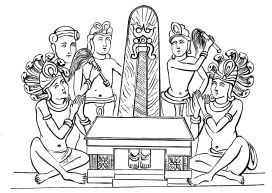
1. Naga people worshipping the Trisul emblem of Buddha, on a fiery pillar. (From a bas-relief at Amravati.)
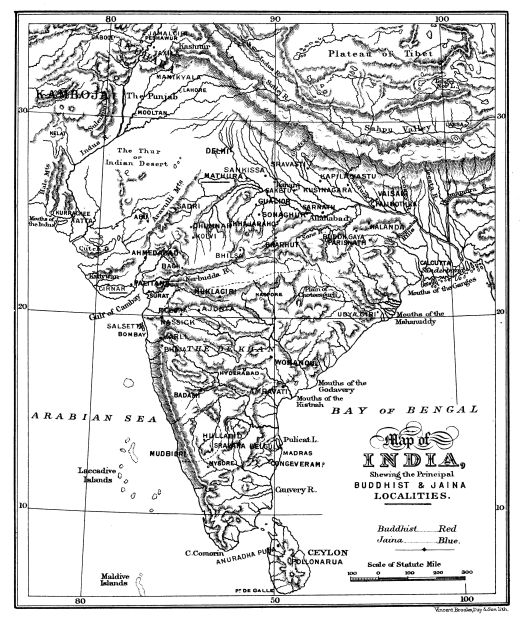
Map of
INDIA,
Showing the Principal
BUDDHIST & JAINA
LOCALITIES.