Volume 4 — CHAPTER I THE FIRST CHALDÆAN EMPIRE AND THE HYKSÔS IN EGYPT (continued 3)
M. L. McClure translation
It was the first time for centuries that a Pharaoh had trusted himself in Asia, and the same dread of the unknown which had restrained his ancestors of the XIIth dynasty, doubtless arrested Ahmosis also on the threshold of the continent. He did not penetrate further than the border provinces of Zahi, situated on the edge of the desert, and contented himself with pillaging the little town of Sharûhana.* Ahmosi-si-Abîna was again his companion, together with his cousin, Ahmosi-Pannekhabit, then at the beginning of his career, who brought away on this occasion two young girls for his household.**
* Sharûhana, which is mentioned again under Thûtmosis III. is not the plain of Sharon, as Birch imagined, but the Sharuhen of the Biblical texts, in the tribe of Simeon (Josh. xix. 6), as Brugsch recognised it to be. It is probably identical with the modern Tell-esh-Sheriâh, which lies north-west of Beersheba. ** Ahmosi Pannekhabit lay in tomb No. 2, at El-Kab. His history is briefly told on one of the walls, and on two sides of the pedestal of his statues. We have one of these, or rather two plates from the pedestal of one of them, in the Louvre; the other is in a good state of preservation, and belongs to Mr. Finlay. The inscription is found in a mutilated condition on the wall of the tomb, but the three monuments which have come down to us are sufficiently complementary to one another to enable us to restore nearly the whole of the original text.
The expedition having accomplished its purpose, the Egyptians returned home with their spoil, and did not revisit Asia for a long period. If the Hyksôs generals had fostered in their minds the idea that they could recover their lost ground, and easily re-enter upon the possession of their African domain, this reverse must have cruelly disillusioned them. They must have been forced to acknowledge that their power was at an end, and to renounce all hope of returning to the country which had so summarily ejected them. The majority of their own people did not follow them into exile, but remained attached to the soil on which they lived, and the tribes which had successively settled down beside them—including the Beni-Israel themselves—no longer dreamed of a return to their fatherland. The condition of these people varied according to their locality. Those who had taken up a position in the plain of the Delta were subjected to actual slavery. Ahmosis destroyed the camp at Avails, quartered his officers in the towns, and constructed forts at strategic points, or rebuilt the ancient citadels to resist the incursions of the Bedouin. The vanquished people in the Delta, hemmed in as they were by a network of fortresses, were thus reduced to a rabble of serfs, to be taxed and subjected to the corvée without mercy. But further north, the fluctuating population which roamed between the Sebennytic and Pelusiac branches of the Nile were not exposed to such rough treatment. The marshes of the coast-line afforded them a safe retreat, in which they could take refuge at the first threat of exactions on the part of the royal emissaries. Secure within dense thickets, upon islands approached by interminable causeways, often covered with water, or by long tortuous canals concealed in the thick growth of reeds, they were able to defy with impunity the efforts of the most disciplined troops, and treason alone could put them at the mercy of their foes. Most of the Pharaohs felt that the advantages to be gained by conquering them would be outweighed by the difficulty of the enterprise; all that could result from a campaign would be the destruction of one or two villages, the acquisition of a few hundred refractory captives, of some ill-favoured cattle, and a trophy of nets and worm-eaten boats. The kings, therefore, preferred to keep a close watch over these undisciplined hordes, and as long as their depredations were kept within reasonable limits, they were left unmolested to their wild and precarious life.
The Asiatic invasion had put a sudden stop to the advance of Egyptian rule in the vast plains of the Upper Nile. The Theban princes, to whom Nubia was directly subject, had been too completely engrossed in the wars against their hereditary enemy, to devote much time to the continuation of that work of colonization in the south which had been carried on so vigorously by their forefathers of the XIIth and XIIIth dynasties. The inhabitants of the Nile valley, as far as the second cataract, rendered them obedience, but without any change in the conditions and mode of their daily life, which appear to have remained unaltered for centuries. The temples of Usirtasen and Amenemhaît were allowed to fall into decay one after another, the towns waned in prosperity, and were unable to keep their buildings and monuments in repair; the inundation continued to bring with it periodically its fleet of boats, which the sailors of Kûsh had laden with timber, gum, elephants’ tusks, and gold dust: from time to time a band of Bedouin from Uaûaît or Mazaiû would suddenly bear down upon some village and carry off its spoils; the nearest garrison would be called to its aid, or, on critical occasions, the king himself, at the head of his guards, would fall on the marauders and drive them back into the mountains. Ahrnosis, being greeted on his return from Syria by the news of such an outbreak, thought it a favourable moment to impress upon the nomadic tribes of Nubia the greatness of his conquest. On this occasion it was the people of Khonthanûnofir, settled in the wadys east of the Nile, above Semneh, which required a lesson. The army which had just expelled the Hyksôs was rapidly conveyed to the opposite borders of the country by the fleet, the two Ahmosi of Nekhabît occupying the highest posts. The Egyptians, as was customary, landed at the nearest point to the enemy’s territory, and succeeded in killing a few of the rebels. Ahmosi-si-Abîna brought back two prisoners and three hands, for which he was rewarded by a gift of two female Bedouin slaves, besides the “gold of valour.” This victory in the south following on such decisive success in the north, filled the heart of the Pharaoh with pride, and the view taken of it by those who surrounded him is evident even in the brief sentences of the narrative. He is described as descending the river on the royal galley, elated in spirit and flushed by his triumph in Nubia, which had followed so closely on the deliverance of the Delta. But scarcely had he reached Thebes, when an unforeseen catastrophe turned his confidence into alarm, and compelled him to retrace his steps. It would appear that at the very moment when he was priding himself on the successful issue of his Ethiopian expedition, one of the sudden outbreaks, which frequently occurred in those regions, had culminated in a Sudanese invasion of Egypt. We are not told the name of the rebel leader, nor those of the tribes who took part in it. The Egyptian people, threatened in a moment of such apparent security by this inroad of barbarians, regarded them as a fresh incursion of the Hyksôs, and applied to these southerners the opprobrious term of “Fever-stricken,” already used to denote their Asiatic conquerors. The enemy descended the Nile, committing terrible atrocities, and polluting every sanctuary of the Theban gods which came within their reach. They had reached a spot called Tentoâ,* before they fell in with the Egyptian troops. Ahmosi-si-Abîna again distinguished himself in the engagement. The vessel which he commanded, probably the Rising in Memphis, ran alongside the chief galliot of the Sudanese fleet, and took possession of it after a struggle, in which Ahmosi made two of the enemy’s sailors prisoners with his own hand. The king generously rewarded those whose valour had thus turned the day in his favour, for the danger had appeared to him critical; he allotted to every man on board the victorious vessel five slaves, and five ancra of land situated in his native province of each respectively. The invasion was not without its natural consequences to Egypt itself.
* The name of this locality does not occur elsewhere; it would seem to refer, not to a village, but rather to a canal, or the branch of a river, or a harbour somewhere along the Nile. I am unable to locate it definitely, but am inclined to think we ought to look for it, if not in Egypt itself, at any rate in that part of Nubia which is nearest to Egypt. M. Revillout, taking up a theory which had been abandoned by Chabas, recognising in this expedition an offensive incursion of the Shepherds, suggests that Tantoâ may be the modern Tantah in the Delta.
A certain Titiânu, who appears to have been at the head of a powerful faction, rose in rebellion at some place not named in the narrative, but in the rear of the army. The rapidity with which Ahmosis repulsed the Nubians, and turned upon his new enemy, completely baffled the latter’s plans, and he and his followers were cut to pieces, but the danger had for the moment been serious.* It was, if not the last expedition undertaken in this reign, at least the last commanded by the Pharaoh in person. By his activity and courage Ahmosis had well earned the right to pass the remainder of his days in peace.
* The wording of the text is so much condensed that it is difficult to be sure of its moaning. Modern scholars agree with Brugsch that Titiânu is the name of a man, but several Egyptologists believe its bearer to have been chief of the Ethiopian tribes, while others think him to have been a rebellious Egyptian prince, or a king of the Shepherds, or give up the task of identification in despair. The tortuous wording of the text, and the expressions which occur in it, seem to indicate that the rebel was a prince of the royal blood, and even that the name he bears was not his real one. Later on we shall find that, on a similar occasion, the official documents refer to a prince who took part in a plot against Ramses III. by the fictitious name of Pentauîrît; Titiânu was probably a nickname of the same kind inserted in place of the real name. It seems that, in cases of high treason, the criminal not only lost his life, but his name was proscribed both in this world and in the next.
A revival of military greatness always entailed a renaissance in art, followed by an age of building activity. The claims of the gods upon the spoils of war must be satisfied before those of men, because the victory and the booty obtained through it were alike owing to the divine help given in battle. A tenth, therefore, of the slaves, cattle, and precious metals was set apart for the service of the gods, and even fields, towns, and provinces were allotted to them, the produce of which was applied to enhance the importance of their cult or to repair and enlarge their temples. The main body of the building was strengthened, halls and pylons were added to the original plan, and the impulse once given to architectural work, the co-operation of other artificers soon followed. Sculptors and painters whose art had been at a standstill for generations during the centuries of Egypt’s humiliation, and whose hands had lost their cunning for want of practice, were now once more in demand. They had probably never completely lost the technical knowledge of their calling, and the ancient buildings furnished them with various types of models, which they had but to copy faithfully in order to revive their old traditions. A few years after this revival a new school sprang up, whose originality became daily more patent, and whose leaders soon showed themselves to be in no way inferior to the masters of the older schools. Ahmosis could not be accused of ingratitude to the gods; as soon as his wars allowed him the necessary leisure, he began his work of temple-building. The accession to power of the great Theban families had been of little advantage to Thebes itself. Its Pharaohs, on assuming the sovereignty of the whole valley, had not hesitated to abandon their native city, and had made Heracleopolis, the Fayum or even Memphis, their seat of government, only returning to Thebes in the time of the XIIIth dynasty, when the decadence of their power had set in. The honour of furnishing rulers for its country had often devolved on Thebes, but the city had reaped but little benefit from the fact; this time, however, the tide of fortune was to be turned. The other cities of Egypt had come to regard Thebes as their metropolis from the time when they had temples. The main body of the building was strengthened, halls and pylons were added to the original plan, and the impulse once given to architectural work, the co-operation of other artificers soon followed. Sculptors and painters whose art had been at a standstill for generations during the centuries of Egypt’s humiliation, and whose hands had lost their cunning for want of practice, were now once more in demand. They had probably never completely lost the technical knowledge of their calling, and the ancient buildings furnished them with various types of models, which they had but to copy faithfully in order to revive their old traditions. A few years after this revival a new school sprang up, whose originality became daily more patent, and whose leaders soon showed themselves to be in no way inferior to the masters of the older schools. Ahmosis could not be accused of ingratitude to the gods; as soon as his wars allowed him the necessary leisure, he began his work of temple-building. The accession to power of the great Theban families had been of little advantage to Thebes itself. Its Pharaohs, on assuming the sovereignty of the whole valley, had not hesitated to abandon their native city, and had made Heracleopolis, the Fayum or even Memphis, their seat of government, only returning to Thebes in the time of the XIIIth dynasty, when the decadence of their power had set in. The honour of furnishing rulers for its country had often devolved on Thebes, but the city had reaped but little benefit from the fact; this time, however, the tide of fortune was to be turned.
The other cities of Egypt had come to regard Thebes as their metropolis from the time when they had learned to rally round its princes to wage war against the Hyksôs. It had been the last town to lay down arms at the time of the invasion, and the first to take them up again in the struggle for liberty. Thus the Egypt which vindicated her position among the nations of the world was not the Egypt of the Memphite dynasties. It was the great Egypt of the Amenemhâîts and the Usirtasens, still further aggrandised by recent victories. Thebes was her natural capital, and its kings could not have chosen a more suitable position from whence to command effectually the whole empire. Situated at an equal distance from both frontiers, the Pharaoh residing there, on the outbreak of a war either in the north or south, had but half the length of the country to traverse in order to reach the scene of action. Ahmosis spared no pains to improve the city, but his resources did not allow of his embarking on any very extensive schemes; he did not touch the temple of Amon, and if he undertook any buildings in its neighbourhood, they must have been minor edifices. He could, indeed, have had but little leisure to attempt much else, for it was not till the XXIInd year of his reign that he was able to set seriously to work.*
* In the inscription of the year XXII., Âhmosis expressly states that he opened new chambers in the quarries of Tûrah for the works in connection with the Theban Amon, as well as for those of the temple of the Memphite Phtah.
An opportunity then occurred to revive a practice long fallen into disuse under the foreign kings, and to set once more in motion an essential part of the machinery of Egyptian administration. The quarries of Turah, as is well known, enjoyed the privilege of furnishing the finest materials to the royal architects; nowhere else could be found limestone of such whiteness, so easy to cut, or so calculated to lend itself to the carving of delicate inscriptions and bas-reliefs. The commoner veins had never ceased to be worked by private enterprise, gangs of quarrymen being always employed, as at the present day, in cutting small stone for building purposes, or in ruthlessly chipping it to pieces to burn for lime in the kilns of the neighbouring villages; but the finest veins were always kept for State purposes. Contemporary chroniclers might have formed a very just estimate of national prosperity by the degree of activity shown in working these royal preserves; when the amount of stone extracted was lessened, prosperity was on the wane, and might be pronounced to be at its lowest ebb when the noise of the quarryman’s hammer finally ceased to be heard.
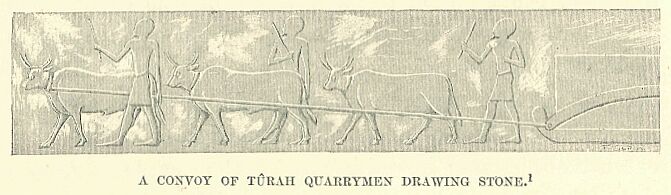
Drawn by Faucher-Gudin, from a sketch by Vyse-Perring.
Every dynasty whose resources were such as to justify their resumption of the work proudly recorded the fact on stelae which lined the approaches to the masons’ yards. Ahmosis reopened the Tûrah quarry-chambers, and procured for himself “good stone and white” for the temples of Anion at Thebes and of Phtah at Memphis. No monument has as yet been discovered to throw any light on the fate of Memphis subsequent to the time of the Amenemhâîts. It must have suffered quite as much as any city of the Delta from the Shepherd invasion, and from the wars which preceded their expulsion, since it was situated on the highway of an invading army, and would offer an attraction for pillagers. By a curious turn of fortune it was the “Fankhûi,” or Asiatic prisoners, who were set to quarry the stone for the restoration of the monuments which their own forefathers had reduced to ruins.* The bas-reliefs sculptured on the stelæ of Ahmosis show them in full activity under the corvée; we see here the stone block detached from the quarry being squared by the chisel, or transported on a sledge drawn by oxen.
* The Fankhûi are, properly speaking, all white prisoners, without distinction of race. Their name is derived from the root fôkhu, fankhu = to bind, press, carry off, steal, destroy; if it is sometimes used in the sense of Phoenicians, it is only in the Ptolemaic epoch. Here the term “Fankhûi” refers to the Shepherds and Asiatics made prisoners in the campaign of the year V. against Sharuhana.
Ahmosis had several children by his various wives; six at least owned Nofrîtari for their mother and possessed near claims to the crown, but she may have borne him others whose existence is unrecorded. The eldest appears to have been a son, Sipiri; he received all the honours due to an hereditary prince, but died without having reigned, and his second brother, Amenhotpû—called by the Greeks Amenôthes*—took his place.
* The form Amenôphis, which is usually employed, is, properly speaking, the equivalent of the name Amenemaupitu, or Amenaupîti, which belongs to a king of the XXIst Tanite dynasty; the true Greek transcription of the Ptolemaic epoch, corresponding to the pronunciation Amehotpe, or Amenhopte, is Amenôthes. Under the XVIIIth dynasty the cuneiform transcription of the tablets of Tel-el Amarna, Amankhatbi, seems to indicate the pronunciation Amanhautpi, Amanhatpi, side by side with the pronunciation Aman-hautpu, Amenhotpu.
Ahmosis was laid to rest in the chapel which he had prepared for himself in the cemetery of Drah-abu’l-Neggah, among the modest pyramids of the XIth, XIIIth, and XVIIth dynasties.* He was venerated as a god, and his cult was continued for six or eight centuries later, until the increasing insecurity of the Theban necropolis at last necessitated the removal of the kings from their funeral chambers.** The coffin of Ahmosis was found to be still intact, though it was a poorly made one, shaped to the contours of the body, and smeared over with yellow; it represents the king with the false beard depending from his chin, and his breast covered with a pectoral ornament, the features, hair, and accessories being picked out in blue. His name has been hastily inscribed in ink on the front of the winding-sheet, and when the lid was removed, garlands of faded pink flowers were still found about the neck, laid there as a last offering by the priests who placed the Pharaoh and his compeers in their secret burying-place.
* The precise site is at present unknown: we see, however, that it was in this place, when wo observe that Ahmosis was worshipped by the Servants of the Necropolis, amongst the kings and princes of his family who were buried at Drah- abu’l-Neggah. ** His priests and the minor employés of his cult are mentioned on a stele in the museum at Turin, and on a brick in the Berlin Museum. He is worshipped as a god, along with Osiris, Horus, and Isis, on a stele in the Lyons Museum, brought from Abydos: he had, probably, during one of his journeys across Egypt, made a donation to the temple of that city, on condition that he should be worshipped there for ever; for a stele at Marseilles shows him offering homage to Osiris in the bark of the god itself, and another stele in the Louvre informs us that Pharaoh Thûtmosis IV. several times sent one of his messengers to Abydos for the purpose of presenting land to Osiris and to his own ancestor Ahmosis.
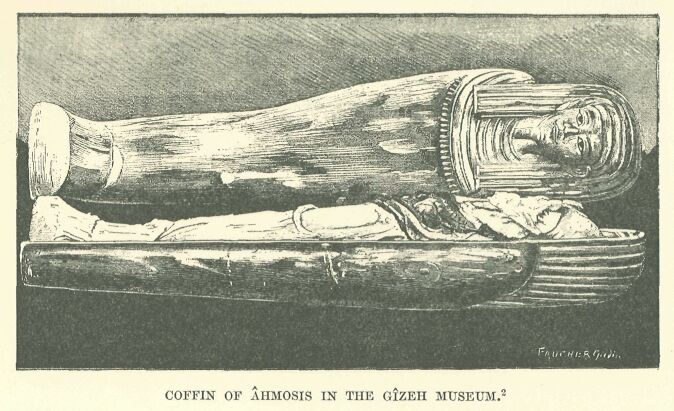
Drawn by Faucher-Gudin, from a photograph by Emil Brugsch-Bey.
Amenôthes I. had not attained his majority when his father “thus winged his way to heaven,” leaving him as heir to the throne.* Nofrîtari assumed the authority; after having shared the royal honours for nearly twenty-five years with her husband, she resolutely refused to resign them.** She was thus the first of those queens by divine right who, scorning the inaction of the harem, took on themselves the right to fulfil the active duties of a sovereign, and claimed the recognition of the equality or superiority of their titles to those of their husbands or sons.
* The last date known is that of the year XXII. at Tûrah; Manetho’s lists give, in one place, twenty-five years and four months after the expulsion; in another, twenty-six years in round numbers, as the total duration of his reign, which has every appearance of probability. ** There is no direct evidence to prove that Amenôthes I. was a minor when he came to the throne; still the presumptions in favour of this hypothesis, afforded by the monuments, are so strong that many historians of ancient Egypt have accepted it. Queen Nofrîtari is represented as reigning, side by side with her reigning son, on some few Theban tombs which can be attributed to their epoch.
Drawn by Bouclier, from the photograph by M. de Mertens taken in the Berlin Museum.
The aged Ahhotpu, who, like Nofrîtari, was of pure royal descent, and who might well have urged her superior rank, had been content to retire in favour of her children; she lived to the tenth year of her grandson’s reign, respected by all her family, but abstaining from all interference in political affairs. When at length she passed away, full of days and honour, she was embalmed with special care, and her body was placed in a gilded mummy-case, the head of which presented a faithful copy of her features. Beside her were piled the jewels she had received in her lifetime from her husband and son. The majority of them a fan with a handle plated with gold, a mirror of gilt bronze with ebony handle, bracelets and ankle-rings, some of solid and some of hollow gold, edged with fine chains of plaited gold wire, others formed of beads of gold, lapis-lazuli, cornelian, and green felspar, many of them engraved with the cartouche of Ahmosis. Belonging also to Ahmosis we have a beautiful quiver, in which figures of the king and the gods stand out in high relief on a gold plaque, delicately chased with a graving tool; the background is formed of small pieces of lapis and blue glass, cunningly cut to fit each other. One bracelet in particular, found on the queen’s wrist, consisted of three parallel bands of solid gold set with turquoises, and having, a vulture with extended wings on the front. The queen’s hair was held in place by a gold circlet, scarcely as large as a bracelet; a cartouche was affixed to the circlet, bearing the name of Ahmosis in blue paste, and flanked by small sphinxes, one on each side, as supporters. A thick flexible chain of gold was passed several times round her neck, and attached to it as a pendant was a beautiful scarab, partly of gold and partly of blue porcelain striped with gold. The breast ornament was completed by a necklace of several rows of twisted cords, from which depended antelopes pursued by tigers, sitting jackals, hawks, vultures, and the winged urasus, all attached to the winding-sheet by means of a small ring soldered on the back of each animal. The fastening of this necklace was formed of the heads of two gold hawks, the details of the heads being worked out in blue enamel. Both weapons and amulets were found among the jewels, including three gold flies suspended by a thin chain, nine gold and silver axes, a lion’s head in gold of most minute workmanship, a sceptre of black wood plated with gold, daggers to defend the deceased from the dangers of the unseen world, boomerangs of hard wood, and the battle-axe of Ahmosis. Besides these, there were two boats, one of gold and one of silver, originally intended for the Pharaoh Kamosû—models of the skiff in which his mummy crossed the Nile to reach its last resting-place, and to sail in the wake of the gods on the western sea.
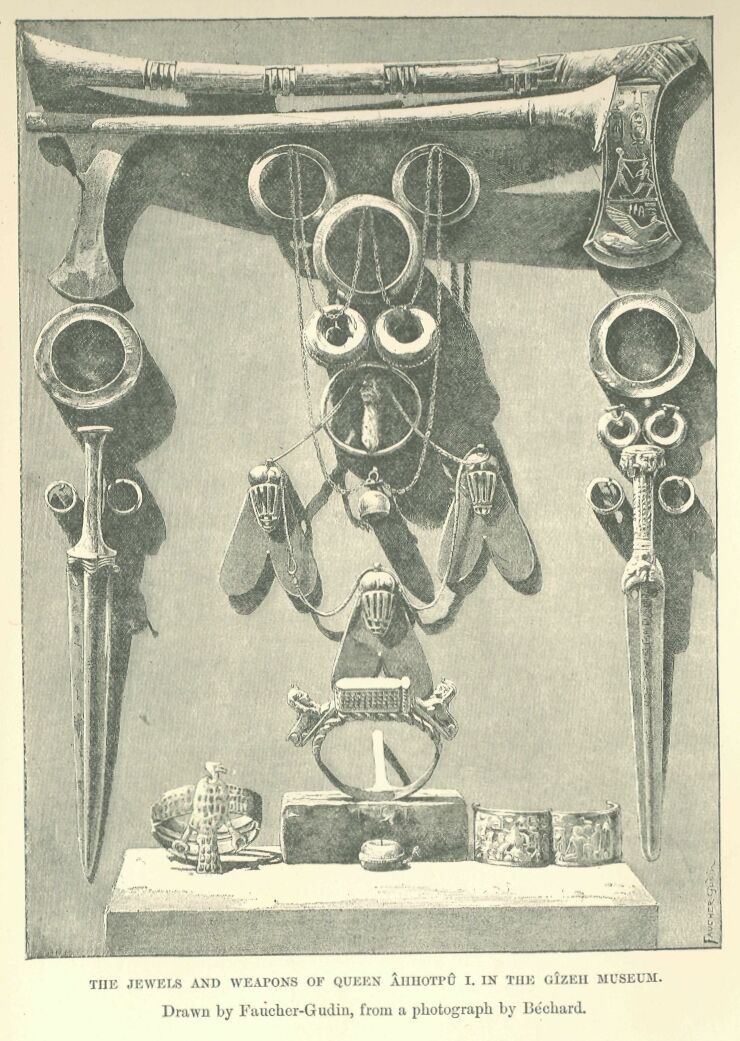
Drawn by Faucher-Gudin, from a photograph by Bechard.
Nofrîtari thus reigned conjointly with Amenôthes, and even if we have no record of any act in which she was specially concerned, we know at least that her rule was a prosperous one, and that her memory was revered by her subjects. While the majority of queens were relegated after death to the crowd of shadowy ancestors to whom habitual sacrifice was offered, the worshippers not knowing even to which sex these royal personages belonged, the remembrance of Nofrîtari always remained distinct in their minds, and her cult spread till it might be said to have become a kind of popular religion. In this veneration Ahmosis was rarely associated with the queen, but Amenôthes and several of her other children shared in it—her son Sipiri, for instance, and her daughters Sîtamon,* Sîtkamosi, and Marîtamon; Nofrîtari became, in fact, an actual goddess, taking her place beside Amon, Khonsû, and Maut,** the members of the Theban Triad, or standing alone as an object of worship for her devotees.
* Sîtamon is mentioned, with her mother, on the Karnak stele and on the coffin of Bûtehamon. ** She is worshipped with the Theban Triad by Brihor, at Karnak, in the temple of Khonsû.
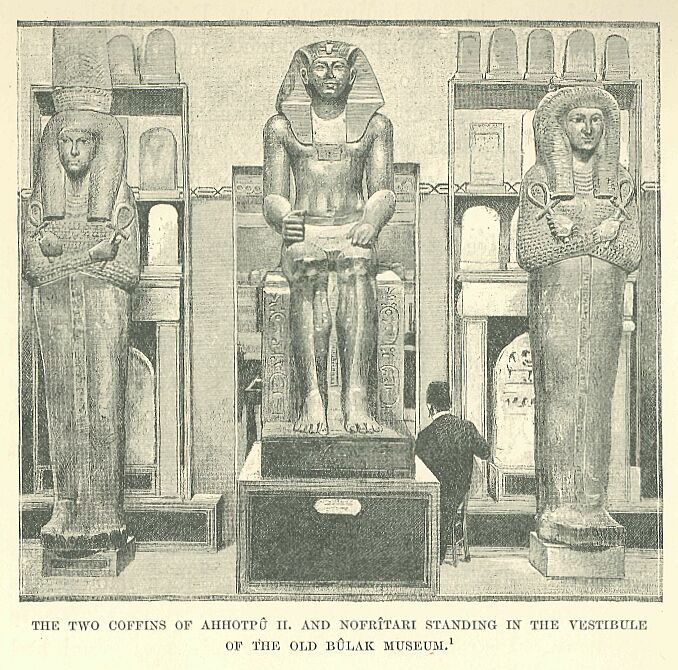
Drawn by Faucher-Gudin, from a photograph by Emil Brugsch- Bey.
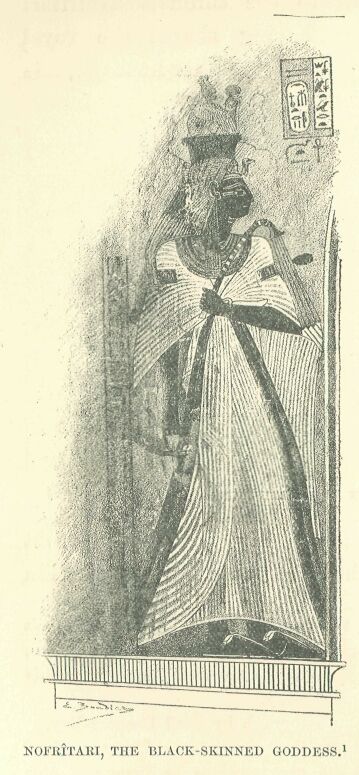
She was identified with Isis, Hathor, and the mistresses of Hades, and adopted their attributes, even to the black or blue coloured skin of these funerary divinities.*
* Her statue in the Turin Museum represents her as having black skin. She is also painted black standing before Amenôthes (who is white) in the Deir el-Medineh tomb, now preserved in the Berlin Museum, in that of Nibnûtîrû, and hi that of Unnofir, at Sheikh Abd el-Qûrnah. Her face is painted blue in the tomb of Kasa. The representations of this queen with a black skin have caused her to be taken for a negress, the daughter of an Ethiopian Pharaoh, or at any rate the daughter of a chief of some Nubian tribe; it was thought that Ahmosis must have married her to secure the help of the negro tribes in his wars, and that it was owing to this alliance that he succeeded in expelling the Hyksôs. Later discoveries have not confirmed these hypotheses. Nofrîtari was most probably an Egyptian of unmixed race, as we have seen, and daughter of Ahhotpû I., and the black or blue colour of her skin is merely owing to her identification with the goddesses of the dead.
Considerable endowments were given for maintaining worship at her tomb, and were administered by a special class of priests. Her mummy reposed among those of the princes of her family, in the hiding-place at Deîr-el-Baharî: it was enclosed in an enormous wooden sarcophagus covered with linen and stucco, the lower part being shaped to the body, while the upper part representing the head and arms could be lifted off in one piece. The shoulders are covered with a network in relief, the meshes of which are painted blue on a yellow background. The Queen’s hands are crossed over her breast, and clasp the crux ansata, the symbol of life. The whole mummy-case measures a little over nine feet from the sole of the feet to the top of the head, which is furthermore surmounted by a cap, and two long ostrich-feathers. The appearance is not so much that of a coffin as of one of those enormous caryatides which we sometimes find adorning the front of a temple.
We may perhaps attribute to the influence of Nofrîtari the lack of zest evinced by Amenôthes for expeditions into Syria. Even the most energetic kings had always shrunk from penetrating much beyond the isthmus. Those who ventured so far as to work the mines of Sinai had nevertheless felt a secret fear of invading Asia proper—a dread which they never succeeded in overcoming. When the raids of the Bedouin obliged the Egyptian sovereign to cross the frontier into their territory, he would retire as soon as possible, without attempting any permanent conquest. After the expulsion of the Hyksôs, Ahmosis seemed inclined to pursue a less timorous course. He made an advance on Sharûhana and pillaged it, and the booty he brought back ought to have encouraged him to attempt more important expeditions; but he never returned to this region, and it would seem that when his first enthusiasm had subsided, he was paralysed by the same fear which had fallen on his ancestors. Nofrîtari may have counselled her son not to break through the traditions which his father had so strictly followed, for Amenôthes I. confined his campaigns to Africa, and the traditional battle-fields there. He embarked for the land of Kûsh on the vessel of Ahmosi-si-Abîna “for the purpose of enlarging the frontiers of Egypt.” It was, we may believe, a thoroughly conventional campaign, conducted according to the strictest precedents of the XIIth dynasty. The Pharaoh, as might be expected, came into personal contact with the enemy, and slew their chief with his own hand; the barbarian warriors sold their lives dearly, but were unable to protect their country from pillage, the victors carrying off whatever they could seize—men, women, and cattle. The pursuit of the enemy had led the army some distance into the desert, as far as a halting-place called the “Upper cistern”—Khnûmît hirît; instead of retracing his steps to the Nile squadron, and returning slowly by boat, Amenôthes resolved to take a short cut homewards. Ahmosi conducted him back overland in two days, and was rewarded for his speed by the gift of a quantity of gold, and two female slaves. An incursion into Libya followed quickly on the Ethiopian campaign.
Drawn by Boudier, from a photograph supplied by Flinders Pétrie.
The tribe of the Kihaka, settled between Lake Mareotis and the Oasis of Amon, had probably attacked in an audacious manner the western provinces of the Delta; a raid was organized against them, and the issue was commemorated by a small wooden stele, on which we see the victor represented as brandishing his sword over a barbarian lying prostrate at his feet. The exploits of Amenôthes appear to have ended with this raid, for we possess no monument recording any further victory gained by him. This, however, has not prevented his contemporaries from celebrating him as a conquering and ‘victorious king. He is portrayed standing erect in his chariot ready to charge, or as carrying off two barbarians whom he holds half suffocated in his sinewy arms, or as gleefully smiting the princes of foreign lands. He acquitted himself of the duties of the chase as became a true Pharaoh, for we find him depicted in the act of seizing a lion by the tail and raising him suddenly in mid-air previous to despatching him. These are, indeed, but conventional pictures of war, to which we must not attach an undue importance. Egypt had need of repose in order to recover from the losses it had sustained during the years of struggle with the invaders. If Amenôthes courted peace from preference and not from political motives, his own generation profited as much by his indolence as the preceding one had gained by the energy of Ahrnosis. The towns in his reign resumed their ordinary life, agriculture flourished, and commerce again followed its accustomed routes. Egypt increased its resources, and was thus able to prepare for future conquest. The taste for building had not as yet sufficiently developed to become a drain upon the public treasury. We have, however, records showing that Amenôthes excavated a cavern in the mountain of Ibrîm in Nubia, dedicated to Satît, one of the goddesses of the cataract.
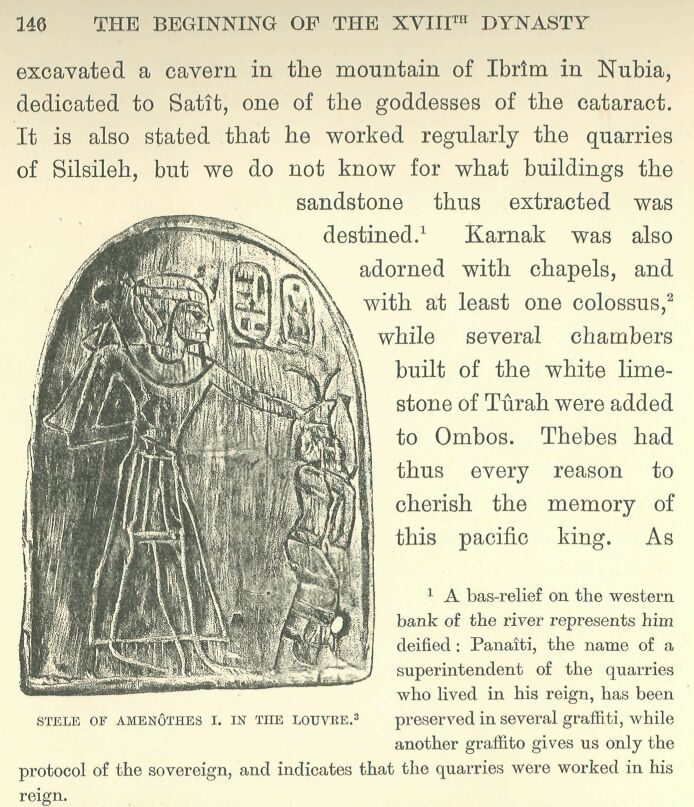
It is also stated that he worked regularly the quarries of Silsileh, but we do not know for what buildings the sandstone thus extracted was destined.* Karnak was also adorned with chapels, and with at least one colossus,** while several chambers built of the white limestone of Tûrah were added to Ombos. Thebes had thus every reason to cherish the memory of this pacific king.
* A bas-relief on the western bank of the river represents him deified: Panaîti, the name of a superintendent of the quarries who lived in his reign, has been preserved in several graffiti, while another graffito gives us only the protocol of the sovereign, and indicates that the quarries were worked in his reign. ** The chambers of white limestone are marked I, K, on Mariette’s plan; it is possible that they may have been merely decorated under Thûtmosis III., whose cartouches alternate with those of Amenôthes I. The colossus is now in front of the third Pylon, and Wiedemann concluded from this fact that Amenôthes had begun extensive works for enlarging the temple of Amon; Mariette believed, with greater probability, that the colossus formerly stood at the entrance to the XIIth dynasty temple, but was removed to its present position by Thûtmosis III.
As Nofrîtari had been metamorphosed into a form of Isis, Amenôthes was similarly represented as Osiris, the protector of the Necropolis, and he was depicted as such with the sombre colour of the funerary divinities; his image, moreover, together with those of the other gods, was used to decorate the interiors of coffins, and to protect the mummies of his devotees.*
* Wiedemann has collected several examples, to which it would be easy to add others. The names of the king are in this case constantly accompanied by unusual epithets, which are enclosed in one or other of his cartouches: Mons. Kevillout, deceived by these unfamiliar forms, has made out of one of these variants, on a painted cloth in the Louvre, a new Amenôthes, whom he styles Amenôthes V.
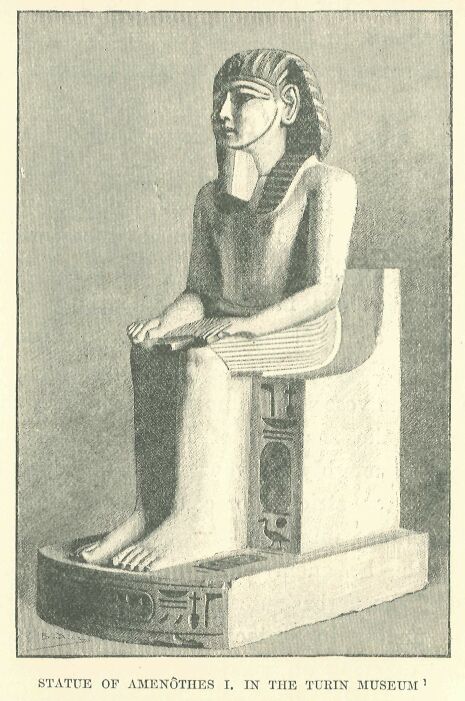
Drawn by Faucher-Gudin, from a photograph by Emil Brugsch- Bey.
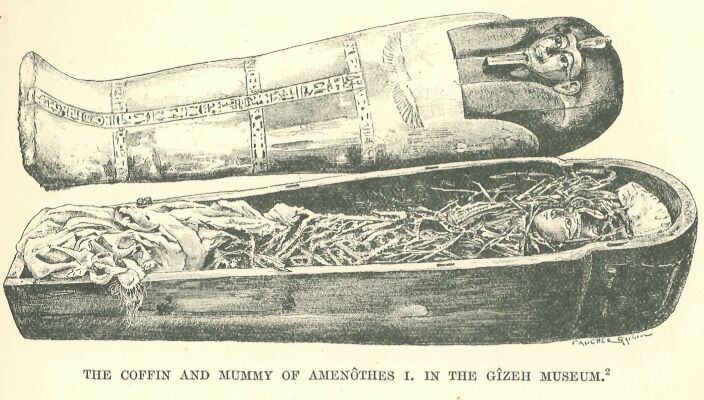
One of his statues, now in the Turin Museum, represents him sitting on his throne in the posture of a king giving audience to his subjects, or in that of a god receiving the homage of his worshippers. The modelling of the bust betrays a flexibility of handling which is astonishing in a work of art so little removed from barbaric times; the head is a marvel of delicacy and natural grace. We feel that the sculptor has taken a delight in chiselling the features of his sovereign, and in reproducing the benevolent and almost dreamy expression which characterised them.* The cult of Amenôthes lasted for seven or eight centuries, until the time when his coffin was removed and placed with those of the other members of his family in the place where it remained concealed until our own times.**
* Another statue of very fine workmanship, but mutilated, is preserved in the Gizeh Museum; this statue is of the time of Seti I., and, as is customary, represents Amenôthes in the likeness of the king then reigning. ** We know, from the Abbott Papyrus, that the pyramid of Amenôthes I. was situated at Dr-ah Abou’l-Neggah, among those of the Pharaohs of the XIth, XIIth, and XVIIth dynasties. The remains of it have not yet been discovered.
It is shaped to correspond with the form of the human body and painted white; the face resembles that of his statue, and the eyes of enamel, touched with kohl, give it a wonderful appearance of animation. The body is swathed in orange-coloured linen, kept in place by bands of brownish linen, and is further covered by a mask of wood and cartonnage, painted to match the exterior of the coffin. Long garlands of faded flowers deck the mummy from head to foot. A wasp, attracted by their scent, must have settled upon them at the moment of burial, and become imprisoned by the lid; the insect has been completely preserved from corruption by the balsams of the embalmer, and its gauzy wings have passed un-crumpled through the long centuries.
Amenôthes had married Ahhotpû II, his sister by the same father and mother;* Ahmasi, the daughter born of this union, was given in marriage to Thûtmosis, one of her brothers, the son of a mere concubine, by name Sonisonbû.** Ahmasi, like her ancestor Nofrîtari, had therefore the right to exercise all the royal functions, and she might have claimed precedence of her husband. Whether from conjugal affection or from weakness of character, she yielded, however, the priority to Thûtmosis, and allowed him to assume the sole government.
* Ahhotpû II. may be seen beside her husband on several monuments. The proof that she was full sister of Amenôthes I. is furnished by the title of “hereditary princess” which is given to her daughter Àhmasi; this princess would not have taken precedence of her brother and husband Thûtmosis, who was the son of an inferior wife, had she not been the daughter of the only legitimate spouse of Amenôthes I. The marriage had already taken place before the accession of Thûtmosis I., as Ahmasi figures in a document dated the first year of his reign. ** The absence of any cartouche shows that Sonisonbû did not belong to the royal family, and the very form of the name points her out to have been of the middle classes, and merely a concubine. The accession of her son, however, ennobled her, and he represents her as a queen on the walls of the temple at Deîr el-Baharî; even then he merely styles her “Royal Mother,” the only title she could really claim, as her inferior position in the harem prevented her from using that of “Royal Spouse.”
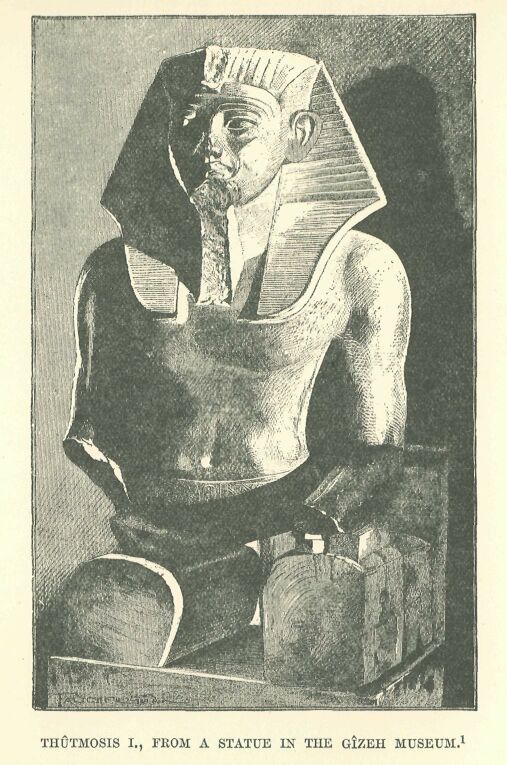
Drawn by Faucher-Gudin, from the photograph taken by Émil Brugsch-Bey.
He was crowned at Thebes on the 21st of the third month of Pirît; and a circular, addressed to the representatives of the ancient seignorial families and to the officers of the crown, announced the names assumed by the new sovereign. “This is the royal rescript to announce to you that my Majesty has arisen king of the two Egypts, on the seat of the Horus of the living, without equal, for ever, and that my titles are as follows: The vigorous bull Horus, beloved of Mâît, the Lord of the Vulture and of the Uraeus who raises itself as a flame, most valiant,—the golden Horns, whose years are good and who puts life into all hearts, king of the two Egypts, Akhopirkerî, son of the Sun, Thûtmosis, living for ever.* Cause, therefore, sacrifices to be offered to the gods of the south and of Elephantine,** and hymns to be chanted for the well-being of the King Akhopirkerî, living for ever, and then cause the oath to be taken in the name of my Majesty, born of the royal mother Sonisonbû, who is in good health.—This is sent to thee that thou mayest know that the royal house is prosperous, and in good health and condition, the 1st year, the 21st of the third month of Pirît, the day of coronation.”
* This is really the protocol of the king, as we find it on the monuments, with his two Horus names and his solar titles. ** The copy of the letter which has come down to us is addressed to the commander of Elephantine: hence the mention of the gods of that town. The names of the divinities must have been altered to suit each district, to which the order to offer sacrifices for the prosperity of the new sovereign was sent.
The new king was tall in stature, broad-shouldered, well knit, and capable of enduring the fatigues of war without flagging. His statues represent him as having a full, round face, long nose, square chin, rather thick lips, and a smiling but firm expression. Thûtmosis brought with him on ascending the throne the spirit of the younger generation, who, born shortly after the deliverance from the Hyksôs, had grown up in the peaceful days of Amenôthes, and, elated by the easy victories obtained over the nations of the south, were inspired by ambitions unknown to the Egyptians of earlier times. To this younger race Africa no longer offered a sufficiently wide or attractive field; the whole country was their own as far as the confluence of the two Niles, and the Theban gods were worshipped at Napata no less devoutly than at Thebes itself. What remained to be conquered in that direction was scarcely worth the trouble of reducing to a province or of annexing as a colony; it comprised a number of tribes hopelessly divided among themselves, and consequently, in spite of their renowned bravery, without power of resistance. Light columns of troops, drafted at intervals on either side of the river, ensured order among the submissive, or despoiled the refractory of their possessions in cattle, slaves, and precious stones. Thûtmosis I. had to repress, however, very shortly after his accession, a revolt of these borderers at the second and third cataracts, but they were easily overcome in a campaign of a few days’ duration, in which the two Âhmosis of Al-Kab took an honourable part. There was, as usual, an encounter of the two fleets in the middle of the river: the young king himself attacked the enemy’s chief, pierced him with his first arrow, and made a considerable number of prisoners. Thûtmosis had the corpse of the chief suspended as a trophy in front of the royal ship, and sailed northwards towards Thebes, where, however, he was not destined to remain long.* An ample field of action presented itself to him in the north-east, affording scope for great exploits, as profitable as they were glorious.**
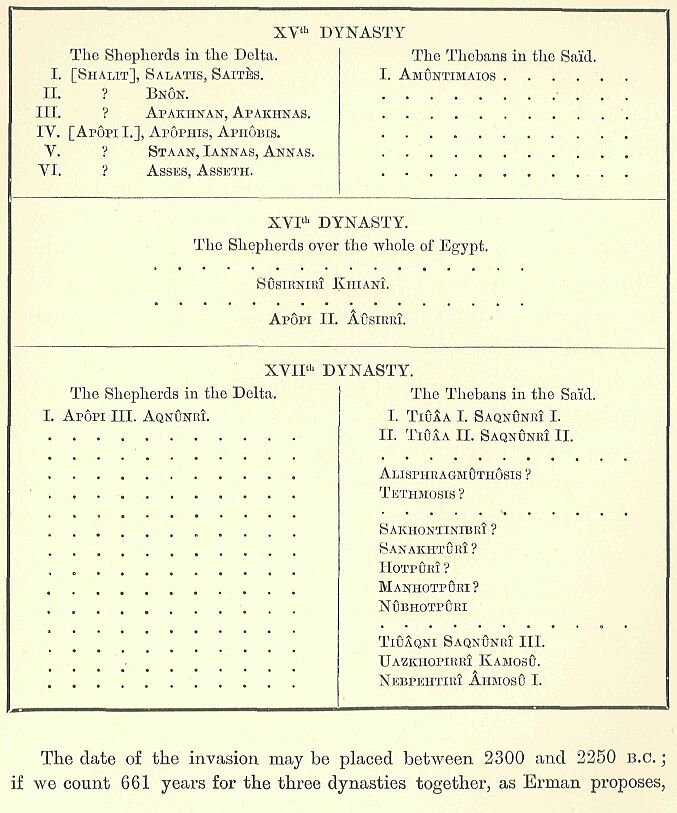
* That this expedition must be placed at the beginning of the king’s reign, in his first year, is shown by two facts: (1) It precedes the Syrian campaign in the biography of the two Âhmosis of El-Kab; (2) the Syrian campaign must have ended in the second year of the reign, since Thûtmosis I., on the stele of Tombos which bears that date, gives particulars of the course of the Euphrates, and records the submission of the countries watered by that river. The date of the invasion may be placed between 2300 and 2250 B.C.; if we count 661 years for the three dynasties together, as Erman proposes, we find that the accession of Ahmosis would fall between 1640 and 1590. I should place it provisionally in the year 1600, in order not to leave the position of the succeeding reigns uncertain; I estimate the possible error at about half a century. ** It is impossible at present to draw up a correct table of the native or foreign sovereigns who reigned over Egypt during the time of the Hyksôs. I have given the list of the kings of the XIIIth and XIVth dynasties which are known to us from the Turin Papyrus. I here append that of the Pharaohs of the following dynasties, who are mentioned either in the fragments of Manetho or on the monuments:
Syria offered to Egyptian cupidity a virgin prey in its large commercial towns inhabited by an industrious population, who by maritime trade and caravan traffic had amassed enormous wealth. The country had been previously subdued by the Chaldæans, who still exercised an undisputed influence over it, and it was but natural that the conquerors of the Hyksôs should act in their turn as invaders. The incursion of Asiatics into Egypt thus provoked a reaction which issued in an Egyptian invasion of Asiatic soil. Thûtmosis and his contemporaries had inherited none of the instinctive fear of penetrating into Syria which influenced Ahmosis and his successor: the Theban legions were, perhaps, slow to advance, but once they had trodden the roads of Palestine, they were not likely to forego the delights of conquest. From that time forward there was perpetual warfare and pillaging expeditions from the plains of the Blue Nile to those of the Euphrates, so that scarcely a year passed without bringing to the city of Amon its tribute of victories and riches gained at the point of the sword. One day the news would be brought that the Amorites or the Khâti had taken the field, to be immediately followed by the announcement that their forces had been shattered against the valour of the Egyptian battalions. Another day, Pharaoh would re-enter the city with the flower of his generals and veterans; the chiefs whom he had taken prisoners, sometimes with his own hand, would be conducted through the streets, and then led to die at the foot of the altars, while fantastic processions of richly clothed captives, beasts led by halters, and slaves bending under the weight of the spoil would stretch in an endless line behind him.
Meanwhile the Timihû, roused by some unknown cause, would attack the outposts stationed on the frontier, or news would come that the Peoples of the Sea had landed on the western side of the Delta; the Pharaoh had again to take the field, invariably with the same speedy and successful issue. The Libyans seemed to fare no better than the Syrians, and before long those who had survived the defeat would be paraded before the Theban citizens, previous to being sent to join the Asiatic prisoners in the mines or quarries; their blue eyes and fair hair showing from beneath strangely shaped helmets, while their white skins, tall stature, and tattooed bodies excited for a few hours the interest and mirth of the idle crowd. At another time, one of the customary raids into the land of Kûsh would take place, consisting of a rapid march across the sands of the Ethiopian desert and a cruise along the coasts of Pûanîfc. This would be followed by another triumphal procession, in which fresh elements of interest would appear, heralded by flourish of trumpets and roll of drums: Pharaoh would re-enter the city borne on the shoulders of his officers, followed by negroes heavily chained, or coupled in such a way that it was impossible for them to move without grotesque contortions, while the acclamations of the multitude and the chanting of the priests would resound from all sides as the cortege passed through the city gates on its way to the temple of Amon. Egypt, roused as it were to warlike frenzy, hurled her armies across all her frontiers simultaneously, and her sudden appearance in the heart of Syria gave a new turn to human history. The isolation of the kingdoms of the ancient world was at an end; the conflict of the nations was about to begin.
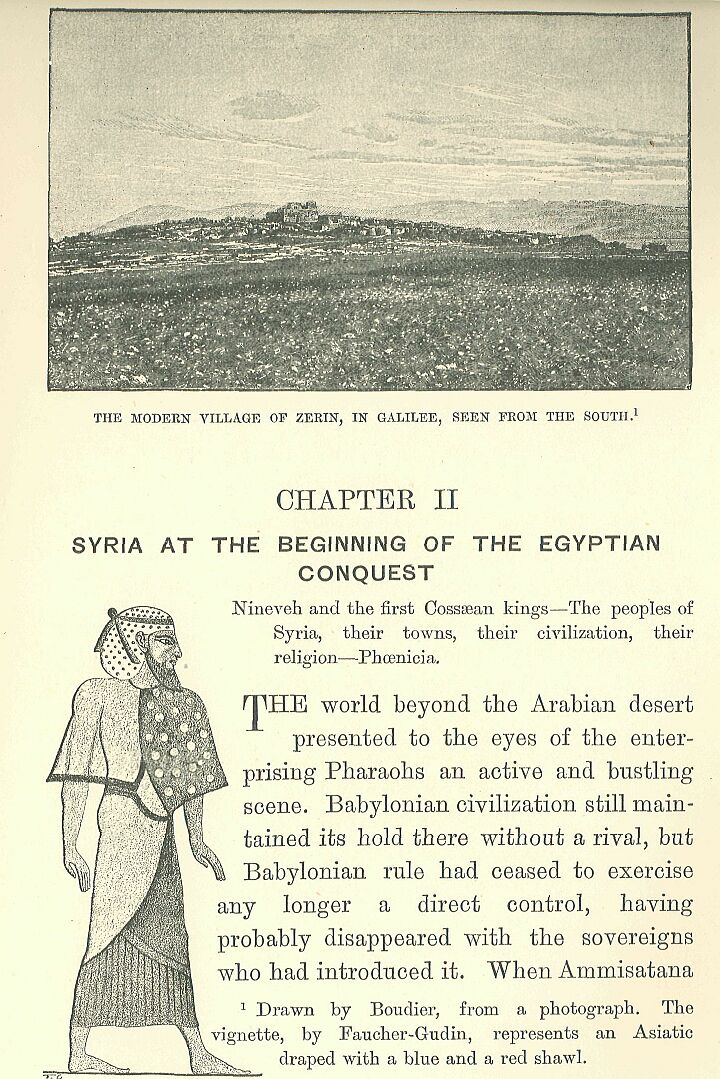
SYRIA AT THE BEGINNING OF THE EGYPTIAN CONQUEST
NINEVEH AND THE FIRST COSSÆAN KINGS-THE PEOPLES OF SYRIA, THEIR TOWNS, THEIR CIVILIZATION, THEIR RELIGION-PHOENICIA.
The dynasty of Uruazagga-The Cossseans: their country, their gods, their conquest of Chaldæa-The first sovereigns of Assyria, and the first Cossæan Icings: Agumhakrimê.
The Egyptian names for Syria: Kharâ, Zahi, Lotanû, Kefâtiu-The military highway from the Nile to the Euphrates: first section from Zalu to Gaza-The Canaanites: their fortresses, their agricultural character: the forest between Jaffa and Mount Carmel, Megiddo-The three routes beyond Megiddo: Qodshu-Alasia, Naharaim, Garchemish; Mitanni and the countries beyond the Euphrates.
Disintegration of the Syrian, Canaanite, Amorite, and Khdti populations; obliteration of types-Influence of Babylon on costumes, customs, and religion—Baalim and Astarte, plant-gods and stone-gods-Religion, human sacrifices, festivals; sacred stones—Tombs and the fate of man after death-Phoenician cosmogony.
Phoenicia—Arad, Marathus, Simyra, Botrys—Byblos, its temple, its goddess, the myth of Adonis: Aphaka and the valley of the Nahr-Ibrahim, the festivals of the death and resurrection of Adonis—Berytus and its god El; Sidon and its suburbs—Tyre: its foundation, its gods, its necropolis, its domain in the Lebanon.
Isolation of the Phoenicians with regard to the other nations of Syria; their love of the sea and the causes which developed it—Legendary accounts of the beginning of their colonization—Their commercial proceedings, their banks and factories; their ships—Cyprus, its wealth, its occupations—The Phoenician colonies in Asia Minor and the Ægean Sea: purple dye—The nations of the Ægean.