Volume 4 — CHAPTER II—SYRIA AT THE BEGINNING OF THE EGYPTIAN CONQUEST (continued 2)
M. L. McClure translation
Rammânu;* Dagon, patron god of fishermen and husbandmen, seems to have watched over the fruitfulness of the sea and the land.** We are beginning to learn the names of the races whom they specially protected: Rashuf the Amorites, Hadad and Rimmon the Aramæans of Damascus, Dagon the peoples of the coast between Ashkelon and the forest of Carmel. Rashûf is the only one whose appearance is known to us. He possessed the restless temperament usually attributed to the thunder-gods, and was, accordingly, pictured as a soldier armed with javelin and mace, bow and buckler; a gazelle’s head with pointed horns surmounts his helmet, and sometimes, it may be, serves him as a cap.
* Hadad and Rimmon are represented in Assyrio-Chaldæan by one and the same ideogram, which may be read either Dadda- Hadad or Eammânu. The identity of the expressions employed shows how close the connection between the two divinities must have been, even if they were not similar in all respects; from the Hebrew writings we know of the temple of Rimmon at Damascus (2 Kings v. 18) and that one of the kings of that city was called Tabrimmôn = “llimmon is good” (1 Kings xv. 18), while Hadad gave his name to no less than ten kings of the same city. Even as late as the Græco- Roman epoch, kingship over the other gods was still attributed both to Rimmon and to Hadad, but this latter was identified with the sun. ** The documents which we possess in regard to Dagon date from the Hebrew epoch, and represent him as worshipped by the Philistines. We know, however, from the Tel el-Amarna tablets, of a Dagantakala, a name which proves the presence of the god among the Canaanites long before the Philistine invasion, and we find two Beth-Dagons—one in the plain of Judah, the other in the tribe of Asher; Philo of Byblos makes Dagon a Phoenician deity, and declares him to be the genius of fecundity, master of grain and of labour. The representation of his statue which appears on the Græco- Roman coins of Abydos, reminds us of the fish-god of Chaldæa.
Each god had for his complement a goddess, who was proclaimed “mistress” of the city, Baalat, or “queen,” Milkat, of heaven, just as the god himself was recognised as “master” or “king.” * As a rule, the goddess was contented with the generic name of Astartê; but to this was often added some epithet, which lent her a distinct personality, and prevented her from being confounded with the Astartês of neighbouring cities, her companions or rivals.**
* Among goddesses to whom the title “Baalat “was referred, we have the goddess of Byblos, Baalat-Gebal, also the goddess of Berytus, Baalat-Berîth, or Beyrut. The epithet “queen of heaven “is applied to the Phoenician Astartê by Hebrew (Jer. vii. 18, xliv. 18-29) and classic writers. The Egyptians, when they adopted these Oanaanitish goddesses, preserved the title, and called each of them nibît pit, “lady of heaven.” In the Phoenician inscriptions their names are frequently preceded by the word Rabbat: rabbat Baalat-Gebal, “(my) lady Baalat-Gebal.” ** The Hebrew writers frequently refer to the Canaanite goddesses by the general title “the Ashtarôth” or “Astartês,” and a town in Northern Syria bore the significant name of Istarâti = “the Ishtars, the Ashtarôth,” a name which finds a parallel in Anathôth = “the Anats,” a title assumed by a town of the tribe of Benjamin; similarly, the Assyrio- Chaldæans called their goddesses by the plural of Ishtar. The inscription on an Egyptian amulet in the Louvre tells us of a personage of the XXth dynasty, who, from his name, Rabrabîna, must have been of Syrian origin, and who styled himself “Prophet of the Astartês,” Honnutir Astiratu.
Drawn by Faucher-Gudin, from a copy of an original in chased gold.
Thus she would be styled the “good” Astartê, Ashtoreth Naamah, or the “horned” Astartê, Ashtoreth Qarnaîm, because of the lunar crescent which appears on her forehead, as a sort of head-dress.* She was the goddess of good luck, and was called Gad;** she was Anat,*** or Asîti,**** the chaste and the warlike.
* The two-horned Astartê gave her name to a city beyond the Jordan, of which she was, probably, the eponymous goddess: (Gen xiv. 5) she would seem to be represented on the curious monument called by the Arabs “the stone of Job,” which was discovered by M. Schumacher in the centre of the Hauran. It was an analogous goddess whom the Egyptians sometimes identified with their Hâthor, and whom they represented as crowned with a crescent. ** Gad, the goddess of fortune, is mainly known to us in connection with the Aramæans; we find mention made of her by the Hebrew writers, and geographical names, such as Baal-Gad and Migdol-Gad, prove that she must have been worshipped at a very early date in the Canaanite countries. *** Anat, or Anaîti, or Aniti, has been found in a Phoenician inscription, which enables us to reconstruct the history of the goddess. Her worship was largely practised among the Canaanites, as is proved by the existence in the Hebrew epoch of several towns, such as Beth-Anath, Beth- Anoth, Anathôth; at least one of which, Bît-Anîti, is mentioned in the Egyptian geographical lists. The appearance of Anat-Anîti is known to us, as she is represented in Egyptian dress on several stelæ of the XIXth and XXth dynasties. Her name, like that of Astartê, had become a generic term, in the plural form Anathôth, for a whole group of goddesses. **** Asîti is represented at Radesieh, on a stele of the time of Seti I.; she enters into the composition of a compound name, Asîtiiàkhûrû (perhaps “the goddess of Asiti is enflamed with anger “), which we find on a monument in the Vienna Museum. W. Max Müller makes her out to have been a divinity of the desert, and the place in which the picture representing her was found would seem to justify this hypothesis; the Egyptians connected her, as well as the other Astartês, with Sit-Typhon, owing to her cruel and warlike character.
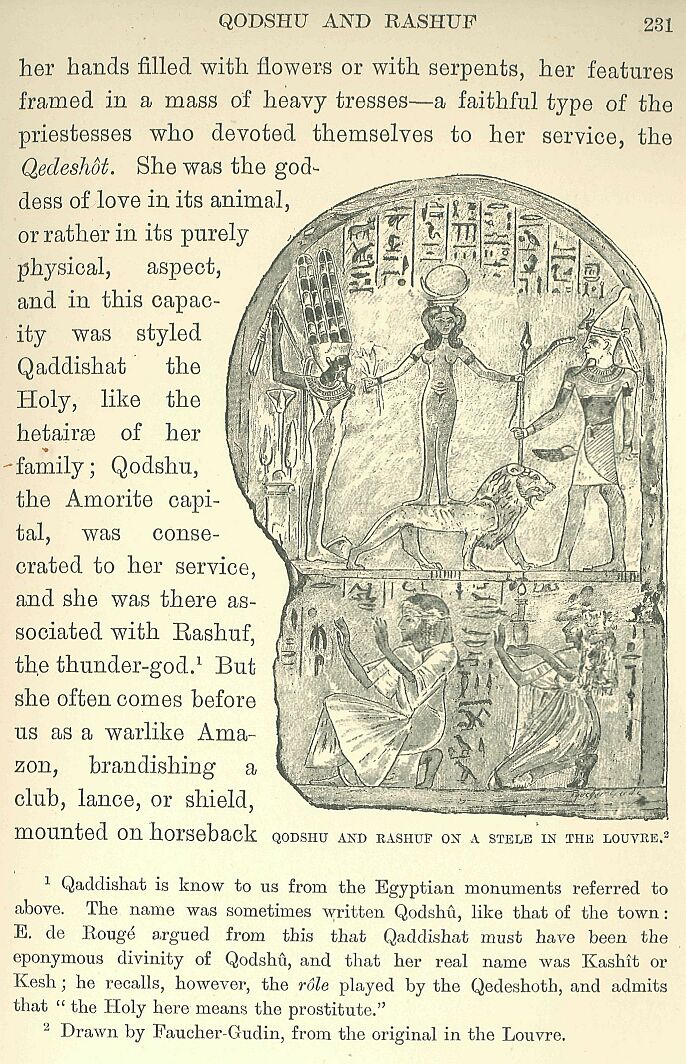
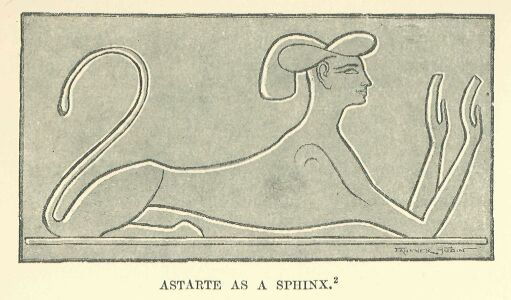
The statues sometimes represent her as a sphinx with a woman’s head, but more often as a woman standing on a lion passant, either nude, or encircled round the hips by merely a girdle, her hands filled with flowers or with serpents, her features framed in a mass of heavy tresses—a faithful type of the priestesses who devoted themselves to her service, the Qedeshôt. She was the goddess of love in its animal, or rather in its purely physical, aspect, and in this capacity was styled Qaddishat the Holy, like the hetairæ of her family; Qodshu, the Amorite capital, was consecrated to her service, and she was there associated with Rashuf, the thunder-god.*
* Qaddishat is know to us from the Egyptian monuments referred to above. The name was sometimes written Qodshû, like that of the town: E. de Bougé argued from this that Qaddishat must have been the eponymous divinity of Qodshû, and that her real name was Kashit or Kesh; he recalls, however, the rôle played by the Qedeshoth, and admits that “the Holy here means the prostitute.”
But she often comes before us as a warlike Amazon, brandishing a club, lance, or shield, mounted on horseback like a soldier, and wandering through the desert in quest of her prey.* This dual temperament rendered her a goddess of uncertain attributes and of violent contrasts; at times reserved and chaste, at other times shameless and dissolute, but always cruel, always barren, for the countless multitude of her excesses for ever shut her out from motherhood: she conceives without ceasing, but never brings forth children.** The Baalim and Astartês frequented by choice the tops of mountains, such as Lebanon, Carmel, Hermon, or Kasios:*** they dwelt near springs, or hid themselves in the depths of forests.**** They revealed themselves to mortals through the heavenly bodies, and in all the phenomena of nature: the sun was a Baal, the moon was Astartê, and the whole host of heaven was composed of more or less powerful genii, as we find in Chaldæa.
* A fragment of a popular tale preserved in the British Museum, and mentioned by Birch, seems to show us Astartê in her character of war-goddess, and the sword of Astartê is mentioned by Chabas. A bas-relief at Edfû represents her standing upright in her chariot, drawn by horses, and trampling her enemies underfoot: she is there identified with Sokhît the warlike, destroyer of men. ** This conception of the Syrian goddesses had already become firmly established at the period with which we are dealing, for an Egyptian magical formula defines Anîti and Astartê as “the great goddesses who conceiving do not bring forth young, for the Horuses have sealed them and Sit hath established them.” *** The Baal of Lebanon is mentioned in an archaic Phoenician inscription, and the name “Holy Cape” (Rosh- Qodshu), borne in the time of Thûtmosis III. either by Haifa or by a neighbouring town, proves that Carmel was held sacred as far back as the Egyptian epoch. Baal-Hermon has already been mentioned. **** The source of the Jordan, near Baniâs, was the seat of a Baal whom the Greeks identified with Pan. This was probably the Baal-Gad who often lent his name to the neighbouring town of Baal-Hermon: many of the rivers of Phoenicia were called after the divinities worshipped in the nearest city, e.g. the Adonis, the Bêlos, the Asclepios, the Damûras.
They required that offerings and prayers should be brought to them at the high places,* but they were also pleased—and especially the goddesses—to lodge in trees; tree-trunks, sometimes leafy, sometimes bare and branchless (ashêrah), long continued to be living emblems of the local Astartês among the peoples of Southern Syria. Side by side with these plant-gods we find everywhere, in the inmost recesses of the temples, at cross-roads, and in the open fields, blocks of stone hewn into pillars, isolated boulders, or natural rocks, sometimes of meteoric origin, which were recognised by certain mysterious marks to be the house of the god, the Betyli or Beth-els in which he enclosed a part of his intelligence and vital force.
* These are the “high places” (bamôth) so frequently referred to by the Hebrew prophets, and which we find in the country of Moab, according to the Mesha inscription, and in the place-name Bamoth-Baal; many of them seem to have served for Canaanitish places of worship before they were resorted to by the children of Israel.
The worship of these gods involved the performance of ceremonies more bloody and licentious even than those practised by other races. The Baalim thirsted after blood, nor would they be satisfied with any common blood such as generally contented their brethren in Chaldæa or Egypt: they imperatively demanded human as well as animal sacrifices. Among several of the Syrian nations they had a prescriptive right to the firstborn male of each family;* this right was generally commuted, either by a money payment or by subjecting the infant to circumcision.**
* This fact is proved, in so far as the Hebrew people is concerned, by the texts of the Pentateuch and of the prophets; amongst the Moabites also it was his eldest son whom King Mosha took to offer to his god. We find the same custom among other Syrian races: Philo of Byblos tells us, in fact, that El-Kronos, god of Byblos, sacrificed his firstborn son and set the example of this kind of offering. ** Redemption by a payment in money was the case among the Hebrews, as also the substitution of an animal in the place of a child; as to redemption by circumcision, cf. the story of Moses and Zipporah, where the mother saves her son from Jahveh by circumcising him. Circumcision was practised among the Syrians of Palestine in the time of Herodotus.
At important junctures, however, this pretence of bloodshed would fail to appease them, and the death of the child alone availed. Indeed, in times of national danger, the king and nobles would furnish, not merely a single victim, but as many as the priests chose to demand.* While they were being burnt alive on the knees of the statue, or before the sacred emblem, their cries of pain were drowned by the piping of flutes or the blare of trumpets, the parents standing near the altar, without a sign of pity, and dressed as for a festival: the ruler of the world could refuse nothing to prayers backed by so precious an offering, and by a purpose so determined to move him. Such sacrifices were, however, the exception, and the shedding of their own blood by his priests sufficed, as a rule, for the daily wants of the god. Seizing their knives, they would slash their arms and breasts with the view of compelling, by this offering of their own persons, the good will of the Baalim.**
* If we may credit Tertullian, the custom of offering up children as sacrifices lasted down to the proconsulate of Tiberius. ** Cf., for the Hebraic epoch, the scene where the priests of Baal, in a trial of power with Elijah before Ahab, offered up sacrifices on the highest point of Carmel, and finding that their offerings did not meet with the usual success, “cut themselves... with knives and lancets till the blood gushed out upon them.”
The Astartês of all degrees and kinds were hardly less cruel; they imposed frequent flagellations, self-mutilation, and sometimes even emasculation, on their devotees. Around the majority of these goddesses was gathered an infamous troop of profligates (kedeshîm), “dogs of love” (kelabîm), and courtesans (kedeshôt). The temples bore little resemblance to those of the regions of the Lower Euphrates: nowhere do we find traces of those ziggurat which serve to produce the peculiar jagged outline characteristic of Chaldæan cities. The Syrian edifices were stone buildings, which included, in addition to the halls and courts reserved for religious rites, dwelling-rooms for the priesthood, and storehouses for provisions: though not to be compared in size with the sanctuaries of Thebes, they yet answered the purpose of strongholds in time of need, and were capable of resisting the attacks of a victorious foe.* A numerous staff, consisting of priests, male and female singers, porters, butchers, slaves, and artisans, was assigned to each of these temples: here the god was accustomed to give forth his oracles, either by the voice of his prophets, or by the movement of his statues.** The greater number of the festivals celebrated in them were closely connected with the pastoral and agricultural life of the country; they inaugurated, or brought to a close, the principal operations of the year—the sowing of seed, the harvest, the vintage, the shearing of the sheep. At Shechem, when the grapes were ripe, the people flocked out of the town into the vineyards, returning to the temple for religious observances and sacred banquets when the fruit had been trodden in the winepress.***
* The story of Abimelech gives us some idea of what the Canaanite temple of Baal-Berîth at Shechem was like. ** As to the regular organisation of Baal-worship, we possess only documents of a comparatively late period. *** It is probable that the vintage festival, celebrated at Shiloh in the time of the Judges, dated back to a period of Canaanite history prior to the Hebrew invasion, i.e. to the time of the Egyptian supremacy.
In times of extraordinary distress, such as a prolonged drought or a famine, the priests were wont to ascend in solemn procession to the high places in order to implore the pity of their divine masters, from whom they strove to extort help, or to obtain the wished-for rain, by their dances, their lamentations, and the shedding of their blood.*
*Cf., in the Hebraic period, the scene where the priests of Baal go up to the top of Mount Carmel with the prophet Elijah.
Almost everywhere, but especially in the regions east of the Jordan, were monuments which popular piety surrounded with a superstitious reverence. Such were the isolated boulders, or, as we should call them, “menhirs,” reared on the summit of a knoll, or on the edge of a tableland; dolmens, formed of a flat slab placed on the top of two roughly hewn supports, cromlechs, or, that is to say, stone circles, in the centre of which might be found a beth-el. We know not by whom were set up these monuments there, nor at what time: the fact that they are in no way different from those which are to be met with in Western Europe and the north of Africa has given rise to the theory that they were the work of some one primeval race which wandered ceaselessly over the ancient world. A few of them may have marked the tombs of some forgotten personages, the discovery of human bones beneath them confirming such a conjecture; while others seem to have been holy places and altars from the beginning. The nations of Syria did not in all cases recognise the original purpose of these monuments, but regarded them as marking the seat of an ancient divinity, or the precise spot on which he had at some time manifested himself. When the children of Israel caught sight of them again on their return from Egypt, they at once recognised in them the work of their patriarchs. The dolmen at Shechem was the altar which Abraham had built to the Eternal after his arrival in the country of Canaan. Isaac had raised that at Beersheba, on the very spot where Jehovah had appeared in order to renew with him the covenant that He had made with Abraham. One might almost reconstruct a map of the wanderings of Jacob from the altars which he built at each of his principal resting-places—at Gilead [Galeed], at Ephrata, at Bethel, and at Shechem.* Each of such still existing objects probably had a history of its own, connecting it inseparably with some far-off event in the local annals.
* The heap of stones at Galeed, in Aramaic Jegar- Sahadutha, “the heap of witness,” marked the spot where Laban and Jacob were reconciled; the stele on the way to Ephrata was the tomb of Rachel; the altar and stele at Bethel marked the spot where God appeared unto Jacob.
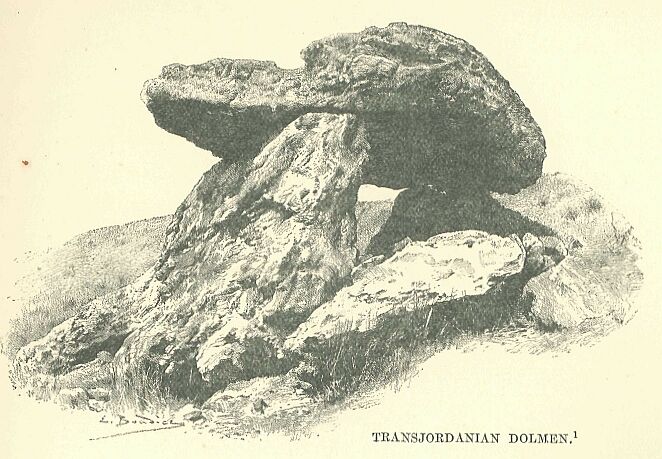
Drawn by Boudier, from a photograph.
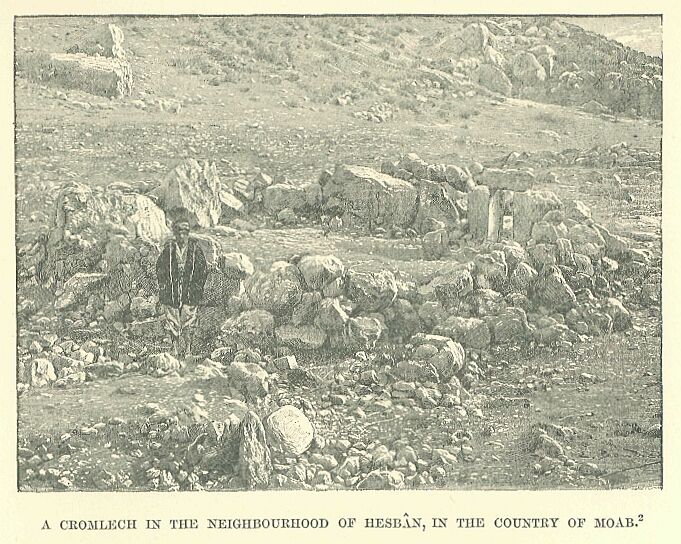
Drawn by Boudier, from a photograph.
Most of them were objects of worship: they were anointed with oil, and victims were slaughtered in their honour; the faithful even came at times to spend the night and sleep near them, in order to obtain in their dreams glimpses of the future.*
* The menhir of Bethel was the identical one whereon Jacob rested his head on the night in which Jehovah appeared to him in a dream. In Phoenicia there was a legend which told how Usôos set up two stellæ to the elements of wind and fire, and how he offered the blood of the animals he had killed in the chase as a libation.
Men and beasts were supposed to be animated, during their lifetime, by a breath or soul which ran in their veins along with their blood, and served to move their limbs; the man, therefore, who drank blood or ate bleeding flesh assimilated thereby the soul which inhered in it. After death the fate of this soul was similar to that ascribed to the spirits of the departed in Egypt and Chaldæa. The inhabitants of the ancient world were always accustomed to regard the surviving element in man as something restless and unhappy—a weak and pitiable double, doomed to hopeless destruction if deprived of the succour of the living. They imagined it as taking up its abode near the body wrapped in a half-conscious lethargy; or else as dwelling with the other rephaim (departed spirits) in some dismal and gloomy kingdom, hidden in the bowels of the earth, like the region ruled by the Chaldæan Allât, its doors gaping wide to engulf new arrivals, but allowing none to escape who had once passed the threshold.*
* The expression rephaim means “the feeble”; it was the epithet applied by the Hebrews to a part of the primitive races of Palestine.
There it wasted away, a prey to sullen melancholy, under the sway of inexorable deities, chief amongst whom, according to the Phoenician idea, was Mout (Death),* the grandson of El; there the slave became the equal of his former master, the rich man no longer possessed anything which could raise him above the poor, and dreaded monarchs were greeted on their entrance by the jeers of kings who had gone down into the night before them.
*Among the Hebrews his name was Maweth, who feeds the departed like sheep, and himself feeds on them in hell. Some writers have sought to identify this or some analogous god with the lion represented on a stele of Piraeus which threatens to devour the body of a dead man.
Drawn by Faucher-Gudin, from a photograph in Lortet.
The corpse, after it had been anointed with perfumes and enveloped in linen, and impregnated with substances which retarded its decomposition, was placed in some natural grotto or in a cave hollowed out of the solid rock: sometimes it was simply laid on the bare earth, sometimes in a sarcophagus or coffin, and on it, or around it, were piled amulets, jewels, objects of daily use, vessels filled with perfume, or household utensils, together with meat and drink. The entrance was then closed, and on the spot a cippus was erected—in popular estimation sometimes held to represent the soul—or a monument was set up on a scale proportionate to the importance of the family to which the dead man had belonged.* On certain days beasts ceremonially pure were sacrificed at the tomb, and libations poured out, which, carried into the next world by virtue of the prayers of those who offered them, and by the aid of the gods to whom the prayers were addressed, assuaged the hunger and thirst of the dead man.** The chapels and stellæ which marked the exterior of these “eternal” *** houses have disappeared in the course of the various wars by which Syria suffered so heavily: in almost all cases, therefore, we are ignorant as to the sites of the various cities of the dead in which the nobles and common people of the Canaanite and Amorite towns were laid to rest.****
* The pillar or stele was used among both Hebrews and Phoenicians to mark the graves of distinguished persons. Among the Semites speaking Aramaic it was called nephesh, especially when it took the form of a pyramid; the word means “breath,” “soul,” and clearly shows the ideas associated with the object. ** An altar was sometimes placed in front of the sarcophagus to receive these offerings. *** This expression, which is identical with that used by the Egyptians of the same period, is found in one of the Phoenician inscriptions at Malta. **** The excavations carried out by M. Gautier in 1893-94, on the little island of Bahr-el-Kadis, at one time believed to have been the site of the town of Qodshu, have revealed the existence of a number of tombs in the enclosure which forms the central part of the tumulus: some of these may possibly date from the Amorite epoch, but they are very poor in remains, and contain no object which permits us to fix the date with accuracy.
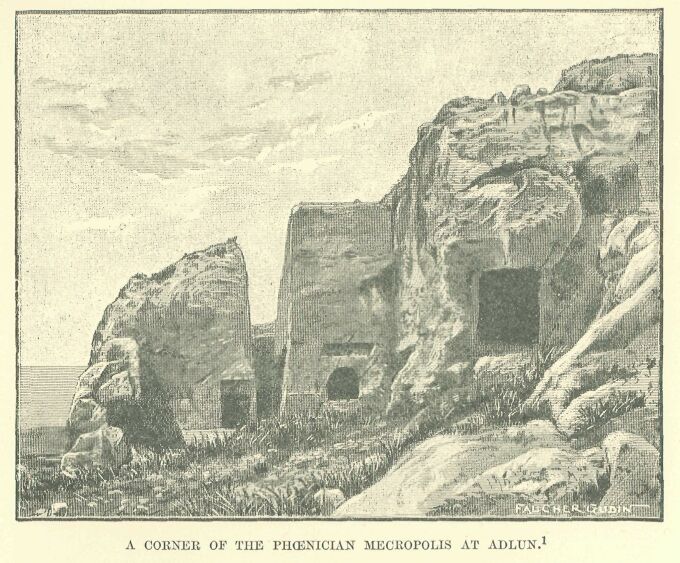
In Phoenicia alone do we meet with burial-places which, after the vicissitudes and upheavals of thirty centuries, still retain something of their original arrangement. Sometimes the site chosen was on level ground: perpendicular shafts or stairways cut in the soil led down to low-roofed chambers, the number of which varied according to circumstances: they were often arranged in two stories, placed one above the other, fresh vaults being probably added as the old ones were filled up. They were usually rectangular in shape, with horizontal or slightly arched ceilings; niches cut in the walls received the dead body and the objects intended for its use in the next world, and were then closed with a slab of stone. Elsewhere some isolated hill or narrow gorge, with sides of fine homogeneous limestone, was selected.*
* Such was the necropolis at Adlûn, the last rearrangement of which took place during the Græco-Roman period, but which externally bears so strong a resemblance to an Egyptian necropolis of the XVIIIth or XIXth dynasty, that we may, without violating the probabilities, trace its origin back to the time of the Pharaonic conquest.
In this case the doors were placed in rows on a sort of façade similar to that of the Egyptian rock-tomb, generally without any attempt at external ornament. The vaults were on the ground-level, but were not used as chapels for the celebration of festivals in honour of the dead: they were walled up after every funeral, and all access to them forbidden, until such time as they were again required for the purposes of burial. Except on these occasions of sad necessity, those whom “the mouth of the pit had devoured” dreaded the visits of the living, and resorted to every means afforded by their religion to protect themselves from them. Their inscriptions declare repeatedly that neither gold nor silver, nor any object which could excite the greed of robbers, was to be found within their graves; they threaten any one who should dare to deprive them of such articles of little value as belonged to them, or to turn them out of their chambers in order to make room for others, with all sorts of vengeance, divine and human. These imprecations have not, however, availed to save them from the desecration the danger of which they foresaw, and there are few of their tombs which were not occupied by a succession of tenants between the date of their first making and the close of the Roman supremacy. When the modern explorer chances to discover a vault which has escaped the spade of the treasure-seeker, it is hardly ever the case that the bodies whose remains are unearthed prove to be those of the original proprietors.

The gods and legends of Chaldæa had penetrated to the countries of Amauru and Canaan, together with the language of the conquerors and their system of writing: the stories of Adapa’s struggles against the south-west wind, or of the incidents which forced Irishkigal, queen of the dead, to wed Nergal, were accustomed to be read at the courts of Syrian princes. Chaldæan theology, therefore, must have exercised influence on individual Syrians and on their belief; but although we are forced to allow the existence of such influence, we cannot define precisely the effects produced by it. Only on the coast and in the Phoenician cities do the local religions seem to have become formulated at a fairly early date, and crystallised under pressure of this influence into cosmogonie theories. The Baalim and Astartês reigned there as on the banks of the Jordan or Orontes, and in each town Baal was “the most high,” master of heaven and eternity, creator of everything which exists, though the character of his creating acts was variously defined according to time and place. Some regarded him as the personification of Justice, Sydyk, who established the universe with the help of eight indefatigable Cabiri. Others held the whole world to be the work of a divine family, whose successive generations gave birth to the various elements. The storm-wind, Colpias, wedded to Chaos, had begotten two mortals, Ulom (Time) and Kadmôn (the First-Born), and these in their turn engendered Qên and Qênath, who dwelt in Phoenicia: then came a drought, and they lifted up their heads to the Sun, imploring him, as Lord of the Heavens (Baalsamîn), to put an end to their woes. At Tyre it was thought that Chaos existed at the beginning, but chaos of a dark and troubled nature, over which a Breath (rûakh) floated without affecting it; “and this Chaos had no ending, and it was thus for centuries and centuries.—Then the Breath became enamoured of its own principles, and brought about a change in itself, and this change was called Desire:—now Desire was the principle which created all things, and the Breath knew not its own creation.—The Breath and Chaos, therefore, became united, and Mot the Clay was born, and from this clay sprang all the seed of creation, and Mot was the father of all things; now Mot was like an egg in shape.—And the Sun, the Moon, the stars, the great planets, shone forth.* There were living beings devoid of intelligence, and from these living beings came intelligent beings, who were called Zophesamîn, or ‘watchers of the heavens.‘Now the thunder-claps in the war of separating elements awoke these intelligent beings as it were from a sleep, and then the males and the females began to stir themselves and to seek one another on the land and in the sea.”
* Mot, the clay formed by the corruption of earth and water, is probably a Phoenician form of a word which means water in the Semitic languages. Cf. the Egyptian theory, according to which the clay, heated by the sun, was supposed to have given birth to animated beings; this same clay modelled by Khnûmû into the form of an egg was supposed to have produced the heavens and the earth.
A scholar of the Roman epoch, Philo of Byblos, using as a basis some old documents hidden away in the sanctuaries, which had apparently been classified by Sanchoniathon, a priest long before his time, has handed these theories of the cosmogony down to us: after he has explained how the world was brought out of Chaos, he gives a brief summary of the dawn of civilization in Phoenicia and the legendary period in its history. No doubt he interprets the writings from which he compiled his work in accordance with the spirit of his time: he has none the less preserved their substance more or less faithfully. Beneath the veneer of abstraction with which the Greek tongue and mind have overlaid the fragment thus quoted, we discern that groundwork of barbaric ideas which is to be met with in most Oriental theologies, whether Egyptian or Babylonian. At first we have a black mysterious Chaos, stagnating in eternal waters, the primordial Nû or Apsû; then the slime which precipitates in this chaos and clots into the form of an egg, like the mud of the Nile under the hand? of Khnûmû; then the hatching forth of living organisms and indolent generations of barely conscious creatures, such as the Lakhmû, the Anshar, and the Illinu of Chaldæan speculation; finally the abrupt appearance of intelligent beings.
Drawn by Faucher-Gudin, from the original in the Cabinet des Médailles.
The Phoenicians, however, accustomed as they were to the Mediterranean, with its blind outbursts of fury, had formed an idea of Chaos which differed widely from that of most of the inland races, to whom it presented itself as something silent and motionless: they imagined it as swept by a mighty wind, which, gradually increasing to a roaring tempest, at length succeeded in stirring the chaos to its very depths, and in fertilizing its elements amidst the fury of the storm. No sooner had the earth been thus brought roughly into shape, than the whole family of the north winds swooped down upon it, and reduced it to civilized order. It was but natural that the traditions of a seafaring race should trace its descent from the winds.
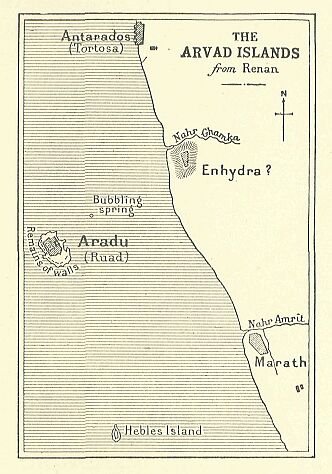
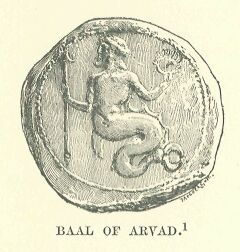
In Phoenicia the sea is everything: of land there is but just enough to furnish a site for a score of towns, with their surrounding belt of gardens. Mount Lebanon, with its impenetrable forests, isolated it almost entirely from Coele-Syria, and acted as the eastward boundary of the long narrow quadrangle hemmed in between the mountains and the rocky shore of the sea. At frequent intervals, spurs run out at right angles from the principal chain, forming steep headlands on the sea-front: these cut up the country, small to begin with, into five or six still smaller provinces, each one of which possessed from time immemorial its own independent cities, its own religion, and its own national history. To the north were the Zahi, a race half sailors, half husbandmen, rich, brave, and turbulent, ever ready to give battle to their neighbours, or rebel against an alien master, be he who he might. Arvad,* which was used by them as a sort of stronghold or sanctuary, was huddled together on an island some two miles from the coast: it was only about a thousand yards in circumference, and the houses, as though to make up for the limited space available for their foundations, rose to a height of five stories. An Astartê reigned there, as also a sea-Baal, half man, half fish, but not a trace of a temple or royal palace is now to be found.**
* The name Arvad was identified in the Egyptian inscriptions by Birch, who, with Hincks, at first saw in the name a reference to the peoples of Ararat; Birch’s identification, is now accepted by all Egyptologists. The name is written Aruada or Arada in the Tel el-Amarna tablets. ** The Arvad Astartê had been identified by the Egyptians with their goddess Bastît. The sea-Baal, who has been connected by some with Dagon of Askalon, is represented on the earliest Arvadian coins. He has a fish-like tail, the body and bearded head of a man, with an Assyrian headdress; on his breast we sometimes find a circular opening which seems to show the entrails.
The whole island was surrounded by a stone wall, built on the outermost ledges of the rocks, which were levelled to form its foundation. The courses of the masonry were irregular, laid without cement or mortar of any kind. This bold piece of engineering served the double purpose of sea-wall and rampart, and was thus fitted to withstand alike the onset of hostile fleets and the surges of the Mediterranean.*
* The antiquity of the wall of Arvad, recognised by travellers of the last century, is now universally admitted by all archæologists.
There was no potable water on the island, and for drinking purposes the inhabitants were obliged to rely on the fall of rain, which they stored in cisterns—still in use among their descendants. In the event of prolonged drought they were obliged to send to the mainland opposite; in time of war they had recourse to a submarine spring, which bubbles up in mid-channel. Their divers let down a leaden bell, to the top of which was fitted a leathern pipe, and applied it to the orifice of the spring; the fresh water coming up through the sand was collected in this bell, and rising in the pipe, reached the surface uncontaminated by salt water.*
* Renan tells us that “M. Gaillardot, when crossing from the island to the mainland, noticed a spring of sweet water bubbling up from the bottom of the sea.... Thomson and Walpole noticed the same spring or similar springs a little to the north of Tortosa.”
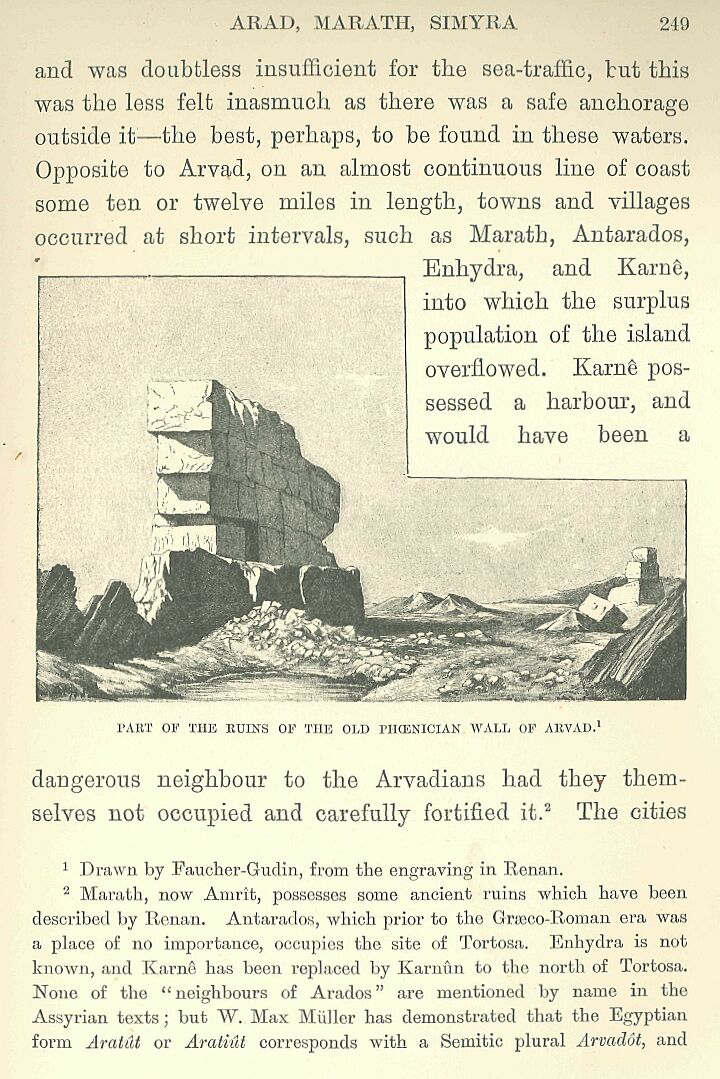
The harbour opened to the east, facing the mainland: it was divided into two basins by a stone jetty, and was doubtless insufficient for the sea-traffic, but this was the less felt inasmuch as there was a safe anchorage outside it—the best, perhaps, to be found in these waters. Opposite to Arvad, on an almost continuous line of coast some ten or twelve miles in length, towns and villages occurred at short intervals, such as Marath, Antarados, Enhydra, and Karnê, into which the surplus population of the island overflowed. Karnê possessed a harbour, and would have been a dangerous neighbour to the Arvadians had they themselves not occupied and carefully fortified it.*
* Marath, now Amrît, possesses some ancient ruins which have been described by Renan. Antarados, which prior to the Græco-Roman era was a place of no importance, occupies the site of Tortosa. Enhydra is not known, and Karnê has been replaced by Karnûn to the north of Tortosa. None of the “neighbours of Arados” are mentioned by name in the Assyrian texts; but W. Max Müller has demonstrated that the Egyptian form Aratût or Aratiût corresponds with a Semitic plural Arvadôt, and consequently refers not only to Arad itself, but also to the fortified cities and towns which formed its continental suburbs.
The cities of the dead lay close together in the background, on the slope of the nearest chain of hills; still further back lay a plain celebrated for its fertility and the luxuriance of its verdure: Lebanon, with its wooded peaks, was shut in on the north and south, but on the east the mountain sloped downwards almost to the sea-level, furnishing a pass through which ran the road which joined the great military highway not far from Qodshu. The influence of Arvad penetrated by means of this pass into the valley of the Orontes, and is believed to have gradually extended as far as Hamath itself—in other words, over the whole of Zahi. For the most part, however, its rule was confined to the coast between G-abala and the Nahr el-Kebîr; Simyra at one time acknowledged its suzerainty, at another became a self-supporting and independent state, strong enough to compel the respect of its neighbours.* Beyond the Orontes, the coast curves abruptly inward towards the west, and a group of wind-swept hills ending in a promontory called Phaniel,** the reputed scene of a divine manifestation, marked the extreme limit of Arabian influence to the north, if, indeed, it ever reached so far.
* Simyra is the modern Surnrah, near the Nahr el-Kebîr. ** The name has only come down to us under its Greek form, but its original form, Phaniel or Penûel, is easily arrived at from the analogous name used in Canaan to indicate localities where there had been a theophany. Renan questions whether Phaniel ought not to be taken in the same sense as the Pnê-Baal of the Carthaginian inscriptions, and applied to a goddess to whom the promontory had been dedicated; he also suggests that the modern name Cap Madonne may be a kind of echo of the title Rabbath borne by this goddess from the earliest times.
Half a dozen obscure cities flourished here, Arka,* Siani,** Mahallat, Kaiz, Maîza, and Botrys,*** some of them on the seaboard, others inland on the bend of some minor stream. Botrys,**** the last of the six, barred the roads which cross the Phaniel headland, and commanded the entrance to the holy ground where Byblos and Berytus celebrated each year the amorous mysteries of Adonis.
* Arka is perhaps referred to in the tablets of Tel el- Amarna under the form Irkata or Irkat; it also appears in the Bible (Gen. x. 17) and in the Assyrian texts. It is the Cassarea of classical geographers, which has now resumed its old Phoenician name of Tell-Arka. ** Sianu or Siani is mentioned in the Assyrian texts and in the Bible; Strabo knew it under the name of Sinna, and a village near Arka was called Sin or Syn as late as the XVth century. *** According to the Assyrian inscriptions, these were the names of the three towns which formed the Tripolis of Græco-Roman times. **** Botrys is the hellenized form of the name Bozruna or Bozrun, which appears on the tablets of Tel el-Amarna; the modern name, Butrun or Batrun, preserves the final letter which the Greeks had dropped.
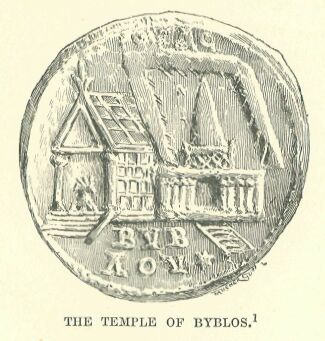
Gublu, or—as the Greeks named it—Byblos,* prided itself on being the most ancient city in the world. The god El had founded it at the dawning of time, on the flank of a hill which is visible from some distance out at sea. A small bay, now filled up, made it an important shipping centre. The temple stood on the top of the hill, a few fragments of its walls still serving to mark the site; it was, perhaps, identical with that of which we find the plan engraved on certain imperial coins.**
* Gublu or Gubli is the pronunciation indicated for this name in the Tel el-Amarna tablets; the Egyptians transcribed it Kupuna or Kupna by substituting n for l. The Greek name Byblos was obtained from Gublu by substituting a b for the g. ** Renan carried out excavations in the hill of Kassubah which brought to light some remains of a Græco-Roman temple: he puts forward, subject to correction, the hypothesis which I have adopted above.
Two flights of steps led up to it from the lower quarters of the town, one of which gave access to a chapel in the Greek style, surmounted by a triangular pediment, and dating, at the earliest, from the time of the Seleucides; the other terminated in a long colonnade, belonging to the same period, added as a new façade to an earlier building, apparently in order to bring it abreast of more modern requirements.
The sanctuary which stands hidden behind this incongruous veneer is, as represented on the coins, in a very archaic style, and is by no means wanting in originality or dignity. It consists of a vast rectangular court surrounded by cloisters. At the point where lines drawn from the centres of the two doors seem to cross one another stands a conical stone mounted on a cube of masonry, which is the beth-el animated by the spirit of the god: an open-work balustrade surrounds and protects it from the touch of the profane. The building was perhaps not earlier than the Assyrian or Persian era, but in its general plan it evidently reproduced the arrangements of some former edifice.*
* The author of the De Deâ Syrâ classed the temple of Byblos among the Phoenician temples of the old order, which were almost as ancient as the temples of Egypt, and it is probable that from the Egyptian epoch onwards the plan of this temple must have been that shown on the coins; the cloister arcades ought, however, to be represented by pillars or by columns supporting architraves, and the fact of their presence leads me to the conclusion that the temple did not exist in the form known to us at a date earlier than the last Assyrian period.
At an early time El was spoken of as the first king of G-ablu in the same manner as each one of his Egyptian fellow-gods had been in their several nomes, and the story of his exploits formed the inevitable prelude to the beginning of human history. Grandson of Eliûn who had brought Chaos into order, son of Heaven and Earth, he dispossessed, vanquished, and mutilated his father, and conquered the most distant regions one after another—the countries beyond the Euphrates, Libya, Asia Minor and Greece: one year, when the plague was ravaging his empire, he burnt his own son on the altar as an expiatory victim, and from that time forward the priests took advantage of his example to demand the sacrifice of children in moments of public danger or calamity.
Drawn by Faucher-Gudin, from the original in the Cabinet des Médailles.
Drawn by Faucher-Gudin, from the original in the Cabinet des Médailles.
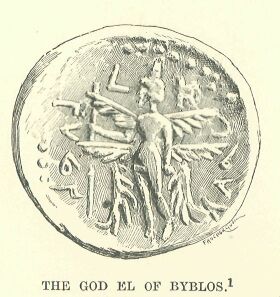
He was represented as a man with two faces, whose eyes opened and shut in an eternal alternation of vigilance and repose: six wings grew from his shoulders, and spread fan-like around him. He was the incarnation of time, which destroys all things in its rapid flight; and of the summer sun, cruel and fateful, which eats up the green grass and parches the fields. An Astartê reigned with him over Byblos—Baalat-Gublu, his own sister; like him, the child of Earth and Heaven. In one of her aspects she was identified with the moon, the personification of coldness and chastity, and in her statues or on her sacred pillars she was represented with the crescent or cow-horns of the Egyptian Hâthor; but in her other aspect she appeared as the amorous and wanton goddess in whom the Greeks recognised the popular concept of Aphroditê. Tradition tells us how, one spring morning, she caught sight of and desired the youthful god known by the title of Adoni, or “My Lord.” We scarce know what to make of the origin of Adonis, and of the legends which treat him as a hero—the representation of him as the incestuous offspring of a certain King Kinyras and his own daughter Myrrha is a comparatively recent element grafted on the original myth; at any rate, the happiness of two lovers had lasted but a few short weeks when a sudden end was put to it by the tusks of a monstrous wild boar. Baalat-Gublu wept over her lover’s body and buried it; then her grief triumphed over death, and Adonis, ransomed by her tears, rose from the tomb, his love no whit less passionate than it had been before the catastrophe. This is nothing else than the Chaldæan legend of Ishtar and Dûmûzi presented in a form more fully symbolical of the yearly marriage of Earth and Heaven. Like the Lady of Byblos at her master’s approach, Earth is thrilled by the first breath of spring, and abandons herself without shame to the caresses of Heaven: she welcomes him to her arms, is fructified by him, and pours forth the abundance of her flowers and fruits. Them comes summer and kills the spring: Earth is burnt up and withers, she strips herself of her ornaments, and her fruitfulness departs till the gloom and icy numbness of winter have passed away. Each year the cycle of the seasons brings back with it the same joy, the same despair, into the life of the world; each year Baalat falls in love with her Adonis and loses him, only to bring him back to life and lose him again in the coming year.
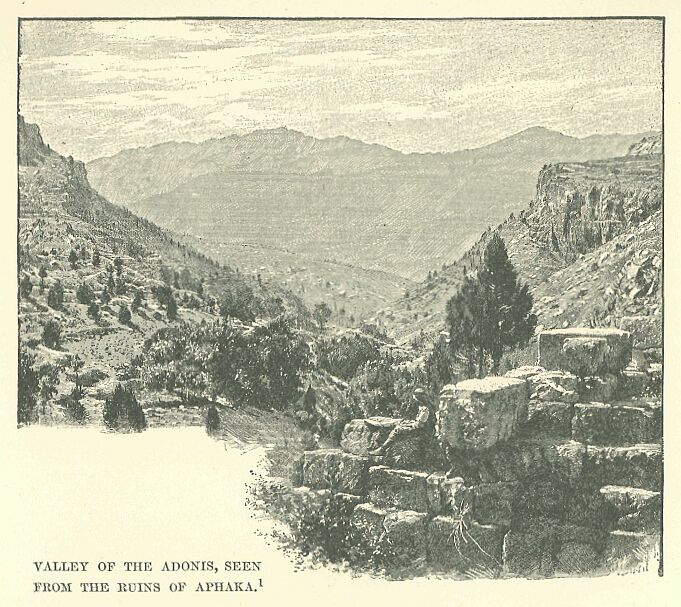
The whole neighbourhood of Byblos, and that part of Mount Lebanon in which it lies, were steeped in memories of this legend from the very earliest times. We know the precise spot where the goddess first caught sight of her lover, where she unveiled herself before him, and where at the last she buried his mutilated body, and chanted her lament for the dead. A river which flows southward not far off was called the Adonis, and the valley watered by it was supposed to have been the scene of this tragic idyll. The Adonis rises near Aphaka,* at the base of a narrow amphitheatre, issuing from the entrance of an irregular grotto, the natural shape of which had, at some remote period, been altered by the hand of man; in three cascades it bounds into a sort of circular basin, where it gathers to itself the waters of the neighbouring springs, then it dashes onwards under the single arch of a Roman bridge, and descends in a series of waterfalls to the level of the valley below.
* Aphaka means “spring” in Syriac. The site of the temple and town of Aphaka, where a temple of Aphroditê and Adonis still stood in the time of the Emperor Julian, had long been identified either with Fakra, or with El-Yamuni. Seetzen was the first to place it at El-Afka, and his proposed identification has been amply confirmed by the researches of Penan.
Drawn by Boudier, from a photograph.
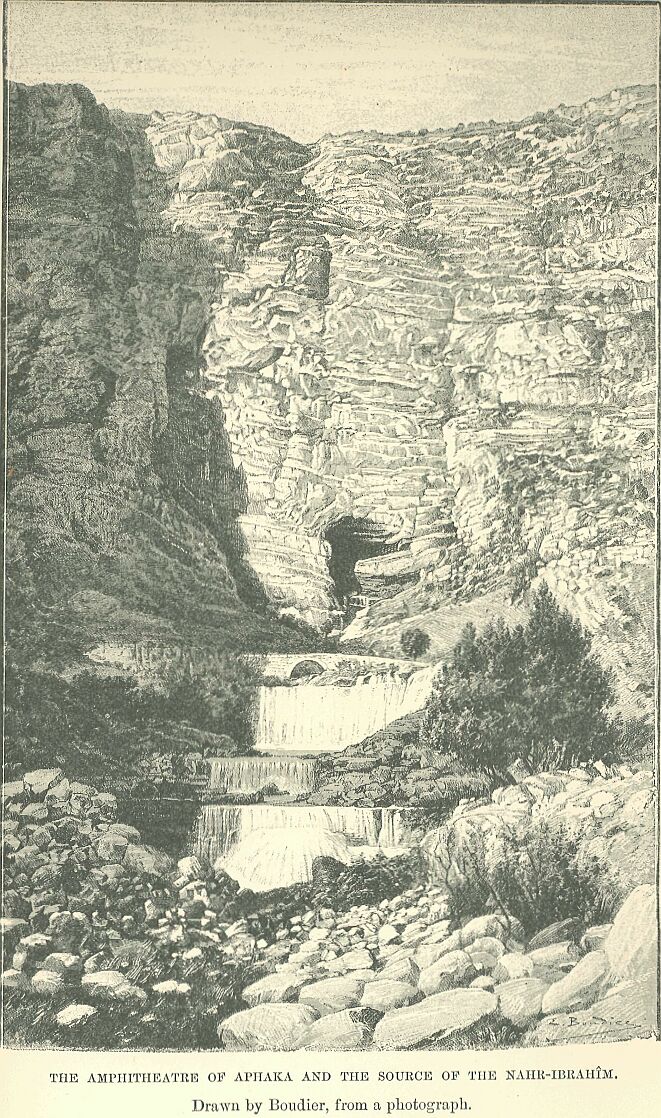
Drawn by Boudier, from a photograph.
The temple rises opposite the source of the stream on an artificial mound, a meteorite fallen from heaven having attracted the attention of the faithful to the spot. The mountain falls abruptly away, its summit presenting a red and bare appearance, owing to the alternate action of summer sun and winter frost. As the slopes approach the valley they become clothed with a garb of wild vegetation, which bursts forth from every fissure, and finds a foothold on every projecting rock: the base of the mountain is hidden in a tangled mass of glowing green, which the moist yet sunny Spring calls forth in abundance whenever the slopes are not too steep to retain a shallow layer of nourishing mould. It would be hard to find, even among the most picturesque spots of Europe, a landscape in which wildness and beauty are more happily combined, or where the mildness of the air and sparkling coolness of the streams offer a more perfect setting for the ceremonies attending the worship of Astartê.*
* The temple had been rebuilt during the Roman period, as were nearly all the temples of this region, upon the site of a more ancient structure; this was probably the edifice which the author of De Deâ Syrâ considered to be the temple of Venus, built by Kinyras within a day’s journey of Byblos in the Lebanon.
In the basin of the river and of the torrents by which it is fed, there appears a succession of charming and romantic scenes—gaping chasms with precipitous ochre-coloured walls; narrow fields laid out in terraces on the slopes, or stretching in emerald strips along the ruddy river-banks; orchards thick with almond and walnut trees; sacred grottoes, into which the priestesses, seated at the corner of the roads, endeavour to draw the pilgrims as they proceed on their way to make their prayers to the goddess;* sanctuaries and mausolea of Adonis at Yanukh, on the table-land of Mashnaka, and on the heights of Ghineh. According to the common belief, the actual tomb of Adonis was to be found at Byblos itself,** where the people were accustomed to assemble twice a year to keep his festivals, which lasted for several days together.
* Renan points out at Byblos the existence of one of these caverns which gave shelter to the kedeshoth. Many of the caves met with in the valley of the Nahr-Ibrahîm have doubtless served for the same purpose, although their walls contain no marks of the cult. ** Melito placed it, however, near Aphaka, and, indeed, there must have been as many different traditions on the subject as there were celebrated sanctuaries.
At the summer solstice, the season when the wild boar had ripped open the divine hunter, and the summer had already done damage to the spring, the priests were accustomed to prepare a painted wooden image of a corpse made ready for burial, which they hid in what were called the gardens of Adonis—terra-cotta pots filled with earth in which wheat and barley, lettuce and fennel, were sown. These were set out at the door of each house, or in the courts of the temple, where the sprouting plants had to endure the scorching effect of the sun, and soon withered away. For several days troops of women and young girls, with their heads dishevelled or shorn, their garments in rags, their faces torn with their nails, their breasts and arms scarified with knives, went about over hill and dale in search of their idol, giving utterance to cries of despair, and to endless appeals: “Ah, Lord! Ah, Lord! what is become of thy beauty.” Once having found the image, they brought it to the feet of the goddess, washed it while displaying its wound, anointed it with sweet-smelling unguents, wrapped it in a linen and woollen shroud, placed it on a catafalque, and, after expressing around the bier their feelings of desolation, according to the rites observed at fanerais, placed it solemnly in the tomb.*
* Theocritus has described in his fifth Idyll the laying out and burial of Adonis as it was practised at Alexandria in Egypt in the IIIrd century before our era.
The close and dreary summer passes away. With the first days of September the autumnal rains begin to fall upon the hills, and washing away the ochreous earth lying upon the slopes, descend in muddy torrents into the hollows of the valleys. The Adonis river begins to swell with the ruddy waters, which, on reaching the sea, do not readily blend with it. The wind from the offing drives the river water back upon the coast, and forces it to cling for a long time to the shore, where it forms a kind of crimson fringe.* This was the blood of the hero, and the sight of this precious stream stirred up anew the devotion of the people, who donned once more their weeds of mourning until the priests were able to announce to them that, by virtue of their supplications, Adonis was brought back from the shades into new life. Shouts of joy immediately broke forth, and the people who had lately sympathized with the mourning goddess in her tears and cries of sorrow, now joined with her in expressions of mad and amorous delight. Wives and virgins—all the women who had refused during the week of mourning to make a sacrifice of their hair—were obliged to atone for this fault by putting themselves at the disposal of the strangers whom the festival had brought together, the reward of their service becoming the property of the sacred treasury.**
* The same phenomenon occurs in spring. Maundrell saw it on March 17, and Renan in the first days of February. ** A similar usage was found in later times in the countries colonised by or subjected to the influence of the Phoenicians, especially in Cyprus.
Berytus shared with Byblos the glory of having had El for its founder.* The road which connects these two cities makes a lengthy detour in its course along the coast, having to cross numberless ravines and rocky summits: before reaching Palai-Byblos, it passes over a headland by a series of steps cut into the rock, forming a kind of “ladder” similar to that which is encountered lower down, between Acre and the plains of Tyre.
* The name Berytus was found by Hincks in the Egyptian texts under the form. Bîrutu, Beîrutu; it occurs frequently in the Tel el-Amarna tablets.
The river Lykos runs like a kind of natural fosse along the base of this steep headland. It forms at the present time a torrent, fed by the melting snows of Mount Sannin, and is entirely unnavigable. It was better circumstanced formerly in this respect, and even in the early years of the Boman conquest, sailors from Arvad (Arados) were accustomed to sail up it as far as one of the passes of the lower Lebanon, leading into Cole-Syria. Berytus was installed at the base of a great headland which stands out boldly into the sea, and forms the most striking promontory to be met with in these regions from Carmel to the vicinity of Arvad. The port is nothing but an open creek with a petty roadstead, but it has the advantage of a good supply of fresh water, which pours down from the numerous springs to which it is indebted for its name.* According to ancient legends, it was given by El to one of his offspring called Poseidon by the Greeks.
* The name Beyrut has been often derived from a Phconician word signifying cypress, and which may have been applied to the pine tree. The Phoenicians themselves derived it from Bîr, “wells.”
Adonis desired to take possession of it, but was frustrated in the attempt, and the maritime Baal secured the permanence of his rule by marrying one of his sisters—the Baalat-Beyrut who is represented as a nymph on Græco-Roman coins.* The rule of the city extended as far as the banks of the Tamur, and an old legend narrates that its patron fought in ancient times with the deity of that river, hurling stones at him to prevent his becoming master of the land to the north. The bar formed of shingle and the dunes which contract the entrance were regarded as evidences of this conflict.**
* The poet Nonnus has preserved a highly embellished account of this rivalry, where Adonis is called Dionysos. ** The original name appears to have been Tamur, Tamyr, from a word signifying “palm” in the Phoenician language. The myth of the conflict between Poseidon and the god of the river, a Baal-Demarous, has been explained by Renan, who accepts the identification of the river-deity with Baal- Thamar, already mentioned by Movers.
Beyond the southern bank of the river, Sidon sits enthroned as “the firstborn of Canaan.” In spite of this ambitious title it was at first nothing but a poor fishing village founded by Bel, the Agenor of the Greeks, on the southern slope of a spit of land which juts out obliquely towards the south-west.* It grew from year to year, spreading out over the plain, and became at length one of the most prosperous of the chief cities of the country—a “mother” in Phoenicia.**
* Sidon is called “the firstborn of Canaan” in Genesis: the name means a fishing-place, as the classical authors already knew—“nam piscem Phonices sidôn appellant.” ** In the coins of classic times it is called “Sidon, the mother—Om—of Kambe, Hippo, Citium, and Tyre.”
The port, once so celebrated, is shut in by three chains of half-sunken reefs, which, running out from the northern end of the peninsula, continue parallel to the coast for some hundreds of yards: narrow passages in these reefs afford access to the harbour; one small island, which is always above water, occupies the centre of this natural dyke of rocks, and furnishes a site for a maritime quarter opposite to the continental city.* The necropolis on the mainland extends to the east and north, and consists of an irregular series of excavations made in a low line of limestone cliffs which must have been lashed by the waves of the Mediterranean long prior to the beginning of history. These tombs are crowded closely together, ramifying into an inextricable maze, and are separated from each other by such thin walls that one expects every moment to see them give way, and bury the visitors in the ruin. Many date back to a very early period, while all of them have been re-worked and re-appropriated over and over again. The latest occupiers were contemporaries of the Macedonian kings or the Roman Cæsars. Space was limited and costly in this region of the dead: the Sidonians made the best use they could of the tombs, burying in them again and again, as the Egyptians were accustomed to do in their cemeteries at Thebes and Memphis. The surrounding plain is watered by the “pleasant Bostrênos,” and is covered with gardens which are reckoned to be the most beautiful in all Syria—at least after those of Damascus: their praises were sung even in ancient days, and they had then earned for the city the epithet of “the flowery Sidon.” **
* The only description of the port which we possess is that in the romance of Olitophon and Leucippus by Achilles Tatius. ** The Bostrênos, which is perhaps to be recognised under the form Borinos in the Periplus of Scylax, is the modern Nahr el-Awaly.
Here, also, an Astartê ruled over the destinies of the people, but a chaste and immaculate Astartê, a self-restrained and warlike virgin, sometimes identified with the moon, sometimes with the pale and frigid morning star.* In addition to this goddess, the inhabitants worshipped a Baal-Sidon, and other divinities of milder character—an Astartê Shem-Baal, wife of the supreme Baal, and Eshmun, a god of medicine—each of whom had his own particular temple either in the town itself or in some neighbouring village in the mountain. Baal delighted in travel, and was accustomed to be drawn in a chariot through the valleys of Phoenicia in order to receive the prayers and offerings of his devotees. The immodest Astartê, excluded, it would seem, from the official religion, had her claims acknowledged in the cult offered to her by the people, but she became the subject of no poetic or dolorous legend like her namesake at Byblos, and there was no attempt to disguise her innately coarse character by throwing over it a garb of sentiment. She possessed in the suburbs her chapels and grottoes, hollowed out in the hillsides, where she was served by the usual crowd of Ephébæ and sacred courtesans. Some half-dozen towns or fortified villages, such as Bitzîti,** the Lesser Sidon, and Sarepta, were scattered along the shore, or on the lowest slopes of the Lebanon.
* Astartê is represented in the Bible as the goddess of the Sidonians, and she is in fact the object of the invocations addressed to the mistress Deity in the Sidonian inscriptions, the patroness of the town. Kings and queens were her priests and priestesses respectively. ** Bitzîti is not mentioned except in the Assyrian texts, and has been identified with the modern region Ait ez-Zeîtûn to the south-east of Sidon. It is very probably the Elaia of Philo of Byblos, the Biais of Dionysios Periegetes, which Renan is inclined to identify with Heldua, Khan-Khaldi, by substituting Eldis as a correction.
Sidonian territory reached its limit at the Cape of Sarepta, where the high-lands again meet the sea at the boundary of one of those basins into which Phoenicia is divided. Passing beyond this cape, we come first upon a Tyrian outpost, the Town of Birds;* then upon the village of Nazana** with its river of the same name; beyond this upon a plain hemmed in by low hills, cultivated to their summits; then on tombs and gardens in the suburbs of Autu;*** and, further still, to a fleet of boats moored at a short distance from the shore, where a group of reefs and islands furnishes at one and the same time a site for the houses and temples of Tyre, and a protection from its foes.
* The Phoenician name of Ornithônpolis is unknown to us: the town is often mentioned by the geographers of classic times, but with certain differences, some placing it to the north and others to the south of Sarepta. It was near to the site of Adlun, the Adnonum of the Latin itineraries, if it was not actually the same place. ** Nazana was both the name of the place and the river, as Kasimîyeh and Khan Kasimîyeh, near the same locality, are to-day. *** Autu was identified by Brugsch with Avatha, which is probably El-Awwâtîn, on the hill facing Tyre. Max Müller, who reads the word as Authu, Ozu, prefers the Uru or Ushu of the Assyrian texts.
It was already an ancient town at the beginning of the Egyptian conquest. As in other places of ancient date, the inhabitants rejoiced in stories of the origin of things in which the city figured as the most venerable in the world. After the period of the creating gods, there followed immediately, according to the current legends, two or three generations of minor deities—heroes of light and flame—who had learned how to subdue fire and turn it to their needs; then a race of giants, associated with the giant peaks of Kasios, Lebanon, Hermon, and Brathy;* after which were born two male children—twins: Samem-rum, the lord of the supernal heaven, and Usôos, the hunter. Human beings at this time lived a savage life, wandering through the woods, and given up to shameful vices.
* The identification of the peak of Brathy is uncertain. The name has been associated with Tabor: since it exactly recalls the name of the cypress and of Berytus, it would be more prudent, perhaps, to look for the name in that of one of the peaks of the Lebanon near the latter town.
Samemrum took up his abode among them in that region which became in later times the Tyrian coast, and showed them how to build huts, papyrus, or other reeds: Usôos in the mean time pursued the avocation of a hunter of wild beasts, living upon their flesh and clothing himself with their skins. A conflict at length broke out between the two brothers, the inevitable result of rivalry between the ever-wandering hunter and the husbandman attached to the soil.
Usôos succeeded in holding his own till the day when fire and wind took the part of his enemy against him.* The trees, shaken and made to rub against each other by the tempest, broke into flame from the friction, and the forest was set on fire. Usôos, seizing a leafy branch, despoiled it of its foliage, and placing it in the water let it drift out to sea, bearing him, the first of his race, with it.
* The text simply states the material facts, the tempest and the fire: the general movement of the narrative seems to prove that the intervention of these elements is an episode in the quarrel between the two brothers—that in which Usôos is forced to fly from the region civilized by Samemrum.
Landing on one of the islands, he set up two menhirs, dedicating them to fire and wind that he might thenceforward gain their favour. He poured out at their base the blood of animals he had slaughtered, and after his death, his companions continued to perform the rites which he had inaugurated.
Drawn by Faucher-Gudin, from the original in the Cabinet des Médailles.
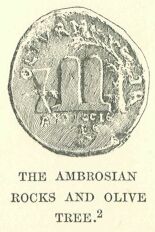
Drawn by Faucher-Gudin, from the original in the Cabinet des Médailles.
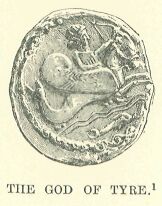
The town which he had begun to build on the sea-girt isle was called Tyre, the “Rock,” and the two rough stones which he had set up remained for a long time as a sort of talisman, bringing good luck to its inhabitants. It was asserted of old that the island had not always been fixed, but that it rose and fell, with the waves like a raft. Two peaks looked down upon it—the “Ambrosian Rocks”—between which grew the olive tree of Astartê, sheltered by a curtain of flame from external danger. An eagle perched thereon watched over a viper coiled round the trunk: the whole island would cease to float as soon as a mortal should succeed in sacrificing the bird in honour of the gods. Usôos, the Herakles, destroyer of monsters, taught the people of the coast how to build boats, and how to manage them; he then made for the island and disembarked: the bird offered himself spontaneously to his knife, and as soon as its blood had moistened the earth, Tyre rooted itself fixedly opposite the mainland. Coins of the Roman period represent the chief elements in this legend; sometimes the eagle and olive tree, sometimes the olive tree and the stelo, and sometimes the two stelæ only. From this time forward the gods never ceased to reside on the holy island; Astartê herself was born there, and one of the temples there showed to the admiration of the faithful a fallen star—an aerolite which she had brought back from one of her journeys.
Baal was called the Melkarth. king of the city, and the Greeks after» wards identified him with their Herakles. His worship was of a severe and exacting character: a fire burned perpetually in his sanctuary; his priests, like those of the Egyptians, had their heads shaved; they wore garments of spotless white linen, held pork in abomination, and refused permission to married women to approach the altars.*
* The worship of Melkarth at Gados (Cadiz) and the functions of his priests are described by Silius Italicus: as Gades was a Tyrian colony, it has been naturally assumed that the main features of the religion of Tyre were reproduced there, and Silius’s account of the Melkarth of Gades thus applies to his namesake of the mother city.
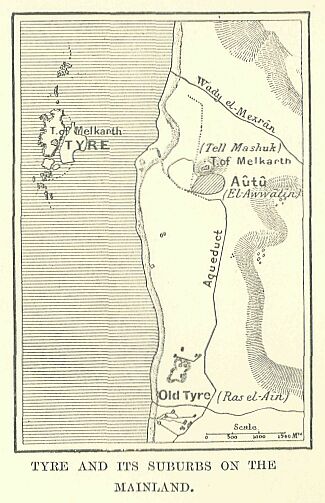
Festivals, similar to those of Adonis at Byblos, were held in his honour twice a year: in the summer, when the sun burnt up the earth with his glowing heat, he offered himself as an expiatory victim to the solar orb, giving himself to the flames in order to obtain some mitigation of the severity of the sky;* once the winter had brought with it a refreshing coolness, he came back to life again, and his return was celebrated with great joy. His temple stood in a prominent place on the largest of the islands furthest away from the mainland. It served to remind the people of the remoteness of their origin, for the priests relegated its foundation almost to the period of the arrival of the Phoenicians on the shores of the Mediterranean. The town had no supply of fresh water, and there was no submarine spring like that of Arvad to provide a resource in time of necessity; the inhabitants had, therefore, to resort to springs which were fortunately to be found everywhere on the hillsides of the mainland. The waters of the well of Eas el-Aîn had been led down to the shore and dammed up there, so that boats could procure a ready supply from this source in time of peace: in time of war the inhabitants of Tyre had to trust to the cisterns in which they had collected the rains that fell at certain seasons.**
* The festival commemorating his death by fire was celebrated at Tyre, where his tomb was shown, and in the greater number of the Tyrian colonies. ** Abisharri (Abimilki), King of Tyre, confesses to the Pharaoh Amenôthes III. that in case of a siege his town would neither have water nor wood. Aqueducts and conduits of water are spoken of by Menander as existing in the time of Shalmaneser; all modern historians agree in attributing their construction to a very remote antiquity.
The strait separating the island from the mainland was some six or seven hundred yards in breadth,* less than that of the Nile at several points of its course through Middle Egypt, but it was as effective as a broader channel to stop the movement of an army: a fleet alone would have a chance of taking the city by surprise, or of capturing it after a lengthened siege.
* According to the writers who were contemporary with Alexander, the strait was 4 stadia wide (nearly 1/2 mile), or 500 paces (about 3/8 mile), at the period when the Macedonians undertook the siege of the town; the author followed by Pliny says 700 paces, possibly over—mile wide. From the observations of Poulain de Bossay, Renan thinks the space between the island and the mainland might be nearly a mile in width, but we should perhaps do well to reduce this higher figure and adopt one agreeing better with the statements of Diodorus and Quintus Curtius.
Like the coast region opposite Arvad, the shore which faced Tyre, lying between the mouth of the Litany and ras el-Aîn, was an actual suburb of the city itself—with its gardens, its cultivated fields, its cemeteries, its villas, and its fortifications. Here the inhabitants of the island were accustomed to bury their dead, and hither they repaired for refreshment during the heat of the summer. To the north the little town of Mahalliba, on the southern bank of the Litâny, and almost hidden from view by a turn in the hills, commanded the approaches to the Bekaa, and the high-road to Coele-Syria.* To the south, at Ras el-Aîn, Old Tyre (Palastyrus) looked down upon the route leading into Galilee by way of the mountains.**
* Mahalliba is the present Khurbet-Mahallib. ** Palrotyrus has often been considered as a Tyre on the mainland of greater antiquity than the town of the same name on the island; it is now generally admitted that it was merely an outpost, which is conjecturally placed by most scholars in the neighbourhood of Ras el-Aîn.
Eastwards Autu commanded the landing-places on the shore, and served to protect the reservoirs; it lay under the shadow of a rock, on which was built, facing the insular temple of Melkarth, protector of mariners, a sanctuary of almost equal antiquity dedicated to his namesake of the mainland.* The latter divinity was probably the representative of the legendary Samemrum, who had built his village on the coast, while Usôos had founded his on the ocean. He was the Baalsamîm of starry tunic, lord of heaven and king of the sun.
* If the name has been preserved, as I believe it to be, in that of El-Awwâtîn, the town must be that whose ruins we find at the foot of Tell-Mashûk, and which are often mistaken for those of Palastyrus. The temple on the summit of the Tell was probably that of Heracles Astrochitôn mentioned by Nonnus.
As was customary, a popular Astartê was associated with these deities of high degree, and tradition asserted that Melkarth purchased her favour by the gift of the first robe of Tyrian purple which was ever dyed. Priestesses of the goddess had dwellings in all parts of the plain, and in several places the caves are still pointed out where they entertained the devotees of the goddess. Behind Autu the ground rises abruptly, and along the face of the escarpment, half hidden by trees and brushwood, are the remains of the most important of the Tyrian burying-places, consisting of half-filled-up pits, isolated caves, and dark galleries, where whole families lie together in their last sleep. In some spots the chalky mass has been literally honeycombed by the quarrying gravedigger, and regular lines of chambers follow one another in the direction of the strata, after the fashion of the rock-cut tombs of Upper Egypt. They present a bare and dismal appearance both within and without. The entrances are narrow and arched, the ceilings low, the walls bare and colourless, unrelieved by moulding, picture, or inscription. At one place only, near the modern village of Hanaweh, a few groups of figures and coarsely cut stelae are to be found, indicating, it would seem, the burying-place of some chief of very early times.
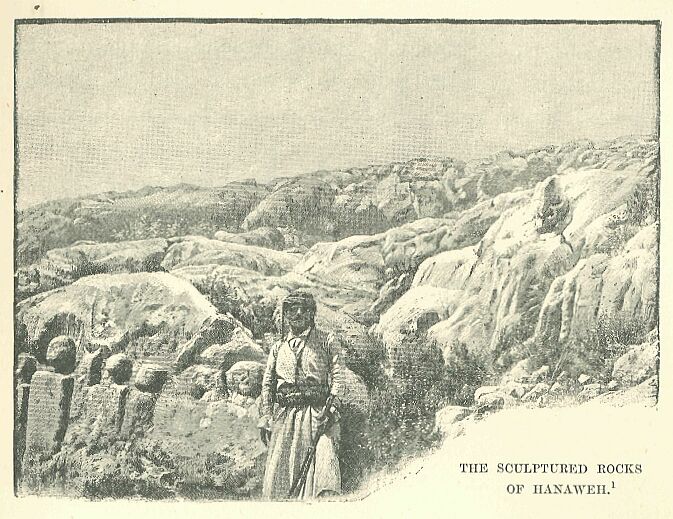
Drawn by Boudier, from a photograph by Lortet.
These figures run in parallel lines along the rocky sides of a wild ravine. They vary from 2 feet 6 inches to 3 feet in height, the bodies being represented by rectangular pilasters, sometimes merely rough-hewn, at others grooved with curved lines to suggest the folds of the Asiatic garments; the head is carved full face, though the eyes are given in profile, and the summary treatment of the modelling gives evidence of a certain skill. Whether they are to be regarded as the product of a primitive Amorite art or of a school of Phoenician craftsmen, we are unable to determine. In the time of their prosperity the Tyrians certainly pushed their frontier as far as this region. The wind-swept but fertile country lying among the ramifications of the lowest spurs of the Lebanon bears to this day innumerable traces of their indefatigable industry—remains of dwellings, conduits and watercourses, cisterns, pits, millstones and vintage-troughs, are scattered over the fields, interspersed with oil and wine presses. The Phoenicians took naturally to agriculture, and carried it to such a high state of perfection as to make it an actual science, to which the neighbouring peoples of the Mediterranean were glad to accommodate their modes of culture in later times.*
* Their taste for agriculture, and the comparative perfection of their modes of culture, are proved by the greatness of the remains still to be observed: “The Phoenicians constructed a winepress, a trough, to last for ever.” Their colonists at Carthage carried with them the same clever methods, and the Romans borrowed many excellent things in the way of agriculture from Carthaginian books, especially from those of Mago.
Among no other people was the art of irrigation so successfully practised, and from such a narrow strip of territory as belonged to them no other cultivators could have gathered such abundant harvests of wheat and barley, and such supplies of grapes, olives, and other fruits. From Arvad to Tyre, and even beyond it, the littoral region and the central parts of the valleys presented a long ribbon of verdure of varying breadth, where fields of corn were blended with gardens and orchards and shady woods. The whole region was independent and self-supporting, the inhabitants having no need to address themselves to their neighbours in the interior, or to send their children to seek their fortune in distant lands. To insure prosperity, nothing was needed but a slight exercise of labour and freedom from the devastating influence of war.
The position of the country was such as to secure it from attack, and from the conflicts which laid waste the rest of Syria. Along almost the entire eastern border of the country the Lebanon was a great wall of defence running parallel to the coast, strengthened at each extremity by the additional protection of the rivers Nahr el-Kebîr and Litany. Its slopes were further defended by the forest, which, with its lofty trees and brushwood, added yet another barrier to that afforded by rocks and snow. Hunters’ or shepherds’ paths led here and there in tortuous courses from one side of the mountain to the other. Near the middle of the country two roads, practicable in all seasons, secured communications between the littoral and the plain of the interior. They branched off on either side from the central road in the neighbourhood of Tabakhi, south of Qodshu, and served the needs of the wooded province of Magara.* This region was inhabited by pillaging tribes, which the Egyptians called at one time Lamnana, the Libanites,** at others Shausu, using for them the same appellation as that which they bestowed upon the Bedouin of the desert.
* Magara is mentioned in the Anastasi Papyrus, No. 1, and Chabas has identified it with the plain of Macra, which Strabo places in Syria, in the neighbourhood of Eloutheros. ** The name Lamnana is given in a picture of the campaigns of Seti I.
The roads through this province ran under the dense shade afforded by oaks, cedars, and cypresses, in an obscurity favourable to the habits of the wolves and hyamas which infested it, and even of those thick-maned lions known to Asia at the time; and then proceeding in its course, crossed the ridge in the neighbourhood of the snow-peak called Shaua, which is probably the Sannîn of our times. While one of these roads, running north along the lake of Yamuneh and through the gorge of Akura, then proceeded along the Adonis* to Byblos, the other took a southern direction, and followed the Nahr el-Kelb to the sea.
* This is the road pointed out by Renan as the easiest but least known of those which cross the Lebanon; the remains of an Assyrian inscription graven on the rocks near Aîn el- Asafîr show that it was employed from a very early date, and Renan thought that it was used by the armies which came from the upper valley of the Orontes.
Towards the mouth of the latter a wall of rock opposes the progress of the river, and leaves at length but a narrow and precipitous defile for the passage of its waters: a pathway cut into the cliff at a very remote date leads almost perpendicularly from the bottom of the precipice to the summit of the promontory. Commerce followed these short and direct routes, but invading hosts very rarely took advantage of them, although they offered access into the very heart of Phoenicia. Invaders would encounter here, in fact, a little known and broken country, lending itself readily to surprises and ambuscades; and should they reach the foot of the Lebanon range, they would find themselves entrapped in a region of slippery defiles, with steep paths at intervals cut into the rock, and almost inaccessible to chariots or horses, and so narrow in places that a handful of resolute men could have held them for a long time against whole battalions. The enemy preferred to make for the two natural breaches at the respective extremities of the line of defence, and for the two insular cities which flanked the approaches to them—Tyre in the case of those coming from Egypt, Arvad and Simyra for assailants from the Euphrates. The Arvadians, bellicose by nature, would offer strong resistance to the invader, and not permit themselves to be conquered without a brave struggle with the enemy, however powerful he might be.* When the disproportion of the forces which they could muster against the enemy convinced them of the folly of attempting an open conflict, their island-home offered them a refuge where they would be safe from any attacks.
* Thûtmosis III. was obliged to enter on a campaign against Arvad in the year XXIX., in the year XXX., and probably twice in the following years. Under Amenôthes III. and IV. we see that these people took part in all the intrigues directed against Egypt; they were the allies of the Khati against Ramses II. in the campaign of the year V. and later on we find them involved in most of the wars against Assyria.
Sometimes the burning and pillaging of their property on the mainland might reduce them to throw themselves on the mercy of their foes, but such submission did not last long, and they welcomed the slightest occasion for regaining their liberty. Conquered again and again on account of the smallness of their numbers, they were never discouraged by their reverses, and Phoenicia owed all its military history for a long period to their prowess. The Tyrians were of a more accommodating nature, and there is no evidence, at least during the early centuries of their existence, of the display of those obstinate and blind transports of bravery by which the Arvadians were carried away.*
* No campaign against Tyre is mentioned in any of the Egyptian annals: the expedition of Thûtmosis III. against Senzauru was directed against a town of Coele-Syria mentioned in the Tel el-Amarna tablets with the orthography Zinzar, the Sizara-Larissa of Græco-Roman times, the Shaizar of the Arab Chronicles. On the contrary, the Tel el-Amarna tablets contain several passages which manifest the fidelity of Tyre and its governors to the King of Egypt.
Their foreign policy was reduced to a simple arithmetical question, which they discussed in the light of their industrial or commercial interests. As soon as they had learned from a short experience that a certain Pharaoh had at his disposal armies against which they could offer no serious opposition, they at once surrendered to him, and thought only of obtaining the greatest profit from the vassalage to which they were condemned. The obligation to pay tribute did not appear to them so much in the light of a burthen or a sacrifice, as a means of purchasing the right to go to and fro freely in Egypt, or in the countries subject to its influence. The commerce acquired by these privileges recouped them more than a hundredfold for all that their overlord demanded from them. The other cities of the coast—Sidon, Berytus, Byblos—usually followed the example of Tyre, whether from mercenary motives, or from their naturally pacific disposition, or from a sense of their impotence; and the same intelligent resignation with which, as we know, they accepted the supremacy of the great Egyptian empire, was doubtless displayed in earlier centuries in their submission to the Babylonians. Their records show that they did not accept this state of things merely through cowardice or indolence, for they are represented as ready to rebel and shake off the yoke of their foreign master when they found it incompatible with their practical interests. But their resort to war was exceptional; they generally preferred to submit to the powers that be, and to accept from them as if on lease the strip of coast-line at the base of the Lebanon, which served as a site for their warehouses and dockyards. Thus they did not find the yoke of the stranger irksome—the sea opening up to them a realm of freedom and independence which compensated them for the limitations of both territory and liberty imposed upon them at home.
The epoch which was marked by their first venture on the Mediterranean, and the motives which led to it, were alike unknown to them. The gods had taught them navigation, and from the beginning of things they had taken to the sea as fishermen, or as explorers in search of new lands.* They were not driven by poverty to leave their continental abode, or inspired thereby with a zeal for distant cruises. They had at home sufficient corn and wine, oil and fruits, to meet all their needs, and even to administer to a life of luxury. And if they lacked cattle, the abundance of fish within their reach compensated for the absence of flesh-meat.
* According to one of the cosmogonies of Sanchoniathon, Khusôr, who has been identified with Hephsestos, was the inventor of the fishing-boat, and was the first among men and gods who taught navigation. According to another legend, Melkarth showed the Tyrians how to make a raft from the branches of a fig tree, while the construction of the first ships is elsewhere ascribed to the Cabiri.
Nor was it the number of commodiously situated ports on their coast which induced them to become a seafaring people, for their harbours were badly protected for the most part, and offered no shelter when the wind set in from the north, the rugged shore presenting little resource against the wind and waves in its narrow and shallow havens. It was the nature of the country itself which contributed more than anything else to make them mariners. The precipitous mountain masses which separate one valley from another rendered communication between them difficult, while they served also as lurking-places for robbers. Commerce endeavoured to follow, therefore, the sea-route in preference to the devious ways of this highwayman’s region, and it accomplished its purpose the more readily because the common occupation of sea-fishing had familiarised the people with every nook and corner on the coast. The continual wash of the surge had worn away the bases of the limestone cliffs, and the superincumbent masses tumbling down into the sea formed lines of rocks, hardly rising above the water-level, which fringed the headlands with perilous reefs, against which the waves broke continuously at the slightest wind. It required some bravery to approach them, and no little skill to steer one of the frail boats, which these people were accustomed to employ from the earliest times, scatheless amid the breakers. The coasting trade was attracted from Arvad successively to Berytus, Sidon, and Tyre, and finally to the other towns of the coast. It was in full operation, doubtless, from the VIth Egyptian dynasty onwards, when the Pharaohs no longer hesitated to embark troops at the mouth of the Nile for speedy transmission to the provinces of Southern Syria, and it was by this coasting route that the tin and amber of the north succeeded in reaching the interior of Egypt. The trade was originally, it would seem, in the hands of those mysterious Kefâtiu of whom the name only was known in later times. When the Phoenicians established themselves at the foot of the Lebanon, they had probably only to take the place of their predecessors and to follow the beaten tracks which they had already made. We have every reason to believe that they took to a seafaring life soon after their arrival in the country, and that they adapted themselves and their civilization readily to the exigencies of a maritime career.*
* Connexion between Phoenicia and Greece was fully established at the outbreak of the Egyptian wars, and we may safely assume their existence in the centuries immediately preceding the second millennium before our era.
In their towns, as in most sea-ports, there was a considerable foreign element, both of slaves and freemen, but the Egyptians confounded them all under one name, Kefâtiu, whether they were Cypriotes, Asiatics, or Europeans, or belonged to the true Tyrian and Sidonian race. The costume of the Kafîti was similar to that worn by the people of the interior—the loin-cloth, with or without a long upper garment: while in tiring the hair they adopted certain refinements, specially a series of curls which the men arranged in the form of an aigrette above their foreheads. This motley collection of races was ruled over by an oligarchy of merchants and shipowners, whose functions were hereditary, and who usually paid homage to a single king, the representative of the tutelary god, and absolute master of the city.*
* Under the Egyptian supremacy, the local princes did not assume the royal title in the despatches which they addressed to the kings of Egypt, but styled themselves governors of their cities.
The industries pursued in Phoenicia were somewhat similar to those of other parts of Syria; the stuffs, vases, and ornaments made at Tyre and Sidon could not be distinguished from those of Hamath or of Carchemish.
Drawn by Faucher-Gudin, from the coloured sketches by Prisse d’Avennes in the Natural Hist. Museum.
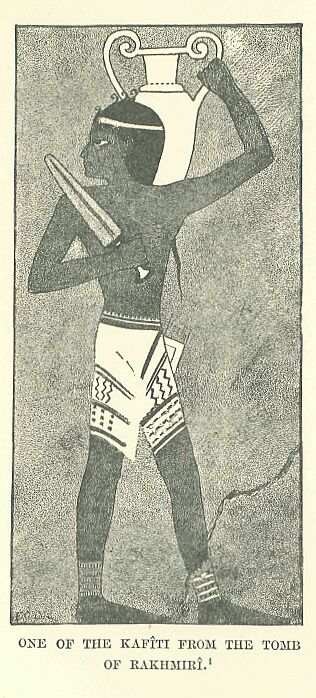
All manufactures bore the impress of Babylonian influence, and their implements, weights, measures, and system of exchange were the same as those in use among the Chaldæans. The products of the country were, however, not sufficient to freight the fleets which sailed from Phoenicia every year bound for all parts of the known world, and additional supplies had to be regularly obtained from neighbouring peoples, who thus became used to pour into Tyre and Sidon the surplus of their manufactures, or of the natural wealth of their country. The Phoenicians were also accustomed to send caravans into regions which they could not reach in their caracks, and to establish trading stations at the fords of rivers, or in the passes over mountain ranges. We know of the existence of such emporia at Laish near the sources of the Jordan, at Thapsacus, and at Nisibis, and they must have served the purpose of a series of posts on the great highways of the world. The settlements of the Phoenicians always assumed the character of colonies, and however remote they might be from their fatherland, the colonists never lost the manners and customs of their native country. They collected together into their okels or storehouses such wares and commodities as they could purchase in their new localities, and, transmitting them periodically to the coast, shipped them thence to all parts of the world.
Not only were they acquainted with every part of the Mediterranean, but they had even made voyages beyond its limits. In the absence, however, of any specific records of their naval enterprise, the routes they followed must be a subject of conjecture. They were accustomed to relate that the gods, after having instructed them in the art of navigation, had shown them the way to the setting sun, and had led them by their example to make voyages even beyond the mouths of the ocean. El of Byblos was the first to leave Syria; he conquered Greece and Egypt, Sicily and Libya, civilizing their inhabitants, and laying the foundation of cities everywhere. The Sidonian Astartê, with her head surmounted by the horns of an ox, was the next to begin her wanderings over the inhabited earth. Melkarth completed the task of the gods by discovering and subjugating those countries which had escaped the notice of his predecessors. Hundreds of local traditions, to be found on all the shores of the Mediterranean down to Roman times, bore witness to the pervasive influence of the old Canaanite colonisation. At Cyprus, for instance, wo find traces of the cultus of Kinyras, King of Byblos and father of Adonis; again, at Crete, it is the daughter of a Prince of Sidon, Buropa, who is carried off by Zeus under the form of a bull; it was Kadmos, sent forth to seek Buropa, who visited Cyprus, Rhodes, and the Cyclades before building Thebes in Boeotia and dying in the forests of Illyria. In short, wherever the Phoenicians had obtained a footing, their audacious activity made such an indelible impression upon the mind of the native inhabitants that they never forgot those vigorous thick-set men with pale faces and dark beards, and soft and specious speech, who appeared at intervals in their large and swift sailing vessels. They made their way cautiously along the coast, usually keeping in sight of land, making sail when the wind was favourable, or taking to the oars for days together when occasion demanded it, anchoring at night under the shelter of some headland, or in bad weather hauling their vessels up the beach until the morrow. They did not shrink when it was necessary from trusting themselves to the open sea, directing their course by the Pole-star;* in this manner they often traversed long distances out of sight of land, and they succeeded in making in a short time voyages previously deemed long and costly.
* The Greeks for this reason called it Phonikê, the Phoenician star; ancient writers refer to the use which the Phoenicians made of the Pole-star to guide them in navigation.
It is hard to say whether they were as much merchants as pirates—indeed, they hardly knew themselves—and their peaceful or warlike attitude towards vessels which they encountered on the seas, or towards the people whose countries they frequented, was probably determined by the circumstances of the moment.* If on arrival at a port they felt themselves no match for the natives, the instinct of the merchant prevailed, and that of the pirate was kept in the background. They landed peaceably, gained the good will of the native chief and his nobles by small presents, and spreading out their wares, contented themselves, if they could do no better, with the usual advantage obtained in an exchange of goods.
* The manner in which the Phoenicians plied their trade is strikingly described in the Odyssey, in the part where Eumaios relates how he was carried off by a Sidonian vessel and sold as a slave: cf. the passage which mentions the ravages of the Greeks on the coast of the Delta. Herodotus recalls the rape of Io, daughter of Inachos, by the Phoenicians, who carried her and her companions into Egypt; on the other hand, during one of their Egyptian expeditions they had taken two priestesses from Thebes, and had transported one of them to Dodona, the other into Libya.
They were never in a hurry, and would remain in one spot until they had exhausted all the resources of the country, while they knew to a nicety how to display their goods attractively before the expected customer. Their wares comprised weapons and ornaments for men, axes, swords, incised or damascened daggers with hilts of gold or ivory, bracelets, necklaces, amulets of all kinds, enamelled vases, glass-work, stuffs dyed purple or embroidered with gay colours. At times the natives, whose cupidity was excited by the exhibition of such valuables, would attempt to gain possession of them either by craft or by violence. They would kill the men who had landed, or attempt to surprise the vessel during the night. But more often it was the Phoenicians who took advantage of the friendliness or the weakness of their hosts.
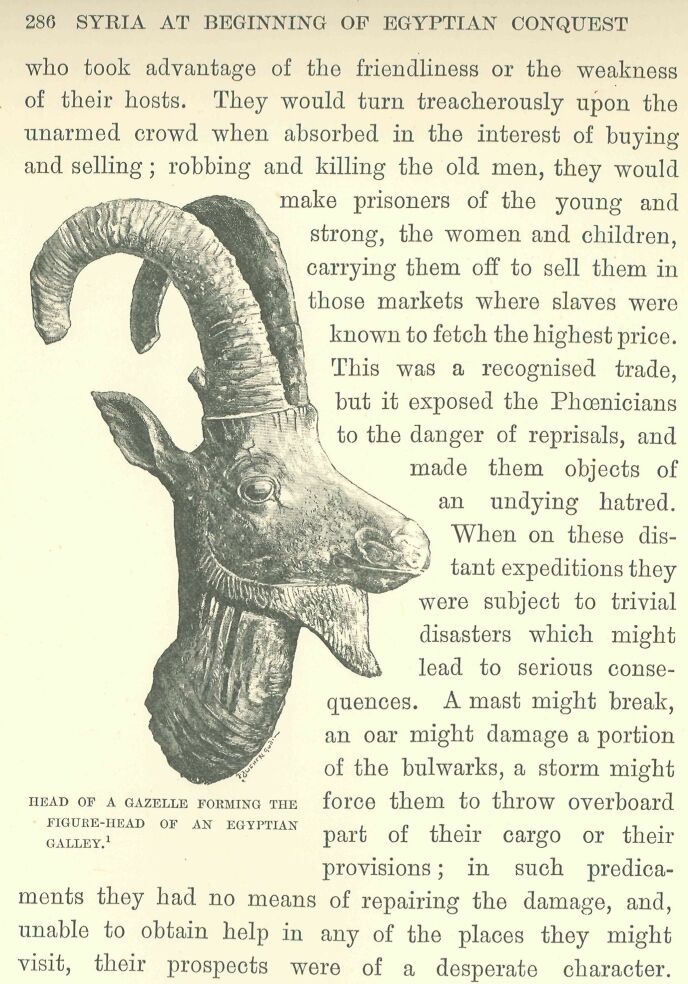
They would turn treacherously upon the unarmed crowd when absorbed in the interest of buying and selling; robbing and killing the old men, they would make prisoners of the young and strong, the women and children, carrying them off to sell them in those markets where slaves were known to fetch the highest price. This was a recognised trade, but it exposed the Phoenicians to the danger of reprisals, and made them objects of an undying hatred. When on these distant expeditions they were subject to trivial disasters which might lead to serious consequences. A mast might break, an oar might damage a portion of the bulwarks, a storm might force them to throw overboard part of their cargo or their provisions; in such predicaments they had no means of repairing the damage, and, unable to obtain help in any of the places they might visit, their prospects were of a desperate character. They soon, therefore, learned the necessity of establishing cities of refuge at various points in the countries with which they traded—stations where they could go to refit and revictual their vessels, to fill up the complement of their crews, to take in new freight, and, if necessary, pass the winter or wait for fair weather before continuing their voyage. For this purpose they chose by preference islands lying within easy distance of the mainland, like their native cities of Tyre and Arvad, but possessing a good harbour or roadstead. If an island were not available, they selected a peninsula with a narrow isthmus, or a rock standing at the extremity of a promontory, which a handful of men could defend against any attack, and which could be seen from a considerable distance by their pilots. Most of their stations thus happily situated became at length important towns. They were frequented by the natives from the interior, who allied themselves with the new-comers, and furnished them not only with objects of trade, but with soldiers, sailors, and recruits for their army; and such was the rapid spread of these colonies, that before long the Mediterranean was surrounded by an almost unbroken chain of Phoenician strongholds and trading stations.