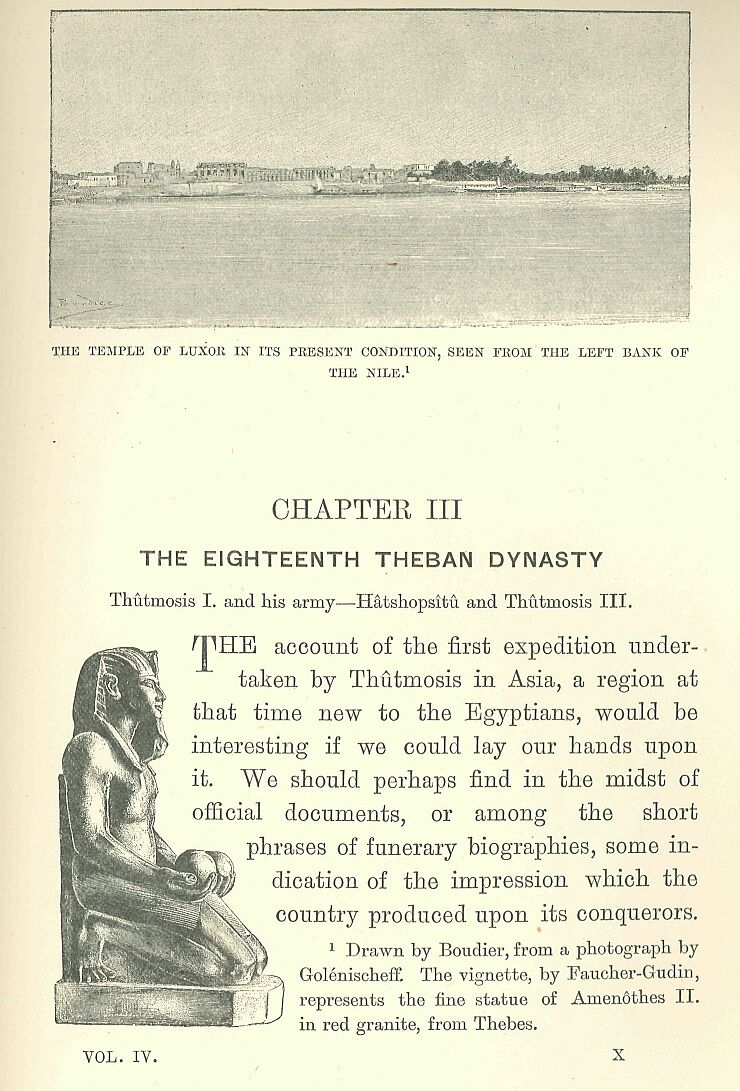
Volume 4 — CHAPTER II—SYRIA AT THE BEGINNING OF THE EGYPTIAN CONQUEST (continued 3)
M. L. McClure translation
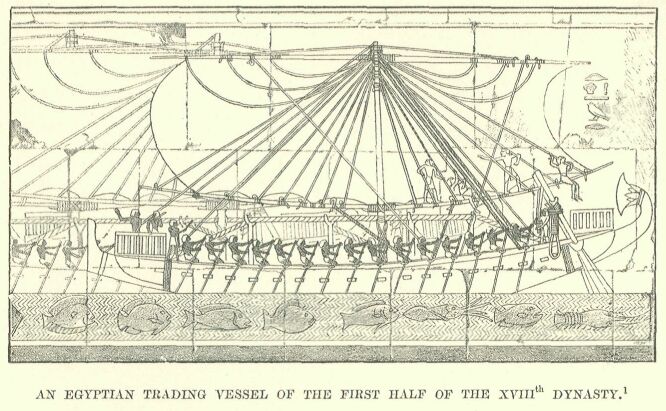
Drawn by Boudier, from a photograph by Beato.
All the towns of the mother country—Arvad, Byblos, Berytus, Tyre, and Sidon—possessed vessels engaged in cruising long before the Egyptian conquest of Syria. We have no direct information from any existing monument to show us what these vessels were like, but we are familiar with the construction of the galleys which formed the fleets of the Pharaohs of the XVIIIth dynasty. The art of shipbuilding had made considerable progress since the times of the Memphite kings. Prom the period when Egypt aspired to become one of the great powers of the world, she doubtless endeavoured to bring her naval force to the same pitch of perfection as her land forces could boast of, and her fleets probably consisted of the best vessels which the dockyards of that day could turn out. Phoenician vessels of this period may therefore be regarded with reason as constructed on lines similar to those of the Egyptian ships, differing from them merely in the minor details of the shape of the hull and manner of rigging. The hull continued to be built long and narrow, rising at the stem and stern. The bow was terminated by a sort of hook, to which, in time of peace, a bronze ornament was attached, fashioned to represent the head of a divinity, gazelle, or bull, while in time of war this was superseded by a metal cut-water made fast to the hull by several turns of stout rope, the blade rising some couple of yards above the level of the deck.* The poop was ornamented with a projection firmly attached to the body of the vessel, but curved inwards and terminated by an open lotus-flower. An upper deck, surrounded by a wooden rail, was placed at the bow and stern to serve as forecastle and quarterdecks respectively, and in order to protect the vessel from the danger of heavy seas the ship was strengthened by a structure to which we find nothing analogous in the shipbuilding of classical times: an enormous cable attached to the gammonings of the bow rose obliquely to a height of about a couple of yards above the deck, and, passing over four small crutched masts, was made fast again to the gammonings of the stern. The hull measured from the blade of the cut-water to the stern-post some twenty to five and twenty yards, but the lowest part of the hold did not exceed five feet in depth. There was no cabin, and the ballast, arms, provisions, and spare-rigging occupied the open hold.**
* To get a clear idea of the details of this structure, we have only to compare the appearance of ships with and without a cut-water in the scenes at Thebes, representing the celebration of a festival at the return of the fleet. ** M. Glaser thinks that there were cabins for the crew under the deck, and he recognises in the sixteen oblong marks on the sides of the vessels at Deîr el-Bahari so many dead-lights; as there could not have been space for so many cabins, I had concluded that these were ports for oars to be used in time of battle, but on further consideration I saw that they represented the ends of the beams supporting the deck.
The bulwarks were raised to a height of some two feet, and the thwarts of the rowers ran up to them on both the port and starboard sides, leaving an open space in the centre for the long-boat, bales of merchandise, soldiers, slaves, and additional passengers.* A double set of steering-oars and a single mast completed the equipment. The latter, which rose to a height of some twenty-six feet, was placed amidships, and was held in an upright position by stays. The masthead was surmounted by two arrangements which answered respectively to the top [“gabie”] and calcet of the masts of a galley.** There were no shrouds on each side from the masthead to the rail, but, in place of them, two stays ran respectively to the bow and stern. The single square-sail was extended between two yards some sixty to seventy feet long, and each made of two pieces spliced together at the centre. The upper yard was straight, while the lower curved upward at the ends. The yard was hoisted and lowered by two halyards, which were made fast aft at the feet of the steersmen. The yard was kept in its place by two lifts which came down from the masthead, and were attached respectively about eight feet from the end of each yard-arm. When the yard was hauled up it was further supported by six auxiliary lifts, three being attached to each yard-arm. The lower yard, made fast to the mast by a figure-of-eight knot, was secured by sixteen lifts, which, like those of the upper yard, worked through the “calcet.”
* One of the bas-reliefs exhibits a long-boat in the water at the time the fleet was at anchor at Puanît. As we do not find any vessel towing one after her, we naturally conclude that the boat must have been stowed on board. ** The “gabie” was a species of top where a sailor was placed on the look-out. The “calcet” is, properly speaking, a square block of wood containing the sheaves on which the halyards travelled. The Egyptian apparatus had no sheaves, and answers to the “calcet” on the masts of a galley only in its serving the same purpose.
The crew comprised thirty rowers, fifteen on each side, four top-men, two steersmen, a pilot at the bow, who signalled to the men at the helm the course to steer, a captain and a governor of the slaves, who formed, together with ten soldiers, a total of some fifty men.* In time of battle, as the rowers would be exposed to the missiles of the enemy, the bulwarks were further heightened by a mantlet, behind which the oars could be freely moved, while the bodies of the men were fully protected, their heads alone being visible above it. The soldiers were stationed as follows: two of them took their places on the forecastle, a third was perched on the masthead in a sort of cage improvised on the bars forming the top, while the remainder were posted on the deck and poop, from which positions and while waiting for the order to board they could pour a continuous volley of arrows on the archers and sailors of the enemy.**
* I have made this calculation from an examination of the scenes in which ships are alternatively represented as at anchor and under weigh. I know of vessels of smaller size, and consequently with a smaller crew, but I know of none larger or more fully manned. ** The details are taken from the only representation of a naval battle which we possess up to this moment, viz. that of which I shall have occasion to speak further on in connection with the reign of Ramses III.
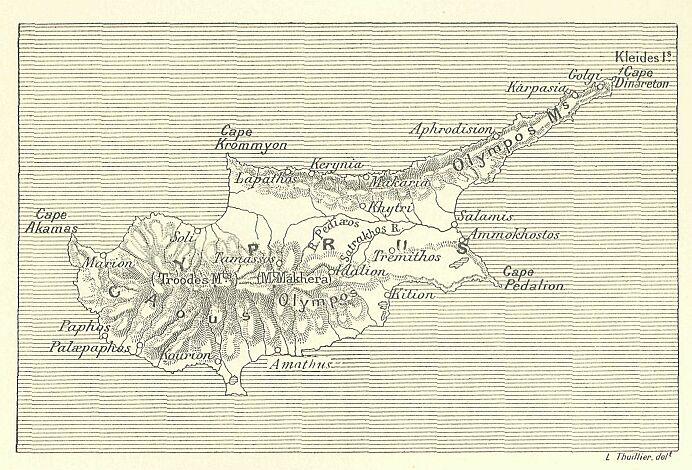
The first colony of which the Phoenicians made themselves masters was that island of Cyprus whose low, lurid outline they could see on fine summer evenings in the glow of the western sky. Some hundred and ten miles in length and thirty-six in breadth, it is driven like a wedge into the angle which Asia Minor makes with the Syrian coast: it throws out to the north-east a narrow strip of land, somewhat like an extended finger pointing to where the two coasts meet at the extremity of the gulf of Issos. A limestone cliff, of almost uniform height throughout, bounds, for half its length at least, the northern side of the island, broken occasionally by short deep valleys, which open out into creeks deeply embayed. A scattered population of fishermen exercised their calling in this region, and small towns, of which we possess only the Greek or Grecised names—Karpasia, Aphrodision, Kerynia, Lapethos—led there a slumbering existence. Almost in the centre of the island two volcanic peaks, Troodes and Olympos, face each other, and rise to a height of nearly 7000 feet, the range of mountains to which they belong—that of Aous—forming the framework of the island. The spurs of this range fall by a gentle gradient towards the south, and spread out either into stony slopes favourable to the culture of the vine, or into great maritime flats fringed with brackish lagoons. The valley which lies on the northern side of this chain runs from sea to sea in an almost unbroken level. A scarcely perceptible watershed divides the valley into two basins similar to those of Syria, the larger of the two lying opposite to the Phoenician coast. The soil consists of black mould, as rich as that of Egypt, and renewed yearly by the overflowing of the Pediæos and its affluents. Thick forests occupied the interior, promising inexhaustible resources to any naval power. Even under the Koman emperors the Cypriotes boasted that they could build and fit out a ship from the keel to the masthead without looking to resources beyond those of their own island. The ash, pine, cypress, and oak flourished on the sides of the range of Aous, while cedars grew there to a greater height and girth than even on the Lebanon. Wheat, barley, olive trees, vines, sweet-smelling woods for burning on the altar, medicinal plants such as the poppy and the ladanum, henna for staining with a deep orange colour the lips, eyelids, palm, nails, and fingertips of the women, all found here a congenial habitat; while a profusion everywhere of sweet-smelling flowers, which saturated the air with their penetrating odours—spring violets, many-coloured anemones, the lily, hyacinth, crocus, narcissus, and wild rose—led the Greeks to bestow upon the island the designation of “the balmy Cyprus.” Mines also contributed their share to the riches of which the island could boast. Iron in small quantities, alum, asbestos, agate and other precious stones, are still to be found there, and in ancient times the neighbourhood of Tamassos yielded copper in such quantities that the Romans were accustomed to designate this metal by the name “Cyprium,” and the word passed from them into all the languages of Europe. It is not easy to determine the race to which the first inhabitants of the island belonged, if we are not to see in them a branch of the Kefâtiu, who frequented the Asiatic shores of the Mediterranean from a very remote period. In the time of Egyptian supremacy they called their country Asi, and this name inclines one to connect the people with the Ægeans.* An examination of the objects found in the most ancient tombs of the island seems to confirm this opinion. These consist, for the most part, of weapons and implements of stone—knives, hatchets, hammers, and arrow-heads; and mingled with these rude objects a score of different kinds of pottery, chiefly hand-made and of coarse design—pitchers with contorted bowls, shallow buckets, especially of the milk-pail variety, provided with spouts and with pairs of rudimentary handles.
* “Asi,” “Asîi,” was at first sought for on the Asiatic continent—at Is on the Euphrates, or in Palestine: the discovery of the Canopic decree allows us to identify it with Cyprus, and this has now been generally done. The reading “Asebi” is still maintained by some.
The pottery is red or black in colour, and the ornamentation of it consists of incised geometrical designs. Copper and bronze, where we find examples of these metals, do not appear to have been employed in the manufacture of ornaments or arrow-heads, but usually in making daggers. There is no indication anywhere of foreign influence, and yet Cyprus had already at this time entered into relations with the civilized nations of the continent.* According to Chaldæan tradition, it was conquered about the year 3800 B.C. by Sargon of Agadê: without insisting upon the reality of this conquest, which in any case must have been ephemeral in its nature, there is reason to believe that the island was subjected from an early period to the influence of the various peoples which lived one after another on the slopes of the Lebanon. Popular legend attributes to King Kinyras and to the Giblites [i.e. the people of Byblos] the establishment of the first Phoenician colonies in the southern region of the island—one of them being at Paphos, where the worship of Adonis and Astartê continued to a very late date. The natives preserved their own language and customs, had their own chiefs, and maintained their national independence, while constrained to submit at the same time to the presence of Phoenician colonists or merchants on the coast, and in the neighbourhood of the mines in the mountains. The trading centres of these settlers—Kition, Amathus, Solius, Golgos, and Tamassos—were soon, however, converted into strongholds, which ensured to Phonicia the monopoly of the immense wealth contained in the island.**
* An examination into the origin of the Cypriotes formed part of the original scheme of this work, together with that of the monuments of the various races scattered along the coast of Asia Minor and the islands of the Ægean; but I have been obliged to curtail it, in order to keep within the limits I had proscribed for myself, and I have merely epitomised, as briefly as possible, the results of the researches undertaken in those regions during the last few years. ** The Phoenician origin of these towns is proved by passages from classical writers. The date of the colonisation is uncertain, but with the knowledge we possess of the efficient vessels belonging to the various Phoenician towns, it would seem difficult not to allow that the coasts at least of Cyprus must have been partially occupied at the time of the Egyptian invasions.
Tyre and Sidon had no important centres of industry on that part of the Canaanite coast which extended to the south of Carmel, and Egypt, even in the time of the shepherd kings, would not have tolerated the existence on her territory of any great emporium not subject to the immediate supervision of her official agents. We know that the Libyan cliffs long presented an obstacle to inroads into Egyptian territory, and baffled any attempts to land to the westwards of the Delta: the Phoenicians consequently turned with all the greater ardour to those northern regions which for centuries had furnished them with most valuable products—bronze, tin, amber, and iron, both native and wrought. A little to the north of the Orontes, where the Syrian border is crossed and Asia Minor begins, the coast turns due west and runs in that direction for a considerable distance. The Phoenicians were accustomed to trade along this region, and we may attribute, perhaps, to them the foundation of those obscure cities—Kibyra, Masura, Euskopus, Sylion, Mygdalê, and Sidyma*—all of which preserved their apparently Semitic names down to the time of the Roman epoch. The whole of the important island of Rhodes fell into their power, and its three ports, Ialysos, Lindos*, and Kamiros, afforded them a well-situated base of operations for further colonisation. On leaving Rhodes, the choice of two routes presented itself to them. To the south-west they could see the distant outline of Karpathos, and on the far horizon behind it the summits of the Cretan chain. Crete itself bars on the south the entrance to the Ægean, and is almost a little continent, self-contained and self-sufficing.
* No direct evidence exists to lead us to attribute the foundation of these towns to the Phoenicians, but the Semitic origin of nearly all the names is an uncontested fact.
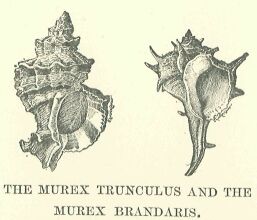
It is made up of fertile valleys and mountains clothed with forests, and its inhabitants could employ themselves in mines and fisheries. The Phoenicians effected a settlement on the coast at Itanos, at Kairatos, and at Arados, and obtained possession of the peak of Cythera, where, it is said, they raised a sanctuary to Astartê. If, on leaving Rhodes, they had chosen to steer due north, they would soon have come into contact with numerous rocky islets scattered in the sea between the continents of Asia and Europe, which would have furnished them with as many stations, less easy of attack, and more readily defended than posts on the mainland. Of these the Giblites occupied Melos, while the Sidonians chose Oliaros and Thera, and we find traces of them in every island where any natural product, such as metals, sulphur, alum, fuller’s earth, emery, medicinal plants, and shells for producing dyes, offered an attraction. The purple used by the Tyrians for dyeing is secreted by several varieties of molluscs common in the Eastern Mediterranean; those most esteemed by the dyers were the Murex trunculus and the Murex Brandaris, and solid masses made up of the detritus of these shells are found in enormous quantities in the neighbourhood of many Phoenician towns. The colouring matter was secreted in the head of the shellfish. To obtain it the shell was broken by a blow from a hammer, and the small quantity of slightly yellowish liquid which issued from the fracture was carefully collected and stirred about in salt water for three days.
It was then boiled in leaden vessels and reduced by simmering over a slow fire; the remainder was strained through a cloth to free it from the particles of flesh still floating in it, and the material to be dyed was then plunged into the liquid. The usual tint thus imparted was that of fresh blood, in some lights almost approaching to black; but careful manipulation could produce shades of red, dark violet, and amethyst. Phoenician settlements can be traced, therefore, by the heaps of shells upon the shore, the Cyclades and the coasts of Greece being strewn with this refuse. The veins of gold in the Pangaion range in Macedonia attracted them off the Thracian coast* received also frequent visits from them, and they carried their explorations even through the tortuous channel of the Hellespont into the Propontis, drawn thither, no doubt by the silver mines in the Bithynian mountains** which were already being worked by Asiatic miners.
* The fact that they worked the mines of Thasos is attested by Herodotus. ** Pronektos, on the Gulf of Ascania, was supposed to be a Phoenician colony.
Beyond the calm waters of the Propontis, they encountered an obstacle to their progress in another narrow channel, having more the character of a wide river than of a strait; it was with difficulty that they could make their way against the violence of its current, which either tended to drive their vessels on shore, or to dash them against the reefs which hampered the navigation of the channel. When, however, they succeeded in making the passage safely, they found themselves upon a vast and stormy sea, whose wooded shores extended east and west as far as eye could reach.
Drawn by Faucher-Gudin, from the facsimile in Perrot-Chipiez.
From the tribes who inhabited them, and who acted as intermediaries, the Phoenician traders were able to procure tin, lead, amber, Caucasian gold, bronze, and iron, all products of the extreme north—a region which always seemed,to elude their persevering efforts to discover it. We cannot determine the furthest limits reached by the Phoenician traders, since they were wont to designate the distant countries and nations with which they traded by the vague appellations of “Isles of the Sea” and “Peoples of the Sea,” refusing to give more accurate information either from jealousy or from a desire to hide from other nations the sources of their wealth.
Drawn by Faucher- Gudin.

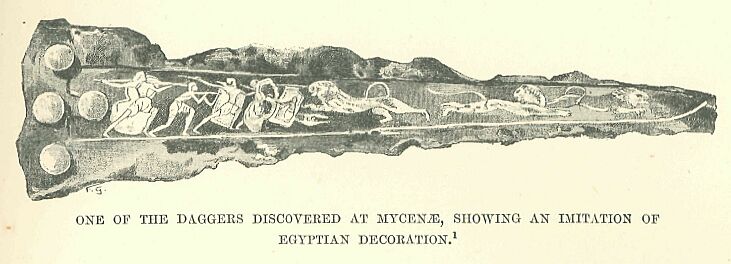
The peoples with whom they traded were not mere barbarians, contented with worthless objects of barter; their clients included the inhabitants of the iEgean, who, if inferior to the great nations of the East, possessed an independent and growing civilization, traces of which are still coming to light from many quarters in the shape of tombs, houses, palaces, utensils, ornaments, representations of the gods, and household and funerary furniture,—not only in the Cyclades, but on the mainland of Asia Minor and of Greece. No inferior goods or tinsel wares would have satisfied the luxurious princes who reigned in such ancient cities as Troy and Mycenae, and who wanted the best industrial products of Egypt and Syria—costly stuffs, rare furniture, ornate and well-wrought weapons, articles of jewellery, vases of curious and delicate design—such objects, in fact, as would have been found in use among the sovereigns and nobles of Memphis or of Babylon. For articles to offer in exchange they were not limited to the natural or roughly worked products of their own country. Their craftsmen, though less successful in general technique than their Oriental contemporaries, exhibited considerable artistic intelligence and an extraordinary manual skill. Accustomed at first merely to copy the objects sold to them by the Phoenicians, they soon developed a style of their own; the Mycenaean dagger in the illustration on page 299, though several centuries later in date than that of the Pharaoh Ahmosis, appears to be traceable to this ancient source of inspiration, although it gives evidence of new elements in its method of decoration and in its greater freedom of treatment. The inhabitants of the valleys of the Nile and of the Orontes, and probably also those of the Euphrates and Tigris, agreed in the, high value they set upon these artistic objects in gold, silver, and bronze, brought to them from the further shores of the Mediterranean, which, while reproducing their own designs, modified them to a certain extent; for just as we now imitate types of ornamental work in vogue among nations less civilized than ourselves, so the iEgean people set themselves the task through their potters and engravers of reproducing exotic models. The Phoenician traders who exported to Greece large consignments of objects made under various influences in their own workshops, or purchased in the bazaars of the ancient world, brought back as a return cargo an equivalent number of works of art, bought in the towns of the West, which eventually found their way into the various markets of Asia and Africa. These energetic merchants were not the first to ply this profitable trade of maritime carriers, for from the time of the Memphite empire the products of northern regions had found their way, through the intermediation of the Haûinibû, as far south as the cities of the Delta and the Thebaid. But this commerce could not be said to be either regular or continuous; the transmission was carried on from one neighbouring tribe to another, and the Syrian sailors were merely the last in a long chain of intermediaries—a tribal war, a migration, the caprice of some chief, being sufficient to break the communication, and even cause the suspension of transit for a considerable period. The Phoenicians desired to provide against such risks by undertaking themselves to fetch the much-coveted objects from their respective sources, or, where this was not possible, from the ports nearest the place of their manufacture. Reappearing with each returning year in the localities where they had established emporia, they accustomed the natives to collect against their arrival such products as they could profitably use in bartering with one or other of their many customers. They thus established, on a fixed line of route, a kind of maritime trading service, which placed all the shores of the Mediterranean in direct communication with each other, and promoted the blending of the youthful West with the ancient East.
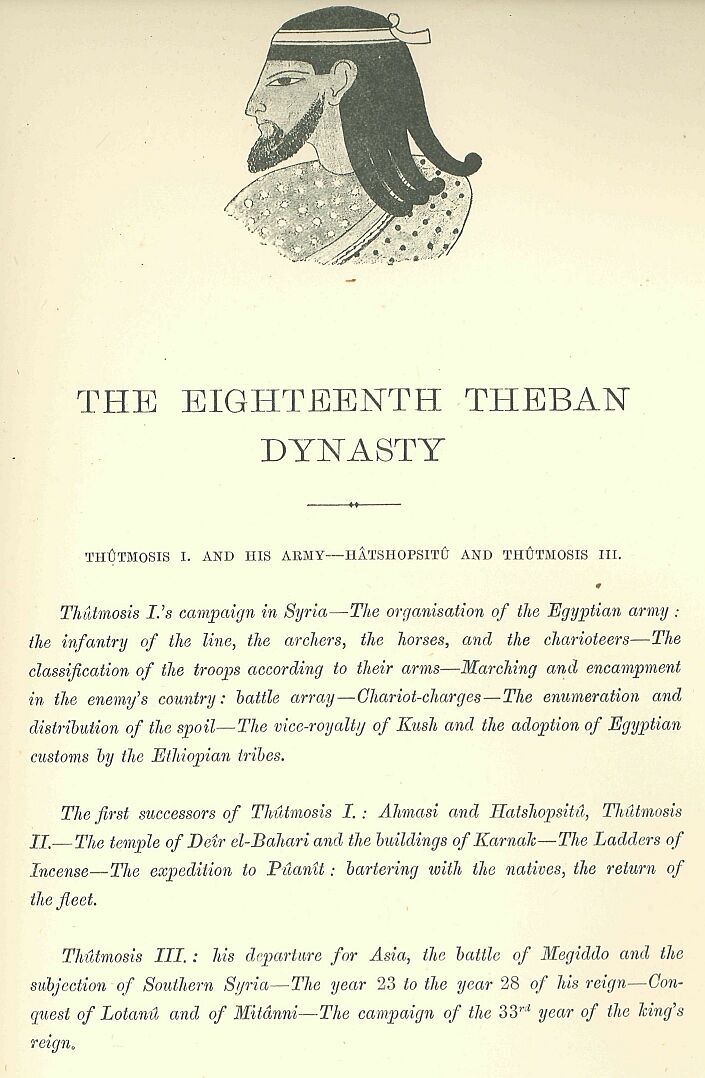
THE EIGHTEENTH THEBAN DYNASTY THÛTMOSIS I. AND HIS ARMY—HÂTSHOPSITÛ AND THÛTMOSIS III.
Thutmosis I.‘s campaign in Syria—The organisation of the Egyptian army: the infantry of the line, the archers, the horses, and the charioteers—The classification of the troops according to their arms—Marching and encampment in the enemy’s country: battle array—Chariot-charges—The enumeration and distribution of the spoil—The vice-royalty of Rush and the adoption of Egyptian customs by the Ethiopian tribes.
The first successors of Thutmosis I.: Ahmasi and Hatshopsitit, Thûtmosis II—The temple of Deîr el-Bahari and the buildings of Karnah—The Ladders of Incense—The expedition to Pûanît: bartering with the natives, the return of the fleet.
Thûtmosis III.: his departure for Asia, the battle of Megiddo and the subjection of Southern Syria—The year 23 to the year 28 of his reign—Conquest of Lotanû and of Mitânni—The campaign of the 33rd year of the king’s reign.