Volume 1 / Part 2 — CHAPTER X RED-FIGURED VASES (continued 2)
Reading edition
PLATE XLI
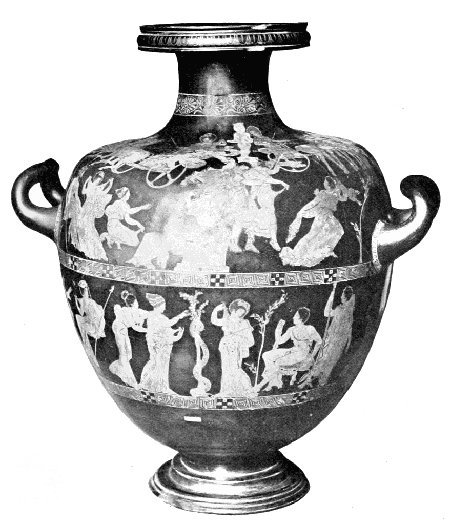
Hydria by Meidias (British Museum).
The subjects represented are arranged in two friezes all round the vase, the upper containing the rape of the Leukippidae by the Dioskuri—a subject which had been chosen by Polygnotos for his painting in the Anakeion.[1390] Not only this, but all the vases with the same subject are doubtless largely indebted to the painting for their ideas, especially in the system of composition with figures at different levels.[1391] On the lower row the front view shows Herakles in the garden of the Hesperides, and at the back is a group of Athenian tribal heroes.[1392] All the figures have their names inscribed; these, together with the artist’s signature, were only first noticed by Gerhard in 1839. Among the details of treatment are to be noted the exquisitely fine lines for the folds of drapery, and the elaborate chequers and other patterns representing embroidery, the occasional use of gilding, the attempts to impart expression to faces by means of wrinkles, and the characteristic rendering of the hair with wavy dark lines of thinned black on a brown wash.
The last artist of Athenian origin who remains to be mentioned is Xenophantos, a contemporary of Meidias, whose name appears on a vase found at Kertch and now in the Hermitage at Petersburg.[1393] Here he expressly calls himself an Athenian, and it has therefore been supposed that the vase was made on the spot, otherwise it would not be obvious why he should proclaim his nationality (see below, p. 464). The chief feature of the vase—a lekythos of the “bellied” type so common at this stage—is the use of figures moulded in relief and applied to the surface, in conjunction with gilding and a lavish use of white colour. The subject is the Persian king hunting.
The vases of the late fine style, into which the “fine” style merges about the year 430 B.C., may be divided into two classes,—that of the larger vases, chiefly kraters, in which the pictorial traditions of the Polygnotan vases are carried on and developed, and the influence of contemporary art makes itself felt; and that of the smaller types, such as the pyxis and the wide-bellied lekythos, in which new features and new subjects are introduced (cf. Plate XLII.).
The former class is chiefly made up of the vases found in Southern Italy, in the Crimea, the Cyrenaica, and the Greek islands, which are apparently of Athenian, not local, fabric; but they are comparatively rare at Athens and in Greece Proper, where the smaller vases have been found in considerable numbers. It may be found convenient to deal first with the latter, as more typically Athenian, while the larger vases serve as a connecting-link with the succeeding fabrics dealt with in the next section.
In these vases linear drawing reaches its limits in respect of perfect freedom and refinement of detail; but it is at a severe cost. The artist seems to have lost interest in his subject when it no longer required an effort to execute it, and is content to decorate his vase with a few stock figures in conventional attitudes, uncharacterised by action or attribute. Frequent faults of design may be observed, such as coarseness of drawing or negligence in the laying on of the black varnish. The artist works by routine, and appears to be nonchalant and bored. Mythological scenes become exceedingly rare, and are confined to Dionysos or Aphrodite with their attendant personifications, and the compositions are fanciful or decorative in character, without any suggestion of particular events or actions. The all-pervading presence of Eros is another feature which is new to vase-painting, but henceforward his position is established. An even greater novelty is the preponderance
PLATE XLII
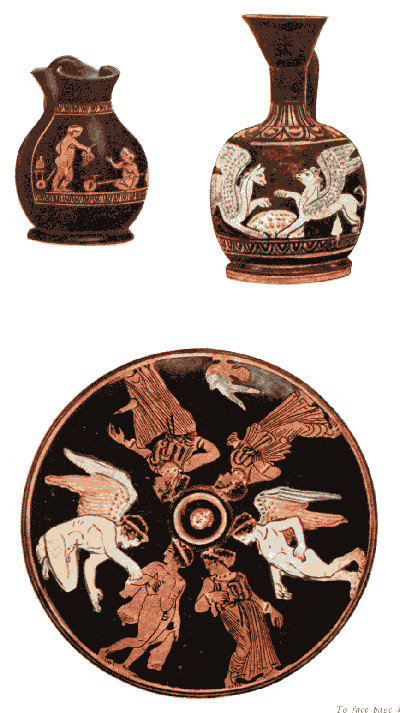
VASE OF “LATE FINE” STYLE. (British Museum).
of subjects connected with the daily life of women or children—the toilet, the occupations of every-day life, or nuptial ceremonies; and a whole series of small jugs, themselves in all probability toys, depicts the various games in which the Athenian child delighted—the hoop, the go-cart, and the ball, or his pet animals (cf. Plate XLII.).
The shapes most popular in this group are, as we have indicated, the oinochoë, the wide-bellied lekythos, and the pyxis (Plate XLII.). Milchhoefer, in a most important article,[1394] regards the lekythi as more instructive than any other group for illustrating the later developments of R.F. vase-painting. Beginning with early examples of the fine style,[1395] they extend to the very end without any gaps, the tradition being further continued in Apulia. They exhibit a development from simple to rich compositions, from “strong” style to perfect freedom. In the latest examples, such as that by Xenophantos, we see the straining after novelty which marks the decadence, in the introduction of figures in relief applied to the surface of the vase, as well as in the increase of polychromy and gilding. Among the finer vases we may note a hydria at Karlsruhe (259) with the Judgment of Paris, in which may be traced the hand of Meidias; the lekythos in the British Museum from Cyprus (E 696), with Oedipus slaying the Sphinx, in which the figure of Athena with its white coating is clearly reminiscent of the gold-and-ivory Parthenos statue; and two pretty lekythi from Apollonia, in Thrace, with the subject of incense-gathering. There are also two pyxides in the British Museum (E 773–4), on which are groups of women, with fancy names added to give interest to the scene: thus Klytaemnestra, Danae, and Iphigeneia occur all together, and the Nereids are engaged in the every-day occupations of the women’s apartments.
From a technical point of view, the principal change is in the increased use of gilding and polychrome colouring. The former, employed exceptionally by Euphronios and Brygos, now becomes the rule, and concurrently the use of white for flesh-tints, as in the figure of Athena just mentioned, and of red, green, and blue for draperies, becomes more and more general. The gilding was applied for small details, such as wreaths, and for the hair; and the places where it was to be applied were marked by low relief. It was fixed in the form of gold-leaf by means of a yellowish gum. Jahn, who some years ago collected the list of vases with gilding,[1396] reckoned fifty-one known to him, chiefly from Kertch; and Heydemann and Collignon[1397] have since added several to the list, chiefly from collections at Athens. They have been found not only in Athens and Kertch, but at Corinth, Megara, Hermione, Thebes, and in Acarnania and Thrace.
In the larger vases of this period the pictorial method of the preceding phase is, as might have been expected, greatly developed. Among the vases of undoubted Attic origin we have, first of all, the Meidias hydria and its companion vase, the Karlsruhe hydria with the Judgment of Paris[1398]; and, secondly, the great Gigantomachia vase from Melos in the Louvre, which contains no less than forty-seven figures.[1399] Another fine instance is the polychrome Kameiros vase in the British Museum with the subject of Peleus and Thetis. Robert[1400] sees in the two latter a possible influence of Parrhasios, who is known to have paid great attention to drawing, and, in reference to the Kameiros vase, draws attention to the plastic silhouette effect of the figures. Parrhasios’ art consisted in giving this effect by his linear drawing.[1401] The influence of Zeuxis is less apparent, though from his earlier date it might more naturally have been expected.[1402]
It is, however, still more instructive to trace in this group the influence of the Parthenon sculptures, which, where it can be observed, enables us to date the vases approximately as at any rate not earlier than 438 B.C. On the other hand, it must be borne in mind that sculptor and painter may often have gone back to the same original type. This explains the appearance of apparently Pheidian motives on vases of an earlier style—such as riding youths, water-carriers, etc.—or the similarity of composition on one of the Parthenon metopes and a vase of undoubtedly earlier date.[1403] But in one or two instances there can be no doubt of such influence, most notably in the Athena and Poseidon vase from Kertch (see below, p. 464). It cannot be without significance here that the two figures are actually in relief on the vase, and the parallelism with the pediment (so far as we know the design) is so close that a copy of it was manifestly the vase-artist’s intention. Mention has already been made of a figure of the Parthenos on a vase of this period, and another instance, though not on a painted vase, may be noted in the polychrome bust of the goddess in terracotta from Athens, now in the British Museum.[1404] Some instances of this type on vases may be earlier than the statue; it was not created by Pheidias.[1405]
It has already been mentioned that there is one exception to the Athenian monopoly of vase-making in the fifth century, and this is in the local fabrics of Boeotia. Of the Kabeirion vases, which, though in the B.F. technique, belong to this period, we have already spoken. There remains a small class—only five examples are at present known—which appears to have been made at Tanagra. All five evidently came from the same workshop, and in three cases the provenance is certainly known. Two are in the British Museum (E 813–4), and three in the Museum at Athens.[1406] With the exception of E 814 in the British Museum, which is a pyxis, all are small two-handled cups, with low feet. The designs are outlined on a background of yellow clay in a black-brown pigment, the lines being coarsely drawn. Inner details are indicated by means of thinned-out pigment. That they are of Boeotian origin is further shown by the ornamentation: the pyxis has round the sides rows of vertical wavy lines, such as are often seen on the Boeotian geometrical fabrics (p. 288), and also an ivy-leaf which recalls the Kabeirion ware. The ornamentation of the hangings round the chair on Athens 1120 exactly resembles the patterns indicating the drapery on some of the early Boeotian terracottas.[1407] The subjects, on the other hand, seem to suggest Athenian prototypes: in the designs much archaism is to be observed—such as defects in perspective, the rendering of the eyelashes, and the drawing of the feet in profile, but with toes in front. Numerous small details point to a date late in the fifth century, which, in view of the conservative tendencies of Boeotia, is not unlikely.
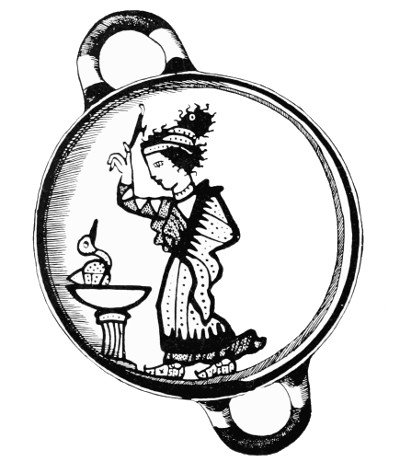
FIG. 104. BOEOTIAN KYLIX (BRITISH MUSEUM): GIRL PLAYING KOTTABOS(?).
The subjects are of some interest, and include two figures of Herakles, one bearded, the other youthful; a girl playing kottabos (Fig. 104); and a cultus-image of an enthroned Chthonian goddess (Demeter or Persephone), holding a torch, ears of corn, and poppies. These vases have been collected and fully discussed in an interesting article by Dr. S. Wide.[1408]