Volume 1 / Part 1 — CHAPTER IV USES AND SHAPES OF GREEK VASES
Reading edition
Mention of painted vases in literature—Civil and domestic use of pottery—Measures of capacity—Use in daily life—Decorative use—Religious and votive uses—Use in funeral ceremonies—Shapes and their names—Ancient and modern classifications—Vases for storage—Pithos—Wine-amphora—Amphora—Stamnos—Hydria—Vases for mixing—Krater—Deinos or Lebes—Cooking-vessels—Vases for pouring wine—Oinochoe and variants—Ladles—Drinking-cups—Names recorded by Athenaeus—Kotyle—Skyphos—Kantharos—Kylix—Phiale—Rhyton— Dishes—Oil-vases—Lekythos—Alabastron—Pyxis—Askos—Moulded vases.
Those who are acquainted with the enormous number of painted vases now gathered together in our Museums, showing the important part they must have played in the daily life of the Greeks and the high estimation in which they were clearly held, as evidenced by the great care bestowed on their decoration and the pride exhibited by artists in their signed productions, may feel some surprise that so few allusions to them can be traced in classical literature. Such passages as can be interpreted as referring to them may actually be counted on the fingers of one hand, and even these are but passing allusions; while any full descriptions of vases, such as that in Theocritus' first Idyll or some of those in Athenaeus’ Book XI., almost invariably refer to metal vases with chased designs. Nor can we trace any reference to known potters or artists in literature or documents, save in a few inscriptions recently found at Athens, which are, of course, of secondary importance for literary history.
More general allusions to pottery and its use in daily life are common enough, and it would hardly be profitable to quote all such passages in detail; many indeed, such as the early allusion to the potter’s wheel in the Iliad (see p. 207), have found a place elsewhere in this work. The passage of Homer at all events supplies proof, if such were needed, that the use of the wheel was known in early times in Greece.
Of undoubted references to painted vases there are but two, though both of them are particularly interesting, as they refer to well-known special classes of Attic vases. The earlier of the two is in Pindar’s tenth Nemean Ode,[447] in which he celebrates the victory of Thiaios of Argos, who had twice been successful in the Panathenaic games at Athens. He says:
γαία δὲ καυθείσα πυρὶ καρπος ἐλαίας
ἔμολεν Ἤρας τὸν ευάνορα λαόν, ἐν ἀγγέων ἔρκεσι παμποικίλοις.[448]
These prize-vases are also mentioned by Simonides of Keos:
καὶ Παναθηναίοις στεφάνους λάβε πέντ’ ἐπ’ ἀέθλοις
ἑξῆς ἀμφιφορεῖς ἐλαίου.[449]
The other passage, from the Ecclesiazusae of Aristophanes (l. 996), is equally well known. One speaker, in somewhat contemptuous terms, alludes to “the fellow who paints the lekythi for the dead”:
ὃς τοῖς νεκροῖσι ζωγραφεῖ τοὺς ληκύθους.[450]
These lekythi may with certainty be identified with the white Athenian variety decorated with appropriate subjects and made specially for funerals (see Chapter XI.). The best examples of this class belong to the very period at which the Ecclesiazusae was written (392 B.C.), but most of them show signs of being hastily executed or made to be sold at a low price. It is probably for this reason that the speaker implies his contempt for the painter, although at the same time it seems likely that vase-painters, like all craftsmen, were looked down upon by the Athenians of that day, in spite of the real beauty and artistic merit of their productions.
One or two doubtful allusions must next be considered. The lyric poet Alcaeus, who flourished 610–580 B.C., seems to allude to painted vases, but the reading is very doubtful. The passage is read by Bergk as follows (Poet. Lyr. Graec. iii. p. 165, frag. 41):
κἀδ δ' ἄειρε κυλίχναις μεγάλαις, αἴτ’ ὄτι, Οἶκι, λαῖς·
... ἔγχεε κίρναις ἔνα καὶ δύο
πλέαις κὰκ κεφάλας, ἁ δ’ ἀτέρα τῶν ἀτέρων κύλιξ
ὠθήτω.[451]
Ahrens[452] read αἶψα ποϊκίλαι for αἴτ’ ὄτι, Οἶκι, λαῖς, and other versions have been suggested. Bergk’s reading is very uncouth, and it certainly seems as if ποϊκίλαις was intended, whatever the preceding word. If it is allowed to stand, it obviously implies painted vases, as in the παμποικίλοις of Pindar.
In the speech of Demosthenes De Falsa Legatione (p. 415) occurs a passage which is generally taken as having reference to painted vases: καὶ σύ, Φιλόχαρες, σὲ μὲν τὰς ἀλαβαστοθήκας γράφοντα καὶ τὰ τύμπανα, “And you, Philochares, who paint the alabastos-stands and the pediments.” The word ἀλαβαστοθήκη is commonly supposed to describe a stand with holders for pots of perfume (also called κέρνος, see below, p. 195), although most painted examples of this vase found in Greece are of very early date. The τύμπανα are more easy of explanation, being the triangular pediments of temples, which, like the metopes of the so-called Theseion at Athens and those at Thermon (p. 92), were no doubt often adorned with paintings in place of sculpture.
Other passages, if they do not actually refer to painted or even to fictile vases, are at least of value as giving information as to the current names for those in every-day use, or as to various purposes for which they were used. Reference will be made to many of these in the course of the chapter.
Suetonius in his Life of Caesar (§ 81) describes how the colonists who were sent out under the Lex Julia to build new houses were destroying ancient tombs for the purpose when they came upon remains of ancient pottery (aliquantum vasculorum operis antiqui), the discovery of which caused them to redouble their efforts in the work of destruction. Similarly Strabo[453] tells us that when Julius Caesar sent colonists to rebuild Corinth they came upon tombs containing large quantities of ὀστράκινα τορεύματα, which they nicknamed “Necrocorinthia.” The meaning of this expression is somewhat doubtful, but the word τορεύματα seems to imply chased or relief work, and it is probable that these were not painted vases, but Hellenistic ware with reliefs, like the so-called Megarian bowls.[454] The latter can be identified, by means of their subjects, with the scyphi Homerici of which Nero was so fond; Suetonius tells us that they were so named a caelatura carminum Homeri, from the subjects from Homer’s poems carved in relief upon them.[455] The scyphi were doubtless of metal, the use of which was confined to the wealthy and luxurious, while the so-called Megarian bowls and similar ware were copied from them in the cheaper material for the use of the humbler classes.
We see, then, that classical literature throws but little light on the uses made of painted vases as such by the Greeks. But we are by no means ill supplied with information as to the uses of pottery in general, about which evidence may be obtained both from the vases themselves and from innumerable passages in ancient writers or the commentaries of the scholiasts and lexicographers. This question is more or less bound up with that of the different shapes and names of vases, of which some 150 have been handed down by Athenaeus, Pollux, and other writers, and these will be considered in detail subsequently. For the present it may suffice to say a few words on what is known of the use of pottery in general and of painted vases in particular.
As most of the vases hitherto known have been discovered in tombs, it would at first sight appear that they were exclusively destined for sepulchral purposes; but this seems to have been in many cases only a subsequent use of them, and they doubtless also found a place among the wants of daily life. That this is true of the plain unglazed or unpainted pottery goes indeed without saying; in regard to the painted vases the question is, in view of the scanty literary evidence, more difficult to decide.
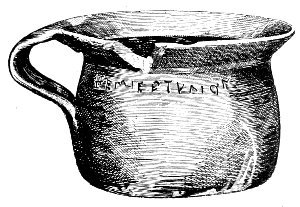
FIG. 14. HEMIKOTYLION (VASE USED AS MEASURE). BRITISH MUSEUM.
As the civil and domestic use of pottery is the most important, it is necessary to consider it first. For ordinary purposes earthenware largely took the place of bronze and the precious metals, just as it does at the present day. One instance of this we have already quoted in speaking of the “Homeric bowls,” and others might be cited, in particular its use for measures, for which metal would naturally be employed as a general rule. This usage is established by the occasional discovery of vases inscribed with the names of measures and the like. The British Museum possesses a small one-handled cup of black glazed ware (F 595 = Fig. 14) found in the island of Cerigo (Kythera), on which is incised in fifth-century lettering the word , ἡμικοτύλιον, or “half-kotyle.” The word κοτύλη is interesting as denoting not only a shape of a drinking-cup (see below, p. 184), but a Greek measure, equivalent to about half a pint. Again, in 1867, a cylindrical vase of red ware was found at Athens inscribed , δημόσιον, or “public (measure).”[456] It was stamped with the figure of an owl and an olive-branch, the official seal of Athens, and has been supposed to represent the χοῖνιξ or quart, its capacity having been estimated at 0·96 litres, or 1¾ pints, while the χοῖνιξ is generally reckoned as equivalent to 1 litre.[457]


Many of the names in common use for shapes of vases are also found applied to measures of capacity either for liquid or dry stuffs; and it is possible that herein lies the explanation of the somewhat puzzling graffiti inscriptions found under the feet of Attic vases (see Chapter XVII.), where the words used seem to have no relation to the vase itself. Thus in liquid measure the amphora (ἀμφορεύς) or κάδος, also known as μετρητής, was equivalent to about 7½ gallons, and was divided into 12 χόες, the χοῦς into 12 κοτύλαι, which, as we have seen, answer to our ½-pints. The ὀξύβαφο was one-fourth of a κοτύλη, the κύαθος one-sixth.[458] All these words were in common use to express various forms of vases, as will be seen later on. Further, the word κεράμιον, which, like the Latin testa, is used generally for pottery, has a more restricted sense of a cask or vessel used for transporting wine, and is even used as a term of measure, presumably equivalent to the amphora.[459]
Earthenware was also used generally for the purpose of storing liquids or various kinds of food, for the preparation of food and liquids, and for the uses of the table or toilet. The painted ware, however, was not employed for the commoner purposes, nor to contain large quantities of liquids, for which it would have been far too expensive. But we know that it was largely used at banquets and drinking-bouts, and on other occasions, from the evidence of the vases themselves. Thus, in the well-known vase with the Harpies robbing the blind Phineus of his food (p. 357), a kotyle painted with black figures is seen in the king’s hands; and in a scene representing the reception of Paris by Helen,[460] the former is offered wine drawn from a large four-handled vase on which figures are painted.[461] Vases with subjects represented on them are also seen placed on columns forming the background of scenes, as if forming part of the furniture of a hall or chamber. But as a general rule the vases represented in banquet scenes and elsewhere are left plain or only decorated with patterns.
To the use of vases in connection with athletic games we have already alluded in discussing Pindar’s mention of the Panathenaic amphorae; it is, of course, likely that other forms of vases were also given as prizes or presented to young men on special occasions, such as entering the ranks of the ἔφηβοι or being married, but we have no evidence of such customs.
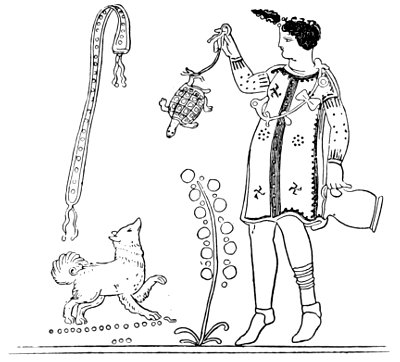
FIG. 15. CHILD PLAYING WITH JUG (BRITISH MUSEUM).
Vases were also used as toys, as is proved by the discovery of many little vases, chiefly jugs, in the tombs of children at Athens, on which are depicted children playing at various games.[462] They are too small to have served any other purpose, and as similarly shaped jugs appear among the toys used by the children in these scenes, it is reasonable to suppose that they were playthings. No doubt some of the more unusual shapes were made with the same end, such as vases in the shape of animals or fruit, or the aski (p. 200), which contained little balls and were used as rattles.
We have already hinted at the purely decorative use of vases as domestic ornaments, in which capacity they were often placed on columns; there is, however, no hint of this in ancient authors. But that it was customary in Greece and Italy, at all events in the later period (i.e. after the Persian Wars), seems to be indicated by the practice which obtains with the larger vases of executing only one side with care, while the other exhibits an unimportant and badly painted design (generally three boys or men wrapped in mantles). It is natural to suppose that the carelessly executed side was not supposed to be seen, owing to the fact that the vase was intended to be placed against a wall. Some of the large round dishes of Apulian fabric seem to have been intended for hanging up against a wall, on the same principle.[463]
The question which next arises is that of the extent to which vases were used for religious and votive purposes. Here, however, with one exception noted below, we derive little aid from a study of the painted vases themselves, in spite of the frequency of mythological subjects. But inasmuch as many instances are known of offerings of metal vases in the temples of the gods, it can hardly be doubted that painted vases served the same purpose for those who could only afford the humbler material. It was at one time supposed that the large vases painted for a front view only, of which we have just spoken, were destined for this purpose; but as they are mostly found in tombs, this can hardly be the case.
Of late years, however, much light has been thrown upon this question by means of scientific excavations. On many temple-sites which have been systematically explored, such as the Acropolis of Athens or Naukratis in the Egyptian Delta, enormous numbers of fragments of painted vases have been found which are clearly the remains of votive offerings. It was a well-known Greek custom to clear out the temples from time to time and form rubbish-heaps of the disused vases and statuettes, sometimes by digging pits for them; and thus these broken fragments, rejected from their apparent uselessness, have from these very circumstances been preserved to the present day to cast a flood of light on many points of archaeology. At Naukratis many of the fragments bear incised inscriptions in the form of dedications to Apollo (Fig. 16.) or Aphrodite, according to the site on which they were found. At Penteskouphia near Corinth a large series of early painted tablets, with representations of Poseidon and inscribed dedications, were found in 1879 (p. 316), and illustrate the practice of making offerings in this form, mentioned by Aeschylos.[464] Tablets painted with figures and hung on trees or walls are not infrequently depicted on red-figured vases, the subject generally implying their votive character.[465] Fig. 17. represents a youth carrying a tablet of this kind.
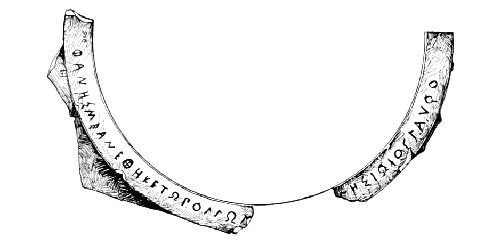
FIG. 16. RIM OF VASE FROM NAUKRATIS WITH DEDICATION TO APOLLO (BRIT. MUS.).
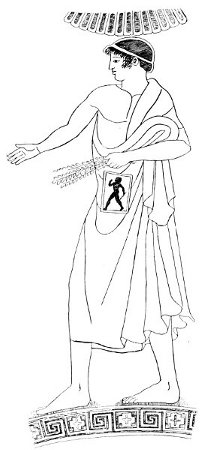
From Benndorf, Gr. u. Sic. Vasenb. FIG. 17. YOUTH WITH VOTIVE TABLET.
There is no doubt that vases (though not, perhaps, painted ones) must have played a considerable part in the religious ceremonies of the Greeks. In the Athenian festival of the Anthesteria, the second day was devoted to the holding of ἀγῶνες χύτρινοι, or “pot-contests,” vessels full of corn being dedicated to Hermes Chthonios.[466] At the festival of the Gardens of Adonis flower-pots of earthenware containing flowers were cast into the sea, as a type of the premature death of Adonis.[467] These flower-pots were also placed on the tops of houses, and in this same festival, which was chiefly celebrated by hetairae, little terracotta figures (κοράλλια) were introduced.[468] The use of flower-pots placed in windows to form artificial gardens is mentioned by Martial and Pliny[469]; and they were also employed to protect tender plants, as hinted by Theophrastos,[470] who speaks of the necessity of propagating southernwood by slips in pots.
It is, perhaps, hardly necessary to speak of the constant use of the jug and bowl (phiale) in sacrifices and libation scenes, as seen on innumerable vases of the R.F. and later periods (see pp. 178, 191). Fig. 18 shows the use of vases on the occasion of a sacrifice to Dionysos. There is also a type of vase which, according to a recent writer,[471] was used for burning incense. It is a form which hitherto had been conventionally named the κώθων, on account of its recurved lip (see below, p. 187); but it is pointed out that it had three feet (the form being clearly derived from the tripod), and therefore stood, and was not carried about; also that it varies much in size, and is found at an early date, and chiefly in women’s graves.[472] There is also evidence that it was meant to stand fire or hold coals. From these details the conclusion is deduced that it represents the earlier form of incense-burner (down to about 500 B.C.), those of later date being of a different form, as often seen on R.F. vases.[473]
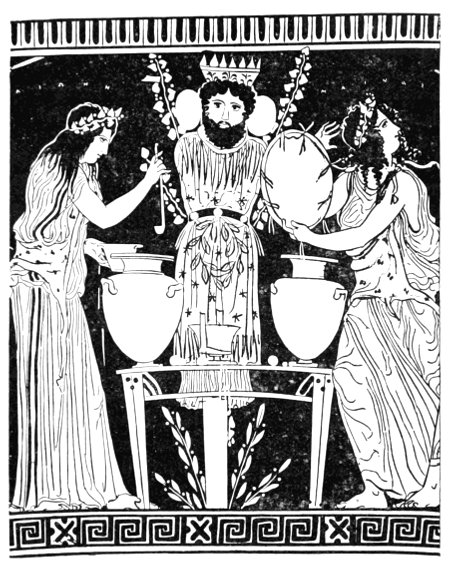
From Furtwaengler and Reichhold. FIG. 18. VASES USED IN SACRIFICE (FROM VASE AT NAPLES).
The most important use, however, for which vases were employed, and that to which their preservation is mainly due, was for purposes connected with funeral ceremonies. These were of a varied nature, including the use of vases at the burial, the placing of them on the tomb to hold offerings, and the depositing of them in the tomb, either to hold the ashes of the dead or as “tomb-furniture,” in accordance with the religious beliefs of the Greeks on the life after death. The principal methods in which they have been found deposited in the tombs have already been described in Chapter II.
Vases were employed in the burial rites in various ways, as we learn from the subjects depicted upon them. In the celebrated vase representing the death and funeral of Archemoros,[474] two persons are seen carrying tables laden with vases to the tomb, while an oinochoë is placed under the bier on which the corpse is laid. It is also probable that they were often burnt on the funeral pile with the corpse, and if this is the case it may account for the discoloured condition of many fine vases in which the red glaze has turned to an ashen grey under the action of fire.[475] In any case vases were often broken before being placed in the tomb, the idea being that they must participate in the death of the person to whom they were consecrated. There is a special class of B.F. amphorae found at Athens, which are commonly known as “prothesis-amphorae,” the subjects relating exclusively to the πρόθεσις or laying-out, and other funeral rites. They were, therefore, probably placed round the bier during this ceremony.
Vases were also used for holding milk, oil, unguents, and other liquids which were poured upon the corpse, or for the lustral water placed at the entrance of the tomb. It was the regular practice of the Athenians to place vases on the outside of the tombs, the commonest forms being that of the lekythos, or a larger vase known as the λουτροφόρος, mentioned by Demosthenes.[476] These were, however, generally of stone, and are sometimes sculptured in relief, or bear inscriptions like the Attic stelae[477] and modern tombstones.
The custom of placing lekythi on tombs is also alluded to once or twice by Aristophanes in the Ecclesiazusae—e.g. line 538:
οὐδ’ ἐπιθεῖσα λήκυθον,
and again, line 1032:
καὶ ταινίωσαι καὶ παράθου τὰς ληκύθους.[478]
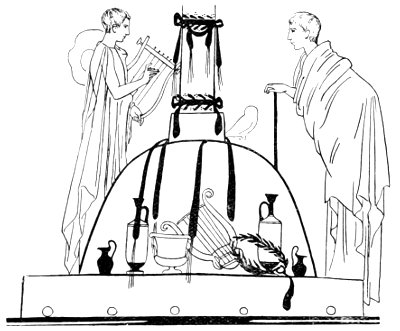
FIG. 19. FUNERAL LEKYTHOS, WITH VASES INSIDE TOMB (BRIT. MUS.).
The manner of employing vases as adjuncts to the tomb is nowhere better illustrated than on the Athenian white lekythi, which are almost all painted with funeral subjects, and, from the hasty way in which many are executed, show that they were often made to order at short notice (see above, p. 132). In particular, one example in the British Museum (D 56 = Fig. 19) shows the interior of a conical tomb or tumulus, within which vases of various shapes are seen. In other examples they are ranged along the steps of a stele, or are represented as being brought to the tomb in baskets by mourning women.[479] The larger vases of Southern Italy, which similarly show by their subjects that they were only made for funeral purposes, bear a close relation to the white lekythi, and also to the Attic funeral stelae with reliefs. The treatment of the subject varies in the different fabrics, but two main types prevail. In the one, of Lucanian origin, the tomb takes the form of a stele or column, round which vases are ranged on steps[480]; in the other, on the large Apulian kraters and amphorae, the tomb is in the shape of a ἡρῷον or small temple, within which is seen the figure of the deceased, while on either side approach women bearing offerings (Fig. 106); but vases do not play an important part in these latter scenes.
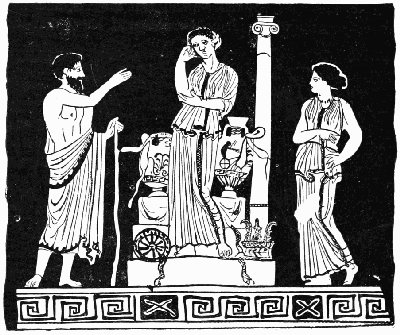
FIG. 20. VASES PLACED ON TOMB (LUCANIAN HYDRIA IN BRIT. MUS.).
Thirdly, we have to deal with the use of painted vases in the tomb itself. As regards their use as cinerary urns, to contain the ashes of the dead, it appears to have been somewhat restricted.
In the Mycenaean period we know that inhumation, not cremation, was the practice, contrary to that of the heroic or Homeric age, in which an entirely different state of things is represented. But when we do read in Homer or the tragic poets, of the methods of dealing with the ashes of the dead, there is no mention of any but metal urns. Thus the ashes of Patroklos were collected in a χρυσέη φιάλη[481] (the word is probably used loosely), while those of Achilles were stored in a golden amphora.[482] Again, Sophokles, in the fictitious account of Orestes’ death given in his Electra, uses the expression (l. 758)[483]:
ἐν βραχεῖ
χαλκῷ μέγιστον σῶμα δειλαίας σποδοῦ,
showing that metal vases were generally employed for this purpose.
No instances occurred among the early tombs in the Dipylon cemetery at Athens or elsewhere in Greece before the sixth century, nor was the practice usually favoured by the Etruscans, who employed painted vases in their tombs exclusively as furniture. In Mycenaean times in Crete coffers (λάρνακες) of terracotta, painted like the vases, were used as ossuaria[484]; and similarly in Etruria at all periods the remains of the deceased were placed in rectangular chests or sarcophagi of terracotta or stone. But in the earliest tombs of Etruria and Central Italy urns and hut-shaped receptacles for the ashes were invariably employed (see Chapter XVIII.).
It is, however, probable that in course of time there was a partial adoption of the practice in Greece. As early as the middle of the sixth century there is an instance in the well-known Burgon Panathenaic amphora, now in the British Museum,[485] found by Mr. Burgon in 1813; it contained remains of burnt bones and several small plain vases. This would seem to indicate that the Panathenaic amphorae in particular were considered appropriate for this purpose, namely, that the cherished prize won by the living should be used for the most sacred purpose in connection with the dead.
Among the red-figured vases of the fifth century which have been found to contain ashes, may be mentioned the famous Vivenzio vase at Naples,[486] which was found carefully deposited within another vase at Nola, and a vase of the shape known as λέβης, now in the British Museum, found near the Peiraeus.[487] There is also a covered vase in the British Museum,[488] which was employed for a similar purpose. It is not, strictly speaking, a painted vase, being covered with a white slip and coloured like the terracottas, while the heads of monsters project from its sides; the shape is that known as λεκάνη (“tureen”), and it dates from the fourth century. It contained human bones, among which were found a small terracotta figure of a Siren and other objects; the jaw-bone, which was preserved, had still fixed in it the obolos, or small silver coin which was placed there as Charon’s fare for ferrying the soul over the Styx. Of later date is a vase found at Alexandria, in the catacombs, similarly decorated, and also filled with bones; it was presented to the British Museum in 1830 by Sir E. Codrington.
The class of large terracotta vases found in tombs at Canosa, Cumae, Capua and Calvi (Cales), of which fine specimens may be seen in the Terracotta Room of the British Museum (see above, p. 119), seems to have been made for sepulchral purposes, as in many cases they are not adapted for practical use. On the other hand, they may have been ornaments for houses. They are decorated with figures in high relief, or attached to different parts of the vase, and many of them, especially those in the form of female heads, are strictly speaking not vases at all, having no proper bottom.
The majority of painted vases found in the tombs must be regarded purely as tomb-furniture, placed there with the idea that the deceased would require in his future life all that had been associated with his former existence. Sometimes they were placed round the corpse, with food or liquids in them for the use of the “ghost,” and instances are known of eggs and other objects having been preserved in this manner.[489] Toy-vases are found buried with children in tombs at Athens and elsewhere, and toilet-boxes or unguent-vases in women’s graves. Nevertheless, it is probably not wide of the mark to say that in the sixth and fifth centuries the custom had lost much of its original meaning; the habit of placing painted vases in tombs survived, but the original idea of the practice had become obscured, and the religious significance was restricted to certain classes of vases, the prothesis-amphorae, white lekythi, and others, which were not used during life but only made specially for this purpose.
Great value seems to have been set upon the painted vases by their possessors. When broken, they were repaired by the pieces being skilfully fitted and drilled, with a rivet of lead or bronze neatly attached to the sides. Several mended vases exist in the European collections.[490] Occasionally they were repaired by inserting pieces of other vases. Thus a vase with two handles, found at Vulci, of the shape called στάμνος, is repaired with a part of a kylix representing quite a different subject, and thus presents a discordant effect.[491] A R.F. vase in the Louvre has actually been mended with part of a B.F. vase.[492] A B.F. kylix in the British Museum (B 398) has a piece inserted with the name of Priapos; similarly the two handles of the R.F. kylix E 4, with the signature of Thypheithides, do not belong to the vase; but these may both be modern restorations. The large casks of coarse and unglazed ware (πίθοι) were also repaired with leaden cramps. “The casks of the ill-clad Cynic,” says the Roman satirist, “do not burn; should you break one of them, another house will be made by to-morrow, or the same will continue to serve when repaired with lead.”[493] Aristophanes puts into the mouth of his old litigant turned roué a popular story of Sybaris which alludes to the use of bronze rivets. A woman of that city broke an earthen pot, which was represented as screaming out, and calling for witnesses to prove how badly it had been treated. “By Persephone!” exclaims the dame, “were you to leave off bawling for witnesses, and make haste to buy a copper clamp (ἐπίδεσμον) to rivet yourself with, you would show more sense.”[494]
After noting the chief uses of Greek vases it is necessary to give some account of the different shapes, and to identify the recorded names as far as possible with the various kinds actually found.
The subject is, however, one of great difficulty, and it is impossible to attain to scientific accuracy, owing to the differences of time between the authors by whom they are mentioned, the difficulty of explaining types by verbal descriptions, and the ambiguity often caused by the ancient practice of describing a vase of one shape by the name of another.
A study of any collection of Greek vases will make it apparent that there is a great variety in the forms of the different periods. This is especially marked in the earliest ages of Greece, in which the variety is almost endless, and the adoption and development of certain recognised forms practically unknown. It must therefore be evident that the statements of ancient writers must always be used with caution, and that a shape described by an early writer must not be taken as representing the same in a later period, even if the same word be used, or vice versa. For instance, the δέπας ἀμφικύπελλον of Homer, which finds a curious parallel in the gold cup with the doves discovered by Schliemann at Mycenae, is, whatever view we may take of the Homeric civilisation, only an example of a passing fashion. Or again, many of the drinking-cups described by Athenaeus in his eleventh book are doubtless only instances of new experiments in pottery or metal-work characteristic of the Hellenistic age, with its tendency to strive after novelties. Many of his names are little more than nicknames for familiar shapes, which enjoyed a temporary popularity.
Some information may be derived from the vases themselves by means of inscriptions, specimens of which are given in Chapter XVII. Thus on the François vase the three-handled pitcher used by Polyxena is inscribed , or “water-pot,” and enables us to apply the name hydria with certainty to a three-handled vase, of which many black- and red-figured specimens exist.[495] Then we have the lekythos of Tataie, and the kylikes of Philto and Kephisophon,[496] which testify by inscriptions to the name by which they were known. The names incised in graffito on the feet of vases[497] are a more doubtful source of evidence, inasmuch as they may refer either to mixed batches of vases or to the names of measures of capacity.

Examples of cursory mention of names in the ancient writers, such as Aristophanes, are innumerable, but seldom explicit, and the scholia on these writers are hardly more useful, inasmuch as the grammarians probably knew little more about obsolete shapes than we do ourselves, and their commentaries have little critical weight. The loci classici on the subject are the book of Athenaeus already referred to,[498] in which he gives a list of over one hundred names, with more or less full explanation and commentary, most of the forms being apparently varieties of drinking-cups, and the Onomasticon of Pollux.[499] Notices of vases are also to be found in the lexicographers, such as Hesychius and Suidas, and the Etymologicum Magnum.
In the early days of modern archaeology the first to propose an identification of the shapes of vases was Panofka,[500] whose fanciful and uncritical lucubrations were shortly afterwards combated by Letronne[501] and Gerhard,[502] the latter of whom introduced a more scientific method of criticism and classification, though his results cannot be considered as final. Other writers were Müller,[503] Thiersch,[504] Ussing,[505] Krause,[506] and Jahn,[507] of whom Ussing followed practically on Gerhard’s lines but with more success; Krause, though exhaustive, is on the whole uncritical; and Jahn has treated the subject with his wonted conciseness and sobriety. Of late years little attention has been paid to it, principally, no doubt, for the reason that so many conventional names have been generally accepted for the ordinary shapes by archaeologists, who have recognised the fact that it will never be possible to treat the subject with scientific accuracy.[508]
The classification of the shapes of vases has usually been undertaken on the lines of distinguishing their main uses, such as (1) those in which food or liquids were preserved; (2) those in which liquids were mixed or cooked; (3) those by means of which liquids were poured out or food distributed; (4) drinking-cups; (5) other vases for the use of the table or toilet. Thus we have the pithos and amphora for storing wine, the krater for mixing it, the psykter for cooling it, the kyathos for ladling it out, and the oinochoë or prochoos for pouring it out; the hydria was used for fetching water from the well. Of smaller vases, the names for drinking-cups are innumerable, but the phiale, for instance, was employed chiefly for pouring libations; while dishes and plates are represented by the lekane, tryblion, pinax, and so on. The pyxis was used by women at their toilet, and the lekythos, alabastron, and askos for holding oil and unguents. There is an interesting passage in Athenaeus (iv. 142 D)[509] which gives a list of the vases required for use at a banquet: “And on the tripod was placed a bronze wine-cooler (ψυκτήρ) and a κάδος (bucket) and a silver σκαφίον holding two kotylae (one pint), and a ladle (κύαθος); and the wine-jug (ἐπίχυσις) was of bronze, but nobody was offered drink unless he asked for it; and one ladleful was given out before the meal.”
For the purposes of this work it is hoped that the usual method of classification indicated above will be found sufficient, supplemented by the descriptions of Athenaeus and other writers, where any details can be obtained; but it is obvious that a really critical treatment of the subject should be chronological, with endeavours to trace the first appearance and development of each type. In the present state of our knowledge, however, it would seem impossible to do so with success.
We begin our description of the vases of the Greeks with an account of the large vases of rough manufacture calculated to hold great quantities of wine, water, or food. The chief vase of this class is the Pithos or cask (Lat. dolium), a vase of gigantic size, found both in Italy and Greece.[510] They are shaped like enormous barrels, with bulging bodies and wide mouths, and answer to the modern hogshead or pipe. When full, the casks were closed with a circular stone, or with a cover of clay. They were used to hold honey, wine, and figs, and were usually kept half-buried in the earth.[511] They were sufficiently capacious to hold a man, and the famous “tub” of Diogenes was of this form. On a lamp in the British Museum and other monuments[512] he is represented appearing from one, presumably on the occasion of his interview with Alexander. In the vase-paintings Eurystheus takes refuge in a pithos from Herakles when he brings the Erymanthian boar,[513] and the same shape of vase is represented as holding the wine of the Centaurs and the water drawn by the Danaids.[514] The “box” of Pandora was in reality a large jar of this kind, as we learn from Hesiod.[515] It required great skill to make these vases, whence a Greek proverb characterised an ambitious but inexperienced man as “one who began with a cask” (ἐν πίθῳ τὴν κεραμείαν μανθάνειν).[516] They were not made on the wheel but by a peculiar process, which is described as plastering the clay round a framework of wood, called κάνναβος[517]; it appears to have been made of vertical boards ranged in a circle, like a tub.
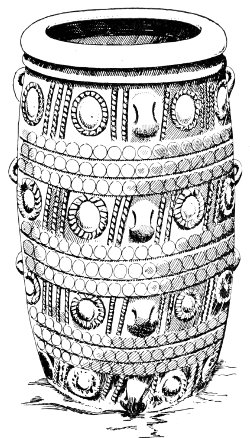
FIG. 21. PITHOS FROM KNOSSOS.
The British Museum possesses two or three πίθοι of exceptional size, ornamented with bands of geometrical patterns in relief, which were obtained from Mr. (now Sir A.) Biliotti’s excavations at Ialysos in Rhodes, and belong to the Mycenaean period. In 1900 Mr. Arthur Evans, among the remains of the Minoan palace at Knossos in Crete, came upon a courtyard round which stood a number of similar πίθοι, with decorations of a Mycenaean character (see Fig. 21).[518] These may be considered to belong to the middle of the second millennium B.C., and it is therefore evident that the πίθος may claim an antiquity second to none among forms of Greek vases.
Among examples of later date may be mentioned the large series recently found in Thera by German explorers, some plain, others with painted geometrical decoration; they are partly of native make, partly importations from Crete, and date from the seventh century B.C.[519] Dr. Dörpfeld found examples of πίθοι in the remains of the earlier cities at Hissarlik, from the second to the seventh layers. These were used for keeping all sorts of liquids and solids, and also apparently formed part of the cooking apparatus.[520] Others were found in the excavations of Mr. J. Brunton on the site of Dardanus in the Troad; they were of pale red clay, with a stone cover. In excavating between Balaclava and Sevastopol Colonel Munroe discovered no less than sixteen, about 4 ft. 4 in. in height, within a circular building, apparently a storehouse; they were also of pale red ware. One had incised upon its lip , apparently indicating its price. Similar πίθοι have been found in Athens, some having fractures joined by leaden rivets. Large πίθοι with archaic reliefs have been found in Crete, Rhodes, Sicily, and Etruria (at Cervetri); they are imitated from metal vases, with designs of Oriental character.[521]

Perhaps of all the ancient vases the best known is the Amphora (ἀμφορεύς or ἀμφιφορεύς), which was used for a variety of domestic and commercial purposes. So numerous are the vases of this form, found all over the Greek world, that they merit a lengthy description. They were principally used for wine, but also for corn, honey, oil, and other substances,[522] and to the use of the word as a measure of capacity we have already alluded. It should be borne in mind that the conventional use of the word amphora in speaking of the painted Greek vases implies a quite different form from the plain wine-amphorae, which were neither painted nor varnished; the type of vase is the same, but the painted examples are smaller and stouter, with a proper foot. For the present we confine our description to the unadorned amphora of commerce.
Besides the two handles from which the word derives its name,[523] the wine-amphora (Fig. 22.) is distinguished by its long egg-shaped body, narrow cylindrical neck, and pointed base; this form is often known as diota (the Latin equivalent). The base is sometimes supplied with a ring to stand on, but is more usually pointed, in order to be easily fixed in the earth in cellars. The mouth was sealed by means of a conical cover terminating in a boss.
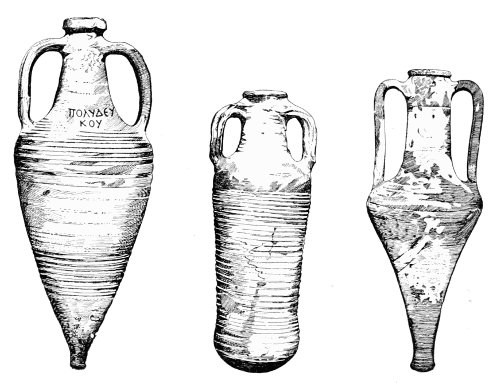
FIG. 22. GREEK WINE-JARS (BRITISH MUSEUM).
Remains of these amphorae have been discovered not only in Greece itself, but also wherever the Greek commerce and settlements extended, as in Alexandria, Kertch (Panticapaeum), Corfu, Rhodes, Sicily, and Asia Minor. They appear to have been used at a very early period, plain specimens of red ware being found not only in the early Greek tombs, like that of Menekrates in Corfu (p. 54), but even in tombs of the Bronze Age period, as in Cyprus. The typical long shape, however, did not come into fashion until about 300 B.C., when the island of Rhodes was a great trading centre, carrying on an active commerce all over the Mediterranean. Amphorae of this form are represented on the coins of Chios and Thasos with reference to their trade in wine, and on the Athenian silver tetradrachms which belong to the period subsequent to about 220 B.C.; they are shown on the reverse, lying horizontally, with an owl above. In this case the reference may be either to the large Attic trade in oil or to the use of the amphora for voting at the election of magistrates (see p. 167).
The most interesting feature of the wine-amphorae is the device or impression stamped on the handles either in a circular medallion or an oblong depression. This was done by means of a stone or bronze stamp, while the clay was still moist. They are found in all parts of the ancient world, but the greater number can be traced to a few places of origin, of which the most important are: Rhodes, Knidos, Thasos, Paros, and Olbia in Southern Russia. As regards the stamps, the usage differs at each centre; but apart from them the handles can be distinguished by their shapes and material, as will be seen in the subsequent description.
The Rhodian amphorae, of which large numbers have been found at Alexandria as well as in the island itself, were of a very pure and tenacious clay, with a fracture as sharp as that of delf. The colour is pale, deepening to a salmon hue. The numerous separate handles which have also been found have all belonged to the same form of amphora, with long square-shouldered handles, as on the Athenian and Chian coins. An entire vase, but without a stamp,[524] which was brought from Rhodes, was 40 in. in height, and the height of the handles alone was 10 in., the upper part attached to the top of the mouth being 3 in. long. This is a typical instance for the shape. The seal when found is impressed on the upper part of the handle, the size of the label being generally about 1½ in. or 1¾ in. long, by ⅝ in. wide, except when they are oval or circular. At Alexandria eight distinct varieties of handles were found, broken from amphorae of different countries, but only one inscribed; the base also assumed various forms.
In the Rhodian amphorae two stamps are in use, a principal and an accessory one (Fig. 23.a).[525] The former has a device of the head of Helios, the Sun-God, or the emblematic rose, both of which types occur on the coins; it is accompanied by an inscription, in the form ἐπὶ τοῦ δεῖνος, sometimes explicitly described as ἱερέως, i.e. in the year of the eponymous priest of the Sun. This is followed by the name of a Rhodian month. The accessory stamp contains the name of a person, usually in the genitive. The months belong to the Doric calendar, and are as follows: Thesmophorios, Theudaisios, Pedageitnyos, Diosthyos, Badromios, Sminthios, Artamitios, Agrianios, Hyakinthios, Panamos, Dalios, Karneios, and the second Panamos, an intercalary month.[526] The object of the stamps is involved in obscurity, but they were probably intended to certify that the amphora (which was also a measure) held the proper quantity. It is clear that they could not have been intended to attest the age of the wine, as the vessel might be used for any sort, and the stamps bear the name of every month in the year.
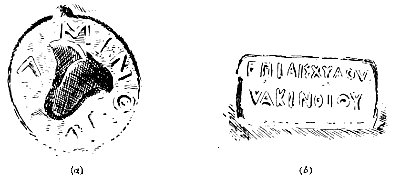
From Dumont. FIG. 23. AMPHORA-STAMPS FROM RHODES.
Other handles of Rhodian amphorae, stamped with an oblong cartouche or label, may be divided into two classes: (1) Those inscribed with the name of a magistrate and an emblem. The latter resembled the “adjuncts” found on the coins of some Greek cities, but it is uncertain whether they were selected on any fixed principle, or merely adopted from caprice. They may perhaps allude to the deity whom the magistrate particularly honoured as the patron god of his tribe or village. The same symbol was, however, often used by many individuals, and on the whole the number known is not large. (2) Those bearing the name of a magistrate, accompanied by that of a month of the Doric calendar, but without any emblem (Fig. 23.b).
Many handles of amphorae from Knidos have been found on different sites. Their clay is coarser than the Rhodian, its colour darker and duller, and the amphorae differ also somewhat in form, nor are they of so early a date, being mostly as late as the Roman Empire. The stamps on the Cnidian amphorae, like those of Rhodes, are inscribed with the name of the eponymous magistrate, and also with that of the wine-grower or exporter of the produce, which is always marked as Cnidian. The stamps show a great variety in the matter of emblems. Remains of Cnidian amphorae have been found in Sicily, at Athens, Alexandria, and Olbia. The palaeography of the inscriptions covers a period of two centuries, from Augustus to Marcus Aurelius, or even later.
Numerous examples have been found of handles of amphorae, in which the celebrated wine of Thasos was exported to places such as Thasos and Olbia. The stamps are nearly square, with a device in the middle, the inscription , and the name of an official. The names are usually in the nominative, but in one instance at least the genitive is used. The symbols include an amphora, kneeling archer, cornucopia, dolphin, etc. (Fig. 24).[527] The known stamps of Paros are few in number; they are simply inscribed , which in one instance is written retrograde.[528]


Handles inscribed with the name of an aedile (ἀστυνόμος) and of another person, probably a magistrate, have been found on various sites in the Crimea and Southern Russia, principally at Olbia. At Panticapaeum (Kertch) two amphorae were found with stamps across the neck, thus:
the upper name being that of the magistrate.[529] These vases appear to have been made on the spot.

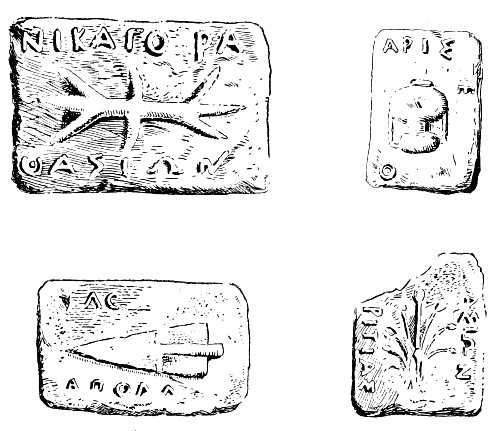
From Dumont. FIG. 24. AMPHORA-STAMPS FROM THASOS.
Stoddart also mentions amphora-handles as having come from Corinth,[530] with names which can be traced to the time of the Roman dominion. Falkner found at Pompeii an amphora with a Greek inscription of three lines painted in red and black, with the name of Menodotos and the letters KOR. OPT., which may mean “the best Corcyraean brand.”[531] A bibliography of the subject is appended below.[532]
Among painted vases the amphora holds a high place, especially in the black-figure period, during which it was most prominent. It is distinguished from the plain type, as already pointed out, by the proportions of the body, as well as by the graceful curve of the handles and the flat circular foot. The variations in its form at different places and periods are so marked that they have led to the adoption of qualifying adjectives for each kind. Although these names cannot now be accepted in a strict sense, they are sometimes useful as conventional expressions. We proceed to describe these in detail.
(1) The origin of the Greek amphora is clearly to be sought in the pithos of primitive times, as may be seen in the vases of the Melian and Proto-Attic classes, and in the early vases with reliefs from Boeotia, Crete, Thera, and elsewhere. It is not found in the Mycenaean style, the large vases of which come under the heading of the krater (see below); and its appearance in Greece dates from the developed stage of the Geometrical period. The earliest specimens among the painted vases are virtually small pithoi, characterised by a long cylindrical neck, and large elaborate handles obviously imitating metal (see p. 495). Of this type are several of the Boeotian Geometrical and Proto-Attic vases discussed in Chapter VII.,[533] and the Boeotian vases with reliefs.[534] Among the Proto-Attic vases found at Vourva a development occurs, in which the neck is greatly elongated, and the body becomes exceedingly slim, while the handles are simplified into plain flat bands united to the neck by bars of clay (see Fig. 89, p. 299). This form is found still further developed in the prothesis-amphorae of the B.F. period[535]; but these are comparatively rare, and the more normal evolution of the amphora with cylindrical neck is to be traced in the varieties (2) and (6) described below.
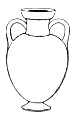
FIG. 25. “TYRRHENIAN” AMPHORA.
(2) The early amphorae preceding the ordinary B.F. Athenian types were divided by Gerhard into two classes, “Egyptian” and “Tyrrhenian.”[536] He describes the former as a vase with tolerably pronounced curve of body, entirely covered with horizontal bands of figures; the latter as of similar form, but with decoration confined to a panel on either side. As regards shape, therefore, the two are actually one, and may be regarded as such for our present purpose; but it is curious to note that the particular class called “Egyptian” by Gerhard has since his time been generally known as “Tyrrhenian,” while his “Tyrrhenian” class has now received, from the peculiar mannerisms of the paintings, the name of “affected” vases.[537] At all events the word is convenient to adhere to for the description of this particular shape (Fig. 25), with its long, egg-shaped body, the vertical section of which is almost an ellipse, a shape common to all early B.F. fabrics—Athenian, Rhodian, Ionic, and Corinthian—but best illustrated by the “Corintho-Attic” class described by Thiersch.[538] It is seldom found in purely Attic examples, and disappears after the middle of the sixth century.
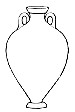
FIG. 26. PANATHENAIC AMPHORA.
(3) Gerhard’s next class is that of the Panathenaic amphorae, which have a long body shaped something like a top, and tapering sharply downwards; the mouth, handles, and neck are small, as is also the foot (Fig. 26). It is so called as being the characteristic form of the earlier (sixth-century) Panathenaic prize-vases, but is also occasionally found in the ordinary fabrics. This type, together with the two following examples, not mentioned explicitly by Gerhard or the other early writers, form the class of “black-bodied” amphorae, as they may conveniently be termed, in order to distinguish those with panel-decoration from those in which the body is entirely covered with red glaze (see below).
(4) The second variety of “black-bodied” amphora (Fig. 27.) is closely akin to the Panathenaic, but the body is better proportioned. It is characterised by the wide mouth in the form of a thick ring, the cylindrical handles, and the concave curve of the shoulder. From the style of the paintings it is probable that this variety must be placed early in the black-figure period.
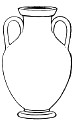
FIG. 27. PANEL-AMPHORA.
(5) This type, on the other hand, is later in the period, being developed out of the last, from which it is marked off only by the form of the handles, which are broad and flanged, and often decorated with patterns. These vases are mostly of large size, and are transitional, some R.F. varieties being known. The paintings on them are in the style of Exekias, Andokides, and Euthymides (see for an example Plates XXXI., XXXII.).
(6) The shape of the “red-bodied” amphora (Fig. 28) is peculiar to the black-figure period.[539] Its characteristic features are the straight, cylindrical neck, with its chain of lotos-and-honeysuckle, the width of the shoulder, and the ribbed handles, formed from moulds in two or three parallel pieces. Artistically it is far superior to the black-bodied, and includes some of the finest specimens of B.F. painting (as in the vases of Exekias), while the decorative element reaches the perfection of beauty and symmetry.
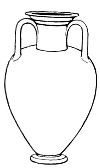
FIG. 28. RED-BODIED AMPHORA.
(7) The red-bodied amphora seems to have been the prototype of what is the most characteristic form of the red-figure period—the so-called “Nolan” amphora (Fig. 29).[540] These have been largely, but not exclusively, found at Nola, whither they seem to have been imported in large numbers from Greece. The whole vase is covered with black, and the decoration confined to one or two figures each side, while the elegant and beautiful outline, the lustre of the varnish, and the restraint of the designs combine to render these perhaps the most beautiful products of Athenian ceramic art. The handles are sometimes four-sided, more often ribbed, and sometimes formed of two twisted strands, produced by rolling up the soft paste; the general outline is that of the last class, but the proportions are far more slender and graceful.
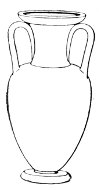
FIG. 29. “NOLAN” AMPHORA.
(8) The Apulian amphora (Fig. 30) illustrates the form which, though generally adopted in Apulia, may have had its origin at Athens, as it is adopted for the fourth-century Panathenaic amphorae.[541] It is distinguished by its great size and egg-shaped body; the mouth is thick and high, spreading out like an inverted cone, and the neck is not cylindrical, but merges into the shoulder. A variety of the Apulian amphora, hardly common enough to form a separate class, was formerly known as the “candelabrum-amphora,” from its resemblance to an incense-burner (an object wrongly interpreted formerly as a candelabrum, or lamp-stand). Its peculiarities are the cylindrical body, tall neck, and elaborate handles in the form of double scrolls.[542]
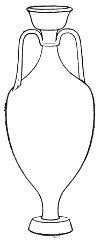
FIG. 30. APULIAN AMPHORA.
(9) The Campanian amphora is derived directly from the “Nolan,” and is in fact a local adaptation, but it was chiefly manufactured at Cumae.[543] It generally has twisted handles, and is painted in polychrome; the proportions are somewhat more elongated than those of the “Nolan” class.
(10) A rare variety of the amphora is sometimes found in the red-figure period, with large spheroidal body and pointed base, intended to be placed in a separate stand. The conventional name of diota is sometimes given to this form, from its imitation of the pointed base of the wine-amphora.[544]
(11) The last variety of the amphora which calls for consideration is the wide-bellied type, usually called (on very slight authority) a pelike, πελίkη (Fig. 31).[545] The name was invented by Gerhard, and has been generally adopted since, but is only to be regarded as a conventional term. This form, which swells out towards the base, and has no stem or neck, is very rarely found before the fifth century,[546] but is common in the R.F. period, and in the Apulian style, in which its proportions are usually more slender.
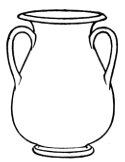
FIG. 31. SO-CALLED “PELIKE.”
The amphora when complete usually had a cover of clay, either coated with a plain black varnish or decorated with bands and patterns; it was lifted by means of a central knob. An amphora in the Berlin Museum (Cat. 1860) has a double cover, the inner one being of alabaster.
Of the other names which seem to denote vases adapted for containing and storing wine or other commodities, the most important is the Stamnos (στάμνος), used for holding wine and oil. It is mentioned by Pollux[547] in his list of wine-jars, and he quotes a line from Aristophanes about “a stamnos of Chian wine arriving.” The diminutives σταμνίον and σταμνάριον are also found, and Aristophanes speaks of a “small Thasian stamnos of wine.”[548] The amphora is defined in the Etymologicum Magnum as “a two-eared σταμνίον.” It has been generally identified with a form well known in the R.F. period, but only found in that style: a spherical jar with short thick neck and small side-handles, of which some very beautiful specimens exist (Fig. 32). The word is still in use in modern Greek.
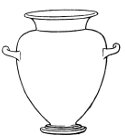
FIG. 32. STAMNOS.
The βῖκος is described by Hesychios as a στάμνος with ears, and by Eustathius as a vessel holding wine[549]; it was also used for figs and salted food.[550] It is probably only another name for the στάμνοςστάμνος, but it seems to be inaccurately described by Athenaeus[551] as “a saucer-shaped drinking-cup” (φιαλῶδες ποτήριον). It was apparently identical with the ὕρχη,[552] a word used by Aristophanes,[553] but more commonly by Roman writers in its Latin form orca.
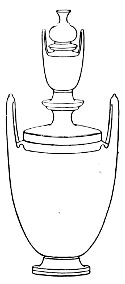
FIG. 33. SO-CALLED “LEKANE.”
The names of Apulian stamnos or λεκάνη have at different times been given to a late form of painted vase found in Southern Italy, with high or low stem, upright handles, and cover, which latter often takes an elaborate form, being surmounted by one or more small vases, also with handles (Fig. 33.). The word λεκάνη,[554] however, seems to indicate a large bowl rather than a covered jar, and no satisfactory name has as yet been found. A similar but flatter form of vase, like a covered bowl or dish, has been named λεκάνη, λεπαστή, or covered pyxis, but no name is satisfactory.
The λαγυνος or λαγυνίς seems to have been a narrow-necked jar of considerable size. Athenaeus[555] says the word represented a Greek measure, equivalent to twelve Attic κοτύλαι, or six pints, and that it was in use at Patrae. The word is used by Plutarch for the jar in which the stork offered entertainment to the fox[556]; it frequently appears in the Latin form lagena (see Chapter XXI.). A wicker-covered λαγυνος was known as a πυτίνη.[557]
Another form of the same class is the κάδοs, with its diminutive καδίσκος, which is represented by the Latin situla, or bucket, the latter word being the one usually employed by archaeologists. It is a form easily to be recognised in Greek art, but is more usually found in metal-work, e.g. in Etruscan and Italian bronzes, than in pottery.[558] The painted situlae, of which a few late examples from Italian tombs exist, are obviously direct imitations of the metal buckets, and in some cases actually have movable bronze handles attached. The situla appears to have been used not only for keeping wine in the cellar, but for serving it up at banquets[559]; the word is also used by Aristophanes for a voting-urn and a well-bucket.[560] In Latin the uses were probably distinguished, cadus denoting a wine-jar, situla a water-bucket. Athenaeus obviously goes astray in regarding it as a drinking-cup.
A vase which was used almost exclusively for carrying water was the Hydria, as is implied by its name (ὑδρία, from ὕδωρ). Its most essential characteristic is the possession of three handles, a large one at the back for carrying when empty, and two small horizontal handles at the sides for carrying when full. The shape of the body varies at different periods; in the B.F. period the shoulder is flat and marked off by a sharp angle from the body (Fig. 34); but about the beginning of the fifth century this is replaced by a form with more rounded outline and smaller handle at the back, generally known for the sake of distinction as a kalpis (Fig. 35). In the earlier variety (of which some R.F. examples are known) there are always two subjects, one forming a frieze on the shoulder, the other treated more in the manner of a metope on the body; they are invariably enclosed in frames or panels, as on the “black-bodied” amphorae. Sometimes a third subject in the form of a frieze of animals is added below. In the earlier stages of the B.F. period this form is seldom found, except in a class known as the “Caeretan hydriae,” distinguished (as far as concerns their shape) by their round, plump body, as also by the florid character of their ornament and curious treatment of subjects (p. 353). These vases were closely copied by the Etruscans. The kalpis form sometimes occurs with black figures, but only in small late specimens, chiefly found in Rhodes. In the vases of Southern Italy the kalpis is fairly popular, but the body is more cylindrical and the foot higher.
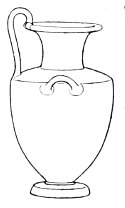
FIG. 34. HYDRIA.
Any doubt that might have existed as to the identification of the ὑδρία is solved by the appearance of the word inscribed over the pitcher which Polyxena dropped in her flight from Achilles, on the François vase. In a scene very common on B.F. hydriae, which represents women drawing water at a fountain, this form of vase is invariably depicted. The word seldom occurs in Greek literature, but Kallimachos speaks of καλπίδες placed on the roof of the Parthenon (?) at Athens, not, he says, by way of ornament, but as prizes of wrestlers.[561] Hence the idea was conceived by Panofka that Panathenaic prize-vases were of this form.
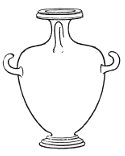
FIG. 35. KALPIS.
Pollux (x. 74) thinks that the hydria was also a wine-vase, and suggests its identity with the πλημοχόη, a vase with broad base used in the Mysteries; but Athenaeus[562] implies that this was used for pouring, and it must therefore have been some kind of jug. The κάλπις is actually identified with the ὑδρία by Aristophanes, as may be seen by a comparison of two lines in the Lysistrata.[563] From a passage in Isocrates[564] it would appear that the hydria was used as a voting-urn or ballot-box, but the κάδος was more generally used for this purpose. That the amphora was also so used we know from Athenian coins.
The next class to be considered is that of vases employed for mixing wine and water for drinking, for which the generic name is that of κρατήρ (from κεράννυμι, “I mix”). Before discussing this form, however, allusion must be made to a vessel which is variously described as a hydria or a krater, and is therefore a link between the two varieties; it was at any rate pre-eminently a water-jar, and was known as a κρωσσός (connected with Fr. cruche = Eng. “crock”). We have no indications of its form except that it had two handles[565]; Pollux (viii. 66) ranks it with the ὑδρία and κάλπις as a water-vessel.[566] It was also used for holding ashes,[567] and Plutarch enumerates it among the vessels in the bath of Darius.[568] Of the same character was perhaps the ἀρδάνιον or ἀρδάλιον, described as a water-pot.[569] Athenaeus also mentions a πρόαρον, or wooden vessel of the krater type, as used in Attica.[570]
The Krater is distinguished from the amphora by its larger body, wider mouth, and smaller handles. It was often placed on a stand, called ὑποκρατήριον, or ὑποκρατηρίδιον,[571] which was either of pottery or metal such as bronze. This either took the form of a hollow cylindrical base, painted with subjects, or of an elaborately moulded stem with egg-and-tongue and other patterns.[572] It is constantly mentioned in Homer, but the kraters standing in the halls of the great palaces, as in that of Odysseus, were made of gold or silver. It is on the average the largest of all Greek vases (except the pithos), some of the later Apulian specimens (of which F 278 in the B.M. is one) reaching a height of about four feet; the ordinary examples have a capacity of three or four gallons. The names Argolic, Lesbian, Laconian, Corinthian, and Thericleian are applied to it by various ancient authors.[573]
In the different fabrics of Greek pottery it takes several distinct forms, to which convenient descriptive names have been given by Italian dealers, and some attempt has been made to identify names given by classical authors as forms of the krater, but without any success. The Italian names, however, which will be mentioned in due course, are somewhat cumbersome for English use.
Among Mycenaean vases there is a variety almost confined to Cyprus, to which the name of krater may fairly be given.[574] Its chief characteristics are a wide spheroidal body, hardly contracted at the neck (which in some varieties is non-existent), flat vertical side-handles, and a high stem. We hardly meet with this form again until the end of the Corinthian style, when it suddenly leaps into popularity.[575] The form in which it appears recalls, though it can hardly be imitated from, the Mycenaean krater, but the stem disappears, and the body is in section about two-thirds of a circle.[576] It is clearly a local invention, and on the evidence of finds at Syracuse, its first appearance may be traced to the first half of the seventh century. Its distinguishing feature, however, is in the handles, each of which is composed of two short vertical bars, sometimes meeting in an arch, supporting a flat square piece formed by a projection from the flat broad rim, which is generally decorated. From the columnar appearance of these handles, the type has received the name of vaso a colonnette, which at all events is a more accurate description than the name κελέβη which, first proposed by Gerhard, has been generally employed by archaeologists, on what grounds it is not clear. This word, as described by Athenaeus, is clearly intended to imply a drinking-cup of some kind[577]; he quotes from Anakreon (frag. 63, Bergk), who speaks of drinking its contents at one draught (ἄμυστιν). On the other hand he quotes the authority of Pamphilos for identifying it with the θερμοπότις, or “water-heater,” a kind of kettle. The probability is that it was a general and loosely-employed word.
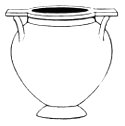
FIG. 36. KRATER WITH COLUMN-HANDLES.
The column-handled krater is also found in the Naukratis wares of the sixth century, as well as in the imitations of Corinthian fabrics in which the Campana collection of the Louvre is so rich; the clay, style, and inscriptions of the latter clearly show their Corinthian origin, apart from the form. This krater is often decorated with friezes of figures (as in the famous Amphiaraos krater, p. 319). In the few existing Attic examples with black figures the subjects are in framed panels. This form, after dying out before the end of the sixth century, is revived towards the middle of the fifth in the later R.F. fabrics, but in a much altered form, which gives greater prominence to the columnar character of the handles. The neck is higher and narrower, and the handles consequently lengthened, the square tops being much diminished, and the body also takes a narrower and straighter form. In the fabrics of Southern Italy this development is even more strongly marked, and the elongated neck is adorned with an ivy-wreath in a panel; this type enjoyed some popularity both in Apulia and Lucania. The system of panel-decoration is employed throughout in all these cases.
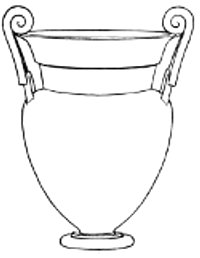
FIG. 37. VOLUTE-HANDLED KRATER.
The only other form of krater found in the B.F. period—and that but rarely—is that known as volute-handled (a rotelle), from the large handles reaching above the lip and curved round in a scroll (Fig. 37). It has an egg-shaped body and large neck. The best and earliest example is the François vase (p. 370), from which it may be clearly seen that the form is derived from the columnar-handled krater. The British Museum also possesses a fine example signed by Nikosthenes, with a design in a frieze on the neck (B 364). The same shape and method of decoration appear in some fine examples of the severe R.F. style (cf. B.M. E 468, 469). During the R.F. period, two entirely new forms of krater suddenly appear, known respectively as the vaso a calice and the vaso a campana, or “calyx-krater” and “bell-krater”; the former is first used by Euphronios.[578] These names give a very accurate description of the forms, the one being like the opening calyx of a flower, the other like an inverted bell (Figs. 38, 39). In each the lip projects above the body, the neck having entirely disappeared, while the handles of the calyx-krater drop to the lower part of the vase, and those of the bell-krater are attached horizontally to the sides. Both types of handle are evidently adapted to carrying full vessels, like the side-handles of the hydria. The name of ὀξύβαφον was given by Gerhard[579] to the bell-krater, again without any real authority, and probably owing to an error, from finding the name scratched underneath one example. Comparison, however, with similar inscriptions (see Chapter XVII.) shows clearly that the ὀξύβαφον was a small measure, less even than a κύαθος, or ladleful. Athenaeus (xi. 494 B) is very explicit on this point. He derives the name from ὀξός, vinegar, which liquid the vessel was used to contain, and describes it as εἴδος κύλικος μικρᾶς. It was therefore a small cup of some kind (see p. 194).
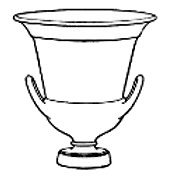
FIG. 38. CALYX-KRATER
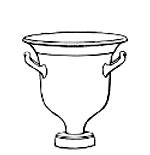
FIG. 39. BELL-KRATER
In Southern Italy the krater holds the same position as the amphora of the B.F. period.[580] The calyx- and bell-kraters are the two forms chiefly affected in the transition period when Athenian artists were working in Italy, or Italian artists directly under the influence of Athenian (see p. 465), but they are also found among the purely local fabrics, especially those of Cumae and Paestum (ibid.). The calyx-krater seems to have been reserved for the better and more carefully-executed specimens,[581] and the Italian bell-kraters often have a top-heavy effect from the greater height of their stems.
In Apulia (and occasionally also in Lucania—the Campanian potters did not affect large vases) the volute-handled krater once more appears, in great magnificence. Not only is the total size and bulk increased, but the neck is lengthened and the handles are often treated with great elaboration of detail, ending below in swans’ necks spreading over the vase. In Apulia the volutes are generally replaced by medallions (whence the Italian name vaso con maniche a mascheroni) decorated with Gorgons’ heads or figures, in relief, painted white, yellow, and red. These vases are sometimes, but incorrectly, called amphorae; they range from two to three or four feet in height. They are generally painted from head to foot with subjects, often of a sepulchral nature, and were no doubt largely made for use at funeral ceremonies. They are more fully described in Chapter XI.
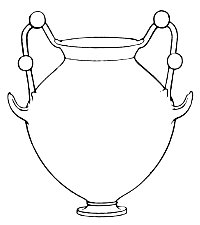
FIG. 40. LUCANIAN KRATER.
The last variety of krater (Fig. 40) is formed by a peculiar type of vase, apparently devised by the Iapygian aborigines of Southern Italy,[582] which has a wide mouth and sloping shoulder, and sometimes a high neck. Its peculiarity is that it has four handles, two upright and two horizontal, to the sides of which large discs are attached, whence its Italian name is vaso con maniche a rotelle, from the wheel or rosette patterns painted on the discs. This feature caused Panofka to give it the name of νεστορίς, with reference to the famous four-handled cup of Nestor (Il. xi. 632). It need hardly be pointed out that there can be little in common between this form and the drinking-cup used by the Homeric hero, in spite of the fact that the latter was too heavy for an ordinary man to lift. We need not suppose that Nestor’s cup (concerning which see below, p. 181) was larger than an ordinary “loving-cup,” and the poet was probably guilty of a pardonable exaggeration. As a painted vase, this four-handled krater is peculiar to Lucania, and it is interesting to note that it sometimes appears depicted on Lucanian vases as used in daily life.[583]
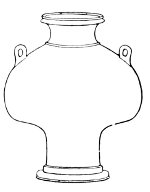
FIG. 41. PSYKTER.
Closely related to the krater is the ψυκτήρ or ψυγεύς, a wine-cooler (from ψύχω, “cool”), which was used for cooling wine by means of snow or cold water.[584] The extant specimens are but few in number and vary in form. The British Museum possesses a very remarkable specimen in the form of a B.F. panel amphora (B 148),[585] with double walls and bottom, and a large spout on one side, through which the snow or cold water was introduced into the outer space; it was afterwards withdrawn through an aperture in the bottom.[586] Similar vases in the “Chalcidian” style are also known. After the beginning of the R.F. period a new type was introduced in the shape of a vessel with a short neck, the body of which bulges out towards its base, and is supported on a high stem; it generally has two small eared handles (Fig. 41). Several R.F. examples are known, of which two are in the British Museum,[587] and three or four in the Louvre; the British Museum also possesses a late B.F. specimen (B 299). The designs are painted in a frieze round the vase.
The ἀκρατοφόρος, or vessel for holding unmixed wine, seems to have been another name for the ψυκτήρ; Pollux (vi. 90) says the difference was that it was supported on small knobs (lit. small knucklebones) instead of a stem.
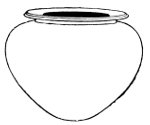
FIG. 42. DEINOS OR LEBES.
Another name identified in antiquity with the ψυκτήρ is that of the δῖνος (sometimes spelled δεῖνος); but the identity was more probably one of usage than of form.[588] As to the latter, there is considerable discrepancy in the accounts of the grammarians[589]; one calls it a deep cup tapering down to a point; another, probably more correctly, since it was certainly not a drinking-vessel, a clay vessel for wine without a base, but rounded underneath. In virtue of this description the name has usually been applied to a class of vase, commoner in the earlier periods than the later, and more often found on Greek sites than on Italian, which has a rounded base without foot, and no handles (Fig. 42). These vases are found as early as the seventh century in Greece, and were very common at Naukratis, appearing also in most of the B.F. fabrics. That they were used to contain the ashes of the dead is shown by the B.M. example already referred to (p. 146), which belongs to the end of the R.F. period.[590] In Southern Italy this form of vase is generally placed on a separate high moulded stem, and has a cover with an ornamental knob. A variety with hemispherical cover nearly equal in size to the vase itself has been identified with the ἡμίτομος (“cut in half”), a form mentioned by Athenaeus.[591]
This type of vase has more usually been described by the name of λέβης, denoting a kettle or caldron; but though the form of the λέβης was practically the same (as we may gather from the fact of its always being placed on a tripod), the purpose for which it was used (i.e. for boiling water) and the fact that it was always of metal, suggest that it is not such an appropriate name as δῖνος for this form of painted vase. The λέβης is constantly mentioned in Homer, both as a cooking-vessel and as a washing-basin.[592] Herodotos[593] says that the Scythians used a λέβης for cooking flesh, which resembled the Lesbian krater, but was much larger. It was also the vessel in which the ram, and subsequently Pelias, were boiled by Medeia; and may be seen depicted in several B.F. representations of that story.[594] A golden lebes was placed at each angle of the temple of Zeus at Olympia.[595] It is also the name of the vessel used by the Boeotians in their ingenious contrivance at the siege of Delion.[596] To its use as a cinerary urn in the tragic poets we have already alluded.
The ordinary name for a cooking-vessel of earthenware in Greece was χύτρα, answering to our “pot”: it was used both for water and for solids, as well as for other domestic purposes. Children were exposed in χύτραι[597]; and a boy’s game called χυτρίνδα is described by Pollux[598]; it was apparently played in two ways, either by a boy representing a χύτρα, who was pulled about by the other players until he caught one, or by a boy carrying a pot, with some obscure reference to the story of Midas. There were several proverbial expressions connected with the χύτρα, such as ποικίλλειν χύτρας, “to paint pots,” expressive of useless labour, owing to the roughness of the ware; and together with the χοῦς, a vessel only known as a measure (12 kotylae or 5¾ pints), it played a part in the festival of the Anthesteria, one day of which was known as Χύτραι καὶ Χόες, or “Pot-and-Pan Day.”[599] The word χυτρόπους, used by Hesiod[600] and Aristophanes,[601] seems merely to denote a cooking-pot with feet. The πύραυνοι or κλίβανοι large clay vessels used either as brasiers or for baking purposes, have been already described in Chapter III.
A few other general words for cooking-vessels and domestic utensils may also be mentioned here. The θερμαντήρ mentioned by Pollux[602] is presumably identical with the θερμοπότις and ἀναφαία of Athenaeus (475 D, 783 F), the former, as its name implies, being a vessel in which hot drinks were prepared. It seems to have been exclusively made of metal, and may, indeed, only be another name for the λέβης. It has, as we have seen, been identified with the κελέβη. Pollux gives a list of vessels used for warming water.[603]
The ἡθμός, or strainer,[604] answers to the modern colander, and is represented by a flat round vessel with long handle, of which some late fictile examples exist.[605] It is mentioned among the vessels in the Sigeian inscription,[606] but is there spelled ἡθμός. Most of the existing specimens are of bronze. The ὁλκεῖον mentioned by Athenaeus[607] appears to have been a bowl used for washing cups. The σκάφη (“boat”) is a general term used in the classics for vessels of varied import: basins, troughs, washing-tubs, bowls, etc.[608] It is the name used in inscriptions relating to the Panathenaic festival to describe the flat dishes or trays borne by the maidens who were called Skaphephori in the procession, as represented on the Parthenon frieze.[609] The diminutive form σκάφιον or σκαφεῖον also occurs, and is identified with καλπίον. The ὅλμος, generally used to denote a mortar,[610] also signified a bowl,[611] and had the special signification of the hollow bowl in which the priestess of Apollo sat when delivering oracles from the Delphic tripod. It may here be noted that the word τρίπους appears to be used in ancient writers[612] not only for the stand which supported the λέβης and other vessels, but for a vessel itself when thus supported on three feet. Most of the existing tripods are made of bronze,[613] but one or two fictile examples are known, including a very remarkable one in Berlin,[614] found at Tanagra, and covered with archaic paintings in the B.F. method.
On bathing and washing vessels our best authority is Pollux (x. 63); it is not, however, likely that they were often of earthenware. The ποδανιπτήρ at all events was of metal; it is often seen on R.F. vases with the subject of Theseus killing Procrustes.[615] Large vessels, resembling modern baths, were known by the names of πύελος: and ἀσαμινθος[616]; the λουτήριον, or laver, on a high stem, is frequently represented on South Italian vases,[617] but is a purely decorative adjunct. It is there painted white to indicate marble.
The λεκάνη[618] should also perhaps be included here, as according to the literary accounts it was a basin used for washing feet or clothes, or for vomiting. It also served the purpose of a mortar, and was used in the game of kottabos. A method of divination sometimes practised was known as λεκανομαντεία and consisted in placing waxen images in a lekane full of water, which became as it were animated and sank, thus signifying the destruction of an enemy. In Pseudo-Callisthenes we read how Nectanebos, the supposed father of Alexander, made use of this procedure.[619]
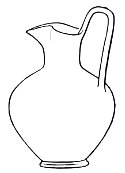
FIG. 43. OINOCHOË (7TH CENTURY).
The next series with which we have to deal is that of vases used for pouring out wine and serving it at the table. They fall into two classes: the wine-jug for pouring, and the ladle for filling it out of the mixing-bowl. We begin with the series of wine-jugs, as being the more important.
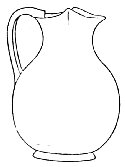
FIG. 44. OINOCHOË (5TH CENTURY).
Of these the most conspicuous is the Oinochoë (οἰνοχόη, from οἴνος, “wine,” and χέω, “pour”), one of the most beautiful shapes among Greek vases. It appears in several forms, but the name is generally restricted to one, which corresponds most closely to the modern beer-jug. It is found at all periods, and the form never varies to any marked extent, except that the later examples are rather more graceful than the earlier, and some of the fine R.F. specimens reach the perfection of elegance in form and decoration (Fig. 44). Its chief characteristic is the trefoil-shaped mouth, but this is not invariable, many specimens having a plain circular lip. It is very commonly found in the Rhodian wares of the seventh century, with designs in a continuous frieze (Fig. 43); and a peculiar form appears in an Ionic fabric (see page 359), with egg-shaped body and coarse designs. In the B.F. period the subjects are nearly always in framed panels. Among the R.F. vases of the fine style, many diminutive oinochoae occur, nearly all of which were found at Athens, the subjects being those of children playing with go-carts and other toys, and sometimes with jugs of the same shape. As these appear to have been found in children’s tombs, it is evident that these painted specimens were actually used as playthings.[620]
The oinochoë is frequently represented in vase-paintings, chiefly in scenes of libation, in which ceremony it was invariably used for pouring wine into the phiale or patera, from which the libation was made. It occurs on the Parthenon frieze. In conjunction with the krater, or mixing-bowl, it is seen on a “Cyrenaic” kylix in the B.M. (B 3), in a scene representing a sacrifice. In reference to this may be quoted a curious injunction given by Hesiod (Op. et Di. 744),
μηδέ ποτ’ οἰνοχόην τιθέμεν κρητῆρος ὔπερθεν πινόντων,
which seems to imply that it was considered an unlucky thing to put the jug back in its place on the edge of the krater during a banquet.[621] Thucydides[622] speaks of silver oinochoae in the temple at Eryx, in conjunction with libation-bowls and incense-burners, and Athenaeus[623] mentions similar offerings at Metapontum.
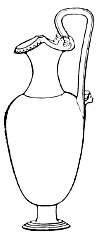
FIG. 45. PROCHOÖS.
A variety of the oinochoë, which is not found before the middle of the R.F. period, but becomes very popular in Apulia, has a very high curved handle and tall stem, the body tapering straighter downwards (Fig. 45). This is usually known as the πρόχοος, and corresponds in form to our claret-decanter. The πρόχοος served the same purpose as the οἰνοχόη, and is frequently mentioned in Homer. It was used not only for pouring wine, but for water to wash the hands of guests.[624]
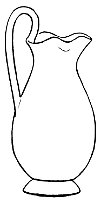
FIG. 46. OLPE.
A third form, usually known as the ὄλπη (Fig. 46), is almost cylindrical in shape, with plain or trefoil lip and no marked neck; it is more usually found in the B.F. period. In early B.F. wares the subjects on the olpae are usually painted on the side, adjoining the handle on the right[625]; they are always in panels. The word is mentioned by Sappho and Ion of Chios.[626]
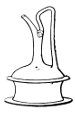
FIG. 47. EPICHYSIS.
Lastly, we have a curious form, only found in Apulia, and belonging to the extreme decadence of vase-painting (Fig. 47), which has a flat cylindrical body like a round toilet-box (see Pyxis, p. 198) with moulded edges. This is surmounted by a long narrow neck and beak-like semi-cylindrical mouth[627]; and the whole effect is awkward and inartistic. The name ἐπίχυσις, derived from the list given by Pollux,[628] is generally given to this form.
For the ladle used for drawing wine out of the krater to fill the oinochoë the ordinary name was κύαθος (Lat. simpulum). This word also commonly denoted a measure of about one gill. Among the painted vases it is represented by a rare but particularly graceful shape, the body fashioned like a straight-sided bowl, with a high looped handle (Fig. 48). In the early B.F. examples a high stem is added. This shape is not found in the later R.F. period or in Southern Italy. The long handle is obviously for convenience in dipping.
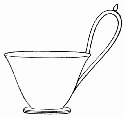
FIG. 48. KYATHOS.
A series of names, all of which are derivatives from the word ἀρύω, “draw” (used only of drawing water), appear to represent ladles of various forms and uses. Herodotos[629] mentions the word ἀρυστήρ, and the forms ἀρυστεῖς, ἀρυτήρ, ἀρυσάνη, ἀρυστρίς, are also found.[630] The ἀρύταινα appears to have been a bronze ladle, used in the baths for collecting oil, and for filling lamps.[631] The ἀρύςτιχος, on the other hand, was a wine-ladle, also known as an ἔφηβος; it appears to have been used in voting in the law-courts.[632] Another word used by Aristophanes is οἰνήρυσις[633]; two parallels to which are the ἐτνήρυσις and ζωμήρυσις of the same author[634] and other comic writers, both words meaning “soup-ladle.” It is doubtful if any of these words were in use for fictile utensils.
The next branch of the subject is concerned with the various forms of Drinking-cups in use among the Greeks. In these the potters may perhaps be said to have attained their highest excellence, not only in regard to beauty and grace of form, but also, so far as concerns one variety at any rate—the R.F. Athenian kylix—in regard to the decoration. The locus classicus on the subject is the eleventh book of Athenaeus, to which frequent reference has already been made[635]; but there are of course frequent references to these cups in Homer and other poets. Athenaeus devotes a discourse by one of his “Doctors at Dinner” entirely to this subject, the different names being discussed in alphabetical order. Many of them are, as will be seen, only alternatives names or nicknames for well-known shapes, while others included in his description are certainly not drinking-cups at all. It must also be borne in mind that many of the names are purely generic, like the Latin poculum, and are not intended to connote any special form; this is particularly the case in the descriptions of Homer, where, indeed, we should not look for scientific accuracy.
The ordinary word for a drinking-cup was ποτήριον or ἔκπωμα, but neither is known to Homer[636]; the terms he uses are δέπας, ἄλεισον, and κύπελλον, the first being further defined as ἀαμφικύπελλον. The word κισσύβιον[637] may be once for all briefly dismissed; it was so called from κισσός (ivy), probably as being ornamented with ivy-foliage in relief, and was made of wood. It is seldom that Homer’s descriptions give any details as to form, and where they do they are difficult to interpret aright. Athenaeus devotes a lengthy section of his discourse to the explanation of the famous cup (δέπας) of Nestor,[638] which he names νεστορίς (cf. p. 172), but arrives at no definite conclusion. It has already been pointed out that a hint at its form seems to be given by the gold and silver cups found in Mycenaean tombs, at Mycenae, and Enkomi in Cyprus, although it need not be assumed that these are the products of the civilisation which Homer describes; he may, however, be speaking of traditional forms. Another instance of the δέπας in legend, is in the story of Herakles crossing the ocean in the golden δέπας of the Sun.[639]
Among the names of drinking-cups given by Athenaeus, the following may be taken as used in a purely general sense, without any idea of a particular form.
Ἄμυστις.—A cup from which it is possible to drink at one draught (cf. κελέβη, p. 169).
Αμφωτις.—A two-handled cup (see under Skyphos, p. 186).
Ἀντύγονις.—A cup named after King Antigonos.
Ἀργυρίς.—A cup of metal (not necessarily silver). Pollux also gives the word χρυσίς.
Ἄωτον.—A Cypriote name for a cup (“without handles,” from α and οὔς).
Βαυκαλίς.—An Alexandrine variety, of glass or clay.
Βῆσσα.—Also an Alexandrine form, widening out below.
Γυάλας.—A Megarian name (the form of the word is Doric).
Δεπαστρόν.—An uncertain form, variously explained.
Δεπαστρόν.—A bye-form of δέπας, in use at Kleitor in Arcadia.
Ἐνιαυτός.—Also known as Ἀμαλθείας κέρας. See under Rhyton (p. 193).
Ἔφηβος or ἐμβασικοίτας.—The significance of these names is not obvious, but see p. 179 for the former.
Ἡδυποτίς.—A Rhodian name (cf. Pollux, vi. 96). Said to have been made by the Rhodians in competition with the Athenian Θηρίκλειοι (see below, p. 189). They were of light make, and not, like the Thericleian cups, for the exclusive use of the rich.
Ἠθάνιον.—Apparently an Egyptian name.
Ἡμίτομος.—An Athenian cup, probably hemispherical (but see above, p. 174).
Ἴσθμιον.—A Cypriote term.
Κελέβη.—See under Krater (p. 169).
Κόνδυ.—An Asiatic name. Menander describes it as holding ten kotylae, or about five pints.
Κρατάνιον or κρανίον.—Polemon mentions silver specimens in the temple of Hera and treasury of the Byzantines at Olympia.
Κρουνεῖον.—It is doubtful if this word denotes a cup, as it is catalogued with the κρατήρ, κάδος, and ὁλκεῖον.
Λαβρωνία.—A Persian cup, named from “greedy” drinking (λαβρότης ἐν τῷ πίνειν).
Λάκαινα.—A cup made of Laconian clay.
Λέσβιον.
Μάνης.—A cup or bowl placed on the top of the kottabos-stand, and used in the game of kottabos to receive the drops of wine thrown from the kylix (q.v.)
Μέλη.
Ὄινιστηρία.—A name given to the wine-cup dedicated to Herakles by the ephebi at the time of entry into that rank.
Ὄλλιξ.—A wooden cup.
Παναθηναικόν.—Probably a variety of the Skyphos (q.v.).
Πελίκη.—See under Amphora (p. 163). A generally disputed form.
Πέταχνον.—A wide flat cup (from πετάννυμι, “spread”).
Πρίστις.
Προυσίας.—Named from the king of Bithynia.
Προχύτης.—Called a cup by Athenaeus, but more probably to be identified with the πρόχοος (p. 178).
Ῥέον or Ῥέοντα.—Probably a variant of ῥυτόν. It is described as taking the form of a Gryphon or Pegasos, both of which occur in rhyta (p. 193).
Σαννακία.—A Persian cup.
Σελευκίς.—A cup named after King Seleukos.
Ταβαίτας.—A wooden cup.
Τραγέλαφος.—Probably a kind of rhyton (p. 193).
Τριύρης.—See p. 186, under κύμβιον.
Ὑστιακόν.
Χαλκιδικόν.—Probably named from the Thracian Chalkidike.
Χόννος.—A bronze cup (perhaps a kind of kylix).
ᾨδός.—A cup associated with the singing of σκόλια.
ᾨόν.—An egg-shaped cup.
ᾨοσκύφιον.—A double cup, apparently like an egg standing in an egg-cup.
Pollux also mentions the names Βησιακόν and Καππαδοκικόν; and Athenaeus describes a γραμματικὸν ἔκπωμα, or cup ornamented with letters (in relief), probably a late Hellenistic type.
We now come to the names which can be identified with existing vases, or are described with some indication of their form.
A name which constantly occurs in two forms is the κοτύλη or κότυλος. The distinction appears to be that the former had no handles, but the latter one,[640] but otherwise the form was probably much the same, being that of a deep cup; it is also probable that it was sometimes used like the κύαθος, as a ladle for drawing out wine, as well as for drinking. The word κοτύλη is found as early as Homer,[641] used metaphorically for the hollow where the thigh-bone joins the hip; in its proper meaning as a cup, it occurs in the familiar proverb[642] which has been adopted into our language:
πολλὰ μεταξὺ πέλει κοτύλης καὶ χείλεος ἀκροῦ
“There’s many a slip ’twixt the cup and the lip.”
As a measure it was equivalent to six kyathi, or roughly half a pint, as already shown (p. 135). The ἡμικοτύλιον there discussed is, however, a one-handled cup, and therefore to be called a κότυλος rather than a κοτύλη. The latter is a word constantly found in Greek literature from Homer downwards, as in the passage where Andromache describes the impending fate of her orphan child, to whom a pitying patron will hold out a cup, merely to taste, not to drain.[643]
From Athenaeus we learn that the κότυλος was like a deep washing-basin (λουτήριον), and that it was associated with Dionysos. Eratosthenes[644] calls it the most beautiful and the best for drinking of all cups. The diminutive form κοτύλισκος occurs in connection with the κέρνος], discussed below (p. 195), which had many of these little cups attached to it. It has been customary to apply the name κοτύλη to a class of vase found at all periods, with flat base, slightly curved sides, and two flat handles level with the rim (Fig. 49); it sometimes attains a considerable size for a drinking-cup, and is usually decorated with one or two figures each side. A notable exception is the beautiful vase in the British Museum (Plate LI.), signed by Hieron, with its frieze of figures all round. This identification is of course at variance with Athenaeus' statement that the kotyle has no handle; but no other satisfactory name has been found for the form.
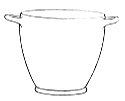
FIG. 49. KOTYLE.
Closely connected, it would seem, with the κοτύλη is the cup known as the σκύφος or σκύπφος, to which there are frequent references in the poets and elsewhere but not in Aristophanes. Homer[645] describes it as a rustic sort of bowl, which held milk; Simonides applies to it the epithet οὐατόεντα, or “handled.” Athenaeus connects the word with σκαφίς, a round wooden vessel which held milk or whey, and this seems to accord with the mention of it in Homer. It was always specially associated with Herakles,[646] who was said to have used it on his expeditions; hence certain varieties were known as σκύφοι Ἡρακλεωτικοί, but it is more probable that this word refers to Heraklea Trachinia in Northern Greece. Besides the Herakleotic, Athenaeus mentions specially Boeotian, Rhodian, and Syracusan skyphi. The ordinary shape of the vase may be inferred from the form of that which Herakles is often depicted holding on the monuments[647]; it is of the same type as the κοτύλη, but the body tapers below and has a higher foot, while the handles are placed lower down and bent upwards. Among the late black-glazed wares with opaque paintings (p. 488) some examples occur of cups with handles twisted in a kind of knot, and it has been suggested that these represent the “Heraklean knot” described by Athenaeus[648] as to be seen on the handles of these: σκύφοι Ἡρακλεωτικοί.
The word is also frequently used by Roman authors, and there is a particularly interesting passage in Suetonius (cf. p. 134) alluding to the Homerici scyphi adorned with chased designs from the Homeric poems[649] which Nero possessed; these were, of course, metal bowls with reliefs,[650] but they have their fictile counterparts in the so-called Megarian bowls (p. 499).
Athenaeus[651] quotes from the philosopher Poseidonios a passage referring to drinking-cups called Παναθηναικά, which may be supposed to have some connection with the Panathenaic festival, and attempts have been made to identify them with a class of skyphi or kotylae of the R.F. period, the invariable subject on which is an owl between two olive-branches (p. 410).[652] There is no doubt some reference to the Athenian goddess, but it is more likely that they represent some kind of official measure (see above, p. 135).
It will be noted that the σκύφος appears to have been originally a wooden vessel used as a milking-pail, and it is further identified in Theocritus with the wooden κισσύβιον, to which we have already alluded. Two other words are given by Athenaeus to denote large wooden bowls of the type of the σκύφος, namely the ἄμφωτις and the πέλλα[653] both used as milking-pails. They were not strictly speaking drinking-cups. Among existing Greek vases this form, viz. a deep straight-sided bowl, such as a carved wooden vessel would naturally take, seems to be best represented by the examples discovered on the site of the Cabeiric temple at Thebes, which are of this shape and of considerable size (see Fig. 98, p. 392).[654]
The βρομίας is described by Athenaeus[655] as a cup resembling the taller skyphi, and the κιβώριον[656] (whence the ecclesiastical Latin ciborium[657]) was also a kind of skyphos. The name μαστός should also be included here, from the likeness of the cup to the skyphos. Its characteristic is that it has no foot but only a small knob, and therefore exactly resembles a woman’s breast with the nipple, whence its name. In Greek pottery the only known painted examples are of the B.F. period,[658] and these are usually modelled and painted with great care and delicacy. The so-called Megarian bowls (see p. 499) should also be included under this heading, in reference to which it has been pointed out that μαστοί of metal were dedicated in temples at Oropos in Boeotia and at Paphos.[659]
Another form of cup, of which Athenaeus has much to say, is the κύμβιον[660] (other forms being κύμβη and κύββα), which was supposed to represent the κύπελλον of Homer. He describes it as small and deep, without foot or handles. On the other hand, the word also means “a boat,” and we further find the words ἄκατος and τριήρης cited by Athenaeus[661] as names of cups, the former being expressly called “a boat-shaped cup.” This has the support of the author Didymos (quoted by Athenaeus, 481 F) who says the κύμβιον was a long narrow cup like a ship.[662] A possible instance of it is a long askos-shaped vessel in the British Museum,[663] on which is incised , “Drink, do not lay me down”; but it is not of a form adapted for drinking. The question must therefore remain undecided. Ussing thinks that κύμβιον was originally a cup-name, and that the other meaning is derived from it; but, on the other hand, ἄκατος and τριήρης are merely nicknames as applied to cups.