Chapter XV · THE GRAND RESULT
Reading edition
I. 7th Battalion: Battle of Amiens
The 7th Battalion of the Buffs on the morning of the 6th August, 1918, was holding the brigade frontage which was north of the Bray-Corbie road and was in a trench which had recently been taken from the enemy and occupied by an Australian force. South of the road at the time of dawn a relief of companies was in progress, and the East Surrey Regiment was experiencing certain difficulties in connection with the operation. The Germans, discovering this fact, seized the opportunity to launch a very sudden and resolute attack which succeeded in piercing the British line. This unfortunate event seems to have been due to a variety of causes, such as incomplete relief and extension of front, but the element of surprise figured largely. Our troops were holding the ground very thinly; the men were anything but fresh; the forward trenches were knee-deep in mud, and their occupants were expecting to leave them only for a forward and not a retrograde movement. The German barrage commenced at 4.20 a.m. No “S.O.S.” signal was made for some time and the general idea seems to have been that the enterprise was merely a raid, but the bombardment lasted two hours and cut the telephone wires, which was the greater disaster because the shape of the ground forbade visual signalling. After about an hour it became clear enough that this was no raid, but a determined attempt to gain and hold on to our trenches and position. The hostile troops succeeded in penetrating along the road to a considerable distance, about eight hundred yards, in fact. The south of it being held but lightly, the 34th Brigade was requested to be responsible for this portion of the line, and a counter-attack by men of the East Surreys was attempted along the highway itself. At 8.36 it was clear to the headquarters in rear that part of our old first line was now in the hands of the enemy; but at 9.45 the Buffs were in the Burke line behind it, had established posts at all the junctions of trenches, and had pushed patrols out to the front, after which there was a lengthy bombing fight for the various trench junctions. During the morning the 55th Brigade had consisted of two battalions only, because the Queen’s had been sent back to rest and get fit, prior to our attack on the 8th. The enemy having anticipated our programme and date of fighting, this battalion was now ordered to the front again and arrived about noon. At 4.45 a conference was held, the principal point for consultation being the possibility of a counter-attack by the 54th Brigade. The leader of this force objected that he required another battalion to make such an attempt feasible, but this objection being overruled, the counter-attack was decided on and one company of the East Surreys placed at the disposal of the 54th Brigade. During the following night the lines were subjected to very heavy shelling, but at 4.40 a.m. the counter-attack was launched and proved a great success, the 54th Brigade gaining all their objectives, as did the detachment of the East Surreys; the latter at 5.47 reported themselves as being where they had been told to go and as having several prisoners and two of the enemy’s machine guns.
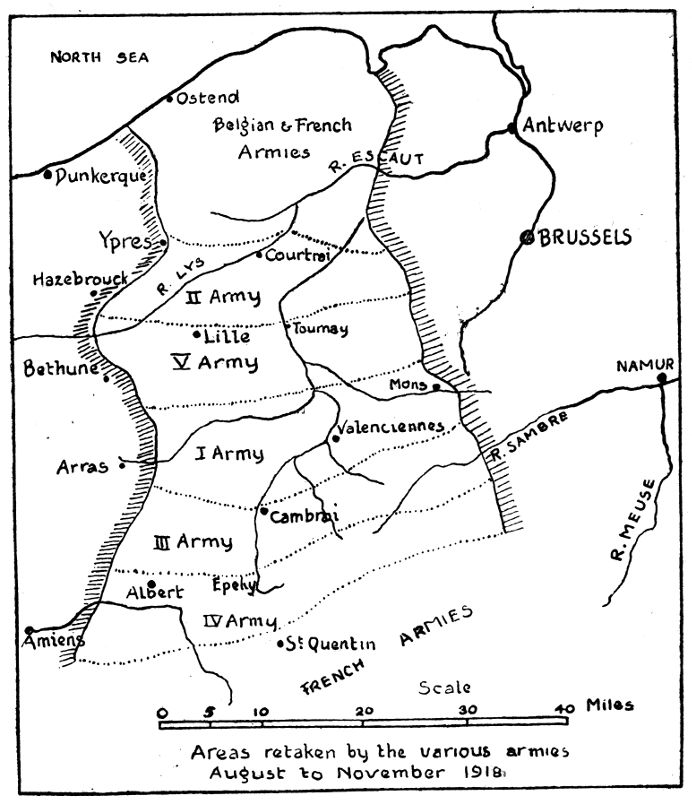
Areas retaken by the various armies August to November 1918.
The following day saw the commencement of the allied offensive, but the 55th Brigade was practically only represented by the 7th Queen’s, which battalion had been nursed for the occasion. Extraordinary efforts had been made to keep the coming operations a dead secret. Only battalion commanders were supposed to know anything whatsoever about the matter, and they only the barest outline of the plan. The job the Queen’s were given was to form the extreme left of the defensive flank of the 4th Army. The battalion was to be accompanied by certain tanks. The morning was almost as misty as on that dreadful day, the 21st March. The tanks failed to turn up and the Queen’s were forced to start without them. In the fog the battalion appeared to have missed its way, and while endeavouring to get right again and into good order it suffered a terrible loss, in that its gallant colonel was mortally wounded. Christopher Bushell, V.C., D.S.O., was a very prominent hero in an army of good soldiers, and his regiment must deeply have felt his loss. Lt.-Colonel Ransome, of the Buffs, was, immediately the news came in, placed in command of all troops in the foremost zone, with directions to clear up the situation and to establish the flank with all speed. In the words of the official account, “He handled the situation most ably.” He was well and worthily assisted by Captain Snell, adjutant of the Queen’s, by Captain Hayfield, of the Buffs, now attached to brigade headquarters, and by Captain Heath, who commanded the 55th Trench Mortar Battery.
The following day, the 9th August, the 55th Brigade was squeezed out as the English armies advanced and so became reserve troops, the Buffs proceeding to Warloy, where they received two large drafts from home which were badly needed. Most of these men were miners and munition workers who all did good work later on. On the 13th August the Buffs moved into line beyond Senlis and with them went American soldiers, one platoon being attached to each Buff company, and the Buffs leaving four platoons of their own in the transport lines. On the 19th, the battalion having relieved the Royal Berkshire Regiment west of Albert, its patrols got touch with the enemy in and about that town, and on the night of the 21st/22nd assembly positions were taken up for battle almost on the western edge of Albert.
The great battle, or rather series of battles and pursuits, which now commenced in this area was fully shared in by other divisions besides the 18th in which the 7th Buffs were serving. Amongst these was the 12th, and in that division was the 6th Battalion of the regiment. These two Kitchener units, then, were during the latter part of August and early September serving shoulder to shoulder, or very nearly so. Therefore before the tale be told of how the enemy was driven from the Ancre river step by step over the Tortille and back to his Hindenburg Line, it would be as well to note how the 6th was spending the time from the 9th to the 21st August.
II. 6th Battalion
At 2 a.m. on the former date the battalion, with the rest of the 37th Brigade, which, it may be remembered, was near Morlancourt, began to move into its assembly position, but at 3 o’clock a message came postponing the attack. This message reached the Queen’s and West Kent in time and these two units were stopped ere reaching their places, but the Buffs, having a longer approach to make subsequently, had to leave their assembly positions much earlier in order to get up to the artillery barrage. Thus it came to pass that the leading companies had already commenced operations when the important message came and it was impossible to stop them, so that the battalion had actually penetrated the enemy’s position at one point when the order for postponement reached it. These forward troops therefore detailed one platoon to occupy a quarry, which was handy, and from there cover the retreat of its comrades. Under cover of this platoon, the remainder withdrew to their assembly positions, but the men took with them a prisoner and a machine gun just to show where they had been. The covering platoon maintained its position. This little error cost one officer and forty men wounded.
The new zero hour was fixed for 5.30 p.m., at which time the Buffs were already in assembly position on the right of the line. The Queen’s and West Kent were to be in position at the zero hour to commence the assault fifty minutes later. The attack proceeded now according to plan, and at the correct moment the Queen’s and West Kent advanced co-operating with the Buffs. Considerable opposition was met with and a large number of Germans killed and taken prisoner. A quantity of machine guns and trench mortars and two 77-mm. cannon were captured. In fact, the whole thing was done in excellent order, and at eight in the evening all objectives were gained and outposts put out. This attack seems to have come as a surprise to the enemy, yet, owing to their numerous machine guns, our casualties were by no means light. The night was quiet, but at 3 o’clock next morning the Germans tried an attack with a few troops, but these were repulsed. The casualties of the Buffs consisted of Captain J. W. Laurie, Lieuts. V. W. J. Hobbs and R. J. Pavitt and 12 other ranks killed; 11 officers and 145 men wounded and 56 missing. With this loss the battalion alone was responsible for the capture of 340 prisoners, a battery of 4·2-in. howitzers, two minenwerfer, twelve machine guns, two 77-mm. guns and seven light minenwerfer.
During the 10th the enemy snipers were very active, and as our front consisted of a series of shell holes linked up, observation on the enemy’s part was fairly easy, and consequently any movements on our side very difficult and dangerous. Lieut. D. A. W. Hill (afterwards died of wounds), 2nd Lieut. Harris and five men were wounded on this day. The next few days were spent in this same locality, either in front line or support, and the shelling and sniping continued to be severe. There was a report on the 15th that the enemy was withdrawing, but patrols sent out soon found the falsity of this story. On the 20th the Buffs were in divisional reserve at Treux, on the Ancre, and next day were attached temporarily to the 35th Brigade, in order to take part with it in the grand attack on Albert planned for the 22nd, in which the 18th Division, with the 7th Battalion of the regiment, was also to be engaged.
III. 6th and 7th Battalions: Albert, etc.
The enemy was holding the line of the Ancre river, using Albert as a bridgehead. The stream here is only about fourteen feet wide, but it averages six feet in depth and has nasty marshy edges and approaches. Thus it is an obstacle requiring the carrying up of bridging material and so forth. The Germans were nearly all on the eastern bank of the river, but the cellars and ruins of the town of Albert, even on the western side, proved to be full of hidden parties cleverly availing themselves of what were in truth considerable facilities for defence. The rôle of the 18th Division was to cover the flank of the main attack of the 4th Army by taking Albert and the high ground beyond it. The 12th Division was on the right of the 18th and had the task of capturing the village of Meaulte, a little to the south, as well as other points. The 35th Brigade, however, was bound for Meaulte and was in immediate touch with the 18th Division.
The scheme of the 18th Division was as follows: the 55th Brigade was to capture Albert itself, and the 54th to operate south of that town and between it and Meaulte. Commencing at zero and for sixty minutes, all the houses of Albert which were to the east of the river were to be submitted to a heavy bombardment while the East Surrey Regiment worked through those to the west of the stream, “mopping up” the small hostile parties which were reported by our scouts to be there. Then our artillery was to lift and devote its attention to certain strong points on the east edge of Albert while the Surrey men crossed the Ancre and continued their work through the place. Finally, the guns were to lift again and allow the battalion to complete its job. Then the 7th Buffs were to come through the town, advance east-north-east till it got touch with the 54th Brigade, which would be attacking between Albert and Meaulte, and then to halt with its left flank on the floods. As it was quite impossible to reckon at what hour the East Surrey would have finished their work, the Buffs must make their advance without the help of a barrage.
As a matter of fact, the battalion debouched from the town at 10 a.m. and touch was got with the 54th Brigade, but then, heavy machine-gun fire being met with, progress astride the Albert-Pozieres road became impossible. All the country just outside Albert is dominated by Usna, Tara and Shamrock hills, which high ground was the especial objective of the 18th Division. When the Buffs emerged from the streets a false report was received that Tara Hill was occupied by the 54th Brigade, and our artillery got orders not to fire upon it. As a matter of fact, however, the enemy was still there and all their machine guns, which of course were not interfered with, were free to play on our battalion as it came on. This state of things caused a halt a little short of the Blue Line, for which the Buffs were bound, and the brigadier came to the conclusion that it would be impossible to push on further without the assistance of tanks and until it was dark. However, at 2.30 a.m. on the 23rd the Blue Line was made good. The Buffs had suffered about two hundred casualties, which were immediately made good by men originally left out of action.
Meanwhile the 35th Brigade, with which for a day or two the 6th Battalion served, was in position at 1.30 a.m. and endured heavy gas shelling during the night. 4.45 a.m. was the zero hour, and then the 6th moved forward, C Company being on the left and D on the right front, A left support and D right. The battalion moved behind the 7th Norfolk Regiment, to which unit had been assigned the first objective. The 9th Essex was on the right of the Buffs. The whole operation this day was completely successful, all objectives being taken and consolidated. The second of these being secured by the 6th Buffs at 8.35 a.m., though unfortunately the Essex were held up by heavy machine-gun fire. There is no doubt that the work was done most creditably; eleven machine guns and fourteen prisoners fell to the share of the battalion we are interested in, and its own casualties were light: 2nd Lieuts. Gibbs and Green were wounded, five men killed, twenty-nine wounded, thirty missing and one gassed. Furthermore, when the second objective was gained the remainder of the day was quiet. The following day, the 23rd of the month, revealed the fact, however, that the situation on the right of the Buffs required much clearing up, so much so that tanks were sent up to investigate matters, and preparations were made for forming a defensive flank which necessitated some small rearrangement of the troops. It is interesting to note that during this day an aeroplane, in response to a call, managed to drop three thousand rounds of small-arm ammunition by means of a parachute.
On the 23rd the 18th Division had been busy. As has been seen, the original objective of the 7th Buffs had been gained at 2.30 a.m., but this move was chiefly made to enable other troops to get possession of the hills which up till then had dominated the British front. This was done, in spite of tremendous difficulties, by the 53rd Brigade with the 7th Queen’s from the 55th, and it was greatly aided by seven tanks which had to approach from Meaulte along the east bank of the Ancre. The work was supported by a brigade of the 38th Division on the left of the 18th, which brigade had to get through Albert and then more to the north and pass the floods so close that many men were wading nearly breast high. Everything now going well, the 55th Brigade, less the Queen’s, was temporarily withdrawn to divisional reserve west of Albert. The first stage of the attack had been a marked success, and all went so well during the time the 55th Brigade was away that when it returned to the front line in relief of the 53rd, which occurred on the night of the 24th/25th, it bore orders to push on the advance relentlessly. This relief was very different from those to which everyone was so well accustomed. It was a mobile business. No taking over of dug-outs and trenches, but the 7th Buffs simply walked into the place of the West Kent on the right of the brigade near the Becourt Wood and took up the running, so to speak.
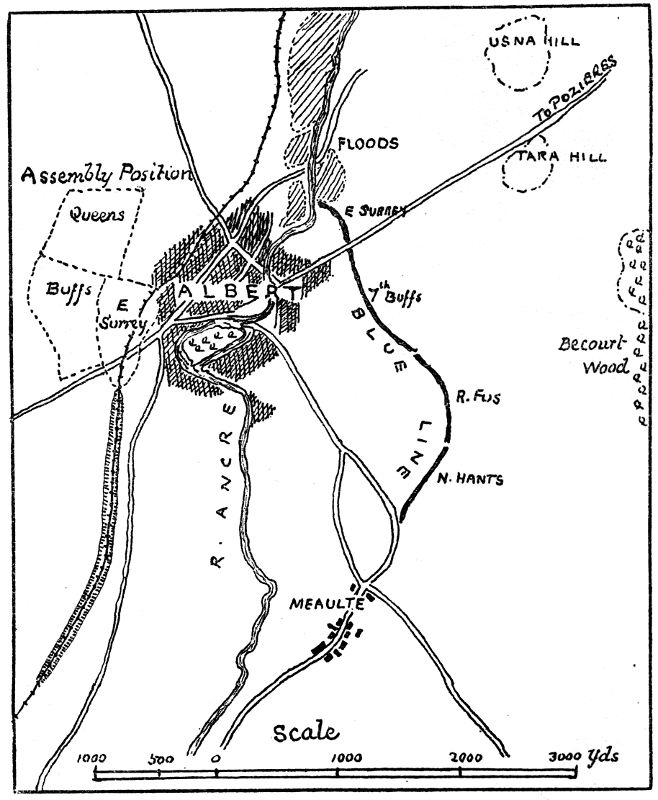
ALBERT
As regards the 12th Division, the 6th Buffs, on the 24th, returned to their own 37th Brigade, which was ordered to carry on the advance, relieving the 35th, which had been ahead so far. At 1 a.m. the brigade, under an artillery barrage, attacked the enemy’s position in front. At 1.30 the Buffs reported that all was going well but that they were facing heavy machine-gun fire, and they asked for the assistance of tanks to clear away certain pockets of the enemy which were giving trouble. Two hours later the Queen’s reported that their right was held up, so, at 7 o’clock, three whippet tanks were placed at the disposal of the brigadier. At 1.30 these tanks, with the West Kent, attacked, but they were back again in an hour, having completely failed; one tank had its guns jammed, and one was badly damaged, for on crossing the ridge they had met with heavy machine-gun and trench-mortar fire. The enemy was still a force in being and knew exactly where to make a resolute stand. A consultation now took place as to the best mode of carrying on the advance on the morrow, and it was determined to leave the German strong place, which was giving so much trouble, and to pass on either side of it, so at 9.30 p.m. orders were issued for the task of the 25th: the Buffs were to advance on the right, and Queen’s on the left, with the West Kent in support. At midnight the Corps cavalry was placed at the disposal of the 37th Brigade. It was now found that the enemy had withdrawn, and it was pretty evident that he had gone back some considerable distance. On the 25th, therefore, the 36th and 37th Brigades, with the 35th in reserve, advanced, in order to maintain their touch with the retiring Germans. The move commenced in the middle of the night and was quite successful, so that by 5.15 the Buffs were holding a new line, once more in contact with the enemy, and with patrols pushed out in front. 2nd Lieuts. Barr and H. J. Hine, with eight other ranks, were wounded during the morning, Hine unhappily dying of his wounds. There was no doubt about the enemy’s temporary stand—indeed, the British line was shelled all day; and at five in the evening the 55th Brigade came up from the reserve and went through as an advance guard, in conjunction with similar movements in the flanks. These troops drove the Germans back about two thousand yards and consolidated a new line, while the Buffs and Queen’s, with the West Kent in reserve, held the old one. The tactics of the 25th were renewed on the 26th. On this day the 36th Brigade took up the advance guard duties, passed through the 35th and carried on the drive for about 3,500 yards. The 37th Brigade remained in position. On the 27th the fighting part of the programme was transferred to the 37th Brigade. Its units came through those of the 36th and at 4.45 a.m. attacked the enemy’s position north of the Somme, captured the village of Carnoy and assisted the 58th Division to take Maricourt. It also took a valuable position north of Hardecourt. During these operations the brigade had been assisted by the cavalry, and after so prolonged a period of trench warfare it was strange to be working with so mobile an arm. The West Kents reporting themselves at 7.32 as being on their objective, and the Buffs doing the same at 7.45, the horsemen were sent forward to occupy the Maurepas ridge far ahead. At 9.20 a counter-attack appeared to be developing south of Bernafay Wood, and the 35th Brigade was ordered to send a battalion up to La Briqueterie to be at the disposal of the brigadier of the 37th, and at 10 o’clock a company of the Machine Gun Corps was added to his force. At 10.45 the Buffs found themselves being seriously enfiladed by machine-gun fire, so much so that their position became untenable and the battalion withdrew in good and correct order some two hundred yards. About this same time the cavalry, after reporting that Faviere Wood, between Hardecourt and Maricourt, was still occupied, had to be recalled as the ground was impossible to work over, owing to wire, shell holes and trenches. At 2 p.m. the brigade was directed to advance its line sufficiently to join up with the 18th Division east of Bernafay Wood, and later on a message came informing the brigadier that the 18th Division intended to attack at seven that evening, its objective being the east edge of Trones Wood, and directing that the battalions of his brigade should keep touch. The casualties to the 6th Battalion the Buffs on the 27th August were Captain L. P. Figgis and ten men killed, 2nd Lieuts. Findley, Hobbs, C. Hunt and H. M. Hunt and forty others wounded; twelve men were missing.
As regards the 7th Battalion, it too was moving forward at 2.30 a.m. On the 25th August the 54th and 55th Brigades, the latter on the left, pushed on without much opposition, the Buffs being on the right and East Surreys on the left of their own brigade. All went well until the neighbourhood of Montauban was reached, and here the opposition began to strengthen somewhat, the enemy showing that he thoroughly understood the scientific use of machine guns in rear-guard action. Lieut. G. B. Mason, commanding A Company, was wounded crossing the crest north of Bottom Wood and progress became slow owing to very wet weather, but by nightfall the battalion had reached a line south of the western edge of Mametz Wood and were in touch with the troops on both flanks. The day’s fighting had resulted in an advance of about a mile and a half. As soon as it was light on the 26th B Company, under Captain A. J. Whitmarsh, was sent forward to continue the advance, but now the enemy’s resistance became more stubborn. The ground east of Montauban was very suitable for machine-gun rear guards, and each little position occupied by these had to be located before they could be first outflanked and then rushed in front. Captain Whitmarsh, with A Company on his left flank, which again kept pace with the East Surreys, took his own men on with great steadiness and skill, and at about 3.15 p.m. assaulted the village of Montauban, taking about sixty prisoners and killing the remainder of the garrison. He was greatly aided by flanking fire brought to bear by machine guns to the north of him. Whitmarsh was awarded the D.S.O. for his work on this day. At 6 p.m. the 7th Queen’s was ordered up as vanguard to the division, the Buffs remaining east of Montauban, with Bernafay Wood full of Germans just in front of them. The next day B Company went back to Caterpillar Valley, where C already was, and these companies were joined by the other two on the 28th, the whole brigade being on that day withdrawn into divisional reserve.
The fighting described above was quite a revelation to most of the young officers and men of both the Buffs’ battalions. Long experience of trench work, only varied by occasional raids or a battle, in the course of which one side or the other gained two or three hundred yards, made it difficult for most men to understand what open warfare really meant, and probably many wondered why such stress is laid in England on the necessity of field days, with their extensive movements. Yet now they saw cavalry at work, infantry skirmishing and artillery galloping into action as if on Salisbury Plain, and behold it was very good.
On the morning of the 29th August the 54th Brigade advanced with very little opposition to the western edge of Combles, but was unable to get further because the enemy still held the ridge where the remains of Morval stood, and thus threatened the flank of any troops which tried to move further eastward.
Meanwhile the 6th Battalion, with the 6th West Kent on their left, had got as far as Maurepas, for that part of the enemy which was opposite them had withdrawn some distance during the night of the 27th/28th, so that in the morning these two battalions had pushed on, in artillery formation, and got into touch again at Maurepas. Here it was found that there was no sign of troops further to the south: the 58th Division, which should have been there, had apparently failed to come up. This meant, of course, that the Buffs had to form a defensive flank in this direction, but after a while the patrols managed to discover some Australians. During this day B Company completely outflanked a similar German unit, taking from it seventy-nine prisoners. Six of our men were wounded.
The several divisions and brigades relieved each other with great frequency during the grand allied advance we are describing. Of course, strong bodies of troops must always be behind those actually in touch with the enemy, and it was so arranged that everybody should have a turn at work nearest the foe and then be passed by some of those in rear, and so take on the business of reserve troops. On the 30th of August, therefore, the 12th Division was relieved by the 47th, the 24th London Regiment taking the place of the 6th Buffs, who retired to Faviere Wood and remained there till the 4th September. On that date the 12th Division relieved the 18th in the left divisional sector of the 3rd Corps front, the Buffs going into trenches east of Fregicourt.
The 18th Division was now faced with the difficulty of passing the high ground about Morval. On the 30th an attempt to advance on Rancourt in conjunction with the 47th was met with very heavy machine-gun fire, particularly from Priez Farm, which was strongly held by the enemy. It was therefore found that for the present the pursuing tactics lately in use must be abandoned and a regular attack undertaken, for here was an obstinate stand. So on this date the 7th Buffs, with the rest of the 55th Brigade, were hurried up by bus to the neighbourhood of Montauban and Bernafay Wood, the Buffs being south of the latter place. It was decided that the 47th Division was to capture Rancourt and to the east of it as far as St. Pierre Vaast Wood. The 38th Division was to take Morval and Sailly Saillisel, while the 18th Division was to assail the north-west corner of St Pierre Vaast Wood and form line facing north-east across the Sailly Saillisel-Rancourt road, the idea being to cut off the enemy holding the Fregicourt-Morval position. The 55th Brigade represented its division in this partition of work, and to the East Surreys was assigned the assault in the corner of the wood; the Buffs were to follow them, form to the left and attack northwards, and the Queen’s to mop up the area north-east of Combles. Smoke barriers were arranged to cover the movements of the 55th Brigade. The day for the fight was at first fixed for the 31st August, but the position appeared so strong and the enemy’s artillery so much more in evidence than had recently been the case, that it was resolved to first make exhaustive preparation with artillery and postpone infantry action for twenty-four hours. The operations necessitated for the Buffs a night march from their bivouac south of Montauban. Little time was given for the issue of orders or reconnaissance, and the manœuvre contemplated was, if not intricate, at any rate somewhat out of the ordinary and the map issued the only guide to the ground. For these reasons, and in case of any accident, Colonel Ransome left B Company, under Captain Whitmarsh, in the assembly area of the East Surrey Regiment. The remainder were to advance in platoon columns for as long as possible in order to facilitate changes of direction. The move to the assembly area was a slow and tedious business; it was intensely dark, roads were scarce, landmarks few and country pitted with shell holes and strewn with wire; however, it was accomplished and in time. The next morning the attack developed according to plan. All accounts of it agree in according the highest possible praise to the 8th East Surrey Regiment, which unit bore the brunt of an action which was a complete success, all objectives being carried with comparatively few casualties. The principal opposition met with came from Priez Farm, which from the very start caused much trouble to the East Surreys, which was, however, not sufficient to stay that regiment’s triumphant progress. The leading companies of the Buffs were also temporarily held by machine guns which had allowed the Surrey men to pass them; these guns necessitated a somewhat wider detour for those that followed than had been anticipated. However, with considerable management and able leadership, especially perhaps on the part of Captain Stronge, of D Company, the difficult advance and still more difficult wheel, during which seven thousand yards was covered, was accomplished. When near Rancourt C and D Companies wheeled to the north and occupied the high ground east-north-east of Fregicourt. The enemy was completely surprised and demoralized and began to stream away northward from Fregicourt, many being killed by C and D Companies while trying to escape to Sailly Saillisel along the valley. The difficult task of seizing the high ground in rear of the enemy holding Fregicourt was successfully carried out and the division had done its part in the Second Battle of Bapaume.
The Buffs’ casualties on this occasion were only two; Captain Stronge, Lieut. Wellman and 2nd Lieut. Lawrence were awarded the M.C. for their gallant conduct on this occasion.
A very large number of prisoners were taken. Receipts, for instance, were given to the Buffs for fourteen officers and nearly eight hundred men, though a good many of these were not actually captured by the battalion. Captain Whitmarsh, of B Company, was after the action ordered to send forward two platoons as patrols into St Pierre Vaast Wood and towards Sailly Saillisel, and as the enemy appeared to be greatly demoralised the 7th West Kent was ordered to attack the village at 7 p.m., which move necessitated a further advance on the Buffs’ part to conform. During the operations between the 22nd August and the 1st September the 7th Buffs had 3 officers killed and 14 wounded; 26 men killed, 84 wounded and 55 missing.
On the 2nd the 53rd Brigade passed through to continue the pursuit. This day was a proud if a sad one for the 7th Battalion, for the commanding officer, Lt.-Colonel Ransome, D.S.O., M.C., who had so often led it to victory or stood in the gap during a necessary retreat, was removed on promotion to command the 170th Infantry Brigade of the 57th Division.[32] Next day Lt.-Colonel Curtis, D.S.O., joined on appointment to the command. On the 4th September the battalion marched to Trones Wood, the division, as has been seen, being relieved by the 12th, and it remained there training till the 16th of the month.
Two days after this relief of divisions the 6th Buffs marched into Riverside Wood on the Tordille stream. While it had been in rear the other troops had, of course, driven the enemy considerably to the eastward, for the 53rd Brigade had taken up the pursuit after the turning of the Morval position. Therefore, when on the 7th the 37th Brigade advanced through the others to take up the duties of advance guard to its division, it became its duty to attack a line of trenches which ran from Heudicourt to Guyencourt, some eight miles east of St Pierre Vaast Wood. The 6th Buffs moved into its assembly position at 4.30 a.m., having C Company on the left, D on the right, A left support and B right support. The battalion had the West Kent on its left with the Queen’s in support, and the objectives were: first, the east edge of Guyencourt; second, the high ground beyond; and third, the eastern outskirt of Epehy and the railway east of Peiziere. Both the Buffs and the West Kent had with them a section of Field Artillery, another of a Trench Mortar Battery and two sections of the Machine Gun Corps. The zero hour was 8 a.m., when an artillery barrage commenced. The enemy’s machine guns were very active from the start, and his artillery fire, though somewhat feeble at first, gradually increased in density. At 9.30 the Buffs had to report that they were held up by numerous machine guns opposite their centre and they asked for artillery aid, which was at once arranged for, with the result that at 10.10 a.m. the battalion was in possession of Guyencourt. The second objective, the hill line east of the village, was taken at 11.15 and consolidation commenced. At 5.50 p.m. orders came to endeavour to make good Epehy and Peiziere. That evening, patrols were pushing on, and at 8 o’clock both the leading battalions reported that they were moving forward; but a little later orders came that the 47th Division would continue the attack the next morning. The day had been a successful one, but the Buffs had Captain Tuke, 2nd Lieut. Thompson and twenty men wounded, four killed and six missing.
The 47th Division experienced some trouble the next day in gaining their objective, a line of trenches two thousand yards west of the Hindenburg Line, as the nearer the Germans were driven to their vaunted series of defences the stronger their opposition became, but at last the advance, which had been temporarily held up, was successfully renewed and a line of trenches gained and consolidated. The 12th Division again relieved the 47th on the evening of the 8th, but the Buffs were told off as divisional reserve and retired to St Pierre Vaast Wood, where they remained till the 17th, training, resting and playing football.
On the 16th of September the 7th Battalion embussed for Moislains and marched east to Longavesnes in a very heavy rainstorm, and next day the officers reconnoitred the approaches to Ronssoy from the high ground near Saulcourt; meanwhile the 6th Battalion was moving into assembly positions three hundred yards west of Guyencourt, cheered before going into action again by the news that Lt.-Colonel Smeltzer had a bar to his D.S.O., and that C.S.M. Coffin and Sgt. Ashby were each to wear the D.C.M. The enemy’s opposition was now getting quite determined, and on the 18th it was arranged to assail him in force. For this purpose the 21st Division on the left, the 18th in the centre and the 12th on the right prepared to carry on the great eastward push, which had now gained some five-and-twenty miles from Albert. Put very briefly, the 35th and 36th Brigades captured the villages of Peiziere and Epehy, but owing to strong machine-gun resistance were unable to make further headway; so the 37th Brigade went forward at 3.30 p.m. to clear up the situation. The objectives were then gained and everything settled by 6 p.m.
Also, a couple of miles or so to the south-east, the 7th Battalion co-operated in an attack by the 55th Brigade on Ronssoy and the exploitation of the enemy’s position beyond the village. To amplify the stories of these attacks a little: in both cases it was noticed that the confidence of our soldiers was supreme; after years of fighting what had seemed more or less a drawn battle, victory was now daily crowning our arms, and success was looked upon as a certainty. At 6.30 the 37th Brigade, being then in reserve just north of Guyencourt, was informed that the Norfolk Regiment on its front was being hardly pressed. At 8.25 it was reported that our troops were seen retiring from Epehy pursued by a tank which appeared to be an English one, manned by a German crew. At 8.40 the brigadier of the 36th Brigade reported that his troops had gained their first objective, but had then been heavily enfiladed from the north and by three tanks, one of them being English; so the West Kent were sent off in this direction. There is no doubt that the German defence of Epehy was a resolute one and of a different type to what the British had now become accustomed to, and the Queen’s battalion, which of course belonged to the 37th (or reserve) Brigade, was ordered to keep touch with the troops to the south and, if necessary, to move round south of Epehy to do so; also a divisional order came to the brigade soon after 9 o’clock that the Buffs were to be kept in hand. By 10 o’clock the West Kent were in Peiziere, with their forward company east of the village, though the enemy’s machine guns and trench mortars were still holding out in the place. The Queen’s, with a battery, were in action two hundred yards west of Epehy. It was now decided, as things were not progressing too well, to attack formally at 3.50 p.m. with the Buffs and Queen’s, so the barrage started and these two battalions went forward, but both were held up by machine guns before the objectives were gained. Captain S. S. Beall, Lieut. R. W. Durdle, 2nd Lieut. A. Mount and eleven men were killed, twenty-two wounded and two missing.
A considerable amount of dogged attack and equally dogged defence on the part of the enemy formed the story of the 6th Battalion up to the end of September. On the 19th the Buffs and Queen’s attacked the Germans in what were called Mule Trench, Bird Trench and Braeton Post. The Buffs had been given the two latter as objective. Very considerable machine-gun opposition was met with, but a line a hundred yards short of the objective was consolidated at 1.30 p.m. At 7.45 the “S.O.S.” signal went up from part of the 18th Division’s front and there was heavy artillery fire on our forward line, but no infantry action followed. Lieut. Brooke was wounded, one man killed, twenty-seven wounded and seven missing. The shelling continued next day, one projectile falling close to battalion headquarters and wounding two servants and three runners. At midnight on the 21st/22nd, under an artillery barrage, the West Kent, with D Company of the Buffs, made another assault which was at first unsuccessful—the opposition being most resolute. A second attempt, at 3 p.m., had better fortune and a new position was consolidated. Buffs’ casualties: seven killed and twelve wounded.
Then the 37th Brigade was relieved by the 35th and the Buffs went into the sunken road south of Epehy, where a comparatively quiet time was enjoyed till the 29th, the only time that action was called for being that on the 27th of the month the Queen’s, who were temporarily attached to the 36th Brigade, carried out another attack in conjunction with troops to the north and south of them, and this battalion was supported by C Company The Buffs in the eastern outskirts of Epehy. Sgt. Alexander got a bar to his M.M. about this time, and C.S.M. Ashby and Pte. Bellchambers that medal itself.
Meanwhile the 7th Battalion had been far from idle. In conjunction with the rest of the 55th Brigade it attacked Ronssoy on the 18th. The work was at first extremely difficult owing to adverse weather conditions, which, however, fortunately improved during the day. The attack was led by the 54th Brigade, who were to capture and pass the village of Ronssoy. This force was to be followed by the 55th, which brigade was to emerge from the eastern edge and form up on the Green Line at 100 minutes after zero. This arrangement had the effect of so limiting the time available to the leading brigade for properly clearing or “mopping up” the village as it passed through, that it was necessary to warn the troops following to move to their places by a route south of the houses and to avoid street fighting as far as possible. The Germans, it was quite evident, expected an attack on this day and the assembly position was heavily bombarded, gas shells being so extensively used that respirators had to be worn for a considerable time. The East Surreys led its brigade, which was intended to leap-frog or pass through the 54th. The morning was wet and misty, which interfered sadly with visual signalling and caused some difficulty in keeping the proper direction. It was soon found that the ground was by no means clear, and machine guns and snipers gave a great deal of trouble. However, the men of Surrey pushed on and, emerging from the houses at the stipulated time, endeavoured to reach the Red Line, but were held up by machine guns from Lempire and Z Copse. Even the other battalions which followed met with much trouble in Ronssoy or on its borders, so many little parties remaining in hiding. The general state of this place at 9 a.m. is exemplified by the fact that the brigadier, walking alone along the road, captured thirty-four Germans himself out of various dug-outs. General Wood threw lumps of chalk and old boots into these places and took the surrender of the men who came tumbling out. These men were fully armed, but dazed and cowed. By 11 a.m. the three battalions were concentrated in the objective trenches and sunken road, but Lempire and the Copses X, Y and Z still held out. Prisoners informed our people that the Red Line was only held by two German companies, so arrangements were made to advance upon it at 5 p.m. under a creeping barrage. On the right the assaulting troops reached this line in parts, but on the left progress was very slow, as machine guns in Lempire enfiladed the advance and the copses gave much trouble; moreover, it was clear that fresh German troops had come up during the afternoon. At 7 o’clock the attempt had to be abandoned for the time and, to prevent complete isolation, those parties which had succeeded in getting ahead were ordered back again. The struggle to get on proved a very protracted one. It is true that the 53rd Brigade captured Lempire post on the 19th, but it was not till 7 a.m. on the 20th that the Queen’s got X Copse and the Buffs Y and Z. The progress of the East Surreys was stayed by opposition from Duncan’s post. At 10 a.m. the enemy commenced a very heavy bombardment on our position, causing our advanced posts to be temporarily withdrawn to avoid casualties. The 53rd and 54th Brigades attacked the Red Line at 5.40 a.m. on the 21st, and when these were well up the 55th was brought back into divisional reserve in the village of Ronssoy. The two first-named found very bitter resistance and, indeed, only captured parts of their objectives. However, on the night of the 22nd, the 55th Brigade, marching up again to relieve the front line, managed to place the Buffs from Cat’s post to Duncan’s post and the Queen’s to the north of that, the Surreys being in brigade reserve. The 23rd of the month was a quiet day and devoted to reconnaissance, and at 6.45 on the 24th the Buffs tried Guillemont Farm, but failed owing to very strong opposition. During that night the brigade was relieved by American troops and retired to Combles. It was afterwards found that this action at Ronssoy had stayed a contemplated counter-attack on a large scale which had been planned by the enemy, the 231st German Division having been diverted to Ronssoy and rushed up to that post of danger by motor buses.
It was on the 28th that the 7th Battalion came up again into the area of active operations, moving on that day by bus to Guyencourt and bivouacking in a sunken road two thousand yards east of the village, ready for an attack next morning, their comrades of the 6th being close by just outside Epehy. On this Michaelmas Day the 12th Division, with an American one on the right and the 47th English on the left, attacked the Hindenburg defences in the neighbourhood of Vendhuille, while the rôle of the 7th Buffs was to assist in protecting the left flank of the Americans and to “mop up” Vendhuille village later on.
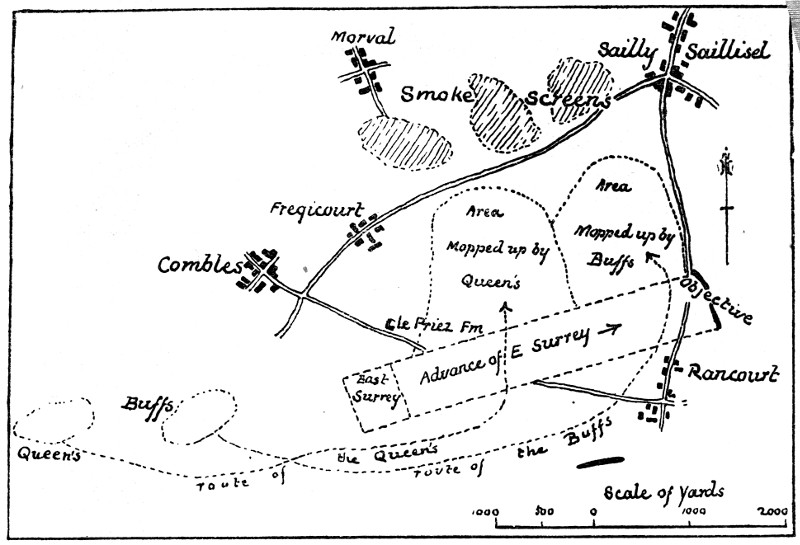
COMBLES AND MORVAL
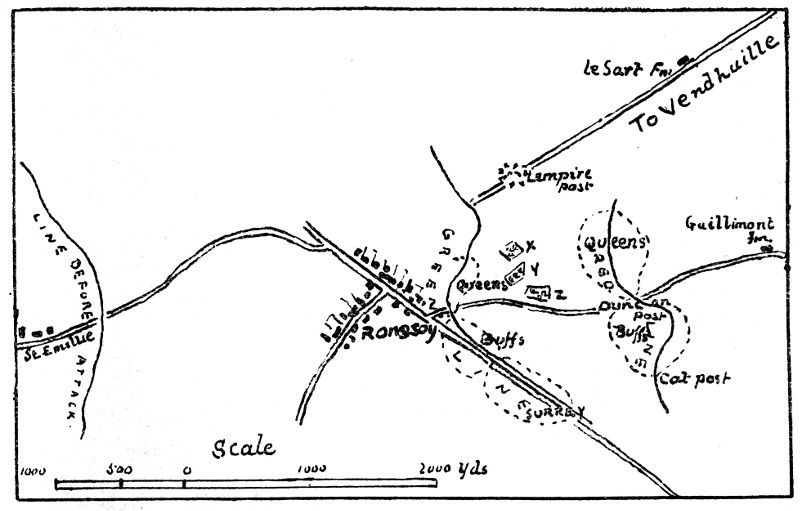
RONSSOY
The 37th Brigade passed through the 35th with the 6th Buffs on the right and West Kent on the left. The 9th Battalion of the Essex were attached to the Buffs and the 6th Queen’s to the 6th West Kent. The objective of the brigade was a line just west of the St Quentin Canal. The zero hour was 5 a.m. when, after a short artillery barrage, the forward move was commenced, the Buffs having A Company on the left, B on the right, C left support and D right support. Owing to the very strong resistance of the enemy, mostly by means of machine guns, the progress was rendered very slow, but at 8.45 the Buffs reported all going well, and at 9 o’clock the Americans were on all objectives. As the canal was approached the opposition became stronger, and this was particularly so at the Quarries, which fell to the lot of the Buffs to take. Indeed, at 10.30 the battalion had to report its left company as being held up here. However, delay was the worst misfortune that befell; gradual advance was made and the objectives were at length reached about 5 p.m. and consolidated after really stubborn fighting, which lasted all day without a break. The Buffs were, however, the only unit of the division that had attained the Blue Line. They captured 120 prisoners and about 40 machine guns, but lost Lieut. H. Thompson killed, Lieut. Dunkerley wounded, 2nd Lieut. Beard missing and about 40 killed or wounded.
The following day the battalion, working forward, reached the canal bank, having picked up four prisoners on the way, captured a 77-mm. gun and bombed many of the enemy’s dug-outs.
The 12th Division was then relieved by the 18th, the 6th Battalion marching back to Guyencourt, while the 7th, who had marched off at 8.20 a.m. on the 29th and, moving south of Epehy, crossed the Epehy-Ronssoy road into St Patrick’s Valley, where it halted about 10.10 a.m. Orders were then received to push on into the Macquincourt Valley to a position of deployment, but trouble came now and the further movements of the newly arrived battalion of the Buffs and others were altered more than once by varying circumstances, the end of the day coming without any marked episode, and evening finding the men in Sart Farm and the neighbouring trenches. The Buffs had moved forward according to order, following the 7th Queen’s, and these were held up by enemy’s machine guns near Guillemont Farm. Further movements not being possible, orders came to occupy an area of trenches in the neighbourhood. An abortive attempt at attack on the Knoll was commenced soon after one o’clock, but the situation was found to be too obscure and the fire too hot to advance against, so the brigade settled into the trenches for the night. During the morning of the following day an officer’s patrol from A Company pushed on and established a post in Macquenet trench, and orders came about 1 p.m. to make all progress possible in the direction of Vendhuille, so by 5 p.m. A Company was established in Macquenet trench, losing its leader, Lieut. A. N. Widdop, while moving there, and B and C well forward; but at night the battalion position was taken over by the East Surreys and the Buffs were placed in brigade reserve, and on the 2nd October were taken away to Contay, some ten miles west of Albert, for a fortnight’s rest and recreation, which of course included training.
An endeavour has been made to trace the history of the 6th Battalion and the 7th together from the capture of Albert to that of the Hindenburg Line at Vendhuille, that is from the 22nd August till the end of September, because during that very strenuous and historic period the 12th and 18th Divisions, to which the Buff units respectively belonged, were working hand in hand, supporting and relieving each other and so on, but from the 1st October till the end of the war the 6th and 7th were far apart again; the former, together with the whole division in which it was serving, was transferred to the 1st Army very early in October, and therefore the area of their activities was no longer identical, and the 6th Buffs were at Rumegies, ten miles south of Tournai, when the war came to an end; while the 7th celebrated that event at the village of Pommereuil, not very far from Le Cateau. It will therefore be convenient now to complete the war story of the 6th Battalion and then consider that of their comrades of the 7th.
IV. 6th Battalion
On the 1st October, then, the 6th Buffs proceeded by bus and by march route into billets at Caucourt, which village may be about twelve miles or so north-west of Arras, but rest here was for an extremely short period and the 6th of the month found the battalion in buses again for Avion, from whence it marched into trenches at Mericourt, just south-east of Lens. This region was not yet clear of the enemy, who had been driven back since August considerably further in some directions than in others. The old and familiar machine gun was soon heard again, therefore, and they were very active the day after the battalion arrived, and the usual patrols which went out in front experienced also their fire on the 8th. However, these patrols established themselves at Molly Villers, a thousand yards in front of our own line, being relieved by the West Kent soon afterwards. On the 13th the 6th Royal West Kent advanced from Mericourt to the Drocourt-Queant trenches, and they had the Buffs in support during the move which brought both regiments into this line for the night, the Buffs’ headquarters being at Floquieres. At this time there was a certain amount of movement occasioned by the readjustment of the larger commands preparatory to a grand processional march towards the east; the enemy was at his last gasp, so to speak, and there was no longer any very strenuous opposition. The 37th Brigade ultimately concentrated at Auby on the 18th October and the advance commenced the next day, the units taking turn to lead and encounter any opposition that might have been organized. Thus the West Kents led off and the Buffs followed, the first day taking the brigade to Flines. On the 20th the Buffs led and advanced as far as Beuvry, arranging the front line at Orchies-Beuvry. This was a very satisfactory day, because the Buffs were able to set free hundreds of unfortunate civilians who had been in the power of the beastly Germans, who, of course, had not actually evacuated the country which was now being passed over. There was always an attempt to sting during the great retreat, even if no regular resistance was made. Thus a soldier was killed on the way to Beuvry, and 2nd Lieut. Roper-Curzon and four men wounded.
On the 21st the Queen’s led the way, and the West Kent, being in front on the 22nd, reached the banks of the River Scarpe, where it was found that all civilians had been released by the retreating German. On the 23rd, when the Buffs were in front, a little more opposition was met with, in so far that a fairly strong machine-gun fire was encountered at Cubray; but this was successfully dealt with, heavy casualties inflicted on the enemy and several prisoners taken. During the night the Buffs rushed what was in front of them and established themselves in Haute Rive. Captain H. Hunter, M.C., and nine men were wounded on this day, the success of which was marred by the death on the same day of the gallant captain from the result of his injuries.
The enemy were making a better stand now than had been the case during the last week, and on the 24th it was found that the villages of Bivridon and Bruille were strongly held. Nothing however at this time, when success had been ours for days, was at all likely to stop the British dash. The Buffs attacked at 9 a.m. and so rapidly and unexpectedly that the enemy was taken by surprise during his breakfast meal and utterly discomfited, so that our line was established upon the River Escaut, after capturing some prisoners, four machine guns and two trench mortars, the Buffs being the first on the whole Corps front to reach that stream; but they lost 2nd Lieut. J. D. Thornley, M.C., and one man killed, Captain Kidd, M.C., Lieuts. Fiske and Hoskyn, 2nd Lieut. Foreman and sixteen wounded.
The General Officer Commanding the Army Corps appreciated the work done on the 24th, for he sent a message to the 12th Division: “Please convey to the officers, N.C.O.’s and men of the 6th Buffs my appreciation of the well-thought-out plan and good organization and fine offensive spirit that led to the capture of Bruille on the 24th of October. It is an operation that reflects great credit not only on all who took part in it, but also on the brigade and the fine division to which they belong.” Thus this good and glorious battalion finished up their war history, for it was its last action. Very few old officers of four years back, not even perhaps Colonel Eaton himself, could have thought it possible to manufacture and train a new fighting unit, even though that unit bore an ancient and honourable name, that could do the deeds that the 6th Buffs had done, not once or twice, but over and over again, and could earn at the last such an eulogy from an experienced general as is quoted above.
The battalion now moved back in support and ultimately found itself in billets at Coutiches, where it remained till the 10th November, on which date it marched to Rumegies, so that it was at this latter village that Armistice Day was spent. The great news came through at 10 a.m., and at 11 o’clock, the hour of cessation of hostilities, a thanksgiving service was held in front of battalion headquarters, the commanding officer and the padre both addressing the battalion, which then marched through the village with its drums beating and the men singing at the top of their voices. On the 14th of November Captain Gullick, M.C., 2nd Lieut. Ayres and forty men formed part of a guard of honour for the Army Commander on the occasion of his entering Mons accompanied by H.R.H. The Prince of Wales. On the 25th the battalion moved south-west to Auberchicourt, there to be quartered, the time being taken up with salvage fatigues and the soldiers kept fit by means of running drill. Christmas Day was properly and religiously kept, and for once the stereotyped wish of the season contained some sense in it. The interval between the great peace day and the end of the year brought some honours to the 6th Battalion which were awarded at different dates. Thus Sgt. and Acting C.S.M. J. Smith obtained a bar to his M.M., and Sgt. Sparks and Corpls. Mount and Penfold were given that decoration itself. Captain Gullick was awarded a clasp to his M.C., Lieut. Fiske got the M.C. and Pte. Mitchell the D.C.M. L.-Corpl. McDonald a little later headed a batch by virtue of a clasp to his M.M., and the following got that coveted decoration for the first time: Sgts. Fisher, Latter, Odell, Pennell, Shelley and Smurthwaite; L.-Sgt. Knappett; Corpls. Allbright, Buxton, Holman, Miller, O’Rourke and Williams; L.-Corpls. Istead, Richardson, Soulsby and Stobart; Ptes. Brazier, Jones, Setchfield, Smithers and Wise. Also at the end of the year Lt.-Colonel Smeltzer, D.S.O., M.C., was again mentioned in despatches, as was Corpl. Pilcher.
V. 7th Battalion: The Selle, etc.
The story of the 7th Battalion for October and afterwards is as follows: on the 16th October, when the well-earned fortnight’s rest was completed and the unit fit and ready again, it was taken by train to Roisel and marched to Templeux la Fosse, moving on again on the 18th by familiar Ronssoy to Beaurevoir, and after a night in billets there to Elincourt, where the men were interested to find civilians once again. It was really wonderful how the brave French peasants, both men and women, clung to their homes. On the 21st to Maurois, four miles further on, where at last hostile signs were met with once more, shells coming over and bombs arriving per aeroplane at night time. The next day took the brigade to Reumont and the concentration area west of Le Cateau.
The 3rd Army was now engaged in important operations in the strip of country to the immediate north of the region awarded to the 4th, of which the 18th Division now formed a unit, and on the 23rd October it fell to the lot of the latter army to attack for the purpose of protecting the major operations to be carried out by the former. The country now forming the theatre of operations was widely different to the Somme Valley and other parts to which the troops had become so accustomed. The numerous hedgerows and ditches affected the style of attack and defence. The arrangements for the attack by the 18th Division on the 23rd October, which formed part of the battle of the Selle, were made with most elaborate care. The area over which the advance was to take place was most exactly divided into portions with an objective at the further end of each portion and, of course, troops detailed to take each objective; moreover, each piece of ground was to be gained by a certain time and each halting place left for further adventure exactly so many minutes afterwards. (See diagram on next page.)
The 53rd Brigade on the right, with the 54th, less the Northamptonshire Regiment, on the left, were to make good the first and second objectives, and the 55th Brigade, with the Northamptonshire and certain details, were to capture the third, fourth and fifth. The 55th and Northamptonshires’ attack was arranged to be carried out leap-frog fashion, so that the ground between the second and fourth objectives was to be made good by the Buffs and East Surreys, the latter being on the right. The advance was not to be covered by a creeping barrage, but was to be proceeded with at the regular rate of one hundred yards in four minutes, and no one unit, if instructions were carried out, could ever find itself unsupported by another through advancing too fast. This leap-frog system of advance obtained even amongst battalions. At any rate, the Buffs arranged that C Company on the right and B on the left should be responsible for the ground from the second objective to a certain line, where A and B should pass through them bound for the fourth objective, at which the Northamptonshire would leap-frog the Buffs and go on to the end. A section of machine guns and one trench mortar was with the battalion reserve and a section of tanks in the immediate rear; the idea being that any company getting into trouble was to apply to the commanding officer, who would send tanks to its aid. Communication was carefully arranged with the accompanying aeroplanes. The zero hour was 2 a.m.
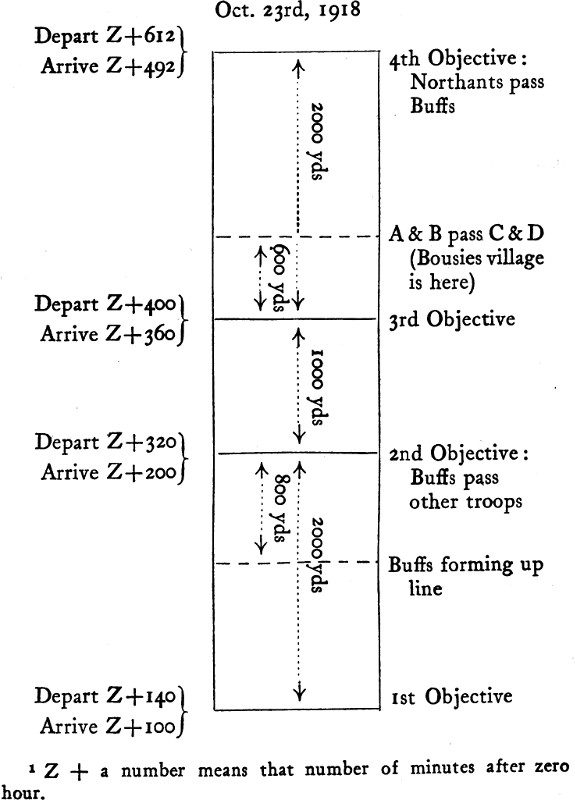
DIAGRAM OF ADVANCE OF 18TH DIVISION AT BATTLE OF THE SELLE[33]
The Buffs arrived at their assembly position at 4.15, suffering fifteen casualties from shell fire on the way. At five they moved in artillery formation towards the forming-up line. Before reaching this the leading companies came under heavy machine-gun fire from the right flank, the brigade in front having only established the line of the first objective. This little trouble, however, was obviated by our aeroplanes dropping bombs on the machine guns. The second objective was passed at 8 o’clock, or forty minutes late. D Company (Captain E. V. Morse, M.C.), on the left, cleverly outmanœuvred and captured a battery of guns, but soon afterwards the captain was killed. He had ably led his company and dealt with many difficult positions. C Company also captured its battery, but, after passing the second objective, the enemy’s opposition stiffened and a great deal of machine-gun fire came from the village of Bousies. However, at 10 o’clock the leading companies were close up to the third objective, which, by the way, should have been reached four hours earlier. At twenty minutes past ten a message was dropped from the air: “Huns still in Bousies. Our boys in eastern part ‘mopping up.’ Huns’ transport just galloped from village.” Ten minutes later Colonel Curtis ordered Captain Whitmarsh to take command of all troops in the battalion sector and endeavour to establish the Green Line, or third objective. At 12.30 the officer in charge of tanks reported that he had been in the village of Bousies with A Company (the right support) and that he had left that company there “mopping up” the village. At 2.40 p.m. all the Buffs’ companies were on a road which is beyond the point where B and A Companies were to relieve the other two. The battalion was in touch on their right, but its left flank was exposed, though patrols were busy in this direction, and these soon reported that the 2nd Argyll and Sutherland Highlanders, though in rear of the Buffs’ position, were pushing forward. A and B Companies were then directed to hold the road, with the others in close support. Heavy machine-gun fire was experienced from the high ground a little distance in front. At 6 o’clock A and B moved forward and made good their objective by 7.15, and an hour afterwards were relieved by the Northamptonshire Regiment, the Buffs going into brigade reserve. Great credit was given in connection with this day’s work to the accompanying tanks under Lieut. Grey, who very fearlessly reconnoitred to the front and dealt with the machine-gun difficulty.
During the afternoon of the following day the Buffs moved into positions in Bousies and there formed a line of resistance. While still in this village on the 25th a report came in that the right sector of the brigade was withdrawing and C Company was pushed forward to deal with any possible German counter-attack, but found the battalion of the Queen’s alert for that duty. The Buffs relieved the East Surreys on outpost duty. On the 26th the brigade on the left made a determined effort to gain ground, but without much success, owing to the usual machine-gun fire. The next day the Buffs became divisional reserve in billets in Bousies, but were back again in forty-eight hours.
There was a considerable pause in the proceedings after the fight just recorded, and no further advance was made until the 4th November, the brigade taking its turn with the others both in the front line and in the trenches, but never very far from the village of Bousies. For the above-mentioned date, however, another blow had been planned. The enemy was despairing and discouraged, but must not be given too much time in which to pull himself together. The task set was very similar to that of the 23rd October. The 53rd and 54th Brigades were first to capture Preux and Hecq and get into the western part of the Mormal Forest, which is a very extensive one, but easy to pass by reason both of the numerous roads and paths and by the absence of thick underwood. After this the Buffs and Queen’s were to pass through at a certain fixed hour. For this purpose Bousies was left at 8.15, two hours after zero, and a sunken road west of Landrecies reached after a few shell casualties had been suffered by the way. Here the headquarters of a Bedfordshire battalion informed the Buffs that the attack on the left had developed satisfactorily; but the 54th Brigade on the right, having come up against strong nests or pockets of hostile machine guns just west of Preux, had made but poor progress through the orchards on its line. Owing to this the 10th Essex had been unable to reach their forming-up position, and as it was the Buffs’ job to pass through this 10th Essex they were, of course, looking out for them. The officer commanding the Buffs therefore decided not to proceed till the Essex had got on a bit, but put his battalion for a while into the trenches with the Bedfords, and sent on patrols with a request to be kept informed of the movements of those they were to relieve. At last, at 12.50, orders came to advance gradually and an hour later to push on with speed to the third objective, and so, after passing Preux, the Red Line was reached at 3.40 without further incident. After the morning’s first stubborn resistance the enemy had, as a matter of fact, retired hurriedly through the forest and put up no further fight. At 10.50 at night orders came to continue the advance at 6.30 in the morning, and at that hour the 8th East Surrey started as divisional vanguard, the Buffs following at the head of the main guard. Very little resistance was met with, and the final objective, the bank of the River Sambre at Sassegnies, was gained about noon.
At 7.50 a.m. on the 6th the 55th Brigade was by arrangement squeezed out, as it was termed, and so had finished its long fighting record. The Buffs marched back to Preux tired and very cold and wet, for the weather throughout these operations had been bad. The 8th of November took the battalion further back to Pommereuil, and there, as nothing must be left to chance, immediate reorganization and making up of deficiencies was commenced. Then came the armistice and with it the finish of the war record of the 7th Battalion of the Buffs, a record which is comparable with any battalion in the army and which includes the First Battle of Albert in 1916, the Battle of Bazentin Ridge, Thiepval Ridge, the Ancre heights, the Battle of the Ancre, the Battles of Arleux, of Poelcappelle, St Quentin, Amiens, Second Battle of Albert in 1918, the Second Battle of Bapaume, the Battle of Epehy, Battle of St Quentin Canal, the Battle of the Selle and the Battle of the Sambre.
There is not much to record for the remainder of the year. The 7th Buffs was not one of the units told off to move into Germany on the 13th November; it went into billets at Elincourt, and on the 17th there took place a brigade thanksgiving service. Then a great deal of salvage work was done, as was the case with most corps. On the 4th December His Majesty The King came to Elincourt and passed on foot between the rows of his soldiers. On the 12th of this month the battalion moved to Mallincourt, and five days later came a most unfortunate occurrence, which strikes one as particularly bad luck after the armistice had been concluded only a month or so. During salvage operations a blind shell exploded, killing seven men and wounding twenty, as well as four more who, being only slightly injured, remained at work. There was a distribution of medals, etc., to the Buffs and East Surreys on the 23rd December.
VI. 10th Battalion
The great Allied advance to victory began with our 10th Battalion near St Floris, which is seven miles south of the town of Hazebrouck. This unit and the 74th Division, to which it belonged, was part of the 5th Army, whose area was considerably north of the country in which the 6th and 7th Battalions operated. During the very strenuous and important month of September, however, the division went south to the 4th Army where the others were, and there saw fighting at the Battle of Epehy before it returned to its regular area and wound up its military experiences at Tournai in November.
The advance, as far as the 10th was concerned, commenced on the 6th August, for on that date an attempt was made to push forward. The brigade on the right succeeded, but, owing to considerable opposition, the Buffs were unable to do the same except on their right, where B Company threw out three posts to keep in touch with the 16th Devons. The battalion had one man killed and three wounded. The next day, however, C and D Companies got ahead with but little trouble, and on the 8th a further advance was made. The companies in front were now B and C, and they went forward about one thousand yards and crossed the enemy’s trenches. This progress might perhaps have been continued had other parts of the British line in the neighbourhood been equally successful. Next morning, the other two companies being in front, the advance started again, but A Company was somewhat heavily counter-attacked on its right flank, which drew back to maintain touch with the 229th Brigade on its right, which was stationary. However, at 7 o’clock D and A Companies got on to the west bank of the River Lys and would have crossed had not all the bridges been destroyed. The crossing, in fact, had to be delayed till the Royal Engineers brought up three bridges, which were quickly in place, and then the infantry dug themselves in on the far bank. The Buffs had six killed and Lieut. Atkinson and thirteen wounded.
Patrols, working to the front, soon discovered that the Germans, armed with many machine guns, were prepared to dispute any further progress, so that an effort made at 9.30 p.m. on the 12th to get forward had to be a properly organized one. It was extremely dark and the ground all shell holes and irregularities, so that the attempt to advance was a failure, though it was the means of ascertaining that it was a considerable force to which our people were opposite and not merely a small rear guard, mostly consisting of machine guns. The battalion had three killed and seventeen wounded, one of whom died, and seven missing.
On the 14th the Buffs were relieved and became supports, and two days afterwards occupied a reserve line just outside St Venant and facing east-north-east. Here the men set to work on the reserve trenches and remained at this job for a week. Soon after this the 10th Buffs entrained at Lillers for Heilly, and by the end of the month the 74th Division was down with the 4th Army in the Somme Valley, the Buffs on the 31st August being at Maurepas, near Combles. It will be remembered that this was the day first arranged for the fight round Fregicourt, which was, however, postponed for twenty-four hours; it was in this fight that the 7th Battalion took so prominent a part in cutting off the Germans who tried to defend the Morval position on the 1st September.
It was on the 2nd of the month that the 74th Division made their attack and the scene was just south of Moislains, some four miles from the other battlefield. The 229th Brigade, aided by one battalion of the 230th, made the attack. It failed to reach the objective, the machine-gun fire being too heavy. The Buffs were in reserve in a valley to the south-west of Moislains and were heavily shelled all day with high explosive and gas; two men were killed and Captain Vickery (the doctor) and twelve men wounded.
The enemy’s rapid retreat did not commence till the 5th of the month; in the interval the 10th Buffs had, on the 3rd, moved into the front line, 2nd Lieut. Onions being on that day wounded by gas shell. The battalion had what was called the Midenette trench in front of it, and this was reported to be occupied by Germans; but on the morning of the 5th two platoons of C Company, pushing forward to keep touch with the 47th London Division on the left, captured the trench without much opposition, and at 6 p.m. the battalion advanced, captured another line and tried to get on still further; but the usual machine-gun opposition began to get heavy and the whole line remained for the present along the Peronne-Cambrai road. The next day the advance continued and with rapidity. The battalion started at 8 a.m. with D and A Companies, C in support and B in reserve. At 3.45 p.m., finding that the 47th Division on the left had dropped behind, and having passed through Templeux la Fosse and reached Longavesne, a halt was called, an outpost line arranged and a defensive flank formed for security till the Londoners arrived. Three men were killed and twelve wounded this day.
On the 7th September the 230th Brigade was relieved in the front line and became reserve to the division, in which capacity it remained for a couple of days, taking a forward place again on the 10th of the month and passing, on its way to do so, the village of Villers Faucon. The ensuing little tour of four days before going into reserve again at Longavesnes was more or less uneventful, for heavy and consistent shelling can hardly be termed an event. During this short time Lieut. Mathews and 2nd Lieut. Jackson were wounded, two men killed and sixteen wounded, one of whom died.
On the 16th September the battalion moved into the Faustine Quarries, ready for a further advance. The rain was heavy, and gas and high-explosive shelling were heavier and aeroplane bombing very severe. Having taken its place in the front line on the 17th, the 10th Battalion next day took its share with the 1st, 6th and 7th Battalions of the Buffs in the Battle of Epehy. The 74th Division on the opening day of this fight was more immediately successful than the 12th or 18th, which units, it will be remembered, met with considerable opposition about Epehy and Ronssoy. The 15th Suffolk and 16th Sussex were to lead the way up to the first objective and the whole began to move up very early in the morning, which was an exceedingly wet one. A pitched battle on French soil was a novelty for the 10th Battalion, and the severity of the opening barrage impressed the men considerably. The German opposition in this part does not appear to have been quite as resolute as at most points in front of the Hindenburg Line. At Templeux le Guerard there are some quarries where pits, refuse heaps and holes and corners generally, offer an exceptionally good position for defence, but these were soon given up, as the Suffolk and Sussex, with the Buffs and Somerset in close support, came resolutely on; these quarries were passed and the Hargicourt trench, which was the first objective, taken without a check at 8 o’clock. Here half an hour’s breathing time was given and then the advance resumed; this time with the Buffs in front, the next objective being what were called the Zogda trench and Rifle-pit trench another mile away. Success continued with the division. The artillery barrage was perfect and the infantryman’s confidence in it supreme, which is exactly as it should be. The enemy’s machine guns presented difficulties, and indeed held up the oncoming line for a little while, but at noon, or soon after, the Zogda trench was ours and a short further advance commenced. But now the trouble which was being experienced at Epehy and Ronssoy began to make itself felt; the stoppage of the 18th Division prevented the left brigade of the 74th getting on, so there was a check all along the line, which extended to the Australians on the right of the Yeomanry Division. About 5 p.m. Very lights were put up on the left of the division, which meant that a counter-attack was expected. This drew our own barrage which came down along the line of the second objective. The Buffs, with others, being by now about three hundred yards in front of this, were very much in the way, and an immediate withdrawal into the Zogda and Rifle-pit trenches was the result. An enormous number of prisoners and considerable booty had been taken. Indeed, many Germans seemed most anxious to come in and so end their fighting days. Captain H. L. Allfrey, 2nd Lieut. E. G. Porter and ten men were killed this day, forty-eight wounded and two missing. The Buffs remained in their captured trenches for a couple of days and were under a good deal of shell fire. In fact, eight men were wounded on the 19th.
The next advance was arranged for the 21st, the objective being about 1,200 yards in front of the Zogda trench and up-hill towards Quennemont Farm. At 5.40 a.m. D and C Companies formed in front line, with A in support, and advanced to take the Blue Line. The country to be crossed was like an old-fashioned glacis, very bare of cover and of a more or less regular slope, the summit of which was well protected by wire and full of machine guns. The Australians were on the right, then the 230th Brigade and on the left, but a little in rear, the 231st Brigade. The start was made behind a barrage, almost before it was light, and was successful enough in so far that regular progress was made until the day broke, when the assaulting troops got among thick belts of wire near Zoo trench, which, of course, checked the infantry while the barrage went on. A few men got through the wire, and then the enemy emerged from his dug-outs and commenced a tremendous fire of shells and machine-gun bullets. C and D Companies, which were in front, could do nothing but take cover in shell holes, wait and hope. The supporting A Company was just as badly off as C and D and could not move, and troops on the left fell back before a counter-attack, so that the Germans who made it were, in the nature of things and merely as a result of their success, now threatening the Buffs in rear and the battalion was in a tight place; the telephone was disconnected, no movement was possible, and, though two gallant runners got back with a report of the situation, both men being wounded over their job, no message could come up from behind to the forward companies. The troops on the left took up a new line parallel to the Zogda trench, and when darkness fell the Buffs managed to get back in small parties to this shelter, having lost Captain C. E. Hatfield, M.C., 2nd Lieut. H. A. Oxley and 12 men killed, Lieut. Turnpenny, 2nd Lieut. Hoare and 58 wounded, Lieut. Wilkinson and 6 other ranks “wounded and missing,” also 20 more “missing.”
After this action the battalion, being relieved by the 15th Suffolk on the following day, remained in reserve under intermittent shell fire till the 25th, during which period three more men were killed and four wounded, one of whom died. The authorities now decided that the 74th Division would again be required in its own army, so, after being relieved by American troops, the Buffs entrained at Peronne for Villers Bretonneux, and again on the 27th at Heilly for Lillers, from whence the battalion marched to billets at Allovagne and remained there refitting and so on till the end of the month. The total casualties during the fighting epoch of the month of September were very considerable, namely, 11 officers and 218 men killed, wounded and missing. Previous to his death Captain Hatfield was given the M.C. for his share in the business, and eleven men the M.M., namely, Sgts. Denton and English, Corpl. Dunn, and Ptes. Dennett, Dier (both of whom died), Forscott, Hibbs, Mather, Sidwell, Sutch (R.A.M.C.) and Willis; and Captain Haughton, M.C., was mentioned in despatches.
On the 1st October the Buffs relieved the 9th Royal Welch Fusiliers in the Richebourg sector, advancing to the front line just west of Lillers next day. This was the commencement of a slow but certain push eastward on the part of the 74th Division, and indeed of the army to which it belonged. There were many delays. The roads and bridges were destroyed by the retreating foe, and a delay caused to one unit on account of either these reasons or by a hostile rear guard meant a check to the whole movement, for the German resistance was not so wholly broken down as to render it wise or safe for the pursuers to break their line by pushing one body of troops in front of another. Sainghin was reached on the 3rd October and there ensued a halt for some days, chiefly because the 55th Division on the right was stayed by the La Bassee Canal. The enemy refused to allow this halt to be a quiet one, and the troops were shelled pertinaciously and thoroughly. The Buffs took their turn in front line and in support and, when in the former, sent out many patrols; in fact, patrolling at this time was kept up both by day and by night, as it was of the utmost importance to keep in touch with the enemy. These parties were able to discover some of the hostile machine-gun nests, and on the 9th of the month our artillery was able to deal with several of these which had been located.
On the 15th the forward move was resumed and the patrols pushed through Rosoir. On the 17th, the Suffolks leading and the Buffs following, Emmerin was reached at 12.10, and the Buffs, passing through, pushed onward in the afternoon towards the road east of Faches, for the division was to pass to the southward of the great town of Lille. Owing to the darkness, progress after leaving the Suffolk was slow and the road was not reached till 6.30 a.m., after which posts were established slightly to the east of the roadway. This country had been for four years in the possession of the Germans, and it is impossible to describe the joy manifested by the French inhabitants at their release at last from their horrible servitude. The Buffs never experienced, nor are they likely to again, such exuberant tokens of welcome and gratitude as they met with in the neighbourhood of Lille. The Frenchman feels very deeply indeed, and he is a demonstrative man. The march continued, every day adding a few miles to the completed journey, and on the 24th the Buffs were at Marquain, only three miles west of the city of Tournai. Here it became pretty evident that the enemy intended making a stand. The shelling, both gas and high explosive, became very severe; night patrols met with heavy machine-gun fire and in every detail resistance was stiffening on the line held by the Germans between our front and the city. Hertain, Marquain and Orcq are all villages just outside the western edge of Tournai, and all these were occupied by the English during the last few days of October, and up till the 7th November the Buffs were first in one and then in the other, according to the nature of their duty as front-line troops or reserve. The brigadier-general commanding inspected the 10th Battalion of the Buffs on the 4th November just as if they had all been at Aldershot, and he took that opportunity of presenting the M.M. ribband to Ptes. Mather and Sidwell. The battalion made a very smart appearance on parade, for the men were ready to enter Tournai and this was not to be done in a slovenly, untidy manner. On the 8th came news that the enemy had withdrawn, and the Buffs, moving up at 11.15 a.m., made a grand entry into the Faubourg de Lille well groomed and turned out and with the band playing triumphantly. All went very well up to a certain point, and then machine-gun fire from the town itself commenced. The German was not so far off, after all, so the march was stayed and all was war again in so far that street fighting continued during the night. The British intelligence might have been somewhat at fault when the Faubourg de Lille was entered in parade style, but it was only a little premature. The German rear guard quitted the place next day, but, of course, blew up all the bridges over the Scheldt. The Germans evacuated the city of Tournai only on the 9th November, and the very next day it was entered by the good King Albert of the Belgians, who was accompanied by his Queen. They came to congratulate their faithful people on their release from German thraldom which had oppressed them for so long.
The next day was the 11th November and at eleven o’clock in the morning there was no more war in France nor Flanders, and the Yeoman of Kent had done his work even if it was not done on horseback. The 10th Battalion was, on receipt of the great news, in the Faubourg de Lille. At 11.45 it marched through Tournai and moved away to the eastward, halting at Montreuil au Bois and Herquecies till, on the 14th of the month, it reached Barry, where it remained for nearly a month. During the operations which culminated in the capture of Tournai and which ended in the armistice, the Military Cross was awarded to Captain J. I. H. Friend and the Military Medal to Sgt. Rudman and to Pte. Hale. The casualties were 2 officers and 18 men killed, 2 officers and 71 men wounded.
On the 7th December a visit was received from His Majesty King George. It was, at his own request, a very informal affair. The men were drawn up on each side of the Tournai-Leuze road just outside Barry, and the King walked quietly down between them, but the welcome he received was one which it is pretty safe to believe was pleasing to our monarch.
The demobilization of such of the men as were miners commenced on the 10th December; but the total dispersal to their homes of an army the size of the British one at this period is a long and tedious job.
VII. 1st Battalion
We left the 1st Battalion in the Malin House area in the vicinity of Dickebusch. It did not immediately take part in the great triumphant and final push, and indeed its history up to the middle of September is not so exciting or full of incident either as that of the sister battalions or as certain periods of its own recent history. It remained in the neighbourhood of Dickebusch, taking its turn in trench work, till the 23rd August; during this period two American companies were attached for a few days, which not only gave our men the pleasure of making new and interesting friends, but was a tangible proof that matters were going well and a successful end to a very awful and strenuous existence fairly in sight; during August, too, came the news of honours, which is always pleasant. First Sgt. Hills got the M.M.; then 2nd Lieut. Lister the M.C. The D.C.M. fell to Sgt. Ayres; and on the 19th there was news of the M.M. for Corpl. Swaine, L.-Corpl. Voyle, and Privates Cook, Dockerill, Lovesey, Stapley and Whiskin.
On the 23rd August the 16th Infantry Brigade was relieved by the 106th American Infantry Regiment and withdrew for training into the St Omer area, the training consisting of the practice of open warfare, and on the 1st September a long railway journey, which was completed next day, took the Buffs with the others all the way to Heilly (between Amiens and Albert). The 16th Brigade spent nearly a fortnight in this neighbourhood, first at Bonnay and then at Fouilloy and Aubigny; and so it was not till the 14th, or five weeks after the British offensive had begun, that the first brigade move was made to Montecourt, the Buffs going to Trefcon, a few miles west of St Quentin. On the 17th the battalion moved to St Quentin Wood and into the battle line after dark, Captain Morley being wounded.
The 1st Battalion, like all the other Buffs in France, was now in the 4th Army, which, as we have seen, was busily engaged in pushing on and fighting its way from Albert to the Hindenburg Line. On the 8th September and following days was fought the great and prolonged Battle of Epehy, the limits of which battle area is officially given as extending from St Quentin (exclusive) to Villers Plouich, a distance of nearly twenty miles as the crow flies. Sir Douglas Haig in his despatches makes use of the words: “Next day at 7 a.m. on the 18th September the 4th and 3rd Armies attacked in heavy rain on a front of about seventeen miles from Holnon to Gouzeaucourt, the 1st French Army co-operating south of Holnon”; and a little later on he writes: “On the extreme right and in the left centre about Epehy the enemy’s resistance was very determined, and in these sectors troops of the 6th, 12th, 18th and 58th Divisions had severe fighting.”
The country over which the 16th Brigade and its immediate neighbours were working during the battle of September may briefly be described as follows: Three miles or so west of St Quentin is a large wood called the Holnon, but sometimes described as the St Quentin Wood. St Quentin itself is commanded to the west and south by high ground; the Hindenburg Line ran just outside this town to the canal at Bellenglise. Holnon village lies in a hollow commanded by Round and Manchester Hills, which latter height lies in the area that was allotted to the French. From the east edge of the wood the ground is a bare slope rising to the high ground overlooking St Quentin. At the highest point and opposite where the centre of the 6th Division was to attack was a network of trenches called the Quadrilateral, which could be reinforced unseen from the enemy’s side of the hill. It was expected that the Germans would stand on the heights commanding St Quentin, but they were reported as being much disorganized and that resistance might not be very obstinate.
The 1st and 6th Divisions, in co-operation with the French, were to capture, on the 18th September, a starting-place for the assault of the Hindenburg Line, and to do this the 11th Essex had, on the 16th, after tremendous effort, secured trenches clear of the Holnon Wood for an assembly position, while with the same object the West Yorkshire had endeavoured to secure Holnon village, but had only gained a part, because the French on the right had failed to take the hills. This failure had its effect on the forming-up arrangements of our troops, as had the fact that the Holnon Wood had become almost impassable from gas shells and wet weather, so much so that the 16th and 71st Brigades had to move round to the north and south of it to get to their places. This fatigued the troops and rendered communications difficult. There was not much time for reconnaissance, for the advance had to be timed in accordance with the movement of the troops to the northward. So on the afternoon of the 17th the 16th Brigade concentrated west of St Quentin Wood preparatory to forming up the next morning. The 18th Brigade had attacked at dawn on the 17th in order to capture the starting-place for the later date, but without success. It was at 6 p.m. that the brigadier of the 16th went out with the commanding officers of the Buffs and the York and Lancaster and chose assembly positions.
On the morrow, with the 71st Brigade on the right and the 16th on the left, the 6th Division attacked the Quadrilateral, being the point where the two joined, and the left of the 16th Brigade being on Fresnoy le Petit. Zero hour was at 5 a.m., the barrage started and the York and Lancaster Regiment moved to the attack. The Buffs were at the north edge of the wood and the objective was south of the village of Gricourt. The York and Lancaster were to capture a line east-south-east of Fresnoy le Petit, and then the Buffs and K.S.L.I. to pass through to their objective. Two tanks were taken to assist the attack, but one failed to start, and the other, after being seen going through Fresnoy le Petit, was never heard of again. At 6.40 the York and Lancaster were reported on their objective, and A, B and C Companies of the Buffs, who had already advanced some distance and suffered a little from shell fire, prepared to play their part. At first they lost direction somewhat owing to the darkness and rain, and then discovered that the satisfactory report about the York and Lancaster Regiment was not quite accurate and that the whole of its objective had not been reached; so that the left company of the Buffs had been held up by machine guns from Fresnoy le Petit, and the support company, after reaching the outskirts of the village, had had to withdraw somewhat. All these causes prevented the remainder of the Buffs with the K.S.L.I. from advancing beyond the position gained by their comrades. Nothing could be heard or seen of the 71st Brigade, which should have been on the right, so this flank was exposed and D Company the Buffs had to be placed on guard there. By evening the different events of the day, together with the difficulty of maintaining direction in the early morning, had completely mixed up the units of the 16th Brigade so much so that the immediate unravelling seemed almost impossible, and the senior officers at various points had to collect all troops in their immediate vicinity and take command of them, thus forming temporarily three composite battalions wherewith to carry on. The 1st Buffs lost 6 officers and 150 men killed and wounded on the 18th.