Chapter XIV · HOLDING ON
Reading edition
I. Preparations
It has been noticed that the great German offensive had been foreseen by our commanders long before the storm actually broke. The transfer of German divisions from their Eastern to their Western front began as early as November, 1917, and it was known that the Russian guns and munitions were at our enemy’s disposal. In fact, it became a question of the French and English holding their own till the Americans could make their weight felt, and thus the war was for the present to be a defensive one and all preparations were made to this end. The defensive area or belt was divided into the forward, the battle and the rear zones, and each of these was carefully chosen; but there was a tremendous amount of work to be done in the way of preparing the ground to be defended, as well as the construction of roads, railway lines and so on. The men, too, required much, training in defensive tactics. The whole military art is not taught in a few months, nor is a man an educated soldier when he can take his part in a route march or a field day. Most training had to be imparted during intervals of fighting, and until now the chief subject of study had been the preparation for the offensive.
Very early in 1918 the British had taken over from the French another considerable extension of front, one, in fact, of over twenty-eight miles, and this brought our line down to the River Oise and gave no less than 125 miles of country to our care. At the same time the indications of an imminent attack became more marked than ever, particularly in front of the 3rd and 5th Armies. Now at this time the 1st Battalion the Buffs was with the former of these and the 7th Battalion with the latter. The enemy’s immediate objective would seem to have been to separate the French and English armies, which joined where the 7th Battalion was, and to capture Amiens, a very important centre of communications.
The 3rd Army was under General the Hon. J. H. G. Byng, K.C.B., and held a front of twenty-seven miles with four Corps; and the 5th Army, under General Sir H. de la P. Gough, K.C.B., occupied forty-two miles, also with four Corps. The weakest part of our line perhaps was that portion so recently taken over from the French, where the defences were not quite so good as elsewhere.
Sir Douglas Haig reckoned that sixty-four German divisions took part in the operations on the first day of the battle; “the majority of these divisions had spent many weeks and even months in concentrated training for offensive operations and had reached a high pitch of technical excellence in the attack.” To meet the enemy’s assault the 3rd Army had eight divisions in line with seven in reserve. The 5th had eleven divisions in line with six divisions (three being cavalry divisions) in reserve. Later on, when it was found the enemy was using his whole strength in the battle, Haig was able to bring eight more divisions from north to south, and by the end of March the supreme German effort was broken. This, however, did not result until after a terrible period of danger had been passed through.
On the 21st March the attack opened after a short but very violent bombardment and, owing to dense fog, the Germans were able to penetrate the British front and force the 5th Army to retreat precipitately. On the 25th of the month the enemy reached Albert, and this day was perhaps one of the most important in history because Marshal Foch, by agreement between the Allies, was appointed to the supreme command of the armies of the West; and from that time onward final victory was secure, whatever troubles might intervene. On the 27th March the Germans took Montdidier.
To meet the crisis all the available reserves, totalling 350,000 men, were hurried to France from England, Palestine and the East, and this brought the 10th Battalion The Buffs on the scene. The despatch of American troops was greatly accelerated, so that between 200,000 and 300,000 men a month were embarked for France. The Germans were stopped before they could reach Amiens by the united efforts of English, French and American troops, yet another offensive south of Ypres developed on the 9th April which was only really stayed three weeks later. During these offensives the German casualties were enormous, but so were ours; and our loss in guns, aerodromes, ammunition, machine guns, trench mortars, tanks and rolling stock was stupendous.
It will be convenient now to trace the history of the 1st, 6th, 10th and 7th Battalions of the Buffs one by one from the 21st March till the 8th August, the date usually ascribed to the commencement of the Allies’ great counter-offensive, which, once started, was maintained without intermission till the end of the war. It may be as well to take the 7th Battalion last, for it was heavily engaged on the 6th August, and the 8th of the month found it practically in the midst of a great battle.
II. 1st Battalion
The 6th Division, in the middle of March, held the ground opposite the villages of Queant and Pronville. The country consists of alternate long spurs and narrow valleys of down-like country, stretching from the high land on the west of our forces down to the valley in which Cambrai stands, and our position was at right angles to or astride these spurs and re-entrants. There were trenches in a state of readiness, but the entire scheme of fortification had not been completed, chiefly owing to a month’s hard frost in January. Still, the front and reserve trenches were in good order, and there was an excellent Corps trench called the Vaulx-Morchies line, a little over a mile in rear of the reserve system. There were, however, hardly any support trenches and no dug-outs. The 16th Brigade was on the left of the division. The distance from the front or outpost zone to the battle line was about two thousand yards on the day of the battle, the York and Lancaster, on the right, and the King’s Shropshire Light Infantry, on the left, were in front line, and it happened to be the turn of the Buffs to be in reserve, where the men were hard at work as usual.
At 2 a.m. on the 21st the latter got the order to take up their battle positions and to be in the Vaulx-Morchies work by 5.30 o’clock, so off the battalion marched, leaving no one behind at Favreuil except the company quartermaster-sergeants and spare drummers and bandsmen, who were detailed as extra runners and stretcher-bearers. While still on the march, at 5 a.m., the battle opened by a tremendous bombardment directed on the front system and Lagnicourt trench, and also on the village of Vaulx. The Buffs were, of course, in ignorance of what was occurring on their front, but they recognized from the continuous and tremendous roar that the bombardment was terribly severe, and themselves suffered casualties. Indeed, the operation of getting into place was attended with great difficulty, as it was dark and gas masks had to be worn on the march. By 5.45 all the forward wires were cut and there was no more telephonic communication. Gas shells were intermingled with the others, and as the Buffs approached the scene they found it more and more difficult to get into position, particularly as it was still dark. However, by 6 o’clock D Company had got to its place on the Noreuil-Morchies road, A Company to posts 21 to 24 in the Vaulx-Morchies lines, B Company to Macauley Avenue, while C, the reserve company, filled gaps between post 22 (battalion headquarters) and the Vaulx-Lagnicourt road. All kits, drums, documents and such-like possessions had been left behind in camp, and subsequent efforts to regain possession of these were almost entirely unavailing.
A most anxious and depressing morning followed the battalion’s arrival in position. Casualties were mounting up from distant shelling: Lieut. P. W. Newington and six men were killed by a shell which struck battalion headquarters, but no definite news was received till 10 o’clock. Then the enemy was seen slowly but steadily advancing under a creeping barrage: now they were moving up the Lagnicourt valley upon the village; then news came that they had broken through the right of the 71st Brigade and were approaching “Skipton Reserve”; again they were in the villages of Noreuil and Lagnicourt; and soon it became plain that the forward part of the battle zone was in the hands of the Germans. Moreover, it was equally certain that the troops of the 6th Division that had defended it had all been killed or captured, for none returned.
The Buffs, to avoid casualties, had moved into the Vraucourt Switch (as it was called), about post 7, and had been joined by D Company, who having got no call from the battalion it was out to support, and being quite exposed, withdrew when the position seemed hopeless. Two platoons of B Company were sent up, however, to the aid of the K.S.L.I., and these were absorbed into the general ruin of the forward troops. They were under the command of Lieut. T. L. V. Moody and 2nd Lieut. Wotton, and they never rejoined. A wounded man stated that he had seen Buffs in “Leeds Reserve,” and that a strong point there was still holding out. Colonel Smith, who commanded the K.S.L.I. and two platoons of the Buffs, showed the greatest gallantry and fought his battalion to the last: not one of his officers who were in the front line ever came back. Later on it was ascertained that Moody had been killed trying to lead a break-through instead of surrendering. With reference to this day’s work in the forward positions, Sir Douglas Haig writes: “The prolonged defence of these different localities, under conditions which left little hope of any relief, deserve to rank among the most heroic actions in the history of the British Army.”
At noon a message came from the brigadier that the enemy was in force east of Lagnicourt. In fact, he was advancing up both valleys and endeavouring to cut off those troops which were still holding the battle zone. The message directed the reserve company (C) to move to the Vaulx-Morchies line to garrison that part near the Bois de Vaulx. The move was successfully accomplished, and C Company’s place was taken by the York and Lancaster headquarters, which had withdrawn, by machine gunners, sappers and a mixed lot of men from various parts of the field. C Company patrolled to its right, but failed to find any friendly troops on its flank. There now came a lull, and it was not till later that the enemy’s advance recommenced. The orders from the brigadier were plain and simple: the flanks were to be watched and every foot of ground was to be disputed. From now onward the position, as far as the Buffs were concerned, became obscure, but the enemy, working up the valleys, was gradually outflanking position after position, causing the defenders to form defensive flanks whenever any line became threatened. Thus the reserve company of the K.S.L.I., leaving Lagnicourt trench, manned Macauley Avenue, and later in the day a message came from Lieut. Collison-Morley, of the Buffs, that the enemy was getting round his No. 24 post, and a defensive flank was formed there. However, the Germans got into the main trench at No. 24 post and for about five hundred yards to the north of it. It appeared later that the little garrison of No. 24 was safe, having withdrawn to a position in some shell holes across the valley, and having got touch of a battalion of Scots Fusiliers on their left. An attempt to eject the enemy from the Vaulx-Morchies line was made by Lieut. Spence, but he was wounded in the foot while reconnoitring. A counter-attack was, however, organized by 2nd Lieut. Rogers of the K.S.L.I., who, with thirty men belonging to the Brigade Grenade School, had come up as a reinforcement. Some progress down the trench was made, but it was found to be occupied for a long extent and so a block was established, for Rogers could get no further. Lieut. E. Foster Hall was holding the post on the extreme left and rendered distinguished service throughout.
Meanwhile there had been developments on our right. At 3.30 p.m. Captain Hamilton reported that the enemy was attacking him there and that he was not in touch with anybody on that flank; that he had a very mixed lot of men and no officers, and was short of ammunition. Now, this particular advance by the enemy failed, notwithstanding very great courage displayed by the German troops. It could be seen from most parts of the field, and so came under fire at all sorts of ranges. Also a counter-attack, by a strong collection of British, got into and occupied the trench into which a few of the enemy had penetrated. There were no further determined attacks, and at dusk the fury of the struggle died away. The Buffs during the day, being in reserve, had suffered far less than the rest of the brigade and had been called upon to resist no frontal attack, though towards noon and afterwards their flanks had always been in danger from the steady hostile advance up both the L’Hirondelle and the Lagnicourt valleys.
At dusk rations, water, ball ammunition and bombs were sent up. The remnants of the York and Lancasters and the K.S.L.I., reinforced from the transport, were reorganized into one unit and were withdrawn and held in reserve, and at 9 p.m. the brigade front was readjusted. The remains of the Border Regiment, which had reinforced the 16th Brigade soon after noon, and a company of the Leicesters held from the right boundary of the Bois de Vaulx to the Lagnicourt-Vaulx road, and the Buffs from there to No. 24 post. The night passed quietly and during it touch was regained with the 71st Brigade on the right, but with no friends on the other flank because of the gap in our line which was held by the enemy. A fresh line of defence some one thousand yards in rear of the Vaulx-Morchies line had been hastily constructed by the engineers and partially manned by men from the Corps Reinforcement Camp, and the 40th Division had been pushed forward on the left of the 16th Brigade, but there was a large gap between it and the Buffs, so that the left flank of the regiment was still unsupported.
The morning of the 22nd was heralded by steady and violent hostile shelling, but no news reached the Buffs till about nine o’clock. It was evident, however, that the enemy were upon both flanks in force and therefore that these were in danger of being turned at any moment.[29] Defensive flanks were therefore arranged down the communication trench and the lower Noreuil road. At 10 a.m. the enemy attacked on the immediate right of the Bois de Vaulx and broke through the front of the brigade on our right, so a defensive flank had to be made by swinging the right round to the road just outside the village of Vaulx to the eastward. A counter-attack made away off to the right gave some hope for a moment, but it was too far away to relieve the pressure on what was left of the 16th Brigade, and the enemy quickly reorganized and pushed forward resolutely and with great vigour to improve his advantage, causing the right of the new defensive flank to close in. At 2 p.m. a determined attack was made on the Vaulx line where it crossed the road to Lagnicourt, and a wedge was driven in between the Borderers and the Buffs. This caused the former regiment to withdraw, and now the Buffs were left with both their flanks exposed and resting on nothing. The old simple order was then given out again: “contest every foot of ground, conform as far as possible with the movement of other troops and only retire fighting.” Hand-to-hand fighting resulted, in which Captain Hamilton greatly distinguished himself as a leader.
During the afternoon the regiment formed fresh defensive flanks, one near the place where the Lagnicourt road leaves Vaulx, and the other facing west across the spur, because the posts hitherto held in the valley had been driven in. These movements, as well as others, were immensely assisted by a machine-gun battalion which showed great pluck and ingenuity in selecting positions. The Buffs held on till 4.15, when the enemy launched a very heavy attack on Vraucourt and the ridge immediately north-east of Vaulx from the L’Hirondelle valley, and this was attended by low-flying aeroplanes which were very audacious. It was in and around Vraucourt that the Buffs concluded their two days’ combat. A very lively battle ensued here; as the Germans advanced up the valley they were met with rapid fire and the fighting was ultimately at point-blank range. The men were heartened by knowing that they inflicted many casualties, but at last the Buffs, together with the rest of the brigade, were forced to commence a withdrawal. Other troops had all gone, and it became obvious to those on the spot that to remain longer merely meant to be surrounded by sheer numbers, so a general retirement to the new army line was ordered. This was successfully carried out, and the battalion was then reorganized and placed in support to the 41st Division, which was now holding the line. The enemy did not attempt any further advance at this time, though he directed a lively machine-gun fire on men of many units who were holding various shell holes which existed between the Vaulx-Morchies and the “Army” lines. At nightfall the 6th Division was withdrawn from the fighting area and, after marching to Favreuil, was embussed there for Achiet le Grand, where it arrived about 3 a.m. on the 23rd.
To sum up the Buffs’ experience during the two momentous days, the 21st and 22nd March, the fighting for them meant a process of being continually outflanked, for that reason forming defensive flanks, and of their straightening out the line again in conformity with the movements of other troops whenever such straightening out became a possibility. These manœuvres were twice carried out at most critical moments, and on each occasion the enemy suffered severely while the battalion experienced but little loss. Great credit is due to the officers and men who rendered this possible by their coolness and quick grasp of each situation as it arose. The net result perhaps was that the battalion delayed the enemy on this front for many hours and withdrew from the fight with less than two hundred casualties, a large percentage of which were lost with Moody’s party. It was the last unit to leave Vaulx, as it had been the last to leave the Morchies line, and it was never disorganized nor out of hand for a moment. “Steady, the Buffs” is an expression often heard in the army and even outside it; it has been used in reference to this old battalion through the ages.
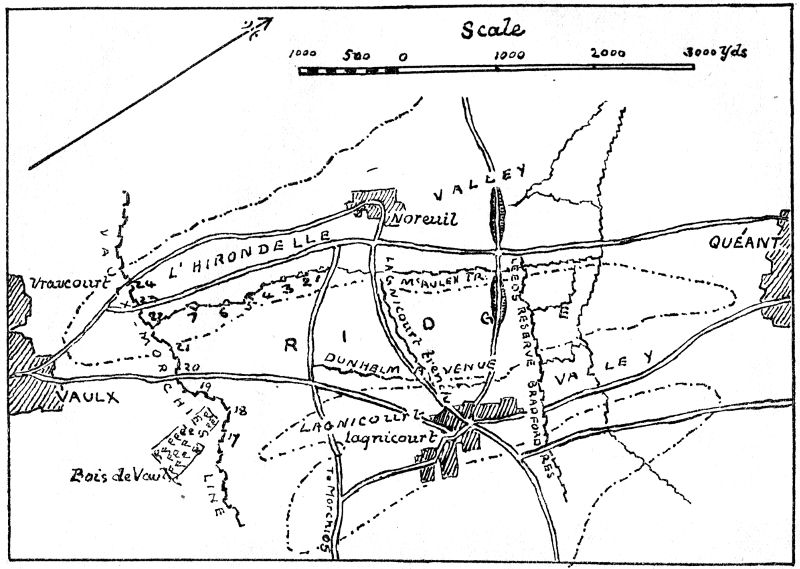
LAGNICOURT AND NOREUIL
Casualty list:—Officers: killed, Lieuts. T. L. V. Moody and P. W. Newington; missing, 2nd Lieuts. Davison and Wotton; wounded, Lieuts. Buss and Spence and 2nd Lieut. Froome.
Other ranks: killed, 24; wounded, 112; wounded but remaining on duty, 2; died of wounds, 5; missing, 65, of whom 40 were with Moody; wounded and missing, 3; missing, believed killed, 1.
For his able handling of the battalion (in the absence of Lt.-Colonel Power, who had been called to Brigade H.Q.) on the 21st and 22nd March, Captain H. de R. Morgan was awarded the D.S.O.
The 23rd March was a fairly peaceful day, but in the morning the men had to get into position and the battalion to push forward patrols towards Courcelles because the enemy was vaguely reported to be within three miles of that place. Gun fire was heavy, but no enemy was discovered in the immediate vicinity. An attempt was made to recover kits, drums and band instruments from Favreuil, but the searchers were promptly turned back by the military police. Two sporting drummers, however, managed to slip through these guardians of law and order and they rescued the big drum and three side drums. On the 24th the 6th Division was transferred to the 2nd Army and at 2.30 p.m. the Buffs entrained for Doullens and next day for Rousbrugge in Belgium, where they arrived at six o’clock on the 26th and from whence they marched six kilometres to Crombeke, going into scattered billets near Watow (some five miles west of Poperinghe).
On the 28th of the month H.M. The King visited Steenvoorde, close by, and the commanding officer, Lt.-Colonel Power, Captain Hamilton and one N.C.O., who had done well in the recent fighting from each company, attended his parade there.
At the very end of the month the battalion moved into the trenches again at Zonnebeke. A second German offensive, which commenced south of Ypres on the 9th April, was referred to at the commencement of this chapter. The 1st Battalion of the Buffs was engaged in no severe fighting in connection with this phase of the war, though it naturally joined in the general gradual withdrawal which was rendered necessary. This withdrawal, as far as it concerned the battalion, commenced on the 15th April, when after a few days of the usual trench warfare, losing eight casualties, one of which was Lieut. S. W. Taylor killed, and receiving a couple of drafts amounting to 230 men, it moved to Westhoek and the neighbourhood, being, in fact, somewhat scattered about to man several posts which were occupied up till the 23rd. The posts were heavily shelled on the 17th, with the result that C.S.M. Field and eleven men were wounded. The situation at this time was that the second German offensive had developed south of Ypres and that Messines Ridge and Kemmel Hill had been taken from us, these two positions being of the greatest importance for the defence of Ypres. Consequently the troops all round this area were in a somewhat desperate position and, as Sir Douglas Haig expressed it, “with their backs to the wall.” The gradual withdrawal of our forces west of Ypres into or immediately around the ruins themselves resulted; and so it came about that on the 23rd April the Buffs moved by detachments into the ramparts of Ypres. On that day the place was heavily gassed and twenty-two of our men were caught in the fumes. On the 26th the K.S.L.I. withdrew from the front line, leaving the York and Lancasters on outpost duty. After this withdrawal the enemy advanced very quickly, but they stopped at the York and Lancaster picquets. There were daily casualties now; men died by twos and threes and some were wounded more or less severely, and there was a continuous toll of gas casualties. A big attack was expected on the 28th, but it did not materialize, for now French reserves were hurrying up to the threatened portion of our line, and the second great German effort to wrest a victory before the Americans were in strength had proved a failure.
The month of May was a remarkable one to the 1st Battalion for the terrible list of casualties from gas. This mode of warfare began, as we have seen, at Ypres, and now, after three years of warfare, it seemed almost as formidable a weapon as ever, notwithstanding the mask, respirators and so on which had been invented to cope with it. During this month alone the 1st Battalion counted 119 casualties from this cause, and the unit was all the month (and up till the 12th June) either in Ypres or its vicinity. There was, however, a bright side to life this merry month of May. There was a gracious and fairly liberal distribution of honours to gladden the hearts of both the recipients and their friends. These were nearly all awarded for the fighting at Vaulx, and it is somewhat curious to note how well the number of awards compares with those given to our 2nd Battalion in 1915 and in connection with their terrible struggle north and east of Ypres. This remark is not for an instant to be misconstrued into an opinion that the 1st Battalion medals were not most magnificently won; it is only by way of a sigh of regret for the brave 2nd Battalion’s bad luck. Military Medals were given to Sgt. Morgan, Corpls. Andrews and Thomas, Ptes. Croft, Highton, Johnson, Kear (attached T.M.B.), Knight, Rainsbury and Stevenson. A bar to his M.M. to L.-Corpl. Wilson; to C.S.M. Peters a D.C.M.; to Major Morgan the D.S.O.; to Lieut. Spence the M.C.; and to Sgt. MacWalter, who had the M.M. already, the D.C.M. Corpl. Brookman also got the M.M. on the 29th. In addition to the gas casualties twelve men were killed during May and twenty-three wounded, as this part of the line, never a quiet one, was the scene at this period of unusual activity.
At 12.45 a.m. on the 27th May the whole of the back area of the brigade was very heavily shelled with gas and high explosive for three hours while the forward area was untouched. A number of direct hits was obtained on brigade headquarters without damage, and the Buffs (in reserve) were obliged to wear their respirators for more than four hours. Meanwhile the enemy attacked the French on our right and penetrated their line to a depth of about seven hundred yards, but did not reach his objective. No attack took place on the 6th Divisional front, but the 71st Infantry Brigade was constrained to form a strong defensive flank. During the day the French partially re-established their position and artillery activity continued on both sides, particularly by the enemy on our back area. During the night the 71st Brigade relieved the French regiment on their right and, in order to supply the number of men required by its brigadier, the Buffs were placed under his tactical orders as his reserve battalion. After this the enemy became for some days comparatively inactive except for the shelling of back areas and the use of aircraft, and on the 8th the brigade retired temporarily to Corps Reserve, moving by train to St. Omer for a few days’ musketry near that city, and afterwards returning to Poperinghe. On the 26th the Buffs relieved a French battalion in the Dickebusch area, taking over a bad line almost unprovided with wire and with no communication trench, so that movement by daytime was impossible. Then casualties recommenced and in four days 2nd Lieut. Thompson (attached from the Queen’s) and three men died, 2nd Lieut. Collett and seventeen were wounded, and this kind of thing went on steadily all July, the battalion losing 2nd Lieut. P. V. Drake-Brockman killed, Captain W. A. C. Hedley, who died of wounds, and eight men killed, one of whom was buried by a shell. 2nd Lieut. Balding and fifty men were wounded, fourteen of whom were, however, able to remain at duty. During June the following were mentioned in despatches for good work during the German offensive: Lt.-Colonel Power, D.S.O.; Major Blackall; Captains E. H. Allen, Marshall, D.S.O., M.C., and Stone; Lieuts. Corney and Froome; Sgt. French; and Ptes. Dewhurst and Keyes.
Towards the end of July two companies of Americans, numbering 4 officers and 340 men, arrived and were distributed amongst our people to learn the hang of things and prepare themselves for the early advance which was now every day becoming more clearly a certainty.
On the 2nd August C Company and No. 7 platoon of B carried out a raid which was arranged and organized by Captain Moss, M.C., the battalion being then on the left sector of the brigade front. The 18th and the 100th Brigades on either flank co-operated with demonstrations and so on, and great help was given by the 6th Divisional Artillery. The object of the expedition was the capture of prisoners and consequent obtaining of identification, and this object was very successfully gained, but at a terrible loss. The story is briefly as follows: two platoons, commanded by Lieut. Hollis, M.C., had for their objective the Brasserie, and another, under Lieut. Harper, a certain cabaret; while No. 7 Platoon, under 2nd Lieut. Lister, was directed on the Brasserie Farm. The raiders left our trenches at 7.5 a.m., and at the same time our barrage opened; a trench mortar of ours engaged the objectives and did great service; the divisional artillery engaged the enemy’s positions and also put up a smoke screen on the right of the raiders, and all neighbouring troops rendered assistance. The affair was most successful and all objectives were gained. The main opposition came from the hostile machine guns. The enemy lost heavily, several prisoners were taken and the fact was established that it was the 153rd regiment of infantry in front of our force. After this success, however, came trouble. It was while returning that the centre and left parties came under the heaviest machine-gun fire and casualties became very numerous. Besides, as there were no communication trenches and our lines were much exposed, the raiders had to scatter into any available cover there was behind our trench. Owing to the hostile sniping, which became very active after the barrage had ceased, it was impossible to remove several badly wounded men, and a machine gun which had been captured could not be brought in. The casualties resulting from this minor affair were, in fact, far too high. Captain R. W. Jones, D.S.O. (R.A.M.C.), Lieut. C. F. G. Hollis and thirteen men were killed; twenty-seven were wounded, of whom two died, and five men were missing. The death of Captain Jones was a very sad blow to the Buffs. With his usual utter disregard for personal safety whenever there was fighting or his assistance needed, this officer had gone over with the raiding party and though himself hit in the arm continued to move about bandaging the wounded until he was again hit, this time fatally. Except for a period following a wound which he had received on the Somme, Captain Jones had, at his own wish, remained always with the battalion since the early days of the war, and no British unit loved or reverenced their Medical Officer more than the Buffs their dear old “Doc.” In Lieut. Hollis, too, another very good officer fell. He had distinguished himself at Cambrai and, poor fellow, was almost back in safety when he received the bullet that killed him.
On the 5th August the battalion was relieved at night and withdrew to the Malin House area, and next day H.M. The King visited the Corps, and two hundred of all ranks, from each unit of the 6th Division, under Lt.-Colonel R. E. Power, D.S.O., went to greet him.
On the 8th August the Buffs became reserve battalion, but did not change their position.
III. 6th Battalion
On the day that the 6th Division, with the 1st Battalion The Buffs, were taken from the 3rd Army, namely, on the 24th March, 1918, the 12th Division, which included the 6th Buffs, was posted to it, and so the regimental history, as far as the 3rd Army is concerned, becomes more or less continuous. The 1st Battalion left from Favreuil in the neighbourhood of Bapaume, and the 6th Battalion reached Contalmaison, ten miles to the south-west of it, on the same day, having moved rapidly by march and by bus from the neighbourhood of Armentieres. Of course the rest of the 37th Brigade was with them, and in the evening the Queen’s and West Kent sent reconnoitring patrols into Pozieres, which was found to be unoccupied; so at 11 o’clock a line was taken up in front of Ovillers. On the 25th the Buffs were on the left of the brigade, joining up with the 63rd Division, the 6th Battalion West Kents being on the right. Battalion headquarters were at Crucifix Corner, Aveluy. In the early morning of the 26th it was reported that the enemy had entered Thiepval and it became necessary to withdraw across the River Ancre. The Buffs were detailed as rear guard while the 47th Division and the rest of the 12th effected the crossing, and, at 7.30 a.m., the 37th Brigade took up a fresh position opposite Hamel, the Buffs being in support in front of Mesnil.
On the following day the most extraordinary mistake was made, due to a false and erroneous report made to brigade headquarters by some unit or other. The Buffs, as has been seen, were at Mesnil, and there were some of the 188th Brigade details, including sailors, at the village of Martinsart, a little over a mile to the southward. An enemy’s patrol was reported on the road which connects these two, and as this seemed to imply considerable danger, the men at Martinsart were placed at the disposal of the brigadier of the 37th Brigade. Then came the report that Mesnil had fallen to the Germans, and the Anson Battalion of the Naval Division was ordered to counter-attack the village from Martinsart, advancing astride the road and engaging the enemy wherever met. Now, as a matter of fact, a strong reconnoitring thrust had been made on the line at Mesnil held by the Buffs, but the attack was completely repulsed by Lewis gun and rifle fire, numbers of the enemy being killed and fourteen taken prisoner. When the naval battalion therefore arrived on the scene, eager for blood, it attacked the Buffs’ headquarters, who defended the post with their usual resolution, so that for a while quite a lively fight between the two raged, each under the impression that the other force was German, until the error was discovered. The Queen’s had also been attacked (about 1 p.m.) and a few Germans entered our lines on the extreme left after a heavy bombardment, but these were driven off by a counter-attack delivered by D Company. The enemy having entered Hamel, the Queen’s had to throw back their flank, but all the dispositions of the Buffs remained intact at nightfall. A large hostile division had been seen during the afternoon about Pierre Divion and our lines had been heavily shelled, this continuing all next day. The Buffs’ casualties on the 27th were Lieuts. E. F. Henderson and W. T. Score killed, Captain Dixson, 2nd Lieut. Caney and about twelve other ranks wounded. And next day, the 28th, 2nd Lieut. E. M. S. Hoare and two men were killed by a shell at the foremost Lewis gun post.
The battalion was relieved late at night by the Oxfordshire Light Infantry in order to enable it to move further south. Indeed, the whole division took up position next to the 2nd Division, because a message had warned everybody that a strong attack was pending, but, after being in support in Martinsart Wood all the 29th, the Buffs were relieved and marched back to billets in Warloy, where they remained for three days of very wet weather, marching to Henencourt on the 2nd April, the rumour of an attack being still very persistent. In fact, the period spent at Warloy had mostly been used for work, particularly at night.
On the 5th April Henencourt was very heavily shelled and the divisional authorities were informed at the same time that it was considered by the Higher Command that it was intended to attack Amiens on that day. There was a very thick mist when the firing commenced and this rendered observation impossible, so the Buffs were ordered to go forward, occupy the reverse slope of the ridge in front and send patrols on from there. The battalion started at 7.5 p.m. and moved through an intense barrage in artillery formation to what was known as the Old Corps Line, which was west of Albert, and did as it was bid. This day’s fighting is known as the Battle of the Ancre. At 7.45 the situation being still obscure, the Queen’s were sent up to support the Buffs, partly, it would seem, because Henencourt was now no place to rest in, as the shelling was terrific up to about a quarter-past ten, when it died down somewhat. The hostile artillery kept both Buffs and Queen’s under very heavy fire, but no infantry attack eventuated; an hour later, however, news came that Dernancourt, which is a couple of miles or so away and down in the Ancre valley, was being very hardly pressed. At 2.30 the Buffs moved forward over the ridge and occupied some old trenches there. Here a bitterly cold night was spent; rations were brought up by Lewis gunners and signallers who had been left behind because they had been out at training when the sudden order to move came. The morning march cost the regiment 2nd Lieut. L. J. G. Davis killed, Lieuts. G. C. Allen and C. S. Newcomb severely wounded (died of wounds), 2nd Lieut. Dorman slightly wounded, twelve men killed and thirty-three wounded. The enemy had put down a barrage on the old Corps trenches directly they were occupied, and fifteen more casualties occurred there. Another fourteen were killed or wounded on the morning of the 6th, and in the afternoon the battalion relieved the Queen’s, which regiment had been sent off to support the 36th Brigade south of Bouzincourt. 2nd Lieuts. Cooper and Dalton were wounded during the relief.
All this time and for several days the weather had been very wet, and about now that old and persistent enemy called trench feet began to raise his head again and there were several cases of this disease in the battalion about this time. After a day in the front line in relief of the West Kent, the battalion marched on the 11th to Herissart, which is some miles to the westward, and there went into billets. The latter half of April was spent in the regions lying west of Albert. Nothing of any great regimental importance is to be noted. There were some changes of scene in so far that Harponville, Mirveux and Acheux were all visited before the next tour of duty in the line, which commenced on May Day, when the brigade relieved elements of the 35th and 36th Brigades in the centre of the divisional front.
This tour lasted only a week and the incidents were not of an uncommon nature. The enemy tried a little modest raid which was easily repulsed, but, on the 3rd, Puchevillers was heavily shelled and one projectile hit battalion headquarters, killing one man and wounding nine others. After this ensued a week at Acheux, and then the trenches again on the 13th May. On the 16th D Company carried out a successful little raid on the enemy with four officers and ninety-six men, who started at 9.20 in the evening. They advanced in good order and with great élan. All ranks speak very highly of the evenness and accuracy of the barrage under which they advanced. The first of the enemy encountered were two listening posts. Their occupants offered no opposition, but refused to leave them. These posts were unexpected and only fifteen minutes had been allowed for the work in hand, so they had to be left. On proceeding, D Company found that it had come up just when an inter-company relief was in progress, with the result that the Germans were in greater strength than was anticipated and considerable opposition was encountered. However, when our right attack had penetrated the wire the enemy vacated his line, suffering many casualties as he retired over the open. The left attack was equally successful or nearly so. Altogether some dug-outs were bombed; a good deal of damage was done to the trenches by our artillery; and three unwounded prisoners were brought back, in addition to considerable casualties as noticed above. We lost four men killed, 2nd Lieut. Davis and eleven wounded and one missing.
On the 25th the whole division was relieved by the 17th. The battalion went away west to Puchevillers, where it remained till the 16th June in G.H.Q. reserve, undergoing special training which included a course of musketry on the ranges. On the 16th the battalion marched to the front line, relieving a battalion of the 35th Division on the left of our divisional front. Next day 2nd Lieut. E. A. M. Stevens, M.C., and Pte. Beadle of C Company were unfortunately killed by a shell at the entrance of C Company’s dug-out. On the 20th of the month, identification of the hostile units in front being desirable, our artillery fired on the enemy’s position in the southern portion of Aveluy Wood, and then the Buffs sent out four strong patrols to obtain the required information. These, however, met with considerable opposition, because the Germans occupied certain small posts forward of their general line and these little places had been overlooked by the artillery bombardment, so our patrols were fired upon by machine guns and rifles and, owing to casualties, were unable to complete their task. 2nd Lieut. E. F. Robinson was killed, 2nd Lieut. Towers and nine men were wounded and four killed; and at 8.15, in shelling the support company (D), the hostile artillery obtained a direct hit, killing one man and wounding four.
On the 22nd the battalion moved to brigade reserve at Senlis, where working parties, four hundred strong, were found each day, till the next trench tour, which commenced on the 29th and which was undertaken under certain difficulties: during the relief, the back areas were kept under heavy gas-shell fire which affected the movement of the troops; moreover, when the battalion headquarters of the Buffs were closeted with the headquarters of the Royal Berkshire Regiment, which it was relieving, a shell made a direct hit on the spot, and it was only with difficulty that the double party emerged from the wreckage. The Medical Officer of the Royal Berkshire was the only one wounded, and he but slightly.
At 9.35 p.m. on the 30th June the Queen’s and West Kent, with the Buffs in support, under cover of heavy artillery, trench mortar and machine-gun barrage, attacked the front-line system of the enemy 1,000 yards north-west of Albert on a frontage of about 1,100 yards with a view to destroying or capturing the garrisons of the first three lines of trenches and holding the front line. Practically the Buffs this day had only to stand to all the time of and after the operation, because it was completely successful with very little help from them, though five men were killed and 2nd Lieut. Symonds and thirty men wounded. The Queen’s, who were on the right, met with a stubborn resistance and suffered many casualties, and C Company the Buffs went forward to their immediate support. Notwithstanding these casualties, both the forward battalions were able at 11.40 to report to the brigadier that they were consolidating; but at 1.23 on the morning of the 1st July the Queen’s, who had sent the message earlier that the Bedfords on their right had been repulsed, reported that they could not hold on without support, and at 2.10 a.m. the S.O.S. signal was up along the line and the Royal Engineers acknowledged that they could not do the wiring satisfactorily on account of casualties. However, the day proved fairly quiet and the Queen’s and West Kents were reinforced by C Company The Buffs, while the remainder were in readiness to move forward, and very early in the morning of the 2nd the battalion relieved the Queen’s in the right half of the brigade front line. The Germans were now taking the offensive and towards nightfall very notably so, though they had been fairly quiet during daylight. At 9.35 p.m. a very intense barrage was put down along the whole brigade front, followed by a counter-attack which caused the West Kent on our left to withdraw to the old British line. Soon afterwards a report was received that the 18th Division on the right had also withdrawn to the old British line, leaving A, B and D Companies of the Buffs still occupying the German front line. The battalion’s casualties this day were 2nd Lieut. Harvey slightly wounded, two men killed and forty-one wounded.
At 6 o’clock on the morning of the 3rd, whilst the Buffs were still holding on and defending, in particular, two blocks which they had made during the night, orders came to withdraw and join the others. This movement was rendered very difficult owing to the clear visibility of that particular morning, which caused our men to be observed when about two-thirds of them had got back into the new or rather into the old position. Thus the Germans sent up a strong bombing party to destroy 2nd Lieut. Hobbs and the small party with him that had been left behind to cover the retreat, but the stubborn resistance of this detachment resulted in there being only two more casualties on account of this move. In fact, the bravery and devotion of Hobbs was beyond all praise: entirely regardless of his personal safety, he not only handled his men to perfection, but himself carried a wounded soldier to safety under heavy fire and persistent bombing. Lieut. Dudeney also showed his manhood by his defence of one of the posts against overwhelming odds. The whole of the battalion’s front was in order by 7.45 a.m., though the condition of the line was now, it is true, far from satisfactory owing to the intense bombardment and other causes. That day the 37th Brigade was relieved by the 36th and the Buffs went into divisional reserve at Senlis and so remained till the 10th July without any further incident.
The brigade was now in G.H.Q. reserve in tents south-east of Harponville and under orders to join the 22nd Corps of the 4th Army. In consequence of this order it marched to Rubempre on the 13th, and next day proceeded by bus to Quevanvillers and marched to Rumatsnil and afterwards to Plachy Buyon, remaining in this district, about ten miles south-west of Amiens, up to the end of July, or rather until the 30th, on which date a movement was made by train to Canaples and thence by route march to Berleaucourt (about twelve miles north-west of Amiens). On the 2nd August the 12th Division relieved the 58th in the centre section of the 3rd Corps front, the 37th Brigade being in divisional reserve. The Buffs, going by bus to a wood on the Behencourt-Franvillers road, thus came into the neighbourhood of Warloy once more; but the next day they proceeded to Dernancourt on the Ancre, and on the 4th relieved a battalion of the United States Army in the front line. There they remained for three days, when, on relief by another American unit, they became part of the Corps Reserve at Franvillers. On the 8th August the battalion moved into trenches south of Morlancourt with orders to attack at 3 a.m., but this was postponed. When the second order came the companies told off for the job were already in No Man’s Land and had to be recalled. The withdrawal was a very difficult business, and one platoon of D Company, under 2nd Lieut. Hearson, could not be got back and had to remain where it was till dusk. Unfortunately the enemy was quite aware of this and opened machine-gun fire on the party, wounding Lieut. Le May, 2nd Lieuts. Gray, M.C., and Thornley, and twenty-four men and killing two. Next day came our British attack.
IV. 10th Battalion
In comparison with the other battalions of the Buffs in France the doings of the 10th during the momentous period between the 21st March and the 8th August, 1918, were uneventful as, naturally, units which came from overseas were chiefly used as reliefs and not pushed at once into the fighting line.
The 10th landed at Marseilles from Palestine on the 7th May and entrained two days later for Noyelles, near Abbeville, where it went into billets and instantly began training to fit itself for the methods of warfare in vogue in the western theatre of war. On the 22nd it proceeded to Buneville and on the 25th to Izellez Hameau, in the Arras district, where it was billeted for a month and where it lost its commanding officer, Lt.-Colonel Lord Sackville, who was sent to do special work at French G.H.Q. On the 25th June the next move came, this time to Enguin les Mines, which is about ten miles south of St. Omer; but on the 10th July the General Headquarters were left behind and the 10th moved by motor bus into divisional reserve at Ham en Artois, then into brigade reserve at La Perriere. Here the first losses in France occurred, two men being killed and seven wounded when on a working party. Finally, till the 4th August, Miquellerie was the home of the unit. All these above-mentioned places are fairly close together, being south of the town of Hazebrouck, south-west of Merville and not far from the River Lys. On the 4th August the right sub-section of the left sector of the Adjusovres-Averskerque line near St. Floris was taken over, and now the time was rapidly approaching for the Allies to assume their turn for offensive work, work which was only to cease with the complete subjection of all our enemies.
On the 5th August the division on the right of the 230th Brigade had advanced its line and the Buffs were warned to be ready to do the same should the trenches in front be found to be evacuated as they had been on the right. There was no doubt at all at this time that the enemy was showing every sign of nervousness, but what follows belongs to the story of the final victorious advance and must be reserved for another chapter.
V. 7th Battalion
Without a doubt the most smashing blow that was dealt during the great German offensive fell upon the British 5th Army, in the very forefront of which stood the 7th Battalion of the Buffs. On the night of the 20th/21st March the 55th Brigade was at Liez holding, as its forward zone, from the village of Travecy, exclusive, up to a point about a mile north of Vendeuil, which sector was garrisoned by the 7th Buffs, eleven machine guns, four Stokes mortars, two six-inch trench mortars, one section of a field company of Royal Engineers, with two infantry platoons attached. Fort Vendeuil held as a garrison one platoon of the Buffs’ support company, the section of Royal Engineers, the two attached platoons and the two trench mortars. These attached platoons were a divisional idea and were No. 17 or extra platoons of the Buffs and the Queen’s. They were composed of men who were bad marchers and were usually employed with the Engineers as unskilled labourers. The Buffs’ headquarters were at a quarry called “Clarence Keep,” though it was only protected by a very light trench. It was close to the Vendeuil-Remigny road and about three-quarters of a mile from the fort. The two forward companies were: B to the northward, holding the main St. Quentin road, about half-way to Le Vert Chasseur, down to the railway station at Vendeuil, with headquarters in the middle of the village; A carrying on towards the south, holding part of Vendeuil, the quarry, which overlooked the river, and a post some nine hundred yards to the south-west of it, which was the company headquarters. C Company was immediately behind A and B, from near Vendeuil Fort to a post some fourteen hundred yards behind A’s headquarters. D Company was further west again and just in front of Poplar and Rouquenet Woods. Thus the battalion front was enormously extended, there being about four thousand yards between the right and the left platoons, and the nearest West Kent post (Le Vert Chasseur) being another twelve hundred yards away. The fighting strength of the Buffs was only 550, many of the men being recently taken over from the late 8th Battalion. The chief unit in the battle zone behind was the 7th Queen’s, and there was no brigade reserve because the 8th East Surrey happened to be in divisional reserve. The 4th Dismounted Brigade was attached to the 55th for the day.
At 4.45 a.m. on the 21st March the enemy’s artillery fire commenced, and almost immediately afterwards the order to man battle positions was sent out, but the Buffs were, of course, already in their places. The hostile shelling was intense and at first many of the shells were gas-laden. When day dawned it was found that the country was wrapped in so dense a fog that a man could not see twenty yards in front of him. It was a misty morning everywhere along our lines on this fateful 21st March, but perhaps in no part lay a thicker blanket of fog than in the valley of the Oise with its neighbouring canals. It was not long before the shelling began to cut, as was often the case, the telephone wires which connected the various distant posts, the first to go being that which connected “Clarence Keep” with B Company (Captain Chant), and soon afterwards Captain Fine, who commanded in Fort Vendeuil, failed to answer calls. Therefore in the morning the situation was very far from pleasant. Little isolated parties of Buffs were scattered about the countryside, blinded by fog, deprived of communication with their neighbours and with the suspicion, which amounted almost to a certainty, that silently closing in upon them were unknown numbers of the enemy intent on their destruction. The mist began to clear about noon, and it was only then that the defenders were able to gain some notion of the hostile movements which up till then had been screened. In the meantime the battalion signal sergeant, Browne, with three men[30] were working desperately to repair the line between “Clarence” and the Fort, and after four hours’ hard labour communication was re-established and Captain Fine reported “all correct.”
The first intimation of any hostile infantry on the sector held by the Buffs came from A Company (Captain Grant) reporting about 10 a.m. that thirty Germans were about Canal Post, near the quarry. After this headquarters lost communication with Captain Grant. At 11 o’clock C Company made out about two hundred of the enemy going north along the main St. Quentin road. At 11.45 A Company got communication with C and informed the latter first that there seemed to be much movement in their rear, and then that they were surrounded; after this the line “went.” D Company then observed a party of Germans between them and the Fort, and it was found that some, covered by the fog, had actually visited the company headquarters and broken the signalling lamp. The Buffs’ Headquarters now directed D Company to be ready to make a counter-attack, and at “Clarence Keep” itself the meagre defences were manned with spare runners, cooks, sanitary men, pioneers, police and servants, and these prepared to see the matter out. Then the chaplain and doctor arrived from Vendeuil, where they had been billeted, and told how B Company had been surrounded, but that Captain Chant had escaped into the fort. Strong bodies of Germans had come down the road from the north and surprised the defenders, though some had escaped in the fog and joined C Company; the enemy had got the two machine guns which on the left flank of the company had been stationed on the road and had surrounded the platoon that was there. There was no news of a party which had been at the railway station.
About this time a bugle sound, evidently German, was heard from the direction of Ronquenet Wood and a party, seen north of “Clarence Keep,” was fired on and dispersed. The second in command, too, trying to get back to report the state of the case to brigade headquarters, was wounded crossing the open ground near Ronquenet Farm, probably by the party that sounded the bugle. All this, of course, meant that the defences had been penetrated during the fog. The length of line held by the Buffs was roughly a couple of miles, and the posts or platoon garrisons had on an average about eight hundred yards between them, and so it came to pass that they were, one by one, isolated and surrounded. In fact, the Germans tried about 1.30 to assail the Fort itself from the south and south-west, but by this time the weather was clearer and, rifles and guns being turned upon them from several points and our artillery firing at very close range or “over the sights,” this attempt was abandoned; nevertheless they began to close on “Clarence Keep,” and later brought up a machine gun which began to fire into the backs of the men, the garrison being disposed now for an all-round defence. Several attacks on this headquarters post were beaten off by rifle fire, greatly due to the gallant behaviour of L.-Corpls. Berry and Harris.[31]
During the afternoon many hostile aeroplanes appeared on the scene. These, flying very low, were directing the shell fire by means of signal, one consequence being the shelling of our guns just east of “Clarence,” under cover of which shelling hostile infantry worked up very close and at last caused our gun detachment to surrender. In fact, the enemy had complete air command in this region. During the whole afternoon “Clarence Keep” kept up communication with D Company by flag, and headquarters had seen the Fort signalling to Liez, where the brigade staff was. The constant message was “counter-attack essential,” and this was because Captain Fine had been led to believe that the divisional reserve had arranged to carry one out, in the case of its being necessary in order to save the Fort. From 6 to 6.30 p.m. an intense hostile bombardment was directed on Captain Fine’s command, after which all was silent and it seemed as if the place had fallen, but it was afterwards ascertained that the little garrison had held out for another twenty-four hours. A Company was despaired of. The best that could be hoped was that the men were prisoners; but firing from their direction was heard up till midnight, and it was supposed that they were then still refusing to surrender. As a matter of fact, it was afterwards ascertained that Lieut. Kennett’s platoon fired on the German transport on the 22nd and held out till the evening of that day. B and C Companies had lost posts and garrisons and were now but fragments of the units they had been, but the enemy had not passed and what they had gained had been won in the morning, when they were so greatly aided by the fog.
C Company had been especially well handled by Captain Tupper and had defeated all hostile attempts during the day, and D Company, under Lieut. Morell, with 2nd Lieut. Halliday to aid him, had made a fine local counter-attack and driven the Germans back at a critical time. A project was entertained by the 55th Brigade, when reinforced by the 4th Dismounted Brigade, for relieving the pressure at Fort Vendeuil, but this was vetoed by the Divisional General, who issued very emphatic orders that touch was to be maintained with the brigade on the right about Quessy, and it was clear that the battle zone of this latter force was in the hands of the enemy. This order therefore meant a withdrawal and that those troops in the forward zone of the 55th Brigade which could not be extricated must just surrender or die. Before withdrawal orders reached the Buffs, they had been busy, under cover of night, reorganizing, serving out food and ammunition and digging in.
The first hint of retreat came at half an hour after midnight, when an officer of the Machine Gun Corps arrived at “Clarence” with orders to take away the two Vickers guns which were there and with the information that a general withdrawal had been ordered to a position west of the canal. This was confirmed shortly afterwards by patrols of the 7th Queen’s. These patrols had been sent up from the battle zone by the brigadier to deliver the orders to all the scattered parties of the Buffs and others which could be reached. Even now Colonel Ransome would not go back unless the order was confirmed, and his adjutant bicycled into Remigny to telephone for instructions. He, however, got a clear and distinct order that the Buffs were to retreat. So at 1.10 a.m. on the 22nd March the battalion headquarters retired by small parties to the brigade at Liez, after destroying all papers and leaving behind many useful and pleasant stores. C Company had already arrived here with fragments of B, and soon after D Company came in, and before daylight in the morning the battalion had concentrated about La Faisanderie, but it now consisted of only three companies. The 55th Brigade Headquarters moved from Liez to Rouez.
It was later ascertained that the 7th Battalion The Buffs was the only unit of the 3rd Corps that was, on the afternoon of the 21st March, still holding out in the forward zone, and that its doing so resulted in other units being enabled to reorganize behind the Crozat Canal. At 2 o’clock in the afternoon the Buffs withdrew into a wood a little to the south and started to dig in on very empty stomachs. It was not, however, till 3.30 a.m. on the 23rd March that the battalion occupied its new position, as it had been called away to the support of the Queen’s, and indeed very early on this date, too, C and D Companies had to be again placed at the disposal of the C.O. of that regiment, in order to fill a dangerous gap that existed between the left of the Queen’s and the right of the East Surrey.
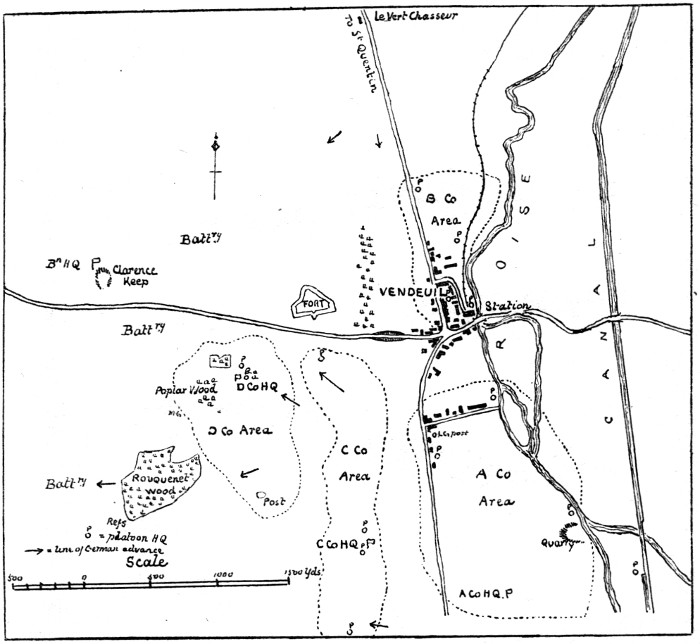
VENDEUIL
Everybody prepared himself for a new day’s fighting, the 55th Brigade being now in support of the forward troops. At 6 o’clock a French regiment, which had been expected, duly arrived. This unit had been detailed to make a counter-attack on the town of Tergnier and was to be supported by the Queen’s, who fought that day under the command of Lt.-Colonel Bushell. This counter-attack was duly attempted, but the Frenchmen were very shortly back amongst the Buffs again. They seemed a fine, resolute lot, and they said they had gone up with only thirty-five rounds of ammunition per man and had expended it all. Moreover, they had lost their way in the mist. The story of this counter-attack is not the history of the Buffs, but it may be here mentioned that Lt.-Colonel Bushell of the Queen’s was the hero of the attempt. He appears to have led his own fellows and Frenchmen too with the greatest gallantry, and he was rewarded with a V.C.
From 8 o’clock in the morning there was confused fighting in the wood, where nothing beyond a range of fifty yards or so could be observed. Wounded men kept coming back to where Colonel Ransome’s little party was, and all brought with them the same tale of the enemy’s steady advance. Both Captain Morrell and 2nd Lieut. Halliday of the Buffs were badly wounded. Both were very gallant officers and a great loss at such a time. It appeared to Colonel Ransome, who commanded the Buffs, that it was not much use stopping in the wood: nothing could be seen, and it was thought that its northern edge was being passed by the enemy; so it was decided to take up two old lines of trenches and pits which existed in an orchard two hundred yards in rear, and the headquarters of both Buffs and Queen’s, with all sorts of fragments of companies and other small units, fell back to this place and there remained all day fighting a grim battle with the advancing foe. There were nine machine guns with the party, but only just enough personnel to work them. It was principally a machine-gun fight and for a long time our weapons did very well, but the enemy kept bringing up more and more, while our supply of ammunition began to fail as the afternoon drew on. Every effort was made to get up more from the rear, but the difficulties were too great to overcome, and the enemy gradually began to gain fire superiority. During the afternoon those companies of the Buffs which had gone forward by direction of the O.C. the Queen’s, as well as other advanced parties of British troops, had rallied on Ransome’s position, which proved an invaluable post for the purpose. The opinion of the brigadier of the 55th Brigade on this point is as follows: “In the light of subsequent knowledge it is clear that the stand made here by Lt.-Colonel Ransome’s force was of the greatest value not only to the rest of the brigade, but to the whole line in this vicinity.... This stand was due in the first place to the skill and foresight of Lt.-Colonel Ransome in establishing a line outside the wood on which the withdrawing troops, scattered and disorganized by the confused fighting in the wood, could be rallied and reorganized. In the latter part of the work Lt.-Colonel Ransome was assisted principally by Major Tortise and Captain Snell of the 7th Queen’s, and by Captain Black and Lieut. Howcroft of his own battalion. All these officers behaved with the utmost gallantry.”
About 6 o’clock a French battalion which had come up behind the English party during the afternoon essayed a frontal counter-attack. There was no artillery preparation. The attempt was beyond praise as regards the gallantry of the soldiers who made it, but the brave Frenchmen were met with a perfect storm of machine-gun bullets and they could not go on. After lying down for a few moments they got up and retired, and the retirement took the whole of the English first-line troops with it. This was by no means a misfortune. Anxiety had been felt already about the possibility of holding the position till nightfall, but it seemed to be suicidal to attempt to retire before the German machine guns by daylight. However, fortunately these ceased fire as the hostile infantry came forward to pursue, and so our retirement was far less costly than could have been expected. It was a very mixed lot of men that went back through Rouez Wood. Frenchmen and all sorts of English units mixed up in great confusion as regards their ranks. A fresh line was formed inside the wood and Captain Black actually led a small party forward to check the pursuit, which prevented any great pressure before darkness set in, and the fugitives were able to collect, reorganize and march back to Villiguier Aumont. During this final phase Sgt. Browne and Pte. Coleman, two signallers who had greatly distinguished themselves on the 21st by mending the line from “Clarence” to the Fort under quite extraordinary difficulties and heavy shell fire, were wounded.
The march to Villiguier was without incident, though it was thought by some that the party was surrounded. On arrival, the details belonging to the 55th Brigade were directed on to Bethancourt, where Br.-General Wood, commanding, already was, as was also the 8th East Surrey Regiment. About 10 a.m. on the 24th March the 55th Brigade was ordered to withdraw to a line approximately east of Caillouel; here it had the 53rd on its right flank and the 54th Brigade on the left. The Buffs, who were the supporting battalion of their brigade at first that night, withdrew later into divisional support, and at 7 a.m. on the 25th the whole division fell back to the line Grandru-Mondescourt-Appilly and later to a position covering Babœuf, these retrograde movements being carried out in good and soldier-like order by platoons in artillery formation. At 2 p.m. on this day the Buffs were sent back to a position west of Babœuf, to cover the canal bridge at Varesnes, and later to Varesnes itself, which was reached at 10 p.m. On the 26th March the whole of the 55th Brigade marched to Caisnes. The casualties suffered by the 7th Buffs between the 21st and 26th March amounted to:—Officers: killed, 1; wounded, 5; missing, 11. Other ranks: killed, 17; wounded, 108; missing, 410. When a force has to retire after fighting, it is generally quite unknown whether a man who fails to answer his name afterwards is dead or a prisoner of war. He is simply described as missing.
By the 28th March the brigade had got to Audignicourt and was in billets and caves there, but now the scene of its activities was changed. There was considerable enemy pressure on our defence works covering the important city of Amiens, and the whole of the 29th March was spent by the Buffs and their comrades in buses undergoing a weary journey to help to relieve the situation in that region. On the 30th the battalion debussed at St. Nicholas, east of Boves, and marched to Gentelles. In fact, the Buffs and Queen’s had to march direct from the buses into a support line east of this village. That night the 55th Brigade took over the front line south-east of Villers Bretonneux, but for the present the Buffs remained where they were, but on the 31st moved to a large farm close to the monument which is on the road which runs south from Villers Bretonneux. This farm was the battalion headquarters and was in full view from the German position at Marcelcave, but had never been shelled. After two days the Buffs relieved the Queen’s in front line and took the left of the brigade with D Company on right, B on the left and C, which was only two platoons strong, in reserve.
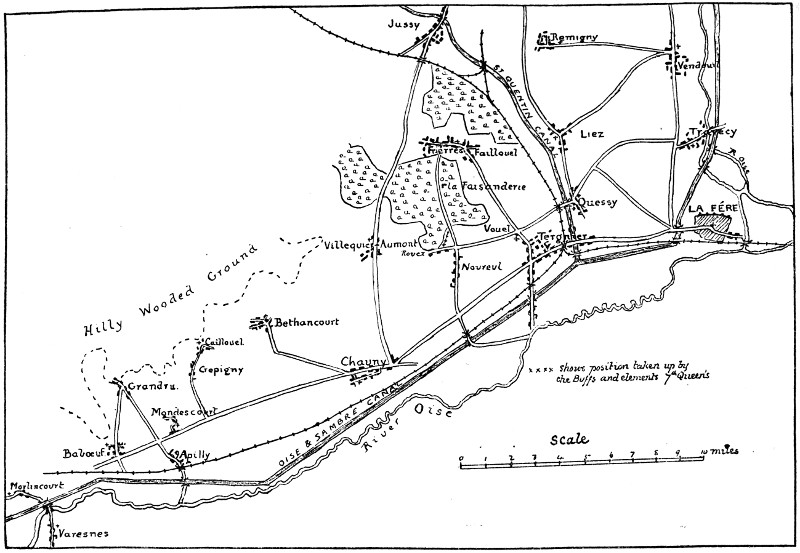
VENDEUIL TO VARESNES
At 3.45 a.m. on the 4th April a German prisoner was captured by the battalion, and this man stated that our enemy was going to attack at dawn and that, in fact, they were at that moment “standing to.” Notice, of course, was immediately sent round to everybody and thus an absolute surprise was avoided, though, of course, the force was always kept ready for contingencies of the sort. At dawn there was a thick mist and, communication being otherwise impossible, the Queen’s dropped a chain of connecting files between battalions and brigade headquarters. At 6 o’clock the hostile bombardment commenced. It was indiscriminate shelling followed by rifle and machine-gun fire, and at seven the attack developed on the Buffs’ front and that of the 35th Australian Battalion on their left. At or about 9 o’clock the Australian troops further away to the left fell back, which caused the 35th Australians and the Buffs to conform, the latter getting back to the bridge over the railway. One company of the Queen’s was at this juncture put under the Buffs’ orders, and an hour later a company also of the 2/6th London Regiment, which had been temporarily placed at the disposal of the 55th Brigade. The Australians withdrew somewhat further, making it necessary for the left of the Buffs to conform, though the right of the regiment remained in position. At four in the afternoon the enemy was seen advancing from the line Marcelcave-Aubercourt, and at the same time his artillery shelled our people heavily with gas, and the Germans got round our right flank, causing our whole line to withdraw, but the Buffs rallied about Villers Bretonneux railway station to cover there a battery of our artillery.
The casualties of the first week in April were:—Officers: killed, 1; wounded, 5. Other ranks: killed, 3; wounded, 34; missing, 13.
Early in the morning of the 5th the battalion got orders to move to Gentelles and later in the day to billets at Boves; it had remained out by the station all night, because those who bore the orders for the retirement failed to discover it. The 55th Brigade Headquarters moved next day to St. Fuscien, and the Buffs and East Surrey were attached to the 53rd and the Queen’s to the 54th Brigade; but the several battalions were by now so weak that a composite one had to be formed under the command of Lt.-Colonel Ransome, D.S.O., M.C., the Buffs finding two companies and the East Surrey and Royal Berkshire one company each. The English forward posts in this portion of the line were now about Gentelles and were manned by the troops in the neighbourhood till the 12th of April, when the 55th Brigade was withdrawn, moving by march to Dreuil les Molliens and Cavillon, about nine miles west of Amiens. The Buffs being close by at Le Mesge. Ten days’ intensive training was now undergone and then the brigade returned to St. Fuscien, only to move four days later north-east to Baizieux to be attached to the 2nd Australian Division. The area west of Albert was occupied by the 18th Division up till the 12th July, when it went into G.H.Q. reserve.
The story of the battalion from May Day till this date is lacking in the tremendous incidents which have been recorded above: the Buffs was soon again a battalion of four companies—such a loss as even a whole company was very quickly replaced in these days. A short history such as this necessarily occupies its available space with the exciting record of valorous days and strenuous combat and must reluctantly pass over with only slight allusion the hard, faithful and continuous work of the draft-finding units in England.
The battalion was a good deal at Lavieville and Baizieux about this time and, of course, were alternately in front line, support and reserve. When in the former a good deal of patrolling work was done: for instance, strong fighting patrols went out on the 3rd June; they got into their objective, but failed to get identification. On the 6th 2nd Lieut. Richardson with fifteen of C Company’s men had a small encounter with the enemy. On the 15th a raid was attempted, but, owing to the enemy’s resistance and the thickness of his wire, the objective was not reached, though some important information was gained. Protective patrols also were out nightly early in the month of June and much digging and wiring work was undertaken, because there were strong and persistent rumours of a hostile attack, and, as a matter of fact, on the 16th, three trench mortars, together with some rifle grenades, played frequently upon B and C Companies, and during the night a barrage was put down on the battalion, consisting of trench-mortar and high-explosive fire, which lasted over an hour. On the 30th June and following two or three days there was some fighting in the neighbourhood of the 55th Brigade, and indeed their comrades of the 54th were engaged, but the Buffs were at the time in divisional reserve and did not come into action. On the 12th July the whole division was relieved and on the 13th marched to Warloy and there embussed for G.H.Q. reserve at Briquemesnil until the 30th, the time being much occupied by strict training, as was usual when in G.H.Q. reserve.
On the 30th this spell of peace was over and the Buffs went into line again on the last day of the month, this time near and a little south of Warloy, the fighting lines being now at this part of the front somewhere about thirty miles westward of their position after the Somme battles of the last year. But by now the great American army was in France and reinforcements were pouring in. The tremendous German efforts to snatch victory between the collapse of Russia and their arrival had failed and our enemy was, so to speak, anxiously looking over his shoulder towards the dear homeland. By the 1st August he had already withdrawn from one or two dangerous points in France and Flanders, and there was a general feeling amongst our people that it was time he was on the move. However that may be, the 7th Battalion patrols on the 4th discovered that the Germans were still on its immediate front, and next day considerable movement was observed in the hostile lines.
Then, on the 6th August, a most unexpected event took place. For the last three days the brigade had been warned to expect and to look out for an enemy’s withdrawal, yet on this morning, before it was fairly light, the 27th German Division astride the Bray-Corbie road actually advanced to the attack at a time when we were relieving certain companies by others. Only a couple of hours or so earlier some of the Buffs had rushed an enemy’s post and found it empty. The authorities, being so certain that the German was going, attributed the movement noticed above as merely a blind on his part to cover an imminent retrograde movement. The battle that followed, though it commenced with a German attack on the 6th, lasted some days, and towards the finish the rôle of the two armies was reversed. It will therefore be convenient to relate what occurred in the following chapter, which will deal with the Grand Advance of the Allies.