HISTORICAL RECORD
Reading edition
OF THE
SEVENTY-FIRST REGIMENT,
HIGHLAND LIGHT INFANTRY;
ORIGINALLY NUMBERED
THE SEVENTY-THIRD REGIMENT.
1777.
The war between Great Britain and her American Colonies had, towards the end of the year 1777, assumed an aspect which was beheld with great interest by the European powers. France, although abstaining at this period from entering into the contest, privately encouraged the colonists, and several French officers proceeded to join the American standard. The influence of the British ministry then became employed in encouraging voluntary efforts for the raising of troops. Liverpool, Manchester, Edinburgh, and Glasgow, at their own expense, each raised a regiment of a thousand men, and several independent companies were levied in Wales. The livery of London and corporation of Bristol did not follow this example, but the monied interest in the metropolis showed its attachment to the administration by opening a subscription for procuring soldiers.
Fifteen thousand men were by these patriotic efforts raised and presented to the state; of this number upwards of two thirds were obtained from Scotland, and principally from the Highland clans.[6] The hardy mountaineers of North Britain had been long celebrated for their military prowess, and the annals of warfare of subsequent years have added to their former renown, by affording them opportunities for sustaining their character for intrepidity and valour.
The present Seventy-first, Highland Light Infantry, was one of the regiments which owes its origin to the foregoing circumstances, and was raised under the following royal warrant, dated 19th December 1777, addressed to John Mackenzie, Esquire, commonly called John Lord Macleod, who was appointed its colonel.
“George R.
“Whereas we have thought fit to order a Highland regiment of foot to be forthwith raised under your command, to consist of ten companies, of five serjeants, five corporals, two drummers, and one hundred private men in each, with two pipers to the grenadier company, besides commissioned officers, these are to authorise you, by beat of drum or otherwise, to raise so many men in any county or part of our kingdom of Great Britain as shall be wanting to complete the said regiment to the above-mentioned numbers; and all magistrates, justices of the peace, constables, and other our civil officers, whom it may concern, are hereby required to be assisting unto you, in providing quarters, impressing carriages, and otherwise, as there shall be occasion.
“Given at our Court at St. James’s, this 19th of December 1777, in the eighteenth year of our reign.
“By His Majesty’s command,
“Barrington.”
“To our trusty and well-beloved John Mackenzie, Esq., (commonly called John Lord Macleod), Colonel of a Highland Regiment of Foot to be forthwith raised, or to the Officer appointed by him to raise Men for our said Regiment.”
1778.
In February 1778 the Court of France concluded a treaty of defensive alliance with the American colonies, and Great Britain became involved in a war with France.
Lord Macleod’s efforts in raising the regiment were so successful that in April 1778 it was embodied at Elgin, under the denomination of “Macleod’s Highlanders,” and was numbered the “Seventy-third Regiment.”
In May the regiment, eleven hundred strong, embarked at Fort George, under the command of Colonel Lord Macleod, and proceeded to Guernsey and Jersey, in which islands it was stationed for six months. The regiment was subsequently removed to Portsmouth, and was cantoned during the remainder of the year in the neighbouring villages.
On the 24th of September, 1778, Colonel Lord Macleod received orders to raise a second battalion to the regiment. Each battalion was to consist of fifty serjeants, fifty corporals, twenty drummers and fifers, two pipers, and a thousand privates.
At this period the following officers had been appointed to the Seventy-third Highland Regiment.
First Battalion.
Colonel, John Lord Macleod.
Lieut.-Colonel, Duncan M‘Pherson.
Majors.
John Elphinston.James Mackenzie.
Captains.
George Mackenzie.Hugh Lamont.
Alexander Gilchrist.Hon. James Lindsay.
John Shaw.David Baird.
Charles Dalrymple.
Captain Lieutenant and Captain, David Campbell.
Lieutenants.
A. Geddes Mackenzie.Simon Mackenzie.
Hon. John Lindsay.Philip Melvill.
Abraham Mackenzie, Adjt.John Mackenzie.
Alexander Mackenzie.John Borthwick.
James Robertson.William Gunn.
John Hamilton.William Charles Gorrie.
John Hamilton.Hugh Sibbald.
Lewis Urquhart.David Rainnie.
George Ogilvie.Charles Munro.
Innes Munro.
Ensigns.
James Duncan.George Sutherland.
Simon Mackenzie.James Thrail.
Alexander Mackenzie.Hugh Dalrymple.
John Sinclair.
Chaplain, Colin Mackenzie.
Adjutant, Abraham Mackenzie.
Quartermaster, John Lytrott.
Surgeon, Alexander MacDougall.
Second Battalion.
Colonel, John Lord Macleod.
Lieut.-Colonel, the Hon. George Mackenzie.
Majors.
Hamilton Maxwell.Norman Macleod.
Captains.
Hon. Colin Lindsay.Mackay Hugh Baillie.
John MacIntosh.Stair Park Dalrymple.
James Foulis.David Ross.
Robert Sinclair.Adam Colt.
Lieutenants.
Norman Maclean.Alexander Mackenzie.
John Irving.Phipps Wharton.
Rod. Mackenzie senior.Laughlan MacLaughlan.
Charles Douglas.Kenneth Mackenzie.
Angus MacIntosh.Murdoch Mackenzie.
John Fraser.George Fraser.
Robert Arbuthnot.John Mackenzie junior.
David MacCullock.Martin Eccles Lindsay.
Rod. Mackenzie junior.John Dallas.
Phineas MacIntosh.David Ross.
John Mackenzie senior.William Erskine.
Ensigns.
John Fraser.John Forbes.
John MacDougal.Æneas Fraser.
Hugh Gray.William Rose.
John Mackenzie.Simon Fraser, Adjt.
Chaplain, Æneas Macleod.
Adjutant, Simon Fraser.
Quartermaster, Charles Clark.
Surgeon, Andrew Cairncross.
1779. 1st bat.
In January 1779 the first battalion of the regiment, commanded by Colonel Lord John Macleod, embarked for the East Indies.
2d bat.
The second battalion, one thousand strong, embarked at Fort George in Scotland, in March 1779, under the command of Lieut.-Colonel the Hon. George Mackenzie (brother of Lord Macleod), and proceeded to Portsmouth, from thence it went on in transports to Plymouth, where the battalion landed, and was encamped upon Maker Heights until the 27th of November following.
The Court of Versailles had now engaged that of Madrid to take a part in the contest, and on the 16th of June 1779 the Spanish ambassador had presented a manifesto at St. James’s, equivalent to a declaration of war, and immediately departed from London. During the summer the siege of Gibraltar was commenced by the Spaniards, the reduction of that important fortress being one of the principal objects of Spain in becoming a party to the war.
1st bat.
The vessels conveying the first battalion formed part of a fleet escorted by Rear-Admiral Sir Edward Hughes, which on the passage touched at Goree, upon the coast of Africa. Goree being evacuated by the French for the purpose of fortifying Senegal, which had been captured by them early in the year, was occupied by a British force, left for that purpose by Sir Edward Hughes.
After quitting Goree, the fleet proceeded to the Cape of Good Hope, at that time in possession of the Dutch, and there landed the sick. The fleet was detained for three months in Table Bay, for the purpose of refreshment and recovery of the sick, after which it sailed for India.
1780. 2d bat.
After the breaking up of the camp on Maker Heights, the second battalion embarked for Gibraltar in transports, under convoy of Admiral Sir George Rodney. When in the Bay of Biscay, the British encountered, on the 8th of January 1780, a valuable Spanish convoy belonging to the Caracca company, consisting of fifteen merchantmen, with a ship of sixty-four guns, and two frigates, the whole of which were captured. Sir George Rodney being compelled to employ many of the crews of the ships of war in manning the prizes, called upon Lieut.-Colonel the Hon. George Mackenzie for the services of the second battalion of the regiment as Marines. In a few days after the men were distributed for this purpose, the fleet defeated, on the 16th of January, off Cape St. Vincent, a squadron of eleven sail of the line, commanded by Admiral Don Juan de Langara. One Spanish ship of seventy guns blew up in the beginning of the action. The Spanish admiral’s ship of eighty guns, and three of seventy, were taken; one of seventy guns ran on shore, and another was lost on the breakers.
Nothing further transpired during the remainder of the voyage, and on the 18th of January 1780 the second battalion disembarked at Gibraltar, then closely blockaded by the Spaniards, who had despatched Don Juan de Langara to intercept the British admiral.
1st bat.
The first battalion had, in the meantime, continued on its voyage to India, and on the 20th of January 1780 anchored in Madras Roads, being twelve months from the time of leaving England. The battalion landed immediately at Fort St. George, and after remaining there about a month was removed to Poonamallee.
The intricate politics of India gave rise to a war in that country. Hyder Ali, the son of a petty chief in the Mysore, had risen to the chief command of the army of that state, and when the rajah died, leaving his eldest son a minor, Hyder assumed the guardianship of the youthful prince, whom he placed under restraint, and seized on the reins of government. Having a considerable territory under his control, he maintained a formidable military establishment, which he endeavoured to bring into a high state of discipline and efficiency. Hyder, now Sultan of Mysore, formed a league with the French, and entered into a confederacy with the Nizam of the Deccan, the Mahrattas, and other of the native powers, for the purpose of expelling the British from India.
In July 1780, Hyder Ali, having passed the Ghauts (as the passes in the mountains on both sides of the Indian peninsula are termed), burst like a torrent into the Carnatic, while his son, Tippoo Saib, advanced with a large body of cavalry against the northern Circars, and the villages in the vicinity of Madras were attacked by parties of the enemy’s horse.
These events occasioned the first battalion of the regiment to be ordered to proceed to join the army which was being assembled at St. Thomas’s Mount, under the command of Major-General Sir Hector Munro, K.B., consisting entirely of the troops of the Honorable East India Company, with the exception of the Seventy-third, then about 800 strong.
Sir Hector Munro’s army amounted to upwards of 4,000 men, and was thus composed:—
{ Infantry1,000
European{ Artillery300
{ Dragoons30
Native{ Infantry3,250
{ Dragoons30
———
Total4,610
=====
With the army were also thirty field-pieces and howitzers, together with four battering twenty-four pounders.
The Anglo-Indian army marched to Conjeveram, sixty miles westward of Madras, where it was to be joined by a detachment from the northward, under the command of Lieut.-Colonel Baillie.
At this period the Sultan of Mysore was engaged in besieging Arcot, the capital of the Carnatic, which was invested by the enemy on the 21st of August. The movement of Sir Hector Munro’s force caused Hyder Ali to raise the siege; he then detached his son, Tippoo Saib, with a large body of horse and foot, amounting to 24,000 men and twelve guns, to intercept Lieut.-Colonel Baillie, whose junction with the main army had been ordered.
In this manœuvre Tippoo Saib succeeded, and Major-General Sir Hector Munro was compelled to detach Lieut.-Colonel Fletcher with a thousand men to reinforce Lieut.-Colonel Baillie. The flank companies of the first battalion of the Seventy-third formed part of this detachment; the grenadier company was commanded by Lieutenant the Honorable John Lindsay, and the light company by Captain, afterwards General the Right Hon. Sir David Baird, Bart. and G.C.B.[7]
On the 6th of September, Lieut.-Colonel Baillie was attacked at Perambaukum by the division under Tippoo Saib, and on the 9th of that month was joined by the detachment under Lieut.-Colonel Fletcher. On the following day they were attacked by Hyder’s whole army, and the officers and men of this ill-fated detachment were either killed, taken, or dispersed.
The following graphic description of this unequal contest with Hyder’s whole army, the division under Tippoo Saib acting in concert, is given by Captain Innes Munro, of the Seventy-third, who published a “Narrative of the Military Operations on the Coromandel Coast from 1780 to 1784:”—
“Lieut.-Colonel Baillie could but make a feeble resistance against so superior a force; but his little band yet gallantly supported a very unequal fire, until their whole ammunition had either been blown up or expended, which of course silenced the British artillery. Hyder’s guns upon this drew nearer and nearer at every discharge, while each shot was attended with certain and deadly effect. Lieut.-Colonel Baillie’s detachment, seeing their artillery silenced and remaining inactive while exposed to certain destruction, very naturally became dismayed; which the enemy no sooner perceived than they made a movement for a general charge and advanced on all quarters to a close attack. At this dangerous and trying juncture, sufficient to damp the spirits of the most intrepid, all the camp-followers rushed in confusion through the ranks of every battalion, and in an instant threw the whole into disorder. The black troops, finding themselves in this calamitous situation, relinquished every hope of success; and, notwithstanding the extraordinary exertions of their European officers, were no more to be rallied. But such of the Europeans as had fallen into disorder by this irregularity, quickly united again in compact order, headed by their gallant commander, who was at this time much wounded; and, being joined by all the Sepoy officers, planted themselves upon a rising bank of sand in their vicinity, where they valiantly resolved to defend themselves to the last extremity.
“History cannot produce an instance, for fortitude, cool intrepidity, and desperate resolution, to equal the exploits of this heroic band. In numbers, now reduced to five hundred, they were opposed by no less than one hundred thousand enraged barbarians, who seldom grant quarter. The mind, in the contemplation of such a scene, and such a situation as theirs was, is filled at once with admiration, with astonishment, with horror, and with awe. To behold formidable and impenetrable bodies of horse, of infantry, and of artillery, advancing from all quarters, flashing savage fury, levelling the numberless instruments of slaughter, and darting destruction around, was a scene to appal even something more than the strongest human resolution; but it was beheld by this little band with the most undaunted and immovable firmness. Distinct bodies of horse came on successively to the charge, with strong parties of infantry placed in the intervals, whose fire was discharged in showers; but the deliberate and well-leveled platoons of the British musketry had such a powerful effect as to repulse several different attacks. Like the swelling waves of the ocean, however, when agitated by a storm, fresh columns incessantly poured in upon them with redoubled fury, which at length brought so many to the ground, and weakened their fire so considerably, that they were unable longer to withstand the dreadful and tremendous shock; and the field soon presented a picture of the most inhuman cruelties and unexampled carnage.
“The last and awful struggle was marked by the clashing of arms and shields, the snorting and kicking of horses, the snapping of spears, the glistening of bloody swords, oaths and imprecations; concluding with the groans and cries of bruised and mutilated men, wounded horses tumbling to the ground upon expiring soldiers, and the hideous roaring of elephants, stalking to and fro, and wielding their dreadful chains alike amongst friends and foes.
“Lieut.-Colonel Fletcher and twenty-nine European officers, with one hundred and fifty-five European rank and file, were killed; Lieut.-Colonel Baillie, with thirty-four officers, and almost all the European privates, were miserably wounded; sixteen officers and privates, from a Divine protection, and the generous clemency of the French hussars, remained unhurt, who, with the rest, were all made prisoners. The whole of the sepoys were either killed, taken, or dispersed.”
The flank companies were almost annihilated. Captain Baird received seven wounds, and Lieutenant the Hon. John Lindsay nine; both were made prisoners.
Lieutenant Philip Melvill[8] was totally disabled by his wounds, and was conveyed to Hyder’s camp, where many other wounded prisoners were crowded together in one tent, so as to prevent a moment’s ease or rest. They were afterwards confined at Bangalore, where they endured the greatest suffering for three years and a half, when, peace being concluded, the captives were released.
Lieutenant William Gunn, of the grenadiers, and Lieutenant Geddes Mackenzie, of the light company, were killed.
These were the whole of the officers serving with the two companies. Of the non-commissioned officers and privates only two men joined the battalion, and those were found in the jungle desperately wounded.
The melancholy fate of these companies rendered it necessary for Colonel Lord Macleod to form two new flank companies from the battalion.
After the defeat of Lieut.-Colonel Baillie, Major General Sir Hector Munro retired with the army to Chingleput, much pressed on the march by the enemy. The wounded and sick being left at Chingleput, the army went into cantonments on Choultry Plain for the rainy season, which had set in. The troops in the retreat had suffered severely from fatigue and want of provisions.
Captain Alexander Gilchrist, of the grenadiers, whose ill-health prevented him from being with his company when Lieut.-Colonel Baillie was attacked, died at this period[9], and Lieutenant Alexander Mackenzie was wounded, together with several soldiers, in skirmishes with the enemy.
2d bat.
After the British fleet had departed from Gibraltar the Spaniards renewed the blockade by sea, and attempted to destroy the vessels in the harbour by fire-ships, but failed. Towards the close of the year provisions again became short. A limited supply was occasionally obtained from the Moors. The effects of the scurvy were mitigated by cultivating vegetables on the rock; and the brave defenders of the fortress maintained their attitude of defiance to the power of Spain.
Mr. Laurens, late President of the American Congress, having been captured in his passage to Holland by the British, papers were found on him showing that a treaty of alliance was on the point of conclusion between the Americans and the States General. Great Britain in consequence declared war against Holland on the 20th of December, and thus became engaged with a fourth enemy, exclusive of the hostile powers in India.
1781. 1st bat.
Upon the 17th of January 1781, the army being re-assembled, took the field under the command of Lieut.-General Sir Eyre Coote, K.B., Commander-in-Chief in India. At this period the strength of the first battalion did not exceed five hundred men. Hyder Ali was then in the Tanjore country, committing every species of outrage and devastation.
On the 1st of June, 1781, Colonel Lord Macleod received the local rank of Major-General in the East Indies. In June Sir Eyre Coote moved the army along the coast southerly, towards Cuddalore, where his out-posts were attacked by Tippoo Saib, who was repulsed. The British commander afterwards marched his whole force to Chillumborem, upon the Coleroon, where the enemy had a large magazine of grain.
The pagoda was attacked by the piquets under the command of Captain John Shaw, of the first battalion, but the detachment was repulsed, and that officer wounded.
Hyder Ali, being apprehensive for the safety of Chillumborem, moved his army in the direction of that place from Tanjore and Trichinopoly, while Lieut.-General Sir Eyre Coote, with the view of obtaining supplies from the shipping, proceeded towards Cuddalore. Hyder, by forced marches and manœuvres, had nearly surrounded the British on the plains of Porto Novo, about two days’ march to the southward of Cuddalore.
At four o’clock in the morning of the 1st of July, Sir Eyre Coote put his army of about 8,000 men in movement, while that of the enemy, computed at 100,000, was observed to range itself in order of battle.
The army of Lieut.-General Sir Eyre Coote formed on the plain in two lines; the first battalion was commanded by Colonel James Craufurd[10] (Lord Macleod having returned to England), and had its station in the first line under the orders of Major General Sir Hector Munro. Major General James Stuart commanded the second line. The action commenced by an advanced movement of the English troops, and the contest was sustained with great spirit by both parties until night, when the firing ceased, and the British remained masters of the field.
The veteran chief, Sir Eyre Coote, was so well pleased with the conduct of the battalion upon this occasion that he was heard to exclaim, addressing himself in the heat of the battle to one of the pipers, “Well done, my brave fellow, you shall have silver pipes when the battle is over!” The general did not forget his promise, and in addition to a general order expressive of his sense of the gallantry and steadiness of the battalion in the battle of Porto Novo, he presented a handsome pair of silver pipes (value one hundred pagodas[11]) to the corps, upon which was engraved a suitable inscription; this he desired might be preserved as a lasting monument of his approbation of its conduct in that battle, the result of which enabled Sir Eyre Coote to reach Cuddalore, the point of destination, on the 4th of July.
Shortly afterwards the army was moved to St. Thomas’s Mount.
On the 3d of August the force from Bengal, under the orders of Colonel Pearse, arrived and formed a junction with Sir Eyre Coote’s army at Pulicat, to which place the army had moved in order to facilitate that important object. The British force now amounted to twelve thousand men.
The first brigade, composed entirely of Europeans, was commanded by Colonel Craufurd, of the present Seventy-first regiment, and had its station generally in the centre of the line. Major General Sir Hector Munro commanded the right wing, and Colonel Pearse the left.
In August, Major James Mackenzie of the battalion died, universally regretted. His exertions in the early part of the campaign had brought on illness, which terminated his career.
On the 16th of August the preparations that had been carried on for the siege of Arcot, which had been taken by Hyder Ali in the previous year, and for the relief of Vellore being completed, the Anglo-Indian army was put in movement. On the 20th of August Tripassoor was retaken, by which capture a very large supply of grain fell into the hands of the British. The camp of Hyder’s main army was at Conjeveram, and every exertion was made by his detachments to interrupt the progress of the British troops.
The British, on the 27th of August, came in sight of the enemy, drawn up in order of battle upon the very ground where Lieut.-Colonel Baillie had met his defeat, a position which the religious notions of Hyder Ali induced him to consider fortunate. Thus encouraged or inspired, he seemed determined to hazard a second general action, and accordingly commenced the attack by a smart cannonade, when an obstinate contest ensued, which lasted the whole day, and which terminated in his defeat, and his being forced to retire from all his positions.
There was a circumstance peculiar to this field of battle which stamped it with aggravated horrors. It is ably and feelingly described by Captain Munro in his Narrative, from which the following is extracted.[12]
“Perhaps there come not within the wide range of human imagination scenes more affecting, or circumstances more touching, than many of our army had that day to witness and to bear. On the very spot where they stood lay strewed amongst their feet the relics of their dearest fellow soldiers and friends, who near twelve months before had been slain by the hands of those very inhuman monsters that now appeared a second time eager to complete the work of blood. One poor soldier, with the tear of affection glistening in his eye, picked up the decaying spatter-dash of his valued brother, with the name yet entire upon it, which the tinge of blood and effects of weather had kindly spared. Another discovered the club or plaited hair of his bosom friend, which he himself had helped to form, and knew by the tie and still remaining colour. A third mournfully recognised the feather which had decorated the cap of his inseparable companion. The scattered clothes and wings of the flank companies of the Seventy-third were everywhere perceptible, as also their helmets and skulls, both of which bore the marks of many furrowed cuts. These horrid spectacles, too melancholy to dwell upon, while they melted the hardest hearts, inflamed our soldiers with an enthusiasm and thirst of revenge such as render men invincible; but their ardour was necessarily checked by the involved situation of the army.”
Upon this horrid spot the army halted two days, and it then retired to Tripassoor, to secure provisions. At this period the health of Major-General Sir Hector Munro compelled him to leave the army.
On the 19th of September, Lieut.-General Sir Eyre Coote made a movement towards Vellore, the relief of which place Hyder Ali appeared determined to oppose, by occupying in order of battle the Pass of Sholingur, at the same time making very spirited attacks against the fortress of Vellore.
Upon the 27th of September, Colonel Craufurd, now second in command, received the orders of the Commander-in-Chief to move the British army to the front.[13] Hyder, confident of success, made a forward movement to meet his opponents, when a general action commenced. A detachment, commanded by Colonel Edmonstone, (of which the flank companies of the first battalion formed part,) succeeded in turning the left flank of the enemy, and fell upon his camp and rear. The day closed by the total defeat of Hyder’s troops, who were pursued by the cavalry until sunset.
Under circumstances the most distressing and unpromising, but with the hope of obtaining the supplies of provisions of which the army was quite destitute, and for which no previous arrangement had been made by the Government, Lieut. General Sir Eyre Coote, on the 1st of October, boldly pushed through the Sholingur Pass, and after a march of two days encamped at Altamancherry, in the Polygar country. Here, by the friendly aid and kindness of Bum-Raze, one of the Polygar princes, the troops were well supplied with every requisite.
The British camp was moved on the 26th of October to Pollipet, and the sick and wounded were sent to Tripassoor. Vellore was also relieved. This desirable object being effected, and the army reinforced by Colonel Laing with a hundred Europeans from Vellore, it proceeded to the attack of Chittoor, which, after a gallant resistance, capitulated.
With a view to get the British from a country so very inaccessible, Hyder Ali proceeded to the attack of Tripassoor, and on the 20th of November Sir Eyre Coote retired out of the Pollams, through the Naggary Pass, which obliged the enemy to raise the siege of Tripassoor, and to retire to Arcot. The campaign closed by the recapture of Chittoor by the enemy.
On the 2d of December, the monsoon having set in, the army broke up its camp on the Koilatoor Plain, and the different corps marched into cantonments in the neighbourhood of Madras.
During the campaign of 1781, the battalion was commanded by Captain John Shaw.
2d bat.
While the first battalion had been thus actively employed in India, the second battalion was engaged in the gallant defence of Gibraltar, the garrison of which was again relieved, in April 1781, by the arrival of a numerous fleet under Vice-Admiral Darby.
The Spaniards, relinquishing all hope of reducing the fortress by blockade, resolved to try the power of their numerous artillery. Scarcely had the fleet cast anchor, when the enemy’s batteries opened, and the fire of upwards of one hundred guns and mortars enveloped the fortress in a storm of war; a number of gun-boats augmented the iron tempest which beat against the rock, and the houses of the inhabitants were soon in ruins. On the 8th of May, Captain James Foulis, of the second battalion of the regiment, was wounded in the lines.
On the night of the 17th of September the following incident relating to the battalion occurred in an attack of the enemy, the account of which is extracted from the “History of the Siege of Gibraltar,” by Colonel John Drinkwater, of the late Seventy-second Regiment, or Royal Manchester Volunteers:—
“A shell during the above attack fell in an embrasure opposite the King’s lines bomb-proof, killed one of the Seventy-third, and wounded another of the same corps. The case of the latter was singular, and will serve to enforce the maxim, that, even in the most dangerous cases, we should never despair of a recovery whilst life remains. This unfortunate man was knocked down by the wind of the shell, which, instantly bursting, killed his companion, and mangled him in a most dreadful manner. His head was terribly fractured, his left arm broken in two places, one of his legs shattered, the skin and muscles torn off part of his right hand, the middle finger broken to pieces, and his whole body most severely bruised, and marked with gunpowder. He presented so horrid an object to the surgeons, that they had not the smallest hopes of saving his life, and were at a loss what part to attend to first. He was that evening trepanned, a few days afterwards his leg was amputated, and other wounds and fractures dressed. Being possessed of a most excellent constitution, nature performed wonders in his favour, and in eleven weeks the cure was completely effected. His name is Donald Ross, and he long continued to enjoy his sovereign’s bounty in a pension of ninepence a day for life.”
On the 4th of November, Lieutenant John Fraser, of the second battalion, had his leg shot off on Montague’s Bastion, and two of the soldiers of the battalion were likewise wounded by the enemy’s fire.
General Eliott, afterwards Lord Heathfield, which title was conferred for the services performed by him when Governor of Gibraltar, in order to free himself from the contiguity of the besiegers, resolved to make a sortie. The favourable opportunity presented itself; and, on the evening of the 26th of November, the following garrison order was issued:—
“Countersign, Steady.—All the grenadiers and light infantry in the garrison, and all the men of the Twelfth and Hardenberg’s regiments, with the officers and non-commissioned officers on duty, to be immediately relieved and join their regiments; to form a detachment, consisting of the Twelfth and Hardenberg’s regiments complete; the grenadiers and light infantry of all the other regiments; one captain, three lieutenants, ten non-commissioned officers, and a hundred artillery; three engineers, seven officers, ten non-commissioned officers, overseers, with a hundred and sixty workmen from the line, and forty workmen from the artificer corps; each man to have thirty-six rounds of ammunition, with a good flint in his piece, and another in his pocket; the whole to be commanded by Brigadier-General Ross, and to assemble on the red sands, at twelve o’clock this night, to make a sortie upon the enemy’s batteries. The thirty-ninth and fifty-eighth regiments to parade at the same hour, on the grand parade, under the command of Brigadier-General Picton, to sustain the sortie, if necessary.”
The flank companies of the second battalion, consisting of eight officers, ten serjeants, and 202 rank and file, formed part of the centre column. The moon shone brightly as the soldiers assembled on the sands at midnight. Between two and three o’clock darkness overspread the country, and the troops issued silently from the fortress. They were challenged and fired upon by the enemy’s sentries, but the British soldiers rushed forward with their native ardour, overpowered the Spanish guards, and captured the batteries in gallant style. The enemy’s soldiers, instead of defending the works, fled in dismay, and communicated the panic to the troops in their rear. The wooden batteries were soon prepared for fire; the flames spread with astonishing rapidity, and a column of fire and smoke arose from the works, illuminating the surrounding objects, and shedding a fiery lustre upon this unparalleled scene.
In an hour the object of the sortie was effected; trains were laid to the enemy’s magazines, and the soldiers withdrew. As they entered the fortress, tremendous explosions shook the ground, and rising columns of smoke, flame, and burning timber proclaimed the destruction of the enemy’s immense stores of gunpowder to be completed. General Eliott declared in orders, “The bearing and conduct of the whole detachment, officers, seamen, and soldiers, on this glorious occasion, surpass my utmost acknowledgments.”
For several days the Spaniards appeared confounded at their disgrace. The smoke of the burning batteries continued to rise, and no attempt was made to extinguish the flames; but several executions took place in their camp, probably of persons who fled so precipitately from the batteries. In the beginning of December they began to arouse themselves, and a thousand workmen commenced labouring to restore the batteries, in which they were retarded by the fire of the garrison.
While the besiegers were thus employed, the gallant defenders of the fortress were equally indefatigable; every serjeant, drummer, musician, officer’s servant, and private soldier, used the musket, shovel, and pick-axe, as his services were necessary.
1782. 1st bat.
At the opening of the campaign in India, in the beginning of 1782, the army did not muster a larger force than at the commencement of the former year. The first and most important object in view was the relief of Vellore, kept in strict blockade by the enemy. The safety of this fortress was of paramount consequence, being the only key the British possessed to the Passes of the Ghauts, through which an invasion of the enemy’s country could be accomplished; and the army being put in movement, pushed through the Sholingur Pass, and by the 11th of January the relief of Vellore, with a supply of rice for six months, was fully effected. After the accomplishment of this object the army retired, and on the 20th of January arrived at Poonamallee, having lost upon this expedition six officers and about thirty Europeans, with one hundred sepoys, killed and wounded.
The following anecdote is extracted from the narrative of Captain Munro, relating to the fall of John Mackay, a corporal of the battalion, in one of the skirmishes with the enemy, when the army was on the march to Vellore:—“For the satisfaction of my Highland friends, I take this opportunity of commemorating the fall of John Mackay, alias Donn, a corporal in the Seventy-third (now Seventy-first) regiment, son of Robert Donn, the famous Highland bard, whose singular talent for the beautiful and extemporaneous composition of Gaelic poetry was held in such esteem by the Highland Society. This son of the bard has frequently revived the drooping spirits of his countrymen upon the march, by singing in a pleasant manner the humorous and lively productions of his father. He was killed by a cannon ball on the 13th of January, and on the same evening was interred by his disconsolate comrades with all the honors of war.”
For the first three months of the year 1782, the army of Lieut.-General Sir Eyre Coote was kept in a state of inactivity at St. Thomas’s Mount, where it would appear the Government of the presidency, apprehensive for its own safety, had detained this force, while a judicious movement to Porto Novo might have prevented the junction of the forces under Tippoo Saib with the strong reinforcement of French troops that had arrived from Europe on board the fleet of Admiral Suffrein, or at all events have prevented the loss of Permacoil and Cuddalore.
At length Sir Eyre Coote, having been reinforced by the Seventy-eighth, afterwards the Seventy-second regiment, recently arrived from England, was permitted to put the army in movement. In the beginning of April he marched in a southerly direction by Carangooly and Wandewash towards the enemy, encamped upon the Red Hills of Pondicherry. The object, which the Commander-in-chief appeared to have in view, was to separate the French and Mysorean troops, and he manœuvred accordingly between Chitaput and Arnee, until Hyder Ali, apprehensive for the safety of the latter place, where he had established magazines, made a rapid movement on the 2d of June, so as to overtake and attack the rear-guard of the British, commanded by Lieut.-Colonel John Elphinston[14], of the Seventy-third, who maintained his ground with great spirit and intrepidity until the line had completed its formation. The troops were ordered to advance immediately upon the enemy’s guns, the action became very warm, and the foe was soon forced across the river of Arnee, and in the pursuit several tumbrils were taken by the Honorable Captain James Lindsay, of the battalion. This gallant and intelligent officer, perceiving an enemy’s battalion endeavouring to extricate the tumbrils in the bed of the river, dashed forward at the head of his grenadier company, supported by the remainder of the corps under Major George Mackenzie’s command, and, quickly dispersing all opposed to his progress, took possession of his prize. This movement of the Seventy-third was supported on the left by a battalion of Bengal Sepoys, who had captured one of the enemy’s guns, and both corps, equally animated by success, pushed on, driving the enemy before them as long as pursuit was prudent.
The conduct of Captain the Honorable James Lindsay, although he had acted without orders, received all the praise it merited from the commander-in-chief, Lieut.-General Sir Eyre Coote. At the battle of Arnee the staff of the regimental colour was shattered by a cannon ball, and the ensign severely wounded.
The army encamped for the night on the field of battle, and on the following morning took up a position before Arnee; but a scarcity of grain compelled the general to retrace his steps towards Madras, and on the 20th of June he arrived at St. Thomas’s Mount.
In the months of July and August the army made two expeditions, one to Wandewash, in which it was foiled by the active and politic Hyder, the other for the relief of Vellore, in which it was more fortunate, having succeeded in throwing a large quantity of grain into that fortress.
The siege of Cuddalore having been determined on, the army moved on the 26th of August in a southerly direction, and on the 4th of September halted on the Red Hills of Pondicherry. Deserters reported the garrison of Cuddalore to consist of 800 Europeans, 300 Africans, and 600 Sepoys, who, having expelled the inhabitants, and covered the walls with cannon, were resolved to defend the place to the last extremity. The failure of the supplies, which Sir Eyre Coote had been led to expect from Madras by the fleet, excited so much anxiety and disappointment in the veteran’s mind, that a severe illness ensued, which obliged him to quit the army, and ultimately to proceed to Bengal for the benefit of his health. The command then devolved upon Major-General James Stuart, who commenced his retreat in the evening of the 10th of October.
On the 15th of October, the monsoon set in with unusual severity, and the army went into cantonments in the vicinity of Madras. Hyder Ali, at the same time, took up his old position near Arcot. Shortly after, Rear Admiral Sir Richard Bickerton, with a large fleet from England, came to anchor in Madras roads, having on board considerable reinforcements for the army, which was joined in the cantonments by the Twenty-third Light Dragoons, the 101st and 102d British regiments, and the Fifteenth regiment of Hanoverian Infantry.
In the month of December occurred the decease of that extraordinary man, Hyder Ali, who was succeeded, without any of the commotions usual in the East on such occasions, by his son, Tippoo Saib, to whom he left a kingdom of his own acquisition, which made him one of the most powerful princes in India.
2d bat.
All ordinary means of attack appearing to be unavailing against the resolute garrison of Gibraltar (of which the second battalion of the regiment formed part), stupendous preparations were made on a new principle, and floating batteries were constructed with great art and labour. These were accounted the most perfect contrivance of the kind ever seen. The combined power of France and Spain was directed against the fortress. The Duke of Crillon assumed the command of the besieging army, and was assisted by a celebrated French engineer, Monsieur d’Arcon, and by Admiral Moreno, and a French army arrived to take part in the siege.
A crisis was evidently approaching, and in the spring and summer of 1782 the garrison of Gibraltar made preparations with cool determination for the hour of trial. The officers and soldiers appeared to be impressed with their peculiar situation; an important fortress was confided to their protection; they had defended it against the efforts of the Spanish army and navy upwards of two years; and the eyes of all Europe were directed towards them. The damaged works were carefully repaired, new ones were constructed, extensive subterraneous works were prepared, and forges for heating red-hot shot were got ready. Every serjeant, drummer, musician, and officer’s servant, as well as the corporals and private soldiers, used a shovel, pickaxe, or musket, according as their services were required. The effect of the red-hot shot was proved on some of the enemy’s wooden batteries on the sands, which were speedily destroyed.
The Duke of Crillon anticipated the most signal success from the extensive preparations he was making. His camp was visited by princes of the royal blood of France, by Spanish nobility, and other dignified characters of Europe, who came to be spectators of the fall of the fortress, under the heavy fire of artillery which was about to be opened upon it. The new batteries on shore were unmasked, and fired a volley of sixty shells, which was followed by the thunder of one hundred and seventy guns of large calibre. Thus was Gibraltar assailed by a storm of iron, which threatened to reduce the fortress to a heap of ruins, and this was only a prelude to the tremendous fire which was afterwards opened upon the garrison. Lieutenant Phipps Wharton, of the second battalion, was dangerously wounded by the enemy’s fire.
On the 13th of September, the ten battering ships took their station before the fortress, in the presence of the combined fleets of France and Spain. The enemy’s camp and neighbouring hills were crowded with spectators from various parts of Europe, to witness the effect of these stupendous vessels, and such a storm of war was opened upon the garrison as was probably never heard before since the invention of cannon. The batteries of the fortress answered this tremendous fire with vigour, and the deafening thunder of four hundred pieces of heavy artillery was heard for many miles. For some hours the attack and defence were so equally well supported as scarcely to admit any appearance of superiority in the cannonade on either side. The wonderful construction of the battering ships seemed to bid defiance to the heaviest ordnance; shells rebounded from their tops, and a thirty-two pound shot scarcely seemed to make any impression on them. The effect of the red-hot shot was doubted; sometimes smoke came from the ships, but the fire-engines within soon occasioned it to cease, and the result was uncertain. The fire was, however, persevered in, and incessant showers of red-hot bullets, shells, and carcases flew through the air. In the afternoon the effects of the red-hot shot became apparent, and volumes of smoke issued from the flag-ship; the Admiral’s second ship was perceived to be in the same condition, and confusion prevailed. The Spaniards expected that the firing of red-hot bullets could not be persevered in beyond a few rounds; but the fire was continued with the same precision and vivacity as cold shot. The effects of the hot balls occasioned the enemy’s cannonade to abate, and about eight o’clock it almost totally ceased. The battering ships made signals to inform the combined fleets of their extreme danger and distress, and several boats were sent to their aid. At this period the fire of the garrison produced great carnage, and the most pitiable cries and groans were heard, as the incessant showers of shot and shells were poured into the floating batteries. Soon after midnight one ship was in flames, and by two o’clock she appeared one sheet of fire from head to stern; a second was soon in the same state; the flames enabled the British artillery to point their guns with precision, and soon after three o’clock six more ships exhibited the effects of the red-hot shot. The burning ships exhibited one of the grandest spectacles of destruction ever beheld; and amidst this dreadful scene of conflagration, the British seamen in boats were seen endeavouring to rescue the Spaniards from the blazing ships. They preserved between three and four hundred; and while they were thus engaged, one of the ships blew up with a dreadful explosion; four others met the same fate before seven o’clock, and another shortly afterwards, and the remainder burnt to the water’s edge, their magazines having been inundated; not one could be preserved as a trophy.
Thus did the mighty efforts of France and Spain end in defeat and destruction, and the gallant efforts of the brave soldiers who defended Gibraltar elicited the admiration of the nations in Europe. In England the most enthusiastic applause was universal; illuminations and other modes of testifying the joy of the people followed the receipt of the news of the destruction of the boasted invincible battering ships, and every family which could claim a defender of Gibraltar belonging to it was proud of the honor. The loss of the garrison, on the 13th and 14th of September, was limited to one officer, two serjeants, and thirteen rank and file killed; five officers and sixty-three rank and file wounded; that of the enemy exceeded two thousand officers and soldiers. Captain Alexander Mackenzie, of the second battalion, was one of the officers wounded.
Although the enemy gave up all hopes of reducing Gibraltar by force of arms, yet some expectation was entertained, that, if the blockade was continued, the garrison might be forced to surrender from the want of provisions; the combined fleet therefore remained in the bay, the besieging army continued in the lines, and about a thousand shots were fired every day from the Spanish batteries. The garrison was encouraged to continue resolute in the defence of the fortress by assurances of their Sovereign’s favour and high approbation. The principal Secretary of State, writing to General Eliott, stated,—“I am honored with His Majesty’s commands to assure you, in the strongest terms, that no encouragement shall be wanting to the brave officers and soldiers under your command. His royal approbation of the past will no doubt be a powerful incentive to future exertions, and I have the King’s authority to assure you, that every distinguished act of emulation and gallantry, which shall be performed in the course of the siege by any, even of the lowest rank, will meet with ample reward from his gracious protection and favour.”
On the 4th of October Lieutenant Kenneth Mackenzie, of the second battalion, was wounded in the communication from the King’s to the Queen’s lines.
In October the combined fleet was much damaged by a storm, and soon afterwards a British naval force arrived, and the garrison was again relieved, when two regiments, the Twenty-fifth and Fifty-ninth, landed to take part in the defence of the fortress.
On the 23d of November Lieutenant John Mackenzie, of the second battalion, was dangerously wounded by the enemy’s cannonade.
1783. 1st bat.
At the opening of the campaign of 1783, Tippoo Saib encamped his army upon the plains of Arnee, where he was joined by a strong detachment of French auxiliaries from Cuddalore.
Major-General Stuart put the British army in movement, having first in view the demolition of the useless fortresses of Wandewash and Carangooly. He arrived at the latter place on the 6th of February, and, leaving there all heavy baggage and encumbrances, proceeded lightly equipped towards Wandewash, the works of which were accordingly destroyed. The army then returned to Carangooly, which experienced the same fate as Wandewash, and on the 23d of February arrived at Poonamallee.
2d bat.
Meanwhile, the siege of Gibraltar had terminated, hostilities having ceased in February 1783, in consequence of the preliminaries of the treaties between Great Britain, France, and Spain having been signed at Versailles on the 20th of the preceding month. The second battalion during the siege was commanded by Lieut.-Colonel the Honorable George Mackenzie.
1st bat.
Notwithstanding private information having been received from respectable sources, overland, of a peace having been concluded between Great Britain and the other belligerent powers in Europe, still the Madras Government was determined to persevere in its original plans for the attack of Cuddalore. With this view, Major-General Stuart put the army in movement on the 21st of April, marching by brigades in a southerly direction. Major-General Stuart’s army consisted of the present Seventy-first and Seventy-second regiments, the 101st regiment, a considerable body of native troops, and a detachment of Hanoverians under Colonel Wangenheim. Brevet Lieut.-Colonel Elphinston, of the first battalion of the regiment, took the lead, with the fifth brigade, to the command of which he had been appointed, in consideration of his distinguished conduct and important services in the field.
Lieut.-Colonel James Stuart, of the Seventy-eighth Highlanders (the present Seventy-second regiment), commanded the first or European brigade, of which the first battalion of the Seventy-third (now the Seventy-first) regiment formed part, and which amounted to sixteen hundred men.
Brevet Lieut.-Colonel Elphinston, in his advance, possessed himself of Permacoil ruins, from whence could be plainly distinguished the enemy’s advanced parties upon the Red Hills of Pondicherry. The remainder of the army joined at Permacoil on the 2d of May.
About this period accounts were received of the decease of Lieut.-General Sir Eyre Coote, which intelligence threw a peculiar gloom over those officers and men who had had the honor to serve under his command in India. Major-General Stuart succeeded to the command of the forces in India for the time being.
After leaving Permacoil, the army advanced to Killinoor, and from thence directed its course towards the Red Hills of Pondicherry.
2d bat.
In May 1783, the second battalion embarked in transports, and sailed from Gibraltar for Portsmouth, where it landed in July following.
1st bat.
On the 4th of June, Major-General Stuart placed the British camp close to the Pannar River, about five miles west of Cuddalore, behind which the French army was descried in an entrenched camp.
The British crossed the Pannar River on the 6th of June, without being molested, passed the Bandipollam Hills, and took up a strong position not more than two miles from the south face of the fortress of Cuddalore, having their right flank covered by the sea, and the left by the Bandipollam Hills. The enemy, commanded by General de Bussy, had in the meantime been occupied in throwing up works along his front.
On the 12th of June, Major-General Stuart had determined upon attacking Monsieur de Bussy in his present position, and issued preparatory orders accordingly. At four o’clock in the morning of the 13th of June, the action commenced by a movement from the British left upon the right flank of the enemy. A very obstinate and sanguinary contest ensued, and continued without intermission until the evening, when both armies remained upon the field of battle, and consequently each claimed the victory.
In this action the first battalion of the regiment highly distinguished itself, having wrested from the enemy, in the course of the conflict, seven different redoubts. The loss sustained by the battalion was very severe, amounting in killed and wounded to 13 officers and 272 men, being one half of the gross number in the field. The battalion in this action was commanded by Captain Hugh Lamont. The battalion had to regret the loss of Captains the Honorable James Lindsay and Alexander Mackenzie, who were killed. The former officer commanded the Grenadier company.
The following flattering compliment formed part of the general orders issued by the Commander-in-Chief at the conclusion of the battle:—“I am also grateful to Captain Lamont and the officers under his command, who gallantly led the precious remains of the Seventy-third Regiment through the most perilous road to glory, until exactly one half of the officers and men of the battalion were either killed or wounded.”
On the 17th of June the English and French fleets fought their last battle during this war. The former commanded by Rear-Admiral Sir Edward Hughes, and the latter by Monsieur Suffrein. The contest was perfectly in view of both armies. The result obliged the British admiral to proceed to Madras, while, to the great embarrassment of the army under Major-General Stuart, the French fleet was enabled to anchor in Cuddalore Roads, and to afford supplies and reinforcements to their troops.
The British prosecuted the siege of Cuddalore with vigour, and on the 25th of June the first parallel was completed. On that day the enemy made a sortie but was repulsed, after a severe contest, with considerable loss. The commander of the party, Colonel the Chevalier de Damas, was among the prisoners taken on this occasion.
On the 1st of July a frigate arrived in Cuddalore Roads, confirming the former intelligence, and bringing the official accounts from England of a general peace having been concluded. Hostilities in consequence ceased. The English and French interchanged visits, congratulations, and compliments, and became apparently as cordial friends as they had before been determined enemies.
By the 2d of August the British army had received the supplies of which it stood greatly in want, and the camp was immediately broken up, the troops proceeding towards Madras, where they arrived on the 16th of that month, at St. Thomas’s Mount.
The army shortly afterwards went into winter quarters, the Seventy-third occupying the fort and cantonment of Arcot.
2d bat.
In August the second battalion marched from Hilsea barracks to Stirling, where it was disbanded on the 3d of October; and the officers belonging to the second battalion, who were regimentally senior to those serving with the first, had the option afforded them of joining that battalion in the East Indies, at their own expense, of which some availed themselves.
1784.
On the 11th of March 1784, a general peace was ratified between the Honorable East India Company and Tippoo Saib, and, shortly afterwards, the officers and men, who had been made prisoners in the action fought by Lieut.-Colonel Baillie, on the 10th of September 1780, were restored to their friends, after having endured captivity in irons in an ungenial climate, and most of them suffering from severe wounds.
The regiment had the gratification to receive Captains David Baird and the Honorable John Lindsay. The commission of the latter, as captain, had been antedated to the 12th of September 1780. Both of these officers had recovered from their wounds.
During the remainder of the year the regiment continued at Arcot, and was only employed, beyond the usual routine of duty in quarters, for a short time in quelling a mutiny which broke out in the native cavalry at Arnee. The regiment at this period was commanded by Lieut.-Colonel William Dalrymple.
1785.
In the course of the month of June the regiment was removed from Arcot to Fort St. George at Madras, where it was joined by certain officers of the late second battalion. Lieut.-Colonel Dalrymple having returned to Great Britain, the regiment was commanded by Brevet Colonel the Honorable George Mackenzie.
The regiment continued in quarters during the remainder of the year at Fort St. George, and in the town at Madras.
1786.
In the year 1786 the numerical title of the regiment was changed from Seventy-third to Seventy-first; and new colours were received from England, bearing the number Seventy-first, which designation it has since retained.
The regiment changed its quarters, in March, to Wallajohabad and Chingleput, having nine companies cantoned at the former station, and one at the latter under Brevet Lieut.-Colonel Hamilton Maxwell.
1787.
On the 4th of June 1787, the commanding officer, Colonel the Honorable George Mackenzie, died, after a short illness. His body was sent to Madras, and there interred with the military honors due to his rank. The senior major, Brevet Lieutenant-Colonel John Elphinston, succeeded to the lieutenant-colonelcy and to the command of the regiment. Captain David Baird was at the same time promoted to the rank of major. The commissions of these officers were dated 5th of June 1787.
During the year 1787 no change of quarters took place, and the regiment remained in cantonments at Wallajohabad and Chingleput.
1788.
In February 1788, in consequence of some disturbance or alarm at the Bombay Presidency, the Seventy-first marched to Madras, and immediately embarked on board the Company’s ships for Bombay. The regiment was commanded by Lieut.-Colonel Elphinston, and was about eight hundred strong.
After a favorable passage, the ships arrived at Bombay in April, when the regiment immediately disembarked and went into barracks, where it remained for six months. The Seventy-fifth and Seventy-seventh regiments having, in this interval, arrived at Bombay from England, the services of the Seventy-first became no longer necessary at that Presidency, and the regiment proceeded in October to Madras, where it arrived in December.
Five companies, under Lieut.-Colonel Elphinston, occupied the barracks in Fort St. George, and the other five companies proceeded to Poonamallee.
1789.
Major-General the Honorable William Gordon was appointed colonel of the Seventy-first regiment on the 9th of April 1789, in succession to Major-General John Lord Macleod, deceased.
In the course of the year 1789, the five companies at Poonamallee were removed to Tripassoor.
1790.
On the 16th of March 1790, the companies at Madras and Tripassoor received orders to join a force which was assembling at Wallajohabad, under the orders of Colonel Thomas Musgrave, of the Seventy-sixth, in consequence of the hostilities which Tippoo Saib had commenced against the Rajah of Travancore, a faithful British ally. The Seventy-first arrived at Wallajohabad on the 18th of March, and joined the other troops, consisting of the nineteenth light dragoons, fifty-second, and Seventy-first regiments, the third and fourth native cavalry, the first battalion of coast artillery, and the second, fourth, ninth, fourteenth, and twenty-fifth coast sepoys.
This force was put in movement on the 29th of March, and proceeded towards Trichinopoly, which it did not reach until the 29th of April, and found there the following corps, under the command of Colonel Brydges:—two King’s regiments, the thirty-sixth and seventy-second; the second and fifth native cavalry; the first, fifth, sixth, seventh, sixteenth, twentieth, and twenty-third coast sepoys. At the same time Colonel Deare, with three companies of Bengal artillery, joined, the whole being under the orders of Major-General Musgrave, to which rank he had been promoted on the 28th of April 1790.
The army was immediately divided into brigades and wings; Lieut.-Colonel James Stuart, of the Seventy-second Highlanders, was appointed to command the left wing, and Colonel Brydges, of the East India Company’s service, the right; the Seventy-first and seventy-second regiments, and first East India Company’s European battalion, formed the second European brigade, under Lieut.-Colonel Clarke, of the Company’s service.
The whole of the cavalry and the advance were commanded by Lieut.-Colonel, afterwards General Sir John Floyd, of the nineteenth light dragoons, since disbanded.
On the 24th of May, Major-General (afterwards Sir William) Medows assumed the command, and reviewed the army, which on the 26th of that month was put in movement towards the Coimbatore country.
The army reached Caroor, a fortified place, on the 15th of June, which the enemy abandoned on the approach of the British, who remained in this position, strengthening Caroor, and collecting grain, until the 2d of July, when they moved for Arrivacourchy, arriving there on the 5th, and continuing their route by Tooramboddy, arrived on the 10th of July at Daraporam. At this latter place was found a large supply of grain and other necessaries, which had been left by the enemy.
During the march to Coimbatore, where the British arrived on the 22d of July, Tippoo’s irregular horse were very active in hovering around, for the purpose of picking up stragglers and baggage.
The army halted at Coimbatore, and detachments were sent off to reduce Dindigul, Errode, and Palghautcherry. The flank companies of the Seventy-first regiment, commanded by Captains Phineas McIntosh and James Robertson, were employed upon the latter service. In August the whole of the cavalry and the advance had been pushed forward to the Boovany, near to the Gudzelhetty Pass. Tippoo Saib, profiting by the divided state of the British force, descended with his whole army, and after a very severe conflict obliged Lieut.-Colonel Floyd to fall back. The troops from Coimbatore had marched to his support, and on the junction being effected, Tippoo retired. The British returned to Coimbatore on the 23d of September.
Upon the march of the main body, the flank companies of the Seventy-first and Seventy-second were withdrawn from the siege of Palghautcherry, and ordered to take post in the fort of Coimbatore; and on the return of the army they rejoined the regiment.
The army was again put in motion on the 29th of September, proceeding towards the Boovany by Shawoor and Coopachitty-pollum, where the troops arrived a few hours after Tippoo had left it. Some elephants, bullocks, and camels loaded with rockets, fell into the hands of the British.
On the 4th of October the army arrived at Errode, the enemy keeping a respectful distance during the march; and on the 6th of that month it was ascertained that he had arrived with his whole force at Darraporam, against which he opened his batteries on the 8th. The fort had no cannon mounted, and the garrison, consisting of a hundred Europeans and two hundred sepoys, capitulated on honorable terms, to which the enemy strictly adhered.
The British army moved on the 5th of October, and on the 15th encamped in the neighbourhood of Coimbatore, where Lieut.-Colonel Stuart joined from Palghautcherry, after having taken the place, and left it in a tolerable state of defence. On the 20th of October, all the heavy baggage having been deposited in the fort of Coimbatore, the army recommenced moving, directing its march towards Errode, by Avinochy and Perentore, where it arrived on the 2d of November. On the 8th the army proceeded in the direction of Bovaneore, and thence to a ford about three miles below Errode, the whole crossing the Cavery on the 9th and 10th, while Tippoo marched with his entire force to attack a division under the orders of Lieut.-Colonel Hamilton Maxwell, of the Seventy-fourth Regiment, then in the Bharamahl country. On the 11th of November the army moved by Sankerrydroog for the Tappoor Pass, and ascended on the 14th, encamping at Adamancottah, in the Bharamahl country; marched again on the 15th, and on the 17th effected a junction with Lieut.-Colonel Maxwell at Darrampoury. This officer had under his orders the Seventy-fourth and Seventy-sixth King’s regiments, the fourth battalion of Madras Europeans, the third, seventh, thirteenth, fourteenth, twenty-first, twenty-sixth, and twenty-seventh Bengal sepoys.
The Seventy-fourth joined the Seventy-first and Seventy-second Regiments in the second brigade; and Lieut.-Colonel Maxwell assumed the command of the left wing in the place of Colonel Brydges, who was appointed to command at Trichinopoly.
On the 18th of November the army moved by Coveriporum to the Tappoor Pass, when the advance fell in with the rear of Tippoo’s force, but could make no impression.
It was now ascertained that the enemy, whose movements were always sudden, varied, and perplexing, was directing his course to the Carnatic by Namacul and Trichinopoly. The British in consequence pursued by Malusundrum, arriving on the 23d at Vavoor; the 27th at Jaloor; on the 6th of December at Munsarapett; and at Terany on the 31st of December.
1791.
On the 1st of January 1791 the army arrived at Terrimungulum, and on the 12th at Arnee.
During this long and fatiguing march, the Anglo-Indian troops frequently encamped upon the ground from which the enemy had removed in the morning, but the efforts made to overtake him were not successful. The sick and heavy guns having been placed in the fort of Arnee, on the 14th of January the advance and right wing marched for Velhout, where they arrived on the 27th, followed by the left wing.
On the 29th of January the army was reviewed by General Charles the Earl Cornwallis, K.G., who had arrived from Bengal to assume the command, and who expressed great satisfaction at the appearance of the troops. His lordship was at this period Governor-General and Commander-in-Chief in the East Indies, and had quitted Bengal on the 6th of December of the previous year, and landed at Fort St. George, Madras, on the 30th of the same month.
In the course of the foregoing campaign the Seventy-first Regiment lost few men in action, but many fell victims to climate and fatigue.
The army, being refreshed and equipped, commenced moving in a westerly direction on the 5th of February, by Perambaukum and Sholingur, arriving on the 11th in the vicinity of Vellore. The troops were ordered into the fort, and on the 14th they marched to Chittipet, turning suddenly to the right by Chittoor towards the Muglee Pass, where they arrived on the 17th of February. On the 18th the advance, followed by the park and stores, ascended the ghauts, the whole army encamping on the day following at Palamnaire, in the Mysore country, without having seen anything of the enemy.
During the time the British army remained at Velhout, Tippoo pushed to the southward, and summoned Cuddalore, but upon learning in what direction Earl Cornwallis had moved, the Sultan hastened to the Shangana Pass, where he arrived too late to oppose the troops at the Muglee Pass. On the 24th, the British marched for Colar, which was abandoned on their approach; from thence the army moved to Ouscotta, which place was immediately carried by a battalion of sepoys.
The enemy displayed a part of his force on the 4th of March, and on the following day opened a cannonade upon the troops moving towards Bangalore, whilst his horse attempted to attack the stores and baggage, but without success. About sunset on the 5th of March, the army encamped within shot of the fort of Bangalore, and shifted its ground on the day following. The pettah (the suburbs of the town) was then attacked by the thirty-sixth and seventy-sixth regiments, with some battalions of sepoys, and carried, after a very resolute resistance on the part of the defenders.
From this period to the 14th of March, nothing material occurred, but every preparation for the approaching siege was carried on with diligence and activity. On the 15th, the batteries being completed, opened a fire upon Bangalore; and on the 17th the lines were cannonaded by the enemy, while at night the camp was much disturbed by his rockets.
Forage became very scarce, and none could be procured beyond the advanced piquets. The siege, however, proceeded, and the enemy continued to harass the British until the 21st March, when the breach being considered practicable, an attack was ordered.
The storming party consisted of the grenadiers of the thirty-sixth, fifty-second, Seventy-first, seventy-second, seventy-fourth, and seventy-sixth regiments, followed by their respective light companies, and led by Lieutenant James Duncan of the Seventy-first, and Lieutenant John Evans of the fifty-second, with a forlorn hope of thirty chosen men; the whole supported by the battalion companies of the thirty-sixth, seventy-second, and seventy-sixth, with some battalions of Bengal sepoys. The corps of attack were commanded by Lieut.-Colonel Maxwell of the seventy-fourth; the flankers immediately by Major Skelly; Major-General Medows was present on the occasion.
The grenadier company of the Seventy-first was commanded by Captain the Honorable John Lindsay, who, upon entering the breach, directed his men to throw away their priming, and trust entirely to their bayonets. The light company was commanded by Captain James Robertson, son of the celebrated historian.
With the aid of scaling ladders, and after encountering very formidable obstacles, Bangalore was carried. From the 6th of March to the conquest of Bangalore, the Seventy-first had six privates killed, and fourteen wounded.
On the 28th of March, a strong garrison being left in Bangalore, the army moved to Deonhully, the birthplace of Hyder Ali, where it arrived on the 30th, and on the 1st of April at Chinnaballaporam, both of which places were abandoned by the enemy. The army reached Connapelly on the 12th of April, and on the following day effected a junction with the Nizam’s force, which had been sent to co-operate with the British, and which amounted to about fifteen thousand cavalry.
The army arrived at Venkatagherry, on the 18th of April, where a large detachment of Europeans, under Colonel Oldham, joined from the Carnatic, and on the 22d of April again encamped near Bangalore. During this march, the object of which was chiefly to procure supplies, the enemy’s irregular horse were now and then seen in small detached bodies.
The British commenced their march on the 4th of May towards Seringapatam, the capital of Tippoo Saib’s territory, and on the 13th of that month arrived at Arakerry, on the Cavery, about eight miles below Seringapatam, which derived its name from the god Serung, to whom one of the pagodas was dedicated. The enemy was discernible in front, with his right resting on the river, and his left on a high hill named the Carighaut.
During the night of the 14th of May the troops marched with a view to surprise the enemy, but owing to the badness of the weather and roads, together with the jaded state of the gun-bullocks, little or no progress was made during the night; but on the following day, after having undergone great fatigue, they were brought into action, when the enemy was driven from his strong position, and forced across the river into the island upon which the capital, Seringapatam, is situated, where he was protected by his batteries.
In this affair four guns and several standards were taken. The Seventy-first had Lieutenant and Adjutant Roderick Mackenzie and seven rank and file killed; Ensign John Stuart and seventy-four rank and file were wounded.
The army rested upon the field of battle, and was again in movement on the 18th of May, and arrived on the 20th at Canambaddy, situated on the Cavery, some miles above Seringapatam. It was now ascertained that the season was too far advanced for undertaking immediately the siege of Tippoo’s capital, and it was determined accordingly to withdraw. The battering train was destroyed; all the ammunition and stores were buried, which could not be removed, and on the 26th of May the army marched in the direction of Bangalore.
Before commencing their retreat, the soldiers were thanked in orders for their conduct throughout these services; and it was added:—“So long as there were any hopes of reducing Seringapatam before the commencement of the heavy rains, the Commander-in-chief thought himself happy in availing himself of their willing services; but the unexpected bad weather, for some time experienced, having rendered the attack of the enemy’s capital impracticable, until the conclusion of the ensuing monsoons, Lord Cornwallis thought he should make an ill return for the zeal and alacrity exhibited by the soldiers, if he desired them to draw the guns and stores back to a magazine, where there remains an ample supply of both, which was captured by their valour; he did not, therefore, hesitate to order the guns and stores which were not wanted for field service to be destroyed.”
In the course of this retreat the British were joined by the Mahratta army, under Hurry Punt and Purseram Bhow, consisting of about thirty-two thousand men, chiefly cavalry, and thirty pieces of cannon. Of the approach of this large force, the British had been kept in total ignorance, by the active manner in which the communications were interrupted by Tippoo’s irregular troops. Captain Little, having under his orders two battalions of Bombay sepoys, joined with the Mahratta army, and the supplies were now abundant.
On the 11th of July, after marching by Alcotta, Goodyanelly, Outredroog, and Sankerrydroog, the army arrived at Bangalore.
The enemy made no attempt whatever to interrupt the march. By this time the Nizam’s cavalry had become unfit to keep the field, and were allowed to return to their own country. Purseram Bhow also, with a large detachment of the Mahrattas, proceeded into the Sera country; but Hurry Punt, with the remainder, continued attached to the British army. On the 15th of July the whole of the sick, and one half of the tumbrils belonging to the field-pieces, were sent into the fort of Bangalore, and the army moved towards Oussoor, where it arrived on the 11th of the following month.
The fort of Oussoor was abandoned by the enemy, after he had blown up the angles. In this place were found the bodies of three Europeans who had been put to death by Tippoo’s orders. One of these unfortunate persons, named Hamilton, had been an officer in the British navy.
On the 12th of August the army moved from Oussoor, and on the 23d arrived at Bayeur. About this period Major Gowdie, of the Honorable East India Company’s Service, was detached with some troops for the reduction of the strong hill fort of Nundydroog, which it was found required regular approaches.
The flank companies of the thirty-sixth and Seventy-first regiments, under the command of Captain Robertson, of the latter corps, marched on the 17th of October to join the detachment under Major Gowdie, and, upon their arrival, were immediately placed in the last parallel.
On the 18th of October, General the Earl Cornwallis, with the whole army, made a movement towards Nundydroog, and in the evening of that day the troops were told off for an assault upon the two breaches, which had been pronounced practicable. The attacks commenced at eleven o’clock at night, the grenadiers assaulting the right breach, and the light companies the left. The forlorn hope of the right attack consisted of twenty grenadiers, volunteers from the thirty-sixth and Seventy-first, led by Lieutenant Hugh Mackenzie of the Seventy-first, formerly paymaster of the regiment. The same number of light infantry, headed by Lieutenant Lewis Moore, of the Seventy-first, formed the left attack. The grenadier company of the regiment, in support, was commanded by Lieutenant James Duncan; the light company, by Lieutenant Kenneth Mackenzie; the whole under Captain Robertson’s orders, as before stated.
Captain Robert Burne supported, with the thirty-sixth grenadiers, the right attack, and Captain William Hartley, with the light company of that regiment, the left attack; Major-General Medows, as usual, animating the whole with his presence.
Both breaches were carried without much resistance from the enemy, and the gateway of the inner wall being soon secured, the fort fell into the possession of the British. Many of the enemy were killed, and several, in attempting to escape, were dashed to pieces over the precipices. It was an additional source of gratification, that this important service had been achieved without the loss of a British soldier.
In a few days subsequently to the fall of Nundydroog, the army retraced its route to Bangalore.
On the 4th of December the troops were again put in movement, directing their march towards Savendroog, a fortress situated on the side of a mountain, environed by almost inaccessible rocks. The fort being reconnoitred, a detachment under Lieut.-Colonel James Stuart, of the Seventy-second regiment, was selected, and ordered to reduce the place. On the 17th the British were enabled to open upon the fort a battery of six eighteen-pounders and three twelve-pounders, with considerable effect.
The flank companies of the Seventy-first and seventy-sixth regiments joined the detachment under Lieut.-Colonel Stuart on the 20th of December, and on the following day the flank companies of the fifty-second, Seventy-first, seventy-second, and seventy-sixth, were selected for the attack upon Savendroog (in which a practicable breach had been effected), and formed under Lieut.-Colonel Colebrook Nesbitt, of the fifty-second regiment.
The storming party, commanded by Lieut.-Colonel Nesbitt, was directed to four different attacks. Captain James Gage, with the grenadiers of the fifty-second and flank companies of the seventy-sixth regiment, to gain the eastern hill to the left; Captain the Honorable William Monson, with the light company of the fifty-second, to scour the works towards the western hill on the right; Captain the Honorable John Lindsay and Captain James Robertson, with the flank companies of the Seventy-first, to separate, and attack the works or parties they might discover in the chasm or hollow between the hills; the fifty-second and seventy-second regiments were to follow the flank companies; parties were detached under Lieut.-Colonel Baird and Major Petrie round the mountain, to draw the attention of the enemy from the main object, and to endeavour to prevent his escape.
At eleven o’clock in the morning of the 21st of December, on a signal of two guns being fired from the batteries, the flank companies, in the order described, followed by the fifty-second and seventy-second regiments, advanced to the assault; the band of the fifty-second playing “Britons, strike home!” while the grenadiers and light infantry mounted the breach.
Immediate success followed the attempt, the fort being carried without the loss of a man. The troops were thanked in general orders for their gallant conduct, in which it was stated,—
“Lord Cornwallis thinks himself fortunate, almost beyond example, in having acquired by assault a fortress of so much strength and reputation, and of such inestimable value to the public interest, as Savendroog,[15] without having to regret the loss of a single soldier.”
In the course of a short time afterwards, the following places surrendered, with trifling loss, to detachments of the British army; namely, Outredroog, Ram Gurry, and Sheria Gurry.
The army subsequently moved towards Outredroog, a hill fort about thirty miles west of Bangalore, where a general hospital was established.
1792.
On the 31st of January 1792 the army under General the Earl Cornwallis was reviewed by the Poonah and Hyderabad chiefs, and on the following day commenced its march towards Seringapatam, passing by Hooleadroog, Tajilly, and Carrycode. The troops came in sight of Tippoo’s capital on the 5th of February, and encamped at the French Rocks. The enemy’s horse showed itself on the 4th and 5th, but attempted nothing hostile.
The entrenched camp of Tippoo was reconnoitred on the 6th of February, and at dark the army was formed in three columns of attack. The right, under Major General Medows, consisting of the thirty-sixth and seventy-sixth King’s regiments. The centre, under the Commander-in-chief, General the Earl Cornwallis, consisting of the fifty-second, Seventy-first, and seventy-fourth King’s regiments. The left, under Lieut.-Colonel Maxwell of the seventy-fourth, was composed of the seventy-second regiment. The native troops were divided among the three columns.
By eight o’clock in the evening of the 6th of February the three columns were in motion. The head of the centre column, led by the flank companies of the respective corps, after twice crossing the Lokany river, which covered the enemy’s right wing and front, came in contact with his first line, and immediately forced through it. The British flankers, mixing with the fugitives, crossed the north branch of the Cavery, at the foot of the glacis of the fort of Seringapatam. Captain the Honorable John Lindsay collected the grenadiers of the Seventy-first upon the glacis, and attempted to push into the body of the place, but was prevented by the bridge being raised a few moments before he reached it. He was soon after joined by some of the light company of the fifty-second and grenadiers of the seventy-sixth, with whom he forced his way down to the famous Llal Baugh, or “Garden of Pearls,” where he was attacked most furiously, but the enemy was repelled in a very spirited style with the bayonet.
Captain Lindsay was afterwards joined by the seventy-fourth grenadiers, and attempted to drive the enemy from the Pettah, but could not succeed, from the numbers which poured on him from all sides. This gallant officer then took post in a redoubt, where he maintained himself until morning, and then moved to the north bank of the river, where the firing appeared very heavy. He was there met by Brevet Lieutenant-Colonel the Honorable John Knox, of the thirty-sixth regiment, and by Lieut.-Colonel Baird, with the grenadiers of the fifty-second, and the light company of the Seventy-first, together with some of the troops that composed the left attack.
During these occurrences the battalion companies of the fifty-second, Seventy-first, and seventy-second regiments forced their way across the river to the island, overpowering all that opposed them, when Captain Archdeacon, commanding a battalion of Bengal Sepoys, being killed, that battalion was thrown into confusion, falling back upon the Seventy-first. Major Stair Park Dalrymple, wishing to prevent the Sepoys intermingling with his men, ordered the regiment to oblique to the left, an operation that by chance brought him in contact with the Sultan’s redoubt, which was instantly attacked and carried. The charge of the redoubt was given to Captain Hugh Sibbald, of the Seventy-first, with his company, who on the following morning was killed, nobly defending it against repeated and desperate attacks from the enemy. The commander-in-chief, General the Earl Cornwallis, in compliment to the memory of this officer, had the name of the redoubt changed to “Sibbald.”
In the evening of the 7th of February three thousand of the enemy’s horse attacked the British troops on the island, but were repulsed by the Seventy-first regiment and the first Coast Sepoys. In the course of these operations the regiment had Captain Sibbald and Lieutenant Daniel Bayne killed; Ensign Duncan Mackenzie was wounded; about one hundred rank and file were killed and wounded.
The enemy’s loss was very severe, being estimated at 20,000 hors-de-combat. Eighty pieces of cannon were taken by the British.
On the 9th of February the army took up its final position for the siege of Seringapatam, and on the 15th Major-General Robert Abercromby joined with the Bombay force, consisting of the seventy-third, seventy-fifth, and seventy-seventh regiments, besides native troops, making a total of about 6,000 men.
The Seventy-first regiment, commanded by Major Dalrymple, crossed the south branch of the Cavery at nine o’clock at night on the 18th of February, and in two hours after attacked by surprise a camp of the enemy’s cavalry, of whom great part were slain, and the remainder dispersed in all directions. This movement was designed to cover the operation of opening the trenches, which took place at the same time, within eight hundred yards of the fort.
Until the 24th of February the approaches were carried on with the greatest activity, when the general orders announced that the preliminary articles of peace had been signed, and in consequence all hostile measures immediately ceased.
On the 26th of February the two sons of Tippoo Saib, Abdel Kalek and Mooza-ud-Deen, the former ten years of age, and the latter eight, were brought to the British camp, as hostages for the due performance of the preliminary articles.[16]
In consequence of some obstacles which had been opposed by Tippoo to the arrangement of the definitive treaty, working parties were ordered, and the guns replaced in the batteries on the 10th March. This state of suspicion and preparation lasted until the 15th of March, when it was discontinued, and on the 18th of that month, the definitive treaty being duly executed, and signed, was delivered by the young Abdel Kalek to each of the confederates. On the 20th the counterpart was sent off to Tippoo Saib.
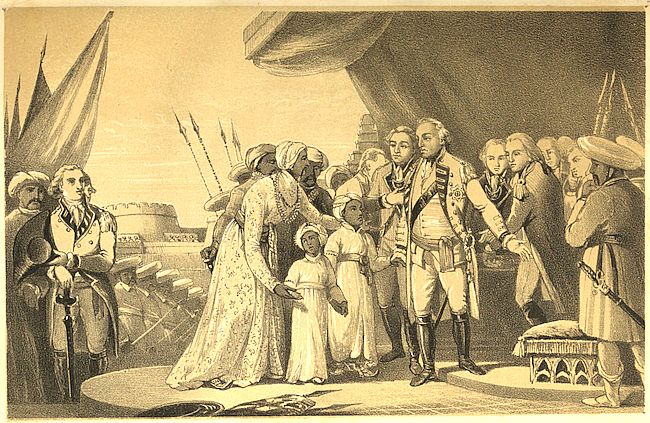
Madeley lith. 3 Wellington St. Strand
THE MARQUIS CORNWALLIS RECEIVING THE TWO SONS OF TIPPOO SULTAUN AS HOSTAGES FROM THE VAKEEL.
“
This morning they were the sons of the Sultaun my Master; they now look up to your Lordship as their Father.
”
For Cannon’s Military Records.
Thus terminated a war in which the confederates wrested from the enemy seventy fortresses, eight hundred pieces of cannon, and destroyed or dispersed at least fifty thousand men. By the articles of the treaty, Tippoo was bound to pay a large sum of money, and to cede one half of his dominions.
The Governor-General and Commander-in-Chief in India granted from this money a sum equal to six months’ batta for all ranks, and the Court of Directors afterwards made a similar grant.
On the 26th of March, the exchange of the definitive treaty being completed, the British commenced moving towards Bangalore, from whence they proceeded to the Pednaigdurgum Pass, where the Bengal troops were ordered to their own presidency.
Early in May the army descended the Ghauts, arriving soon after at Vellore, where the Commander-in-Chief arranged the cantonments of the troops, and proceeded to Madras. The Seventy-first received orders to march to the southward, and in the month of June arrived at Warriore, near Trichinopoly, under the command of Lieut.-Colonel Baird, who during the campaign had been absent from the regiment in command of a brigade. Eight companies were stationed at Warriore, and two were detached with Major Dalrymple to Dindigul. In this situation the regiment continued for the remainder of the year.
1793.
In March 1793, the eight companies under the command of Lieut.-Colonel Baird proceeded from Warriore to Secundermally, in the neighbourhood of Madura. Meanwhile the events of the French revolution had involved England in another contest, the National Convention of France having declared war against Great Britain and Holland, in February 1793. The news of this event arrived in India in May following, when the siege of the French settlement of Pondicherry, on the Coromandel coast, was determined upon. Lieut.-Colonel Baird, of the Seventy-first, was appointed to command a brigade on this service.
In July the flank companies of the regiment were ordered to join the force about to besiege Pondicherry, and marched for that purpose, being followed soon afterwards by the battalion companies. The place surrendered on the 22d of August, and the Seventy-first returned to Secundermally and Dindigul, where the regiment continued during the remainder of the year.
1794.
An attack upon the Mauritius was in contemplation at the commencement of the year 1794, and troops for that service were assembled at Wallajohabad. The Seventy-first, having received orders to join this force, marched to Wallajohabad, where the regiment remained only a short time, having been ordered to return to the southward, in consequence of the projected expedition being relinquished.
The regiment marched accordingly, and arrived at Tanjore in June, where it was stationed for the remainder of the year, having two companies detached, under Major Dalrymple, at Vellum.
1795.
Holland became united to France in the early part of 1795, and was styled the Batavian republic. Upon the arrival of this information in India, an expedition was fitted out against the island of Ceylon, where the Dutch had several settlements. Major Dalrymple, with the flank companies, marched to the coast, and embarked at Negapatam, for the purpose of co-operating with the troops destined for Ceylon, under the command of Colonel James Stuart, of the seventy-second, who was promoted to the rank of Major-General at this period. The fleet arrived on the coast of Ceylon on the 1st of August, and two days afterwards the troops landed four miles north of the fort of Trincomalee. The siege of the fort was commenced as soon as the artillery and stores could be landed, and removed sufficiently near to the place. On the 26th of August a practicable breach was effected, and the garrison surrendered. The fort of Batticaloe surrendered on the 18th of September, and the fort and island of Manaar capitulated on the 5th of October. After these services were performed, the flank companies returned to Tanjore in the month of October, having lost eleven men in killed and wounded. Captain William Charles Gorrie, of the grenadier company, was desperately wounded in this expedition.
1796.
In May 1796, the regiment marched to Wallajohabad, where it was stationed during the remainder of the year.
1797.
On the 2d of January 1797, the regiment was inspected by Major-General Clarke, who issued the following general order:—
“Major-General Clarke has experienced infinite satisfaction, this morning, at the review of His Majesty’s Seventy-first regiment.
“He cannot say that on any occasion of field exercise he ever was present at a more perfect performance.
“When a corps is so striking in appearance, and so complete in every branch of its discipline, little can occur to the Commander-in-chief to particularize. He cannot but notice, however, that the Seventy-first regiment has excited his admiration for its expertness in those parts of its exercise which are most essential, and most difficult to execute. He alludes to its order and regularity when moving in line; its extreme accuracy in preserving distances, and the neatness and promptitude that are so evident in all its formations. So much perfection in a corps, whose services in India will long be held in remembrance does the greatest honor to Lieut.-Colonel Baird and all his officers, to whom, and the corps at large, the Commander-in-chief desires to offer his best thanks.”
The regiment remained in the cantonment of Wallajohabad until the month of October, when orders were issued for its return to Europe. It was accordingly drafted, giving five hundred men to the seventy-third and seventy-fourth regiments, and then marched from Wallajohabad, under the command of Colonel Baird, with the non-commissioned officers, drummers, and invalids, to Madras, and immediately embarked on board of Indiamen for Great Britain. The fleet sailed from Madras Roads on the 17th of October, and was at sea during the remainder of the year.[17]
1798.
Early in January 1798, the fleet arrived at the Cape of Good Hope, where the commanding officer of the regiment, Colonel Baird, was detained upon the staff, having been appointed brigadier-general. After remaining a few days in Table Bay, the fleet sailed, and reached St. Helena in February, where it was detained three months waiting for a convoy.
The fleet sailed on the 1st of May from St. Helena, without a convoy, and in July, in consequence of contrary winds, was compelled to put into Cork Harbour. It sailed from thence for the Thames, and on the 12th of August the regiment disembarked at Woolwich, where it remained for a few days, and then re-embarked in smacks for Leith. After landing, the regiment proceeded to Stirling. As a mark of indulgence, a general leave for two months was granted to the officers and men of the Seventy-first, to enable them to visit their friends and families, after a long absence from their native country. At the expiration of this period, the whole assembled at Stirling, with the addition of several recruits. Immediately afterwards, the whole of the officers and non-commissioned officers, with the exception of the staff, and a few at head-quarters, were sent out to recruit the regiment.
1799.
During the year 1799, the head-quarters remained at Stirling, and the recruiting went on but slowly.
1800.
In May 1800, the strength of the regiment amounted to about two hundred rank and file, when a route arrived changing the quarters to Paisley, but soon after the march an order arrived for its proceeding to Ireland. In June the regiment reached Portpatrick, and crossed immediately to Donaghadee, from whence it marched, under the command of Colonel Dalrymple, to Newry, and in a few days afterwards was removed to Dundalk.
In July the regiment received six hundred volunteers from the Scotch Fencible corps serving in Ireland, and remained at Dundalk until the close of the year, when a route for Dublin was received. At this period, Colonel Dalrymple was appointed brigadier-general, and the command of the regiment devolved on Brevet Lieut.-Colonel John French.
On the 6th of December Major Denis Pack was promoted from the fourth Royal Irish dragoon guards to be Lieutenant-Colonel in the Seventy-first regiment, in succession to Lieut.-Colonel the Honorable John Lindsay, who retired from the service.
1801.
The regiment, early in the year 1801, marched from Dundalk to Dublin, and occupied the barracks in the Palatine Square. On the 24th of April, Lieut.-Colonel Pack joined, and assumed the command of the regiment.
1802.
In March 1802, in which month the Peace of Amiens was concluded, the regiment proceeded from Dublin, and was cantoned in the county of Wicklow. The corps was so divided, that at Arklow, the head-quarters, there were only two companies. In this situation it continued for the remainder of the year.
1803.
The regiment proceeded, in March 1803, in three divisions, to Ballinasloe, where it remained for a few days, and afterwards marched to Loughrea.
Major-General Sir John Francis Cradock, K.B., was appointed colonel of the Seventy-first regiment on the 6th of August 1803, in succession to General the Honorable William Gordon, who was removed to the twenty-first Royal North British Fusiliers.
The regiment continued at Loughrea, but the light company was detached to Limerick, to join a light battalion which was being formed at that place.
1804.
In May the regiment proceeded from Loughrea to the county of Limerick, the head-quarters being stationed at Rathkeale; one detachment at Newcastle, another at Tarbert, and a third at Askeaton.
2d bat.
While the regiment was stationed in Ireland, war had recommenced with France, and Bonaparte having made preparations for invading Great Britain, additional measures of defence to those of the former year were adopted by the Government;[18] and under the “Additional Force Act,” passed on the 10th of July 1804, a second battalion was added to the Seventy-first regiment, which was to consist of men to be raised for limited service in certain counties of North Britain. The second battalion was formed at Dumbarton in October, to the command of which Lieut.-Colonel Lord George Beresford was appointed. Its establishment was fixed at 23 serjeants, 22 drummers, 20 corporals, and 380 privates.
1805. 1st bat.
In March 1805 the first battalion, under the command of Lieut.-Colonel Pack, proceeded to Bandon in the county of Cork, and was stationed at that place until July, when it marched to Cork, and immediately afterwards to Monkstown, where it embarked in transports, having been selected to form part of a secret expedition under its former commander, Major-General Sir David Baird.
In the beginning of August the embarkation was completed, and on the 5th of that month the fleet sailed, convoyed by three 64-gun ships, two frigates and gun-brigs, under the orders of Commodore Sir Home Popham; and on the 28th of September the fleet, after a very boisterous passage, arrived at Madeira.
On the 3d of October the fleet left Madeira, and on the 12th of November arrived at St. Salvador, in the Brazils, where an opportunity was afforded of refreshing the men, landing the sick, and procuring some horses for the cavalry.
The fleet again put to sea on the 28th of November, and directed its course towards the Dutch colony of the Cape of Good Hope, then in possession of the Batavian Government, which was united with France in hostility to Great Britain.
1806.
The fleet arrived at the high table-land of the Cape of Good Hope on the 4th of January 1806, and shortly afterwards came to anchor. The whole of the following day the surf upon the shore of the bay was too violent to admit of any attempt to land. Brigadier-General William Carr, afterwards General Viscount, Beresford, was detached, with such of the cavalry as had horses, and the thirty-eighth regiment, to Saldanha Bay.[19]
In the morning of the 6th of January a landing was effected by the Highland brigade, under the command of Brigadier-General Ronald Craufurd Ferguson, in the performance of which service Lieut.-Colonel Pack, the commanding officer of the Seventy-first regiment, was wounded. The following day was devoted to landing the supplies and the remainder of the army.
Early in the morning of the 8th of January Major-General Sir David Baird formed his troops in two columns, and moved up to the heights of Bleuberg (Blue Mountain), from whence the enemy was seen, drawn up in order of battle, in two lines, with twenty-three pieces of cannon, his numbers being calculated at 5,000, of which a large proportion was cavalry.