HISTORICAL RECORD (continued 3)
Reading edition
Previously to the departure of the regiment from Hertford, it was inspected by the Adjutant-General to the Forces, Major-General Sir Henry Torrens, K.C.B., who communicated to Colonel Sir Thomas Arbuthnot, K.C.B., commanding the Seventy-first, the expression of the satisfaction experienced by His Royal Highness the Commander-in-Chief in perusing the report made on that occasion.
1821.
In June 1821, the regiment marched to Chatham, having detachments at Sheerness, Tilbury Fort, and Harwich. Here a further reduction took place of two companies, making the establishment to consist of 576 rank and file.
1822.
From Chatham the regiment marched to London, and proceeded by the canal to Liverpool, there to embark for Dublin, where it arrived on the 3d of May 1822; the regiment remained in that city until the beginning of October, when it marched to the south of Ireland. The head-quarters were stationed at Fermoy, and detachments proceeded to the villages of Ballahooly, Castletown Roche, Kilworth, Kildorrory, Wattstown, Glanworth, and Mitchelstown. A subaltern’s party was also encamped at Glennasheen in the county of Limerick, the disturbed state of that part of Ireland requiring detachments in the above posts, and the utmost exertions of every individual for their protection.
1824.
Lieut.-General Sir Gordon Drummond, G.C.B., was removed from the colonelcy of the eighty-eighth to that of the Seventy-first regiment on the 16th of January 1824, in succession to General Francis Dundas, deceased.
The regiment remained here for two winters, and in the beginning of May 1824 orders were received to march to the Cove of Cork, to embark for foreign service.
Before the Seventy-first marched to the coast for embarkation, very gratifying addresses were presented to Colonel Sir Thomas Arbuthnot, commanding the regiment, from the magistrates and inhabitants of the district round Fermoy, conveying their approbation of the conduct of the corps, which had won the esteem of all classes.
A very gratifying order was also issued by Major-General Sir John Lambert, K.C.B., commanding the south-western district of Ireland, relative to the conduct of the regiment.
The regiment embarked for North America on the 14th, 16th, 17th, and 18th of May 1824, on board the Indian trader Prince of Orange, Cato and Fanny transports, and anchored at Quebec on the 23d, 24th, and 25th of June.
1825.
In the year 1825, the establishment of the regiment was augmented from eight to ten companies, and formed into six service and four depôt companies, consisting of forty-two sergeants, fourteen buglers, and 740 rank and file.
In consequence of this arrangement, the officers and non-commissioned officers of two companies were sent to England to join the depôt companies at Chichester.
1826.
The detachments stationed during the summer months at the posts of Sorel and Three Rivers rejoined the head-quarters of the regiment at Quebec on the 15th of October.
On the 25th of October and the 4th of November, the service companies were inspected by Lieut.-General the Earl of Dalhousie, the Commander of the Forces in British North America, who expressed his fullest approbation of their discipline and interior economy, as well as of their conduct and appearance.
1827.
The head-quarter division of the Seventy-first embarked at Quebec for Montreal on the 17th of May 1827, after having been stationed in that garrison nearly three years. Preparatory to this change of quarters, the service companies were again inspected by Lieut.-General the Earl of Dalhousie, who, in orders, assured Lieut.-Colonel Jones that he had never seen any regiment in more perfect order.
The service companies arrived at Montreal on the 19th of May, and detachments from them were stationed at Isle-aux-Noix, St. John’s, William Henry, La Chine, Coteau-du-Lac, and Rideau.
1828.
On the 8th of May 1828, the Seventy-first embarked for Kingston in batteaux, and arrived there on the 16th of that month.
The Seventy-first remained stationed here for twelve months. During the summer and part of the autumn they suffered much from fever and ague, having had at one period nearly a third of the men in hospital.
1829.
Upon the 1st of June 1829, the head-quarters embarked in a steam-boat for York, now called Toronto, the capital of the Upper Province, and arrived there on the following morning.[33]
One company was detached to Niagara, another to Amherstburg, and a third to Penetanguishene on Lake Huron. A small number of men occupied the naval post at Grand River on Lake Erie. The Seventy-first occupied these posts for a period of two years.
On the 10th of August 1829, the depôt companies embarked at Gravesend for Berwick-on-Tweed.
Major-General Sir Colin Halkett, K.C.B., was removed from the colonelcy of the ninety-fifth to that of the Seventy-first regiment, on the 21st of September 1829, in succession to General Sir Gordon Drummond, G.C.B., who was appointed to the forty-ninth regiment.
1830.
In June, 1830, the depôt companies were removed from Berwick-on-Tweed to Edinburgh Castle.
1831.
In May 1831, the service companies moved down to Quebec, where the whole were assembled on the 16th of June. After a stay of nearly five months in that city, orders arrived for the Seventy-first to proceed to Bermuda. The service companies embarked on the 20th of October 1831 in the transports Layton and Manlius, and arrived off St. George’s, Bermuda, upon the 11th of November, when they immediately disembarked, sending a detachment of one captain, two subalterns, and a hundred and twenty men to Ireland Island.
The head-quarters were subsequently moved to Hamilton, and small parties were detached to the signal posts at Gibbs Hill and Mount Langton.
1833.
During the years 1832 and 1833, the service companies continued at Bermuda, and the depôt remained in North Britain.
On the 30th of August 1833, Lieut.-Colonel the Honorable Charles Grey exchanged from the half-pay to the Seventy-first Regiment with Lieut.-Colonel Joseph Thomas Pidgeon.
1834.
The tartan plaid scarf was restored to the Seventy-first regiment by an authority (under the King’s Sign Manual) dated 17th of February 1834.
On the 11th of September 1834, the service companies embarked at Bermuda for Great Britain, and arrived at Leith on the 19th of October following. The regiment was afterwards stationed at Edinburgh, where it remained during the year 1835.
1836.
The regiment embarked at Glasgow on the 11th of May 1836 for Ireland, and was stationed at Dublin during the remainder of the year.
1837.
In June 1837, the regiment proceeded from Dublin to Kilkenny.
1838.
Major-General Sir Samuel Ford Whittingham, K.C.B., was appointed Colonel of the Seventy-first regiment on the 28th of March 1838, in succession to Lieut.-General Sir Colin Halkett, K.C.B., appointed to the thirty-first regiment.
Meanwhile orders had been received for the regiment to proceed on foreign service, and on the 20th of April 1838 the six service companies embarked at Cork for Canada. The four depôt companies remained in Ireland.
1839.
On the 2d of June 1839 the depôt companies embarked at Cork for North Britain, and were afterwards stationed at Stirling.
The establishment of the regiment was augmented on the 12th of August 1839, from seven hundred and forty to eight hundred rank and file.
1840.
During the year 1840 the service companies were stationed at St. John’s, Lower Canada. The depôt companies proceeded from Stirling to Dundee in April.
1841.
Lieut.-General Sir Thomas Reynell, Bart., K.C.B., was removed from the colonelcy of the eighty-seventh Royal Irish fusiliers to that of the Seventy-first or Highland regiment on the 15th of March 1841, in succession to Lieut.-General Sir Samuel Ford Whittingham, K.C.B. and K.C.H., deceased.
In May 1841 the depôt companies proceeded from Dundee to Aberdeen.
Lieut.-Colonel the Honorable Charles Grey exchanged to half-pay with Lieut.-Colonel James England on the 8th of April 1842.
1842.
The service companies proceeded from St. John’s to Montreal, in two divisions, on the 27th and 28th of April 1842.
In consequence of the augmentation which took place in the army at this period, the Seventy-first regiment was ordered to be divided into two battalions, the six service companies being termed the first battalion, and the depôt, augmented by two new companies, being styled the reserve battalion. The depôt was accordingly moved from Stirling to Chichester in 1842, and after receiving one hundred and eighty volunteers from other corps, was there organised into a battalion for foreign service.
The reserve battalion of the Seventy-first, under the command of Lieut.-Colonel James England, embarked at Portsmouth in Her Majesty’s troop-ship “Resistance,” which sailed for Canada on the 13th of August 1842, and the battalion landed at Montreal on the 23d of September, where the first battalion was likewise stationed, under the command of Major William Denny, who, upon the arrival of Lieut.-Colonel England, took charge of the reserve battalion.
1843.
The reserve battalion marched from Montreal to Chambly on the 5th of May 1843, and arrived there on the same day.
The first battalion, under the command of Lieut.-Colonel England, embarked at Quebec for the West Indies in the “Java” transport, on the 20th of October 1843. The head-quarters disembarked at Grenada on the 15th of December following.
1844.
The head-quarters of the first battalion embarked on the 25th of December 1844, at Grenada, for Antigua.
1845.
During the year 1845 the head-quarters of the first battalion continued at Antigua.
The head-quarters and three companies of the reserve battalion marched from Chambly on the 11th of May 1845, and arrived at Kingston, in Canada, on the 14th of that month.
1846.
On the 18th of April 1846, the head-quarters and four companies of the first battalion embarked at Antigua on board the transport “Princess Royal,” and landed at Barbadoes on the 24th of the same month.
The first battalion, under the command of Captain Nathaniel Massey Stack, embarked for England at Barbadoes on the 29th and 30th of December, on board of Her Majesty’s ship “Belleisle.”
On the 6th of October 1846, the reserve battalion left Kingston, in Canada West, and the head-quarters arrived at La Prairie on the 8th of that month.
1847.
The ship “Belleisle,” having the first battalion on board, sailed for Portsmouth on the 1st of January 1847, and arrived at Spithead on the 25th of that month. After disembarking at Portsmouth, the battalion proceeded to Winchester, where it was stationed until the 19th of July, when it was conveyed in three divisions by railway to Glasgow, and on the 21st of December it was removed to Edinburgh.
In September 1847, the head-quarters of the reserve battalion were removed from La Prairie to Chambly, and in October proceeded to St. John’s, in Canada East.
1848.
Lieutenant-General Sir Thomas Arbuthnot, K.C.B., was removed from the colonelcy of the ninth foot to that of the Seventy-first regiment on the 18th of February 1848, in succession to Lieut.-General Sir Thomas Reynell, Bart. and K.C.B., deceased.
Three companies of the first battalion proceeded from Edinburgh to Dublin on the 27th of April 1848; and the head-quarters, with the three remaining companies, were removed to Dublin on the 1st of May. In June, the head-quarters were removed to Naas.
During the year 1848, the head-quarters of the reserve battalion remained at St. John’s, in Canada East.
1849.
Lieut.-General Sir James Macdonell, K.C.B. and K.C.H., was appointed from the seventy-ninth to be colonel of the Seventy-first or Highland regiment, on the 8th of February 1849, upon the decease of Lieut.-General Sir Thomas Arbuthnot, K.C.B.
In compliance with instructions received upon the occasion of Her Majesty’s visit to Dublin, the head-quarters of the first battalion, with the effectives of three companies, proceeded from Naas to that garrison on the 28th of July, and were encamped in the Phœnix Park. The three detached companies also joined at the encampment on the same day. On the 13th of August the head-quarters and three companies returned to Naas.
The head-quarters and two companies of the reserve battalion, under the command of Lieut.-Colonel Sir Hew Dalrymple, Bart., proceeded from St. John’s to Montreal, in aid of the civil power, on the 28th of April 1849. The head-quarters and three companies quitted Montreal and encamped on the Island of St. Helen’s on the 30th of June, but returned to St. John’s on the 16th of July. On the 17th of August 1849, the head-quarters and two companies proceeded from St. John’s to Montreal, in aid of the civil power, and returned to St. John’s on the 6th of September.
1850.
In April 1850, the first battalion proceeded from Naas to Dublin.
The head-quarters and two companies of the reserve battalion quitted St. John’s and Chambly on the 21st of May 1850, and arrived at Toronto on the 23d of that month, where the battalion was joined by the other companies, and it continued there during the remainder of the year.
1851.
In April 1851, the first battalion proceeded from Dublin to Mullingar, and in July following was removed to Newry.
During the year 1851 the reserve battalion continued to be stationed at Toronto.
1852.
In May 1852, the reserve battalion proceeded from Toronto to Kingston. On the 8th of June following, Lieut.-Colonel Sir Hew Dalrymple, Bart., retired from the service by the sale of his commission, and was succeeded by Lieut.-Colonel Nathaniel Massey Stack.
On the 1st of July 1852, the date to which this Record has been brought, the first battalion of the Seventy-first regiment was stationed at Newry, under the command of Lieut.-Colonel William Denny; the reserve battalion continued at Kingston, in Canada.
1852.
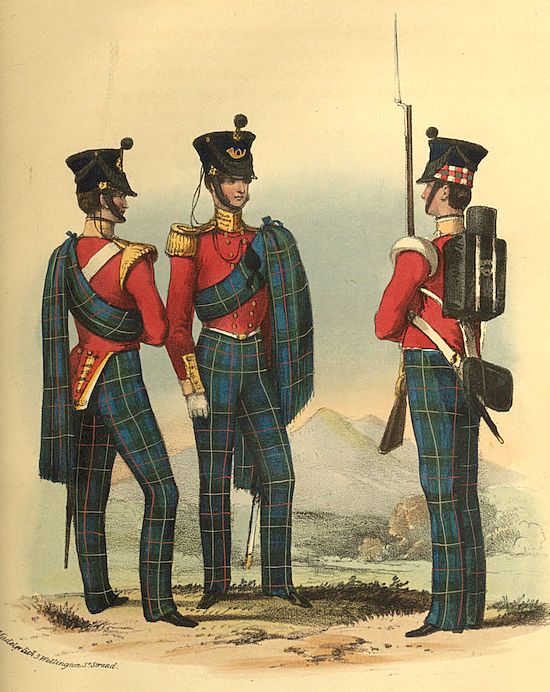
Madeley lith. 3 Wellington St. Strand
SEVENTY FIRST HIGHLANDERS.
LIGHT INFANTRY.
For Cannon’s Military Records.