HISTORICAL RECORD
Reading edition
OF
THE EIGHTEENTH,
OR THE
ROYAL IRISH REGIMENT OF FOOT.
1684
The Royal Irish Regiment of Foot existed many years, as independent companies of pikemen and musketeers on the establishment of Ireland, previous to the formation of the regiment in 1684; several of these companies having been in the service of the Commonwealth in the time of Oliver Cromwell. At the Restoration in 1660, King Charles II. disbanded the army of the Commonwealth in England, and embodied several new corps. Little alteration was, however, made in the Irish forces, excepting the formation of a regiment of foot guards, called the "Royal Regiment of Ireland," which, with about twenty independent troops of horse and eighty companies of foot, constituted the military force of Ireland. Towards the close of his reign, King Charles II. took particular interest in improving the organization of the military establishments of his dominions, and the Irish independent troops of horse were embodied into three regiments of cavalry; at the same time the companies of foot were constituted seven regiments of infantry. The colonelcy of one of these corps was conferred on Arthur Earl of Granard, by commission dated the 1st of April, 1684; it is the only one of these ten regiments which has continued in the service of the British crown; and it now bears the title of the Eighteenth, or the Royal Irish Regiment of Foot.[6]
1685
On the 6th of February, 1685, King Charles II. died, and was succeeded by his brother, James II.; and in June following James Duke of Monmouth erected the standard of rebellion in the west of England, and asserted his own pretensions to the throne. On this occasion the Earl of Granard's regiment was ordered to proceed to England: it embarked from Dublin, landed at Park Gate, and marched to Chester. In a few days after its arrival in England the rebel army was overthrown at Sedgemoor, and the Duke of Monmouth was subsequently captured and beheaded; when the regiment returned to Ireland.
1686
The King, being of the Roman Catholic persuasion, soon evinced a determination to use his utmost endeavours to subvert the Protestant religion and the constitution of the kingdom; commencing in Ireland, where the Catholics were more numerous than the Protestants. The Earl of Clarendon was nominated Lord-Lieutenant; but "Colonel —— Talbot, a furious Papist, was empowered to model the army, and he dismissed the greater part of the Protestant officers, filling their places with those of his own religion. After having performed this signal service, he came over to England, where he was created Earl Tyrconnel and lieut.-general of the Irish army."[7] The Earl of Granard, not approving of these proceedings, resigned the colonelcy of the regiment in favour of his son, Arthur Lord Forbes, whose commission as colonel was dated the 1st of March, 1686.
1687
In the summer of 1687, the regiment was encamped, with the other Irish corps, on the Curragh of Kildare; and the Earl Tyrconnel made a minute inspection of every troop and company, inquiring the name of every man, and discharging many because they were the descendants of men who had served Oliver Cromwell. When the regiment went into quarters, nearly all the Protestant officers and soldiers were dismissed from the service, a few only being retained to discipline the recruits, and the ranks were completed with men of the Roman Catholic religion.[8]
Colonel Lord Forbes being a spirited young nobleman of the Protestant religion, Earl Tyrconnel paid some deference to his Lordship, to avoid an open collision with so chivalrous an officer; and more Protestants were retained in Lord Forbes's regiment than in any other Irish corps.
1688
In the summer of 1688, the regiment was again encamped on the Curragh of Kildare. Meanwhile the proceedings of the Court in favour of Papacy and arbitrary government, had alarmed the kingdom, and a number of noblemen and gentlemen had invited the Prince of Orange to come to England with an army to support the Protestant interest. On this occasion Lord Forbes's regiment was ordered to proceed to England:[9] it landed at Chester, marched to London, and was quartered in the borough of Southwark.
The Prince of Orange having passed Dover with a powerful armament, the regiment was ordered to march to Salisbury, where it joined King James's army a few days after the Prince had landed at Torbay, and marched to Exeter. The English army, which amounted to thirty thousand men, had not been remodelled as the Irish forces had been, but consisted principally of Protestant officers and soldiers, who refused to fight in the cause of Papacy and arbitrary government, and many of them joined the Prince of Orange. Under these circumstances, the King ordered the army to withdraw towards London, and Lord Forbes's regiment marched to Colnbrook, where it was quartered when King James attempted to escape to France Lord Forbes waited on the Prince of Orange, who directed him to disband the Roman Catholic officers and soldiers, and to keep the Protestants to their colours: upwards of five hundred officers and soldiers were dismissed, and about two hundred Protestants, of all ranks, remained with the colours.
In a few days after this event, a report was circulated that the Irish soldiers had commenced murdering the country people and setting fire to the villages in the south of England. This proved false; but on the first circulation of the report, Major Sir John Edgeworth, who commanded the regiment in the absence of Colonel Lord Forbes, who was with the Prince of Orange in London (the Lieut.-Colonel, Lord Brittas, being a Papist, had left the regiment), assembled the men at his quarters, and formed them on parade in the court of Lord Oslington's house, which was walled in. "The country people, hearing that an Irish regiment was there, came flocking from all parts to knock us on the head; but Sir John bid them, at their peril, not to approach, and told them we were not Irish Papists, but true Church of England men; and seeing among the crowd a gentleman, called to him, and desired he would send to the minister of the parish to read prayers to us, and if the minister did not convince them we were all of the Church of England, we would submit to their mercy. The minister was soon sent for, and to prayers we went, repeating the responses of the Liturgy so well and so exactly, that the minister declared to the mob he never before heard the responses of the Church of England prayers repeated so distinctly and with so much devotion, upon which the mob gave a huzza, and cried 'Long live the Prince of Orange!' and so returned home."[10]
Soon afterwards the regiment marched to Hertfordshire, and the Protestant officers of Hamilton's Irish regiment were added to its numbers. The Irish Roman Catholic soldiers were sent prisoners to the Isle of Wight, and afterwards transferred to the service of the Emperor of Germany.
Lord Forbes retiring from the service at this period, the Prince of Orange conferred the colonelcy of the regiment on Major Sir John Edgeworth, by commission dated the 31st of December, 1688: at the same time measures were adopted to recruit its diminished numbers.
1689
In the beginning of April, 1689, the regiment marched to Chester, where it was stationed several weeks.
Colonel Sir John Edgeworth having been guilty of irregularity in procuring clothing, viz., purchasing the old clothing of disbanded Roman Catholic soldiers, from the Jews, to supply the recruits, instead of providing new clothing, was deprived of his commission; and on the 1st of May, 1689, the colonelcy was conferred on Edward Earl of Meath: Major Newcomb was appointed lieut.-colonel, and Captain Frederick Hamilton major.
Early in May the regiment marched into Wales.
Meanwhile the Prince of Orange had been elevated to the throne; but Earl Tyrconnel, who had been nominated lord-lieutenant of Ireland in the preceding year, had retained that country in the Roman Catholic interest; King James had arrived there with a body of French troops, and the whole country was subject to him, excepting Enniskillen and Londonderry, which were defended by Protestants. To rescue the suffering Protestants of Ireland from the power of their enemies, King William assembled an army at Chester, under Marshal Frederick Duke Schomberg; and the Earl of Meath's regiment being selected for this service, marched to Highlake, where it embarked for Ireland, and landing at White-house, near Belfast, on the 22nd of August, joined the troops under Duke Schomberg, who had commenced the siege of Carrickfergus, which fortress surrendered a few days afterwards.
The regiment advanced with the army to Dundalk, where a camp was formed on low, wet ground, which occasioned great loss of life among the troops from disease. No action of importance occurred during this campaign, and the regiment passed the winter in quarters at Lisburn, where it furnished a daily guard at Duke Schomberg's quarters: its ranks were completed by zealous Protestants, who were eager to enrol themselves under its colours, and it was the strongest corps in the army.
1690
In the summer of 1690, King William arrived in Ireland, and the officers and soldiers of the regiment had the honor of serving under the eye of their Sovereign. They took part in the memorable battle of the Boyne, on the 1st of July, when the army of King William forced the passage of the river in the face of the French and Irish forces under King James, and gained a decisive victory.
From the Boyne the regiment marched with the army towards Dublin, and at the general review at Finglass, on the 7th and 8th of July, it mustered six hundred and seventy-eight rank and file. It afterwards proceeded towards Limerick, where the defeated army of King James had rallied, and was prepared to make a determined stand. On arriving before the town, the regiment was detached, with three other corps, against Castle-Connell, which surrendered on being summoned.
The British battering train was destroyed by a detachment of the enemy, before it arrived at the camp; but the King resolved to prosecute the siege, and on the 20th of August the grenadiers of the regiment, commanded by Captain Needham, with those of Lord Cutts's regiment under Captain Foxon, entered the trenches to storm one of the outworks near the south-east corner of the wall. At two o'clock in the afternoon the signal was given, when the grenadiers rushed forward under a heavy fire, threw a shower of hand-grenades into the outwork, and scaling the wall with distinguished gallantry, captured the fort, killing about fifty men, and making a captain and twelve men prisoners: the remainder of the garrison escaped into the town. The grenadiers maintained the post they had captured; a sortie of the enemy was repulsed; and when the soldiers of the regiment were relieved, they retired: as they withdrew, Captain Needham was killed by a random shot from the town.[11]
A breach being made in the wall, and the approaches carried to the foot of the glacis, the King ordered a general assault to be made, on the 27th of August, by half the grenadiers of the army, supported by seven battalions, to capture the covered way and two towers near the breach: the Earl of Meath's regiment was one of the corps selected for this service. The assault was made with great gallantry; but, owing to some misapprehension of orders, the attack failed, and the several regiments engaged were forced to retire to the trenches, with the loss of five hundred officers and soldiers killed, and upwards of a thousand wounded.
The regiment had Lieutenant Latham and Ensign Smith killed; Lieut.-Colonel Newcomb died of his wounds; Colonel the Earl of Meath, Lieutenants Blakeney and Hubblethorn, wounded; and upwards of a hundred soldiers killed and wounded.[12]
The failure of this attack, with the approach of unfavourable weather, occasioned His Majesty to raise the siege, when the regiment marched with several others, under Major-General Kirke, towards Mullingar; but afterwards proceeded to the relief of Birr, which was besieged by a body of the enemy under Major-General Sarsfield, who retired behind the Shannon on the approach of the British troops.
The regiment was afterwards stationed at Mullingar, which was one of the frontier garrisons, and was actively employed during the winter in making incursions into the enemy's cantonments.
1691
Towards the end of April, 1691, a detachment of the regiment, commanded by Lieut.-Colonel Hamilton, accompanied a party under Colonel Brewer in a sudden advance towards Dunore, to surprise two thousand armed Roman Catholic peasantry, who had taken post near that place. At daybreak on the following morning the detachment approached the post, and the enemy formed for battle, but soon fled, and the soldiers pursued and killed about fifty fugitives.
Quitting Mullingar in the early part of June, the regiment was engaged in the operations of the army under Lieut.-General Baron De Ghinkel, afterwards Earl of Athlone:[13] it took part in the siege of Ballymore, which place was captured in a few days; and afterwards appeared before Athlone, in the siege of which fortress it had several men killed and wounded.
A strong detachment of the regiment took part in the capture of Athlone by storm, on which occasion the assailants rushed through the rapid stream of the Shannon, which was breast high, carried the enemy's works in gallant style, and in less than half an hour were masters of the town, to the surprise of General St. Ruth, who commanded King James's army, which was encamped near the fortress, and who was giving a public entertainment in his camp, when the news of the loss of Athlone reached him.
After putting the captured fortress in repair, the army marched towards the enemy, who occupied a strong position near the castle of Aghrim, and on the 12th of July a general engagement took place, in which the Irish forces were overpowered and driven from the field with severe loss, including General St. Ruth, who was killed by a cannon ball. On this occasion the regiment formed part of the brigade under Major-General Talmash: it had seven rank and file killed; one major, two captains, one lieutenant, one ensign, and eight rank and file wounded.
After this victory, the army marched to Galway, which surrendered in a few days; and the victorious English troops proceeded to Limerick, where the remains of the defeated Irish forces had assembled, and appeared determined to make a resolute stand, in the hope of being reinforced from France. The regiment had the honour to take part in the siege of Limerick; and, the army having crossed the river Shannon and completed the investment of the place, the Irish soon afterwards surrendered the city, and with it every other part of Ireland of which they retained possession, the Irish regiments being permitted to follow King James to France, or remain in their own country, as they should choose: the "Royal Regiment of Ireland" was one of the corps which proceeded to France, and was taken into the service of Louis XIV. The Earl of Meath's, now EIGHTEENTH regiment, was the only one of the eleven Irish corps embodied by King Charles II. which remained in the service of the English crown.
Ireland being rescued from the domination of King James, the regiment went into quarters in the county of Wicklow, and in December it proceeded to Waterford and Youghal.
1692
In the spring of 1692, the King of France assembled an army near La Hogue, and prepared an immense fleet to convey the troops to England, to replace King James on the throne. When this menace of invasion was given, the Earl of Meath's and several other regiments embarked at Waterford for England, and landing at Bristol, proceeded from thence to Portsmouth. Meanwhile the British and Dutch fleets had put to sea, and while the nations of Europe were gazing, in anxious expectation, at these preparations, the French navy was nearly annihilated in a decisive action off La Hogue, when the alarm of invasion ceased.
Soon after this victory a powerful armament was placed under the orders of Lieut.-General Meinhardt Duke of Leinster (afterwards Duke Schomberg) for the purpose of making a descent on the coast of France, and the Earl of Meath's regiment was one of the corps which embarked on this service. The court of France had, however, drawn so immense a number of troops to the coast, that it was not thought advisable to land, and the fleet sailed to the Downs, where orders were received for a number of regiments to proceed to Flanders. The transports sailed to Ostend, where the Earl of Meath's and several other corps landed, and being joined by a detachment from the confederate army under King William, they took and fortified the towns of Furnes and Dixmude. This service being completed, the regiment embarked for England; it encountered a severe storm at sea, and the transports were separated, but no loss was sustained; part of the regiment arrived in the Thames, the remainder landed at Harwich, and the whole were united at Bristol.
The Earl of Meath, being desirous of devoting his attention to the interests of Ireland, retired from the regiment, and was succeeded in the colonelcy by the lieut.-colonel, Frederick Hamilton; Major Ormsby was promoted Lieut.-Colonel, and Captain Richard Stearne Major.
1693
From Bristol the regiment marched in May, 1693, to Portsmouth, where it embarked on board the fleet to serve as marines, and in June sailed to Torbay, where the Dutch squadron joined. The first service undertaken was the protection of about four hundred merchant ships belonging to England, Holland, Denmark, Sweden, Hamburg, and Flanders, engaged in the Mediterranean trade. As the fleet proceeded through the Channel, it presented a splendid appearance. Captain Parker states—"All the sea, from the line of battle to our English coast, seemed as a floating wood covered with canvass; and as the weather was very fair, the whole made a most glorious appearance." After protecting the merchant-vessels through the Bay of Biscay, the grand fleet returned, leaving a squadron under Admiral Sir George Rooke, to continue the voyage with them. The French monarch had made powerful efforts to send to sea a formidable fleet, which attempted to intercept the merchantmen and convoy under Sir George Rooke. The English admiral avoided an engagement with so superior a force, and brought off the greater part of his fleet; but many valuable vessels were captured or destroyed by the enemy. On receiving news of this event, the combined fleets of England and Holland attempted to intercept the French naval force, but it got safe into port.
In the autumn the regiment landed and marched to Norwich.
During the campaign of this year, the confederate army in Flanders had sustained severe loss at the battle of Landen, and efforts were made to increase its numbers, for which purpose Colonel Hamilton's regiment was ordered to proceed abroad. It marched to London in December, was reviewed by King William in Hyde Park, and embarking on the Thames, sailed to Ostend, where it landed, and was stationed several months.
1694
Taking the field in the spring of 1694, the regiment proceeded to the vicinity of Louvain, where it was reviewed by the King, and afterwards took part in the operations of the army. At the camp near Ramilies it was formed in brigade under Major-General Ramsay, and posted between two divisions of cavalry, in the left wing; it afterwards shared in many toilsome marches, also formed part of the covering army during the siege of Huy, and subsequently marched into winter quarters at Ghent.
During this campaign a question arose respecting the rank of regiments, and the King directed the subject to be submitted to a board of general officers.[14] Captain Parker states,—"As the general officers were most of them colonels of regiments raised in England by King James II., they showed great partiality on this occasion, for they would not allow the regiments, raised in Scotland or Ireland, to have any rank in the army previous to the time of their coming to England and entering upon English pay. By this regulation, ours, that had been regimented in the time of King Charles II., lost rank of eleven regiments, that had been raised by King James II. The King thought it very hard; but as he had left the matter to them, he confirmed their sentence." The rank of the regiment was thus fixed as EIGHTEENTH in the British line; numerical titles were, however, not generally used until the reign of George II.[15]
1695
Taking the field to serve the campaign of 1695, the regiment was formed in brigade with the Fifth, Seventh, Twenty-third, Collingwood's (afterwards disbanded), and La Melonière's regiment of French Protestants, in the English service, under Brigadier-General Fitzpatrick.
When King William undertook the siege of the important fortress of Namur, the regiment formed part of the covering army under the Prince of Vaudemont, against which a French force of very superior numbers advanced under the orders of Marshal Villeroy. During the night of the 14th of July, the hostile columns confronted each other; the French, confident of success, detached a body of troops to gain the rear of the allies, and anxiously waited for daylight to commence the action. The Prince of Vaudemont ordered his cavalry forward; the dragoons dismounting and forming on foot, while the artillery, and infantry with pikes trailed, withdrew unobserved. The French prepared for the attack, when the dragoons of the confederate forces retired a few paces, mounted their horses, and retreated, presenting to the surprised French what appeared to be the magic spectacle of an army vanishing out of sight. The enemy pursued, but the allies retreated in good order, and took up a position in front of Ghent. This retreat has been celebrated by historians as a fine specimen of the art of war.
The EIGHTEENTH were afterwards engaged in several manœuvres for the preservation of the maritime towns of Flanders; in the early part of August they were encamped between Genappe and Waterloo, and afterwards joined the forces under King William. In the mean time the town of Namur had surrendered; but the castle, a strong fortress situate on a rock, still held out, and, on the 11th of August, the EIGHTEENTH relieved one of the regiments which had suffered severely in the siege, and took its turn of duty in the trenches. A breach having been effected, arrangements were made for a general assault. Three thousand British, under Lord Cutts, were to attack the counterscarp and the breach of the Terra Nova; three thousand Bavarians the breach of the Cohorn; two thousand Brandenburgers (Prussians) the upper point of the Cohorn; two thousand Dutch the Casotte; and six hundred men were to storm the lower town: the EIGHTEENTH formed part of the British storming party.
The regiment marched into the trenches on the 20th of August, to take part in storming the Castle of Namur, and the soldiers were elated with the expectation of distinguishing themselves under the eye of their Sovereign. The trenches being crowded with troops, the EIGHTEENTH and two other regiments were ordered to Salsine Abbey, half a mile from the breach to be attacked. A little before mid-day the assault was made with heroic ardour, but, owing to some mistake in the signal, all the corps did not advance simultaneously, and the British grenadiers, who headed the storming party, were opposed by very superior numbers, and sustained severe loss; Lord Cutts being among the wounded. Hurrying from Salsine Abbey to share in the assault, the EIGHTEENTH approached the scene of conflict a few moments after the grenadiers had been repulsed and forced to retire; the regiment, however, rushed forward, stormed the breach with signal gallantry, and planted the regimental colours on the summit; but the enemy had constructed a strong work within the breach, which the utmost efforts of the officers and soldiers could not force, and after performing "prodigies of valour" they were obliged to retreat with severe loss. The other attacks were more successful; and lodgments were effected in the works. Captain Parker states—"The King saw this action from a rising ground at the back of Salsine Abbey, and took particular notice of the behaviour of our regiment; for ours, only, mounted the top of the breach, and we planted our colours thereon, but could not proceed farther, because a strong retrenchment had been thrown up on the inside, which we could not see till we had mounted the very top of the breach, so we were obliged to follow the crowd. His Majesty, on this occasion, was pleased to honour us with the title of 'THE ROYAL REGIMENT OF FOOT OF IRELAND.'"[16] The King also conferred on the regiment the privilege of bearing his own arms, "the Lion of Nassau," on its colours (on which the cross of St. Patrick had previously been displayed); also the "Harp in a blue field and a crown over it," and the motto, "Virtutis Namurcensis Præmium."
The title was afterwards changed to "ROYAL IRISH REGIMENT."
The regiment sustained severe loss on this occasion; Lieut.-Colonel Ormsby, Captains Purefoy, Pinsent, and Cateret, Lieutenants Fitzmorris and Ramme, Ensigns Fettyplace, Blunt, Baker, and Hayter, with eighty-six non-commissioned officers and soldiers, were killed: Captain John Southwell and Ensign Lister died of their wounds; Colonel Frederick Hamilton, Captains Kane, Duroure, Seymour, and William Southwell, Lieutenants La Planche, Brereton, Hybert, Arphaxad, and Rolleston, Ensigns John Gifford, Ormsby, and Blakeney, with one hundred and eighty-five non-commissioned officers and soldiers, were wounded.[17]
The fire against the castle was continued, and preparations were made for another assault, which was prevented by the surrender of the garrison. Thus was captured the celebrated fortress of Namur, which reflected great credit on the confederate armies.
This conquest terminated the campaign, and the regiment passed the winter in garrison at Ghent.
1696
During the campaign of 1696, the regiment served with the army of Flanders under the Prince of Vaudemont; and was formed in brigade with a battalion of the Royals, the third, fifth, and seventeenth regiments under Brigadier-General Selwyn; and its services were limited to the protection of Ghent, Bruges, and the maritime towns of Flanders. In the autumn it returned to Ghent.
1697
Leaving Ghent in the spring of 1697, the regiment joined the army of Brabant under King William, and took part in the movements of this campaign; which were terminated by the treaty of Ryswick, when the British monarch saw his efforts for the liberty of Europe, and the preservation of the Protestant religion, attended with success.
On the termination of hostilities, the regiment marched to Ghent, where it was quartered several weeks, and on the 10th of December embarked at Ostend for Ireland. As two of the transports approached the Irish coast, they were chased by a Sallee man-of-war of eighteen guns, carrying Zealand colours. Seeing his brave soldiers in danger of being made slaves, Lieut.-Colonel Stearne called them on deck; the whole resolved on a desperate defence; and it was arranged that when the Sallee man-of-war attacked one transport, the other should come to its assistance, and the enemy should be boarded by the soldiers sword in hand, not doubting but that they would overpower the Turks and Moors, and capture the ship. With this view the soldiers were kept out of sight to induce the enemy to make an attack, and every man was ready for action. "The Sallee man-of-war kept us company about an hour, and was once, as we thought, coming up to board us; however, she thought better of it, fell astern, and stood off without firing a shot."[18] During the following night the two transports narrowly escaped destruction from a storm; they afterwards arrived safe in Bantry Bay; the soldiers landed on the 24th of December, and marched to Cork, where the regiment was assembled.
1699
From Cork the regiment marched, in July, 1698, to Waterford; in the spring of 1699 it proceeded to Dublin, and in 1700 it was removed to Kinsale.
1700
Pursuing those schemes of aggrandizement which had repeatedly involved Europe in war, Louis XIV. procured the accession of his grandson, Philip Duke of Anjou, to the throne of Spain, in violation of existing treaties; seized on the Spanish Netherlands; and made prisoners the Dutch troops in garrison in the barrier towns. The sudden acquisition of the Spanish monarchy by a grandson of the most ambitious and potent monarch of Europe, with the prospect of France and Spain being eventually united under one sovereign, affected the interests and agitated the public mind of all countries.
1701
War was resolved upon: the standing armies were augmented; and while the din of hostile preparation was heard on every side, the ROYAL IRISH regiment was placed upon a war establishment, and embarked for Holland, where it arrived, with several other corps, in July, 1701, and was placed in garrison at Huesden. On the 21st of September it was reviewed on Breda-heath by King William III.
1702
Quitting Huesden in March, 1702, the regiment proceeded to Rosendael, where the British infantry was assembled under Brigadier-General Ingoldsby; and at this place the troops received information of the death of King William III., on the 8th of March, and of the accession of Queen Anne.
From Rosendael the regiment marched to the duchy of Cleves, and formed part of the army encamped at Cranenburg during the siege of Kayserswerth, on the Lower Rhine, by the Germans. A French force of very superior numbers attempting to cut off the communication of the army at Cranenburg with Nimeguen, the troops struck their tents on the 10th of June, and by a forced march during the night arrived within a few miles of Nimeguen as the French legions approached. Some sharp fighting occurred, in which the British corps in the rear-guard evinced great gallantry, and the army effected its retreat under the works of the fortress.
Additional forces having arrived from England, the Earl of Marlborough[19] assumed the command of the allied army, and by a series of skilful movements he forced the French army to make a precipitate retreat from the frontiers of Holland to their own lines, and he twice attempted to bring on a general engagement under advantageous circumstances, but was restrained by the Dutch field deputies. The French forces having fled to their lines, the English General resolved to attack their fortified towns, and the ROYAL IRISH regiment was one of the corps detached from the main army to undertake the siege of the fortress of Venloo, situate on the east side of the river Maese, in the province of Limburg.[20] On the west side of the river was a detached fortification of five bastions, called Fort St. Michael, against which the British troops carried on their approaches;—the Dutch and Germans attacking other parts of the town: the whole were under Veldt-Marshal Prince Nassau-Saarbruck. The approaches being carried to the foot of the glacis, orders were given to storm the covered-way, and make a lodgment on the top of the glacis; and the ROYAL IRISH regiment, being on duty in the trenches at the time, was appointed to make the attack, together with the grenadiers of the brigade, and a party of chosen fusiliers. Captain Parker has given the following account of this attack:—
"The Lord Cutts sent for all the officers, and told them, the design was to drive the enemy from the covered-way, that they might not disturb the workmen in making a lodgment; however, if the enemy gave way with precipitation, we were to jump into the covered-way, and pursue them, let the consequence be what it would. We all thought these were very rash orders, contrary both to the rules of war, and the design of the attack.
"About four in the afternoon (18th September), the signal was given, and, according to our orders, we rushed up the covered-way; the enemy gave us one scattering fire, and away they ran: we jumped into the covered-way, and ran after them. They made to a ravelin, which covered the curtain of the fort, in which were a captain and sixty men. We, seeing them get into the ravelin, pursued them, got in with them, and soon put most of them to the sword. They that escaped us fled over a small wooden bridge, that led over the moat to the fort; and here, like madmen, without fear or wit, we pursued them over that tottering bridge, exposed to the fire of the great and small shot of the fort. However, we got over the fausse-braye, where we had nothing for it but to take the fort or die. They that fled before us climbed up by the long grass that grew out of the fort; so we climbed after them. Here we were hard put to it to pull out the palisades, which pointed down upon us from the parapet, and, was it not for the great surprise and consternation of those within, we could never have surmounted this very point: but, as soon as they saw us at this work, they quitted the rampart, and retired down to the parade in the body of the fort, where they laid down their arms and cried for quarter, which was readily granted them. Thus were the unaccountable orders of Lord Cutts as unaccountably executed, to the great surprise of the whole army, and even of ourselves, when we came to reflect on what we had done."
The enemy had about four hundred killed, and two hundred made prisoners. The British loss, in killed and wounded, did not exceed forty men.
Captain Parker, of the ROYAL IRISH regiment, adds,—"This affair was the occasion of another almost as surprising. An express came to Prince Nassau which gave an account that Landau was taken; whereupon he ordered the army to draw down near the town, to fire three rounds (as a feu de-joie); the cannon also of all the batteries, the mortars, and cohorns, were ordered to fire, with the troops, into the town. When the garrison and inhabitants saw us drawing down on all sides, they judged it was with a design of making such an attack on the town as we had made on the fort, which struck such a terror into them, that the magistrates begged the Governor to capitulate, and not suffer them all to be put to the sword. The first round of all our batteries, and the small shot of the army, so affrighted them, that men, women, and children, came flocking to the ramparts with white cloths in their hands, crying, 'Mercy! mercy!' and the Governor, in as great a consternation as the rest, sent out an officer to the Prince to desire a capitulation, which was immediately granted; as we had other sieges to carry on this season, the Prince allowed them honourable terms."
After the capture of Venloo, the regiment was employed in the siege of the fortress of Ruremonde, which was captured in a short time; and Stevenswart having also been reduced by a detachment from the covering army, the navigation of the Maese was thus cleared of the enemy up to Maestricht.
Rejoining the main army after this achievement, the regiment advanced towards the city of Liège, the French forces retiring as the British approached, but leaving a strong garrison in the citadel and Chartreuse. The ROYAL IRISH regiment was employed in the siege of the citadel of Liège, and its grenadier company had the honour to take part in the capture of that fortress by storm, on the 23rd of October, when the British soldiers highly distinguished themselves. They were permitted to appropriate a large quantity of dollars and silver plate, captured on this occasion, to their own use.
From the pleasant valley of Liège, the regiment commenced its march, on the 3rd of November, back to Holland, and passed the winter in garrison at Huesden.
1703
Quitting its winter quarters in April, 1703, the regiment traversed the country to Maestricht, and was in position near that city when the French forces, under Marshals Villeroy and Boufflers, made a sudden advance to surprise the British troops in their quarters, but were defeated in their design.
The Duke of Marlborough assembled the army near Maestricht, and the ROYAL IRISH regiment was formed in brigade with the eighth, thirteenth, seventeenth, and thirty-third, under its colonel, Brigadier-General F. Hamilton; and it advanced with the army towards Tongres, when the French quitted their post and eventually retired within their fortified lines, where the English General was desirous of attacking them, but was prevented by the Dutch commanders and field deputies. The services of the regiment were afterwards connected with the siege of Huy, which fortress was captured in ten days.
The ROYAL IRISH regiment formed part of the covering army during the siege of Limburg, which was commenced on the 10th of September, and on the 27th of that month the Governor surrendered. Spanish Guelderland being thus delivered from the power of France, the Dutch were freed from the danger of an invasion.
After taking part in these services the regiment marched to Breda: during the severe frosts of winter it proceeded to Bergen-op-Zoom, to reinforce the garrison of that fortress, and afterwards returned to Breda, from whence it detached three hundred men to Maestricht, to join the garrison of that city, while the Dutch soldiers were working at the entrenchments on the heights of Petersberg.
1704
Meanwhile the united French and Bavarian armies had gained considerable advantage in Germany, and the Duke of Marlborough resolved to lead his British brigades from the ocean to the Danube, to rescue the Emperor of Germany from the menaced danger. To engage in this splendid undertaking, the ROYAL IRISH regiment marched from Breda on the 5th of May, N.S., and proceeded towards the Rhine; being joined at Bedburg by the detachment from Maestricht. Continuing its route, the regiment proceeded to Coblentz, where it passed the Moselle and the Rhine, and afterwards traversed the minor states of Germany towards the seat of war on the Danube; all Europe being surprised at the ability evinced by the British commander in conducting this daring enterprise.
Having united with the forces of the Empire, the British advanced on the 2nd of July to attack a body of French and Bavarians under Count d'Arco, in an entrenched camp on the heights of Schellenberg, on the left bank of the Danube. About six in the evening the leading division, of which a detachment of the ROYAL IRISH regiment formed part, moved forward under a heavy fire, and attacked the enemy's entrenchments with distinguished gallantry. The enemy made a determined resistance, and the assailants were repulsed; but the attack was renewed with heroic courage, and, after a protracted contest, the Germans co-operated in the attack, when the entrenchments were forced, and the French and Bavarians driven from the heights with great slaughter. The British cavalry, charging, completed the discomfiture of the enemy, and sixteen pieces of ordnance, a number of standards and colours, with the enemy's tents, and the equipage and plate of the Count d'Arco, were captured.
The regiment had one serjeant and eleven rank and file killed; Captain Lea, Ensigns Gilman, Walsh, and Pensant, three serjeants, and thirty-two rank and file wounded.[21]
The victory at Schellenberg was followed by the flight of the enemy from Donawerth; and the regiment was engaged in the operations of the army which penetrated Bavaria, and captured Rayn after a short siege. The Elector of Bavaria formed an entrenched camp at Augsburg, to which city the allied army advanced; but found the enemy's camp too strong to be attacked with any prospect of success, and the troops retired a short distance. The siege of Ingoldstadt was commenced by the Germans, and the ROYAL IRISH regiment formed part of the covering army.
Quitting his camp at Augsburg, the Elector of Bavaria joined a strong body of French troops sent to reinforce his army, and the united divisions encamped in the valley of the Danube, near the village of Blenheim.
At three o'clock on the morning of the memorable 13th of August, 1704, the allied army advanced towards the enemy, and about three o'clock in the afternoon the British developed their attack against the French brigades posted in the village of Blenheim; thus commencing an engagement in which the English troops acquired great distinction. The village being found strongly fortified, it was environed by a few corps, and the army passed the little river Nebel to attack the enemy's lines. The ROYAL IRISH regiment directed its attacks against the right wing of the Gallo-Bavarian army, and was engaged with the chosen troops of France, under Marshal Tallard; its heroic conduct reflected the highest lustre on the British arms, and it contributed materially to the complete overthrow and discomfiture of the opposing host. The French were chased from the field with great slaughter, and the loss of their cannon, baggage, and many troops captured, including the brigades posted in the village of Blenheim: Marshal Tallard, and several officers of distinction, were among the prisoners. The left wing of the enemy was also overpowered by the Germans, and the victory was complete and decisive: the powerful armies of France and Bavaria being literally destroyed. Thus, on the banks of the Danube, was achieved by British valour a trophy which will serve as a monument to commemorate the national glory to the end of time. The conduct of the brave soldiers who conquered in the interior of Germany was the admiration of surrounding states, and has been lauded by numerous historians: the Duke of Marlborough was elevated to the dignity of a Prince of the Roman Empire.
The loss of the ROYAL IRISH regiment was Captains Brown, Rolleston, and Vaughan, Ensign Moyle, five serjeants, and fifty-two rank and file killed; Major Kane, Captains Lepenitor and Hussey, Lieutenants Smith, Roberts, Blakeney, and Harvey, Ensign Trips, nine serjeants, and eighty-seven rank and file wounded.[22]
From the Danube, the regiment traversed the country to the banks of the Rhine, crossed that river at Philipsburg on the 7th of September, and formed part of the covering army encamped at Croon-Weissemberg during the siege of Landau, which was undertaken by the Germans. When the siege drew towards a close, the regiment marched to Germersheim, where it embarked in boats on the Rhine, and in twelve days arrived at Nimeguen, where it landed, and, marching to Ruremonde, passed the winter at that place.
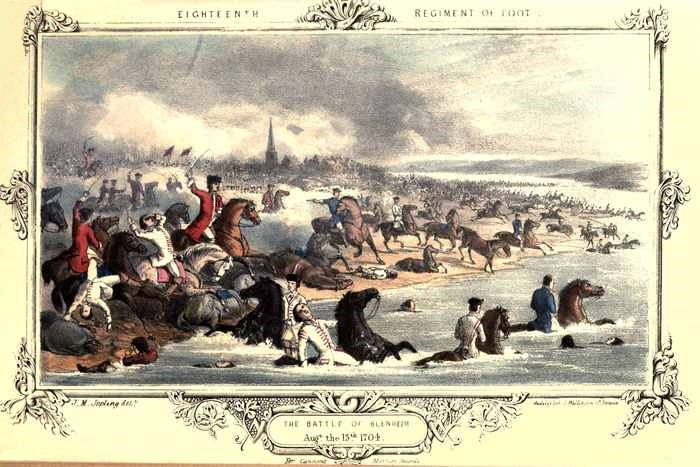
EIGHTEENTH REGIMENT OF FOOT.
THE BATTLE OF BLENHEIM.
Aug
t
the 13
th
1704.
J.M. Jopling delt Madeley lith 3 Wellington St Strand
For Cannon's Military Records
1705
Brigadier-General Hamilton, having become advanced in years, retired from active service, and was permitted to dispose of the colonelcy of the regiment to Lieut.-General Ingoldsby, from the twenty-third foot, who was appointed colonel of the ROYAL IRISH regiment by commission dated the 1st of April, 1705.
From Ruremonde the regiment marched to the vicinity of Maestricht, where it joined the army; and afterwards proceeded by Juliers, through a mountainous country, to the valley of the Moselle, where it encamped near the city of Treves. The army passed the Moselle and the Saar in the early part of June, with the view of carrying on the war in that direction; but the Duke of Marlborough, being disappointed of the co-operation of the Germans, marched his army back to the Netherlands, which occasioned the soldiers much fatigue. On arriving at the Maese, a detachment was employed in recapturing Huy, which the enemy had taken during the absence of the army up the Moselle.
A formidable barrier of forts and entrenchments had been constructed with great labour and expense to arrest the progress of the British General; but by menacing the lines to the south of the Mehaine, to draw the French army to that quarter, and afterwards making a forced march to the right during the night of the 17th of July, these stupendous works were passed at Helixem and Neer-Hespen, with little opposition; and the French and Bavarian troops, which hurried to the spot to drive back the leading corps of the allied army, were repulsed with severe loss. The ROYAL IRISH regiment was formed in brigade on this occasion with the twenty-fourth, twenty-ninth, and Temple's (afterwards disbanded), under Brigadier-General Webb, and, being in the main body of the army, did not sustain any loss. After this brilliant success, the designs of the British commander were frustrated by the opposition of the Dutch Generals, and little further advantage was gained.
The regiment returned to Holland for winter quarters, and was stationed at Worcum.
1706
Taking the field in May, 1706, the regiment proceeded to the general rendezvous of the army near Tongres, and, advancing from thence in the direction of Mont St. André, on Whit-Sunday the 23rd of May, the British commander discovered a powerful French army, under Marshal Villeroy and the Elector of Bavaria, in position at that place, with their centre at the village of Ramilies, which was occupied by a considerable body of troops.
Diverging into the plain, the allied army formed line and advanced towards the enemy; the ROYAL IRISH regiment, being in the right wing, formed on the heights of Foulz, and, descending into the low grounds near the Little Gheet river, menaced the enemy's left, at Autreglise and Offuz, with an attack. This movement occasioned the enemy to weaken his centre to support his left flank, when the Duke of Marlborough instantly reinforced his centre, and made a determined attack upon the enemy's position at the weakened point. For some time the officers and soldiers of the ROYAL IRISH regiment were spectators of the fight; but at a critical moment they were brought forward, and they contributed to the complete overthrow of the forces of France, Spain, and Bavaria. The warlike brigades of the enemy, a few hours before so formidable and menacing, were driven from the field with great slaughter, and the loss of many officers and soldiers taken prisoners, also of their cannon and many standards and colours. After pursuing the fugitives a considerable distance, the regiment halted for the night, surrounded by the ensanguined trophies of this day of glorious triumph to the British arms.
Retreating to Louvain, the broken remains of the enemy's splendid army halted a short time, and soon afterwards abandoned that city, and also Lierre, Ghent, Damme, and Bruges. The magistrates of these towns, together with those of Brussels, Malines, and Alost, renounced their allegiance to the Duke of Anjou, and declared in favour of the House of Austria. The garrisons of Oudenarde and Antwerp surrendered; Ostend withstood a short siege and then capitulated. Thus the successes of the allied arms were splendid beyond all precedent.
Towards the end of July, the ROYAL IRISH regiment was detached from the main army to take part in the siege of the fortress of Menin, which was considered one of the masterpieces of Vauban, the celebrated French engineer, and was provided with a numerous garrison well supplied with everything necessary for a protracted defence. The garrison disputed every yard of ground with sanguinary tenacity; but the allies carried on the siege with vigour, and brought their approaches to the foot of the glacis, where a storming party was assembled to attack the covered-way. The ROYAL IRISH regiment was appointed to take part in this service. The signal being given, the assailants rushed forward to the palisades, and threw a shower of hand-grenades into the covered-way; then, entering amidst the confusion, overthrew all opposition. General Stearne states,—"This proved warm service; for though we drove the enemy at once out of the counterscarp, they sprung two mines upon us, and from their works plied us with a most violent fire, which we lay exposed to until our workmen had thrown up an entrenchment sufficient to cover us. In this action our regiment had six officers and upwards of eighty soldiers killed and wounded."[23]
The Governor, finding himself unable to arrest the progress of the besieging force, surrendered.
The fortress of Aeth was afterwards captured, and this event terminated the campaign. Thus fortresses which had resisted powerful armies for months and years, and provinces disputed for ages, were the conquests of a summer: the nations of Europe witnessing with astonishment the splendid achievements of the forces under the Duke of Marlborough. After sharing in the brilliant successes of this campaign, the ROYAL IRISH regiment passed the winter at Ghent.
1707
In May, 1707, the regiment again took the field, and was formed in brigade with the second battalion of the Royals, the eighth, twenty-fourth, and Temple's regiments, under Brigadier-General Sir Richard Temple (afterwards Viscount Cobham). During this campaign, the French army avoided a general engagement, and the summer was passed by the opposing armies in manœuvring and watching each other's movements. In the autumn, the regiment marched to the castle of Ghent, of which its commanding officer, Colonel Stearne, was appointed governor.
1708
Finding his armies beaten on the continent, the French monarch fitted out an expedition for the purpose of landing the Pretender in Scotland, to embroil Great Britain in civil war; and the EIGHTEENTH regiment was one of the corps ordered home to repel the invaders: it embarked from Ostend in the middle of March, 1708, and sailed to the river Tyne; but the English fleet chased the French squadron from the British coast, and the regiment returned to Flanders.
When the opposing armies took the field, the French had obtained possession of Ghent and Bruges by treachery; but the English General surprised the French on the march near Oudenarde on the 11th of June, and gained a decisive victory. The EIGHTEENTH regiment formed part of the leading brigade of the van of the army, under Major-General Cadogan, and with the eighth, twenty-third, and thirty-seventh regiments, descended from the high grounds between Eyne and Bevere, forded a rivulet, and attacked seven battalions of the Swiss regiments of Pfeffer, Villars, and Gueder, which had taken post at Eyne: after a sharp contest British valour prevailed, and Brigadier-General Pfeffer, with three entire battalions, were made prisoners of war: the remainder were either killed, or intercepted in their attempt to escape, and made prisoners. The EIGHTEENTH afterwards attacked a body of troops posted in the enclosures, and soon drove the French from their ground. As the regiment was advancing in pursuit, a numerous body of French cavalry menaced it in front and flank, and it fell back to the hedges, where it repulsed the French horsemen. Other British brigades arriving, the whole advanced; a fierce conflict of musketry ensued, and charge succeeded charge until darkness put an end to the conflict, and thus saved the French army from complete annihilation. The enemy made a precipitate retreat during the night.
Lieut.-Colonel Stearne commanded the regiment on this occasion, and he states in his journal,—"Our regiment, though the first that engaged, had only one lieutenant and eight men killed, and twelve men wounded."
The ROYAL IRISH regiment formed part of the force employed in the siege of the important fortress of Lisle, the capital of French Flanders, and the regiment had numerous opportunities of distinguishing itself during the long and determined defence made by a numerous garrison under Marshal Boufflers. The citadel did not surrender until the 9th of December. The EIGHTEENTH had two captains and three subalterns killed, the major and several other officers wounded, and two hundred non-commissioned officers and soldiers killed and wounded.
1709
A strong detachment of recruits replaced the losses of the regiment, and it was in a highly efficient state when it took the field to serve the campaign of 1709. The Duke of Marlborough menaced the French army with an attack, which occasioned Marshal Villars to weaken the garrisons of the fortified towns to strengthen the army in the field, when the allies besieged Tournay. The EIGHTEENTH were detached, under the Prince of Orange, to drive the French detachment from Mortagne and St. Amand, and, having accomplished this service, joined the besieging army, and carried on its approaches at the seven fountains. The regiment was engaged in storming the breaches in the Ravelin and Half-Moon; and on the 29th of July it was in readiness to take part in storming the town, which was prevented by the surrender of the place, the garrison retiring into the citadel.
The EIGHTEENTH took part in the siege of the citadel of Tournay, which was celebrated for the extent of its underground works. Captain Parker, of the regiment, states in his journal,—"Our approaches against this citadel were carried on mostly underground, by sinking pits several fathom deep, and working from thence until we came to their casemates and mines. These extended a great way from the body of the citadel, and in them our men and the enemy frequently met, and fought with sword and pistol. We could not prevent them springing several mines which blew up some of our batteries, guns and all, and a great many men, in particular a captain, lieutenant, and forty (the London Gazette says thirty) men of our regiment." The EIGHTEENTH lost a lieutenant and several men in the combats underground; and ten grenadiers were suffocated in one of the galleries. In the early part of September the governor surrendered.
From Tournay the army marched in the direction of Mons, and, the French taking up a position near Malplaquet, a general engagement took place on the 11th of September, when the enemy was forced from his entrenchments with loss. Captain Parker states,—"The part which our regiment acted in this battle was something remarkable. We happened to be the last of the regiments which had been left at Tournay to level the approaches, and did not come up till the lines were formed. We were ordered to draw up on the right of the army, opposite a skirt of the wood of Sart, and, when the army advanced to attack the enemy, we entered the wood in our front. We continued marching till we came to a small plain, on the opposite side of which we perceived a battalion of the enemy drawn up, a skirt of the wood being in its rear. Colonel Kane, who was then at the head of the regiment, having drawn us up, and formed our platoons, advanced towards the enemy, with the six platoons of our first fire made ready. When we arrived within a hundred paces of them, they gave us a fire of one of their ranks; whereupon we halted, and returned them the fire of our six platoons at once, and immediately made ready the six platoons of our second fire, and advanced upon them again. They then gave us the fire of another rank; and we returned them a second fire, which made them shrink; however they gave us the fire of a third rank, after a scattering manner, and then retired into the wood in great disorder; on which we sent our third fire after them and saw them no more. We advanced up to the ground which they had quitted, and found several of them killed and wounded; and among the latter was one Lieutenant O'Sulivan, who told us the battalion we had engaged was the 'Royal Regiment of Ireland.'[24] Here, therefore, was a fair trial between the two Royal Regiments of Ireland, one in the British and the other in the French service; for we met each other upon equal terms, and there was none else to interpose. We had but four men killed and six wounded; and found near forty of them on the spot killed and wounded. The advantage on our side will be easily accounted for, first from the weight of our ball; for the French arms carry bullets of 24 to the pound, whereas our British firelocks carry ball of 16 only to the pound, which will make a considerable difference in the execution: again, the manner of our firing was different from theirs; the French, at that time, fired all by ranks, which can never do equal execution with our platoon firing."
Lieut.-Colonel Stearne gives nearly the same particulars, and adds—"We marched into the wood after them (the Royal Irish in the French service); and when we had got through, we found our army mounting the enemy's last entrenchments, and our brother harpers[25] scoured off as fast as their heels could carry them. Thus ended this great and terrible battle, which was the most obstinate engagement on both sides that has been known in the memory of man: the killed and wounded on both sides was very great."
The EIGHTEENTH were afterwards employed in covering the siege of Mons, and passed the winter in quarters at Ghent.
1710
From Ghent the regiment advanced on the 14th of April, 1710, and took part in the operations by which the French lines were passed at Pont-à-Vendin; and also formed part of the covering army during the siege of Douay, and also during the siege of Bethune; and was afterwards detached, under the Prince of Anhalt, to attack the town of Aire, situate on the banks of the river Lys. In the siege of this place many difficulties had to be overcome, from the nature of the ground, and from the determined defence of a numerous garrison: the EIGHTEENTH regiment had three officers killed, and five wounded; also about eighty soldiers killed and wounded. The garrison surrendered on the 9th of November; and the regiment, afterwards returned to Ghent.[26]
1711
The ROYAL IRISH again took the field in April, 1711, and were employed in the operations by which the boasted impregnable French lines were passed at Arleux, and the opportunity of attacking the fortified town of Bouchain, situated on both sides of the river Scheldt, was ensured. The regiment formed part of a detachment of twenty battalions, commanded by Lieut.-General the Earl of Orkney, which took post on the north and north-west side of the town and river, and advanced to drive the French from the heights of Wavrechin. Captain Parker states, "Our British grenadiers marched to the top of the hill on the left of their works, in order to begin the attack on that side: here we were posted in a field of wheat, about seventy or eighty paces from their works, expecting every moment the signal to fall on. I must confess I did not like the aspect of the thing: we plainly saw their entrenchment was a perfect bulwark, strong and lofty, and crowded with men, and cannon pointed directly at us: we wished much that the Duke might take a nearer view. * * * * While I was musing, the Duke of Marlborough, ever watchful, ever right, rode up unattended, and posted himself on the right of my company of grenadiers, from whence he had a fair view of the greater part of the enemy's works. It is quite impossible for me to express the joy which the sight of this man gave me. I was well satisfied he would not push the thing unless he saw a strong probability of success; nor was this my notion alone; it was the sense of the whole army, both officers and soldiers, British and Foreigners; and, indeed, we had all the reason in the world for it, for he never led us on to any one action that we did not succeed in. He stayed only three or four minutes, and then rode back: we were in pain for him while he stayed, lest the enemy might have discovered him, and fired at him, in which case they could not well have missed him. He had not been longer from us than he stayed when orders came to us to retire. As the corn we stood in was high, we slipped off undiscovered, and were a good way down the hill before they perceived that we were retiring, and then they let fly all their great and small shot after us; but as we were by this time under the brow of the hill, all their shot went over our heads." This statement of a distinguished officer of the EIGHTEENTH regiment shows how fully the great Duke of Marlborough possessed the confidence of his troops.
During the siege of Bouchain, the ROYAL IRISH regiment was actively engaged in the trenches and the attacks; but did not sustain a very severe loss. Lieut.-Colonel Stearne states,—"In this siege our regiment had four officers wounded but none killed, and about forty men killed and wounded; the grenadiers suffered most. Bouchain being taken, our regiment was ordered to Tournay, where we were quartered the remaining part of the campaign, from whence we escorted what provision came that way to the army which continued about Bouchain." In October the regiment marched to Lisle, where it passed the winter.
1712
In February, 1712, Lieut.-General Ingoldsby died, and was succeeded in the colonelcy of the regiment by Lieut.-Colonel Stearne, who had held a commission in the corps thirty-four years, and wrote an account of its services.[27]
From Lisle the regiment advanced in April to some high ground beyond Bouchain, where a camp was formed of several corps, and entrenchments thrown up. The ROYAL IRISH regiment afterwards joined the army under the orders of the Duke of Ormond, and its grenadier company advanced on a reconnoitring party into Picardy; but a suspension of hostilities took place soon afterwards, and the army withdrew to Ghent, where the regiment passed the winter. The power of France was reduced, its armies defeated, its frontier towns captured, its ambitious monarch was forced to sue for peace, and the treaty of Utrecht gave repose to Europe.
1713
The ROYAL IRISH regiment had acquired a high reputation during the war; and a board of officers being assembled in London, to decide on the rank of regiments, Colonel Stearne sent Captain Parker to England to claim rank for the regiment from the date of its formation in 1684, which would have given it rank as FIFTH foot; but this was not granted, and it continued to take date and rank in the English army from the time of its arrival in England in the autumn of 1688.[28]
During the winter, a very serious mutiny occurred among the troops stationed at Ghent, to which the soldiers were incited by a man, whom Captain Parker calls "a pettifogging attorney from London," who had entered the EIGHTEENTH regiment. This dangerous combination was suppressed, and ten of the ringleaders were executed.
1714
After the conclusion of the treaty of peace, the British regiments quitted Flanders, excepting the eighth and EIGHTEENTH, which were appointed to garrison the citadel of Ghent until the barrier treaty was signed. The Duke and Duchess of Marlborough passing through Ghent, the officers of the two regiments met His Grace without the town, to show their respect to the character of their former commander.
1715
On the breaking out of the rebellion of the Earl of Mar, in the autumn of 1715, the regiment was ordered to proceed to England, leaving the lieut.-colonel and a hundred men in the castle of Ghent; it landed at Greenwich, and marched to Gloucester, where it was joined by the party from Ghent in February following.
1716
From Gloucester the regiment marched to Oxford; many persons at this celebrated university were disaffected to the government of King George I., and on the Prince of Wales's birthday, when the officers of the regiment were assembled at one of the inns, to celebrate the day, they were assailed by stones thrown from a house on the opposite side of the street. A number of soldiers, hearing that their officers had been thus assailed by the Jacobites, came running to the spot, and soon destroyed the windows of the house from whence the stones had been thrown. They afterwards went from street to street, and broke the windows of persons who refused to illuminate for the Prince of Wales's birthday. The Vice-Chancellor sent a complaint to His Majesty's privy council, and the officers were called upon for an explanation. The subject was afterwards investigated by the House of Lords, and, after several debates, the university was censured for not observing the birthday of the Prince of Wales, afterwards King George II.
1717
In May, 1717, the regiment marched to Portsmouth, where it received orders to hold itself in readiness to proceed abroad.
Brigadier-General Stearne obtained permission to dispose of the colonelcy of the regiment to Lieut.-Colonel William Cosby, from the first troop, now first regiment of life guards.
1718
Soon afterwards the regiment embarked for the island of Minorca, where it arrived in the early part of 1718, and it was stationed there many years, during which period little occurred worthy of being recorded.
1727
In 1727, when the Spaniards besieged Gibraltar, a detachment from the regiments at Minorca proceeded to that fortress, under Colonel Cosby of the ROYAL IRISH regiment, to reinforce the garrison. This detachment took part in the successful defence of Gibraltar against the power of Spain, and when the siege was raised, it returned to Minorca.
1732 1735 1742
While the regiment was at Minorca, Colonel Cosby was succeeded by Sir Charles Hotham, Baronet, in 1732; and, in 1735, King George II. nominated Colonel John Armstrong to the colonelcy. This officer, dying in 1742, was succeeded by Colonel John Mordaunt, from the forty-seventh regiment.
In the same year, the ROYAL IRISH regiment was relieved from duty at Minorca, and returned to England: it landed at Portsmouth and Southampton, and marched to Taunton, and the neighbouring towns, where it passed the winter.
1743
From Taunton the regiment marched, in the spring of 1743, to Exeter and Plymouth, where it was reviewed by Lieut.-General Lord Tyrawley.
1744
In the spring of 1744, the regiment marched to Richmond, and other towns near Hounslow Heath, and was reviewed by His Royal Highness the Duke of Cumberland. "The regiment gained great reputation by its discipline and good appearance, and had the pleasure of being assured of His Royal Highness' approbation."[29] After the review, the regiment marched to Fareham, and mounted guard over the French and Spanish prisoners at Portchester Castle.
1745
At the battle of Fontenoy, the British troops, supporting the interests of the house of Austria against the power of France and Bavaria, were repulsed in their attempts to raise the siege of Tournay, and sustained severe loss; and the ROYAL IRISH regiment was ordered to join the British army in Flanders. The EIGHTEENTH embarked at Gravesend, with a detachment of foot guards and the fourteenth regiment, landed at Ostend, and, advancing up the country, joined the army, commanded by His Royal Highness the Duke of Cumberland, at the camp at Lessines, in May, 1745. The French, having a great superiority of numbers, captured several strong towns, and besieged Ostend, when the ROYAL IRISH were selected to reinforce the garrison of that fortress. The regiment accordingly marched to Antwerp, where it embarked on board of Dutch billanders, in which it sailed to Flushing, where it was removed on board of transports that conveyed it to Ostend, which town was found abandoned by the inhabitants, and besieged by a numerous French force. The garrison did not exceed three thousand men, a number very inadequate to the defence of the place; the fortifications had been neglected and were out of repair; and the Austrian governor permitted the enemy to gain possession of the sluices before he had inundated the country round the town. The means of a long defence were wanting, and, after holding out until the ammunition was nearly expended, and the guns of the fortress dismounted, the governor capitulated, on condition that the garrison should march to the quarters of the allied army. The writer of the continuation of General Stearne's journal complains of the treacherous conduct of the French on this occasion, in causing the garrison to make a considerable détour, employing agents to induce, by promises of reward, the soldiers to desert, and, after a march of twenty miles in one day, delivering the garrison up at a frontier village cantonment about seven in the evening, and having a numerous force ready to cut off the fatigued men at an early hour on the following morning. This was, however, defeated; the Duke of Cumberland sent a General officer to take charge of the troops on their arrival, and, instead of allowing the tired soldiers to go into quarters, he ordered them to load their muskets, fix their bayonets, and march for Mons. The writer, before alluded to, states, "As we every moment expected the enemy, we continued our march in the greatest order; not a whisper was to be heard: the officers who were present will always remember with pleasure the discipline and good disposition every regiment showed on that occasion." ... "So narrow was our escape, that the French got to their ground within an hour of our passing it, and we saw them in the morning encamped about two miles from Mons."
The EIGHTEENTH regiment, and other corps from Ostend, remained at Mons about three weeks, watched by a numerous French force; but on the approach of a detachment from the allied army, the enemy retired: the regiments then marched out at midnight, arrived at Charleroi on the following day, and afterwards joined the army near Brussels.
In the autumn of this year, Charles Edward, eldest son of the Pretender, raised the standard of his father in Scotland, and, being joined by a number of Highland clans, penetrated into England. On this occasion the ROYAL IRISH regiment marched to Williamstadt, where it embarked for England, and, arriving at Gravesend on the 5th of November, landed and joined the camp at Dartford, where it remained several weeks, and lost the surgeon and a number of men from diseases produced by being exposed to severe weather in a camp in the winter months.
1746
The regiment returned to Gravesend in March, 1746, and embarked for Scotland, with the twelfth, sixteenth, and twenty-fourth foot. These corps arrived at Leith on the 19th of April, as the guns of Edinburgh castle were firing for the victory gained over the rebels at Culloden, and this terminated the rebellion.
The regiment waited at Leith until the return of an express from the army, when it received orders to sail northward; it landed at Nairn on the 1st of May, was cantoned in the neighbourhood of that place three weeks, and afterwards joined the army at Inverness, at which place the regiment was encamped until the autumn, when it marched into quarters at Nairn, Elgin, &c.
1747
In the summer of 1747, the regiment marched to Fort Augustus, and encamped among the mountains near that place, under the orders of Major-General Blakeney, until October, when it marched to Edinburgh castle, and Stirling.
Major-General Sir John Mordaunt was removed to the twelfth dragoons in December of this year, and was succeeded in the colonelcy by Colonel John Folliott, from the sixty-first foot, a newly-raised corps, afterwards disbanded.
1748 1749 1750
Returning to England in the spring of 1748, the regiment was stationed at Berwick, Newcastle, and Carlisle, where it remained until the peace of Aix-la-Chapelle, when it marched to Glasgow, and embarked for Ireland on the 18th of February, 1749. It was stationed at Enniskillen and Ballyshannon twelve months, and was removed in 1750 to Kinsale, and in 1751 to Cork.
1751
In the Royal warrant of the 1st of July, 1751, the uniform of the regiment is directed to be scarlet, faced with blue. The First, or King's colour, to be the great union; the Second, or regimental colour, to be of blue silk with the union in the upper canton; in the centre of the colour, the Harp in a blue field and the Crown over it; and in the three corners of the colour, the Lion of Nassau, the arms of King William III. On the grenadier caps, the Harp and Crown, as on the colours. The Harp and Crown to be painted in the same manner on the drums and bells of arms, with the rank of the regiment underneath.[30]
1752 1753 1754
From Cork the regiment marched, in 1752, to Waterford; in 1753 it proceeded to Dublin, and in 1754 to Londonderry and Ballyshannon.
1755
Disputes having arisen between Great Britain and France, respecting the extent of the British territories in North America, hostilities commenced, and the regiment was suddenly ordered to England in the spring of 1755. It landed at Liverpool on Easter Sunday, the 3rd of April, and marched to Berwick, where the establishment was augmented to seventy-eight men per company, and two companies were afterwards added: in October the regiment marched to Edinburgh, where it was stationed during the winter.
1756
In February, 1756, the two additional companies were incorporated in the fifty-sixth regiment, then newly raised; and in May the EIGHTEENTH were reviewed by Lieut.-General Bland, commanding the forces in North Britain, and afterwards marched to Fort William, with numerous detachments at various posts in the Highlands.
1757
Orders were received in February, 1757, for the regiment to proceed to Ireland, and it was stationed in that part of the United Kingdom during the remainder of the seven years' war.
1762
Lieut.-General Folliott died in January, 1762, and in April King George III. conferred the colonelcy of the EIGHTEENTH regiment on Major-General Sir John Sebright, Bart., from the eighty-third foot, which corps was disbanded in 1763.
1767 1775
In 1767 the ROYAL IRISH regiment proceeded from Ireland to North America, where it was stationed when the unfortunate misunderstanding occurred between Great Britain and her North American colonies on the subject of taxation. The Americans manifested a disposition to violence, and three companies of the EIGHTEENTH were stationed at Boston, the capital of the state of Massachusetts, under the Governor of the province, General Gage.
General Gage, having ascertained that the Americans had collected a quantity of military stores at Concord, detached the grenadiers and light infantry, including the companies of the EIGHTEENTH, to effect the destruction of these stores. These companies embarked in boats, under Colonel Smith, of the tenth, on the evening of the 18th of April, 1775, and sailed up Charles river to the marshes of Cambridge, where they landed and marched towards Concord. At the village of Lexington they were opposed by a party of American militia; some firing occurred, and several men were killed and wounded: thus the first blood was spilt, and open resistance followed. The King's troops continued their march to Concord, and effected the destruction of the stores. In the meantime the country had been alarmed for many miles, and, when the soldiers commenced their journey back to Boston, they were fired upon from behind the walls, trees, fences, barns, &c., on both sides of the road, and skirmish succeeded skirmish until they arrived at Lexington, where they were met by Earl Percy's brigade, with two field-pieces. The fire of the artillery checked the Americans, and the troops continued their march to Boston. The flank companies of the ROYAL IRISH regiment had two men killed and four wounded on this occasion.
This open resistance to legal authority was followed by the appearance of multitudes of armed Americans in the neighbourhood of Boston, and on the night of the 16th of June they commenced throwing up entrenchments on the peninsula of Charleston, on a height called Bunker's Hill; and on the following day General Gage detached a body of troops, of which the flank companies of the ROYAL IRISH regiment formed part, to drive the Americans from the hill. The attack was made about three o'clock in the afternoon, and British valour was conspicuously displayed; but the Americans had a great superiority of numbers and a strong post. The King's troops were twice arrested in their progress, but by a determined effort they carried the height at the point of the bayonet, and triumphed over thrice their own numbers. The loss of the EIGHTEENTH was limited to three rank and file killed, Lieutenant William Richardson and seven rank and file wounded.
1776
Although the valour and discipline of the British corps in North America were so conspicuous as to excite the admiration of their country, yet the few corps at Boston were beset by such multitudes of opponents, that it became impossible for these excellent qualities to be exercised with any prospect of ultimate success; and in the middle of March, 1776, the town was abandoned, the British troops embarking for Nova Scotia.
1777
Soon afterwards the regiment received orders to transfer its men fit for service to other corps, and return to Europe: it arrived in England in July, 1776, and was stationed at Dover Castle, where it remained during the year 1777.
1778
From Dover, the regiment proceeded to Coxheath, where an encampment was formed of the Royal Dragoons, five regiments of infantry, and fifteen battalions of militia.
1779
In the summer of 1779, the regiment was encamped at Warley, in the Essex district, with three other corps of regular infantry and ten battalions of militia, under Lieut.-General Parker.
1780 1782
The regiment was encamped at Finchley in 1780, and afterwards in Hyde Park; and in 1782 it proceeded to the island of Jersey, where its numbers were reduced to the peace establishment in consequence of the termination of the American war.
Leaving Jersey in February, 1782, the thanks of the Commander of the forces at that station were conveyed to the officers and soldiers of the EIGHTEENTH, for their conduct while under his command. The regiment was afterwards stationed at Guernsey, where an alarming mutiny occurred among the soldiers of the 104th regiment, who fired upon their officers, and took possession of the fort. They were invested by the ROYAL IRISH regiment, commanded by Major Mawby, and a battalion of militia, and were forced to submit. The lieut.-governor thanked the ROYAL IRISH regiment, in orders, for its loyal and spirited conduct on this occasion, in the strongest terms, and promised to take the earliest opportunity of bringing its meritorious conduct before the King. The States of the island also conveyed the expression of their thanks and approbation of the excellent behaviour of the EIGHTEENTH regiment, accompanied by a vote of 100 guineas, to be divided among the non-commissioned officers and soldiers.
1783
In July, 1783, the regiment proceeded to Portsmouth, and in October it embarked for the fortress of Gibraltar.
1793
While the ROYAL IRISH regiment was employed in protecting the important fortress of Gibraltar, a revolution occurred in France; Louis XVI. was beheaded by his subjects in 1793; and while anarchy and bloodshed prevailed in France, the republicans of that country sought to involve other nations in the same calamities. War was the result. A powerful party favourable to monarchy still existed in France, many patriots stood forward in the cause of royalty, and the inhabitants of Toulon joined with Admiral Turgot in delivering up that port to the British, who took possession of the place in the name of Louis XVII. A numerous republican army advanced against Toulon, and the allies made exertions to procure troops for the defence of the town and harbour. Some corps of French loyalists were embodied; detachments of Spaniards, Neapolitans, and Sardinians were procured, and the ROYAL IRISH regiment was withdrawn from Gibraltar to aid in the protection of this important place.
The regiment arrived at Toulon in November, and was actively employed in the defence of the place upwards of a month, during which period it was frequently engaged with the republican troops of France.
A battery having been erected by the enemy on the heights of Arenes, which much annoyed one of the principal outposts, a party of the EIGHTEENTH joined the troops under Major-General David Dundas, which issued from Toulon on the morning of the 30th of November, crossed the river, traversed olive-grounds, intersected with stone walls, ascended a height cut into vine-terraces, and, surprising the French on their post, drove them from the battery with signal gallantry. The object in view was thus accomplished, but the impetuosity of the soldiers could not be restrained; they pursued the enemy too far, and, encountering fresh adversaries, were forced to retire with loss. The ROYAL IRISH regiment had seven men killed on this occasion, twenty-four wounded, four serjeants, one drummer, and twenty-nine rank and file missing.
Much difficulty was experienced in defending Toulon with twelve thousand men, of five different nations, against thirty to forty thousand French troops; a circumference of fifteen miles having to be occupied by a number of posts which required nine thousand men for their protection, so that three-fourths of the men were constantly on duty. On the 17th of December, the French attacked the British quarter under Captain William Conolly of the EIGHTEENTH, who defended his post with great gallantry until the enemy had forced the Spanish side, when he fell back fighting to another position. The regiment lost Ensign George Minchin and two rank and file on this occasion. The enemy afterwards attacked the posts on the mountain of Pharou, where another party of the EIGHTEENTH was engaged, and lost one serjeant and five rank and file.
The line of posts being forced, it was found impossible to preserve the town and harbour, and the French shipping, arsenal, and magazines were set on fire, and the troops of the several nations embarked on board of the fleet on the 19th of December.
1794
After the evacuation of Toulon, the fleet proceeded to the bay of Hières, and arrangements were made for attacking the island of Corsica: the fleet weighed anchor on the 24th of January, 1794; but was dispersed by a gale of wind. Early in February a landing was effected in the gulf of Fiorenzo in the island of Corsica, and a series of operations were commenced by which the greater part of the island was speedily reduced, and an assembly of Deputies afterwards agreed to unite Corsica to the British dominions.
The fortified town of Calvi, situate on a tongue of land which forms a beautiful harbour thirty-three miles from Bastia, the capital of Corsica, still held out in the French interest, and the EIGHTEENTH regiment, commanded by Lieut.-Colonel David Douglas Wemyss, was selected to join the troops, under Lieut.-General C. Stuart, appointed for the reduction of this fortress. The regiment accordingly sailed from Bastia, and, having landed near Calvi on the 19th of June, took post on a ridge of mountains three miles from the town. Owing to the numerous rocky heights and steep acclivities before the town, the soldiers and seamen had to make roads along difficult precipices, to drag guns up the mountains, and to carry up materials for erecting the batteries, which they performed with cheerfulness. A practical breach having been made in the west side of the Mozello, on the 18th of July the light infantry (including the light company of the EIGHTEENTH) and the second battalion of the Royals, commanded by Lieut.-Colonel Moore, "proceeded with a cool steady confidence, and unloaded arms, towards the enemy, forced their way through a smart fire of musketry, and, regardless of live shells flung into the breach, or the additional defence of pikes, stormed the Mozello; while Lieut.-Colonel Wemyss, with the ROYAL IRISH regiment, and two pieces of cannon under the direction of Lieutenant Lemoine of the royal artillery, equally regardless of opposition, carried the enemy's battery on the left, and forced the trenches without firing a shot."[31]
After the capture of these important posts, the siege of Calvi was prosecuted with vigour, and on the 10th of August the garrison surrendered.
The loss of the ROYAL IRISH regiment was limited to six rank and file killed; Lieutenant William Johnston, one serjeant, and ten rank and file wounded.
In the early part of this year, General Sir John Sebright, Bart., died; and the colonelcy of the regiment was conferred on Major-General Sir James Murray, Bart., who afterwards took the surname of Pulteney.
1795 1796
The ROYAL IRISH regiment was stationed in the island of Corsica during the year 1795, and nine months of 1796. In the mean time the success of the French arms, particularly the brilliant career of General Bonaparte in Italy, had produced a change of sentiment among the inhabitants of Corsica. Bonaparte was a native of the island; the Corsicans gloried in him as a man who reflected honour on their country, and they regretted that the island had become annexed to Great Britain, as this event placed them in hostility to their victorious countryman, and they began to plot measures to effect its separation. It appearing evident that the expense of the defence would exceed the advantage derived from the possession of the island, the British troops were withdrawn in October, and the EIGHTEENTH proceeded to the island of Elba.
1797 1798 1799
Soon afterwards the regiment was detached, with a small force under Colonel Wemyss, to the coast of Italy; the troops landed on the 7th of November, and, having driven the French from the principality of Piombino, occupied the towns of Campiglia, Castiglione, and Piombino, with some advanced posts in the Tuscan states. The ROYAL IRISH were commanded by Lieut.-Colonel H. T. Montresor, and distinguished themselves on several occasions. They waded through an inundation of near three miles, to attack the town of Campiglia, and made the French garrison prisoners. The enemy receiving considerable reinforcements, and advancing in force against those towns, the British troops were withdrawn from Italy, and returned to Elba. During the winter, the EIGHTEENTH regiment sailed for Gibraltar, where it arrived in the beginning of 1797, and was stationed at that fortress during the two following years.
1800
In the spring of 1800, the regiment was withdrawn from Gibraltar, to join the armament preparing for active service in the Mediterranean: it proceeded to Minorca, where the land-forces were assembled, and in the summer sailed under the orders of Lieut.-General Sir Ralph Abercromby for Genoa, to co-operate with the Austrians; but the victories gained by the French in Italy occasioned this enterprise to be abandoned, and the EIGHTEENTH returned to Minorca.
The regiment afterwards sailed with the expedition against Cadiz, and it had entered the boats of the fleet for the purpose of effecting a landing and attacking Cadiz, when orders were received to return on board the shipping; the attack of this place having been relinquished in consequence of an infectious disease of a fatal character ravaging the city; and the armament sailed to Gibraltar.
After some delay, the EIGHTEENTH regiment again proceeded to Minorca.
In the meantime a powerful French army had taken possession of Egypt, with the view of colonizing that country, and making it the base of future conquests in the east, and the ROYAL IRISH regiment was called from Minorca to take part in the expulsion of the boasted invincible legions of France from Egypt. The regiment accordingly quitted Minorca without landing, and sailed to Malta, where it joined the armament under Lieut.-General Sir Ralph Abercromby, and was formed in brigade with the thirtieth, forty-fourth, and eighty-ninth, under the orders of Brigadier-General Doyle. The troops were soon restored and reanimated, after having been so long at sea, by the abundance of fresh provisions which the island of Malta afforded, and the comforts of the beautiful city of Valetta, and on the 20th of December the fleet sailed for the bay of Marmorice, in Asiatic Turkey, where it arrived in nine days.
1801
In this bay, environed by mountains covered with the foliage of trees, the troops remained several weeks, while preparations were being completed, and a plan of co-operation was arranged with the Turks, whose tardy proceedings detained the expedition some time. On the 23rd of February, 1801, the fleet again put to sea, presenting a splendid sight; the magnitude of the armament, and the gaiety of the brave men on board, being calculated to excite emotions of an interesting character. On the 1st of March, the armament arrived off the celebrated city of Alexandria, and anchored in the bay of Aboukir.
Early on the morning of the 8th of March, five thousand British troops entered the boats to effect a landing in the face of an adverse army, and the ROYAL IRISH regiment, having joined the second brigade under Major-General Cradock, entered some small Greek ships to be in readiness to support the gallant men who should first land on the shores of Egypt. A rocket gave the expected signal, and the clear silence of the morning was instantly broken by the deep murmur of a thousand oars urging forward the flower of a brave army, whose polished arms gleamed in the rays of the morning sun. Suddenly the thunder of artillery shook the ground, and a tempest of balls cut the surface of the water; but the British soldiers speedily gained the shore in the face of this tempest of war, and, rushing forward to close upon their enemies with the bayonet, soon decided the contest and forced the French to retreat with loss. The EIGHTEENTH regiment, commanded by Lieut.-Colonel Montresor, was one of the first corps which landed to support the leading division, and to participate in this splendid triumph of British valour.
Advancing towards Alexandria, the British troops encamped near Mandora Tower, and on the 13th of March they proceeded through a wood of date-trees to attack the French forces posted on a ridge of heights in front. The ROYAL IRISH deployed under a heavy fire, with the other corps of their brigade, and executed the manœuvre with admirable order and precision; and, advancing upon their adversaries, compelled the French to retire from their position. A strong body of French cavalry charged the leading corps of the British right column, but was repulsed. Under the cover of some sand-hills, a body of French dragoons rode towards the British second brigade, and attempted to penetrate the interval between the EIGHTEENTH and the regiment on their left: the French troopers were checked by a prompt and well-directed fire from the light company of the EIGHTEENTH, which was followed by a rapid platoon fire from the regiment, and the French horsemen made a precipitate retreat. They belonged to the eighteenth French dragoons, and had been mistaken, by one British battalion, for a foreign corps in the English service.
The French, having been driven from their post, fell back to an entrenched position before Alexandria; and the British, after reconnoitring the ground, encamped in front of the enemy's lines. Speaking of the conduct of the army, on this occasion, in general orders, Sir Ralph Abercromby stated that he felt it "incumbent on him particularly to express his most perfect satisfaction with the steady and gallant conduct of Major-General Cradock's brigade." The conduct of the brigade was also commended in the General's public despatch.
The loss of the ROYAL IRISH regiment was Captain George Jones, killed; three officers, one serjeant, and forty-five rank and file wounded.
On the morning of the 21st of March, the French issued from their position, and attacked the British line; but they encountered an opposition which they were unable to overcome, and the English army was once more triumphant over the numerous veteran troops of France. This action afforded the ROYAL IRISH regiment another opportunity of gaining honour on the distant shores of Egypt; and its gallant bearing throughout the day was conspicuous. This victory was however clouded with the fall of the brave Sir Ralph Abercromby, who died of wounds received in action. He was succeeded in the command of the army by Major-General (afterwards Lord) Hutchinson.
Soon afterwards a body of British troops traversed the country to Rosetta, where a small force of British, Turks, and Greeks was assembled, and took post at Hamed. The EIGHTEENTH regiment, and two other corps, followed on the 13th of April, and, after the surrender of Fort St. Julian, a strong division of the army advanced up the banks of the Nile, to attack the French troops in Upper Egypt.
The ROYAL IRISH regiment took part in the operations by which the French were driven from El Aft, and from the fortified post of Rahmanie, and forced to retire upon Cairo.
Following the retreating enemy up the country, the EIGHTEENTH arrived, with the army, at the vicinity of the celebrated pyramids of Egypt, in the early part of June; and after a halt of several days they advanced upon the city of Cairo, which was besieged by the united British and Turkish forces, and in a few days the garrison surrendered, on condition of being sent back to France.
The capture of the capital of Egypt added fresh laurels to the British arms; and the troops which had acquired these honours retired down the Nile to the vicinity of Alexandria, and, having driven in the French outposts, commenced the siege of that place with vigour. In the beginning of September, the garrison surrendered, on condition of being sent back to France.
Thus was Egypt delivered from the power of France; and the British troops, which overcame the boasted invincible legions of Bonaparte, and forced the Army of the East to surrender its conquests, were rewarded with the thanks of Parliament, the approbation of their Sovereign, and the royal authority to bear on their colours the "Sphinx," with the word "Egypt;" and the officers were permitted to receive gold medals from the Grand Seignior.
Immediately after the conquest of Egypt, the British generals and admirals endeavoured to promote still further the interests of their country by preparing to make additional acquisitions, and the ROYAL IRISH regiment was one of the corps selected to proceed on another expedition. Several corps sailed on the 12th of September; but were met at sea by a ship of war bringing information that the preliminaries of a treaty of peace were signed; the troops proceeded to Malta, where the ROYAL IRISH regiment arrived in October.
After performing garrison duty at Valetta for six weeks, the regiment proceeded to the island of Elba, and occupied the fortress of Porto Ferrajo, the French being in possession of other parts of the island.
1802
The treaty of Amiens being concluded, the regiment sailed for Ireland in the summer of 1802, and after landing at Cork proceeded to Armagh.
1803
War was resumed in 1803, and in the summer of that year the regiment marched to Newry, where it was augmented to two battalions, from the army of reserve. Both battalions were completed to 1100 men each in less than two months, and in October the first battalion embarked from Ireland for Scotland; it landed at Greenock, and proceeded from thence to Edinburgh. It was followed to Scotland by the second battalion, which was stationed a short time at Stirling castle; but on the removal of the first battalion from Edinburgh to Haddington, the second battalion proceeded to Dunbar.
1804
The threat of invading England made by Napoleon Bonaparte, with the progress of the naval preparations on the coast of France, and the presence of a numerous French army at Boulogne, occasioned the regiment to be withdrawn from Scotland in the summer of 1804, and to proceed to the south of England, to be in readiness to repel the invaders, should they venture to land. On quitting Haddington, Lieut.-Colonel Montresor received a highly gratifying letter from the magistrates and clergy of that place, expressing their admiration of the peaceable and regular behaviour of the non-commissioned officers and soldiers of the first battalion during their stay at Haddington, and a tribute of public respect to the officers for their gentlemanly deportment towards the respectable inhabitants in the neighbourhood.