HISTORICAL RECORD (continued 2)
Reading edition
Both battalions landed at Ramsgate, and joined the troops encamped on Barham Downs. On the breaking up of the camp, the second battalion embarked for the island of Jersey.
1805
Towards the end of January, the first battalion embarked for the island of Jamaica, where it arrived in May.
1807
In 1807 the second battalion proceeded to the West Indies, and was stationed at the island of Curaçao.
1808 1809
The ROYAL IRISH regiment being employed in guarding the colonial possessions of Great Britain, its services were valuable to the Crown and to the kingdom, and the exemplary conduct of both battalions was commended by the general officers under whom the regiment served; but the performance of this duty precluded the EIGHTEENTH sharing in the brilliant campaigns of the British army in the Peninsula, where several corps acquired numerous honorary inscriptions for their regimental colours.
The first battalion sailed from Jamaica on the 7th of June, 1809, with the troops under Major-General Sir Hugh Lyle Carmichael, to aid the Spaniards in their attempt to reduce the city of St. Domingo. The British troops landed about thirty miles from the place, and, advancing to the besieged fortress, found the Spanish army greatly reduced by sickness. Prompt measures were adopted for an attack on the place by storm by the British troops, and the EIGHTEENTH were under arms to take part in this service, when hostilities were suddenly terminated by the surrender of the French garrison.
After the deliverance of the city of St. Domingo from the power of France, the ROYAL IRISH returned to Jamaica.
1810
Very severe losses having been sustained by the second battalion from the climate of the West Indies, it was directed to transfer its men fit for service to the first battalion, and embark for England to recruit. It arrived at Ottery barracks, in Devonshire, in October 1810, and was joined by the regimental depôt, amounting to upwards of five hundred men.
1811
In the spring of 1811 the second battalion proceeded to the island of Jersey.
On the decease of General Sir James Pulteney, Bart., His Royal Highness the Prince Regent conferred the colonelcy of the ROYAL IRISH regiment on Lieut.-General John Lord Hutchinson, K.B., afterwards Earl of Donoughmore, from the fifty-seventh regiment, by commission dated the 27th of April, 1811.
1814
The second battalion was employed on garrison duty in the island of Jersey until the power of Napoleon Bonaparte was overthrown by the armies of the allies, and the Bourbon family was restored to the throne of France, which was accompanied by the restoration of peace to Europe. A reduction was, in consequence, made in the strength of the British army, and the second battalion of the ROYAL IRISH regiment was disbanded at Jersey on the 24th of October 1814, transferring its non-commissioned officers and private soldiers fit for duty to the first battalion.
1817
After twelve years' service in Jamaica, during which time it had suffered severely from the effects of climate, and had lost upwards of fifty officers and nearly three thousand non-commissioned officers and soldiers, the ROYAL IRISH regiment received orders to return to England. It landed at Portsmouth in March, 1817, in so complete a state of discipline and efficiency, that it was ordered to proceed to Brighton, where it had the honour of furnishing the usual guard for the Prince Regent during His Royal Highness' stay at the Pavilion. The regiment was afterwards removed to Chatham and Sheerness, and in August it proceeded to Hilsea barracks.
1818
Early in 1818 the ROYAL IRISH regiment marched to Haslar barracks and Gosport; in December it embarked for Ireland, and, after landing at Cork, proceeded to Fermoy.
1819
From Fermoy the regiment marched, in January, 1819, to Waterford, Wexford, Carlow, Duncannon-fort, and Kilkenny; and the excellent conduct of the men, during their stay in these quarters, elicited the admiration and gratitude of the public authorities of the several places, which was communicated to the corps in the strongest terms.
1820
In July, 1820, the regiment marched to Cork.
1821
Orders having been received for the regiment to transfer its services to Malta, it embarked from Cork in February, 1821, and after its arrival on that island the head-quarters were established in the Cottonera district, with one company detached to the small island of Gozo.
1822
In November, 1822, the regiment was removed to St. Elmo barracks and Valetta, where the detached company joined from the island of Gozo.
1823
After remaining twelve months at St. Elmo barracks, the regiment was removed to Floriana barracks in November, 1823, detaching two companies to Fort Manuel and Tignie.
1824
On the 8th of May, 1824, the first division of the regiment embarked from Malta for the Ionian Islands, and was followed by the head-quarters in June, on which occasion the following general order, dated Malta, 18th of June, 1824, was issued:—
"The Marquis of Hastings, having been long acquainted with the high character of the ROYAL IRISH regiment of infantry, cannot suffer that distinguished corps to quit this island without expressing his regret at losing its services. The report made to him, by Major-General Sir Manley Power, of the uniformly excellent conduct maintained by the officers and men of the regiment, during their residence here, authorizes the Marquis of Hastings to request that they will accept his applause, and his sincere wishes for their future welfare.
"By command of His Excellency,
"C. Bayley, A.M.S."
The last division of the regiment arrived at Corfu on the 24th of June, and occupied quarters in the citadel.
1825
In July, 1825, four companies and the head-quarters proceeded to Fort Neuf, leaving the remaining companies in the citadel. In August the regiment was formed into six service and four depôt companies.
The head-quarters and flank companies returned to the citadel on the 14th of November, and on the same day four battalion companies embarked for Santa Maura, furnishing detachments at Calamas, Magnassia, Fort Alexandria, San Nicolo, Fort Constantine, Scorpio, San Nichola, and Vassaliki.
1832
The regiment remained at the Ionian Islands until February, 1832, when it embarked from Corfu for England, and landed at Portsmouth on the 7th of March.
The decease of General the Earl of Donoughmore occurred in the summer of 1832, when King William IV. appointed Lieut.-General Matthew Lord Aylmer, K.C.B., from the fifty-sixth foot, to the colonelcy of the ROYAL IRISH regiment, by commission dated 23rd of July, 1832.
1834 1835 1836
The regiment remained in England until May, 1834, when it embarked from Liverpool, and, landing at Dublin, was stationed in Ireland nearly three years, during which period it preserved its high character.
1837
Having received orders to transfer its services to the British possessions in Asia, the ROYAL IRISH regiment was divided into six service and four depôt companies, and on the 10th of January, 1837, the service companies embarked for Ceylon, under the orders of Colonel George Burrell: they landed at Colombo on the 1st of June, and were stationed at that place and at Galle.
1838
In the autumn of 1838 the depôt companies embarked from Dublin, and, landing at Portsmouth, were stationed in South Britain.
1839
The service companies remained at Colombo and Galle until February, 1839, when a change of quarters took place, and they were stationed at Trincomalee and Galle, where they continued until March of the following year.
1840
In the mean time a course of violence and spoliation had been commenced by the Chinese government against the persons and property of the British merchants trading with that empire, in consequence of the introduction of opium into China, which was prohibited by the Chinese laws, but was tacitly admitted by the local authorities, who did not enforce the law. At length, however, the Chinese authorities commenced summary measures without sufficient previous notice, and the British superintendents of trade found it necessary to apply to the Governor-General of India for a number of ships of war and armed vessels for the protection of life and property. The violence of the Chinese, however, could not be restrained by reason or menace, but the thunder of British artillery was necessary to enforce forbearance.
The British government found it necessary to send an expedition to the Chinese seas, to compel the government of the "Celestial empire" to acknowledge the principles of international law, as adopted by civilized nations, and the ROYAL IRISH regiment was one of the corps selected for this service. Three companies from the depôt embarked from Portsmouth in October, 1839, and arrived at Bombay in March, 1840, and they afterwards sailed for China: three companies embarked from Trincomalee in May, and three from Galle in June, and sailed for the Chinese seas.
Hostilities having been found unavoidable, it became important to gain possession of a portion of the Chinese territory, and the governor of Chusan, an island lying off the coast, and comprising in its jurisdiction a small group of islands, was summoned to surrender in the beginning of July. He, however, made dispositions to defend the place, and on the morning of the 5th of July the shore was crowded with Chinese troops, and the landing place, wharf, and adjoining hill displayed an array of military power. The British shipping silenced the enemy's war-junks and batteries; and the right wing of the ROYAL IRISH regiment, commanded by Major Henry William Adams, with the Royal Marines of the fleet, forming the advance, landed. They were followed by other corps, and the British troops, commanded by Brigadier-General George Burrell, Lieut.-Colonel of the EIGHTEENTH, took up a position in front of the fortified city of Ting-hae-hien, from whence a sharp fire was kept up for some time; but before the following day the Chinese soldiers fled in a panic. The city was taken possession of, and this success gave presage of future conquests; but the climate proved injurious to the health of the troops, and many soldiers died.
This display of British prowess was followed by negotiations; and in August the other three companies of the regiment landed on the island of Chusan, a detachment taking post at Tsin-Kong.
1841
The tardy councils of the Chinese were expedited by the activity of the British naval force, and in the early part of 1841 they agreed to give up the island of Hong-Kong, pay an indemnity of six million dollars, and open a direct intercourse for trading upon an equal footing. The detachment of the ROYAL IRISH stationed at Tsin-Kong joined the head-quarters, and on the 17th of February the regiment embarked for Hong-Kong, where it arrived in seven days, and the island was taken possession of; but the Chinese authorities appeared by their conduct to have no intention of fulfilling the other stipulations of the treaty. Hostilities were in consequence resumed, and the ROYAL IRISH regiment sailed with the expedition up the Canton river. The fleet silenced the batteries of Wantong, and a body of troops landing, the island was captured without the loss of a man, thirteen hundred Chinese soldiers surrendering prisoners of war. Continuing the voyage up the river, the fleet arrived at the bar, destroyed the enemy's war-junks, and the works were stormed and captured by the Marines, &c. As the expedition pursued its voyage up the river, the Chinese abandoned several batteries and armed rafts, and solicited terms of peace; but procrastination appeared to be their only object, and the British fleet advanced. The forts in front of Canton soon fell under the fire of British artillery, the Chinese flotilla was destroyed, and terms of peace were again solicited by the authorities of the "Celestial empire." While negotiations were pending, bodies of Tartar troops were arriving at Canton, which exposed the object of the enemy; and on the 24th of May the ROYAL IRISH regiment and other British troops landed. On the following day they advanced against the fortified heights on the north of the city, and dispositions were made for the attack, when the EIGHTEENTH, commanded by Lieut.-Colonel Adams, supported by the Royal Marines, the whole under Major-General Burrell, were directed to carry a hill in their front.
Major-General Sir Hugh Gough stated in his public despatch,—"About half past nine o'clock the advance was sounded, and it has seldom fallen to my lot to witness a more soldierlike and steady advance, or a more animated attack. Every individual, native as well as European, steadily and gallantly did his duty. The EIGHTEENTH and forty-ninth were emulous which should first reach their appointed goals; but under this impulse, they did not lose sight of that discipline which could alone ensure success."
The heights were carried by a spirited effort, the British colours waved triumphantly on the captured forts, and the soldiers looked down on Canton within a hundred paces of its walls.
A fortified Chinese camp had been established on the high ground on the north-east of the city, and from this camp bodies of the enemy advanced against the British troops. The EIGHTEENTH, forty-ninth, and a company of Marines, met and repulsed the principal attack, and, following the fugitives along a causeway, stormed and captured the entrenched camp in gallant style. Major-General Sir Hugh Gough stated in his despatch,—"I have to record my approval of the spirited conduct of Captain John Grattan, who commanded the two leading companies of the EIGHTEENTH across the causeway." The camp was burnt, and the magazines were destroyed.
On the following morning a flag of truce was seen on the walls, and hostilities were suspended; but procrastination still appearing to be the object of the Chinese, preparations were made to attack the city by storm, and the ROYAL IRISH were under arms waiting for the signal to rush forward and achieve the conquest of the celebrated city of Canton, when an agreement to terms suddenly prevented further hostilities, the Chinese paying six millions of dollars for the redemption of Canton, and opening the port for trade.
The ROYAL IRISH regiment, commanded by Lieut.-Colonel Henry William Adams, had two men killed; Captain John James Sargent, Lieutenants George Hilliard and David Edwards, and sixteen men wounded.
On the 2nd of June, the regiment embarked for the ceded island of Hong-Kong, where it arrived in a few days; and this station proving healthy and convenient, works were constructed for its protection.
The Emperor of China disregarded the stipulations of treaties, and issued a mandate for the extermination of the English who dared thus to insult his coasts and capture his towns, offering, at the same time, immense rewards for the heads of the British commanders, and even a large sum for the head of a private soldier. His decrees were responded to by depriving him of a greater extent of territory; and on the 22nd of August the ROYAL IRISH sailed on an expedition against the island and city of Amoy, situate in a fine gulf in the province of Fokien, the great tea district of China. On the 25th of August the fleet arrived before Amoy, which was defended by five hundred pieces of cannon and a numerous force; but nothing could withstand the combined efforts of the British naval and land force. On the following day the works were bombarded two hours. The ROYAL IRISH landed about three o'clock, with little opposition, and escaladed a castellated wall with great gallantry. They were speedily within the works, and afterwards charged up a precipitous gorge in the face of two posts of defence, and rushing forward with great gallantry, the Chinese and Tartar soldiers fled in dismay, after firing a few shots. The regiment remained on the heights above the city during the night; and on the following morning the troops advanced towards the wall. No resistance was made, the advance of the EIGHTEENTH escaladed the walls,—opened the gates,—and the city was taken possession of. The small island of Koolangsoo was captured on the preceding day. The loss of the regiment was limited to two men wounded.
On the 5th of September, the regiment sailed with the expedition for the recapture of Chusan, which island had been given up in consequence of the stipulations of the first treaty. The place was found more strongly fortified than before, and a resolute stand was made by the Chinese; but British skill and valour prevailed. The EIGHTEENTH landed on the 1st of October, stormed the enemy's works with great gallantry, under Lieut.-Colonel Adams, and occupied the Joss-house hill, Captain Francis Wigston particularly distinguishing himself at the head of the grenadier company of the regiment. The ROYAL IRISH afterwards entered the city of Ting-hae-hien at the western gate, and the British colours were speedily planted in triumph on the walls. The regiment had one serjeant and six rank and file wounded on this occasion.
On the following day the regiment traversed the island to Tsin-kong, and afterwards proceeded to Sahoo; but returned to Ting-hae-hien on the 4th of October, and on the 6th embarked with the expedition against the city of Chinhae, the military depôt of the province, situate on the mainland opposite Chusan, and surrounded by a wall of extraordinary height and thickness. The troops landed on the 10th of October, advanced through a difficult country towards the city, and stormed the works covering the approach to the place, overthrowing all opposition. "The EIGHTEENTH charged up a deep gorge to the left, and broke through the central encampment, carrying everything before them."[32] The city was captured, and in it was an extensive arsenal, and cannon foundry, with military stores. The EIGHTEENTH crossed the river and entered the city on the same evening: their loss was one man killed and three wounded.
From Chinhae the ROYAL IRISH proceeded up the river on the 13th of October, against the fortified city of Ningpo, where no resistance was met with. The troops landed and formed on the ramparts, the band of the EIGHTEENTH playing "God save the Queen," and they took possession of the second city in the province of Che-Keang, containing a population of three hundred thousand souls. The regiment was afterwards stationed in the city of Ningpo some time; and the Chinese having garrisoned several forts up the river, the flank companies embarked on the 27th of December, with an expedition to dislodge the Chinese and Tartar soldiers from their posts, but the enemy fled without waiting to be attacked, and the companies returned to Ningpo.
1842
The flank companies proceeded to You-You on the 10th of January, 1842, and were engaged in routing the enemy, and destroying their encampment the day following.
During the first three months of the year 1842, four companies of the regiment were stationed at the city of Ningpo, under Major Nicholas R. Tomlinson, and five companies at Koolangsoo, under Major Jeremiah Cowper.
On the 10th of March a numerous army of Tartars and Chinese made a sudden attack upon Ningpo, escalading the walls, and forcing some of the gates, with great spirit, and the few British forces in garrison were enveloped by crowds of assailants; but the bravery of the British was conspicuous, and they triumphed over their numerous opponents. A guard of the regiment, consisting of Lieutenant Anthony W. S. F. Armstrong, one serjeant, and twenty-three rank and file, stationed at the West-gate, being attacked by large numbers, behaved steadily, and gallantly drove the enemy back, capturing two banners, the bearers of which had been shot at the gate: the spirited behaviour of Lieutenant Armstrong was commended in the public despatches.
Five days afterwards, the EIGHTEENTH embarked from Ningpo, and sailed up the river to attack the enemy's posts. On the 15th of March they were engaged at Tsekee, and the heights of Segaon, which were captured; and the ROYAL IRISH also took part in forcing the Chankee-pass: they returned to Ningpo on the 17th of March.
Three companies of the EIGHTEENTH were withdrawn from Koolangsoo at the end of March, and proceeded in a steam-vessel to Ningpo, to reinforce the garrison: in April two companies proceeded from Ningpo to Chinhae. One company was afterwards withdrawn from Chinhae and five from Ningpo, to take part in the expedition against the fortified city of Chapoo, under the command of Lieut.-Colonel Tomlinson. A landing was effected on the 18th of May; British prowess was again conspicuous, and the EIGHTEENTH were distinguished for their heroic bearing at the attack and capture of this place, on which occasion Lieut.-Colonel Nicholas R. Tomlinson fell at the head of the regiment, "in full career of renown, honoured by the corps, and lamented by all."[33]
The loss of the regiment at the capture of this place was Lieut.-Colonel Tomlinson, one serjeant, and three rank and file killed; Lieutenants Edward Jodrell and Alexander Murray, one serjeant, one drummer, and twenty-seven rank and file wounded. Major Jeremiah Cowper was promoted to the rank of Lieut.-Colonel on the 19th May, 1842, in succession to Lieut.-Colonel Tomlinson; and Brevet Major John Grattan received the Majority. These brilliant successes had taught the Chinese the true character of British skill, spirit of enterprise, and valour, yet, with unaccountable infatuation, the authorities of the "Celestial empire" still looked for success, and their resistance gave the EIGHTEENTH opportunities of gaining additional honours. In June six companies of the regiment were employed in an expedition up the Yangtse-Keang river, and took part in the capture of the fortified post of Woosung, and also in the capture of Poonshau; they afterwards advanced against the city of Shanghae, which was taken possession of without opposition.
The company of the regiment stationed at Chinhae was withdrawn to take part in active operations, and seven companies sailed with the expedition to carry on operations against Chin-Keang-foo, one of the strongest and most important cities of China. To proceed on this enterprise the fleet left Woosung on the 6th of July, the Chinese troops were driven from Suyshan, and on the 20th of July the armament approached Chin-Keang-foo. A landing was effected, and the EIGHTEENTH evinced the same intrepidity and valour in the attack of the enemy's entrenched camp, and at the capture of the city by storm, on the 21st of July, for which they had previously been distinguished. On passing through the city and suburbs, the troops witnessed the painful spectacle of hundreds of the dead bodies of men, women, and children, lying in the houses, numerous families having destroyed themselves sooner than outlive the disgrace of their city being captured by foreigners.
The ROYAL IRISH regiment had Captain Charles J. Russell Collinson and two soldiers killed; Lieutenant Scroope Bernard, one serjeant, and fifteen rank and file wounded.
This brilliant success of the British arms filled the Chinese empire with consternation and dismay, and the English General prepared to carry his victorious troops into the heart of the empire, and attack Nankin, the ancient capital of China, to which place the fugitives from Chin-Keang-foo had fled for refuge. Embarking on the 29th of July to carry out this important object, the armament proceeded against the celebrated city of Nankin, where the ROYAL IRISH and other corps arrived on the 9th of August, when a great portion of the troops landed, and the ancient capital of China was environed by the British naval and land forces. This decisive step produced the desired results; the court of China could no longer hope that its legions would eventually arrest the victorious career of the British arms, and conditions of peace were acceded to; the Chinese paying an indemnity, and ceding a portion of territory to the British crown.
Thus terminated a war in which the EIGHTEENTH, or the ROYAL IRISH, regiment, had acquired additional reputation; a hostile nation had been impressed with a just sense of the capabilities of the English arms; and important commercial and national advantages had been acquired for the British empire.
Her Majesty, in consideration of the gallantry displayed by the troops employed on the coasts and rivers of China, was graciously pleased to permit the EIGHTEENTH (ROYAL IRISH), twenty-sixth, forty-ninth, fifty-fifth, and ninety-eighth regiments, and Royal Artillery, to bear on their colours and appointments the word "China," and the device of the "Dragon," in commemoration of their distinguished services.
After the termination of the contest, the EIGHTEENTH sailed from Nankin to the island of Chusan, where they arrived in October: the head-quarters sailed for Koolangsoo on the 17th of November, leaving four companies of the regiment at Chusan.
1843
The regiment remained at Koolangsoo during the year 1843.
1844
On the 1st of April the light company embarked at Koolangsoo, and arrived at Chusan on the 10th of that month. The head-quarters proceeded from Koolangsoo to Chusan in the middle of May, and remained there during the year.
1845
The head-quarters of the regiment proceeded from Chusan to Hong Kong on the 22nd of February: the left wing arrived at Hong Kong from Chusan on the 12th of May.
1846
During the year 1846 the regiment remained at Hong Kong.
1847
The head-quarters, consisting of twenty-four officers, thirty-four serjeants, seven drummers, and four hundred and sixty-eight rank and file, embarked at Hong Kong for active service on the 1st of April, 1847, and were employed during the combined naval and military operations on the Canton river under Major-General D'Aguilar, C.B., and returned to Hong Kong on the morning of the 9th of April, 1847, leaving a detachment at Canton of three officers, six serjeants, and sixty-two men, which returned to Hong Kong on the 2nd of June following.
The regiment, consisting of twenty-five officers and six hundred and fifty-two men, embarked at Hong Kong for Calcutta on the 20th of November, 1847.
1848
The regiment arrived at Calcutta on the 10th of January, 1848, and occupied the barracks at Fort William, where it continued to be stationed on the 1st of June, 1848, at which period the record is concluded.
The foregoing pages, after diligent research, contain, as far as possible, a faithful detail of the services of the EIGHTEENTH, ROYAL IRISH, REGIMENT OF FOOT.
The career of this highly honorable corps can only be appreciated as a public body, and as a portion of the military force of the British empire, after a perusal of its gallant deeds in the various situations and services on which it has been employed.
The circumstance of its first formation in the reign of King Charles II.,—of its adhesion to King James II. on his succeeding to the British throne in 1685,—and of the severe test to which the army was exposed at the Revolution in 1688,—all prove the value of the corps, and the difficulties with which its principal officers had to contend at a period when the English nation was endeavouring to rid itself of a sovereign of Popish principles, and to establish a Protestant Government.
The decided conduct of the EIGHTEENTH, ROYAL IRISH, regiment on the commencement of the Revolution in 1688, and throughout the contest in Ireland until 1691, evinced a steady loyalty and determination, on which King William III. found he could rely.
The same confidence was placed in this regiment by King William during the campaigns in Flanders from 1691 to 1697, for which the most distinguished honours were conferred by His Majesty on the corps on account of its heroic services.
In the war of the Spanish Succession, during the reign of Queen Anne, from 1702 to 1712, the EIGHTEENTH, ROYAL IRISH, regiment is recorded as having shared in the numerous sieges and victories under the Duke of Marlborough, as detailed in the Regimental Record.
After the cessation of hostilities by the Treaty of Utrecht, in 1713, the services of the regiment were equally efficient and useful in the British possessions, particularly at the island of Minorca, from whence it proceeded in 1727 to Gibraltar, when the Spaniards again besieged that fortress.
The ROYAL IRISH REGIMENT was again employed in Flanders during the war of the Austrian Succession, from 1743 to 1748.
The regiment shared also in the arduous duties of the British troops employed during the early part of the American war, which commenced in 1775.
The next important service on which the EIGHTEENTH, ROYAL IRISH, regiment was engaged, was the ever-memorable campaign of the British army in Egypt, which succeeded in repelling from that country the French army, which had vainly styled itself "invincible," and through the efforts of which Napoleon Bonaparte intended to open a route to India, and thereby disturb, if not annihilate, the British possessions in Asia.
After returning from Egypt, the services of this valuable regiment were employed in guarding the colonial possessions in the West Indies for a period of twelve years, during which the British army acquired additional honours and distinctions by its services in the Peninsula, which terminated in 1814, and afterwards by the decisive battle and overthrow of the French army at Waterloo.
The EIGHTEENTH was employed on garrison duty from 1821 to 1832 in the islands of the Mediterranean.
In 1837 the regiment was embarked for Ceylon, and in 1840 it formed part of the expedition to the Chinese seas, and by its gallantry eventually compelled the government of the "Celestial empire" to cede a portion of territory to the British Crown, and to pay an indemnity for losses sustained: the word China and the device of the Dragon, authorized by Her Majesty to be borne on the colours and appointments of the regiment, are proud memorials of its services in this distant scene of warfare, which was a novel arena, not only to the EIGHTEENTH, but to European troops generally. The regiment was again employed during the military operations on the Canton river in 1847, and towards the close of that year proceeded to the East Indies.
After a service of twelve years in the eastern parts of the world, the EIGHTEENTH, ROYAL IRISH, regiment has received instructions to be prepared to return to its native country, on being relieved by the ninety-sixth regiment from the New South Wales Colony.
In drawing this summary, the compiler could not conclude the record of the arduous services of so meritorious a regiment, without an endeavour to do justice to its loyalty and devotedness to ten successive sovereigns, and to its zeal and usefulness in the cause of its country, during a period of one hundred and sixty-five years.
1848.
EIGHTEENTH, ROYAL IRISH REGIMENT.
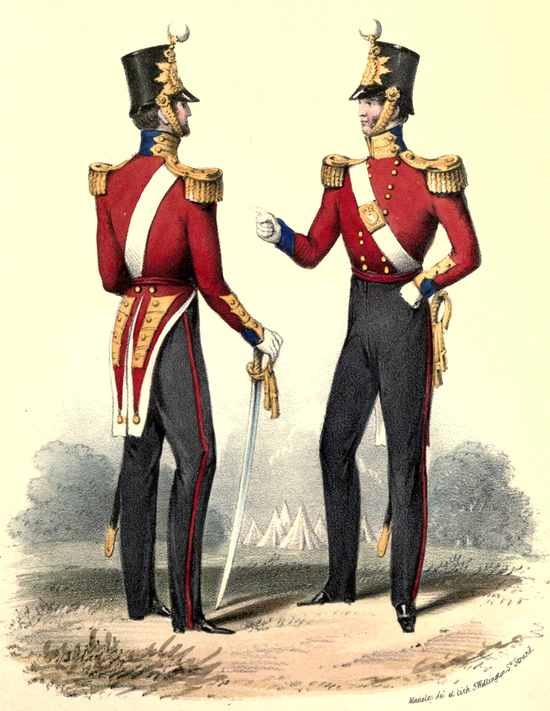
Madeley lith 3 Wellington St Strand
FOR CANNON'S MILITARY RECORDS.